PREFACE
The 2000 millennial year title of the 64 Essays was The Ultimate Personal Survival Guide. It came from a brainstorming session with a business consultant for marketing The Common Sense Book of Change. She was unfamiliar with the I Ching.
We went back and forth with questions and answers about its use and value. Finally, she sat back and blinked. “It sounds like the ultimate personal survival guide,” she concluded.
She’d hit the nail right on the head. She got it!
However, before she drew me out with her questions, I’d taken my answers to her valid concerns for granted. Others were likely to have similar doubts.
So a further step was necessary. A follow-up book was required, one which would lead others to draw the same conclusion that she did. It had to dispel myths and misconceptions which prevent this gravely misunderstood and underrated treasure from getting the international acceptance it so richly deserves.
I’d become certain that the worldwide leadership deficit (and related budget deficits) are explained by an underlying knowledge deficit. For lack of what The Book of Change has to offer, people everywhere remain perplexed as to how and why so much continues to go so horribly wrong, even despite the best of intentions.
It seemed urgent to clear the decks. Making this compendium of Natural Law — the premier leadership training and decision-making manual in China for thousands of years — widely accessible now to fill in this fatal knowledge gap.
Mainstreaming this vitally important information is the first, necessary step towards the positive change which many call for, but remain unable to achieve.
Fourteen years later [now 24], I find myself in the same predicament. How does one shake up the sleeping public? What will it take to make people worldwide aware of how important this information is, and how gravely we’re at risk due to its absence?
As a possible solution, I returned to The UPSG. In the process of updating the Introduction, I had an “Aha” moment.
In the text, I’d made the conscience connection: The I Ching is called The Ultimate Personal Survival Guide because it refers to ULTIMATE timeless wisdom. This wisdom is accessible on a PERSONAL level, facilitating inner and outer change, one person at a time. This change gives us the edge on SURVIVAL, influencing who will survive, how, on which levels of experience. And it’s a GUIDE that helps put us in resonance with the ultimate inner guide — conscience.
Taken out of context, however, the title left The USPG open to misunderstandings. It could be misconstrued as suggesting that the benefits of working with the I Ching come from the book itself. However, no physical book, no matter how inspired or useful, is correctly called an ultimate survival guide. Books are just material things.
Conscience alone is the ultimate survival guide. The value of using The Book of Change is that it leads the individual back to personal conscience. It serves to reconnect the user with the eternal center which resides at the hub of the quantum Life Wheel.
Exactly what is meant here by “conscience?” As with each of the 64 Essay terms, definitions of “conscience” have devolved over time. Here, the word refers to the pristine meaning of the term, associating it with “inner light.”
In I Ching context, Conscience is associated with the innermost center of the quantum Life Wheel. This yoga-compatible model, as detailed in Rethinking Survival and summarized below, layers the variables of Albert Einstein’s famous formula, e = mc2.
Einstein’s view of conscience was consistent with I Ching use. He regarded an enlightened person as one liberated from limiting selfish desires, who has turned instead to aspirations of transcendent value. Einstein described the experience of an “inner voice” that brought him closer to the “secrets of the Old One.”
Essay 12 on Values gives a snapshot glimpse of the word’s appropriate use:
Conscience not only puts us in touch with our own uniqueness; it also connects us with the universal true north principles that create quality of life.
The extraordinary value of the I Ching is that it reveals the secrets of dynamic Natural Law. Working with its changes opens inner access to the middle level of the quantum Life Wheel, the “e” energy layer of Einstein’s Unified Field Theory.
This middle level serves as mediating, two-directional gate-keeper between the ever-changing surface rim and the universal, timeless center. You can’t get from here to there, except through the middle layer which, in Western thinking, is effectively taboo, buried in the inaccessible “unconscious.”
To the extent that Natural Law is a blind spot in the prevailing, linear and exclusively empirical paradigm, we are left powerless to move beyond the surface level of experience. The realm of light and conscience which rests beyond, on the far side of the dynamic energy level, remains functionally inaccessible.
Moral codes promoted by religionists or politicians are sometimes equated with conscience. But they’re no substitute for direct experience. Only by becoming intelligently competent in managing the subtle energies of the middle level is it possible to travel further inwards for the immediate, personal experience of inner light.
When the middle level becomes clogged with painful memories, negative emotions and socially taboo urges, it becomes a barrier to deeper knowing. The Book of Change is indispensable as a tool for restoring the unnecessarily “unconscious” to conscious awareness, so that the levels of human potential can be linked and unified.
In Quantum Paradigm context, survivors who prevail in dangerous times aren’t those with the most material wealth, possessions or political power. They’re the ones who’ve successfully navigated the middle realm, reached the far shore of enlightenment and returned to the surface with their new information intact.
Those who succeed in linking the levels of experience are genius leaders in whatever fields they choose to engage. They’re the fortunate ones who’ve acquired the inner wealth necessary to both hear the inner voice of conscience and act on the guidance they receive.
Q. & A.
As yet, an exclusively materialistic. linear paradigm continues to generate the dysfunctional results experienced in every aspect of personal and public life. The powerful benefits to be gained from shifting to the more inclusive Quantum Paradigm are blocked by so-called authorities and experts who are highly invested in the limited and limiting empirical science paradigm.
The I Ching is misrepresented with numerous assumptions and prejudices which have effectively kept this critically important information in the shadows. Answers to some of the most familiar doubts are listed below:
- Question: What does an ancient book from a foreign land have to do with me, here and now?
- Answer: Everything. As the compendium of Natural Law, the I Ching is neither time nor place-bound. It speaks to the questions we all ask about the human condition. For over 8,000 years, with good reason, it has endured as the foundation of Chinese healing, governing and military arts alike. No equivalent exists in the West. It fills a fatal gap in the way we think.
- Question: If it’s so important, why isn’t it taught in schools?
- Answer: Good question! Probably because the objections raised here are taught as assumptions instead.
- Question: Isn’t the Book of Change unscientific – just hocus pocus or New Age superstition?
- Answer: Like any other wisdom tradition that has endured over time, the I Ching has inevitably been subject to misuse. This doesn’t, however, reflect on its inherent value. This compendium of Natural Law is so highly sophisticated, in fact, that Western science is just beginning to catch up with it. For example, in the 1800s, Leibniz acknowledged that its mathematical foundations long preceded his calculus. The single and broken lines of the hexagrams are analogous to binary-digital computer code. Further, as described elsewhere, its 64 hexagrams are analogous to DNA structure.
- Question: Is the I Ching a sacred book, like the Bible? Is it part of a religion?
- Answer: Yes and no. Taoists, Buddhists, and Confucians, despite their differences, all hold the I Ching in highest regard. It is used to connect with deity, on the one hand, and consulted for practical advice regarding every aspect of daily life, on the other. Sacred is in the eye of the beholder.
- Question: Is The Book of Change pagan and therefore off-limits to Christians? Does it contradict or oppose the teachings of the Old and New Testaments?
- Answer: There is no conflict. Natural and Divine law are two different but interdependent levels of the quantum Life Wheel. Pagans by-pass Divine law, choosing to worship nature instead. In contrast, sages observe and work with the laws of nature, the better to serve humanity by serving the divine. Both the Old and New Testaments show an understanding of nature which is compatible with the I Ching worldview.
- Question: Can the I Ching be fully understood or appreciated without knowledge of the Chinese language?
- Answer: Hindu’s have a similar attachment to the exclusive value of the Sanskrit language, Jews to ancient Hebrew, and Muslims to the original language of the Koran. However, the Source of truth is beyond language. Its cultural expression at a particular time and place varies, but the basic essentials are necessarily the same. As translations into English and other languages continue to improve, this will become increasingly apparent.
What is the I Ching?
The Book of Change is a text that consists of 64 interactive, six-lined graphs — hexagrams — placed within the matrix of a circle, a square, or both. In combination, they map of the Natural Laws of change. Each graph is assigned a name represented by a Chinese pictograph. Translations are comparable to Plato’s perfect Ideas.
The 64 hexagrams represent the bare bones of the life process. They are to Natural Law what basic axioms are to geometry. The open and closed lines the hexagrams are a convenient shorthand used to represent alternating energy valances. A broken line stands for negative (yin) energy (chi). A solid line stands for positive (yang) energy.
For example, the hexagram for Awareness, looks like this:
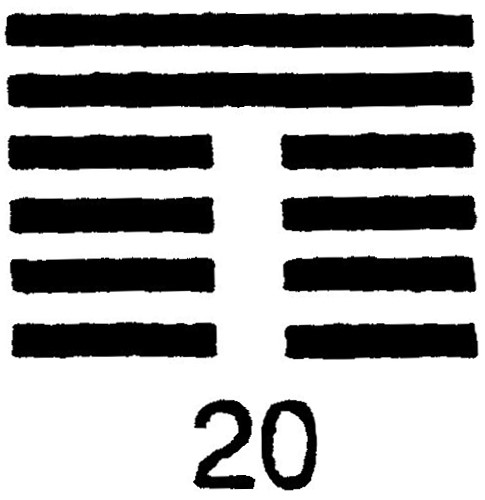
Each hexagram is like the common denominator of a math equation. Each reduces expanded, complex relationships back to their most simple, recognizable form. No matter how complex or convoluted specific variations on the basic themes become, all experience can be reduced back to these fundamental dynamics. Over time, meanings have been associated with each of the hexagrams. These, in turn, have been elaborated upon by a succession of interpretations.
Because the hexagrams are universal, they can be applied to virtually any discipline. For example, one version of I Ching correlates the hexagrams with DNA discoveries. There’s a medical diagnostic version. Da Liu correlates his 64-form practice of healing tai chi with the 64 hexagrams of the I Ching. Another version applies the readings to Jungian psychology. A constitutional law professor at Yale University has published a commendable version. Yet another correlates the hexagrams with meditative Taoist practices. Other versions reflect on the order of family and social relationships, on successful business practices, and on the conduct of war.
The basic readings are descriptive and informational only. There is no moralistic or prescriptive bent. The content is observational and practical: If this, then that. For example, if one squanders resources during times of prosperity, then times of adversity will follow. If one is respectful towards others, then they will be moved to behave respectfully in return.
Using the interactive Book of Change is a powerful way to get in touch with the native common sense (conscience) we’re all born with, but too often forget under the pressures of hectic daily life. It is used first to increase self-understanding, then to create harmony between the inner world of self and outer world of others.
There are many ways to select the relevant hexagram. All involve approaching the book with a quiet, open mind, analyzing the current situation, framing a question regarding that situation and then finding its answer. These methods are described in The Common Sense Book of Change.
Whichever method is used, it yields a hexagram which represents the immediate moment. Each hexagram, however, has the potential to mutate. This is because any one or any combination of the six lines can change into its opposite. This produces one or more new hexagrams.
The “direction of change” reading associated with the mutating line(s) indicate which level(s) are kinetically active and what the possible consequences could be. This information is regarded as a warning, which heeded, may influence future results.
The correlation between actions and predictable consequences is called the Law of Karma. In biblical terms, this law is expressed as the familiar warning, “As ye sow, so shall ye reap.” It is the practical basis of ethics. It underscores the wisdom of the advice, “Do unto others as you would have them do unto you.” Because actions do, in fact, inevitably return in kind.
Among other things, the I Ching works like a cosmic clock, telling us the time. In the Old Testament, King Solomon expressed the natural, rhythmic alternations of time in poetic form:
To every thing there is a season, and a time to every purpose under heaven:
A time to be born, and a time to die;
a time to plant and a time to pluck up that which is planted.
A time to kill, and a time to heal; a time to break down and a time to build up;
A time to weep, and a time to laugh; a time to mourn and a time to dance;
A time to cast away stones and a time to gather stones together;
A time to embrace, and a time to refrain from embracing;
A time to get and a time to lose; a time to keep, and a time to cast away;
A time to rend, and a time to sew; a time to keep silence and a time to speak;
A time to love, and a time to hate; a time of war, and a time of peace.
Working with the Book of Change puts its users in touch with these pulsating, alternating rhythms of life. It connects them with inner knowing – call it intuition or conscience – that anticipates approaching changes, the better to prepare for what is to come. It serves as a reminder that our lives change like nature’s seasons. Fall follows summer. Spring follows winter. It lends perspective to the current times and what is likely to come next.
Historically, the I Ching has been held in the highest regard throughout Asia for over eight-thousand years. Its cultural influence has been roughly equivalent to that of the Bible in the West. Leaders in philosophy, religion, healing, government, business, martial arts and the military were all trained from this single, universal text. It is still widely accepted as the basic manual of relationship dynamics and effective decision-making.
How to Approach the I Ching
The I Ching offers a comprehensive understanding of how the world works. It doesn’t, however, fit neatly into the usual book categories. It can be approached as an historical document or philosophical tract, but is far more than that. It can be used as a self-help book, but is more than that too.
Above all, it’s a practical decision-making tool based on a comprehensive science. It challenges us to jump outside the narrow boxes within which we’ve been taught to reason, to qualitatively change the way we think.
The method of working with the I Ching requires stilling the mind and entering the receptive, meditative state in which inspirational thoughts become available. As such, it is an invaluable compliment to the practice of any religion.
Why Use the I Ching?
In an age of ever-accelerating, sometimes bewildering change, working with the I Ching helps its users remain focused on the basics. Ephemerals on the surface of the quantum Life Wheel inevitably pass away. Social customs continue to change. Old friends move on or prove fickle. Jobs disappear without warning. Fortunes are lost over night. Buildings are blown out of the skyline.
Loved ones leave or pass away. If we neglect ourselves long enough, even health becomes precarious.
The more chaotic the uncertain world becomes on the surface, the more personal balance depends upon the opposite and equal anchor of inner strength, accessed with the help of timeless wisdom. The I Ching serves to remind us of the constant within change. It grounds us in unchanging reality, the better to sustain the courage and confidence required to endure and prevail during tough times.
Working with the I Ching gradually changes the way we think, intentionally linking the levels of experience. It disciplines us to ask better questions and to be receptive to answers which extend beyond the parameters of empirical science.
The I Ching advises, “It is futile to hunt for deer in a forest where none dwell.” Issues which can’t be solved with rational logic, money, mechanical engineering or brute force, soften and open in the light of inner wisdom.
As such, The Book of Change is an invaluable life companion for everyone facing ongoing personal changes in a rapidly changing world. Its premise is the assurance that even when social, economic and political chaos seems staggering, taken one instance at a time, there’s always hope.
The world at large is an unmanageable unit. But by focusing on the smallest unit closest to home, oneself, one needn’t be overwhelmed or paralyzed. Whereas forcing change on others is a violation of free will, one can always — especially with the aid of wisdom tools like the I Ching — change oneself.
The important first change is not image or behavior, but more fundamentally, one’s vision of life’s potentials and the way to transform from within. The rest follows. It is, after all, possible to change the hearts and minds of others through one’s example. Perfected, one individual’s life can have a ripple effect that emanates outwards in all directions across the boundaries of time and space. Buddha and Christ both demonstrated this.
Who Benefits from working with the I Ching?
Natural Law is written in our hearts, in our very DNA. It is equally available to everyone with open ears and a ready willingness to hear. Those able to think with uncluttered, childlike simplicity resonate most easily with the I Ching call to conscience.
Often, individuals at a cross-roads in life, where they suddenly find themselves in unfamiliar territory or it seems as if they have nothing to loose, take new interest in a book that helps them navigate life’s passages with dignity and grace.
Importantly, the Book of Change isn’t the exclusive property of highly-educated people, nor of a particular gender, age-group, culture, class, time or place. It’s an indispensable basic, a valuable teacher to everyone who chooses to make themselves whole.
A caveat: it’s not those who understand, but those who also follow through who benefit most from the value The Book of Change has to offer. Its concepts may be relatively easy to comprehend. But they’re not always easy to put into practice.
Working with the 64 hexagrams of the I Ching requires the time to pause and reflect. It’s not like fast food that can be taken in at one gulp and then forgotten.
But it nourishes on many levels. Its benefits are cumulative and enduring. Returns on the investment of time and effort made are exponential.
Over time, I’ve come to understand that the I Ching’s value is measured by the quality of focused attention, self-honesty and positive intention with which it’s used. Those who dismiss it, who “believe” it is superstitious nonsense, fulfill their expectations. As such, this vastly powerful book has its own fail safes.
Context
In Rethinking Survival, discrimination, violence and sexual abuse are linked to an information deficit. The Natural Law codified in the Book of Change:
. . . fills in an information gap. It’s the missing link in our knowledge banks. In a complete worldview, the dynamic law of change occupies the middle level. It links the outer material surface with the innermost center. You “can’t get from here to there” except through that middle layer.
This explains why many leaders, even with the best of intentions, go terribly wrong. When authorities operate from an incomplete paradigm, they’re blind-sided. Lacking what has been mainstreamed as “emotional intelligence,” they can’t identify the place where things are messed up. When they take a left-hand turn, they don’t understand why. Worse, they don’t know how to return to the positive path.
Here’s the context: Laws of nature emanate from the Divine. It’s a mistake to romanticize (or demonize) nature. It’s a worse mistake to worship nature in place of the Creator. But being competent at the practical, middle (energy) level of three-part experience is essential to the whole. Again, it’s a sorely missed link in our functional knowledge base.
The “subtle” energy realm lies between the outer, surface level of matter and the deepest center of unchanging stillness. As the functional link between extremes, both on the out-going and the in-going paths, it serves as the unavoidable gatekeeper and mediator between the two. “You can’t get from here to there,” except through this middle level of experience.
Without wisdom and skill at this middle level of experience, spiritual aspirations cannot be realized nor can political policies be effectively implemented. Ongoing sex scandals which plague high-level politicians and clergy give a hint of what’s missing from their training, causing them to fail miserably at great expense to those they claim to serve.
Using a well-familiar example from American history, here’s how I expressed the place of Natural Law in the Introduction to The Common Sense Book of Change:
THREE LEVELS OF LAW. The American Declaration of Independence names three kinds of law: the laws of man, of nature and nature’s God. The Book of Change is based on the laws of natural change. They emanate from and depend on divine law and serve as the rightful foundation of civil law. Clearly, laws legislated in ignorance of or in opposition to natural and divine law are not likely to work out well. Policy makers at all levels would do well to give this point careful thought.
In Common Sense, Thomas Paine wrote about the relationship of divine, natural and human law in a way that inspired readers at the time of the American Revolution to fight for freedom from tyranny. Approaching natural law from the deeper understanding of the ancients could inspire a reinvention of democracy now.
Sages say that freedom from tyranny begins with dispelling ignorance and overcoming negative emotions. True freedom starts with the self-awareness and self-mastery which can be gained by diligent use of the I Ching.
I had this in mind when critiquing Affirmative Action, and in formulating Positive Action alternatives to achieve the valid goals of misguided legislation bound to trigger backlash.
Overcoming Fear of Change
Lacking the balancing anchor of that which is beyond change — that which puts short-term change in perspective — people stuck on the surface of the Life Wheel become fearfully addicted to the familiar.
But resisting change doesn’t prevent it from occurring. It only leaves the fearful unprepared to meet change when it inevitably arrives. They’re perpetually behind the eight-ball, left out of “luck,” a day late and a dollar short.
Addressing unnecessary fear was a large part of my incentive for bringing the Quantum Paradigm to the public. It speaks to those who struggle in dark, doing best they know how as they continue to live lives of “quiet desperation.”
They intuitively know, as I did earlier, that somewhere somehow something is terribly wrong. But they too don’t know where to look, or what to fight.
They feed insatiable appetite with all the wrong foods. They take vacations to escape from angst, but in the wrong directions, and wake up afterwards, hung over and broke. They hunger and thirst, but things of the world do not satisfy.
27. GROWTH
People seek help according to what they need for their own growth.
Unless hunger is fed with the right food, no amount of input will satisfy.
To understand others, watch how they nourish themselves. Nature provides for all.
Leaders promote those who have the ability to serve many. Avoid greed.
Conclusion
Although The Book of Change is held in highest esteem by philosophers of every nationality, as well as the followers of the world’s enduring religions, the I Ching is not a religion. It is a map, expressed in binary mathematical code, of Natural Law. It explains not only the observable patterns of natural events, but also repeating cycles of dynamic personal life, social systems and nations throughout history.
In its essence, the perennial Book of Change is timeless. It continues to help thoughtful users tap into the source of universal wisdom which all enduring spiritual, religious and healing traditions share in common. It resonates with a fundamental inner core of experience which, despite apparent diversity, all truth traditions share in common. It therefore has the potential to link people of good will across the globe with a basis of shared understanding.
Whether the context be therapy, spiritual practice, personal introspection, or practical decision-making, working with the Book of Change is the quintessential method for cultivating mindfulness and self-awareness. It enables users to move beyond the theory of their personal philosophy and into its practical applications in positive action.
As such, this book which touches the heart of all religions, is the universal key sought by religious scholars. It embodies The Perennial Philosophy of Aldous Huxley, the common thread which links all human experience.

 Rethinking Survival