Monthly Archives: July 2024

Go with the Flow of the Future

In a Next Level Soul Podcast, host Alex Farrari speaks with Craig Hamilton-Parker: UK’s MOST ACCURATE Psychic PREDICTS Future of the USA/Europe! BRACE YOURSELF.

The contents of this conversation bear striking resemblance to that of The Quantum Solution: What the Ancients Knew About Our POSSIBLE Future. It’s almost as if Craig foresees the emergence of the Quantum Paradigm embodied in the archetypal Life Wheel — creating a readiness for the book.

Craig describes the current times as being the emergence from the darkness of the Kali Yuga. We’re going through a challenging but hopeful paradigm shift that, in the long run, will reset the historical clock as citizens of Earth establish the planet’s place among its intergalactic neighbors.

Alex and Craig agree from personal experience that times of major transition are often unnecessarily painful, primarily because of fear and resistance brought to immanent change, no matter how necessary or ultimately beneficial. Fear, however, invites danger. And resistance, ultimately, is futile. Going with the flow rather than exhausting one’s energies in upstream resistance allows for the possibility of steering the ship as it flows downstream.

They agree that an optimal response to change requires fearlessness . . . having faced and overcome culturally conditioned, unnatural fear of death. Near death experiences are one way that the illusion of extinction is dispelled. Spiritual beliefs fortify inner strength and faith when facing unknowns.


Craig Hamilton-Parker: I feel that something’s going to happen. There’s going to be something huge in the world that’s going to happen on a spiritual level. I don’t think of it as a second-coming type of thing. I see it as multiple people incarnating in the world simultaneously in a way that would change everything. 

I believe it’s on its way. It might even be here already. But I have a very very strong feeling about this. This will bridge the terrible crisis we are in at the moment — a crisis of not knowing who we are. A crisis of weakness that comes through endless looking at screens and internets. A loss of our sense of personal identity or loss of sense of national identities and undermining by so many negative forces. 

We’ve got to pull ourselves out of it. All the great flowerings in history when there’s been a spiritual awakening have been at times like this, when there’s been a sense of something that’s not quite right. Buddhism came when Hinduism was in a terrible state and there was conflict within India. Jesus came in at the beginning of the fall of the Roman Empire. 

If you look at any great flowering of awakening, it always comes at a time of great difficulty. This is the darkness before the dawn. Out of this time is going to come something very very special. It’s going to be a superb time to live in.

, , , we’ve got to start thinking more in terms of humanity [not just “What’s in it for me?”]. If there is a renaissance of consciousness and renaissance of the arts which often comes with a renaissance of consciousness — many of these problems will be easily solved because more and more people will be thinking in a different way.

. . . First and foremost, seek first the kingdom of heaven and all else will be added on to it. As another way of looking at it, when we put our spiritual awakening at the top of the agenda, it compels us to want to help others. And being compelled to want to help others, we also influence society. 

——————-

Craig Hamilton-Parker: There’s been so much complacency. So much division. So much lack of cultural identity. There’s been huge shifts to the right wing in Italy. There’s a reaction against a lot of immigration coming into countries. Huge amounts, that so that people can’t integrate. So you get multiple societies within the society. We start to get ghettos again. 

So I think the big question that we’re all going to have for the future is How Can We Find Unity Within Diversity? We have new peoples in our countries. We have divisions of thought between countries. There’s going to be these divisions. And it’s really important that we find some way of finding Unity in Diversity.

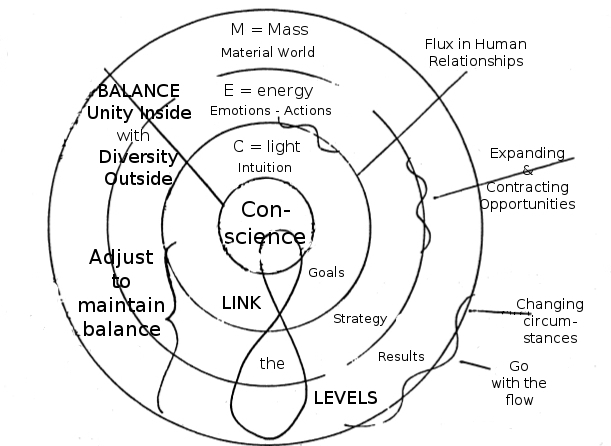
[Here is one of numerous variations on the quantum Life Wheel depicting Unity at the central hub of the wheel with spokes radiating out in all directions, manifesting diversity on the ephemeral surface.]
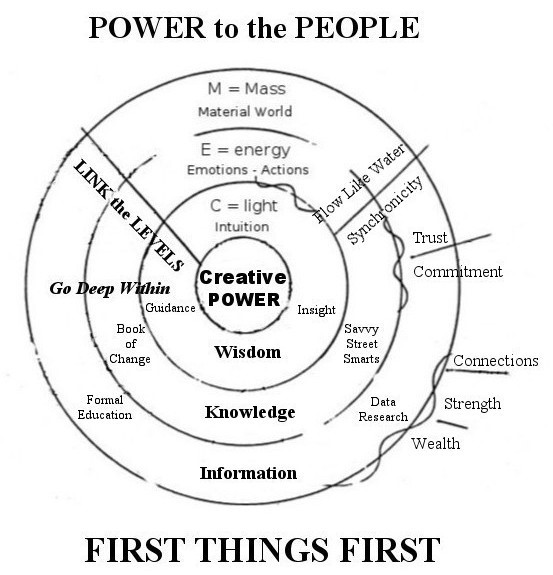
We’ve got to start looking for our commonalities. We’ve got to start looking for what is it that makes us all human. We’ve got to start thinking, we’re spirits in body. That’s it. We’re all spirit. We’re all the same. So the answer has to come from a spiritual standpoint. The only way we can bridge these things is through spirituality. 


Craig Hamilton-Parker: It’s going to be a struggle. And it’s how we approach it, isn’t it. It’s how we live it. I think the big mistake we make – we’ve got to live from the inside out, not the outside in. 

We’re all living our lives as if that’s where it is — it’s out there [on the surface of the quantum Life Wheel]. My happiness is out there. My love is out there. My people I want — everything’s out there. That’s where we’ve fallen victim.  

If we can live from the inside, we’re balanced within ourselves. We’re centered within ourselves. We’re at peace within ourselves. We’re happy and content within ourselves. Then all the things in the outside aren’t going to draw us out quite so much. We’re not going to fall victim to illusion all the time. 

So we’ve got to live from the inside. If each person can do that, then you’ll walk through this life in safety. 

. . . keep the attention on yourself, on the spirit, on the inner self, on the goodness within you, on the love that you can give to the world. Think what you can do for it. When more of us become focused like that — and you don’t need many — it changes the balance of everything.


Craig Hamilton-Parker: I think we will rethink money and work. It could be within the next ten years that we see a big reversal of things and a scramble to get things right again. These changes often can lead to something better. We have to go through rebirths all the time [the Phoenix Response]. 

People say, “We’re not going to make it.” But we’ve survived ice ages. We’ve survived the dinosaurs. We’ve evolved more than most creatures on earth. We’ve managed to do it in the past. I’m sure we’ll do it again. 

Consciousness is something special. Consciousness is not something held in the body. This whole universe is here for this. This is what it’s all about. Consciousness is the most important thing in the universe.  

And consciousness is not going to be wiped out. So humanity or some form of consciousness will continue. Consciousness will survive. And that’s what it’s all about — to create a being that can house consciousness. So it can’t go wrong. Ultimately, we can’t fail.


Craig Hamilton-Parker: I think there’s a lack of direction and a lack of national identity. That’s why you do need somebody like Trump, albeit somebody that’s a bit suspect. You need someone who gets people focused again. Europe’s got exactly the same problem. UK’s got it. All around the world, we’ve got exactly the same problems with people having this loss of faith in oneself. 

I think we will pull together again. I don’t think America’s going to fall into decline. America was founded on spiritual values. I’m born in Southampton and the Mayflower sailed from Southampton into Plymouth and then to America. The Pilgrim fathers and the rest went into America to set up a new spiritual country.  

And I think that foundation — actually from the seeds — America will be spiritual again. I think America’s just lost its way at the moment. It’s lost its sense of purpose because it got lost in materialism. Like the rest of the world, we all got lost in this plastic world we’ve created. This lazy world we’ve created. Now with AI as well, where human intelligence becomes less important. 

We’ve got to get back to basics. Yogananda had it right when he said that America in the future will become decentralized. It will become smaller communities. The big cities will become less important. People will get back to the land. 

We have gotten too centralized. We don’t necessarily need to be so. We can still be a unified country, but in a different way. When we get a spiritual awakening again, places like America will come back into harmony. It won’t break up into multiple countries, like will happen in China, reverting back to the way it was centuries ago. 

I think America will remain as One. America will continue. America will continue to be first in the world and be one of the policemen of the world. It will be the leading democratic country of the world. We’ll do it.

—————-

Craig Hamilton-Parker: No matter how bad it gets, we’ll get through it. There will be some bad stuff ahead. It will be something like an earth shift or a meteorite. We’ll have some dramatic thing that will make us all sit up and take notice. 

The only way we can solve the big problems in the world is when we work together. And by having these big problems — the reason they’re there — is to make us work together. Individually, if you get complacent, life comes along and gives you a kick. If as a world we get complacent, something could come along and give us a kick. It’s a compassionate kick because it’s a kick to get us back on the path to awakening. 

 Alex Farrari: I have heard that within the rest of this year and going into the next couple years, there’s going to be an event — a natural or possibly economic event, a battle or a war, that’s going to cross the line and galvanize us. Something that pushes us in into this new era.  I joke, it’s like the movie, Independence Day. Aliens park right in front of the White House lawn and everyone goes, “Wait a minute. We’re all humans. We have a common foe.” Where we all choose, “We’ve been down this road before. But NOT again.

—————–

Alex Farrari: You mentioned the galactic scenario in regards to creatures on other planets or beings on other planets. I found that that as I went deeper down the Eastern philosophies, the Eastern teachings like Yogananda, Babaji — that whole lineage. Those worlds are known and have been known for thousands of years. The Bhagavata Gita. Otherworldly blue avatar people that decided to show up. It’s part of their culture, the beings from another planets or beings from another part of the universe. 

We in the West are honestly starting to open up to that idea a lot more, with the UAF’s now and the government coming out here in the States. “Hey man, there’s something going on.” I’d love to hear your point of view on that from a spiritual place. How do you think that’s going to impact humanity’s consciousness as we get closer and closer to that awareness? 

Craig Hamilton-Parker:  I really do believe that we’re going through tough times. Anybody would look at the politics and the wars in the world and see we’re coming out of the darker age. But as we come out of the darker age, we enter into a new form of consciousness and this is where there’s hope.

As we come out of that darker age and into an age of greater understanding and awakening, we start to realize that our thoughts are not limited to our own heads. When you feed telepathy, thoughts have wings. They go out and they can connect, speak. But also thoughts can influence the whole world around us. They can influence events that happen to us. They can influence the karma that’s in our life. Good thoughts can open up wonderful things in our life. 

But also, those thoughts can connect with other people’s thoughts. We’re in an Internet. It’s a spiritual Internet. We’re in a mycelium that connects all throughout the whole universe. Beings in different worlds can connect with this world.  

What Unity IS & Isn’t

Interesting, isn’t it.

At a time marked by fragmenting beliefs, polarizing politics, and irrational violence, people across the board increasingly crave what we all seem to most lack: UNITY, both within and without.

Tapping into this deeply felt common need, politicians of every stripe are joining the national call for UNITY.

If only we understood what the word from its deepest, pristine origins really means, and were in agreement in a vision as to how it might play out in our day-to-day lives.

Aye. There’s the rub.

The English language has devolved to such an extent that value words are very often defined both as one thing and its exact opposite. All too often when we speak, we miss each other coming and going, not even recognizing the disconnect. I’ve called this The Tower of Babel Dilemma.

To remedy it, in part, I wrote a series of 64 essays, each focused on a commonly used value word, intending to restore a common understanding regarding its correct use. As an example, Essay 60. Unity is attached to the end of this post.

A recent, uniquely excellent expression of true UNITY was written by Melania Trump immediately after the assassination attempt on her husband’s life. At the Republication convention, he thanked his wife for her “beautiful letter calling for national unity.” It reads in pertinent part:

Melania Trump. July 14, 2024  

We have always been a unique union. America, the fabric of our gentle nation is tattered, but our courage and common sense must ascend and bring us back together as one.  

Let us not forget that differing opinions, policy, and political games are inferior to love.

We all want a world where respect is paramount, family is first, and love transcends. We can realize this world again. Each of us must demand to get it back. We must insist that respect fills the cornerstone of our relationships again.  

Just prior to the Republican convention, because he’d been informed that it would be the subject of Trump’s acceptance speech, in One America film maker Dinesh D’Souza addressed the emerging theme of national unity.

I quote him here at length, edited only for grammar, because the point and its illustrators are so important:

The point I want to make here is, when we talk about unity, what do we actually mean by unity? Does it mean, first of all talking about the Republican Party, that we’re going to find a common denominator of every person who has an R after their name and that’s unity? 

No. Republican unity means, by and large, taking the main coalitions or the main constituents of the Republican Party and  . . inspiring them to want to vote Republican. 

But at the same time, you want to frame your message in such a way that you attract Independents. You also lure some Democrats. 

Unity is never a matter — and I think Trump understands this very well (we’ll find out when we watch his speech when he gives it later this week) that unity doesn’t mean finding the people who want to destroy you and frankly, the people who want to destroy the country, and unifying with them. Because our agenda and their agenda are incompatible. 

. . . even in the Reagan era, the Reagan agenda and the Carter agenda or the Reagan and the Mondale agendas were incompatible. At that point, by and large, debates were not over ends. They were over means. 

Now the left and the right disagree over ends — not just means. That means MAGA has got to be interpreted not as unifying the country per se, but unifying the country against the left [including their globalist agenda].  

This is the key. 

Let’s go back to Abraham Lincoln for a moment. Lincoln understood that bringing the country together doesn’t mean finding a new consensus in which the slave master and the Republicans sit down and “iron out” their differences. Lincoln understood that unifying the country is unifying the country on a consensus that slavery shall not be allowed to spread. That was the Republican platform. Lincoln was willing to compromise up to that point, but no further. He was implacable beyond that. 

This is important to realize in any kind of compromise. This is also true of normal negotiations. You go, “Okay. I’m going to ask for X. I’ll be willing to settle for Y. But I’m not willing to settle for anything below Y.”  You draw the line. 

The meeting of the minds is over that basic starting point: the point that Republicans do seek unity, but not unity at any price. And not a weak unity that finds the lowest common denominator. But to unify over the core principles that will save America. Frame those principles in as broad and charitable way as you can. 

. . . the job of the Republicans here is to reframe that consensus.

Trump’s VP pick, J.D. Vance, demonstrates that he understands these core principles in a deep, profound way. And, perhaps in a more grounded way than most, he appreciates Trump’s style, articulating the middle path of compassionate unity within the party.

For example, at the Faith and Freedom Coalition breakfast in Milwaukee, J.D. Vance gave us a glimpse into his way of thinking:

. . . when I talk about [Donald Trump’s] uniqueness in politics, I think one of the great virtues of his approach to politics — that his critics will slander in every which way. . . but President Trump is uniquely capable and aware of politics being the art of the possible. What can we accomplish in the here and now? How do we advance the ball one yard, before we advance it ten yards, before we advance it to a touchdown. 

So I’d ask my social conservative friends, as you see the administration unfold, as you see the campaign unfold, remember that this is a guy who delivered for social conservatives more than any president in my 39 years of life.

I think he deserves a little bit of grace. He deserves a little bit of trust. And I hope that we will all provide that to him. I certainly know that as his running mate, I will. 

———

For the sake of the nation’s survival, I dearly hope citizens across the board will start to think and choose to act in terms of the unifying core principles that define America, in stark contrast to the drastically incompatible agenda of the leftists and their destructive, globalist ends.

To this point, in various interviews, Jordan Peterson holds forth on Trump’s psychology and why he drives liberal elites crazy. His flamboyant, often unpredictable style is chief among complaints. Many think he acts like a bully.

But Peterson is quick to add, Yes. “Trump has proclivity to bully. He does so effectively and sometimes very usefully.” Yes. In the company of international leaders, each of whom is a bully, he speaks their language, necessarily. . . and fluently. 

But as Piers Morgan insists, Trump is “multifaceted.” This illustrates J.D. Vance’s point. Trump uniquely understands the art of the possible. He speaks the language of business to business leaders. And compassionate love of family to ordinary Americans, for example to the Gold Star parents of children lost in the Afghanistan withdrawal.

He’s more skilled than most in the art of optics. Put in biblical terms, “For everything there is a season. And time for every purpose under heaven.”

Essay 60. UNITY

An individual has not started living until he can rise above the narrow confines of his individualistic concerns to the broader concerns of all humanity. — Martin Luther King, Jr.,
The Words of Martin Luther King, Jr.

—–

The scientist or the artist takes two facts or experiences which we separate; he finds in them a likeness which had not been seen before: and he creates a unity by showing the likeness. . . . All science is the search for unity in hidden likenesses. — Jacob Bronowski, quoted by Todd Siler in Think Like a Genius

—–

I have always felt that one of the simplest and most apt metaphors for an organization as complex as the United Nations is the Rorschach inkblot test. What one person sees as the hope of a world free of war, famine, poverty, and disease, another interprets as a global boondoggle comprised of uncaring civil servants threatening the cherished concept of state sovereignty. — James Holtje, Divided It Stands: Can the United Nations Work

————

THE FRONT

The Latin root of unity means oneness.

Webster’s first definition is the state of being one, or united; oneness, singleness.

— It means something complete in itself, single, or separate.

— It can be the quality of being one in spirit, sentiment, purpose; harmony, agreement or concord.

— It can also mean uniformity.

— It can refer to an arrangement of parts or material in a work of art or literature that will produce a single, harmonious effect.

— It can refer to constancy, continuity, or fixity of purpose or action.

The difference amongst these definitions reflects a general cultural confusion as to the optimal relationship of the individual to the levels of the Life Wheel, including society, nature, inner life, and Creator Source. Effective, consistent action depends upon an integrated concept of self and a comfortable relationship of each level and part within the whole.

Therefore, thinking carefully about what unity means — as well as what it doesn’t — is a necessary prelude to ultimate success in life.

Accepting the I Ching view that accomplishments begin with the smallest unit, unity is first to be attained within. It’s common to say, “My mind’s not made up” or “Get it together.” The familiar saying, “The right hand doesn’t know what the left is doing,” could also be phrased, “The left brain doesn’t know what the right brain is doing.”

When Westerns say, “I’m of two minds on this,” it reflects confusion, ambivalence or lack of discipline. However, the martial arts advice to have eight brains and eight hearts refers to the height of attainment. It suggests ability to intentionally shift internal gears to meet any situation. From the totality of unified mind, the ideal I Ching master focuses from above while acting through each of the energy centers according the immediate need at the time.

The motive, the “why” of psychologies and meditative practices is the same: to unify fragmented, antagonistic functions of mind, personality and behavior. The purpose, the “what” they plan to accomplish, ranges from personal self-mastery to inner peace and/or functional relationships. The intent, the “how,” is diverse. Some practices start from the outside with behavior and work in. Others start with the mind, ideas and attitudes, and work outwards. Still others work on both simultaneously, which is possible in communities where work and self-awareness training go hand in glove.

External diversity complements inner unity. The core of life’s concentric circles, like the hub of a wheel, remains still as the outer rim revolves, constantly changing and in motion. Meridians, like spokes of a wheel, link center to surface, connecting and organizing the wheel of life in a dynamic unity.

It hardly matters how the goal of inner unity is attained. Once one is focused and all the facets of inner energy are coordinated by a single-minded purpose, the pieces of life’s mosaic fall into place, forming a coherent picture. Then life becomes a work of art, like a poem or a song.

Albert Einstein –equal parts musician, philosopher, physicist and world citizen — searched lifelong for a unified field theory. The Book of Change embodies the universal code he sought. We’ve failed to recognize the clues hidden for centuries in a venerable text that have the potential to lead us to solutions desperately needed NOW. Restoring this treasure to the general culture would provide a fully functional paradigm from which positive, life-sustaining results can be generated across-the-board.

THE BACK

Regimentation and conformance are perversions of unity. Nature flourishes in diversity. Like snowflakes, each individual is a unique variation of its kind. In contrast, in extreme social contexts, variations are suppressed and punished. While this unnatural state might be appropriate to unnatural situations like war, it’s antithetical to personal well-being.

Technically, because all things are connected, it’s possible to dabble in the dark worlds of demons and departed souls. However, though these realms do exist, it is dangerously unwise to explore them without a specific, positive purpose and a white magician’s protective guidance.

What Has a Front . . .

I want to draw your attention to the timeless Laws of the Universe.

The subject may seem abstract to you, perhaps unrelatable.

But I promise, they have not only a profound affect on your mental health, physical well-being and personal relationships, but also – as I’m focusing on here — they have practical applications to the current election process.

So follow along with me, if you will, to arrive at the destination towards which this metaphysical premise leads.

Let’s start with the Principles of the Order of the Universe. Michio Kushi lists twelve, of which the first six are:

  1. Everything is a differentiation of ONE infinity.
  2. Everything changes.
  3. All antagonisms are complimentary.
  4. There is nothing identical.
  5. What has a front has a back.
  6. The bigger the front, the bigger the back.

Put simply, every coin has two sides.

In I Ching terms, it is a given that extreme yin changes to extreme yang. Extreme yang (strength, virtue) changes to extreme yin (weakness, vice). Thus, for example, a belligerent display of control and dominance often masks the opposite extreme of fragile insecurity. Extreme righteousness has within it the potential for perversion. Conversely, beneath a crusty, harsh exterior may rest an opposite and equally generous heart of gold.

The necessary remedy to misunderstandings, backfires and tragedy is to avoid extremes by respecting, balancing, and harmonizing the energetic valances of yin and yang:

History and literature abound with examples of extreme imbalance. General George S. Patton, for example, comes to mind as a brilliant leader whose personality flaws were the catalyst of his undoing.

Greek tragedies demonstrate the essence of the law in action: hubris. The hero’s greatest strength, ironically, becomes the instrument of his downfall.

Oscar Wilde’s The Picture of Dorian Gray, whose seductively impeccable exterior masked the deeds of a fiendish villain, captures the clash of extremes.

The origins and practical results of this dynamic are described in How Bad People Become Leaders. Long story short, the dilemma is that:

. . . in the prevailing, exclusively materialistic empirical science paradigm, the center is ruled out. Intuition is denied. Emotions and energy aren’t accounted for. All that matters are concrete tangibles and physical image. A leader’s motives and intentions are known only when it’s too late – after the selection has been made and the (sometimes regrettable) results come in.

Literal, empirical standards, judging at face value, fail to account for the universal principle that whatever has a front has a back. Moreover, the larger the front, the larger the back.

A “scientific” leadership selection process takes into account only that which is measurable and/or observable, for example academic IQ or skin color.

Intangibles like the presence or absence of cultivated emotional intelligence (street smarts) fly under the radar, as do ethical intelligence, creativity and a capacity for visionary insight.

When selectors judge only by appearances, it’s easy to deceive them. As Abraham Lincoln said, “You can fool all of the people some of some of the time, and some of the people all of the time.” For an ambitious con artist, those are pretty good odds.

An immediate and important practical example is the flawed selection process (in this case, of a U.S. president) which elected a leader who was, in the extreme, not what he seemed to be, to the detriment . . . even potential undoing . . . of a nation.

In Why Thomas Sowell Doesn’t Think Obama Is A Socialist, we’re told how Obama used executive orders to make end-runs around Congress, landing the nation in a world of hurt. According to Sowell, beneath the front of socialist humanism was the shadow side of outright fascism.

In Dismantling America , Sowell describes how, operating behind the front of a uniter, Obama was, in the extreme, divisive. Pres. Obama Didn’t Believe in the Principles and Values of America – Chief Divider. The result: The Devastating Legacy of Obama’s Presidency – A Point of No Return.

Fast forward to 2024. The U.S. finds itself struggling in the throws of a catastrophic presidency under an incapacitated leader functioning, for all practical purposes, as an Obama surrogate, using the same strategy of issuing executive orders to bypass the powers of Congress to further dismantle the nation.

Right now, it is imperative to recognize the dynamics at play in order to, at all costs, prevent yet another Obama surrogate from being snuck in under the wire at the last moment to replace Biden.

Granted, there are no innocents. To one degree or another, none of the presidential candidates is free from the shadows that lurk behind out-of-balance personas. How could it be otherwise? Our high energy leaders haven’t been trained in the universal principles of the I Ching, or in the ancient energy sciences. They’ve not been taught what their energy truly is, much less how to discipline it, avoid its pitfalls – particularly in terms of sexual behavior, or how to harness energies (one’s own as well as of others) to reach intentional goals. (Vivek Ramaswami, given his background, might be an exception.)

Insightfully, Ramaswami puts his finger on the pulse of current campaign dynamics:

The president really is a symbol: a puppet for a machine underneath it that’s really driving most of the policy decisions. That’s not conspiratorial or accusational. It’s just a descriptive reality of how Washington DC works today. The people we elect to run the government are not the ones actually running the government. Nowhere is that more true than in the case of Joe Biden, who is only in some in nominal sense the president of the United States. I don’t think in any real actual true sense he really is the president.

Which is part of why I’ve long advised . . . that the way that we need to win this election isn’t just by criticizing Biden. Frankly, Biden isn’t going to be the nominee, as I’ve said for the last year and a half.

The way we’re going to actually win not only this election, but revive this country, is by defining who we are and what we stand for. What values are we’re actually advancing?

Amen to that!

In fact, that’s why independent candidate RFK Jr.’s campaign, which intentionally focuses upon American values, is increasingly gaining traction with Americans across a broad political spectrum.

Bottom line: In choosing which candidate to vote for, don’t be distracted by superficial personalities — whether they’re likeable or not. Choose to overlook their inevitable human flaws with compassion. Instead, focus on their declared values, and whether their words are backed by consistent action. Do they intend to revive this country? Are they committed to furthering the well-being of American citizens with positive action?

To avoid tragically putting more bad leaders in place, let’s make demonstrated, sincerely held traditional American values — along with universal human truths — the standard of our selection process.