Monthly Archives: March 2014

Rethinking ACTION

One of the 64 Essays on Change is posted each consecutive Sunday. The choice is decided either by requests made on the Contact Page and/or immediate relevance to current events. See the UPSG Essays page for a description of the structure-within-structure format of the Essays, an overview of CONSCIENCE: Your Ultimate Personal Survival Guide, and an alphabetical list of the Essays from which to choose.

On the new moon of March 9, 2014, the first of the Essays to be posted was Number 61 on PEACE. It was selected as a timely response to events in the Ukraine. The following Sunday, the very first Essay, CRIME, was selected, followed by its companion Essay Number 18 on MOTIVES.

The final Essay, Number 64 has been selected for Sunday, March 30th, the second new moon in the month of March. It completes a triad that started with CRIME, then MOTIVES, and now, consequent ACTION. This Essay has immediate applications to the progression of world events.

Bloggers have likened Putin’s actions to the strategy of Sun Tzu’s Art of War. America’s leaders have been faulted for lacking the ability to think in terms of positive action responses. It therefore behooves everyone, everywhere with an eye to the future, in the interests of human survival, to fill in that void.

globe

64. ACTION

“Military action is important to the nation — it is the ground of death and life, the path of survival and destruction, so it is imperative to examine it. . . The Way means inducing the people to have the same aim as the leadership, so that they will share death and share life, without fear of danger.” — Sun Tzu, The Art of War

“The warrior is always alert. He is always awake. He knows how to focus his mind and his body. He is what the samurai call “mindful.” . . . As a function of his clarity of mind, he is a strategist and a tactician. He can evaluate his circumstances accurately and then adapt himself to the “situation on the ground.” — Moore & Gillette, The Warrior in His Fullness

“We cannot stop the seasons of history, but we can prepare for them. Right now, in 1997, we have eight, ten, perhaps a dozen more years to get ready. Then events will begin to take choices out of our hands. Yes, winter is coming, but our path through the winter is up to us. . . History’s howling storms can bring out the worst and best in a society.” — Strauss & Howe, The Fourth Turning

THE FRONT

Webster’s defines action on a sliding scale of meanings. Taking in the full spectrum as a whole is an eye-opener. Originally it was a physics concept, the state of being in motion. From there the definition changes to habitual conduct characterized by energy and boldness. It changes again to include the effect produced by something (like a drug), or the way organs or machines work.

Action is used to describe the function of a piano or a gun. It shifts to take on the connotation of a legal proceeding by which one seeks to have a wrong put right. It’s the term used to describe military combat. Lastly, in slang it denotes excitement, specifically gambling.

Over a life-time, novelist Earle Stanley Gardner worked to develop a best-seller formula: a virtuous hero whom everyone loves to see in action. The result, Attorney Perry Mason, solves crimes and puts wrongs right in the court of law. He’s a deliberate blending of Robin Hood and Sherlock Holmes. Robin defended the betrayed and down-trodden. He took from the rich to give to the poor, helping them stand against oppressors. Sherlock used his highly trained powers of observation and deduction to trace devious crimes to the unseen hand of the evil Moriarty, then courageously drew the villain out to defeat him.

New law students are often grieved to find reality so far removed from fiction. Just so. Gardner knew people bought his books exactly because they longed for what’s missing in their lives. But fiction soothes without solving. The times call for a multitude of Positive Perrys taking positive action every day, here and now.

Movie action heroes also exemplify the intellect-action blend of leadership we miss. To become a Jedi knight, Luke SkyWalker first must train to attune himself to “the force.” Indiana Jones similarly blends the best of right and left brain worlds. Both he and Nazi opponents search out the arc of the covenant, then the grail. The enemy wants the key to world domination; Indy and his beloved father seek “illumination.” They respect the wisdom of ancient times and adventure to recover lost treasures. The I Ching is another of the ancient lost treasures, both used and abused by seekers through the ages.

Unlike these action heroes, intellectuals who contempt practical people and workers who enviously mistrust the educated are equally lop-sided actors. For positive results, scholars and street-smart frontliners must join ranks. Better still, we should each train ourselves like action hero role models to balance self-awareness and action, to live fully effective, each in our own way.

George S. Patton, the general who defeated Hitler’s army, quoted scriptures like a bishop, knew Shakespeare’s verse by heart.

THE BACK

The opposite of action is inaction. This may be appropriate. Those who patiently wait also serve. Other times it’s due to indifference or paralysis of will. Procrastination, delaying action, may be a result of ambivalence. Lack of commitment or conflicting goals and beliefs often work unconsciously to sabotage consistent action.

A perversion of action is hyperactivity, sometimes the result of a chemical imbalance, other times an effort to avoid thinking. Restricting youthful energies, forcing children to sit too long inactive, can trigger rebellion as an extreme and opposite reaction to boredom.

————

  • Sun Tzu, The Art of War, trans. Thomas Cleary. (Shambhala: Boston, 1988.) p. 41.
  • Robert Moore and Douglas Gillette, “The Warrior in His Fullness,” in The Awakened Warrior: Living with Courage, Compassion & Discipline, ed. Rick Fields. (Putnam’s Sons: New York, 1994.) pp. 29-30.
  • William Strauss & Neil Howe, The Fourth Turning: An American Prophecy. (Broadway Books: New York,1997.) p. 7.

The Positive Paradigm Handbook is Coming SOON

HERE’s a sample from the Coming Positive Paradigm Handbook!

globe

PREFACE

The Positive Paradigm Handbook will change the way you see yourself

and relate to the world – forever.

  • It gives you a functional picture of how your life really works, and by extension, what moves the people around you.

  • It gives you the map for achieving fulfillment, personal happiness and higher love.

  • It give you an instrument with which to effectively organize your personal life, make realistic decisions, and act more effectively to achieve intended results.

  • It gives you premier tools for cultivating self-awareness, making the unconscious conscious, and mapping goals for personal change.

  • It gives you a comprehensive standard for assessing your leadership skills, maximizing this potential, and choosing which leaders to follow.

  • It gives self-healers and therapists a powerful diagnostic tool for identifying the roots of disease-causing stress and correcting lifestyle imbalances.

  • It gives profound insight into the causes of discrimination, sexual abuse and PTSD, as well as how to heal from their effects.

  • It gives everyone a realistic standard for recognizing true friends from mortal enemies.

  • Ultimately, it gives those who follow through the edge on long-term success, tipping the scales of history in favor of human survival, one person at a time.

If these claims sound intense, they are. But they’re well founded.

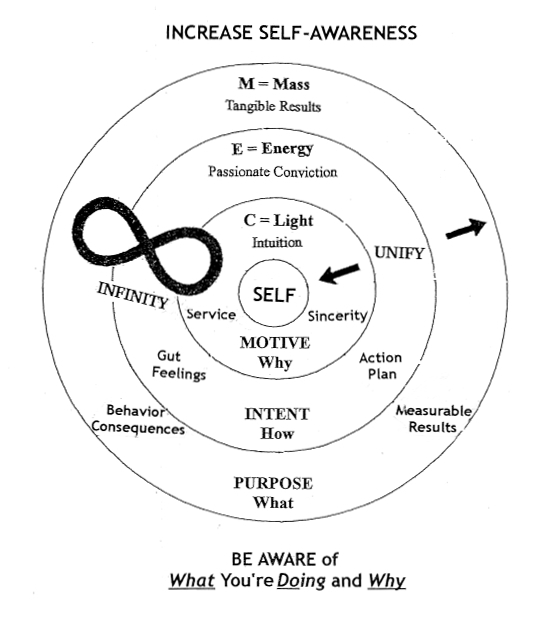
As a teenager, I was fascinated by the fact that Einstein’s abstract formula, e = mc2, could produce powerfully tangible results — the atomic bomb!

Later, I was even more intrigued to discover that this same formula, when plugged into the concentric circles of the Positive Paradigm Wheel, not only resulted in the Unified Theory of Einstein’s lifelong quest. It was capable of generating equally powerful and practical personal results.

The Positive Paradigm Handbook reveals this Unified Theory and supplies the tools needed to start thinking like a genius. By internalizing this method, making it your own by repeated use, your life will be changed in ways only dreamed of before. Virtually endless in its practical applications, it can be pointed like a laser beam to illumine every field of endeavor.

The Handbook is the bare bones take-away from Rethinking Survival. The author’s personal background, academic credentials, research and experience are described in Getting to the Positive Paradigm. But here, what matters is simply that it works and that owning it is a matter of personal survival.

Based on the foundation of the earlier books on change, The Positive Paradigm Handbook goes directly to the heart of personal, practical application, here and now. The purpose of working with the Handbook is to ingrain Einstein’s “substantially new way of thinking,” which, he said, is required “if mankind is to survive.”

In a world seemingly intent on fracturing experience into smaller and smaller niches, the Positive Paradigm provides an urgently needed counter-balance, applying an opposite and equal weight in a unifying direction.

Rethinking MOTIVES

One Essay on Change is posted each consecutive Sunday. The choice of which is decided either by requests made on the Contact Page and/or immediate relevance to current events.

Tonight, 03/23/14, I’m following through on a promise made in answer to the question, “Crime, Is It Natural?” I told Barrister Brendon Moorhouse, a reported Sherlock of the Courtroom, that I’d respond to this important question on this website with my perspective. After all, CRIME just happens the very first of the 64 UPSG Essays. However, I’ve waited until the following week because the companion Essay on Motives speaks more closely to the subject of investigating crimes, white collar as well violent ones.

globe

18. MOTIVES

“Although the feelings mentioned above [sadness, pessimism, guilt, emptiness] may accompany a depressed mood, the most prevalent effects usually involve low energy and lack of motivation. . . An effective way of lifting these moods involves using music to activate our resources.” — John M. Ortiz, The Tao of Music: Sound Psychology

“It occurred to me that the only way to figure out what had happened at a crime scene was to understand what had gone on inside the head of the principal actor in that drama: the offender. And the only way to find that out was to ask him. . . If we could give the law enforcement community some insights into the process, the internal logic, of how violent offenders actually decide to commit crimes and why they come up with their choice of crimes — where the motive comes from — then we could provide a valuable tool in pointing investigators toward what for them must be the ultimate question: Who? Stated as simply as possible: Why? + How? = Who.” John Douglas, The Anatomy of Motive

“On some level, you are meditating all the time. One goal of meditation practice is to become aware of that. Another is to extend that awareness to more and more areas of your life. . . It takes practice and conscious effort to restructure the mind and move it from habitual patterns.” – Andrew Weil, 8 Meditations for Optimum Health

 THE FRONT

The root of motive means to move. Webster’s single definition refers to “some” inner drive, impulse, or intention that causes a person to do something or act in a certain way. It’s an incentive or goal.

Motive, purpose and intent explain human behavior. Unless viewed as a whole, what we see is taken out of context and misunderstood. You see a man take someone else’s car. That’s intent, the what. You see him grab the keys and drive off. That’s purpose, the how. But unless you know his motive, why he did it, the picture is incomplete. Was he desperately racing to save his beloved child’s life, escaping from vengeful gang lords, or simply lusting after a fancy new car?

We’re fascinated by crime. Mystery novels, detective movies and sensational murder stories on TV news are big business. We stretch our minds to second-guess the ending, figure out who committed the crime, and why. We look for the mistakes that reveal dark secrets and lead to the criminal’s undoing. We’re satisfied only when truth is revealed and order is restored by justice.

At heart, what we’re really trying to understand is ourselves. We’re haunted by a pervasive sense of wrongs committed against us, or by us. We can’t quite bring ourselves to recognize what they are, or to admit our own mistakes. But a nagging sense of unfinished business leaks out as voyeurism.

Ultimately, it’s the stifled voice of conscience that persistently calls us back to our neglected dreams and deepest longings for fulfillment. Those who allow themselves to be defined by others, who live in habitual fear of people’s opinions and fail to honor their inner sense of calling commit a soul-searing violence akin to suicide. The crime they commit is against their own true selves.

Failing to be true to oneself can be the hardest crime to detect. Finding one’s true calling can be the greatest mystery of all. People who march to others’ drums, unconscious of their motives and what moves those around them, live in painful confusion. Only those who know how to listen and dance to the inner music of their soul’s desire live in joyful harmony with themselves and the world around them.

 The I Ching is a means for turning the camera around, focusing in on ourselves. Uncovering hidden motives might cause initial discomfort. But it can lead to positive changes. After analyzing them, we have the option to decide on better ways to accomplish intentional ends.

Our what and how isn’t always appropriate to our why. Other solutions may accomplish our goals without committing crimes against ourselves and others.

 THE BACK

The opposite of motive is motiveless, to be without awareness of calling, any conscious purpose, or impulse to action. This condition is sometimes an extreme reaction to an extended period of frenzied, excessive, forced action. People experience it as apathy, shell shock or burn out.

 When crazed criminals go on sprees, kill strangers and wreak havoc on public property, their acts are regarded as random and senseless. To all but the most highly attained, the subtle laws of cause and effect are incomprehensible. There’s wisdom in accepting the unfathomable as Job did, saying, “The Lord giveth, and the Lord taketh away.“

 ————————–

John M. Ortiz, The Tao of Music: Sound Psychology. (Samuel Weiser: ME, 1997.) p. 7.

John Douglas, The Anatomy of Motive. (Scribner: New York, 1999.) pp. 25-26.

Andrew Weil, 8 Meditations for Optimum Health. (audio cassette, Upaya,1997.)

—————————

Illustration from Conscience: Your Ultimate Personal Survival Guide


Aware2

Rethinking CRIME

Today, I’m fulfilling a promise made on a LinkedIn thread in answer to the question, “Crime, Is It Natural?” I responded to look here for my perspective on this very important question. After all, CRIME just happens the very first of the UPSG Essays.

 globe

1. CRIME

 “Our time has committed a fatal error; we believe we can criticize the facts of religion intellectually . . . The gods have become diseases; Zeus no longer rules Olympus but rather the solar plexus, and produces curious specimens for the doctor’s consulting room, or disorders the brains of politicians and journalists who unwittingly let loose psychic epidemics on the world.” — C. G. Jung, The Collected Works of C.G. Jung, Vol. 13.

“Nature itself has a pulse, a rhythmic, wavelike movement between activity and rest . . . We are capable of overriding these natural cycles, but only by summoning the fight-or-flight response and flooding our bodies with stress hormones. We can only push so long without breaking down and burning out.” — Loehr & Schwartz, The Power of Full Engagement

“Your life is created from the inside out, so you must get right with you on the inside — and that takes time and focus on you; not your social mask, but you. . . You are uniquely equipped for a mission in this world, and to fail to commit to finding that mission and then achieving it is to wither the mind, body and spirit.” — Phillip C. McGraw, Self Matters: Creating Your Life from the Inside Out

THE FRONT

Linguistic roots of crime indicate a verdict, an object of reproach, or offense. According to Webster’s, crime is an act which the law prohibits. Conversely, it is failure to act as the law orders. Crimes are variously punishable by death, imprisonment, or the imposition of fines and restrictions.

A second kind of crime is an offense against morality, called sin. More loosely, this word is used to refer to something regrettable. “It’s a crime you didn’t finish school.”

What’s significantly missing from Webster’s definitions is reference to violations of Natural Law. Over millennia, Asian practitioners evolved sophisticated sciences which map the subtle laws of energy movement and study the effects of natural change on human physiology, behavior and institutions. For thousands of years, health sciences, social structures, business practices and the education of monastic, government and military leaders alike were based on this practical understanding of human dynamics.

Westerners, in contrast, have little functional understanding of Natural Law and violate it with impunity. We experience subtle energy shifts as emotional reactions or the erratic ups and downs of daily life. Because Western cultures are historically out-of-tune with energy dynamics at this level of law, it is often referred to as the unconscious. Crimes of passion and self-sabotage are proof of this bind spot.

The focus of Conscience: The Ultimate Personal Survival Guide is the I Ching, the Chinese Book of Change. It embodies a time-tested method for making the unconscious conscious. As the repository of Natural Law, it fills a gap in the way we’ve been taught to think about life.

Restoring its ancient wisdom to current awareness could correct mistakes in the ways we think and therefore act, revitalizing virtually every field of endeavor, from the healing and entertainment arts to the political and social sciences.

In I Ching context, the worst crimes are those we commit against ourselves when we accept and act on limiting suggestions. When we block out the lower octave of sub-rational intelligence (the middle, energy level of the Life Wheel) as if it didn’t exist, we fail to recognize and release the buried fears that sabotage our rational decisions.

When we disown the higher octave of our super-rational awareness, (the Center of the Wheel) we block out intuitive access to the Book of Life, written in our very DNA — the universal source of creative solutions, the means of healing every disease, and hope of ultimate survival.

Those who dismiss, demean or control children with fear condemn them to empty lives of masked conformity on the material surface of the Life Wheel. Instilling extreme ideas about death, as if it were either a reward or ultimate punishment, one’s only hope or worst enemy, results in living inappropriate to reality.

 The more moderate, I Ching view accepts mortality as a natural change. Sages use keen awareness that time on Earth is limited as motivation to live authentic to their true selves, making the best possible use of every precious moment here and now.

To keep people in ignorance, lulling them into inaction by minimizing future dangers or the opportunities inherent in them is irresponsible. To withhold the information we need to be effective in meeting and surviving immanent challenges is most certainly the ultimate crime against humanity.

For a timely wake-up call would serve to shake us out of self-denial and shatter the prisons of narrow thinking. It could rouse the courage to face up to the unknown, to slay the demons that lurk in the sub-rational mind. It might also open us up to our super-rational potentials and the distant calling of eternal life.

 THE BACK

The positive resolution of crime is atonement. In social relationships, it’s accomplished by setting wrongs right. At a personal level, it’s accomplished by returning to a lifestyle compatible with Natural Law. Lat the deepest level, at-one-ment is attained by overcoming separation and restoring one’s original at-one connection with conscience and the creative Source.

The negative consequence of unrepentant wrong doing is punishment. Breaking human laws, as Webster’s enumerates, precipitates punitive results. Over time, the Natural Law of Karma returns actions in kind to the doer. Retribution can be visited in many forms, from mental or physical disease, to personal, professional or financial misfortune. The biblical admonition holds true: As ye sow, so shall ye reap.

—————

Carl G. Jung, The Collected Works of C.G. Jung, Vol. 13.Alchemical Studies. (Princeton University Press: Princeton, NJ, 1967.) p. 36.

Jim Loehr & Tony Schwartz, The Power of Full Engagement: Managing Energy, Not Time Is the Key to High Performance and Personal Renewal. (Free Press: New York, 2003.) pp. 30, 31.

Phillip C. McGraw, Self Matters: Creating Your Life from the Inside Out. (Free Press: New York, 2001.) pp. 12, 13.

Rethinking PEACE

Given the extraordinary amount of pain suffered in many parts of the world today — not the least of which being the very real fear of nuclear annihilation — I’ve chosen a message of PEACE from Conscience: Your Ultimate Personal Survival Guide.

 Essay 61. PEACE

When the forces of nature unite in profound harmony,

heavenly PEACE fills the earth.

Lives blossom. Prosperity increases.

Easy communication makes it possible

for people to understand one another.

This leads to cooperative efforts that will be fruitful.

Tranquility follows fulfillment of life goals.  

— Patricia West, The Common Sense Book of Change

Conflict is woven into the fundamental fabric of nature. The sea and land meet in violent conflict and make waves together. The plow turns the meadow and wheat springs forth. . . Conflict is evidence that human beings are engaged in something interesting. . . [It] plays a key role in the growth of character and the development of stable relationships. Conflict makes us into who we really are. — Brian Muldoon, The Heart of Conflict

The principle of economy in movement arises from a state of internal harmony. A mind that is at peace is not easily swayed or disturbed. This principle also plays a vital role in daily life, whether in business or in combat. If one over-reacts and responds with excessive or unnecessary action, one is at a disadvantage.-Mantak Chia & Juan Li, The Inner Structure of Tai Chi

THE FRONT

Webster’s defines peace as freedom from war or a stopping of war. It can refer to a treaty or agreement to end war or the threat of war. It’s defined as freedom from public disturbance or disorder, public security, law and order. It refers to freedom from disagreement or quarrels.

Peace also means harmony or concord. It’s used to describe an undisturbed state of mind, absence of mental conflict, serenity, or tranquility. To keep one’s peace means to be silent, keep quiet.

The timid are satisfied with peace defined by predictable routine, without conflict or challenge. The aggressive prefer peace defined as defeat of enemies or absolute control over subordinates. The peace of the grave is cessation of life. I Ching philosophy guides careful thinkers away from these extremes.

In I Ching context, peace is an inward state of calm that manifests as outward poise. Where timid and aggressive definitions both depend on external circumstances, the experience of tranquility depends only on oneself. External conditions will always be in flux. Therefore, looking for peace in the world is an exercise in futility. Internal states, however, are subject to self-governance.

In Asian traditions, peace is akin to the yogic concept of contentment — an attitude of grateful acceptance of all seasons and quiet openness to the rhythms of life. In biblical context, the lyrical stanzas of Ecclesiastes capture the wisdom of natural law:

 To every thing there is a season, and a time to every purpose under heaven:

A time to be born, and a time to die;

a time to plant and a time to pluck up that which has been planted;

A time to kill, and a time to heal.

The sage takes responsibility for attaining inner peace as the first step towards world peace. Inner quiet begets the attitude of confidence, which in turn generates acts of compassion, courage and generosity. World organizations which would impose military peace upon warring nations comprised of individuals each at war internally have no hope of success.

Conflict, like peace, starts from the inside and projects outwards. Therefore, no matter what military force is applied, so long as people are educated into internal conflict, external wars will continue to break out.

St. Paul’s epistle to the Ephesians takes on significant new meaning in the light of I Ching wisdom. Peace seekers would do well to consider it carefully:

2.14.  For he is our peace, who hath made both one

and hath broken down the middle wall of partition between us;

2.15. Having abolished in his flesh the enmity,

even the law of commandments contained in ordinances;

for to make in himself of twain one new man, so making peace.

Meditative practices which intentionally focus on the corpus callosum as the middle wall which separates and/or unifies right and left brain (yin/yang, male/female) functions give practical means for implementing biblical insight.

THE BACK

Conflict and war are opposites of peace. Only the context of motive, purpose and intent determines whether they are necessary and to long-term benefit, or unwarranted and uselessly destructive. Shunning either out of fear invites danger.

Enforced silence is a perversion of peace. A totalitarian state can outlaw free expression. It may compel rigid conformance and suppress dissent. However, it cannot contain the vitality of the creative life force, which always prevails.

———————–

Patricia West, The Common Sense Book of Change. (+A Positive Action Press: WI, 2000.) No. 11.

Brian Muldoon, The Heart of Conflict. (G.P. Putnam’s Sons: New York, 1996.) p. 9.

Mantak Chia & Juan Li, The Inner Structure of Tai Chi. (Healing Tao Books: Huntington,

NY, 1996.) p. 35.

Clinton, Putin and Einstein’s Worst Nightmare

Once again, the U.S. and Russia are edging towards the death dance JFK engaged in with Nikita Khrushchev during the 1962 Cuban missile crisis.

The ego-sparing between Hillary Clinton and Vladimir Putin has been escalating for months, almost as if to precipitate the current crisis, only ostensibly over the Ukraine.

We know George Soros is behind Obama and heir apparent Clinton. Heaven only knows what puppeteer is pulling Putin’s (or for that matter, Soros’s) strings.

None of this is said lightly. In fact, the title Rethinking Survival: Getting to the Positive Paradigm of Change refers to Albert Einstein’s prescient warning. Human survival can no longer be taken for granted. Nuclear annihilation, so terrible a prospect that most of us refuse to wrap our minds around the possibility, doesn’t disappear by just denying it.

A ground swell of public opinion should be stirred to put worldwide pressure on leaders to back off from the terrible brink. This is the Positive Action response to the threat of mortal danger recommended in the section “We’re in a Terrible Mess.”

Open letters to Putin, Clinton, Soros and Glenn Beck set the stage. Here are excerpts from the frontispiece:

 “Cynics may ask, ‘Why do paradigms matter one way of the other? What do they have to do with survival?’ My repeated answer is, ‘A great deal!’ Rethinking Survival applies directly to practical politics. As an example of what’s possible, here are four open letters to world leaders currently dedicated to shaping the directions of our collective future.

 “VLADIMIR PUTIN: Let history remember you differently from the first consolidator of all the Russias, Ivan, who impoverished the serfs and was called “The Terrible.” Be remembered as Vladimir, who protected his people, prevented starvation and was called “The Wise.”

“HILLARY CLINTON: John F. Kennedy’s undelivered speech left us a legacy. Parallel to Einstein’s unfinished quest for the Unified Theory, the time is right to pick up Kennedy’s fallen flag and move forward, using the Positive Paradigm as the basis of a common leadership initiative.

­”GEORGE SOROS: In a flash, history’s greatest persecutor of truth changed into its greatest advocate. Like Saul become Paul, you still have time to open your eyes and truly soar in the annals of history by making a similar reversal. Apply the Positive Paradigm to your own life choices. See Part Three: Atheism Answered.

“GLENN BECK: Back Clinton and Putin’s efforts to transcend ego animosities for the sake of something truly worthwhile. Call on them to build lifeboats ahead of the crash looming ahead. Help them complete the unfulfilled legacies of Einstein and JFK. We have lost time to make up for.”

Commentators on TheBlaze, notably Jay Severin, have decried Russia’s so-called “intervention” in the Ukraine and expressed outrage over the ironic possibility of Putin receiving a Nobel Peace Prize. Though, why not? He’d fit right in with other recipients like Henry Kissinger and besieged Americans’ current disastrous leader.

Severin is adamant that his boss, Glenn Beck, has done much more for world peace than Putin. Hmmm. I’m not so sure about that one. What’s still missing is a critical piece of the information puzzle, lacking which, things continue to go terribly wrong, even despite the best of intentions.

The greatest irony of all is that Einstein had the key all along, but never knew it. Read Rethinking Survival for the missing Unified Theory. A five star Amazon review describes it as: “A broad brush stroke type of book that touches and colors so many elements and areas of life. A great read and well worth the investment.”

Read it. Give the Positive Paradigm of Change a chance. At stake is nothing less that human survival.

 globe