Tag Archives: Christ

WHAT YOU SEE IS WHAT YOU GET

After months of over nights engrossed in writing Rethinking Survival, the kaleidescope has turned. Time to put on another hat. It’s now or never. Give form to thought. First I produced the Kindle version and now the paperback edition. Quite a strenuous project. A friend likened it to giving birth.

Tonight, Friday, December 27th of the waning year 2013, I’m waiting for final approval of the submitted book. How, then, do I announce this new arrival? It’s full of hope for the New Year, yet so fragile in its uncertain future.

When I draw on my memory banks for the best way to describe my concern, I’m remembering a powerful experience from Oberlin years. It was the mid 1960’s. I was a college Freshman. The occasion was a performance of Brahm’s A German Requiem.

I was seated towards the back of the upper balcony in Finney Chapel. This 19th century, church-like assembly hall was fitted with wooden pews and a large front stage. The Conservatory Orchestra and College Choir were seated up front. The chapel was filled to capacity with a mix of students, faculty and “townies.”

The Requiem wasn’t new to me. As a member of the Festival Choir at Interlochen’s National Music Camp, I’d actually participated in an earlier concert. So the power of the music was reinforced with memories of intense rehearsals.

The unforgettable, dirge-like opening weighs on the soul with its ponderous message of mortality. ” . . . all flesh is as grass, and the glory of man like flowers. The grass withers and the flower falls.”

But at Oberlin, I had the misfortune to be seated behind a clique of music students. (Conservatory students called their building the Con. We called them “Connies.”) They were remarkably oblivious to the solemnness of the Requiem. Throughout, they showed off their cleverness by critiquing the performance. In stage whispers, hissing derogatory remarks. A soloist’s pitch was off. The conductor’s tempo was too slow.

However, right next to them, ignoring the Connies entirely, sat a single listener, engrossed in his attention to the music. His right elbow rested on the pew before me, his hand resting on his chin, as if deep in thought. I could actually hear his wind-up wristwatch ticking in time to the morbid music. It took my breath away. It seemed as if the watch was in synch with the Brahms, confirming the shortness of human life on Earth. The countdown clock was ticking for those with an ear to hear.

Were the Connies rude? That was the least of it! They’d totally missed what Brahms had labored to communicate to us from an earlier century. What a loss.

Were they correct in their technical assessments? Maybe, so far as it went. I wouldn’t know. Because I was listening for the music, not the mistakes. This was my choice.

I made this decision at Interlochen while attending student concerts there. On the one hand, I realized, I could listen with my physical ears, focusing on the limitations of amateur musicians. But that approach would have driven me crazy. I’d have made myself miserable.

On the other hand, I could listen with the heart. I could open myself to what the composer heard with the inner ear and done his best to express in the language of music. I could admire the energy of enthusiastic, sincere students who loved the music and were doing their very best, however imperfectly, to measure up to it. That was the beneficial path of gratitude and enjoyment.

In the English language, we use the same word for both the piece of paper upon which physical notes are printed . . . the sheet music . . . and for the music itself. In contrast, in the German language of the Requiem, two different words are used to distinguish between the notation and the actual sound.

Just so, I agreed with myself not to worry so much for the technical notes, but instead to focus on the actual music. I chose to listen with the inner ear to hear what the composer intended and what merely human musicians labored to recreate. Here Brahms was reminding us with his dark, brooding music that mankind, as numerous as blades of grass on the face of the earth, is perilously mortal. Like flowers, all human greatness ultimately comes to naught.

But the Connies missed it in their chit chat, hearing only with their physical ears.

This memory serves to illustrate the choices available for approaching Rethinking Survival. It’s my best hope that readers will meet me half way — that they’ll focus not on the book’s technical mistakes but on its substance and value. This book is about survival in the very literal sense of the term. And like the Requiem, it balances short-term warnings with long-term hope. Brahms completes his reminder of mortality with the confirmation of immortality: “The word of the Lord endures for eternity.” Rethinking Survival mirrors this balance.

In short, what I’m offering is the very best I could do given limited time and finite resources. For the sake of the message, I urge readers to forgive an imperfect messenger for the sake of the message. Because what you see is what you get — either a powerful paradigm or a less than perfect physical book. Your choice.

 

globe

Rethinking Christ at Christmas

RETHINKING SURVIVAL

 Excerpts

No matter what your beliefs, you’ll find Rethinking’s explanation for Christ’s enduring influence both fascinating and persuasive.

I came to the story of Jesus fairly late in life. When it finally came time to focus on The New Testament, I was ready and well prepared to appreciate it. It hadn’t been spoiled by being introduced too early, before I was mature enough to relate to the teachings as an adult. No one had spoiled the teachings for me with prejudiced opinions or by bad example. There was no social or authoritative pressure put upon me to either believe or not believe. It was my choice.

I came to the teachings, especially St. Matthew, with an open mind and uncluttered brain. Further, I Ching and yogic backgrounds put the life and times of Jesus in perspective. Many of his teachings and so-called miracles, it seemed, were built on tacit understandings generally accepted at a time when people lived far closer to nature than most of us city-folk do today. This bedrock of common understanding has since, for the most part, been lost or forgotten.

His story didn’t seem like hocus pocus to me, as intellectuals often assume. In the context of Chinese sages and Hindu yogis, it was plausible and wonderful. Here was an extraordinarily great master who choose to arrive on Planet Earth at a tipping point in history. Civilization had reached critical mass. This rare, great being had the compassion and power to influence the fate (survival versus extinction) of the human race. His demonstrated love, courage and personal sacrifice changed the course of history.

Not coincidentally, it seemed that at the time I was making friends with St. Matthew (the early 1980’s), humanity was slowly approaching another tipping point, another time when, again, human survival, cannot be taken for granted. There was a message here for those with “ears to hear.” It influenced me to write Rethinking Survival for the purpose of giving people worldwide the means to see Christ’s power and purpose with fresh eyes. The Positive Paradigm of Change offers a context within which his life, death and transfiguration are understandable.

It gives us an opportunity to rethink the example of his life, teachings and sacrifice. It’s a means to save the hope of the Christ child from the bathwater of false distortions. It offers a way out of narrow-minded strife in political and religious arenas alike.

Bottom line: I found that the Old Testament and the New Testament which completes it both work for me. What goes on at the surface, cultural level of institutional religions is a different matter. Sadly, too often, it’s apples and oranges. Disconnected universes. So it bears repeating: distortions at the ephemeral surface cannot negate the power and validity of the scriptures. Whatever unfortunate baggage and associations have accrued to the teachings, release them. However jaded you’ve become, get over it. However tragic the past, forgive it. Go back and rethink the teachings. See them like a genius, through fresh eyes, as if for the first time, new again. It’s worth it.

The 19th century poet William Wordsworth likened the paradigm’s center to “life’s Star.” Einstein’s earliest glimpse of eternity came from a compass. It gave him his first experience of something powerfully magical hidden behind the world of things. The True North center is the source of all-encompassing compassion, the Buddhist equivalent of Higher Love. It’s the fountainhead of Christian “charity.”

The Positive Paradigm model answers Bill O’Reilly’s implicit question. During a 60 Minutes interview on CBS, Norah O’Donnell asked for his take-away from Killing Jesus. His response: “The Christian savior was able to attract a following and a level of popularity that nobody to date has replicated.”

O’Reilly’s phenomenal success rides on technology earlier unknown. “He had no infrastructure,” O’Reilly marveled. “. . . He had no government, no PR guy, no money, no structure. He had nothing, yet he became the most famous human being ever.”

How can this be?

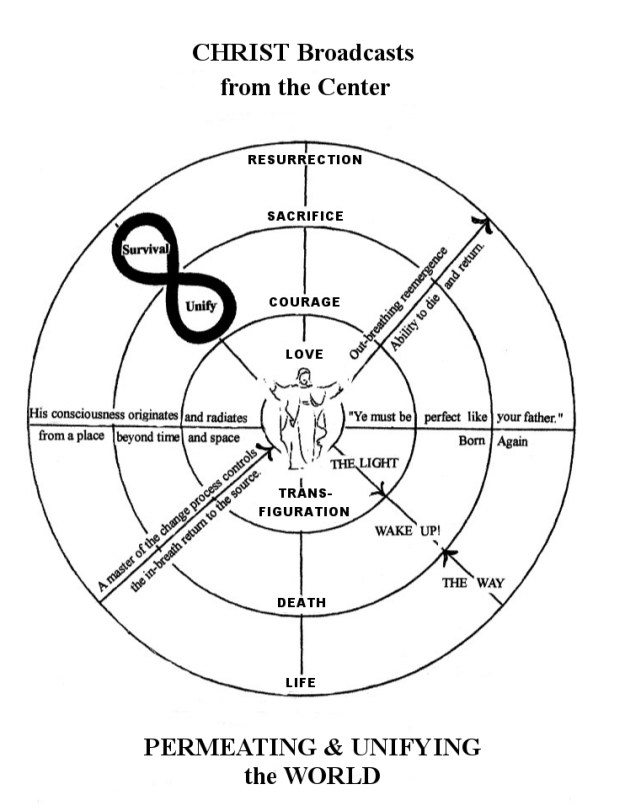
The level from which Christ broadcasts explains his extraordinary influence both then and now. His consciousness originates deep within the Life Wheel. It radiates from a place beyond time and space in all directions, permeating the entire field of creation, touching everyone everywhere. This explains the literal truth in his promise, that he would be with us always, even to the end of days.

0 CHRIST Permeates

The Positive Paradigm also gives us a picture of how disciples’ reports of Christ’s death and resurrection can be literally true. Accomplished meditation practitioners withdraw attention from the physical body and then return to ordinary consciousness on a daily basis. A true master of the change process controls the in-breathing return to the creative source and out-breathing reemergence into the material plane of physical experience. Proof of this mastery is the demonstrated ability to die to the physical body and then return.

Yogic literature is full of stories about masters who chose the time of their physical departure as well as the time, place and circumstances of their next incarnation. In this, Christ’s example is not unheard of.

It’s motive and magnitude of effect that make his story unique. His was an act of supreme self-sacrifice and compassion for self-doomed humanity. He had the power and will to buy humanity one last hope of survival — a final opportunity to WAKE UP in time to prevent ultimate extinction — being erased from the cycle of life altogether.

What’s critically important to remember here is that the example of his sacrifice speaks to everyone, everywhere. Jesus did not perform his apparent miracle to set himself above and apart from humanity. Quite the contrary. He did it to set an example of what’s possible, with the command that each of us should follow in his footsteps. “Ye must be perfect like your father.”

The Positive Paradigm is a model of potentials within each of us which make this command plausible and viable. The dynamic, creative process is on-going. The pattern of continuous regeneration is the deepest heritage of every individual. Whether aware of it or not, we continuously, daily, with every breath, release and die to the old in order to regenerate and be reborn to the new.

By extension, Christ’s example of mastering the change process applies not only to individuals but to the civilization as a whole. The world as we know it seems threatened, as if coming to an end. Yet those who hold the key to life and the universe, like modern day Noahs, have the opportunity — and responsibility — to ride the tide of the times and begin again, not just for themselves, but for the sake all life on Earth. They are the ultimate survivors who have it in their power to reseed the next generation, following Christ’s example to perpetuate the wheel of life.

globe