During Tucker Carlson’s interview with Xi Van Fleet, a survivor of Mao’s cultural revolution, she explains that Mao rewrote history and controlled education as a way to secure what he regarded as absolute power.
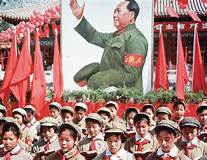
But here’s where an understanding of the perversion of the language becomes critical to defeating the globalists .. . among whom Mao was a precursor.
Restoring the language is essential in the path to overcoming them.
Understand this: they may have worldly the control. They may call it power. But it’s only control.
True power is defined in Power vs. Force by Dr. David R. Hawkins.
To the extent that we believe in God and in ourselves, We the People have the real power. Because creative power is connection with Source. It’s a subtle, energizing, quickening essence.
We the People have true power. Tyrants don’t. What they call power is merely control over resources. External, ephemeral illusory control.
We the People overcome wannabe tyrants – the globalists — by remembering and claiming our innate inner power. We overcome external control and dominance with inner spiritual power. With knowledge, education, and by remembering who we are.
There’s a recurring theme running through recent video posts. “Wake up, wake up, wake up” to what globalists are doing. But it’s not just to what they‘re about. More importantly, We the People need to wake up to our own power. Like Lambert, the sheepish lion, remember who we truly are.

That’s how we take back the reins. Then globalists are exposed for what they are. Powerless, empty shells.
Remember the scene in movie version of Stephen King’s The Stand. In jail, the opponent of Randall Flagg, the darkside demon, scorns him, laughing, “You’re just another scurrying rat going about your rat business.” No power at all, in the true sense.
Here’s a pondering on various meanings assigned to the word Power, dating back to the millennial year 2,000. Interestingly, definitions of power span all levels of the quantum Life Wheel.
57. POWER
Nothing under heaven is as soft, receptive and yielding as water.
Its gentleness dissolves the hard, erodes and absorbs the rigid.
Thus, those who bend endure long after the unbending have snapped.
So it is that the low and high trade places, and the forceful loose their influence.
Like water, sages embrace humility to endure,
remaining flexible and responsive to the needs of the time.
This is known by many, but practiced by few.
— P.E. West, Two Sides of a Coin: Lao Tze’s Common Sense Way of Change
The principle aim . . . is to unfold a Tao of economics; it has always seemed to me appropriate to establish and re-establish a truer alignment of political and economic forces with the natural processes and, through the ancient Chinese I Ching, such an endeavour is possible. — Guy Damian-Knight, The I Ching on Business and Decision Making
Part of what goes into acting decisively in any life situation, along with aggressiveness, clarity of thinking, the awareness of one’s own death, is training. The warrior energy is concerned with skill, power, and accuracy, with control, both inner and outer, psychological and physical. . . He has developed skill with the “weapons” he uses to implement his decisions. — Moore & Gillette, The Warrior in His Fullness
THE FRONT
The root of power means to be able, potent.
Webster’s first definition is the ability to do, act or produce.
It refers to a specific ability or faculty, like the power to hear.
It refers to a great ability to act or affect strongly using vigor, force, or strength.
Power is used to describe the ability to control others, or the authority to influence, such as legal authority.
Power refers to the source of physical energy or mechanical force that can be put to work, like water power.
It points to a person or thing having great influence.
It can mean a nation which dominates other nations.
Power also refers to spirit or divinity.
An archaic use implies an armed force: army, navy, or military strength, like air power.
In optics, power refers to the degree of magnification of a lens, microscope or telescope.
R.L. Wing elaborates on the adage, “Knowledge is power,” pointing out the unique advantage gained from focusing the I Ching like a magnifying lens on daily life.
“The power and astuteness that we gain from this universal perspective,” she writes, “can be applied to any of life’s situations.” In addition, “We recognize situations that hold no promise because they are structured in a way that will cause their own downfall.” In other words, knowledge gives us insight to recognize where various choices are likely to lead, resulting is better decisions.
In Taoist thinking, laws of nature explain why power over time reverts to the people. While drops of water are insignificant, they add up. The momentum driving a tidal wave is formidable.
Divided by fear, ignorance, and narrow materialistic beliefs, individuals remain insignificant. Unified in wisdom by common purpose, people become powerful indeed. Leaders, whether a Stalin, Mao or a Mandela, ride the waves of time like energy surfers, directing their followers either towards slaughter or towards freedom.
Great temporal power of itself implies no value. Its effect, whether positive or negative, depends on the context within which it’s used, either consciously or unconsciously, skillfully or incompetently, for good or evil. The results of a warrior’s prowess, military arsenal and self-control depend on how, when, where and why they’re applied.
For example, in the last century Germany produced both a Hitler and an Einstein. Hitler was obsessed with the occult. He wanted to harness unseen forces to further his goal of world domination. Einstein, on the other hand, searched for the subtle laws of physics. He hoped thereby to discover a unified field theory which perfectly describes the operations of nature. Had he prevailed, he would have re-invented the I Ching.
THE BACK
The opposite of power is powerlessness. Though energy is inherent in every life form, and every individual has the potential to express a unique variation of power, through any combination of external circumstances and personal choices, it can remain latent and dormant, an opportunity lost.
A perversion of power is malicious aggression. Using force to harm others, even destroying life to steal material possessions or gain political power, violates Natural Law. In time, harm returns to the abuser in equal proportion to damage done. Herein is practical proof of biblical wisdom, “Justice is mine, sayeth the Lord.”
 Rethinking Survival