Category Archives: Faith

Hidden Giants

According to the world-loved Tao Te Ching, when the times reach critical mass, leaders arise in response to the deep-felt heart-cries of the suffering masses for deliverance.

This assurance is repeated twice, first in Passage 18. “When countries degenerate into strife, anarchy sets in. / When danger peaks, however, heroes emerge and come forward.”

It appears again in Passage 78. “Like water, the sage takes the world’s suffering to heart, endures its hardships, / and responsive to the times, becomes the catalyst of collective action.

This is the underlying thought in the following rethinking of the David and Goliath scenario. The upcoming anthology, The BEST of WEST will include this excerpt from Rethinking Survival. It’s taken from the section called “We’re Never Alone: Gladwell’s Misfits and Giants in Perspective.”

globe

When Malcolm Gladwell’s David and Goliath came out in October of 2013, I had to read it. The subject promised to be a perfect fit with the vision of Rethinking. After all, King David is my ideal: musician, psalmist, warrior and king in one.

It turns out this book is a perfect example of how sorely the Positive Paradigm of Change is needed. “We need a better guide for facing giants,” Gladwell wrote. I agree. Here it is.

As far as it goes, the book is a good read. What’s lacking is the Positive Paradigm to put David and Goliath in context. From this viewpoint, Goliath was stuck on the surface. Despite his physical size, he was ultimately powerless. David, on the other hand, was connected to center. That gave him the advantage.

Using this Einstein-inspired model of concentric circles linked in an infinite, two-directional loop, we can place the source of David’s strength as well as his strategies and his deadly slingshot.

Resting in the innermost hub of the Life Wheel associated with light was the source of little David’s confidence — the timeless God of Israel.

His strategies, however, belonged to the middle, dynamic level associated with energy.

His prowess as a straight-shooter depended on physical strength, visual acuity and years of experience. Those have their place on the outermost material surface associated with mass.

In other words, the levels of David’s life were coordinated. They were in synch. Unified.

If David had drawn a blank on any one of the three levels, he wouldn’t have succeed then. Nor can anyone succeed today. Vision that’s not backed by a good plan and technical competence is incomplete. Cunning strategies lacking equal competence to execute them are lop-sided. Without a direct connection with the creative center, all the physical resources in the world aren’t enough.

There are several reasons, however, why the story of David and Goliath isn’t the best model for coping with adversity today. For one, we’re at a very different point in history. This is end stage. Civilization was relatively young back then. Different times call for different responses.

Further, confronting a single foe face-to-face was one matter. The tangled mess of corporate-faced, alien-driven evil which little guys are up against now is a much different threat. Different dangers call for different protections.

Another point: Gladwell’s subtitle refers to underdogs and misfits. It’s not a good idea to romanticize misfits. Not all are creative geniuses. Timothy McVey and Charles Manson were also misfits. They too didn’t fit in with mainstream society, but with good cause.

It’s the telescoping mistake. Extremes on both sides of the bell-shaped median are lumped together and written off as “deviant.” But spiritual geniuses and murderous psychopaths don’t belong in the same category.

Further, not all giants are enemies of the people. There are corporate CEOs who treat their workers decently and genuinely serve the public. When I searched my memory banks for a good example, I thought back to Glenn Beck’s billionaire philanthropist friend. What was his name?!

It took me a couple days to find it. Strangely, he doesn’t get much media attention. (Why not is an interesting question!)

But Jon Huntsman, Sr. is living proof. A corporate giant can be as much a part of the solution as the underdogs. Sometimes even more.

A web search comes up with several sides to his story. He gained his wealth by climbing the corporate ladder of success. In 1974, Huntsman Container Corporation created the “clamshell” container for the McDonald’s Big Mac. It developed other popular products, including the first plastic plates and bowls. This led to the 1994 founding of the multi-billion dollar Huntsman Corporation. He continues to expand into new business ventures.

As a philanthropist, Huntsman has given away more than $1.2 billion to both domestic and international charities. His humanitarian aid includes help to the homeless, ill and under-privileged. He holds that the very rich should give not half, as Gates and Buffet say, but a full 80 percent of their wealth to worthy causes. It should be through voluntary choice, however. Not taxation. In this, he agrees with Thomas Paine’s Common Sense.

His goal is to give away everything before he dies. But this isn’t an easy task. He keeps making too much money.

On the personal side, Huntsman not only lost parents to cancer, but is himself a four-time cancer survivor. His response has been to turn adversity into opposite and equal good. The Huntsman Cancer Institute in Salt Lake City accelerates the work of curing cancer through human genetics. It also focuses on providing humane care to cancer patients.

Huntsman has been married to his wife Karen for over fifty years. He’s the father of nine children. The eldest son, Jon Jr. is a public servant. He was the governor of Utah, and later an ambassador to China. (Small world.) The second son is a corporate executive who carries on his father’s business.

Come to find out, Jon Huntsman. Sr. is also an author. One of his books is Winners Never Cheat – Even in Difficult Times. Amazon’s editorial review calls him “one of the finest human beings, industrial leaders and philanthropists on the planet.” His book drills down on “ten timeless, universal values” for business and life. The review concludes that Huntsman’s work edifies, inspires and motivates all of us to model his common sense lessons.

Timeless? Universal? Common sense? I like it!

Moving on, Gladwell also says little guys need to redefine power. I’ve done that too. In Positive Paradigm context, true power comes from within. Goliath, who drew strength primarily from the physical plane, was puny compared to the force behind David’s sling.

Gladwell notes that a single smooth stone to center of Goliath’s head probably destroyed the pituitary gland. He quotes researchers who theorize that the giant had a glandular disorder which explains his huge size. This same pituitary disease would have caused eye problems. That’s probably why a slave had to lead him into battle. Presumably his vision was failing.

But from a holistic perspective, the same story has a deeper meaning. David’s single shot went straight to the third eye, the ajna center located in the center of the forehead. It correlates with the pineal gland, a close neighbor of the pituitary. In yoga anatomy, this center is associated with spiritual vision.

David’s projectile put out the giant’s lights. It was poetic justice for an enemy who was closed to inner truth. That was the giant’s weakness. It remains the weakness of bad guys today as well. A single shot is all it takes, when you know where to aim.

Here’s yet another point. David and Goliath has one take on the giants of the world. But there’s also another way to think about giants. The reverse, shadow side – the opposite side of the coin. Early on, for example, I was inspired by Awaken the Giant Within. I founded the +A Positive Action Press in response to Tony Robbins’ book. From a Positive Paradigm perspective, his words take on new meaning:

If we want to discover the unlimited possibilities within us, we must find a goal big enough and grand enough to challenge us to push beyond our limits and discover our true potential. . . The answer to our current energy challenges will lie in the imagination and resourcefulness of today’s physicists and engineers. And the resolution to our social crises, like the alarming spread of racial hate groups, homelessness, and hunger, can only be addressed with the inventiveness and compassion of dedicated individuals like you and me.

The threat of evil giants in the world serves to awaken the true giant that resides deep within each of us. That’s the blessing hidden in adversity. It’s the opportunity latent in Titanic Times. The Greek Titans, the giants sired by Kronos, survived his murderous envy and returned to claim their heritage.

Similarly, as Lao Tze assures us, there are surely sleeping giants are among us now.

It’s time for them to WAKE UP!

Are you a sleeping giant? Do you work or live with one? What will it take for you (or them) to wake up?
What’s Your Definition of GOOD?

In duality, there are two sides to every coin. It’s a basic law of nature. “Whatever has a front, has back.” Further, “The larger the front, the larger the back.” This explains why surface appearances are often so deceiving.

I mention the Two Sides Law here because I’ve been following a LinkedIn discussion group called The New Philosophy Network. The subject of the particular “thread” is HOW DO YOU DEFINE EVIL?

Not to worry. You haven’t missed much. Philosophy isn’t what it used to be. If there was any “love of wisdom” (the definition of philosophy), it got lost in the one-upsmanship jousting of an extraordinarily uncivil ego contest.

But it got me to thinking about the opposite, shadow side of evil. Did the negative approach influence the quality of conversation? Has anyone asked lately, HOW DO YOU DEFINE GOOD?

Come to think of it, I did awhile ago. So here, for the sake of balance, is the three-part Essay on GOOD from Conscience: Your Ultimate Personal Survival Guide.

globe

Essay 30. GOOD

“The true genius of living is to carry the spirit of the child into old age. And what is the spirit of the child, but that of wide-eyed open wonder, excitement and zest, the optimistic attitude that nothing is too good to be true, that the world is literally a wonderful place?” — Norman Vincent Peale, Enthusiasm Makes the Difference

“We all want the good things in life; we all desire to be surrounded by friends; but we have no right to expect to attract any of these things except when our own lives have earned us the right to be honored, respected, and admired. . . .” — M.P. Hall, Magic: A Treatise on Esoteric Ethics

“It’s the one characteristic that connects all the defendants: a genuine incapacity to feel with their fellow man. Evil, I think, is the absence of empathy.” — Medical Officer, Nuremberg

THE FRONT

The roots of good mean to unite, be associated, or suitable. The term goes through seventeen permutations in Webster’s Dictionary alone.

The first definition is a general term of approval or commendation. Good means suitable to a purpose or effect. It means efficient, producing favorable or beneficial results. It can mean fresh, unspoiled, uncontaminated. It can mean valid, genuine, or real, as in good money or a good excuse.

Good means healthy, strong or vigorous, as in good eyesight. The word is used to mean financially safe or sound. It means honorable, worthy, or respectable. It is used to mean enjoyable, desirable, pleasant or happy, as in the good life. Good can mean dependable, reliable or correct, as in good advice. It can mean thorough or complete, as in a good job of cleaning.

Good can mean excellent of its kind, as in a good novel or considered the best, as in her good china. It can mean morally sound or excellent, virtuous, honest, just, pious, devout, kind, benevolent, generous, sympathetic or well-behaved and dutiful.

It can mean proper, becoming, correct (good manners) and therefore socially acceptable (a good family). It can mean able, skilled, or expert, as in a good swimmer.

It can mean loyal or conforming, as in a good Democrat. In law, it means an effectual or valid title.

The Ten Commandments that Moses gave to the people of Israel, enumerated in the fifth chapter of Deuteronomy in the Old Testament, are a generally accepted code of right conduct. They prescribe what we should and should not do to live a good life. Though the cultural context is different, in principle they are consistent with I Ching philosophy.

Revisiting them from an I Ching point of view enriches their meaning. For example, the seventh commandment has become the focus of special public attention, taking on political overtones. “Neither shalt thou commit adultery.” This one-sentence commandment has depths of meaning which span the energy continuum.

For example, at first chakra level, it includes refraining from contaminating air, water and food with pollutants. At the second, it includes not violating marital or parental responsibilities.

At the third, it includes not tampering with legislation for antisocial purposes. At the fourth, it includes not mixing compassion with sentimentality or greed.

At the fifth, it includes not misconstruing scriptures to suit political agendas. At the sixth, it includes not adulterating conscience with the ego impulses.

In addition, each level’s “shalt not” implies a positive shadow: “thou shalt.” At the first chakra level, this includes taking active responsibility for cleansing air, water and food of pollutants.

At the second chakra level, it includes fulfilling family commitments. At the third, it includes adjusting corporate and government practices to serve the common good.

At the fourth, it includes quietly serving those in need without public fanfare. At the fifth, it includes aligning personal and political goals with natural and scriptural law.

At the sixth, it includes practicing self-awareness methods to purify ego.

THE BACK

In I Ching context, evil violates divine and natural law. It is antithetical to the life process, tearing the pattern apart. Good and evil cannot be equated with yin and yang. Good is inclusive of the harmonious whole, both yin and yang, attainable by males and females of every race without limitation.

In moralist context, violating codes of generally accepted social or sexual conduct is regarded as bad, the opposite of good. Sages, however, define correct or incorrect behavior in terms of context and results. Right or wrong action is defined in terms of the immediate situation and the actor’s deepest, underlying motives.

I Want To Know What Love IS (& Isn’t)

There was a time when, wherever I’d go, the popular Foreigner tune “I Want To Know What Love Is” was playing in the background. I shopped to it at Woodman’s grocery store. At Gold’s gym, I showered and dressed to the sound of the same music. While I waited in line at the local Subway for my six inch sandwich on honey-oat bread with tuna, provolone cheese and veggies . . . again, the same song.

Now this mountain I must climb
Feels like a world upon my shoulders
And through the clouds I see love shine
It keeps me warm as life grows colder.

If it wasn’t that, then it was the Jennings/Winwood song, “Higher Love.”

Think about it: There must be higher love
Down in the heart or hidden in the stars above.
Without it, life is wasted time.
Worlds are turning and we’re just hanging on..

We walk blind, we try to see,
Falling behind in what could be.

I took it as a cosmic hint. Pay attention to this universal need, and the ways we sing about our searchings.

We look everywhere for this illusive, life-sustaining essence (albeit sometimes in the wrong places). Is it above us, hidden in the mountains tops, or still higher, shining from the stars? Does it dwell deep within the human heart?

Or all of the above, like the all-pervading force Yoda honors in Star Wars.

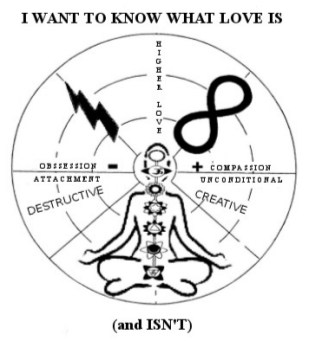
Here’s what I came up with as a result of my personal searchings – a picture of Love’s full-spectrum possibilities:

Want to know

Used as a diagnostic tool, the Life Wheel shows how words shift meanings at each successively inward level. It applies to the full spectrum of value words, from Action to Virtue, including Love.

Positive and negative expressions of love take on different forms at each ascending (or descending) stage of the Life Wheel. We each experience our personal, unique variations on the same basic themes. But the idea isn’t that complicated. It looks like this:

LoveLadder.sized

Scientists limit their search to the outermost tangible, measurable surface of the Life Wheel. Because they look exclusively at physical manifestations, they find different (though complimentary) answers. Take, for example, the Youtube series on “The World’s Most Asked Questions.”

SciShow surveyed Google and Youtube for the most frequently asked questions searched on the web. According to them, the world’s #1 burning question is, “What Is Love?”

The video on the #1 question is hosted by an unidentified, fresh-faced 20-something presenter — gravity-defying hair, sporting a gray hoodie. Reading from a teleprompter, he waves his hands with the confident gestures of an expert. Flashing in the background, bolded scientific terms along with colorful brain-scan images reinforce his message.

“Love,” the unnamed anchor starts out, “is the number one question that keeps poets and philosophers up at night.” But, he claims, it’s no mystery to scientists. “They have good explanations.” Several in fact. The answer changes depending on which kind of scientist you ask.

A biologist would say it’s all about reproduction, evolution and the survival of the species. [Issues associated with the first three centers (“chakras” or “wheels”).]

A psychologist would say it’s all about togetherness and our need for acceptance. [Issues associated with the fourth, heart chakra.]

But, no-name continues, “It’s really about chemistry – brain chemistry to be exact.” Aha! This is where the preamble was leading. “It’s incorrect to associate love with the heart,” he says. “It’s all about the brain. We know this because we can see the brain in action in brain scans.”

What follows is a discourse on brain science. “In fact,” he claims, “the early stages of love look an awful lot like a brain on cocaine.” When a person first “falls” in love, at least a dozen different brain parts light up, releasing powerful chemicals, hormones and neurotransmitters that trigger “feelings of excitement, euphoria, bonding and butterflies.”

Research also shows that the unconditional love between a mother and child activates slightly different regions of the brain, he says. (That’s interesting, but no details are supplied.)

The video ends where it started, “Love may seem like a mystery to poets. But to science, love is within the realms of the comprehensible.”

Oh well. If you’ve been following my earlier posts, you’ve seen the hollow-shell diagram of the exclusively materialistic, empirical science worldview. According to the Rules of this Knowledge Game, information received by intuition and con-science at the inward levels of the Life Wheel is excluded as off-limits.

But scientists don’t have all the answers about love. Some perhaps, but not all. Research science (as Einstein knew) is a “necessary but not sufficient” piece of the knowledge puzzle.

From experience, I know there’s much more to higher, unconditional love than meets the measuring eyes. Nor does everything done in the name of love partake of this universal essence. Quite the opposite.

The love we seek and sing about isn’t motivated by chemicals. Hormones aren’t causes, only response mechanisms. Nor can love be contained or explained by analyzing the brain. People come and go. The legacy of love they leave behind endures. The temporary physical receiver can’t be equated with its mysterious, eternal source.

“Re-search” = “Look again.”

The ELEVENTH HOUR

11th hour sized

In drafting “Do You Have the Time?” I brainstormed all the possible ways this seemingly simple question can be taken (and mistaken). Different interpretations yield significantly different answers.

I also browsed for clip art clock faces to illustrate my point. Coincidentally, the one I chose adds yet another perspective, giving the question a deeper, philosophical meaning: “Do you know what time it is in your life?”

What stage of personal evolution / growth are you going through now? From a larger, historical perspective, what point in its life cycle is your business, nation or even the world experiencing today?

The pictured clock face shows the stage many say the world is now in: its eleventh hour.

Even then, there are different views as to the best way to respond to being at the eleventh hour in human history. The cliché is currently used to mean “running out of time, at the very last minute, or almost too late.”

But biblical origins of the cliché offer an alternative viewpoint. In Matthew 20: 2-16, laborers hired at the last, eleventh hour worked for only an hour. But at the end of the day, they received the same reward as those hired early in the morning, who had worked all day.

Christ’s parable of the eleventh hour epitomizes the hope humans have in God’s compassionate mercy. It’s never to late to change. It’s not over til it’s over.

(Of course, there is no such thing as coincidence.)

globe

Do You Have the Time?

Early this morning, I was startled awake by a cell phone alert. The power was out – for a second time. The first outage occurred over night. I was still asleep, so didn’t know the difference.

Roommates who commute long-distance to work got started just before the electric garage door came to a standstill. (They don’t know how to open it manually.)

Emergency protocols immediately kicked into place. I reached out in the dark for my wind-up flashlight. It was where it should be, on top of the disabled alarm clock. It supplied enough light to find a second, larger LED flashlight. It too was where I expected, on my work desk next to the powerless computer. I made my way carefully down the pitch black stairwell.

Next: get the battery-run lanterns out of storage. In one, the D-cells had gone dead. Look for back-ups.

Fortunately, there’s a battery-run wall clock by the main office door that keeps accurate time. Which is the subject of this post. “Do you have the time?”

Have you ever thought about how many different ways there are to answer this seemingly simple question, “Do you have the time?” My smart-mouthed high school friends, for example, would have answered, “If you have the nerve.”

The most straight-forward response is to look at a time-piece and give a literal answer. It’s 6:30 in the morning.

Alternative answers go along the lines of, I don’t have enough time . . . . to get the many tasks that need doing done well . . . to take care of my health . . . to check in on elderly relatives. Etc. etc.

Philosophical answers might include regret for the shortness and uncertainty of life. “Here today. Gone tomorrow.” Or, as the carved and painted wood plaque over my Grandfather’s fireplace mantle put it, “We get too soon old, and too late smart.”

Which brings me back to the point where I left off in the last post, “Rethinking Our Common Humanity:”

While we all have the option to remember who we truly are, most of us are like Lambert, the sheepish lion. It takes a smack with a two-by-four upside the head before we’re finally ready to WAKE UP.

Often it takes the form of life-threatening danger to those we care for. A personal health crisis will also do the trick. So will job loss or a run-in with natural disaster. But, like Dorothy stranded in the Land of Oz, when you want dearly enough to return “home,” you can click your heels whenever you chose — and come to find out, you’re already there.

Most of us live as if today will last forever. We prefer to live in the moment. In part, this is a good thing. The mindful focus of a “Be here and now” attitude allows us to savor our immediate blessings.

However . . . on the other hand, heedless lack of foresight can have extremely dangerous consequences.

Tomorrow and tomorrow and tomorrow add up, inevitably sneaking up from behind like a thief in the night when least expected. (And not just a temporary power outage like this morning. Think Pompeii.)

Impending disasters, even those right before our eyes like handwriting on the wall, can catch the unprepared off guard, robbing them of the precious time which could have been used to wake up from their deep soul sleep and re-member who they truly are.

I understand. Given today’s economy, many have little choice but to live hand-to-mouth. Check-to-pay-(or welfare)-check. Even the well-off who could afford to prepare are besieged with putting out day-to-day fires — or by other glittery distractions.

There’s no time or energy reserved for assessing possible risks. It’s not a priority to think through “If / Then” preparedness scenarios.

I find it most peculiar that even Millennials, who have grown up fluent in computer-driven technology, usually don’t apply if / then computer logic to their personal decision-making and daily behavior. This makes them even more ill-equipped than their elders to cope realistically with sudden change.

For example, in a personal email sent in response to “Give Millennials an App for Their Inner Compass,” Tom Richards detailed his frustration with Millennials:

I live in NJ where Hurricane Sandy hit dead center. Devastation like you would not believe. No power in most of the state for over 8 days. Here are actual examples which I came across immediately following the storm . . .

1. An hour after the storm ended, early in the morning, a car load of kids in their mid-twenties got stuck in a washed out piece of road in front of my house. No power, of course, and trees down everywhere. When the kiddies came to my door to ask to call for a tow truck, I had to laugh. When I asked them why the hell they were out on the roads, in their PJ’s none the less, immediately after the storm of the century, I got this. “We don’t have power and want coffee and breakfast. We are going to WaWa to get some.” Didn’t even dawn on them that if they have no power, and the state has no power, the WaWa doesn’t have power. Nor did it dawn on them that with the storm and devastation, that the people who work at WaWa would not be able to go there and open it for them.

2. Three days later the local farmers market opened, even though they only had power to keep the refrigerated items going. No power within 3 counties at this point. A young couple who lives two doors down needed food. Went to the market and came home empty handed. They had no cash, and the store was obviously only able to take cash. They pay for everything with their debit cards. Never dawned on them to have some cash around for emergencies and things like this. They were mad that the store wouldn’t sell them anything nor that they couldn’t take the debit card. It also is interesting that they never even thought to prepare even though warnings were given over and over.

3. My daughter and her friends were hungry. Her friends hadn’t had a hot meal in days. Plus, it had gotten cold and most had no heat. They came over to our house. Saw we were using my wood stove in the music studio to cook on and stay warm. It never dawned on them (or their parents, which frightened me) to use their BBQ propane grill or make a fire to cook with nor to build a fire in their yards to at least get a bit warm.

4. Just about every traffic light was out, and roads were blocked by either police or downed trees. I cannot tell you how many younger people stopped in front of my house when they saw me there to ask me how to get to a certain place, and also how many could not understand when I gave them road names where those roads were. . . .

What most amazes me is that repeatedly, after each disaster, whether natural or man-made, in media interviews, the “victims” chant the same mantra. “It was a WAKE UP CALL.” But life goes on. After the initial shock wears off, people get mired once again in the routines of daily living. And they forget. They go back to sleep.

We aren’t changing! And time is running out. As the late computer leader-innovator Steve Jobs poignantly observed:

Your time is limited, so don’t waste it living someone else’s life. Don’t be trapped by dogma – which is living with the results of other people’s thinking. Don’t let the noise of other’s opinions drown out your own inner voice. And most important, have the courage to follow your heart and intuition. They somehow already know what you truly want to become. Everything else is secondary.

Time is a blessing and a luxury. None of us knows how much time we have left to WAKE UP, think, prepare, and perhaps survive whatever is to come.

Commenting on “Change the Rules of the Knowledge Game,” Peter Fellingham gave his opinion:

Another reason why people avoid critical thinking is because it usually results in significant introspection. Introspection tends to make clear the responsibility the individual has for the resolution of their own troubles.

I answered back:

Peter, you’ve pinpointed the blind spot in curriculum — the information deficit of which I speak. Clear & critical thinking isn’t often taught in schools, nor are problem-solving tools provided as essential basics. They should be.

Then there’s the question of motivation. Requires a carrot & stick approach. The stick is awareness that laziness comes with horrific consequences. The carrot is assurance of the benefits which accrue to living a self-responsible life.

In part, people often avoid issues they find too fearful to face. If there truly are no better options, and only dangerous consequences, keeping still is an understandable choice. However, if better options ARE available, then making them known and available is an important first step in positive change. That’s what I’m working to accomplish.. . .

So, if you and/or those you lead and care for have been avoiding introspection, if you’ve been ignoring the warning signs and denying fears for the future, waiting for dangers to miraculously disappear and problems to be solved without effort, it’s time to take the striking two-by-four hint from escalating wake-up calls worldwide.

It may be a matter of survival to rethink priorities while there’s still precious time left to do so. Ask, If not now, when?

And consider the likelihood that the life / family / organization you save may be not only yours, but those of generations to come.