Interesting, isn’t it.
At a time marked by fragmenting beliefs, polarizing politics, and irrational violence, people across the board increasingly crave what we all seem to most lack: UNITY, both within and without.
Tapping into this deeply felt common need, politicians of every stripe are joining the national call for UNITY.
If only we understood what the word from its deepest, pristine origins really means, and were in agreement in a vision as to how it might play out in our day-to-day lives.
Aye. There’s the rub.
The English language has devolved to such an extent that value words are very often defined both as one thing and its exact opposite. All too often when we speak, we miss each other coming and going, not even recognizing the disconnect. I’ve called this The Tower of Babel Dilemma.
To remedy it, in part, I wrote a series of 64 essays, each focused on a commonly used value word, intending to restore a common understanding regarding its correct use. As an example, Essay 60. Unity is attached to the end of this post.

A recent, uniquely excellent expression of true UNITY was written by Melania Trump immediately after the assassination attempt on her husband’s life. At the Republication convention, he thanked his wife for her “beautiful letter calling for national unity.” It reads in pertinent part:
Melania Trump. July 14, 2024
We have always been a unique union. America, the fabric of our gentle nation is tattered, but our courage and common sense must ascend and bring us back together as one.
Let us not forget that differing opinions, policy, and political games are inferior to love.
We all want a world where respect is paramount, family is first, and love transcends. We can realize this world again. Each of us must demand to get it back. We must insist that respect fills the cornerstone of our relationships again.

Just prior to the Republican convention, because he’d been informed that it would be the subject of Trump’s acceptance speech, in One America film maker Dinesh D’Souza addressed the emerging theme of national unity.
I quote him here at length, edited only for grammar, because the point and its illustrators are so important:
The point I want to make here is, when we talk about unity, what do we actually mean by unity? Does it mean, first of all talking about the Republican Party, that we’re going to find a common denominator of every person who has an R after their name and that’s unity?
No. Republican unity means, by and large, taking the main coalitions or the main constituents of the Republican Party and . . inspiring them to want to vote Republican.
But at the same time, you want to frame your message in such a way that you attract Independents. You also lure some Democrats.
Unity is never a matter — and I think Trump understands this very well (we’ll find out when we watch his speech when he gives it later this week) that unity doesn’t mean finding the people who want to destroy you and frankly, the people who want to destroy the country, and unifying with them. Because our agenda and their agenda are incompatible.
. . . even in the Reagan era, the Reagan agenda and the Carter agenda or the Reagan and the Mondale agendas were incompatible. At that point, by and large, debates were not over ends. They were over means.
Now the left and the right disagree over ends — not just means. That means MAGA has got to be interpreted not as unifying the country per se, but unifying the country against the left [including their globalist agenda].
This is the key.
Let’s go back to Abraham Lincoln for a moment. Lincoln understood that bringing the country together doesn’t mean finding a new consensus in which the slave master and the Republicans sit down and “iron out” their differences. Lincoln understood that unifying the country is unifying the country on a consensus that slavery shall not be allowed to spread. That was the Republican platform. Lincoln was willing to compromise up to that point, but no further. He was implacable beyond that.
This is important to realize in any kind of compromise. This is also true of normal negotiations. You go, “Okay. I’m going to ask for X. I’ll be willing to settle for Y. But I’m not willing to settle for anything below Y.” You draw the line.
The meeting of the minds is over that basic starting point: the point that Republicans do seek unity, but not unity at any price. And not a weak unity that finds the lowest common denominator. But to unify over the core principles that will save America. Frame those principles in as broad and charitable way as you can.
. . . the job of the Republicans here is to reframe that consensus.

Trump’s VP pick, J.D. Vance, demonstrates that he understands these core principles in a deep, profound way. And, perhaps in a more grounded way than most, he appreciates Trump’s style, articulating the middle path of compassionate unity within the party.
For example, at the Faith and Freedom Coalition breakfast in Milwaukee, J.D. Vance gave us a glimpse into his way of thinking:
. . . when I talk about [Donald Trump’s] uniqueness in politics, I think one of the great virtues of his approach to politics — that his critics will slander in every which way. . . but President Trump is uniquely capable and aware of politics being the art of the possible. What can we accomplish in the here and now? How do we advance the ball one yard, before we advance it ten yards, before we advance it to a touchdown.
So I’d ask my social conservative friends, as you see the administration unfold, as you see the campaign unfold, remember that this is a guy who delivered for social conservatives more than any president in my 39 years of life.
I think he deserves a little bit of grace. He deserves a little bit of trust. And I hope that we will all provide that to him. I certainly know that as his running mate, I will.
———
For the sake of the nation’s survival, I dearly hope citizens across the board will start to think and choose to act in terms of the unifying core principles that define America, in stark contrast to the drastically incompatible agenda of the leftists and their destructive, globalist ends.

To this point, in various interviews, Jordan Peterson holds forth on Trump’s psychology and why he drives liberal elites crazy. His flamboyant, often unpredictable style is chief among complaints. Many think he acts like a bully.
But Peterson is quick to add, Yes. “Trump has proclivity to bully. He does so effectively and sometimes very usefully.” Yes. In the company of international leaders, each of whom is a bully, he speaks their language, necessarily. . . and fluently.
But as Piers Morgan insists, Trump is “multifaceted.” This illustrates J.D. Vance’s point. Trump uniquely understands the art of the possible. He speaks the language of business to business leaders. And compassionate love of family to ordinary Americans, for example to the Gold Star parents of children lost in the Afghanistan withdrawal.
He’s more skilled than most in the art of optics. Put in biblical terms, “For everything there is a season. And time for every purpose under heaven.”

Essay 60. UNITY
An individual has not started living until he can rise above the narrow confines of his individualistic concerns to the broader concerns of all humanity. — Martin Luther King, Jr.,
The Words of Martin Luther King, Jr.
—–
The scientist or the artist takes two facts or experiences which we separate; he finds in them a likeness which had not been seen before: and he creates a unity by showing the likeness. . . . All science is the search for unity in hidden likenesses. — Jacob Bronowski, quoted by Todd Siler in Think Like a Genius
—–
I have always felt that one of the simplest and most apt metaphors for an organization as complex as the United Nations is the Rorschach inkblot test. What one person sees as the hope of a world free of war, famine, poverty, and disease, another interprets as a global boondoggle comprised of uncaring civil servants threatening the cherished concept of state sovereignty. — James Holtje, Divided It Stands: Can the United Nations Work
————
THE FRONT
The Latin root of unity means oneness.
Webster’s first definition is the state of being one, or united; oneness, singleness.
— It means something complete in itself, single, or separate.
— It can be the quality of being one in spirit, sentiment, purpose; harmony, agreement or concord.
— It can also mean uniformity.
— It can refer to an arrangement of parts or material in a work of art or literature that will produce a single, harmonious effect.
— It can refer to constancy, continuity, or fixity of purpose or action.
The difference amongst these definitions reflects a general cultural confusion as to the optimal relationship of the individual to the levels of the Life Wheel, including society, nature, inner life, and Creator Source. Effective, consistent action depends upon an integrated concept of self and a comfortable relationship of each level and part within the whole.
Therefore, thinking carefully about what unity means — as well as what it doesn’t — is a necessary prelude to ultimate success in life.
Accepting the I Ching view that accomplishments begin with the smallest unit, unity is first to be attained within. It’s common to say, “My mind’s not made up” or “Get it together.” The familiar saying, “The right hand doesn’t know what the left is doing,” could also be phrased, “The left brain doesn’t know what the right brain is doing.”
When Westerns say, “I’m of two minds on this,” it reflects confusion, ambivalence or lack of discipline. However, the martial arts advice to have eight brains and eight hearts refers to the height of attainment. It suggests ability to intentionally shift internal gears to meet any situation. From the totality of unified mind, the ideal I Ching master focuses from above while acting through each of the energy centers according the immediate need at the time.
The motive, the “why” of psychologies and meditative practices is the same: to unify fragmented, antagonistic functions of mind, personality and behavior. The purpose, the “what” they plan to accomplish, ranges from personal self-mastery to inner peace and/or functional relationships. The intent, the “how,” is diverse. Some practices start from the outside with behavior and work in. Others start with the mind, ideas and attitudes, and work outwards. Still others work on both simultaneously, which is possible in communities where work and self-awareness training go hand in glove.
External diversity complements inner unity. The core of life’s concentric circles, like the hub of a wheel, remains still as the outer rim revolves, constantly changing and in motion. Meridians, like spokes of a wheel, link center to surface, connecting and organizing the wheel of life in a dynamic unity.
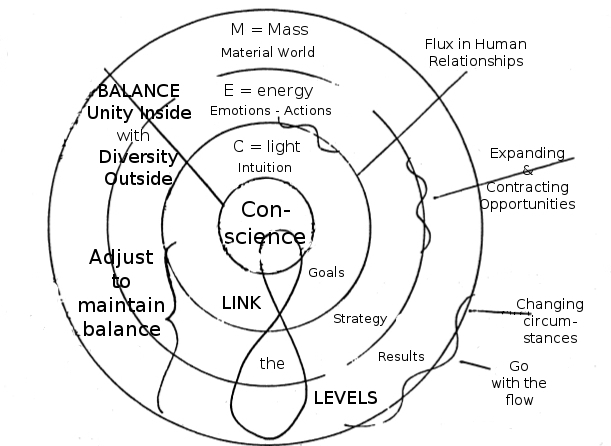
It hardly matters how the goal of inner unity is attained. Once one is focused and all the facets of inner energy are coordinated by a single-minded purpose, the pieces of life’s mosaic fall into place, forming a coherent picture. Then life becomes a work of art, like a poem or a song.
Albert Einstein –equal parts musician, philosopher, physicist and world citizen — searched lifelong for a unified field theory. The Book of Change embodies the universal code he sought. We’ve failed to recognize the clues hidden for centuries in a venerable text that have the potential to lead us to solutions desperately needed NOW. Restoring this treasure to the general culture would provide a fully functional paradigm from which positive, life-sustaining results can be generated across-the-board.
THE BACK
Regimentation and conformance are perversions of unity. Nature flourishes in diversity. Like snowflakes, each individual is a unique variation of its kind. In contrast, in extreme social contexts, variations are suppressed and punished. While this unnatural state might be appropriate to unnatural situations like war, it’s antithetical to personal well-being.
Technically, because all things are connected, it’s possible to dabble in the dark worlds of demons and departed souls. However, though these realms do exist, it is dangerously unwise to explore them without a specific, positive purpose and a white magician’s protective guidance.




 Rethinking Survival