Monthly Archives: May 2017

What Do YOU Think?

confusion

I have an important question for you. Your thoughtful answer(s) are greatly appreciated!

Here’s the problem, wonderfully put in The Art of Growing Old – Aging with Grace by Marie De Hennezel:

. . . the worst is not inevitable. The keys to a fulfilling old age do exist, and it’s up to our generation to discover them and pass them on. It’s up to us, the baby boomers, to invent a new art of growing old – which is a paradox, as it means accepting the inevitablity of aging without becoming “old.”

She continues:

. . . we can grow old intelligently; we can accept what we cannot change, and look toward all that has yet to be discovered.

I totally agree. But there are issues. First, although she states the challenge (opportunity!) wonderfully and touches on important responses, she doesn’t really have The KEY.

Second, I do. It’s what The Phoenix Response is about.

Why is that an issue? That’s where YOU come in.

In 2014, I wrote about “The Key to Everything” in Rethinking Survival – from my point of view. For me, it explains “The Mystery of Death and Rebirth.” Looking back, I was clarifying my thoughts for me.

Now the burning question remains, How do I bridge the gap between where I stood then and where you are NOW? For me, The Key and it’s implications for ultimate survival are breath-taking. How could I present them better, in a way YOU can usefully relate to and enjoy?

Or is all this something you’d rather not think about? If so, Why not?

Please tell me. And while you’re at it, it would help to know your (relative) age, gender, and location along with any comments on what shapes your current needs.

So, what do YOU think about “The Key to Everything” and “The Mystery of Death and Rebirth?”

The KEY

The Key to Everything

My “take away” from yoga years was the parable of a young boy who asked his teacher, “What is that, knowing which, all else is known.” The implication to this question, put forth in the ancient Sanskrit Mandukya Upanishad,41 is that, with the right key, everything can be known.

It reminded me of the medieval masterpiece in the Prado Museum that grabbed my mind earlier, the one which showed me that it’s possible to see with a larger point of view, beyond time, where all history is like a static painting and everything is actually going on at the same time.

I ardently wanted that key to life and the universe. I asked myself this question over and over and compared everything I read to this standard.

Years ago, I put the question to a wise friend, “What is that, knowing which, all else is known?” His cryptic reply: “Look it up in the encyclopedia.”

“Huh?”

I parsed this one-liner for every hint and clue. What does this riddle in answer to a riddle mean? “Look upwards?” And “en-cyclo-pedia?” That which encircles (cyclo, cycles). Pedia meaning feet. The foundation? The fundamental base which supports the whole body. Perhaps the functional impetus of movement and action.

According to Webster’s dictionary, “encyclopedic” means “comprehensive in scope.” All-encompassing view. Aha! I got it!The Positive Paradigm is the answer to the riddle. Look there.

I’m now convinced that the Positive Paradigm of Change is the ultimate answer to the ancient ultimate question. It’s the literal proof that humans are made in the image of the Creator — the microcosm resonates with the macro. I AM that I AM.

Put another way, “God don’t make no junk.” In this context, the exhortation, “Ye must be perfect like your Father in Heaven” makes perfect sense.

Just as Einstein had the Unified Field Theory, but didn’t know it, each and every one of us on the planet is perfect in potential: made in God’s image. But we’ve forgotten.

And tyrants want you to sleep on. They’ll do anything to prevent you from remembering that you’re inherently okay. Because once you do, as Einstein did, no one can intimidate, control or dominate you. You’re aware that nothing anyone has for sale can make you more perfect. Nor can anything that anyone threatens to take away alter your essential okayness.

It’s your inalienable birthright. A given.

The Positive Paradigm is the viable basis upon which to build valid self-esteem. It’s the key to personal freedom — freedom from ignorance, freedom from fear.

One minor caveat: it all depends. While we all have the option to remember who we truly are, most of us are like Lambert, the sheepish lion. It takes a smack with a two-by-four upside the head before we’re finally ready to wake up. Often it takes the form of life-threatening danger to those we care for.

A personal health crisis will also do the trick. So will job loss or a run-in with natural disaster.

But, like Dorothy stranded in the Land of Oz, when you want dearly enough to return “home,” you can click your heels whenever you chose — and come to find out, you’re already there.

Innocence

The Mystery of Death and Rebirth

The yin-yang mysteries of life and death are embedded within every in- and out-breath of our lives. They alternate, however unappreciated, inside each unit of time: from minute-to-minute, day-to-day and season-to-season. They repeat on every scale of magnitude, from the individual, to families, corporations, nations, whole civilizations and even planets.

Buddhist teachings reflect these mysteries, compatible with the Positive Wheel model and its central hub. For example, in Being with Dying: Cultivating Compassion and Fearlessness in the Presence of Death, Roshi Joan Halifax explores the transformative power of the dying process, advising readers to be still, listen and open to the unknown.

Indian film actor Rajini captures the Rethinking concept succinctly in his review: “This book helped me touch that divine part that we all share; it is the Deathless, eternal part of us that will never die because it was never born.”

“The strange thing about growing old,” Einstein wrote, “is that the intimate identification with the here and now is slowly lost. One feels transposed into infinity . . . ”

In the year before his death, commenting on the passing of colleague Michele Besso, Einstein wrote, “He has departed from this strange world a little ahead of me. It means nothing.”

Making an observation that could have come directly from the Yoga Sutras, consistent with the Positive Paradigm, Einstein consoled Besso’s family, “For us believing physicists, the distinction between past, present and future is only a stubborn illusion.”

It is said that in the middle ages, Carmelite nuns retired to their cells each night to sleep inside the wooden casket in which, when they died, they would be buried. Taken out of context, this may seem morbid. But in fact, they had it right. They were aligning themselves with the patterns of nature, the better to ultimately survive them. For each in- and out-breath repeats the cycle of release and renewal. Each night that we sleep, we let go of bodily awareness and return refreshed the next day.

On every scale of magnitude, the pattern is the same. Paradoxically, survivors who have released unfounded fears of death are freed to live to the full, here and how.

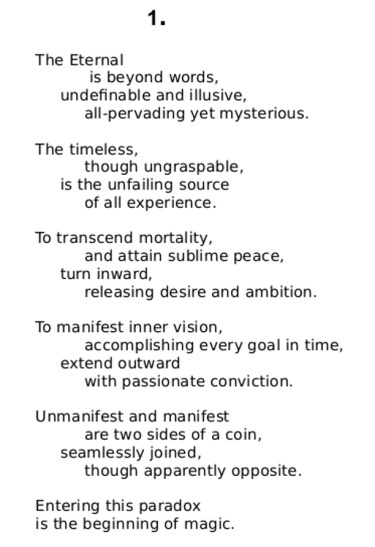
Lao Tze’s work, which breathes I Ching wisdom, illumines this paradox. He describes the relationship between the Creator and creation in the first aphorism of the Tao Te Ching. From Two Sides of a Coin: Lao Tze’s Common Sense Way of Change:
01

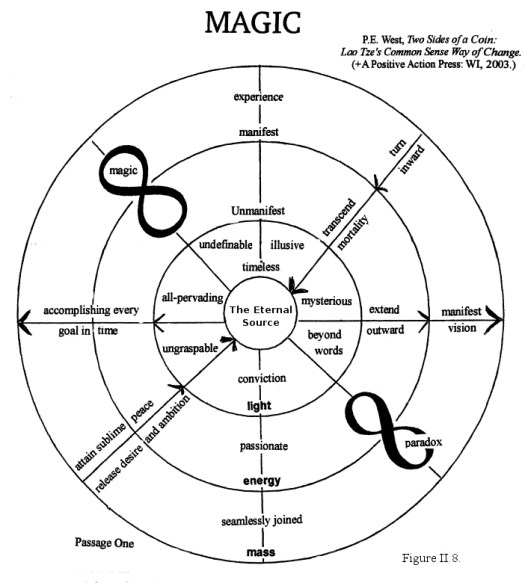
Figure II.8 shows what this vision looks like when the words are properly placed within the Positive Paradigm Wheel. To the uninitiated who live exclusively on the surface of the Wheel, the eternal may seem illusive. However, the inner vision is accomplished by daring to let go of the familiar surface to travel true home to the center, from which, completing the cycle, blessings then flow outward.
II-8 rev

(Reminiscent is God’s promise in Genesis, “Return unto me, and I return unto you.”)

In Passage 16, Lao Tze goes even further:

16

Here, Lao Tze’s sage not only repeats the vision of the hero’s journey. The methods of the journey are given — the meditative practice of stilling the mind and emptying the heart, followed by contemplation from the detached observer’s perspective. Lao Tze also details the consequences of failing to complete the life pattern: misfortune, pain and suffering.

Those who attain the source, however, (usually with the guidance of an enlightened teacher) achieve the overview which leads to acceptance, compassion and omniscience. Those who survive intact, merge with the eternal source and begin anew, like the New Adam and Christ in The New Testament. (See Figure II.9.)

II-9 rev

Preparation makes the difference, deciding who is most likely to survive coming transitions, emerging better than before through the experience. Here is the root of Positive Change, described in Hexagram 49 from The Common Sense Book of Change:

49. CHANGE. Day and night replace each other in endless cycles of CHANGE. The same natural law generates flux in human events. The unprepared see Change as a threat, but the well-prepared face the unknown calmly. They know that after degeneration reaches critical mass, regeneration follows. Welcome the new. Avoid short-sighted fear.

Please Help Me.jpg

So, now it’s your Turn. Please tell me what YOU think about all this. And, thank You.

thanks.jpg

The Wright Connection


connection

On two separate occasions, I’ve recently had reason to revisit a blog about Frank Lloyd Wright originally posted elsewhere.

The first was reading about Judith Orloff being jilted because her boyfriend’s rabbi called her a witch. Contact with her deceased grandfather was judged unacceptable. Especially because — though living in Europe with no way to know that he’d died — I had vivid dream warnings from my Grandpa West at the time of his passing. It’s described in Rethinking Survival:

In another memorable dream, I spoke with my father’s father, Hubble West — the one his grandkids nicknamed “Hubba Hubba,” from whom I inherited my Native American looks. Gravely, he warned that I was trapped in a high-rise tower. I was dead and didn’t know it.

I took this troubling message as a warning that important parts of me were atrophied. I was stuck in my head, neglecting my body and failing to listen to my heart. As a result, I was in mortal danger. Later I learned that at the time of the dream, Hub had just passed. This was his parting benediction.

So, to me, the clergyman’s assumption seems most unjust. To the best of my knowledge, Dr. Orloff’s dream guidance had nothing to with witchcraft. The Wright post serves to vindicate her, putting her experience in larger context.

In brief, as I understand it, our experiences of nature or the so-called “supernatural” are pagan only if we  seek them out, especially to the exclusion of or elevating them above their deepest, original Source. Wright overtly courted the pagan god Taliesin, defiantly rejecting Isaiah’s Hebrew God. Dr Orloff’s stated beliefs, however, are completely compatible with the Positive Paradigm shown below.

The second occasion was an email exchange with friend describing a museum visit. She wrote:

Seeing a tapestry/hanging from Frank Lloyd Wright in the crafts section brought you to mind, although I’ve forgotten just how you ended up with your connection to Taliesin. Through music perhaps? The same association came to me as I listened to a talk at the Seattle public library on the history of Seattle architecture just before leaving for Boston.

I reminded her:

The Taliesin connection was music and yoga related. I was at Hill Top for a yoga retreat. It’s just down the road from Taliesin. The owner, Herb Fritz, was one of Wright’s apprentices. Also a cellist, he heard me play violin and invited me back to play chamber music. The rest, as they say, was history.

She isn’t familiar with the context of that connection, however. This Wright post also fills in those blanks for her. For example, as described below, Herb Fritz was sole apprentice to survive the Taliesin mass murder and testify about what happened.

So for those reasons, I’m posting below an edited version of the earlier LinkedIin post.

header

Frank Lloyd Wright Had It Wrong!

Why does it still matter that a century ago, Frank Lloyd Wright’s Taliesin burned, torched by an ax-wielding mass murderer?

It matters a great deal. Not because of the tragedy’s lurid details. But because Taliesin East – located in Spring Green, Wisconsin – is an important example of how NOT to organize an intentional community.

Years ago, from stories told in Spring Green at dinner tables and around fireplaces, I learned how powerful an effect Wright’s personality had on apprentices and their families. They remembered him with equal parts awe and dread. He was, so they believed, an architectural genius. He was not, they all agreed, a good neighbor or compassionate, trustworthy friend.

What I learned from those close to him motivated me to read books written by the Wrights, as well as biographies by others – notably The Fellowship. I came to the conclusion that intentional communities like Taliesin – an inherently worthy endeavor — deserve careful rethinking.

I wrote about Taliesin in a LinkedIn email exchange.

Viewing my profile, a connection (“Senior Zen Practitioner and Baseball Umpire”) noticed mention of the time I spent in Spring Green. He emailed me RE. Taliesin West:

My Mom was the Office Mgr. for 21 years…small world

To which I responded:

This particular West has never been to Taliesin, either East or West. But the tales told by scarred survivors (some of whom are very dear to me) sparked keen interest in building BETTER intentional communities. . . . I’m sure your Mom has her share of stories to tell too.

The conversation continued from there. Quoted with his permission, he replied:

“particular West.”…you are cracking me up! My Mom knew everyone, was dear friends with all of them, one-on-one teaching. survivors…you are very wise. my Mom fell down and they fired her because they were afraid she would sue them and she is hard core Catholic and would never sue anyone. . . they broke her heart. . .

Later he wrote:

i just spoke with Mom, she says everything i already told you is true, which i already knew. She said FLW was a slave driver who made the apprentices build the buildings themselves, i did not know that. She said when they cut her loose the yearly tuition was 30K.

Later I responded:

Have been giving much thought to the best ways to use limited time and energy. (Did you see the blog posted over night on rethinkingsurvival.com?)

I mention this because it applies to the article on Wright. It’s important to keep my focus on how to do things RIGHT. Exposing the dark side of Taliesin isn’t my purpose. For the tabloid dirt on FLW, you can easily read The Fellowship: The Untold Story of Frank Lloyd Wright and the Taliesin Fellowship by Friedland & Zellman. In fact, you can just look up the book description on Amazon along with the comments to find out all you ever wanted to know . . . and more.

Though I will add that (unless I missed it), the authors omitted a significant detail. The third Mrs. Wright was not only a student of [the so-called mystic] Gurdjieff, but bore one of his illegitimate children (Svetlana the first). Gurdjieff wanted live at Taliesin, but Wright would have none of it . . .

So, moving on. My basic purpose is to address a viable approach to doing intentional communities RIGHT. As an intermediate step in this direction – proof of the larger point — it is instructive to consider what Wright did WRONG.

Here’s my underlying premise: Paradigms are of life-or-death importance. Incomplete, inaccurate beliefs result in tragedy. Achieving more positive, sustainable results requires the foundation of a complete and accurate worldview.

Like Wright, many today strive with all their hearts to accomplish great work. Sadly, even geniuses like Wright, despite the best of intentions, undo themselves, precipitating loss and disaster. In the process, they hurt others as well as themselves. Yet they rail against misfortune as if they were randomly selected, unjustly persecuted victims of fate.

From my point of view, positive solutions start with recognizing a major source of life problems: a knowledge deficit. For example, outcomes would significantly improve by expanding one’s reality map to include three kinds of law. Each regulates its own level of the Life Wheel.

levels of law - sized

The levels are interrelated and interdependent. When they are aligned, integrated and balanced, when they operate harmoniously, all goes well. When any of the levels is left out of the equation, nothing works right. When they are out of balance, so is life. When they aren’t correctly prioritized, all hell breaks loose.

The Positive Paradigm represented by the Life Wheel is a universal standard. In this context, Wright acted without respect for the whole of life. As a consequence, he experienced repeated setbacks — as do many of today’s leaders.

Here is Wright’s attitude towards each level of law:

  • Divine Law. He rebelled against it. In his equation, the innermost level of law was ruled out. To the extent God exists, the relationship between God and man is one of mutual enmity.
  • Natural Law. Instead of God, he worshiped a romanticized version of nature.
  • Human Law. In his financial and social behavior, he demonstrated an arrogant disregard for fellow human beings, acting as if he were out exclusively for himself.

Ironically, Wright seemed to think his genius (a gift of God) placed him above the laws which ordinary mortals respect and follow. He didn’t pay bills, didn’t honor family commitments, and later in life, presumed to act as if he were a god, dominating the lives of apprentice architects.

And, as the Greeks knew, the flaw of pride – hubris – precipitates tragedy.

From his books, we know that Wright hated and probably feared the wrathful prophet Isaiah. In reaction to the failings of his preacher father, he swung to an opposite extreme – replacing worship of God with deification of nature.

He may well have had valid grievances against his biological father. He may have been correct about the limitations of conventional morality.

But (if you’ll forgive the pun), “Two wrongs don’t make a right.”

Taliesin (meaning shining brow) is the name of the pagan Celtic god Wright invoked as patron of his unconventional lifestyle. When Taliesin East was built, Wright had just walked away from his first wife and their six children. It was designed as a love nest to share with the married mistress from Chicago whom he felt was his soul mate.

The dynamics of ancient Natural Law (a subject altogether different from Wright’s beliefs) explain the inevitable misfortunes that plagued him throughout life. The Law of Karma (“As ye sow, so shall ye reap”), is quite straight forward. Whatever you do returns in kind.

As a simple, infallible law of nature, if you hurt and harm others, your actions come back to you, in some form or other, at some time or other. (“What goes around comes around,” as they say. Or, “Payback is a bitch.”)

In this case, Wright had remarkable (dare I say, God-given) gifts as an architect. But on a personal level, he was despised by many people, for many reasons. Not all were forgiving. Newton’s law, “For every action there is an opposite and equal reaction,” caused his short-sighted desires to backfire in horrific ways.

For example, to all appearances, the mass murder at Taliesin was an orchestrated hit. The assassin, 30-year-old Julian Carlton, an estate worker originally from Barbados, was recommended to Wright by Chicago associates who just might have held grudges. Carlton himself had no motive for butchering Mamah Borthwick or her two children. He didn’t have the education to plan his carefully calculated attack on the apprentices, standing outside the only door of their burning room, ax in hand, waiting to cut them down one-by-one as they tried to escape certain death by fire.

Killing the apprentices was probably a secondary priority. Had all of them died, there would have been no witnesses to the crime. One, however, though gravely injured, survived long enough to run from the isolated rural setting and sound an alarm. A second (Herb Fritz, my Spring Green host) lived to identify the killer.

How would a simple hired man have known to purchase and pack a vial of cyanide to swallow in case he was caught? It scarred his throat so badly he couldn’t have answered questions in jail even if he wanted to. Nor could he eat. He died within a few days of capture, starved, in agony. So today, no one knows for sure who commissioned his crime.

But then again, back in the day, no one really wanted the world to know the facts. Carlton’s death was a convenience not only for the unknown master-mind, but also for Wright and his followers. Being highly invested in their image, whether for personal or financial reasons, they preferred to deny any connection between Wright’s personal life and its logical consequences. Rather than recognizing the opportunity to learn from hard lessons, Wright wallowed dramatically in his grief. Rather than take personal responsibility, he blamed a vengeful God for this (as well as the following string of repeated tragedies – including a later fire at Taliesin which destroyed newly acquired treasures of Japanese art and then the drowning death of Svetlana I).

The lessons set by his example, however, remain useful for us now. Bottom line: communities based on upside-down worldviews are tragedy magnets. They never have and never will work out well.

What remains to be seen is whether, on the basis of a complete and correct paradigm, with sufficient motivation to do things RIGHT, we can do better now.

book header bird

Friends Coming Full Circle

book header bird

Thursday, April 20th of 2017 wasn’t an ordinary shopping day. Once every two weeks, I routinely make the hour plus drive into Madison to buy groceries. But this day became a one-year book-end to last April’s Magical Day. That day, two parts woven into The Phoenix Response appeared. This day, given hints as subtle as two-by-fours, I clicked on the missing third part.

I look forward to these drives as a time to collect my thoughts and make plans. Truth funnier than fiction, a few days earlier, our teething brindle hound puppy dog trotted off with my reading glasses and thoroughly mangled them. So part of this day’s errands was an optometrist appointment to get new ones. I always take incidents affecting vision as a cue that it’s time to start seeing things differently.

As I drove, enjoying the rural Wisconsin spring greenery, one thing led to another. It started with mentally composing an email about the puppy to Lynn, my college roommate and dear friend.

We go back a long way, Lynn and I. On the surface, we couldn’t be more different. Tall and short, blond and brunette, scientist and musician. Yet, to my mother, we looked alike. The similarity she saw was the same expression on our faces. In some intangible way, we were on the same wavelength.

Back then, our unknown futures lay ahead of us.

Over time, we lost track of each other. But just before Christmas, Lynn found me again through this website. Since then we’ve been writing back and forth, reminiscing and catching up on the last forty years.

Lynn says she’s not a dog fan, so, thinking to entertain her, I was mulling over memories of different dogs I’ve known — the point being that, as with humans, some are definitely more likable than others.

In the process, it dawned on me that our renewed connection was the missing piece that ties The Phoenix Response together.

A year ago, I blogged:

Did you ever have a magical day – one that stands out even amongst the countless miracles that abound, most often unnoticed and unappreciated, in the midst of daily life?

Today offered one of those rare and precious moments to me. It had to do with basic life questions important to us all – about the quality of life and our purpose for surviving.

It was an encouraging day . . .[that] shone as a confirming ray of hope, strengthening my resolve to complete the book listed on CreateSpace as The Phoenix Response.

The initial cue came from finding The Longevity Book on a bestseller store shelf. Carmen Diaz’s first book was written for young women. This, her second, focuses on women entering middle age. But where’s the third?

An amazon reviewer’s Re line states “Wish she would have taken it to a woman’s age when she’s elderly.” The comment continues “There are so many things mothers did not tell daughters that many many of us in our 60’s, 70’s and 80’s have had to find out on our own – sadly.”

I observed: The Longevity Book begs for a sequel – one Im eminently qualified to supply. The Phoenix Response fills many gaps crying out for completion.

That day, however, thoughts about the aging process triggered personal memories. I wrote:

I thought back to my grandmother, Ellie West, who gave up a promising singing career to marry my grandfather, Hubble.

Late in her life, Ellie told me about the day he proposed. During a walk in the local park, he stopped in front an enormous sun dial set in granite and pointed to the attached plaque. Engraved onto the metal were the words of poet Robert Browning. “Grow old along with me. The best is yet to be.”

It won her heart.

As she described the event, now gray and ill, she shook her head. If not cynical, she seemed at best remorseful. For her, life hadn’t turned out the way the poet promised.

Her story left me with questions to ask in The Phoenix Response. Why did the poet associate growing old with the best yet to be? Why wasn’t this Ellie’s experience? What are the implications of her disappointment for Lynn and me as we come full circle, now even older than Grandma Ellie was when she told the youthful me about Hubba Hubba’s proposal?

Over time, the phoenix concept has expanded. In the blog with that title I wrote:

. . . here is the solution recorded in notebooks over the years. Whenever circumstances or people push me to suicide, I will die – but only to be reborn in this lifetime, over and over, each time better than before.

I called it The Phoenix Response.

I associated this intentional positive decision with the death and resurrection of Christ, whose archetypal pattern is an example for each of us to follow, at any time, as a matter of personal choice, commitment and dedicated follow-through.

Later I added:

My message for baby boomers: it’s still not too late. It’s not over til its over. Even for those of us who’ve let go of self-care and made mistakes along the way, there’s always a second chance. There’s always the Phoenix Response of regeneration – returning to the creative process of genesis itself, repairing not only original DNA of the body but of the soul.

Not only is this book dearly needed. The way for it is actually being paved and readiness created.

This April, I was receiving powerful hints from the powers that be that it’s time to start writing again. Further, I should seek out whatever assistance it takes to assure the widest publication possible.

I was pleasantly surprised by the outcome of the eye exam. My long-distance vision has actually changed for the better! And because I was from out of town, it was arranged to have the new reading glasses ready within an hour. I was able to take them home and start working the same day.

There was also a special cup I “knew” was waiting for me to find at the grocery store. A month earlier, I splurged on one with a geometrical blue-gray-violet Native American design. It bears this hopeful omen: “Give thanks for unknown blessings already on their way.”

This day’s companion cup pictured a scene reminiscent of ancient Asian landscape paintings. A bridge connects a valley in the foreground with distant mountains disappearing into a vast sky. The cup’s quote confirmed my experience: “Some days have God’s fingerprints all over them.”

The cup now sits directly above my computer. As I continue to gaze on it, the bridge image grows on me. For we both are inevitably approaching life’s completion in death. Lynn has had bouts with breast cancer. I’ve had my share of physical health scares as well.

But I am of a certainly that death is a bridge to another dimension, whereas fatalistic Lynn probably thinks of it as a dead end, an abrupt full stop, a dark extinction.

This, then, has become the central challenge of The Phoenix Response. How do I lovingly, persuasively communicate to her, to our whole generation, and for that matter, her daughters and their children, about our marvelous but sadly forgotten, neglected and denied potentials.

What practical, proactive methods can we bring to our life and death questions while there’s still precious time left to make positive changes?

How can we make friends with the opportunity inherent in our ultimate transformation, accepting physical death as integral to the larger pattern of repetitive, cyclical change?

How do I bypass tenaciously held prejudice and culturally enforced taboos to help reconnect others once again with the innate birthright we all share in common?

bridge sized