Category Archives: Uncategorized

Rethinking MOTIVES

One Essay on Change is posted each consecutive Sunday. The choice of which is decided either by requests made on the Contact Page and/or immediate relevance to current events.

Tonight, 03/23/14, I’m following through on a promise made in answer to the question, “Crime, Is It Natural?” I told Barrister Brendon Moorhouse, a reported Sherlock of the Courtroom, that I’d respond to this important question on this website with my perspective. After all, CRIME just happens the very first of the 64 UPSG Essays. However, I’ve waited until the following week because the companion Essay on Motives speaks more closely to the subject of investigating crimes, white collar as well violent ones.

globe

18. MOTIVES

“Although the feelings mentioned above [sadness, pessimism, guilt, emptiness] may accompany a depressed mood, the most prevalent effects usually involve low energy and lack of motivation. . . An effective way of lifting these moods involves using music to activate our resources.” — John M. Ortiz, The Tao of Music: Sound Psychology

“It occurred to me that the only way to figure out what had happened at a crime scene was to understand what had gone on inside the head of the principal actor in that drama: the offender. And the only way to find that out was to ask him. . . If we could give the law enforcement community some insights into the process, the internal logic, of how violent offenders actually decide to commit crimes and why they come up with their choice of crimes — where the motive comes from — then we could provide a valuable tool in pointing investigators toward what for them must be the ultimate question: Who? Stated as simply as possible: Why? + How? = Who.” John Douglas, The Anatomy of Motive

“On some level, you are meditating all the time. One goal of meditation practice is to become aware of that. Another is to extend that awareness to more and more areas of your life. . . It takes practice and conscious effort to restructure the mind and move it from habitual patterns.” – Andrew Weil, 8 Meditations for Optimum Health

 THE FRONT

The root of motive means to move. Webster’s single definition refers to “some” inner drive, impulse, or intention that causes a person to do something or act in a certain way. It’s an incentive or goal.

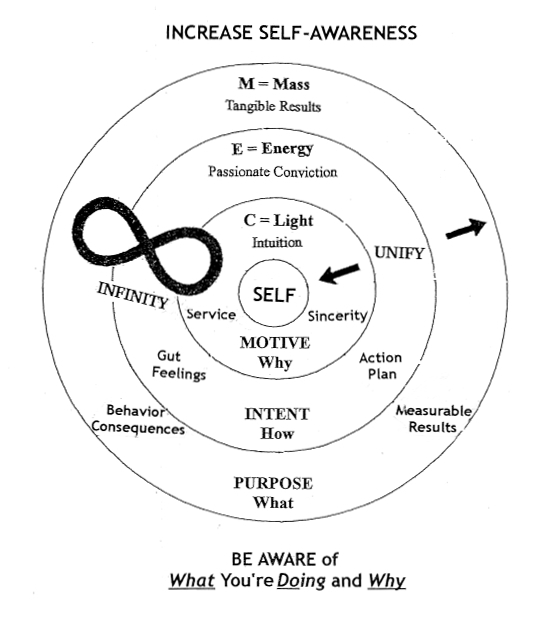
Motive, purpose and intent explain human behavior. Unless viewed as a whole, what we see is taken out of context and misunderstood. You see a man take someone else’s car. That’s intent, the what. You see him grab the keys and drive off. That’s purpose, the how. But unless you know his motive, why he did it, the picture is incomplete. Was he desperately racing to save his beloved child’s life, escaping from vengeful gang lords, or simply lusting after a fancy new car?

We’re fascinated by crime. Mystery novels, detective movies and sensational murder stories on TV news are big business. We stretch our minds to second-guess the ending, figure out who committed the crime, and why. We look for the mistakes that reveal dark secrets and lead to the criminal’s undoing. We’re satisfied only when truth is revealed and order is restored by justice.

At heart, what we’re really trying to understand is ourselves. We’re haunted by a pervasive sense of wrongs committed against us, or by us. We can’t quite bring ourselves to recognize what they are, or to admit our own mistakes. But a nagging sense of unfinished business leaks out as voyeurism.

Ultimately, it’s the stifled voice of conscience that persistently calls us back to our neglected dreams and deepest longings for fulfillment. Those who allow themselves to be defined by others, who live in habitual fear of people’s opinions and fail to honor their inner sense of calling commit a soul-searing violence akin to suicide. The crime they commit is against their own true selves.

Failing to be true to oneself can be the hardest crime to detect. Finding one’s true calling can be the greatest mystery of all. People who march to others’ drums, unconscious of their motives and what moves those around them, live in painful confusion. Only those who know how to listen and dance to the inner music of their soul’s desire live in joyful harmony with themselves and the world around them.

 The I Ching is a means for turning the camera around, focusing in on ourselves. Uncovering hidden motives might cause initial discomfort. But it can lead to positive changes. After analyzing them, we have the option to decide on better ways to accomplish intentional ends.

Our what and how isn’t always appropriate to our why. Other solutions may accomplish our goals without committing crimes against ourselves and others.

 THE BACK

The opposite of motive is motiveless, to be without awareness of calling, any conscious purpose, or impulse to action. This condition is sometimes an extreme reaction to an extended period of frenzied, excessive, forced action. People experience it as apathy, shell shock or burn out.

 When crazed criminals go on sprees, kill strangers and wreak havoc on public property, their acts are regarded as random and senseless. To all but the most highly attained, the subtle laws of cause and effect are incomprehensible. There’s wisdom in accepting the unfathomable as Job did, saying, “The Lord giveth, and the Lord taketh away.“

 ————————–

John M. Ortiz, The Tao of Music: Sound Psychology. (Samuel Weiser: ME, 1997.) p. 7.

John Douglas, The Anatomy of Motive. (Scribner: New York, 1999.) pp. 25-26.

Andrew Weil, 8 Meditations for Optimum Health. (audio cassette, Upaya,1997.)

—————————

Illustration from Conscience: Your Ultimate Personal Survival Guide


Aware2

Rethinking PEACE

Given the extraordinary amount of pain suffered in many parts of the world today — not the least of which being the very real fear of nuclear annihilation — I’ve chosen a message of PEACE from Conscience: Your Ultimate Personal Survival Guide.

 Essay 61. PEACE

When the forces of nature unite in profound harmony,

heavenly PEACE fills the earth.

Lives blossom. Prosperity increases.

Easy communication makes it possible

for people to understand one another.

This leads to cooperative efforts that will be fruitful.

Tranquility follows fulfillment of life goals.  

— Patricia West, The Common Sense Book of Change

Conflict is woven into the fundamental fabric of nature. The sea and land meet in violent conflict and make waves together. The plow turns the meadow and wheat springs forth. . . Conflict is evidence that human beings are engaged in something interesting. . . [It] plays a key role in the growth of character and the development of stable relationships. Conflict makes us into who we really are. — Brian Muldoon, The Heart of Conflict

The principle of economy in movement arises from a state of internal harmony. A mind that is at peace is not easily swayed or disturbed. This principle also plays a vital role in daily life, whether in business or in combat. If one over-reacts and responds with excessive or unnecessary action, one is at a disadvantage.-Mantak Chia & Juan Li, The Inner Structure of Tai Chi

THE FRONT

Webster’s defines peace as freedom from war or a stopping of war. It can refer to a treaty or agreement to end war or the threat of war. It’s defined as freedom from public disturbance or disorder, public security, law and order. It refers to freedom from disagreement or quarrels.

Peace also means harmony or concord. It’s used to describe an undisturbed state of mind, absence of mental conflict, serenity, or tranquility. To keep one’s peace means to be silent, keep quiet.

The timid are satisfied with peace defined by predictable routine, without conflict or challenge. The aggressive prefer peace defined as defeat of enemies or absolute control over subordinates. The peace of the grave is cessation of life. I Ching philosophy guides careful thinkers away from these extremes.

In I Ching context, peace is an inward state of calm that manifests as outward poise. Where timid and aggressive definitions both depend on external circumstances, the experience of tranquility depends only on oneself. External conditions will always be in flux. Therefore, looking for peace in the world is an exercise in futility. Internal states, however, are subject to self-governance.

In Asian traditions, peace is akin to the yogic concept of contentment — an attitude of grateful acceptance of all seasons and quiet openness to the rhythms of life. In biblical context, the lyrical stanzas of Ecclesiastes capture the wisdom of natural law:

 To every thing there is a season, and a time to every purpose under heaven:

A time to be born, and a time to die;

a time to plant and a time to pluck up that which has been planted;

A time to kill, and a time to heal.

The sage takes responsibility for attaining inner peace as the first step towards world peace. Inner quiet begets the attitude of confidence, which in turn generates acts of compassion, courage and generosity. World organizations which would impose military peace upon warring nations comprised of individuals each at war internally have no hope of success.

Conflict, like peace, starts from the inside and projects outwards. Therefore, no matter what military force is applied, so long as people are educated into internal conflict, external wars will continue to break out.

St. Paul’s epistle to the Ephesians takes on significant new meaning in the light of I Ching wisdom. Peace seekers would do well to consider it carefully:

2.14.  For he is our peace, who hath made both one

and hath broken down the middle wall of partition between us;

2.15. Having abolished in his flesh the enmity,

even the law of commandments contained in ordinances;

for to make in himself of twain one new man, so making peace.

Meditative practices which intentionally focus on the corpus callosum as the middle wall which separates and/or unifies right and left brain (yin/yang, male/female) functions give practical means for implementing biblical insight.

THE BACK

Conflict and war are opposites of peace. Only the context of motive, purpose and intent determines whether they are necessary and to long-term benefit, or unwarranted and uselessly destructive. Shunning either out of fear invites danger.

Enforced silence is a perversion of peace. A totalitarian state can outlaw free expression. It may compel rigid conformance and suppress dissent. However, it cannot contain the vitality of the creative life force, which always prevails.

———————–

Patricia West, The Common Sense Book of Change. (+A Positive Action Press: WI, 2000.) No. 11.

Brian Muldoon, The Heart of Conflict. (G.P. Putnam’s Sons: New York, 1996.) p. 9.

Mantak Chia & Juan Li, The Inner Structure of Tai Chi. (Healing Tao Books: Huntington,

NY, 1996.) p. 35.

Clinton, Putin and Einstein’s Worst Nightmare

Once again, the U.S. and Russia are edging towards the death dance JFK engaged in with Nikita Khrushchev during the 1962 Cuban missile crisis.

The ego-sparing between Hillary Clinton and Vladimir Putin has been escalating for months, almost as if to precipitate the current crisis, only ostensibly over the Ukraine.

We know George Soros is behind Obama and heir apparent Clinton. Heaven only knows what puppeteer is pulling Putin’s (or for that matter, Soros’s) strings.

None of this is said lightly. In fact, the title Rethinking Survival: Getting to the Positive Paradigm of Change refers to Albert Einstein’s prescient warning. Human survival can no longer be taken for granted. Nuclear annihilation, so terrible a prospect that most of us refuse to wrap our minds around the possibility, doesn’t disappear by just denying it.

A ground swell of public opinion should be stirred to put worldwide pressure on leaders to back off from the terrible brink. This is the Positive Action response to the threat of mortal danger recommended in the section “We’re in a Terrible Mess.”

Open letters to Putin, Clinton, Soros and Glenn Beck set the stage. Here are excerpts from the frontispiece:

 “Cynics may ask, ‘Why do paradigms matter one way of the other? What do they have to do with survival?’ My repeated answer is, ‘A great deal!’ Rethinking Survival applies directly to practical politics. As an example of what’s possible, here are four open letters to world leaders currently dedicated to shaping the directions of our collective future.

 “VLADIMIR PUTIN: Let history remember you differently from the first consolidator of all the Russias, Ivan, who impoverished the serfs and was called “The Terrible.” Be remembered as Vladimir, who protected his people, prevented starvation and was called “The Wise.”

“HILLARY CLINTON: John F. Kennedy’s undelivered speech left us a legacy. Parallel to Einstein’s unfinished quest for the Unified Theory, the time is right to pick up Kennedy’s fallen flag and move forward, using the Positive Paradigm as the basis of a common leadership initiative.

­”GEORGE SOROS: In a flash, history’s greatest persecutor of truth changed into its greatest advocate. Like Saul become Paul, you still have time to open your eyes and truly soar in the annals of history by making a similar reversal. Apply the Positive Paradigm to your own life choices. See Part Three: Atheism Answered.

“GLENN BECK: Back Clinton and Putin’s efforts to transcend ego animosities for the sake of something truly worthwhile. Call on them to build lifeboats ahead of the crash looming ahead. Help them complete the unfulfilled legacies of Einstein and JFK. We have lost time to make up for.”

Commentators on TheBlaze, notably Jay Severin, have decried Russia’s so-called “intervention” in the Ukraine and expressed outrage over the ironic possibility of Putin receiving a Nobel Peace Prize. Though, why not? He’d fit right in with other recipients like Henry Kissinger and besieged Americans’ current disastrous leader.

Severin is adamant that his boss, Glenn Beck, has done much more for world peace than Putin. Hmmm. I’m not so sure about that one. What’s still missing is a critical piece of the information puzzle, lacking which, things continue to go terribly wrong, even despite the best of intentions.

The greatest irony of all is that Einstein had the key all along, but never knew it. Read Rethinking Survival for the missing Unified Theory. A five star Amazon review describes it as: “A broad brush stroke type of book that touches and colors so many elements and areas of life. A great read and well worth the investment.”

Read it. Give the Positive Paradigm of Change a chance. At stake is nothing less that human survival.

 globe

Rethinking Discrimination

On Jan. 3, 2014 at 4:45pm a blog posted on theblaze.com announced that “Greta Van Susteren is one of few people who understands how to talk about racism.” Beneath that was the comment, “If national talks about racism could all be led by Fox News anchor Greta Van Susteren, we’d all probably be in a better place.”

I checked out the comments she made on “Off the Record.” To summarize, Greta says racism exists and it’s terrible. But using the race card wrongfully is just as bad. Public figures who stir up the pot are dividing the nation, not healing it. They’re doing a real disservice to those with valid grievances. She called for “Real Solutions to Solve Real Racism.”

The first comment on her remarks was posted by BMRCG, who wrote “Bravo Greta! Although it is your opinion and it is commentary, I agree 100000000% with every last word. There are many in society that perceive life through emotion and feeling, much in the same way animals perceive their world. They have either lost the ability to think critically or never had it to begin with.”

I second this enthusiastic comment! Since Affirmative Action was my obligatory subject as a grad student in the UW-Madison Department of Educational Administration, I had to think long and hard about discrimination. As part of my story, Rethinking Survival has a lot to say on the subject.

So here are a few samples:

 THREE LEVELS OF LAW ARE OUT OF SYNCH:

Affirmative Action Was Doomed from the Start.

Why it Matters Now

The American Declaration of Independence names three kinds of law: the laws of man, of nature and nature’s God. The Book of Change is based on the laws of natural change. They emanate from and depend on divine law and serve as the rightful foundation of civil law. Clearly, human laws legislated in ignorance of or in opposition to natural and divine law are not likely to work out well. Policy makers at all levels would do well to give this point careful thought.

– P.E. West. The Common Sense Book of Change

In 1976, I participated in an educational law seminar, “How to Enforce Affirmative Action Legislation in Higher Education.” This assumption-driven premise (en-force) was backwards from the start. I applied the standard of natural law to social dynamics, backed it up with Jungian psychology, and arrived at the conclusion that the legislation was not only unenforceable. It would trigger backlash. Though hardly a popular viewpoint then, with twenty years time, my analysis proved correct.

 I wrote that we must first correct critical mistakes in our thinking which prevent both naming the problems we face and solving them. Experts mistakenly dismiss everything that’s not exclusively “rational” as “irrational.” The super-rational, highest octave (intuition, conscience, and divine guidance) and the sub-rational, lower octave (emotions and animal instincts) are lumped together as the “unconscious.” Poetic, biblical language is taken literally. Light and dark, male and female are mistakenly equated with physical bodies and skin types rather than dualistic pairs of cosmic energetic compliments which operate within each of us.

Based on this analysis, I made recommendations for what I called a Positive Action alternative for achieving valid Affirmative Action goals.

 ——————–

 Affirmative Action legislation was but one example of the disconnect between policy and practice which results when levels of law are out of synch. So long as rules of the knowledge game (epistemology — who has permission to know what, and in what ways) continue to close people off from the richness of their inner lives, negative discrimination (projection and scapegoating) will also continue.

 ——————

A keystone of this philosophy is the virtue of moderation. It acts as a fulcrum, balancing the alternating, see-saw ups and downs between opposite extremes. An example related to Affirmative Action legislation was the upsurge in the 1960s and 70s of radical feminism and angry black power in reaction to dominant oppression by white males. They are two extremes, opposite and equal mistakes. However, two wrongs don’t make a right. The second compounds the first, making a bad situation even worse. Solutions rest elsewhere. An easier way to approach the same understanding now would be to work with the derivative Positive Paradigm Wheel described in Part Two.

 ——————–

 In accepting an internship in 1976 at the Wisconsin Association of School Boards as their Affirmative Action advisor, I was intentionally seeking to broaden my horizons in what Goleman describes as “self-directed learning.” I was taking on an unfamiliar role within what, for me, was a whole new world. I was a relatively young, inexperienced woman being initiated into an old boys’ club. I was a university grad student mentoring with street-smart lobbyists who despised pointy-headed intellectuals. And the approach to “change” I brought to both the UW and to WASB — The Book of Change (the boundary-spanner’s handbook) — was continents and centuries apart from their ideas about change.

WASB’s Director, George Tipler, hated Affirmative Action legislation with a passion. As his staff secretly confirmed, the only reason I’d been brought on board was to get federal monies. The Association had been awarded a grant to train school board members on the school administrator hiring process, but only on the condition that an Affirmative Action component was included.

Nevertheless, when I pushed his buttons (as he said,“Put up or shut up”), George gave me his grudging respect. He introduced me to his lobbyist world, taking me to the Wisconsin State Capitol. He included me in lunch meetings with legislators, where he elaborated emphatically on his opinions.

But he also distanced himself, signaling to his constituents that it was okay to ignore my work. I organized a mandated state-wide seminar on Affirmative Action for school board members and district administrators. He set its date as the first day of deer hunting season. Morbid symbolism aside, no self-respecting rural school board member could be expected to attend.

To satisfy mandated requirements, I collected an anthology of papers written by seminar presenters. He had each article printed on different, pastel-colored paper. His staff snickered, “the fruit salad” manual.

However, there was some fun along the way as I managed to score enough “points” to keep the leader board even. My favorite example was the state-wide seminar on “How to Select Your School District Superintendent.”

For the sake of a five-minute presentation, I had to sit all day up front on the panel podium. Wearing my navy polyester pants suit, power red-white-and-blue neck scarf, and navy pumps, I was posed like politically correct window-dressing, while Lyle Bruss, the main presenter from Green Bay, droned on about selecting and interviewing candidates. His assumption: all were males.

Every time Lyle used the “he” word, I (quite inadvertently) winced. “Yeuch.” An audience member picked up on this, winked at me and elbowed his neighbor. Pretty soon, every time Lyle used the “he” word, the whole audience was going “Yeuch” back at him, chortling. It took Lyle several minutes to catch on. When he finally did, he turned beet red and made a flustered remark about having four daughters, all of whom were referred to as “he.” Point made, without my having to say a word.

——————

In his later bid for the presidency, Perot focused on the national deficit. He overlooked the greatest one of all: the leadership deficit. He propounded laudable policies, but was unable to enforce them, even within his own organization.

Just as policy was not enough to make Affirmative Action goals a reality, so policies out of synch with natural law fail miserably in corporations as well. The deficit which begins with limiting, skewed education incapacitates management. This reflects in government and world economies alike — a disaster of Titanic proportions.

The knowledge deficit — the change science sadly lacking in leadership training — cripples us. Politicians continue to talk about the urgent need for change. But they know not whereof they speak, any more than did the pseudo-Shogun honchos at E.D.S. Federal.

———————

 . . . tacking Affirmative Action legislation as an overlay on the surface level, while failing to address a deeper, divisive worldview, couldn’t help, and most likely would make matters worse. (Figure II.14 shows why enforcing morality with Affirmative Action legislation backfires, as well as the alternative Positive Action approach which works.)

———————–

Bottom line: exploitation is an energy dynamic, a symptom of self-destructive imbalance. To the extent that individuals operate on incomplete, inaccurate and false paradigms, they remain insecure, unconscious and functionally disconnected from their higher potentials. Out of that pain and suffering, like Kissinger, like Soros in the extreme, they will continue to feel justified in dominating, controlling and exploiting whomever they can, however they can — playing out power addictions with hypocritical talk of philanthropy.

Affirmative Action legislation has not changed these dynamics — nor, as discussed earlier, could it. Looking in the wrong places doesn’t help. Blaming outside enemies as an excuse to avoid self-examination and correction is a futile waste of precious time and energy. Although venting frustration in politically motivated social movements — even terrorism and outright war — may temporarily feel good, it doesn’t address the underlying paradigm deficiency that drives hatred, violence and injustice. It therefore can’t put an end to catastrophic outcomes.

Rethinking Suicide at New Year’s

globeTonight I’m remembering the year I worked as a legal secretary for a divorce attorney. His income was seasonal. Before the Christmas, business was slack. He shrugged it of philosophically. He knew he’d make up the difference and then some after New Year’s.

 Then, people who’d gone into the holiday season with unrealistic expectations crashed with opposite and equal disappointment. After all the anticipation, a let down was sure to follow. That’s when they decided to call it quits, in droves.

 Sometimes, calling it quits takes an even more drastic form. This is when Rethinking Survival becomes a must. Here are relevant sections.

 RETHINKING SURVIVAL – Excerpts

 Stability in the Midst of Change

Working with the Quantum Paradigm of Change gives the thoughtful person a realistic perspective on what changes and what doesn’t, of what to depend on and what not. The eternal center, deeper than change, is impervious to time. It’s changeless.

In stark contrast, on the surface, natural elements are continuously combining, separating and recombining. Matter is continuously composing and decomposing. Human organizations are inherently unstable.

Human relationships are continuously evolving. Only the power of higher love and disciplined long-term commitments override the natural process of death and decay.

For those securely established at the hub, the center holds eternal. With a correct and complete model of change, survivors are able to the maintain inner stability necessary to cope with unstable circumstances. But when people forget, they get stuck on the surface and then complain that “the center does not hold.”

Those attuned to the center don’t identify with surface changes. They know better than to take them personally. They don’t kill themselves when the stock market crashes. They adjust. They don’t kill others to revenge themselves on outrageous fortune. For the sake of their own sanity, they simply forgive and remain open to new opportunities.

From a limited human perspective, experience sometimes seems just, the logical consequence of past behavior. Other times, life seems to make no sense whatsoever. Most unjust. But that’s life as we know it on Planet Earth. “Shit happens.”

TO BE OR NOT TO BE: Beliefs and Information Make the Difference

“To be, or not to be: that is the question:
Whether ’tis nobler in the mind to suffer
The slings and arrows of outrageous fortune,
Or to take arms against a sea of troubles,
And by opposing end them?

Shakespeare. Hamlet

The specter of suicidal thoughts haunted my up-bringing. It’s taken me over fifty years to track this demon to its lair and tame it. In retrospect, in simplest terms, I was raised in a family, reinforced by a culture, which disconfirmed my very existence.

A girl who in no way matched demeaning stereotypes — who had no desire to either cynically exploit or fearfully cave into them — was simply a non-being. She could not and should not exist. The tacit message: “Make yourself gone.”

At first I coped with less catastrophic compliance — denial. I reasoned like this: “Women are stupid, fickle and helpless. If I’m not stupid, fickle and helpless, then I’m not a woman.” I disowned the labels associated with gender and escaped into music and books.

Only later, a yogic energy understanding of the difference between feminine essence and cultural molds allowed me to rescue the baby from the bath water, reestablish an identity in harmony with the facts.

Shakespeare studies as well as reading and re-reading Faulkner’s masterpiece, The Sound and the Fury, helped clarify my dilemma.

So did Ph.D. dissertation research that explained the scarcity of women in school administration. It brought to my awareness the programmed stereotypes, antithetical to competent behavior, that I had to root out of my unconscious mind.

In Europe, I clicked with an “A-ha!” moment when a boyfriend put me down with the cliché, “Es gibt nicht so was,” which translates roughly as, “You’re impossible.” Literally, the words mean, “There is no such thing,” or “You don’t exist.” My angry answer was immediate. “Hier bin ich!” I pointed to myself with the literal retort, “Here I am!”

Surely no one intended by such mindless language to harm me, or Marilyn Maraffe either. Yet she is still dead and the lives of those affected by her suicide changed forever. This gifted young cellist, belittled and pushed to the sidelines by condescending males who knew not what they did, dropped out of Oberlin’s Music Conservatory.

She fell into depression, closed herself in her garage and turned on the ignition of her black VW Bug. She left a copy of Shakespeare’s Romeo and Juliet on the passenger seat beside her, opened to the death scene.

She didn’t intend to die. It was cry for help. But crying wolf can backfire.

By an unfortunate quirk of fate, the neighbor who arrived home from work punctually at the same time every night, who should have opened garage doors in time to rescue her, had an errand to run that night. He didn’t find her in time.

. . . In an inhospitable world that continues to disconfirm my true identity, pushes to wipe me off the map, cram me into the narrow molds of other people’s convenience, I practice the positive phoenix response open to everyone, everywhere. When outrageous misfortune impels to suicide, I die to the old, but only to continuously recreate myself new and better.

“Hier bin ich!” I am here still yet!

Einstein’s Energy Variable

 . . . Those denied access to material and social resources are often forced inside. Of necessity, turning inward, they depend for survival on strengths drawn from the middle and center of the wheel. At times, deprivation and hardships yield the opposite and equal blessings of in-sight and emotional fortitude.

At other times, however, excessive investment at the middle level results in delusions, latent with the potential for erupting into violence. In any case, making a virtue of necessity by rejecting the material world prevents completion of the pattern. It can’t correctly be equated with spirituality.

Societies which enforce an exclusively materialistic worldview that denies the experience of everything not tangible and measurable place severe hardship on those whose inner lives are especially active. Denying high energy people’s drive and failing to provide practical methods for articulating and harnessing inner energies creatively can literally drive people crazy, to suicide, or at best, underground.

Many “sensitives” survive by channeling socially banned, unacceptable awareness into the arts: music and literature, including romance, murder mysteries and science fiction.

Humor provides another outlet for releasing the pent-up emotional tensions which cause illness. The Quantum Paradigm gives credence to the Norman Cousin’s belief that “laughter is the best medicine. ”It validates the healing wisdom of Patch Adams, the paradigm-breaking physician whose clowning with patients has earned international fame.

————–

 The Danger: Programmed assumptions too often drive our decisions, actions and ultimately, survival options. Even with the best of intentions, misinformed people operating on conflicting beliefs destroy themselves and others.

Sometimes the process is quick. Murder. Suicide. Usually it’s slower — atrophy and self-sabotage.

This is why it’s imperative to recognize and root out the assumptions based on dysfunctional paradigms that tie us in knots. They tear us apart. They drive us crazy.

To survive intact, we must cleave to the essence of the perennial philosophy. The Quantum Paradigm is a snapshot of the essential truth which the world’s great religions share in common. It offers us a way out of global madness. It gives us a means for restoring sanity to our world outlook.

 ————-

Alien invaders delight in cheating. They stack the deck, gumming up the works with false information driven by dysfunctional paradigms.

If you accept the game and its rules as alien agents define them and proceed to rebel against uncivil authorities, mindlessly hating and resisting, YOU LOSE. (Alien invaders win.)

. . . The only chance of winning — ultimately, surviving — is to demand a new, clean, unmarked deck — one with all the cards. In other words, make a fresh start based on the accurate and complete Quantum Paradigm.

LET THE NEW YEAR BE THE TIME OF YOUR START FRESH.

All best! Pat West

globe

Answering Chrystina’s Question

globeToday, December 30th of the waning year 2013, Chrystina Trulove-Reyes posted a question about Rethinking Survival.

She wrote: “I would like to know more about the book. Is it about survival, the human condition, or mythology.”

Hmm. I answered back, “Good question. The short answer is, All of the above. The long answer deserves a post.”

Here I must caution, as I do in Rethinking, about the flexible nature of the English language. We often miss each other coming and going because the same word can mean many different things. This makes clarity in communication challenging — at best.

My answer as to whether Rethinking is about survival, the human condition, or mythology depends on what you and I mean. And it’s not really an either-or choice.

This isn’t just a quibble.

For example, take the word “mythology.” In the full spectrum use of “mythology,” it can simply mean fiction. But sometimes the slang use implies unscientific and therefore utterly false.

In a certain way, Chrystina, you’re creating a mythology with Cleopatra Stevens at survivingthezombieapocolypse.wordpress.com. But your story, though fiction, also speaks to the human condition.

Joseph Campbell, the famous comparative religion buff, used “myth” to describe the creation stories of the world’s great religions. These stories may be fiction, but they have served to answer our deepest questions. How did we get here? What is humanity’s place in creation? They define our common purpose and suggest possible futures.

From Campbell’s perspective, Yes. Rethinking is about mythology and the human condition. It’s basically one and the same subject.

“Paradigm” is another word for myth. It’s a structure for how we define ourselves, the operating rules of the world we live in, and humanity’s possible futures. Paradigm is used interchangeably with world view and belief system. Rethinking is, most importantly, about the importance and effect of paradigms.

In this context, Rethinking is also about survival. My point is that our belief systems — paradigms, world views, mythologies — shape our experience. To the extent that they’re false — don’t correspond with the facts — they can drive us crazy, push us to murder or even suicide. They can endanger our very existence.

When Einstein said we will need a substantially new way of thinking if humanity is to survive, he was referring to the dangerous effects of limited, separatist thinking. According to him, we must to expand our circle of compassion to get free from the prison of limiting world views.

Rethinking answers this urgent need.

So, Yes. it is about human survival. Yes. It is about mythology insofar as the term is interchangeable with paradigms and belief systems. And, Yes, because paradigms have a great impact, for better or worse, on the human condition, it is about this as well.

Thus my short answer: All of the above.

globe

WHAT YOU SEE IS WHAT YOU GET

After months of over nights engrossed in writing Rethinking Survival, the kaleidescope has turned. Time to put on another hat. It’s now or never. Give form to thought. First I produced the Kindle version and now the paperback edition. Quite a strenuous project. A friend likened it to giving birth.

Tonight, Friday, December 27th of the waning year 2013, I’m waiting for final approval of the submitted book. How, then, do I announce this new arrival? It’s full of hope for the New Year, yet so fragile in its uncertain future.

When I draw on my memory banks for the best way to describe my concern, I’m remembering a powerful experience from Oberlin years. It was the mid 1960’s. I was a college Freshman. The occasion was a performance of Brahm’s A German Requiem.

I was seated towards the back of the upper balcony in Finney Chapel. This 19th century, church-like assembly hall was fitted with wooden pews and a large front stage. The Conservatory Orchestra and College Choir were seated up front. The chapel was filled to capacity with a mix of students, faculty and “townies.”

The Requiem wasn’t new to me. As a member of the Festival Choir at Interlochen’s National Music Camp, I’d actually participated in an earlier concert. So the power of the music was reinforced with memories of intense rehearsals.

The unforgettable, dirge-like opening weighs on the soul with its ponderous message of mortality. ” . . . all flesh is as grass, and the glory of man like flowers. The grass withers and the flower falls.”

But at Oberlin, I had the misfortune to be seated behind a clique of music students. (Conservatory students called their building the Con. We called them “Connies.”) They were remarkably oblivious to the solemnness of the Requiem. Throughout, they showed off their cleverness by critiquing the performance. In stage whispers, hissing derogatory remarks. A soloist’s pitch was off. The conductor’s tempo was too slow.

However, right next to them, ignoring the Connies entirely, sat a single listener, engrossed in his attention to the music. His right elbow rested on the pew before me, his hand resting on his chin, as if deep in thought. I could actually hear his wind-up wristwatch ticking in time to the morbid music. It took my breath away. It seemed as if the watch was in synch with the Brahms, confirming the shortness of human life on Earth. The countdown clock was ticking for those with an ear to hear.

Were the Connies rude? That was the least of it! They’d totally missed what Brahms had labored to communicate to us from an earlier century. What a loss.

Were they correct in their technical assessments? Maybe, so far as it went. I wouldn’t know. Because I was listening for the music, not the mistakes. This was my choice.

I made this decision at Interlochen while attending student concerts there. On the one hand, I realized, I could listen with my physical ears, focusing on the limitations of amateur musicians. But that approach would have driven me crazy. I’d have made myself miserable.

On the other hand, I could listen with the heart. I could open myself to what the composer heard with the inner ear and done his best to express in the language of music. I could admire the energy of enthusiastic, sincere students who loved the music and were doing their very best, however imperfectly, to measure up to it. That was the beneficial path of gratitude and enjoyment.

In the English language, we use the same word for both the piece of paper upon which physical notes are printed . . . the sheet music . . . and for the music itself. In contrast, in the German language of the Requiem, two different words are used to distinguish between the notation and the actual sound.

Just so, I agreed with myself not to worry so much for the technical notes, but instead to focus on the actual music. I chose to listen with the inner ear to hear what the composer intended and what merely human musicians labored to recreate. Here Brahms was reminding us with his dark, brooding music that mankind, as numerous as blades of grass on the face of the earth, is perilously mortal. Like flowers, all human greatness ultimately comes to naught.

But the Connies missed it in their chit chat, hearing only with their physical ears.

This memory serves to illustrate the choices available for approaching Rethinking Survival. It’s my best hope that readers will meet me half way — that they’ll focus not on the book’s technical mistakes but on its substance and value. This book is about survival in the very literal sense of the term. And like the Requiem, it balances short-term warnings with long-term hope. Brahms completes his reminder of mortality with the confirmation of immortality: “The word of the Lord endures for eternity.” Rethinking Survival mirrors this balance.

In short, what I’m offering is the very best I could do given limited time and finite resources. For the sake of the message, I urge readers to forgive an imperfect messenger for the sake of the message. Because what you see is what you get — either a powerful paradigm or a less than perfect physical book. Your choice.


globe

Rethinking Our Common Humanity

Rethinking Survival

Excerpts

Without an accurate reality map, chances of success in life are slim to none. You need a complete picture of your potentials along with an accurate belief system, one that explains how the world works and what it expects of you.

Basing decisions on a worldview that’s distorted, incomplete or otherwise out of synch with the way things really are seriously diminishes chances of survival. In times as dangerous as these, it’s more important than ever to operate on correct and complete information.

But, as comparative religion legend Joseph Campbell observed, traditional creation stories no longer serve us well. He called for a re-vision of the timeless wisdom shared in common by the world’s great religions. We need a unifying view of creation that transcends cultural differences. In The Power of Myth, he put it this way:

“If we’re to solve the problem that’s confronting the world today, we will have develop a new mythology. The old myths are no longer serving us. We don’t have a mythology for people recognizing the humanity of a person on the other side of the hemisphere. I’ve often wondered if some of the notions coming out of quantum physics, quantum interconnectedness, don’t express that.”

Humanity needs a more inclusive reality map, one people worldwide can understand and identify with. The Positive Paradigm model meets this urgent need. It’s based on universally recognized and accepted physics, discovered by an internationally known and loved world citizen, Albert Einstein.

The Positive Paradigm of Change pictures an elegantly simply yet complete and correct reality map that accords with the way life truly is. It meets the Occam’s Razor standard: maximum inclusiveness with greatest simplicity. It has the power to give life travelers, wherever their journey starts, a new vision of life’s possibilities and with it, a realistic hope of survival.

It’s not “myth” as the slang implies, meaning unscientific, false and fictitious. To the contrary, it’s pure science, meaning “with knowledge.” It expresses the perennial philosophy embodied in the world’s great scriptures and shows them to be compatible with modern physics. The Positive Paradigm is equally consistent with science, the visionary poetry of culture-specific myths, and the Star Wars movies of George Lucas.

The Positive Paradigm structure satisfies Campbell’s call for a new mythology as the term is traditionally used. It is a symbolic representation of the creation story (genesis) and how humans fit into the picture. If it has a hero, as myths are said to center around a key figure, it would be Albert Einstein. He intuited the unifying theory which Campbell sought, and gave us the formula which, when plugged into Positive Paradigm Wheel, bridges the apparent gap between world religions and modern science.

The Positive Paradigm pictures what Campbell called “quantum interconnectedness:” a circle that, no matter where on the surface people stand, they are all connected to the same center. Every spoke of the wheel is linked to one unifying hub. The Positive Paradigm Wheel (which represents the whole world, of which everyone is part) literally gives us Einstein’s option of “widening the circle of compassion.”

It pictures a worldview where delusional separatist thinking has no place. Because, contrary to the conventional, competitive manner of thinking, the apex of individual achievement isn’t to rise above, separate from and dominate others. Quite the opposite. Paradoxically, the pinnacle of human attainment rests at the center of the Wheel of Life. Here, the illusion of Einstein’s dreaded separateness disappears.

Uniqueness belongs to the surface of the wheel, but the true height of attainment rests within. However, when the surface is linked with the center in an endless, infinite loop, there’s no conflict between individual freedom and universal compassion.

Tyrants of the world hate enlightened unity. They’ll do anything to prevent you from remembering that everyone, everywhere shares a common origin, that we are all inherently okay.

Because once you know this, as Einstein did, no one can intimidate, control or dominate you. No one can sell you on the virtue of warring against your neighbor. You’re aware that nothing anyone has for sale can make you more perfect. Nor can anything that anyone threatens to take away alter your essential okayness. It’s your inalienable birthright. A given.

“You are already okay.” This is the basic premise of the Positive Paradigm. It’s the realistic foundation upon which to build valid self-esteem. It’s the key to personal freedom — freedom from ignorance, freedom from fear. It’s the rock-solid foundation of functional democracy. It’s grounds for rethinking what the word really means and how to implement its promise.

One minor caveat: it all depends. While we all have the option to remember who we truly are, most of us are like Lambert, the sheepish lion. It takes a smack with a two-by-four upside the head before we’re finally ready to WAKE UP.

Often it takes the form of life-threatening danger to those we care for. A personal health crisis will also do the trick. So will job loss or a run-in with natural disaster. But, like Dorothy stranded in the land of Oz, when you want dearly enough to return “home,” you can click your heels whenever you chose — and come to find out, you’re already there.

Educators can use the Positive Paradigm of Change as a positive tool for motivating students. It is easy to understand, uplifting and unifying. It confirms the innate okayness of everyone everywhere. It simplifies the essence of world religions without bias. It emphasizes the importance of rational thinking and is compatible with science. It shows students the importance of experiencing every aspect of their lives. It’s the optimal tool for building the philosopher kings urgently needed today.

globe

Rethinking Survival can be purchased at amazon.com.

Einstein’s New Way of Thinking

Rethinking Survival

Here’s a summary of basics from Rethinking. The title reflects Einstein’s prophetic words:

A human being is part of the whole called by us “‘Universe,’

a part limited in time and space.

We experience ourselves, our thoughts and feelings

as something separate from the rest . . .

This delusion is a kind of prison for us,

restricting us to our personal desires and to affection

for a few persons nearest to us.

Our task must be to free ourselves from the prison

by widening our circle of compassion to embrace

all living creatures and the whole of nature in its beauty. . .

We shall require a substantially new manner of thinking

if mankind is to survive.

— Albert Einstein [emphasis added]

 RS web

The Positive Paradigm is the unified (and unifying) theory which Einstein sought. He missed it because he lacked a non-linear, concentric circle structure which expresses the dynamic relationships of his three variables in a two-directional, infinite continuum.

 The layered structure of the Positive Paradigm Wheel gives new meaning to Einstein’s observation that a problem can’t be solved at the same level on which it was created. “We can’t solve problems by using the same kind of thinking we used when we created them.” It gives new meaning to “Go deep,” and “We can’t be satisfied with superficial answers.” The model literally pictures the widening circle of compassion. It shows the way to escape from the prison of separatist thinking.

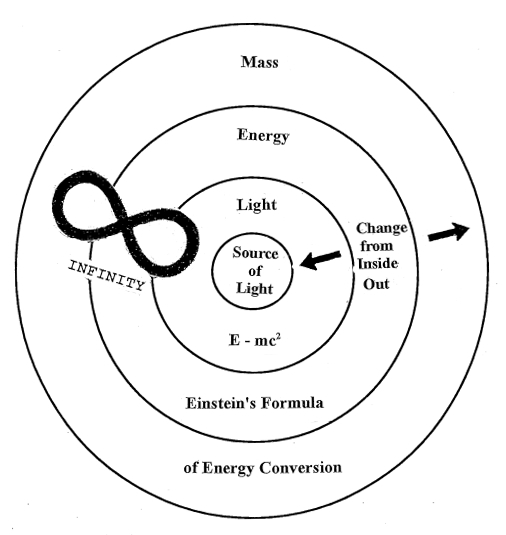
 As the book cover shows, three concentric circles orbit around a common center. The three variables of Albert Einstein’s famous formula, e = mc2 (energy, mass and light) are placed within this wheels-within-wheels structure.

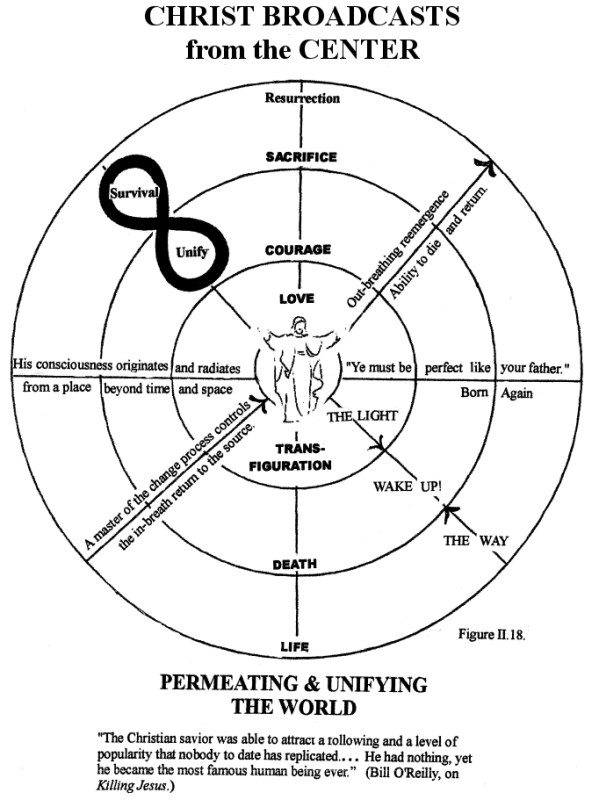
 The figure-eight-shaped symbol of infinity is used in the Positive Paradigm Wheel. Because the Creator is characterized as infinite, beyond time, using this physics symbol is an especially appropriate way to symbolize the linking of the levels.

 As light travels on the outward path, it transforms from wave to particle. As pure, generative potential expands, silence transforms into ideas and then emotions within the middle level of the wheel. These in turn materialize into actions that produce physical, tangible results. On the return path, the process reverses. Matter disperses. It returns to its basic elements. It contracts, receding from particles to waves and then into the perfect silence from which it came.

 The Positive Paradigm Wheel mirrors the microcosmic structure of atoms as well as the macro-cosmic structure of planetary systems. At the microscopic level, its concentric rings mirror the structure of atoms around a nucleus. It equally mirrors the symmetry of the planets orbiting around an organizing star, the sun. On the largest scale of magnitude, it reflects the in- and out-breaths of perpetually expanding and contracting universes.

 This familiar atomic structure repeats smallest to largest in the patterns of nature, from snow flakes and intricate flowers to spiders’ webs and sea shells. Similar symmetrical patterns in repeat worldwide in the art of every culture — including the prayer wheels of Native Americans, the colored sand mandalas of Tibetan Buddhists, the stained glass windows of European cathedrals and the intricate geometrical patterns that cover Muslim Mosques, to name but a few. They speak to the universal awareness of a central inner reality. They confirm a continuity of experience deeper than individual lives or transitory cultures.

 Outer levels of the Positive Paradigm Wheel are ephemeral extensions a timeless, absolute center. But the layers of concentric circles aren’t literally separate and discrete. Rather, they are a continuum along the infinite spectrum of creation. Within each layer are numerous degrees and distinctions which can be verified only by direct experience.

 The word Change in “The Positive Paradigm of Change” emphasizes that this isn’t a static model. It is dynamic, inclusive of the outward path of creative extension as well as the inward return to the creative source. This change is called “positive” because the creative process as a whole is in accord with the organic laws of nature encoded in the Book of Change. Positive change is quite distinct from the unnatural, superficial and arbitrary changes of short-sighted human devising

 This Positive Paradigm of Change shows how to think in the new manner Einstein called for. Working with it instills the ability to link the inner with middle and outermost levels of experience. The goal is to integrate conscience with emotions, reason and actions.

 The Positive Paradigm Wheel as an organizing model of experience isn’t really new, however. Restoring it now isn’t so much a paradigm shift as a return to what Aldus Huxley called the timeless, perennial philosophy which the world’s major religions share in common.

 This model emphasizes the holistic quality of creativity associated with genius. In fact, the secret to thinking like a genius has been known for thousands of years. Yogis call it Raja Yoga. “Raja” is the Sanskrit word for “king.” “Yoga” means “link” or “union.”

globe