Category Archives: Uncategorized

Healing & the Book of Change

Yoga Anatomy and the Hexagrams 

Yoga anatomy explains the unifying effect of working with the Book of Change. It isn’t necessary to know about its details in depth to receive the benefits of using the I Ching. However, the basics are highly suggestive as to how the hexagrams work and why their healing effect often seems magical. The following image shows the energy centers which correlate with lines of the hexagram. The seventh center, being beyond physical time and space, is not represented.

Both Chinese and Hindu versions of yoga describe subtle energy centers located along the physical spine. They are associated with the flow of electrical energy currents through the nervous system, but at a deeper level, along subtle pathways called nadis or meridians.

Both traditions draw on this knowledge in the practice of their healing arts. Both prescribe meditative practices that balance these centers for the ultimate purpose of achieving spiritual enlightenment. 

Traditional Chinese Medicine (TCM) and related martial arts work with three centers called “tan tiens,” or cauldrons. These correspond roughly with the head, heart and solar plexus. In this tradition, the bottom two lines of the hexagram correlate with the lower dan tien. The middle two lines correspond with the middle dan tien. The upper two lines correspond with the upper dan tien. Tai Chi, practiced as moving meditation, unifies the three centers with holistic effect. 

The yoga practiced in India posits six energy centers described as spinning vortexes or wheels, called “chakras.” These subtle centers correlate roughly with the physical anatomy of the brain, throat, heart, solar plexus, genital and anal regions.  

The six lines of the hexagram each correspond with one of the chakras. The top line corresponds with the ajna center near the pituitary gland, called the third eye. The bottom line corresponds with the base chakra. Increasingly higher centers correlate with progressive stages of human development.  

The chakra system of energy transformers which traverse the spine is another knowledge matrix that affects how we process and transmit information. Each chakra filters perception. Each influences the way we interpret experience. . . . One proof of this process is the wide array of Western psychologies, each relevant to a specific chakra issue.  

Skinner’s is a first chakra psychology based on behavior. Freud focused on sex, a second chakra issue. Adler thought in terms of power, the third chakra. Fromm wrote about love, the fourth chakra focus. Jung was interested in literary symbols and self-actualization, which are fifth and sixth center interests. 

Asian sciences, however, have recognized the interactive relationships amongst these concerns. They provide practical methods for integrating the chakras to pave an optimally functioning highway of continuous energy and information. 

Similarly, psychologist Abraham Maslow’s Hierarchy of Needs sums them up. His five stage model starts with basic physiological and safety needs. Once these are satisfied, the individual pursues issues of love and esteem. Only when these needs are met is one ready to focus on personal growth needs – ultimately “self-actualization.

Most of us function primarily at one or a combination of the chakra levels. Blind spots prevent fluid, integrated thinking, making it difficult to relate to other people’s perspectives. Working with the I Ching helps to open, coordinate and align the specific mental, emotional, and social issues associated with each of the six energy centers. This greatly improves the quality of personal relationships and professional effectiveness. 

Further, yoga anatomy has implications for human survival. In this world view, each individual is a miniature of all creation. Every unit, from atom to individual, mirrors the structure of the solar system and universe entire. So restoring order and balance to one’s own life does in effect save a world complete, one life at a time. 

Yoga Anatomy and the Caduceus 

The Greek caduceus, the familiar symbol of the Western medical profession, is a vestigial reminder of the origins (albeit forgotten) common to the Western and Asian healing arts, perhaps dating still further back to ancient Egypt’s Hermetic tradition. In Greek mythology, the caduceus is the healing staff of Mercury, messenger of the gods. It links heaven and earth. 

Far earlier than the Greeks, however, the caduceus is the model of yoga energy anatomy. It comes from a time-tested tradition thousands of years old. The axis represents the human spine. The pair of snakes winding around the axis represent alternating, cyclical patterns of negative and positive (yin and yang) energy currents. 

The six chakras are the intersecting points where the curving snake-like energy forces meet and cross at the axis. These are the major centers of transformation and evolution. The wings at the top of the axis represent the integrating seventh crown chakra. 

The Caduceus and DNA 

Just as the I Ching hexagram structure correlates with the chakras of yoga anatomy, the chakras in turn are associated with DNA.  

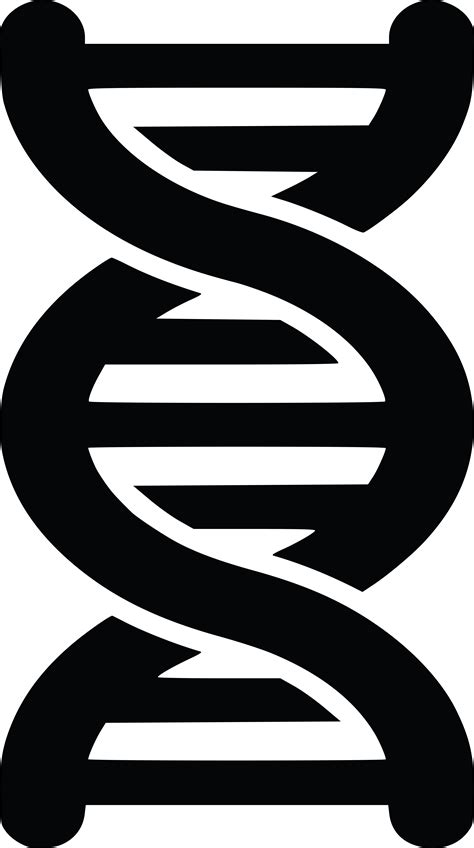
Further, the hexagrams have been directly correlated with DNA. In fact, the Chinese ideogram for the word I Ching looks remarkably like not only the caduceus but also the spiraling structure of the DNA double helix. This cannot be coincidental.

The I Ching Pictograph

The Double Helix of DNA

A shorthand rendition of the pictograph is featured on the Wilhelm/Baynes translation of the German version into English with its famous introduction by psychologist Carl Jung.

Many striking resemblances between the structure of DNA and I Ching hexagrams suggest at least one fascinating explanation for how/why this information source resonates with quantum inner knowing. It can’t be accidental that both the DNA helix and the I Ching matrix are based upon a binary-quaternary code that generates a system of 64 possibilities. 

The I Ching matrix with its 64 possible combinations of yin and yang lines along with their endless permutations lend themselves to medical diagnosis. For example, according to the Medical I Ching by Dr. Miki Shima: 

The practice of traditional Chinese medicine is based on the recognition of patterns of change within one’s patients. When these patterns of change are harmonious and foster life and well being, we say the patient is healthy or recuperating. . . Without going back to [the I Ching] . . . one cannot fully understand and appreciate the height and depth of the immense body of Chinese medical wisdom. 

Interestingly, Da Liu correlates a 64 form practice of tai chi with the 64 hexagrams of the I Ching, 32 of which are yin, inward and 32 outward.

Conclusion

These energetic correlations suggest the potential for a quantum approach to health and healing on all levels – mental, emotional and physical. It’s an approach from the inside out, a quantum solution to the medical madness currently plaguing our civilization.

Your Ultimate Personal Survival Guide 

PREFACE 

The 2000 millennial year title of the 64 Essays was The Ultimate Personal Survival Guide. It came from a brainstorming session with a business consultant for marketing The Common Sense Book of Change. She was unfamiliar with the I Ching

We went back and forth with questions and answers about its use and value. Finally, she sat back and blinked. “It sounds like the ultimate personal survival guide,” she concluded.  

She’d hit the nail right on the head. She got it! 

However, before she drew me out with her questions, I’d taken my answers to her valid concerns for granted. Others were likely to have similar doubts. 

So a further step was necessary. A follow-up book was required, one which would lead others to draw the same conclusion that she did. It had to dispel myths and misconceptions which prevent this gravely misunderstood and underrated treasure from getting the international acceptance it so richly deserves. 

I’d become certain that the worldwide leadership deficit (and related budget deficits) are explained by an underlying knowledge deficit. For lack of what The Book of Change has to offer, people everywhere remain perplexed as to how and why so much continues to go so horribly wrong, even despite the best of intentions. 

It seemed urgent to clear the decks. Making this compendium of Natural Law — the premier leadership training and decision-making manual in China for thousands of years — widely accessible now to fill in this fatal knowledge gap. 

Mainstreaming this vitally important information is the first, necessary step towards the positive change which many call for, but remain unable to achieve. 

Fourteen years later [now 24], I find myself in the same predicament. How does one shake up the sleeping public? What will it take to make people worldwide aware of how important this information is, and how gravely we’re at risk due to its absence? 

As a possible solution, I returned to The UPSG. In the process of updating the Introduction, I had an “Aha” moment.  

In the text, I’d made the conscience connection: The I Ching is called The Ultimate Personal Survival Guide because it refers to ULTIMATE timeless wisdom. This wisdom is accessible on a PERSONAL level, facilitating inner and outer change, one person at a time. This change gives us the edge on SURVIVAL, influencing who will survive, how, on which levels of experience. And it’s a GUIDE that helps put us in resonance with the ultimate inner guide — conscience

Taken out of context, however, the title left The USPG open to misunderstandings. It could be misconstrued as suggesting that the benefits of working with the I Ching come from the book itself. However, no physical book, no matter how inspired or useful, is correctly called an ultimate survival guide. Books are just material things. 

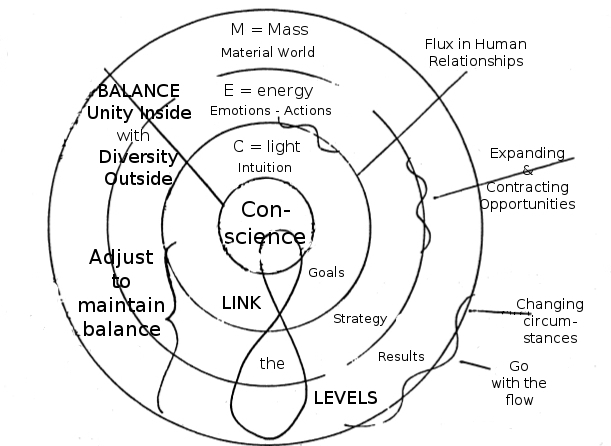
Conscience alone is the ultimate survival guide. The value of using The Book of Change is that it leads the individual back to personal conscience. It serves to reconnect the user with the eternal center which resides at the hub of the quantum Life Wheel.  

Exactly what is meant here by “conscience?” As with each of the 64 Essay terms, definitions of “conscience” have devolved over time. Here, the word refers to the pristine meaning of the term, associating it with “inner light.” 

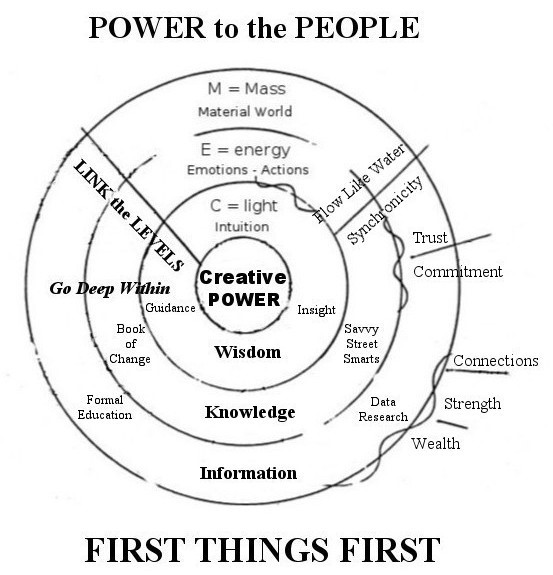
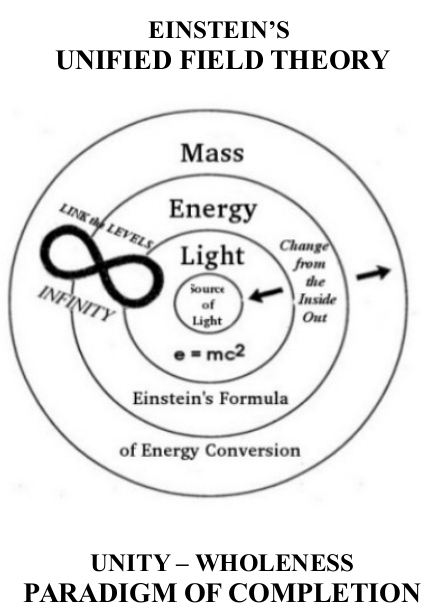
In I Ching context, Conscience is associated with the innermost center of the quantum Life Wheel. This yoga-compatible model, as detailed in Rethinking Survival and summarized below, layers the variables of Albert Einstein’s famous formula, e = mc2

Einstein’s view of conscience was consistent with I Ching use. He regarded an enlightened person as one liberated from limiting selfish desires, who has turned instead to aspirations of transcendent value. Einstein described the experience of an “inner voice” that brought him closer to the “secrets of the Old One.” 

Essay 12 on Values gives a snapshot glimpse of the word’s appropriate use: 

Conscience not only puts us in touch with our own uniqueness; it also connects us with the universal true north principles that create quality of life. 

The extraordinary value of the I Ching is that it reveals the secrets of dynamic Natural Law. Working with its changes opens inner access to the middle level of the quantum Life Wheel, the “e” energy layer of Einstein’s Unified Field Theory.  

This middle level serves as mediating, two-directional gate-keeper between the ever-changing surface rim and the universal, timeless center. You can’t get from here to there, except through the middle layer which, in Western thinking, is effectively taboo, buried in the inaccessible “unconscious.” 

To the extent that Natural Law is a blind spot in the prevailing, linear and exclusively empirical paradigm, we are left powerless to move beyond the surface level of experience. The realm of light and conscience which rests beyond, on the far side of the dynamic energy level, remains functionally inaccessible. 

Moral codes promoted by religionists or politicians are sometimes equated with conscience. But they’re no substitute for direct experience. Only by becoming intelligently competent in managing the subtle energies of the middle level is it possible to travel further inwards for the immediate, personal experience of inner light. 

When the middle level becomes clogged with painful memories, negative emotions and socially taboo urges, it becomes a barrier to deeper knowing. The Book of Change is indispensable as a tool for restoring the unnecessarily “unconscious” to conscious awareness, so that the levels of human potential can be linked and unified. 

In Quantum Paradigm context, survivors who prevail in dangerous times aren’t those with the most material wealth, possessions or political power. They’re the ones who’ve successfully navigated the middle realm, reached the far shore of enlightenment and returned to the surface with their new information intact. 

Those who succeed in linking the levels of experience are genius leaders in whatever fields they choose to engage. They’re the fortunate ones who’ve acquired the inner wealth necessary to both hear the inner voice of conscience and act on the guidance they receive. 

Q. & A. 

As yet, an exclusively materialistic. linear paradigm continues to generate the dysfunctional results experienced in every aspect of personal and public life. The powerful benefits to be gained from shifting to the more inclusive Quantum Paradigm are blocked by so-called authorities and experts who are highly invested in the limited and limiting empirical science paradigm. 

The I Ching is misrepresented with numerous assumptions and prejudices which have effectively kept this critically important information in the shadows. Answers to some of the most familiar doubts are listed below: 

  • Question: What does an ancient book from a foreign land have to do with me, here and now? 
  • Answer: Everything. As the compendium of Natural Law, the I Ching is neither time nor place-bound. It speaks to the questions we all ask about the human condition. For over 8,000 years, with good reason, it has endured as the foundation of Chinese healing, governing and military arts alike. No equivalent exists in the West. It fills a fatal gap in the way we think. 

  • Question: If it’s so important, why isn’t it taught in schools? 
  • Answer: Good question! Probably because the objections raised here are taught as assumptions instead. 

  • Question: Isn’t the Book of Change unscientific – just hocus pocus or New Age superstition? 
  • Answer: Like any other wisdom tradition that has endured over time, the I Ching has inevitably been subject to misuse. This doesn’t, however, reflect on its inherent value. This compendium of Natural Law is so highly sophisticated, in fact, that Western science is just beginning to catch up with it. For example, in the 1800s, Leibniz acknowledged that its mathematical foundations long preceded his calculus. The single and broken lines of the hexagrams are analogous to binary-digital computer code. Further, as described elsewhere, its 64 hexagrams are analogous to DNA structure.

  • Question: Is the I Ching a sacred book, like the Bible? Is it part of a religion? 
  • Answer: Yes and no. Taoists, Buddhists, and Confucians, despite their differences, all hold the I Ching in highest regard. It is used to connect with deity, on the one hand, and consulted for practical advice regarding every aspect of daily life, on the other. Sacred is in the eye of the beholder.
  • Question: Is The Book of Change pagan and therefore off-limits to Christians? Does it contradict or oppose the teachings of the Old and New Testaments
  • Answer: There is no conflict. Natural and Divine law are two different but interdependent levels of the quantum Life Wheel. Pagans by-pass Divine law, choosing to worship nature instead. In contrast, sages observe and work with the laws of nature, the better to serve humanity by serving the divine. Both the Old and New Testaments show an understanding of nature which is compatible with the I Ching worldview. 

  • Question: Can the I Ching be fully understood or appreciated without knowledge of the Chinese language? 
  • Answer: Hindu’s have a similar attachment to the exclusive value of the Sanskrit language, Jews to ancient Hebrew, and Muslims to the original language of the Koran. However, the Source of truth is beyond language. Its cultural expression at a particular time and place varies, but the basic essentials are necessarily the same. As translations into English and other languages continue to improve, this will become increasingly apparent. 

What is the I Ching? 

The Book of Change is a text that consists of 64 interactive, six-lined graphs — hexagrams — placed within the matrix of a circle, a square, or both. In combination, they map of the Natural Laws of change. Each graph is assigned a name represented by a Chinese pictograph. Translations are comparable to Plato’s perfect Ideas. 

The 64 hexagrams represent the bare bones of the life process. They are to Natural Law what basic axioms are to geometry. The open and closed lines the hexagrams are a convenient shorthand used to represent alternating energy valances. A broken line stands for negative (yin) energy (chi). A solid line stands for positive (yang) energy. 

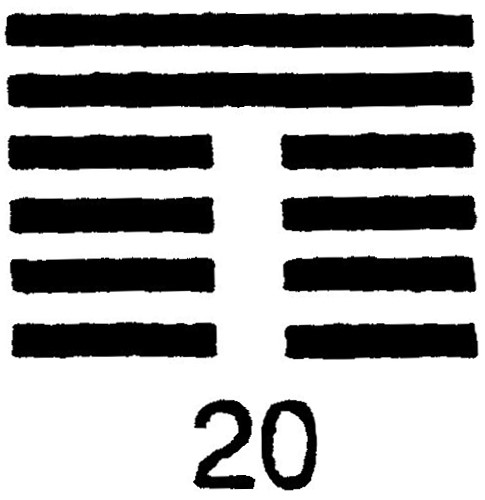
For example, the hexagram for Awareness, looks like this:  

Each hexagram is like the common denominator of a math equation. Each reduces expanded, complex relationships back to their most simple, recognizable form. No matter how complex or convoluted specific variations on the basic themes become, all experience can be reduced back to these fundamental dynamics. Over time, meanings have been associated with each of the hexagrams. These, in turn, have been elaborated upon by a succession of interpretations.

Because the hexagrams are universal, they can be applied to virtually any discipline. For example, one version of I Ching correlates the hexagrams with DNA discoveries. There’s a medical diagnostic version. Da Liu correlates his 64-form practice of healing tai chi with the 64 hexagrams of the I Ching. Another version applies the readings to Jungian psychology. A constitutional law professor at Yale University has published a commendable version. Yet another correlates the hexagrams with meditative Taoist practices. Other versions reflect on the order of family and social relationships, on successful business practices, and on the conduct of war. 

The basic readings are descriptive and informational only. There is no moralistic or prescriptive bent. The content is observational and practical: If this, then that. For example, if one squanders resources during times of prosperity, then times of adversity will follow. If one is respectful towards others, then they will be moved to behave respectfully in return. 

Using the interactive Book of Change is a powerful way to get in touch with the native common sense (conscience) we’re all born with, but too often forget under the pressures of hectic daily life. It is used first to increase self-understanding, then to create harmony between the inner world of self and outer world of others. 

There are many ways to select the relevant hexagram. All involve approaching the book with a quiet, open mind, analyzing the current situation, framing a question regarding that situation and then finding its answer. These methods are described in The Common Sense Book of Change

Whichever method is used, it yields a hexagram which represents the immediate moment. Each hexagram, however, has the potential to mutate. This is because any one or any combination of the six lines can change into its opposite. This produces one or more new hexagrams. 

The “direction of change” reading associated with the mutating line(s) indicate which level(s) are kinetically active and what the possible consequences could be. This information is regarded as a warning, which heeded, may influence future results. 

The correlation between actions and predictable consequences is called the Law of Karma. In biblical terms, this law is expressed as the familiar warning, “As ye sow, so shall ye reap.” It is the practical basis of ethics. It underscores the wisdom of the advice, “Do unto others as you would have them do unto you.” Because actions do, in fact, inevitably return in kind. 

Among other things, the I Ching works like a cosmic clock, telling us the time. In the Old Testament, King Solomon expressed the natural, rhythmic alternations of time in poetic form: 

To every thing there is a season, and a time to every purpose under heaven: 

A time to be born, and a time to die; 

a time to plant and a time to pluck up that which is planted

A time to kill, and a time to heal; a time to break down and a time to build up; 

A time to weep, and a time to laugh; a time to mourn and a time to dance; 

A time to cast away stones and a time to gather stones together; 

A time to embrace, and a time to refrain from embracing; 

A time to get and a time to lose; a time to keep, and a time to cast away; 

A time to rend, and a time to sew; a time to keep silence and a time to speak; 

A time to love, and a time to hate; a time of war, and a time of peace. 

Working with the Book of Change puts its users in touch with these pulsating, alternating rhythms of life. It connects them with inner knowing – call it intuition or conscience – that anticipates approaching changes, the better to prepare for what is to come. It serves as a reminder that our lives change like nature’s seasons. Fall follows summer. Spring follows winter. It lends perspective to the current times and what is likely to come next. 

Historically, the I Ching has been held in the highest regard throughout Asia for over eight-thousand years. Its cultural influence has been roughly equivalent to that of the Bible in the West. Leaders in philosophy, religion, healing, government, business, martial arts and the military were all trained from this single, universal text. It is still widely accepted as the basic manual of relationship dynamics and effective decision-making. 

How to Approach the I Ching 

The I Ching offers a comprehensive understanding of how the world works. It doesn’t, however, fit neatly into the usual book categories. It can be approached as an historical document or philosophical tract, but is far more than that. It can be used as a self-help book, but is more than that too. 

Above all, it’s a practical decision-making tool based on a comprehensive science. It challenges us to jump outside the narrow boxes within which we’ve been taught to reason, to qualitatively change the way we think. 

The method of working with the I Ching requires stilling the mind and entering the receptive, meditative state in which inspirational thoughts become available. As such, it is an invaluable compliment to the practice of any religion. 

Why Use the I Ching? 

In an age of ever-accelerating, sometimes bewildering change, working with the I Ching helps its users remain focused on the basics. Ephemerals on the surface of the quantum Life Wheel inevitably pass away. Social customs continue to change. Old friends move on or prove fickle. Jobs disappear without warning. Fortunes are lost over night. Buildings are blown out of the skyline.  

Loved ones leave or pass away. If we neglect ourselves long enough, even health becomes precarious. 

The more chaotic the uncertain world becomes on the surface, the more personal balance depends upon the opposite and equal anchor of inner strength, accessed with the help of timeless wisdom. The I Ching serves to remind us of the constant within change. It grounds us in unchanging reality, the better to sustain the courage and confidence required to endure and prevail during tough times. 

Working with the I Ching gradually changes the way we think, intentionally linking the levels of experience. It disciplines us to ask better questions and to be receptive to answers which extend beyond the parameters of empirical science.  

The I Ching advises, “It is futile to hunt for deer in a forest where none dwell.” Issues which can’t be solved with rational logic, money, mechanical engineering or brute force, soften and open in the light of inner wisdom.  

As such, The Book of Change is an invaluable life companion for everyone facing ongoing personal changes in a rapidly changing world. Its premise is the assurance that even when social, economic and political chaos seems staggering, taken one instance at a time, there’s always hope.  

The world at large is an unmanageable unit. But by focusing on the smallest unit closest to home, oneself, one needn’t be overwhelmed or paralyzed. Whereas forcing change on others is a violation of free will, one can always — especially with the aid of wisdom tools like the I Ching — change oneself. 

The important first change is not image or behavior, but more fundamentally, one’s vision of life’s potentials and the way to transform from within. The rest follows. It is, after all, possible to change the hearts and minds of others through one’s example. Perfected, one individual’s life can have a ripple effect that emanates outwards in all directions across the boundaries of time and space. Buddha and Christ both demonstrated this. 

Who Benefits from working with the I Ching? 

Natural Law is written in our hearts, in our very DNA. It is equally available to everyone with open ears and a ready willingness to hear. Those able to think with uncluttered, childlike simplicity resonate most easily with the I Ching call to conscience. 

Often, individuals at a cross-roads in life, where they suddenly find themselves in unfamiliar territory or it seems as if they have nothing to loose, take new interest in a book that helps them navigate life’s passages with dignity and grace. 

Importantly, the Book of Change isn’t the exclusive property of highly-educated people, nor of a particular gender, age-group, culture, class, time or place. It’s an indispensable basic, a valuable teacher to everyone who chooses to make themselves whole. 

A caveat: it’s not those who understand, but those who also follow through who benefit most from the value The Book of Change has to offer. Its concepts may be relatively easy to comprehend. But they’re not always easy to put into practice. 

Working with the 64 hexagrams of the I Ching requires the time to pause and reflect. It’s not like fast food that can be taken in at one gulp and then forgotten. 

But it nourishes on many levels. Its benefits are cumulative and enduring. Returns on the investment of time and effort made are exponential. 

Over time, I’ve come to understand that the I Ching’s value is measured by the quality of focused attention, self-honesty and positive intention with which it’s used. Those who dismiss it, who “believe” it is superstitious nonsense, fulfill their expectations. As such, this vastly powerful book has its own fail safes.

Context 

In Rethinking Survival, discrimination, violence and sexual abuse are linked to an information deficit. The Natural Law codified in the Book of Change

. . . fills in an information gap. It’s the missing link in our knowledge banks. In a complete worldview, the dynamic law of change occupies the middle level. It links the outer material surface with the innermost center. You “can’t get from here to there” except through that middle layer. 

This explains why many leaders, even with the best of intentions, go terribly wrong. When authorities operate from an incomplete paradigm, they’re blind-sided. Lacking what has been mainstreamed as “emotional intelligence,” they can’t identify the place where things are messed up. When they take a left-hand turn, they don’t understand why. Worse, they don’t know how to return to the positive path. 

Here’s the context: Laws of nature emanate from the Divine. It’s a mistake to romanticize (or demonize) nature. It’s a worse mistake to worship nature in place of the Creator. But being competent at the practical, middle (energy) level of three-part experience is essential to the whole. Again, it’s a sorely missed link in our functional knowledge base. 

The “subtle” energy realm lies between the outer, surface level of matter and the deepest center of unchanging stillness. As the functional link between extremes, both on the out-going and the in-going paths, it serves as the unavoidable gatekeeper and mediator between the two. “You can’t get from here to there,” except through this middle level of experience. 

Without wisdom and skill at this middle level of experience, spiritual aspirations cannot be realized nor can political policies be effectively implemented. Ongoing sex scandals which plague high-level politicians and clergy give a hint of what’s missing from their training, causing them to fail miserably at great expense to those they claim to serve. 

Using a well-familiar example from American history, here’s how I expressed the place of Natural Law in the Introduction to The Common Sense Book of Change

THREE LEVELS OF LAW. The American Declaration of Independence names three kinds of law: the laws of man, of nature and nature’s God. The Book of Change is based on the laws of natural change. They emanate from and depend on divine law and serve as the rightful foundation of civil law. Clearly, laws legislated in ignorance of or in opposition to natural and divine law are not likely to work out well. Policy makers at all levels would do well to give this point careful thought. 

In Common Sense, Thomas Paine wrote about the relationship of divine, natural and human law in a way that inspired readers at the time of the American Revolution to fight for freedom from tyranny. Approaching natural law from the deeper understanding of the ancients could inspire a reinvention of democracy now.  

Sages say that freedom from tyranny begins with dispelling ignorance and overcoming negative emotions. True freedom starts with the self-awareness and self-mastery which can be gained by diligent use of the I Ching

I had this in mind when critiquing Affirmative Action, and in formulating Positive Action alternatives to achieve the valid goals of misguided legislation bound to trigger backlash. 

Overcoming Fear of Change 

Lacking the balancing anchor of that which is beyond change — that which puts short-term change in perspective — people stuck on the surface of the Life Wheel become fearfully addicted to the familiar. 

But resisting change doesn’t prevent it from occurring. It only leaves the fearful unprepared to meet change when it inevitably arrives. They’re perpetually behind the eight-ball, left out of “luck,” a day late and a dollar short. 

Addressing unnecessary fear was a large part of my incentive for bringing the Quantum Paradigm to the public. It speaks to those who struggle in dark, doing best they know how as they continue to live lives of “quiet desperation.” 

They intuitively know, as I did earlier, that somewhere somehow something is terribly wrong. But they too don’t know where to look, or what to fight. 

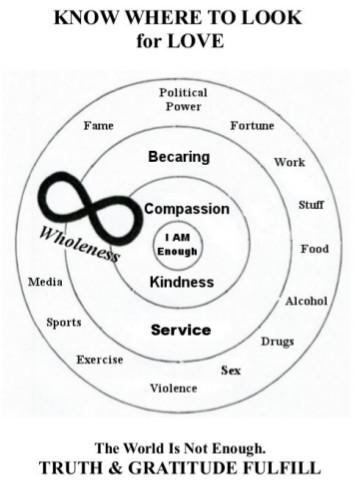
They feed insatiable appetite with all the wrong foods. They take vacations to escape from angst, but in the wrong directions, and wake up afterwards, hung over and broke. They hunger and thirst, but things of the world do not satisfy.  

27. GROWTH

People seek help according to what they need for their own growth.
Unless hunger is fed with the right food, no amount of input will satisfy.
To understand others, watch how they nourish themselves. Nature provides for all.
Leaders promote those who have the ability to serve many. Avoid greed.

Conclusion 

Although The Book of Change is held in highest esteem by philosophers of every nationality, as well as the followers of the world’s enduring religions, the I Ching is not a religion. It is a map, expressed in binary mathematical code, of Natural Law. It explains not only the observable patterns of natural events, but also repeating cycles of dynamic personal life, social systems and nations throughout history. 

In its essence, the perennial Book of Change is timeless. It continues to help thoughtful users tap into the source of universal wisdom which all enduring spiritual, religious and healing traditions share in common. It resonates with a fundamental inner core of experience which, despite apparent diversity, all truth traditions share in common. It therefore has the potential to link people of good will across the globe with a basis of shared understanding. 

Whether the context be therapy, spiritual practice, personal introspection, or practical decision-making, working with the Book of Change is the quintessential method for cultivating mindfulness and self-awareness. It enables users to move beyond the theory of their personal philosophy and into its practical applications in positive action. 

As such, this book which touches the heart of all religions, is the universal key sought by religious scholars. It embodies The Perennial Philosophy of Aldous Huxley, the common thread which links all human experience. 
Rethinking VALUES in 2024

In watching Watching JFK Jr. Birthday Celebration, it seemed clear that this noble soul is “here for a time such as this” to remind us all of our core values.

In rereading Essay 12 on Values, I’m reminded to be aware that whatever time left is precious, and to use it wisely.

12. VALUES

Learn to get in touch with the silence within yourself and know that everything in this life has a purpose. — Elisabeth Kübler-Ross, quoted by Sarah Ban Breathnach in Simple Abundance

Conscience not only puts us in touch with our own uniqueness; it also connects us with the universal true north principles that create quality of life. We can use conscience to align our values and strategies with principles, ensuring that both the ends and the means of our mission statement — both the contribution and the methods used in making the contribution — are principle-based. — Stephen R. Covey, First Things First

All this turning away from one another is terrible for our souls. When we live in a world in which ethical and spiritual goals have been excluded and ridiculed, we find the human spirit shrinking with disastrous consequences. Selfishness and cynicism are bad for our physical and psychological health. . . On the one end of the continuum, people approximate the extreme of caring only for themselves. On the other end, people begin to approach the biblical ideal; seeing every single human being as created in the image of God, and hence as infinitely precious and deserving of our care and respect. — Michael Lerner, The Politics of Meaning

THE FRONT
Value has the same root as valor, meaning strength.

Webster’s first definition pertains to money. It means a fair price for something sold or exchanged. It refers to the worth of a thing in money or goods at a certain time, the market price. It describes purchasing power.

Value means whether a thing or idea is regarded as more or less desirable, useful, or important. It points to that which is esteemed for its own sake, having intrinsic worth.

Value also pertains to social principles, goals or standards held or accepted by an individual, class or society.

In music, value is related to timing: the relative duration of a note, tone, or rest.

What a person holds in esteem defines his character. Whether a person consistently acts according to these values is the measure of her integrity. Living congruent with beliefs and promises affords peace of mind. Ignoring beliefs or violating commitments tears individuals, businesses and communities apart. We sicken and fail mentally, then physically, one at a time and then collectively.

Used divisively, “family values” is a polarizing slogan that stirs up political animosities. It places moral assumptions above the timeless values of wisdom and heart-felt compassion. In The Bible Code, Michael Drosnin observes that the family of man has fragmented into competing religions whose extremist leaders would rather destroy the planet than share the holy city of Jerusalem. According to him, placing the values of pride, ownership and sheer hatred over love of life signals the end of times.

In contrast, in I Ching context, moderation is esteemed as the greatest social value. For example, R.L. Wing’s version of Hexagram 15, “Moderation,” observes: “The enlightened person reduces the excessive and increases the insufficient. He weighs the outside world and bring about equality.”

Thus, to react with extremes of hatred towards those act hatefully endangers us all. Reacting with extreme fear to end-stage prognosis poisons the quality of whatever time remains. I Ching wisdom would call us to center and balance, moderating cultural conditioning with self-confidence and self-discipline. Where there is insufficient love and trust, they must be restored. Where there is excess fear, panic and resistance, they must be reduced. If the span of life, whether individual or collective, be short, then the value of each moment left is so much the greater.

Wisdom traditions regard survival in terms of soul, not body alone. We do our best when we focus not on the fact that we eventually die, but on how we use our allotted time on earth. Then, every day becomes a precious opportunity to earn what Elizabeth Kübler-Ross calls a “good death:” safe passage to the beyond with our life-work accomplished — lessons learned and commitments fulfilled.

Increasingly dangerous times heighten the sense of urgency and value placed on making the best of every day. Prophecies simultaneously warn of the end and promise a new beginning for those who live the law. The Bible Code can be read as yet another wake-up call, a reminder that the time to put our lives in order is NOW.

Mortality is a given. Experiencing immortality, however, is a choice. We can either follow the sleep-walker’s path to oblivion or value I Ching wisdom, heeding the DNA Bible code written in our hearts, remaining alert and awake to hear and do whatever it takes to ultimately survive.

THE BACK
Opposites of value include scorn, contempt, and rejection. Closing off awareness of connection results in failure to honor life. By denying creative potentials in ourselves and others, we underrate and debase our collective worth.

Overestimating the worth of money, status and physical beauty is a perversion of value. Unthinking acceptance of others’ opinions as more important than personal health, integrity, or self-esteem has a corrupting effect, resulting in puppet-like behavior. Portfolio value can vanish overnight; the soul’s worth is eternal.

Reconciliation Is an Inside Job

From my heart to yours.

This will be a mosaic of puzzle pieces. I’ll place them here, one at a time. Trust me, they will come together in the end.

* * *

For starters, the reconciliation which philosophers (wisdom lovers) seek isn’t to be found in duality, on the surface of the Life Wheel, where illusory options alternate without cease. I Ching sages put it this way: It is futile to hunt for deer in a forest where none dwell.

To the point, why call the pending econ shift a Rawlsian moment if the collapse and reset is not what Rawles foresaw or which social justice Marxists intend? Extending an olive branch as if to appease them couldn’t possibly prevent the destructive civil war upon which communists are hell-bent.

Calling a donkey’s tail a leg doesn’t make it one. (Remember?) Not only does applying incorrect labels to band-aid over differences fool no one. But current problems are way deeper than labels. Solutions are deeper still.

But not to worry. The reconciliation you sense and strive for IS to be found, IF you know where and HOW to look.

What’s coming doesn’t fit within the box of old thinking – Rawles, Buffet or Munger. Only thinking outside the box, expanding the parameters of reality correctly can encompass what may come.

The synthesis must be more organic, more metaphysical than 3-D, linear thinking allows. It’s outside the narrow, tidy either/or paradigm familiar to logic-choppers. Genuine synthesis isn’t possible within the limited confines of rational thinking. It requires a shift to a broader, more inclusive reality map. One inclusive of not only the rational but also the super- and sub-rational.

Genuine synthesis requires linking the levels of the quantum Life Wheel, placing opposites face-to-face and then transcending them. Unifying them into something new and qualitatively different.

* * *

Shifting gears, let me tell you about a round table discussion held by OA associates a few years back. About six months before his passing, he put out a question. What would each of us most like to have? Before he left, each of our wishes was granted.

One asked for money to repair the house and paint the inside walls. Another wanted a greenhouse for her garden. Yet another asked for a new truck and trailer.

What I asked for was the software of The Bible Code. Though we didn’t purchase the computer version, I was provided with what I really needed. I’d already been given it, though at the time didn’t recognize it as such.

In Kabbalah, the 72 Names of God are encoded in three consecutive verses of Exodus. During the years working the overnight shift at the Relay Center for the Deaf and Hard of Hearing, in order to become familiar with the 72 Names, I retaught myself the basic Hebrew to work with this code.

It answered a long-standing question I’d had about the I Ching. The 72 Names filled in a gap left empty by the Laws of Nature codified in the 64 hexagrams of the Book of Change. Where the I Ching speaks to the fluctuations of energy that influence the material world, the 72 Names speaks to a higher dimension, one of values.

The I Ching is value-free, focusing primarily on the middle, e=energy level of the Life Wheel associated with Natural Law. In contrast, the 72 Names relates primarily to the deeper, c=light level associated with Divine Law.

For example, the I Ching speaks of Gain versus Decline, Promotion versus Adversity, etc. In contrast, the 72 Names speaks to the inner experience of Compassion, Gratitude, Humility, and Angelic Influence.

This isn’t the place to get more technical. And there are overlaps. But, in essence, these approaches to reality address qualitatively different facets of experience.

After my request, what I came across, “coincidentally,” was a whole new side of the 72 Names. The Relay Center work set the foundation that prepared me to now add on new levels of understanding. Each of the 72 Names is associated with specific archangels and angels, as well as their manifestations.

In retrospect, I was being prepared to survive after OA’s passing. Just as I was encompassed by his auric field and protections during his lifetime, I was being made aware that I was and would in the future continue to be supported and sustained not only by him but also the host of angels he referred to as his “drinking buddies.”

* * *

I mention this angelic support as introduction to a relevant experience with a recently purchased, extraordinarily powerful deck of Archangel Metatron messages. I know there are uses and abuses to working with such information sources. The same goes for working with the I Ching, or, for that matter, with various translations (sometimes printed in China) of the Bible. For the sake of this discussion, please give me the benefit of the doubt and stay with me.

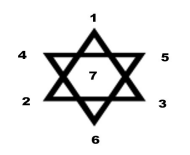
I work with this particular deck as a way to make the unconscious conscious, to trigger inner knowing and expand awareness. When I’m really stuck and need help, I call on angelic input for answers. I find this spread particularly compatible. It uses the Star of David, placing messages at each of the six points and then a 7th in the center. It looks like this:

The top point is read as the overall message. The bottom, 6th point is read as action advice. The 2nd and 4th points are lower and higher octaves of overt experience. Their complimentary points in the 3rd and 5th positions correlate with unconscious/subliminal experience and blocks/obstacles. The seventh message is read as the sum effect of the six outer points as they combine to influence the center.

What’s fascinating to me and important here is that the healing effect of working with combined messages requires that what’s hidden must be brought forward and brought into balance with the overt experience in order for resolution and reconciliation to occur. What’s in darkness must be brought into the light, lest it undermine and undo conscious intention.

It’s relevant to the dynamic of Greek tragedy, where the hero’s strength, unbalanced and in extreme, becomes the source of his undoing. Just as Carl Jung regarded the I Ching as a tool for making the unconscious conscious, similarly, to prevent tragedy we must balance and harmonize extremes. This isn’t a Hegelian synthesis so much as Unifying the quantum field, resulting in transformation and transcendence. Shifting to a higher octave, if you will.

That’s where the flat, linear empirical science paradigm which rules out the inner levels of the Life Wheel, allowing only what can be rationally measured and quantified into awareness, betrays us. It prevents the dynamics by which the influences of Natural and Divine Law color and direct decisions affecting the outer material plane of physical existence.

Einstein, the physicist, called this culturally imposed blind spot “the fateful fear of metaphysics.” I’ve called it the fateful fear of self-awareness. This is the rock and hard place between which civilization is stuck right now. And Steering planet humanity safely past the twin dangers of tyranny and anarchy requires full-spectrum, quantum awareness.

* * *

Now, I’ve also been following the work of Dr. Joe Dispenza for quite awhile. He says much the same things, but in rational, science-based language which healthcare professionals and spiritual seekers alike can relate to.

By profession he started as a chiropractor and martial arts/yoga/meditation instructor. This background prepared him perfectly to survive an accident that shattered his spine. Four experts agreed that what remained of his spine had to be surgically altered and fused with metal rods, with the prognosis that he might never walk again.

As a leap of faith, he said NO.

Using powerful mind-intent combined with an exact knowledge of how the spine works, he visualized and – within a relatively short time — repaired himself completely from the inside out. Paying this blessing forward, fulfilling a promise to help heal others as he’d been healed, he’s made it his lifework to teach others what’s possible with the right quantum reality map along with practical information on how to use it.

P.S. Dr. Joe admits that angelic beings show keen interest in his healing workshops. He and other participants repeatedly report their presence, observing and overseeing this work.

For lack of time, I am simply quoting relevant sections transcribed from A MIRACLE Could Happen To YOU! — How Your THOUGHTS Create Your Reality. Applications to the current deconstruction and reconstruction of world governments, economies, etc. abound. Here goes:

. . . the more you understand WHAT you’re doing and WHY you’re doing it, the HOW gets easier.

. . . If you give them the proper instruction and you set up the conditions in the environment where they feel safe enough to create, a certain number of people will get their behaviors to match their intentions and their actions equal to their thoughts. When they do, there’s going to be some type of transformation. All you have to do is understand the formula.

The miraculous of biblical proportions is beginning to happen. This is a time in history when it’s not enough to know. It’s a time to know HOW.

. . .We’re reaching a point of critical mass. We’re living in a time of extreme polarities. Things have to be pulled apart. Polarity . . . if you look at studies in chaos theory . . . there always have to be extreme polarities before there’s a reorganization. And everything that is not consistent with a new level of energy or a new level of consciousness is going to spiral apart.

. . . That greater level of energy and consciousness is causing old systems and old paradigms to begin to spiral out. Whether you’re looking at the environment, politics, economics, religion, education, journalism, medicine . . . all of those paradigms are beginning to unravel because they’re no longer consistent with a greater level of energy.

. . . So, now then, the next question is, how do you change the world? Because if you’re seeing those non-local changes, then those people who are feeling heart coherence . . . every person they’re in a relationship with, that they are networked with, to some measure or degree will have an affect on their autonomic nervous system. They’ll feel more coherent, more loving in that moment. . . . Heartmath Institute has done research in Project Coherence on the effect which can happen on opposite sides of the world.

. . . So the question becomes, How do you become supernatural? Well, you have to first start doing what feels unnatural. When everybody else is in fear, that’s when you show courage. When everybody else is hostile and angry, that’s the time to show love and compassion. When everyone else is in lack and poverty, that’s the time to be generous . . . to give. That gives other people permission to do the same. . .

. . . So when a person is able to sustain or maintain that modified state of mind and being, then the fun starts to happen. Because you start seeing those synchronicities, coincidences, opportunities, unknowns. Things start falling out of nowhere because you are connected to that field of information. Not only are you connected to it but also you’re beginning to influence it.

. . . The Unified Field governs the laws of nature that brings everything into order. As you connect it to more and more, then you experience more wholeness and more oneness, less separation. If you experience less separation, there’s less separation between you and your dreams as well. As you progress deeper into that field you can produce greater effects on the nature of reality because you’re moving closer to its origin.

We experience separation when we feel fear. We experience separation when we feel anger and aggression, pain and suffering. The very chemicals cause us to perceive reality with our senses. But as we get closer and closer to it and experience more of it, then we produce greater effect on the nature of reality because we’re more and more connected to the very field of information that organizes matter into form. We’re climbing upstream to be able to produce an effect downstream.

. . . Only when you are pure consciousness can you begin to change your body. Only when you’re beyond your body can you heal your body. The body can’t heal the body. You have to get beyond your body to heal your body. In order to to create a new experience, you have to get beyond the problems in your life. In order to create a future event in some future time, you’ve got to get beyond predictable linear time.

If you’re going to heal your body by thought alone, create a new experience or event in your life by thought alone, then you have to become thought alone. When you become pure consciousness, that is the moment you are nobody, no one, no thing, nowhere in no time – that is the moment when you are no longer constrained by those [natural] laws.

That is the moment your consciousness, free will, subjective human consciousness merges with the quantum field, the objective universal consciousness. When they come together and you come back to awareness, you take a piece of it with you and you become more like it:

  • You become stronger willed. It is a powerful will.
  • You become more mindful. It is an infinite mind.
  • You more consciousness, more loving, a lover of life.
  • You become more giving. It’s the giver of life.
  • Its nature becomes your nature.

So teaching people how to do that is the art. There are ways to help people get there faster.

Two Way Street

My first response to a video suggesting possible ways out of current madness was that it reminds me of an earlier post, The Highway to Heaven is a Two-Way Street.

I’ll first give you my response to the madness solution and afterwards, in case you’d like to take a look, supply a link to that post.

Premise: Today’s economic/political crisis is reaching critical mass. The war is being fought on several levels at once, not unlike the three-tiered chess game familiar to Kung Fu movie fans. Younger initiates defend the monastery gates, battling enemies in hand-to-hand mortal combat. Behind the scenes, senior monks seated in meditation, apparently immobile, direct subtle forces through mental intent. Higher still, passed-on elders oversee this war between good and evil, guiding the entire process.

Application: This video describes a way to reconcile polar world views. It’s described as a Hegelian synthesis of humanitarian versus totalitarian positions now necessary because an economic reset has become inevitable, triggering an egalitarian “Rawlsian moment.”

As an alternative to civil war followed by tyranny rising from the ashes of our republic, we can make a currency change, along with a transitional, dual currency regime. To prevent economic collapse and another great depression, it is proposed that the U.S. introduce a “newer, wiser taxation system”and social safety net in the context of that new currency.

A la Milton Friedman, we could introduce a flat tax counterbalanced by Universal Basic Income (UBI). This combo offers an olive branch to each political extreme, respecting the claims/priorities of each. The flat tax would satisfy fiscal conservatives. Touted as the greatest anti-poverty program you could hope to come up with, the Universal Basic Income satisfies “social justice” demands.

* * *

Next. Another synthesis with similar potential for reconciliation happens when you plug the antithetical visions described in Thomas Sowell’s A Conflict of Visions: Ideological Origins of Political Struggles into the Life Wheel.

Here’s a summary graph of opposing views.

The two apparently conflicting visions correlate with the in- and outward-moving energies which link the Life Wheel.

Outward-traveling yang energies extend from center to surface. Converting to its complimentary opposite, yang changes to yin, reversing polarity to return from surface to center. In this overview, the two are linked in an infinite loop. No conflict.

The apparent conflict between complimentary yin and yang energies resolves when plugged into this larger picture. Each has a place. The two sides are necessary and, in rhythmic fashion, in their pure form, are mutually reinforcing.

Only in the flat, false (linear) model of empirical science do they clash. All kinds of foolishness regarding authority, natural rights, and freedom follow from failing to work from a complete and accurate reality map.

Further, the war we’re in is not truly a clash of visions. Rather, it’s a clash of intentions. Some honor life and seek to fulfill it. Other want to destroy it.

In other words, what’s not okay is separating complimentary valences, setting them in conflict, creating the illusion that they’re an either/or choice. (Not to mention that those with evil intentions can coopt either “vision” and turn it to destructive ends.)

* * *

So, unfortunately, here’s where the reconciliation proposal, IMHO, breaks down.

Should we harmonize yin and yang, the outward energies of manifestation with the inward energies of aspiration? Yes. Always.

But that’s not the same thing as attempting to reconcile parties motivated by good intentions with those driven by evil forces. Impossible. They’re antithetical.

In How Bad People Become Leaders, I described the importance of acknowledging the existence of evil, and gave a picture to recognize its dynamics.

Basically, evil operates by fragmenting the three levels law: human, natural and divine. They operate out of synch and in conflict.

Evil is antithetical to the very life process, tearing the fundamental life pattern apart. So, NB: Good and evil cannot (!) be equated with yin and yang. Good is inclusive of the harmonious whole, both yin and yang, attainable by males and females of every race without limitation.

Those who love life, who seek truth and understanding and do their best to help others as they can, have more in common with each other than with evildoers within their own groups.

Here’s the picture of the evil:

Hitler is a familiar example of evil, meaning anti-life: intentionally shattering and fragmenting the creative pattern. In Quantum Paradigm context, the intentions and actions of any person (or group) that destroys its own and/or threatens to annihilate enemy groups, devoid of respect for the inherent sanctity of life, are defined as evil.

* * *

Finally, here is the promised link to the supportive post, The Highway to Heaven Is a Two-Way Street. Its reference to the hope of RENAISSANCE underscores the proposed reconciliation’s potential.

* * *

P.S. I regret the hasty, imperfect presentation of this piece. Given limiting circumstances, it is suggestive only. I publish it in hopes that it’s sufficient to prevent fatal flaws in the “reconciliation” approach from undermining a viable, urgently needed interim compromise.

Taboos

A recent round of comments opened up a Pandora’s box of messy issues. Since that site isn’t purposed to explore them, let’s do so here.

It started when, intending to give a site host a helpful heads up on the subject of timing, I commented:

FYI. From another point of view, the current astrological “weather report” shows all the outer planets in retrograde, auguring delays, setbacks and reversals. In rapid succession, they’ll all turn direct in the early weeks of October. That might be the best time to look for things to suddenly take off.

He responded simply:

ok

Which in turn drew this reproach:

eastern philosophies must have a strong hold on you to believe in the astrological report. (That was me before I was saved…Thank you Jesus!✝) [she challenged the host]: What are your beliefs?

Excuse me? Let’s count a few of the false assumptions wrapped around this condescending attitude.

  • I’m far superior to you.
  • I’m saved; you aren’t.
  • Astrology is a philosophy, and an eastern one at that.
  • Astrology is a belief system [a religion] that’s antithetical to Christianity.
  • My understandings back then were the same as those you hold now.
  • Case closed.

In retrospect, I should have ignored it. But, mistakenly thinking the challenge was directed towards me, I owned my beliefs:

I am of the persuasion that Jeshua ha’Mashia came before and will endure long after puny planet earth. His essence pervades all peoples through all times, influencing all cultures east and west, without prejudice. No either/ors. Since his presence pervades the entire world, how could it be otherwise?

Also . . . there are many approaches to astrology. Some focus on lunar cycles, others on cycles of the sun. Chinese seers followed the stars. Literally astro-logy. Each view represents a fragmented piece of a larger mosaic puzzle. Christ encompasses and surpasses them all.

Also, and this is important, astrology pertains to the e=energy middle level of the Life Wheel. Technically, it is an energy science, not a philosophy defined as “love of wisdom.” It’s just another tool in the decision-maker’s toolbox. Its usefulness depends upon the wisdom and intent of the user.

To make the point, I included this image:

On a side note, another member commented:

I heard 9/6 was a positive day

To which I responded:

Yes. Traditionally, Labor Day is a day of rest, and [as was] pointed out, a time used by many to reconnect with loved ones. He advises using the time to rethink where we’re at and where we’re headed. That accords with the spirit of a New Moon, seen as a fresh start and a time to set positive intentions for the future.

This particular New Moon is in Virgo, sign of service and agricultural abundance. It’s well aspected to Uranus, said to be the visionary planet of innovation and change. So Yes. It’s a good day for reaffirming our positive True North intentions.

What I didn’t add, but will here, is beautifully expressed by Brian Colter. He titles his New Moon video “Batten Down the Hatches.” He compares this auspicious day to the calm before an onslaught of horrific storms. From now to the end of the year, each month is charted to become increasingly more chaotic. As the host also warned, NOW is the time to stock up the pantry and prepare for rough sailing ahead.

* * *

But here’s the kicker. Apparently before my responses were posted, the host took up the challenger’s glove and responded like this:I did not take saying “OK“ has [sic] committing me to any spiritual assertions. Someone was sharing her worldview, and I could not tell if she was really using astrology, or speaking metaphorically through astrological terms. So I noncommittally said, “OK“.

Hope that clears things up for you.

This noncommittal sidetrack probably appeased his critic. Though I appreciate the need to keep members calm, I felt a flash of pain. Self-doubt. “Why bother? Good Will misplaced.” I fired back:

Alas. Spirituality & astrology are, IMHO, non-sequitors.

Your ok was a dismissive “whatever” ? Thanks for clarifying.

* * *

Now none of this would be worth reporting if it were simply a matter of misunderstandings or hurt feelings. But important ideas with serious consequences are at stake.

On the macro scale, this conversation is proof of how desperately we need to shift to the quantum paradigm. Education must support conscious awareness of the full spectrum of human experience.

For example, earlier, the host of same site put out a post calling for members to comment on corruption in government:

“When once a republic is corrupted, there is no possibility of remedying any of the growing evils but by removing the corruption and restoring its lost principles; every other correction is either useless or a new evil.” — Thomas Jefferson

“Nope. Not taking that bait.” To successfully remove corruption, we would first have to pinpoint its driver. The cause of the corruption stems from educating generations of citizens into a fatally flawed (corrupted and corrupting) paradigm of empirical science which rules out both sub-rational and super-rational levels of experience. Garbage in. Garbage out.
To remedy political corruption, we must first prevent the mistakes which occur as a result of ruling out awareness of the inner levels the Life Wheel. Ignorance of their existence and operations put us at extreme disadvantage.

In particular, the e=energy level is where emotions reside. Intellectuals who operate exclusively from head, with closed heart and empty gut, are ineffectual in the world. The professors I worked with in University, for example, behaved like emotional four-year olds. “Emotional intelligence” wasn’t their speciality.

Second, sexual energy also resides in the inner e=energy level. When awareness of these energies is repressed and skillful harnessing of them is made taboo, they fester in the unconscious and manifest darkly. It’s no accident that behind the mask of celibacy, rape and pedophilia run rampant in monasteries, Catholic, Hindu and Buddhist alike.

Not to mention that foreign governments honey pot emotionally immature leaders in government and business to compromise them. Corruption in politics is often driven by fear of blackmail.

* * *

Now, as to astrology in particular. It’s also housed at the non-tangible but nevertheless very real e=energy level. Like any other science (defined as “with knowledge”), it has both uses and abuses. I’m reminded of being obliged to do a statistical study for my dissertation. The stats professor was amazed at the results I got. Most grad students got garbage. How did I explain 99% statistically significant findings?

“Easy,” I told him. I understood the limits of statistics and stayed within its parameters. I tracked demographics and behavior. I did NOT ask value questions.

It’s the same with astrology. Historically, shepherds in the fields and sailors on the high seas depended on their understandings of weather — the seasons, oceans and sky, for safety. Knowing and skillfully abiding by the laws of nature was a matter of survival. The operations of nature have no prejudice, no values. They simply are. Take it or leave it, the consequences are yours.

Although urban dwellers may be relatively disconnected from the elements of nature, the dynamics of human nature remain unchanged.

Now, a passionate, idealistic leader without the advantage of astrology is at serious disadvantage. Because, yes, “Timing is everything.” Promising followers that something will happen because you think it should, because you really really desperately want it to, because you know in your heart it is right, leads to mistakes. If the timing is off, there’s no way (no matter how “right”), you can deliver. So. Before making promises, check your astral watch. For best results, know what time it is and temper behavior accordingly.

As for abuses of astrology, while “good” guys sanctimoniously condemn and abstain, dark side folks take full advantage. For example, ups and downs of economic trends are easily calculated. Those well advised on financial matters can become fantastically rich, while others must depend on listening to gut and/or intuition for similar effect.

Also, astral charts for most public figures are easily obtained, even online. You can trust that leaders’ weaknesses are well known to dark side manipulators, who’ve chosen pawns accordingly and placed them in position in order to use them.

* * *

So. A few quick thoughts. Questions? Comments? You’re welcome to contact me at positiveactionpress@yahoo.com.

Rethinking Change

March 24th marks the launch of my YouTube Channel, RETHINKING CHANGE.

Here, I’m sharing with you the link to the Premier video, as well  as the script which appears below.

Rethinking Change Banner

Hello and Welcome to Rethinking Change. I’m Pat West.

So. Let’s start right in with a riddle. Here’s a list of thought leaders in fields like:

  • Finance – Napoleon Hill. Robert Kiyasaki.
  • Science – Gregg Braden.
  • Healing – Joe Dispenza.
  • Energy Work – Donna Eden, Jeffrey Allen.
  • Hypnosis – Marisa Peer.
  • Martial arts — Bruce Lee
  • . . . . the  list goes on

But here’s the question. What do they have in common? By the end of this video, you’ll have the answer to that question, as well as an appreciation for the value Rethinking Change has to offer you  and those you care for.

As a special bonus, at the end, I’ll share with you what the Book of Change has to say about the COVID-19 pandemic. As you’ll come to find out, the I Ching is the foundation of energy medicine and Tai Chi. It’s the missing link we need NOW to survive and thrive in this intense time of extremes. I think you’ll find its message . . very interesting.

You’re probably wondering by now, who I am to be saying all of this. Well, there’s a long version, because I have plenty of stranger-than-fiction stories to share with you in good time. But here’s the short version.

I was trained as a musician. I played piano and various string instruments — guitar, a bit of sitar, but primarily violin. I shared this life-saver in common with my man, Einstein, who was also a violinist. It led me to yoga and to the magical, marvelous I Ching, the Book of Change, which maps the laws of nature, the repeating cycles of change which everyone everywhere share in common. For more than 8,000 years, it’s been used as a decision-making tool by leaders in every walk of life, all over the world. It’s used to bypass danger, optimize opportunities and to maintain balance in the midst of change.

Psychologist Carl Jung wrote an introduction to the Wilhelm/Baynes translation. He taught us to use it as a tool for making the unconscious conscious.

In 1975, I wrote my own version. It still works for me. My idea was, it shouldn’t be so tough . . and it should be made available to everyone. You can find it on Amazon. It’s called The Common Sense Book of Change.

I’ve been growing with the book for over 40 years now, taking it with me through every imaginable situation to understand the dynamics that drive human behavior. It’s become a good friend and mentor. More than once, it’s saved my life. If you want to know more, you can check out my website, rethinking survival.com. You’ll find several related posts. One is “The I Ching and Me.” Another is “How the Common Sense Book of Change (CSBOC) Came To Be.

In the late 1970s, I earned a Ph.D. in Educational Administration. From writing books to fill the shelves that weren’t there when I needed them, I went on to earn the credential to build schools to fill what I call the fatal knowledge gap in what we’re taught in schools.

Basically, though, what you need to know about me is summed up in my latest book, You Are Already Enough: How Would Your Life CHANGE if you really Believed It? There, I give you my personal Why, How and What.

Basically, though, what you need to know about me is summed up in my latest book, You Are Already Enough: How Would Your Life CHANGE if you really Believed It? There, I give you my personal Why, How and What.

My WHY is to pay forward the extraordinary blessings I’ve received over a lifetime. I experience it as a calling. My HOW has been to write books, blog, give an occasional class, and now, to create content for this YouTube channel. My WHAT, the end result I’m aiming for, is to restore sanity to a badly fractured world, one person at a time.

Okay then. The Book of Change is one self-awareness tool. The second is a spin-off. And here things get even more interesting.

I came to it by applying yoga sutras to Einstein. Take the archetypal Life Wheel that repeats through all cultures and all times, well known to meditators. Then take the variables of Einstein’s formula – M = mass, E = energy, C = light – and plug them into the increasingly deeper levels of the Life Wheel. The result is the Unified Field Theory – including the elusive “consciousness factor.” Einstein had already received it, but for lack of yoga training, he missed it.

02a. Unfied Field Theory

Now. . . . just like the Ching’s repetitive cycle of hexagrams, this quantum pattern of creation also repeats throughout nature, on every scale of magnitude . . . smallest to largest, from atoms to solar systems. It repeats in every cell of our bodies. In Already Enough, I give pictures of this pattern repeating throughout nature and world art.

But what’s important to emphasize here is that this isn’t just an interesting, abstract idea. The formula e=m2 has powerful applications, for destruction – the atomic bomb – as well as creation. We can personalize the Life Wheel to make it real in our own lives. We can use it to assess how we’re doing, to identify what’s missing, decide what we intend to change, and then to plan how to get from here to there. It’s a powerful tool. It can bring us back from an incomplete, fractured lifestyle into full alignment with our true complete nature, the original design of creation.

Here’s just one picture of what wheel-work looks like:

happy face

And here’s my Why, How and What prioritized inside the Life Wheel structure.

My Why, How & What

So. The answer to the riddle I asked at the beginning . . is this. What all those thought leaders share in common is an intuitive fidelity to this basic structure, the quantum reality embodied in the Life Wheel. It explains . . for example. . the effectiveness of Napoleon’s Hill Think and Grow Rich formula. And so on. . . In You Are Already Enough!, I show that, just as Einstein’s formula plugs into the Life Wheel, so do the ideas that get the powerful results each of these thought leaders has achieved.

Before moving on to the COVID-19 section, I briefly want to tell you this. When I was brainstorming for future video content, the list got huge . . . because the Life Wheel truly meets the Occam’s Razor standard of greatest simplicity with maximum inclusiveness.

Once you start rethinking change, seeing how the dynamics expand and contract from the inside out, and how the levels of the Life Wheel link up . . the possibilities become infinite. It’s like, anywhere you focus the laser beam, it illumines the field.

Here’s a short list of potential subjects:

  • The MPI standard – motive, purpose, and intent. (Being aware of what you’re doing and why.)
  • Abundance. Magic. Manifestation. Wealth.
  • Change. Change agents. Affirmative action. Positive Action.
  • Unity. The United States.
  • Conflict. Common sense. The law of Karma. Ethics.
  • Creativity. Intuition. Self-awareness. Self-actualization.
  • Relationships. Empaths and narcissists.
  • Interdependence. Cooperation.
  • Communication. Community. Intentional community.
  • Education. Higher Education. Paradigm shifts. And opportunity.
  • Authority. Inner authority. Conscience.
  • Medicine. Healing. Mindfulness. Meditation.
  • Codes. The Emotion Code. The Healing Code.
  • Stress. The suicide epidemic and its prevention.

So, if you have any preferences among those topics or other related questions you’d like me to address, please comment below and I’ll do my best to respond. And please do take the time to like, share and subscribe, so we can get this urgently needed information out to a badly fractured world that – for lack of it – is in SUCH deep trouble.

Now, here’s the COVID-19 bonus I promised you.

There are many ways to approach the Book of Change. It starts with finding a quiet place and settling down the noisy mind. After deciding on a question, there’s a process for arriving at an answer. I’m saving the technical side for later. Today, I’m going straight to the answer I got on March 14th to this written question: “What advice does the Book of Change have to offer the general public about the COVID-19 pandemic?”

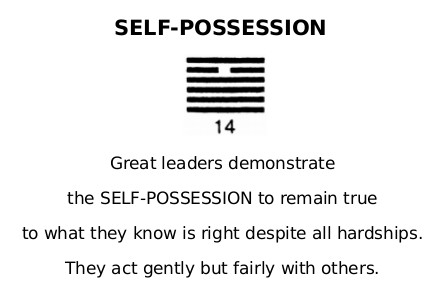
The initial outcome was 14, SELF-POSSESSION. It looks like this:

14 Self-Possession

It seems to me that the general public expects leaders to demonstrate calmness, integrity, and fairness. We want them to give us a clear picture of what’s going on. Deep down, we really want leaders who inspire us.

However, the initial answer was dynamic. It had two changing lines that offer warnings or advice. These combined to result in a different outcome.

The advice from line four is “Do not compete with others. Use your skills to build.” It advises restraint and to avoid careless waste. So I would be concerned that precious time is being wasted, that this crisis is being used BY SOME as a political football, and that it’s possible resources being mobilized might to some extent be misdirected.

The advice from line five reads “When you prove yourself responsible, others will trust you.” The shadow side here is that unless leaders prove themselves trustworthy, people won’t trust them.

But even when there’s restraint and responsibility, the second outcome remains FRUSTRATION. This makes good sense. We have expectations that aren’t always being met. It’s related to the leadership issue, but just as importantly . . . we need to be aware that there’s a lot going on – hidden – behind the scenes. Things aren’t exactly what they seem.

Number 9 reads: External factors you may not even be aware of will cause FRUSTRATION. New projects will not work out now. This cannot be avoided. Arguing will not influence those who could help. Your choice is either to wait patiently or to leave the situation. “

So it seems to me that right now we’re in for a waiting game. Getting emotionally caught up in the upheavals that have been set in motion would be counter-productive. To the extent that worry is a waste of time, refocusing attention . . . rethinking the change going on all around us . . . is a better option.

So, the next question that arises is Where should we turn our attention? For one thing, I would look for the opportunities hidden within current dangers, because it’s a rule of Natural Law that in duality, there are two sides to every coin.

It’s quite possible we’ve been looking in the wrong places for IMPORTANT answers. And that the Book itself is welcoming the pandemic as an opportunity to reintroduce itself as an inspirational way to access the deeper energy and light levels of our Life Wheels for a better understanding what’s truly going on – within ourselves . . . as well as in the world around us.

NOW this opens WIDE the door to a whole new world. I will continue this thread in my next video, which I’m calling “Blessings in Disguise.”

So, here’s what you can expect from now on. In each Thursday video, I’ll balance discussion with a hands-on reading from different versions of the Book of Change. The plan is to illumine key issues in terms of the Life Wheel pattern, supported by readings to make the Book of Change increasingly more familiar.

Again. Please comment below. Like, share and subscribe. Hit the bell to be notified each time I publish a new video. And I’ll see you again next time. Until then, do take good care of yourselves.

Hope for the Future

My life quest started with a heart-felt question. A poem, actually.

Because in early teen years, I felt a growing, uneasy sense of danger. I couldn’t put my finger on what was wrong.

But something sure wasn’t right.

So I put ink pen to paper and wrote:

Poem

Since then, bit by bit, the Universe has answered my soul call.

I’m moved to share my story because, as the world becomes increasingly more complicated and dangerous, more and more of us are feeling that angst.

The time is ripe and ready for the answers I was given.

This book is my way of paying forward what gave me help and peace of mind. If what I’ve been given to share does the same for you, my journey will be fulfilled.

Long story short, my searchings led to this answer. The world is suffering from a fatal knowledge deficit. The limited and limiting rules of empirical science cut us off from who we truly are. Public education alienates us from our inborn native power.

No matter how much we feed the illusion of lack with drug, alcohol, food, sex and violence addictions, we’re never satisfied. We can’t be.

Because we’re looking in the wrong place to fill the deepest, universal needs everyone everywhere shares in common.

We’re starving for lack of wholeness. Most of us suffer terribly from the illusion of being cut off from Source.

We’ve been misled into believing that we’re not enough. We’re not smart enough, good enough, rich enough, attractive or lovable enough.

Nothing on the surface of the Life Wheel can satisfy that gnawing sense of emptiness and loneliness. No amount of external input can help.

However, given new and better information, negative beliefs can be changed.

In truth, we’re already okay in a way that can’t be measured or quantified. It’s simply how we were made. We’re inherently whole and complete.

God don’t make no junk.”

Know Where To Look - sized

When we become aware of who we truly are, always were and always will be, we reconnect with our original, true identity. We come to Really Believe we were born already enough. At our central, unalienable core, we are divinely perfect.

When we truly believe and act on that inner awareness, then no one can ever again sell us on the lie that we’re not okay, not enough. It’s simply not possible. And our lives change dramatically for the better.

* * *

This excerpt comes from the Introduction of You Are Already ENOUGH! How Would Your Life CHANGE If You Really Believed It?

It’s the perfect gift of hope for the new year and decade. Now available on amazon.com.

Time to Choose: Life or Death

Today I revisited a blog called Choose Life II.  Back then — January of 2016   — its resonance with biblical verses was in the back my mind. Today, I will put them up front. They add yet another layer of meaning to the original post:

In Deuteronomy, Moses said to Israel:

15 Today I am giving you a choice. You can choose life and success or death and disaster. 16-18 I am commanding you to be loyal to the Lord, to live the way he has told you, and to obey his laws and teachings. You are about to cross the Jordan River and take the land that he is giving you. If you obey him, you will live and become successful and powerful.

19 Right now I call the sky and the earth to be witnesses that I am offering you this choice. Will you choose for the Lord to make you prosperous and give you a long life?

Three years later, I found the substance republished here just as timely and helpful as before. I hope you find it helpful too.

body-mind-spirit

Last fall’s mystery illness became a strict teacher, a blessing in disguise. It dramatically reinforced my awareness of the mutually dependent relationship between brain and gut long recognized by Asian healing traditions.

As modern medical research documents, mental distress manifests as a myriad of gut-spawned diseases – Crone’s disease, fibromyalgia, rheumatoid arthritis, irritable bowel syndrome and eventually cancers, to name but a few.

Conversely, the broad spectrum of diseases arising in the gut spawn a host of mental illnesses – not only depression, memory loss, dementia and schizophrenia, but autism and A.D.H.D, for example.

The hopeful application is this. Correctly steered, interventions on either side of the gut-psychology continuum positively affects the other. The relationship spans an infinite loop. So wherever one starts, given time and effort, it’s possible to complete the cycle, eventually restoring balance and good health.

Follow along if you like and I’ll connect the dots that led to this conclusion.

It started with asking WHY. Medical people failed to correctly diagnosis what went wrong. The ER physician (nice lady) jumped to the convenient assumption that, given my demographics, a lower tract infection was the problem. Antibiotics would make symptoms go away.

When the first round of drugs didn’t help, instead of questioning the assumption, the local nurse practitioner prescribed a battery of (expensive!) different antibiotics over following months – in increasingly stronger doses – each with its “interesting” side effects.

The duration of this “illness” was cause for some serious introspection on my part. Certainly the WHY had a mental origin. Stern teacher that LIFE is, I came to accept that I wasn’t going to be let off the hook until I came clean with myself. Release demanded self-honesty.

What I unburied was a death wish of sorts. It wasn’t that I wanted to be gone, so much as that negative suggestions from false friends absorbed over the years had worn me down to the point of critical mass.

I was increasingly motivated by dread of facing a future based on past experience. Subconsciously, I had succumbed to a death sentence suggested by people far too “nice” to kill me outright, but all too capable of driving me to slow suicide.
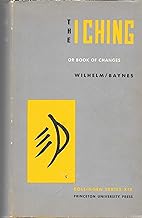
LIFE had sounded a warning alarm to bring me back to my Self.

Something had to change. It started with a stark decision. A conscious commitment to LIFE, whatever it takes. I wrote a confirming article, Choose Life.

Once recognition and the decision were made, LIFE responded most generously. The help and information needed to support my choice appeared from several directions.

The next step was for me to ask HOW do I return to health? And how do I change my attitudes and behavior to make my personal future different and better from the past?

Critically important information was found in Susan Forward’s Emotional Blackmail: When the People in Your Life Use Fear, Obligation and Guilt to Manipulate You.

I was instantly inspired to borrow the book from the library after reading a top-ranked review of the book which starts:

This book does a very clear job of defining emotional blackmail so you can begin to easily spot emotional blackmailers in your life. It then concludes with telling you specifically how to deal with emotional blackmail, that is, how to keep your energy, resources, and sometimes your very soul, from being stolen by them.

WOW. I could relate to that!

She writes, At the heart of any kind of blackmail is one basic threat, which can be expressed in many different ways: If you don’t behave the way I want you to, you will suffer.

Forward explains:

Manipulators work hard to deny, obscure, camouflage, prettify, excuse, rationalize, disguise, HIDE what they are doing. They make it hard, if not impossible, to see HOW they’re manipulating us. They lay down a thick FOG that obscures their actions.

FOG is an acronym that stands for the psychological warfare tactics used against targets: Fear, Obligation and Guilt.

This information is reinforced by Harriet Braiker in Who’s Pulling Your Strings? How to Break the Cycle of Manipulation and Regain Control of Your Life:

People who manipulate are often so hard to spot. They become your friend and then find ways to have their way with you. . .

A reviewer summarizes:

You can’t reason with a manipulator because of their insecurities but you can reason with your own insecurities; and best of all are the practical ways you can change your behavior to take back the power.

This book teaches you to get up, learn what you did wrong and what you should have done, and even better how not to repeat the same mistakes.

There’s also a warning given from experience:

I’ve put an end to so much manipulation in my life. It takes the wind right out of the manipulator’s sails. The book is right…the manipulator will blow really hard, so prepare yourself; it’s going to get stormy.

choose life

Another fortunate form of help followed from my decision to seek medical advice elsewhere. An intern at the UW kindly saw me on short notice. Intrigued by my situation, she brought in her mentor. Together, after reviewing the history of lab results, they confirmed that the initial diagnosis wasn’t right. The medications hurt more than helped.

Although I knew enough to eat yogurt to offset the effect of antibiotics, to repair the damage done by antibiotics they recommended taking pharmaceutical probiotics as well. This opened the door to a whole new world of science and healing.

Probiotics for Dummies, for example, includes a useful section on the brain-gut connection.

Medical researchers have long known that stress depresses immune function, but only recently have they linked stress to changes in gut bacteria.

The medical community’s interest in probiotics was initially sparked by the seminal work on GAPS (Gut and Psychology Syndrome) published by researcher Natasha Campbell-McBride.

In Gut and Psychology Syndrome: Natural Treatment for Autism, Dyspraxia, A.D.D., Dyslexia, A.D.H.D., Depression and Schizophrenia, she notes that Western medicine has long acknowledged the brain-gut connection:

The father of modern psychiatry, French psychiatrist Phillipe Pinel (17-45-1828), after working with mental patients for many years, concluded in 1807: “The primary seat of insanity generally is in the region of the stomach and intestines.”

Interestingly, she uses the same word, FOG, when in describing the mental-emotional relief experienced as the intestines heal by using probiotics to restore balance. “It is as if the fog lifts.” Ahh!

But, like cutting through the psychological FOG, cleaning out the gut doesn’t happen over night, or without difficulties. Campbell-McBride warns things often seem to get worse before they get better. Detox is a necessary but challenging middle step along the road that leads from here and there. So, again, “prepare yourself; it’s going to get stormy.”

There are important parallels between the so-called Leaky Gut Syndrome and psychological distress. In the first case, weakened intestines become permeable. Toxins and undigested food leak out and are circulated by the blood stream throughout the entire body, poisoning other internal organs – including the brain.

Similarly, psychological defenses can also be worn down and compromised, sometimes due to “second-hand stress.” In this case, when protective borders between self and others break down, toxic influences from outside undermine mental-emotional balance. Others’ fears, rage and general unhappiness poison the unprotected mind. Toxic people preoccupied with their own wants and personal dramas, even when unintentionally, do great harm.

Interestingly, the GAPS/probiotics approach is highly compatible with the wisdom of Asian healers. Traditional Chinese Medicine, for example, carefully maps the gut-psychology connection. They describe the dynamics of what is called “the abdominal brain.” The following illustration captures thousands of years of wisdom in a single picture.

0 012316

According to Mantak Chia, when the intestine becomes congested, it cannot perform its physiological functions. Though you may eat well, you may be under nourished.

As he explains, each of the organs is correlated with one of the five elements. In turn, each is associated with specific positive or negative emotions:

All negative emotions are expressed in the small intestine by contraction and circumvolutions, Anger contracts the right side of the intestine near the liver. Worry affects the upper left side near the spleen. Impatience and anxiety affect the top. Sadness affects both lower lateral sides. Fear affects the deeper and lower abdominal areas.

As the I Ching instructs, the same dynamics repeat on every scale of magnitude, from cellular to universal. So many hints from sciences both ancient and modern could be taken in many directions. They apply to relationships on a personal level, to community dynamics, and governance. But those will be subject of posts yet to follow.

For starters, I’ll offer just one hint.

Campbell-McBride uses the image of a medieval fortress under attack to describe the breakdown of  defenses that result in auto-immune diseases. It parallels the Interleukin II research described earlier, where the grad students saw their research on pediatric leukemia in terms of a war between good and evil.

When confusions in gut mirror confusions of the mind – when the difference between friend and enemy is fogged — anabolic (building up) and catabolic (breaking down) functions are thrown off balance. The body  is fooled into turning against itself in self-destructive ways.

In conclusion, however, a key component overlooked in the popular gut-psychology formula must be noted. Spirit — that third, underlying, unifying and overriding component of the e = mc2 equation – plays a deciding role in the outcome of the LIFE versus death struggle to survive.

It is said, “The mind will play any tune you tell it to play.”

choose wisely

So – who is it that quietly instructs the mind which tune to choose?

LIFE itself, the soul’s advocate, is the tie-breaker that tips the balance.

Here, I allow Mantak Chia to have the final word. He describes the discipline of cultivating chi – the subtle energy that links mind and body — and the end goal of the path to which all endeavors ultimately lead: 

  • If one wishes to be a healer, success depends upon the ability to channel energy through the hands.
  • If one wishes to be an athlete, success depends upon the ability to convert energy into strength and endurance.
  • If one wishes to be free of negative influences, success depends upon the ability to transform negative energy into positive energy.
  • One who seeks enlightenment is searching for the highest source of all energy.

I write in hopes that you will find this saga helpful. If you relate, I invite you to apply your imagination and follow wherever the subject leads you.

To your health!

Use the CSBOC To Increase Self-Awareness

Did you know that Swiss analyst, Carl Jung, who gave us the concept of archetypes and influenced appreciation of dream analysis, also had great respect for the Chinese I Ching? He used it as as a tool for making the unconscious conscious.

In fact, Jung was instrumental in bringing the first usable English translation to the West. He wrote the introduction to the Wilhelm/Baynes version by giving an example of using it. He queried asking for a comment on the translation. The answer received was, in effect, that a vessel of great value which had fallen into disrepair was being restored.

My small yellow book follows Jung’s example. In the Introduction, I ask, “What does the Common Sense Book of Change (CSBOC)  have to offer its readers?”

Its answer: “Awareness.” A changing line yields the likely future outcome of following through. “Gain.” (I’ll show you how this works below.)

But even before starting, the book emphasizes the importance of practicing a thoughtful process of question- asking:

The quality of results depends on the state of mind in which information is received. It is therefore essential to learn how to approach the Book of Change in the best possible frame of mind.

So quiet yourself. Get past the clutter of chaotic thoughts to focus on forming a worthy question.

. . . There are many techniques for calming the mind and focusing attention. One of these is usually practiced before asking the question.

Bottom line: consulting the Book of Change is not only compatible with yogic and mindfulness practices of introspection, contemplation and meditation. They work synergistically. Settling the mind to ask the right question induces a meditative state. The ability to induce a meditative state enhances the quality of questions asked and value of answers received.

To give you the flavor of working with The Common Sense Book of Change, I’m sharing the example given in the book.

If you initially feel uneasy with this approach to increasing self-awareness, you might find the answers to commonly asked questions reassuring.

If this is new to you, try approaching it with the attitude for approaching the unfamiliar recommended by Samuel Coleridge, a “willing suspension of disbelief.” Or, as I do, at the start, prayerfully invoke protection and guidance according to your beliefs.


SAMPLE READING

First I collect my materials. I need three pennies, a pad of paper or notebook, a pen or pencil and the Book of Change.

Then I find a quiet place to sit. I take a few minutes to settle down. I clear my mind of other thoughts and silently watch the breath until it becomes slow and even.

Then I think carefully about what is going on, what is troubling me, and the issues I need to know more about. I list the decisions I have to make and consider what consequences are likely to follow from my future actions.

For the example in this book, I have decided to ask, “What does The Common Sense Book of Change have to offer its readers?”

I enter the date and my question in the Diary Section at the back of the book.

Concentrating on my question, I take my three pennies, shake them a few times in my gently closed fist and roll them onto the flat surface in front of me.

The first throw of my three coins comes up three heads. The value of heads is two, so I multiply three times two to get six.

Since this is an even number, I draw a broken line on my pad of paper. It will be the bottom line. Because all three coins were the same, I place an “X” next to this line to show that it is a changing line.

My bottom line looks like this:

Place Throws Values Sum Line

Bottom H H H 2 2 2 6 ___ ___X

Then I take the three coins and throw them again. This time I get two tails and one head. The value of tails is one, so I add one and one to get two. I add this to the two for the heads coin to get four.

Since four is an even number, I place a broken line in the second place over the bottom line. My pad of paper now looks like this:

Place Throws Values Sum Line

Line 2    T T H 1 1 2 4 ___ ___

Bottom H H H 2 2 2 6 ___ ___ X

̀I follow the same procedure four more times. My final hexagram looks like this:

Place Throws Values Sum Line

Top       T H H 1 2 2 5 _______

Line 5   T H H 1 2 2 5 _______

Line 4    T T H 1 1 2 4 ___ ___

Line 3     T T H 1 1 2 4 ___ ___

Line 2     T T H 1 1 2 4 ___ ___

Bottom  H H H 2 2 2 6 ___ ___ X

The next step is to find the number of my reading. I turn to the chart at the back of the book. The bottom three lines of my hexagram are all broken.

I turn to the chart at the back. In the “lower trigram” column of the chart, the picture which matches this figure is “k’un.”

The top three lines of my hexagram are two solid lines over a broken line. In the “upper trigram” row of the chart, the picture which matches this figure is “sun.”

By going to the box which shows the combination of upper and lower trigrams, I find the number 20. I therefore turn to Hexagram 20 for answers to my question.

Hexagram 20 is AWARENESS. So the answer to my question, “What does the Common Sense Book of Change have to offer its readers?” is AWARENESS. It reads:

Seek increased AWARENESS of the patterns which underlie all natural events. Tune yourself to the creative source of natural change. Then harmony becomes a way of life. Secrets of the arts and sciences will be revealed. Human relationships will become smooth. Mistakes of mis-calculation will be prevented. Avoid unnatural leaders.

Because the bottom line is a changing line, I go to the page directly opposite the hexagram, titled “Direction of Change.” I read the sentences for the bottom line. They advise:

Narrow-minded self-interest is not enlightened. Broaden your views. Include others. (42)

The number in parens after the warning represents the hexagram which results when the bottom line changes to its opposite, a firm line.

The new hexagram, GAIN, indicates the change that would result from the AWARENESS this book has to offer its readers. Turning to Hexagram 42, I read:

GAINS can be made after analyzing the situation correctly. When a person’s life goals are kept firmly in mind, no time is wasted. A way can be found to use whatever resources are at hand to serve one’s purpose. Serving others can be compatible with personal gain. Avoid smug self-satisfaction.

I then turn to the back of the book. In the Diary Section, I write the numbers of the hexagram and any changing lines next to my question. Then I decide what future actions I to take.

Finally, I enter a few sentences to describe my thoughts and decisions into the Diary Section. That way, I know I can return to my question, the reading and my decisions later to think more about them.

I hope this helps. Any questions? Comments? Your feedback is welcome.

How the CSBOC Came To Be

For those who wondered, I’ve already answered eight of your most often asked questions, including“What makes the Book of Change so unique and important? Why is it especially relevant worldwide?”

wondering face

Here, I’m answering another question: “Why is this particular version, the Common Sense Book of Change (CSBOC), an excellent choice for me to work with right now?”

As strange as it appears at first glance, there are actually several good reasons. So let me tell you more.

Discourse sized

First, I should let you know that today, publishing is a just hobby for me. The world will go its own way. I no longer think can any book change the world.

But it certainly changed me. It’s no exaggeration to say the I Ching saved my life. More than once.

So, for me, if the Common Sense Book of Change helps even one of you, that is enough. I would be satisfied. As it has been written, “To save one life is to save the world entire.”

I also recognized that the I Ching is not the only book with life-saving potential. The most powerful is the Bible. In my case, however, early in life, poor examples confused and repelled me. I do believe that in their infinite mercy, good angels guide and protect truth seekers through any medium available. Angels are not limited by the restrictions of human religion. : )

So long before I was ready for the New Testament, the I Ching was there to get me through some rough transitions.

Angel Calling

Now, then. How did I come to create this little book? I am American, not Chinese. Nor am I a scholar with advanced degrees in Chinese language and literature. I’ve described my personal journey in several places. For example, in The I Ching & Me, I wrote:

For me, the Book of Change is a gateway to magic. On this side, it has been a close companion, good friend and advisor through the years. On the far side, perhaps remembered from lifetimes past, it speaks to me from a place beyond time and space.

With it, I was never alone, even and especially when I was loneliest in crowded rooms. When the world impelled suicide, it brought me back to a deeper, all-pervasive love of life.

So I will share a few sections from Rethinking Survival about how I met the book, and how it has grown on me.

ICgraph

I wrote about the origins of CSBOC in Rethinking Survival:

. . . I’d had a hunch about [the I Ching] for a very long time. Ellsworth Carlson, who lived in Shansi, China during WWII, was a classmate of my parents at Oberlin College. When I was nursery school age, he bounced me on his knees at Harvard.

As Freshman student, I took Dr. Carlson’s course in Asian History at Oberlin. What stuck with me how vast an influence the I Ching had on China for 8,000 years and counting.

So, when I left the U.S., all I took with me was my violin and one small suitcase. Of that, half contained clothes. The other half held sheet music and one small book: the Legge translation of the I Ching.

It made no sense to me. I could barely get through a page or two before giving up. But I kept coming back to it. It led to something important I had to know more about.

When I happened upon the Wilhelm/Baynes edition in Düsseldorf’s International Bookshop on Konigs Allee — Finally! — I had a version I could relate to. It literally became my teacher. It gave me a whole new concept of how the world really works.

Not just this family or that institution or the other county. Not arbitrary and capricious, fluctuating fashions, but the constant anchor over time.

From it, I could deduce the fundamental energy dynamics of action and reaction which drive behavior, internally at a psychological level, and externally in relationships and day-to-day events.

It was an extension of the logic my English teacher Miss Elson impressed on my high school brain. But more. It gave me a map of logical consequences, as inevitable as computer language. “If this, then that.”

For example, If you kick people, they kick back (if they can) or otherwise resist. If you are kind, you inspire love and trust in others. If you violate natural law, nature bites back — your mental health suffers; relationships deteriorate; your behavior becomes erratic and social/physical survival is imperiled.

Asian cultures call this “the law of karma.” Its operation is also described in biblical terms: “As ye reap, so shall ye sow,” and “to everything there is a season.”

In sum, its 64 permutations map a progression of repetitive, cyclical change.

Tai Chi Tu

I’ve also explained why I felt compelled to write a simpler, accessible version, free of unnecessary jargon, sexism and cultural baggage:

There was, as in all things, a downside to the Wilhelm/Baynes version. It was unnecessarily difficult, sexist and elitist. A confusing overlay of cultural baggage obscured its meaning. After working for ten years with every version I could find, I wrote an easy-to-use version called The Common Sense Book of Change, intending to make this treasure available to anyone with an open heart and basic reading skills.

I fantasized on the possibility of teasing the Chinese people into reclaiming their heritage, self-publishing it as small yellow book (the traditional Chinese color of wisdom) in a pocket-sized form to replace Mao’s little blood-red book. No matter how many new versions have come out since then, it still works for me.

seated crosslegged
Here is the story of how the CSBOC came to be:

More “neatsies” surround my small version of the I Ching, the Chinese Book of Change. I wrote it in 1975 during the window of time after I moved back from Spring Green to Madison, but before I had a job. As a leap of faith, I concentrated on the writing, putting off a job search until the book was done. This was a bit scary. Money was going to run out very soon.

I sat cross-legged on the bare wood floor of a living room furnished with cardboard boxes. I spread every version I owned in a half-circle around me. They included the Wilhelm/Baynes translation brought back from Germany, of course. There was a battered second-hand paperback by Joseph Murphy, a research fellow in Andrha, India, as I recall, who quoted the Old Testament in the judgments. Others included the spiral-bound Workbook by R. L. Wing, a hardbound version which presented the I Ching as a form of astrology and a hippie-like paperback.

I trusted that the Platonic-like ideas of the I Ching are timeless, the common heritage of all humanity. They’re not the exclusive property of a particular culture or class. Each of these authors was drawing on the same source for inspiration, expressing universal experience from different viewpoints. So I opened my mind, asking for the deeper meaning these versions shared in common.

I was certain that the most powerful ideas are the most simple. They deserve to be expressed in the clearest language with fewest words possible, free of flowery poetry, scholarly hocus pocus, sexist assumptions (the so-called “superior man”) or other distortions. I intended to make my version easy to read – accessible to anyone with basic reading skills and an open heart.

The format just “came” to me. It worked fine. Fifty words, no more or less, for each hexagram. Ten words, no more, no less for each changing line. The images came easily. I worked systematically from start to finish, no looking back. With the exception of “Sacrifice,” which I revisited fifteen years later, I’ve made no revisions.

Eventually, I called this version The Common Sense Book of Change. I like the word “common.” To me, it doesn’t signify “ordinary” or even “vulgar,” as some use the term, but rather “universal.” “Common” is the root of both “communication” and “community.” And the allusion to Tom Paine’s Common Sense isn’t accidental.

But there’s more to this story:

Upon its completion, the kaleidoscope turned instantly.

Results of the civil service test for Typist III positions came in the mail, along with a list of job openings.

My first interview was at the UW-Madison Department of French and Italian. The Chairman not only gave me the job on the spot. He decided from my resume that I had administrative potential and made me an offer. The Department’s Administrative Secretary III had given notice. She was moving out of town soon. There was no replacement. If I was willing to do her job for Typist III pay, and if I took the pending Ad Sec civil service exam, and if I got one of the five highest scores to qualify for an interview, I could have the job. . . .

I agreed, did administrative work for typist pay, took the exam, qualified for an interview, and within a few months took a leap up the career ladder that secretaries usually took years to accomplish. I was suddenly earning more than ever before. . .

I concluded:

The reward for this leap of faith was immediate. I took it as confirmation from the powers that be that I’d made the right choice to put the book first.

listen with the heart


JBP at His Best

On September 30th, I found two particularly endearing tweets posted by JB Peterson Quotes. I thought, I owe him a post showing him at his very best.

The first one shows Dr. Peterson outdoors, sun shining on his brow, hugging smiling students from a surrounding crowd. There’s actually a broad grin on his face! It made me want to smile back at him.

The quote assigned to this photo: “Make at least one thing better every single place you go” – JBP

jbp w friends

The second shows Dr. Peterson gesturing in the professor mode, pronouncing a noble set of maxims. My first response: “What a great heart this man possesses!” It warmed my heart.

jbp Stumble Forward

But then, my rational mind took over.

After the warm fuzzy feelings he stimulates subside, clarity arises. What’s left is this: At each step, his reasoning is based on false assumptions. More fundamentally, the paradigm he’s operating on is incomplete and incorrect.

Life is suffering” is what Mephistopheles (Satan) argues to Faust. This is pure irony, of course, because Satan’s lies are the primary cause of human suffering.

Christ’s example taught us quite the opposite, that Life is Eternal. Suffering exists on the ephemeral surface of the Life Wheel, in large part due to poor decisions based on false beliefs that lead to catastrophic mistakes. Suffering does not exist at the unchanging Center of the Wheel. I’ve dedicated an entire post, Life is Eternal, to support this alternative premise, from which very different results follow.

Further, however obscured by deception, humans are made in the image of God. They suffer terribly because they have forgotten who they truly are and don’t know how to re-member what they sense they’ve lost and dearly long to recover. Insufficiency is a surface illusion, though a very persistent one. (In the context of mortality, Einstein said the thing about time.)

A great deal of suffering comes from ignorant fear of death. Many have been deceived into doubting the existence of the immortal structure that supports the mortal frame. Sages act on the belief that the consequences of their actions inevitably return. They know of a certainty that upon physical death the immortal part continues on to complete whatever has been left unfinished in future life cycles. So they behave very differently from those who mistakenly believe they can get away with murder or that suicide puts an end to suffering forever.

So what’s the problem? Certainly it’s not lack of intelligence or sincerity. Dr. Peterson is looking for Love and Truth using the limited tool of reason to fathom what exceeds and transcends it.

The rational mind cannot fathom or encompass super-rational realms. Further, he’s looking in the wrong place, on the surface. According to an old saying, “It is futile to hunt for deer in a forest in which none dwell.” Even religions as codified, institutionalized teachings, though speaking to direct experience of the Center, partake of surface limitations.

Nor is truth to be found in the duality of human relationships. That’s an especially hard sell. Not very likely. Actually, it’s the other way around. To the extent individuals align with the Center, the more wisdom, compassion and competence they bring to their relationships. If more of us aligned our personal lives with the Center, increasing numbers would find ways to overcome interpersonal conflicts.

Nor do we need to “stumble” towards the Kingdom of God. As Christ confirmed, the Kingdom of God is already present. It rests within. Getting there, for most of us, however, requires a leap of faith.

He says, “To learn is to die voluntarily and to be born again, in great ways and small.” This is the Phoenix response, of which I’ve written at length.

Nor is any of this a quibble, because a great many people right now are influenced by Dr. Peterson’s logic.

book header bird

I felt compelled to address this quote one word at a time.

SUFFERING. To repeat, stating categorically that life is suffering is misleading. While Buddhists equate human experience with suffering, they also teach that the root of suffering is IGNORANCE. And the primary way to ameliorate suffering is to dispel ignorance. In this case, false, incomplete and incorrect paradigms perpetuate ignorance and generate suffering. As he has also made clear, there’s a direct correlation between beliefs and outcomes.

Whereas Dr. Peterson looks to Goethe’s Faust to explain suffering, I prefer the Old Testament:

And then there’s Job, the model of faith enduring to the end and being restored, even better than before. The phoenix image.

Here’s the secret to be gleaned from this story, illumined by the infinity symbol that links the levels of the Life Wheel. Job says, “The Lord giventh.” This is the outward, materializing movement from center to surface of the Wheel. “And The Lord taketh away.” This is the receding path of return to center. In all, “Blessed be the NAME of the Lord.” The Logos.

LOVE. “Love,” Dr, Peterson says, “is the desire to see unnecessary suffering ameliorated.” To answer that one, I had to write an entire post to reply, Yes. And much more:

[Love] can be an expression of one’s affection. It can mean a feeling of brotherhood and good will towards other people.

It can be strong liking for or interest in something (a love of music). It’s a strong, usually passionate affection, partly based on sexual attraction.

In theology, love refers to God’s tender regard for mankind, or mankind’s desire for God as the supreme good. Love is the ultimate mystery. It sparks and keeps the life process going, more to be accepted and honored than psychoanalyzed.

Further,

Plato described seven stages of love. Each is a rung on an evolutionary ladder which leads from a child’s love for parents, to erotic love, to friendship, and eventually the pinnacle of divine connection. These seven steps correlate exactly with the hierarchal seven energy centers of yoga anatomy.

Plato traces the attraction between males and females to jealous gods who split a complete, content person in half at the navel. Ever since, each part has chased after the other, longing to become whole again – another yogic priority.

Tai Chi Tu

Next, he says,”TRUTH it the handmaiden of love. Dialogue is the Pathway of Truth.”

WOW. What a partial truth. Again, it takes another post to even come close to addressing it.

I say, “Dialogue in good faith may be the instrument of coming to common understanding between individuals and amongst groups. But Truth has many levels.

So, truth meaning what? Facts? Data? Axiomatic laws of nature? Absolutes? All of the above.

What does it mean to tell the truth? About what one is doing? Thinking? Feeling? Believing? Layers and levels of truth. How do they hang together?

I even supplied a picture, put together early on in my blogging years before I’d acquired photo-shopping skills:

TruthLevels021713

A Rare Opportunity

Immediately after posting Be Harmless, NOT Defenseless, a twitter message from JBP came to my attention. He will be speaking in Madison, Wisconsin on Thursday, November 16th. Small world. This happens to be a day when I’m already scheduled to be in town.

The event will take place on the UW-Madison campus in the building where I worked two years as a Ph.D. candidate in the Department of Educational Administration. My office on the eleventh floor was so high above ground that I could watch incoming weather changes in the sky, far above the railroad tracks and coal yard below.

Since meeting face to face is the only way to answer inevitable questions on both sides, fate seems to be offering us an unlikely and rare opportunity.

Certainly he has many reasons to avoid it. But I have a hunch the best part of him will push past excuses. The opportunity may seem strange, uncomfortable and inconvenient. But on the opposite side of the coin, uncommonly valuable gifts might emerge from a “. . . dialogue . . . so that we can all humbly learn . . .”

Angel Calling

Love IS . . .

Dr. Jordan Peterson says, “Love is the desire to see unnecessary suffering ameliorated.”

I say, “Yes . . and much, much more.”

Here’s what I mean:

Essay 38. LOVE

Hear, O Israel: The Lord our God is one Lord; And thou shalt love the Lord thy God, with all thine heart, and with all thy soul, and with all thy might. Moses, Deuteronomy 6:4-5

As the Father hath loved me, so have I loved you. . .This is my commandment. That ye love one another, as I have loved you.  — Jesus Christ in St. John, The New Testament

In Taoism, we say the heart is the seat of love, compassion, joy and happiness. This is what people are looking for. But they are looking outside. We don’t know that joy and happiness is seated INSIDE our heart. We’re running around the whole world. Going to the amusement park, night club, theaters, all kinds of places in search of happiness, peace, joy. But the peace, joy and happiness are within us. – — Mantak Chia, The Inner Smile

THE FRONT

Roots of love mean to be fond, or to desire. Webster’s first definition is a deep and tender feeling of affection for, or attachment to. It can be an expression of one’s affection. It can mean a feeling of brotherhood and good will towards other people.

It can be strong liking for or interest in something (a love of music). It’s a strong, usually passionate affection, partly based on sexual attraction. In theology, love refers to God’s tender regard for mankind, or mankind’s desire for God as the supreme good. Love is the ultimate mystery. It sparks and keeps the life process going, more to be accepted and honored than psychoanalyzed.

Plato described seven stages of love. Each is a rung on an evolutionary ladder which leads from a child’s love for parents, to erotic love, to friendship, and eventually the pinnacle of divine connection. These seven steps correlate exactly with the hierarchal seven energy centers of yoga anatomy.

Plato traces the attraction between males and females to jealous gods who split a complete, content person in half at the navel. Ever since, each part has chased after the other, longing to become whole again – another yogic priority.

Tai Chi Tu - sized

Unfortunately, rather than seeking to integrate male and female energies internally, most Westerners persist in externalizing this desire for re-union. In contrast, I Ching-related healing arts provide methods for restoring inner wholeness, attaining the ultimate level of Platonic love.

The new law Christ taught fulfills the law of Moses. Further, the Old Testament command to unify the three levels of soul, heart and might into a single-minded love of One God resonates with I Ching-related practices which coordinate upper, middle and lower energy centers.

Practical methods give people of every faith practical ways to actualizing their religious ideals. Put another way, only by integrating and harmonizing the levels of mind, body and emotions can love of God be complete or the universal law fulfilled.

Healing gender, race and religious splits calls for fluency in the complete spectrum of love. Even in grimmest times, love is the omnipresent, underlying bedrock. In Rocky IV, for example, Sylvester Stallione scripted an East-West reconciliation of opposite cultures.

A nature-trained David not only defeats a technology-mutant Goliath with love and relentless grit. He wins the hearts of a hostile crowd. His victory message to international TV viewers: “If I can change, and you can change, we all can change.”

Those who turn love into a commodity exploit what people out of touch with their true selves crave most. There’s a push-pull between those greedy to get what they’ve been fooled into thinking they lack and those who profit from this illusion.

False prophets profit from persuading followers that they’re incomplete and not-okay. Further, there’s a life-changing product that can fix them. If they buy it, do whatever they’re told, turn over their power and money, they’ll be transformed and made okay. Sages grounded in reality, however, know better.

The question then arises, what happens when one is focused and centered. Does all interest in the external world and motive to accomplish cease?

Actually, it’s the opposite. As one becomes more secure from within, fear-built barriers come down. New, more authentic motives arise to replace artificial desires. As one pares away the illusion of need, the native impulse to serve with generous compassion arises.

THE BACK

In duality, hate is the opposite of love. While love grows upwards from childish attachment through degrees of maturity to altruism, hate descends to the depths of destruction. It obliterates connections, shatters hope, and in the end destroys those it consumes.

Fear-based insecurities generate a host of love perversions. Possessiveness, envy, jealousy and rivalry are variations on the theme of illusory insufficiency. In all cases, it’s the result of looking on the outside for what can neither be bought nor stolen, for the completion of Higher Love is the timeless, abiding state of one’s innermost life.

Phoenix - sized

In this context, I say to the definition of Love as “the desire to see unnecessary suffering ameliorated” . . YES. With this modifier: Love is an absolute. In duality it manifests in a multitude of ephemeral desires, altruism being one of the highest.

Angel Calling

Be Harmless, NOT Defenseless

Jordan Peterson is drawing predictable backlash upon himself.

Though a clinical psychologist, he seems irrationally intent on attracting danger, while at the same time, logically, persuasively but incorrectly protesting that retreating from conflict when you shouldn’t “will cause self-annihilation.”

The qualifier is “when you shouldn’t.” Sun Tzu, reputed author of The Art of War, is keen on the importance of knowing when to make strategic retreats. There is, after all, a time and place for every purpose under heaven.

Second, what does he mean by “self-annihilation?” As righteous warriors grounded in Old Testament faith know full well, the true Self is indestructible. So also, savvy martial artists who are seeped in I Ching wisdom trust that true identity is neither enhanced nor diminished by the dance of advance and retreat.

So what’s really at stake in pressing forward against the tide, against the grain, against the laws of nature? Why vent rage, disgust and contempt at despicable, treacherous, venomous opponents? If he exposes and humiliates them, however much deserved, they will mirror his negativity back – in spades. It’s called backlash. Every action generates an opposite and equal reaction. It’s a natural law of psychological physics.

There are other, wiser ways to shift gears — address valid grievances on higher ground without attracting inevitable vengeful retaliation.

Persisting in upping the ante, provoking human snakes, smells like pride to me. Hubris, to be precise. The stuff of tragedy in the making.

I am afraid for this highly articulate but unin-formed professor.

Here’s an example of the inevitable retaliation and escalating conflict he has drawn not only into his own personal life, but also into his neighborhood — not to mention the media.

On October 26th, 2017, he posted on Twitter: Those who consider themselves my enemies have been posting these all around my home neighbourhood.

Here’s the poster:

jbp

I tweeted back, “What else would you expect?” Afterwards, I realized that without this explanation, the remark wouldn’t make sense. Hence, this blog of explanation.

Phoenix - sized

Please understand. I do not write to humiliate or diminish Dr. Peterson. Quite the opposite. He has become to the current generation of young people what John F. Kennedy was to mine. A symbol of nobility. Of hope.

I remember as painfully as if it were yesterday what it felt like to me and my friends when we heard the news that his brains had been splattered by an assassin’s bullet.

I dearly want that NOT to happen again.

I’m writing to warn Dr. Peterson. To suggest ways to protect himself, not only for his own sake and for his family’s, but for those to whom he has become a hero – who would be shattered were he to come to harm.

To plead with him to rethink the limited psychology which allows him to rationalize such intensely emotional, dangerous risk-taking.

I’m writing to urge him to add to his armory of psychologies the survival wisdom of Lao Tze and the foundational attitudes prescribed in Patanjali’s Yoga Sutras. Their teachings have guided the lives of truth seekers of thousands years. There must be something of value to recommend them, having withstood this test of time.

For example, Dr. Peterson knows not whereof he speaks when he says, “Don’t be harmless.

Is he intentionally rejecting ancient wisdom by this word choice, or is he unaware of the significance of this virtue in ancient lore?

Lao Tze, in fact, uses harmlessness as his defense. It’s a time-honored strategy.

Here is a famous drawing of Lao Tze riding his ox. He is credited with writing The Tao Te Ching, which next to the Bible is the world’s most often translated scripture. It shows the enlightened sage as so intricately merged with the beast which carries him that they appear inseparable. This image represents the higher mind which has tamed and harnessed the energy of emotions. He uses them to carry him towards his destination.

Lao Tze on Ox

I will give you a hint of this survival approach to dealing with snakes excerpted from Two Sides of a Coin: Lao Tze’s Common Sense Way of Change.

snake

Passage 50 reads, in part:

Those who live by the law are protected by it.

They travel the world without being injured.

In the midst of hostilities, no one knows where to attack.

Wild beasts sense no openings to penetrate.

Enemies find no weaknesses to exploit.

Armies can’t locate a fortress to assault.

This accords with the following section about harmlessness used as defense strategy.

Non-Violence

Taoists abhor selfish meddling and gratuitous violence as equally destructive to individuals, society and the environment.

In this, their thinking is in accord with the most fundamental tenet of the yoga. Non-violence is the virtue listed first among the commitments which constitute the fundamental basis of yoga disciplines. The attitude of harmlessness, or non-violence, is the prerequisite upon which all more advanced spiritual practices depend.

In Sutra 35 of Book II, Patanjali informs us that:

When non-violence in speech, thought and action is established, one’s aggressive nature is relinquished and others abandon hostility in one’s presence.

Similarly, in Passage 55 Lao Tze describes sages as being accomplished in the ways of the ancient yoga masters:

Sages who master the infant’s harmlessness:

don’t startle wasps or snakes, and therefore don’t get stung;

don’t threaten angry beasts, and therefore are left in peace;

don’t bother birds of prey and therefore aren’t carried off.

Lao Tze describes non-violence as the cornerstone of social stability. In Passage 68 he tells us:

The best leaders act with subtle dignity.

Successful warriors move with alert caution.

Enduring winners shun prideful vengeance.

Good employers quietly support their workers.

The way of non-violence is the supreme treasure of communities

founded in the eternal Tao.

book header bird

Again, let me emphasize that I wish Dr. Peterson all the best. May he live long and prosper. Let him put on the full armor of God for protection. Give him the wisdom to tame his righteous indignation with the discipline of a seasoned sage. Let him survive as a shining inspiration to those who have come to treasure his innate nobility.

As yet, for whatever reasons, he remains unresponsive. The Catch 22 seems to be that since I’m not a well-known public figure, he assumes he has no grounds for communication. In Don’t throw pearls before swine, he says, “You cannot talk to people who will not engage in a discussion.”

So be it. He says he had no desire to engage in the legislative issue that catapulted him to fame, but felt compelled to do so. In exactly the same way, I had no desire whatsoever to write these blogs, but felt deeply compelled to do so. Unfathomable but somehow irresistible.

Whatever the outcome, at least I’ve done my best. And having done so, leave the future in trust to God’s will.

Angel Calling

Yes, AND . . .

What follows is the irrefutable answer to bogus post-modernist views. Psychologists’ tool boxes are incomplete without it. Political theorists’ speculations are void.

Here’s the plan: I’ll give you the remedy up front, then paint with a broad brush its applications and implications. As a wrap up, I’ll ask why the answer has been overlooked, listing and dismissing arguments (prejudices) that have blinded us to this answer. A P.S. suggests why this post is longer than most.

The key I’m referring to is embedded in Asian teachings that predate Christ’s incarnation by thousands of years. (Mind you, this remedy in no way conflicts with his teachings. Quite the contrary. I’ll get back to this important point in good time.)

Interestingly, Jordan Peterson opened the door to acceptance of this investigation. In describing the classic Tai Chi Tu, the Chinese yin-yang symbol, he refuted the familiar objection that the idea is too abstract. It’s “not real” in the sense that it can’t be quantified or measured. He fired back, it’s hyper-real. It is the substratum which underlies and supports physical reality.

Tai Chi Tu

So too are the chakras. Ancient Hindus mapped the internal energy transformers knows as chakras (“wheels).” Know how to activate them, they taught. You’ll experience enlightenment. (This opens up the subjects of Einstein, the science of human energy transformation, and psychologists as agents of positive change – all of which I’ll also get back to briefly later on.)

Though recorded in ancient scripture, sages experienced vibrant spinning wheels of energy in deep meditative states as a fact of inner reality. Their reports are not the same as poetic symbolism, mythology or parable. Chakras exist as literal fact, integral to inner life as an experience which can and has been replicated by countless practitioners over time.

Here’s the basic picture of seven subtle energy centers aligned along the spine. It sums up the evolutionary stages of human development from base to crown. Increasingly more sophisticated psychological states are assigned to each of the centers, as are specific emotions, endocrine glands, internal organs and life issues.

chakras

Albeit subtle (which is different from “abstract”), this image, like the DNA imprinting of cells, is intrinsic to the very structure of our souls. It includes both the vertical alignment of centers and their interdependence. Its hierarchal nature can no more be debated than can the importance of breathing. Further, the vital structure of inner organization naturally reflects outwardly, mirrored in analogous family and extended social relationships.

So. Arguments that hierarchical relationships are invalid or that value systems have been negated, however apparently seductive to some, are WRONG! FALSE! The image of chakra organization supports the conclusion drawn in Be an Instrument of Light:

God is not

and could not possibly be

dead.

Being made in the image of God,

YOU are the living proof

of God’s existence.

Before you reflexively dismiss this imagery as foreign to Western thinking, let me remind you that, though overlooked, it is intrinsic to Western civilization’s deepest roots. The caduceus is associated with both Greek mythology and the Western medical profession. It serves as a vestigial reminder of the medical sciences which are shared in common by the Western and Asian healing arts, dating even further back to ancient Egypt’s Hermetic tradition.

Caduceus

In Greek mythology, the caduceus is the healing staff of Mercury, messenger of the gods. It links heaven and earth. The axis of the staff represents the human spine. The pair of snakes winding around the axis represent alternating, cyclical patterns of negative and positive (yin and yang) energy currents.

(These twin currents regulate the sympathetic and parasympathetic nervous systems, which explains why focusing the eyes where they intersect at the nostrils evens the breath, calms the mind and heals the body.)

The six chakras are the intersecting points where the curving snake-like energy forces meet and cross at the axis. These are the major centers of transformation and evolution. The wings atop the axis represent its integrating ruler: the crown chakra.

Another view brings it closer to home. Dr. Peterson also opened the door to this picture, which explains the different orientations (he calls them temperaments) amongst the psychologist’s approaches in his “tool box,” each applied at discretion according to individual client needs:

invisible geometry sized

This suggestive picture could be unpacked at length. For those familiar with psychological traditions, however, it speaks volumes unto itself.

The concept of Invisible Geometry, by the way, comes from comparative religion teacher Huston Smith, who wrote:

Twenty years ago I wrote a book, The Religions of Man, which presented the world’s enduring traditions in their individuality and variety. It has taken me until now to see how they converge. . . .

What then emerges is a remarkable unity underlying the surface variety. When we look at human bodies, what we normally notice is their surface features, which of course differ markedly. Meanwhile on the insides, the spines that support these motley physiognomies are structurally very much alike. It is the same with human outlooks. Outwardly they differ, but inwardly it is as if an “invisible geometry” has everywhere been working to shape them to a single truth.

Much is available on the web for those interested in researching the details. What’s relevant to the forward movement of this particular discussion is that this picture shows the innate hierarchal nature of human development and social organization. Not coincidentally, the highest center, associated with Christ consciousness, is called the crown center. It rules over all lesser states of being.

Next in line is the Ajna or Command Center, usually referred to as the “third eye.” It receives messages from above and coordinates functions of the lower centers.

In an article to be published in Prabuddha Bharata, I expanded:

Now, the Western way of ignoring and denying the reality and influence of chakras makes life’s journey far more difficult than need be. But it can’t and doesn’t cause them to cease to exist. Despite scientific prohibitions, most of us still have glimpses of transcendent experience, most often through the arts.

For example, music moves us because its sound sets the chakras in sympathetic vibration. Inspired music has a healing, uplifting affect on the nervous system, the emotions, and the soul. It is not coincidence that the seven notes of the Western chromatic scale correspond with the vibratory rates of the seven major chakras. Indian ragas intentionally draw on chakra correlations to soothe emotions or lift the spirit. In the West, similar effects of inspired music have been described as The Mozart Effect.

In addition, the (albeit too-often unconscious) effect of the chakras on human experience is particularly strong in the visual arts, including the full spectrum from fashion and home-making to interior design, architecture and fine arts. This in due in large part to the fact that the chakras are associated with geometric shapes, as well as with specific colors of rainbow spectrum.

Yes, AND

The Yes, AND was originally a response to a JBP video: Bravo, JBP – But there’s more!”

Yes. This is necessary, but not sufficient. My work compliments and completes yours. Knowledge, as written elsewhere, is a two-way street.

Make no mistake. I’m a great fan.

But there’s more. I MUST hope and trust that, as the declared truth-seeker and teller that he is, he’ll welcome the opportunity to learn and grow.

In one video, JBP says he’s deliberately working to improve himself, taking advice from friends who advise when he comes on too angry, too this or that. But these comments are at the level of presentation. What I’m addressing is deeper and directional. One approach starts from the outside and works inwards. The other starts from the inside and radiates outwards.

As the medieval Great Debate detailed in The Highway to Heaven is a Two-Way Street concluded, there is no contradiction. Truth travels in an infinite loop, joining surface with center, highest to lowest. So, no matter where you start, you’ll eventually cover all the bases and arrive at the same destination.

I’m guessing that limits on his approach might be intentional — strategic and necessary. His options are restricted by the professional hats he wears as clinical psychologist and teaching professor at an established university.

Whatever the case, I am free to take the next steps.

book header bird

Here’s a good example of what I mean. The Youtube video How To Transform is packed with statements that beg to be unpacked – taken the logical next step that leads outside the domains of empirical science.

What got my immediate attention was his mention of the phoenix. That happens to be the subject of a book on my drawing board, The Phoenix Response.

Referring to sorting oneself out, Dr. Peterson says:

. . . you have to allow yourself to shake off those things about you that you might be pathologically attached to – habits and people, for that matter, ways of thinking . . .

Immediately I thought, Aha! Because Rethinking Survival is premised on an Einstein quote: “We shall require a substantially new manner of thinking if mankind is to survive.”

But, continuing:

You have to allow yourself to shake those off. That’s more like a burning. That’s why the phoenix is the symbol. It’s old and it deteriorates, bursts into flame and then it’s reborn.

Well, do you want to be reborn? Do you want to burst into flame?

The answer to that generally is NO. But that’s the wrong answer. The right answer is, You let all that nonsense burn away.

Agreed. This is the hero’s journey, facing the challenges of Chapel Perilous, knowing that “the only way out is through.” Facing fears is part of the hero’s territory.

Here’s my summary or the phoenix book:

The phoenix is a mythical, magical fiery bird that recreates itself, repeatedly rising from its own ashes to begin life anew. An inspiration to self-healers, The Phoenix Response details the ultimate survival option that always remains open, even in a dangerous world which too often compels suicide.

Using time-tested methods, we can continue to repair and rejuvenate, even in the face of overwhelming stress. Yielding before life threats, we can die to the old – to be reborn IN THIS LIFETIME, over and over, each time better than before.

The Phoenix Response draws on universal wisdom written in every human heart, sought after as if lost, and esteemed as a priceless treasure by those who succeed in actualizing the hope of self-renewal.. . . anyone who deeply desires positive personal change can activate the archetypal Life Wheel, going deep within and returning to daily life again, transformed and renewed.

Just one sobering caution, however, before moving on. Ancient practices regarded each day as the microcosm of a life complete. They began and ended the day’s cycle with book-ends of prayer and preparation. Thus made themselves ready to meet the closings of larger-scale cycles whenever they should come, as prelude to the next day’s awakening.

Similarly, we can no more forestall the cyclical downturn we’re now engaged in than we could stop the sun and moon from making their rounds. Though the phoenix can usher in new beginnings, it knows better than to resist the call to transformation.

Politics and Unnatural Change

For a lighter angle, I’ll share the famous Upanishad story about blind men and an elephant as it applies to atheism. I refer to it in part to lay the groundwork for another application. I’m quoting from “The Ant and the Elephant,” a section in the “Atheism Answered” chapter of Rethinking Survival.

An ancient parable from India captures the dilemma of human inadequacy in the face of Truth. Five blind men were introduced to a gigantic elephant. After touching only one part, each reported his experience.
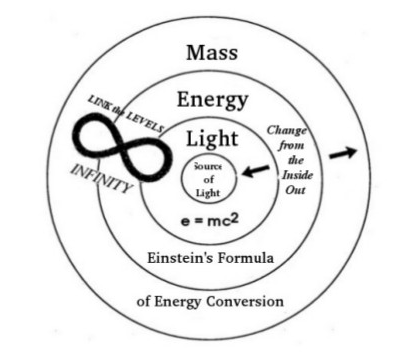
The one who embraced a leg said elephants are round and rough, like the trunk of a tree. The next, who felt a tusk, said elephants are hard and sharp, like a sword. The one who felt an ear described elephants as thin, flat and flexible like a fan. The next, who grabbed hold of the tail, was certain elephants are like ropes, perhaps even whips. The last, who felt its belly concluded that elephants are thick and heavy, like walls.

blindmen & elephant

Now add to the mix a contemporary riddle which captures the humor of human gropings. Question: “What is the height of ambition?” Answer: “An ant climbing up an elephant’s leg with sex on its mind.”

Next question: “What’s the height of fulfillment?” Answer: “The ant climbing back down the elephant’s leg with a smile on its face.”

Just so, we’re like blind beggars, groping towards fulfillment and comprehension of universal Truth. We mistakenly generalize our partial perceptions of a reality which none can see in entirety. We’re like ants who aspire far beyond our limits, sometimes fortunate enough to enjoy a taste of satisfaction.

Heated arguments between religionists and atheists are equally noisy, short-sighted and futile. Each disputant has a partial piece of the larger puzzle. But only that. Their antics — posturings and posings — would be comical, were it not for the extraordinary waste of time and energy lost to creative endeavors.

Atheists who deny the existence of God are equally ignorant and silly. They might as well argue that atoms have no nucleus, or that the solar system has no sun. It’s like ants presuming to deny the existence of elephants.

Their superficial (often angry, self-pitying and self-serving) arguments have no affect whatsoever on the eternal center which always was, IS, and always will be.

Have authority-cloaked religionists, for thousands of years, abused the name of God to excuse abuse of power, claiming divine rights for human rulers — be it European kings, Chinese emperors, Russian tzars, Arabian caliphs, or whomever? Certainly.

Have their enemies repeatedly wrested temporal power away from its holders, only to abuse it in even worse ways themselves? Definitely.

Have humans suffered unspeakable cruelties and injustices at the hands of fellow humans from time immemorial? Sadly so. Continuous upheavals on the surface of the wheel are part of life. It’s nothing new.

But the existence of the unchanging silent center continues into infinity, regardless of what’s happening at the surface. Whether you honor it with awe in simple silence or choose a particular name for it makes no difference. It remains the same.

If you’re totally disillusioned by bad luck or the particular version of religion enforced by your elders, your quarrel is with the ways of the world and its human institutions. Your misfortunes don’t reflect on the Creator’s existence, which is a different subject. God continues to broadcast. Whether you listen remains your choice, the exercise of God-given Free Will.

Here’s a quick summary critique of Saul Alinsky’s concept of “change.” It’s literally antithetical to the Natural Law embodied in the Chinese Book of Change.

It would seem that Edward Bernays — the so-called “father of spin” — was a foremost henchman of the invading aliens. If so, Saul Alinsky was their number one point man. The “coach” was a self-proclaimed radical.

In a twist of our poor abused language, Christ was rightly regarded as “radical” in his day. He would be today as well (in the original meaning) were he to walk among us now, because “radical” originally meant “going to the foundation or source of something; fundamental.”

That’s a far cry from Alinsky’s extremist meaning of “radical.” He was intentionally the antithesis of Christ, going so far as to acknowledge Lucifer in the dedication to Rules for Radicals: ‘the very first radical known to man who rebelled against the establishment and did it so effectively that he at least won his own kingdom – Lucifer.’

His logic is so twisted that a critique would have to move line-by-line to unravel his spiderweb of tangled assumptions. The attempt would be like wading in quicksand. A Jesuit-trained logician would be hard-pressed to come out clean. Yet Rules for Radicals is sometimes made required reading for impressionable teenagers.

In the first chapter, Alinsky stated his exact purpose, namely to coach those who “want to change the world” from what it is “to what they believe it should be.”

In this book we are concerned with how to create mass organizations to seize power and give it to the people. . . We are talking about a mass power organization which will change the world . . [emphasis added.]

Here’s part of my analysis:

Note the use of the “royal we.” This is a megalomaniac talking. He wants to change the entire world. His attitude is towards power holders is openly aggressive. He doesn’t just want to take what they hold. He wants to seize it. To violently “change the world” by means of a “mass power organization” makes no positive sense. History tells us that repeatedly, when power is seized from one set of Haves, it merely passes to another set of worse ones. Never, ever has it been “given” to “the people.” This assumption-packed premise is an extraordinary feat of tragedy-fraught hubris.

First off, what blind, ant-like mortal would dare to think that he can comprehend what, in its entirety, the world — the elephant — really is? What human could possibly be so foolish as to think she is qualified — on the basis of one puny view — to judge what it should be? Alinksy’s rules extended an invitation for blind mortals to jump in feet first where good angels know far better than to tread.

Second, who really understands change? Many bandy the word about. But it’s a profound science of which few have in-depth knowledge. Confucius dedicated a lifetime to understanding the dynamics of Natural Law encoded in the perennial Book of Change.

So, for starters, the “belief” that anyone can change the world from what he assumes it is to what he assumes it should be is unspeakably misguided. Building on this false premise, Alinsky then fueled the undermining alien arsenal with a full battery of destructive tactics. In essence, political radicals should feel “free” to violate the ten commandments. The ends (getting what you want) justify any means.

His version of social change is engineered by stirring up conflict. Use fabricated information to bear false witness against inconvenient neighbors. Alinsky advocates scapegoating, not unlike the dynamic which propelled Nazis to power. Create the illusion of an outside enemy as the way to unify your base. (How is that for the ultimate double-speak? Conflict is the opposite of unity.)

Transformation and Psychologists

Looking back on the story of blind men and the elephant, I now recognize that the seers who told this story were alluding to the chakras, telling us that the world looks very different, depending upon which set of filters you’re seeing through.

That’s why, for example, the world seen through the first chakra makes sense to a behaviorist like Skinner. Whereas, seen through a more evolved lens, human potentials look quite different. Thus, in The Carl Rogers Reader we find this prophetic comparison:

Skinner argued for the intelligent and hopefully humane use of reinforcement theory to direct the course of the individual’s and the society’s development. . . freedom and choice are mere illusions. . . Rogers argued that freedom and choice were not illusory but real phenomena, and that a science that dehumanizes the individual and attempts to control human development paves the way for dictators and despots to move society inexorably toward a totalitarian, Orwellian future.

Now, it’s important that Jordan Peterson holds Rogers in high regard. The video called A Psychotherapist Is An Engineer Of The Soul is well worth quoting:

. . . read the damn therapists, man. Those people were smart. It’s like each of them gives you a different tool box. They’re not scientific theories, exactly.

But as a clinician, you’re not a scientist. You’re an engineer of the soul. That’s a better way of thinking about it. Because it’s applied. It’s like engineering. It’s an applied science. So that makes it not a science exactly. You can use scientific knowledge. But you’re still aiming at the good. Right? That’s what you are doing as a therapist.

You say, Look. You already know that things aren’t as good as they need to be. We’re going to work on that. We’re here to make things better. And I’m going to help you figure out how to make things better. Then I’ll listen to you. And we’ll move towards some place that’s lighter and better.

Then you have tools you can use. Those great psychotherapists, man. Those people had their 10,000 hours. They all come at it from slightly different temperamental perspectives. [chakra filters!] Like Jung’s work is really useful for dealing with people who are high in openness. You have an open client? Jung works. If you have a conservative client, forget it. It’s a whole different thing.

His attitude reaffirms the conclusion drawn in Therapists as Positive Change Agents. Given Alinsky’s nefarious influence on politicians and governments, you don’t dare look to them for positive change. Nor to religionists with their scripture-defying double-talk about “social justice.”

Filling a glaring need, therapists have been obliged to take on that important role:

In the past, those in psychological pain, suffering from self-doubt and looking for a better way to live, would have turned to sages or kings for guidance. At this stage in history, however, therapists as healers (meaning “to make whole”) are often the best secular refuge.

Just imagine, if you will, how even more effective they’d be if they added chakras and the Natural Law of Change to their tool chests.

Why Asian Sciences Are Overlooked and Undervalued

Many in the West devalue Asian teachings, though in some ways, they are more sophisticated than our own. Their sages obtained knowledge from the inside, in prayer and meditation. Unfortunately, this inward focus, taken to yin extremes, explains the material poverty of the masses, which materialist Westerners find abhorrent.

But extreme-yang Westerners swing to the opposite and equal mistake. Making a deity of empirical science, they acknowledge only the “reality” of that which can be quantified and measured. As a result, generally speaking, the vast majority enjoy a relatively high standard of living, but suffer terribly from spiritual poverty.

Here’s a picture of the way each approach fractures the Life Wheel. Extreme yin religionists value the center of the Life Wheel to the exclusion of the material surface. Extreme yang materialists go the other way, valuing material wealth while denying, if not defying, the existence of its Creator.

extremes

Reminiscent of the Hindu parable, extremists are blind to the whole, mistaking a limited experience of a part for all there is. Asians, atheists, theists all have partial understandings of reality.

Now, Christ did not make this mistake, though Western religionists who call themselves Christians often do. Nor could he possibly have sanctioned the out-of-hand rejection of Asian wisdom as if pagan and therefore “unChristian.”

I’ve been told by one who knows, OA, that few people actually understood what Christ was about during his lifetime. Even fewer can claim to completely fathom the vastness of his essence now. But surely, to the extent ancient teachings contain part of universal Truth, they partake of Christ’s essence. For Christ Consciousness pervades the entire field of creation, the full chakra spectrum of potential experience.
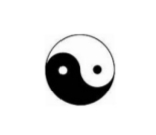
Since, as he told us, he existed before and will endure after this Earth, permeating the entire world, how could the truth teachings of distant times and civilizations not be part of Christ? I love this cartoon, in which the Christ corrects the blind men. He gets it! (Now it’s up to the rest of us to take the hint!)

christ & elephant

So let’s drop bogus excuses for overlooking the validity of Asian teaching. They speak to fatal blind spots in Western knowledge banks. They are no more foreign or outdated than are the teachings held up to us as the foundations of Western civilization. To reject them is to forfeit the immeasurable benefits to be gained from restoring that yin part of the metaphorical elephant to our yang arsenal.

It’s the abuse of the teachings, the corruption that has occurred in every time and place, the overlay of dross and foolishness which we must shed. Do this to let pristine Truth rise once more out of the ashes of outworn customs, ignorant prejudices and greedy exploitation.

Wheel2

Wheels within wheels within wheels. Got the picture? : )

Now, here’s what I’ve been trying to get across to JBP in one form or another. Christ, like many before and after him – from ancient Hindus to Mayans – spoke about end times. However detestable, like Judas, today’s postmodernist neo-Marxists have role to play. Crossing swords with them isn’t the Phoenix way of redemption.

The irrefutable answer to bogus postmodernist views is helpful only in so far as it used to prevent deceivers from confusing those who serve truth. It’s not going to “change” the course of history as it has long been foretold.

Resigning oneself to the inevitable crash and burn of civilization is a sad but necessary preliminary step which must be endured as the prelude to its rebirth. Titanic-like victims have chosen to take a joy ride on an ill-equipped, fated ship. Squandering regretful attention on their fate is fruitless. The wiser to choice is to devote limited resources of time and attention to what can be redeemed.

Christ compared today’s end times to the fate of Noah’s civilization. The wise heeded warnings and survived. Fools partied on, oblivious to danger until the flood waters rose up to carry them off. Now as then, those deaf to calling and hardened against Truth will choose to party on, oblivious. It’s their choice. And their consequences.
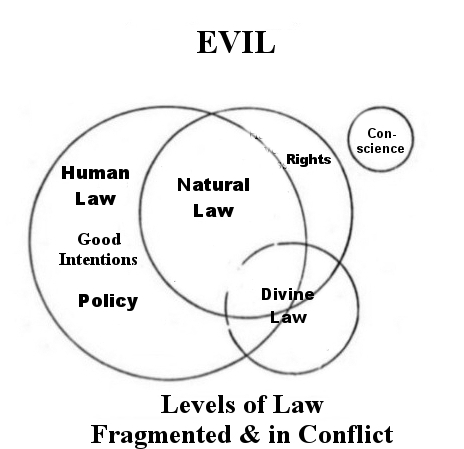
Let us, instead, choose to follow Noah’s example. Prepare for what coming. Preserve the timeless teachings and protect those willing to listen and follow Truth. The process necessarily begins one person at a the time, living according to a complete and accurate reality paradigm in which yin and yang ways of knowing complete each other, bringing the music of life once again into harmony.
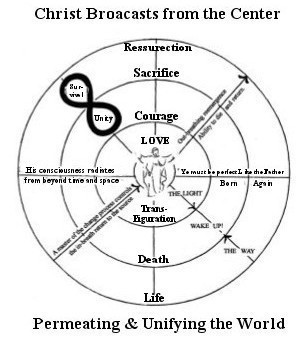
Angel Calling

P.S.

There’s necessity to the length of this post. It’s the last for now, so I’ve reduced the content of what might otherwise have been four separate pieces, to include everything that wanted to be said. As it stands, writing takes too much out of me, for too little in return. I’ll consolidate past work into a book, whose whole may be greater than the sum of its parts. But unless balance is restored in terms of feedback, the rest must remain unsaid.