Tag Archives: Einstein

Rethinking DISCRIMINATION

Saturday morning, May 17th, while browsing on Twitter, I happened upon the question, “Is Affirmative Action still necessary?” I tweeted straight back, “It was NEVER necessary. The goals are still valid; the legislation missed the point, triggering backlash without valid solutions.” On second thought, I tweeted “AA my thesis subject; response not made lightly; see  http://wp.me/p46Y5Z-7h. All best!”

Then, out of curiosity, I looked up the folks who asked. It’s a suspiciously faceless group using the same familiar but empty buzz words that attract all, but satisfy none. “Change is Coming. Engage. Unite. Inspire.”

It’s my ongoing work to take back and revitalize the language. Change is my subject. The Unified Theory inherent in Einstein’s famous formula is the message. Reinventing democracy by inspiring careful thinkers to Positive Action is my intended result.

Hence, today’s blog is dedicated to the history behind my answer. Take time to balance the overlooked neutral and positive meanings of “discrimination” with the overworked negative ones. It’s important.

An earlier blog posted on January 5, 2014, I spoke to a comment about discrimination made on “Off the Record” by Fox News’ Greta Van Susteren. She said racism exists and it’s terrible. But using the race card wrongfully is just as bad. Public figures who stir up the pot are dividing the nation, not healing it. They’re doing a real disservice to those with valid grievances. She called for “Real Solutions to Solve Real Racism.” I agreed whole-heartedly.

I continued, “Bottom line: exploitation is an energy dynamic, a symptom of self-destructive imbalance. To the extent that individuals operate on incomplete, inaccurate and false paradigms, they remain insecure, unconscious and functionally disconnected from their higher potentials. Out of that pain and suffering, like Kissinger, like Soros in the extreme, they will continue to feel justified in dominating, controlling and exploiting whomever they can, however they can — playing out power addictions with hypocritical talk of philanthropy.

“Affirmative Action legislation has not changed these dynamics — nor, as discussed earlier, could it. Looking in the wrong places doesn’t help. Tacking Affirmative Action legislation as an overlay on the surface level, while failing to address a deeper, divisive worldview, couldn’t help, and most likely would make matters worse.

“Blaming outside enemies as an excuse to avoid self-examination and correction is a futile waste of precious time and energy. Although venting frustration in politically motivated social movements — even terrorism and outright war — may temporarily feel good, it doesn’t address the underlying paradigm deficiency that drives hatred, violence and injustice. It therefore can’t put an end to catastrophic outcomes.”

Here then, is the supporting Essay from Conscience: Your Ultimate Personal Survival Guide.*

globe


19. DISCRIMINATION

“Relying more on the social scientists than on legal precedents . . the Court insisted on equality of the mind and heart rather than on equal school facilities. . . . Brown symbolizes the Good America, rather than the country that slaughtered Native Americans, subordinated women, and enslaved blacks. — Jack M. Balkin, What “Brown v. Board of Education” Should Have Said

Dealing exclusively on a rational level with an issue like discrimination which is deeply emotion-laden (sub-rational) on the one hand, and highly value-laden (super-rational) on the other, fails to acknowledge and draw on the levels where problems begin and where solutions can be found. — Patricia West, “Positive Action: The Next Generation”

Seeing and hearing are like food and drink; you need them every day, but you also need to digest and eliminate them every day. If they are not digested and eliminated thoroughly, they remain in the gut, eventually producing illness. — Taoist Meditation, trans. Thomas Cleary.

THE FRONT

Three levels of definition attribute opposite, contradictory meanings to the single word discrimination. In the last century, failure to recognize and sort out this confusion resulted in muddled perceptions of purpose, inconsistent implementation and half-hearted compliance with Affirmative Action legislation.

The Oxford English Dictionary’s rational definition of discrimination posits a neutral function of mind. To discriminate is to distinguish with the mind or intellect; to perceive, observe, or note the difference in or between. As an analytical tool, discrimination is the neutral function of mind used to dissect a situation’s parts and deduce cause/effect relationships amongst them. As a tool, effects of its use, whether creative or destructive, depend on the motives and competence of the user.

The last given definition adds a preposition: against. To discriminate against is to make an adverse distinction in regard to, to distinguish unfavorably from others. This negative definition is the sub-rational use. It describes abuse of the critical faculty of mind to separate, distance and subordinate others, and to rationalize exploitation. Discrimination as a function of biased, negative emotions such as fear, hate, envy, arrogance or greed is the polar opposite of objective analysis.

Still further from the rational meaning of discrimination is its super-rational definition. It is not included in The Oxford English Dictionary. However, in Eastern scriptures, the highest function of mind is called buddhi (hence the name Buddha), translated into English as the power of discrimination.

This usage alludes to the ability to see through deceptive illusions, to recognize the eternal in the midst of change, to be aware of all-pervading spirit operating within gross material forms. While rational discrimination is neutral and sub-rational discrimination has separatist results, the super-rational function of discrimination is unifying in effect.

Depending on the user’s mind-set, the I Ching can be used to serve rational, sub- or super-rational motives. Ideally, it’s used to facilitate the process of mental metabolism. When the senses are overloaded with impressions, the Book of Change can be approached as a discipline for settling down and organizing one’s thoughts sufficiently to define the immediate situation and ask questions about it.

As negative emotions surface, they’re named and released, not unlike the process of separating toxins from useful nutrients, eliminating them as waste. Rational thoughts are then simplified, prioritizing essentials and aligning them to basic purpose. Then, when emotions and rational mind are harmonized and stilled, the higher mind is invoked.

It is in this state of tranquil revere that one pierces the veil of ordinary thought, allowing the transcendent awareness attributed to genius to come forward. Einstein, for example, acknowledged that his famous e = mc2 formula came in a flash of inspired contemplation. He faulted his peers for what he called the “fateful fear of metaphysics,” a pernicious prejudice that’s easily as dangerous as racism or sexism.

THE BACK

Mercy and compassion ameliorate the effects of negative discrimination. Introspective activities like self-analysis and use of the I Ching promote the positive capacity to discriminate, make correct decisions, and act wisely. In human law, the opposite of discrimination is justice and equity. In an equitable society, wisdom is promoted as the foundation of harmony and order.

The discipline of positive discrimination is neglected in an unjust world. Ruthless extortionists in positions of political power will kill to prevent discriminating thinkers from recognizing and opposing their abuses. Tyrants promote negative discrimination. They exploit hatred, weakening the people by turning them against each other, conquering by dividing them.

—————————-

What “Brown v. Board of Education” Should Have Said. Ed. Jack M. Balkin. (New York

University Press: New York, 2001.) pp. 4-5.

Patricia West, Positive Action: The Next Generation of Affirmative Action. Unpublished paper. (Madison, WI, 1976).

Taoist Meditation: Methods for Cultivating a Healthy Mind and Body, trans. Thomas Cleary. (Shambhala: Boston, MA, 2000.) P. 57.

——————-

* See the Conscience Page for illustrations, description of the structure-within-structure format of the Sixty-Four Essays, an overview of CONSCIENCE: Your Ultimate Personal Survival Guide, and an alphabetical list of the Essays.

Rethinking POWER

Because democracy is defined as “power to the people,” the Essay on POWER follows FREEDOM. With the stage set, the third blog – Rethinking Democracy – will summarize personal observations made in Rethinking Survival.

globe

ESSAY 57. POWER


 Nothing under heaven is as soft, receptive and yielding as water.

Its gentleness dissolves the hard, erodes and absorbs the rigid.

Thus, those who bend endure long after the unbending have snapped.

So it is that the low and high trade places, and the forceful loose their influence.

Like water, sages embrace humility to endure,

remaining flexible and responsive to the needs of the time.

This is known by many, but practiced by few.

— Patricia West, Two Sides of a Coin: Lao Tze’s Common Sense Way of Change

*

“The principle aim . . . is to unfold a Tao of economics; it has always seemed to me appropriate to establish and re-establish a truer alignment of political and economic forces with the natural processes and, through the ancient Chinese I Ching, such an endeavour is possible.” — Guy Damian-Knight, The I Ching on Business and Decision Making

*

“Part of what goes into acting decisively in any life situation, along with aggressiveness, clarity of thinking, the awareness of one’s own death, is training. The warrior energy is concerned with skill, power, and accuracy, with control, both inner and outer, psychological and physical. . . He has developed skill with the “weapons” he uses to implement his decisions.” — Moore & Gillette, The Warrior in His Fullness

THE FRONT

The root of power means to be able, potent. Webster’s first definition is the ability to do, act or produce. It refers to a specific ability or faculty, like the power to hear. It refers to a great ability to act or affect strongly using vigor, force, or strength. Power is used to describe the ability to control others, or the authority to influence, such as legal authority.

.

Power refers to the source of physical energy or mechanical force that can be put to work, like water power. It points to a person or thing having great influence. It can mean a nation which dominates other nations. Power also refers to spirit or divinity. An archaic use implies an armed force: army, navy, or military strength, like air power. In optics, power refers to the degree of magnification of a lens, microscope or telescope.

.

R.L. Wing elaborates on the adage, “Knowledge is power,” pointing out the unique advantage gained from focusing the I Ching magnifying lens on daily life. “The power and astuteness that we gain from this universal perspective,” she writes, “can be applied to any of life’s situations.” In addition, “We recognize situations that hold no promise because they are structured in a way that will cause their own downfall.” In other words, knowledge gives us insight to recognize where various choices are likely to lead, resulting is better decisions.

.

In Taoist thinking, laws of nature explain why power over time reverts to the people. While drops of water are insignificant, they add up. The momentum driving a tidal wave is formidable. Divided by fear, ignorance, and narrow materialistic beliefs, individuals remain insignificant. Unified in wisdom by common purpose, people become powerful indeed. Leaders, whether a Stalin or a Mandela, ride the waves of time like energy surfers, directing their followers either towards slaughter or towards freedom.

.

Great temporal power of itself implies no value. Its effect, whether positive or negative, depends on the context within which it’s used, either consciously or unconsciously, skillfully or incompetently, for good or evil. The results of a warrior’s prowess, military arsenal and self-control depend on how, when, where and why they’re applied.

.

For example, in the last century Germany produced both a Hitler and an Einstein. Hitler was obsessed with the occult. He wanted to harness unseen forces to further his goal of world domination. Einstein, on the other hand, searched for the subtle laws of physics. He hoped thereby to discover a Unified  Field Theory which perfectly describes the operations of nature. Had he prevailed, he would have re-invented the I Ching and its off-spring, the Positive Paradigm of Change.

.

THE BACK

The opposite of power is powerlessness. Though energy is inherent in every life form, and every individual has the potential to express a unique variation of power, through any combination of external circumstances and personal choices, it can remain latent and dormant, an opportunity lost.

.

A perversion of power is malicious aggression. Using force to harm others, even destroying life to steal material possessions or gain political power, violates natural law. In time, harm returns to the abuser in equal proportion to damage done. Herein is practical proof of biblical wisdom, “Justice is mine, sayeth the Lord.”

Snippets from The Positive Paradigm Handbook

globe

WHY PARADIGMS MATTER

Ideas drive results. People’s beliefs drive their actions.

Actions that stem from a simple, complete and accurate paradigm result in personal fulfillment, harmonious relationships, and economic prosperity.

Actions based on false, incomplete and inaccurate paradigms, however well intended or passionately defended, are the cause of widespread misery, suffering and deprivation.

As detailed in Rethinking Survival: Getting to the Positive Paradigm of Change, a fatal information deficit explains the worldwide leadership deficit and related budget deficits.

In a dangerous world where psychological and economic warfare compete with religious extremism and terrorism to undo thousands of years of incremental human progress, a healing balance is urgently needed.

Restoring a simple, complete and accurate paradigm of leadership and relationships now could make the difference between human survival on the one hand, and the extinction of the human race (or the end of civilization as we know it), on the other.

cov wheel

The TWIN BASICS of POSITIVE CHANGE

Inside to Out. Individual change begins from the inside and radiates outwards from the central hub of the Positive Paradigm Wheel. Light initiating from the silent innermost center extends outwards. Guidance and inspiration are articulated in language. These ideas, expressed with genius and passionate conviction, drive motivated action that manifests in positive results.

Smallest to Largest. Transformation begins with the smallest unit, the individual. Therefore, the quality of family life depends on the functional integrity of each family member. Large organizations are improved by first improving the quality of family life. Qualitative reform of whole nations is achieved only by restoring the internal integrity of their agencies and supporting business connections.

Einstein’s New Way of Thinking

Human survival, Einstein warned us, cannot be taken for granted. Tipping the scales of history in favor of survival depends on freeing ourselves from the mental prison of limited, delusional thinking:

A human being is part of the whole called “Universe,” a part limited in time and space. We experience ourselves, our thoughts and feelings as something separate from the rest . . . This delusion is a kind of prison for us, restricting us to our personal desires and to affection for a few persons nearest to us. Our task must be to free ourselves from the prison by widening our circle of compassion to embrace all living creatures and the whole of nature in its beauty. . We shall require a substantially new manner of thinking if mankind is to survive.

The Positive Paradigm of Change pictures Einstein’s widened circle of compassion, complete with his magical, magnetic all-encompassing center.

It’s also the answer to comparative religion legend Joseph Campbell’s prescient hint:

We don’t have a mythology for people recognizing the humanity of a person on the other side of the hemisphere. I’ve often wondered if some of the notions coming out of quantum physics, quantum interconnectedness, don’t express that.

In the interests of human survival, the purpose of The Positive Paradigm Handbook: Make Yourself Whole Using the Wheel of Change is to make this new way of thinking as widely known and usefully available as possible.

The Who, When, How, What and Why

Logical questions then follow. Who should use The Positive Paradigm Handbook? When should the Handbook be used and how? What are the benefits? Why is this method of “thinking like a genius” so effective?

Who? The Handbook is intended for self-selected survivors with the heartfelt desire to improve themselves and the courage to rethink their lives. Everyone everywhere with basic English language skills and a commitment to ensuring survival for themselves and those they care for can and should use The Positive Paradigm Handbook.

As the next-generation Book of Change, the Handbook is especially useful to those in responsible leadership positions as well as those who advise them. However, it is equally useful to truth seekers and decisions-makers in every walk of life.

The Handbook should be required reading for young people who need to understand the way the world really works and how they fit in.

When? It’s natural to cling to what’s already known and familiar, especially when it seems as if there’s no better solution to an admittedly bad situation. Many find the possibility of extinction so threatening that they refuse to even think about it.

However, this doesn’t make danger disappear. It just leaves escapists unprepared to face inevitable change. Regardless of what may or may not come, denial, resistance and procrastination are a dangerous waste of precious time.

Once it’s accepted that there is a hopeful and positive approach to facing today’s dangers, the time to work with the Handbook and internalize this worldview is NOW.

What? As the title suggests, the end result of using the Handbook is restored wholeness. The process of comparing one’s immediate personal organization to the Positive Paradigm standard of completeness is a means for recognizing excesses and deficiencies, the better to correct them, thus restoring balance, integration and harmony to the whole. Benefits from using the Handbook are cumulative. Depending on diligence and frequency of use, they increase exponentially.

On the one hand, intentionally aligning and linking the levels of experience will increase self-awareness, improve relationships and lead to effective decision-making. On the other, as beliefs and actions become significantly the less fragmented, the side-effects of stress and related mental/physical disease will decrease accordingly.

Why? In part, working with the Wheel of Change remedies the right- and left-brain imbalances that lead to dysfunctional results. Plugging left-brain language into the right-brain imagery of concentric circles has the balancing effect of stimulating both sides of the brain simultaneously. Further, diminishing the noise of emotional pain and overcoming the dichotomies of either/or thinking opens access to the innermost realms of conscience and the inspirational guidance associated with great leaders and inventive genius.


Rethinking POSITIVE DISCRIMINATION

An earlier blog took a different approach to racial prejudice in the context of Affirmative Action legislation. Here is the balancing, opposite and equally positive approach to discrimination.

globe

19. DISCRIMINATION

“Relying more on the social scientists than on legal precedents . . the Court insisted on equality of the mind and heart rather than on equal school facilities. . . . Brown symbolizes the Good America, rather than the country that slaughtered Native Americans, subordinated women, and enslaved blacks.” — Jack M. Balkin, What “Brown v. Board of Education” Should Have Said

“Dealing exclusively on a rational level with an issue like discrimination which is deeply emotion-laden (sub-rational) on the one hand, and highly value-laden (super-rational) on the other, fails to acknowledge and draw on the levels where problems begin and where solutions can be found.” — Patricia West, Positive Action: The Next Generation

“Seeing and hearing are like food and drink; you need them every day, but you also need to digest and eliminate them every day. If they are not digested and eliminated thoroughly, they remain in the gut, eventually producing illness.” — Taoist Meditation, trans. Thomas Cleary.

THE FRONT

Three levels of definition attribute opposite, contradictory meanings to the single word discrimination. In the last century, failure to recognize and sort out this confusion resulted in muddled perceptions of purpose, inconsistent implementation and half-hearted compliance with Affirmative Action legislation.

The Oxford English Dictionary’s rational definition of discrimination posits a neutral function of mind. To discriminate is to distinguish with the mind or intellect; to perceive, observe, or note the difference in or between. As an analytical tool, discrimination is the neutral function of mind used to dissect a situation’s parts and deduce cause/effect relationships amongst them. As a tool, effects of its use, whether creative or destructive, depend on the motives and competence of the user.

The last given definition adds a preposition: against. To discriminate against is to make an adverse distinction in regard to, to distinguish unfavorably from others. This negative definition is the sub-rational use. It describes abuse of the critical faculty of mind to separate, distance and subordinate others, and to rationalize exploitation. Discrimination as a function of biased, negative emotions such as fear, hate, envy, arrogance or greed is the polar opposite of objective analysis.

Still further from the rational meaning of discrimination is its super-rational definition. It is not included in The Oxford English Dictionary. However, in Eastern scriptures, the highest function of mind is called buddhi (hence the name Buddha), translated into English as “the power of discrimination.”

This usage alludes to the ability to see through deceptive illusions, to recognize the eternal in the midst of change, to be aware of all-pervading spirit operating within gross material forms. While rational discrimination is neutral and sub-rational discrimination has separatist results, the super-rational function of discrimination is unifying in effect.

Depending on the user’s mind-set, the I Ching can be used to serve rational, sub- or super-rational motives. Ideally, it’s used to facilitate the process of mental metabolism. When the senses are overloaded with impressions, the Book of Change can be approached as a discipline for settling down and organizing one’s thoughts sufficiently to define the immediate situation and ask questions about it.

As negative emotions surface, they’re named and released, not unlike the process of separating toxins from useful nutrients, eliminating them as waste. Rational thoughts are then simplified, prioritizing essentials and aligning them to basic purpose. Then, when emotions and rational mind are harmonized and stilled, the higher mind is invoked.

It is in this state of tranquil revere that one pierces the veil of ordinary thought, allowing the transcendent awareness attributed to genius to come forward. Einstein, for example, acknowledged that his famous e = mc2 formula came in a flash of inspired contemplation. He faulted his peers for what he called the “fateful fear of metaphysics,” a pernicious prejudice that’s easily as dangerous as racism or sexism.

THE BACK

Mercy and compassion ameliorate the effects of negative discrimination. Introspective activities like self-analysis and use of the I Ching promote the positive capacity to discriminate, make correct decisions, and act wisely. In human law, the opposite of discrimination is justice and equity. In an equitable society, wisdom is promoted as the foundation of harmony and order.

The discipline of positive discrimination is neglected in an unjust world. Ruthless extortionists in positions of political power will kill to prevent discriminating thinkers from recognizing and opposing their abuses. Tyrants promote negative discrimination. They exploit hatred, weakening the people by turning them against each other, conquering by dividing them.

—————————-

What “Brown v. Board of Education” Should Have Said. Ed. Jack M. Balkin. (New York University Press: New York, 2001.) pp. 4, 5.

Patricia West, Positive Action: The Next Generation of Affirmative Action. Unpublished paper. (Madison, 1976).

Taoist Meditation: Methods for Cultivating a Healthy Mind and Body, trans. Thomas Cleary. (Shambhala: Boston, MA, 2000.) P. 57.

————————–

See the UPSG for a description of the structure-within-structure format of the Essays, an overview of CONSCIENCE: Your Ultimate Personal Survival Guide, and an alphabetical list of the Essays.
The Positive Paradigm Handbook is Coming SOON

HERE’s a sample from the Coming Positive Paradigm Handbook!

globe

PREFACE

The Positive Paradigm Handbook will change the way you see yourself

and relate to the world – forever.

  • It gives you a functional picture of how your life really works, and by extension, what moves the people around you.

  • It gives you the map for achieving fulfillment, personal happiness and higher love.

  • It give you an instrument with which to effectively organize your personal life, make realistic decisions, and act more effectively to achieve intended results.

  • It gives you premier tools for cultivating self-awareness, making the unconscious conscious, and mapping goals for personal change.

  • It gives you a comprehensive standard for assessing your leadership skills, maximizing this potential, and choosing which leaders to follow.

  • It gives self-healers and therapists a powerful diagnostic tool for identifying the roots of disease-causing stress and correcting lifestyle imbalances.

  • It gives profound insight into the causes of discrimination, sexual abuse and PTSD, as well as how to heal from their effects.

  • It gives everyone a realistic standard for recognizing true friends from mortal enemies.

  • Ultimately, it gives those who follow through the edge on long-term success, tipping the scales of history in favor of human survival, one person at a time.

If these claims sound intense, they are. But they’re well founded.

As a teenager, I was fascinated by the fact that Einstein’s abstract formula, e = mc2, could produce powerfully tangible results — the atomic bomb!

Later, I was even more intrigued to discover that this same formula, when plugged into the concentric circles of the Positive Paradigm Wheel, not only resulted in the Unified Theory of Einstein’s lifelong quest. It was capable of generating equally powerful and practical personal results.

The Positive Paradigm Handbook reveals this Unified Theory and supplies the tools needed to start thinking like a genius. By internalizing this method, making it your own by repeated use, your life will be changed in ways only dreamed of before. Virtually endless in its practical applications, it can be pointed like a laser beam to illumine every field of endeavor.

The Handbook is the bare bones take-away from Rethinking Survival. The author’s personal background, academic credentials, research and experience are described in Getting to the Positive Paradigm. But here, what matters is simply that it works and that owning it is a matter of personal survival.

Based on the foundation of the earlier books on change, The Positive Paradigm Handbook goes directly to the heart of personal, practical application, here and now. The purpose of working with the Handbook is to ingrain Einstein’s “substantially new way of thinking,” which, he said, is required “if mankind is to survive.”

In a world seemingly intent on fracturing experience into smaller and smaller niches, the Positive Paradigm provides an urgently needed counter-balance, applying an opposite and equal weight in a unifying direction.

Einstein’s New Way of Thinking

Rethinking Survival

Here’s a summary of basics from Rethinking. The title reflects Einstein’s prophetic words:

A human being is part of the whole called by us “‘Universe,’

a part limited in time and space.

We experience ourselves, our thoughts and feelings

as something separate from the rest . . .

This delusion is a kind of prison for us,

restricting us to our personal desires and to affection

for a few persons nearest to us.

Our task must be to free ourselves from the prison

by widening our circle of compassion to embrace

all living creatures and the whole of nature in its beauty. . .

We shall require a substantially new manner of thinking

if mankind is to survive.

— Albert Einstein [emphasis added]

 RS web

The Positive Paradigm is the unified (and unifying) theory which Einstein sought. He missed it because he lacked a non-linear, concentric circle structure which expresses the dynamic relationships of his three variables in a two-directional, infinite continuum.

 The layered structure of the Positive Paradigm Wheel gives new meaning to Einstein’s observation that a problem can’t be solved at the same level on which it was created. “We can’t solve problems by using the same kind of thinking we used when we created them.” It gives new meaning to “Go deep,” and “We can’t be satisfied with superficial answers.” The model literally pictures the widening circle of compassion. It shows the way to escape from the prison of separatist thinking.

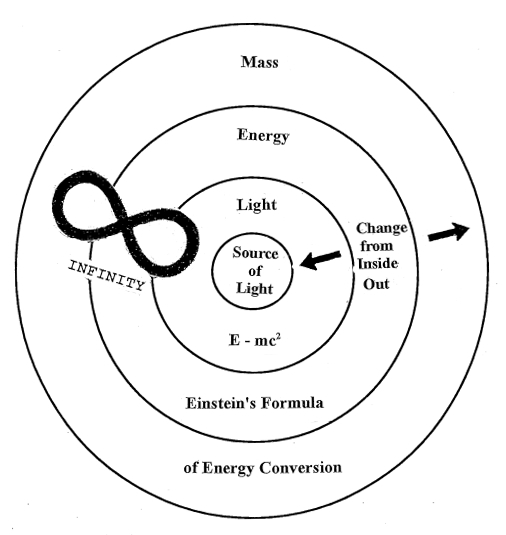
 As the book cover shows, three concentric circles orbit around a common center. The three variables of Albert Einstein’s famous formula, e = mc2 (energy, mass and light) are placed within this wheels-within-wheels structure.

 The figure-eight-shaped symbol of infinity is used in the Positive Paradigm Wheel. Because the Creator is characterized as infinite, beyond time, using this physics symbol is an especially appropriate way to symbolize the linking of the levels.

 As light travels on the outward path, it transforms from wave to particle. As pure, generative potential expands, silence transforms into ideas and then emotions within the middle level of the wheel. These in turn materialize into actions that produce physical, tangible results. On the return path, the process reverses. Matter disperses. It returns to its basic elements. It contracts, receding from particles to waves and then into the perfect silence from which it came.

 The Positive Paradigm Wheel mirrors the microcosmic structure of atoms as well as the macro-cosmic structure of planetary systems. At the microscopic level, its concentric rings mirror the structure of atoms around a nucleus. It equally mirrors the symmetry of the planets orbiting around an organizing star, the sun. On the largest scale of magnitude, it reflects the in- and out-breaths of perpetually expanding and contracting universes.

 This familiar atomic structure repeats smallest to largest in the patterns of nature, from snow flakes and intricate flowers to spiders’ webs and sea shells. Similar symmetrical patterns in repeat worldwide in the art of every culture — including the prayer wheels of Native Americans, the colored sand mandalas of Tibetan Buddhists, the stained glass windows of European cathedrals and the intricate geometrical patterns that cover Muslim Mosques, to name but a few. They speak to the universal awareness of a central inner reality. They confirm a continuity of experience deeper than individual lives or transitory cultures.

 Outer levels of the Positive Paradigm Wheel are ephemeral extensions a timeless, absolute center. But the layers of concentric circles aren’t literally separate and discrete. Rather, they are a continuum along the infinite spectrum of creation. Within each layer are numerous degrees and distinctions which can be verified only by direct experience.

 The word Change in “The Positive Paradigm of Change” emphasizes that this isn’t a static model. It is dynamic, inclusive of the outward path of creative extension as well as the inward return to the creative source. This change is called “positive” because the creative process as a whole is in accord with the organic laws of nature encoded in the Book of Change. Positive change is quite distinct from the unnatural, superficial and arbitrary changes of short-sighted human devising

 This Positive Paradigm of Change shows how to think in the new manner Einstein called for. Working with it instills the ability to link the inner with middle and outermost levels of experience. The goal is to integrate conscience with emotions, reason and actions.

 The Positive Paradigm Wheel as an organizing model of experience isn’t really new, however. Restoring it now isn’t so much a paradigm shift as a return to what Aldus Huxley called the timeless, perennial philosophy which the world’s major religions share in common.

 This model emphasizes the holistic quality of creativity associated with genius. In fact, the secret to thinking like a genius has been known for thousands of years. Yogis call it Raja Yoga. “Raja” is the Sanskrit word for “king.” “Yoga” means “link” or “union.”

globe