Tag Archives: I Ching

It Is Possible to Make A FRESH START

I started “A Fresh Start is Urgently Necessary” by saying two coincidental things happened that day. I described the first, the internet being down. (Turns out a heedless farmer severed a fiber optic cable.) The second had to wait until today. Namely, I connected the dots between an overnight YouTube music search and the challenges inherent in presenting the  timeless I Ching to the Millennial generation in a way they can identify with and own.

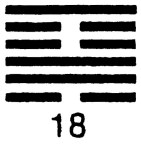
For starters, here’s the Common Sense Book of Change version of Hexagram 18.
hex 18

FRESH START

Even when it seems that all has been spoiled,

it is possibleto make a FRESH START.

Be willing to face your faults.

Find out how to correct them.

The situation will gradually improve

if you are sincere and work hard.

Be sure you know what you want.

Avoid delay.

The unfamiliar graph is called a hexagram. It’s an ancient short-hand method for expressing countless generations of experiential wisdom about the correspondence between chi (energy) flow in the human mind/body (the microcosm) and in the universe (the macrocosm). In yogic philosophy, these six lines correlate with six basic chakras (wheels, or subtle energy centers) located at intersections along the human spine. Each of the centers is associated with specific developmental stages. A primary purpose of yogic practices is to awaken, balance and integrate these levels of experience.

The straight and broken lines of the hexagram are a binary-digital way of expressing alternating, expanding and contracting life rhythms. In the Book of Change, any or all of the six lines can change into its opposite. This results in 64 possible permutations. It’s not coincidence that the ancient I Ching and modern DNA patterns are exact correlates. This is one explanation for the healing effects of medical sciences based on the I Ching hexagrams.

Admittedly, the specifics are beyond my comprehension, for the most part because I trust from experience in the practical results. Just as I use my computer without a deep understanding of how it operates, I have benefited greatly from working with the I Ching and its off-shots. Both sciences, modern and ancient, for many of the same reasons, simply work.

To carry forward the question — When the Lights Go Out, Who Will Millennials Call? (see wp.me/p46Y5Z-cm) — consider this. If/when today’s hospitals are rendered inoperable by grid failures, and/or healthcare as we know it is made unavailable due to social-political malfunctions (like Obama un-care, for example), where can we turn for practical health sciences that maintain health and heal dis-eases? Modern medicine as a profession and a social-political corporate conglomerate has become, for many people, for many reasons, a nightmare. We especially need a Fresh Start in this important area of our lives.

My short answer: long after grid-dependent lights go out, the same basics that work seeming magic with the I Ching will still be available to those familiar with Traditional Chinese Medicine (TCM) methods — including Chi Kung and Tai Chi. The sooner people become fluent in the self-healing arts, the better off — for countless reasons — most of us will be.

I’ve been emphatically told by the one I most trust that “The mind will play any tune you ask it to.” When he speaks, I unpack every word. (He doesn’t waste them.) There is more meaning to this key than simply “Mind over matter” or “Beliefs generate results,” though in terms of self-healing these are included. Training the mind as a musical instrument to skillfully, deliberately apply the I Ching‘s 64-permutations of dynamic “if-then” consequences (analogous to existing computer-driven chess games) would greatly enhance one’s ability to recognize prevailing self-defeating tunes. Further, one could discover better tunes, decide which to play when, and learn how to “ask the mind” to play them.

Advanced meditators describe hearing a celestial “music of the spheres.” Just imagine, if you will, what wondrous music is available to those with “ears to hear.”

Much of I Ching-based philosophy focuses on understanding how fluctuating energy patterns affect human behavior, as well as how they can be used to create harmonious relationships and orchestrate viable institutions of governance. Much has been spoiled by lack of awareness of these patterns (tunes) and ignorance as to how to steer institutions effectively. By reintroducing this vital information, correcting what I have repeatedly described as a “fatal information deficit,” the damage resulting from such ignorance could be repaired and a Fresh Start initiated.

Unfortunately, much of this tradition has a very bad “rep.” It’s been spoiled by a complex mix of misunderstanding, misapplication, and misrepresentation. For example, when I went on YouTube looking for music (the second coincidence I mentioned earlier — see wp.me/p46Y5Z-cJ), what I had in mind was chakra/DNA healing ragas. What I found instead was a commercialized, psychedelic offering of “feel good” audio engineering. Comments likened listening to taking psychotropic drugs that induce the illusion of mind-altering experience. They raved about hallucinations experienced while tripping and listening at the same time.

My Aha: So much of what has been spoiled and cries out for a Fresh Start is the I Ching itself. Today it needs to be approached from the modern science of mind-exploration. It needs to be repackaged as a delightful, game-oriented Lumosity experience, but founded on a profoundly motivating purpose: human survival. Not unlike the Christian tradition, which has suffered greatly in the wrong hands for centuries, the timeless wisdoms must be “reinvented” and approached as if new: First time, every time.
compass clock

It’s the 11th hour, for sure. But, as it has been written, With God all things are possible –including, even, at this late hour, a Fresh Start. But the clock is ticking. God — the Tao — is infinite. Time is not.

When the Lights Go Out, Who Will Millennials Call?

Whenever I hear how addicted Millennials are to their iPods, social media friends and electronic war games, I cringe. It reminds me of the biblical story about handwriting on the wall. As I recall, in ancient times, a mysterious message magically appeared on a decadent palace wall, writ large by an invisible hand in a script unknown to King Belshazzar or his corrupt cronies. To those able to decipher such warnings, however, it predicted the ruler’s extinction.

Millennials are touted as the golden children of progress. “They’re the last best hope for our future,” I hear you say. That’s the rumor, anyway.

But there’s another rumor. Ever hear the maxim, “Whatever has a front has a back?” It continues, “The larger the front, the larger the back.” It’s another way of saying, “Every coin has two sides.”

In this case, let’s ask, “On the day when the lights go out, what would happen to wiz kids dependent on their electronic toys? What use would their extreme investment in computer skills be then?” The logical answer: None. Zip. They’d be helpless and useless.

Nor is this scenario as unlikely as most would hope. Look at the decrepit condition of overworked national grid systems. Consider the frequently threatened possibility of hostile cyber attacks.

I have a powerful memory of the night the lights went out in New York City. It lasted only a span of a few days. I don’t recall the exact date or duration. Only the horror of that early warning remains clear.

Thousands were trapped in high rise apartment buildings. Their windows didn’t open to fresh air. Phones were down. Radios and TV didn’t work. They couldn’t communicate with loved ones or connect with the outside world for help.

Kitchen and bathroom gadgets were useless. Food and water supplies ran dangerously short. What little food remained in freezers started to spoil. Without central air, slow suffocation was a real possibility. Without lighting, folks could barely fumble their way down long flights of stairs. Those who managed to get outside faced a nightmare war scene of muggings, looting, widespread panic and riots.

After that, if I’d lived in any large city, I’d have relocated as quickly as possible. Some said it was a wake-up call. But, surprisingly, people still continue to go quickly back to sleep, even after a long string of similar wake-up calls. Life appears to get back to “normal” (whatever that may be). Most just shrug and revert back to their old dependencies.

In my last blog, “Early Adapters Are Most Likely To Survive,” I hinted at my best hope for Millennials. [See wp.me/p46Y5Z-c8.] I held that once Millennials start connecting the dots and seeing the larger picture of how the Book of Change resonates with their own computer and game addictions — as well as the enormous implications — there’s a genuine, valid basis for future hope.

This hope is the up-side to the same maxim, “The larger the front, the larger the back.” Name, the same computer technologies turned outward to connect with peers and dazzle (or alienate) their elders have biological and metaphysical equivalents. When turned inward, they have the potential to empower Millennials in a way that changes the dark side of dependency on technology to an opposite and equal survival advantage — even and especially in the face of a (God forbid) technology-poor future.

Here’s the key. There are powerful correspondences between technology and human anatomy. Inventors have always depended on self-awareness to create extensions. For example, the violin’s resonant music depends on the same science of sound vibrations that powers the alternating pulsations of the breath and the lub-dub rhythm of the human heart. It’s no accident that the musical instrument’s parts have human anatomy names — neck, belly and spine. Other examples are legion. Think of the horse-drawn chariot, steam engine, train and automobile, to name a few.

Those who practice the I Ching-related discipline of yoga intentionally tune their bodies as instruments. By regulating the breath and slowing their heart rates, they heighten awareness and increase lifespan.

IF (dare I say when) Millennials connect the dots and recognize the powerful correlations between computer technologies and the human brain — how it’s wired, stores information, etc., —  they can, with appropriate disciplines, change themselves into instruments of higher consciousness. Because, just as violins don’t have souls — it takes musicians to fashion them and then activate their potentials — so also, computers don’t have souls. Their inventors and those who choose to use them wisely do.**

Lumosity computerized games are tapping into the vast potential for good. But so far, based on the limited and limiting research methods of empirical science, they’ve just scratched the surface (quite literally so). To go deeper and actualize the unrecognized potential for expanding human consciousness latent in computer technologies, it’s necessary to look to the tried and tested science developed over eight-thousand years and counting that’s hiding in plain sight. Yes, I’m referring to the Chinese I Ching.

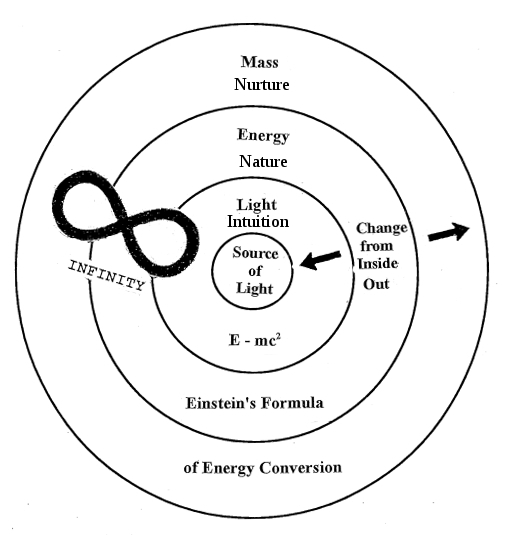
Here’s a picture of how it fits into the larger scheme of things as an essential puzzle piece of the larger, atom-like structure of Einstein’s intuited Unified Theory.

Fits in the Picture

There’s powerful magic latent in the timeless Book of Change, albeit written in a language not all understand. Like the ancients who were able to read, heed and survive the handwriting on the wall, those of every generation who attune themselves to the wisdom of this interactive book will have the edge on future survival. By this I mean not just clinging to the bare minimum of animal existence, but a hopeful new beginning.

And no, this isn’t new age hocus pocus. Although it resonates in musical ways that seem magical to the uninitiated, the modern sciences of atomic physics, computer binary digital code, and DNA structure/function now give intriguing explanations as to how/why it works on a cellular or even atomic level. To repeat, once Millennials start connecting the dots and seeing the larger picture of how the Book of Change resonates with their own computer and game addictions — as well as the enormous implications — there’s a valid basis for genuine future hope.

How can this be? How does this all work? Here’s another pair of maxims, rarely understood, even less often applied: “As within, so without” and “As without, so within.”

In any case, on the day when the physical lights go out, those who depend on inner light for guidance will be the ultimate survivors. In the interim, intelligent use of the interactive Book of Change can serve to reconnect sincere preppers (early adapters) with their deepest core. It gives those with an open mind the wisdom needed to navigate successfully through dangerous times.

Electricity and the many kinds of vehicles it powers are ephemeral mirrors of the inner source upon which they depend, the eternal light which sustains those open to receive it. To repeat what was earlier written for a Millennial who challenged me with a leadership question, “Dangerous Times Call for True Radicals.” [See wp.me/p46Y5Z-aA.]

When preparing for danger — the eventuality, for any host of reasons, that the physical lights go out — the best answer to the movie question “Who you gonna call?” isn’t “Ghost Busters.” But close. Call on the myth busters who dispel dysfunctional paradigms like the limiting exclusively empirical science paradigm which has gotten us into our current mess. Call on the radical truth-and-light-bearers of all times.

——–

** [Atheists may argue the point. There’s no time left for such nonsense. Besides of which, this has already been addressed at length elsewhere.  See Atheism Answered.]

globe

Early Adapters Are Most Likely To Survive

With one exception, responses to recent blogs have been gratifying.

In response to “Therapists as Agents of Positive Change,” Brent Nichols, M.A., C.S.W., a Jungian Psychoanalyst located near Berlin, Germany, wrote, “Very nice piece. . . I very much appreciate your lovely thoughts about the Jungian therapeutic process.”

John Romig Johnson, Ph.D., NCPsyA., a Jungian Analyst at Body and Soul International near Charleston, South Carolina, wrote “Marvelous blog. I want to read them all when I get a chance.”

Candace Kleven, PhD., a Psychotherapist in the Jungian Tradition wrote from Redondo Beach, California, “Thank you Pat! I am looking forward to reading your blog and staying connected with your much needed work.”

In response to “Savvy Leaders Go with the Flow,” from Toronto, Canada, Frank Feather at StratEDGYInc. wrote “That is a wonderful and very sage article, Pat. . . . I fear for America. The paradoxes in its political and socio-economic way of life are astonishing and self-destructive. The so-called dream is in danger of becoming a nightmare. . . . Please keep writing, and thanks again for connecting. You are extremely wise.”

But, in balance, lest I get overly-impressed with myself, Brian Chernett, Founder and Chief Executive at ELLAFORUMS CIC in Harrow, U.K. responded, “Its interesting but a little Academic for me.”

Ouch. But, okay. This is an important turning point for me. It’s time find a new, more effective way to communicate. So this is for Brian.

I checked out ELLAFORUMS and learned that it’s a “leadership development programme specifically designed to inspire and develop the leaders of Social Enterprises and Charities.” I listened as Brian explained that ELLA stands for Experiential Leadership Learning Academy. Ah. His direct, interactive approach to leadership training explains, at least in part, his objection to a one-sided monologue.

But to be honest, there’s more. I read “Savvy Leaders” again, thinking how it must look from Brian’s view point. Sure enough. Though I swim like a golden fish in the lore of world scriptures, taking joy in linking the patterned echoes of truth that repeat throughout, to a reader without the background of my chosen path, allusions to Plato and the Old Testament, not to mention Lao Tze, are a stretch. [Understatement.]

So I’m challenging myself here to get straight to the point of “Savvy Leaders” without depending on the authority of unnecessary outside sources. The timing of this decision is critical because I’ve chosen from now on to focus my work towards Millennials (as well as the parents and grandparents who dearly wish them well).

Twenty-somethings swim like golden fish in computer technologies which I find as challenging as my academic waters are to them and their practical hands-on mentors. It’s my responsibility a boundary- spanner to reach out and bridge whatever gaps interfere with effective communication, be they professional or generational.

So here’s my point, straight up. History repeats itself in intricate but predictable cyclical patterns. To stay ahead of the curve, successful leaders depend for survival on timeless wisdom — both innate and educated.

The basic point of Rethinking Survival is that human survival will depend upon decisions based on a simple, complete and correct paradigm. Currently, world leaders operating on the basis of incomplete, extreme and dysfunctional paradigms are making decisions that endanger us all.

The way out of current madness must begin with restoring a complete and correct paradigm, one that is consistent with both the world’s great religions and with modern physics. I’ve presented it as the Positive Paradigm of Change and published two books, one an autobiographical and personal approach, the other a bare bones, practical user’s manual.

I’m advocating a Positive Paradigm shift, regarding it as urgent to rethink priorities and retrain our minds. Historically, power holders with a vested interest in the status quo met calls for change with fierce resistance. It takes a new generation, one for whom old solutions to challenging situations no longer work, to take up the banner of a more functional, hopeful paradigm.

This is why I dedicated Two Sides of a Coin to the Millennial Generation. Seemingly disinherited by their elders, they have little vested interest in protecting the dysfunctional paradigms that have brought us to the current mess we’re in. The Positive Paradigm of Change, a descendant of the Book of Change that remains true to the original, gives them the means to actualize the opportunity hidden in adversity. Namely, survivors must, albeit of necessity, fortify inner strengths and restore forgotten wisdom.

In 1975, I wrote an easy-to-read version of the timeless Chinese I Ching called The Common Sense Book of Change. In fact, it was written exactly to rescue the timeless essence from unnecessary baggage in a non-sexist, non-flowery form that readers of every age with basic language skills and an open heart could relate to.

I cannot speak highly enough of this treasure. This interactive book serves to connect sincere users with their deepest core. When I was dealing with issues which couldn’t be spoken, it was the best friend that got me through tough times. It was the therapist I couldn’t afford, but in some respects better.

It resonates in ways that seem almost magical, though the modern sciences of atomic physics, computer binary digital code, and DNA now give intriguing explanations as to why it works on a cellular or even atomic level. (Hint: It’s no accident that the universal Positive Paradigm model is reminiscent of the rings surrounding the atom’s nucleus as well as the planets revolving around our solar system’s sun.)

Once Millennials start connecting the dots and seeing the larger picture of how the Book of Change resonates with their own computer and game addictions — as well as the enormous implications — there’s a hope for the future. (To those of Christian background who resist its wisdom as if there were a conflict, let me assure you: There is none. Christ told us he existed before the world and will continue after. He presence permeates the field. The wisdom of all human times necessarily partakes of that essence.)

Jesus foresaw the times we’re now enduring. The Book of Change confirms what he foretold and gives those with an open mind the wisdom needed to navigate successfully through dangerous times. Regardless of naysayers who wish to believe otherwise, the world is currently at a nadir point in its history. We are already in the midst of what Old Avatar calls a Near Extinction Level Crisis (N.E.L.C). Recent events in the Near East, North Korea, and the former U.S.S.R, not to mention those closer to home on the U.S. Southern border are merely the visible tip of a vast iceberg.

Historically, at the critical mass of decline and chaos, visionary leaders equal to the times have come forward. They will surely arise from the amongst the Millennial Generation’s ranks as well. They may not have the material advantages earlier available to me. But there’s a trade off.

I’ve had the instructional blessings of international travel and a good education, as well as the luxury of a lifetime to turn knowledge and experience into wisdom. This is my legacy, handed over across the bridge of the generation gap. Millennials are the children and grandchildren I never had. The Positive Paradigm of Change is the sum of all I’ve learned, an inheritance now entrusted to their use, to pass on to their children in turn, if and when that time comes.

Bottom line: history is not a straight line. Those who live as if it were are in deep trouble. Those of vision, while living in today’s world, are quietly preparing for inevitable shocks waiting around the bend. They’re savvy enough to avoid calamity whenever possible, and when the inevitable must be faced, they’re ready meet it, adapt and survive as best they can.

The self-aware who sense and respond to the changes “blowing in the wind” are called “early adapters.” They, along with those who heed and follow them, are the most likely to survive whatever challenges may come.

All Best!

Savvy Leaders Go with the Flow

We’ve all familiar with the phrase, “Go with the flow.” It’s another way of saying, “Timing is everything.” But how does it apply to the leader selection process? That’s the final, forth factor Mike Lehr of Omega Z Advisors invited me to comment on. Earlier, he wrote:

.

When I look at events, I see four major forces: circumstances, flow, people and leader. From my perspective, you wrote about the last two. [See “Scientists and Sages Can Agree on This,” wp.me/p46Y5Z-8W and “How Bad People Become Leaders,” wp.me/p46Y5Z-9B.] I’m asking about the first two.

The third factor has already been covered in a responsive blog. [See “Do Circumstances Influence Leader Selection?” wp.me/p46Y5Z-be.] That leaves the fourth major force influencing leader selection – flow.

Though I often describe flow as timing, my view is more from the I Ching on this. So, my question to you is this: Would being at different points in the I Ching cycle produce different leaders?

To summarize, I often ask people this question: If everyone suddenly awoke not knowing who they were and not remembering how they came to be where they are (if we could reset life), would the same leaders arise that we have now?

In fact, the Book of Change was traditionally consulted as a method of telling time. According to Conscience: Your Ultimate Personal Survival Guide:

 .

. . . the I Ching works like a cosmic clock, telling us the time. In the Old Testament, King Solomon expressed the natural, rhythmic alternations of time in poetic form: “To every thing there is a season, and a time for every purpose under heaven.”

.

The Book of Change puts its users in touch with these pulsating, alternating rhythms of life. It connects them with inner knowing – call it intuition or conscience – that anticipates approaching changes, the better to prepare for what is to come.

.

The Common Sense Book of Change explains it this way:

.

This text is called the Book of Change because its readings sum up the natural laws of change. They reflect stages through which daily events evolve in predictable cyclical patterns.

.

These patterns can be drawn on any scale from smallest to largest. For example, they might express the seconds which add up to a minute, or the minutes which complete an hour on the face of the clock.

compass clock

.

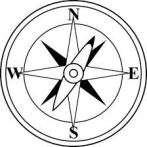
What most leaders fail to take into account, however, is that the different hands of this cosmic clock return to the twelve o’clock alpha-omega compass point of True North at different rates of speed. By analogy, successful leaders have an overview of the complex point in time where their organizations currently stand, as well as the ultimate direction in which they’re headed.

.

Unfortunately, short-sighted leaders see only the second- or, at best, the minute-hand of the clock, mistakenly assuming they see the whole picture. They remain sadly unaware of the larger context, oblivious to the long-term hour.

.

For example, the fast-moving second-hand of the cosmic clock may point due North towards the zenith point of twelve o’clock and the intermediate-speed minute-hand point to 12:15. All the while, unobserved, the slowest-moving hour-hand may point towards the nadir, due South at six o’clock.

.

Short-sighted leaders miscalculate. Their timing is dangerously off. For example, when they act as if prosperity is never-ending (or else just around the corner) when in fact a depression of unprecedented proportions is looming ahead like an “unforeseen” iceberg, they’re unwittingly leading unprepared followers into a disaster of Titanic proportion.

.

To continue with Plato’s earlier “leader as charioteer” image, successful executives must be capable of harnessing the opposite forces of expansion and contraction, the yin-yang pair of white and black horses. If these energies are not reined in and balanced, they can tear whole nations apart, steering them off-course into self-destruction, either consumed by the sun or else smashed to smithereens below. [See “Know When to Mistrust Inner Voices,” wp.me/p46Y5Z-aR.]

.

Those versed in the dynamics of I Ching yin-yang opposites know that each extreme generates its polar opposite. For example, extreme inflation inevitably triggers an opposite and equal extreme of deflation. Extremes of extravagant waste on the part of a few predictably lead to wide-spread deprivation and misery for the many.

.

But how do the basics of flow apply to leader selection today? As discussed earlier, it depends on who the selectors are. For example, in biblical times, when the Egyptian Pharaoh had disturbing warning dreams which he couldn’t fathom, he had the humility (prudence) to seek out those wiser in such matters. He took the advice of a cup-bearer, formerly a prisoner, whose release and good fortune was foretold by an unjustly incarcerated fellow prisoner named Joseph.

.

Joseph not only recognized the meaning of the Pharaoh’s warning dreams, but proved to be a skillful administrator. During the sunny cyclical time of prosperity, he advised on how best to meet the approaching shadow cycle of downturn with its specter of drought, famine and starvation. Given the responsibility to oversee collection of grain during times of plenty, he steered his people towards survival. (Joseph was what in modern parlance is called a “prepper.”)

.

Unfortunately, most leader selectors have less humility. When they have bad dreams, they’re less likely to seek out the modern day equivalent of a Joseph to reap the benefits of inner signals. [See “Therapists as Agents of Positive Change,” wp.me/p46Y5Z-bA.]

.

Disregarding disturbing signals coming from every direction, they’re more likely to listen to feel-good gurus who get rich by telling them whatever they want to hear. “Everything will be okay. Be Happy. Don’t Worry.”

.

Unfortunately, repeating positive mantras can’t alter the patterned flow of events. As irresponsible leaders across the globe continue to lead their followers into war, playing political chess from their plush, comfortable offices, eating, drinking and making merry at others’ expense, the Titanic ship of Planet Earth continues on its fateful collision course towards disaster.

.

In fact, as Old Avatar warns, at this late date in the flow of time, we’re not only approaching a Near Extinction Level Crisis (NELC). We’re already in its midst. The extreme outcome will surpass even the dangers foreseen by Plato or dreamed of by Pharaoh — more along the lines of the four-horsed apocalypse of biblical prophecy.

.

Today’s savvy and responsible leaders — those with the prudent humility of a Pharaoh to recognize that they aren’t equipped to analyze warnings and prepare to survive approaching dangers — would do well to seek out and select those wiser than themselves and heed their prepper advice. The survival of their beloved children and grandchildren (which, as Einstein warned us, can no longer be taken for granted) hangs in the balance.

.

Mike asked, hypothetically, If we could reset the clock to the zero hour and make a clean start, would the same leaders emerge? The ones he’s hoping might arise are already there, allbeit waiting in the wings. I’ve been hinting as much in recent tweets. “The presence of true masters is only suspected. Lao Tze 17.”

.

The introduction of Two Sides of a Coin: Lao Tze’s Common Sense Way of Change quotes Passage 18, which echoes the Bhagavad Gita’s premise that at the nadir of historical cycles, true leaders come forward for the instruction and deliverance of troubled truth seekers:

.

When countries degenerate into strife, / anarchy sets in.

When danger peaks, however, / heroes emerge / and come forward.

.

In this context, the more realistic question is, Would a better leader selection process produce better results? That’s the immediate challenge facing today’s leader selectors.

.

As for how timing influences leader selection, Lao Tze gives this answer:

.

78.

Nothing under heaven is as soft,

receptive or pliant as water;

but when amassed,

nothing withstands

its tidal wave impact.

.

As water penetrates

and dissolves the hard,

erodes and absorbs the rigid,

those who yield and encompass their foes

prevail long after evil doers

have disappeared.

.

Like water,

the sage takes the world’s suffering

to heart,

endures its hardships,

and responsive to the times,

becomes the catalyst

of collective action.

.

So it is that the low and high trade places,

and the forceful lose their influence;

this is known by many,

but practiced by few.

Therapists as Positive Change Agents

During a critical transition point in my life, books by Swiss analyst Carl Jung had a magically powerful, formative influence. After leaving the United States to tour in Italy and Austria with a Brazilian chamber orchestra, I auditioned to join the master violin class taught by Sandor Vegh at the Robert Schumann Konservatorium in Düsseldorf, Germany.

The following year spanning 1970-71 was one of self-discovery and reinvention. [See Discovering the Missing Link, His autobiography Memories, Dreams and Reflections provided the clues I needed to reexamine my relationships and purpose in life. In conjunction, his introduction to the Wilhelm/Baynes translation of the Chinese I Ching initiated a life-long relationship with the text that continues to validate intuition and in-form important life decisions.

The Book of Change has been applied to countless disciplines for every imaginable purpose for over eight-thousand years. Leaders have respected the fundamentals of human dynamics to guide their businesses and nations. Military strategists have avoided no-win conflicts and won necessary battles based on the same principles. Healing sciences based on this wisdom, notably Traditional Chinese Medicine, balance extreme emotions to alleviate symptoms of physical disease.


Jung explored the universal experience of the dynamic inner-life which influences human behavior. These intangibles lie outside the parameters of empirical science, which deals exclusively with tangible, measurable experience. So he looked elsewhere for clues, including not only dreams, but ancient scriptures which can explain formerly taboo subjects. For example, both ancient Egyptians and Tibetans recognized the existence of the “bardo,” an intermediate level of existence to which departed souls travel. In each case, a Book of the Dead gives instructions on how to facilitate the process of “crossing over.”

More “A-ha” moments followed during the decade spent making acquaintance with the scriptures associated with yoga practice. I began to see the intimate connection between the Book of Change and yoga philosophy/science. Each informs the other. Conversely, each without the other is insufficient. It seemed that, throughout history, mosaic pieces of universal truth have been placed in different cultures, waiting to be reassembled into a larger picture.


Yoga scriptures included not only Patanjali’s Yoga Sutras and the Bhagavad Gita, but also the Upanashads. Yoga anatomy, including an evolutionary scale of subtle energy centers, is an invaluable concept for psychologists and healers. Whereas Chinese medicine focuses on internal organs and three energy centers — the lower, middle, and upper Tan Tiens — yoga anatomy names seven basic centers located at intersection points along the human spine. Their correlation with the repeated number “7” in the Old Testament is not coincidental.


But it was the premise posed as a question in the Manduka Upanishad that haunted me for years. “What is that, knowing which, all else is known?” I repeatedly asked myself that question, and applied it to everything I learned.


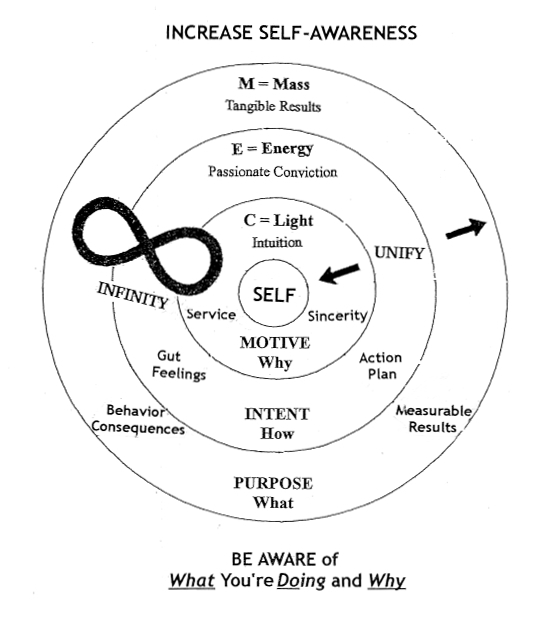
When I recognized the correlation between Einstein’s famous formula, e = mc2 and ancient teachings from around the world, I used the Positive Paradigm of Change to picture their common understanding. Then came another Aha! This Unified Wheel is fact That, Knowing Which, All Else is Known. It puts the mosaic pictures together in a way that is larger than the sum of its parts.

.

cov wheel

Why then, I continue to ask, if this information is readily available, do people balk at the marvelous possibilities inherent in the Positive Paradigm of Change, refusing to go through the doorway it opens for those with the courage to enter? I addressed this briefly in The Fateful Fear of Self-Awareness, This blog contrasts the hollow shell of the prevailing empirical science paradigm with the universal, complete paradigm of diversity on the surface with timeless unity at the center. Bottom line: incomplete, inaccurate paradigms generate resistance to the unfamiliar.

But there’s more. Additional blogs expand on that fateful fear: “The Only Way Out is Through and Know When to Mistrust Inner Voices, The Chapel Perilous journey through the middle level of the Wheel takes soul seekers on what comparative religion legend Joseph Campbell called the Hero’s Journey. Not everyone is equipped to face and survive that dark night of the soul alone.


Here’s where feedback from others more experienced and wise than ourselves can be invaluable. Those whose understanding encompasses a complete and correct reality map (Jungian therapists and self-aware Christians who adhere to the Bible, for example) serve as the agents of positive change, one person at a time.


With the combined tools of reason, empathy and intuition, they are the most qualified to help those willing to face their fears. Understanding discrimination in the full meaning of the term, they can skillfully steer us safely through the danger-fraught middle level of irrational prejudice, fears and delusions, to attain fuller Self-Awareness. They can lead us on the road to recovering the infinite store of treasures available on the far shore of life, ever present and waiting for us in the innermost center of the life wheel.

Here’s the picture of full-spectrum discrimination in Positive Paradigm context. It includes not only the rational and sub-rational definitions, but also the super-rational. In the Buddhist tradition, discrimination (buddhi) is defined as the ability to see through illusions and recognize the eternal at the center of change.

.Discrim3

In the past, those in psychological pain, suffering from self-doubt and looking for a better way to live, would have turned to sages or kings for guidance. At this stage in history, however, therapists as healers (meaning “to make whole”) are often the best secular refuge.

Do Circumstances Influence Leader Selection?

Continuing our conversation about the leadership selection process, Mike Lehr of Omega Z Advisors forwarded another set of questions:

.

The Premise

When I look at events, I see four major forces: circumstances, flow, people and leader. From my perspective, you wrote about the last two. [See “Scientists and Sages Can Agree on This.” wp.me/p46Y5Z-8W and “How Bad People Become Leaders,” wp.me/p46Y5Z-9B.]

I’m asking about the first two.

Mike’s Comments about Circumstances

In regard to the conditionality of leadership, I welcome your thoughts on the influences circumstances have on leadership.

For example, just as terrain influences the type of battle to wage, there are market forces, technological influences and timing issues at play. All of these influence the selection of leaders.

For example, I often ask folks this question: Which dog would you prefer, a collie or a pit bull? Most usually indicate a collie. However, when I add the qualification that you now live in a very dangerous, crime-ridden neighborhood, they tend to revert to the pit bull.

Relating this to business, a firm in high-growth mode is a different situation than one in trouble or growing incrementally. Market forces and competition are also circumstantial influences.

My Response

The leadership selection process depends largely upon who the selectors are. The formal process in small business and corporate sectors varies, depending upon ownership, mission, size and by-laws. Similarly, who many participate in the selection of political leaders differs by location across the globe.

What all have in common, however, is the principle of natural selection. As Mike suggests, people instinctively gravitate towards those best suited to protect the flock and ensure group survival. For example, during war times, women prefer mates with mechanical, farming and martial arts skills over impractical, unskilled intellectuals. Conversely, during prosperous peace times when basic survival items like food, clothing, and shelter are widely available, intellectuals with the high earning power to purchase them are favored.

Here, observations made by a mentor at the Wisconsin School Board Association serve as a useful example. He told me that the selection of a school district administrator starts with the search for a harsh disciplinarian to force teacher unions and unruly students to “toe the line.” This works for a while. But then heavy-handed administration gets old. Abuses of authority are resented. So opponents mobilize to “throw the bum out.” They search for a mild-mannered replacement who is who is teacher-friendly and soft on discipline.

However, in due time, this lax approach starts to rub other factions in the community the wrong way. Yet another selection process is initiated to bring in a tougher new leader who will restore “law and order.” Opposite and equal challenges continue to generate an ongoing succession of new faces in the administrator role.

The senior School Board Association officer had witnessed this process long enough to recognize a repeating pattern. Elected, short-term school board members in local communities probably didn’t.

These pendulum swings between extremes are natural, but not optimal. Instead of repeated, disruptive shifts between between contrasting leadership styles, it’s possible to sustain cultural continuity by harmonizing contrasting opposites. An alternative, I Ching-savvy approach balances the demands of different groups within the community.

In this worldview, the sought-after leader is keenly attuned to fluctuating economic / political as well as technological changes in the environment. Such a leader isn’t driven by circumstances, but rather has an overview of the directions in which they continuously change. With an understanding of natural law, this leader has the ability to steer followers safely through every stage of the organization’s life.

Thus, in the Tao Te Ching, Lao Tze advises leaders to adjust with the times to maintain long-term tenure as well as organizational stability in all circumstances:

Adhere to principle / while adjusting to circumstance.

Goals are secured / by remaining flexible and open.

Caveat: When working with the I Ching, it is essential to keep its place within the larger scheme of things firmly in mind. Otherwise, it is subject to dangerous abuses. The abode of Natural Law in the Positive Paradigm Context is the middle level of the Unified Wheel. It stands as the gatekeeper between Human Law (legislation and custom) on the surface and Divine Law at the center. Its powerful applications are equally effective regardless of whether the user’s motives be for good or evil.

con_bak_cov

While good (meaning responsible, competent and compassionate) leaders are sometimes wary of working with the I Ching because of its potential for abuse, bad (meaning irresponsible, selfish and cruel) leaders who have no respect for either Human or Divine Law feel free to use their understanding of human dynamics to manipulate others for antisocial purposes. [See “Know When to Mistrust Inner Voices,” wp.me/p46Y5Z-aR.]

For example, I have warned repeatedly about the disaster looming ahead in the next U.S. election cycle. Extraordinarily extreme abuses by the political left may have been deliberately orchestrated by behind-the-scenes puppet masters, as if to precipitate an opposite and equally extreme reaction. [See “To Push a Man Right, First Push Him Left,” wp.me/p46Y5Z-9K.]

I’ve also hinted at the urgently necessary antidote to this potentially deadly outcome. [See “What’s More Important–-Nature, Nurture, OR . . ,” wp.me/p46Y5Z-8k.]  In that blog, I conclude:

Leaders who intentionally live true their conscience and succeed in linking the levels of life are key to a viable future. The rest of us will depend on them to out-think, out-maneuver and succeed long after pretenders with no substantial connection to the center of life have been blown away like dust in the wind.

To Be Continued:

The next installment will include responses to Mike’s comments about the fourth factor, “flow,” as well as what he calls “non-cultural” issues.


.

The Only Way Out Is Through

The back cover of Conscience: Your Ultimate Personal Survival Guide sums it up:


con_bak_cov

The Positive Paradigm Handbook — a practical, bare bones work book — offers the following, abbreviated description of the middle, energy level of the Positive Paradigm Wheel of Change. **

The dangers of this level cannot be underestimated. Understandably, without a reliable road map and a keen sense of purpose and commitment, the middle level seems frightfully laden with traps to ensnare the uninformed and reckless. Hence the Fateful Fear of Self-Awareness. (See wp.me/p46Y5Z-aK.)

However, its value cannot be underestimated either. Armed with the skills and insight to use the necessary powers associated with this level wisely, courageous pioneers of the inner worlds can achieve success in every area of their lives.

To avoid the dangers of getting stuck in the middle level, mired in the traps of delusions and negative emotions, it’s critically important to have an accurate and complete reality map. The purpose of pushing through this level is ultimately to reach the far side, the abode of intuition and light, the storehouse of infinite treasure. But, as told of The Chapel Perilous, “The Only Way Out Is Through.”

—————————–

e. Energy. Much ignorance, misinformation and confusion surrounds the energy level of the Positive Paradigm. The state of chaos into which the world has degenerated attests to this deficiency, as well as the urgent need to correct it. Only the basics are described here, suggestive of further exploration.

The middle level is the domain of natural law, whose dynamics are mapped in the Chinese I Ching, the Book of Change. This body of knowledge has evolved over eight thousand years as sages continue to observe the operations of energy and document the repetitive patterns of change.

Natural law maps the energetic underpinnings of the dynamic, physical world. It is experienced as the patterned recurring cycles of seasonal change, and is equally applicable to humans and their cyclical life changes: birth, growth, decay and death.

The middle layer is the realm of less tangible but still measurable states of energy, including electricity. More subtly, it is the chi, ki or prana described by Chinese, Japanese and Indian traditions as the life force which animates all living beings. In Greek and Christian contexts it correlates with the breath, the psyche.

These subtle energies influence internal psychological states and drive external human behavior, which in turn affects social relationships. Knowledge of these dynamics is essential to personal survival.

Effective leadership and the quality of life within organizations hinge on the quality of awareness brought to dynamics at this level. While some leaders understand the dynamics of change at a gut level as a matter of common sense, systematic logic and deliberate understanding would significantly improve the results of the decision-making process.

Those denied access to material and social resources are often forced inside. Of necessity, turning inward, they develop and depend for survival upon strengths drawn from the middle and center of the Wheel.

At times, material deprivation and hardships yield the opposite and equal blessings of in-sight and emotional fortitude. At other times, however, excessive investment at the middle level results in delusions, latent with the potential for erupting into violence.

In any case, making a virtue of necessity by rejecting the material world prevents completion of the pattern. It can’t correctly be equated with spirituality.

Cultures which enforce an exclusively materialistic worldview and deny the experience of everything not tangible and measurable place severe hardships on those whose inner lives are especially active. The Handbook gives ample opportunities to diagnose such imbalances, the better to remedy them.

Societies that deny their citizens practical outlets for articulating and harnessing inner energies creatively can literally drive people crazy, to suicide, or at best, underground. Many “sensitives” survive by channeling socially banned, unacceptable awareness and longing for self-fulfilling adventure into the arts: music and literature, including romance, murder mysteries and science fiction.

This is a great loss to society. The world would be far better off if high-energy, creative individuals were identified as potential leaders, trained and given employment options accordingly.

** Educators, therapists and theologians interested in detailed applications to their particular professions are referred to the more complete description provided in Rethinking Survival: Getting to the Positive Paradigm of Change.

Dangerous Times Call for True Radicals

At 7:07 a.m. on Tuesday, July 2nd, a tweet from RhinoforDinner popped into my email inbox. “Thanks for the follow! I’m Page! What leadership quality do you think is most important for young leaders to learn?”

I tweeted back, “Great Q, Page! I’d say Confidence, meaning “with faith” in their True Selves: having the courage to hear & follow inner voice of Conscience.” I double-checked Page’s avatar – a seriously disgruntled cartoon rhino.

Here’s the description: “What is real leadership? A rhino in a restaurant is no doubt powerful… But he has no authority! Helping leaders lead with authority!” So I followed up, “Conscience is the connection with ultimate inner authority.” Then, on second thought, an hour later, “Con-science = with science, the true meaning of which is ‘with knowledge.’”

I have enormous compassion for Millennials . . . as well as great hope, which is why the 2014 edition of Two Sides of a Coin: Lao Tze’s Common Sense Way of Change is dedicated to them:

Though it may seem as if they’ve been economically disenfranchised by their elders, material misfortune on the surface of the Positive Paradigm Wheel contains within it the hidden seeds of humanity’s long-term survival.

Ours isn’t the first time in the repeating cycles of history that leaders have squandered national resources. But in the context of Lao Tze’s larger reality, material resources aren’t that significant when compared with the intelligence, inner strength and inexhaustible vitality available to those whom circumstances oblige to return to the less tangible but very real levels of inner experience.

Millennials are the ones for whom the results of the materialistic, conflict-paradigm are so catastrophic that they have no vested interests to protect. They’re the ones prepared to move forward once again into the past, recovering the timeless treasure of the Positive Paradigm buried deep within the Tao Te Ching‘s wisdom.

  They’ve been given the greater opportunity to dig deep,

rediscover their inalienable inner resources, and

become the truly radical agents of substantive, positive change.

In the repeating cycles of generational pendulum swings, their 1960’s grandparents (indiscriminately) embraced all things change – on the surface. Religious, sexual and cultural norms went by the board. Hippie flower children dropped out of “the system” and tuned in to drugs, hard rock and doing their own thing.

Working with less-than-perfect translations of the I Ching, they popularized the misunderstood Chinese Book of Change to rationalize (predictable) rebellion against security-obsessed elders, who (as survivors of the great depression and World War II), had reacted in opposite and equally extreme ways to the extremes of the generation before them. (And so on, and so forth, round and round again.)

My best hope for Millennials is that they’ll benefit from the lessons of history and NOT mindlessly perpetuate the pattern of yo-yo swings between opposite and equally dysfunctional extremes on the surface, disconnected from the timeless center.

We now recognize that different visions of timeless truth are, necessarily, inherently the same. Looking back in time, the Tao Te Ching (along with the I Ching worldview it expresses) is remarkably compatible with Patanjali’s Yoga Sutras. Looking forward, it is equally compatible with the teachings of Christ. Most recently, the correlation has been made with the three variables of Einstein’s famous formula. He had the Unified Theory, though lacking familiarity with ancient teachings, didn’t know it.

Now, as in the time when Christ walked the Earth, true fundamentalists and radicals (both words mean the same thing) aren’t conflicting extremist groups that meddle with events on the material surface of life’s wheel, but single individuals with the courage and vision to change themselves from the inside out.

Millennials, along with the parents and grandparents who dearly wish them well, can benefit from a hard-earned, deeper understanding of change. They’re becoming aware that times of adversity and extreme danger offer opportunities for self-transcendence. They can anticipate hidden blessings (however well-disguised) and prepare according to The Common Sense Book of Change view of CHANGE:

49. CHANGE

Day and night replace each other

in endless cycles of CHANGE.

The same natural law generates flux

in human events.

The unprepared see change

as a threat,

but the well-prepared

face the unknown calmly.

They know that after degeneration

reaches critical mass,

regeneration follows.

Welcome the new.

Avoid short-sighted fear.


This, in turn, however, leads to a whole new subject.

.

globe

What’s Most Important – Nature, Nurture, OR . . . ?

The other day, I encountered Ivan Goldberg on LinkedIn. A Chair at Vistage International, his formal title is Executive Mentor and Coach. But it’s his personal handle I find irresistible. He describes himself as an “Enthusiastic Agent for Change, Wise Old Sage, Great Listener, and Author of ‘Leading to Success.’”

globe

I’m an author of books on change based on the book ancient sages have depended upon for eight thousand years and counting. So I had a hunch that I’d found a kindred soul. I sent an email to find out.

When he accepted my invite, I wrote back: “Thanks for the connection, Ivan– Your blogs look terrific. Maybe you’d like mine as well. Here’s one that’s just been retweeted. Thanks for your great work. All best, Pat West”

Sure enough, he answered me, “Hi Pat. Many thanks for the link. Your blog is certainly more academic (that is a compliment BTW) than mine and is very thought provoking. Hope that you like today’s post on Leadership. Best regards, Ivan”

Being an academic (though also much more), I did my homework. On his website, Ivan asks “Are Leaders Born or Made?” He also answers the question: “It is Nature, Nurture and Much More!”

One good blog deserves another. So I answered back:

Hi Ivan. Yes, I liked the Nature, Nurture AND More blog. I also liked the ones on motivating and daring to be different. Seems to me that you do in fact have the soul of a sage, and know a thing or two about change. The Chinese don’t have a monopoly on wisdom after all. Now I’m motivated to write you an answering blog on the subject of nature, nurture, and More. I’ll alert you come mid-week, if you like. All best, Pat”

What follows is my response to Ivan’s blog. He concludes, “Is it a matter of nature or nurture?  It is both.  Leaders need to be aware of their inborn abilities and how they can develop them, which is, essentially, an auto-didactic exercise.”

What? “Auto-didactic?!” I can’t resist a friendly tease here. Ivan, who doesn’t really have much use for academics, uses a pretty fancy word that I (the presumed academician) had to look up. Turns out, it means self-analysis. As a noun, it means self-taught.

Agreed. Self-responsible learning and experience are essential. Potential is necessary but not sufficient. However, the wisdom of sages (not the same as academic theories) can make a useful difference. I’ll give one example here using the Positive Paradigm Wheel of Change which is true to the original, the I Ching. This picture talks to the right brain to balance the left-brain discussion which follows.

It places the relationship of nature, nurture and “much more” in prioritized context.

NatureNurtureWheel

For those as yet unfamiliar with the Unified Theory of Einstein’s heart’s desire, let me explain briefly. The model of concentric wheels-within-wheels is equally compatible with modern atomic science, the world’s great religions, and yoga philosophy.

The surface level that corresponds with MASS includes everything tangible and measurable. It’s the realm of empirical science. That would be “nurture.”

The middle ENERGY level corresponds not only with electricity, but with subtle but measurable energies that yogis call “chi” or “prana.” It’s the level associated with DNA, emotions and “gut” feelings. As detailed below, that’s the level of “nature.”

The innermost level of LIGHT is associated with intangibles. That’s the “. . . and Much MORE.”

On the surface, intelligence is measured by IQ. It’s also the realm of human laws and social codes, including morality.

The middle level is the domain of the natural law encoded in the venerable Chinese Book of Change. Competence at the middle level is popularly called EQ – Emotional Intelligence. This is the realm of native virtues, including but not limited to courage, kindness and calmness. Compassion is the balanced composite of intrinsic virtues.

Still further inwards, deeper knowledge is experienced as intuition, sometimes called guidance. Most notably, the New and Old Testaments speak to this level.

At the hub of life’s Wheel, the unchanging center holds the radiating spokes and rim together. This eternal source of life and light is associated with the silent voice of Conscience. The Chinese call it the Tao, the Way which cannot be named.

Here’s how Ivan’s comments on nature vs. nurture fit into the Wheel. The surface of the Wheel is the level of daily experience, which includes on-the-job and classroom training as well as expert mentoring. This is the level of nurture – leadership development.

Even so, depending on what (or whether) they choose to learn from it, experience shapes different leaders differently. (Academics who are heavy on theory but light on experience are understandably frustrating to leaders whose common sense is highly developed.)

The middle level of the Wheel is where some leaders fall short. This is what Ivan calls nature – innate potentials. Leaders may or may not be self-aware on this level. Some trust their gut feelings more than others. A fortunate few, like Mozart, for example, are born already in-formed. But a deficit can be improved by relevant training, especially when reinforced by practical experience.

The innermost level of the Wheel is where more leaders are gun shy. This is the “And MORE” factor. Deeper than either surface nurture or middle level nature, only the most successful are in-formed by intuition (which is different from gut instinct.) Creative change agents regarded as visionaries receive their inspiration at this level.

The center of the Wheel is, by definition, absolute. The other levels emanate from and return to this creative source. The very best leaders are those who focus here and link the hub all the way to the surface. They’re equally competent on all levels in a balanced way. This is the ideal towards which to strive. It’s also the standard for deciding which leaders to follow, and which ones to promote.

In Positive Paradigm context, the three levels radiating outwards from the central hub are prioritized. For this reason, a highly proficient but insensitive and uninspired technician isn’t yet qualified to lead others. An enthusiastic, high energy leader may attract followers. But a charismatic speaker whose ethics are shaky or whose connection to the center is unstable needs work. Wherever there are deficiencies, once identified, they can be corrected. This is the purpose and value of the The Positive Paradigm Handbook.

The relationship amongst the levels explains the extraordinary success of leaders who start with few material advantages, but succeed far beyond many who begin with more.

Scriptures tell us, and the best leaders affirm, “With God, all things are possible.” That is to say, from a strong connection to the center, entire empires can be spun. Leaders who demonstrate the courage of their convictions make up for early social disadvantages through native intelligence, hard work and the not-coincidental luck this generates.

Detractors may doubt the necessary connection between material success, emotional intelligence, intuition and conscience. They ask, “What explains the success of the fabulously rich and powerful men on the planet who, as outspoken atheists, get whatever they want, however they want, with no regard for the harm they cause to anyone who dares stand their way?”

Well, there are many stories about bad deals with the Devil. Satan promises – and for a short time, can sometimes deliver – ephemeral success in the transitory world. But never the lasting peace which comes from following conscience. Disciples of Saul Alinsky, an admitted follower of Lucifer, can deliver worldly success to political organizers (you know who they are) willing to deceive, fragment and exploit the masses they pretend to serve.

But leaders who intentionally live true their conscience and succeed in linking the levels of life are key to a viable future. The rest of us will depend on them to out-think, out-maneuver and succeed long after pretenders with no substantial connection to the center of life have been blown away like dust in the wind.

So here’s my ongoing call to sages world-wide. Unite in the vision of Einstein’s Unified Theory. As he warned us, this “substantially new way of thinking” is a matter of human survival.

 Angel Calling


Discovering the Missing Link

This afternoon, as an after-thought, my author-journalist LinkedIn connection emailed me, “On another note, your years living in Europe and your other international travel sound interesting. Must be a good story there. Would love to hear more when time permits.”

As a matter of fact, a section in Rethinking Survival describes the highlights of living in Europe. So I’ll share some of them here.

globe

EUROPE: Discovering the Missing Link

“If you love your children, tell them how the world works.” — Dr. Phil

According to the people who raised me, the way the world worked was this. If you “pleased” them, then they would take care of you: feed you, house you, pay the bills for your clothes . . . let you live. If you didn’t, they’d disown you, cut you off, write you out of their will. The end. Survival depended exclusively on being very good at pleasing those who controlled the money and the material resources which come from it.

In my case, this was a problem. What pleased one adult didn’t please the next. And what pleased me didn’t necessarily please any of them. It was, at best, a con. Bottom line: I had no idea of how the world really works, only that mine at the time didn’t work for me. When conflicting survival demands came to a head, I had to split. “Get out of town, Tonto. Pronto.”

The year Nixon was elected president, a poster hanging in my dorm hallway said it all. It showed him wearing Uncle Sam’s pin-stripe suit and top hat, finger pointing to recruit. The question posed:  “Would you buy a used car from this man?” My answer was, “No way!” I wasn’t in a position to change the country, so I changed my location. At the invitation to join up with a touring Brazilian chamber orchestra, I left for foreign lands.

Living abroad began the process of divesting the cultural conditioning I’d taken for granted. Being the only English speaker in the group made me rethink communication, getting down to the basics. When it took an effort to find the words, it was amazing how little really needed to be said. Accompanied with suggestive body language and facial expressions. a few words went a long way.

However, I found that change of scene, of language and cultural settings, changed nothing of substance. “Wherever you go, there you are.” In Sandor Vegh’s violin master class, students from around the world agonized over the same dilemmas I thought I’d left behind. They too thought they could escape problems just by walking away – but nothing is so easy.

Nao, a darkly mournful Japanese violist, described the shock of discovering her older brother’s dead body hanging limp in his clothes closet. Chiao, a bright shining extrovert, grieved over love lost. When she beat him to take first place in a violin competition, Alberto chose a less threatening lover as his companion.

My German hosts, who’d survived WWII, however, had much to teach. They didn’t take survival, as I had up to that point, for granted. A cellist friend with whom I stayed in St. Georgen, located in the Black Forest of South Germany, told me her mother’s story. To save her starving children’s lives during the Russian occupation of Berlin after the war, Frau Hass changed from oppressed housewife to heroic protector. In contrast, Herr Petersen, a 75-year-old portrait painter – my Düsseldorf landlord – recalled war time as “the best years.” It was only then– albeit of extreme necessity– that formal, inhibited Germans came out of their shells and actually talked with one another.

For me, the highlight of studies at the Robert Schumann Konservatorium wasn’t the music teachers, but a modest, insightful kinesiology instructor. Frau Lehru wasn’t a musician herself. But vocal and instrumental teachers alike sent students beyond their help to her.

The pianist whose lessons were scheduled the hour before mine told me her story. Herr Dreschel had given up on her as either lazy or untalented. But Frau Lehru diagnosed the real problem — pinched spinal nerves. Recommended visits to a chiropractor worked “miracles.” Elated, she was a “new person.”

I went to her studio and asked Frau Lehru to coach me. Her lessons were wonderful. She saw timidity in my posture and tension in the way I held my violin. She gave me exercises to correct not only my posture, but the underlying attitudes which bent me out of shape.

“Platz machen,” she encouraged me. “Make room! Don’t crowd me!” And, “Auf wiederstand waschen.” Figuratively, Grow upwards. Stand tall under the pressure of resistance and adversity.

In retrospect, it was if she’d reinvented the yogic disciplines which sitar and tabla students are taught in India, where music technique is balanced with breathing and physical exercises. Her gift inspired a change in my career goals. Rather than teach technique, I could help many more musicians by becoming an exercise-and-therapy coach in one, like her. She was much too busy to consider writing about her methods and results. I would do this for her with a book called The Body as Instrument: How to Tune It. (Still later, ratcheting up another notch, I aspired to build schools to facilitate a whole generation of coaches like Frau Lehru.)

Even more influential than people, however, were two books I discovered in Düsseldorf’s International Book Market on Königs Allee. In combination, they substantially broadened my life’s horizons. One was the Wilhelm/Baynes English translation of the Chinese I Ching, the Book of Change. The other was Carl Jung’s autobiography, Memories Dreams and Reflections. This Swiss analyst also wrote the introduction to the Wilhelm/Baynes translation.

I’m now aware of much that’s been written about Jung’s darker side. But in 1970, I resonated with his descriptions of self-discovery. In particular, I related to the story about his quickest cure. A young woman, the daughter of wealthy, stylishly atheistic parents was instantly healed of her neurosis upon learning of her heritage. Her grandfather had been a Talmudic scholar. Though an embarrassment to her parents, he was regarded by peers as a saint. This knowledge gave her permission to know what she “knew,” and released her psychological suffering instantly.

As it happened, I’d just been contacting my grandparents, asking them to write me about their history. I did so because Herr Oswald Peterson, my portrait painter landlord, insisted I was not American. “Who are you?” he wanted to know.

I’d already known that in her youth, my father’s mother, Grandma Ellie West, had a gorgeous soprano voice. What I learned from her letters was that she’d auditioned for John Philip Sousa’s world tour and was invited to join his band as a soloist. But she decided to stay home instead to marry my grandfather, Hub. She heartily approved of my European music jaunt. “Good for you!”

I was fascinated to learn from Grandpa Dave, my mother’s father, that his father came from Russia. He was a “very good” tailor by profession and a Talmudic scholar as well. A-ha. Who would have guessed? It opened a door of new possibilities in my mind.

Because Jung experienced dreams as the winged messengers of key insights, I began paying attention to mine. The dream I remember best was of climbing the third-story stairs of Herr Peterson’s building. He’d never repaired the roof after the WWII, so the top flight led to rubble and open air.

In my dream, however, I discovered a new floor that hadn’t been there before. It was dimly lit and full of draped furniture, covered with cobwebs. As I brushed away the dust, details of this new room began to emerge. It was as if I were entering into a new level of personal awareness.

As for the I Ching, I’d had a hunch about it for a very long time. Dr. Ellsworth Carlson, who lived in Shansi, China during WWII, was an Oberlin College classmate of my parents. When I was nursery school age, he’d bounced me on his knees at Harvard. As Freshman student, I took his course in Asian History at Oberlin. What stuck with me how vast an influence the I Ching had on Chinese thinking for 8,000 years and counting.

In fact, when I left for Europe, I carried only my violin and one small suitcase. Of that, half was filled with clothes and personal items. The other half contained sheet music and one small book: the Legge translation of the I Ching. It made no sense to me. I could barely get through a page or two before giving up. But I kept coming back to it. There was something important there that I had to know more about.

Finally, with the Wilhelm/Baynes edition, I had a version I could relate to. It literally became my teacher. It gave me a whole new concept of how the world really works. Not just this family or that institution or the other county. Not arbitrary and capricious, fluctuating fashions, but the constant anchor over time. From it, I could deduce the fundamental energy dynamics of action and reaction which drive relationships, internally at a psychological level, and externally in terms of practical, day-to-day events and their long-term consequences.

It was an extension of the logic my English teacher Miss Elson impressed on my high school brain. But more. It gave me a map of logical consequences, as inevitable as computer language. “If this, then that.”

For example, If you kick people, they kick back (if they can) or otherwise resist. If you are kind, you inspire love and trust in others. If you violate natural law, nature bites back (your mental health suffers; relationships deteriorate; your behavior becomes erratic and social/physical survival is imperiled). Asian cultures call this “the law of karma.” Its operation is also described in biblical terms: “As ye reap, so shall ye sow,” and “to everything there is a season.”

In sum, its 64 permutations map a progression of the AC-DC energy changes which constitute the natural law of repetitive, cyclical change. From my point of view, this ancient, timeless science fills a critical blind-spot in Western thinking, lacking which, all efforts are partial and incomplete. Put another way, the glaring absence of this information explains why so much goes so wrong, despite even the best of intentions on the part of politicians, priests, coaches and leaders of every ilk.

. . .  [an understanding of natural law], the practical, middle (energy) level of three-part experience, is essential to the whole. It’s a sorely missed link in our functional knowledge base. Without wisdom and skill at this middle level of experience, spiritual aspirations cannot be realized nor can political policies be effectively implemented. Ongoing sex scandals which plague high-level military leaders, politicians and Christian clergy give a hint of what’s missing from their training, causing them to fail miserably at great expense to those they should be serving.

Rethinking FREEDOM


globe

40. FREEDOM

“The natural laws of the universe are inviolable: Energy condenses into substance. A person who neglects to breathe will turn blue and die. Some things simply can’t be dismissed.

.

“It is also part of the cosmic law that what you say and do determines what happens in your life.” — Brian Walker, Hua Hu Ching : The Unknown Teachings of Lao Tzu

.

“Especially for those of us who lived in single cells, we discovered that sitting down just to think is one of the best ways of keeping yourself fresh . . . to address the problems facing you. You could stand away from yourself in the past and examine whether your behavior was befitting to a person who tried to serve society.” — Nelson Mandela, Interview, Larry King Live

.

“When employees trade love, soul and freedom for maximizing profits, corporations lose their human center, and that’s as deadly for corporations as it is for us. The unhappiness and suffering that trade-offs create suggest that the paradigm is the culprit. We’re using bad software, and it’s distorting our concepts of what’s going on. We need all three together to be creative. When we’re destructive, it’s not because our nature is destructive, but because the trade-off paradigm is destructive to us.” — Breton & Largent, Love, Soul & Freedom: Dancing with Rumi on the Mystic Path

.

THE FRONT

.

Freedom is the state or quality of being free, implying exemption or liberation from the control of other people or arbitrary powers. It means liberty and independence. It implies exemption from arbitrary restriction or a specified civil right. It can mean exemption or release from imprisonment, or being able to act, move or use without hindrance or restraint. It means being able of itself to choose or determine action freely, at will, implying ease of movement performance or facility. It means being free from the usual rules or patterns. It can also mean easiness of manner, or sometimes an excessive frankness and familiarity.

.

Like the words peace, love and unity, freedom is a state attained on the inside first, only then reflected in external circumstances. In I Ching context, freedom is a state of in-dependence, depending on inner resources for guidance, protection and peace. The freedom sages seek is the cessation of negative, involuntary patterns of behavior. Breaking the chains of destructive cause and effect is a function of focus combined with self-correction, forgiveness and atonement (at-one-ment) in positive action.

.

Those secure in themselves dedicate their lives to extending the freedom they value for themselves to others without prejudice. Abraham Lincoln, for example, had the soul of a sage. He intuitively knew the basics of magic, and recognized the difference between black and white rules. He wrote, “As I would not be a slave, so I would not be a master.” As if direct from the Treatise on Esoteric Ethics, Abe delivered a speech in Wisconsin where he said, “Let us have faith that right makes might, and in that faith do our duty as we understand it.”

.

Yet legal prohibitions cannot end of slavery. Saying and doing whatever one wants as a puppet of blind impulse isn’t true freedom. Seeing through negative filters of fear, pride, or apathy is as limiting as literal blindness. Even in a society that calls itself democratic, to the extent we’re unaware of inner wisdom and the laws of natural change, we’re not really free.

.

Soul is like the in-breath of life. Love is like the out-breath. Freedom is the intertwined marriage of soul and love in balanced, rhythmic exchange. When we can’t breathe freely, we slowly starve from within, and wither mysteriously even in the midst of apparent prosperity.

.

Breton and Largent, quoting the Sufi mystic Rumi, write, “Whatever we do, we do from our inner compass. That’s free:

.

Take someone who doesn’t keep score,

Who’s not looking to be richer, or afraid of losing,

Who has not the slightest interest even

in his own personality: He’s free.”

.

In I Ching context, the self-mastery attained by thinking and acting consistently from a positive paradigm that’s simple, complete and correct is the most precious, inalienable freedom.

.

Nelson Mandela’s life is proof that it’s not circumstances which enslave.

.

THE BACK

.

The opposite of freedom is imprisonment or slavery. This includes not only external, physical incarceration, but internal, self-imposed limitations. Bad attitudes, negative emotions and self-destructive habits can be as addicting as tobacco, alcohol or drugs, undermining personal freedom.

.

Recklessness and heedlessness are perversions of freedom. If a mistrusted authority says not to drink, smoke or drive too fast, for example, the first thing a rebellious teen will do to assert “freedom” is disobey, regardless of the consequences. Sadly, this is the hard way to learn the connection between foolishness and disaster.

.

————————

Brian Walker, Hua Hu Ching: the Unknown Teachings of Lao Tzu. (HarperSanFrancisco: New York, 1992.) #40.

.

Nelson Mandela, Larry King Live Interview, aired May 16, 2000. cnn.com/transcripts.

.

Denise Breton & Christopher Largent, Love, Soul & Freedom: Dancing with Rumi on the Mystic Path. (Hazelden: Center City, Minnesota, 1998.) p. 7.


Rethinking POSITIVE DISCRIMINATION

An earlier blog took a different approach to racial prejudice in the context of Affirmative Action legislation. Here is the balancing, opposite and equally positive approach to discrimination.

globe

19. DISCRIMINATION

“Relying more on the social scientists than on legal precedents . . the Court insisted on equality of the mind and heart rather than on equal school facilities. . . . Brown symbolizes the Good America, rather than the country that slaughtered Native Americans, subordinated women, and enslaved blacks.” — Jack M. Balkin, What “Brown v. Board of Education” Should Have Said

“Dealing exclusively on a rational level with an issue like discrimination which is deeply emotion-laden (sub-rational) on the one hand, and highly value-laden (super-rational) on the other, fails to acknowledge and draw on the levels where problems begin and where solutions can be found.” — Patricia West, Positive Action: The Next Generation

“Seeing and hearing are like food and drink; you need them every day, but you also need to digest and eliminate them every day. If they are not digested and eliminated thoroughly, they remain in the gut, eventually producing illness.” — Taoist Meditation, trans. Thomas Cleary.

THE FRONT

Three levels of definition attribute opposite, contradictory meanings to the single word discrimination. In the last century, failure to recognize and sort out this confusion resulted in muddled perceptions of purpose, inconsistent implementation and half-hearted compliance with Affirmative Action legislation.

The Oxford English Dictionary’s rational definition of discrimination posits a neutral function of mind. To discriminate is to distinguish with the mind or intellect; to perceive, observe, or note the difference in or between. As an analytical tool, discrimination is the neutral function of mind used to dissect a situation’s parts and deduce cause/effect relationships amongst them. As a tool, effects of its use, whether creative or destructive, depend on the motives and competence of the user.

The last given definition adds a preposition: against. To discriminate against is to make an adverse distinction in regard to, to distinguish unfavorably from others. This negative definition is the sub-rational use. It describes abuse of the critical faculty of mind to separate, distance and subordinate others, and to rationalize exploitation. Discrimination as a function of biased, negative emotions such as fear, hate, envy, arrogance or greed is the polar opposite of objective analysis.

Still further from the rational meaning of discrimination is its super-rational definition. It is not included in The Oxford English Dictionary. However, in Eastern scriptures, the highest function of mind is called buddhi (hence the name Buddha), translated into English as “the power of discrimination.”

This usage alludes to the ability to see through deceptive illusions, to recognize the eternal in the midst of change, to be aware of all-pervading spirit operating within gross material forms. While rational discrimination is neutral and sub-rational discrimination has separatist results, the super-rational function of discrimination is unifying in effect.

Depending on the user’s mind-set, the I Ching can be used to serve rational, sub- or super-rational motives. Ideally, it’s used to facilitate the process of mental metabolism. When the senses are overloaded with impressions, the Book of Change can be approached as a discipline for settling down and organizing one’s thoughts sufficiently to define the immediate situation and ask questions about it.

As negative emotions surface, they’re named and released, not unlike the process of separating toxins from useful nutrients, eliminating them as waste. Rational thoughts are then simplified, prioritizing essentials and aligning them to basic purpose. Then, when emotions and rational mind are harmonized and stilled, the higher mind is invoked.

It is in this state of tranquil revere that one pierces the veil of ordinary thought, allowing the transcendent awareness attributed to genius to come forward. Einstein, for example, acknowledged that his famous e = mc2 formula came in a flash of inspired contemplation. He faulted his peers for what he called the “fateful fear of metaphysics,” a pernicious prejudice that’s easily as dangerous as racism or sexism.

THE BACK

Mercy and compassion ameliorate the effects of negative discrimination. Introspective activities like self-analysis and use of the I Ching promote the positive capacity to discriminate, make correct decisions, and act wisely. In human law, the opposite of discrimination is justice and equity. In an equitable society, wisdom is promoted as the foundation of harmony and order.

The discipline of positive discrimination is neglected in an unjust world. Ruthless extortionists in positions of political power will kill to prevent discriminating thinkers from recognizing and opposing their abuses. Tyrants promote negative discrimination. They exploit hatred, weakening the people by turning them against each other, conquering by dividing them.

—————————-

What “Brown v. Board of Education” Should Have Said. Ed. Jack M. Balkin. (New York University Press: New York, 2001.) pp. 4, 5.

Patricia West, Positive Action: The Next Generation of Affirmative Action. Unpublished paper. (Madison, 1976).

Taoist Meditation: Methods for Cultivating a Healthy Mind and Body, trans. Thomas Cleary. (Shambhala: Boston, MA, 2000.) P. 57.

————————–

See the UPSG for a description of the structure-within-structure format of the Essays, an overview of CONSCIENCE: Your Ultimate Personal Survival Guide, and an alphabetical list of the Essays.

Rethinking MOTIVES

One Essay on Change is posted each consecutive Sunday. The choice of which is decided either by requests made on the Contact Page and/or immediate relevance to current events.

Tonight, 03/23/14, I’m following through on a promise made in answer to the question, “Crime, Is It Natural?” I told Barrister Brendon Moorhouse, a reported Sherlock of the Courtroom, that I’d respond to this important question on this website with my perspective. After all, CRIME just happens the very first of the 64 UPSG Essays. However, I’ve waited until the following week because the companion Essay on Motives speaks more closely to the subject of investigating crimes, white collar as well violent ones.

globe

18. MOTIVES

“Although the feelings mentioned above [sadness, pessimism, guilt, emptiness] may accompany a depressed mood, the most prevalent effects usually involve low energy and lack of motivation. . . An effective way of lifting these moods involves using music to activate our resources.” — John M. Ortiz, The Tao of Music: Sound Psychology

“It occurred to me that the only way to figure out what had happened at a crime scene was to understand what had gone on inside the head of the principal actor in that drama: the offender. And the only way to find that out was to ask him. . . If we could give the law enforcement community some insights into the process, the internal logic, of how violent offenders actually decide to commit crimes and why they come up with their choice of crimes — where the motive comes from — then we could provide a valuable tool in pointing investigators toward what for them must be the ultimate question: Who? Stated as simply as possible: Why? + How? = Who.” John Douglas, The Anatomy of Motive

“On some level, you are meditating all the time. One goal of meditation practice is to become aware of that. Another is to extend that awareness to more and more areas of your life. . . It takes practice and conscious effort to restructure the mind and move it from habitual patterns.” – Andrew Weil, 8 Meditations for Optimum Health

 THE FRONT

The root of motive means to move. Webster’s single definition refers to “some” inner drive, impulse, or intention that causes a person to do something or act in a certain way. It’s an incentive or goal.

Motive, purpose and intent explain human behavior. Unless viewed as a whole, what we see is taken out of context and misunderstood. You see a man take someone else’s car. That’s intent, the what. You see him grab the keys and drive off. That’s purpose, the how. But unless you know his motive, why he did it, the picture is incomplete. Was he desperately racing to save his beloved child’s life, escaping from vengeful gang lords, or simply lusting after a fancy new car?

We’re fascinated by crime. Mystery novels, detective movies and sensational murder stories on TV news are big business. We stretch our minds to second-guess the ending, figure out who committed the crime, and why. We look for the mistakes that reveal dark secrets and lead to the criminal’s undoing. We’re satisfied only when truth is revealed and order is restored by justice.

At heart, what we’re really trying to understand is ourselves. We’re haunted by a pervasive sense of wrongs committed against us, or by us. We can’t quite bring ourselves to recognize what they are, or to admit our own mistakes. But a nagging sense of unfinished business leaks out as voyeurism.

Ultimately, it’s the stifled voice of conscience that persistently calls us back to our neglected dreams and deepest longings for fulfillment. Those who allow themselves to be defined by others, who live in habitual fear of people’s opinions and fail to honor their inner sense of calling commit a soul-searing violence akin to suicide. The crime they commit is against their own true selves.

Failing to be true to oneself can be the hardest crime to detect. Finding one’s true calling can be the greatest mystery of all. People who march to others’ drums, unconscious of their motives and what moves those around them, live in painful confusion. Only those who know how to listen and dance to the inner music of their soul’s desire live in joyful harmony with themselves and the world around them.

 The I Ching is a means for turning the camera around, focusing in on ourselves. Uncovering hidden motives might cause initial discomfort. But it can lead to positive changes. After analyzing them, we have the option to decide on better ways to accomplish intentional ends.

Our what and how isn’t always appropriate to our why. Other solutions may accomplish our goals without committing crimes against ourselves and others.

 THE BACK

The opposite of motive is motiveless, to be without awareness of calling, any conscious purpose, or impulse to action. This condition is sometimes an extreme reaction to an extended period of frenzied, excessive, forced action. People experience it as apathy, shell shock or burn out.

 When crazed criminals go on sprees, kill strangers and wreak havoc on public property, their acts are regarded as random and senseless. To all but the most highly attained, the subtle laws of cause and effect are incomprehensible. There’s wisdom in accepting the unfathomable as Job did, saying, “The Lord giveth, and the Lord taketh away.“

 ————————–

John M. Ortiz, The Tao of Music: Sound Psychology. (Samuel Weiser: ME, 1997.) p. 7.

John Douglas, The Anatomy of Motive. (Scribner: New York, 1999.) pp. 25-26.

Andrew Weil, 8 Meditations for Optimum Health. (audio cassette, Upaya,1997.)

—————————

Illustration from Conscience: Your Ultimate Personal Survival Guide


Aware2

Rethinking PEACE

Given the extraordinary amount of pain suffered in many parts of the world today — not the least of which being the very real fear of nuclear annihilation — I’ve chosen a message of PEACE from Conscience: Your Ultimate Personal Survival Guide.

 Essay 61. PEACE

When the forces of nature unite in profound harmony,

heavenly PEACE fills the earth.

Lives blossom. Prosperity increases.

Easy communication makes it possible

for people to understand one another.

This leads to cooperative efforts that will be fruitful.

Tranquility follows fulfillment of life goals.  

— Patricia West, The Common Sense Book of Change

Conflict is woven into the fundamental fabric of nature. The sea and land meet in violent conflict and make waves together. The plow turns the meadow and wheat springs forth. . . Conflict is evidence that human beings are engaged in something interesting. . . [It] plays a key role in the growth of character and the development of stable relationships. Conflict makes us into who we really are. — Brian Muldoon, The Heart of Conflict

The principle of economy in movement arises from a state of internal harmony. A mind that is at peace is not easily swayed or disturbed. This principle also plays a vital role in daily life, whether in business or in combat. If one over-reacts and responds with excessive or unnecessary action, one is at a disadvantage.-Mantak Chia & Juan Li, The Inner Structure of Tai Chi

THE FRONT

Webster’s defines peace as freedom from war or a stopping of war. It can refer to a treaty or agreement to end war or the threat of war. It’s defined as freedom from public disturbance or disorder, public security, law and order. It refers to freedom from disagreement or quarrels.

Peace also means harmony or concord. It’s used to describe an undisturbed state of mind, absence of mental conflict, serenity, or tranquility. To keep one’s peace means to be silent, keep quiet.

The timid are satisfied with peace defined by predictable routine, without conflict or challenge. The aggressive prefer peace defined as defeat of enemies or absolute control over subordinates. The peace of the grave is cessation of life. I Ching philosophy guides careful thinkers away from these extremes.

In I Ching context, peace is an inward state of calm that manifests as outward poise. Where timid and aggressive definitions both depend on external circumstances, the experience of tranquility depends only on oneself. External conditions will always be in flux. Therefore, looking for peace in the world is an exercise in futility. Internal states, however, are subject to self-governance.

In Asian traditions, peace is akin to the yogic concept of contentment — an attitude of grateful acceptance of all seasons and quiet openness to the rhythms of life. In biblical context, the lyrical stanzas of Ecclesiastes capture the wisdom of natural law:

 To every thing there is a season, and a time to every purpose under heaven:

A time to be born, and a time to die;

a time to plant and a time to pluck up that which has been planted;

A time to kill, and a time to heal.

The sage takes responsibility for attaining inner peace as the first step towards world peace. Inner quiet begets the attitude of confidence, which in turn generates acts of compassion, courage and generosity. World organizations which would impose military peace upon warring nations comprised of individuals each at war internally have no hope of success.

Conflict, like peace, starts from the inside and projects outwards. Therefore, no matter what military force is applied, so long as people are educated into internal conflict, external wars will continue to break out.

St. Paul’s epistle to the Ephesians takes on significant new meaning in the light of I Ching wisdom. Peace seekers would do well to consider it carefully:

2.14.  For he is our peace, who hath made both one

and hath broken down the middle wall of partition between us;

2.15. Having abolished in his flesh the enmity,

even the law of commandments contained in ordinances;

for to make in himself of twain one new man, so making peace.

Meditative practices which intentionally focus on the corpus callosum as the middle wall which separates and/or unifies right and left brain (yin/yang, male/female) functions give practical means for implementing biblical insight.

THE BACK

Conflict and war are opposites of peace. Only the context of motive, purpose and intent determines whether they are necessary and to long-term benefit, or unwarranted and uselessly destructive. Shunning either out of fear invites danger.

Enforced silence is a perversion of peace. A totalitarian state can outlaw free expression. It may compel rigid conformance and suppress dissent. However, it cannot contain the vitality of the creative life force, which always prevails.

———————–

Patricia West, The Common Sense Book of Change. (+A Positive Action Press: WI, 2000.) No. 11.

Brian Muldoon, The Heart of Conflict. (G.P. Putnam’s Sons: New York, 1996.) p. 9.

Mantak Chia & Juan Li, The Inner Structure of Tai Chi. (Healing Tao Books: Huntington,

NY, 1996.) p. 35.

Einstein’s New Way of Thinking

Rethinking Survival

Here’s a summary of basics from Rethinking. The title reflects Einstein’s prophetic words:

A human being is part of the whole called by us “‘Universe,’

a part limited in time and space.

We experience ourselves, our thoughts and feelings

as something separate from the rest . . .

This delusion is a kind of prison for us,

restricting us to our personal desires and to affection

for a few persons nearest to us.

Our task must be to free ourselves from the prison

by widening our circle of compassion to embrace

all living creatures and the whole of nature in its beauty. . .

We shall require a substantially new manner of thinking

if mankind is to survive.

— Albert Einstein [emphasis added]

 RS web

The Positive Paradigm is the unified (and unifying) theory which Einstein sought. He missed it because he lacked a non-linear, concentric circle structure which expresses the dynamic relationships of his three variables in a two-directional, infinite continuum.

 The layered structure of the Positive Paradigm Wheel gives new meaning to Einstein’s observation that a problem can’t be solved at the same level on which it was created. “We can’t solve problems by using the same kind of thinking we used when we created them.” It gives new meaning to “Go deep,” and “We can’t be satisfied with superficial answers.” The model literally pictures the widening circle of compassion. It shows the way to escape from the prison of separatist thinking.

 As the book cover shows, three concentric circles orbit around a common center. The three variables of Albert Einstein’s famous formula, e = mc2 (energy, mass and light) are placed within this wheels-within-wheels structure.

 The figure-eight-shaped symbol of infinity is used in the Positive Paradigm Wheel. Because the Creator is characterized as infinite, beyond time, using this physics symbol is an especially appropriate way to symbolize the linking of the levels.

 As light travels on the outward path, it transforms from wave to particle. As pure, generative potential expands, silence transforms into ideas and then emotions within the middle level of the wheel. These in turn materialize into actions that produce physical, tangible results. On the return path, the process reverses. Matter disperses. It returns to its basic elements. It contracts, receding from particles to waves and then into the perfect silence from which it came.

 The Positive Paradigm Wheel mirrors the microcosmic structure of atoms as well as the macro-cosmic structure of planetary systems. At the microscopic level, its concentric rings mirror the structure of atoms around a nucleus. It equally mirrors the symmetry of the planets orbiting around an organizing star, the sun. On the largest scale of magnitude, it reflects the in- and out-breaths of perpetually expanding and contracting universes.

 This familiar atomic structure repeats smallest to largest in the patterns of nature, from snow flakes and intricate flowers to spiders’ webs and sea shells. Similar symmetrical patterns in repeat worldwide in the art of every culture — including the prayer wheels of Native Americans, the colored sand mandalas of Tibetan Buddhists, the stained glass windows of European cathedrals and the intricate geometrical patterns that cover Muslim Mosques, to name but a few. They speak to the universal awareness of a central inner reality. They confirm a continuity of experience deeper than individual lives or transitory cultures.

 Outer levels of the Positive Paradigm Wheel are ephemeral extensions a timeless, absolute center. But the layers of concentric circles aren’t literally separate and discrete. Rather, they are a continuum along the infinite spectrum of creation. Within each layer are numerous degrees and distinctions which can be verified only by direct experience.

 The word Change in “The Positive Paradigm of Change” emphasizes that this isn’t a static model. It is dynamic, inclusive of the outward path of creative extension as well as the inward return to the creative source. This change is called “positive” because the creative process as a whole is in accord with the organic laws of nature encoded in the Book of Change. Positive change is quite distinct from the unnatural, superficial and arbitrary changes of short-sighted human devising

 This Positive Paradigm of Change shows how to think in the new manner Einstein called for. Working with it instills the ability to link the inner with middle and outermost levels of experience. The goal is to integrate conscience with emotions, reason and actions.

 The Positive Paradigm Wheel as an organizing model of experience isn’t really new, however. Restoring it now isn’t so much a paradigm shift as a return to what Aldus Huxley called the timeless, perennial philosophy which the world’s major religions share in common.

 This model emphasizes the holistic quality of creativity associated with genius. In fact, the secret to thinking like a genius has been known for thousands of years. Yogis call it Raja Yoga. “Raja” is the Sanskrit word for “king.” “Yoga” means “link” or “union.”

globe