Category Archives: Life Wheel

Be a Warrior, NOT a Monster

Here I must make an exception to my usual rule, “Take the best. Leave the rest.”

As a reminder, here’s the Take the Best standard:

In reading opinion and even “how to” pieces, I recommend the 30/70 principle. With careful attention and a little bit of luck, it’s possible to extract the 30-percent value from the 70-percent rubbish in which its embedded.

At Oberlin, where I had the good fortune to attend college, this process was described in agricultural terms: “sifting and winnowing.” Founders probably had a biblical allusion in mind: the end-time sorting of wheat from chaff.

Were it not so over-used, “discrimination” in its original meaning would be another way to put it.

From Rethinking Survival:

I’ve come to recognize that it’s ideas — usually unconsciously held in the form of automatic-pilot, programmed assumptions — which drive decisions, actions and ultimately, survival options. Even with the best of intentions, people who operate on incomplete, inaccurate and conflicting beliefs undo themselves and harm others .. .

Sadly, I now recognize that Jordan B. Peterson is no exception. On one point in particular, he is dead and dangerously WRONG!

He claims that everyone is a potential monster. Each of us, in certain circumstances, would behave no differently than sadistic Nazi prison guards.

Here, briefly, is how he arrived at that conclusion. He recognized that potential in himself. In reading Jung, he came to mistakenly equate the experience of evil impulses with the “unconscious” shadow side of the human psyche. Ergo, since we all are in part unconscious, we are all in part evil.

Now, his experience of cruel impulses and his buying into Jung’s confusions about the “shadow” are his own personal problems.

I draw the line, however, when he uses his bully pulpit as professor and now media rock star to mislead sincere young people (primarily men). Like the Evil Emperor, he is seducing potential heroes like Luke Skywaker to the dark side of the force.

He asserts as if undeniable fact that we are all intrinsically capable of evil. To deny the dark, shadow, evil side of oneself is self-deception. It is foolish and naive – the mark of victims.

This assumption is so repugnant to me that I asked for OA’s opinion. He shook his head, No. Sadistic Nazi guards, he said, were the ones who as young boys tore the wings off flies and tortured their pet dogs. To the contrary, for example, forensic researchers who studied the remains of America’s Civil War battlefields found that frequently, dead soldiers carried fully loaded weapons on their bodies. Killing a fellow human being was apparently so unacceptable that they preferred to go down without firing a shot. That’s closer to the “norm.”

Yet Dr. Peterson insists on instructing students that they must accept and integrate into their personalities evil (a.k.a. the shadow dark side) as part of their essence. I say, NO! Light is our true and universal essence. To repeat from Be an Instrument of Light:

God is not and could not possibly be dead.

Being made in the image of God,

YOU are the living proof of God’s existence.

The truth cannot be altered. Each of us is the embodied form of a musical instrument. Even if, for any multitude of reasons, your light is switched off right now, you still have the innate potential to conduct electricity (energy, prana, chi) that in turn transforms into light.

The problem lies in the abuse of God-given Free Will. Perversions of our essential nature – including gratuitous cruelty – are the cumulative result of bad decisions made over a very long period of time.

Dr. Peterson’s way to prevent acting out evil is to “tell the truth.” But what does he mean by truth? Does it mean point an accusatory finger outwards towards others to expose their faults? Exposing problems within human institutions?

Or does he point the finger inwards towards his own (and by extension, everyone’s) limitations? Admitting fears, rage, resentments and malevolent intentions driven by envy and greed is NOT divine Truth – certainly not the truth intended when Christ said, I am the Truth and the Way. Far from it.

OA calls identifying with personal limitations “Honest Bullshit.” The Herculean solution is to clean out the Aegean horse stables – releasing negativity to restore underlying, fundamental, universal Truth. Clean out the inner emotional swamp. Just as sculptors chip away at a block of stone to reveal the figure hidden within it, so true teachers show us how to shed human dross and release inborn greatness.

This admittedly “hyper-verbal” professor is fiercely passionate, apparently sincere and highly entertaining in the delivery of false ideas. His personal magnetism – his manly panache – distracts away from critical analysis.

Here’s why I make my exception to the Take the Best rule. While I appreciate the value of Dr. Peterson’s  work, this one point is too dangerous to give a pass. It’s one thing to admit his potential for malevolence. That’s between him and God.

It’s quite another to thing say that, by extension, because he has cruel tendencies, EVERYONE does. That cruelty is innate — part of our essence. DEAD WRONG. Worse, he says we should actually cultivate it in ourselves as if owing it is the only way to recognize it and thereby prevent being victimized. “Be the baddest ass on the block to scare off wanna-be bullies.”

Dr. Peterson holds Disney’s Simba, the Lion King, up as an example to follow. Simba grows into a King, all right. King of the beasts. But there’s much much more to humans than that bestial component! Worse, he repeatedly states that you must develop your inner monster – your inner psychopath – grow TEETH, as if two wrongs make a right. NOOOOO. Two wrongs do not make a right. To the contrary, they magnify and compound the depths of evil.

Quite simply, Jung was probably advising us to make the unconscious conscious. Fine. Granted. But this process has nothing to do with mistakenly integrating hidden demons into our personality. Nor does it sanction acting them out. I doubt this Dr. Peterson’s intention. But it’s too easy, out of context, to misconstrue his meaning.

Giving him the benefit of the doubt, I think what Dr. Peterson intends to recommend is that we become WARRIORS. Fierce. Competent. Able to protect ourselves and others from seductive evil.

That I can identify with and wholeheartedly recommend. In fact, it’s a frequent theme.

OA . . . described the necessary role of a “righteous warrior,” one who has the back of true peace makers. A farmer plows his field, plants and harvests his crops. He teaches his children, loves his family, and mends his fences. Day in and out, he does whatever it takes to support those he loves. And when an enemy approaches his gate, he defends them with his life. It’s all woven into the single fabric of life.

And what protections against monstrousness does a righteous warrior bring to the ongoing battles of daily life? The weapons of light – the equivalent of Luke Skywalker’s light saber, designed to defeat darkness. Members of every American military branch know this. They choose wisely, every day, living by scripture, making incrementally correct choices in every area of their lives.

They live, for example, by Psalm 91, Psalm 144, and Ephesians 6: 10-18.

The opening verse of Psalm 91 offers a radically different understanding of “the shadow.” It is worth your careful thought:

He that dwelleth in the secret place of the most High

shall abide under the shadow of the Almighty.

The opening verse of Psalm 144 is also an eye-opener:

Blessed be the Lord my strength

which teacheth my hands to war,

and my fingers to fight:

Warriors for countless generations have suited up for battle in the full armor of God described in Ephesians.

righteous warrior


11. Put on the whole armour of God, that ye may be able to stand against the wiles of the devil.

12.  For we wrestle not against flesh and blood, but against principalities, against powers, against the rulers of the darkness of this world, against spiritual wickedness in high places.

13.  Wherefore take unto you the whole armour of God, that ye may be able to withstand in the evil day, and having done all, to stand.

14.  Stand therefore, having your loins girt about with truth, and having on the breastplate of righteousness;

15.  And your feet shod with the preparation of the gospel of peace;

16.  Above all, taking the shield of faith, wherewith ye shall be able to quench all the fiery darts of the wicked.

17.  And take the helmet of salvation, and the sword of the Spirit, which is the word of God:

18.  Praying always with all prayer and supplication in the Spirit, and watching thereunto with all perseverance and supplication for all saints . .

This is the tradition which Jesus, as a practicing Jew who kept the sabbath, told us he came to fulfill.

Now, Dr. Peterson is rightly obsessed with how to stop genocides from recurring. Hitler, Stalin and Mao might well be precursors of far worse in the works. He’s got the problem right. But solutions remain where they have been since the times of Moses and later, King David:

Dr. Peterson is looking to Abraham right now, possibly because he was the progenitor of three major religions currently engaged in mutual self-destruction.

But I’m more interested in King David, who, like Christ was born in Bethlehem, and who as young shepherd was anointed by the prophet Samuel as future king. The point in time that’s appropriate to us now, I think, is the confrontation between the boy David and the giant Goliath. Today, this might represent individuals of good will in the face of impending totalitarian global government.

What’s important here is that David exemplifies acting from a complete and accurate paradigm. He acted fearlessly on the belief that “God is with me.” With a single shot to the center of the giant’s forehead (not coincidentally seat of the third eye), he brought the monster down.

David trusted that he was not alone. He “knew” exactly where to aim. His vision was clearly focused on his target (light). He had the vigor (energy) and physical strength (mass) as well as coordination (unity) to overcome the fearsome obstacle that threatened to annihilate him and enslave his people.

It is surely no accident that Patton, the general who stopped Hitler, quoted scriptures like a bishop, knew Shakespeare’s verse by heart.

To repeat,

What’s needed now, OA told me, isn’t pacifists. Trying to reason with an evil enemy is like pissing on a forest fire. What we need now is a generation of warrior monks. Though they serve wisely, with peace in their hearts, at the same time they’re ever alert – competent to protect against intruders, whatever the level.

OA continued, People misconstrue the words, “He who lives by the sword dies by the sword.” No fault or prohibition is implied. A soldier who fights for a living hopes to retire and die in bed. A righteous warrior, however, fights the good fight right up to the last breath. It isn’t a reproach to say he’ll die by the sword. Standing firm in his truth even to the very end earns him an honorable and worthy death.

Phoenix - sized

Here’s a hint. Though not an excuse, Dr. Peterson’s metaphysical /logical insufficiencies are the symptomatic, even  inevitable result of operating from an incomplete, flat and linear false paradigm. It is highly unlikely he would make the same recommendations if he were better in-formed. Were he operating from the complete Life Wheel, he would better understand where Truth resides, what unconscious shadows are about, and how monsters are made.

He owes it to himself, his beloved family, and the countless fans who hang on his every word to get it right.

Angel Calling


The Highway to Heaven Is a Two-Way Street

jacob's ladder

Balance yin and yang approaches to solving your problems. It gets better results.

Jordan B. Peterson gives a good example. Early in their marriage, when conflicts arose, he wanted to argue. His wife, however, would turn over and go to sleep. When she awoke, she reported insightful dreams which helped resolve their issues.

Dreams, as you’ll recall, are associated with the middle, Gatekeeper level of the Life Wheel which links the yang surface with inward, yin levels of intuition and conscience.

I’m well familiar with her problem-solving method, as well as how it compliments his.

Here’s an example from my graduate school experience. An Educational Administration professor wanted to know, “Why are there so few women principals in school administration?”

To me, the answer was intuitively obvious. Women teachers get no support. If they received support from family and school administrators, I told him, more would be promoted.

Two years later, after an extensive review of the research literature and a statistical study yielding 99 percent statistically significant results, these yang methods confirmed my yin intuition. My stats prof was amazed at the high probability correlations. Most of his students got garbage results. How did I manage to get significant ones, he wanted to know. And how did I explain the unusually high response rate?

Well. For one thing, because I already “knew” the answer, I knew where to look and what to ask. All I had to do was design a study that allowed the evidence to come forward. In addition, in the statistical portion of the questionnaire, I limited myself to the kinds of questions which statistics can measure. To obtain information about subjective values, I asked open-ended questions requiring written responses.

Finally, the form itself was non-threatening, attractively presented on light blue paper. I used plain language. I intentionally made the content intriguing —  even fun.

Now, for me, empirical methods are an unnecessarily complicated way to arrive at an answer. But we got to the same place, just the same.

The difference between these yin and yang approaches explains the particular value I have to offer in matters philosophical. My yin perspective compliments Dr. Peterson’s yang presentation.

We share in common a desire to understand human nature. In college, my question was, what educational discipline was the best route to answers. Psychology might have been the logical choice. But a discipline that categorizes using statistical methods (often based on rat and monkey research) left me cold.

B.F. Skinner’s presentation as a guest lecturer at Oberlin decided the issue. In his general presentation, he described toilet-training his daughter using music, so her associations would be pleasant. In the question and answer session that followed, a student asked, “What happens the first time she goes to a concert?”

No answer.

Skinner’s work has an important place, no doubt. But as teachings acquired later confirm, it focuses exclusively on behavior – a first chakra center issue. There had to be more! In addition to inhabiting physical bodies constrained within socially conditioned environments, humans have rational minds, hearts capable of empathy, creative aspirations, and, yes – souls.

So for my understanding of humans, I opted to major in comparative history rather than “science,” rounded out in equal parts by philosophy and comparative literature courses.

The places I looked for answers gave me different approaches to the devastating division between faith and empirical science. The Life Wheel described in The Key That Reconciles Science & Religion came both before and after the history course described below.

Critics have complained that its wheels-within-wheels geometry is “too abstract” and unaccessible. In thinking it through, however, I’ve concluded that the problem lies not with the concept. Rather, alienated yang intellects obscure the yin mind which intuitively grasps non-verbal truths.

From personal experience, I know that the Life Wheel is natural and intuitive. Going through puberty, I spontaneously started drawing wheels with multi-colored pencils. Without naming a reason or purpose for doing so, I filled notebooks with mandala-like geometric flowers circling outwards from a center, building layers upon layers.

childish

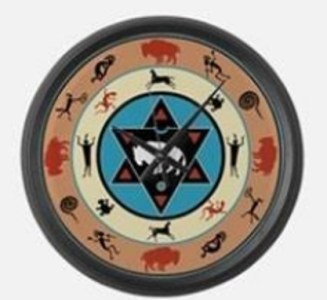
My step-father thought I was an artist. But it had nothing to do with professional calling. I was going through a natural change. My consciousness was blossoming, expressing itself in the non-verbal language common to native cultures from the beginnings of time. Native Americans draw prayer wheels.

Native American

Buddhists create intricate mandalas with colored sands.

buddhist

Medieval architects built radiantly multi-colored stained glass windows into their cathedrals.

Mandala1

Later, I felt compelled to return to the Life Wheel. As I applied left-brain reasoning to penetrate its meaning, it continued to develop, changing into a diagnostic and decision-making tool, a means of linguistic analysis, a zodiac-like measure of time, and more.

It’s not concentric circles that are too abstract. Quite the contrary, this primal way of understanding has been forgotten by isolated intellectuals out of touch with their universal roots.

In The Key that Reconciles Science & Religion, I showed how the Life Wheel reconciles the conflict which Nietzsche, later Jung and then Dr. Peterson, describe as devastating. I quoted Dr. Peterson, who assures us that “there’s much more to ‘reality’ than current assumptions allow.”

What follows is taken from an earlier post that draws on my history background. Snippet quotes are a spoiler alert intended to intrigue you into reading the rest.

closing

  • Professor McGill beamed his approval of the solution to the either/or conflict between science and religion. Historians, he said, call it “The Great Reconciliation.”

  • According to St. Aquinas, It works both ways. Observing the world leads to faith. Faith leads to effective behavior in the world.

  • As Albert Einstein put it, “Science without religion is lame, religion without science is blind.”

  • At the 11th hour of human history, few people have time to learn much less apply the lessons of history. For the sake of simplicity and immediately useful applications, The Great Debate’s outcome is pictured by the Positive Paradigm of Change in the form of a multi-dimensional Life Wheel.

  • Why have we forgotten this? Why do either/or controversies continue to rage as if the solution had never been articulated? Who perpetuates this unnecessary separation? Why? Who benefits? Who pays the terrible price?

book header bird

The GREAT RECONCILIATION

Like Romeo and Juliet, Abelard and Heloise are remembered in as tragic lovers separated by the slings and arrows of outrageous fortune.

Here are the highlights from medieval history. Abelard, a monk, was rich-girl Heloise’s tutor. He seduced her. Their affair outed when she became pregnant. Her uncle exacted poetic justice: the offending lover was attacked in the night and castrated. Afterwards, the lovers exchanged celebrated letters, but were never reunited.

The low lights are usually overlooked. In fact, Abelard married Heloise. But to protect his reputation as a cleric, kept it secret. He urged her to take monastic vows, which she did, but under protest. She felt no calling. For her, living a cloistered life was most unfair.

Why is this story is relevant to the ongoing discussion about the Rules of the Knowledge Game? Because Abelard later distinguished himself a participant in The Great Debate of the Middle Ages.

During my Freshman year at Oberlin College, Professor Barry McGill presented the debate with style and passion. Tall, pencil-thin, graying and bespectacled, he dramatized the effect of pendulum swings on history.

Ideas, he insisted, have great power. They alter the course of human events. In particular, philosophers’ beliefs profoundly affect the forms governments take and the way leaders treat their people.

Long before Hegel wrote about dialectics, which in turn influenced Marx. a triad of medieval scholars — St. Augustine, our sadly altered Abelard, and St. Aquinas — completed the classic example of contrasting beliefs about What Can Be Known, How, and By Whom (epistemology).

St. Augustine sat on one extreme of the philosophical see-saw. Abelard perched on the other. The intellectual world was at odds until St. Aquinas came up with the balancing fulcrum.

see saw

St. Augustine’s approach was faith-based. He depended exclusively on his belief in God. In his worldview, knowledge is the result of divine grace. His credo: “I believe that I may know.” Faith in God is prior and necessary to human endeavors.

In Life Wheel context, Augustine’s primary reality rested at the center of the Wheel and extended outwards from it to include the surface of the physical, manifested world.

Abelard took the opposite approach. Man, he held, depends on observable things and tangible experience to acquire knowledge. This approach, taken to the extreme, results in the exclusively superficial, materialistic paradigm of research science.

Importantly, however, Abelard never denied the existence of God. He held that experience of the world leads the thoughtful man to deduce the necessary existence of God. In Life Wheel context, he started at the Wheel’s surface and pushed inwards to complete the circuit.

It took St. Aquinas to complete the loop. He concluded there is no conflict between the other two approaches. Knowing is a two-way street. No matter where you start, each position leads to and completes the other, reconnecting heaven and earth, center with surface. Complete knowledge flows continuously along the path of an infinite loop.

According to St. Aquinas, it works both ways. Observing the world leads to faith. Faith leads to effective behavior in the world.

Professor McGill beamed his approval of the solution to the either/or conflict between science and religion. Historians, he said, call it “The Great Reconciliation.”

Why have we forgotten this? Why do either/or controversies continue to rage as if the solution had never been articulated?

Who perpetuates this unnecessary separation? Why? Who benefits? Who pays the terrible price?

CONCLUSION

Allow me to point out a relevant conclusion from the sad story of Abelard and Heloise. Today’s exclusively rational philosophers are as sterile as was he. And Heloise’s feminine counter-parts, isolated and cloistered, are equally unfulfilled. Just as yin and yang yearn for unity and the fulfillment of creative balance, so also faith and reason depend upon one another for completion.

As Albert Einstein put it, “Science without religion is lame, religion without science is blind.”

At the 11th hour of human history, few people have time to learn much less apply the lessons of history. For the sake of simplicity and immediately useful applications, The Great Debate’s outcome has been summed up in the Positive Paradigm of Change and illustrated in the form of its multi-dimensional Life Wheel.

Here’s why it is so critically important to reconnect the surface with the center of the Life Wheel in an infinite two-way loop, joining the material surface with its innermost source. The times in history when the rules of the knowledge game allowed creative thinkers to access both sides of the infinite, two-way street were times of renaissance that saw huge outpourings of invention, commerce, arts and learning.

The renaissance at the end of the middle ages, first in Italy and later in England represented by Elizabeth I’s Shakespeare, were times of paradigm shifts. The origin of universities took place during this time. The rules were in flux. It was fair game to access both sides of the coin, so to speak. There was no perceived conflict between faith and reason. Separation of church and state was a non-existent issue. The result was a time of creative flowering in both the arts and sciences.

Our future may well depend upon

whether or not there’s a similar Positive Paradigm shift now . . .

It will take a reconciliation and reawakening

to the full spectrum of human potentials

to generate a flourishing of creative problem-solving

sufficient to tip the scales of history

in favor of human survival.

Phoenix - sized

N.B. “Re-nasissance” = “rebirth.”

Phoenix rising from its own ashes. Got it? : )

Virtue – Rewards and Punishments

On a personal note, I’ll confess that the following was written because of an early morning dream. The previous night, being overwhelmed by the illusion of futility, I’d decided not to write further unless invited, and with a promise of financial reward attached.

But the dreaming mind knows better. I can’t recall how the dream started. What I do remember was sitting in a large convention hall at a dinner hosted by a football coach. He was chastising (in absentia) ticket holders who hadn’t shown up. And he was honoring fans who had. He rewarded the most loyal ones with lifetime game tickets. The middling ones received the current season’s tickets only.

Exactly how this followed, I cannot tell you. But I knew I had to keep writing, and that a blog on Virtue was what needed to be thought through and posted.

Phoenix - sized

In rethinking the recent blog on ethics, I connected several dots for the first time. I’ll also connect what I’ve written on Virtue to Dr. Jordan Peterson’s most excellent videos on the subject. Spoiler alert: we agree in substance entirely. My particular contribution is the multi-dimensional Life Wheel geometry. It adds depth and dimension — a new perspective — to the mix. In addition, I look to the energy concepts embedded in Traditional Chinese Medicine (TCM) for a more comprehensive take on Virtue.

But, Dr. Peterson first.

In Why be Virtuous, he says:

If you’re going to rely on your sense of meaning, make sure that you don’t pollute the mechanism. . . . try not to utter falsehoods, because you warp your neurological structure by doing so. . . it will read out pathologically. . . if you rely on it to guide you, it will run you right off a cliff. So that’s why there’s a moral element to this.

. . . Why be virtuous? That’s the question. It’s so that you can bear the suffering of life without becoming corrupt [forgetting, becoming disconnected, dissociated from the core center of who you truly are] . . . it’s practical. There’s nothing more practical than that. Unless you want misery . . .

Listening really closely to Dr. Jordan Peterson on the Necessity of Virtue helped me recognize that in fact, he is fully aware of and gives us all the elements of the Life Wheel. It’s as if he as a “natural,” intuitively aware of the Wheel’s existence. But he zips right passed it, like Einstein and his famous equation, not knowing what he has been given.

With emphasis to underscore the correlation with the Wheel, he says:

Virtue, ethics, morality isn’t a field of study. It’s a mode of being upon which all fields of study rest. It’s also a mode of being upon which all everything you do in your life rests. . . And more deeply than that, what role it is that you play in your life in the world.

. . . To the degree that they [clinical clients] are embedded in a network of relationships where virtue is fundamentally absent, they’re tortured and tormented and they’re unable to find firm ground.

. . . Modern people are fundamentally materialistic. There’s some utility in that. We’re masters of material transformation. And the fact that we’re materialistic in our scientific philosophies has made us extremely powerful – maybe too powerful for our morality – extremely powerful from a technological perspective. But it has blinded us to certain things.

I think one of the things that it has really blinded us to is the nature of our own being. 2:32 because we make the assumption that the fundamental constituent elements of reality are material. We fail to notice that the fundamental constituent elements of our own reality are NOT material [outer surface rim of the Life Wheel]. They”re emotional [energy level]. They’re motivational [light and conscience levels]. They’re dreams. They’re visions. They’re relationships with other people. They’re dependent on consciousness – and Self-consciousness. And we have no materialist explanation whatsoever either for consciousness or Self-consciousness. And we don’t deal well from a materialistic perspective with the qualities of being.

Phoenix - sized

Now me.

First, as an aside, here is a personal example of how life experience has prepared me step-by-step for the unforeseeable future. I started as a musician, training my hands and building keyboard skills. This translated into typing faster than a speeding bullet, which made it possible to pay the bills as a legal secretary. In that job, I learned transcription, which later served me well as a graduate student taking ethnology courses. During that time, I learned that recording interviews not only freed me from having to take notes, the better to give the subject my full attention. Transcribing afterwards gave me the humble awareness that – of what I thought I had heard — I’d consciously registered at best a small fraction of what had been spoken.

The payoff even further down the pike is that now, when I listen to youtube videos dense in spoken content, I know to transcribe them word-for-word, the better to really “hear” all that has been spoken.

A second important aside – an inversion of the Crime and Punishment theme. While full-spectrum virtue has its intrinsic rewards, in corrupted civilizations, virtue sometimes has short-term punishments. Socrates’ death, described by Plato, is an example. Described in Essay 2 on Death:

Fear is the natural outcome of limited materialistic beliefs equating the end of physical life with total extinction. Those who experience the True Self as immortal and indestructible are not plagued by fear of mortality. No doubt the courage and solace which sustained Socrates as he calmly accepted his death sentence — not as an escape, but an affirmation of principle — came from the depth of his soul awareness.

Now then, to the point: the complete and accurate paradigm embodied in the Life Wheel makes it possible to distinguish the differences between morality, ethics and virtue.

This is one reason why restoring a complete and accurate paradigm to common understanding is a matter of human survival. For without agreement upon a complete and correct paradigm, a community of shared, effective communication is not possible. (Who would actively promote this negative/destructive outcome, and why? Who stands to benefit?)

Conversely, there is no place for genuine Virtue in a hollowed out, atheist world view. Its origins and home have been ruled out.

Phoenix - sized

In the complete and correct paradigm, Christ shines forth from the eternal center of the Life Wheel. His light illumines the middle level, which filters light into the full spectrum of natural virtues. Virtues, including kindness, gentleness and courage, reflect inner light. They are hardwired at the energy center, woven into human DNA.

Dr. Peterson says the significance of Christ’s being a carpenter is that he had to do good work – build houses that stay standing. Agreed. In addition, however, historically a “carpenter” is “joiner,” meaning one who connects all the pieces together – one who has the ability to unify separate parts into a single, coherent whole. The Life Wheel which links center to surface in an infinite loop represents this reality.

In this context, morality is a socially useful code of conduct located on the surface rim of the Wheel. Genuine virtue, like the Law of Karma, is an energy concept located in the fatally forgotten middle level of the Life Wheel. As described earlier, this level serves as the necessary two-way Gate-Keeper between the eternal center and its manifest world.

Morality has a virtue component, but with add-ons. It can reflects Divine Law. An example of this is the Ten Commandments handed down from God on Mount Sinai to Moses. On the other, it sometimes, though not always, is reflected in Human Laws. Warrior codes of conduct are one example. Others include religious sanctions and secular legislation which dictates moral behavior. Outcomes are inconsistent at best.

Whereas ethics are strictly intellectual, moral courage blends mental commitment to a code of conduct with the virtue of fiery conviction.

Phoenix - sized


Here is an essay that expands on what I mean:

Essay 54. VIRTUE

In the West, virtue suggests righteousness, but in fact Te is a term that refers to the potential energy that comes from being in the right place and in the right frame of mind at the right time. — R.L. Wing, The Tao of Power

The last thing to say about strategy is that it exploits opportunity, the right moment. Greek theologians called it Kairos, the point when the new is received. . . Ask: “Is this something that fits our strengths? Can we develop the service that satisfies?” Then comes the third element, the right moment to seize the opportunity by the forelock, to run with success. — Peter F. Drucker, Managing the Non-Profit Organization

The destiny of mankind is not decided by material computation. When great causes are on the move in the world. . . we learn we are spirits, not animals, and that something is going on in space and time, and beyond space and time, which, whether we like it or not, spells duty. — Sir Winston Churchill, Radio broadcast to America

THE FRONT

Definitions of virtue are mixed and confusing. Ancient derivations suggest goodness or power. Latin roots imply manliness or worth. Webster’s definitions refer to moral excellence, right action and thinking. In a woman, virtue is said to imply chastity. In a man, it implies effectiveness or force. It can also mean the power to heal or strengthen.

In ancient Asian traditions, virtue is used as an umbrella term. Healing sciences correlate the healthy functioning of each internal organ with a specific virtue, while weakened energy centers generate negative emotions.

For example, heart energy produces either the experience of love or expressions of cruelty. Kidney energy manifests as either gentleness or fear. Liver energy has the potential for either kindness or anger. Lung energy produces confidence or grief. Spleen energy manifests alternatively as openness or anxiety. Combined positive energies blended together create a transcendent virtue called compassion. In Western traditions, this compassion is called charity.

Though in medical schools it remains a little know fact, oriental and occidental healing traditions have common origins. The caduceus, the familiar symbol of the modern medical profession, has its origins in Greek mythology, which in turn extends back to Himalayan traditions, and still further to ancient Egypt. In Greek mythology, the caduceus is the healing staff of the messenger god, Mercury. In yoga traditions, this symbol represents energy anatomy.

Caduceus.jpg

As a shorthand logo, the staff represents the spine. Twin snakes encircling the axis represent alternating positive and negative energy currents. Intersecting points where cyclic energy forces meet at the axis are the major centers of transformation, chakras. Wings sprouting from the bija point at the top of the axis represent the ajna center, known as the “third eye.”

I Ching traditions describe virtue as the competence acquired by coordinating and balancing the yin-yang functions and concerns associated with each subtle energy center, then harnessing these energies to serve consistent, positive ends. It is not gender-specific.

Confucius compared virtue to an oriel. He observed this bird as being perfectly in harmony with nature: precisely accurate in the timing of its flight, poised upon well-chosen landing, and sweet in its song. Who, he asked, could hope to be more virtuous than this winged messenger?

Such virtue is radically different from arbitrary moral codes specific to a particular time and place. Sometimes an elite class imposes morality upon presumed inferiors in order to exploit them. Often, the unspoken maxim is, “Do what I say, not what I do.”

Rich corporate owners, for example, expect their workers to be hard-working, law-abiding and honest. For the most part, however, they themselves act as if above the law. Compliant workers though moral, aren’t necessarily virtuous.

Soldiers follow orders, mindlessly destroying life and property for the sake of pay. Warriors uphold the codes of their particular tribe or clan. Heroes act from love to protect life. Great leaders like Lincoln, Churchill and most recently Giuliani, however, shed light on the human condition during history’s darkest hours and times of greatest need. They exemplify innate virtue — the courage which leaders of all cultures share in common.

THE BACK

Vice is the opposite of virtue, while sin is the opposite of morality. Villains are those who abuse energy potentials to destructive ends. Chief among the vices is pride, taking natural gifts for granted, forgetting their universal Source. Another is deception, pretending to have virtues one lacks in order to get respect and compliance from others.

Indifference, apathy and paralysis are perversions of virtue. Stagnations in the human body and body politic reduce an organism’s vitality and capacity for positive action. Macho moral codes which assume virtue is exclusively gender-related become self-fulfilling prophecies — IF women and men are fooled into accepting them.