Tag Archives: leadership

Do Circumstances Influence Leader Selection?

Continuing our conversation about the leadership selection process, Mike Lehr of Omega Z Advisors forwarded another set of questions:

.

The Premise

When I look at events, I see four major forces: circumstances, flow, people and leader. From my perspective, you wrote about the last two. [See “Scientists and Sages Can Agree on This.” wp.me/p46Y5Z-8W and “How Bad People Become Leaders,” wp.me/p46Y5Z-9B.]

I’m asking about the first two.

Mike’s Comments about Circumstances

In regard to the conditionality of leadership, I welcome your thoughts on the influences circumstances have on leadership.

For example, just as terrain influences the type of battle to wage, there are market forces, technological influences and timing issues at play. All of these influence the selection of leaders.

For example, I often ask folks this question: Which dog would you prefer, a collie or a pit bull? Most usually indicate a collie. However, when I add the qualification that you now live in a very dangerous, crime-ridden neighborhood, they tend to revert to the pit bull.

Relating this to business, a firm in high-growth mode is a different situation than one in trouble or growing incrementally. Market forces and competition are also circumstantial influences.

My Response

The leadership selection process depends largely upon who the selectors are. The formal process in small business and corporate sectors varies, depending upon ownership, mission, size and by-laws. Similarly, who many participate in the selection of political leaders differs by location across the globe.

What all have in common, however, is the principle of natural selection. As Mike suggests, people instinctively gravitate towards those best suited to protect the flock and ensure group survival. For example, during war times, women prefer mates with mechanical, farming and martial arts skills over impractical, unskilled intellectuals. Conversely, during prosperous peace times when basic survival items like food, clothing, and shelter are widely available, intellectuals with the high earning power to purchase them are favored.

Here, observations made by a mentor at the Wisconsin School Board Association serve as a useful example. He told me that the selection of a school district administrator starts with the search for a harsh disciplinarian to force teacher unions and unruly students to “toe the line.” This works for a while. But then heavy-handed administration gets old. Abuses of authority are resented. So opponents mobilize to “throw the bum out.” They search for a mild-mannered replacement who is who is teacher-friendly and soft on discipline.

However, in due time, this lax approach starts to rub other factions in the community the wrong way. Yet another selection process is initiated to bring in a tougher new leader who will restore “law and order.” Opposite and equal challenges continue to generate an ongoing succession of new faces in the administrator role.

The senior School Board Association officer had witnessed this process long enough to recognize a repeating pattern. Elected, short-term school board members in local communities probably didn’t.

These pendulum swings between extremes are natural, but not optimal. Instead of repeated, disruptive shifts between between contrasting leadership styles, it’s possible to sustain cultural continuity by harmonizing contrasting opposites. An alternative, I Ching-savvy approach balances the demands of different groups within the community.

In this worldview, the sought-after leader is keenly attuned to fluctuating economic / political as well as technological changes in the environment. Such a leader isn’t driven by circumstances, but rather has an overview of the directions in which they continuously change. With an understanding of natural law, this leader has the ability to steer followers safely through every stage of the organization’s life.

Thus, in the Tao Te Ching, Lao Tze advises leaders to adjust with the times to maintain long-term tenure as well as organizational stability in all circumstances:

Adhere to principle / while adjusting to circumstance.

Goals are secured / by remaining flexible and open.

Caveat: When working with the I Ching, it is essential to keep its place within the larger scheme of things firmly in mind. Otherwise, it is subject to dangerous abuses. The abode of Natural Law in the Positive Paradigm Context is the middle level of the Unified Wheel. It stands as the gatekeeper between Human Law (legislation and custom) on the surface and Divine Law at the center. Its powerful applications are equally effective regardless of whether the user’s motives be for good or evil.

con_bak_cov

While good (meaning responsible, competent and compassionate) leaders are sometimes wary of working with the I Ching because of its potential for abuse, bad (meaning irresponsible, selfish and cruel) leaders who have no respect for either Human or Divine Law feel free to use their understanding of human dynamics to manipulate others for antisocial purposes. [See “Know When to Mistrust Inner Voices,” wp.me/p46Y5Z-aR.]

For example, I have warned repeatedly about the disaster looming ahead in the next U.S. election cycle. Extraordinarily extreme abuses by the political left may have been deliberately orchestrated by behind-the-scenes puppet masters, as if to precipitate an opposite and equally extreme reaction. [See “To Push a Man Right, First Push Him Left,” wp.me/p46Y5Z-9K.]

I’ve also hinted at the urgently necessary antidote to this potentially deadly outcome. [See “What’s More Important–-Nature, Nurture, OR . . ,” wp.me/p46Y5Z-8k.]  In that blog, I conclude:

Leaders who intentionally live true their conscience and succeed in linking the levels of life are key to a viable future. The rest of us will depend on them to out-think, out-maneuver and succeed long after pretenders with no substantial connection to the center of life have been blown away like dust in the wind.

To Be Continued:

The next installment will include responses to Mike’s comments about the fourth factor, “flow,” as well as what he calls “non-cultural” issues.


.

The Only Way Out Is Through

The back cover of Conscience: Your Ultimate Personal Survival Guide sums it up:


con_bak_cov

The Positive Paradigm Handbook — a practical, bare bones work book — offers the following, abbreviated description of the middle, energy level of the Positive Paradigm Wheel of Change. **

The dangers of this level cannot be underestimated. Understandably, without a reliable road map and a keen sense of purpose and commitment, the middle level seems frightfully laden with traps to ensnare the uninformed and reckless. Hence the Fateful Fear of Self-Awareness. (See wp.me/p46Y5Z-aK.)

However, its value cannot be underestimated either. Armed with the skills and insight to use the necessary powers associated with this level wisely, courageous pioneers of the inner worlds can achieve success in every area of their lives.

To avoid the dangers of getting stuck in the middle level, mired in the traps of delusions and negative emotions, it’s critically important to have an accurate and complete reality map. The purpose of pushing through this level is ultimately to reach the far side, the abode of intuition and light, the storehouse of infinite treasure. But, as told of The Chapel Perilous, “The Only Way Out Is Through.”

—————————–

e. Energy. Much ignorance, misinformation and confusion surrounds the energy level of the Positive Paradigm. The state of chaos into which the world has degenerated attests to this deficiency, as well as the urgent need to correct it. Only the basics are described here, suggestive of further exploration.

The middle level is the domain of natural law, whose dynamics are mapped in the Chinese I Ching, the Book of Change. This body of knowledge has evolved over eight thousand years as sages continue to observe the operations of energy and document the repetitive patterns of change.

Natural law maps the energetic underpinnings of the dynamic, physical world. It is experienced as the patterned recurring cycles of seasonal change, and is equally applicable to humans and their cyclical life changes: birth, growth, decay and death.

The middle layer is the realm of less tangible but still measurable states of energy, including electricity. More subtly, it is the chi, ki or prana described by Chinese, Japanese and Indian traditions as the life force which animates all living beings. In Greek and Christian contexts it correlates with the breath, the psyche.

These subtle energies influence internal psychological states and drive external human behavior, which in turn affects social relationships. Knowledge of these dynamics is essential to personal survival.

Effective leadership and the quality of life within organizations hinge on the quality of awareness brought to dynamics at this level. While some leaders understand the dynamics of change at a gut level as a matter of common sense, systematic logic and deliberate understanding would significantly improve the results of the decision-making process.

Those denied access to material and social resources are often forced inside. Of necessity, turning inward, they develop and depend for survival upon strengths drawn from the middle and center of the Wheel.

At times, material deprivation and hardships yield the opposite and equal blessings of in-sight and emotional fortitude. At other times, however, excessive investment at the middle level results in delusions, latent with the potential for erupting into violence.

In any case, making a virtue of necessity by rejecting the material world prevents completion of the pattern. It can’t correctly be equated with spirituality.

Cultures which enforce an exclusively materialistic worldview and deny the experience of everything not tangible and measurable place severe hardships on those whose inner lives are especially active. The Handbook gives ample opportunities to diagnose such imbalances, the better to remedy them.

Societies that deny their citizens practical outlets for articulating and harnessing inner energies creatively can literally drive people crazy, to suicide, or at best, underground. Many “sensitives” survive by channeling socially banned, unacceptable awareness and longing for self-fulfilling adventure into the arts: music and literature, including romance, murder mysteries and science fiction.

This is a great loss to society. The world would be far better off if high-energy, creative individuals were identified as potential leaders, trained and given employment options accordingly.

** Educators, therapists and theologians interested in detailed applications to their particular professions are referred to the more complete description provided in Rethinking Survival: Getting to the Positive Paradigm of Change.

Know When to Mistrust Inner Voices

A recent misunderstanding taught me a well-deserved humility lesson. Millennial spokesperson RhinoforDinner had challenged me: “What leadership quality do you think is most important for young leaders to learn?”

.

Like a thoughtless Rhino, I jumped in feet first with an enthusiastic response. “I’d say Confidence, meaning ‘with faith’ in their True Selves: having the courage to hear & follow inner voice of Conscience.” Further, in a blog, Dangerous Times Call for True Radicals, I elaborated on why Two Sides of a Coin: Lao Tze’s Common Sense Way of Change is dedicated to the Millennial Generation.

.

In retrospect, I recognize my answer came straight from my own world view, failing to take Page’s background and beliefs into account. So I didn’t anticipate his response. Instead of answering me back, he cut off our Twitter connection.

.

I felt surprised, baffled and more than a little hurt. But when I expressed my disappointment to a close friend, he showed no sympathy.

.

In essence, he reminded me of the obvious. I still have a lot to learn. In particular, he pointed out that to people of faith who read the Bible, my response might have seemed New Agey. The responsibility is on my shoulders to be far more careful, considerate and clear in the future.

.

I did my homework. Page Cole is co-author of The Character-Based Leader: Instigating a Leadership Revolution…One Person at a Time. The book’s sub-title “one person at a time” resonates with the Positive Paradigm of Change and its motto, “Change from the Inside Out, and One Person at at Time.”

.

However, whereas I’m a respecter of the world’s great religions, with an eye to the timeless, universal basics they share in common, Page is firmly grounded in the Baptist faith. I have greatest respect for the Bible and regard Christ as the ultimate universal teacher. But my answer failed to reflect this acceptance and respect. He had no way to recognize my answer as being completely in harmony with his beliefs.

.

He had tweeted, “We believe in a Leader with Character, who acts with Integrity/Trust/ Respect for People. What do you stand for?” What he probably wanted to know was where I stand in relationship to other people.

.

After healing my wounded feelings and doing an attitude adjustment, I invited Page to connect via LinkedIn. He quickly accepted, so I sent this message:

.

Thanks for the connection, Page. I’d deeply appreciate your feedback. Rather than guess, I’d like to know from you why you responded to my Twitter answer to your leadership question by cutting me off. My head says to let it go. My heart says there’s something important to learn from you. There’s so much good will on this side. Why the disconnect?

.

He responded charitably, re-following my Twitter account immediately. Later he emailed a detailed response. The cut-off was an unintentional error, he wrote, adding , . . “your comments were insightful and genuine. I loved the blog post.” But he also added a hint: “I’m not as versed in the writing you mentioned. . . “

.

He continued, “I come from a distinctly Christian background.  I believe that ‘inner voice’ is the character within me that is being shaped by many factors, among them culture, family, relationships and of course Scripture and my personal relationship with God.”

.

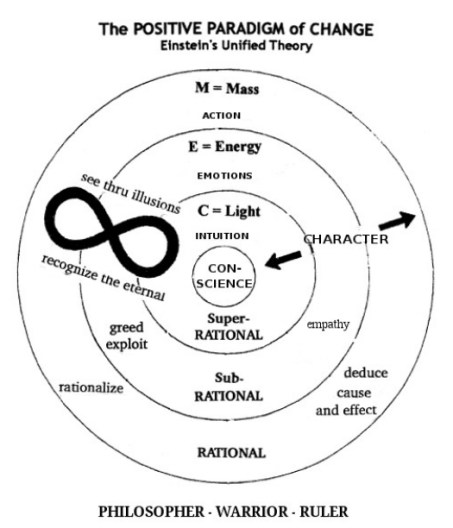
So far, it was merely a language disconnect. For him, “character” is a highly value-ladened word, one that by his definition spans the surface, middle and center of the Life Wheel, linking them. What I call a Philosopher-Warrior-Ruler, he calls a Person of Character. So far, no substantial disagreement. 

.

Here’s how I picture our common understanding:

0 leader ruller


BUT then came the heart of the disconnect. He continued,


I’m not convinced that the “inner voice” is always a good thing to listen to, as evidenced by the actions of destructive and evil people throughout history.

.

This is a seriously important reservation. It’s my boundary-spanner job to reach across the divide with a response that connects us in common understanding.

.

The unique contribution of the Positive Paradigm of Change is that it speaks to this issue. It pictures a reality map that draws clear distinctions between rational, sub-rational and super-rational levels of experience. It’s not a new model. But it rephrases the “perennial philosophy” in terms of Einstein’s physics, linking historical wisdom with modern experience. It gives a way to articulate the important difference between misleading, deceptive voices that imitate conscience and the “real deal.”

.

It follows in the footsteps of psychoanalyst Carl Jung, who was instrumental in introducing the Wilhelm/Baynes version of the I Ching, the venerable Chinese Book of Change to the English-speaking public. He worked to define the common thread of human experience that links wisdom traditions throughout human history, as did comparative religion teachers, notably Joseph Campbell and Huston Smith.

.

Universal stories they focused on include one told by the Greek philosopher Plato. His psychological model pictures a chariot drawn by a pair of horses that pull in opposite directions. A white steed tries to pull the chariot off course, striving upward so close to the sun that it risks catching fire and being consumed. The black one pulls downwards, threatening to crash the chariot and driver into the ground. The driver’s challenge is to rein in and coordinate the team, steering a steady middle course that avoids danger-filled extremes. In this way, he succeeds in reaching his intended destination.

.

[Regrettably, this poetic model, while psychologically accurate, has been taken literally and harmfully misconstrued as if it had racist implications.]

.

A similar chariot story from the Hindu tradition is told in the Bhagavad Gita. Arjuna, a warrior driving his chariot into battle, grows faint of heart. At this point, Krisna, a god representing conscience, makes his presence known. As the passenger seated behind Arjuna, Krisna advises with encouragement and wisdom, giving him the heart to prevail in fighting the good fight.

.

The Positive Paradigm Wheel is true to these poetic traditions. All account for the interdependent facets of awareness. The rational mind (driver) of the chariot (physical body) must skillfully harness the horses (energies, emotions) that power the vehicle, while heeding the guiding voice of conscience in order to meet ultimate goals.

.

In addition, however, the Positive Paradigm, also accounts for the actions of destructive and evil people throughout history which give Page pause. Despite claims to the contrary, such actions are not the result listening to the Inner Voice of Conscience. Evil actions are the mark of unbalanced extremists who have been misled into following the seductive voices lodged within the middle, sub-rational level of the Wheel.

.

Destructive leaders are heeding not the innermost voice of Conscience, but the clamor of the Seven Deadly Sin-Demons — starting with Pride, followed by (and often in combination with) Anger, Avarice, Gluttony, Lust, Envy and Sloth. Modern day demon off-spring include Separatism, Exclusiveness, Arrogance, Ambition and Competition.

.

What’s dangerously missing from the prevailing, exclusively materialistic paradigm of empirical science — a glaring gap which the Positive Paradigm of Change fills — is a universally acceptable reality map which includes the sub-rational middle level with all its dangers, but in its complete and correct context: contained by the super-rational level of intuition on one side and by the rational level of practical experience on the other.

.

Herein is the common thread which continues the earlier blog, the Fateful Fear of Self-Awareness. I will shortly post a description of the reality map with emphasis on the too little known and greatly misunderstood, danger-fraught middle level. Character- based leaders in every walk of life and therapists as positive change agents can use it as a reference to realistically navigate the temptations of Seven Deadlies and their off-spring in order to prevail in fighting the good fight for themselves, and then for those those who place trust in them.

.

In the meantime, dear Page, I heartily encourage you to read your Bible faithfully. I’m remembering Old Testament words burned into my mind from a performance of Mendelssohn’s Elijah long ago. It’s a tenor solo, the scripture-based words being, “If with all your heart ye truly seek me, Ye shall ever surely find me. Thus sayeth our God.” It’s as good a guide for sincere leaders as one would wish for in this dangerous world.


All best.

Dangerous Times Call for True Radicals

At 7:07 a.m. on Tuesday, July 2nd, a tweet from RhinoforDinner popped into my email inbox. “Thanks for the follow! I’m Page! What leadership quality do you think is most important for young leaders to learn?”

I tweeted back, “Great Q, Page! I’d say Confidence, meaning “with faith” in their True Selves: having the courage to hear & follow inner voice of Conscience.” I double-checked Page’s avatar – a seriously disgruntled cartoon rhino.

Here’s the description: “What is real leadership? A rhino in a restaurant is no doubt powerful… But he has no authority! Helping leaders lead with authority!” So I followed up, “Conscience is the connection with ultimate inner authority.” Then, on second thought, an hour later, “Con-science = with science, the true meaning of which is ‘with knowledge.’”

I have enormous compassion for Millennials . . . as well as great hope, which is why the 2014 edition of Two Sides of a Coin: Lao Tze’s Common Sense Way of Change is dedicated to them:

Though it may seem as if they’ve been economically disenfranchised by their elders, material misfortune on the surface of the Positive Paradigm Wheel contains within it the hidden seeds of humanity’s long-term survival.

Ours isn’t the first time in the repeating cycles of history that leaders have squandered national resources. But in the context of Lao Tze’s larger reality, material resources aren’t that significant when compared with the intelligence, inner strength and inexhaustible vitality available to those whom circumstances oblige to return to the less tangible but very real levels of inner experience.

Millennials are the ones for whom the results of the materialistic, conflict-paradigm are so catastrophic that they have no vested interests to protect. They’re the ones prepared to move forward once again into the past, recovering the timeless treasure of the Positive Paradigm buried deep within the Tao Te Ching‘s wisdom.

  They’ve been given the greater opportunity to dig deep,

rediscover their inalienable inner resources, and

become the truly radical agents of substantive, positive change.

In the repeating cycles of generational pendulum swings, their 1960’s grandparents (indiscriminately) embraced all things change – on the surface. Religious, sexual and cultural norms went by the board. Hippie flower children dropped out of “the system” and tuned in to drugs, hard rock and doing their own thing.

Working with less-than-perfect translations of the I Ching, they popularized the misunderstood Chinese Book of Change to rationalize (predictable) rebellion against security-obsessed elders, who (as survivors of the great depression and World War II), had reacted in opposite and equally extreme ways to the extremes of the generation before them. (And so on, and so forth, round and round again.)

My best hope for Millennials is that they’ll benefit from the lessons of history and NOT mindlessly perpetuate the pattern of yo-yo swings between opposite and equally dysfunctional extremes on the surface, disconnected from the timeless center.

We now recognize that different visions of timeless truth are, necessarily, inherently the same. Looking back in time, the Tao Te Ching (along with the I Ching worldview it expresses) is remarkably compatible with Patanjali’s Yoga Sutras. Looking forward, it is equally compatible with the teachings of Christ. Most recently, the correlation has been made with the three variables of Einstein’s famous formula. He had the Unified Theory, though lacking familiarity with ancient teachings, didn’t know it.

Now, as in the time when Christ walked the Earth, true fundamentalists and radicals (both words mean the same thing) aren’t conflicting extremist groups that meddle with events on the material surface of life’s wheel, but single individuals with the courage and vision to change themselves from the inside out.

Millennials, along with the parents and grandparents who dearly wish them well, can benefit from a hard-earned, deeper understanding of change. They’re becoming aware that times of adversity and extreme danger offer opportunities for self-transcendence. They can anticipate hidden blessings (however well-disguised) and prepare according to The Common Sense Book of Change view of CHANGE:

49. CHANGE

Day and night replace each other

in endless cycles of CHANGE.

The same natural law generates flux

in human events.

The unprepared see change

as a threat,

but the well-prepared

face the unknown calmly.

They know that after degeneration

reaches critical mass,

regeneration follows.

Welcome the new.

Avoid short-sighted fear.


This, in turn, however, leads to a whole new subject.

.

globe

How Bad People Become Leaders

In response to my last blog, “Scientists and Sages Can Agree on This,” Mike Lehr of Omega Z Advisors posed a question: “It seems many leadership models characterize leadership as a universal good . . [but] it’s hard to give much credence to any model that can’t explain how ‘bad people’ become leaders. What thoughts do you have on this?”

I answered back: “I love a challenge, Mike. I’ll post my thoughts by Monday, and tweet you the link. Many thanks for asking.”

And it is a very challenging question. The subject is vastly complex. Making matters worse, the English language is so compromised that it’s difficult to answer simply and clearly.

For one thing, Mike, you’re not alone in looking for answers to this question. Earlier on LinkedIn, I was following a thread in the Leadership Think Tank discussion group. Five months ago Milan Grković, who heads the MUI Centar in Croatia, posed the question, “Why We Have So Many Bad Leaders?” At last count, there have been 1529 comments.

Mike’s question is framed in terms of “bad people.” Milan calls them “bad leaders.” It’s an important distinction. Both are valid. There are good (meaning ethical, responsible, compassionate) people who function poorly in leadership roles, and vice versa – not-so-good people who in measurable ways function effectively as leaders.

Unfortunately, good people who are also effective leaders are rare, while bad people who function terribly in leadership roles are all too common.

From childhood on, authoritarian educators brainwash the masses with a “respect” for authority figures, a word experienced somewhere along a continuum between “high regard” and “terror.” So most of us assume we’re obliged to comply without question.

We also been taught to expect that non-conformance has life-threatening consequences. (The tyranny of “experts” is a related but different subject for a future blog.)

Many individuals are placed in leadership roles. Very few have the combined aptitude and practical experience to actually lead. On the other side of the coin, some individuals are highly influential even without an organizational title. Their outstanding ideas and/or example suffice. Einstein is an excellent example.

Further, the description of a “bad” leader ranges from “well-intentioned but ineffective” to “incompetent, toxic and destructive.” Some people placed in leadership roles are hapless puppets.

On the other extreme, some crave power for its own sake, take pleasure in dominating others cruelly, and are quite intentionally evil. (Although business consultants, understandably, hesitate to use the word, the existence of evil is an important, unavoidable subject. A functional definition is given below.)

Different qualifications are required to lead in different situations. We each fill leadership roles at some times and in some areas of our lives. So the definition of an effective leader also changes on a sliding scale.

On the largest scale of magnitude, a universal leader is an educator in the pristine meaning term: one who leads from darkness to light. Christ was the ultimate leader. He instructed students to call him Rabbi, which means teacher.

All of this, however, begs Mike original question of how (meaning the process by which) bad people become leaders. Outside of sheer brute force, HOW are unethical, inhumane, and/or incompetent people selected to fill leadership roles?

I addressed part of this question in an earlier blog on the leadership selection process. (See Democracy Is a Myth.) My doctoral research study proved with 99 percent statistically significant results that an informal pre-selection process precedes the formal one.

Innovative, creative candidates are screened out by current power holders with a vested interest in maintaining the status quo. No one is identified, groomed or nominated who doesn’t mirror the values or otherwise suit the agendas of existing (sometimes not-so-good) administrators.

For another perspective, refer back to the Positive Quantum Paradigm Life Wheel. The previous blog, Sages and Scientists Can Agree on This pictured this holistic, integrated reality map. According to this model, a good leader is one who is not only self-aware on all levels, but is able to link, balance and prioritize them.

Both books on the Positive Quantum Paradigm, however, include sections that describe the extraordinary amount of pain, suffering and loss that results from basing decisions and actions on incomplete, incorrect paradigms.

Here, two illustrations must suffice. First is a picture of the prevailing, exclusively materialistic empirical science paradigm. The center is ruled out. Intuition is denied. Emotions and energy aren’t accounted for. All that matters are concrete tangibles and physical image. A leader’s motives and intentions are known only when it’s too late – after the selection has been made and the (sometimes regrettable) results come in.

.

MaterialistAthest

A “scientific” leadership selection process takes into account only that which is measurable, for example academic IQ. Intangibles like the presence or absence of cultivated Emotional Intelligence (street smarts) fly under the radar, as do ethical intelligence, creativity and a capacity for visionary insight.

When selectors judge only by appearances, it’s easy to deceive them. As Lincoln said, “You can fool all of the people some of some of the time, and some of the people all of the time.” Tor an ambitious con artist, those are pretty good odds .

In a second variation, all levels of the Wheel are operational, but they operate intermittently and out of synch, each disassociated from the others. The smallest circle which represents Conscience floats outside, detached from daily experience.

Stress

On one side of the continuum, this is the picture of a hypocrite, for example a person who operates on one standard with close family, but on another with strangers or at work. It represents someone who presents one image to the public, but acts quite differently when no one is looking.

Hitler is a familiar example on the far opposite extreme. This is the picture of evil, meaning anti-life: intentionally shattering and fragmenting the creative pattern. In Positive Quantum Paradigm context, the intentions and actions of any person (or group) that destroys its own and/or threatens to annihilate enemy groups, devoid of respect for the inherent sanctity of life, are defined as evil.

The empirical science paradigm has no language or structure for recognizing such malfunctions. In contrast, the Quantum Paradigm is designed to diagnose inner dynamics. Use it to identify bad people and prevent them from being given leadership roles.

Again, my thanks to Mike Lehr for this opportunity to respond. Hope this helps.

All best!

globe

Scientists & Sages Can Agree on This

Today’s effort started with a most excellent blog tweeted out by Mike Lehr of Omega Z Advisors: “The essence of #leadership in a single word blog.omegazadvisors.com/?p=2696.

It looked interesting, so I clicked on the link.

Yup. The major puzzle pieces are there. Vision. Strategy. Idea. Inspiration. Speaking directly to my subject, he states, “Leadership is about change.”

So I tweeted back, “I totally agree about inspiration and change, Mike. But then, how do we train such leaders?? I have a few suggestions. All best.”

Within a day, Mike tweeted back,“Post them somewhere, Pat . . .”

So here’s my short version of how to train leaders who are equally inspired and effective — a picture worth a thousand words.

The BEST LEADERS ARE SELF-AWARE

061614 Wheel

BE AWARE of

What You’re Doing and Why

The Life Wheel (also described as the Quantum Paradigm of Change) is a modern day descendant of the time-tested but gravely misunderstood, underrated Book of Change which leaders in every walk of life have consulted to cultivate self-awareness, make better decisions and get better results for over eight-thousand years.

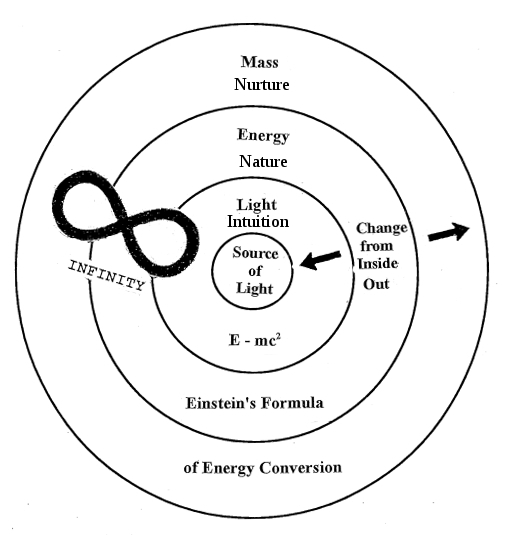
It places the three variables of Einstein’s famous formula, e = mc2 mass, energy and light, on increasingly deeper levels within the Wheel. The result is the Unified Field Theory which Einstein already had — consciousness factor included — though, sadly, lacking yoga background, didn’t recognize. This archetypal wheels-within-wheels model is equally compatible with modern physics, yoga philosophy and the world’s great religions. It is a reality map upon which scientists and sages can agree. It images the in-depth experience of the quantum spacious NOW, abiding beneath the surface waves of rational thinking and everyday sensory experience described by Eckhart Tolle.

  • The intuition Mike describes fits within the WHY level of the Wheel. This innermost level of Light is associated with spiritual guidance and flashes of genius. Unless integrated with the ability to strategize and implement, however, vision and insights fail to manifest as practical results.
  • Emotions (including empathy) and strategy belong to the middle HOW level. The Energy layer is associated with street smarts and Emotional Intelligence. Magnetism and charisma emanate from this level, but unfortunately aren’t always integrated with integrity, intelligence and practical organizational skills.
  • Purpose and outcomes belong to the surface WHAT level associated with tangible, measurable results. The Mass layer is the realm of quantifiable IQ as well as biological family and social/political connections. Persona (mask) and personality are surface appearances. They don’t necessarily reflect actual motives and feelings. (This is why merely imitating the words and actions of great leaders doesn’t have the same affect).

The three outer levels are interrelated and interdependent. Each is necessary but not sufficient. Their existence depends on the unchanging hub of the Life Wheel. The true SELF — also called Conscience, the Tao or God — holds the spokes together as events on the Wheel’s surface rim change continuously. Creation in the form of primal consciousness emanates from and returns to this silent alpha-omega center.

Inspired leaders are Self-aware. Positive leaders link inner vision with compassion to generate practical results. They serve as organizational catalysts, bringing out the best in others by example. Like stringed instruments, we resonate when true leaders strike a universal chord, set in motion by a deeper music.

This quantum paradigm of completion is “positive” because all the levels of experience are included and correctly prioritized. None are excluded. None are out of place. The levels are harmoniously linked in an infinite, two-way continuum of creative balance. (This is the holistic picture of unity or “yoga.”) Mindful of Einstein’s warning that problems cannot be solved at the same level they are created, it pictures the deeper levels where we can first get unstuck, and then travel deeper to where the genuine solutions we dearly need and seek can be found.

Prophetically, Einstein warned about the dangers of inverted priorities: “The intuitive mind is a sacred gift and the rational mind is a faithful servant. We have created a society that honors the servant and has forgotten the gift.” Today, more than ever, the world urgently needs leaders who remember their gifts and use reason correctly.

An important first step in training better leaders is to convince educators/executives/politicians and their students/employees/supporters of the grave dangers inherent in prevailing, incomplete and inaccurate paradigms. Then, it requires rousing sufficient courage to make a paradigm shift.

What could be more powerful motivation than the pending threat to human survival?! For today’s un-in-formed leaders are undeniably steering planet Earth towards a catastrophic disaster that dwarfs the Titanic’s collision. Einstein wasn’t exaggerating when he observed, “We shall require a substantially new manner of thinking if mankind is to survive.”

Decision-makers and leaders in every walk of life can make themselves whole by using the method outlined in The Positive Paradigm Handbook — currently under revision. In addition, it gives a practical standard for assessing leadership potentials, training better leaders, and choosing which ones to follow.

All best!

globe

Democracy Is a Myth

Another installment of Reinventing Democracy must include my basic conclusion that today, for many reasons, democracy is a myth.

For starters, in Rethinking Survival, I draw on the key observation made by legendary comparative religion expert Joseph Campbell.

In his opinion, current myths (meaning creation stories and paradigms of how the world works) no longer serve us well. He called for a new paradigm, one that allows us to recognize the humanity of people living on the other side of the hemisphere.

Anticipating the Positive Paradigm of Change as the embodiment of Einstein’s long-sought Unified Theory, in The Power of Myth, Campbell wrote, “I’ve often wondered if some of the notions coming out of quantum physics, quantum interconnectedness, don’t express that.”

Historically, a belief in democracy is fundamental to the American world view. However, what I inadvertently proved in my dissertation’s statistical research study is that the existence of democracy in America is also a myth in the slang usage, meaning “false and fictitious.” Excerpts from Rethinking Survival explain.


globe

THE SELECTION PROCESS: Democracy is a Myth

Graduate school years were another mixed blessing. While earning a Ph.D. in Educational Administration didn’t lead to career advancement, it was highly therapeutic: another opportunity to divest myself of unconsciously held programming.

One day I would read in the research literature about the mistakes women new to administration make, being unable to read the hidden cues of old boys’ club colleagues. The next day, I would fall kerplunk, right into the same traps. Ouch! I would read about female stereotypes, and almost immediately find myself playing them out. Aha!

Another upside was the presence of exactly the right people in the right places to tell me what I needed to know to survive. . . . Howard Wakefield, the Department Chairman, took on the role of thesis advisor. His sense of humor and down-to-earth attitude saw me safely through the Ph.D. credentialing process. We spent long hours talking philosophy. Howard was a practicing Christian. He gave me a pocket Bible from the stash he kept in his center desk drawer. I treasured this gift.

The dissertation topic was as challenging for him as for me. Stereotype issues literally hit home. He began to see relationships with his wife and teenage daughter in a new light. But, he told me, it worked both ways. The job of his dreams had been to be a school district administrator.

But he was a short and small-boned. With thick glasses, he didn’t exactly project an athletic image. Muscular football coaches capable of nailing unruly teenage boys to the gym wall were the candidates of choice. He became a professor because, like it or not, that was stereotype he matched.

The Dissertation

Ethnology was ruled out for thesis projects. I was required to use statistical methods in my 1978 Ph.D. dissertation, “Women Principals in Wisconsin Elementary Schools: A Support-Success Theory.” With 99 percent statistically significant results, this study proved that public schools in Wisconsin are an inbred, insider’s closed shop.

No one enters the selection process who hasn’t first been identified and groomed by current school administrators. No one enters graduate school to earn a school administrator degree or applies to the Department of Public Instruction for credentials who hasn’t already been promised a job. The unwritten, informal rules of the pre-selection process require that job candidates mirror the values, beliefs and interests of current power-holders.

Dissertation research surveyed four distinct groups with the same set of questions. Each population had radically different perceptions of the same selection process. Men principals, those who benefit most from the process, responded with a remarkable 98 percent return rate, insisting the process is fair and unbiased.

Men teachers, however, those whose expectations and ambitions had been thwarted, were angry and cynical, certain that the process is stacked and unfair. In one respondent’s words, the chief qualification is “a willingness to screw teachers.”

Women teachers were oblivious to the existence of a selection process. Their mantra was, “I am not aware . . .” Only women principles were ambivalent. As boundary spanners, they had succeeded in being selected, but still recognized bias and injustice in the selection process.

What separated principals from teachers, regardless of gender, was the combined support received in their personal and professional lives. Those who got the most support succeeded accordingly. Those who received little support were least likely to succeed.

Interestingly, my research of the literature found that convenient myths are easily forgotten when they suddenly become inconvenient. A paradigm shift occurs, for example, during war time. When the men are away and there’s work to be done, then women are suddenly seen as perfectly fit to function as factory workers or school principals.

By extension, it’s only when the times make skewed rules of the knowledge and power-distribution game sufficiently inconvenient that the public will become receptive to the Positive Paradigm of Change and Positive Action ways to identify and support more effective leaders.

Applications: the I Ching view recognizes that patterned events repeat smallest to largest. Thus my research findings can be applied to the selection of government officials at every level. It applies to the selection of the CEOs in leadership positions within businesses and corporations. It also applies to political leadership, even on an international scale.

Conclusion: the American dream of a democratic, meaningful choice in leadership is but an illusion. In an informal process that proceeds the formal one, candidates are pre-selected and effectively owned by insiders. The sorry absence of innovative, effective leadership is explained by the documented filtering process which for the most part excludes creative, natural leaders.

What are the long-term survival consequences? To our detriment, the Western linear progressive theory of history puts in-bred leaders operating on dysfunctional paradigms at a loss to foresee cyclical down-turns in order to prepare for them in time.

Ancient Egypt’s pharaoh had his Joseph to interpret warning dreams and oversee the timely storage of grain during seasons of plenty to off-set famine during seasons of drought. Who prepares or listens to such boundary-spanning advisors now?

What’s Most Important – Nature, Nurture, OR . . . ?

The other day, I encountered Ivan Goldberg on LinkedIn. A Chair at Vistage International, his formal title is Executive Mentor and Coach. But it’s his personal handle I find irresistible. He describes himself as an “Enthusiastic Agent for Change, Wise Old Sage, Great Listener, and Author of ‘Leading to Success.’”

globe

I’m an author of books on change based on the book ancient sages have depended upon for eight thousand years and counting. So I had a hunch that I’d found a kindred soul. I sent an email to find out.

When he accepted my invite, I wrote back: “Thanks for the connection, Ivan– Your blogs look terrific. Maybe you’d like mine as well. Here’s one that’s just been retweeted. Thanks for your great work. All best, Pat West”

Sure enough, he answered me, “Hi Pat. Many thanks for the link. Your blog is certainly more academic (that is a compliment BTW) than mine and is very thought provoking. Hope that you like today’s post on Leadership. Best regards, Ivan”

Being an academic (though also much more), I did my homework. On his website, Ivan asks “Are Leaders Born or Made?” He also answers the question: “It is Nature, Nurture and Much More!”

One good blog deserves another. So I answered back:

Hi Ivan. Yes, I liked the Nature, Nurture AND More blog. I also liked the ones on motivating and daring to be different. Seems to me that you do in fact have the soul of a sage, and know a thing or two about change. The Chinese don’t have a monopoly on wisdom after all. Now I’m motivated to write you an answering blog on the subject of nature, nurture, and More. I’ll alert you come mid-week, if you like. All best, Pat”

What follows is my response to Ivan’s blog. He concludes, “Is it a matter of nature or nurture?  It is both.  Leaders need to be aware of their inborn abilities and how they can develop them, which is, essentially, an auto-didactic exercise.”

What? “Auto-didactic?!” I can’t resist a friendly tease here. Ivan, who doesn’t really have much use for academics, uses a pretty fancy word that I (the presumed academician) had to look up. Turns out, it means self-analysis. As a noun, it means self-taught.

Agreed. Self-responsible learning and experience are essential. Potential is necessary but not sufficient. However, the wisdom of sages (not the same as academic theories) can make a useful difference. I’ll give one example here using the Positive Paradigm Wheel of Change which is true to the original, the I Ching. This picture talks to the right brain to balance the left-brain discussion which follows.

It places the relationship of nature, nurture and “much more” in prioritized context.

NatureNurtureWheel

For those as yet unfamiliar with the Unified Theory of Einstein’s heart’s desire, let me explain briefly. The model of concentric wheels-within-wheels is equally compatible with modern atomic science, the world’s great religions, and yoga philosophy.

The surface level that corresponds with MASS includes everything tangible and measurable. It’s the realm of empirical science. That would be “nurture.”

The middle ENERGY level corresponds not only with electricity, but with subtle but measurable energies that yogis call “chi” or “prana.” It’s the level associated with DNA, emotions and “gut” feelings. As detailed below, that’s the level of “nature.”

The innermost level of LIGHT is associated with intangibles. That’s the “. . . and Much MORE.”

On the surface, intelligence is measured by IQ. It’s also the realm of human laws and social codes, including morality.

The middle level is the domain of the natural law encoded in the venerable Chinese Book of Change. Competence at the middle level is popularly called EQ – Emotional Intelligence. This is the realm of native virtues, including but not limited to courage, kindness and calmness. Compassion is the balanced composite of intrinsic virtues.

Still further inwards, deeper knowledge is experienced as intuition, sometimes called guidance. Most notably, the New and Old Testaments speak to this level.

At the hub of life’s Wheel, the unchanging center holds the radiating spokes and rim together. This eternal source of life and light is associated with the silent voice of Conscience. The Chinese call it the Tao, the Way which cannot be named.

Here’s how Ivan’s comments on nature vs. nurture fit into the Wheel. The surface of the Wheel is the level of daily experience, which includes on-the-job and classroom training as well as expert mentoring. This is the level of nurture – leadership development.

Even so, depending on what (or whether) they choose to learn from it, experience shapes different leaders differently. (Academics who are heavy on theory but light on experience are understandably frustrating to leaders whose common sense is highly developed.)

The middle level of the Wheel is where some leaders fall short. This is what Ivan calls nature – innate potentials. Leaders may or may not be self-aware on this level. Some trust their gut feelings more than others. A fortunate few, like Mozart, for example, are born already in-formed. But a deficit can be improved by relevant training, especially when reinforced by practical experience.

The innermost level of the Wheel is where more leaders are gun shy. This is the “And MORE” factor. Deeper than either surface nurture or middle level nature, only the most successful are in-formed by intuition (which is different from gut instinct.) Creative change agents regarded as visionaries receive their inspiration at this level.

The center of the Wheel is, by definition, absolute. The other levels emanate from and return to this creative source. The very best leaders are those who focus here and link the hub all the way to the surface. They’re equally competent on all levels in a balanced way. This is the ideal towards which to strive. It’s also the standard for deciding which leaders to follow, and which ones to promote.

In Positive Paradigm context, the three levels radiating outwards from the central hub are prioritized. For this reason, a highly proficient but insensitive and uninspired technician isn’t yet qualified to lead others. An enthusiastic, high energy leader may attract followers. But a charismatic speaker whose ethics are shaky or whose connection to the center is unstable needs work. Wherever there are deficiencies, once identified, they can be corrected. This is the purpose and value of the The Positive Paradigm Handbook.

The relationship amongst the levels explains the extraordinary success of leaders who start with few material advantages, but succeed far beyond many who begin with more.

Scriptures tell us, and the best leaders affirm, “With God, all things are possible.” That is to say, from a strong connection to the center, entire empires can be spun. Leaders who demonstrate the courage of their convictions make up for early social disadvantages through native intelligence, hard work and the not-coincidental luck this generates.

Detractors may doubt the necessary connection between material success, emotional intelligence, intuition and conscience. They ask, “What explains the success of the fabulously rich and powerful men on the planet who, as outspoken atheists, get whatever they want, however they want, with no regard for the harm they cause to anyone who dares stand their way?”

Well, there are many stories about bad deals with the Devil. Satan promises – and for a short time, can sometimes deliver – ephemeral success in the transitory world. But never the lasting peace which comes from following conscience. Disciples of Saul Alinsky, an admitted follower of Lucifer, can deliver worldly success to political organizers (you know who they are) willing to deceive, fragment and exploit the masses they pretend to serve.

But leaders who intentionally live true their conscience and succeed in linking the levels of life are key to a viable future. The rest of us will depend on them to out-think, out-maneuver and succeed long after pretenders with no substantial connection to the center of life have been blown away like dust in the wind.

So here’s my ongoing call to sages world-wide. Unite in the vision of Einstein’s Unified Theory. As he warned us, this “substantially new way of thinking” is a matter of human survival.

 Angel Calling


The Positive Paradigm Handbook Will CHANGE the Way You See Yourself

globeThe Positive Paradigm of Change gives change agents a practical method for achieving the positive, long-lasting change which all of us want, many promise, but few are able to achieve.
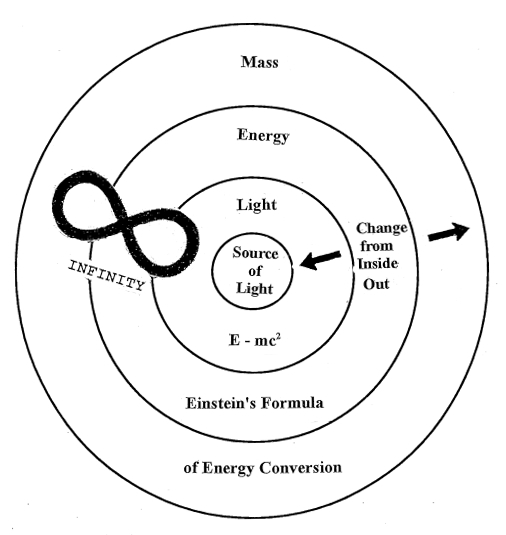

The Positive Paradigm Handbook will change the way you see yourself and relate to the world – forever. It gives you:

  • a functional picture of how your life really works, and by extension, what moves the people around you.

  • the map for achieving fulfillment, personal happiness and higher love.

  • an instrument for organizing your personal life, making realistic decisions and acting more effectively to achieve intended results.

  • premier tools for cultivating self-awareness, making the unconscious conscious, and mapping goals for personal change.

  • a comprehensive standard for assessing your leadership skills, maximizing this potential, and choosing which leaders to follow.

  • a powerful diagnostic tool for identifying the roots of disease-causing stress and correcting lifestyle imbalances.

  •  profound insight into the causes of discrimination, sexual abuse and PTSD, as well as  how to heal from their effects.

  • a realistic standard for recognizing true friends from mortal enemies.

Ultimately, it gives those who follow through the edge on long-term success, tipping the scales of history in favor of human survival, one person at a time. If these claims sound intense, they are. But they’re well founded.

To be continued. Follow next week for the Seven Basic Axioms of the Positive Paradigm.

Snippets from The Positive Paradigm Handbook

globe

WHY PARADIGMS MATTER

Ideas drive results. People’s beliefs drive their actions.

Actions that stem from a simple, complete and accurate paradigm result in personal fulfillment, harmonious relationships, and economic prosperity.

Actions based on false, incomplete and inaccurate paradigms, however well intended or passionately defended, are the cause of widespread misery, suffering and deprivation.

As detailed in Rethinking Survival: Getting to the Positive Paradigm of Change, a fatal information deficit explains the worldwide leadership deficit and related budget deficits.

In a dangerous world where psychological and economic warfare compete with religious extremism and terrorism to undo thousands of years of incremental human progress, a healing balance is urgently needed.

Restoring a simple, complete and accurate paradigm of leadership and relationships now could make the difference between human survival on the one hand, and the extinction of the human race (or the end of civilization as we know it), on the other.

cov wheel

The TWIN BASICS of POSITIVE CHANGE

Inside to Out. Individual change begins from the inside and radiates outwards from the central hub of the Positive Paradigm Wheel. Light initiating from the silent innermost center extends outwards. Guidance and inspiration are articulated in language. These ideas, expressed with genius and passionate conviction, drive motivated action that manifests in positive results.

Smallest to Largest. Transformation begins with the smallest unit, the individual. Therefore, the quality of family life depends on the functional integrity of each family member. Large organizations are improved by first improving the quality of family life. Qualitative reform of whole nations is achieved only by restoring the internal integrity of their agencies and supporting business connections.

Einstein’s New Way of Thinking

Human survival, Einstein warned us, cannot be taken for granted. Tipping the scales of history in favor of survival depends on freeing ourselves from the mental prison of limited, delusional thinking:

A human being is part of the whole called “Universe,” a part limited in time and space. We experience ourselves, our thoughts and feelings as something separate from the rest . . . This delusion is a kind of prison for us, restricting us to our personal desires and to affection for a few persons nearest to us. Our task must be to free ourselves from the prison by widening our circle of compassion to embrace all living creatures and the whole of nature in its beauty. . We shall require a substantially new manner of thinking if mankind is to survive.

The Positive Paradigm of Change pictures Einstein’s widened circle of compassion, complete with his magical, magnetic all-encompassing center.

It’s also the answer to comparative religion legend Joseph Campbell’s prescient hint:

We don’t have a mythology for people recognizing the humanity of a person on the other side of the hemisphere. I’ve often wondered if some of the notions coming out of quantum physics, quantum interconnectedness, don’t express that.

In the interests of human survival, the purpose of The Positive Paradigm Handbook: Make Yourself Whole Using the Wheel of Change is to make this new way of thinking as widely known and usefully available as possible.

The Who, When, How, What and Why

Logical questions then follow. Who should use The Positive Paradigm Handbook? When should the Handbook be used and how? What are the benefits? Why is this method of “thinking like a genius” so effective?

Who? The Handbook is intended for self-selected survivors with the heartfelt desire to improve themselves and the courage to rethink their lives. Everyone everywhere with basic English language skills and a commitment to ensuring survival for themselves and those they care for can and should use The Positive Paradigm Handbook.

As the next-generation Book of Change, the Handbook is especially useful to those in responsible leadership positions as well as those who advise them. However, it is equally useful to truth seekers and decisions-makers in every walk of life.

The Handbook should be required reading for young people who need to understand the way the world really works and how they fit in.

When? It’s natural to cling to what’s already known and familiar, especially when it seems as if there’s no better solution to an admittedly bad situation. Many find the possibility of extinction so threatening that they refuse to even think about it.

However, this doesn’t make danger disappear. It just leaves escapists unprepared to face inevitable change. Regardless of what may or may not come, denial, resistance and procrastination are a dangerous waste of precious time.

Once it’s accepted that there is a hopeful and positive approach to facing today’s dangers, the time to work with the Handbook and internalize this worldview is NOW.

What? As the title suggests, the end result of using the Handbook is restored wholeness. The process of comparing one’s immediate personal organization to the Positive Paradigm standard of completeness is a means for recognizing excesses and deficiencies, the better to correct them, thus restoring balance, integration and harmony to the whole. Benefits from using the Handbook are cumulative. Depending on diligence and frequency of use, they increase exponentially.

On the one hand, intentionally aligning and linking the levels of experience will increase self-awareness, improve relationships and lead to effective decision-making. On the other, as beliefs and actions become significantly the less fragmented, the side-effects of stress and related mental/physical disease will decrease accordingly.

Why? In part, working with the Wheel of Change remedies the right- and left-brain imbalances that lead to dysfunctional results. Plugging left-brain language into the right-brain imagery of concentric circles has the balancing effect of stimulating both sides of the brain simultaneously. Further, diminishing the noise of emotional pain and overcoming the dichotomies of either/or thinking opens access to the innermost realms of conscience and the inspirational guidance associated with great leaders and inventive genius.


The Positive Paradigm Handbook is Coming SOON

HERE’s a sample from the Coming Positive Paradigm Handbook!

globe

PREFACE

The Positive Paradigm Handbook will change the way you see yourself

and relate to the world – forever.

  • It gives you a functional picture of how your life really works, and by extension, what moves the people around you.

  • It gives you the map for achieving fulfillment, personal happiness and higher love.

  • It give you an instrument with which to effectively organize your personal life, make realistic decisions, and act more effectively to achieve intended results.

  • It gives you premier tools for cultivating self-awareness, making the unconscious conscious, and mapping goals for personal change.

  • It gives you a comprehensive standard for assessing your leadership skills, maximizing this potential, and choosing which leaders to follow.

  • It gives self-healers and therapists a powerful diagnostic tool for identifying the roots of disease-causing stress and correcting lifestyle imbalances.

  • It gives profound insight into the causes of discrimination, sexual abuse and PTSD, as well as how to heal from their effects.

  • It gives everyone a realistic standard for recognizing true friends from mortal enemies.

  • Ultimately, it gives those who follow through the edge on long-term success, tipping the scales of history in favor of human survival, one person at a time.

If these claims sound intense, they are. But they’re well founded.

As a teenager, I was fascinated by the fact that Einstein’s abstract formula, e = mc2, could produce powerfully tangible results — the atomic bomb!

Later, I was even more intrigued to discover that this same formula, when plugged into the concentric circles of the Positive Paradigm Wheel, not only resulted in the Unified Theory of Einstein’s lifelong quest. It was capable of generating equally powerful and practical personal results.

The Positive Paradigm Handbook reveals this Unified Theory and supplies the tools needed to start thinking like a genius. By internalizing this method, making it your own by repeated use, your life will be changed in ways only dreamed of before. Virtually endless in its practical applications, it can be pointed like a laser beam to illumine every field of endeavor.

The Handbook is the bare bones take-away from Rethinking Survival. The author’s personal background, academic credentials, research and experience are described in Getting to the Positive Paradigm. But here, what matters is simply that it works and that owning it is a matter of personal survival.

Based on the foundation of the earlier books on change, The Positive Paradigm Handbook goes directly to the heart of personal, practical application, here and now. The purpose of working with the Handbook is to ingrain Einstein’s “substantially new way of thinking,” which, he said, is required “if mankind is to survive.”

In a world seemingly intent on fracturing experience into smaller and smaller niches, the Positive Paradigm provides an urgently needed counter-balance, applying an opposite and equal weight in a unifying direction.

Rethinking CRIME

Today, I’m fulfilling a promise made on a LinkedIn thread in answer to the question, “Crime, Is It Natural?” I responded to look here for my perspective on this very important question. After all, CRIME just happens the very first of the UPSG Essays.

 globe

1. CRIME

 “Our time has committed a fatal error; we believe we can criticize the facts of religion intellectually . . . The gods have become diseases; Zeus no longer rules Olympus but rather the solar plexus, and produces curious specimens for the doctor’s consulting room, or disorders the brains of politicians and journalists who unwittingly let loose psychic epidemics on the world.” — C. G. Jung, The Collected Works of C.G. Jung, Vol. 13.

“Nature itself has a pulse, a rhythmic, wavelike movement between activity and rest . . . We are capable of overriding these natural cycles, but only by summoning the fight-or-flight response and flooding our bodies with stress hormones. We can only push so long without breaking down and burning out.” — Loehr & Schwartz, The Power of Full Engagement

“Your life is created from the inside out, so you must get right with you on the inside — and that takes time and focus on you; not your social mask, but you. . . You are uniquely equipped for a mission in this world, and to fail to commit to finding that mission and then achieving it is to wither the mind, body and spirit.” — Phillip C. McGraw, Self Matters: Creating Your Life from the Inside Out

THE FRONT

Linguistic roots of crime indicate a verdict, an object of reproach, or offense. According to Webster’s, crime is an act which the law prohibits. Conversely, it is failure to act as the law orders. Crimes are variously punishable by death, imprisonment, or the imposition of fines and restrictions.

A second kind of crime is an offense against morality, called sin. More loosely, this word is used to refer to something regrettable. “It’s a crime you didn’t finish school.”

What’s significantly missing from Webster’s definitions is reference to violations of Natural Law. Over millennia, Asian practitioners evolved sophisticated sciences which map the subtle laws of energy movement and study the effects of natural change on human physiology, behavior and institutions. For thousands of years, health sciences, social structures, business practices and the education of monastic, government and military leaders alike were based on this practical understanding of human dynamics.

Westerners, in contrast, have little functional understanding of Natural Law and violate it with impunity. We experience subtle energy shifts as emotional reactions or the erratic ups and downs of daily life. Because Western cultures are historically out-of-tune with energy dynamics at this level of law, it is often referred to as the unconscious. Crimes of passion and self-sabotage are proof of this bind spot.

The focus of Conscience: The Ultimate Personal Survival Guide is the I Ching, the Chinese Book of Change. It embodies a time-tested method for making the unconscious conscious. As the repository of Natural Law, it fills a gap in the way we’ve been taught to think about life.

Restoring its ancient wisdom to current awareness could correct mistakes in the ways we think and therefore act, revitalizing virtually every field of endeavor, from the healing and entertainment arts to the political and social sciences.

In I Ching context, the worst crimes are those we commit against ourselves when we accept and act on limiting suggestions. When we block out the lower octave of sub-rational intelligence (the middle, energy level of the Life Wheel) as if it didn’t exist, we fail to recognize and release the buried fears that sabotage our rational decisions.

When we disown the higher octave of our super-rational awareness, (the Center of the Wheel) we block out intuitive access to the Book of Life, written in our very DNA — the universal source of creative solutions, the means of healing every disease, and hope of ultimate survival.

Those who dismiss, demean or control children with fear condemn them to empty lives of masked conformity on the material surface of the Life Wheel. Instilling extreme ideas about death, as if it were either a reward or ultimate punishment, one’s only hope or worst enemy, results in living inappropriate to reality.

 The more moderate, I Ching view accepts mortality as a natural change. Sages use keen awareness that time on Earth is limited as motivation to live authentic to their true selves, making the best possible use of every precious moment here and now.

To keep people in ignorance, lulling them into inaction by minimizing future dangers or the opportunities inherent in them is irresponsible. To withhold the information we need to be effective in meeting and surviving immanent challenges is most certainly the ultimate crime against humanity.

For a timely wake-up call would serve to shake us out of self-denial and shatter the prisons of narrow thinking. It could rouse the courage to face up to the unknown, to slay the demons that lurk in the sub-rational mind. It might also open us up to our super-rational potentials and the distant calling of eternal life.

 THE BACK

The positive resolution of crime is atonement. In social relationships, it’s accomplished by setting wrongs right. At a personal level, it’s accomplished by returning to a lifestyle compatible with Natural Law. Lat the deepest level, at-one-ment is attained by overcoming separation and restoring one’s original at-one connection with conscience and the creative Source.

The negative consequence of unrepentant wrong doing is punishment. Breaking human laws, as Webster’s enumerates, precipitates punitive results. Over time, the Natural Law of Karma returns actions in kind to the doer. Retribution can be visited in many forms, from mental or physical disease, to personal, professional or financial misfortune. The biblical admonition holds true: As ye sow, so shall ye reap.

—————

Carl G. Jung, The Collected Works of C.G. Jung, Vol. 13.Alchemical Studies. (Princeton University Press: Princeton, NJ, 1967.) p. 36.

Jim Loehr & Tony Schwartz, The Power of Full Engagement: Managing Energy, Not Time Is the Key to High Performance and Personal Renewal. (Free Press: New York, 2003.) pp. 30, 31.

Phillip C. McGraw, Self Matters: Creating Your Life from the Inside Out. (Free Press: New York, 2001.) pp. 12, 13.