Category Archives: Faith

The I Ching and ME

A guest blog I’ve enjoyed writing focuses on using the Book of Change to experience the difference between KNOWLEDGE (information) and KNOWING (introspection). Maintaining a balance between the two is a survival priority.

The article’s section headers include Lao Tze and the I Ching, Jung and the I Ching, and The I Ching and You.

After submitting it, this thought flashed into mind. A section was missing: The I Ching and ME. So here it is.

For me, the Book of Change is a gateway to magic. On this side, it has been a close companion, good friend and advisor through the years. On the far side, perhaps remembered from lifetimes past, it speaks to me from a place beyond time and space.

With it, I was never alone, even and especially when I was loneliest in crowded rooms. When the world impelled suicide, it brought me back to a deeper, all-pervasive love of life.

So I will share a few sections from Rethinking Survival about how I met the book, and how it has grown on me.
globe

First Introductions

. . . I’d had a hunch about [the I Ching] for a very long time. Ellsworth Carlson, who lived in Shansi, China during WWII, was a classmate of my parents at Oberlin College. When I was nursery school age, he bounced me on his knees at Harvard.

As Freshman student, I took Dr. Carlson’s course in Asian History at Oberlin. What stuck with me how vast an influence the I Ching had on China for 8,000 years and counting.

So, when I left the U.S., all I took with me was my violin and one small suitcase. Of that, half contained clothes. The other half held sheet music and one small book: the Legge translation of the I Ching.

It made no sense to me. I could barely get through a page or two before giving up. But I kept coming back to it. It led to something important I had to know more about.

When I happened upon the Wilhelm/Baynes edition in Düsseldorf’s International Bookshop on Konigs Allee — Finally! — I had a version I could relate to. It literally became my teacher. It gave me a whole new concept of how the world really works.

Not just this family or that institution or the other county. Not arbitrary and capricious, fluctuating fashions, but the constant anchor over time.

From it, I could deduce the fundamental energy dynamics of action and reaction which drive behavior, internally at a psychological level, and externally in relationships and day-to-day events.

It was an extension of the logic my English teacher Miss Elson impressed on my high school brain. But more. It gave me a map of logical consequences, as inevitable as computer language. “If this, then that.”

For example, If you kick people, they kick back (if they can) or otherwise resist. If you are kind, you inspire love and trust in others. If you violate natural law, nature bites back — your mental health suffers; relationships deteriorate; your behavior becomes erratic and social/physical survival is imperiled.

Asian cultures call this “the law of karma.” Its operation is also described in biblical terms: “As ye reap, so shall ye sow,” and “to everything there is a season.”

In sum, its 64 permutations map a progression of the AC-DC energy changes which constitute the natural law of repetitive, cyclical change.

Value

From my point of view, this ancient, timeless science fills a critical blind-spot in Western thinking, lacking which, all efforts are partial and incomplete. Put another way, the glaring absence of this information explains why so much goes so wrong, despite even the best of intentions on the part of politicians, priests, coaches and leaders of every ilk.

The Book of Change combines the best of many worlds. On the one hand, it’s pure logic and math. Its binary-digital code long predates both Leibniz’s calculus and computer science. On the other hand, it leads inwards, serving to link the material world of physical experience (empirical science) with its ultimate source (the realm of con-science).

Working with it, one starts with immediate, practical experience, with the option to travel with it to the opposite end of the reality scale that merges with the apparently mystical. This interactive book, regarded by some as magical, depends on the phenomena of synchronicity to link person, time and events in the decision-making process.

The longevity of ancient Chinese dynasties is attributed to sages who advised their emperors on ways to balance and thus survive historical yin-yang cycles of decay and regeneration. By working in harmony with the laws of nature, rulers succeeded in maintaining social and political stability, riding out the predictable, alternating pendulum swings between extremes.

Even the Communist Chairman Mao, an avowed atheist, owed his success to the I Ching. Its influence permeated both his moving poetry and highly successful, if unorthodox, military strategies.

When I described the many benefits of working with The Book of Change to a business consultant, she summed it up for me. “It sounds to me like the ultimate personal survival guide.” She was exactly right. So I used her description as the title of a book describing its many virtues (as well as answering the unfortunate prejudices/assumptions which have kept the book too much in the shadows).

What You See Is What You Get

The I Ching‘s value, I’ve finally come to understand, is measured by the quality of focused attention, self-honesty and positive intention with which it’s used. Those who dismiss it, who “believe” it is superstitious nonsense, fulfill their expectations. In a way, the book has its own fail-safes. Those who approach it with arrogance or evil motives get little from it.

In my case, it has provided ongoing, life-confirming support, most especially when humans failed me totally. Probably any truth book approached with concentrated attention and an open heart connects the personal mind with the guidance of the Universal Mind. Truth is timeless, so whether the catalyst that triggers inner knowing is ancient or modern doesn’t much matter.

But for me personally, working with The Book of Change is an especially powerful form of introspection. It’s a favorite mindfulness practice, if you will. Best translations link magic with science to satisfy head, heart and soul.

I admit that, as with any good friend, it took a while to break the ice and get to know it. For example, once, when I was relatively new to the book, on an early winter morning in Spring Green, I woke up with a bad feeling and consulted the I Ching for feedback. Its advice, in essence: “Don’t move. Don’t go anywhere. Anything you do now will go wrong.”

Friends were skeptical. I was scheduled for a job interview that couldn’t be missed. Even when the bald tires on my vintage Buick skidded on the ice, spinning me into a snow bank along Willow Gold Farm’s long driveway, they refused to quit. They drove up the tractor and jammed a curved metal hook under the front fender. It punctured the radiator, emptying its yellow-green fluid onto the crystal white snow.

I wasn’t going anywhere that day. Or, after their “help,” even the next.

This was definitely a book to be taken seriously!

globe bullet size

But enough for today. There’s much more, of course. Will have to wait for later.
History Repeats Itself – Renaissance or Another Dark Ages?

A recent post described the unfortunate end of Abelard, the medieval philosopher best known for his tragic love of Heloise.

Out of synch with his times, this celebrated cleric taught that men gain knowledge – including faith – through reason. For this, he was convicted by his monastic superiors of heresy. Abelard’s books were banned and burned. He died shortly afterwards in prison.

St. Augustine’s exclusively faith-based Rules of the Knowledge Game were balanced with Abelard’s opposite approach only after St. Aquinas harmonized the two extremes. According to the new Rules, no matter where you start, each approach leads to and reinforces the other.

This broad-based approach to knowing as a two-way street set the foundation for the flowering of arts, sciences and commerce known as the 12th Century Renaissance.

But, I suspect you’re wondering by now, is medieval history relevant NOW?

It’s highly relevant, particularly when taken in the context of patterned, repeating cycles of human behavior. Learning the basic lessons of history is an important way of leveraging the future.

Back to the 12th Century Renaissance. It was during this time of creative balance that universities evolved to replace monasteries as centers of learning.

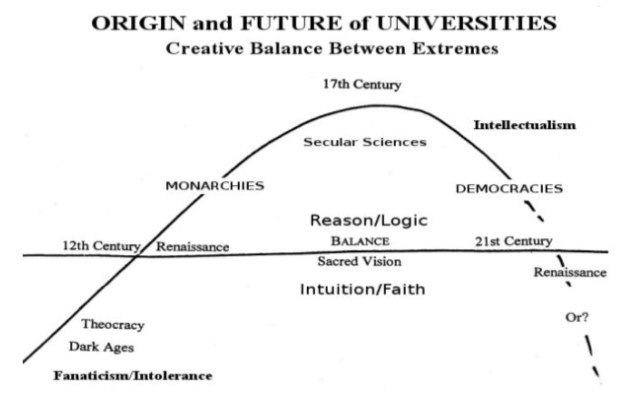
I’ve thought about this a lot. The Origin and Future of Universities was the dissertation topic of my choice. In my proposal, I drew a bell-shaped curve that cycled above and below a median-line that represented historical times of creative balance between extremes. It looked like this:

bell curve sized

In the late 1970’s, when I wrote my proposal, universities were at a critical point of intersection. There was still a window of time left during which to mitigate a predictably dangerous direction of change, before a narrow window of opportunity closed.

Humanistic psychology and holistic health movements were leading the way towards another reintegration of faith and logic — a reconciliation of intuitive and rational ways of knowing. On the one hand, I held hopes that another creative renaissance was on the horizon. On the other, I foresaw the possibility that the curve would cross the median balance point and continue its downward slope, plunging the world into another dark ages of fanaticism and intolerance.

Departmental politics prevented me from writing the dissertation of my choice. (That story and its implications, however, are a different subject.) What’s pertinent here is the outcome. The window of opportunity has closed. Proof abounds. For example, during the Arab Spring, disillusioned Muslims who at first had welcomed violence as an opportunity for positive change were horrified at the repressive results. One Egyptian commented to a reporter that his country had entered a new dark age. News here and abroad continues to confirm that downward trend.

What remains are the mitigating possibilities open to I Ching users. The Chinese Book of Change keeps self-honest seekers in synch with the times, giving them survival insights and hints as to where to look for respite from the worst that might yet come. It keeps hope for the positive change we persist in holding dear to our hearts alive.

Here’s the key. Patterns codified in The Book of Change repeat on every scale of magnitude. That is to say, the same seasonal cycles repeat in an individual’s life. They also repeat in families, in the work place, in governments and even in the history of civilizations.

So even when the times are dangerously out of joint, individuals can still change for the better. So can intentional communities. So long as there’s this hope, it’s never to late. In the early dark ages, for example, monasteries were islands of hope, civility and sanity in a violent, barbaric world. Their equivalents might again serve the same purpose.

Further, personal, organizational and historical rhythms aren’t necessarily in synch. This explains why the same view is welcome at one place or time, but not in others. Abelard’s emphasis on reason, for example, would have been in synch in 17th century universities even though they were fatally out of harmony with beliefs held in the monastic circles of his day.

This information holds good or bad news, depending on whether it’s recognized and how it’s used. On one hand, acting as if personally preferred realities are fact, regardless of whether or not they’re in synch with the times, is unrealistic. For example, New-Agers who ardently believe the near future promises a widespread renaissance of human upliftment are quite probably mistaken. Worse, they may be misleading followers who will find themselves unfit and unprepared to survive in an increasingly intolerant, dark ages environment.

But on the other, positive side, it’s still possible, even as a dark age of fanaticism is gaining ground, to maintain personal balance. Personal renaissance – literally re-birth – is possible at any split second in time. Even when social trends are devolving into extremes, individuals aren’t required to forsake the ideal of personal integration just to fit in. In fact, personal and community survival may well depend on the capacity to maintain stable balance even in the most unbalanced of times.

Of a certainty, heightened, intentional balance will be essential to personal survival, even and especially as dark times cloud collective reason and threaten to extinguish faith.

MY Worst Fear

When I posted What is YOUR Worst Fear, I intended to follow the next week with a sequel, MY Worst Fear. But it has taken a full month of soul-searching labor to deliver. The outcome – a yin-yang re-birthing of this website.

062115 embryo

The original sequel would have expressed the persistent fear described in Rethinking Survival:

The greatest personal obstacle I listed was pessimism, an attitude embedded deep in my upbringing, which crops up from the reservoir of inherited weaknesses from time-to-inconvenient-time. . . . the demon that surfaces when things get especially rough, taunting that all I’ve learned has been in vain, all the books I’ve written were for naught.

I feared the fate of Cassandra. I feared that I’ll fall short in warning that we urgently need to recognize an unwelcome elephant’s presence in civilization’s room – the hovering uncertainty of human survival.

Then doubts crept in. I decided to learn more about Cassandra, sung of by the bard, Homer, in The Iliad. I knew she was a priestess gifted with foresight. I knew her warnings went unheeded. Her prescience failed to prevent the destruction of her people.

But research uncovered another side to her story. According to legend, she received her gift from the Sun god Apollo in exchange for promises which she failed to keep. The curse of disbelief was attached to her prophetic abilities – so it is said – as punishment for deceiving the gods.

Obviously, I hope there’s no similarity between us on that count. Also, Cassandra died a hideous death, a fate which isn’t included in my particular fear portfolio.

So I searched my memory banks for a more accurate image of my worst fear. Immediately, one came forward.

As a teen, I spent two wonderful summers at Interlochen, the National Music Camp. One night, as was my habit, after the bugle sounded taps and the lights went out, I hid, wide awake, completely covered under my wool olive-drab army blanket and turned on a flashlight to read in the dark.

My borrowed book chronicled atrocities of the WWII holocaust. The powerfully horrifying image that remains with me was an enforced still birth. Enroute to death camps, Nazi guards responded to calls for help when a Jewish woman went to labor by chaining her legs tightly together at the ankles. Suffering oceans of agony, she died together with her unborn child.

Over the years, this is the repeating image of agony that comes to mind whenever the constellation of conspiring events seems to prevent me from bringing my writing into the world.

But again, rethinking led to doubts. I put this fear to Plato’s test, remembering his standard:

We can easily forgive a child who is afraid of the dark; the real tragedy of life is when men are afraid of the light.

I decided, figuratively speaking, to turn the flashlight formerly hidden furtively under my youthful pillow for secret night-time use to submit my adult fears to the daylight of reason. Knowing that fear invites danger, I asked myself, “Am I allowing festering fears to become a self-fulfilling prophecy?”

So I named my immediate fears, one-by-one, and took responsibility for allowing them to influence my decisions, yielding a new array of options for correcting old mistakes. I can now proceed to direct future choices toward better outcomes.

For one thing, I decided to take on the paralyzing web of Catch 22s that plague a writer’s career. This is not the place to digress into war stories and bitter complaints. Suffice it to say that trusting authors are all-too-easy prey for members of the established publishing profession who specialize in eating them for their lunch.

But then, the alternative – to do everything alone, wear the many diverse hats required to bring a finished product to the general public – has just as many pitfalls. Marketing especially has been an issue. I took this position in The Positive Paradigm Handbook:

To my way of thinking, a person with something of extraordinary value to offer should be eagerly sought out and welcomed.

This is the book I dearly wanted for myself, the one that wasn’t on the shelves no matter where I looked. I’d have given everything I had for the knowledge in the Handbook. It’s the sum of what I’ve searched a lifetime to find. I’ve sacrificed a great deal to write and make the information usefully available. I’m offering it whole, on a silver platter, to those with an ear to hear.

So courting readers seems inappropriate and undignified, even embarrassing. I’ve accepted the necessity of marketing as a humbling, character-building opportunity. I can gladly swallow personal pride for the sake of human survival. The trade-off is more than worth it.

In some respects, however, I stand my ground. When marketing standards go against the grain of the Positive Paradigm, I draw the line. One fashionable marketing concept is called branding. “The author is the brand.”

Here I disagree wholeheartedly. It’s not about me. I’m just an imperfect messenger, not the message. I am but a transient visitor, briefly here, soon enough gone. The universal structure of the Positive Paradigm is the brand and its center hub is forever.

In this, yet another Greek myth is relevant. Again, from Rethinking Survival:

The Titans were gods sired by Kronos (Father Time). Fearfully jealous, as each was born, Kronos stole the male infants from his wife Gia (Mother Earth), swallowing his sons whole. This story is a metaphor for the Law of Karma. Our deeds may seem to be swallowed up by time, but in fact they never die.

In the cyclical course of natural events, they come back, as did the Titans, returning to conquer and replace the old gods.

Suffice it to say this self-assessment has resulted in a total rethinking of my attitudes and approach. These will be mirrored in the redesign of this website, to take place gently and gradually over the summer months. I’ll save the transformations of specific fears into action plans for a future post, “Under Construction.”

Nothing of substance – the archetypal ideas presented here – will change, but presentation will improve dramatically.

In sum, facing my worst fears for the purpose of writing this post has had a marvelously healing effect. Just so, I remember the Bene-Gesserit fear mantra from Frank Herbert’s Dune:

I must not fear. Fear is the mind-killer. Fear is the little-death that brings total obliteration. I will face my fear. I will permit it to pass over me and through me. And when it has gone past I will turn the inner eye to see its path. Where the fear has gone there will be nothing. Only I will remain.

062115 eye of the tiger

What Is YOUR Worst Fear?

Stay just the way you are,” pleaded a friend. Another graduating pal scribbled in my 1964 year book, “Stay as sweet as you are.” A third warned, “Don’t ever change!”

Looking back, the strange and impossible expectation that we live the rest of our lives frozen in time, forever unchanged, was at best, unrealistic.

What lurked beneath the surface was fear of the open-jawed monster – the Unknown – looming ahead, threatening to swallow up this class of bright-eyed but poorly prepared graduates, changing each of us forever in unforeseen ways.

Back then, we were as cocky-confident as the youthful Luke Skywalker who boasted, “I’m not afraid.”

Little did we suspect then, as savvy Yoda warned, “You will be.”

Had we been cavemen, our dreads would have been limited to the instinctual fear of loud noises or falling off sharp cliffs.

But we were born in the year nuclear bombs ended WW II with horrifying finality. The list of fears we grew up was quite different from those of our earliest ancestors.

Even so, following the example of our elders, most of us have continued to engage in daily tasks, hiding behind a hedge of busy-work to fend off the unacknowledged terrors that lurk on the furthermost edges of awareness.

Today, international leaders and the rogue terrorists of shadow governments continue to flirt with Einstein’s dreaded nuclear destruction. Horrific headlines have become so familiar that we’ve become numb to bad news. Likely outcomes of nuclear war are so horrific that the mind refuses to wrap itself around the possibility of a world suddenly changed forever.

We say to ourselves, “If we deny the possibility, refuse to even think about it, it can’t happen.”

But according to Plato, we’ve got it backwards. “We can easily forgive a child who is afraid of the dark; the real tragedy of life is when men are afraid of the light.” For, seeking light on all levels – literal facts, metaphysical truth and inner illumination – leads us to recognize what inevitably changes as well as what does not. It secures triumph over petty fears and victory over illusory death.

Yet, rather than acknowledge danger and take decisive action to avert it, we continue to fend off awareness of the monster of all fears – total annihilation. Instead, we fritter away precious time and energy sweating over inconsequential “small stuff.” We allow ourselves to be seduced by the trivial and irrelevant . . . until, finally, inevitably, calamity strikes and finds us unprepared.

What is the greatest fear you allow yourself to be aware of?

Do you categorically dread any change to your comfortable (or at least familiar) status quo?

The list of specific possibilities is virtually endless. Fear of abandonment, of failure, of success, of poverty, of rejection, of ridicule. There’s the death of loved ones and finally one’s own decline and departure from the physical.

Importantly, are you aware of what you DO about your fears? For, in fact, you do have a wide range of options to choose from.

You can unconsciously project them onto others and make them happen. Or take responsibility to face and overcome them.

You can deny them, bury your head in the sand and hide. Or go to the opposite extreme and overcompensate: adopt a fatalistic hedonist “Eat drink and be merry” attitude. Or choose one of gratitude, focusing on and appreciating the good things of life now, while they last.

As ever, there are two sides to this coin. On the one hand, fear attracts danger. Dwelling on fears can make them come true. But, on the other hand, denying the existence of one’s fears invites danger as well.

Timing is also a important. Now versus later also factors into end results.

Where’s your balance point? It’s a puzzlement.

From Conscience, here are a few thoughts to help sort it out.

globe bullet size

Essay 34. FEAR

Tao does not seem to be something we need to acquire. We are already a part of it. We can, however, do a great job of blocking its manifestation within us. We primarily block the Tao through fear and tension. . . Fear is the source of blockage; it underlies our painful, negative emotions, even though its presence is usually hidden.” — Wolfe Lowenthal, There Are No Secrets

Ninety-five percent of the beliefs we have stored in our minds are nothing but lies, and we suffer because we believe all these lies. In the dream of the planet, it is normal for humans to suffer, to live in fear, and to create emotional dramas . . . If we look at human society we see a place so difficult to live in because it is ruled by fear.” — Don Miguel Ruiz, The Four Agreements

Fear is an essential part of our nature, installed in our DNA, no doubt for very good reason. Fear is an alarm system. It is there to push us in one direction or another, out of harm’s way. . . it is part of our intelligence, part of an ingenious guidance system to help ensure our survival — as individuals, as communities, and as a species.” — Thom Rutledge, Embracing Fear and Finding the Courage to Life Your Life

THE FRONT

An Old English root means sudden attack, ambush or snare. Webster’s first definition is a feeling of anxiety and agitation caused by the presence or nearness of danger, evil, or pain. It suggests doubt, timidity, dread, terror, fright or apprehension.

Alternatively, fear is defined as a respectful dread, awe, or reverence. Fear of God is often a combination of both types, including both awe for the majesty of God’s creation and guilty anticipation of punishment for wrong-doings.

Fears are part natural, part the result of cultural conditioning. Those which are unreal are best dispelled by analysis and understanding. Those which are justified are best faced by correcting and atoning for one’s own mistakes as well as preparing to meet and overcome external dangers.

Working with the I Ching helps us discriminate between appropriate fears which require positive action and illusory fears to release and forget. It is an invaluable aid in the process of cultivating self-honesty for the purpose of self-correction. It is equally useful in the process of articulating immanent dangers and deciding on the best strategies for effective response.

Primal fears are associated with correlative chakras. At the first chakra level, the fear is of physical death. At the second, loss of sexual prowess or family support. At the third, the fear is of losing of material and financial accumulations, along with social connections and influence. At the fourth, failure in love relationships. At the fifth, fears turn to losing face or being judged wrong or inadequate in intellectual matters. At the sixth, one fears loss of connection with the creative source.

As one ascends the evolutionary ladder, emotion-based fears lessen, seen in larger perspective. Integrating and balancing the levels reduces the influence fear has on decision-making.

Some fears have physical causes. For example, habitual muscle tension packs lactic acid into the fascia, producing chemically-induced anxiety. Relaxation and stretching exercises which release tension and reduce acid levels relieve tension anxieties.

Fear is also stimulated by abusing internal organs. Excessive sugar and/or alcohol intake causes metabolic imbalances. The kidneys and liver are stressed by the burden of excess toxins and fluids. The nervousness, anger and fear associated with imbalance in these organs is corrected by improving lifestyle choices.

Cultural conditioning causes still other kinds of fear. Authorities who use terror as a means of control instill a sense of inadequacy and helplessness. Hitler, for example, was the product of an authoritarian, fear-based culture as well as the embodiment of its shadow opposite, destructive megalomania.

Fears denied or unresolved undermine self-confidence, sabotage love relationships, and turn life against itself. They manifest in the physical body as heart disease and cancers.

Fear of God, meaning awe, on the other hand, is life-protective. Direct experience of divine connection (the timeless heritage which everyone everywhere shares in common) overcomes ephemeral fears with the larger light of wisdom and higher love.

Awareness of unseen benevolent powers standing by us on all sides though danger and distress restores strength and courage. It is also the ultimate deterrent to wrong-doing.

THE BACK

Ignorance is the root of fear-caused suffering. Its antidote is confidence gained through inner knowledge and direct experience. Trust that deep within, we each hold the answers to every question and solutions to every problem is the beginning of wisdom.

Terror is a perversion of natural fear. Terrorists may believe playing on fear is the best way to control subordinates or get the attention of unjust leaders. However, unlike math, where two negatives make a positive, two wrongs don’t make a right.

When Leaders Can’t Be Trusted

In ancient times, seasons of drought were foreseen by the prophets and prepared for by the leaders they advised. The best known example is Joseph, who correctly interpreted the Egyptian Pharaoh’s dreams. Working together as protectors of their people, they succeeded in storing sufficient supplies of grain during times of plenty to outlast years of famine, saving countless lives.

Today, Obama’s reign up-ends the story of Joseph in Egypt, weaving a tangled, dangerous legacy designed to outlast his years in office.

Now, vulture-like, presidential strategists who “never let an emergency go to waste,” lie in wait for opportunities to further the incremental process of world domination by administrative fiat.

Executive Order 13603 is a blatant case in point.

What it boils down to is that federal agencies have been given free license to take anything from anyone, including virtually ALL privately owned resources. All it would take to trigger this social-economic disaster waiting to happen is a dramatic crisis – a convenient excuse to declare a national state of emergency.

Does escalating race-baiting and violence against urban police ring a bell? Inciting massive Muslim retaliations with cartoon contests in the name of “freedom of speech” would also do the trick. Surely you can easily come up with other likely triggers.

Sounding the alert, M.D. Creekmore, author at TheSurvivalistBlog.net, writes:

Over the years I’ve read many articles and books which suggest that the biggest threat to your survival post collapse are refugees fleeing the cities or your neighbors coming to take your preps. While they maybe a legitimate concern, as you can see by reading the except from executive order 13603, they probably won’t be the biggest threat to your survival.*

Following up, I looked for other descriptions of EO 13603. Wikipedia sanitizes it entirely.

The National Defense Resources Preparedness executive order (Executive Order 13603) is an order of the United States’ President signed by President Barak Obama March 16, 2012. The purpose of this order is to delegate authority and address national defense resource policies and programs under the Defense Production Act of 1950. Executive Order 13603 provides the framework and authority for the allocation or appropriation of resources, materials and services to promote national defense.

Contrary to a few initial claims otherwise, the Order appears to update long-existing directives that have been issued as far back as the Truman Administration and makes no claim to allowing the federal government to confiscate private property or declare martial law.** [emphasis added]

In stark contrast, according to MinutemenNews.com:

The EO includes all of Obama’s out-of-control agencies and they would have unlimited power if the president declared a “national emergency.” Executive Order 13603 — National Defense Resources Preparedness allows the government to completely control our lives through the “industrial and technological base,” should the president declare a national emergency.

EO 13603 gives Obama the power over all commodities and products capable of being ingested by human beings and animals; all forms of energy; all forms of civil transportation; all usable water from all sources; health resources; forces labor such as military conscription; and federal officials can issue regulations to prioritize and allocate resources.*** [emphasis added]

Rather than encouraging and supporting individual initiatives to prepare for seasons of natural disaster, the federal government is systematically blocking such efforts, jealously taking unto itself the exclusive role of “protector” – quite the ravenous wolf in faux-sheep clothing. Home farming is banned in favor of huge corporate monoliths. Second Amendment rights, a basic premise of the Republic, are under fire while the feds are simultaneously arming local police to the teeth.

Which leads me to ask, “What recourse is available to sincere leaders at smaller levels of organization? How are they to fulfill their responsibilities to sustain and protect themselves and those they care for, especially from the onslaught of regulations imposed, ironically, in the name of protection?” For all empty PR, feeble gestures and false pretenses to the contrary, world leaders are part of the problem, not any viable solution.

When, far from being trustworthy, those in positions of authority can be relied upon to be self-serving and deceitful regarding the very real dangers we face from the environment and national enemies alike, where do we turn?

Although I’m never given to know more than what I need to function in the moment, I do know this. The “interesting” times we’re going through now were long foreseen by the prophets. Further, the more extreme external dangers become, the more urgently, in balance, we are obliged to turn to the internal, eternal resources which no government can confiscate with the excuse of exercising “emergency powers.”

Unfortunately, those who riot, protest and return violence for violence play into the hands of their enemies. Those who survive and succeed in protecting those they care for know better.

For far greater subtle powers have always protected those who hear and heed them. In an earlier post, I described Joseph, husband of Mary and protector of the baby Jesus, as a wondrous example of “knowing” where to be when to avoid persecution and ensure his family’s survival.

The earlier Joseph, before becoming Pharaoh’s advisor, also miraculously survived the attacks of jealous brothers, the unjust accusations of his owner’s spiteful wife, and years of imprisonment.

With or without the intercession of religious authorities, the living presence of Christ endures as the ultimate source of guidance and protection. I take his words quite literally. He said he was before, is now, and will continue after the End of Times. As such, his universal presence pervades the essence of all true wisdom traditions. He promised he will be with his followers always, even to the End of Times. When humans leaders prove untrustworthy, this is the deeper promise I implicitly trust.

The challenge inherent in extreme times, a blessing in disguise, is that they force us to return to the basics and draw upon the inner strength too easily forgotten when life on the Wheel’s surface is easy. To repeat, Christ’s essence (call it the Force, or the Tao, as you will) pervades the matrix of creation. It broadcasts from the center of the Life Wheel, ever available as the unfailing fount of strength and help to those listen and trust.

Christ Broadcasts-sized

* http://www.thesurvivalistblog.net/executive-order-13603-and-what-it-means-to-preppers/

** http://en.wikipedia.org/wiki/Executive_Order_13603

*** http://minutemennews.com/2013/06/executive-order-13603-how-dangerous-is-it/

Now Needed: An Army of Arjunas

Sometimes it seems the magic is gone forever from my life. All that remains is chores, living like an unwelcome fugitive, dodging the condescending cruelties of householders who bring in more money. Pretty grim.

But suddenly that changed. Today the magic is back, full force. Coming out of the blue, encouraging messages from strangers sparked me back into the writing mode.

It started this morning (Saturday, April 18. 2015) with an email notice. A recommendation had been voluntarily added to my [now cancelled] LinkedIn profile. “Insightful, ground breaking, immensely important.”

Shortly afterwards, a delightful, koan-like message (re: Humanity) appeared: “Very acknowledgeable am smiling please carry on.”

That me jolted out of my funk. After thanking these messengers of the Universe (no naming names, so as not to offend anyone), I continued, responding to overlooked messages I earlier hadn’t had the heart to answer. One simply said, “Hey Patricia, Thanks for the new post.”

Another wrote, “Patricia, Good morning, I trust you are doing well. Take good care.”

After that, I checked an abandoned blog site to see how old friends are faring there. I was delighted to find a post from an earlier commenter whom I thought I’d offended beyond repair. Resonance with my work showed he’s following through in his own way. He wrote:

We tend to miss that our immediate environment is part of a much bigger ecosystem whose dynamics and ramifications extend far beyond our limited grasp of space and time.

Though delighted, I kept my response short: Well said. Agreed. : )

But I still had questions about writing. If I should I continue, in what in direction? I’ve been stuck on the topic of intentional communities, which has stalled on the drawing board for months. The content continues to elude me. Outlines only generate more questions.

Further, one LinkedIn connection who’s now occupied elsewhere rejected the topic, assuming communism is what I have in mind. (No way!) Another connection with enormous potential to do great good has taken a different direction, choosing to engage in a family-run start-up.

I considered listing my doubts and inviting comments. But that didn’t click either.

So now, in thinking about the “interesting” timing of encouraging emails, I remembered that today – April 18th – – is a new moon, traditionally associated with new beginnings. Before checking for a description of the day’s potential, I “knew” I should first consult my old, best friend, the Book of Change.

That’s when the magic kicked in big time.

Granted that the I Ching (especially useful as a vehicle for entering the fourth dimension of time-space where synchronicity comes into play) is outside the comfort zone of some professionals. Nevertheless, please stay with me. After all, it has also been the enduring, practical foundation of leadership training in Asian cultures for many thousands of years – with good reason.

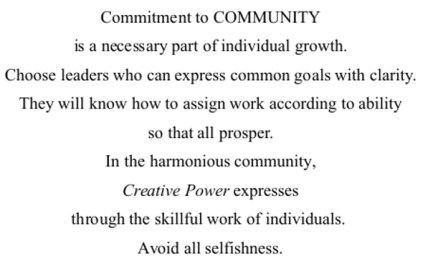
Be that as it may, I queried for direction. The resulting hexagram COMMUNITY was directly to the point of my concern. The CSBOC reading for #13 is:

IC 13

A changing line in the second place reinforced the concluding warning against selfishness: Avoid special interest groups. Selfish and corrupt motives bring downfall.

The resultant change, were the warning heeded, is #1 – CREATIVE POWER, which further reinforces the text.

The changing line in the fourth place reads: If you have become isolated, understand why and correct yourself.

This warning line pin-points a major problem. If heeded, the resultant change would result in # 37 – FAMILY, the cornerstone of community. I take the concluding warning very personally: Avoid roles not suited to your nature.

This returns full circle to my immediate dilemma. As a writer, my topic – the uncertainty of human survival – puts me in the role of a Cassandra relative to the larger, defiantly oblivious society. Being the messenger of an unpopular warning, though it seems my calling, can be isolating, not to mention unrewarding. It results in lifestyle issues with no immediate solutions in sight.

Nevertheless, I persist in believing that as increasingly more people find themselves in desperate social and economic straits, readiness will increase and my time eventually will come. The funding needed to support the intentional communities I envision will eventually materialize.

The situation reminds me of the dilemma faced by the warrior-charioteer Arjuna in the Bhadavad Gita. Those who opposed him were corrupt relatives, which posed a great conflict. Was it morally right to take sides against family, even if they were in the wrong? Forced to make an apparently no-win choice was paralyzing. On the battlefield, overwhelmed, he put down his weapons and refused to fight.

But at this crisis and turning point, his chariot driver, Lord Krsna, revealed his true identity. With inspirational encouragement, he encouraged the warrior to take heart, stand firm and win the righteous battle against evil.

GITA sized

Similarly, the communities which timeless scriptures encourage, of which Einstein wrote, and of which I am thinking, are not based on biological or even cultural kindred, but rather on resonance of heart and mind. Communities connecting kindred souls, if you will. And in this, the exceedingly dangerous times in which we live hold magical seeds of opportunity. From Two Sides of a Coin:

Whereas most rulers suffer the unanticipated consequences of ignorance, pride and greed as shock, humiliation and undoing, sages intentionally harness the forces of nature to positive ends. Thus it is, that throughout history, at the right time, in the necessary circumstances, leaders of ordinary and humble beginnings have catapulted to extraordinary levels of accomplishment, effecting broad political and social change.

By voicing the collective yearnings of the suffering masses, perennial sage-leaders shed the light of eternal hope on times of greatest darkness. By inspired words and living example, they recreate ever-new the Gita’s vision of opportunities hidden within the outward experience of hardship.

For as sages know, “when social degeneration reaches critical mass, regeneration follows.” From Passage 78 of the Tao Te Ching:

78a snippet

Returning to this morning’s magical COMMUNITY reading: another next bend in the road occurred. Surprisingly, the changing lines combine to produce a most inauspicious outcome: # 9 – FRUSTRATION, which begins:

External factors you may not even be aware of will cause FRUSTRATION. New projects will not work out now. . . Your choice is either to wait patiently or to leave the situation.

It concludes by advising, Avoid major commitments.

So, turning to what I saved for last, I asked, What is the nature of the frustration in building intentional communities? The answer, when I checked the astrological description of today’s new moon was this. Timing. Major planets of communication and reform are currently going into hibernation, so to speak. Retrograde.

According to the calendar, the correct decision for me personally is to wait until the end September and into October. For the time being, continue to patiently endure unavoidable frustrations.

For others, for many other reasons, there will be other choices. What is consistent across the board is that building effective intentional communities will depend on an army of Arjunas, each of whom listens to the inner voice of conscience represented by Lord Krsna rather than to the dictates of their particular biological families or immediate social, political and religious prejudices.

Sometimes I wish I could win the largest lottery in history, as if that would end current frustrations. Yet I know bringing in money that way cannot solve the deeper problems. It would not influence hearts or minds, persuade the public of the wisdom needed to ensure human survival. For this, patience is required. So it is no accident that first three letters of PATIENCE are also the first letters of my name.

Today’s magic provided the immediate encouragement now needed to keep writing . . . balanced with acceptance of long-term timing. May my telling of it encourage fellow Arjunas-in-waiting, those who also will, when the time is right, God-willing, be ready to build on common ground.

Stillness and Peace

Sometimes words fail me. Keeping quiet seems the better way. To share my immediate preference for silence, I’m offering two earlier approaches to Stillness. The simplest comes from the Common Sense Book of Change. The second elaborates on the first, and as a compliment may prove helpful.

Hexagram 52. STILLNESS

Peace within and harmony without come from STILLNESS.

When immediate answers to important questions

cannot be found,

sometimes keeping still is the best way out.

Burning desires produce chaotic thinking.

This only clouds the issue

and makes life painful.

Meditation is a valuable method for finding stillness.

Avoid useless activity.

Essay 47 from Conscience offers alternative perspectives on the meditative tradition, practiced throughout the ages around the globe.

globe

Essay 47. STILLNESS

Knowing where and how to settle the mind, one will become calm.

Having attained calmness, one will be undisturbed.

Having attained an undisturbed mind, one will have peace.

Having attained peace, one’s mind will respond correctly to all situations.

One who responds correctly to all situations will find the way.

— Confucius, Great Commentary. [emphasis added]

I suggest you begin with such a primary procedure as simply the practice of keeping physically still. . . In developing a calm control it is necessary to think calmness, for the body responds sensitively to the type of thoughts that pass through the mind. It is also true that the mind can be quieted by first making the body quiet. That is to say, a physical attitude can induce desired mental attitudes.” — Norman Vincent Peale, The Power of Positive Thinking

Taoism advises us to try neither to win nor lose, to seek neither resolution nor impasse, but to study the rising and falling of the way as it moves through the field of our conflict. . . At all times, we search for the center, the fulcrum that creates balance. We stay within the eye of the hurricane. We look for the center, for that is where truth is to be found.” — Brian Muldoon, The Heart of Conflict

THE FRONT

The root of “still” means immobile. By extension, the quality of stillness means being without sound; quiet, silent. It means not moving, stationary, at rest, motionless. It is characterized by little or no commotion or agitation, being tranquil, calm, and serene, like the still water of a lake.

The “where” Confucius refers to in the Great Commentary is the point of focus, called the ajna center, known as the third eye – Muldoon’s “eye of the hurricane.”

The “how” refers to meditative breathing and exercise practices which direct the flow of energy (chi). The intent is to circulate chi freely throughout the subtle nervous system and energy centers, thus linking and harmonizing the interrelated functions of mind and body.

Peace” refers to inner equilibrium, regardless of whether the external world is in harmony or conflict. “Correctly” refers to behavior in accord with natural and divine law. “The way” refers to the unfathomable Tao, the undivided source of creation.

In the Bible, we’re told, “Be still and know that I am God.” Similarly, in Asian traditions, meditators cultivate a quiet heart through physical stillness to experience the supreme ultimate, Tai Chi.

The practical methods outlined in Patanjali‘s Yoga Sutras are helpful in this regard. This classic lists sequential stages of development, as well as obstacles to be avoided. When the beginner first starts the process of calming and disciplining the mind, temptations arise.

One, for example, is the quicksand of astral experience. Others include “siddhis,” or “powers” – sometimes offered by the “dark side of the force.” The beginner is warned to recognize the important difference between between the multitude of seductive astral voices and the quiet, still voice of conscience.

During initial stages of training, distracting voices are silenced. Discrimination is cultivated. helping meditators recognize the difference between fantasies, old mental impressions and genuine intuition. The goal is to penetrate the clouds of the middle astral/energy level of the Life Wheel in order to access the still, timeless center.

THE BACK

Information overload is the opposite of stillness. Visual and audio clutter pull attention in thousands of fragmenting directions, diminishing personal integration and mental cohesion. In extreme situations, the mind and nervous system shut down in self-defense, going catatonic to close out mind-shattering external influences.

Rigid tension, blocking out whatever was seems threatening or inconvenient, obstructs the relaxed, receptive attitude of genuine stillness. Those who ignore the still voice of inner calling and the good advice of true friends can’t receive help. Impervious minds, deaf ears and hard hearts are perversions of stillness.

globe bullet size

Healing the Past

I highly recommend Brain Longevity by Dharma Singh Khalsa, M.D. with Cameron Stauth. They explain how meditation-as-medicine (the “magic bullet”) opens windows to personal transformation. It’s relevant to my LinkedIn post on the nature of Time. So I’ll give you an example of how medical “matter over mind” leads to its compliment, “mind over matter.”

People get “stuck” when they constantly relive the traumas that occurred when they really didn’t have much control over their lives. Specifically, many people can’t “get over” their childhoods, mostly because they suffered painful events then that they really couldn’t control.

Many continuously revive past traumas by recreating similar situations throughout later adult life. However, rather than “acting out” painful memories, some choose to confront their fears under the safe supervision of a therapist. The goal is to recognize unconscious negative patterns and replace them with intentional, positive action.

Meditation, however, takes healing the past to a whole new level.

. . . mind and spirit can heal. . . the space between our thoughts – what the Asian healers “the sacred space” – is where most spirit-directed healing originates.

They continue:

When you meditate and elicit the relaxation response, your mind stops racing with thoughts, and there are longer spaces between your thoughts. The space between thoughts usually feels timeless.

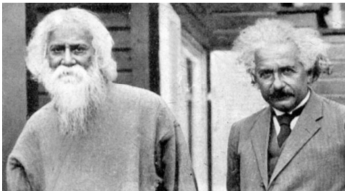
The concept of a fourth time/space dimension is familiar from Chinese yoga as well as Einstein’s physics. It repeats in the 1913 classic Sadhana: The Realization of Life by Indian mystic, musician, poet, novelist, painter, teacher, political activist and Einstein contemporary Rabindranath Tagore.

033015 R & E sized

He wrote:

Yes, we must know that within us we have that where space and time cease to rule and where the links of evolution are merged in unity.

Here then, is the original article:

globe bullet size


ALTERING TIME

The pattern repeats. Three strands emerge and merge to show how the apparently abstract and universal can be importantly relevant in an immediately personal way.

The subject of Time isn’t new. I’ve approached it twice before, both “times” from a practical point of view. Since then, however, I’ve been looking at Time from another perspective to find out how Einstein, experienced sages past and present, as well as science fiction writers describe its nature. Their views are in some ways similar, but in others importantly different.

Above all, what does all this mean to every day people like you and me? And why does it matter NOW?

If matters a great deal, for example, whether what we regard as the past is immutable/unalterable as if cast in stone. Or if, instead, as some say, it is possible to alter – even heal – a fluid past and thereby create a more hopeful, alternative future. If this truly is possible, HOW can we – you and I – alter at least a few minuscule threads in the fabric of time?

Strand ONE. If we compare Einstein’s comments regarding time, it seems he was of two (or more) minds about it. In his last years, consistent with ancient scriptures, he concluded that past, present and future exist simultaneously. In his 1952 book, Relativity, he wrote:

It appears therefore more natural to think of physical reality as a four dimensional [time-space] existence, instead of, as hitherto, the evolution of a three dimensional existence.

This conclusion, however, is the objective overview of a reflective senior scientist. In contrast, and not necessarily a contradiction, he earlier described a highly subjective and situational aspect to perceived time:

When you sit with a nice girl for two hours, you think it’s only a minute. But when you sit on a hot stove for a minute, you think its two hours. That’s relativity.

Strand TWO. In the context of writing an invited article for the international journal Prabuddha Bhrata, I was so bold as to speculate about the prophecized End of Times:

. . . We are now enduring the decline described as the Kali Yuga. Christ similarly foretold the End of Times. . . . [Yet] Time does not exist for accomplished sages who dwell in the changeless center of the Life Wheel. To enlightened beings, it is but an illusion. They experience themselves as eternal, at one with the Creator. For them, life will go on whether or not the world as we now know it continues.

To the point, in an post to my personal website, I quoted a marvelously articulate and entertaining book, The Tao of Meditation:Way to Enlightenment, by Tsung Hwa Jou. Experienced practitioner as well as author of a balanced tripod of books on Tai Chi and the I Ching as well as meditation, Mr. Jou describes the difference between three- versus four-dimensional experiences of time in terms of tadpoles and frogs.

A mother frog, so the story goes, answered her babies’ questions about sunlight, trees and land by telling them they must wait until they mature, shed their tails and swim to the surface of the pond to experience the beyond for themselves:

We who philosophize about time, we who are limited to three dimensions are like a school of tadpoles wondering about another world. Until we too are able to “drop our tails” and step into that dimension, time must remain a subject of speculation to us, as a drinking glass is to a shadow. Until we can experience time as a dimensional context, it must remain a flat reflection to us as the upper world is to the water-bound tadpole.

With Einstein at the end of his years, Mr. Jou agrees that time cannot be measured in discrete units, but rather, is a unified a fabric, a continuum in another dimension complete unto itself. But whereas Einstein arrived at his conclusion through abstract deduction, Mr. Jou was an experienced practitioner.

In sum, he agrees with other accomplished meditators. The concept of beginnings and endings is the subjective perception of limited, three-dimensional experience. Without making claims, he modestly asks:

What is the shape of life from a four-dimensional point of view? . . . Suppose there are sentient beings who have a natural capacity to see the four-dimensional shape of things. They could tell us what the shape of our life is; that is, they could see all at once what to us is separated as past, present and future.

Why does he bother to share this information? Mr. Jou’s Motive, his WHY appears to be a kindhearted desire to share wisdom received from direct experience, for which he is infinitely grateful. His Purpose, the HOW is to detail in a book the methods and benefits of meditation along with the supporting science which explains its effectiveness. His Intended end result, the WHAT, is to give readers a time-tested way to improve the quality of daily life for both individuals and their social combinations:

If people began to think past [sic. beyond] the limitation of three-dimensions, there would be more respect between men in the business of living together for the common good. Three-dimensional tensions would dissolve, and a spirit of cooperation and mutual generosity would spring up in human affairs.

To repeat, as Einstein warned, “We shall require a substantially different manner of thinking if mankind is to survive.” Perhaps that manner of thinking requires the courageous willingness and competence to enter an entirely different dimension of experience — a Star Trek-like journey through inner rather than outer space. This requires not only acquiring the theoretical concept of four-dimensional time which Einstein held, but further, its immediate, direct experience as consistently reported by accomplished meditators.

To take this the next step, however, even immediate personal experience is not enough. For completion of the infinite loop, inner attainment then requires application of awareness to the outer world of experience, changing relationships and even institutional governance for the better. Sound like science fiction? For the most part, Yes. Which leads to:

Strand THREE. By coincidence (if there is such a thing), I was recently lent a science fiction book, Beth Benrobich’s The Time Roads. I chose to read it simply as a diversion.

Science fiction generally treats time travel as a hybrid of three- and four-dimensional experience. Past, present and future are understood to be happening simultaneously. However, the characters are only capable of being in one place “at a time.” Moving from a current time location to a different one requires machines.

The premise of this particular story was familiar from Amelia Pond’s dilemma in Dr. Who episodes, where dangerously expanding cracks in Time threaten to shatter and END it altogether. Scientists specializing in math and physics explore the mechanical possibility of traveling to either the past or future by moving along tears in the fabric of time. Political motives to alter history contaminate scientific inquiry. Madness, grotesque murders, bazaar explosions and scrambled perceptions of violent events follow. So far, nothing unusual to this genre.

But then, an unexpected surprise. (Spoiler alert!) A reconciliation occurs. A brief visit to the future allows the heroine to discover a plot in time to confront would-be traitors and redirect their plans. For reasons equally compassionate and astute, the red-haired Queen of Ēire extends mercy instead of retribution, and in so doing forges new pathways to a hopeful future. Long story short, in the end, the murders and violent upheavals never happened. Time lines are healed. In the process, both past and future are altered.

This surprise ending is a filled with fascinating implications, suggestive of radically important possibilities, directly relevant to the immediate discussion.

NOW, how do these strands weave together, and how might this information be usefully applied on a personal level? How can tadpole-like humans limited to three-dimensional consciousness bridge the illusory disconnects of time without the aid of high-tech machines?

I confess that, although familiar with political and fiction fascination for travel through both time and outer space, I find the very real inner possibilities closer to home much more interesting. For time as a quantifiable third-dimension experience remains plastic insofar as that, by changing subjective perceptions of the our personal past, we each have the possibility to heal that past and thereby alter the future.

In this, forgiveness is an important key. I know, for example, that whenever I hold a grudge, it distorts and even fractures the fluidity of present time. The baggage of fear, resentment and negative expectations layered onto an initial awful experience locks me in the time of the perceived injury. This seriously distorts my possible futures.

By letting go of injuries (naming them would only confirm and magnify the undesirable “reality” to be left behind), I can return my exclusive focus to the present moment and thereby expand the range of my possible positive futures.

Is this possible on larger scales of magnitude as well? I suspect so. Skeptics ridicule dire End of Times warnings. Repeatedly, disasters seem to loom, only to elude us as deadlines pass without catastrophe. But – just may be – white magicians are continuously working behind the scenes in the fourth dimension to heal the past- present-future as did the Queen of Ēire in science “fiction,” unrecognized and unrewarded except for the satisfaction of having ensured human survival – at least for a short while longer.

I think perhaps, just perhaps, every time every one of us forgives, releases the past, and alters our attitudes for the better, we are contributing, one person at a time, to an extension of the future we’ve been mercifully granted in which to improve our ways, thereby entering the fourth dimension before it’s too late and Einstein’s warning is fulfilled for those who fall between the cracks.

What do you think?

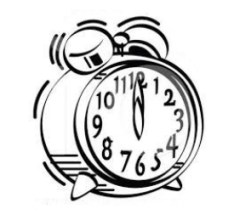
032515 Alarm sized


Overcoming Limitations

In writing an invited article for the international journal Prabuddha Bhrata, I was so bold as to speculate about the prophecized End of Times. In retrospect, I’m having second, third and fourth thoughts.

Here’s what I wrote:

. . . wherein is consolation to be found during the present difficult times? For Hindu sages foresaw them. We are now enduring the decline described as the Kali Yuga. Christ similarly foretold the End of Times. It lies in this. Time does not exist for accomplished sages who dwell in the eternal center of the Life Wheel. To enlightened beings, it is but an illusion. They experience themselves as eternal, at one with the Creator. For them, life will go on whether or not the world as we now know it continues. If even for this reason alone, seeking inner enlightenment is an urgent priority.

How can one really know about such things? Such opinions are necessarily based on hearsay, albeit the testimony of sages is consistent on such matters.

To the point is a description of time as a fourth dimension in the marvelously articulate and entertaining book The Tao of Meditation:Way to Enlightenment by Tsung Hwa Jou. He writes:

Like the shadow, which cannot perceive something above or below its plane, we live in a three-dimensional world, able only to experience reality in segments of time.

According to Mr. Jou, Man’s epistemologies and methodologies are all right from a three-dimensional point of view, and since this is our only possible viewpoint, they constitute the best means to the truth about our reality. Every religion, philosophy, or science is right in three dimension. . . with this caveat: these partial approaches to truth are like different windows in a large building. Each affords us a different view of the outdoors. A unified perspective, however, is gained only by leaving the building.

He continues:

What is the shape of life from a four-dimensional point of view? . . . Suppose there are sentient beings who have a natural capacity to see the four-dimensional shape of things. They could tell us what the shape of our life is; that is, they could see all at once what to us is separated as past, present and future.

Likewise, he assures us that in the fourth dimension, birth and death are not separate, discrete experiences, but rather part of an ongoing, continuous whole. Our birth and death are just another transformation of one form to another.

In sum, he agrees with other accomplished meditators who regard time as we experience it as but an illusion. The perception of beginnings and endings is the result of human limitations – being capable of seeing in only three dimensions.

Why does this matter to us NOW? Look at it this way. Mr. Jou’s Motive, his WHY appears to be a kindhearted desire to share wisdom received from direct experience, for which he is infinitely grateful. His Purpose, the HOW is to detail in a book the methods and benefits of meditation along with the supporting science which explains its effectiveness. His Intended end result, the WHAT, is to give readers a time-tested way to improve the quality of daily life for both individuals and their social combinations:

If people began to think past the limitation of three-dimensions, there would be more respect between men in the business of living together for the common good. Three-dimensional tensions would dissolve, and a spirit of cooperation and mutual generosity would spring up in human affairs.

But he also admits that describing direct experience of the fourth dimension is like describing the taste of an apple to someone who has never eaten one. Similarly, he describes a mother frog who answers her babies’ questions about sunlight, trees and land by telling them they’ll have to wait until they mature, shed their tails and swim to the surface of the pond to experience what’s beyond for themselves:

We who philosophize about time, we who are limited to three dimensions are like a school of tadpoles wondering about another world. Until we too are able to “drop our tails” and step into that dimension, time must remain a subject of speculation to us, as a drinking glass is to a shadow. Until we can experience time as a dimensional context, it must remain a flat reflection to us as the upper world is to the water-bound tadpole.

The question/challenge for us as tadpole-like humans is HOW do we get from here (three-dimensional, conflict-driven either-or thinking) to there (fourth-dimensional awareness within and beneficial, harmonious relationships with others in the world).

Training the mind to expand awareness has been the systematic task of monastic Asian traditions throughout the ages. At the current “time,” the benefits of meditation – significantly improved awareness and effectiveness – may well be a matter of both individual and collective survival.

To that end, I’ve been looking through an assortment of books, each of which opens a different window on the subject of Spiritual Intelligence. In the PB article, I placed this term in the larger context of the two-directional, multi-layered Life Wheel:

In terms of clinical psychology, intelligence at the outermost level is described as IQ, at the middle level as EQ (emotional intelligence) and at the third as SQ (spiritual intelligence)..The levels, which actually flow along continuum, neither separate nor totally distinct, are linked in an infinite loop. The one who succeeds in joining them, living here and yet there, in the world but not of it, enjoys the experience of enlightenment – Christ Consciousness.

Each of the books on SQ (or SI) has its own point of reference, for example quantum physics, Christianity, etc. Interestingly, there’s also a forthcoming book on SI by and for Muslims based on teachings from the Koran. While a detailed summary is beyond the parameters of the current discussion, suffice it to say that although each author defines spiritual intelligence differently, they share a common intent.

Unfortunately, another thing Spiritual Intelligence books share in common is than none have gotten much traction. A quick tour through Amazon books shows that very few have been reviewed or purchased. Spiritual intelligence as a concept isn’t sexy. It is as if the concept is outside the “hearing” range of the general public. Why this remains so and what might be done to change this is yet another subject worthy of investigation and ACTION.

I do know, as do the authors of SI books who repeatedly call for “change,” that the future depends on such a reawakening. In the context of End of Time concerns, I’m reminded of Hexagram 49 of the Book of Change:

Day and night replace each other in endless cycles of CHANGE.

The same natural law generates flux in human events.

The unprepared see change as a threat,

but the well-prepared face the unknown calmly.

They know that after degeneration reaches critical mass,

regeneration follows.

In other words, one way or the other, preparation on every scale of magnitude will definitely make a great difference in the outcomes of as yet unforeseen futures waiting to be born. Overcoming the limitations of our current either/or way of thinking is an important first step. For, to repeat, as Einstein warned us, “We shall require a substantially different manner of thinking if mankind is to survive.”

For starters, thinking about this admittedly limited linear Essay on limitations may be helpful.

globeEssay 10. LIMITATIONS

The Chinese concept of change, which gives the I Ching its validity, has found its echo in chaos theory. The concepts presented by this theory give us vital information about how the I Ching functions. Understanding this may help us cross the bridge between determinist rationality and chance, and go further toward our comprehension of this age-old system, which could have a profound influence on the rest of our lives”. — Cyrille Javary, Understanding the I Ching

Let me not to the marriage of true minds

Admit impediments. Love is not love

Which alters when it alteration finds

Or bends with the remover to remove.

Oh no! It is an ever fixèd mark

That looks on tempests and is never shaken.

— William Shakespeare, Sonnet 116

The Bible encodes all the possibilities, and what we do determines the actual outcome. . .The only thing that can be predicted is the probability of different events. Yet quantum physics is a highly successful branch of science. It works. Perhaps because it recognizes uncertainty as a part of reality. In the same way, the Bible code works . . . because it recognizes uncertainty as part of reality.” — Michael Drosnin, The Bible Code

THE FRONT

A limit is a point, line or edge where something ends or must end, a boundary or border beyond which something ceases to be or to be possible. A limitation is something that limits, as some factor in make-up which restricts the scope of a person’s qualifications, activity, or accomplishment. In law, it’s a period of time, fixed by statute, during which legal action can be brought, as for settling a claim.

On the positive side, we limit ourselves consciously by choosing how to allocate our attention, time and effort. This is called discipline and commitment. On the negative side, we unconsciously diminish our potentials, tying them up in knots of insecurity and doubt. Attitude limitations are as debilitating as physical handicaps. Often they’re unconsciously acquired, internalized by cultural conditioning and negative suggestions. Identifying and correcting these attitudes, overcoming unnecessary limitations, is essential to personal growth and fulfillment.

Rules of empirical science limit the field of knowledge to tangible things. Yet when we exclude the data of extra-sensory experience, we impoverish our lives. Instinct is a survival mechanism built into animals and humans alike. Dogs and horses, however, are sometimes more savvy about people than we are; they’re not fooled by false appearances. Intuition, however, is a gift exclusive to humans. It flashes on inventive thinkers when they see new possibilities or dream of futures not yet born.

The I Ching supplies a method for revitalizing instinct and intuition gone numb through suppression or lack of attention. It helps us link the middle octave of reason with the lower and higher octaves of experience, expanding our range of hearing and awareness.

People raised exclusively on empirical science limit their concept of love and joy to tangibles — physical beauty and sex appeal. When youth fades, marriage partners who lack wisdom are tempted to break their vows. Using the I Ching, however, helps fine-tune awareness of what changes, as well as that which remains constant. Using the I Ching as the foundation of realistic relationships, we build the inner consistency necessary to sustain commitments and complete long-term goals.

But just as an individual’s time on Earth is limited, civilizations and even planets pass in due course. At each stage in history, wisdom appropriate to the times is revealed to those who seek. Drosnin speculates that Newton’s intuited but evasive Bible code was purposefully hidden until the time that computers were invented to unlock it. Similarly, Einstein’s Unified Theory eluded him because he lacked yogic I Ching wisdom. In turn, it may well be that the extraordinary value of this text has been hidden for centuries, waiting for public understanding of binary-digital computer code, energy chakras and DNA genome theory to revolutionize our approach to the Book of Change.

THE BACK

The opposite of limitations is the unlimited. We call this infinity or the unknowable unknown. We are told we have unlimited potentials, but on the material plane they are framed by choice and the structure of whatever language we speak. Only the unfathomable, unnameable essence referred to as the timeless Tao or God — the alpha-omega source of creation — is truly without limitation.

When humans defy natural limitations of time, space and form, they are said to be delusional. When they behave in reckless, unrestrained ways, in defiance of their mortality, acting as if they were invincible and above the law, this is arrogance and sheer ignorance. Knowing one’s place in the universe is wisdom; resisting it is futile.

globe bullet size

Rethinking COMMUNITY

For years now, the same familiar pattern repeats. Whenever I decide I’m finished with writing, something comes along to make me rethink my decision. Two such events triggered today’s post. One was a thought-provoking article, “Mindfulness, Behavior and Social Change” by Mark Leonard, Director/Mindfulness Trainer at the Oxford’s Mindfulness Exchange.

I responded with a question: I’ve often thought about the possibility of building intentional communities, despite the evidence that experiments in the past have not always worked out well. Any thoughts on the subject?

In fact, I had mentally sketched but not followed-through on an article about intentional communities based on my connection with Spring Green and Frank Lloyd Wright’s Taliesin Fellowship. It was an example which, for many important reasons, I would not recommend following.

He replied: I suspect an intentional community needs a suite of conditions including contemporary analogs of functions which hold traditional societies together. I think that mindfulness meditation could play a part here.

The basic axioms listed in The Positive Paradigm Handbook are my recommended contribution to this cohesive foundation. They were fatally lacking in the Spring Green experiment.

Coincidently, these axioms were the reason for accepting an invitation from Swami Narasimhananda to submit an article to Prabuddha Bharata, a journal devoted to the social sciences and humanities started by Swami Vivekananda and in continuous publication since 1896.  [See When Conflict Escalates, What Can Be Done NOW? ]

Timing being everything, I had decided a few hours earlier to list them there in the context of rethinking leadership, family and community based on timeless wisdom traditions.

My interest is based on the observation made in The Age of Heretics (Charles Krone) that when chaos enveloped the civilized European world, monasteries appeared during the dark ages as islands of purposeful community — centers of learning, healing and hospitality. Similarly, monasteries of refuge from barbarism appeared in Asian lands during particularly harsh historical times.

This dynamic seems highly relevant today, for, as Mark Leonard details in his article, the world is surely sinking into another dark ages. Intentional communities may once again become the necessary counter-balance of positive change — the means for ensuring human survival, which, as Einstein warned us, can no longer be taken for granted.

So for starters, from Conscience: Your Ultimate Personal Survival Guide, here are my original thoughts on community. It forms a hopeful basis for rethinking intentional communities. Although my frame of reference for thinking about the dynamics of change is the Chinese Book of Change, resonance with the immediately popular mindfulness movement will be immediately apparent.

globe

Essay 14. COMMUNITY

We can create communities and relationships that are based on love and intimacy rather than fear and hatred. We can learn from the suffering of others. Awareness is the first stage in healing. . . Likewise, we can create a new model of medicine as we move into the next century that is more competent and cost-effective as well as being more caring and compassionate.” — Dean Ornish, Love and Survival

As we accept the smallness of the world, the density of the population, and the myriad influences on individuals and families, someday we may recognize the community and even the whole society as the patient. Imagine, then, what a “doctor of society” might do, what kinds of diseases he or she might treat!” — Patch Adams, Gesundheit!

Each celestial body, in fact each and every atom, produces a particular sound on account of its movement, its rhythm or vibration. All these sounds and vibrations form a universal harmony in which each element, while having its own function and character, contributes to the whole.” – Pythagoras, quoted in The Healing Power of Sound 

THE FRONT

Community stems from a root word meaning fellowship. In English, the word refers to all the people living in a particular district or city. It can also mean a group of people living together as a smaller social unity within a larger one, and having interests or work in common, such as a college community.

Alternatively, it can refer to a group of nations loosely or closely associated because of common traditions or for political and economic advantage. It also covers similarity of tastes and preferences. The last definition Webster’s gives is the condition of living with others in friendly association and fellowship. The last definition has come full circle back to original meaning.

Communities are founded on a common cause. It can be as practical as survival or idealistic as freedom. Often, community cohesion is artificially stimulated by fear and hatred of a common enemy. Hitler inflamed passions against Jews and foreign bankers to mobilize his war-weary country into a second world war even more devastating than the first. Then Americans rallied behind the common goal of defeating enemies of democracy on two fronts, Asia and Europe.

In Common Sense, Thomas Paine wrote about the relationship of divine, natural and human law in a way that inspired readers at the time of the American Revolution to fight for freedom from tyranny. Winning that war did not, however, automatically secure freedom for all times. Democracy isn’t a static achievement that can be passed on unchanged from one generation to the next. It must renewed and earned again, one individual at a time, each generation at a time, continuously redefined in the context of immediate circumstances.

Nor can the structures of American-style democracy be imposed by force, whole, from the outside, on peoples whose beliefs are shaped by vastly different cultural influences. It is the common respect of life and liberty, not external forms, which is universally translatable. The music of life that moves every organization, smallest to largest, is the basis of harmonious fellowship. Approaching natural law and social organizations from the deeper understanding of the ancients could inspire a new, more humane and effective approach to international relations now, one based timeless values which the human community shares in common.

Sages say that freedom from tyranny begins with dispelling ignorance and overcoming negative emotions. True freedom and stable communities begin with the self-awareness and self-mastery which can be gained by diligent use of wisdom tools like the I Ching. First remembering the core of compassion and caring within, we can then extend and expand this good-will into healing society as well.

Put another way, it’s useless to fight for a democratic world before one cleans out the inner swamp of negative emotions. Since inner life projects into external experience, fighting tyranny in the turmoil of anger and hatred reaps results in kind. Therefore, working to establish positive community relationships before attitudes of good-will and willing self-discipline are established is a futile exercise. As Covey reminds us, first things must come first.

Conversely, the more individuals free themselves from personal problems, the more they become open to the calling to community and able to play their part in the harmony of the natural whole.

THE BACK

Street gangs, terrorist groups, religious cults and secret societies are subgroups within the larger community. To the extent that their goals oppose and even endanger the community at large, these organizations are antithetical to the general good.

Pariahs, nomads and outcasts [heretics!] are individuals excluded from society, either voluntarily or by edict. Whether justified or not, their attitudes and behavior are out of harmony with accepted norms. If enough of them find common cause to band together, they form alternative groups which become the foundation of new communities.

globe bullet size

Rethinking COMMUNICATION

The following essay from Conscience: Your Ultimate Personal Survival Guide is an appropriate companion to the article just posted on LinkedIn, “True Leaders Trust Their Inner Compass To Overcome Confusion.” It opens with a question:

When others use the same word to mean different things, how do effective leaders bridge the gap to communicate clearly? If you’d like to see the rest, here’s the link: https://www.linkedin.com/pulse/true-leaders-trust-inner-compass-overcome-confusion-patricia-west?trk=prof-post

globe bullet size

Essay 32. COMMUNICATION

He who is learning to paint must first learn to still his heart, thus to clarify his understanding and increase his wisdom.” — The Mustard Seed Garden Manual of Painting, quoted by R.L. Wing.

Painting in China made it possible to manipulate the veil of appearances so that it might be pulled away to reveal the hidden essentials of reality and lead the observer into an experience approaching ‘truth.’ Both art and the I Ching employ a triggering device that makes conscious that which has been buried in our unconscious.” R.L. Wing, The Illustrated I Ching. 

“My pen is my bokken, sword of discrimination, ruthless as it follows certain lines of thought onto the page and ignores others into nonexistence. My pen gives life or death to words. My pen cuts through partial truths, slashes weak verbs, and sparring and paring, uncovers a rare, gemlike image. . . As my mind’s chatter settles ever more deeply, my pen can follow a thought like a bee tracking nectar.” — Connie Zweig, Becoming a Warrior Writer

THE FRONT

Roots of communicate suggest sharing, to make common. Webster’s defines communication as the act of transmitting, giving or exchanging information. The means can include signals, gestures, and writing as well as speaking. The word is also used to describe the means of information changing hands, such telephone, telegraph, radio, or other systems. It’s also used to describe routes for moving troops and materials. In the arts, it connotes expressing ideas and sentiments. In mathematics and science, it includes symbols.

The definition has no shadings of meaning to indicate the multitude of verbal and non-verbal levels of information exchange, acknowledging a broad spectrum spanning cellular synaptic connections and inarticulate body language on one extreme to non-local, telepathic messaging (ESP) at the other. The definition of communication also lacks nuances that indicate motives for communicating, or whether information shared is complete or accurate.

Bad-faith extremists babel. They intentionally miss each other coming and going. Seemingly powerful extroverts (extreme-yang aggressors or oppressors) abuse communication tools as overt weapons of propaganda, intimidation and subordination. Speech is used to overpower and control. Seemingly helpless introverts (extreme-yin targets or victims) use language (along with silence) as covert weapons of self-protection or retaliation. Words are used to placate, distract or mislead.

In The More You Watch the Less You Know, TV veteran Danny Schechter observes that there’s a media war going on to win the hearts and minds of viewers. It’s going on in education too. Insiders disempower people with the potential to threaten empire-building plans by feeding them partial information piece-meal. Potential leaders are co-opted by rewarding them for knowing more and more about less and less, calling the outcome “expertise.” The right hand/brain can’t know what the left is doing.

It takes cooperative interdisciplinary work, linking not only related academic specialties, but also the levels of law, to discover solutions to apparently unsolvable economic/social/political conundrums. The most essential community-building service sincere leaders can provide is the dissemination of accurate, hopeful information that promotes positive action. As people of good-will intentionally transcend extremes, cultivating balanced mesovert communication skills, they are developing a base of values shared in common, along with means for connecting to share vital information.

Especially in the arts, however, it isn’t the writer who inspires. Words are just catalysts. They precipitate inner knowing, causing it to rise to the surface of conscious awareness. It’s the result of synchronicity. When the writer, reader, time and topic are in synch, then, Bingo! There’s a connection — communication.

THE BACK

The opposite of communication is silence, the absence of giving and/or receiving information. In a social context, ignoring others is a sign of mistrust or disrespect, a denial of their value, trustworthiness or sincerity. In meditation, however, silence in the inner sanctuary of the mind is the respectful attitude of receptive humility. In this context, cessation of dialogue is prelude to at-oneness.

A perversion of communication is cacophony. The overwhelming amount of data now available from an increasing number of sources causes information overload. City streets and public places are filled with loud, harsh noises that shatter the nervous system. This extreme causes the mind to shut down in self-protection.

Put the Common Core Back in Common Core

restore common core

Restore the Common Core” is packed with implications for education and, ultimately, human survival.

For those who haven’t been following articles posted on rethinkingsurvival.com over the past year, here’s a brief summary of the concepts embedded in the Life Wheel.

arrow bulletThe Positive Paradigm of Change is a model equally compatible with the perennial philosophy embodied in the world’s enduring wisdom traditions and with modern science. It serves to bridge the gap between religion and science.

arrow bulletThe Life Wheel with its concentric circles and central, unifying hub pictures the multi-level structure of creation. This form is repeats throughout nature, from smallest to largest. It pictures the organization of snowflakes, each unique in form but identical in basic structure. It pictures the rings which orbit the nucleus of each atom as well as the planets which circle our sun.

arrow bullet

These circles correspond with the three variables of Einstein’s formula, e = mc2. Ironically he had the Unified Theory, but for lack of yoga background, didn’t know it. Briefly, the levels include the material outermost level of observable, measurable, tangible objects, then a middle level associated with energy (chi, prana) and emotions. Still deeper resides a level associated with light. It correlates with the experience of intuition or guidance. All three depend on the Source of Light – the unchanging silent Eternal, beyond duality and therefore beyond words.

arrow bullet

These levels are not actually separate. They function as an interrelated and interdependent whole, linked in an infinite, two-directional in- and out-breathing loop. Those who experience this whole succeed in integrating the levels of daily life with conscience. Those who separate the levels, who ignore some at the expense of others, prioritize levels incorrectly, or place them in conflict, will eventually find themselves in deep trouble.

arrow bullet

This universal concept can be pointed like a laser beam in any direction to illumine the field. For example, the three levels of the Life Wheel correspond with three levels of law: human, natural and divine. This relationship is acknowledged in the Declaration of Independence, which refers to the laws of Man, Nature and Nature’s God.

arrow bullet

A second example explains differing types of intelligence. On the surface, intelligence which divides and argues (using and/or abusing the tools of reason and logic) is measured by the standard of IQ. More recently, it has become fashionable to speak of EQ, or emotional intelligence associated with the middle, energy level. Deeper still is the intelligence described as intuition or inspiration. All these center around a common core which can be called “Conscience.”

arrow bullet

A third example is the use of the Wheel as a linguistic tool. Most words shift meanings depending the level of experience they describe. In the example shown here, the popular concept “Common Sense” shifts meanings with each level of the Wheel. When the levels are linked and experienced as a continuum, Common Sense partakes equally of intuition, gut feeling and sound reasoning.

Now, how is it that this Unified and potentially Unifying Theory gains so little public traction? It begs the question to simply say that many people, for a multitude of reasons, are too highly invested in the status quo. Given the life threatening circumstances that confront us, why is there still such powerful resistance to a return to what the wisest among us have consistently taught from the beginnings of time? Where is the method to the madness?

In partial answer, I offer excerpts from earlier works. The first spells out just how important paradigms are. They make the difference between success and failure, ultimately between survival and extinction. The second excerpt suggests there are deeper dimensions at play. After these two excerpts, I’ll apply all of the above to the restoring the true, eternal Common Core to the progressive/Marxist political/educational curriculum inappropriately called Common Core.

globe bullet sizeWHY PARADIGMS MATTER

Ideas drive results. People’s beliefs color their feelings, triggering basic emotions which in turn drive their actions.

Actions that stem from a simple, complete and accurate paradigm result in personal fulfillment, harmonious relationships, and economic prosperity.

Actions based on false, incomplete and inaccurate paradigms, however well intended or passionately defended, are the cause of widespread misery, suffering and deprivation.

A fatal information deficit explains the worldwide leadership deficit and related budget deficits.

In a dangerous world where psychological and economic warfare compete with religious extremism and terrorism to undo thousands of years of incremental human progress, a healing balance is urgently needed.

Restoring a simple, complete and accurate paradigm of leadership and relationships now could make the difference between human survival on the one hand, and the extinction of the human race (or the end of civilization as we know it), on the other.

globe bullet size

ALIEN INVADERS

Alien invaders infiltrating Planet Earth, weakening humans to eventually take over and enslave them, is a familiar theme in science fiction. For example, in his various incarnations, Dr. Who — television’s time traveler — continuously detects nefarious alien plots and rescues heedless humans from annihilation.

Current events indicate there’s considerable truth cloaked in that science “fiction.” Starting with the premise that hidden alien enemies are covertly scheming to undermine humanity, ask, “How would they set about to destroy us?” Logically, they’d create chaos, setting everyone at each others’ throats. They’d trick humans into mutual self-destruction by stirring up dissension and fragmenting their governments.

It’s an absolute priority for evil aliens to attack the mind. Their agents will do whatever it takes to pollute your mind. They confuse it with false paradigms. They clutter and distract it with the ongoing media circus. Every doubt planted in your mind, causing you to forget who you are, to disbelieve in your ultimate origins and creative potentials, is a victory for the dark side.

To totally undermine humanity, atheism is a must. The unifying beliefs which hold families and nations together and fortify them in times of adversity must be destroyed at all costs. Again, how would this be accomplished?

For one thing, language which makes communication and community-building possible would have to be polluted beyond repair. In the English language, for example, every value word has devolved to mean both one thing and its opposite. So people often talk at cross purposes, unaware that they’re missing each other coming and going.

Divide and conquer. Pit each group against the others. It matters not to them which side wins. Let Sharia law advocates, members of Putin’s Eurasian Union and American exceptionalists squander their precious resources duking it out. If they destroy each other and no one’s left, so much the better.

Alien invaders delight in cheating. They stack the deck, gumming up the works with lies and disinformation driven by dysfunctional paradigms.

If you accept the game and its rules as alien agents define them and proceed to rebel against uncivil authorities, mindlessly hating and resisting, YOU LOSE. (Alien invaders win.)

If you give all your attention to what other guys are doing wrong, playing the role of contrarian, YOU LOSE. (Alien invaders win.)

If you quit on humanity and live only for yourself, leading a life of self-centered indulgence, YOU LOSE. (Alien invaders win.)

If you persist in thinking narrowly in terms of political interests and institutions, not human survival, YOU LOSE. (Alien invaders win big time.)

The only chance of winning — ultimately, surviving — is to demand a new, clean, unmarked deck, one with all the cards. In other words, make a fresh start based on an accurate, complete Positive Paradigm.

globe bullet size

My younger brother once riddled me, “How many legs does a donkey have if you call it’s tail a leg?”

His solution: “Four. Calling a tail a leg doesn’t make it a leg.”

Even so, tacking the label “Common Core” on a curriculum doesn’t guarantee that the substance includes the basics on any level of the Life Wheel. Logic and reasoning skills are deficient; emotional intelligence is insulted, not enhanced; the existence of divine law is excluded, if not ridiculed, as an option.

It’s a matter of human survival to take back the language. Then restore accepted access to the true, eternal Common Core as part of a genuine, complete and accurate education in the true meaning of the word – “leading from darkness to light.”

Conform: Exposing The Truth About Common Core And Public Education by Glenn Beck & team places the political/educational monstrosity called Common Core directly in the camp of the evil aliens described above. They start with the premise, “Information is power. Those without it have nothing. Those with it will always have CONTROL.” They state:

The dumbing-down of America is good for one group and one group only: those who currently have all the power and control. By maintaining a failing system they are forcing a collapse that will have only one “savior”: the federal government. And that’s exactly how they want it.

They continue:

We now stand at the precipice. On one side is the complete nationalization of education and complete loss of local and parental control. On the other side is a complete educational revolution – one that is rooted in individuality and that follows the principle of “maximum freedom, maximum responsibility.”

Sadly, 180 + pages of Conform are dedicated to argument and expose. Less than 30 pages are dedicated to solutions. And these, unfortunately, are limited exclusively to political measures. The most fundamental problem, the lack of a complete and accurate, unifying paradigm is neither acknowledged nor addressed. Deeper underlying origins of conflict as well as the source of genuinely positive solutions are overlooked.

Yet restoring the unifying basics of the perennial philosophy – the True COMMON CORE experienced as COMMON SENSE – an experience equally available to everyone, everywhere – is what might (just might) turn the tide of human history, tipping the balance in favor of human survival.

What Glenn Beck & company has exposed is a radically dangerous situation that calls for opposite and equally radical (truly radical) solutions.

Herein lies the opportunity hidden in dangerous times. In larger context, material resources aren’t that significant when compared with the intelligence, inner strength and inexhaustible vitality available to those whom circumstances oblige to return to the less tangible but very real levels of inner experience.

The disenfranchised (whose numbers increase exponentially with each passing day) experience the results of the prevailing materialistic, conflict-paradigm as catastrophic. They no longer have vested interests in the status quo to protect. They are the ones most likely to find the courage to move forward once again into the past, recovering the timeless treasures buried deep within the perennial philosophy of the world’s enduring wisdom traditions.

Now, as when Christ walked the Earth, the true fundamentalists and radicals (both words mean the same thing!) aren’t members of conflicting extremist groups who meddle with events on the material surface of life’s wheel. They are highly motivated individuals with the vision and determination to change themselves from the inside out. Their shining examples have a ripple effect, gaining momentum through time and space.

globe bullet size

* N.B. The current trend towards disempowerment of the masses is prelude to oppression and tyranny on an unprecedented scale. Co-opting education in the guise of Common Core, turning public school children into Nazi-cloned, obedient zombies, is one piece of a much larger puzzle. Attacks on Second Amendment rights is another. See: http://writerbeat.com/articles/4737-Should-civilians-be-allowed-quot-military-style-quot-guns-

Rethinking HOPE

New years are traditionally welcomed as a harbinger of fresh hope and the opportunity for new beginnings. In these perilous times, I have searched my heart for the most realistic approach to fulling the eternal hope for love, unity and survival which everyone everywhere shares in common – a way that acknowledges escalating world challenges while balancing them with their inherent potential for renewal.

Because it rings true as the vision of realistic hope, I have chosen to return to this simple essay, written in the year 2000, included in Conscience: Your Ultimate Personal Survival Guide.

May your New Year be filled with the blessings of your dearest heart’s desire.

121714 rose

ESSAY 63. HOPE

Ephesians

Here the people could stand it no longer and complained of the long voyage; but the Admiral cheered them as best he could, holding out the good hope of the advantages they would have. He added that it was useless to complain, he had come [to go] to the Indies, and so had to continue it until he found them, with the help of Our Lord.  — Christopher Columbus, Journal of the First Voyage

We live at a particularly perilous moment, one in which self-deception is a subject of increasing urgency. The planet itself faces a threat unknown in other times: its utter destruction. . . The splitting of the atom, said Einstein, has changed everything, save how we think. And thus, he observed, “we drift toward unparalleled catastrophe.” — Daniel Goleman, Vital Lies, Simple Truths

We are seeing a health care system in pain, people in pain, and a world in pain. I believe that something can be done to make it better. — Patch Adams, Gesundheit!

THE FRONT

Webster’s defines hope as a feeling that what is wanted will happen. It is a desire accompanied by expectation. It can mean that which one has a hope for. It can mean a reason for hope. A meaning listed as archaic is to trust or rely.

In I Ching context, hope transcends short-sighted wishing and emotional wanting. It is a trust that one has the wherewithal to respond appropriately to every change of fortune. It’s not total self-sufficiency, but awareness that one’s efforts are met half way. When one does the best one can, the rest is supplied in the right way, at the right time.

Daniel Goleman emphasizes the direct relationship between honest self-awareness and survival. Like Einstein and like Strauss & Howe (authors of The Fourth Turning), Goleman is a messenger of awareness we’re often trained to block out. His vision is in synch with The Book of Change philosophy in this: ignoring dangers, deceiving ourselves that all is well when it isn’t, doesn’t make problems go away. It only renders us powerless to recognize early warning signals in time to prepare and ameliorate the worst that might come.

In The Fourth Turning, Strauss and Howe emphasize that declining resources will necessitate major changes in healthcare delivery. Anticipating that the cost of health-care will continue to rise and become increasingly unaffordable, they recommend that cost-effective, affordable alternatives be in put in place now. Forward-looking health practitioners are therefore now turning to inexpensive, preventive self-maintenance practices like Tai Chi, Qigong and yoga.

There are hidden benefits to timely austerities. Though it is unfortunate that people see fit to return back to self-responsible methods only as a last resort, if the prospect of hard times returns people back to their more simple and beneficial roots, it serves as a blessing in disguise.

In his epistle to the Corinthians, St. Paul wrote of hope in the context of faith and charity. His hope isn’t Webster’s hope of wanting and expecting. Like I Ching hope, it is trust that human events which make no sense in the short-term fit into the larger pattern of life, and that God’s will does in the long-term prevail.

THE BACK

The opposite of hope is despair. Seeing one’s situation as hopeless is a self-fulfilling prophecy. So long as one places hope in externals, one feeds the illusion of powerlessness. Turning the focus of hope inwards makes all the difference.

Self-deception is a perversion of hope. Lacking a concept of cyclical change, linear thinkers hope to control time. They defy the aging process or pretend change can’t or hasn’t happened rather than adjusting and benefiting from new opportunities that arise to replace the ones which pass away.

globe

The Evolution of My Understanding

A post-Thanksgiving exchange with a LinkedIn connection (I’ll call him Dave, a favorite name) made me realize I owe it to readers to describe from personal experience why I’ve come to place so much importance on Natural Law. It’s critically important to be fluent in its operations. It’s equally essential to understand how it’s related to, though different from, Divine Law. As I’ve learned from personal experience, a little knowledge can get you in a lot of trouble.

dragon

Dave and I have never met. He hasn’t, to the best of my knowledge, read any of my books, so isn’t familiar with the autobiographical account written in Rethinking Survival. So other than candid answers to his frank questions, his impression is based on posts I’ve written.

We originally hit it off in an exchange of comments. In response to “Boundary Spanners Connect at the Center,” posted September 10, 2014, he wrote:

Wow and thanks Patricia! That was Profound and easy to read. Writing such articles take real skill and something of real value to communicate. I especially liked the hors d’oeuvre at the beginning that made me want to read the rest. Half way through I said out loud, “I think I love you”. I certainly enjoyed reading your article very much. I just clicked “follow”, although I hate the concept of “leaders” and “followers” because I am fiercely independent. I think of it instead as “subscribe”; as in “offer me some more of your tasty wares”; rather than tell me what to think…

I can relate to independent. Mom didn’t call the toddler-me an “independent critter” for nothing. So I answered back:

In-dependent = depending on the True Self deep within. Fiercely = connected with the passionate energy of the middle level. Love you too! Thanks for the subscribe, Dave. : )

Dave’s 80-something parents, who live in South Africa, flew to California, where both he and his brother now live. He dedicated the duration of the Thanksgiving holiday season to family. After they left, he wrote:

I told my mother about you and she asked me if you were a Christian. I said that you were aware of God and often reference Christian tenets in your writing, but that your belief system seemed much wider than that. I did not feel the need to try and label you, but said that you are driven by natural law that springs from the Creator; and that is enough for me.

But that got me to thinking. How would I have answered if she had asked me directly? Then one thing led to another. Later I wrote back:

I was thinking of how to answer your mother’s question, and remembered a post from last December, “Rethinking Christ at Christmas.”. . . I’ll include the link so you can forward it to her – in case she would like to see it.

I continued:

In terms of her asking if I am Christian, the correct answer is that I love, respect and do my best to follow Christ. I’m not sure that’s the same thing as being a “Christian.” (I was not born/raised in a Christian family.)

But, having reservations about his description, I continued.

However, I am not driven by natural law. Rather, ignorance regarding the relationship of divine, human and natural law is a fatal blind spot in our education. It prevents us from understanding and connecting with Christ. (The blog will show you, literally, what I mean. If we can’t recognize/navigate that middle, energy level of natural law, we’re left stuck on the material surface.)

My belief system is “much wider” than Christian tenants, but, then again, so is Christ.

My understanding is that the essence of Christ is vastly greater in time/space than institutionalized Christian religions. Again, the illustration in the blog shows how this must be so. Christ told us he was before the world, is with us always, and will continue to exist long after the world does not. So, if his presence permeates all time and space, in effect of his presence permeates all religions.

Dave’s lengthy, astute response is too long to quote in entirety. Two paragraphs relevant to the critically important distinction which is the purpose of my blogging today (12-13-14 is an “interesting” date – perhaps the right time to make a breakthrough, finally get across the all-important sequence I’ve been laboring to define).

Religions have too much dogma. For me, the only absolute truth is that every individual is responsible directly to God for their own decisions and actions. No human intermediaries are required. Any person can communicate directly with God. Not only can they; they should.

I could not say it better!

But here’s where the conversation became murky, and needs clarification:

My remarks about natural law may not fit your definition exactly, but to me, natural law is God’s law. That said, I use the term more often in the context of physics and chemistry, without declaring who the author is.

From my point of view, two critically important distinctions must be emphasized. First, Divine Law is the Creator’s law. It rules that which is timeless, unchanging and eternal. It pertains to the source of (but cannot be equated with) the created world measured and quantified by human sciences. I don’t quibble about names. The Creator is an essence beyond words. Call it the Tao. The Universal Mind. The Divine by any other name is still eternal.

Second. Natural Law is a related but distinctly different subject. The Book of Change, the Chinese I Ching codifies the 64 permutations of alternating, cyclical change. It is the binary-digital code of duality, the blueprint of DNA – that which has a beginning and an end in time. It maps the dynamics by which creation emanates from the hub at the timeless center of the Life Wheel, and then recedes, being absorbed back into the stillness of original silence.

That’s a lot of big words and still bigger, mind-boggling ideas. But, in simple language, I’ll want to tell you why this distinction between Divine and Natural Law is so critically and personally important to me.

In the evolution of my understanding, I began an as agnostic. As described in Rethinking Survival:

The silver lining to being uprooted early and often is that assumptions others take for granted weren’t deeply ingrained. I was raised by adults from different religions who held conflicting political beliefs. Not all of them could be right. It was my responsibility to sort things out, make sense out confusion and choose for myself. “Take the best and leave the rest.”

As to the existence of God, I had no opinion. I didn’t know whether or not God existed. I didn’t really care. It didn’t seem to make a difference in the conduct of my daily life one way or the other. I was quite content to live according to the maxim,“The reward for a good life is a good life,” which appealed to me as sensible and satisfying.

But then things changed. I began to have experiences which were outside the boundaries of anything I’d thought possible, unlike anything I’d learned from anyone anywhere. One day at the downtown YWCA, a yoga teacher intoned, “When the student is ready, the master appears.” And the very next day, as I was hitch-hiking to a concert, violin case in hand, out-of-town yoga disciples stopped their VW bug to pick me up. They were in Madison to attend a seminar. I was invited. Their teacher picked up on me. I ended up in India, and doors to a new life opened.

In retrospect, there was nothing in my training that gave me a frame of reference to help put this swami in context. He was a con artist. He performed cheap magic tricks that impressed gullible physicians and therapists, and seduced vulnerable women.

He had a modest degree of attainment, mistakenly assumed to be “spiritual.” He could read minds and manipulate material objects. He knew just enough about Natural Law to seem powerful to naïve Westerners. He cynically claimed to be a man of God, a celibate monk and penniless renunciate. But he wasn’t.

What was lacking in my education was an understanding that Natural Law exists. With simple mastery, anyone can do magic tricks. (They’re called sidhiis, or powers.) My pesudo-logic went something like this: “The Swami is powerful. Power comes from God. Therefore he is a man of God. God is good. Therefore the Swami can be implicitly trusted as good.”

His hapless students had never been taught to discriminate in the positive meaning of the word. We didn’t recognize the importance difference between holiness and magnetism, between sincerity and smooth-talking charisma.

Here’s the bottom-line, the extremely important point I want to impress, the lesson learned from this sad experience, to be passed along as a cautionary tale. Divine Law and Natural Law are NOT the same. One is an off-shoot of the other. But there is nothing sacred about Natural Law. Depending on the motive, purpose and intent of the user, power can be used to serve and heal. It can also be abused to exploit and even destroy. It can be turned to serve good or evil. It expresses in the extremes of black and white magic, was well as intermediate shades of gray and yellow.

Tony Silver’s rules for an unfair fight (remember the Karate Kid?) sum up the disadvantages of limited and limiting education:

A man who can’t stand, can’t fight. So break his knees.

A man who can’t breathe, can’t fight. So break his nose.

A man who can’t see, can’t fight. So gouge out his eyes.

In effect, education which doesn’t teach us how to take a stand, breathe deep and see life for what it is, complete and whole, cripples and suffocates us. It blinds us to the dangers inherent in our immediate circumstances. It renders us powerless in the face of dark-side puppet masters who practice black magic to dominate and control unsuspecting innocents. It renders us unable to protect ourselves and those we care for. It sets us adrift, unable to recognize the difference between shadow and substance, between lies and truth, and between illusory, false teachers who distract with cheap magic tricks versus true leaders who offer genuine hope.

In the evolution of my understanding, here’s my take-away from the swami experience. Just as the biological process of metabolism is essential to physical health, so also the process of mental metabolism is equally important to psychological well-being. We take in experience raw and whole. But then it’s imperative to digest it. Take responsibility to decide what is beneficial and healthy. Put it to good use. But eliminate the rest before it festers, causing disease and decay. Release release poisons from the system completely.

In the case of the swami experience, the beneficial effect worth keeping was that it shook me out of my culturally-induced coma. It gave me first-hand experience of invisible forces which bad guys manipulate with impunity to get whatever they want, at everyone else’s expense. It also led me to other experiences. There are protections. Working with the Book of Change, for example, was a life saver. It gave me the leverage to recognize danger, put it in perspective and protect myself from it.

My choice was to honor and maintain connection with the life-sustaining eternal center. I released as poisonous the anger/pain which causes many to react to unfortunate experiences with false teachers by rejecting the Creator whom they only pretend to represent. That would be to choose starvation rather than taking responsibility to process life’s challenges intelligently.

As a child, I thought the question of God’s existence didn’t matter. Now I recognize that operating on the basis of a complete and accurate reality map makes all the difference. There’s more to life than our materialist teachers taught us. Seeing life whole and complete is the starting point of clear thinking and effective, positive action. It’s imperative to recognize that there is an eternal center which abides deep within, regardless of whatever abuses of power are perpetrated in the name of God. It continues to exist whether or not we choose to be aware of it.

In the evolution of my understanding, I’ve come aware that bad guys succeed in wielding temporal power by abusing natural law with impunity. They succeed only by keeping the rest of us in ignorance, the mother of slavery and seed of suffering. I’ve become convinced that the way out of mortal danger is for good guys to open their eyes, breathe in their courage and take a stand. Human survival will depend upon the leadership of those who exercise their God-given free will, who choose to wake up to the magnitude of the danger we’re in, and who are capable of wielding their natural powers/potentials in the service of the larger good.

Authentic Friends Are Rare & Precious


friend.jpg

When I asked myself what I’m most grateful for this Thanksgiving season, a recent walk through the Hill Top woods in Spring Green, Wisconsin instantly came to mind. Sunny but crisply cool, the fall weather was perfect. Colorful turning leaves were at their brilliant best.

I hadn’t seen long-time friend Janelle Fritz for thirty years and counting. But it could have been yesterday. Authentic friends are like that.

Why did we come together again now? Long story.

On the surface, the catalyst was a note I sent while she and husband Ty were still wintering in Arizona. I had expressed my thanks to his father, Herb Fritz, in the dedication of Rethinking Survival, I told her. Further, in the autobiographical section, I wrote about his being the sole survivor and witness of the 1914 Taliesin massacre, as well as about performing string trios at Hill Top with Herb and his sister, Frances Caraway. I wanted Ty and Janell to know about the dedication first, from me.

On that October day, there was much catching up to do. Words came easily on both sides, punctuated, of course, by spontaneous bear hugs.

I was fascinated to find out that she too is a good friend of the I Ching. Or perhaps, better put, the Book of Change has been a good friend to her. Like me, she has repeatedly turned to the Wilhelm/Baynes edition over the years to survive seriously challenging, tough times. It has served to keep her pointed steadfastly towards her inner True North.

Though I never doubted the outcome, still I rejoiced to see that she’s weathered her personal storms wonderfully and has become even better for them. It’s apparent that this tiny woman (even smaller in size that I am) is the true backbone of her family. And I said so! (Sometimes it helps to hear it from a friend.)

Since our walk, I’ve been reading Bill George’s books, including True North and Authentic Leadership. They describe Janelle to a Tee. She’s centered in her True North. In direct, simple terms, she’s an exemplary authentic leader. Her beliefs, words and actions are consistent across the board. She’s devoted to her family, becaring not only Ty, their sons and now grandchildren (WOW!), but also her sprightly mother-in-law, Eloise Fritz, who’s now 89 years-old.

Janelle was a dancer. In Arizona, she told me, she owned and ran a dance studio. Like Eloise before her, who ran a girls camp at Hill Top, Jan’s purpose was to encourage and bring out the best in young women. Horse riding and dance were incidental to the deeper, soul purpose of their businesses.

We both, Janelle and I, have given up our early avocations. She couldn’t understand, at first, how I could give up music. It was only when I explained it in terms of her releasing the dance studio that she recognized the common thread.

I explained the change in I Ching terms. “The larger the front, the larger the back.” And “Every extreme turns into its opposite.” The benefits – the front side – of the music were enormous. As a child, I lived and breathed in continuous joy. Immersed in music, I was shielded from the dark side of living in a dysfunctional family on a dysfunctional planet.

Music taught me many important life lessons. As Einstein observed, discipline learned through violin practice came much easier than it would have through harsh obligation. Playing in string ensembles and orchestras was a model for cooperation as well as for following the single lead of a conductor.

Music eventually led me, via Menhuin students, to yoga, complimentary medicine, and the scriptures which teach methods for actualizing the Unified Theory reformulated by Einstein. Like every discipline studied with love, focus on music led me deeper, first to the physics and then to the origins and mysteries of sound.

Sufi Inayat Kahn, the great sarod player, explained how this can be. In Music, he wrote:

The art of music has been especially considered divine, because it is the exact miniature of the law working through the whole universe. For instance, if we study ourselves we shall find that the beats of the pulse and the heart, the inhaling and exhaling of the breath, are all the work of rhythm. Life depends upon the rhythmic working of the whole mechanism of the body. Breath manifests as voice, as word, as sound; and the sound is continually audible, the sound without and the sound within ourselves.

Inayat Khan became a role model. As a teacher and author, he himself became the instrument. From his example, I recognized that, like him, I had to give up that which I loved most, my brown-blond,1776 Mathias Thier violin, to go beyond it.

It was necessary because the back of the coin was as great as the front. Over time, the blessing had changed into its opposite. Once the lessons had been learned, holding on to their vehicle would have held me back. I was not only shielded. I had become oblivious to the rest of the world and the responsibility to serve. Music had become an addiction and an obstacle to further, necessary growth.

But, as Janelle was quick to point out, Nothing is ever lost. Only changed. Everything cultivated as a musician is now funneled into the writing. I’ve become the instrument of the ideas that kept me focused True North even during confusing, difficult times. Now I weave in the music of language using the medium of a computer keyboard.

Similarly, Janelle and Ty have dedicated their Hill Top inheritance from Herb and Eloise to building a community center where people gather to honor the passages of their lives. They come to celebrate weddings and return to commemorate their milestones, including anniversaries. Life continues to evolve. We change, yet the True North of constant friendship remains the same.

For that I am abundantly, infinitely grateful.

globe