Category Archives: I Ching

The I Ching and ME

A guest blog I’ve enjoyed writing focuses on using the Book of Change to experience the difference between KNOWLEDGE (information) and KNOWING (introspection). Maintaining a balance between the two is a survival priority.

The article’s section headers include Lao Tze and the I Ching, Jung and the I Ching, and The I Ching and You.

After submitting it, this thought flashed into mind. A section was missing: The I Ching and ME. So here it is.

For me, the Book of Change is a gateway to magic. On this side, it has been a close companion, good friend and advisor through the years. On the far side, perhaps remembered from lifetimes past, it speaks to me from a place beyond time and space.

With it, I was never alone, even and especially when I was loneliest in crowded rooms. When the world impelled suicide, it brought me back to a deeper, all-pervasive love of life.

So I will share a few sections from Rethinking Survival about how I met the book, and how it has grown on me.
globe

First Introductions

. . . I’d had a hunch about [the I Ching] for a very long time. Ellsworth Carlson, who lived in Shansi, China during WWII, was a classmate of my parents at Oberlin College. When I was nursery school age, he bounced me on his knees at Harvard.

As Freshman student, I took Dr. Carlson’s course in Asian History at Oberlin. What stuck with me how vast an influence the I Ching had on China for 8,000 years and counting.

So, when I left the U.S., all I took with me was my violin and one small suitcase. Of that, half contained clothes. The other half held sheet music and one small book: the Legge translation of the I Ching.

It made no sense to me. I could barely get through a page or two before giving up. But I kept coming back to it. It led to something important I had to know more about.

When I happened upon the Wilhelm/Baynes edition in Düsseldorf’s International Bookshop on Konigs Allee — Finally! — I had a version I could relate to. It literally became my teacher. It gave me a whole new concept of how the world really works.

Not just this family or that institution or the other county. Not arbitrary and capricious, fluctuating fashions, but the constant anchor over time.

From it, I could deduce the fundamental energy dynamics of action and reaction which drive behavior, internally at a psychological level, and externally in relationships and day-to-day events.

It was an extension of the logic my English teacher Miss Elson impressed on my high school brain. But more. It gave me a map of logical consequences, as inevitable as computer language. “If this, then that.”

For example, If you kick people, they kick back (if they can) or otherwise resist. If you are kind, you inspire love and trust in others. If you violate natural law, nature bites back — your mental health suffers; relationships deteriorate; your behavior becomes erratic and social/physical survival is imperiled.

Asian cultures call this “the law of karma.” Its operation is also described in biblical terms: “As ye reap, so shall ye sow,” and “to everything there is a season.”

In sum, its 64 permutations map a progression of the AC-DC energy changes which constitute the natural law of repetitive, cyclical change.

Value

From my point of view, this ancient, timeless science fills a critical blind-spot in Western thinking, lacking which, all efforts are partial and incomplete. Put another way, the glaring absence of this information explains why so much goes so wrong, despite even the best of intentions on the part of politicians, priests, coaches and leaders of every ilk.

The Book of Change combines the best of many worlds. On the one hand, it’s pure logic and math. Its binary-digital code long predates both Leibniz’s calculus and computer science. On the other hand, it leads inwards, serving to link the material world of physical experience (empirical science) with its ultimate source (the realm of con-science).

Working with it, one starts with immediate, practical experience, with the option to travel with it to the opposite end of the reality scale that merges with the apparently mystical. This interactive book, regarded by some as magical, depends on the phenomena of synchronicity to link person, time and events in the decision-making process.

The longevity of ancient Chinese dynasties is attributed to sages who advised their emperors on ways to balance and thus survive historical yin-yang cycles of decay and regeneration. By working in harmony with the laws of nature, rulers succeeded in maintaining social and political stability, riding out the predictable, alternating pendulum swings between extremes.

Even the Communist Chairman Mao, an avowed atheist, owed his success to the I Ching. Its influence permeated both his moving poetry and highly successful, if unorthodox, military strategies.

When I described the many benefits of working with The Book of Change to a business consultant, she summed it up for me. “It sounds to me like the ultimate personal survival guide.” She was exactly right. So I used her description as the title of a book describing its many virtues (as well as answering the unfortunate prejudices/assumptions which have kept the book too much in the shadows).

What You See Is What You Get

The I Ching‘s value, I’ve finally come to understand, is measured by the quality of focused attention, self-honesty and positive intention with which it’s used. Those who dismiss it, who “believe” it is superstitious nonsense, fulfill their expectations. In a way, the book has its own fail-safes. Those who approach it with arrogance or evil motives get little from it.

In my case, it has provided ongoing, life-confirming support, most especially when humans failed me totally. Probably any truth book approached with concentrated attention and an open heart connects the personal mind with the guidance of the Universal Mind. Truth is timeless, so whether the catalyst that triggers inner knowing is ancient or modern doesn’t much matter.

But for me personally, working with The Book of Change is an especially powerful form of introspection. It’s a favorite mindfulness practice, if you will. Best translations link magic with science to satisfy head, heart and soul.

I admit that, as with any good friend, it took a while to break the ice and get to know it. For example, once, when I was relatively new to the book, on an early winter morning in Spring Green, I woke up with a bad feeling and consulted the I Ching for feedback. Its advice, in essence: “Don’t move. Don’t go anywhere. Anything you do now will go wrong.”

Friends were skeptical. I was scheduled for a job interview that couldn’t be missed. Even when the bald tires on my vintage Buick skidded on the ice, spinning me into a snow bank along Willow Gold Farm’s long driveway, they refused to quit. They drove up the tractor and jammed a curved metal hook under the front fender. It punctured the radiator, emptying its yellow-green fluid onto the crystal white snow.

I wasn’t going anywhere that day. Or, after their “help,” even the next.

This was definitely a book to be taken seriously!

globe bullet size

But enough for today. There’s much more, of course. Will have to wait for later.

Who Is Qualified to Know What – and How?

Have you ever thought about how the organizations you were born into – family, communities, governments – society in its many interdependent forms and interrelated facets – came into being? Or are you concerned about where they might now be headed?

I certainly do. Often.

Nor are we alone. Over history, serious thinkers have pondered the subject. A LinkedIn connection recently asked for my thoughts on the possible relationship between awareness and responsibility. He framed his question in the context of social contract theory.

Though initially the subject might seem academic, it’s the basic stuff of human survival. The quality of our lives – even, ultimately, our existence – depends on the level and quality of awareness leaders bring to their organizations.

In turn, their success as leaders depends on the trust, integrity and loyalty of their followers. For in fact, rights and responsibilities on both sides – leaders AND followers — are a two-way street. And when the delicate balance of expectations and obligations is violated, social fabric unravels.

contract

Yet the subject doesn’t get the serious attention it urgently deserves. The consequences of taking for granted what we have inherited, with too little awareness of dangers risked by squandering the fragile blessings we enjoy, need comprehensive rethinking NOW – before it’s too late.

I responded to the question with a LinkedIn article, “Natural Leadership or Authority – Where in the Wheel Do YOU Stand?” (See www.linkedin.com/pulse/natural-leadership-authority-where-wheel-do-you-stand-patricia-west.)

A comment on that post by Lloyd Amogan sparked this extension of the subject. With his permission, I’ll quote:

Yes, there is a relationship between social contract and awareness. The awareness has to involve both our physical levels and our Spiritual levels of Awareness/Consciousness, and not many are familiar with the Spiritual Levels, hence very few are qualified to teach.

I responded:

Your premise poses an interesting question, Lloyd. If the relationship “HAS to involve” full-spectrum awareness, yet many are NOT aware, how does lack of awareness impact of the status of the contract? Some theorize that the contract is “understood” or “implied.” Is this sufficient? What consequences follow from a lack of conscious, intentional involvement in the social contract?

An after thought, if Hobbes was unfamiliar, was he unqualified to write on the subject?

Hobbes, by the way, was famous for his view that, without the overseeing rule of a leviathan ruler, human life is necessarily “solitary, poor, nasty, brutish, and short.” Spiritual awareness, in his world view, was NOT a factor on either side of the leader-follower equation.

In contrast, trusted advisors to the rulers of long-lived Chinese dynasties depended on a high-level of awareness to maintain social-political stability. The Book of Change, the leadership manual upon which they depended, instills a comprehensive understanding of the human dynamics which drive social-political organizations.

The applications of the following Essay on Knowledge offer an approach to leadership awareness that might have a positive influence on the future directions of existing organizations:

globe bullet size

Essay 20. KNOWLEDGE

Lao Tzu believed that intuitive knowledge was the purest form of information. For that reason, he expressed his philosophy in the form of thought experiments — mental exercises designed to enhance and evolve the intuitive skills. In the Tao Te Ching, he compels us to use intuition as an equal partner with logic.” — R.L. Wing, The Tao of Power

There is a stream of transcendental, information power flowing into the DNA. . . The I CHING, which, by this hypothesis, is coincident with the DNA system, is perhaps the textbook for this cosmic force, the static tension and dynamic flux flowing into the matrix of the DNA.” — Martin Schönberger, The I Ching & The Genetic Code

Modern science tells us that the human organism is not just a physical structure made of molecules, but that, like everything else, we are also composed of energy fields. . . We, too, ebb and flow like the sea. We, too, are constantly changing. How do we, as human beings, deal with such information?” — Barbara Ann Brennan, Hands of Light

THE FRONT

Roots of knowledge mean both acknowledgment or confession, as well as to play, give, or move about. Webster’s first definition is the act, fact, or state of knowing, specifically direct acquaintance or familiarity with a fact or place.

It can mean awareness or understanding. It can mean acquaintance with the facts, range of information grasped by the mind, or enlightenment. It can mean the body of facts, principles accumulated by mankind. An archaic meaning includes carnal knowledge.

Epistemology is the branch of philosophy which defines the rules of knowledge at any given time/place, setting limits by its answers to these questions: What can be known, how, and by whom? Answers have political overtones, often assigning roles according to class, race, age or gender. They influence cultural decisions about the distribution of wealth, power, social status and access to legal protections.

Empirical science respects only information known through reason. Universities train students to dissect and analyze with quantitative and verbal skills. At its best, reason is a tool of constructive discernment, capable of articulating both tangible and intangible information.

With proper training, it can be used to harness the sub-rational, serve the super-rational and link the two, balancing their extremes. As such, reason is a harmonizing function.

Using reason to rule out, avoid or even demean awareness of sub- and super-rational experience is an abuse of the critical faculty.

One overlooked knowledge matrix is ingrained in our very DNA. Many striking resemblances between the structure of DNA and I Ching hexagrams suggest at least one fascinating explanation for how/why this information source resonates with inner knowing. For example, it can’t be accidental that both are both based upon a binary-quaternary code that generates a system of 64 possibilities.

The chakra system of energy transformers which traverse the spine is another knowledge matrix that affects how we process and transmit information. Each chakra filters perception. Each influences the way we interpret experience. Their existence explains how/why the inspired ideas of every religion or science change over time, being diluted and narrowed to fit the thinking of less evolved followers.

One proof of this process is the wide array of Western psychologies, each relevant to a specific chakra issue. Skinner’s is a first chakra psychology based on behavior. Freud focused on sex, a second chakra issue. Adler thought in terms of power, the third chakra. Fromm wrote about love, the fourth chakra focus. Jung was interested in literary symbols and self-actualization, which are fifth and sixth center interests.

Asian sciences, however, have recognized the interactive relationships amongst these concerns. They provide practical methods for integrating the chakras to pave an optimally functioning two-directional highway of continuous energy and information.

Chakra filters also explain why some users interpret the I Ching through the filters of the sub-rational, using it as an oracle of divination. Farmers rely on it to predict the weather and agricultural yield. Others reject such use, preferring to regard The Book of Change as a rational manual for personal improvement and professional advancement.

Traditional Chinese Medicine (TCM) practitioners refer to it as a psychological and/or medical diagnostic instrument. Still others view it as a super-rational code book, giving it spiritual interpretations. For example Taoist masters interpret it as a yogic manual detailing the alchemical process of inner transformation.

Because it encompass the whole of human experience, the I Ching actually accommodates all of these perspectives – and more.

THE BACK

Ignorance is the opposite of knowledge. It can be the innocence of an inexperienced child, or the result of being kept in the dark, deceived or misled. Some people know, but deny who they are and what they know. The social price of being different seems too high. Others fail to use love and creativity to bridge the gap between inner knowledge and outer experience, and succumb to madness.

Delusion is a perversion of knowledge. It’s a belief that things are as one wants or fears, not as they actually are; or thinking one knows everything there is to know, when one doesn’t. Untrained mediums are sometimes misguided either by their own fantasies or dark angels posing as benefactors.

Now Needed: An Army of Arjunas

Sometimes it seems the magic is gone forever from my life. All that remains is chores, living like an unwelcome fugitive, dodging the condescending cruelties of householders who bring in more money. Pretty grim.

But suddenly that changed. Today the magic is back, full force. Coming out of the blue, encouraging messages from strangers sparked me back into the writing mode.

It started this morning (Saturday, April 18. 2015) with an email notice. A recommendation had been voluntarily added to my [now cancelled] LinkedIn profile. “Insightful, ground breaking, immensely important.”

Shortly afterwards, a delightful, koan-like message (re: Humanity) appeared: “Very acknowledgeable am smiling please carry on.”

That me jolted out of my funk. After thanking these messengers of the Universe (no naming names, so as not to offend anyone), I continued, responding to overlooked messages I earlier hadn’t had the heart to answer. One simply said, “Hey Patricia, Thanks for the new post.”

Another wrote, “Patricia, Good morning, I trust you are doing well. Take good care.”

After that, I checked an abandoned blog site to see how old friends are faring there. I was delighted to find a post from an earlier commenter whom I thought I’d offended beyond repair. Resonance with my work showed he’s following through in his own way. He wrote:

We tend to miss that our immediate environment is part of a much bigger ecosystem whose dynamics and ramifications extend far beyond our limited grasp of space and time.

Though delighted, I kept my response short: Well said. Agreed. : )

But I still had questions about writing. If I should I continue, in what in direction? I’ve been stuck on the topic of intentional communities, which has stalled on the drawing board for months. The content continues to elude me. Outlines only generate more questions.

Further, one LinkedIn connection who’s now occupied elsewhere rejected the topic, assuming communism is what I have in mind. (No way!) Another connection with enormous potential to do great good has taken a different direction, choosing to engage in a family-run start-up.

I considered listing my doubts and inviting comments. But that didn’t click either.

So now, in thinking about the “interesting” timing of encouraging emails, I remembered that today – April 18th – – is a new moon, traditionally associated with new beginnings. Before checking for a description of the day’s potential, I “knew” I should first consult my old, best friend, the Book of Change.

That’s when the magic kicked in big time.

Granted that the I Ching (especially useful as a vehicle for entering the fourth dimension of time-space where synchronicity comes into play) is outside the comfort zone of some professionals. Nevertheless, please stay with me. After all, it has also been the enduring, practical foundation of leadership training in Asian cultures for many thousands of years – with good reason.

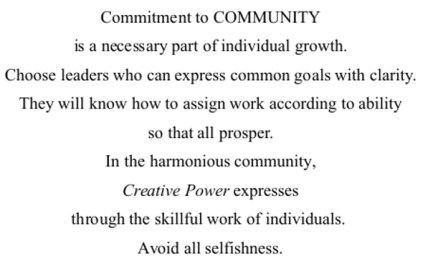
Be that as it may, I queried for direction. The resulting hexagram COMMUNITY was directly to the point of my concern. The CSBOC reading for #13 is:

IC 13

A changing line in the second place reinforced the concluding warning against selfishness: Avoid special interest groups. Selfish and corrupt motives bring downfall.

The resultant change, were the warning heeded, is #1 – CREATIVE POWER, which further reinforces the text.

The changing line in the fourth place reads: If you have become isolated, understand why and correct yourself.

This warning line pin-points a major problem. If heeded, the resultant change would result in # 37 – FAMILY, the cornerstone of community. I take the concluding warning very personally: Avoid roles not suited to your nature.

This returns full circle to my immediate dilemma. As a writer, my topic – the uncertainty of human survival – puts me in the role of a Cassandra relative to the larger, defiantly oblivious society. Being the messenger of an unpopular warning, though it seems my calling, can be isolating, not to mention unrewarding. It results in lifestyle issues with no immediate solutions in sight.

Nevertheless, I persist in believing that as increasingly more people find themselves in desperate social and economic straits, readiness will increase and my time eventually will come. The funding needed to support the intentional communities I envision will eventually materialize.

The situation reminds me of the dilemma faced by the warrior-charioteer Arjuna in the Bhadavad Gita. Those who opposed him were corrupt relatives, which posed a great conflict. Was it morally right to take sides against family, even if they were in the wrong? Forced to make an apparently no-win choice was paralyzing. On the battlefield, overwhelmed, he put down his weapons and refused to fight.

But at this crisis and turning point, his chariot driver, Lord Krsna, revealed his true identity. With inspirational encouragement, he encouraged the warrior to take heart, stand firm and win the righteous battle against evil.

GITA sized

Similarly, the communities which timeless scriptures encourage, of which Einstein wrote, and of which I am thinking, are not based on biological or even cultural kindred, but rather on resonance of heart and mind. Communities connecting kindred souls, if you will. And in this, the exceedingly dangerous times in which we live hold magical seeds of opportunity. From Two Sides of a Coin:

Whereas most rulers suffer the unanticipated consequences of ignorance, pride and greed as shock, humiliation and undoing, sages intentionally harness the forces of nature to positive ends. Thus it is, that throughout history, at the right time, in the necessary circumstances, leaders of ordinary and humble beginnings have catapulted to extraordinary levels of accomplishment, effecting broad political and social change.

By voicing the collective yearnings of the suffering masses, perennial sage-leaders shed the light of eternal hope on times of greatest darkness. By inspired words and living example, they recreate ever-new the Gita’s vision of opportunities hidden within the outward experience of hardship.

For as sages know, “when social degeneration reaches critical mass, regeneration follows.” From Passage 78 of the Tao Te Ching:

78a snippet

Returning to this morning’s magical COMMUNITY reading: another next bend in the road occurred. Surprisingly, the changing lines combine to produce a most inauspicious outcome: # 9 – FRUSTRATION, which begins:

External factors you may not even be aware of will cause FRUSTRATION. New projects will not work out now. . . Your choice is either to wait patiently or to leave the situation.

It concludes by advising, Avoid major commitments.

So, turning to what I saved for last, I asked, What is the nature of the frustration in building intentional communities? The answer, when I checked the astrological description of today’s new moon was this. Timing. Major planets of communication and reform are currently going into hibernation, so to speak. Retrograde.

According to the calendar, the correct decision for me personally is to wait until the end September and into October. For the time being, continue to patiently endure unavoidable frustrations.

For others, for many other reasons, there will be other choices. What is consistent across the board is that building effective intentional communities will depend on an army of Arjunas, each of whom listens to the inner voice of conscience represented by Lord Krsna rather than to the dictates of their particular biological families or immediate social, political and religious prejudices.

Sometimes I wish I could win the largest lottery in history, as if that would end current frustrations. Yet I know bringing in money that way cannot solve the deeper problems. It would not influence hearts or minds, persuade the public of the wisdom needed to ensure human survival. For this, patience is required. So it is no accident that first three letters of PATIENCE are also the first letters of my name.

Today’s magic provided the immediate encouragement now needed to keep writing . . . balanced with acceptance of long-term timing. May my telling of it encourage fellow Arjunas-in-waiting, those who also will, when the time is right, God-willing, be ready to build on common ground.

Stillness and Peace

Sometimes words fail me. Keeping quiet seems the better way. To share my immediate preference for silence, I’m offering two earlier approaches to Stillness. The simplest comes from the Common Sense Book of Change. The second elaborates on the first, and as a compliment may prove helpful.

Hexagram 52. STILLNESS

Peace within and harmony without come from STILLNESS.

When immediate answers to important questions

cannot be found,

sometimes keeping still is the best way out.

Burning desires produce chaotic thinking.

This only clouds the issue

and makes life painful.

Meditation is a valuable method for finding stillness.

Avoid useless activity.

Essay 47 from Conscience offers alternative perspectives on the meditative tradition, practiced throughout the ages around the globe.

globe

Essay 47. STILLNESS

Knowing where and how to settle the mind, one will become calm.

Having attained calmness, one will be undisturbed.

Having attained an undisturbed mind, one will have peace.

Having attained peace, one’s mind will respond correctly to all situations.

One who responds correctly to all situations will find the way.

— Confucius, Great Commentary. [emphasis added]

I suggest you begin with such a primary procedure as simply the practice of keeping physically still. . . In developing a calm control it is necessary to think calmness, for the body responds sensitively to the type of thoughts that pass through the mind. It is also true that the mind can be quieted by first making the body quiet. That is to say, a physical attitude can induce desired mental attitudes.” — Norman Vincent Peale, The Power of Positive Thinking

Taoism advises us to try neither to win nor lose, to seek neither resolution nor impasse, but to study the rising and falling of the way as it moves through the field of our conflict. . . At all times, we search for the center, the fulcrum that creates balance. We stay within the eye of the hurricane. We look for the center, for that is where truth is to be found.” — Brian Muldoon, The Heart of Conflict

THE FRONT

The root of “still” means immobile. By extension, the quality of stillness means being without sound; quiet, silent. It means not moving, stationary, at rest, motionless. It is characterized by little or no commotion or agitation, being tranquil, calm, and serene, like the still water of a lake.

The “where” Confucius refers to in the Great Commentary is the point of focus, called the ajna center, known as the third eye – Muldoon’s “eye of the hurricane.”

The “how” refers to meditative breathing and exercise practices which direct the flow of energy (chi). The intent is to circulate chi freely throughout the subtle nervous system and energy centers, thus linking and harmonizing the interrelated functions of mind and body.

Peace” refers to inner equilibrium, regardless of whether the external world is in harmony or conflict. “Correctly” refers to behavior in accord with natural and divine law. “The way” refers to the unfathomable Tao, the undivided source of creation.

In the Bible, we’re told, “Be still and know that I am God.” Similarly, in Asian traditions, meditators cultivate a quiet heart through physical stillness to experience the supreme ultimate, Tai Chi.

The practical methods outlined in Patanjali‘s Yoga Sutras are helpful in this regard. This classic lists sequential stages of development, as well as obstacles to be avoided. When the beginner first starts the process of calming and disciplining the mind, temptations arise.

One, for example, is the quicksand of astral experience. Others include “siddhis,” or “powers” – sometimes offered by the “dark side of the force.” The beginner is warned to recognize the important difference between between the multitude of seductive astral voices and the quiet, still voice of conscience.

During initial stages of training, distracting voices are silenced. Discrimination is cultivated. helping meditators recognize the difference between fantasies, old mental impressions and genuine intuition. The goal is to penetrate the clouds of the middle astral/energy level of the Life Wheel in order to access the still, timeless center.

THE BACK

Information overload is the opposite of stillness. Visual and audio clutter pull attention in thousands of fragmenting directions, diminishing personal integration and mental cohesion. In extreme situations, the mind and nervous system shut down in self-defense, going catatonic to close out mind-shattering external influences.

Rigid tension, blocking out whatever was seems threatening or inconvenient, obstructs the relaxed, receptive attitude of genuine stillness. Those who ignore the still voice of inner calling and the good advice of true friends can’t receive help. Impervious minds, deaf ears and hard hearts are perversions of stillness.

globe bullet size

Overcoming Limitations

In writing an invited article for the international journal Prabuddha Bhrata, I was so bold as to speculate about the prophecized End of Times. In retrospect, I’m having second, third and fourth thoughts.

Here’s what I wrote:

. . . wherein is consolation to be found during the present difficult times? For Hindu sages foresaw them. We are now enduring the decline described as the Kali Yuga. Christ similarly foretold the End of Times. It lies in this. Time does not exist for accomplished sages who dwell in the eternal center of the Life Wheel. To enlightened beings, it is but an illusion. They experience themselves as eternal, at one with the Creator. For them, life will go on whether or not the world as we now know it continues. If even for this reason alone, seeking inner enlightenment is an urgent priority.

How can one really know about such things? Such opinions are necessarily based on hearsay, albeit the testimony of sages is consistent on such matters.

To the point is a description of time as a fourth dimension in the marvelously articulate and entertaining book The Tao of Meditation:Way to Enlightenment by Tsung Hwa Jou. He writes:

Like the shadow, which cannot perceive something above or below its plane, we live in a three-dimensional world, able only to experience reality in segments of time.

According to Mr. Jou, Man’s epistemologies and methodologies are all right from a three-dimensional point of view, and since this is our only possible viewpoint, they constitute the best means to the truth about our reality. Every religion, philosophy, or science is right in three dimension. . . with this caveat: these partial approaches to truth are like different windows in a large building. Each affords us a different view of the outdoors. A unified perspective, however, is gained only by leaving the building.

He continues:

What is the shape of life from a four-dimensional point of view? . . . Suppose there are sentient beings who have a natural capacity to see the four-dimensional shape of things. They could tell us what the shape of our life is; that is, they could see all at once what to us is separated as past, present and future.

Likewise, he assures us that in the fourth dimension, birth and death are not separate, discrete experiences, but rather part of an ongoing, continuous whole. Our birth and death are just another transformation of one form to another.

In sum, he agrees with other accomplished meditators who regard time as we experience it as but an illusion. The perception of beginnings and endings is the result of human limitations – being capable of seeing in only three dimensions.

Why does this matter to us NOW? Look at it this way. Mr. Jou’s Motive, his WHY appears to be a kindhearted desire to share wisdom received from direct experience, for which he is infinitely grateful. His Purpose, the HOW is to detail in a book the methods and benefits of meditation along with the supporting science which explains its effectiveness. His Intended end result, the WHAT, is to give readers a time-tested way to improve the quality of daily life for both individuals and their social combinations:

If people began to think past the limitation of three-dimensions, there would be more respect between men in the business of living together for the common good. Three-dimensional tensions would dissolve, and a spirit of cooperation and mutual generosity would spring up in human affairs.

But he also admits that describing direct experience of the fourth dimension is like describing the taste of an apple to someone who has never eaten one. Similarly, he describes a mother frog who answers her babies’ questions about sunlight, trees and land by telling them they’ll have to wait until they mature, shed their tails and swim to the surface of the pond to experience what’s beyond for themselves:

We who philosophize about time, we who are limited to three dimensions are like a school of tadpoles wondering about another world. Until we too are able to “drop our tails” and step into that dimension, time must remain a subject of speculation to us, as a drinking glass is to a shadow. Until we can experience time as a dimensional context, it must remain a flat reflection to us as the upper world is to the water-bound tadpole.

The question/challenge for us as tadpole-like humans is HOW do we get from here (three-dimensional, conflict-driven either-or thinking) to there (fourth-dimensional awareness within and beneficial, harmonious relationships with others in the world).

Training the mind to expand awareness has been the systematic task of monastic Asian traditions throughout the ages. At the current “time,” the benefits of meditation – significantly improved awareness and effectiveness – may well be a matter of both individual and collective survival.

To that end, I’ve been looking through an assortment of books, each of which opens a different window on the subject of Spiritual Intelligence. In the PB article, I placed this term in the larger context of the two-directional, multi-layered Life Wheel:

In terms of clinical psychology, intelligence at the outermost level is described as IQ, at the middle level as EQ (emotional intelligence) and at the third as SQ (spiritual intelligence)..The levels, which actually flow along continuum, neither separate nor totally distinct, are linked in an infinite loop. The one who succeeds in joining them, living here and yet there, in the world but not of it, enjoys the experience of enlightenment – Christ Consciousness.

Each of the books on SQ (or SI) has its own point of reference, for example quantum physics, Christianity, etc. Interestingly, there’s also a forthcoming book on SI by and for Muslims based on teachings from the Koran. While a detailed summary is beyond the parameters of the current discussion, suffice it to say that although each author defines spiritual intelligence differently, they share a common intent.

Unfortunately, another thing Spiritual Intelligence books share in common is than none have gotten much traction. A quick tour through Amazon books shows that very few have been reviewed or purchased. Spiritual intelligence as a concept isn’t sexy. It is as if the concept is outside the “hearing” range of the general public. Why this remains so and what might be done to change this is yet another subject worthy of investigation and ACTION.

I do know, as do the authors of SI books who repeatedly call for “change,” that the future depends on such a reawakening. In the context of End of Time concerns, I’m reminded of Hexagram 49 of the Book of Change:

Day and night replace each other in endless cycles of CHANGE.

The same natural law generates flux in human events.

The unprepared see change as a threat,

but the well-prepared face the unknown calmly.

They know that after degeneration reaches critical mass,

regeneration follows.

In other words, one way or the other, preparation on every scale of magnitude will definitely make a great difference in the outcomes of as yet unforeseen futures waiting to be born. Overcoming the limitations of our current either/or way of thinking is an important first step. For, to repeat, as Einstein warned us, “We shall require a substantially different manner of thinking if mankind is to survive.”

For starters, thinking about this admittedly limited linear Essay on limitations may be helpful.

globeEssay 10. LIMITATIONS

The Chinese concept of change, which gives the I Ching its validity, has found its echo in chaos theory. The concepts presented by this theory give us vital information about how the I Ching functions. Understanding this may help us cross the bridge between determinist rationality and chance, and go further toward our comprehension of this age-old system, which could have a profound influence on the rest of our lives”. — Cyrille Javary, Understanding the I Ching

Let me not to the marriage of true minds

Admit impediments. Love is not love

Which alters when it alteration finds

Or bends with the remover to remove.

Oh no! It is an ever fixèd mark

That looks on tempests and is never shaken.

— William Shakespeare, Sonnet 116

The Bible encodes all the possibilities, and what we do determines the actual outcome. . .The only thing that can be predicted is the probability of different events. Yet quantum physics is a highly successful branch of science. It works. Perhaps because it recognizes uncertainty as a part of reality. In the same way, the Bible code works . . . because it recognizes uncertainty as part of reality.” — Michael Drosnin, The Bible Code

THE FRONT

A limit is a point, line or edge where something ends or must end, a boundary or border beyond which something ceases to be or to be possible. A limitation is something that limits, as some factor in make-up which restricts the scope of a person’s qualifications, activity, or accomplishment. In law, it’s a period of time, fixed by statute, during which legal action can be brought, as for settling a claim.

On the positive side, we limit ourselves consciously by choosing how to allocate our attention, time and effort. This is called discipline and commitment. On the negative side, we unconsciously diminish our potentials, tying them up in knots of insecurity and doubt. Attitude limitations are as debilitating as physical handicaps. Often they’re unconsciously acquired, internalized by cultural conditioning and negative suggestions. Identifying and correcting these attitudes, overcoming unnecessary limitations, is essential to personal growth and fulfillment.

Rules of empirical science limit the field of knowledge to tangible things. Yet when we exclude the data of extra-sensory experience, we impoverish our lives. Instinct is a survival mechanism built into animals and humans alike. Dogs and horses, however, are sometimes more savvy about people than we are; they’re not fooled by false appearances. Intuition, however, is a gift exclusive to humans. It flashes on inventive thinkers when they see new possibilities or dream of futures not yet born.

The I Ching supplies a method for revitalizing instinct and intuition gone numb through suppression or lack of attention. It helps us link the middle octave of reason with the lower and higher octaves of experience, expanding our range of hearing and awareness.

People raised exclusively on empirical science limit their concept of love and joy to tangibles — physical beauty and sex appeal. When youth fades, marriage partners who lack wisdom are tempted to break their vows. Using the I Ching, however, helps fine-tune awareness of what changes, as well as that which remains constant. Using the I Ching as the foundation of realistic relationships, we build the inner consistency necessary to sustain commitments and complete long-term goals.

But just as an individual’s time on Earth is limited, civilizations and even planets pass in due course. At each stage in history, wisdom appropriate to the times is revealed to those who seek. Drosnin speculates that Newton’s intuited but evasive Bible code was purposefully hidden until the time that computers were invented to unlock it. Similarly, Einstein’s Unified Theory eluded him because he lacked yogic I Ching wisdom. In turn, it may well be that the extraordinary value of this text has been hidden for centuries, waiting for public understanding of binary-digital computer code, energy chakras and DNA genome theory to revolutionize our approach to the Book of Change.

THE BACK

The opposite of limitations is the unlimited. We call this infinity or the unknowable unknown. We are told we have unlimited potentials, but on the material plane they are framed by choice and the structure of whatever language we speak. Only the unfathomable, unnameable essence referred to as the timeless Tao or God — the alpha-omega source of creation — is truly without limitation.

When humans defy natural limitations of time, space and form, they are said to be delusional. When they behave in reckless, unrestrained ways, in defiance of their mortality, acting as if they were invincible and above the law, this is arrogance and sheer ignorance. Knowing one’s place in the universe is wisdom; resisting it is futile.

globe bullet size

Where Is the Unity in COMM-UNITY?

Working with words mindfully is an interesting challenge.

For example, have you ever wondered about the names United States and United Nations? Why did Founders choose to describe their country as United? United on what levels and in what way(s)? By common principles? Common interests, commitments, or vision for the future?

What did charter members of the international organization intend by using the same word, United? Pursuing common goals, pooling resources and/or standing firm against common dangers? Does the word hold the same meaning today as it did earlier? What does it mean now, and to whom? Does United mean the same thing to insider elites as to the rest of us? Why does this matter?

The use of the word United is ironic with overtones of tragedy, given the current fragmented and contentious condition of both entities.

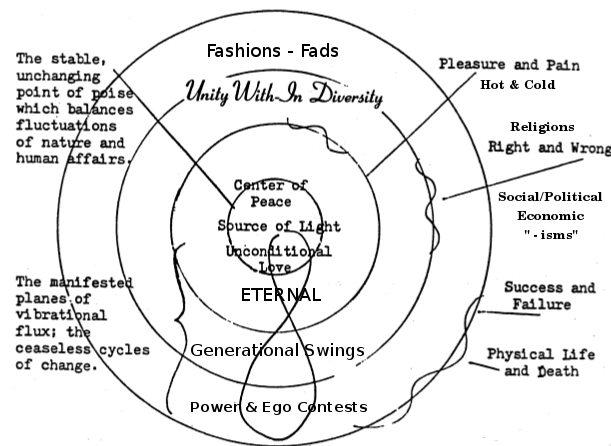
It part, current problems were inherent from inception, a consequence of failing to be philosophically correct in foundations. This single picture shows wherein unity can truly be found, and where not.

0 Def of Paradigm

Looking for unity in the wrong places was fraught with potentially dangerous consequences which are still bearing poisonous fruit today.

It’s especially important to rethink the meaning of Unity in the context of building intentional communities, for the chain of individuals bound together by common purpose is no stronger than its weakest link. The foundation of viable, sustainable communities begins with the integrity of each participating member.

The following Essay from Conscience provides food for thought along these lines. It offers a holistic perspective on unity, both within and without. This comprehensive view offers a useful understanding for building effective communities, as well as diagnosing past failures experienced as a consequence of limited vision and follow-through.

globe bullet size

Essay 60. UNITY

An individual has not started living until he can rise above the narrow confines of his individualistic concerns to the broader concerns of all humanity. — Martin Luther King, Jr., The Words of Martin Luther King, Jr. 

The scientist or the artist takes two facts or experiences which we separate; he finds in them a likeness which had not been seen before: and he creates a unity by showing the likeness. . . . All science is the search for unity in hidden likenesses. — Jacob Bronowski, quoted by Todd Siler in Think Like a Genius

I have always felt that one of the simplest and most apt metaphors for an organization as complex as the United Nations is the Rorschach inkblot test. What one person sees as the hope of a world free of war, famine, poverty, and disease, another interprets as a global boondoggle comprised of uncaring civil servants threatening the cherished concept of state sovereignty. — James Holtje, Divided It Stands: Can the United Nations Work

THE FRONT

The Latin root of “unity” means oneness. Webster’s first definition is the state of being one, or united; oneness, singleness. It means something complete in itself, single, or separate. It can be the quality of being one in spirit, sentiment, purpose; harmony, agreement or concord. In contrast, it can also mean uniformity.

It can refer to an arrangement of parts or material in a work of art or literature that produce a single, harmonious effect. It can refer to constancy, continuity, or fixity of purpose or action.

The difference amongst these definitions reflects a general cultural confusion as to the optimal relationship of the individual to nature, society, and their creative Source. Effective, consistent action depends on an integrated concept of self and a comfortable relationship of each part with the whole. Therefore, thinking carefully about what unity means — as well as what it doesn’t — is a necessary prelude to ultimate success in life.

Accepting the I Ching view that accomplishments begin with the smallest unit, unity is first to be attained within. It’s common to say, “My mind’s not made up” or “Get it together.” The familiar saying, “The right hand doesn’t know what the left is doing,” could also be phrased, “The left brain doesn’t know what the right brain is doing.”

When Westerns say, “I’m of two minds on this,” it reflects confusion, ambivalence or lack of discipline. However, the martial arts advice to have eight brains and eight hearts refers to the height of attainment. It suggests ability to intentionally shift internal gears to meet any situation. From the totality of unified mind, the ideal I Ching master focuses from above while acting through each of the energy centers according the immediate need at the time.

According to the MPI Standard, the Motive, the WHY of psychologies and meditative practices is the same: to unify fragmented, antagonistic functions of mind, personality and behavior.

The Purpose, the HOW they accomplish this is diverse. Some practices start from the outside with behavior and work inwards. Others start with the mind, ideas and attitudes, and work outwards. Still others work on both simultaneously, which is possible in comm-unities where work and self-awareness training go hand-in-glove.

The Intent, the WHAT, ranges from personal self-mastery to inner peace and/or functional relationships.

As pictured above, in a holistic world view, external diversity complements inner unity. The core of life’s concentric circles, like the hub of a wheel, remains still as the outer rim revolves, constantly changing and in motion. Meridians, like spokes of a wheel, link center to surface, connecting and organizing the Wheel of Life in a dynamic unity.

It hardly matters how the goal of inner unity is attained. Once one is focused and all the facets of inner energy are coordinated by a single-minded purpose, the pieces of life’s mosaic fall into place, forming a coherent picture. Then life becomes a work of art, like a poem or a song.

Albert Einstein — equal parts musician, philosopher, physicist and world citizen — searched lifelong for a Unified Theory. The Book of Change embodies the universal code he sought. We’ve failed to recognize the clues hidden for centuries in a venerable text that have the potential to lead us to solutions desperately needed NOW. Restoring this treasure to the general culture would provide a fully functional paradigm from which positive, life-sustaining results can be generated across-the-board.

THE BACK

Regimentation and conformance are perversions of unity. Nature flourishes in diversity. Like snowflakes, each individual is a unique variation of its kind. Yet, in extreme social contexts, variations are suppressed and punished. While this unnatural state might be appropriate to unnatural situations like war, it’s antithetical to personal well-being.

Technically, because all things are connected, it’s possible to dabble in the dark worlds of demons and departed souls. However, though these realms do exist, it is dangerously unwise to explore them without a specific, positive purpose (“know the enemy”) and a white magician’s guidance.

Rethinking COMMUNITY

For years now, the same familiar pattern repeats. Whenever I decide I’m finished with writing, something comes along to make me rethink my decision. Two such events triggered today’s post. One was a thought-provoking article, “Mindfulness, Behavior and Social Change” by Mark Leonard, Director/Mindfulness Trainer at the Oxford’s Mindfulness Exchange.

I responded with a question: I’ve often thought about the possibility of building intentional communities, despite the evidence that experiments in the past have not always worked out well. Any thoughts on the subject?

In fact, I had mentally sketched but not followed-through on an article about intentional communities based on my connection with Spring Green and Frank Lloyd Wright’s Taliesin Fellowship. It was an example which, for many important reasons, I would not recommend following.

He replied: I suspect an intentional community needs a suite of conditions including contemporary analogs of functions which hold traditional societies together. I think that mindfulness meditation could play a part here.

The basic axioms listed in The Positive Paradigm Handbook are my recommended contribution to this cohesive foundation. They were fatally lacking in the Spring Green experiment.

Coincidently, these axioms were the reason for accepting an invitation from Swami Narasimhananda to submit an article to Prabuddha Bharata, a journal devoted to the social sciences and humanities started by Swami Vivekananda and in continuous publication since 1896.  [See When Conflict Escalates, What Can Be Done NOW? ]

Timing being everything, I had decided a few hours earlier to list them there in the context of rethinking leadership, family and community based on timeless wisdom traditions.

My interest is based on the observation made in The Age of Heretics (Charles Krone) that when chaos enveloped the civilized European world, monasteries appeared during the dark ages as islands of purposeful community — centers of learning, healing and hospitality. Similarly, monasteries of refuge from barbarism appeared in Asian lands during particularly harsh historical times.

This dynamic seems highly relevant today, for, as Mark Leonard details in his article, the world is surely sinking into another dark ages. Intentional communities may once again become the necessary counter-balance of positive change — the means for ensuring human survival, which, as Einstein warned us, can no longer be taken for granted.

So for starters, from Conscience: Your Ultimate Personal Survival Guide, here are my original thoughts on community. It forms a hopeful basis for rethinking intentional communities. Although my frame of reference for thinking about the dynamics of change is the Chinese Book of Change, resonance with the immediately popular mindfulness movement will be immediately apparent.

globe

Essay 14. COMMUNITY

We can create communities and relationships that are based on love and intimacy rather than fear and hatred. We can learn from the suffering of others. Awareness is the first stage in healing. . . Likewise, we can create a new model of medicine as we move into the next century that is more competent and cost-effective as well as being more caring and compassionate.” — Dean Ornish, Love and Survival

As we accept the smallness of the world, the density of the population, and the myriad influences on individuals and families, someday we may recognize the community and even the whole society as the patient. Imagine, then, what a “doctor of society” might do, what kinds of diseases he or she might treat!” — Patch Adams, Gesundheit!

Each celestial body, in fact each and every atom, produces a particular sound on account of its movement, its rhythm or vibration. All these sounds and vibrations form a universal harmony in which each element, while having its own function and character, contributes to the whole.” – Pythagoras, quoted in The Healing Power of Sound 

THE FRONT

Community stems from a root word meaning fellowship. In English, the word refers to all the people living in a particular district or city. It can also mean a group of people living together as a smaller social unity within a larger one, and having interests or work in common, such as a college community.

Alternatively, it can refer to a group of nations loosely or closely associated because of common traditions or for political and economic advantage. It also covers similarity of tastes and preferences. The last definition Webster’s gives is the condition of living with others in friendly association and fellowship. The last definition has come full circle back to original meaning.

Communities are founded on a common cause. It can be as practical as survival or idealistic as freedom. Often, community cohesion is artificially stimulated by fear and hatred of a common enemy. Hitler inflamed passions against Jews and foreign bankers to mobilize his war-weary country into a second world war even more devastating than the first. Then Americans rallied behind the common goal of defeating enemies of democracy on two fronts, Asia and Europe.

In Common Sense, Thomas Paine wrote about the relationship of divine, natural and human law in a way that inspired readers at the time of the American Revolution to fight for freedom from tyranny. Winning that war did not, however, automatically secure freedom for all times. Democracy isn’t a static achievement that can be passed on unchanged from one generation to the next. It must renewed and earned again, one individual at a time, each generation at a time, continuously redefined in the context of immediate circumstances.

Nor can the structures of American-style democracy be imposed by force, whole, from the outside, on peoples whose beliefs are shaped by vastly different cultural influences. It is the common respect of life and liberty, not external forms, which is universally translatable. The music of life that moves every organization, smallest to largest, is the basis of harmonious fellowship. Approaching natural law and social organizations from the deeper understanding of the ancients could inspire a new, more humane and effective approach to international relations now, one based timeless values which the human community shares in common.

Sages say that freedom from tyranny begins with dispelling ignorance and overcoming negative emotions. True freedom and stable communities begin with the self-awareness and self-mastery which can be gained by diligent use of wisdom tools like the I Ching. First remembering the core of compassion and caring within, we can then extend and expand this good-will into healing society as well.

Put another way, it’s useless to fight for a democratic world before one cleans out the inner swamp of negative emotions. Since inner life projects into external experience, fighting tyranny in the turmoil of anger and hatred reaps results in kind. Therefore, working to establish positive community relationships before attitudes of good-will and willing self-discipline are established is a futile exercise. As Covey reminds us, first things must come first.

Conversely, the more individuals free themselves from personal problems, the more they become open to the calling to community and able to play their part in the harmony of the natural whole.

THE BACK

Street gangs, terrorist groups, religious cults and secret societies are subgroups within the larger community. To the extent that their goals oppose and even endanger the community at large, these organizations are antithetical to the general good.

Pariahs, nomads and outcasts [heretics!] are individuals excluded from society, either voluntarily or by edict. Whether justified or not, their attitudes and behavior are out of harmony with accepted norms. If enough of them find common cause to band together, they form alternative groups which become the foundation of new communities.

globe bullet size

Rethinking COMMUNICATION

The following essay from Conscience: Your Ultimate Personal Survival Guide is an appropriate companion to the article just posted on LinkedIn, “True Leaders Trust Their Inner Compass To Overcome Confusion.” It opens with a question:

When others use the same word to mean different things, how do effective leaders bridge the gap to communicate clearly? If you’d like to see the rest, here’s the link: https://www.linkedin.com/pulse/true-leaders-trust-inner-compass-overcome-confusion-patricia-west?trk=prof-post

globe bullet size

Essay 32. COMMUNICATION

He who is learning to paint must first learn to still his heart, thus to clarify his understanding and increase his wisdom.” — The Mustard Seed Garden Manual of Painting, quoted by R.L. Wing.

Painting in China made it possible to manipulate the veil of appearances so that it might be pulled away to reveal the hidden essentials of reality and lead the observer into an experience approaching ‘truth.’ Both art and the I Ching employ a triggering device that makes conscious that which has been buried in our unconscious.” R.L. Wing, The Illustrated I Ching. 

“My pen is my bokken, sword of discrimination, ruthless as it follows certain lines of thought onto the page and ignores others into nonexistence. My pen gives life or death to words. My pen cuts through partial truths, slashes weak verbs, and sparring and paring, uncovers a rare, gemlike image. . . As my mind’s chatter settles ever more deeply, my pen can follow a thought like a bee tracking nectar.” — Connie Zweig, Becoming a Warrior Writer

THE FRONT

Roots of communicate suggest sharing, to make common. Webster’s defines communication as the act of transmitting, giving or exchanging information. The means can include signals, gestures, and writing as well as speaking. The word is also used to describe the means of information changing hands, such telephone, telegraph, radio, or other systems. It’s also used to describe routes for moving troops and materials. In the arts, it connotes expressing ideas and sentiments. In mathematics and science, it includes symbols.

The definition has no shadings of meaning to indicate the multitude of verbal and non-verbal levels of information exchange, acknowledging a broad spectrum spanning cellular synaptic connections and inarticulate body language on one extreme to non-local, telepathic messaging (ESP) at the other. The definition of communication also lacks nuances that indicate motives for communicating, or whether information shared is complete or accurate.

Bad-faith extremists babel. They intentionally miss each other coming and going. Seemingly powerful extroverts (extreme-yang aggressors or oppressors) abuse communication tools as overt weapons of propaganda, intimidation and subordination. Speech is used to overpower and control. Seemingly helpless introverts (extreme-yin targets or victims) use language (along with silence) as covert weapons of self-protection or retaliation. Words are used to placate, distract or mislead.

In The More You Watch the Less You Know, TV veteran Danny Schechter observes that there’s a media war going on to win the hearts and minds of viewers. It’s going on in education too. Insiders disempower people with the potential to threaten empire-building plans by feeding them partial information piece-meal. Potential leaders are co-opted by rewarding them for knowing more and more about less and less, calling the outcome “expertise.” The right hand/brain can’t know what the left is doing.

It takes cooperative interdisciplinary work, linking not only related academic specialties, but also the levels of law, to discover solutions to apparently unsolvable economic/social/political conundrums. The most essential community-building service sincere leaders can provide is the dissemination of accurate, hopeful information that promotes positive action. As people of good-will intentionally transcend extremes, cultivating balanced mesovert communication skills, they are developing a base of values shared in common, along with means for connecting to share vital information.

Especially in the arts, however, it isn’t the writer who inspires. Words are just catalysts. They precipitate inner knowing, causing it to rise to the surface of conscious awareness. It’s the result of synchronicity. When the writer, reader, time and topic are in synch, then, Bingo! There’s a connection — communication.

THE BACK

The opposite of communication is silence, the absence of giving and/or receiving information. In a social context, ignoring others is a sign of mistrust or disrespect, a denial of their value, trustworthiness or sincerity. In meditation, however, silence in the inner sanctuary of the mind is the respectful attitude of receptive humility. In this context, cessation of dialogue is prelude to at-oneness.

A perversion of communication is cacophony. The overwhelming amount of data now available from an increasing number of sources causes information overload. City streets and public places are filled with loud, harsh noises that shatter the nervous system. This extreme causes the mind to shut down in self-protection.

Put Terrorism in Larger Context

Recently, much commentary has been focused on the Charlie Hebdo murders in Paris. Most are asking the wrong questions. Many look to place blame. There are exceptions however. Looking for lessons to be learned which might lead to hopeful solutions is the rare but positive approach.

Why do either/or-thinking journalists fixate on assigning or denying blame? Like spoiled children, they squabble and point fingers. “He started it.” “No, it’s their fault!” It’s time to grow up! Expand our way of thinking to recognize the all-inclusive pattern in which everyone is partially culpable and equally responsible for positive change.

The prevailing materialistic paradigm of empirical science limits the questions which can be asked, which in turn limits the places where viable solutions are to be be found. If the middle and innermost levels of the Life Wheel are ruled out, analysts are functionally blinded to the dynamics on all sides which perpetuate back-and-forth bickering, throwing self-righteous excuses for hatred and violence. When underlying motives which drive these dynamics are ignored, the parties on all sides of escalating world conflict place human survival at risk.

Terrorism is a surface symptom of much deeper problems. Attacking symptoms of disease without correctly diagnosing root causes can quell specific symptoms. But the cause, unseen and untouched, simply mutates into even more dreadful symptoms. Destroying terrorist cells is like surgically removing cancer from an affected organ, only to cause its spread throughout the body.

Intent is the WHAT, the outcome or end result that resides on the outermost level of the Life Wheel. In this case, the Paris murders and kidnappings are only the visible end result of a much larger and more complex process.

Deeper than intent is purpose, the HOW. Purpose resides at the middle, energy level of the Life Wheel. For example, one purpose of terrorism is to use violence as an instrument of economic or political upheaval in the name of “social justice.”

Still deeper than purpose is motive, the WHY that leads to violent methods resulting in death and destruction. In some very twisted way, the motive may include setting perceived wrongs right, asserting self-respect and restoring violated human dignity.

Then the questions become, What is justice? Wherein lies valid self-respect? What is the basis of true human dignity? Can these valid motives possibly be served through acts of violence that destroy lives on all sides? Sounds like a fundamental contradiction to me.

If the deepest, underlying motive is to set wrongs right, that opens many doors for alternative approaches to satisfying these motives, ones appropriate to the basic human needs crying out for expression, ones with some valid ways for actually fulling them, instead of the self-defeating methods and results we see now.

World leaders, and each of us as the leaders responsible for doing our best within our limited spheres of personal responsibility, would do well to rethink recent Paris events by putting them in larger perspective. Use the MPI (Motive-Purpose-Intent) standard to look deeper into the heart of terrorism as the first step in making positive responses leading in new directions.

Here as food for thought is an earlier essay on motives. It seems timely and may prove useful.

globe

ESSAY 18. MOTIVES

Although the feelings mentioned above [sadness, pessimism, guilt, emptiness] may accompany a depressed mood, the most prevalent effects usually involve low energy and lack of motivation . . . An effective way of lifting these moods involves using music to activate our resources.”  — John M. Ortiz, The Tao of Music: Sound Psychology

It occurred to me that the only way to figure out what had happened at a crime scene was to understand what had gone on inside the head of the principal actor in that drama: the offender. And the only way to find that out was to ask him. . . If we could give the law enforcement community some insights into the process, the internal logic, of how violent offenders actually decide to commit crimes and why they come up with their choice of crimes — where the motive comes from — then we could provide a valuable tool in pointing investigators toward what for them must be the ultimate question: Who? Stated as simply as possible: Why? + How? = Who.” — John Douglas, The Anatomy of Motive

On some level, you are meditating all the time. One goal of meditation practice is to become aware of that. Another is to extend that awareness to more and more areas of your life. . . It takes practice and conscious effort to restructure the mind and move it from habitual patterns.” — Andrew Weil, 8 Meditations for Optimum Health

THE FRONT

The root of “motive” is “to move.” Webster’s single definition refers to “some” inner drive, impulse, or intention that causes a person to do something or act in a certain way. It’s an incentive or goal.

Motive, purpose and intent explain human behavior. Unless viewed as a whole, what we see is taken out of context and misunderstood. You see a man take someone else’s car. That’s intent, the WHAT. You see him grab the keys and drive off. That’s purpose, the HOW. But unless you know his motive, WHY he did it, the picture is incomplete. Was he desperately racing to save his beloved child’s life, escaping from vengeful gang lords, or simply lusting after a fancy new car?

We are fascinated by crime. Mystery novels, detective movies and sensational murder stories on TV news are big business. We stretch our minds to second-guess the ending, figure out who committed the crime, and why. We look for the mistakes that reveal dark secrets and lead to the criminal’s undoing. We’re satisfied only when truth is revealed and order is restored by justice.

At heart, what we’re really trying to understand is ourselves. We’re haunted by a pervasive sense of wrongs committed against us, or by us. We can’t quite bring ourselves to recognize what they are, or to admit our own mistakes. But a nagging sense of unfinished business leaks out as voyeurism.

Ultimately, it is the stifled voice of conscience that persistently calls us back to our neglected dreams and deepest longings for fulfillment. Those who allow themselves to be defined by others, who live in habitual fear of people’s opinions and fail to honor their inner sense of calling commit a soul-searing violence akin to suicide. The crime they commit is against their own true selves. Failing to be true to oneself can be the hardest crime to detect. Finding one’s true calling can be the greatest mystery of all.

People who march to others’ drums, unconscious of their motives and what moves those around them, live in painful confusion. Only those who know how to listen and dance to the inner music of their soul’s desire live in joyful harmony with themselves and the world around them.

The I Ching is a means for turning the camera around, focusing in on ourselves. Uncovering hidden motives might cause initial discomfort. But it can lead to positive changes. After analyzing them, we have the option to decide on better ways to accomplish intentional ends. Our What and How isn’t always appropriate to our Why. Other solutions may accomplish our goals without committing crimes against ourselves and others.

THE BACK

The opposite of motive is motiveless, to be without awareness of calling, any conscious purpose, or impulse to action. This condition is sometimes an extreme reaction to an extended period of frenzied, excessive, forced action. People experience it as apathy, shell shock or burn out.

When crazed criminals go on sprees, kill strangers and wreak havoc on public property, their acts are regarded as random and senseless. To all but the most highly attained, the subtle laws of cause and effect are incomprehensible. There’s wisdom in accepting the unfathomable as Job did, saying, “The Lord giveth, and the Lord taketh away.“