Category Archives: Psychology

Healing the Past

I highly recommend Brain Longevity by Dharma Singh Khalsa, M.D. with Cameron Stauth. They explain how meditation-as-medicine (the “magic bullet”) opens windows to personal transformation. It’s relevant to my LinkedIn post on the nature of Time. So I’ll give you an example of how medical “matter over mind” leads to its compliment, “mind over matter.”

People get “stuck” when they constantly relive the traumas that occurred when they really didn’t have much control over their lives. Specifically, many people can’t “get over” their childhoods, mostly because they suffered painful events then that they really couldn’t control.

Many continuously revive past traumas by recreating similar situations throughout later adult life. However, rather than “acting out” painful memories, some choose to confront their fears under the safe supervision of a therapist. The goal is to recognize unconscious negative patterns and replace them with intentional, positive action.

Meditation, however, takes healing the past to a whole new level.

. . . mind and spirit can heal. . . the space between our thoughts – what the Asian healers “the sacred space” – is where most spirit-directed healing originates.

They continue:

When you meditate and elicit the relaxation response, your mind stops racing with thoughts, and there are longer spaces between your thoughts. The space between thoughts usually feels timeless.

The concept of a fourth time/space dimension is familiar from Chinese yoga as well as Einstein’s physics. It repeats in the 1913 classic Sadhana: The Realization of Life by Indian mystic, musician, poet, novelist, painter, teacher, political activist and Einstein contemporary Rabindranath Tagore.
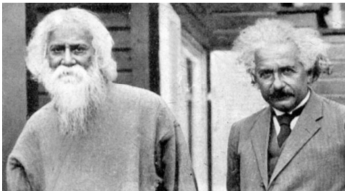
033015 R & E sized

He wrote:

Yes, we must know that within us we have that where space and time cease to rule and where the links of evolution are merged in unity.

Here then, is the original article:

globe bullet size


ALTERING TIME

The pattern repeats. Three strands emerge and merge to show how the apparently abstract and universal can be importantly relevant in an immediately personal way.

The subject of Time isn’t new. I’ve approached it twice before, both “times” from a practical point of view. Since then, however, I’ve been looking at Time from another perspective to find out how Einstein, experienced sages past and present, as well as science fiction writers describe its nature. Their views are in some ways similar, but in others importantly different.

Above all, what does all this mean to every day people like you and me? And why does it matter NOW?

If matters a great deal, for example, whether what we regard as the past is immutable/unalterable as if cast in stone. Or if, instead, as some say, it is possible to alter – even heal – a fluid past and thereby create a more hopeful, alternative future. If this truly is possible, HOW can we – you and I – alter at least a few minuscule threads in the fabric of time?

Strand ONE. If we compare Einstein’s comments regarding time, it seems he was of two (or more) minds about it. In his last years, consistent with ancient scriptures, he concluded that past, present and future exist simultaneously. In his 1952 book, Relativity, he wrote:

It appears therefore more natural to think of physical reality as a four dimensional [time-space] existence, instead of, as hitherto, the evolution of a three dimensional existence.

This conclusion, however, is the objective overview of a reflective senior scientist. In contrast, and not necessarily a contradiction, he earlier described a highly subjective and situational aspect to perceived time:

When you sit with a nice girl for two hours, you think it’s only a minute. But when you sit on a hot stove for a minute, you think its two hours. That’s relativity.

Strand TWO. In the context of writing an invited article for the international journal Prabuddha Bhrata, I was so bold as to speculate about the prophecized End of Times:

. . . We are now enduring the decline described as the Kali Yuga. Christ similarly foretold the End of Times. . . . [Yet] Time does not exist for accomplished sages who dwell in the changeless center of the Life Wheel. To enlightened beings, it is but an illusion. They experience themselves as eternal, at one with the Creator. For them, life will go on whether or not the world as we now know it continues.

To the point, in an post to my personal website, I quoted a marvelously articulate and entertaining book, The Tao of Meditation:Way to Enlightenment, by Tsung Hwa Jou. Experienced practitioner as well as author of a balanced tripod of books on Tai Chi and the I Ching as well as meditation, Mr. Jou describes the difference between three- versus four-dimensional experiences of time in terms of tadpoles and frogs.

A mother frog, so the story goes, answered her babies’ questions about sunlight, trees and land by telling them they must wait until they mature, shed their tails and swim to the surface of the pond to experience the beyond for themselves:

We who philosophize about time, we who are limited to three dimensions are like a school of tadpoles wondering about another world. Until we too are able to “drop our tails” and step into that dimension, time must remain a subject of speculation to us, as a drinking glass is to a shadow. Until we can experience time as a dimensional context, it must remain a flat reflection to us as the upper world is to the water-bound tadpole.

With Einstein at the end of his years, Mr. Jou agrees that time cannot be measured in discrete units, but rather, is a unified a fabric, a continuum in another dimension complete unto itself. But whereas Einstein arrived at his conclusion through abstract deduction, Mr. Jou was an experienced practitioner.

In sum, he agrees with other accomplished meditators. The concept of beginnings and endings is the subjective perception of limited, three-dimensional experience. Without making claims, he modestly asks:

What is the shape of life from a four-dimensional point of view? . . . Suppose there are sentient beings who have a natural capacity to see the four-dimensional shape of things. They could tell us what the shape of our life is; that is, they could see all at once what to us is separated as past, present and future.

Why does he bother to share this information? Mr. Jou’s Motive, his WHY appears to be a kindhearted desire to share wisdom received from direct experience, for which he is infinitely grateful. His Purpose, the HOW is to detail in a book the methods and benefits of meditation along with the supporting science which explains its effectiveness. His Intended end result, the WHAT, is to give readers a time-tested way to improve the quality of daily life for both individuals and their social combinations:

If people began to think past [sic. beyond] the limitation of three-dimensions, there would be more respect between men in the business of living together for the common good. Three-dimensional tensions would dissolve, and a spirit of cooperation and mutual generosity would spring up in human affairs.

To repeat, as Einstein warned, “We shall require a substantially different manner of thinking if mankind is to survive.” Perhaps that manner of thinking requires the courageous willingness and competence to enter an entirely different dimension of experience — a Star Trek-like journey through inner rather than outer space. This requires not only acquiring the theoretical concept of four-dimensional time which Einstein held, but further, its immediate, direct experience as consistently reported by accomplished meditators.

To take this the next step, however, even immediate personal experience is not enough. For completion of the infinite loop, inner attainment then requires application of awareness to the outer world of experience, changing relationships and even institutional governance for the better. Sound like science fiction? For the most part, Yes. Which leads to:

Strand THREE. By coincidence (if there is such a thing), I was recently lent a science fiction book, Beth Benrobich’s The Time Roads. I chose to read it simply as a diversion.

Science fiction generally treats time travel as a hybrid of three- and four-dimensional experience. Past, present and future are understood to be happening simultaneously. However, the characters are only capable of being in one place “at a time.” Moving from a current time location to a different one requires machines.

The premise of this particular story was familiar from Amelia Pond’s dilemma in Dr. Who episodes, where dangerously expanding cracks in Time threaten to shatter and END it altogether. Scientists specializing in math and physics explore the mechanical possibility of traveling to either the past or future by moving along tears in the fabric of time. Political motives to alter history contaminate scientific inquiry. Madness, grotesque murders, bazaar explosions and scrambled perceptions of violent events follow. So far, nothing unusual to this genre.

But then, an unexpected surprise. (Spoiler alert!) A reconciliation occurs. A brief visit to the future allows the heroine to discover a plot in time to confront would-be traitors and redirect their plans. For reasons equally compassionate and astute, the red-haired Queen of Ēire extends mercy instead of retribution, and in so doing forges new pathways to a hopeful future. Long story short, in the end, the murders and violent upheavals never happened. Time lines are healed. In the process, both past and future are altered.

This surprise ending is a filled with fascinating implications, suggestive of radically important possibilities, directly relevant to the immediate discussion.

NOW, how do these strands weave together, and how might this information be usefully applied on a personal level? How can tadpole-like humans limited to three-dimensional consciousness bridge the illusory disconnects of time without the aid of high-tech machines?

I confess that, although familiar with political and fiction fascination for travel through both time and outer space, I find the very real inner possibilities closer to home much more interesting. For time as a quantifiable third-dimension experience remains plastic insofar as that, by changing subjective perceptions of the our personal past, we each have the possibility to heal that past and thereby alter the future.

In this, forgiveness is an important key. I know, for example, that whenever I hold a grudge, it distorts and even fractures the fluidity of present time. The baggage of fear, resentment and negative expectations layered onto an initial awful experience locks me in the time of the perceived injury. This seriously distorts my possible futures.

By letting go of injuries (naming them would only confirm and magnify the undesirable “reality” to be left behind), I can return my exclusive focus to the present moment and thereby expand the range of my possible positive futures.

Is this possible on larger scales of magnitude as well? I suspect so. Skeptics ridicule dire End of Times warnings. Repeatedly, disasters seem to loom, only to elude us as deadlines pass without catastrophe. But – just may be – white magicians are continuously working behind the scenes in the fourth dimension to heal the past- present-future as did the Queen of Ēire in science “fiction,” unrecognized and unrewarded except for the satisfaction of having ensured human survival – at least for a short while longer.

I think perhaps, just perhaps, every time every one of us forgives, releases the past, and alters our attitudes for the better, we are contributing, one person at a time, to an extension of the future we’ve been mercifully granted in which to improve our ways, thereby entering the fourth dimension before it’s too late and Einstein’s warning is fulfilled for those who fall between the cracks.

What do you think?
032515 Alarm sized


Overcoming Limitations

In writing an invited article for the international journal Prabuddha Bhrata, I was so bold as to speculate about the prophecized End of Times. In retrospect, I’m having second, third and fourth thoughts.

Here’s what I wrote:

. . . wherein is consolation to be found during the present difficult times? For Hindu sages foresaw them. We are now enduring the decline described as the Kali Yuga. Christ similarly foretold the End of Times. It lies in this. Time does not exist for accomplished sages who dwell in the eternal center of the Life Wheel. To enlightened beings, it is but an illusion. They experience themselves as eternal, at one with the Creator. For them, life will go on whether or not the world as we now know it continues. If even for this reason alone, seeking inner enlightenment is an urgent priority.

How can one really know about such things? Such opinions are necessarily based on hearsay, albeit the testimony of sages is consistent on such matters.

To the point is a description of time as a fourth dimension in the marvelously articulate and entertaining book The Tao of Meditation:Way to Enlightenment by Tsung Hwa Jou. He writes:

Like the shadow, which cannot perceive something above or below its plane, we live in a three-dimensional world, able only to experience reality in segments of time.

According to Mr. Jou, Man’s epistemologies and methodologies are all right from a three-dimensional point of view, and since this is our only possible viewpoint, they constitute the best means to the truth about our reality. Every religion, philosophy, or science is right in three dimension. . . with this caveat: these partial approaches to truth are like different windows in a large building. Each affords us a different view of the outdoors. A unified perspective, however, is gained only by leaving the building.

He continues:

What is the shape of life from a four-dimensional point of view? . . . Suppose there are sentient beings who have a natural capacity to see the four-dimensional shape of things. They could tell us what the shape of our life is; that is, they could see all at once what to us is separated as past, present and future.

Likewise, he assures us that in the fourth dimension, birth and death are not separate, discrete experiences, but rather part of an ongoing, continuous whole. Our birth and death are just another transformation of one form to another.

In sum, he agrees with other accomplished meditators who regard time as we experience it as but an illusion. The perception of beginnings and endings is the result of human limitations – being capable of seeing in only three dimensions.

Why does this matter to us NOW? Look at it this way. Mr. Jou’s Motive, his WHY appears to be a kindhearted desire to share wisdom received from direct experience, for which he is infinitely grateful. His Purpose, the HOW is to detail in a book the methods and benefits of meditation along with the supporting science which explains its effectiveness. His Intended end result, the WHAT, is to give readers a time-tested way to improve the quality of daily life for both individuals and their social combinations:

If people began to think past the limitation of three-dimensions, there would be more respect between men in the business of living together for the common good. Three-dimensional tensions would dissolve, and a spirit of cooperation and mutual generosity would spring up in human affairs.

But he also admits that describing direct experience of the fourth dimension is like describing the taste of an apple to someone who has never eaten one. Similarly, he describes a mother frog who answers her babies’ questions about sunlight, trees and land by telling them they’ll have to wait until they mature, shed their tails and swim to the surface of the pond to experience what’s beyond for themselves:

We who philosophize about time, we who are limited to three dimensions are like a school of tadpoles wondering about another world. Until we too are able to “drop our tails” and step into that dimension, time must remain a subject of speculation to us, as a drinking glass is to a shadow. Until we can experience time as a dimensional context, it must remain a flat reflection to us as the upper world is to the water-bound tadpole.

The question/challenge for us as tadpole-like humans is HOW do we get from here (three-dimensional, conflict-driven either-or thinking) to there (fourth-dimensional awareness within and beneficial, harmonious relationships with others in the world).

Training the mind to expand awareness has been the systematic task of monastic Asian traditions throughout the ages. At the current “time,” the benefits of meditation – significantly improved awareness and effectiveness – may well be a matter of both individual and collective survival.

To that end, I’ve been looking through an assortment of books, each of which opens a different window on the subject of Spiritual Intelligence. In the PB article, I placed this term in the larger context of the two-directional, multi-layered Life Wheel:

In terms of clinical psychology, intelligence at the outermost level is described as IQ, at the middle level as EQ (emotional intelligence) and at the third as SQ (spiritual intelligence)..The levels, which actually flow along continuum, neither separate nor totally distinct, are linked in an infinite loop. The one who succeeds in joining them, living here and yet there, in the world but not of it, enjoys the experience of enlightenment – Christ Consciousness.

Each of the books on SQ (or SI) has its own point of reference, for example quantum physics, Christianity, etc. Interestingly, there’s also a forthcoming book on SI by and for Muslims based on teachings from the Koran. While a detailed summary is beyond the parameters of the current discussion, suffice it to say that although each author defines spiritual intelligence differently, they share a common intent.

Unfortunately, another thing Spiritual Intelligence books share in common is than none have gotten much traction. A quick tour through Amazon books shows that very few have been reviewed or purchased. Spiritual intelligence as a concept isn’t sexy. It is as if the concept is outside the “hearing” range of the general public. Why this remains so and what might be done to change this is yet another subject worthy of investigation and ACTION.

I do know, as do the authors of SI books who repeatedly call for “change,” that the future depends on such a reawakening. In the context of End of Time concerns, I’m reminded of Hexagram 49 of the Book of Change:

Day and night replace each other in endless cycles of CHANGE.

The same natural law generates flux in human events.

The unprepared see change as a threat,

but the well-prepared face the unknown calmly.

They know that after degeneration reaches critical mass,

regeneration follows.

In other words, one way or the other, preparation on every scale of magnitude will definitely make a great difference in the outcomes of as yet unforeseen futures waiting to be born. Overcoming the limitations of our current either/or way of thinking is an important first step. For, to repeat, as Einstein warned us, “We shall require a substantially different manner of thinking if mankind is to survive.”

For starters, thinking about this admittedly limited linear Essay on limitations may be helpful.

globeEssay 10. LIMITATIONS

The Chinese concept of change, which gives the I Ching its validity, has found its echo in chaos theory. The concepts presented by this theory give us vital information about how the I Ching functions. Understanding this may help us cross the bridge between determinist rationality and chance, and go further toward our comprehension of this age-old system, which could have a profound influence on the rest of our lives”. — Cyrille Javary, Understanding the I Ching

Let me not to the marriage of true minds

Admit impediments. Love is not love

Which alters when it alteration finds

Or bends with the remover to remove.

Oh no! It is an ever fixèd mark

That looks on tempests and is never shaken.

— William Shakespeare, Sonnet 116

The Bible encodes all the possibilities, and what we do determines the actual outcome. . .The only thing that can be predicted is the probability of different events. Yet quantum physics is a highly successful branch of science. It works. Perhaps because it recognizes uncertainty as a part of reality. In the same way, the Bible code works . . . because it recognizes uncertainty as part of reality.” — Michael Drosnin, The Bible Code

THE FRONT

A limit is a point, line or edge where something ends or must end, a boundary or border beyond which something ceases to be or to be possible. A limitation is something that limits, as some factor in make-up which restricts the scope of a person’s qualifications, activity, or accomplishment. In law, it’s a period of time, fixed by statute, during which legal action can be brought, as for settling a claim.

On the positive side, we limit ourselves consciously by choosing how to allocate our attention, time and effort. This is called discipline and commitment. On the negative side, we unconsciously diminish our potentials, tying them up in knots of insecurity and doubt. Attitude limitations are as debilitating as physical handicaps. Often they’re unconsciously acquired, internalized by cultural conditioning and negative suggestions. Identifying and correcting these attitudes, overcoming unnecessary limitations, is essential to personal growth and fulfillment.

Rules of empirical science limit the field of knowledge to tangible things. Yet when we exclude the data of extra-sensory experience, we impoverish our lives. Instinct is a survival mechanism built into animals and humans alike. Dogs and horses, however, are sometimes more savvy about people than we are; they’re not fooled by false appearances. Intuition, however, is a gift exclusive to humans. It flashes on inventive thinkers when they see new possibilities or dream of futures not yet born.

The I Ching supplies a method for revitalizing instinct and intuition gone numb through suppression or lack of attention. It helps us link the middle octave of reason with the lower and higher octaves of experience, expanding our range of hearing and awareness.

People raised exclusively on empirical science limit their concept of love and joy to tangibles — physical beauty and sex appeal. When youth fades, marriage partners who lack wisdom are tempted to break their vows. Using the I Ching, however, helps fine-tune awareness of what changes, as well as that which remains constant. Using the I Ching as the foundation of realistic relationships, we build the inner consistency necessary to sustain commitments and complete long-term goals.

But just as an individual’s time on Earth is limited, civilizations and even planets pass in due course. At each stage in history, wisdom appropriate to the times is revealed to those who seek. Drosnin speculates that Newton’s intuited but evasive Bible code was purposefully hidden until the time that computers were invented to unlock it. Similarly, Einstein’s Unified Theory eluded him because he lacked yogic I Ching wisdom. In turn, it may well be that the extraordinary value of this text has been hidden for centuries, waiting for public understanding of binary-digital computer code, energy chakras and DNA genome theory to revolutionize our approach to the Book of Change.

THE BACK

The opposite of limitations is the unlimited. We call this infinity or the unknowable unknown. We are told we have unlimited potentials, but on the material plane they are framed by choice and the structure of whatever language we speak. Only the unfathomable, unnameable essence referred to as the timeless Tao or God — the alpha-omega source of creation — is truly without limitation.

When humans defy natural limitations of time, space and form, they are said to be delusional. When they behave in reckless, unrestrained ways, in defiance of their mortality, acting as if they were invincible and above the law, this is arrogance and sheer ignorance. Knowing one’s place in the universe is wisdom; resisting it is futile.

globe bullet size

Where Is the Unity in COMM-UNITY?

Working with words mindfully is an interesting challenge.

For example, have you ever wondered about the names United States and United Nations? Why did Founders choose to describe their country as United? United on what levels and in what way(s)? By common principles? Common interests, commitments, or vision for the future?

What did charter members of the international organization intend by using the same word, United? Pursuing common goals, pooling resources and/or standing firm against common dangers? Does the word hold the same meaning today as it did earlier? What does it mean now, and to whom? Does United mean the same thing to insider elites as to the rest of us? Why does this matter?

The use of the word United is ironic with overtones of tragedy, given the current fragmented and contentious condition of both entities.

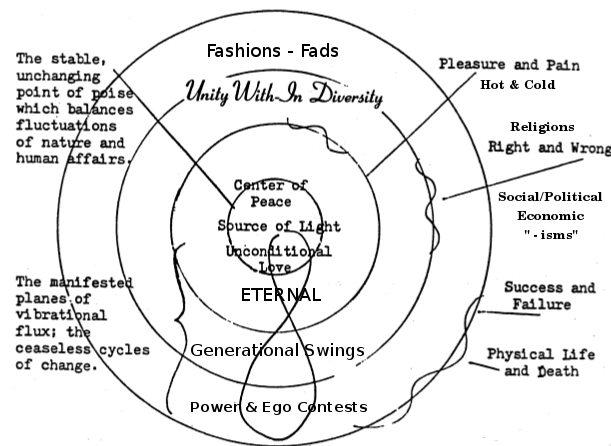
It part, current problems were inherent from inception, a consequence of failing to be philosophically correct in foundations. This single picture shows wherein unity can truly be found, and where not.

0 Def of Paradigm

Looking for unity in the wrong places was fraught with potentially dangerous consequences which are still bearing poisonous fruit today.

It’s especially important to rethink the meaning of Unity in the context of building intentional communities, for the chain of individuals bound together by common purpose is no stronger than its weakest link. The foundation of viable, sustainable communities begins with the integrity of each participating member.

The following Essay from Conscience provides food for thought along these lines. It offers a holistic perspective on unity, both within and without. This comprehensive view offers a useful understanding for building effective communities, as well as diagnosing past failures experienced as a consequence of limited vision and follow-through.

globe bullet size

Essay 60. UNITY

An individual has not started living until he can rise above the narrow confines of his individualistic concerns to the broader concerns of all humanity. — Martin Luther King, Jr., The Words of Martin Luther King, Jr. 

The scientist or the artist takes two facts or experiences which we separate; he finds in them a likeness which had not been seen before: and he creates a unity by showing the likeness. . . . All science is the search for unity in hidden likenesses. — Jacob Bronowski, quoted by Todd Siler in Think Like a Genius

I have always felt that one of the simplest and most apt metaphors for an organization as complex as the United Nations is the Rorschach inkblot test. What one person sees as the hope of a world free of war, famine, poverty, and disease, another interprets as a global boondoggle comprised of uncaring civil servants threatening the cherished concept of state sovereignty. — James Holtje, Divided It Stands: Can the United Nations Work

THE FRONT

The Latin root of “unity” means oneness. Webster’s first definition is the state of being one, or united; oneness, singleness. It means something complete in itself, single, or separate. It can be the quality of being one in spirit, sentiment, purpose; harmony, agreement or concord. In contrast, it can also mean uniformity.

It can refer to an arrangement of parts or material in a work of art or literature that produce a single, harmonious effect. It can refer to constancy, continuity, or fixity of purpose or action.

The difference amongst these definitions reflects a general cultural confusion as to the optimal relationship of the individual to nature, society, and their creative Source. Effective, consistent action depends on an integrated concept of self and a comfortable relationship of each part with the whole. Therefore, thinking carefully about what unity means — as well as what it doesn’t — is a necessary prelude to ultimate success in life.

Accepting the I Ching view that accomplishments begin with the smallest unit, unity is first to be attained within. It’s common to say, “My mind’s not made up” or “Get it together.” The familiar saying, “The right hand doesn’t know what the left is doing,” could also be phrased, “The left brain doesn’t know what the right brain is doing.”

When Westerns say, “I’m of two minds on this,” it reflects confusion, ambivalence or lack of discipline. However, the martial arts advice to have eight brains and eight hearts refers to the height of attainment. It suggests ability to intentionally shift internal gears to meet any situation. From the totality of unified mind, the ideal I Ching master focuses from above while acting through each of the energy centers according the immediate need at the time.

According to the MPI Standard, the Motive, the WHY of psychologies and meditative practices is the same: to unify fragmented, antagonistic functions of mind, personality and behavior.

The Purpose, the HOW they accomplish this is diverse. Some practices start from the outside with behavior and work inwards. Others start with the mind, ideas and attitudes, and work outwards. Still others work on both simultaneously, which is possible in comm-unities where work and self-awareness training go hand-in-glove.

The Intent, the WHAT, ranges from personal self-mastery to inner peace and/or functional relationships.

As pictured above, in a holistic world view, external diversity complements inner unity. The core of life’s concentric circles, like the hub of a wheel, remains still as the outer rim revolves, constantly changing and in motion. Meridians, like spokes of a wheel, link center to surface, connecting and organizing the Wheel of Life in a dynamic unity.

It hardly matters how the goal of inner unity is attained. Once one is focused and all the facets of inner energy are coordinated by a single-minded purpose, the pieces of life’s mosaic fall into place, forming a coherent picture. Then life becomes a work of art, like a poem or a song.

Albert Einstein — equal parts musician, philosopher, physicist and world citizen — searched lifelong for a Unified Theory. The Book of Change embodies the universal code he sought. We’ve failed to recognize the clues hidden for centuries in a venerable text that have the potential to lead us to solutions desperately needed NOW. Restoring this treasure to the general culture would provide a fully functional paradigm from which positive, life-sustaining results can be generated across-the-board.

THE BACK

Regimentation and conformance are perversions of unity. Nature flourishes in diversity. Like snowflakes, each individual is a unique variation of its kind. Yet, in extreme social contexts, variations are suppressed and punished. While this unnatural state might be appropriate to unnatural situations like war, it’s antithetical to personal well-being.

Technically, because all things are connected, it’s possible to dabble in the dark worlds of demons and departed souls. However, though these realms do exist, it is dangerously unwise to explore them without a specific, positive purpose (“know the enemy”) and a white magician’s guidance.

Rethinking COMMUNITY

For years now, the same familiar pattern repeats. Whenever I decide I’m finished with writing, something comes along to make me rethink my decision. Two such events triggered today’s post. One was a thought-provoking article, “Mindfulness, Behavior and Social Change” by Mark Leonard, Director/Mindfulness Trainer at the Oxford’s Mindfulness Exchange.

I responded with a question: I’ve often thought about the possibility of building intentional communities, despite the evidence that experiments in the past have not always worked out well. Any thoughts on the subject?

In fact, I had mentally sketched but not followed-through on an article about intentional communities based on my connection with Spring Green and Frank Lloyd Wright’s Taliesin Fellowship. It was an example which, for many important reasons, I would not recommend following.

He replied: I suspect an intentional community needs a suite of conditions including contemporary analogs of functions which hold traditional societies together. I think that mindfulness meditation could play a part here.

The basic axioms listed in The Positive Paradigm Handbook are my recommended contribution to this cohesive foundation. They were fatally lacking in the Spring Green experiment.

Coincidently, these axioms were the reason for accepting an invitation from Swami Narasimhananda to submit an article to Prabuddha Bharata, a journal devoted to the social sciences and humanities started by Swami Vivekananda and in continuous publication since 1896.  [See When Conflict Escalates, What Can Be Done NOW? ]

Timing being everything, I had decided a few hours earlier to list them there in the context of rethinking leadership, family and community based on timeless wisdom traditions.

My interest is based on the observation made in The Age of Heretics (Charles Krone) that when chaos enveloped the civilized European world, monasteries appeared during the dark ages as islands of purposeful community — centers of learning, healing and hospitality. Similarly, monasteries of refuge from barbarism appeared in Asian lands during particularly harsh historical times.

This dynamic seems highly relevant today, for, as Mark Leonard details in his article, the world is surely sinking into another dark ages. Intentional communities may once again become the necessary counter-balance of positive change — the means for ensuring human survival, which, as Einstein warned us, can no longer be taken for granted.

So for starters, from Conscience: Your Ultimate Personal Survival Guide, here are my original thoughts on community. It forms a hopeful basis for rethinking intentional communities. Although my frame of reference for thinking about the dynamics of change is the Chinese Book of Change, resonance with the immediately popular mindfulness movement will be immediately apparent.

globe

Essay 14. COMMUNITY

We can create communities and relationships that are based on love and intimacy rather than fear and hatred. We can learn from the suffering of others. Awareness is the first stage in healing. . . Likewise, we can create a new model of medicine as we move into the next century that is more competent and cost-effective as well as being more caring and compassionate.” — Dean Ornish, Love and Survival

As we accept the smallness of the world, the density of the population, and the myriad influences on individuals and families, someday we may recognize the community and even the whole society as the patient. Imagine, then, what a “doctor of society” might do, what kinds of diseases he or she might treat!” — Patch Adams, Gesundheit!

Each celestial body, in fact each and every atom, produces a particular sound on account of its movement, its rhythm or vibration. All these sounds and vibrations form a universal harmony in which each element, while having its own function and character, contributes to the whole.” – Pythagoras, quoted in The Healing Power of Sound 

THE FRONT

Community stems from a root word meaning fellowship. In English, the word refers to all the people living in a particular district or city. It can also mean a group of people living together as a smaller social unity within a larger one, and having interests or work in common, such as a college community.

Alternatively, it can refer to a group of nations loosely or closely associated because of common traditions or for political and economic advantage. It also covers similarity of tastes and preferences. The last definition Webster’s gives is the condition of living with others in friendly association and fellowship. The last definition has come full circle back to original meaning.

Communities are founded on a common cause. It can be as practical as survival or idealistic as freedom. Often, community cohesion is artificially stimulated by fear and hatred of a common enemy. Hitler inflamed passions against Jews and foreign bankers to mobilize his war-weary country into a second world war even more devastating than the first. Then Americans rallied behind the common goal of defeating enemies of democracy on two fronts, Asia and Europe.

In Common Sense, Thomas Paine wrote about the relationship of divine, natural and human law in a way that inspired readers at the time of the American Revolution to fight for freedom from tyranny. Winning that war did not, however, automatically secure freedom for all times. Democracy isn’t a static achievement that can be passed on unchanged from one generation to the next. It must renewed and earned again, one individual at a time, each generation at a time, continuously redefined in the context of immediate circumstances.

Nor can the structures of American-style democracy be imposed by force, whole, from the outside, on peoples whose beliefs are shaped by vastly different cultural influences. It is the common respect of life and liberty, not external forms, which is universally translatable. The music of life that moves every organization, smallest to largest, is the basis of harmonious fellowship. Approaching natural law and social organizations from the deeper understanding of the ancients could inspire a new, more humane and effective approach to international relations now, one based timeless values which the human community shares in common.

Sages say that freedom from tyranny begins with dispelling ignorance and overcoming negative emotions. True freedom and stable communities begin with the self-awareness and self-mastery which can be gained by diligent use of wisdom tools like the I Ching. First remembering the core of compassion and caring within, we can then extend and expand this good-will into healing society as well.

Put another way, it’s useless to fight for a democratic world before one cleans out the inner swamp of negative emotions. Since inner life projects into external experience, fighting tyranny in the turmoil of anger and hatred reaps results in kind. Therefore, working to establish positive community relationships before attitudes of good-will and willing self-discipline are established is a futile exercise. As Covey reminds us, first things must come first.

Conversely, the more individuals free themselves from personal problems, the more they become open to the calling to community and able to play their part in the harmony of the natural whole.

THE BACK

Street gangs, terrorist groups, religious cults and secret societies are subgroups within the larger community. To the extent that their goals oppose and even endanger the community at large, these organizations are antithetical to the general good.

Pariahs, nomads and outcasts [heretics!] are individuals excluded from society, either voluntarily or by edict. Whether justified or not, their attitudes and behavior are out of harmony with accepted norms. If enough of them find common cause to band together, they form alternative groups which become the foundation of new communities.

globe bullet size

Rethinking COMMUNICATION

The following essay from Conscience: Your Ultimate Personal Survival Guide is an appropriate companion to the article just posted on LinkedIn, “True Leaders Trust Their Inner Compass To Overcome Confusion.” It opens with a question:

When others use the same word to mean different things, how do effective leaders bridge the gap to communicate clearly? If you’d like to see the rest, here’s the link: https://www.linkedin.com/pulse/true-leaders-trust-inner-compass-overcome-confusion-patricia-west?trk=prof-post

globe bullet size

Essay 32. COMMUNICATION

He who is learning to paint must first learn to still his heart, thus to clarify his understanding and increase his wisdom.” — The Mustard Seed Garden Manual of Painting, quoted by R.L. Wing.

Painting in China made it possible to manipulate the veil of appearances so that it might be pulled away to reveal the hidden essentials of reality and lead the observer into an experience approaching ‘truth.’ Both art and the I Ching employ a triggering device that makes conscious that which has been buried in our unconscious.” R.L. Wing, The Illustrated I Ching. 

“My pen is my bokken, sword of discrimination, ruthless as it follows certain lines of thought onto the page and ignores others into nonexistence. My pen gives life or death to words. My pen cuts through partial truths, slashes weak verbs, and sparring and paring, uncovers a rare, gemlike image. . . As my mind’s chatter settles ever more deeply, my pen can follow a thought like a bee tracking nectar.” — Connie Zweig, Becoming a Warrior Writer

THE FRONT

Roots of communicate suggest sharing, to make common. Webster’s defines communication as the act of transmitting, giving or exchanging information. The means can include signals, gestures, and writing as well as speaking. The word is also used to describe the means of information changing hands, such telephone, telegraph, radio, or other systems. It’s also used to describe routes for moving troops and materials. In the arts, it connotes expressing ideas and sentiments. In mathematics and science, it includes symbols.

The definition has no shadings of meaning to indicate the multitude of verbal and non-verbal levels of information exchange, acknowledging a broad spectrum spanning cellular synaptic connections and inarticulate body language on one extreme to non-local, telepathic messaging (ESP) at the other. The definition of communication also lacks nuances that indicate motives for communicating, or whether information shared is complete or accurate.

Bad-faith extremists babel. They intentionally miss each other coming and going. Seemingly powerful extroverts (extreme-yang aggressors or oppressors) abuse communication tools as overt weapons of propaganda, intimidation and subordination. Speech is used to overpower and control. Seemingly helpless introverts (extreme-yin targets or victims) use language (along with silence) as covert weapons of self-protection or retaliation. Words are used to placate, distract or mislead.

In The More You Watch the Less You Know, TV veteran Danny Schechter observes that there’s a media war going on to win the hearts and minds of viewers. It’s going on in education too. Insiders disempower people with the potential to threaten empire-building plans by feeding them partial information piece-meal. Potential leaders are co-opted by rewarding them for knowing more and more about less and less, calling the outcome “expertise.” The right hand/brain can’t know what the left is doing.

It takes cooperative interdisciplinary work, linking not only related academic specialties, but also the levels of law, to discover solutions to apparently unsolvable economic/social/political conundrums. The most essential community-building service sincere leaders can provide is the dissemination of accurate, hopeful information that promotes positive action. As people of good-will intentionally transcend extremes, cultivating balanced mesovert communication skills, they are developing a base of values shared in common, along with means for connecting to share vital information.

Especially in the arts, however, it isn’t the writer who inspires. Words are just catalysts. They precipitate inner knowing, causing it to rise to the surface of conscious awareness. It’s the result of synchronicity. When the writer, reader, time and topic are in synch, then, Bingo! There’s a connection — communication.

THE BACK

The opposite of communication is silence, the absence of giving and/or receiving information. In a social context, ignoring others is a sign of mistrust or disrespect, a denial of their value, trustworthiness or sincerity. In meditation, however, silence in the inner sanctuary of the mind is the respectful attitude of receptive humility. In this context, cessation of dialogue is prelude to at-oneness.

A perversion of communication is cacophony. The overwhelming amount of data now available from an increasing number of sources causes information overload. City streets and public places are filled with loud, harsh noises that shatter the nervous system. This extreme causes the mind to shut down in self-protection.

Put Terrorism in Larger Context

Recently, much commentary has been focused on the Charlie Hebdo murders in Paris. Most are asking the wrong questions. Many look to place blame. There are exceptions however. Looking for lessons to be learned which might lead to hopeful solutions is the rare but positive approach.

Why do either/or-thinking journalists fixate on assigning or denying blame? Like spoiled children, they squabble and point fingers. “He started it.” “No, it’s their fault!” It’s time to grow up! Expand our way of thinking to recognize the all-inclusive pattern in which everyone is partially culpable and equally responsible for positive change.

The prevailing materialistic paradigm of empirical science limits the questions which can be asked, which in turn limits the places where viable solutions are to be be found. If the middle and innermost levels of the Life Wheel are ruled out, analysts are functionally blinded to the dynamics on all sides which perpetuate back-and-forth bickering, throwing self-righteous excuses for hatred and violence. When underlying motives which drive these dynamics are ignored, the parties on all sides of escalating world conflict place human survival at risk.

Terrorism is a surface symptom of much deeper problems. Attacking symptoms of disease without correctly diagnosing root causes can quell specific symptoms. But the cause, unseen and untouched, simply mutates into even more dreadful symptoms. Destroying terrorist cells is like surgically removing cancer from an affected organ, only to cause its spread throughout the body.

Intent is the WHAT, the outcome or end result that resides on the outermost level of the Life Wheel. In this case, the Paris murders and kidnappings are only the visible end result of a much larger and more complex process.

Deeper than intent is purpose, the HOW. Purpose resides at the middle, energy level of the Life Wheel. For example, one purpose of terrorism is to use violence as an instrument of economic or political upheaval in the name of “social justice.”

Still deeper than purpose is motive, the WHY that leads to violent methods resulting in death and destruction. In some very twisted way, the motive may include setting perceived wrongs right, asserting self-respect and restoring violated human dignity.

Then the questions become, What is justice? Wherein lies valid self-respect? What is the basis of true human dignity? Can these valid motives possibly be served through acts of violence that destroy lives on all sides? Sounds like a fundamental contradiction to me.

If the deepest, underlying motive is to set wrongs right, that opens many doors for alternative approaches to satisfying these motives, ones appropriate to the basic human needs crying out for expression, ones with some valid ways for actually fulling them, instead of the self-defeating methods and results we see now.

World leaders, and each of us as the leaders responsible for doing our best within our limited spheres of personal responsibility, would do well to rethink recent Paris events by putting them in larger perspective. Use the MPI (Motive-Purpose-Intent) standard to look deeper into the heart of terrorism as the first step in making positive responses leading in new directions.

Here as food for thought is an earlier essay on motives. It seems timely and may prove useful.

globe

ESSAY 18. MOTIVES

Although the feelings mentioned above [sadness, pessimism, guilt, emptiness] may accompany a depressed mood, the most prevalent effects usually involve low energy and lack of motivation . . . An effective way of lifting these moods involves using music to activate our resources.”  — John M. Ortiz, The Tao of Music: Sound Psychology

It occurred to me that the only way to figure out what had happened at a crime scene was to understand what had gone on inside the head of the principal actor in that drama: the offender. And the only way to find that out was to ask him. . . If we could give the law enforcement community some insights into the process, the internal logic, of how violent offenders actually decide to commit crimes and why they come up with their choice of crimes — where the motive comes from — then we could provide a valuable tool in pointing investigators toward what for them must be the ultimate question: Who? Stated as simply as possible: Why? + How? = Who.” — John Douglas, The Anatomy of Motive

On some level, you are meditating all the time. One goal of meditation practice is to become aware of that. Another is to extend that awareness to more and more areas of your life. . . It takes practice and conscious effort to restructure the mind and move it from habitual patterns.” — Andrew Weil, 8 Meditations for Optimum Health

THE FRONT

The root of “motive” is “to move.” Webster’s single definition refers to “some” inner drive, impulse, or intention that causes a person to do something or act in a certain way. It’s an incentive or goal.

Motive, purpose and intent explain human behavior. Unless viewed as a whole, what we see is taken out of context and misunderstood. You see a man take someone else’s car. That’s intent, the WHAT. You see him grab the keys and drive off. That’s purpose, the HOW. But unless you know his motive, WHY he did it, the picture is incomplete. Was he desperately racing to save his beloved child’s life, escaping from vengeful gang lords, or simply lusting after a fancy new car?

We are fascinated by crime. Mystery novels, detective movies and sensational murder stories on TV news are big business. We stretch our minds to second-guess the ending, figure out who committed the crime, and why. We look for the mistakes that reveal dark secrets and lead to the criminal’s undoing. We’re satisfied only when truth is revealed and order is restored by justice.

At heart, what we’re really trying to understand is ourselves. We’re haunted by a pervasive sense of wrongs committed against us, or by us. We can’t quite bring ourselves to recognize what they are, or to admit our own mistakes. But a nagging sense of unfinished business leaks out as voyeurism.

Ultimately, it is the stifled voice of conscience that persistently calls us back to our neglected dreams and deepest longings for fulfillment. Those who allow themselves to be defined by others, who live in habitual fear of people’s opinions and fail to honor their inner sense of calling commit a soul-searing violence akin to suicide. The crime they commit is against their own true selves. Failing to be true to oneself can be the hardest crime to detect. Finding one’s true calling can be the greatest mystery of all.

People who march to others’ drums, unconscious of their motives and what moves those around them, live in painful confusion. Only those who know how to listen and dance to the inner music of their soul’s desire live in joyful harmony with themselves and the world around them.

The I Ching is a means for turning the camera around, focusing in on ourselves. Uncovering hidden motives might cause initial discomfort. But it can lead to positive changes. After analyzing them, we have the option to decide on better ways to accomplish intentional ends. Our What and How isn’t always appropriate to our Why. Other solutions may accomplish our goals without committing crimes against ourselves and others.

THE BACK

The opposite of motive is motiveless, to be without awareness of calling, any conscious purpose, or impulse to action. This condition is sometimes an extreme reaction to an extended period of frenzied, excessive, forced action. People experience it as apathy, shell shock or burn out.

When crazed criminals go on sprees, kill strangers and wreak havoc on public property, their acts are regarded as random and senseless. To all but the most highly attained, the subtle laws of cause and effect are incomprehensible. There’s wisdom in accepting the unfathomable as Job did, saying, “The Lord giveth, and the Lord taketh away.“

Rethinking HOPE

New years are traditionally welcomed as a harbinger of fresh hope and the opportunity for new beginnings. In these perilous times, I have searched my heart for the most realistic approach to fulling the eternal hope for love, unity and survival which everyone everywhere shares in common – a way that acknowledges escalating world challenges while balancing them with their inherent potential for renewal.

Because it rings true as the vision of realistic hope, I have chosen to return to this simple essay, written in the year 2000, included in Conscience: Your Ultimate Personal Survival Guide.

May your New Year be filled with the blessings of your dearest heart’s desire.

121714 rose

ESSAY 63. HOPE

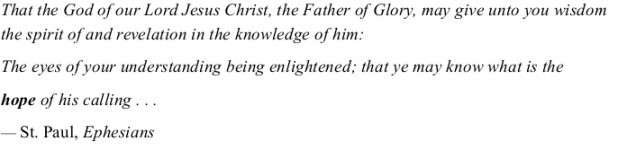
Ephesians

Here the people could stand it no longer and complained of the long voyage; but the Admiral cheered them as best he could, holding out the good hope of the advantages they would have. He added that it was useless to complain, he had come [to go] to the Indies, and so had to continue it until he found them, with the help of Our Lord.  — Christopher Columbus, Journal of the First Voyage

We live at a particularly perilous moment, one in which self-deception is a subject of increasing urgency. The planet itself faces a threat unknown in other times: its utter destruction. . . The splitting of the atom, said Einstein, has changed everything, save how we think. And thus, he observed, “we drift toward unparalleled catastrophe.” — Daniel Goleman, Vital Lies, Simple Truths

We are seeing a health care system in pain, people in pain, and a world in pain. I believe that something can be done to make it better. — Patch Adams, Gesundheit!

THE FRONT

Webster’s defines hope as a feeling that what is wanted will happen. It is a desire accompanied by expectation. It can mean that which one has a hope for. It can mean a reason for hope. A meaning listed as archaic is to trust or rely.

In I Ching context, hope transcends short-sighted wishing and emotional wanting. It is a trust that one has the wherewithal to respond appropriately to every change of fortune. It’s not total self-sufficiency, but awareness that one’s efforts are met half way. When one does the best one can, the rest is supplied in the right way, at the right time.

Daniel Goleman emphasizes the direct relationship between honest self-awareness and survival. Like Einstein and like Strauss & Howe (authors of The Fourth Turning), Goleman is a messenger of awareness we’re often trained to block out. His vision is in synch with The Book of Change philosophy in this: ignoring dangers, deceiving ourselves that all is well when it isn’t, doesn’t make problems go away. It only renders us powerless to recognize early warning signals in time to prepare and ameliorate the worst that might come.

In The Fourth Turning, Strauss and Howe emphasize that declining resources will necessitate major changes in healthcare delivery. Anticipating that the cost of health-care will continue to rise and become increasingly unaffordable, they recommend that cost-effective, affordable alternatives be in put in place now. Forward-looking health practitioners are therefore now turning to inexpensive, preventive self-maintenance practices like Tai Chi, Qigong and yoga.

There are hidden benefits to timely austerities. Though it is unfortunate that people see fit to return back to self-responsible methods only as a last resort, if the prospect of hard times returns people back to their more simple and beneficial roots, it serves as a blessing in disguise.

In his epistle to the Corinthians, St. Paul wrote of hope in the context of faith and charity. His hope isn’t Webster’s hope of wanting and expecting. Like I Ching hope, it is trust that human events which make no sense in the short-term fit into the larger pattern of life, and that God’s will does in the long-term prevail.

THE BACK

The opposite of hope is despair. Seeing one’s situation as hopeless is a self-fulfilling prophecy. So long as one places hope in externals, one feeds the illusion of powerlessness. Turning the focus of hope inwards makes all the difference.

Self-deception is a perversion of hope. Lacking a concept of cyclical change, linear thinkers hope to control time. They defy the aging process or pretend change can’t or hasn’t happened rather than adjusting and benefiting from new opportunities that arise to replace the ones which pass away.

globe

The Evolution of My Understanding

A post-Thanksgiving exchange with a LinkedIn connection (I’ll call him Dave, a favorite name) made me realize I owe it to readers to describe from personal experience why I’ve come to place so much importance on Natural Law. It’s critically important to be fluent in its operations. It’s equally essential to understand how it’s related to, though different from, Divine Law. As I’ve learned from personal experience, a little knowledge can get you in a lot of trouble.

dragon

Dave and I have never met. He hasn’t, to the best of my knowledge, read any of my books, so isn’t familiar with the autobiographical account written in Rethinking Survival. So other than candid answers to his frank questions, his impression is based on posts I’ve written.

We originally hit it off in an exchange of comments. In response to “Boundary Spanners Connect at the Center,” posted September 10, 2014, he wrote:

Wow and thanks Patricia! That was Profound and easy to read. Writing such articles take real skill and something of real value to communicate. I especially liked the hors d’oeuvre at the beginning that made me want to read the rest. Half way through I said out loud, “I think I love you”. I certainly enjoyed reading your article very much. I just clicked “follow”, although I hate the concept of “leaders” and “followers” because I am fiercely independent. I think of it instead as “subscribe”; as in “offer me some more of your tasty wares”; rather than tell me what to think…

I can relate to independent. Mom didn’t call the toddler-me an “independent critter” for nothing. So I answered back:

In-dependent = depending on the True Self deep within. Fiercely = connected with the passionate energy of the middle level. Love you too! Thanks for the subscribe, Dave. : )

Dave’s 80-something parents, who live in South Africa, flew to California, where both he and his brother now live. He dedicated the duration of the Thanksgiving holiday season to family. After they left, he wrote:

I told my mother about you and she asked me if you were a Christian. I said that you were aware of God and often reference Christian tenets in your writing, but that your belief system seemed much wider than that. I did not feel the need to try and label you, but said that you are driven by natural law that springs from the Creator; and that is enough for me.

But that got me to thinking. How would I have answered if she had asked me directly? Then one thing led to another. Later I wrote back:

I was thinking of how to answer your mother’s question, and remembered a post from last December, “Rethinking Christ at Christmas.”. . . I’ll include the link so you can forward it to her – in case she would like to see it.

I continued:

In terms of her asking if I am Christian, the correct answer is that I love, respect and do my best to follow Christ. I’m not sure that’s the same thing as being a “Christian.” (I was not born/raised in a Christian family.)

But, having reservations about his description, I continued.

However, I am not driven by natural law. Rather, ignorance regarding the relationship of divine, human and natural law is a fatal blind spot in our education. It prevents us from understanding and connecting with Christ. (The blog will show you, literally, what I mean. If we can’t recognize/navigate that middle, energy level of natural law, we’re left stuck on the material surface.)

My belief system is “much wider” than Christian tenants, but, then again, so is Christ.

My understanding is that the essence of Christ is vastly greater in time/space than institutionalized Christian religions. Again, the illustration in the blog shows how this must be so. Christ told us he was before the world, is with us always, and will continue to exist long after the world does not. So, if his presence permeates all time and space, in effect of his presence permeates all religions.

Dave’s lengthy, astute response is too long to quote in entirety. Two paragraphs relevant to the critically important distinction which is the purpose of my blogging today (12-13-14 is an “interesting” date – perhaps the right time to make a breakthrough, finally get across the all-important sequence I’ve been laboring to define).

Religions have too much dogma. For me, the only absolute truth is that every individual is responsible directly to God for their own decisions and actions. No human intermediaries are required. Any person can communicate directly with God. Not only can they; they should.

I could not say it better!

But here’s where the conversation became murky, and needs clarification:

My remarks about natural law may not fit your definition exactly, but to me, natural law is God’s law. That said, I use the term more often in the context of physics and chemistry, without declaring who the author is.

From my point of view, two critically important distinctions must be emphasized. First, Divine Law is the Creator’s law. It rules that which is timeless, unchanging and eternal. It pertains to the source of (but cannot be equated with) the created world measured and quantified by human sciences. I don’t quibble about names. The Creator is an essence beyond words. Call it the Tao. The Universal Mind. The Divine by any other name is still eternal.

Second. Natural Law is a related but distinctly different subject. The Book of Change, the Chinese I Ching codifies the 64 permutations of alternating, cyclical change. It is the binary-digital code of duality, the blueprint of DNA – that which has a beginning and an end in time. It maps the dynamics by which creation emanates from the hub at the timeless center of the Life Wheel, and then recedes, being absorbed back into the stillness of original silence.

That’s a lot of big words and still bigger, mind-boggling ideas. But, in simple language, I’ll want to tell you why this distinction between Divine and Natural Law is so critically and personally important to me.

In the evolution of my understanding, I began an as agnostic. As described in Rethinking Survival:

The silver lining to being uprooted early and often is that assumptions others take for granted weren’t deeply ingrained. I was raised by adults from different religions who held conflicting political beliefs. Not all of them could be right. It was my responsibility to sort things out, make sense out confusion and choose for myself. “Take the best and leave the rest.”

As to the existence of God, I had no opinion. I didn’t know whether or not God existed. I didn’t really care. It didn’t seem to make a difference in the conduct of my daily life one way or the other. I was quite content to live according to the maxim,“The reward for a good life is a good life,” which appealed to me as sensible and satisfying.

But then things changed. I began to have experiences which were outside the boundaries of anything I’d thought possible, unlike anything I’d learned from anyone anywhere. One day at the downtown YWCA, a yoga teacher intoned, “When the student is ready, the master appears.” And the very next day, as I was hitch-hiking to a concert, violin case in hand, out-of-town yoga disciples stopped their VW bug to pick me up. They were in Madison to attend a seminar. I was invited. Their teacher picked up on me. I ended up in India, and doors to a new life opened.

In retrospect, there was nothing in my training that gave me a frame of reference to help put this swami in context. He was a con artist. He performed cheap magic tricks that impressed gullible physicians and therapists, and seduced vulnerable women.

He had a modest degree of attainment, mistakenly assumed to be “spiritual.” He could read minds and manipulate material objects. He knew just enough about Natural Law to seem powerful to naïve Westerners. He cynically claimed to be a man of God, a celibate monk and penniless renunciate. But he wasn’t.

What was lacking in my education was an understanding that Natural Law exists. With simple mastery, anyone can do magic tricks. (They’re called sidhiis, or powers.) My pesudo-logic went something like this: “The Swami is powerful. Power comes from God. Therefore he is a man of God. God is good. Therefore the Swami can be implicitly trusted as good.”

His hapless students had never been taught to discriminate in the positive meaning of the word. We didn’t recognize the importance difference between holiness and magnetism, between sincerity and smooth-talking charisma.

Here’s the bottom-line, the extremely important point I want to impress, the lesson learned from this sad experience, to be passed along as a cautionary tale. Divine Law and Natural Law are NOT the same. One is an off-shoot of the other. But there is nothing sacred about Natural Law. Depending on the motive, purpose and intent of the user, power can be used to serve and heal. It can also be abused to exploit and even destroy. It can be turned to serve good or evil. It expresses in the extremes of black and white magic, was well as intermediate shades of gray and yellow.

Tony Silver’s rules for an unfair fight (remember the Karate Kid?) sum up the disadvantages of limited and limiting education:

A man who can’t stand, can’t fight. So break his knees.

A man who can’t breathe, can’t fight. So break his nose.

A man who can’t see, can’t fight. So gouge out his eyes.

In effect, education which doesn’t teach us how to take a stand, breathe deep and see life for what it is, complete and whole, cripples and suffocates us. It blinds us to the dangers inherent in our immediate circumstances. It renders us powerless in the face of dark-side puppet masters who practice black magic to dominate and control unsuspecting innocents. It renders us unable to protect ourselves and those we care for. It sets us adrift, unable to recognize the difference between shadow and substance, between lies and truth, and between illusory, false teachers who distract with cheap magic tricks versus true leaders who offer genuine hope.

In the evolution of my understanding, here’s my take-away from the swami experience. Just as the biological process of metabolism is essential to physical health, so also the process of mental metabolism is equally important to psychological well-being. We take in experience raw and whole. But then it’s imperative to digest it. Take responsibility to decide what is beneficial and healthy. Put it to good use. But eliminate the rest before it festers, causing disease and decay. Release release poisons from the system completely.

In the case of the swami experience, the beneficial effect worth keeping was that it shook me out of my culturally-induced coma. It gave me first-hand experience of invisible forces which bad guys manipulate with impunity to get whatever they want, at everyone else’s expense. It also led me to other experiences. There are protections. Working with the Book of Change, for example, was a life saver. It gave me the leverage to recognize danger, put it in perspective and protect myself from it.

My choice was to honor and maintain connection with the life-sustaining eternal center. I released as poisonous the anger/pain which causes many to react to unfortunate experiences with false teachers by rejecting the Creator whom they only pretend to represent. That would be to choose starvation rather than taking responsibility to process life’s challenges intelligently.

As a child, I thought the question of God’s existence didn’t matter. Now I recognize that operating on the basis of a complete and accurate reality map makes all the difference. There’s more to life than our materialist teachers taught us. Seeing life whole and complete is the starting point of clear thinking and effective, positive action. It’s imperative to recognize that there is an eternal center which abides deep within, regardless of whatever abuses of power are perpetrated in the name of God. It continues to exist whether or not we choose to be aware of it.

In the evolution of my understanding, I’ve come aware that bad guys succeed in wielding temporal power by abusing natural law with impunity. They succeed only by keeping the rest of us in ignorance, the mother of slavery and seed of suffering. I’ve become convinced that the way out of mortal danger is for good guys to open their eyes, breathe in their courage and take a stand. Human survival will depend upon the leadership of those who exercise their God-given free will, who choose to wake up to the magnitude of the danger we’re in, and who are capable of wielding their natural powers/potentials in the service of the larger good.

“Promise Them Anything, But . . .”

dragon

The state-of-the-political/marketing-art is to conduct surveys to determine what people really, really want — what they feel they can’t live without – and then promise them exactly that. Frame (disguise) whatever you have for sale in terms of those most basic, deepest needs. After they’re hooked, then switch.

Here’s the upside of this dismally deceptive state-of-the-art: The empty promises are a well-researched, accurate gauge of peoples’ valid needs and deepest desires. A partial check-list includes: Change we can believe in. Hope. Accountable, transparent government. Authentic leadership. A paradigm shift. Compassion. Collaboration. Opportunity. Freedom. Justice.

But the burning question remains. How do We-the-People (whose desires are exploited by false leaders/teachers to make themselves rich and powerful), get from here to there?

How do we get from cynical promises (which self-serving, irresponsible opinion-pollsters have no intention or ability whatsoever to deliver) to the real deal?

This is a pervasive, many-faceted problem. I keep making unpleasant encounters with new variations. Two recent examples include a book on the future recommended by a LinkedIn connection who claimed it resembles mine. The second was a CEO’s LinkedIn post about Ferguson issues (which is also the focus of “Beware of Disinformation” shown below.)

Naming names would miss the point. It’s the dynamic, not particular individuals, I’m targeting. Besides of which, only counter-productive rounds of retaliatory accusations would result from being specific.

In both recent examples, dilution/co-opting of language/ideas is the constant. I’m learning that this dynamic is as pervasive in the knowledge industry — universities and publishing corporations – as it is in politics. The formula seems to be, take all the most sacred words in the language and turn them into buzz. That way, whatever you have for sale takes on the aura of the sacred. Conversely, when those with authentic ideas which could actually deliver on those deepest needs use these sacred works – people who represent a serious threat to status quo power-holders – can’t be recognized. Because the powerful words have been co-opted, it’s next to impossible to distinguish genuine and sincere leaders from the glut of false gurus on the market.

In my two recent examples, a futurist and a CEO have poured as many as buzz words as possible into a single glass. “Positive. Change. Revolution. Collaboration. Paradigm. Unity. Equity.” Then shake, do not stir.

The futurist comes highly recommended from the small community of back-scratching, best-selling new age gurus who promote each others’ books. He spins a vague vision of “quantum interconnectedness” to predict what one reviewer calls a future of the “spiritual-Borg:” collectivists ruled by and dependent on community consensus. He takes an ancient, scriptural reference to akasha and turns even that into a glamorous but meaningless buzz word.

But there is a glimmer of hope. Every once in awhile, an authentic voice arises which stands above the rest. Someone recognizes that personal self-responsibility rather than collective action is the first line of positive action. Someone, who, like me, insists that positive change necessarily takes place one person at a time, and from the inside out.

Let me introduce you to John Williams, who posted a LinkedIn blog called “Principles We Can Take Away From Ferguson.” At last count, there were 53 views and 3 likes (one of them mine). No buzz. No empty promises. But solid, first-rate, practical recommendations.

However, in contrast, sadly but predictably, at last count the self-promoting CEO had 91,528 views and 2,278 likes (as well as very mixed-reviews). His article reads like the carefully manicured product of a focus-group process, full of empty, shop-worn buzzers – “positive” being the worst offender. All the changes he recommends depend on experts and groups conducting empty, tried-and-disproven committee efforts guaranteed to accomplish nothing much.

My take away is that the knowledge industry promotes and protects the Agents of Disinformation. It marginalizes, when it can’t entirely exclude, other voices. It feeds on the demands/expectation that we be told (whether it be true or not) only what we want to hear.

Below, in “Beware of Disinformation,” I acknowledge Edward Bernays as the inventor of public relations, known in Hitler’s time as propaganda, and today as spin. The remedy available to We-the-People is genuinely Positive Action.

To this end, let’s rename the dragon and snake described below.

Because he’s been tied in a knot, turned upside-down and headed due South, I gave the dragon the pet-name DRAG. Let’s uncoil our energies and desires, turn them right-side up and redirect them True North. Let’s put paralyzing fears and confusion behind, take heart/courage to deserve a new name, GET IT ON.

Similarly, uncoil the American Revolution’s mascot, the rattlesnake on the Tea-Party flag that warns, “Don’t Tread on Me.” I nick-named him DON’T because he resists oppression, but hasn’t as yet generated authentically positive alternatives. Let him show us his true value and take a new name: CAN DO.

Let’s breathe life into our representative mascots, allow them the full-spectrum colors of their energetic potentials, rather than letting them see (and be seen) in black and white extremes only.

BEWARE of DISINFORMATION

An entangled dragon completes the earlier picture, “Hidden Danger Eludes Us.”

drag-sized

This suggestive image surely has as many meaning as there are viewers. However, this time, I’ll tell you a few of the things “Drag” (my pet name for him) means to me – in this context.

In Chinese mythology, dragons represent the invisible power associated with spirit – universal intelligence, the psyche or soul. They’re somewhat similar to the coiled snake called Kundalini in the Hindu tradition. In latent form, she rests unconscious at the base of the human spine, but gradually uncoils to rise through the energy centers called chakras as human consciousness evolves.

Another close relative is the coiled red-on-black rattlesnake pictured on the yellow flag flown by colonists during the American Revolution. “Don’t” is my pet name for him, short for “DON’T TREAD ON ME.” In recent times, Don’t has been given second life by Tea Party members, sending the message that like their ancestors, they’re fed up to the boiling point of rebellion with government abuses.

However, in this particular illustration, Drag appears (to me) to be in trouble. He’s uncoiling, but he’s tied in a knot. He’s stuck. Further, he’s not rising. His head points not True North, but due South, which (to me) means BIG TROUBLE.

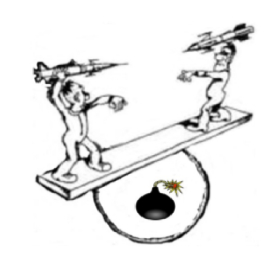
Here’s the segue to the earlier picture of teeter-tottering adversaries engrossed in murderous enmity, oblivious to the live grenade beneath them, threatening both with extinction – the final oblivion.

see saw & bomb sized

There are several different directions this can take. I’ve narrowed the choices to three. Because I’ve already written on this in Rethinking Survival, I’m just summing up major points here. In each case, ongoing Ferguson events and the escalating outpouring of opinions make my point – in spades.

1. Most of us are ignorant of the natural law encoded in the Book of Change. We are (almost as if intentionally) left in ignorance of how we tick at an energetic/emotional level. By extension, we act in ignorance of the human dynamics that drive human relationships, from families to governments and international conglomerates. For this reason, we fail even in sincere efforts to create the positive change everyone wants, many promise, but few deliver.

To me, the invisible ticking time-bomb (threatening both missile-throwing rivals without prejudice) represents volatile unconscious energies. Politicians, marketers and their handlers know how to set them off. They intentionally fuel and harness mindless animosities to enrich military armaments industries and their stockholders, to the danger (and impoverishment) of the rest of us.

2. Especially in the case of Ferguson, the volatile mistrust and empty slogan throwing are grist for escalating police-state dynamics which threaten the freedom of ALL of us. We’re pointed, goose-stepping towards the creation of another fascist state, all in the sentimental double-speak names of freedom, human rights and “justice.” Ironically, the USA is tied in knots. Bottled up long enough, the inarticulate, volatile aspirations and frustrations of the coiled rattlesnake explode, heedless of what targets they destroy –or what the long-term consequences. Oppression of an even more nightmarish form is in the works, being fueled, ironically, in the name of resisting and ending oppression.

3. A critical key is the prevailing dysfunctional empirical science paradigm to which most of pay token lip service. It disallows the existence of not only the subliminal level of emotional content that underlies rational thought and action, but also the deeper core of True North reality called conscience, or the True Self.

Without the Positive Paradigm of Change, we’re stuck, operating blindly without a complete and accurate road map. Even when we have the intuitive experience of the middle and innermost levels of the Life Wheel, we don’t have permission/confidence to know what we know.

We haven’t been educated to recognize the sleeping dragons that move us. We remain ignorant as to how to effectively harness them so they take us in the direction of the positive change we ardently desire.

Further, we don’t recognize when/how others intentionally manipulate our unconscious drives, and NOT in our best interests. We don’t have the means for protecting ourselves from manipulators and their dark intentions.

Nor is this lack of a functional, positive paradigm and its related methods/protections an accident. The information is available. But creative, useful work is systematically banned from public awareness. A positive paradigm is our best interests, but NOT in the interests of those who profit hugely from systematically manipulating the public.

I warned about Bernays and the illusion of democracy in Rethinking Survival. As yet, no one has paid attention. Why not is explained in an eloquent blog (to the same point) by Charles Cawley called “Americans: happy to be manipulated?” posted 11-25-14 on writerbeat.com. It’s but a small leap to connect the dots between dishonesty (disinformation, manipulation, culturally reinforced ignorance) and the outcomes, like Ferguson and its ripple effect in all directions.

Cawley writes, in part:

The principles of Behaviorism developed by BF Skinner and Bernays are key to the foundations of modern advertising, business practice and politics.. . Cosmetic politics have created a generation of reactive politicians who second guess what will appeal to voters and say what is needed to get people to vote for them. This can include significant dishonesty. This process is reactive and marginalizes or even excludes new ideas, policies, and creativity to provide solutions to current economic and political issues. . .

The issue of propaganda is immense and desperately needs urgent attention. However, vested interests have heavily bought into the manipulative dishonest approach to propaganda (a la Bernays and Skinner) and they are a major barrier to engaging with the future. . . . they appear to be destroying democracy. How much more serious can you get than this?

Cawley repeats my frequent warning, WAKE UP!

If we do not wake up and replace manipulation to engineer obedience with stimulation to work well events will crush us all.

It is as serious as that.. . . We have the choice to end this delusional activity ourselves or let events do it for us. The latter will be an immeasurably more costly, painful and bitter experience. This is the dark negative heart of behaviorist manipulation.

I go one step further.

It’s not enough to pinpoint the dynamics of manipulators and their smoke screen of disinformation. A remedy in the form of correct and positive information – a complete and accurate reality map – is also required. False information must be rooted out; it must then be substituted with a practical, useful replacement.

In sum, we’re sitting on a time bomb and fail to recognize it. We’re distracted by dramatic, polarizing events which mask the deeper dynamics and inherent danger to us all. To repeat Einstein’s warning, “We shall require a significantly new manner of thinking if mankind is to survive.” I agree with Cawley. It’s that serious. Human survival is at stake.

dragon-green-sized

Authentic Friends Are Rare & Precious


friend.jpg

When I asked myself what I’m most grateful for this Thanksgiving season, a recent walk through the Hill Top woods in Spring Green, Wisconsin instantly came to mind. Sunny but crisply cool, the fall weather was perfect. Colorful turning leaves were at their brilliant best.

I hadn’t seen long-time friend Janelle Fritz for thirty years and counting. But it could have been yesterday. Authentic friends are like that.

Why did we come together again now? Long story.

On the surface, the catalyst was a note I sent while she and husband Ty were still wintering in Arizona. I had expressed my thanks to his father, Herb Fritz, in the dedication of Rethinking Survival, I told her. Further, in the autobiographical section, I wrote about his being the sole survivor and witness of the 1914 Taliesin massacre, as well as about performing string trios at Hill Top with Herb and his sister, Frances Caraway. I wanted Ty and Janell to know about the dedication first, from me.

On that October day, there was much catching up to do. Words came easily on both sides, punctuated, of course, by spontaneous bear hugs.

I was fascinated to find out that she too is a good friend of the I Ching. Or perhaps, better put, the Book of Change has been a good friend to her. Like me, she has repeatedly turned to the Wilhelm/Baynes edition over the years to survive seriously challenging, tough times. It has served to keep her pointed steadfastly towards her inner True North.

Though I never doubted the outcome, still I rejoiced to see that she’s weathered her personal storms wonderfully and has become even better for them. It’s apparent that this tiny woman (even smaller in size that I am) is the true backbone of her family. And I said so! (Sometimes it helps to hear it from a friend.)

Since our walk, I’ve been reading Bill George’s books, including True North and Authentic Leadership. They describe Janelle to a Tee. She’s centered in her True North. In direct, simple terms, she’s an exemplary authentic leader. Her beliefs, words and actions are consistent across the board. She’s devoted to her family, becaring not only Ty, their sons and now grandchildren (WOW!), but also her sprightly mother-in-law, Eloise Fritz, who’s now 89 years-old.

Janelle was a dancer. In Arizona, she told me, she owned and ran a dance studio. Like Eloise before her, who ran a girls camp at Hill Top, Jan’s purpose was to encourage and bring out the best in young women. Horse riding and dance were incidental to the deeper, soul purpose of their businesses.

We both, Janelle and I, have given up our early avocations. She couldn’t understand, at first, how I could give up music. It was only when I explained it in terms of her releasing the dance studio that she recognized the common thread.

I explained the change in I Ching terms. “The larger the front, the larger the back.” And “Every extreme turns into its opposite.” The benefits – the front side – of the music were enormous. As a child, I lived and breathed in continuous joy. Immersed in music, I was shielded from the dark side of living in a dysfunctional family on a dysfunctional planet.

Music taught me many important life lessons. As Einstein observed, discipline learned through violin practice came much easier than it would have through harsh obligation. Playing in string ensembles and orchestras was a model for cooperation as well as for following the single lead of a conductor.

Music eventually led me, via Menhuin students, to yoga, complimentary medicine, and the scriptures which teach methods for actualizing the Unified Theory reformulated by Einstein. Like every discipline studied with love, focus on music led me deeper, first to the physics and then to the origins and mysteries of sound.

Sufi Inayat Kahn, the great sarod player, explained how this can be. In Music, he wrote:

The art of music has been especially considered divine, because it is the exact miniature of the law working through the whole universe. For instance, if we study ourselves we shall find that the beats of the pulse and the heart, the inhaling and exhaling of the breath, are all the work of rhythm. Life depends upon the rhythmic working of the whole mechanism of the body. Breath manifests as voice, as word, as sound; and the sound is continually audible, the sound without and the sound within ourselves.

Inayat Khan became a role model. As a teacher and author, he himself became the instrument. From his example, I recognized that, like him, I had to give up that which I loved most, my brown-blond,1776 Mathias Thier violin, to go beyond it.

It was necessary because the back of the coin was as great as the front. Over time, the blessing had changed into its opposite. Once the lessons had been learned, holding on to their vehicle would have held me back. I was not only shielded. I had become oblivious to the rest of the world and the responsibility to serve. Music had become an addiction and an obstacle to further, necessary growth.

But, as Janelle was quick to point out, Nothing is ever lost. Only changed. Everything cultivated as a musician is now funneled into the writing. I’ve become the instrument of the ideas that kept me focused True North even during confusing, difficult times. Now I weave in the music of language using the medium of a computer keyboard.

Similarly, Janelle and Ty have dedicated their Hill Top inheritance from Herb and Eloise to building a community center where people gather to honor the passages of their lives. They come to celebrate weddings and return to commemorate their milestones, including anniversaries. Life continues to evolve. We change, yet the True North of constant friendship remains the same.

For that I am abundantly, infinitely grateful.

globe

Survival Basics We Didn’t Learn in School – But Should Have!

Thinking – really thinking – about way the world works and how we fit into it is essential to human survival. This, in large part, depends upon careful, conscious use of the primary tools of logic and language.

Digging deeper than programmed assumptions to understand what we truly mean is one of the basic skills we never learned in school, but should have! Being able to clearly express our concerns and insights is equally important.

This includes knowing the precise definitions of words – how we intend them, as well as the many ways they can be misconstrued by others who use them differently.

Each of the 64 Essays in Conscience: Your Ultimate Personal Survival Guide addresses the Tower of Babel dilemma, where it’s shown that the words we use every day have devolved to mean one thing as well as their opposites. Each Essay highlights the many different meanings assigned to a single, key concept in the English language. Each then focuses on the word’s use in the context of the natural law encoded in the Chinese I Ching.

Westerners, for the most part, remain ignorant of the order implicit in dynamic natural law, as well as the critically important, two-way role it serves as the “middle man” gatekeeper between human and divine law. We suffer the adverse consequences of this blind spot in every aspect of our lives. Unfortunately, even many urban, “modern” Asians seem to have become disconnected from their wisdom roots.

The following is one example: the word ORDER.

As with each of other 64 key terms, its meaning is illuminated by placing gradations within the levels of the Life Wheel. The first principle of Dr. Kushi’s “Principles of Order of the Universe” acknowledges the ONE which resides at the timeless center hub of the Wheel. Infinity is represented by its creative extension process, with its alternating, rhythmic expansions and contractions. The outline below could be expanded and elaborated upon in volumes, and still barely touch the surface of the implications.

Forthcoming blogs will elaborate on the basic principles of universal order which we should have learned as the basics in school and need to know NOW, as an urgent matter of survival.

globe

29. ORDER

Principles of the Order of the Universe:

1. Everything is a differentiation of ONE Infinity.

2. Everything changes.

3. All antagonisms are complementary.

4. There is nothing identical.

5. What has a front has a back.

6. The bigger the front, the bigger the back.

7. What has a beginning has an end.

8. Nothing is solely yin or solely yang.

9. There is nothing neutral.

10. Large yin attracts small yin. Large yang attracts small yang.

11. Extreme yin produces yang, and extreme yang produces yin.

12. All physical manifestations are yang at the center and yin at the surface.

— Michio Kushi, Natural Healing through Macrobiotics

In the secure, high-synergy societies, wealth gets spread around, it gets siphoned off from the high places down to the low places. It tends, one way or another, to go from rich to poor, rather than from poor to rich.  — Abraham H. Maslow, The Farther Reaches of Human Nature

When evil men plot, good men must plan. . . When evil men shout ugly words of hatred, good men must commit themselves to the glories of love. Where evil men would seek to perpetuate an unjust status quo, good men must seek to bring into being a real order of justice. — Martin Luther King, Jr., The Words of Martin Luther King, Jr.

THE FRONT

Roots of order mean straight, row, or regular series. The first of Webster’s seventeen definitions is a social position or rank in the community. Order means a state of peace or serenity, observance of the law, or orderly conduct. It can refer to the sequence or arrangement of things or events, a series, succession. [As in, “Order in the court room!” or “It’s time to put your affairs in order.”]

Order can refer to a fixed or definite place, system or law of arrangement. It can refer to a group or class of persons set off from others by some trait or quality. It can mean a group of persons constituting an association formed for some special purpose, like the Order of Knights Templars, or a community of monks or nuns following a rule.

Order can refer to a group of persons distinguished for having received a certain award or citation. Order can mean a general state, as in “not in working order.” It can mean a command, direction or instruction, usually backed by authority. It can mean an established method or system, as of conduct or action in meetings or worship. It can be a request or commission to make or supply something, such an order for merchandise or services.

In I Ching context, order refers to the sequence in which straight and divided lines are placed in the three-line trigrams which represent the eight building blocks of nature. Alchemical interactions amongst these primal natural forces are mapped by pairing trigrams in every possible combination. The 64 six-line hexagrams which result are placed in ordered matrices, sometimes encompassed by a circle. Different sages place these figures in different order with different effect.

However, any or all of the lines within each six-line configuration can change to its opposite. So the myriad possibilities inherent in any circumstance have the potential to shift in an infinite number of directions.

The implication (and opportunity) is this: Despite appearances, nothing within a given situation is static, nor can the fluid, dynamic permutations of change be controlled or foreseen. Put another way, those who understand how to work with the laws of change can use them to advantage, accepting that no situation, no matter how dire, is either hopeless or without useful possibilities. Order lies in the process, not immediate specifics.

Cutting edge physicists continue to probe the order of the universe. In The Elegant Universe, Brian Greene builds on violinist Einstein’s vision, describing the string theory which “can heal the breach between gravity and quantum, unifying all of nature’s ingredients.” His book is recommended to those who “want to get a real appreciation for the amazing miracle that the universe is.”

The I Ching is recommended for the same reasons. Its advantage over modern physics is first that it is time-tested and proven, second that its careful use over time can bring abstract intellectual theories closer to home, making them applicable to immediate, practical concerns. For it is only with a profound understanding of how the world works, that these dynamics can be applied to establish communities like those envisioned by Maslow and King, where equity and justice prevail.

THE BACK

In biblical context, the shadow side of order is chaos, the primordial state which predates manifest creation. This is different from the chaos physicists study, which refers to turmoil or dynamic instability within which humans have not yet recognized inherent order.

In social context, rigid caste structures based on blood lines or material possessions are perversions of the dynamic natural order. Pigeon-holing or excluding people by race, age, gender or economic status is a competitive strategy; it has nothing to with inherent divine order, human potentials or functional competence.

What’s Your Answer to Hamlet’s Existential Question?

The last post, How Do You Define GOOD, opened with a basic law of nature: in duality, every coin has two sides. “Whatever has a front, has back. The larger the front, the larger the back.” It  explains why surface appearances are often deceiving.

I bring the Two Sides Law up here again in answer to comments from a recent LinkedIn post, To Be or Not To Be PC? There, political correctness was defended:

PC is often viewed incorrectly, fundamentally it is a collective societal attempt to correct social inequity – the avoidance, often considered as taken to extremes, of forms of expression or action that are perceived to exclude, marginalize, or insult groups of people who are socially disadvantaged or discriminated against.

I responded:

Understood . . . As an Ed Admin grad student, I wrote a paper for a law seminar on Affirmative Action. I observed that, however worthy the goals, the legislation missed the point. Not only was it unenforceable. It would trigger backlash. Which in time proved to be a correct assessment. I recommended Positive Action as a viable alternative for achieving the legislation’s worthy goals then — and still do. The surface definition of PC is, of course, impeccable. But applications and abuses have drifted so far afield from the verbal window dressing and original intent as to be unrecognizable. “Good intentions . . . “

These days, when promises seem too good to be true, I instinctively know they’re a ruse — a cover for something opposite and equally awful. A Shakespearian observation captures the gist. “Methinks he doth protest too much.”

“Change we can believe in?” “Social equity?” Methinks such slogans are market-tested veneer, engineered by behind-the-scenes puppet-masters to tap into and exploit our deepest desires and highest aspirations. They mask political agendas that have nothing whatsoever to do with seductive but empty wrappers. When politicians protest too much, you can depend on their front being a cynical cover for unacceptable, unspeakable motives.

To Be or Not To Be PC

Remember Daniel-san and Mr. Miyagi from the Karate Kid? After Daniel wins the tournament, John Kreese, abusive Sensei of Cobra Kai, corners Miyagi in the parking lot and swings at him twice.

Miyagi simply ducks. Kreese misses, smashing first one fist and then the other through a parked car window, shattering the glass and lacerating both hands.

In Karate Kid III, Kreese calls on a Vietnam war buddy to act as the agent of his revenge. Treacherous but slick, Terry Silver, wealthy owner of a toxic waste disposal corporation, confuses Daniel to the point of self-destruction. Daniel mistakes his best friend for his enemy, and vice versa.

“Have no mercy,” was Kreese’s creed.

Silver gives Daniel three rules for winning an unfair fight. First, “If a man can’t stand, he can’t fight. So break his knees.”

Second, “If a man can’t breathe, he can’t fight. So break his nose.”

Third, “If a man can’t see, he can’t fight. So gouge out his eyes.”

That brings us back to the theme of an earlier post, “Change the Rules of the Knowledge Game.” The progressive/atheist Rules of the Politically Correct Game prevent believers (along with those they try to control) from being able to see and take a positive stand against evil.

PC advocates confuse the public, presenting true friends of the people as enemies, and vice versa. Even the existence evil is cast into doubt. It’s quibbled away in double-talk speculations, relegated to the fringes of speculative theory – outside the “accepted” rules of what can be known.

By PC standards, the concept of evil is demeaned, presumed to be a moralistic, judgmental, prejudiced fiction. This is a Yes and No. But denying the existence of evil by an exclusively materialistic standard prevents believers from being able to see grave danger, name it and protect from it – much less fight intelligently and successfully against it.

Is there method to this madness? Take a moment to think about it. Who stands to benefit from this blindness? Who stands to lose?

This picture of the PC problem may help:

Can't See.sized

Here’s how the Motive/Purpose/Intent (MPI) standard – the Why/How/What – applies to Daniel’s situation. He sees the surface What of Mr. Miyagi’s refusing to train him for another karate event. He compares it to Silver’s sly What – an all-too-eager willingness to act has his trainer.

What Daniel doesn’t know because he can’t see them are the underlying intangibles. Mr. Miyagi doesn’t support the fight because there’s no worthy Purpose. His Motive is to protect Daniel’s best interests. In contrast, Silver has set Daniel up to fight, even pressured him into entering the contest. But his ulterior Motive (the Why) is to exact revenge. His Purpose (the How) is to defeat and humiliate Daniel as painfully as Kreese was beaten, breaking Miyagi’s heart in the process.

Details. But important ones. For lack of inner awareness, Daniel was steered into a world of hurt. As are we all in similar circumstances.

Here’s another example of confusions resulting from operating on limited and limiting PC rules taken taken directly from an ongoing LinkedIn discussion in the New Philosophy Network. The thread is called HOW DO YOU DEFINE EVIL?

I entered the discussion, thinking my viewpoint would be interesting, perhaps even helpful, by offering this comment:

I’ve written to this subject, so let me sum up a few basics from my perspective. First, morality is technically an ephemeral social construct at the surface of the Life Wheel, whereas virtues (compassion, including kindness, gentleness, courage, etc.) are inherent potentials residing at the middle level of the Wheel. Evil in Positive Paradigm context is defined as destructive acts or intentions which violate the integrity of the whole, the aim of destroying the life pattern itself. If there’s further interest, pictures and explanations are available online. Pls. see http://wp.me/p46Y5Z-9B (“How Bad People Become Leaders”).

There were two responses. One dismissed the definition as a bit obtuse. The other seemed like a back-handed compliment – condescending, perhaps flirtatious. Thanks Patricia, nice and simple for a simple mind like me to understand. I would love to read some of your books 🙂

Not sure what to make of this, I reviewed many of the 523 comments posted over the past 24 days. They were sickening, both literally and figuratively.

The opening statement, made by medical doctor and research scientist, is this:

Christians condem anyone who does not follow their beliefs to live forever in Hell ( the bosom of all evil) , Fundamentalist followers of Islam believe everyone who does not follow their beliefs are evil and condem them to death via evil attrocities, Other religions have gods to protect them against evil, and gods to explain evil. Society explains evil through Freudian concepts of psycopathy and sociopathy. It would seem that evil is perpetuated by intolerance of other peoples beliefs?
And is this not the basis of human conflict throughout all history? What are your philosophical views on this concept?

(Turns out, it’s the platform for promoting a forthcoming book.)

But a wide range of contributors — atheists, agnostics and theists – chime in. The first comment reads, Evil is just anything contrary to the norms of the one judging and no more. The concept rests on inauthentic or authoritarian thinking.

A “top contributor” takes it upon himself to moderate the discussion, repeating the same mantra, straight out of the PC progressive handbook – evil is what effectively undoes or blocks any progress to greater purposeful complexity and abundance.

Suffice it to say, the level of discourse quickly degenerates into a testosterone-saturated, contentious and extraordinary disrespectful exchange. “Childish” comes to mind. The troll word is thrown back and forth. On the defensive, one commenter states:

I would prefer your responses were less transparently hostile (and as abusive of metaphor as you have accused me of being, I suspect to win the point). : ) I am not a member of any sort of ‘guys’ and my pants are on.

One remark criticizes the self-nominated moderator: Your sarcasm is showing; you should at least try a little to be more balanced, your post is so one-sided and shows such negative bias you should be embarrassed at the lack of balance. It’s so unbalanced it reminds me of the Titanic after it hit the iceberg. . . .

To some extent, I empathize with the deep, underlying frustration. They’re struggling inside the box of dysfunctional paradigms. Trapped as if in a Japanese wicker-woven finger-prison, the harder they struggle to get out, the stucker they get. They sense that somewhere, somehow, something is terribly wrong – but without a comprehensive paradigm, they have no way to identify the heart of the problem much less find positive solutions.

I’ll speak further to important issues from this heated discussion in the next post, “The Great Reconciliation.” But here, the subject remains defining evil.

In “How Bad People Become Leaders,”I offered another picture, defining “evil” as anti-life: intentionally shattering and fragmenting the creative pattern. In Positive Paradigm context, the intentions and actions of any person (or group) that destroys its own and/or threatens to annihilate enemy groups, devoid of respect for the inherent sanctity of life, are defined as evil.

In metaphysical circles, by the way, in addition to extremes of black and white magic, there are shades of gray and yellow, depending on the extent of harm done and degree of intentionality.

In Karate Kid III, the central villain runs a toxic waste disposal business – an apt metaphor for abusive defenders of toxic PC ideas and attitudes! Why do I take such exception to PC “ideologies?” Because misleading, dysfunctional paradigms are life-threatening, a danger even to human survival itself.

In Shakespeare’s Hamlet, the procrastinating prince debates the suicide option: To be or not to be, that was his question. He waivers and philosophies right up the the 11th hour. As a consequence, in the final act, the stage is littered with bodies – not only his, but also others whom he might have saved.

If rules of the knowledge game prohibit the general population from seeing genuine evil clearly for what it is and if they inhibit us from standing firm against it, they effectively prevent us from protecting ourselves and those we love from it’s toxic, destructive effects. In the name of tolerance, PC progressives pretend to be the best friends of minorities and women. In practice, they function as worst enemies. As a first step, would-be survivors must restore a full-spectrum reality map that allows them to recognize who’s who, and what’s what.

To be or not to be, asked Hamlet. That is the question. Today, to be or not to be PC is the burning issue. Whether to commit national, even global suicide through ignorance, or to WAKE UP to existing dangers of Titanic proportion and take a positive stand – while there’s still precious time left.

What’s Your Definition of GOOD?

In duality, there are two sides to every coin. It’s a basic law of nature. “Whatever has a front, has back.” Further, “The larger the front, the larger the back.” This explains why surface appearances are often so deceiving.

I mention the Two Sides Law here because I’ve been following a LinkedIn discussion group called The New Philosophy Network. The subject of the particular “thread” is HOW DO YOU DEFINE EVIL?

Not to worry. You haven’t missed much. Philosophy isn’t what it used to be. If there was any “love of wisdom” (the definition of philosophy), it got lost in the one-upsmanship jousting of an extraordinarily uncivil ego contest.

But it got me to thinking about the opposite, shadow side of evil. Did the negative approach influence the quality of conversation? Has anyone asked lately, HOW DO YOU DEFINE GOOD?

Come to think of it, I did awhile ago. So here, for the sake of balance, is the three-part Essay on GOOD from Conscience: Your Ultimate Personal Survival Guide.

globe

Essay 30. GOOD

“The true genius of living is to carry the spirit of the child into old age. And what is the spirit of the child, but that of wide-eyed open wonder, excitement and zest, the optimistic attitude that nothing is too good to be true, that the world is literally a wonderful place?” — Norman Vincent Peale, Enthusiasm Makes the Difference

“We all want the good things in life; we all desire to be surrounded by friends; but we have no right to expect to attract any of these things except when our own lives have earned us the right to be honored, respected, and admired. . . .” — M.P. Hall, Magic: A Treatise on Esoteric Ethics

“It’s the one characteristic that connects all the defendants: a genuine incapacity to feel with their fellow man. Evil, I think, is the absence of empathy.” — Medical Officer, Nuremberg

THE FRONT

The roots of good mean to unite, be associated, or suitable. The term goes through seventeen permutations in Webster’s Dictionary alone.

The first definition is a general term of approval or commendation. Good means suitable to a purpose or effect. It means efficient, producing favorable or beneficial results. It can mean fresh, unspoiled, uncontaminated. It can mean valid, genuine, or real, as in good money or a good excuse.

Good means healthy, strong or vigorous, as in good eyesight. The word is used to mean financially safe or sound. It means honorable, worthy, or respectable. It is used to mean enjoyable, desirable, pleasant or happy, as in the good life. Good can mean dependable, reliable or correct, as in good advice. It can mean thorough or complete, as in a good job of cleaning.

Good can mean excellent of its kind, as in a good novel or considered the best, as in her good china. It can mean morally sound or excellent, virtuous, honest, just, pious, devout, kind, benevolent, generous, sympathetic or well-behaved and dutiful.

It can mean proper, becoming, correct (good manners) and therefore socially acceptable (a good family). It can mean able, skilled, or expert, as in a good swimmer.

It can mean loyal or conforming, as in a good Democrat. In law, it means an effectual or valid title.

The Ten Commandments that Moses gave to the people of Israel, enumerated in the fifth chapter of Deuteronomy in the Old Testament, are a generally accepted code of right conduct. They prescribe what we should and should not do to live a good life. Though the cultural context is different, in principle they are consistent with I Ching philosophy.

Revisiting them from an I Ching point of view enriches their meaning. For example, the seventh commandment has become the focus of special public attention, taking on political overtones. “Neither shalt thou commit adultery.” This one-sentence commandment has depths of meaning which span the energy continuum.

For example, at first chakra level, it includes refraining from contaminating air, water and food with pollutants. At the second, it includes not violating marital or parental responsibilities.

At the third, it includes not tampering with legislation for antisocial purposes. At the fourth, it includes not mixing compassion with sentimentality or greed.

At the fifth, it includes not misconstruing scriptures to suit political agendas. At the sixth, it includes not adulterating conscience with the ego impulses.

In addition, each level’s “shalt not” implies a positive shadow: “thou shalt.” At the first chakra level, this includes taking active responsibility for cleansing air, water and food of pollutants.

At the second chakra level, it includes fulfilling family commitments. At the third, it includes adjusting corporate and government practices to serve the common good.

At the fourth, it includes quietly serving those in need without public fanfare. At the fifth, it includes aligning personal and political goals with natural and scriptural law.

At the sixth, it includes practicing self-awareness methods to purify ego.

THE BACK

In I Ching context, evil violates divine and natural law. It is antithetical to the life process, tearing the pattern apart. Good and evil cannot be equated with yin and yang. Good is inclusive of the harmonious whole, both yin and yang, attainable by males and females of every race without limitation.

In moralist context, violating codes of generally accepted social or sexual conduct is regarded as bad, the opposite of good. Sages, however, define correct or incorrect behavior in terms of context and results. Right or wrong action is defined in terms of the immediate situation and the actor’s deepest, underlying motives.

I Want To Know What Love IS (& Isn’t)

There was a time when, wherever I’d go, the popular Foreigner tune “I Want To Know What Love Is” was playing in the background. I shopped to it at Woodman’s grocery store. At Gold’s gym, I showered and dressed to the sound of the same music. While I waited in line at the local Subway for my six inch sandwich on honey-oat bread with tuna, provolone cheese and veggies . . . again, the same song.

Now this mountain I must climb
Feels like a world upon my shoulders
And through the clouds I see love shine
It keeps me warm as life grows colder.

If it wasn’t that, then it was the Jennings/Winwood song, “Higher Love.”

Think about it: There must be higher love
Down in the heart or hidden in the stars above.
Without it, life is wasted time.
Worlds are turning and we’re just hanging on..

We walk blind, we try to see,
Falling behind in what could be.

I took it as a cosmic hint. Pay attention to this universal need, and the ways we sing about our searchings.

We look everywhere for this illusive, life-sustaining essence (albeit sometimes in the wrong places). Is it above us, hidden in the mountains tops, or still higher, shining from the stars? Does it dwell deep within the human heart?

Or all of the above, like the all-pervading force Yoda honors in Star Wars.

Here’s what I came up with as a result of my personal searchings – a picture of Love’s full-spectrum possibilities:

Want to know

Used as a diagnostic tool, the Life Wheel shows how words shift meanings at each successively inward level. It applies to the full spectrum of value words, from Action to Virtue, including Love.

Positive and negative expressions of love take on different forms at each ascending (or descending) stage of the Life Wheel. We each experience our personal, unique variations on the same basic themes. But the idea isn’t that complicated. It looks like this:

LoveLadder.sized

Scientists limit their search to the outermost tangible, measurable surface of the Life Wheel. Because they look exclusively at physical manifestations, they find different (though complimentary) answers. Take, for example, the Youtube series on “The World’s Most Asked Questions.”

SciShow surveyed Google and Youtube for the most frequently asked questions searched on the web. According to them, the world’s #1 burning question is, “What Is Love?”

The video on the #1 question is hosted by an unidentified, fresh-faced 20-something presenter — gravity-defying hair, sporting a gray hoodie. Reading from a teleprompter, he waves his hands with the confident gestures of an expert. Flashing in the background, bolded scientific terms along with colorful brain-scan images reinforce his message.

“Love,” the unnamed anchor starts out, “is the number one question that keeps poets and philosophers up at night.” But, he claims, it’s no mystery to scientists. “They have good explanations.” Several in fact. The answer changes depending on which kind of scientist you ask.

A biologist would say it’s all about reproduction, evolution and the survival of the species. [Issues associated with the first three centers (“chakras” or “wheels”).]

A psychologist would say it’s all about togetherness and our need for acceptance. [Issues associated with the fourth, heart chakra.]

But, no-name continues, “It’s really about chemistry – brain chemistry to be exact.” Aha! This is where the preamble was leading. “It’s incorrect to associate love with the heart,” he says. “It’s all about the brain. We know this because we can see the brain in action in brain scans.”

What follows is a discourse on brain science. “In fact,” he claims, “the early stages of love look an awful lot like a brain on cocaine.” When a person first “falls” in love, at least a dozen different brain parts light up, releasing powerful chemicals, hormones and neurotransmitters that trigger “feelings of excitement, euphoria, bonding and butterflies.”

Research also shows that the unconditional love between a mother and child activates slightly different regions of the brain, he says. (That’s interesting, but no details are supplied.)

The video ends where it started, “Love may seem like a mystery to poets. But to science, love is within the realms of the comprehensible.”

Oh well. If you’ve been following my earlier posts, you’ve seen the hollow-shell diagram of the exclusively materialistic, empirical science worldview. According to the Rules of this Knowledge Game, information received by intuition and con-science at the inward levels of the Life Wheel is excluded as off-limits.

But scientists don’t have all the answers about love. Some perhaps, but not all. Research science (as Einstein knew) is a “necessary but not sufficient” piece of the knowledge puzzle.

From experience, I know there’s much more to higher, unconditional love than meets the measuring eyes. Nor does everything done in the name of love partake of this universal essence. Quite the opposite.

The love we seek and sing about isn’t motivated by chemicals. Hormones aren’t causes, only response mechanisms. Nor can love be contained or explained by analyzing the brain. People come and go. The legacy of love they leave behind endures. The temporary physical receiver can’t be equated with its mysterious, eternal source.

“Re-search” = “Look again.”

The ELEVENTH HOUR

11th hour sized

In drafting “Do You Have the Time?” I brainstormed all the possible ways this seemingly simple question can be taken (and mistaken). Different interpretations yield significantly different answers.

I also browsed for clip art clock faces to illustrate my point. Coincidentally, the one I chose adds yet another perspective, giving the question a deeper, philosophical meaning: “Do you know what time it is in your life?”

What stage of personal evolution / growth are you going through now? From a larger, historical perspective, what point in its life cycle is your business, nation or even the world experiencing today?

The pictured clock face shows the stage many say the world is now in: its eleventh hour.

Even then, there are different views as to the best way to respond to being at the eleventh hour in human history. The cliché is currently used to mean “running out of time, at the very last minute, or almost too late.”

But biblical origins of the cliché offer an alternative viewpoint. In Matthew 20: 2-16, laborers hired at the last, eleventh hour worked for only an hour. But at the end of the day, they received the same reward as those hired early in the morning, who had worked all day.

Christ’s parable of the eleventh hour epitomizes the hope humans have in God’s compassionate mercy. It’s never to late to change. It’s not over til it’s over.

(Of course, there is no such thing as coincidence.)

globe

Do You Have the Time?

Early this morning, I was startled awake by a cell phone alert. The power was out – for a second time. The first outage occurred over night. I was still asleep, so didn’t know the difference.

Roommates who commute long-distance to work got started just before the electric garage door came to a standstill. (They don’t know how to open it manually.)

Emergency protocols immediately kicked into place. I reached out in the dark for my wind-up flashlight. It was where it should be, on top of the disabled alarm clock. It supplied enough light to find a second, larger LED flashlight. It too was where I expected, on my work desk next to the powerless computer. I made my way carefully down the pitch black stairwell.

Next: get the battery-run lanterns out of storage. In one, the D-cells had gone dead. Look for back-ups.

Fortunately, there’s a battery-run wall clock by the main office door that keeps accurate time. Which is the subject of this post. “Do you have the time?”

Have you ever thought about how many different ways there are to answer this seemingly simple question, “Do you have the time?” My smart-mouthed high school friends, for example, would have answered, “If you have the nerve.”

The most straight-forward response is to look at a time-piece and give a literal answer. It’s 6:30 in the morning.

Alternative answers go along the lines of, I don’t have enough time . . . . to get the many tasks that need doing done well . . . to take care of my health . . . to check in on elderly relatives. Etc. etc.

Philosophical answers might include regret for the shortness and uncertainty of life. “Here today. Gone tomorrow.” Or, as the carved and painted wood plaque over my Grandfather’s fireplace mantle put it, “We get too soon old, and too late smart.”

Which brings me back to the point where I left off in the last post, “Rethinking Our Common Humanity:”

While we all have the option to remember who we truly are, most of us are like Lambert, the sheepish lion. It takes a smack with a two-by-four upside the head before we’re finally ready to WAKE UP.

Often it takes the form of life-threatening danger to those we care for. A personal health crisis will also do the trick. So will job loss or a run-in with natural disaster. But, like Dorothy stranded in the Land of Oz, when you want dearly enough to return “home,” you can click your heels whenever you chose — and come to find out, you’re already there.

Most of us live as if today will last forever. We prefer to live in the moment. In part, this is a good thing. The mindful focus of a “Be here and now” attitude allows us to savor our immediate blessings.

However . . . on the other hand, heedless lack of foresight can have extremely dangerous consequences.

Tomorrow and tomorrow and tomorrow add up, inevitably sneaking up from behind like a thief in the night when least expected. (And not just a temporary power outage like this morning. Think Pompeii.)

Impending disasters, even those right before our eyes like handwriting on the wall, can catch the unprepared off guard, robbing them of the precious time which could have been used to wake up from their deep soul sleep and re-member who they truly are.

I understand. Given today’s economy, many have little choice but to live hand-to-mouth. Check-to-pay-(or welfare)-check. Even the well-off who could afford to prepare are besieged with putting out day-to-day fires — or by other glittery distractions.

There’s no time or energy reserved for assessing possible risks. It’s not a priority to think through “If / Then” preparedness scenarios.

I find it most peculiar that even Millennials, who have grown up fluent in computer-driven technology, usually don’t apply if / then computer logic to their personal decision-making and daily behavior. This makes them even more ill-equipped than their elders to cope realistically with sudden change.

For example, in a personal email sent in response to “Give Millennials an App for Their Inner Compass,” Tom Richards detailed his frustration with Millennials:

I live in NJ where Hurricane Sandy hit dead center. Devastation like you would not believe. No power in most of the state for over 8 days. Here are actual examples which I came across immediately following the storm . . .

1. An hour after the storm ended, early in the morning, a car load of kids in their mid-twenties got stuck in a washed out piece of road in front of my house. No power, of course, and trees down everywhere. When the kiddies came to my door to ask to call for a tow truck, I had to laugh. When I asked them why the hell they were out on the roads, in their PJ’s none the less, immediately after the storm of the century, I got this. “We don’t have power and want coffee and breakfast. We are going to WaWa to get some.” Didn’t even dawn on them that if they have no power, and the state has no power, the WaWa doesn’t have power. Nor did it dawn on them that with the storm and devastation, that the people who work at WaWa would not be able to go there and open it for them.

2. Three days later the local farmers market opened, even though they only had power to keep the refrigerated items going. No power within 3 counties at this point. A young couple who lives two doors down needed food. Went to the market and came home empty handed. They had no cash, and the store was obviously only able to take cash. They pay for everything with their debit cards. Never dawned on them to have some cash around for emergencies and things like this. They were mad that the store wouldn’t sell them anything nor that they couldn’t take the debit card. It also is interesting that they never even thought to prepare even though warnings were given over and over.

3. My daughter and her friends were hungry. Her friends hadn’t had a hot meal in days. Plus, it had gotten cold and most had no heat. They came over to our house. Saw we were using my wood stove in the music studio to cook on and stay warm. It never dawned on them (or their parents, which frightened me) to use their BBQ propane grill or make a fire to cook with nor to build a fire in their yards to at least get a bit warm.

4. Just about every traffic light was out, and roads were blocked by either police or downed trees. I cannot tell you how many younger people stopped in front of my house when they saw me there to ask me how to get to a certain place, and also how many could not understand when I gave them road names where those roads were. . . .

What most amazes me is that repeatedly, after each disaster, whether natural or man-made, in media interviews, the “victims” chant the same mantra. “It was a WAKE UP CALL.” But life goes on. After the initial shock wears off, people get mired once again in the routines of daily living. And they forget. They go back to sleep.

We aren’t changing! And time is running out. As the late computer leader-innovator Steve Jobs poignantly observed:

Your time is limited, so don’t waste it living someone else’s life. Don’t be trapped by dogma – which is living with the results of other people’s thinking. Don’t let the noise of other’s opinions drown out your own inner voice. And most important, have the courage to follow your heart and intuition. They somehow already know what you truly want to become. Everything else is secondary.

Time is a blessing and a luxury. None of us knows how much time we have left to WAKE UP, think, prepare, and perhaps survive whatever is to come.

Commenting on “Change the Rules of the Knowledge Game,” Peter Fellingham gave his opinion:

Another reason why people avoid critical thinking is because it usually results in significant introspection. Introspection tends to make clear the responsibility the individual has for the resolution of their own troubles.

I answered back:

Peter, you’ve pinpointed the blind spot in curriculum — the information deficit of which I speak. Clear & critical thinking isn’t often taught in schools, nor are problem-solving tools provided as essential basics. They should be.

Then there’s the question of motivation. Requires a carrot & stick approach. The stick is awareness that laziness comes with horrific consequences. The carrot is assurance of the benefits which accrue to living a self-responsible life.

In part, people often avoid issues they find too fearful to face. If there truly are no better options, and only dangerous consequences, keeping still is an understandable choice. However, if better options ARE available, then making them known and available is an important first step in positive change. That’s what I’m working to accomplish.. . .

So, if you and/or those you lead and care for have been avoiding introspection, if you’ve been ignoring the warning signs and denying fears for the future, waiting for dangers to miraculously disappear and problems to be solved without effort, it’s time to take the striking two-by-four hint from escalating wake-up calls worldwide.

It may be a matter of survival to rethink priorities while there’s still precious time left to do so. Ask, If not now, when?

And consider the likelihood that the life / family / organization you save may be not only yours, but those of generations to come.