Know When to Mistrust Inner Voices

A recent misunderstanding taught me a well-deserved humility lesson. Millennial spokesperson RhinoforDinner had challenged me: “What leadership quality do you think is most important for young leaders to learn?”

.

Like a thoughtless Rhino, I jumped in feet first with an enthusiastic response. “I’d say Confidence, meaning ‘with faith’ in their True Selves: having the courage to hear & follow inner voice of Conscience.” Further, in a blog, Dangerous Times Call for True Radicals, I elaborated on why Two Sides of a Coin: Lao Tze’s Common Sense Way of Change is dedicated to the Millennial Generation.

.

In retrospect, I recognize my answer came straight from my own world view, failing to take Page’s background and beliefs into account. So I didn’t anticipate his response. Instead of answering me back, he cut off our Twitter connection.

.

I felt surprised, baffled and more than a little hurt. But when I expressed my disappointment to a close friend, he showed no sympathy.

.

In essence, he reminded me of the obvious. I still have a lot to learn. In particular, he pointed out that to people of faith who read the Bible, my response might have seemed New Agey. The responsibility is on my shoulders to be far more careful, considerate and clear in the future.

.

I did my homework. Page Cole is co-author of The Character-Based Leader: Instigating a Leadership Revolution…One Person at a Time. The book’s sub-title “one person at a time” resonates with the Positive Paradigm of Change and its motto, “Change from the Inside Out, and One Person at at Time.”

.

However, whereas I’m a respecter of the world’s great religions, with an eye to the timeless, universal basics they share in common, Page is firmly grounded in the Baptist faith. I have greatest respect for the Bible and regard Christ as the ultimate universal teacher. But my answer failed to reflect this acceptance and respect. He had no way to recognize my answer as being completely in harmony with his beliefs.

.

He had tweeted, “We believe in a Leader with Character, who acts with Integrity/Trust/ Respect for People. What do you stand for?” What he probably wanted to know was where I stand in relationship to other people.

.

After healing my wounded feelings and doing an attitude adjustment, I invited Page to connect via LinkedIn. He quickly accepted, so I sent this message:

.

Thanks for the connection, Page. I’d deeply appreciate your feedback. Rather than guess, I’d like to know from you why you responded to my Twitter answer to your leadership question by cutting me off. My head says to let it go. My heart says there’s something important to learn from you. There’s so much good will on this side. Why the disconnect?

.

He responded charitably, re-following my Twitter account immediately. Later he emailed a detailed response. The cut-off was an unintentional error, he wrote, adding , . . “your comments were insightful and genuine. I loved the blog post.” But he also added a hint: “I’m not as versed in the writing you mentioned. . . “

.

He continued, “I come from a distinctly Christian background.  I believe that ‘inner voice’ is the character within me that is being shaped by many factors, among them culture, family, relationships and of course Scripture and my personal relationship with God.”

.

So far, it was merely a language disconnect. For him, “character” is a highly value-ladened word, one that by his definition spans the surface, middle and center of the Life Wheel, linking them. What I call a Philosopher-Warrior-Ruler, he calls a Person of Character. So far, no substantial disagreement. 

.

Here’s how I picture our common understanding:
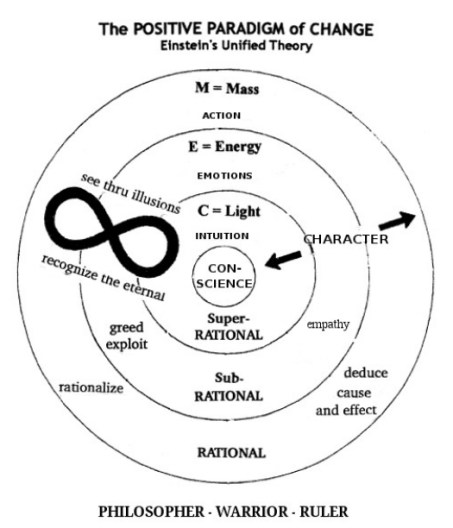
0 leader ruller


BUT then came the heart of the disconnect. He continued,


I’m not convinced that the “inner voice” is always a good thing to listen to, as evidenced by the actions of destructive and evil people throughout history.

.

This is a seriously important reservation. It’s my boundary-spanner job to reach across the divide with a response that connects us in common understanding.

.

The unique contribution of the Positive Paradigm of Change is that it speaks to this issue. It pictures a reality map that draws clear distinctions between rational, sub-rational and super-rational levels of experience. It’s not a new model. But it rephrases the “perennial philosophy” in terms of Einstein’s physics, linking historical wisdom with modern experience. It gives a way to articulate the important difference between misleading, deceptive voices that imitate conscience and the “real deal.”

.

It follows in the footsteps of psychoanalyst Carl Jung, who was instrumental in introducing the Wilhelm/Baynes version of the I Ching, the venerable Chinese Book of Change to the English-speaking public. He worked to define the common thread of human experience that links wisdom traditions throughout human history, as did comparative religion teachers, notably Joseph Campbell and Huston Smith.

.

Universal stories they focused on include one told by the Greek philosopher Plato. His psychological model pictures a chariot drawn by a pair of horses that pull in opposite directions. A white steed tries to pull the chariot off course, striving upward so close to the sun that it risks catching fire and being consumed. The black one pulls downwards, threatening to crash the chariot and driver into the ground. The driver’s challenge is to rein in and coordinate the team, steering a steady middle course that avoids danger-filled extremes. In this way, he succeeds in reaching his intended destination.

.

[Regrettably, this poetic model, while psychologically accurate, has been taken literally and harmfully misconstrued as if it had racist implications.]

.

A similar chariot story from the Hindu tradition is told in the Bhagavad Gita. Arjuna, a warrior driving his chariot into battle, grows faint of heart. At this point, Krisna, a god representing conscience, makes his presence known. As the passenger seated behind Arjuna, Krisna advises with encouragement and wisdom, giving him the heart to prevail in fighting the good fight.

.

The Positive Paradigm Wheel is true to these poetic traditions. All account for the interdependent facets of awareness. The rational mind (driver) of the chariot (physical body) must skillfully harness the horses (energies, emotions) that power the vehicle, while heeding the guiding voice of conscience in order to meet ultimate goals.

.

In addition, however, the Positive Paradigm, also accounts for the actions of destructive and evil people throughout history which give Page pause. Despite claims to the contrary, such actions are not the result listening to the Inner Voice of Conscience. Evil actions are the mark of unbalanced extremists who have been misled into following the seductive voices lodged within the middle, sub-rational level of the Wheel.

.

Destructive leaders are heeding not the innermost voice of Conscience, but the clamor of the Seven Deadly Sin-Demons — starting with Pride, followed by (and often in combination with) Anger, Avarice, Gluttony, Lust, Envy and Sloth. Modern day demon off-spring include Separatism, Exclusiveness, Arrogance, Ambition and Competition.

.

What’s dangerously missing from the prevailing, exclusively materialistic paradigm of empirical science — a glaring gap which the Positive Paradigm of Change fills — is a universally acceptable reality map which includes the sub-rational middle level with all its dangers, but in its complete and correct context: contained by the super-rational level of intuition on one side and by the rational level of practical experience on the other.

.

Herein is the common thread which continues the earlier blog, the Fateful Fear of Self-Awareness. I will shortly post a description of the reality map with emphasis on the too little known and greatly misunderstood, danger-fraught middle level. Character- based leaders in every walk of life and therapists as positive change agents can use it as a reference to realistically navigate the temptations of Seven Deadlies and their off-spring in order to prevail in fighting the good fight for themselves, and then for those those who place trust in them.

.

In the meantime, dear Page, I heartily encourage you to read your Bible faithfully. I’m remembering Old Testament words burned into my mind from a performance of Mendelssohn’s Elijah long ago. It’s a tenor solo, the scripture-based words being, “If with all your heart ye truly seek me, Ye shall ever surely find me. Thus sayeth our God.” It’s as good a guide for sincere leaders as one would wish for in this dangerous world.


All best.

The Fateful Fear of Self-Awareness

According to new research from the University of Virginia, most people would rather do something external — even hurt themselves in some cases — than sit alone with their thoughts. Why is this?

How do people of all ages get so stuck on the material surface of the Wheel that they’re unwilling (afraid!) to look inside? The researchers guessed that maybe people were born this way. But I doubt it. Powerful indeed are the social incentives for Self-avoidance, even self-harm — which is pretty much the same thing.

Here’s the picture of the exclusively empirical science world view which rules out the middle and center levels of human experience. If you’ve been taught to believe there’s nothing more to life than the material surface and have come to expect that taboos on inner experience will be enforced with punitive ridicule and rejection, then the blessing of quiet time becomes a threat.

MaterialistAthest

Contrast this with the timeless Unified Theory which is equally compatible with ancient yoga, biblical tradition and Einstein’s vision. This picture shows levels and layers of inner experience available to pioneer spirits with the courage to explore as yet unknown territories and reap the reward of their riches.

062514 Balanced World View

Dangerous Times Call for True Radicals

At 7:07 a.m. on Tuesday, July 2nd, a tweet from RhinoforDinner popped into my email inbox. “Thanks for the follow! I’m Page! What leadership quality do you think is most important for young leaders to learn?”

I tweeted back, “Great Q, Page! I’d say Confidence, meaning “with faith” in their True Selves: having the courage to hear & follow inner voice of Conscience.” I double-checked Page’s avatar – a seriously disgruntled cartoon rhino.

Here’s the description: “What is real leadership? A rhino in a restaurant is no doubt powerful… But he has no authority! Helping leaders lead with authority!” So I followed up, “Conscience is the connection with ultimate inner authority.” Then, on second thought, an hour later, “Con-science = with science, the true meaning of which is ‘with knowledge.’”

I have enormous compassion for Millennials . . . as well as great hope, which is why the 2014 edition of Two Sides of a Coin: Lao Tze’s Common Sense Way of Change is dedicated to them:

Though it may seem as if they’ve been economically disenfranchised by their elders, material misfortune on the surface of the Positive Paradigm Wheel contains within it the hidden seeds of humanity’s long-term survival.

Ours isn’t the first time in the repeating cycles of history that leaders have squandered national resources. But in the context of Lao Tze’s larger reality, material resources aren’t that significant when compared with the intelligence, inner strength and inexhaustible vitality available to those whom circumstances oblige to return to the less tangible but very real levels of inner experience.

Millennials are the ones for whom the results of the materialistic, conflict-paradigm are so catastrophic that they have no vested interests to protect. They’re the ones prepared to move forward once again into the past, recovering the timeless treasure of the Positive Paradigm buried deep within the Tao Te Ching‘s wisdom.

  They’ve been given the greater opportunity to dig deep,

rediscover their inalienable inner resources, and

become the truly radical agents of substantive, positive change.

In the repeating cycles of generational pendulum swings, their 1960’s grandparents (indiscriminately) embraced all things change – on the surface. Religious, sexual and cultural norms went by the board. Hippie flower children dropped out of “the system” and tuned in to drugs, hard rock and doing their own thing.

Working with less-than-perfect translations of the I Ching, they popularized the misunderstood Chinese Book of Change to rationalize (predictable) rebellion against security-obsessed elders, who (as survivors of the great depression and World War II), had reacted in opposite and equally extreme ways to the extremes of the generation before them. (And so on, and so forth, round and round again.)

My best hope for Millennials is that they’ll benefit from the lessons of history and NOT mindlessly perpetuate the pattern of yo-yo swings between opposite and equally dysfunctional extremes on the surface, disconnected from the timeless center.

We now recognize that different visions of timeless truth are, necessarily, inherently the same. Looking back in time, the Tao Te Ching (along with the I Ching worldview it expresses) is remarkably compatible with Patanjali’s Yoga Sutras. Looking forward, it is equally compatible with the teachings of Christ. Most recently, the correlation has been made with the three variables of Einstein’s famous formula. He had the Unified Theory, though lacking familiarity with ancient teachings, didn’t know it.

Now, as in the time when Christ walked the Earth, true fundamentalists and radicals (both words mean the same thing) aren’t conflicting extremist groups that meddle with events on the material surface of life’s wheel, but single individuals with the courage and vision to change themselves from the inside out.

Millennials, along with the parents and grandparents who dearly wish them well, can benefit from a hard-earned, deeper understanding of change. They’re becoming aware that times of adversity and extreme danger offer opportunities for self-transcendence. They can anticipate hidden blessings (however well-disguised) and prepare according to The Common Sense Book of Change view of CHANGE:

49. CHANGE

Day and night replace each other

in endless cycles of CHANGE.

The same natural law generates flux

in human events.

The unprepared see change

as a threat,

but the well-prepared

face the unknown calmly.

They know that after degeneration

reaches critical mass,

regeneration follows.

Welcome the new.

Avoid short-sighted fear.


This, in turn, however, leads to a whole new subject.

.

globe

Seven Axioms of Positive Change

As promised, here is an abbreviated list of the seven basic axioms of viable, positive change as they’re listed in The Positive Paradigm Handbook: Make Yourself Whole Using the Wheel of Change. They all refer to the basic model of concentric circles linked in a continuous, infinite loop:


PositiveParadigmWheel

.

  • AXIOM ONE: A complete and correct paradigm is the key to personal well-being and success.

In the Positive Paradigm worldview, the physical world of experience has its origin and end at the creative center of the Wheel. The unseen drives the seen. The invisible precedes the visible. Inspiration precedes actions which in turn produce results.

Therefore, the quality of daily life depends on the quality of belief systems. If the paradigm held is complete and accurate, it leads to consistent action that yields successful, beneficial results. When paradigms are incomplete and inaccurate, however, they generate inconsistent actions that lead to failure, pain and suffering.

By definition, a universal paradigm can be applied to every and any aspect of life. A rethinking of personal lives, bringing them into alignment with the Positive worldview, will enhance well-being on all levels. A similar rethinking of organizational structures on increasingly larger scales of magnitude will have equally beneficial consequences.

A deep understanding of the Positive Paradigm illumines whatever field of endeavor upon which it is focused. This includes all the arts as well as the physical and social sciences — economics, politics and government.

.

  • AXIOM TWO: We are each a world complete, containing the potentials of the universe.

Sadly, this is the least known but most important fact of life we never learned in school – but should have. In large part, the Handbook is written as the book I searched for on the library shelves, but couldn’t find. It should have been there, and now will be for others who also sense that there’s something really important missing from what we were taught which must be restored. It’s the basis of a fundamental respect for self as well as for all others.

The place to look in this information starts with ancient medical traditions. The traditional sciences of both India and China map the subtle inner energy patterns which Huston Smith called the “invisible geometry” which shapes all humanity to a “single truth.”

In these worldviews, energy emanates from and returns to an eternal source. It is the stuff from which the physical world is generated. It is the substructure which frames the physical human body, upon which mental and physical health depend. When this energy is abundant, its circulation free flowing, and its distribution balanced, we experience health. When energy is depleted, stagnant or unbalanced, the result is disease on every level.

The functional term “health” in the context of these traditions means “whole.” The health of subtle energetic and related biological systems depends on the integrated balance of the interrelated parts. Each part depends on and completes the whole. The concept of “holism” expresses this worldview. . . .

.

  • AXIOM THREE: Unity and Diversity Are Necessary Compliments

The third axiom is almost as neglected as the second. In addition, it is subject to distortions and misunderstandings that make matters worse. This confusion is the unfortunate cause of conflict in family relationships, and all the way up the life chain to conflict between nations.

Inherent, inner similarity is the realistic foundation of common understanding. However, the fact that all people have the same inner structure does not mean that all are identical, or should be treated the same. Quite the contrary, within the evolutionary chakra scale, at any given time, most individuals are focused on only one or a small combination of centers and their related issues.

Like snowflakes, humans are identical in their basic structure. Each, however, is unique expression of the universal pattern. Personal abilities and needs are the result of an infinitely complex set of variables. And just as the balance of energy centers promotes the health of the individual, a balance of complimentary aptitudes and interests promotes the general health of society at large.

.

  • AXIOM FOUR: The consequences of action are inevitable; those who respect the law of karma succeed.

Axiom Four is the practical foundation of ethics. In a materialist, linear worldview, it may seem possible to hide selfish motives and evil deeds behind a mask of false appearances and escape the logical consequences of one’s actions. This false premise and its horrific outcome, however, is exposed in Oscar Wilde’s The Picture of Dorian Gray.

In the circular and richly textured fabric of the Positive Paradigm reality, attempts at evasion and deception are ultimately futile. The Old Testament describes the karmic law of return in agricultural terms. “As ye reap, so shall ye sow,” and “For everything there is a season. . . “

In modern parlance, the saying that underscores the circular dynamic of “poetic justice” is, “What goes around comes around.”

In the New Testament, Jesus stated the Law of Karma as practical advice: “Do unto others as ye would have them do unto you.” This observation holds true as axiomatic. It has been observed for a very long time that in fact — even if not immediately, or directly — what is done does, for better or worse, return in kind.

.

  • AXIOM FIVE: History is neither linear or progressive, nor can human survival be taken for granted.

Some things change. Others never do. Knowing the difference between absolutes and ephemerals is matter of life or death. The center of the Wheel is changeless. Those in the know depend on this. But the Wheel’s rim spins in endless circles of repeating, patterned change. Therefore, survivors anticipate the predictable, cyclical changes of nature.

They know far better than to take immediate appearances at face value. They’re not fooled by wishful thinking into the false belief that what can be seen is permanent.

Lao Tze, who wrote the world-loved Tao Te Ching, or The Way and Its Power, knew this and tried to warn the world. Sun Tzu, Chinese author of The Art of War — a manual used by successful military leaders for hundreds of years — taught savvy strategists how to exploit the knowledge of human dynamics to win their battles. Today’s international business leaders have adapted this wisdom, as well as spin-offs like the 36 Stratagems, to capture markets, maximize profits and beat out the competition.

All these texts draw on the wisdom encoded in the I Ching, the venerable Book of Change, to steer them in the decision-making process. They rely on the law of subtle change and the personal understandings derived from working with it to stay ahead of the curve. Knowing that surface appearances are deceptive can be used as a protective, self-defense measure, or exploited with endlessly ingenious variations that take advantage of the uninformed. . .

In the dark ages, Europeans were taught to believe that the world was flat. That the globe of spinning Planet Earth is in fact round was received as life-changing information that dramatically changed the way people thought and lived.

Similarly, some today still continue to think of history as a flat, straight line. In this they are as sadly mistaken as were the navigators who guided their ships on the assumption that the world was flat. In fact, the dynamics of human history resemble a multi-layered clock whose second, minute and hour hands continuously return to the same starting point at different rates of speed. Rethinking the paradigm of history to align with known facts would give future leaders an edge on survival.

.

  • AXIOM SIX: Used as a linguistic tool, the Positive Paradigm Wheel of Change promotes clear, accurate and effective communication.

Like humanity itself, the English language is also becoming an endangered species. Clear and effective communication can no more be taken for granted than any other aspect of the civilization.

In tracking the meanings of words, their devolution is found to be systematic. In some cases, the same word means not only one thing, but its exact opposite as well. The inherent danger is that people often talk at cross-purposes, thinking they understand each other when in fact they’re missing each other coming and going, only vaguely aware of the disconnect.

It’s worth the time to pay attention to what’s meant by specific words in common use. Working with the Positive Paradigm Wheel explains the dynamics of shifting definitions. The same word takes on different meanings on different levels of the Wheel.

One example is the word “positive.” Webster’s Dictionary lists seventeen (!) different uses. They span the continuum from center to surface, with many gradations along the route. At the core, “positive” refers to that which is absolute, unqualified, and independent of circumstances; that which has real existence in itself.

At the middle, energy level, the term is used describe an electrical valence. As an attitude, positive can mean either confident or dogmatic. At the surface, positive may mean showing forward progress or increase, making a constructive contribution.

  • AXIOM SEVEN: With a correct paradigm, practical methods and useful tools, you can make yourself whole.

As stated in the Preface caveat, according to the Positive Paradigm, everyone is already intrinsically whole. Put another way, “God don’t make no junk.” This is the wisdom behind the biblical admonition, “Ye must be perfect like your father.” However, just as Einstein had the Unified Field Theory, but didn’t know it, each and every one of us on the planet is perfect in potential: made in God’s image. But we’ve forgotten.

Worse, many have been deceived into believing they’re inherently not-okay. The Handbook confirms inherent wholeness. Its structure provides the practical foundation for actualizing in-born potential and initiating the ongoing process of making and keeping ourselves FUNCTIONALLY whole, over and over again.

The subtitle Make Yourself Whole Using the Wheel of Change isn’t intended to suggest that this or any other book can magically or literally make anyone whole, or that once through the book, you’re done. It requires not only initial work, but ongoing follow-through. It’s personal intention and consistent effort that produce results. This is just a really useful tool.

***

To be continued. Each of the basic axioms generates numerous related corollaries. Future blogs will list the most important of them.

I’m a Passionate Mama Bear

A critic warned that unless I reach out to readers right away, I’ll lose them. Accordingly, I added this acknowledgement to The Positive Paradigm Handbook:

This book is dedicated to YOU, the reader. It acknowledges that we each mirror the potentials of the entire universe. The problem is that you’ve forgotten! Because the times are increasingly dangerous, you urgently need to remember who you truly are. WAKE UP!

I firmly believe that you’re far greater than you’ve allowed yourself to dream, and need only the encouragement, tools and motivation to prove me right. I’ve pushed myself to the burn out point to deliver the best I can offer, while there’s precious time left.

He hated it. “Saying ‘WAKE UP!’ will come across as an insult to some, and all the caps make it sound as though you’re yelling at them, “ he wrote.

What??? Of course I’m shouting. When a locomotive is bearing down on sleepers unknowingly camped on railroad tracks, directly in harms way, you don’t whisper. There’s no time for the subtle indirections he recommends.

But my message is intended as high compliment, a confirmation that we’re all potential GIANTS, albeit sleeping. How does he get an insult out of this?

He overlooked the rest:

I’ve been cautioned that the “average jane-schmo” can’t relate to my ideas. I don’t believe such a person exists. I’ve also been warned that because people today are unusually stressed, they want to read something “tangible.” I understand stress. But “feel good” stories and false assurances don’t change the facts or truly help anyone.

Do we as readers really want to be lulled into forgetful sleep? I believe we’re hungry to know why things are going terribly wrong and are urgently seeking better options. Life isn’t a popularity contest, nor is the Handbook about me. It’s about YOU and your ultimate survival. Please remember in reading it that I dearly wish you all the very best.

I’ve been told my style is “intense,” or “in your face.” I suppose so. It’s the voice of a passionate mama bear, fighting for the survival of her cubs.

“Give a story about your parents, or a teacher, or a mentor. Make people feel warm, like they can relate to you as a person,” advised my critic. I responded, “I’ve already done all this in the autobiographical part of Rethinking Survival. It’s filled with childhood anecdotes and other personal stuff. The Handbook is the bare bones summary.”

He declined my offer of a complimentary RS copy. Too busy.

For now, I’m providing excerpts from RS below that put my WAKE UP call in context. It’s more than just a call to wake up to current political abuses. It’s also a wake up call that points out HOW and WHY we’ve gotten into our current predicaments, WHO we truly are, and on that basis, WHAT options for positive change remain at this late date.


globe

I’m now convinced that the Positive Paradigm of Change is the ultimate answer to the ancient ultimate question. It’s the literal proof that humans are made in the image of the Creator — the microcosm resonates with the macro. I AM that I AM.

Put another way, “God don’t make no junk.” In this context, the exhortation, “Ye must be perfect like your father” makes perfect sense. Just as Einstein had the Unified Field Theory, but didn’t know it, each and every one of us on the planet is perfect in potential: made in God’s image. But we’ve forgotten.

And tyrants want you to sleep on. They’ll do anything to prevent you from remembering that you’re inherently okay. Because once you do, as Einstein did, no one can intimidate, control or dominate you. You’re aware that nothing anyone has for sale can make you more perfect. Nor can anything that anyone threatens to take away alter your essential okayness.

It’s your inalienable birthright. A given.

The Positive Paradigm is the viable basis upon which to build valid self-esteem. It’s the key to personal freedom — freedom from ignorance, freedom from fear. It’s the rock-solid foundation of functional democracy. It’s grounds for rethinking what the word really means and how to implement its promise.

One minor caveat: it all depends. While we all have the option to remember who we truly are, most of us are like Lambert, the sheepish lion. It takes a smack with a two-by-four upside the head before we’re finally ready to wake up. Often it takes the form of life-threatening danger to those we care for. A personal health crisis will also do the trick. So will job loss or a run-in with natural disaster.

But, like Dorothy stranded in the Land of Oz, when you want dearly enough to return “home,” you can click your heels whenever you chose — and come to find out, you’re already there.

———————-

The threat of evil giants in the world serves to awaken the true giant that resides deep within each of us. That’s the blessing hidden in adversity. It’s the opportunity latent in Titanic Times. The Greek Titans, the giants sired by Kronos, survived his murderous envy and returned to claim their heritage. Similarly, there are giants are among us now. It’s time for them to WAKE UP!

In the face of Titanic dangers bearing down from all directions, remember the stork and cobra cartoon. The snake is winding up the bird’s long, skinny leg, wrapping around its neck in a choke hold. The caption reads: “Never, ever give up.” To this, I would add more — essentially other ways of saying the same thing.

First, to the snake: “It’s never to late to change.” Second, to the bird: “Never, ever forget.” No matter how dark and dangerous life becomes on the surface, God the Creator — the Tao, the Source of all life — broadcasts love, wisdom and hope eternal from the center of the Positive Paradigm Wheel. Remember this: We’re not alone. We never have been. We never will be.

Unity Within, Diversity Without

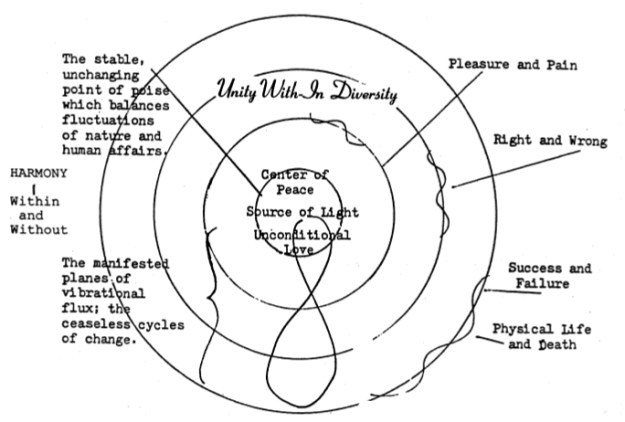
Here’s a note to acknowledge ongoing conversations with Mike Lehr and Steven Z. The first illustration (it dates back to 1982) shows what I mean when I say “Unity Within, Diversity Without.” By extension, it also shows that enduing stability rests within the eternal center. Growth takes place in the middle level. The diversity of unique personalities is associated with the surface level of ongoing change.

062514 Balanced World View

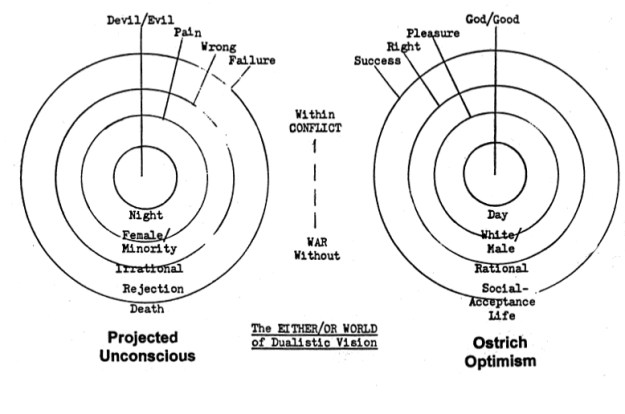
In contrast, the second, companion illustration shows the divisive either/or worldview that is currently causing so much confusion, pain and suffering.

062514 Evil

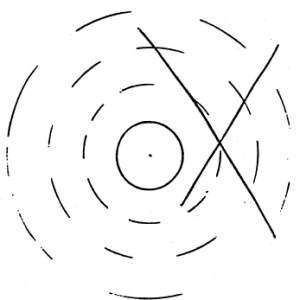
Additional pictures contrast two opposite and equal mistakes. The first shows the hollow shell of the exclusively materialistic, empirical science model.

MaterialistAthest

The second shows the dangerous, anti-life orientation of religious extremists.

Religionist

.

The Positive Paradigm of Change translates the old-new I Ching world view into the yoga-compatible Unified Theory. Based on Einstein’s theory of relativity, it offers the hope of a positive future for generations to come.

PositiveParadigmWheel

Do I Understand What You Mean?

I promised this blog to Steven Z. In response to a tweet, he wrote, “I have a possible new article suggestion for you and it’s simply – Rethinking Word Usage.” He continued,In general, people use ‘words’ that they unfortunately have no clue of their true meaning or origin. I’ll even go so far as to suggest the paradigm of usage has become corrupted on purpose, as a social control mechanism. By whom?”**

After giving examples, Steven Z concluded, “It’s all these subtleties that add up to being where the world is today = lack of awareness.”

On June 17th, I answered back, “Great Message, Steve. I’ve written extensively about this issue. 1) Virtually every key term in the English language has been perverted to the extent that the same word means both one thing and its opposite. 2) Unraveling this “Tower of Babel” factor is essential to communication.

In fact, I tweeted out today, from The Positive Paradigm Handbook: ‘Axiom Six: Used as a linguistic tool, the Positive Paradigm Wheel promotes clear, accurate and effective communication.’”

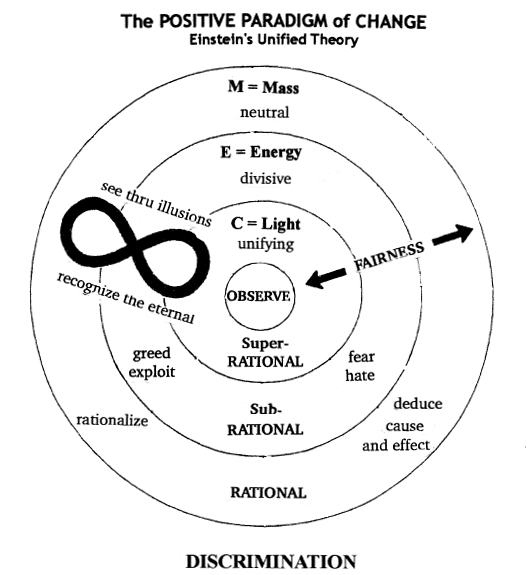
Here’s an illustration worth a thousand words, It shows the range of different meanings assigned to the single word, “discrimination.”

062414 Discrim

Here’s a basic explanation of Axiom Six:

Like humanity itself, the English language is also becoming an endangered species. Clear and effective communication can no more be taken for granted than any other aspect of the civilization.

In tracking the meanings of words, their devolution is found to be systematic. In some cases, the same word means not only one thing, but its exact opposite as well. The inherent danger is that people often talk at cross-purposes, thinking they understand each other when in fact they’re missing each other coming and going, only vaguely aware of the disconnect.

It’s worth the time to pay attention to what’s meant by specific words in common use. Working with the Positive Paradigm Wheel explains the dynamics of shifting definitions. The same word takes on different meanings on different levels of the Wheel.

One example is the word “positive.” Webster’s Dictionary lists seventeen (!) different uses. They span the continuum from center to surface, with many gradations along the route. At the core, “positive” refers to that which is absolute, unqualified, and independent of circumstances; that which has real existence in itself.

At the middle, energy level, the term is used describe an electrical valence. As an attitude, positive can mean either confident or dogmatic. At the surface, positive may mean showing forward progress or increase, making a constructive contribution.

As this one example serves to indicate, it’s extraordinarily difficult to communicate so as to be understood as intended. The “Tower of Babel” factor issue is addressed in Rethinking Survival and Conscience:

Tower of Babel Factor

The gift of language sets humans apart from animals. It provides the building blocks of communication. It’s the foundation of civilizations and the necessary glue of cultural continuity.

That being said, humans are the only creatures who rationalize greed, lie to others about their actions and deceive themselves. . . .

That’s quite the opposite of the language I’d learned to love and respect in high school. There, we were taught to regard language as the premier tool of logic. When used with Sherlock-like diligence, applied with the powers of keen observation and heightened awareness, it can solve mysteries — not only detect the crimes of evil-doers and the nefarious plots of national enemies, but reveal the mysteries of life and the universe.

Turned inwards, used with self-honesty, language is an essential tool of introspection used for cultivating self-awareness. For the truth-seeker, language is the necessary vehicle of information both on the inward quest and on the return journey to share its benefits.

** In Rethinking Survival, I’ve also described the intentional perversion of the English language to which Steven Z alludes. However, it’s outside the limits of this particular piece.


How Bad People Become Leaders

In response to my last blog, “Scientists and Sages Can Agree on This,” Mike Lehr of Omega Z Advisors posed a question: “It seems many leadership models characterize leadership as a universal good . . [but] it’s hard to give much credence to any model that can’t explain how ‘bad people’ become leaders. What thoughts do you have on this?”

I answered back: “I love a challenge, Mike. I’ll post my thoughts by Monday, and tweet you the link. Many thanks for asking.”

And it is a very challenging question. The subject is vastly complex. Making matters worse, the English language is so compromised that it’s difficult to answer simply and clearly.

For one thing, Mike, you’re not alone in looking for answers to this question. Earlier on LinkedIn, I was following a thread in the Leadership Think Tank discussion group. Five months ago Milan Grković, who heads the MUI Centar in Croatia, posed the question, “Why We Have So Many Bad Leaders?” At last count, there have been 1529 comments.

Mike’s question is framed in terms of “bad people.” Milan calls them “bad leaders.” It’s an important distinction. Both are valid. There are good (meaning ethical, responsible, compassionate) people who function poorly in leadership roles, and vice versa – not-so-good people who in measurable ways function effectively as leaders.

Unfortunately, good people who are also effective leaders are rare, while bad people who function terribly in leadership roles are all too common.

From childhood on, authoritarian educators brainwash the masses with a “respect” for authority figures, a word experienced somewhere along a continuum between “high regard” and “terror.” So most of us assume we’re obliged to comply without question.

We also been taught to expect that non-conformance has life-threatening consequences. (The tyranny of “experts” is a related but different subject for a future blog.)

Many individuals are placed in leadership roles. Very few have the combined aptitude and practical experience to actually lead. On the other side of the coin, some individuals are highly influential even without an organizational title. Their outstanding ideas and/or example suffice. Einstein is an excellent example.

Further, the description of a “bad” leader ranges from “well-intentioned but ineffective” to “incompetent, toxic and destructive.” Some people placed in leadership roles are hapless puppets.

On the other extreme, some crave power for its own sake, take pleasure in dominating others cruelly, and are quite intentionally evil. (Although business consultants, understandably, hesitate to use the word, the existence of evil is an important, unavoidable subject. A functional definition is given below.)

Different qualifications are required to lead in different situations. We each fill leadership roles at some times and in some areas of our lives. So the definition of an effective leader also changes on a sliding scale.

On the largest scale of magnitude, a universal leader is an educator in the pristine meaning term: one who leads from darkness to light. Christ was the ultimate leader. He instructed students to call him Rabbi, which means teacher.

All of this, however, begs Mike original question of how (meaning the process by which) bad people become leaders. Outside of sheer brute force, HOW are unethical, inhumane, and/or incompetent people selected to fill leadership roles?

I addressed part of this question in an earlier blog on the leadership selection process. (See Democracy Is a Myth.) My doctoral research study proved with 99 percent statistically significant results that an informal pre-selection process precedes the formal one.

Innovative, creative candidates are screened out by current power holders with a vested interest in maintaining the status quo. No one is identified, groomed or nominated who doesn’t mirror the values or otherwise suit the agendas of existing (sometimes not-so-good) administrators.

For another perspective, refer back to the Positive Quantum Paradigm Life Wheel. The previous blog, Sages and Scientists Can Agree on This pictured this holistic, integrated reality map. According to this model, a good leader is one who is not only self-aware on all levels, but is able to link, balance and prioritize them.

Both books on the Positive Quantum Paradigm, however, include sections that describe the extraordinary amount of pain, suffering and loss that results from basing decisions and actions on incomplete, incorrect paradigms.

Here, two illustrations must suffice. First is a picture of the prevailing, exclusively materialistic empirical science paradigm. The center is ruled out. Intuition is denied. Emotions and energy aren’t accounted for. All that matters are concrete tangibles and physical image. A leader’s motives and intentions are known only when it’s too late – after the selection has been made and the (sometimes regrettable) results come in.

.

MaterialistAthest

A “scientific” leadership selection process takes into account only that which is measurable, for example academic IQ. Intangibles like the presence or absence of cultivated Emotional Intelligence (street smarts) fly under the radar, as do ethical intelligence, creativity and a capacity for visionary insight.

When selectors judge only by appearances, it’s easy to deceive them. As Lincoln said, “You can fool all of the people some of some of the time, and some of the people all of the time.” Tor an ambitious con artist, those are pretty good odds .

In a second variation, all levels of the Wheel are operational, but they operate intermittently and out of synch, each disassociated from the others. The smallest circle which represents Conscience floats outside, detached from daily experience.

Stress

On one side of the continuum, this is the picture of a hypocrite, for example a person who operates on one standard with close family, but on another with strangers or at work. It represents someone who presents one image to the public, but acts quite differently when no one is looking.

Hitler is a familiar example on the far opposite extreme. This is the picture of evil, meaning anti-life: intentionally shattering and fragmenting the creative pattern. In Positive Quantum Paradigm context, the intentions and actions of any person (or group) that destroys its own and/or threatens to annihilate enemy groups, devoid of respect for the inherent sanctity of life, are defined as evil.

The empirical science paradigm has no language or structure for recognizing such malfunctions. In contrast, the Quantum Paradigm is designed to diagnose inner dynamics. Use it to identify bad people and prevent them from being given leadership roles.

Again, my thanks to Mike Lehr for this opportunity to respond. Hope this helps.

All best!

globe

Scientists & Sages Can Agree on This

Today’s effort started with a most excellent blog tweeted out by Mike Lehr of Omega Z Advisors: “The essence of #leadership in a single word blog.omegazadvisors.com/?p=2696.

It looked interesting, so I clicked on the link.

Yup. The major puzzle pieces are there. Vision. Strategy. Idea. Inspiration. Speaking directly to my subject, he states, “Leadership is about change.”

So I tweeted back, “I totally agree about inspiration and change, Mike. But then, how do we train such leaders?? I have a few suggestions. All best.”

Within a day, Mike tweeted back,“Post them somewhere, Pat . . .”

So here’s my short version of how to train leaders who are equally inspired and effective — a picture worth a thousand words.

The BEST LEADERS ARE SELF-AWARE

061614 Wheel

BE AWARE of

What You’re Doing and Why

The Life Wheel (also described as the Quantum Paradigm of Change) is a modern day descendant of the time-tested but gravely misunderstood, underrated Book of Change which leaders in every walk of life have consulted to cultivate self-awareness, make better decisions and get better results for over eight-thousand years.

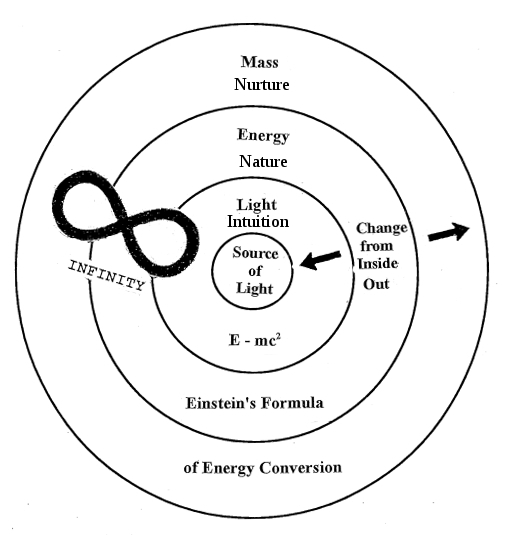
It places the three variables of Einstein’s famous formula, e = mc2 mass, energy and light, on increasingly deeper levels within the Wheel. The result is the Unified Field Theory which Einstein already had — consciousness factor included — though, sadly, lacking yoga background, didn’t recognize. This archetypal wheels-within-wheels model is equally compatible with modern physics, yoga philosophy and the world’s great religions. It is a reality map upon which scientists and sages can agree. It images the in-depth experience of the quantum spacious NOW, abiding beneath the surface waves of rational thinking and everyday sensory experience described by Eckhart Tolle.

  • The intuition Mike describes fits within the WHY level of the Wheel. This innermost level of Light is associated with spiritual guidance and flashes of genius. Unless integrated with the ability to strategize and implement, however, vision and insights fail to manifest as practical results.
  • Emotions (including empathy) and strategy belong to the middle HOW level. The Energy layer is associated with street smarts and Emotional Intelligence. Magnetism and charisma emanate from this level, but unfortunately aren’t always integrated with integrity, intelligence and practical organizational skills.
  • Purpose and outcomes belong to the surface WHAT level associated with tangible, measurable results. The Mass layer is the realm of quantifiable IQ as well as biological family and social/political connections. Persona (mask) and personality are surface appearances. They don’t necessarily reflect actual motives and feelings. (This is why merely imitating the words and actions of great leaders doesn’t have the same affect).

The three outer levels are interrelated and interdependent. Each is necessary but not sufficient. Their existence depends on the unchanging hub of the Life Wheel. The true SELF — also called Conscience, the Tao or God — holds the spokes together as events on the Wheel’s surface rim change continuously. Creation in the form of primal consciousness emanates from and returns to this silent alpha-omega center.

Inspired leaders are Self-aware. Positive leaders link inner vision with compassion to generate practical results. They serve as organizational catalysts, bringing out the best in others by example. Like stringed instruments, we resonate when true leaders strike a universal chord, set in motion by a deeper music.

This quantum paradigm of completion is “positive” because all the levels of experience are included and correctly prioritized. None are excluded. None are out of place. The levels are harmoniously linked in an infinite, two-way continuum of creative balance. (This is the holistic picture of unity or “yoga.”) Mindful of Einstein’s warning that problems cannot be solved at the same level they are created, it pictures the deeper levels where we can first get unstuck, and then travel deeper to where the genuine solutions we dearly need and seek can be found.

Prophetically, Einstein warned about the dangers of inverted priorities: “The intuitive mind is a sacred gift and the rational mind is a faithful servant. We have created a society that honors the servant and has forgotten the gift.” Today, more than ever, the world urgently needs leaders who remember their gifts and use reason correctly.

An important first step in training better leaders is to convince educators/executives/politicians and their students/employees/supporters of the grave dangers inherent in prevailing, incomplete and inaccurate paradigms. Then, it requires rousing sufficient courage to make a paradigm shift.

What could be more powerful motivation than the pending threat to human survival?! For today’s un-in-formed leaders are undeniably steering planet Earth towards a catastrophic disaster that dwarfs the Titanic’s collision. Einstein wasn’t exaggerating when he observed, “We shall require a substantially new manner of thinking if mankind is to survive.”

Decision-makers and leaders in every walk of life can make themselves whole by using the method outlined in The Positive Paradigm Handbook — currently under revision. In addition, it gives a practical standard for assessing leadership potentials, training better leaders, and choosing which ones to follow.

All best!

globe

Don’t Blame the Stars – the Fault is in False Paradigms

globe

Last week, driving down hilly country roads, listening to the radio, I chanced upon an NPR interview with John Green, author of the wildly popular book — now a movie — The Fault in Our Stars. He said he spent years writing, alone in his basement, going, “Marco, Marco, Marco.” And then, finally, a response: “Polo!”

Green has reworked for Millennials the archetypal story of star-crossed lovers that has resonated with theater-goers ever since Shakespeare’s Romeo and Juliet.

In 1970, Love Story, ar tear-jerking tragedy of youthful lovers separated by cancer, was a box office hit.

In 1997, the same archetype catapulted the movie Titanic to world-wide success. Here, lovers rich and poor crossed social boundary lines, only to be separated by calamity and death.

Why is that archetype so powerful? Wherein lies its power to move us? What is the deeper prescient chord it strikes that is common to everyone, everywhere? Because there’s much more to the scenario than just young love and social differences.

It speaks to us at a deeper level. Especially in Titanic, we respond subliminally, not only with a painful awareness of our own mortality, but also an inner foreboding – foreknowledge, if you will — that even as we continue to heedlessly pursue our individual wants, the mother ship of planet Earth is speeding on a collision course towards disaster.

While each individual faces the certainty of physical death, far worse, we’re now faced with the possibility of collective extinction as well.

Importantly, however, Green’s title, The Fault in Our Stars, isn’t taken from Romeo and Juliet. The quote comes from a Shakespearean tragedy about political intrigue, betrayal and assassination: Julius Caesar. The scheming nobleman Cassius tells his co-conspirator: “The fault, dear Brutus, is not in our stars, / But in ourselves, that we are underlings.”

On the surface level, Hazel and Augustus, Green’s cancer-stricken protagonists, may regard their cancers as the separating enemy at fault. But just as there are many kinds of physical cancers, there are deeper ones to blame for the larger tragedies that threaten humanity on a planetary scale.

The same ego-driven madness expressed by Cassius drives leaders today too, escalating the advance of wordwide oppression.

According to The Positive Paradigm Handbook, the megalomaniac urges that motivate many politicians and corporate executives are like cancers:

Dysfunctional paradigms result in fragmented policies and unstable governments. . . This happens when toxic, pride-based competition enters into the mix of human relationships. The illusion that one person or group “needs” to seem bigger, better, stronger, smarter or more powerful than the others poisons the waters of life from which all drink.

This prideful attitude breeds insecurities, triggering an opposite and equal illusion of lack, as if the success of others constitutes an insult or threat that must be counter-attacked.

Like cancers which turn the cellular dynamics of the human body against itself, views that violate holistic wisdom turn the parts of the social organism against each other.

In other words, the underlying fault of the tragic story I’m writing about in my secluded author’s corner is another kind of self-destructive cancer. And though it would take a great deal of courage and considerable, ongoing effort, for some, it’s curable.

What is needed is a positive paradigm shift. In Einstein’s words, “We shall require a substantially new manner of thinking if mankind is to survive.”

True, grieving over a sentimental boy-meets-girl story is less challenging than facing up to our deepest faults and fears first hand. We are ready to weep for fictional characters when what we’re really crying about is our own inevitable demise. The problem with projection, however, is that shedding tears doesn’t change the facts.

It might well be that emotional romance stories are part of the diversionary media noise being generated to distract away from and cover up impending real life dangers. In the meantime, I am still writing away, like Green going “Marco, Marco, Marco.”

“Polo,” anyone?

Democracy Is a Myth

Another installment of Reinventing Democracy must include my basic conclusion that today, for many reasons, democracy is a myth.

For starters, in Rethinking Survival, I draw on the key observation made by legendary comparative religion expert Joseph Campbell.

In his opinion, current myths (meaning creation stories and paradigms of how the world works) no longer serve us well. He called for a new paradigm, one that allows us to recognize the humanity of people living on the other side of the hemisphere.

Anticipating the Positive Paradigm of Change as the embodiment of Einstein’s long-sought Unified Theory, in The Power of Myth, Campbell wrote, “I’ve often wondered if some of the notions coming out of quantum physics, quantum interconnectedness, don’t express that.”

Historically, a belief in democracy is fundamental to the American world view. However, what I inadvertently proved in my dissertation’s statistical research study is that the existence of democracy in America is also a myth in the slang usage, meaning “false and fictitious.” Excerpts from Rethinking Survival explain.


globe

THE SELECTION PROCESS: Democracy is a Myth

Graduate school years were another mixed blessing. While earning a Ph.D. in Educational Administration didn’t lead to career advancement, it was highly therapeutic: another opportunity to divest myself of unconsciously held programming.

One day I would read in the research literature about the mistakes women new to administration make, being unable to read the hidden cues of old boys’ club colleagues. The next day, I would fall kerplunk, right into the same traps. Ouch! I would read about female stereotypes, and almost immediately find myself playing them out. Aha!

Another upside was the presence of exactly the right people in the right places to tell me what I needed to know to survive. . . . Howard Wakefield, the Department Chairman, took on the role of thesis advisor. His sense of humor and down-to-earth attitude saw me safely through the Ph.D. credentialing process. We spent long hours talking philosophy. Howard was a practicing Christian. He gave me a pocket Bible from the stash he kept in his center desk drawer. I treasured this gift.

The dissertation topic was as challenging for him as for me. Stereotype issues literally hit home. He began to see relationships with his wife and teenage daughter in a new light. But, he told me, it worked both ways. The job of his dreams had been to be a school district administrator.

But he was a short and small-boned. With thick glasses, he didn’t exactly project an athletic image. Muscular football coaches capable of nailing unruly teenage boys to the gym wall were the candidates of choice. He became a professor because, like it or not, that was stereotype he matched.

The Dissertation

Ethnology was ruled out for thesis projects. I was required to use statistical methods in my 1978 Ph.D. dissertation, “Women Principals in Wisconsin Elementary Schools: A Support-Success Theory.” With 99 percent statistically significant results, this study proved that public schools in Wisconsin are an inbred, insider’s closed shop.

No one enters the selection process who hasn’t first been identified and groomed by current school administrators. No one enters graduate school to earn a school administrator degree or applies to the Department of Public Instruction for credentials who hasn’t already been promised a job. The unwritten, informal rules of the pre-selection process require that job candidates mirror the values, beliefs and interests of current power-holders.

Dissertation research surveyed four distinct groups with the same set of questions. Each population had radically different perceptions of the same selection process. Men principals, those who benefit most from the process, responded with a remarkable 98 percent return rate, insisting the process is fair and unbiased.

Men teachers, however, those whose expectations and ambitions had been thwarted, were angry and cynical, certain that the process is stacked and unfair. In one respondent’s words, the chief qualification is “a willingness to screw teachers.”

Women teachers were oblivious to the existence of a selection process. Their mantra was, “I am not aware . . .” Only women principles were ambivalent. As boundary spanners, they had succeeded in being selected, but still recognized bias and injustice in the selection process.

What separated principals from teachers, regardless of gender, was the combined support received in their personal and professional lives. Those who got the most support succeeded accordingly. Those who received little support were least likely to succeed.

Interestingly, my research of the literature found that convenient myths are easily forgotten when they suddenly become inconvenient. A paradigm shift occurs, for example, during war time. When the men are away and there’s work to be done, then women are suddenly seen as perfectly fit to function as factory workers or school principals.

By extension, it’s only when the times make skewed rules of the knowledge and power-distribution game sufficiently inconvenient that the public will become receptive to the Positive Paradigm of Change and Positive Action ways to identify and support more effective leaders.

Applications: the I Ching view recognizes that patterned events repeat smallest to largest. Thus my research findings can be applied to the selection of government officials at every level. It applies to the selection of the CEOs in leadership positions within businesses and corporations. It also applies to political leadership, even on an international scale.

Conclusion: the American dream of a democratic, meaningful choice in leadership is but an illusion. In an informal process that proceeds the formal one, candidates are pre-selected and effectively owned by insiders. The sorry absence of innovative, effective leadership is explained by the documented filtering process which for the most part excludes creative, natural leaders.

What are the long-term survival consequences? To our detriment, the Western linear progressive theory of history puts in-bred leaders operating on dysfunctional paradigms at a loss to foresee cyclical down-turns in order to prepare for them in time.

Ancient Egypt’s pharaoh had his Joseph to interpret warning dreams and oversee the timely storage of grain during seasons of plenty to off-set famine during seasons of drought. Who prepares or listens to such boundary-spanning advisors now?

What’s Most Important – Nature, Nurture, OR . . . ?

The other day, I encountered Ivan Goldberg on LinkedIn. A Chair at Vistage International, his formal title is Executive Mentor and Coach. But it’s his personal handle I find irresistible. He describes himself as an “Enthusiastic Agent for Change, Wise Old Sage, Great Listener, and Author of ‘Leading to Success.’”

globe

I’m an author of books on change based on the book ancient sages have depended upon for eight thousand years and counting. So I had a hunch that I’d found a kindred soul. I sent an email to find out.

When he accepted my invite, I wrote back: “Thanks for the connection, Ivan– Your blogs look terrific. Maybe you’d like mine as well. Here’s one that’s just been retweeted. Thanks for your great work. All best, Pat West”

Sure enough, he answered me, “Hi Pat. Many thanks for the link. Your blog is certainly more academic (that is a compliment BTW) than mine and is very thought provoking. Hope that you like today’s post on Leadership. Best regards, Ivan”

Being an academic (though also much more), I did my homework. On his website, Ivan asks “Are Leaders Born or Made?” He also answers the question: “It is Nature, Nurture and Much More!”

One good blog deserves another. So I answered back:

Hi Ivan. Yes, I liked the Nature, Nurture AND More blog. I also liked the ones on motivating and daring to be different. Seems to me that you do in fact have the soul of a sage, and know a thing or two about change. The Chinese don’t have a monopoly on wisdom after all. Now I’m motivated to write you an answering blog on the subject of nature, nurture, and More. I’ll alert you come mid-week, if you like. All best, Pat”

What follows is my response to Ivan’s blog. He concludes, “Is it a matter of nature or nurture?  It is both.  Leaders need to be aware of their inborn abilities and how they can develop them, which is, essentially, an auto-didactic exercise.”

What? “Auto-didactic?!” I can’t resist a friendly tease here. Ivan, who doesn’t really have much use for academics, uses a pretty fancy word that I (the presumed academician) had to look up. Turns out, it means self-analysis. As a noun, it means self-taught.

Agreed. Self-responsible learning and experience are essential. Potential is necessary but not sufficient. However, the wisdom of sages (not the same as academic theories) can make a useful difference. I’ll give one example here using the Positive Paradigm Wheel of Change which is true to the original, the I Ching. This picture talks to the right brain to balance the left-brain discussion which follows.

It places the relationship of nature, nurture and “much more” in prioritized context.

NatureNurtureWheel

For those as yet unfamiliar with the Unified Theory of Einstein’s heart’s desire, let me explain briefly. The model of concentric wheels-within-wheels is equally compatible with modern atomic science, the world’s great religions, and yoga philosophy.

The surface level that corresponds with MASS includes everything tangible and measurable. It’s the realm of empirical science. That would be “nurture.”

The middle ENERGY level corresponds not only with electricity, but with subtle but measurable energies that yogis call “chi” or “prana.” It’s the level associated with DNA, emotions and “gut” feelings. As detailed below, that’s the level of “nature.”

The innermost level of LIGHT is associated with intangibles. That’s the “. . . and Much MORE.”

On the surface, intelligence is measured by IQ. It’s also the realm of human laws and social codes, including morality.

The middle level is the domain of the natural law encoded in the venerable Chinese Book of Change. Competence at the middle level is popularly called EQ – Emotional Intelligence. This is the realm of native virtues, including but not limited to courage, kindness and calmness. Compassion is the balanced composite of intrinsic virtues.

Still further inwards, deeper knowledge is experienced as intuition, sometimes called guidance. Most notably, the New and Old Testaments speak to this level.

At the hub of life’s Wheel, the unchanging center holds the radiating spokes and rim together. This eternal source of life and light is associated with the silent voice of Conscience. The Chinese call it the Tao, the Way which cannot be named.

Here’s how Ivan’s comments on nature vs. nurture fit into the Wheel. The surface of the Wheel is the level of daily experience, which includes on-the-job and classroom training as well as expert mentoring. This is the level of nurture – leadership development.

Even so, depending on what (or whether) they choose to learn from it, experience shapes different leaders differently. (Academics who are heavy on theory but light on experience are understandably frustrating to leaders whose common sense is highly developed.)

The middle level of the Wheel is where some leaders fall short. This is what Ivan calls nature – innate potentials. Leaders may or may not be self-aware on this level. Some trust their gut feelings more than others. A fortunate few, like Mozart, for example, are born already in-formed. But a deficit can be improved by relevant training, especially when reinforced by practical experience.

The innermost level of the Wheel is where more leaders are gun shy. This is the “And MORE” factor. Deeper than either surface nurture or middle level nature, only the most successful are in-formed by intuition (which is different from gut instinct.) Creative change agents regarded as visionaries receive their inspiration at this level.

The center of the Wheel is, by definition, absolute. The other levels emanate from and return to this creative source. The very best leaders are those who focus here and link the hub all the way to the surface. They’re equally competent on all levels in a balanced way. This is the ideal towards which to strive. It’s also the standard for deciding which leaders to follow, and which ones to promote.

In Positive Paradigm context, the three levels radiating outwards from the central hub are prioritized. For this reason, a highly proficient but insensitive and uninspired technician isn’t yet qualified to lead others. An enthusiastic, high energy leader may attract followers. But a charismatic speaker whose ethics are shaky or whose connection to the center is unstable needs work. Wherever there are deficiencies, once identified, they can be corrected. This is the purpose and value of the The Positive Paradigm Handbook.

The relationship amongst the levels explains the extraordinary success of leaders who start with few material advantages, but succeed far beyond many who begin with more.

Scriptures tell us, and the best leaders affirm, “With God, all things are possible.” That is to say, from a strong connection to the center, entire empires can be spun. Leaders who demonstrate the courage of their convictions make up for early social disadvantages through native intelligence, hard work and the not-coincidental luck this generates.

Detractors may doubt the necessary connection between material success, emotional intelligence, intuition and conscience. They ask, “What explains the success of the fabulously rich and powerful men on the planet who, as outspoken atheists, get whatever they want, however they want, with no regard for the harm they cause to anyone who dares stand their way?”

Well, there are many stories about bad deals with the Devil. Satan promises – and for a short time, can sometimes deliver – ephemeral success in the transitory world. But never the lasting peace which comes from following conscience. Disciples of Saul Alinsky, an admitted follower of Lucifer, can deliver worldly success to political organizers (you know who they are) willing to deceive, fragment and exploit the masses they pretend to serve.

But leaders who intentionally live true their conscience and succeed in linking the levels of life are key to a viable future. The rest of us will depend on them to out-think, out-maneuver and succeed long after pretenders with no substantial connection to the center of life have been blown away like dust in the wind.

So here’s my ongoing call to sages world-wide. Unite in the vision of Einstein’s Unified Theory. As he warned us, this “substantially new way of thinking” is a matter of human survival.

 Angel Calling


Discovering the Missing Link

This afternoon, as an after-thought, my author-journalist LinkedIn connection emailed me, “On another note, your years living in Europe and your other international travel sound interesting. Must be a good story there. Would love to hear more when time permits.”

As a matter of fact, a section in Rethinking Survival describes the highlights of living in Europe. So I’ll share some of them here.

globe

EUROPE: Discovering the Missing Link

“If you love your children, tell them how the world works.” — Dr. Phil

According to the people who raised me, the way the world worked was this. If you “pleased” them, then they would take care of you: feed you, house you, pay the bills for your clothes . . . let you live. If you didn’t, they’d disown you, cut you off, write you out of their will. The end. Survival depended exclusively on being very good at pleasing those who controlled the money and the material resources which come from it.

In my case, this was a problem. What pleased one adult didn’t please the next. And what pleased me didn’t necessarily please any of them. It was, at best, a con. Bottom line: I had no idea of how the world really works, only that mine at the time didn’t work for me. When conflicting survival demands came to a head, I had to split. “Get out of town, Tonto. Pronto.”

The year Nixon was elected president, a poster hanging in my dorm hallway said it all. It showed him wearing Uncle Sam’s pin-stripe suit and top hat, finger pointing to recruit. The question posed:  “Would you buy a used car from this man?” My answer was, “No way!” I wasn’t in a position to change the country, so I changed my location. At the invitation to join up with a touring Brazilian chamber orchestra, I left for foreign lands.

Living abroad began the process of divesting the cultural conditioning I’d taken for granted. Being the only English speaker in the group made me rethink communication, getting down to the basics. When it took an effort to find the words, it was amazing how little really needed to be said. Accompanied with suggestive body language and facial expressions. a few words went a long way.

However, I found that change of scene, of language and cultural settings, changed nothing of substance. “Wherever you go, there you are.” In Sandor Vegh’s violin master class, students from around the world agonized over the same dilemmas I thought I’d left behind. They too thought they could escape problems just by walking away – but nothing is so easy.

Nao, a darkly mournful Japanese violist, described the shock of discovering her older brother’s dead body hanging limp in his clothes closet. Chiao, a bright shining extrovert, grieved over love lost. When she beat him to take first place in a violin competition, Alberto chose a less threatening lover as his companion.

My German hosts, who’d survived WWII, however, had much to teach. They didn’t take survival, as I had up to that point, for granted. A cellist friend with whom I stayed in St. Georgen, located in the Black Forest of South Germany, told me her mother’s story. To save her starving children’s lives during the Russian occupation of Berlin after the war, Frau Hass changed from oppressed housewife to heroic protector. In contrast, Herr Petersen, a 75-year-old portrait painter – my Düsseldorf landlord – recalled war time as “the best years.” It was only then– albeit of extreme necessity– that formal, inhibited Germans came out of their shells and actually talked with one another.

For me, the highlight of studies at the Robert Schumann Konservatorium wasn’t the music teachers, but a modest, insightful kinesiology instructor. Frau Lehru wasn’t a musician herself. But vocal and instrumental teachers alike sent students beyond their help to her.

The pianist whose lessons were scheduled the hour before mine told me her story. Herr Dreschel had given up on her as either lazy or untalented. But Frau Lehru diagnosed the real problem — pinched spinal nerves. Recommended visits to a chiropractor worked “miracles.” Elated, she was a “new person.”

I went to her studio and asked Frau Lehru to coach me. Her lessons were wonderful. She saw timidity in my posture and tension in the way I held my violin. She gave me exercises to correct not only my posture, but the underlying attitudes which bent me out of shape.

“Platz machen,” she encouraged me. “Make room! Don’t crowd me!” And, “Auf wiederstand waschen.” Figuratively, Grow upwards. Stand tall under the pressure of resistance and adversity.

In retrospect, it was if she’d reinvented the yogic disciplines which sitar and tabla students are taught in India, where music technique is balanced with breathing and physical exercises. Her gift inspired a change in my career goals. Rather than teach technique, I could help many more musicians by becoming an exercise-and-therapy coach in one, like her. She was much too busy to consider writing about her methods and results. I would do this for her with a book called The Body as Instrument: How to Tune It. (Still later, ratcheting up another notch, I aspired to build schools to facilitate a whole generation of coaches like Frau Lehru.)

Even more influential than people, however, were two books I discovered in Düsseldorf’s International Book Market on Königs Allee. In combination, they substantially broadened my life’s horizons. One was the Wilhelm/Baynes English translation of the Chinese I Ching, the Book of Change. The other was Carl Jung’s autobiography, Memories Dreams and Reflections. This Swiss analyst also wrote the introduction to the Wilhelm/Baynes translation.

I’m now aware of much that’s been written about Jung’s darker side. But in 1970, I resonated with his descriptions of self-discovery. In particular, I related to the story about his quickest cure. A young woman, the daughter of wealthy, stylishly atheistic parents was instantly healed of her neurosis upon learning of her heritage. Her grandfather had been a Talmudic scholar. Though an embarrassment to her parents, he was regarded by peers as a saint. This knowledge gave her permission to know what she “knew,” and released her psychological suffering instantly.

As it happened, I’d just been contacting my grandparents, asking them to write me about their history. I did so because Herr Oswald Peterson, my portrait painter landlord, insisted I was not American. “Who are you?” he wanted to know.

I’d already known that in her youth, my father’s mother, Grandma Ellie West, had a gorgeous soprano voice. What I learned from her letters was that she’d auditioned for John Philip Sousa’s world tour and was invited to join his band as a soloist. But she decided to stay home instead to marry my grandfather, Hub. She heartily approved of my European music jaunt. “Good for you!”

I was fascinated to learn from Grandpa Dave, my mother’s father, that his father came from Russia. He was a “very good” tailor by profession and a Talmudic scholar as well. A-ha. Who would have guessed? It opened a door of new possibilities in my mind.

Because Jung experienced dreams as the winged messengers of key insights, I began paying attention to mine. The dream I remember best was of climbing the third-story stairs of Herr Peterson’s building. He’d never repaired the roof after the WWII, so the top flight led to rubble and open air.

In my dream, however, I discovered a new floor that hadn’t been there before. It was dimly lit and full of draped furniture, covered with cobwebs. As I brushed away the dust, details of this new room began to emerge. It was as if I were entering into a new level of personal awareness.

As for the I Ching, I’d had a hunch about it for a very long time. Dr. Ellsworth Carlson, who lived in Shansi, China during WWII, was an Oberlin College classmate of my parents. When I was nursery school age, he’d bounced me on his knees at Harvard. As Freshman student, I took his course in Asian History at Oberlin. What stuck with me how vast an influence the I Ching had on Chinese thinking for 8,000 years and counting.

In fact, when I left for Europe, I carried only my violin and one small suitcase. Of that, half was filled with clothes and personal items. The other half contained sheet music and one small book: the Legge translation of the I Ching. It made no sense to me. I could barely get through a page or two before giving up. But I kept coming back to it. There was something important there that I had to know more about.

Finally, with the Wilhelm/Baynes edition, I had a version I could relate to. It literally became my teacher. It gave me a whole new concept of how the world really works. Not just this family or that institution or the other county. Not arbitrary and capricious, fluctuating fashions, but the constant anchor over time. From it, I could deduce the fundamental energy dynamics of action and reaction which drive relationships, internally at a psychological level, and externally in terms of practical, day-to-day events and their long-term consequences.

It was an extension of the logic my English teacher Miss Elson impressed on my high school brain. But more. It gave me a map of logical consequences, as inevitable as computer language. “If this, then that.”

For example, If you kick people, they kick back (if they can) or otherwise resist. If you are kind, you inspire love and trust in others. If you violate natural law, nature bites back (your mental health suffers; relationships deteriorate; your behavior becomes erratic and social/physical survival is imperiled). Asian cultures call this “the law of karma.” Its operation is also described in biblical terms: “As ye reap, so shall ye sow,” and “to everything there is a season.”

In sum, its 64 permutations map a progression of the AC-DC energy changes which constitute the natural law of repetitive, cyclical change. From my point of view, this ancient, timeless science fills a critical blind-spot in Western thinking, lacking which, all efforts are partial and incomplete. Put another way, the glaring absence of this information explains why so much goes so wrong, despite even the best of intentions on the part of politicians, priests, coaches and leaders of every ilk.

. . .  [an understanding of natural law], the practical, middle (energy) level of three-part experience, is essential to the whole. It’s a sorely missed link in our functional knowledge base. Without wisdom and skill at this middle level of experience, spiritual aspirations cannot be realized nor can political policies be effectively implemented. Ongoing sex scandals which plague high-level military leaders, politicians and Christian clergy give a hint of what’s missing from their training, causing them to fail miserably at great expense to those they should be serving.

I’m a Boundary Spanner. Are You?

Last Saturday, a LinkedIn connection traveling in the Middle East sent me a delightful email. It started, “Just read some of your essays in your new handbook and it left me wanting to read more. I like your holistic approach to problem solving and living life.”

globe

He followed with comments and questions you may have too. So I decided I’ll answer them here.

An author and journalist, he wrote, “Your background, with a Ph.D in Educational Admin, seems so ‘traditional’ that I was taken by surprise when I discovered that you’re an innovative thinker.”

This surprise is no surprise. Most who’ve survived the credentialing process have been flattened and homogenized beyond recognition. They’re rewarded for becoming “experts” inside a narrowly defined field and only on a specific subject within that limited area. Professional survival depends on pleasing gatekeepers who rigidly define what can be known and said.

In Rethinking Survival, I describe my personal experience of this process. Not pretty. My purpose was to build an accredited School Without Walls that would allow self-responsible students to create career-specific degree programs.

For example, a golfer whose dream was to build a world-class golf course could pick and choose the subjects essential to achieving his goal. Classes on how to run a small business could be combined with architectural courses to engineer golf greens, agricultural courses to maintain them, education classes to teach beginning golfers, and marketing classes to attract new customers.

Another aspect of the School Without Walls solved the dilemma of highly educated graduates entering the job market with zero job experience. A supervised internship program was intended to link students with mentors inside government institutions, non-profit agencies, corporations, hospitals or small businesses. Experienced insiders would be given the opportunity to share valuable experience in return for the assistance of a highly-motivated intern.

I’d come to the idea of building the School Without Walls from personal experience. As a musician, I wasn’t satisfied with training limited to violin technique. I wanted to know everything about everything that goes into music from every point of view.

I wanted to know about the physics of sound vibration and the science of violin making. I needed to know about the history behind composers’ biographies, the literature they read, about psychology and the religions that inspired their music. Eventually, my search included kinesiology and yoga, the fundamental disciplines of movement and breath awareness practiced by musicians in India.

Traditional schools didn’t help much in this quest. Even so-called interdisciplinary studies were timid in their scope. Not to be discouraged, I patched together what I could from every possible source, eventually studying in Europe and India to learn what wasn’t taught in American schools.

So by the time I entered graduate school at the UW-Madison, I’d already traveled far beyond traditional boundaries, both physically and philosophically. I returned fully motivated to earned the degree in Educational Administration which could be used to make the journey easier for others than it had been for me.

Therefore, my answer to his next question probably isn’t what he’d expect. He wrote, “I would think there is a niche for your writings in schools that teach Eastern philosophies and with educational institutions that are progressive thinkers and open to new ways of teaching.”

The main point of The Positive Paradigm Handbook is that the basics are universal. They’re shared in common by everyone, everywhere. They’re not the exclusive property of this or that culture or cult. In fact, the narrowing fragmentation of knowledge into increasingly smaller niches is a dangerous symptom of dark times. In the Handbook, I put it this way:

In a world seemingly intent on fracturing experience into smaller and smaller niches, the Positive Paradigm provides an urgently needed counter-balance, applying an opposite and equal weight in a unifying direction.

The change series answers Einstein’s call: “We shall require a substantially new manner of thinking if mankind is to survive.” Those who succeed in returning to the universal basics are most likely to survive whatever dangers are to come.

The Positive Paradigm of Change embodies the Unified Theory which Einstein already had (though didn’t know it). The Handbook’s presentation of the basics is new and appropriate to the times. However, the basics themselves aren’t new. Just neglected. It would be a contradiction in terms to relegate the Positive Paradigm of Change to a niche, nor is the concept “progressive.”

The timeless Unified Theory is universal. Like a laser beam, it illumines the field wherever it’s pointed. The difference today is that modern physics now confirms the same Unified Theory which ancient teachers called yoga (which means “union”).

From this standpoint, the necessary interconnectedness of every field of knowledge is apparent. Hence, in Rethinking Survival, a full chapter is devoted to boundary-spanners as leaders. There’s even a favorite riddle that makes the point. Question: “How does an elephant play bridge?” Answer: “It puts two feet on one side of the river, and two feet on the other.”

In the 1980’s, there was an encouraging trend towards reunifying fragmented bodies of knowledge. For example, a Department of Interdisciplinary Studies at the UW-Madison led by Reid Bryson coordinated the physical sciences related to climate change – geology, oceanography, meteorology, etc. What it didn’t include, however, was social, political, and ethical studies. The interdisciplinary department facilitated coordinated data collection. No thought was given to training decision-makers about making responsible, effective use of that information.

In addition, in Positive Paradigm context, there’s still more. We urgently need to restore leadership training that enables social and physical scientists to link the surface of their daily lives with the deeper levels of human experience. These include the middle level of the Wheel associated with emotional intelligence and functional ethics, the inner level associated with insight and intuition, and the eternal silent center called “conscience.”

In the never-ending School of Life, we are each self-responsible for acquiring this knowledge and putting it into practice as best we can. The Positive Paradigm sums up the basics of what Huxley called the perennial philosophy common to the world’s great religions. The Handbook not only pictures and explains the paradigm, but gives practical methods for implementing it.

Appropriately mainstreamed, it has the potential to tip the scales in favor of human survival. It’s that starkly simple.

I’m a boundary spanner. Are you? If not, let’s give new meaning to the famous warning of a beloved American president: “Take down those walls.”

Rethinking SCIENCE – Does yours explain all the facts?


PositiveParadigmWheel

21. SCIENCE

The achievement of decipherment . . . required painstaking analysis and sound judgment, but at the same time an element of genius, the ability to take a leap in the dark, but then to find firm ground on the other side. Few discoveries are made solely by the process of logical deduction. At some point the researcher is obliged to chance a guess, to venture an unlikely hypothesis; what matters is whether he can control the leap of imagination, and have the honesty to evaluate the results soberly. – John Chadwick, quoted in The Man Who Deciphered Linear B


Skinner argued for the intelligent and hopefully humane use of reinforcement theory to direct the course of the individual’s and the society’s development. . . freedom and choice are mere illusions. . . Rogers argued that freedom and choice were not illusory but real phenomena, and that a science that dehumanizes the individual and attempts to control human development paves the way for dictators and despots to move society inexorably toward a totalitarian, Orwellian future. — Kirschenbaum & Henderson, The Carl Rogers Reader


The genome alphabet does not tell you the full story. . . we are no way closer to understanding the real questions of life, which are, Do we have a soul? Where do we come from? What is insight? What is imagination? What is intention? What is intuition? What is inspiration? What is creativity? What is knowingness? What is understanding? What is free will? — Deepak Chopra, transcript, Larry King Live Interview


THE FRONT

The tacit implication of the first definition, with knowledge, suggests living what one knows, not mere theories or words. With knowledge suggests a full-spectrum continuum of awareness, not just rational thought that blocks off sub-rational experience and drowns out the super-rational music that sings from deep inside.

Unfortunately, the practice of inspired science, religions and philosophy inevitably degenerates over time, departing from the vision of original founders. Sadly, verbal codifications of partial knowledge used as guidelines for decision-making and behavior are poor substitutes for inner experience.

Truth seekers soon become aware that what un-in-formed authorities claim in the name of one system or another isn’t necessarily so.

Einstein’s famous e=mc2 formula is an accepted statement of the two-directional relationship of light, energy, and mass. It’s the physics equivalent of divine, natural and human law. This relationship, known and practiced by Taoist masters for thousands of years, is the logical foundation of an urgently needed comprehensive epistemology — meaning prevailing rules of the knowledge game that set limits on who may know what, and how.

In the comprehensive Positive Paradigm approach to science, the inner energy and light components of Einstein’s formula are approached without sentimentality, religious bias or superstition as simply The Way It IS. This worldview accepts the complete meaning of “science” as “with knowledge,” which includes not only the tangible, measurable objects of the material surface of life’s wheel, but the subtle energetic dynamics and causal origins of all the physical eyes see as well.

Ironically, tragic abuse of Einstein’s discovery may have been a necessary prelude to popular dissemination of holistic sciences. For those who must see something to believe it, an atomic bomb explosion is dramatic proof that releasing energies of a subtle sort can produce very tangible, powerful results.

The potentials for transformation embedded in medical DNA technologies and still deeper within the change sciences that are now being made public after being guarded for millennia as the secret treasures of esoteric inner temples will bring upliftment OR destruction depending on how responsibly and wisely they are used. Let the abuse of Einstein’s inspiration serve as warning.

Our challenge is to use the knowledge implicit in subtle sciences not for economic/political advantage or physical destruction, but for personal transformation that serves the common good, remembering that every leap of faith depends on deep honesty and common sense to ground the fruits of genius in the practical here and how. Science is a blessing when we live with knowledge, incorporating it as wisdom that enriches daily life. Abused as a means to conquer and control, it becomes a curse.

THE BACK

The complement of science is conscience. Empirical science depends on observation of tangible things and on rational thought. Conscience doesn’t. It’s instantaneous knowing, received in stillness. Direct connection with the higher mind/will implies profound responsibility to act as an instrument of greater purpose.

Prejudice and superstition are perversions of science. Rigid defense of rational “science” can take on the characteristics of irrational prejudice. When people’s minds are tainted by the whims of personal ambition, appetites and fears, subject to sensory stimulation without the mitigating influence of conscience, their words may sound logical, their acts appear rational. But they’re not.

———————

John Chadwick, quoted by Andrew Robinson in The Man Who Deciphered Linear G: the Story of Michael Ventris.. (Thames & Hudson: New York, 2002). p. 14.

The Carl Rogers Reader, ed Kirschenbaum & Henderson. (Houghton Mifflin: New York, 1989.) p. 261.

Depak Chopra, Larry King Live Interview, aired June 26, 2000. cnn.com/transcripts.

———————–

globe