Tag Archives: Change

Happy One-Year Anniversary

October marks the one-year anniversary of the +A Positive Action Press WordPress website, RethinkingSurvival.com. Looking back, I’m amazed at the way daily, incremental baby-steps have added up.

With the help of (sometimes) forbearing computer savvy friends, I’ve gone from cut-and-paste technology to working with a photo-shop clone to produce illustrations. Starting with no marketing skills and less interest, I’ve swallowed my pride and actually gotten interested in the process. From being overwhelmed by Twitter, I now really enjoy direct messaging with savvy, fun new folks. Certainly limiting myself to messages of 140 characters or less has significantly altered my writing style for the better. : )

So tonight I thought I’d take a break from my current projects to revisit the Essay on Practice from Conscience. Written in the year 2000, it’s not in my current voice. But it speaks to my immediate appreciation for the benefits of daily discipline.

globe

27. PRACTICE

Each T’ai Chi movement is related to a particular hexagram of the I Ching. This relationship holds vital clues to a deeper understanding of Chinese thought which, like all valid world-views, is based on knowledge of the self gleaned from the practical experience of meditation. — Dal Liu, Tai Chi Ch’uan and I Ching: A Choreography of Body and Mind

Practice is essential. Through regular practice, you will become familiar with the feeling of being relaxed. You will find that you can achieve results with shorter and shorter practice sessions. You will become like a pianist who is ready to play a beautiful Mozart sonata as soon as her hands touch the keyboard. — Kenneth S. Cohen, The Way of Qigong

One should never rush in entering Taoism. . . One must proceed step by step, never advancing to the next stage until one is ready. One need not fret. If one discharges one’s tasks and proceeds with training perseveringly, then the transitions are virtually automatic. — Deng Ming-Dao, Chronicles of Tao

THE FRONT

Practice means to do or engage in frequently, make a habit or custom. It means to do repeatedly in order to learn or become proficient; to exercise or drill oneself. Practice is using one’s knowledge, as in a profession. To practice is to adhere to beliefs or ideals. It means to teach or train through exercise. An archaic definition suggests intrigue, trickery, or scheming.

Practice is closely related to the words discipline and preparation. It implies the ability to anticipate the future and make decisions about how best to make ready for it. It was the practice of Chinese emperors to consult ministers and sages for information on how to prepare for the future. They, in turn, consulted the I Ching to decide the best ways to adjust to alternating seasons of hardship and plenty in order to maintain social, political and economic equilibrium.

By biblical account, Joseph was sold into slavery by jealous older brothers and taken to Egypt. Thus, he found himself in the right place at the right time to fulfill his destiny. By correctly interpreting Pharaoh’s dreams, he saved countless lives, including those of the brothers whom he forgave.

He foresaw coming changes in nature and drew conclusions as to how prepare for the future. The practice of disciplined conservation during seven years of plenty allowed Pharaoh to feed his people during the seven years of drought which followed, thus preventing starvation, mass suffering and social upheaval.

Applications to current economic practices should be abundantly clear. Squandering resources during times of abundance is a sure recipe for famine, widespread misery and unrest when the rhythmic pendulum of history swings, replacing times of plenty with times of hardship. Wishing and hoping current “good” times will last forever because we want them to, refusing to heed clear warning signs that they never do, foolishly puts everyone at risk.

Music is a demanding discipline which emphasizes the importance of regular practice, preparing in advance to perform well. Similarly, martial arts instill respect for regular practice, cultivating the ability to adjust quickly and skillfully to sudden danger. In this case, the body itself is the instrument and tuning it a fine art. As Chuck Norris says, “Practice, practice, practice! Practice can save your life.” God forbid you’ll ever be attacked. But be ready.

Through the daily practice of meditation balanced by Tai Chi meditation-in-action, it is possible to make teachings real through experience, fulfilling the maxim “Learn by doing.”

Then, with sustained focus and loving attention, everyday activities and relationships are transformed into spiritual and martial arts training. Practice becomes a way of life, an ongoing proof of commitment in action. It’s not just a few hours set aside from the rest of the day. Nor is it to be flaunted, foolishly attracting envy and vengeance.

In Cleary’s translation of The Taoist I Ching, meditation and action alternating in rhythmic sequence are described as equally important complements. Inner stillness develops the abode of rest. Action completes and tests the abode of rest. Progress achieved by steady, gradual, consistent efforts accomplishes far more than dramatic spurts of activity that can’t be sustained over time.

Understanding the philosophy and science of the I Ching intellectually is relatively easy. Putting it into practice is more of a challenge. It’s not like something memorized for class, and then you’ve got it forever. It requires consistent attention and renewal, applying the readings to myriad kaleidoscope changes during the ongoing process of a lifetime.

THE BACK

The opposite of practice is lack of foresight and disciplined preparation for the future. Aesop’s fable of the race between the tortoise and the hare captures the difference between making steady progress toward a goal and the lazy assumption of inevitable victory, sleeping until it’s too late.

Enforced drilling is an inadequate substitute for intelligent practice. Mechanical repetitions without understanding and involved commitment are pointless. Repeating affirmations instead of taking positive action doesn’t produce quality results.

 globe

Use the Wheel to Make Yourself Whole

AXIOM SEVEN of the Positive Paradigm states, “With a Correct Paradigm and Useful Tools, You Can Make Yourself Whole.”

globe

The Handbook’s preface starts with a caveat. Everyone is already intrinsically whole. Put another way, “God don’t make no junk.” This is the wisdom behind the biblical admonition, “Ye must be perfect like your father.”

However, just as Einstein already had the Unified Field Theory but didn’t know it, each and every one of us on the planet is perfect in potential: made in God’s image. But we’ve forgotten.

Worse, many have been deceived into believing they’re inherently not-okay. The Handbook confirms inherent wholeness. Its structure provides a practical, hands on method for waking up. The goal is to re-member (“get it together”) and actualize in-born potential. It initiates the on-going process of making and keeping ourselves FUNCTIONALLY whole, over and over again.

The subtitle Make Yourself Whole Using the Wheel of Change isn’t intended to suggest that this or any other book can magically or literally make anyone whole, or that once through the book, you’re done. It requires not only initial work, but on-going follow-through. It’s personal intention and consistent effort that produce results. This is just a really useful tool.

But it is tremendously important to start this life journey with a reality map that accords with the way things really are. As written in Rethinking Survival:

Chances of success in life are slim to none without an accurate reality map. It’s imperative to have a complete picture of your potentials along with a correct understanding of the world around you, and what’s required to survive in that world.

Basing decisions on a worldview that’s distorted, incomplete or otherwise out of synch with the way things really are seriously diminishes chances of survival. In times as dangerous as these, it’s more important than ever to make sure you’re operating on complete and correct information.

Unfortunately, many have been led to believe, not only that they’re no-okay, but that they have to look outside themselves for permission to be okay, usually at a stiff price. There’s a method to this madness.

. . . tyrants want you to sleep on. They’ll do anything to prevent you from remembering that you’re inherently okay. Because once you do, as Einstein did, no one can intimidate, control or dominate you. You’re aware that nothing anyone has for sale can make you more perfect. Nor can anything that anyone threatens to take away alter your essential okayness.

It’s your inalienable birthright. A given.

The Positive Paradigm is the viable basis upon which to build valid self-esteem. It’s the key to personal freedom — freedom from ignorance, freedom from fear.

It’s the rock-solid foundation of functional democracy. It’s grounds for rethinking what the word really means and how to implement its promise.

One minor caveat: it all depends. While we all have the option to remember who we truly are, most of us are like Lambert, the sheepish lion. It takes a smack with a two-by-four upside the head before we’re finally ready to wake up.

Often it takes the form of life-threatening danger to those we care for. A personal health crisis will also do the trick. So will job loss or a run-in with natural disaster.

But, like Dorothy stranded in the land of Oz, when you want dearly enough to return “home,” you can click your heels whenever you chose — and come to find out, you’re already there.

Useful tools do make a difference, however. Part Four of The Handbook gives examples of putting the Wheel into motion. Part Five supplies instruction on how to modify the Wheel with virtually limitless applications to suit personal interest and needs. Forms supplied in the Appendices help complete the process.

For example, Rethinking Survival shows my personal, evolving uses of the Wheel:

Over time, I began sectoring the circles into quarters, giving it North-South, East-West compass directions. I cut out a single eye from a graphic tiger and pasted it into the center of my template Wheel to represent an all-seeing eye.

I plugged the aspects of my daily life into the model. I chose major categories: work, personal life, social life and public service. I used it to analyze where sectors had changed to take too much or too little space within the wheels, where the layers had grown too thick or thin, or how sectors or levels were coming into conflict.

I repeatedly worked with this information to bring the various demands on my life back into balance, to continuously reintegrate the aspects of daily life.

Later, I found it necessary to break the quarters down into smaller subcategories. The concentric wheels began to look oddly like the twelve-sectored zodiac used by astrologers to diagram the placements and interactions of planetary energies.

I used the model not only to organize the sectors of my life, but to plan for alternative futures. I used it to picture not only where I was, but where I intended to go and what changes were necessary to get from here to there.

Another time, I used the Wheel to record my life history. I used compass North to mark my beginnings. On the surface I noted the date and place of my birth. On the middle level, I plugged in the names of my parents and grandparents. I created new sectors (pie-slices of experience) for each move, from Peoria to Boston to Tucson to Buffalo and so forth.

Inside, I drew significant events and people associated with each time in my life. I used stick figures striding along the surface to represent me in the role I played at that time. I drew happy or sad faces to indicate my state of mind during that particular period.

Personal work with the Wheel over many years has evolved into the inclusive method presented in the Handbook.

globe

Corollary A: The Positive Paradigm of Change is the ultimate answer to the ultimate question, “What is that, knowing which, all else is known?” It’s proof that humans are made in the image of the Creator — the microcosm mirrors the macro. It’s the universal confirmation that everyone everywhere is inherently okay. The purpose of working with the Wheel of Change is to remember who you truly are, to repair the pattern and make yourself whole.

Corollary B: The Wheel can be used to discriminate between absolutes and ephemerals. The “small stuff” goes on the surface. Unrealized hopes, dreams and plans fit in the middle level. Basic commitments are placed close to the center, next to guidance and connection with Conscience.

The Wheel can be used to separate the signal from the noise. Used as a meditative practice, it is a discipline for quieting the mind, withdrawing from draining distractions, eliminating bad attitudes and healing negative emotions.

The Wheel serves to prioritize the levels. By placing first things first, you can see what’s irrelevant and weed it out of the picture. Once Conscience as your ultimate personal survival guide is placed at the center, then everything that gets between you and your conscience is recognized as antithetical to ultimate survival.

Corollary C: Those who’ve done the hard, honest work of mental house-cleaning not only understand themselves better, but also others as well. You can’t leave a place you’ve never been. But once you’re been there and prevailed, you’re in a much better position to empathize with and serve others humanely. Nor can you be easily fooled. Compassionate, skillful leaders/therapists have earned their in-depth worldview through experience.

Conversely, those who block out memories or reject some sectors and levels of experience find it difficult to relate to the needs and experiences of others which they’ve rendered invisible to themselves.

Corollary D: Especially in dangerous times, changing the world is an overwhelming, seemingly impossible prospect. But that’s not your job, nor do you need to be overwhelmed. It doesn’t matter how much is going wrong “out there.” As your primary responsibility, the one manageable unit is the one closest to home: yourself.

The premier self-management method for linking and balancing the levels of the Wheel is the Motive + Purpose + Intent formula given in Chapter Five. Using the Wheel, you can map out and balance the Why (motives) at the center with the How (strategies/actions) in the middle level and the What (results) on the surface.

With this process, there are always choices. Hence the motto, “Because I can’t change the world, I change myself.” The world is a great motivator. The time to remember and wake up is NOW, while there’s still precious time left!

In the face of daunting odds, there’s comfort in the wisdom of quantum realities. The beating of a single butterfly’s wings can change weather patterns continents away. The same is true of personal change. The long-term effects of personal improvements and good deeds may never be known to the doer. But as a simple law of nature, good karma returns over time, exponentially.

Corollary E: Unity is accomplished through personal effort, one person at a time. Attempts to enforce global unity through world organizations operating at the surface of the Wheel are unnatural, unrealistic and no matter how seductively presented, “scary bad.”

Corollary F: Numerous authors have written about to the necessity of changing from the inside out. They include, but are not limited to, Stephen Covey, Jon Kabat-Zinn, Jim Loehr and Tony Schwartz, Dr. Phil McGraw, and Julie Morgenstern. The Positive Paradigm Handbook is a useful compliment that gives a memorable picture of the dynamic process which they advocate.

globe

Where in the Wheel Are We NOW?

Utopia.sized

Comments on my last post, A Philosopher’s Response to Boomer & Millennial Blogs, are the logical springboard to a series. This the first installment.

Jerry Pociask (Life Coach | Inspirational Mentor | Author | Speaker) remarked, I have seen this diagram many times in the past.

Of course. This archetypal, mandala structure repeats in every civilization throughout history. It’s a map of the basic internal dynamics that make everyone, everywhere tick. It’s present throughout the records of cultural anthropology and embodied in the creation stories of the world’s enduring religions.

What IS news here is that this perennial diagram is also the stuff of modern physics, as well as the foundation of an inclusive Self-Awareness psychology. Rethinking Survival correlates this universal pattern with both the ancient Chinese Book of Change and Einstein’s famous formula of energy conversion.

It describes the universal pattern:

The Positive Paradigm’s Synthesis Wheel mirrors the micro-cosmic structure of atoms as well as the macro-cosmic structure of planetary systems. At the microscopic level, its concentric rings mirror the structure of atoms around a nucleus. It equally mirrors the symmetry of the planets orbiting around an organizing star, the sun. On the largest scale of magnitude, it reflects the in- and out-breaths of perpetually expanding and contracting universes.

This familiar atomic structure repeats smallest to largest in the patterns of nature, from snow flakes and intricate flowers to spiders’ webs and sea shells. Similar symmetrical patterns repeat worldwide in the art of every culture — including the prayer wheels of Native Americans, the colored sand mandalas of Tibetan Buddhists, the stained glass windows of European cathedrals and the intricate geometrical patterns that cover Muslim Mosques, to name but a few.

They offer proof of the universal awareness of a central inner reality, of an inner structure common to all humanity — a continuity of experience deeper than individual lives or transitory cultures.

This structure continues to take on new expressions to meet the unique needs of immediate times. Today is no exception. Star Wars and the Indiana Jones movies are examples of how a timeless fascination with the war between good and evil is being retold using modern technologies. Today, a worldwide audience relates to archetypal adventure stories reenacted by dynamic action heroes.

Similarly, The Positive Paradigm Handbook gives new clothes to the timeless perennial philosophy. It is intentionally designed to meet the needs of decision-makers in every walk of life. Its practical methods and examples show how to personalize the timeless pattern, first bringing one’s individual life into alignment with the universal pattern and then restoring harmony to a chaotic environment.

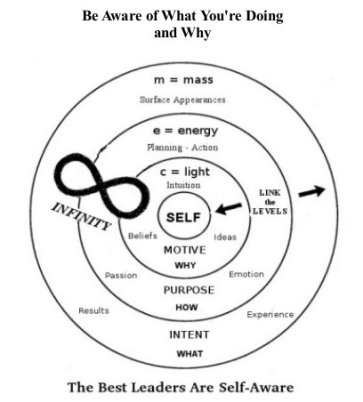
For example, the universal pattern has been modified to use as a method for restoring mindfulness to the decision-making process. It emphasizes the critically important relationship between self-awareness and effective leadership.

Be Aware.sized

The Life Wheel in pristine form is complete. The levels are all present, correctly prioritized, and in balanced proportion. Were our lives so complete, we would be called “perfect.” Were our society equally whole and balanced, it would be called “Utopia.”

Few of us are there now. Although originally created in the image of the Creator, as a consequence of our own choices and actions over a very long time, our personal Life Wheels have become fragmented and “bent out of shape.” Like Dorothy stranded in the Land of Oz, our dearest, deepest wish is to find our way home again.

Getting there requires a map, methods and proactive discipline. Converting the abstract Wheel into a practical diagnostic tool is a first step. The self-healer can use it to diagram the immediate situation, design a better future, and then decide on the steps necessary to get from here to there. Initially, the levels and sectors of one’s own life are drawn into a Wheel template. Then, taking a sequence of steps one-at-a-time leads towards the experience of an increasingly full and satisfying life.

For example, here is the diagram of an intermediate Life Wheel. It pictures the “state of the art” of an individual whose life is a work in progress. The X at the center represents the conviction that there is no God. The possible existence of a vital center has been ruled out. The innermost level of light (intuition, guidance) is therefore missing.

fagmented

Nevertheless, this improved personal Wheel a represents a major step forward from the starting point. New sectors have been added. Excessive focus on the Professional sector has been reduced and brought into relative balance. The sliver of a missing Family sector has been restored to the picture. An honest NO to the question of whether life is experienced as fulfilling has resulted in the decision to expanding the Entertainment sector to include time for self-improvement.

Redrawing the map can become a daily morning discipline. Ask yourself, “Where in the Wheel am I NOW?” And, if you don’t like it, “What am I willing and able to do about it NOW?”

In addition, however, there’s plenty more work to be done. This is just the tip of the iceberg of what’s possible.

Jerry Pociask’s comment hints at what’s next. He concludes, The diagram can be applied in so many ways . . . unfortunately it probably isn’t available on mobile phones!

That’s where I’ll begin next time.

Unity & Diversity Are Necessary Compliments

AXIOM THREE of the Positive Paradigm of Change is now “Unity and Diversity are Necessary Compliments.” Although the idea isn’t necessarily fun or sexy, understanding this essential relationship will significantly improve the quality of both your personal and professional life.

Taken out of context, the second axiom is subject to distortions and misunderstandings. Resulting confusion can generate conflict in family relationships and on, all the way up the life chain to conflict amongst nations. That’s why Axiom Three is an such important extension of the second.

According to Axiom Two, “We are Each a World Complete, Containing the Potentials of the Universe.” This inherent inner similarity is the realistic foundation of common understanding. However, the fact that we each have the same inner structure does not mean that everyone is identical and that we should act as if we’re all the same.

Like snowflakes, humans are identical in their basic structure. Each, however, is a unique expression of the universal pattern. Personal abilities and needs are the result of an infinitely complex set of variables.

And just as an integrated balance of energy centers is necessary to the overall health of an individual, a balance of complimentary abilities and interests promotes the general health of society at large.

We share the potential for perfection in common. However, in balance, innate potentials are filtered by cultural conditioning. Each of us has an overlay of education and personal experience which tends to distort and even mask that common core.

Each of us has a long history of decisions, not all of them good. We live with the consequences of past actions as well as our hopes for the future.

Further, while our inherent structure is identical, within the evolutionary chakra scale, at any given time and place, most individuals are narrowly focused on only one or a small combination of the seven centers and their specific issues. The roles which meet our immediate learning needs and simultaneously best serve the whole are the outcome of these combined influences.

Bottom line: diversity on the surface is an inevitable, necessary and beneficial compliment to unity at the center. So long as the levels of the perfect pattern are understood and correctly prioritized, there is no conflict between unity and diversity.

0 Axiom 3

When the levels are not prioritized, problems follow. Unity at the surface — meaning regimentation, uniformity and coerced one-size-fits-all thinking — is antithetical to life, just as diversity is at the center is impossible.

So it’s essential to prioritize the levels correctly. Be clear and correct about what is absolute and unchanging. Conversely, worldly success depends on accepting what is ephemeral, non-essential, subject to change and short-lived for what it is . . . and is not. Recognizing the difference is critically important to maintaining both personal and institutional stability.

For example, when alliances are formed on the basis of surface appearances — whether it be immediate self-interest, perceived attractiveness, race, gender, age or other biological markers — the connection is weak and likely to be short-lived.

In contrast, relationships remain stable when they’re based on a personal connection with the unchanging, universal center – that which everyone shares in common and upon which everyone depends. They withstand the tests of time and prove to be mutually beneficial.

For eight-thousand years and counting, Chinese sages operated on an understanding of how the world really works based on The Book of Change. This explains the longevity of dynasties which were steered in alignment with the fundamental axioms of change.

To the extent that ancient societies understood and were governed in accordance with the universal pattern, their leadership choices mirrored this organization. At the family level, the leadership role of the biological father was regarded as a natural reflection of the divine pattern.

In increasingly larger levels of organization, in each case the greatest among the group was designated as its natural leader, seated at its center, and entrusted with the grave responsibility of maintaining stability and balance in the best interests of the whole.

Although rarely honored and only imperfectly implemented, the universal pattern pictured in the Positive Paradigm Wheel remains the organizational model which best accords with reality, and has the most likely chance of generating beneficial results.

Just as we dearly need to depend on the center of our personal lives for inspiration, wisdom and stability, we need to be able to look to the leaders in our lives – families, schools, business, and governments – as stewards of our trust.

When leaders at every level, worldwide cannot be trusted to maintain stability or protect the common good, the times grow exceedingly dangerous. In such times, personal balance and ultimately survival depends ever more greatly upon an unshakable connection with the unchanging center within.

globe

Corollary A: The levels of the Positive Paradigm Wheel are interrelated and interdependent. But they are qualitatively different and should be prioritized accordingly.

The surface is transient. Hurt it, and it can heal. Have a bad day, and there’s always tomorrow. This is “the small stuff.” The center, however is absolute and absolutely necessary. “With God, all is possible.” But without a conscious connection to the center, nothing of enduring value can be accomplished. Violate this connection with impunity long enough, and eventually there will not be another tomorrow.

Corollary B: Looking for completion and stability on the surface, where none exist, is a sure formula for disappointment. Creating false expectations and failing to teach realistic attitudes towards inevitable changes on the surface of the life wheel (as well as where to turn for wisdom and solace in the face of life’s disappointments) is bad for mental health and long-term relationships.

Corollary C: Unrealistic, dysfunctional paradigms are the root cause of addictions. When people are cut off from their center or deny their emotional/physical needs, they feel starved. Not knowing why, they turn to substitutes which don’t truly satisfy. When mental escapes aren’t an option, self-destructive alternatives present themselves.

Corollary D: Bigotry, discrimination and violence of every stripe are a function of ignorance in regard to Axiom Three. We are different on the outside, but eternally the same on the inside. Look past appearances which are often deceptive for the foundation of enduring relationships of value.

Corollary E: Reason is necessary but not sufficient. When used to link the material surface with the middle and inner levels of the Wheel, it is a powerful tool. When turned against the life force, elevating itself as if it were the exclusive way of knowing, it presumes to judge what is beyond it. This is hubris, the catalyst of tragedy. Rationality in the extreme changes into its opposite, producing desperately irrational results.

Corollary F: Forgetting (or denying) the existence of a nucleus at the center of our personal atomic structure along with fighting over the illusion of superiority and possession of ephemeral assets is a sure recipe for personal suffering, relationship problems and professional failure. On an international level, it leads to atrocities and genocidal wars.

globe

We Are Each a World Complete

Sadly, Axiom Two of the Positive Paradigm is a little known but important fact of life we never learned in school – but should have. “We Are Each a World Complete, Containing the Potentials of the Universe.”

In large part, The Positive Paradigm Handbook was written as the book I searched for on library shelves during school years, but couldn’t find. It’s now available for others who also sense that there’s something important missing from what we’re taught which urgently needs to be restored.

Hints of Axiom Two are embedded in ancient healing traditions, both West and East. Medical sciences of Europe as well as India and China map mapped subtle inner energy patterns which traverse the spine. Huston Smith (the famous comparative religion teacher) was correct in recognizing what he called an “invisible geometry” which shapes all humanity to a “single truth.”

Here’s that single truth: We are all made (quite literally) in the image of God. Each and every individual mirrors the structure and godlike potentials of the Creator. As miniatures, we each embody the perfect and complete pattern of the Universe. Starting from the inalienable eternal core, it’s possible to generate (as in “genesis”) entire worlds from that center.

But here’s the catch. We’ve forgotten who we truly are. Most of us are sleeping giants. Only a vestigial memory of this ancient wisdom remains with us. It’s ever present, however, as for example in the familiar shield of modern medicine.

Caduceus

The Caduceus is the symbol of the Greek healer-messenger god, Mercury. The central staff represents the spine. The pair of snakes coiling around it represent alternating positive and negative energy currents that link the levels of the spine into a continuous whole. The pair of wings at the top extend from the third eye, the point of divine connection and intuition. All life emanates from and returns to this creative point of origin.

Similarly, in Traditional Chinese Medicine (TCM), subtle energies radiate throughout the physical body in meridians which link and nourish the internal organs. Chi is stored in energy centers (“dan tiens”) which correspond with the upper, middle and lower parts of the physical body.

0 Invisible Geometry

Yoga anatomy details seven major centers where energy (“prana”) pathways intersect along the human spine. They’re named “chakras” (“wheels”), reflecting their spinning, wheel-like dynamics. As detailed in Conscience: Your Ultimate Personal Guide, each of the chakras is associated a with specific level of psychological/social evolution.

In each of these traditions, “health” means “whole.” The health of subtle energetic and related biological systems depends on the integrated balance of the interrelated parts. Each part depends on and completes the whole. The concept of “holism” expresses this worldview.

Positive Paradigm of Change

The Positive Paradigm Wheel is consistent with these medical traditions. The Handbook extracts from these sciences the universal basics most relevant to today’s immediate, survival needs. Its purpose is to restore applications of this wisdom to their necessary, central place in the decision-making process.

Corollaries (applications) of Axiom Two could fill an entire book. Here, for starters, are a few:

Corollary A: This view of human origin and creative potentials is the universal foundation of respect, both for oneself and for others. That all humans are created equal is an existential truth. [What they’ve chosen to do (or not do) with this gift is different subject.]

Corollary B: “To save one life is to save the world entire.” Every human life is a complete mirror of creation. As an integral and necessary part of the whole, each of individual has intrinsic value and is worth every effort to save.

Corollary C: Because light at the center of the Positive Paradigm Wheel is the source of energy, which in turn generates mass, the biblical instruction is good advice. “Seek ye first the kingdom of God. All else follows.” As Stephen Covey puts it, “First things first.”

The first of the Ten Commandments given to Moses in the Old Testament calls for exclusive commitment to conscience. When faced with a conflict over which commandment to obey, again, the first comes first.

When a noisy world tempts away from inner knowing, survival depends on the ability to listen to the still inner voice at the heart of hearts, and having the courage to honor that calling by following through with positive action.

Corollary D: Looks are deceiving. What is visible on the surface isn’t the whole picture. What’s hidden at the middle energy level and deeper still within the inner core are often very different from surface appearances. [Superficial thinkers produce shallow work and are themselves easily deceived.]

Corollary E: Every excess or deficiency is detrimental to health. In extreme, the opposites of spirituality and materialism are equally dangerous to the whole. If any level is neglected, problems are certain to follow.

Corollary F: When the natural thirst for inner light is not satisfied in healthy, life-confirming ways, life becomes blighted. When high energy people are denied confirmation and remain ignorant as to how best to harness their energies, they become vulnerable to the promises of cults leaders, succumb to mental illness or worse.

globe

To Tell the Truth

To tell the truth - image.jpg

Bogus claims about new I Ching sciences remind me of the long-running TV game show, “To Tell the Truth.” In this format, three challengers are introduced to a celebrity panel, each claiming to be the featured guest. Impostors can lie and pretend to be the central character. Only the real one is sworn to tell the truth. Panelists are challenged to ask penetrating questions, see through deceptions, and correctly identify the truth teller.

In this game reality, the best liars are rewarded. But that’s not how it works in the real world. There’s nothing entertaining or ultimately rewarding about deceiving the public. Yet, at this stage of history, it’s nigh unto impossible for all but the most discriminating (in the positive sense) tell the difference between imitators and the “real deal.” Shameless parodies of wisdom traditions abound.

Hucksters out to make a quick fortune while basking in their 15-minutes of fame misrepresent both their intentions and abilities. The sure-fire get-rich formula of “spiritual” entrepreneurs is to tap into people’s deepest desires and fears. Associate your product with an accepted wisdom tradition to piggy-back on its credibility. Offer gullible marks whatever it is they want on the one hand, and guaranteed protection from the consequences of stupidity on the other.

In a crowded market place full of unscrupulous pretenders, how do messengers of substance and integrity stand out from the noisy crowd? Even screaming isn’t heard over the ruckus. Their only option is to play by the rules – quietly, persistently Tell the Truth.

In my last blog, I stood up to a Millennial I Ching pretender. But as soon was that posted, an even more outrageously upside-down New Age pitch came in via the website contact page. This one (again, no names) proposes to change the course of civilization by gathering statistical proof of a timeless, transpersonal “force” (for a donation, of course). Those who hurry can get a free game stone now, before they’re sold for a hefty price. All major credit cards accepted.

Sigh. Statistical methods associated with the prevailing empirical science method may appeal to “rational” intellectuals stuck on the material surface of the wheel. (See illustration below.) But quantifiable evidence is irrelevant to the middle and innermost levels of the Positive Paradigm of Change.

The first false premise is that the rational mind is sufficient to comprehend, analyze and “prove” with its puny methods the existence of the Universal Mind. How comical is that? It’s like a flea presuming to do the metaphorical elephant the favor of confirming its existence to other fleas. (The flea’s arguments make a difference to the elephant because . . . . ?)

Further false logic goes, “Since the source is infinitely powerful, and we as individuals partake of it, therefore we are equally infinitely powerful.” Wrong! (Boooo!) This is like a drop of water claiming equal partnership with the wave within which it rides.

Still more ridiculous is the assumption that we as individual drops of water can make the tidal waves of history change direction – as if puny humans had the superior wisdom and power to influence the forces of nature and Nature’s God.

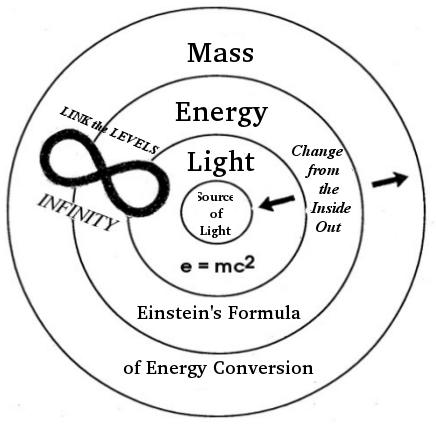
As a reminder, here’s the Wheel of Change. It reinforces both the appropriate relationships amongst the levels and the value of linking them in a two-way, infinite loop. Each of the outer levels is an extension of and depends upon the deeper ones for its existence. Never the other way around.

082214 to tell the truth

The value of the I Ching, correctly used, is to serve as the energy-level bridge that links reason on the outermost level with innermost ways of knowing – intuition and conscience.

A basic premise of New Age I Ching distortions is that superior humans, if they don’t like the current course of history, can just rewrite history, avoiding the consequences of past action. That is not positive change. The attempt is a delusional waste of precious time.

Today’s place in history is the cumulative consequence of thousands of years of poor choices. To continue an earlier thread, keep in mind the Old Testament prophet Daniel. He foresaw an end time followed by a new beginning. There is no short-cut from here to there that by-passes the tough part of the process he envisioned.

Those who intend to survive to partake of that new beginning would be far better off to heed what is written and align themselves with the tides of Titanic times, rather than resisting or presuming to circumvent them.

Here’s a hint and reminder of what is to come, with its reference to false paradigms (unsustainable foundations of civilization) as “feet of clay” from the King James version of The Book of Daniel:

2:28: But there is a God in heaven that revealeth secrets

and maketh known to the king Nebuchadnezzar what shall be in the latter days.

Preparing now for inevitable changes to come is a personal choice and responsibility, accomplished first on the inside, one person at a time. The basic axioms and methods offered in the I Ching-compatible Positive Paradigm Handbook facilitate that powerful personal change. The purpose is to replace the unsustainable, corrupted foundation of false paradigms (feet of clay) with a complete and correct paradigm. Like childbirth, the process isn’t necessarily fun, but the outcome is worth it.

2:44. And in the days of these kings shall the God of heaven set up a kingdom

which shall never be destroyed . . it shall stand for ever.

Daniel’s vision of this basic truth was written long ago. (Daniel 2:45. . . The dream is certain; and the interpretation thereof sure.) He’s a central character who told the truth, the whole truth, and nothing but.

To Tell the Truth is the longest-running show in history. It’s not a game, however, nor is it for the faint of heart and spirit. But our very survival is at stake.

.

book header bird

Prepare Now for Inevitable Shocks

Why would Millennials (or anyone else, for that matter) want to consult an ancient book that’s outside the familiar boundaries of what’s currently accepted for answers to survival questions? The answer is contained in the question. Expanding beyond limiting boundaries is essential to future survival.

Prevailing paradigms have brought the world to the brink of an NELC (Near Extinction Level Crisis). A better paradigm is urgently necessary. To repeat Einstein’s warning yet again, “It will require a substantially new manner of thinking if mankind is to survive.”

Rethinking Survival: Getting to the Positive Paradigm of Change introduces that qualitatively different manner of thinking. Four contrasting thought paradigms are pictured in an earlier blog. (See wp.me/p46Y5Z-a4.) Another, the Positive Paradigm of Change, translates the old-new I Ching world view into the yoga-compatible Unified Theory. It answers Einstein’s challenge in terms of his own work. It contains within it a seed of hope for generations to come.

Returning to the ongoing discussion, however, How will Millennials benefit from working with the Book of Change (or for that matter, The Positive Paradigm Handbook)? I hinted at the answer in “When the Lights Go Out, Who Will Millennials Call?” There, the question is asked and answered: “On the day when the lights go out, what would happen to wiz kids dependent on their electronic toys? What use would their extreme investment in computer skills be then? The logical answer: None. Zip.” (See wp.me/p46Y5Z-cm.)

Millennials are reputed to depend exclusively on their peers for validation and support. Yet, like any other strength, when taken to extremes, this dependence has the potential to become their greatest weakness. If the noise generated by peer content blocks out inner guidance and prevents individuation, they’ll be in big trouble if/when immanent dangers oblige them to think for and depend upon themselves.

Here’s the larger context, a picture of connections on many levels, joined in an infinite loop. The unique value of the I Ching is that serves to give access to the neglected, innermost sphere which we’ll all eventually need to draw upon for inner strength. Here’s where working with the Book of Change can make all the difference. It gives uninitiated users the direct experience of that neglected, inner connection.

Connections

In answer to my query, the book’s benefit to Millennials is Hexagram 58, INSPIRATION, with changing lines in the third and fifth places. It reads:

When minds are moved by INSPIRATION, nothing is impossible.

Misunderstandings can be cleared up,

problems solved and hardships overcome.

Inspired speakers can move others

to acts of heroism by well-chosen words.

Reminding people of their common goals

and deepest desires

gives them the courage to continue.

Two changing lines modify and transform the initial answer. The third line reads, “Sharpen mental discrimination. Refuse temptations that lead to destructive consequences.” I’m understanding that even inspiration cannot be depended upon exclusively. It requires the balancing faculty of reason to ground intuition and keep priorities in perspective.

The intermediate change that results from the warning is Hexagram 43, DETERMINATION. It advises “If you approach the situation with DETERMINATION, you can now overcome problems that have held you back in the past.” It also stipulates, “Avoid solving problems by force.”

The changing line in the fifth place warns, “Be careful in whom you place your trust. Avoid sorrow.” It changes to Hexagram 54, SUPPORT.

The outcome of the two combined changing lines is Hexagram 51:

SHOCK

Violent movement creates SHOCK.

To prepare yourself to face external disasters calmly,

face your personal fears first. Then nothing can shake you.

Sudden changes will become challenges which test your strength.

Carry on with your daily life but expect major shifts.

Develop the will to endure.

In sum, the sequence leads me to this conclusion. Openness to Inspiration will increase awareness of the need to prepare for shocking, external disasters. Even while carrying on with daily life, it’s important to anticipate major shifts. This resonates with the earlier blog on Change, which also emphasizes prepping. “The unprepared see change as a threat, but the well-prepared face the unknown calmly.”

So, what specifically does the Common Sense Book of Change have to offer the Millennial generation? For starters, the Inspiration to anticipate shocking changes and the determination to meet external disasters calmly.

Naturally, there’s much more. But it will have to wait for next time.

globe

How Will Millennials Benefit?

At the end of “Influencers Cut Through the Noise” I resolved to ask The Common Sense Book of Change how to present the I Ching to the Millennial generation. I did so recognizing that Einstein’s warning doesn’t seem to get through. It’s urgently necessary to find out what will.

Einstein warned, “We shall require a substantially new manner of thinking if mankind is to survive.”

So I queried, “How do savvy influencers translate this imperative into Millennial terms? What relevant key can cut through the layers of noise (assumptions, prejudice, distractions) that cloud perception?”

The hexagram (six-line shorthand graph) answer to my query was COLLECTIVE ACTION with a single changing line in the fourth place. It looks like this:

7 CollectiveAction

Here’s the reading which represents the basic situation:

The foundation of successful COLLECTIVE ACTION is three-fold.

It requires clearly-defined, worthy goals,

effective organization and

willing self-discipline on the part of all involved.

Respectful awareness of others’ needs

will bring grateful cooperation.

Keep the larger purpose for action clearly in mind.

Avoid selfish exploitation of good-will.

Despite similar sounding words, the Collective Action referred to here ultimately has nothing in common with Marxist-derived approximations. Essential components of SUCCESSFUL Collection Action have been glaringly absent: worthy goals, willing self-discipline, and respectful awareness of others. So if Millennials are currently being drawn towards socialist/communist/progressive belief systems, oblivious to inherent dangers, that requires change.

When a reading has changing lines, the original one is taken to represent the immediate situation. The changing line is taken as a warning, which, if heeded, brings about a new situation.

What strikes me immediately is that this recommended approach is antithetical to the hippie, “do your own thing” attitude of the Baby Boomer generation that turned to the Book of Change to reinforce rebellious, antisocial individuality.

Paradoxically, there is no conflict. Thankfully, the I Ching is universal. The Introduction to the CSBOC observes:

Because the I Ching’s diagram of the universe is so complete, it is regarded as a valid tool by people with many different points of view. For example, Lao Tse, a Taoist, used the Book of Change. He viewed the world as an artist and free spirit. Confucius, however, who was mainly concerned with duty towards family and state, also had profound respect for the Book of Change.

The two-directional, infinite loop of the Unified Theory explains how this can be. Introspection on the inward path of individuation and social responsibility on the outward extension are ultimately compatible. Each extreme compliments and completes the other. Conversely, each out of balance and lacking the other, is incomplete.

No Conflict

Moving forward, however, the recommended approach of COLLECTIVE ACTION isn’t static. The fourth place associated with the heart center of yoga anatomy is a changing line. It contains a warning, which, if heeded, has the potential to transform the immediate situation into a new one. “When dangers are too great to handle, retreat. Try later.”

This caution is certainly reason to pause and consider. What dangers? Perhaps there’s an automatic-pilot animosity, a reflexive rejection of an unfamiliar book assumed to be foreign, unscientific, or just plain weird.

Then again, perhaps Millennials harbor an intense, angry mistrust for the I Ching as a book they associate with their irresponsible elders.Then again, perhaps the dangers of Collective Action are inherent in the warning. Remember the outcomes of Russia and China’s unnatural, failed Marxist, Socialist, Communist experiments.

If the warning advice is heeded and thoughtful pause is taken before pushing forward with promoting the Book of Change to Millennials, then what is the likely outcome? The new pattern that results from heeding the warning is Hexagram 40, FORGIVENESS:

Through FORGIVENESS, old debts are canceled and harmony is restored.

Free yourself from outgrown habits. Don’t be afraid to let go of the past.

Releasing tensions will produce health. Mental blocks will be resolved.

New clarity of vision will lead to important decisions.

Peace of mind will follow. Avoid anxiousness.

The consequences of reconciliation that could result from this improved approach to generational strife deserve a major blog in itself. For here it must suffice to say that what both Millennials and their elders have to gain from working intelligently with the I Ching is a healing of destructive misunderstandings. This brings me back to the basic point made in Dangerous Times Call for True Radicals:

My best hope for Millennials is that they’ll benefit from the lessons of history and NOT mindlessly perpetuate the pattern of yo-yo swings between opposite and equally dysfunctional extremes on the surface, disconnected from the timeless center.

There’s a shared benefit for all generations alike in using The Book of Change. Contrary to popular misconceptions, it’s not a manual to use for the purpose of stirring up change for its own sake. The primary purpose for working with the I Ching is to maintain balance. The more confusing and desperate the times, the greater the benefit.

Individuals consult the book to preserve mental-emotional equilibrium throughout life’s ongoing personal challenges. Leaders depend on the wisdom of the I Ching to steer a steady course towards their goals despite all obstacles and upheavals.

More specific benefits for the Millennial generation will have to be continued another time.

globe

It Is Possible to Make A FRESH START

I started “A Fresh Start is Urgently Necessary” by saying two coincidental things happened that day. I described the first, the internet being down. (Turns out a heedless farmer severed a fiber optic cable.) The second had to wait until today. Namely, I connected the dots between an overnight YouTube music search and the challenges inherent in presenting the  timeless I Ching to the Millennial generation in a way they can identify with and own.

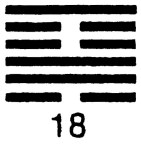
For starters, here’s the Common Sense Book of Change version of Hexagram 18.

hex 18

FRESH START

Even when it seems that all has been spoiled,

it is possibleto make a FRESH START.

Be willing to face your faults.

Find out how to correct them.

The situation will gradually improve

if you are sincere and work hard.

Be sure you know what you want.

Avoid delay.

The unfamiliar graph is called a hexagram. It’s an ancient short-hand method for expressing countless generations of experiential wisdom about the correspondence between chi (energy) flow in the human mind/body (the microcosm) and in the universe (the macrocosm). In yogic philosophy, these six lines correlate with six basic chakras (wheels, or subtle energy centers) located at intersections along the human spine. Each of the centers is associated with specific developmental stages. A primary purpose of yogic practices is to awaken, balance and integrate these levels of experience.

The straight and broken lines of the hexagram are a binary-digital way of expressing alternating, expanding and contracting life rhythms. In the Book of Change, any or all of the six lines can change into its opposite. This results in 64 possible permutations. It’s not coincidence that the ancient I Ching and modern DNA patterns are exact correlates. This is one explanation for the healing effects of medical sciences based on the I Ching hexagrams.

Admittedly, the specifics are beyond my comprehension, for the most part because I trust from experience in the practical results. Just as I use my computer without a deep understanding of how it operates, I have benefited greatly from working with the I Ching and its off-shots. Both sciences, modern and ancient, for many of the same reasons, simply work.

To carry forward the question — When the Lights Go Out, Who Will Millennials Call? (see wp.me/p46Y5Z-cm) — consider this. If/when today’s hospitals are rendered inoperable by grid failures, and/or healthcare as we know it is made unavailable due to social-political malfunctions (like Obama un-care, for example), where can we turn for practical health sciences that maintain health and heal dis-eases? Modern medicine as a profession and a social-political corporate conglomerate has become, for many people, for many reasons, a nightmare. We especially need a Fresh Start in this important area of our lives.

My short answer: long after grid-dependent lights go out, the same basics that work seeming magic with the I Ching will still be available to those familiar with Traditional Chinese Medicine (TCM) methods — including Chi Kung and Tai Chi. The sooner people become fluent in the self-healing arts, the better off — for countless reasons — most of us will be.

I’ve been emphatically told by the one I most trust that “The mind will play any tune you ask it to.” When he speaks, I unpack every word. (He doesn’t waste them.) There is more meaning to this key than simply “Mind over matter” or “Beliefs generate results,” though in terms of self-healing these are included. Training the mind as a musical instrument to skillfully, deliberately apply the I Ching‘s 64-permutations of dynamic “if-then” consequences (analogous to existing computer-driven chess games) would greatly enhance one’s ability to recognize prevailing self-defeating tunes. Further, one could discover better tunes, decide which to play when, and learn how to “ask the mind” to play them.

Advanced meditators describe hearing a celestial “music of the spheres.” Just imagine, if you will, what wondrous music is available to those with “ears to hear.”

Much of I Ching-based philosophy focuses on understanding how fluctuating energy patterns affect human behavior, as well as how they can be used to create harmonious relationships and orchestrate viable institutions of governance. Much has been spoiled by lack of awareness of these patterns (tunes) and ignorance as to how to steer institutions effectively. By reintroducing this vital information, correcting what I have repeatedly described as a “fatal information deficit,” the damage resulting from such ignorance could be repaired and a Fresh Start initiated.

Unfortunately, much of this tradition has a very bad “rep.” It’s been spoiled by a complex mix of misunderstanding, misapplication, and misrepresentation. For example, when I went on YouTube looking for music (the second coincidence I mentioned earlier — see wp.me/p46Y5Z-cJ), what I had in mind was chakra/DNA healing ragas. What I found instead was a commercialized, psychedelic offering of “feel good” audio engineering. Comments likened listening to taking psychotropic drugs that induce the illusion of mind-altering experience. They raved about hallucinations experienced while tripping and listening at the same time.

My Aha: So much of what has been spoiled and cries out for a Fresh Start is the I Ching itself. Today it needs to be approached from the modern science of mind-exploration. It needs to be repackaged as a delightful, game-oriented Lumosity experience, but founded on a profoundly motivating purpose: human survival. Not unlike the Christian tradition, which has suffered greatly in the wrong hands for centuries, the timeless wisdoms must be “reinvented” and approached as if new: First time, every time.

compass clock

It’s the 11th hour, for sure. But, as it has been written, With God all things are possible –including, even, at this late hour, a Fresh Start. But the clock is ticking. God — the Tao — is infinite. Time is not.

Influencers Cut Through the Noise

To change the world for the good, the multiple authors of Influencer: The New Science of Leading Change recommend a three-stage process. As author of multiple books on change, I was eager read about the new science whereof they speak.

However, their content confirms what a Jungian analyst reminded me of in response to a recent blog on Therapists as Positive Change Agents. Namely, there’s nothing new on leadership under the sun – just infinite variations on a few important themes.

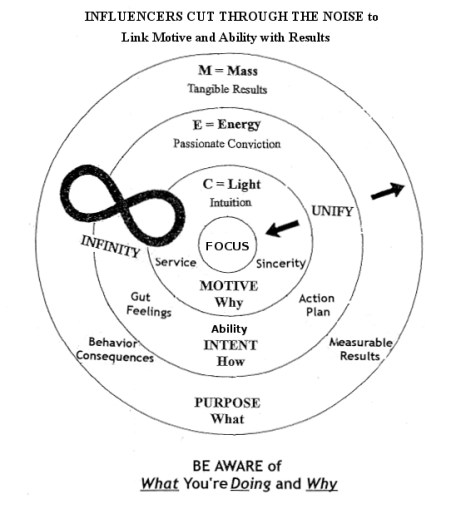
In fact, with the exception of a single random remark debunking the role of intuition in the decision-making process, their worldview is remarkably compatible with the Positive Paradigm of Change. Here’s how it translates into the Bible-, Yoga- and Einstein-compatible Unified Theory Wheel:

————————————————————————————————–

Influencers cut thru the noise

———————————————————————————————-

Authors Joseph Grenny, Kerry Patterson, David Maxfield, Ron McMillan and Al Switzler speak to our common challenge. “How can the leader as alarm sounder cut through the noise to effectively wake the unaware up from their slumbers?”

Their solution, like the Positive Paradigm of Change, recognizes a necessary relationship between motivation and action (ability). However, I see the two as residing on qualitatively different, interior levels of a two-directional life wheel. They posit three paired levels of influence – personal, social and organizational. This yields a total of six areas which can either impede or accelerate positive change. The key is to harness all six and focus them like a laser on a finely tuned purpose.

In Positive Paradigm context, the universal atom-like structure repeats on every scale of magnitude. The individual is a complete unit. By extension, so is the family. The ongoing units of business and government organization are all multi-level organisms, each with its unique motives and action abilities.

But rather than side-track deep into academese, I’ll focus instead on applying the concept of Influence (focused, effective leadership) to my ongoing discussion of survival and Millennials. As the generation apparently disinherited by their elders, Millennials have little ego-investment in the dysfunctional paradigms that have gotten the world into its current political-economic mess. So they’re the most likely to welcome and champion a Positive Paradigm shift.

Here’s the premise: While marketers are correct in selling Millennials as the best hope for the future, as of yet, the hope is only potential. In “When the Lights Go Out, Who Will Millennials Call?” the very real danger – along with its hidden opportunity – is explored. Millennials are fluent to a fault in all things digital. But there’s an inherent risk in lopsided over-investment. What would happen if, overnight, their iPads ceased to work and they were cut off from their social networks? They might suddenly become as helpless as fish out of water.

The hidden upside to their imbalanced addictions to things digital and social remains to be realized. To actualize this potential, the correlations between the ancient science of change and modern binary digital computer language must be drawn. To repeat, when they recognize that they contain in their innermost DNA the very same potentials that drive computers, that their brain functions are limitless beyond even the most powerful digital instruments, then there’s real hope.

In response to the blog When the Lights Go Out, D.R. Baker wrote a complimentary comment, calling it my best, most relevant work yet. He complained about relatives whose addiction to their gadgets seemed mindless and asked for suggestions as to how he could control the situation.

My response was that, in general, it’s better to focus on self-control rather than controlling others. Since D.R. is familiar with the Book of Change, I suggested that he query the book for insight into his specific situation.

His question, however, got me thinking. I should do the same with my compassionate concern for Millennials. It’s not enough to tell them they have marvelous, latent potential but are at risk, or to suggest wherein the positive future lies. I’ve written books on change and survival. I’ve repeatedly tweeted Einstein’s warning, “It will take a substantially new manner of thinking if mankind is to survive.” But that’s apparently not the alarm that suffices to wake sleepers up.

I would have thought Einstein’s wake-up call was powerful and sufficient motivation. But that’s my point of view. What’s theirs? In a future blog I’ll present the results of asking, “What benefit does the Book of Change offer the Millennial generation?” In addition, I’ll ask, “How should this answer be presented? What’s the right, most influential approach for me to take?”

Phoenix - sized

When the Lights Go Out, Who Will Millennials Call?

Whenever I hear how addicted Millennials are to their iPods, social media friends and electronic war games, I cringe. It reminds me of the biblical story about handwriting on the wall. As I recall, in ancient times, a mysterious message magically appeared on a decadent palace wall, writ large by an invisible hand in a script unknown to King Belshazzar or his corrupt cronies. To those able to decipher such warnings, however, it predicted the ruler’s extinction.

Millennials are touted as the golden children of progress. “They’re the last best hope for our future,” I hear you say. That’s the rumor, anyway.

But there’s another rumor. Ever hear the maxim, “Whatever has a front has a back?” It continues, “The larger the front, the larger the back.” It’s another way of saying, “Every coin has two sides.”

In this case, let’s ask, “On the day when the lights go out, what would happen to wiz kids dependent on their electronic toys? What use would their extreme investment in computer skills be then?” The logical answer: None. Zip. They’d be helpless and useless.

Nor is this scenario as unlikely as most would hope. Look at the decrepit condition of overworked national grid systems. Consider the frequently threatened possibility of hostile cyber attacks.

I have a powerful memory of the night the lights went out in New York City. It lasted only a span of a few days. I don’t recall the exact date or duration. Only the horror of that early warning remains clear.

Thousands were trapped in high rise apartment buildings. Their windows didn’t open to fresh air. Phones were down. Radios and TV didn’t work. They couldn’t communicate with loved ones or connect with the outside world for help.

Kitchen and bathroom gadgets were useless. Food and water supplies ran dangerously short. What little food remained in freezers started to spoil. Without central air, slow suffocation was a real possibility. Without lighting, folks could barely fumble their way down long flights of stairs. Those who managed to get outside faced a nightmare war scene of muggings, looting, widespread panic and riots.

After that, if I’d lived in any large city, I’d have relocated as quickly as possible. Some said it was a wake-up call. But, surprisingly, people still continue to go quickly back to sleep, even after a long string of similar wake-up calls. Life appears to get back to “normal” (whatever that may be). Most just shrug and revert back to their old dependencies.

In my last blog, “Early Adapters Are Most Likely To Survive,” I hinted at my best hope for Millennials. [See wp.me/p46Y5Z-c8.] I held that once Millennials start connecting the dots and seeing the larger picture of how the Book of Change resonates with their own computer and game addictions — as well as the enormous implications — there’s a genuine, valid basis for future hope.

This hope is the up-side to the same maxim, “The larger the front, the larger the back.” Name, the same computer technologies turned outward to connect with peers and dazzle (or alienate) their elders have biological and metaphysical equivalents. When turned inward, they have the potential to empower Millennials in a way that changes the dark side of dependency on technology to an opposite and equal survival advantage — even and especially in the face of a (God forbid) technology-poor future.

Here’s the key. There are powerful correspondences between technology and human anatomy. Inventors have always depended on self-awareness to create extensions. For example, the violin’s resonant music depends on the same science of sound vibrations that powers the alternating pulsations of the breath and the lub-dub rhythm of the human heart. It’s no accident that the musical instrument’s parts have human anatomy names — neck, belly and spine. Other examples are legion. Think of the horse-drawn chariot, steam engine, train and automobile, to name a few.

Those who practice the I Ching-related discipline of yoga intentionally tune their bodies as instruments. By regulating the breath and slowing their heart rates, they heighten awareness and increase lifespan.

IF (dare I say when) Millennials connect the dots and recognize the powerful correlations between computer technologies and the human brain — how it’s wired, stores information, etc., —  they can, with appropriate disciplines, change themselves into instruments of higher consciousness. Because, just as violins don’t have souls — it takes musicians to fashion them and then activate their potentials — so also, computers don’t have souls. Their inventors and those who choose to use them wisely do.**

Lumosity computerized games are tapping into the vast potential for good. But so far, based on the limited and limiting research methods of empirical science, they’ve just scratched the surface (quite literally so). To go deeper and actualize the unrecognized potential for expanding human consciousness latent in computer technologies, it’s necessary to look to the tried and tested science developed over eight-thousand years and counting that’s hiding in plain sight. Yes, I’m referring to the Chinese I Ching.

Here’s a picture of how it fits into the larger scheme of things as an essential puzzle piece of the larger, atom-like structure of Einstein’s intuited Unified Theory.

Fits in the Picture

There’s powerful magic latent in the timeless Book of Change, albeit written in a language not all understand. Like the ancients who were able to read, heed and survive the handwriting on the wall, those of every generation who attune themselves to the wisdom of this interactive book will have the edge on future survival. By this I mean not just clinging to the bare minimum of animal existence, but a hopeful new beginning.

And no, this isn’t new age hocus pocus. Although it resonates in musical ways that seem magical to the uninitiated, the modern sciences of atomic physics, computer binary digital code, and DNA structure/function now give intriguing explanations as to how/why it works on a cellular or even atomic level. To repeat, once Millennials start connecting the dots and seeing the larger picture of how the Book of Change resonates with their own computer and game addictions — as well as the enormous implications — there’s a valid basis for genuine future hope.

How can this be? How does this all work? Here’s another pair of maxims, rarely understood, even less often applied: “As within, so without” and “As without, so within.”

In any case, on the day when the physical lights go out, those who depend on inner light for guidance will be the ultimate survivors. In the interim, intelligent use of the interactive Book of Change can serve to reconnect sincere preppers (early adapters) with their deepest core. It gives those with an open mind the wisdom needed to navigate successfully through dangerous times.

Electricity and the many kinds of vehicles it powers are ephemeral mirrors of the inner source upon which they depend, the eternal light which sustains those open to receive it. To repeat what was earlier written for a Millennial who challenged me with a leadership question, “Dangerous Times Call for True Radicals.” [See wp.me/p46Y5Z-aA.]

When preparing for danger — the eventuality, for any host of reasons, that the physical lights go out — the best answer to the movie question “Who you gonna call?” isn’t “Ghost Busters.” But close. Call on the myth busters who dispel dysfunctional paradigms like the limiting exclusively empirical science paradigm which has gotten us into our current mess. Call on the radical truth-and-light-bearers of all times.

——–

** [Atheists may argue the point. There’s no time left for such nonsense. Besides of which, this has already been addressed at length elsewhere.  See Atheism Answered.]

globe

Early Adapters Are Most Likely To Survive

With one exception, responses to recent blogs have been gratifying.

In response to “Therapists as Agents of Positive Change,” Brent Nichols, M.A., C.S.W., a Jungian Psychoanalyst located near Berlin, Germany, wrote, “Very nice piece. . . I very much appreciate your lovely thoughts about the Jungian therapeutic process.”

John Romig Johnson, Ph.D., NCPsyA., a Jungian Analyst at Body and Soul International near Charleston, South Carolina, wrote “Marvelous blog. I want to read them all when I get a chance.”

Candace Kleven, PhD., a Psychotherapist in the Jungian Tradition wrote from Redondo Beach, California, “Thank you Pat! I am looking forward to reading your blog and staying connected with your much needed work.”

In response to “Savvy Leaders Go with the Flow,” from Toronto, Canada, Frank Feather at StratEDGYInc. wrote “That is a wonderful and very sage article, Pat. . . . I fear for America. The paradoxes in its political and socio-economic way of life are astonishing and self-destructive. The so-called dream is in danger of becoming a nightmare. . . . Please keep writing, and thanks again for connecting. You are extremely wise.”

But, in balance, lest I get overly-impressed with myself, Brian Chernett, Founder and Chief Executive at ELLAFORUMS CIC in Harrow, U.K. responded, “Its interesting but a little Academic for me.”

Ouch. But, okay. This is an important turning point for me. It’s time find a new, more effective way to communicate. So this is for Brian.

I checked out ELLAFORUMS and learned that it’s a “leadership development programme specifically designed to inspire and develop the leaders of Social Enterprises and Charities.” I listened as Brian explained that ELLA stands for Experiential Leadership Learning Academy. Ah. His direct, interactive approach to leadership training explains, at least in part, his objection to a one-sided monologue.

But to be honest, there’s more. I read “Savvy Leaders” again, thinking how it must look from Brian’s view point. Sure enough. Though I swim like a golden fish in the lore of world scriptures, taking joy in linking the patterned echoes of truth that repeat throughout, to a reader without the background of my chosen path, allusions to Plato and the Old Testament, not to mention Lao Tze, are a stretch. [Understatement.]

So I’m challenging myself here to get straight to the point of “Savvy Leaders” without depending on the authority of unnecessary outside sources. The timing of this decision is critical because I’ve chosen from now on to focus my work towards Millennials (as well as the parents and grandparents who dearly wish them well).

Twenty-somethings swim like golden fish in computer technologies which I find as challenging as my academic waters are to them and their practical hands-on mentors. It’s my responsibility a boundary- spanner to reach out and bridge whatever gaps interfere with effective communication, be they professional or generational.

So here’s my point, straight up. History repeats itself in intricate but predictable cyclical patterns. To stay ahead of the curve, successful leaders depend for survival on timeless wisdom — both innate and educated.

The basic point of Rethinking Survival is that human survival will depend upon decisions based on a simple, complete and correct paradigm. Currently, world leaders operating on the basis of incomplete, extreme and dysfunctional paradigms are making decisions that endanger us all.

The way out of current madness must begin with restoring a complete and correct paradigm, one that is consistent with both the world’s great religions and with modern physics. I’ve presented it as the Positive Paradigm of Change and published two books, one an autobiographical and personal approach, the other a bare bones, practical user’s manual.

I’m advocating a Positive Paradigm shift, regarding it as urgent to rethink priorities and retrain our minds. Historically, power holders with a vested interest in the status quo met calls for change with fierce resistance. It takes a new generation, one for whom old solutions to challenging situations no longer work, to take up the banner of a more functional, hopeful paradigm.

This is why I dedicated Two Sides of a Coin to the Millennial Generation. Seemingly disinherited by their elders, they have little vested interest in protecting the dysfunctional paradigms that have brought us to the current mess we’re in. The Positive Paradigm of Change, a descendant of the Book of Change that remains true to the original, gives them the means to actualize the opportunity hidden in adversity. Namely, survivors must, albeit of necessity, fortify inner strengths and restore forgotten wisdom.

In 1975, I wrote an easy-to-read version of the timeless Chinese I Ching called The Common Sense Book of Change. In fact, it was written exactly to rescue the timeless essence from unnecessary baggage in a non-sexist, non-flowery form that readers of every age with basic language skills and an open heart could relate to.

I cannot speak highly enough of this treasure. This interactive book serves to connect sincere users with their deepest core. When I was dealing with issues which couldn’t be spoken, it was the best friend that got me through tough times. It was the therapist I couldn’t afford, but in some respects better.

It resonates in ways that seem almost magical, though the modern sciences of atomic physics, computer binary digital code, and DNA now give intriguing explanations as to why it works on a cellular or even atomic level. (Hint: It’s no accident that the universal Positive Paradigm model is reminiscent of the rings surrounding the atom’s nucleus as well as the planets revolving around our solar system’s sun.)

Once Millennials start connecting the dots and seeing the larger picture of how the Book of Change resonates with their own computer and game addictions — as well as the enormous implications — there’s a hope for the future. (To those of Christian background who resist its wisdom as if there were a conflict, let me assure you: There is none. Christ told us he existed before the world and will continue after. He presence permeates the field. The wisdom of all human times necessarily partakes of that essence.)

Jesus foresaw the times we’re now enduring. The Book of Change confirms what he foretold and gives those with an open mind the wisdom needed to navigate successfully through dangerous times. Regardless of naysayers who wish to believe otherwise, the world is currently at a nadir point in its history. We are already in the midst of what Old Avatar calls a Near Extinction Level Crisis (N.E.L.C). Recent events in the Near East, North Korea, and the former U.S.S.R, not to mention those closer to home on the U.S. Southern border are merely the visible tip of a vast iceberg.

Historically, at the critical mass of decline and chaos, visionary leaders equal to the times have come forward. They will surely arise from the amongst the Millennial Generation’s ranks as well. They may not have the material advantages earlier available to me. But there’s a trade off.

I’ve had the instructional blessings of international travel and a good education, as well as the luxury of a lifetime to turn knowledge and experience into wisdom. This is my legacy, handed over across the bridge of the generation gap. Millennials are the children and grandchildren I never had. The Positive Paradigm of Change is the sum of all I’ve learned, an inheritance now entrusted to their use, to pass on to their children in turn, if and when that time comes.

Bottom line: history is not a straight line. Those who live as if it were are in deep trouble. Those of vision, while living in today’s world, are quietly preparing for inevitable shocks waiting around the bend. They’re savvy enough to avoid calamity whenever possible, and when the inevitable must be faced, they’re ready meet it, adapt and survive as best they can.

The self-aware who sense and respond to the changes “blowing in the wind” are called “early adapters.” They, along with those who heed and follow them, are the most likely to survive whatever challenges may come.

All Best!

Savvy Leaders Go with the Flow

We’ve all familiar with the phrase, “Go with the flow.” It’s another way of saying, “Timing is everything.” But how does it apply to the leader selection process? That’s the final, forth factor Mike Lehr of Omega Z Advisors invited me to comment on. Earlier, he wrote:

.

When I look at events, I see four major forces: circumstances, flow, people and leader. From my perspective, you wrote about the last two. [See “Scientists and Sages Can Agree on This,” wp.me/p46Y5Z-8W and “How Bad People Become Leaders,” wp.me/p46Y5Z-9B.] I’m asking about the first two.

The third factor has already been covered in a responsive blog. [See “Do Circumstances Influence Leader Selection?” wp.me/p46Y5Z-be.] That leaves the fourth major force influencing leader selection – flow.

Though I often describe flow as timing, my view is more from the I Ching on this. So, my question to you is this: Would being at different points in the I Ching cycle produce different leaders?

To summarize, I often ask people this question: If everyone suddenly awoke not knowing who they were and not remembering how they came to be where they are (if we could reset life), would the same leaders arise that we have now?

In fact, the Book of Change was traditionally consulted as a method of telling time. According to Conscience: Your Ultimate Personal Survival Guide:

 .

. . . the I Ching works like a cosmic clock, telling us the time. In the Old Testament, King Solomon expressed the natural, rhythmic alternations of time in poetic form: “To every thing there is a season, and a time for every purpose under heaven.”

.

The Book of Change puts its users in touch with these pulsating, alternating rhythms of life. It connects them with inner knowing – call it intuition or conscience – that anticipates approaching changes, the better to prepare for what is to come.

.

The Common Sense Book of Change explains it this way:

.

This text is called the Book of Change because its readings sum up the natural laws of change. They reflect stages through which daily events evolve in predictable cyclical patterns.

.

These patterns can be drawn on any scale from smallest to largest. For example, they might express the seconds which add up to a minute, or the minutes which complete an hour on the face of the clock.

compass clock

.

What most leaders fail to take into account, however, is that the different hands of this cosmic clock return to the twelve o’clock alpha-omega compass point of True North at different rates of speed. By analogy, successful leaders have an overview of the complex point in time where their organizations currently stand, as well as the ultimate direction in which they’re headed.

.

Unfortunately, short-sighted leaders see only the second- or, at best, the minute-hand of the clock, mistakenly assuming they see the whole picture. They remain sadly unaware of the larger context, oblivious to the long-term hour.

.

For example, the fast-moving second-hand of the cosmic clock may point due North towards the zenith point of twelve o’clock and the intermediate-speed minute-hand point to 12:15. All the while, unobserved, the slowest-moving hour-hand may point towards the nadir, due South at six o’clock.

.

Short-sighted leaders miscalculate. Their timing is dangerously off. For example, when they act as if prosperity is never-ending (or else just around the corner) when in fact a depression of unprecedented proportions is looming ahead like an “unforeseen” iceberg, they’re unwittingly leading unprepared followers into a disaster of Titanic proportion.

.

To continue with Plato’s earlier “leader as charioteer” image, successful executives must be capable of harnessing the opposite forces of expansion and contraction, the yin-yang pair of white and black horses. If these energies are not reined in and balanced, they can tear whole nations apart, steering them off-course into self-destruction, either consumed by the sun or else smashed to smithereens below. [See “Know When to Mistrust Inner Voices,” wp.me/p46Y5Z-aR.]

.

Those versed in the dynamics of I Ching yin-yang opposites know that each extreme generates its polar opposite. For example, extreme inflation inevitably triggers an opposite and equal extreme of deflation. Extremes of extravagant waste on the part of a few predictably lead to wide-spread deprivation and misery for the many.

.

But how do the basics of flow apply to leader selection today? As discussed earlier, it depends on who the selectors are. For example, in biblical times, when the Egyptian Pharaoh had disturbing warning dreams which he couldn’t fathom, he had the humility (prudence) to seek out those wiser in such matters. He took the advice of a cup-bearer, formerly a prisoner, whose release and good fortune was foretold by an unjustly incarcerated fellow prisoner named Joseph.

.

Joseph not only recognized the meaning of the Pharaoh’s warning dreams, but proved to be a skillful administrator. During the sunny cyclical time of prosperity, he advised on how best to meet the approaching shadow cycle of downturn with its specter of drought, famine and starvation. Given the responsibility to oversee collection of grain during times of plenty, he steered his people towards survival. (Joseph was what in modern parlance is called a “prepper.”)

.

Unfortunately, most leader selectors have less humility. When they have bad dreams, they’re less likely to seek out the modern day equivalent of a Joseph to reap the benefits of inner signals. [See “Therapists as Agents of Positive Change,” wp.me/p46Y5Z-bA.]

.

Disregarding disturbing signals coming from every direction, they’re more likely to listen to feel-good gurus who get rich by telling them whatever they want to hear. “Everything will be okay. Be Happy. Don’t Worry.”

.

Unfortunately, repeating positive mantras can’t alter the patterned flow of events. As irresponsible leaders across the globe continue to lead their followers into war, playing political chess from their plush, comfortable offices, eating, drinking and making merry at others’ expense, the Titanic ship of Planet Earth continues on its fateful collision course towards disaster.

.

In fact, as Old Avatar warns, at this late date in the flow of time, we’re not only approaching a Near Extinction Level Crisis (NELC). We’re already in its midst. The extreme outcome will surpass even the dangers foreseen by Plato or dreamed of by Pharaoh — more along the lines of the four-horsed apocalypse of biblical prophecy.

.

Today’s savvy and responsible leaders — those with the prudent humility of a Pharaoh to recognize that they aren’t equipped to analyze warnings and prepare to survive approaching dangers — would do well to seek out and select those wiser than themselves and heed their prepper advice. The survival of their beloved children and grandchildren (which, as Einstein warned us, can no longer be taken for granted) hangs in the balance.

.

Mike asked, hypothetically, If we could reset the clock to the zero hour and make a clean start, would the same leaders emerge? The ones he’s hoping might arise are already there, allbeit waiting in the wings. I’ve been hinting as much in recent tweets. “The presence of true masters is only suspected. Lao Tze 17.”

.

The introduction of Two Sides of a Coin: Lao Tze’s Common Sense Way of Change quotes Passage 18, which echoes the Bhagavad Gita’s premise that at the nadir of historical cycles, true leaders come forward for the instruction and deliverance of troubled truth seekers:

.

When countries degenerate into strife, / anarchy sets in.

When danger peaks, however, / heroes emerge / and come forward.

.

In this context, the more realistic question is, Would a better leader selection process produce better results? That’s the immediate challenge facing today’s leader selectors.

.

As for how timing influences leader selection, Lao Tze gives this answer:

.

78.

Nothing under heaven is as soft,

receptive or pliant as water;

but when amassed,

nothing withstands

its tidal wave impact.

.

As water penetrates

and dissolves the hard,

erodes and absorbs the rigid,

those who yield and encompass their foes

prevail long after evil doers

have disappeared.

.

Like water,

the sage takes the world’s suffering

to heart,

endures its hardships,

and responsive to the times,

becomes the catalyst

of collective action.

.

So it is that the low and high trade places,

and the forceful lose their influence;

this is known by many,

but practiced by few.

I’m a Passionate Mama Bear

A critic warned that unless I reach out to readers right away, I’ll lose them. Accordingly, I added this acknowledgement to The Positive Paradigm Handbook:

This book is dedicated to YOU, the reader. It acknowledges that we each mirror the potentials of the entire universe. The problem is that you’ve forgotten! Because the times are increasingly dangerous, you urgently need to remember who you truly are. WAKE UP!

I firmly believe that you’re far greater than you’ve allowed yourself to dream, and need only the encouragement, tools and motivation to prove me right. I’ve pushed myself to the burn out point to deliver the best I can offer, while there’s precious time left.

He hated it. “Saying ‘WAKE UP!’ will come across as an insult to some, and all the caps make it sound as though you’re yelling at them, “ he wrote.

What??? Of course I’m shouting. When a locomotive is bearing down on sleepers unknowingly camped on railroad tracks, directly in harms way, you don’t whisper. There’s no time for the subtle indirections he recommends.

But my message is intended as high compliment, a confirmation that we’re all potential GIANTS, albeit sleeping. How does he get an insult out of this?

He overlooked the rest:

I’ve been cautioned that the “average jane-schmo” can’t relate to my ideas. I don’t believe such a person exists. I’ve also been warned that because people today are unusually stressed, they want to read something “tangible.” I understand stress. But “feel good” stories and false assurances don’t change the facts or truly help anyone.

Do we as readers really want to be lulled into forgetful sleep? I believe we’re hungry to know why things are going terribly wrong and are urgently seeking better options. Life isn’t a popularity contest, nor is the Handbook about me. It’s about YOU and your ultimate survival. Please remember in reading it that I dearly wish you all the very best.

I’ve been told my style is “intense,” or “in your face.” I suppose so. It’s the voice of a passionate mama bear, fighting for the survival of her cubs.

“Give a story about your parents, or a teacher, or a mentor. Make people feel warm, like they can relate to you as a person,” advised my critic. I responded, “I’ve already done all this in the autobiographical part of Rethinking Survival. It’s filled with childhood anecdotes and other personal stuff. The Handbook is the bare bones summary.”

He declined my offer of a complimentary RS copy. Too busy.

For now, I’m providing excerpts from RS below that put my WAKE UP call in context. It’s more than just a call to wake up to current political abuses. It’s also a wake up call that points out HOW and WHY we’ve gotten into our current predicaments, WHO we truly are, and on that basis, WHAT options for positive change remain at this late date.


globe

I’m now convinced that the Positive Paradigm of Change is the ultimate answer to the ancient ultimate question. It’s the literal proof that humans are made in the image of the Creator — the microcosm resonates with the macro. I AM that I AM.

Put another way, “God don’t make no junk.” In this context, the exhortation, “Ye must be perfect like your father” makes perfect sense. Just as Einstein had the Unified Field Theory, but didn’t know it, each and every one of us on the planet is perfect in potential: made in God’s image. But we’ve forgotten.

And tyrants want you to sleep on. They’ll do anything to prevent you from remembering that you’re inherently okay. Because once you do, as Einstein did, no one can intimidate, control or dominate you. You’re aware that nothing anyone has for sale can make you more perfect. Nor can anything that anyone threatens to take away alter your essential okayness.

It’s your inalienable birthright. A given.

The Positive Paradigm is the viable basis upon which to build valid self-esteem. It’s the key to personal freedom — freedom from ignorance, freedom from fear. It’s the rock-solid foundation of functional democracy. It’s grounds for rethinking what the word really means and how to implement its promise.

One minor caveat: it all depends. While we all have the option to remember who we truly are, most of us are like Lambert, the sheepish lion. It takes a smack with a two-by-four upside the head before we’re finally ready to wake up. Often it takes the form of life-threatening danger to those we care for. A personal health crisis will also do the trick. So will job loss or a run-in with natural disaster.

But, like Dorothy stranded in the Land of Oz, when you want dearly enough to return “home,” you can click your heels whenever you chose — and come to find out, you’re already there.

———————-

The threat of evil giants in the world serves to awaken the true giant that resides deep within each of us. That’s the blessing hidden in adversity. It’s the opportunity latent in Titanic Times. The Greek Titans, the giants sired by Kronos, survived his murderous envy and returned to claim their heritage. Similarly, there are giants are among us now. It’s time for them to WAKE UP!

In the face of Titanic dangers bearing down from all directions, remember the stork and cobra cartoon. The snake is winding up the bird’s long, skinny leg, wrapping around its neck in a choke hold. The caption reads: “Never, ever give up.” To this, I would add more — essentially other ways of saying the same thing.

First, to the snake: “It’s never to late to change.” Second, to the bird: “Never, ever forget.” No matter how dark and dangerous life becomes on the surface, God the Creator — the Tao, the Source of all life — broadcasts love, wisdom and hope eternal from the center of the Positive Paradigm Wheel. Remember this: We’re not alone. We never have been. We never will be.

Scientists & Sages Can Agree on This

Today’s effort started with a most excellent blog tweeted out by Mike Lehr of Omega Z Advisors: “The essence of #leadership in a single word blog.omegazadvisors.com/?p=2696.

It looked interesting, so I clicked on the link.

Yup. The major puzzle pieces are there. Vision. Strategy. Idea. Inspiration. Speaking directly to my subject, he states, “Leadership is about change.”

So I tweeted back, “I totally agree about inspiration and change, Mike. But then, how do we train such leaders?? I have a few suggestions. All best.”

Within a day, Mike tweeted back,“Post them somewhere, Pat . . .”

So here’s my short version of how to train leaders who are equally inspired and effective — a picture worth a thousand words.

The BEST LEADERS ARE SELF-AWARE

061614 Wheel

BE AWARE of

What You’re Doing and Why

The Life Wheel (also described as the Quantum Paradigm of Change) is a modern day descendant of the time-tested but gravely misunderstood, underrated Book of Change which leaders in every walk of life have consulted to cultivate self-awareness, make better decisions and get better results for over eight-thousand years.

It places the three variables of Einstein’s famous formula, e = mc2 mass, energy and light, on increasingly deeper levels within the Wheel. The result is the Unified Field Theory which Einstein already had — consciousness factor included — though, sadly, lacking yoga background, didn’t recognize. This archetypal wheels-within-wheels model is equally compatible with modern physics, yoga philosophy and the world’s great religions. It is a reality map upon which scientists and sages can agree. It images the in-depth experience of the quantum spacious NOW, abiding beneath the surface waves of rational thinking and everyday sensory experience described by Eckhart Tolle.

  • The intuition Mike describes fits within the WHY level of the Wheel. This innermost level of Light is associated with spiritual guidance and flashes of genius. Unless integrated with the ability to strategize and implement, however, vision and insights fail to manifest as practical results.
  • Emotions (including empathy) and strategy belong to the middle HOW level. The Energy layer is associated with street smarts and Emotional Intelligence. Magnetism and charisma emanate from this level, but unfortunately aren’t always integrated with integrity, intelligence and practical organizational skills.
  • Purpose and outcomes belong to the surface WHAT level associated with tangible, measurable results. The Mass layer is the realm of quantifiable IQ as well as biological family and social/political connections. Persona (mask) and personality are surface appearances. They don’t necessarily reflect actual motives and feelings. (This is why merely imitating the words and actions of great leaders doesn’t have the same affect).

The three outer levels are interrelated and interdependent. Each is necessary but not sufficient. Their existence depends on the unchanging hub of the Life Wheel. The true SELF — also called Conscience, the Tao or God — holds the spokes together as events on the Wheel’s surface rim change continuously. Creation in the form of primal consciousness emanates from and returns to this silent alpha-omega center.

Inspired leaders are Self-aware. Positive leaders link inner vision with compassion to generate practical results. They serve as organizational catalysts, bringing out the best in others by example. Like stringed instruments, we resonate when true leaders strike a universal chord, set in motion by a deeper music.

This quantum paradigm of completion is “positive” because all the levels of experience are included and correctly prioritized. None are excluded. None are out of place. The levels are harmoniously linked in an infinite, two-way continuum of creative balance. (This is the holistic picture of unity or “yoga.”) Mindful of Einstein’s warning that problems cannot be solved at the same level they are created, it pictures the deeper levels where we can first get unstuck, and then travel deeper to where the genuine solutions we dearly need and seek can be found.

Prophetically, Einstein warned about the dangers of inverted priorities: “The intuitive mind is a sacred gift and the rational mind is a faithful servant. We have created a society that honors the servant and has forgotten the gift.” Today, more than ever, the world urgently needs leaders who remember their gifts and use reason correctly.

An important first step in training better leaders is to convince educators/executives/politicians and their students/employees/supporters of the grave dangers inherent in prevailing, incomplete and inaccurate paradigms. Then, it requires rousing sufficient courage to make a paradigm shift.

What could be more powerful motivation than the pending threat to human survival?! For today’s un-in-formed leaders are undeniably steering planet Earth towards a catastrophic disaster that dwarfs the Titanic’s collision. Einstein wasn’t exaggerating when he observed, “We shall require a substantially new manner of thinking if mankind is to survive.”

Decision-makers and leaders in every walk of life can make themselves whole by using the method outlined in The Positive Paradigm Handbook — currently under revision. In addition, it gives a practical standard for assessing leadership potentials, training better leaders, and choosing which ones to follow.

All best!

globe