Tag Archives: Change

What’s Most Important – Nature, Nurture, OR . . . ?

The other day, I encountered Ivan Goldberg on LinkedIn. A Chair at Vistage International, his formal title is Executive Mentor and Coach. But it’s his personal handle I find irresistible. He describes himself as an “Enthusiastic Agent for Change, Wise Old Sage, Great Listener, and Author of ‘Leading to Success.’”

globe

I’m an author of books on change based on the book ancient sages have depended upon for eight thousand years and counting. So I had a hunch that I’d found a kindred soul. I sent an email to find out.

When he accepted my invite, I wrote back: “Thanks for the connection, Ivan– Your blogs look terrific. Maybe you’d like mine as well. Here’s one that’s just been retweeted. Thanks for your great work. All best, Pat West”

Sure enough, he answered me, “Hi Pat. Many thanks for the link. Your blog is certainly more academic (that is a compliment BTW) than mine and is very thought provoking. Hope that you like today’s post on Leadership. Best regards, Ivan”

Being an academic (though also much more), I did my homework. On his website, Ivan asks “Are Leaders Born or Made?” He also answers the question: “It is Nature, Nurture and Much More!”

One good blog deserves another. So I answered back:

Hi Ivan. Yes, I liked the Nature, Nurture AND More blog. I also liked the ones on motivating and daring to be different. Seems to me that you do in fact have the soul of a sage, and know a thing or two about change. The Chinese don’t have a monopoly on wisdom after all. Now I’m motivated to write you an answering blog on the subject of nature, nurture, and More. I’ll alert you come mid-week, if you like. All best, Pat”

What follows is my response to Ivan’s blog. He concludes, “Is it a matter of nature or nurture?  It is both.  Leaders need to be aware of their inborn abilities and how they can develop them, which is, essentially, an auto-didactic exercise.”

What? “Auto-didactic?!” I can’t resist a friendly tease here. Ivan, who doesn’t really have much use for academics, uses a pretty fancy word that I (the presumed academician) had to look up. Turns out, it means self-analysis. As a noun, it means self-taught.

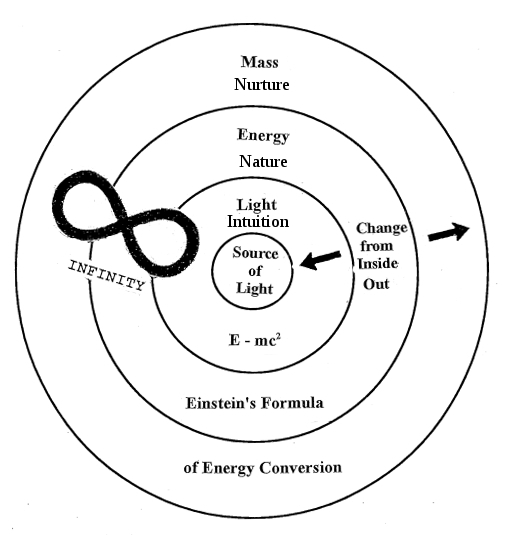
Agreed. Self-responsible learning and experience are essential. Potential is necessary but not sufficient. However, the wisdom of sages (not the same as academic theories) can make a useful difference. I’ll give one example here using the Positive Paradigm Wheel of Change which is true to the original, the I Ching. This picture talks to the right brain to balance the left-brain discussion which follows.

It places the relationship of nature, nurture and “much more” in prioritized context.

NatureNurtureWheel

For those as yet unfamiliar with the Unified Theory of Einstein’s heart’s desire, let me explain briefly. The model of concentric wheels-within-wheels is equally compatible with modern atomic science, the world’s great religions, and yoga philosophy.

The surface level that corresponds with MASS includes everything tangible and measurable. It’s the realm of empirical science. That would be “nurture.”

The middle ENERGY level corresponds not only with electricity, but with subtle but measurable energies that yogis call “chi” or “prana.” It’s the level associated with DNA, emotions and “gut” feelings. As detailed below, that’s the level of “nature.”

The innermost level of LIGHT is associated with intangibles. That’s the “. . . and Much MORE.”

On the surface, intelligence is measured by IQ. It’s also the realm of human laws and social codes, including morality.

The middle level is the domain of the natural law encoded in the venerable Chinese Book of Change. Competence at the middle level is popularly called EQ – Emotional Intelligence. This is the realm of native virtues, including but not limited to courage, kindness and calmness. Compassion is the balanced composite of intrinsic virtues.

Still further inwards, deeper knowledge is experienced as intuition, sometimes called guidance. Most notably, the New and Old Testaments speak to this level.

At the hub of life’s Wheel, the unchanging center holds the radiating spokes and rim together. This eternal source of life and light is associated with the silent voice of Conscience. The Chinese call it the Tao, the Way which cannot be named.

Here’s how Ivan’s comments on nature vs. nurture fit into the Wheel. The surface of the Wheel is the level of daily experience, which includes on-the-job and classroom training as well as expert mentoring. This is the level of nurture – leadership development.

Even so, depending on what (or whether) they choose to learn from it, experience shapes different leaders differently. (Academics who are heavy on theory but light on experience are understandably frustrating to leaders whose common sense is highly developed.)

The middle level of the Wheel is where some leaders fall short. This is what Ivan calls nature – innate potentials. Leaders may or may not be self-aware on this level. Some trust their gut feelings more than others. A fortunate few, like Mozart, for example, are born already in-formed. But a deficit can be improved by relevant training, especially when reinforced by practical experience.

The innermost level of the Wheel is where more leaders are gun shy. This is the “And MORE” factor. Deeper than either surface nurture or middle level nature, only the most successful are in-formed by intuition (which is different from gut instinct.) Creative change agents regarded as visionaries receive their inspiration at this level.

The center of the Wheel is, by definition, absolute. The other levels emanate from and return to this creative source. The very best leaders are those who focus here and link the hub all the way to the surface. They’re equally competent on all levels in a balanced way. This is the ideal towards which to strive. It’s also the standard for deciding which leaders to follow, and which ones to promote.

In Positive Paradigm context, the three levels radiating outwards from the central hub are prioritized. For this reason, a highly proficient but insensitive and uninspired technician isn’t yet qualified to lead others. An enthusiastic, high energy leader may attract followers. But a charismatic speaker whose ethics are shaky or whose connection to the center is unstable needs work. Wherever there are deficiencies, once identified, they can be corrected. This is the purpose and value of the The Positive Paradigm Handbook.

The relationship amongst the levels explains the extraordinary success of leaders who start with few material advantages, but succeed far beyond many who begin with more.

Scriptures tell us, and the best leaders affirm, “With God, all things are possible.” That is to say, from a strong connection to the center, entire empires can be spun. Leaders who demonstrate the courage of their convictions make up for early social disadvantages through native intelligence, hard work and the not-coincidental luck this generates.

Detractors may doubt the necessary connection between material success, emotional intelligence, intuition and conscience. They ask, “What explains the success of the fabulously rich and powerful men on the planet who, as outspoken atheists, get whatever they want, however they want, with no regard for the harm they cause to anyone who dares stand their way?”

Well, there are many stories about bad deals with the Devil. Satan promises – and for a short time, can sometimes deliver – ephemeral success in the transitory world. But never the lasting peace which comes from following conscience. Disciples of Saul Alinsky, an admitted follower of Lucifer, can deliver worldly success to political organizers (you know who they are) willing to deceive, fragment and exploit the masses they pretend to serve.

But leaders who intentionally live true their conscience and succeed in linking the levels of life are key to a viable future. The rest of us will depend on them to out-think, out-maneuver and succeed long after pretenders with no substantial connection to the center of life have been blown away like dust in the wind.

So here’s my ongoing call to sages world-wide. Unite in the vision of Einstein’s Unified Theory. As he warned us, this “substantially new way of thinking” is a matter of human survival.

 Angel Calling


Rethinking DISCRIMINATION

Saturday morning, May 17th, while browsing on Twitter, I happened upon the question, “Is Affirmative Action still necessary?” I tweeted straight back, “It was NEVER necessary. The goals are still valid; the legislation missed the point, triggering backlash without valid solutions.” On second thought, I tweeted “AA my thesis subject; response not made lightly; see  http://wp.me/p46Y5Z-7h. All best!”

Then, out of curiosity, I looked up the folks who asked. It’s a suspiciously faceless group using the same familiar but empty buzz words that attract all, but satisfy none. “Change is Coming. Engage. Unite. Inspire.”

It’s my ongoing work to take back and revitalize the language. Change is my subject. The Unified Theory inherent in Einstein’s famous formula is the message. Reinventing democracy by inspiring careful thinkers to Positive Action is my intended result.

Hence, today’s blog is dedicated to the history behind my answer. Take time to balance the overlooked neutral and positive meanings of “discrimination” with the overworked negative ones. It’s important.

An earlier blog posted on January 5, 2014, I spoke to a comment about discrimination made on “Off the Record” by Fox News’ Greta Van Susteren. She said racism exists and it’s terrible. But using the race card wrongfully is just as bad. Public figures who stir up the pot are dividing the nation, not healing it. They’re doing a real disservice to those with valid grievances. She called for “Real Solutions to Solve Real Racism.” I agreed whole-heartedly.

I continued, “Bottom line: exploitation is an energy dynamic, a symptom of self-destructive imbalance. To the extent that individuals operate on incomplete, inaccurate and false paradigms, they remain insecure, unconscious and functionally disconnected from their higher potentials. Out of that pain and suffering, like Kissinger, like Soros in the extreme, they will continue to feel justified in dominating, controlling and exploiting whomever they can, however they can — playing out power addictions with hypocritical talk of philanthropy.

“Affirmative Action legislation has not changed these dynamics — nor, as discussed earlier, could it. Looking in the wrong places doesn’t help. Tacking Affirmative Action legislation as an overlay on the surface level, while failing to address a deeper, divisive worldview, couldn’t help, and most likely would make matters worse.

“Blaming outside enemies as an excuse to avoid self-examination and correction is a futile waste of precious time and energy. Although venting frustration in politically motivated social movements — even terrorism and outright war — may temporarily feel good, it doesn’t address the underlying paradigm deficiency that drives hatred, violence and injustice. It therefore can’t put an end to catastrophic outcomes.”

Here then, is the supporting Essay from Conscience: Your Ultimate Personal Survival Guide.*

globe


19. DISCRIMINATION

“Relying more on the social scientists than on legal precedents . . the Court insisted on equality of the mind and heart rather than on equal school facilities. . . . Brown symbolizes the Good America, rather than the country that slaughtered Native Americans, subordinated women, and enslaved blacks. — Jack M. Balkin, What “Brown v. Board of Education” Should Have Said

Dealing exclusively on a rational level with an issue like discrimination which is deeply emotion-laden (sub-rational) on the one hand, and highly value-laden (super-rational) on the other, fails to acknowledge and draw on the levels where problems begin and where solutions can be found. — Patricia West, “Positive Action: The Next Generation”

Seeing and hearing are like food and drink; you need them every day, but you also need to digest and eliminate them every day. If they are not digested and eliminated thoroughly, they remain in the gut, eventually producing illness. — Taoist Meditation, trans. Thomas Cleary.

THE FRONT

Three levels of definition attribute opposite, contradictory meanings to the single word discrimination. In the last century, failure to recognize and sort out this confusion resulted in muddled perceptions of purpose, inconsistent implementation and half-hearted compliance with Affirmative Action legislation.

The Oxford English Dictionary’s rational definition of discrimination posits a neutral function of mind. To discriminate is to distinguish with the mind or intellect; to perceive, observe, or note the difference in or between. As an analytical tool, discrimination is the neutral function of mind used to dissect a situation’s parts and deduce cause/effect relationships amongst them. As a tool, effects of its use, whether creative or destructive, depend on the motives and competence of the user.

The last given definition adds a preposition: against. To discriminate against is to make an adverse distinction in regard to, to distinguish unfavorably from others. This negative definition is the sub-rational use. It describes abuse of the critical faculty of mind to separate, distance and subordinate others, and to rationalize exploitation. Discrimination as a function of biased, negative emotions such as fear, hate, envy, arrogance or greed is the polar opposite of objective analysis.

Still further from the rational meaning of discrimination is its super-rational definition. It is not included in The Oxford English Dictionary. However, in Eastern scriptures, the highest function of mind is called buddhi (hence the name Buddha), translated into English as the power of discrimination.

This usage alludes to the ability to see through deceptive illusions, to recognize the eternal in the midst of change, to be aware of all-pervading spirit operating within gross material forms. While rational discrimination is neutral and sub-rational discrimination has separatist results, the super-rational function of discrimination is unifying in effect.

Depending on the user’s mind-set, the I Ching can be used to serve rational, sub- or super-rational motives. Ideally, it’s used to facilitate the process of mental metabolism. When the senses are overloaded with impressions, the Book of Change can be approached as a discipline for settling down and organizing one’s thoughts sufficiently to define the immediate situation and ask questions about it.

As negative emotions surface, they’re named and released, not unlike the process of separating toxins from useful nutrients, eliminating them as waste. Rational thoughts are then simplified, prioritizing essentials and aligning them to basic purpose. Then, when emotions and rational mind are harmonized and stilled, the higher mind is invoked.

It is in this state of tranquil revere that one pierces the veil of ordinary thought, allowing the transcendent awareness attributed to genius to come forward. Einstein, for example, acknowledged that his famous e = mc2 formula came in a flash of inspired contemplation. He faulted his peers for what he called the “fateful fear of metaphysics,” a pernicious prejudice that’s easily as dangerous as racism or sexism.

THE BACK

Mercy and compassion ameliorate the effects of negative discrimination. Introspective activities like self-analysis and use of the I Ching promote the positive capacity to discriminate, make correct decisions, and act wisely. In human law, the opposite of discrimination is justice and equity. In an equitable society, wisdom is promoted as the foundation of harmony and order.

The discipline of positive discrimination is neglected in an unjust world. Ruthless extortionists in positions of political power will kill to prevent discriminating thinkers from recognizing and opposing their abuses. Tyrants promote negative discrimination. They exploit hatred, weakening the people by turning them against each other, conquering by dividing them.

—————————-

What “Brown v. Board of Education” Should Have Said. Ed. Jack M. Balkin. (New York

University Press: New York, 2001.) pp. 4-5.

Patricia West, Positive Action: The Next Generation of Affirmative Action. Unpublished paper. (Madison, WI, 1976).

Taoist Meditation: Methods for Cultivating a Healthy Mind and Body, trans. Thomas Cleary. (Shambhala: Boston, MA, 2000.) P. 57.

——————-

* See the Conscience Page for illustrations, description of the structure-within-structure format of the Sixty-Four Essays, an overview of CONSCIENCE: Your Ultimate Personal Survival Guide, and an alphabetical list of the Essays.

Rethinking CHANGE

Natural change on the surface and middle levels of the Life Wheel is ongoing and inevitable. In addition, ignorant and/or irresponsible people superimpose additional layers of unnatural change to the mix, products of cultural conditioning and human agendas. So the best hope we have for maintaining inner and outer stability in the midst of chaos and suffering is to focus on the unchanging center. Otherwise, working consistently to achieve worthwhile long-term goals would be impossible. Hence, from the Introduction to the Common Sense Book of Change:

Ancient sages looked to The Book of Change primarily to discover ways to maintain balance and stability in the midst of change.

Advisors to long-lasting dynasties in China observed how to adjust with the winds and waves of time just as a ship pilot shifts the sails or a surfer rides the cresting water to reach a far shore safely.

They knew that temporal wisdom depends on the existence of a timeless essence deeper than change, the same at the heart of the universe, the individual and every atom.

Here, then, is an Essay on natural change from an I Ching perspective:

Phoenix - sized


Essay 11. CHANGE

We have always thought of the Bible as a book. We now know that was only its first incarnation. It is also a computer program. Not merely a book that Rips typed into a computer, but something that its original author actually designed to be interactive and ever-changing.  — Michael Drosnin, The Bible Code


For the last eight years, I have been studying all the various ways that people can heal, and I have integrated all the integrative medicine approaches, and I have learned how to change my lifestyle. . . I can honestly tell you that the one thing I never questioned was the fact that there is divine order, that there is a supreme being behind the universe. I’ve always known that. It’s as if it’s in my DNA. [The “Power to Change” Tour] — Naomi Judd, Larry King Live Interview


The responsibility for [improvement strategies] rests at the top, as in everything that has to do with the spirit of an organization. And so the executives who run innovative organizations must train themselves to look out the window, to look for change. The funny thing is, it’s easier to learn to look out the window than to look inside, and that’s also a smart thing to do systematically. — Peter F. Drucker, Managing the Non-Profit Organization


THE FRONT

Webster’s gives seven definitions of change. Root derivations include exchange, or bent and crooked, suggesting the image of a curved, wavy line. The first definition of the verb is to substitute, replace or transfer one thing for another. The second is to give and receive reciprocally, exchange or switch. The third is to cause to become different, alter, transform, convert, or undergo a variation. The fourth is to give or receive the equivalent of a coin in currency. The fifth is to put on other clothes. The sixth, used as a noun, describes the place where merchants do business. The seventh is the pattern in which bells are rung. By extension, jazz musicians use the term to denote chord progressions.

Translators call the dynamic natural law mapped in the I Ching “change.” However, if we think of the word as its regularly used, we miss what the book’s really about. Change isn’t synonymous with political reform, for example, which results, literally, in different forms. Rarely does it bring about qualitative change. Revolution is closer. Just as the minute hand of a clock revolves once an hour back to its starting point, governments revolve over time from reactionary to revolutionary extremes and back. Rarely, however, is long-term qualitative change is achieved in the process.

Evolution is another word used to mean change. Often it implies improvement. However, life is not like a mechanical clock which always runs forward. Over time, poor choices and destructive behavior change us for the worse. The life clock can be turned counter-clockwise. Humans have equal potential for both evolution and devolution.

No one can take for granted either that change is automatically good, or that no matter what one does or doesn’t do, improvement is inevitable. The I Ching helps careful thinkers to relate wisely to change, to ensure through their choices that they actualize their potentials for positive growth.

As Drucker indicates, leaders too often think of change as external, something imposed from the outside upon others. They too often forget about the personal, internal changes that must precede any qualitative, long-lasting external change. Repent is defined as an awakening of conscience that stimulates regret for past mistakes and determination to improve. The warning “repent before it’s too late” on one level refers to a change of heart. On another, it indicates, as Einstein warned, the urgent need to change the way we think and therefore respond to life’s challenges.

In The Bible Code, a challenge was found in proximity to a pending assassination: “Can you change it?” Drosnin took the question literally and made a futile attempt to warn Prime Minister Rabin, as if to change the course of history.

Perhaps on another level the question implies other challenges. Maybe we are being asked to change our relationship to the timeless teachings we take for granted, to look again with fresh eyes and change not external events, but rather our hearts and minds, to change from the inside out.

THE BACK

The opposite of change is stasis. People who feel threatened by change and think they can benefit from resisting it try to freeze time. This results not in perfection, however, but in stagnation and decay. While natural change is vital and life-enhancing, obstructing it is counter-productive and ultimately self-destructive.

Anarchy is a perversion of natural change. Nature is exquisitely ordered and therefore, to those who observe carefully, predictable. Political radicals impatient with corrupt governments leap to opposite and equal abuses of power. Lacking wisdom, their violence abruptly shatters existing order, but fails to improve the quality of life. On subtle levels, attempts to destroy natural patterns results not in desired freedom, but in annihilation.


Rethinking ACTION

One of the 64 Essays on Change is posted each consecutive Sunday. The choice is decided either by requests made on the Contact Page and/or immediate relevance to current events. See the UPSG Essays page for a description of the structure-within-structure format of the Essays, an overview of CONSCIENCE: Your Ultimate Personal Survival Guide, and an alphabetical list of the Essays from which to choose.

On the new moon of March 9, 2014, the first of the Essays to be posted was Number 61 on PEACE. It was selected as a timely response to events in the Ukraine. The following Sunday, the very first Essay, CRIME, was selected, followed by its companion Essay Number 18 on MOTIVES.

The final Essay, Number 64 has been selected for Sunday, March 30th, the second new moon in the month of March. It completes a triad that started with CRIME, then MOTIVES, and now, consequent ACTION. This Essay has immediate applications to the progression of world events.

Bloggers have likened Putin’s actions to the strategy of Sun Tzu’s Art of War. America’s leaders have been faulted for lacking the ability to think in terms of positive action responses. It therefore behooves everyone, everywhere with an eye to the future, in the interests of human survival, to fill in that void.

globe

64. ACTION

“Military action is important to the nation — it is the ground of death and life, the path of survival and destruction, so it is imperative to examine it. . . The Way means inducing the people to have the same aim as the leadership, so that they will share death and share life, without fear of danger.” — Sun Tzu, The Art of War

“The warrior is always alert. He is always awake. He knows how to focus his mind and his body. He is what the samurai call “mindful.” . . . As a function of his clarity of mind, he is a strategist and a tactician. He can evaluate his circumstances accurately and then adapt himself to the “situation on the ground.” — Moore & Gillette, The Warrior in His Fullness

“We cannot stop the seasons of history, but we can prepare for them. Right now, in 1997, we have eight, ten, perhaps a dozen more years to get ready. Then events will begin to take choices out of our hands. Yes, winter is coming, but our path through the winter is up to us. . . History’s howling storms can bring out the worst and best in a society.” — Strauss & Howe, The Fourth Turning

THE FRONT

Webster’s defines action on a sliding scale of meanings. Taking in the full spectrum as a whole is an eye-opener. Originally it was a physics concept, the state of being in motion. From there the definition changes to habitual conduct characterized by energy and boldness. It changes again to include the effect produced by something (like a drug), or the way organs or machines work.

Action is used to describe the function of a piano or a gun. It shifts to take on the connotation of a legal proceeding by which one seeks to have a wrong put right. It’s the term used to describe military combat. Lastly, in slang it denotes excitement, specifically gambling.

Over a life-time, novelist Earle Stanley Gardner worked to develop a best-seller formula: a virtuous hero whom everyone loves to see in action. The result, Attorney Perry Mason, solves crimes and puts wrongs right in the court of law. He’s a deliberate blending of Robin Hood and Sherlock Holmes. Robin defended the betrayed and down-trodden. He took from the rich to give to the poor, helping them stand against oppressors. Sherlock used his highly trained powers of observation and deduction to trace devious crimes to the unseen hand of the evil Moriarty, then courageously drew the villain out to defeat him.

New law students are often grieved to find reality so far removed from fiction. Just so. Gardner knew people bought his books exactly because they longed for what’s missing in their lives. But fiction soothes without solving. The times call for a multitude of Positive Perrys taking positive action every day, here and now.

Movie action heroes also exemplify the intellect-action blend of leadership we miss. To become a Jedi knight, Luke SkyWalker first must train to attune himself to “the force.” Indiana Jones similarly blends the best of right and left brain worlds. Both he and Nazi opponents search out the arc of the covenant, then the grail. The enemy wants the key to world domination; Indy and his beloved father seek “illumination.” They respect the wisdom of ancient times and adventure to recover lost treasures. The I Ching is another of the ancient lost treasures, both used and abused by seekers through the ages.

Unlike these action heroes, intellectuals who contempt practical people and workers who enviously mistrust the educated are equally lop-sided actors. For positive results, scholars and street-smart frontliners must join ranks. Better still, we should each train ourselves like action hero role models to balance self-awareness and action, to live fully effective, each in our own way.

George S. Patton, the general who defeated Hitler’s army, quoted scriptures like a bishop, knew Shakespeare’s verse by heart.

THE BACK

The opposite of action is inaction. This may be appropriate. Those who patiently wait also serve. Other times it’s due to indifference or paralysis of will. Procrastination, delaying action, may be a result of ambivalence. Lack of commitment or conflicting goals and beliefs often work unconsciously to sabotage consistent action.

A perversion of action is hyperactivity, sometimes the result of a chemical imbalance, other times an effort to avoid thinking. Restricting youthful energies, forcing children to sit too long inactive, can trigger rebellion as an extreme and opposite reaction to boredom.

————

  • Sun Tzu, The Art of War, trans. Thomas Cleary. (Shambhala: Boston, 1988.) p. 41.
  • Robert Moore and Douglas Gillette, “The Warrior in His Fullness,” in The Awakened Warrior: Living with Courage, Compassion & Discipline, ed. Rick Fields. (Putnam’s Sons: New York, 1994.) pp. 29-30.
  • William Strauss & Neil Howe, The Fourth Turning: An American Prophecy. (Broadway Books: New York,1997.) p. 7.

The Positive Paradigm Handbook is Coming SOON

HERE’s a sample from the Coming Positive Paradigm Handbook!

globe

PREFACE

The Positive Paradigm Handbook will change the way you see yourself

and relate to the world – forever.

  • It gives you a functional picture of how your life really works, and by extension, what moves the people around you.

  • It gives you the map for achieving fulfillment, personal happiness and higher love.

  • It give you an instrument with which to effectively organize your personal life, make realistic decisions, and act more effectively to achieve intended results.

  • It gives you premier tools for cultivating self-awareness, making the unconscious conscious, and mapping goals for personal change.

  • It gives you a comprehensive standard for assessing your leadership skills, maximizing this potential, and choosing which leaders to follow.

  • It gives self-healers and therapists a powerful diagnostic tool for identifying the roots of disease-causing stress and correcting lifestyle imbalances.

  • It gives profound insight into the causes of discrimination, sexual abuse and PTSD, as well as how to heal from their effects.

  • It gives everyone a realistic standard for recognizing true friends from mortal enemies.

  • Ultimately, it gives those who follow through the edge on long-term success, tipping the scales of history in favor of human survival, one person at a time.

If these claims sound intense, they are. But they’re well founded.

As a teenager, I was fascinated by the fact that Einstein’s abstract formula, e = mc2, could produce powerfully tangible results — the atomic bomb!

Later, I was even more intrigued to discover that this same formula, when plugged into the concentric circles of the Positive Paradigm Wheel, not only resulted in the Unified Theory of Einstein’s lifelong quest. It was capable of generating equally powerful and practical personal results.

The Positive Paradigm Handbook reveals this Unified Theory and supplies the tools needed to start thinking like a genius. By internalizing this method, making it your own by repeated use, your life will be changed in ways only dreamed of before. Virtually endless in its practical applications, it can be pointed like a laser beam to illumine every field of endeavor.

The Handbook is the bare bones take-away from Rethinking Survival. The author’s personal background, academic credentials, research and experience are described in Getting to the Positive Paradigm. But here, what matters is simply that it works and that owning it is a matter of personal survival.

Based on the foundation of the earlier books on change, The Positive Paradigm Handbook goes directly to the heart of personal, practical application, here and now. The purpose of working with the Handbook is to ingrain Einstein’s “substantially new way of thinking,” which, he said, is required “if mankind is to survive.”

In a world seemingly intent on fracturing experience into smaller and smaller niches, the Positive Paradigm provides an urgently needed counter-balance, applying an opposite and equal weight in a unifying direction.

Rethinking CRIME

Today, I’m fulfilling a promise made on a LinkedIn thread in answer to the question, “Crime, Is It Natural?” I responded to look here for my perspective on this very important question. After all, CRIME just happens the very first of the UPSG Essays.

 globe

1. CRIME

 “Our time has committed a fatal error; we believe we can criticize the facts of religion intellectually . . . The gods have become diseases; Zeus no longer rules Olympus but rather the solar plexus, and produces curious specimens for the doctor’s consulting room, or disorders the brains of politicians and journalists who unwittingly let loose psychic epidemics on the world.” — C. G. Jung, The Collected Works of C.G. Jung, Vol. 13.

“Nature itself has a pulse, a rhythmic, wavelike movement between activity and rest . . . We are capable of overriding these natural cycles, but only by summoning the fight-or-flight response and flooding our bodies with stress hormones. We can only push so long without breaking down and burning out.” — Loehr & Schwartz, The Power of Full Engagement

“Your life is created from the inside out, so you must get right with you on the inside — and that takes time and focus on you; not your social mask, but you. . . You are uniquely equipped for a mission in this world, and to fail to commit to finding that mission and then achieving it is to wither the mind, body and spirit.” — Phillip C. McGraw, Self Matters: Creating Your Life from the Inside Out

THE FRONT

Linguistic roots of crime indicate a verdict, an object of reproach, or offense. According to Webster’s, crime is an act which the law prohibits. Conversely, it is failure to act as the law orders. Crimes are variously punishable by death, imprisonment, or the imposition of fines and restrictions.

A second kind of crime is an offense against morality, called sin. More loosely, this word is used to refer to something regrettable. “It’s a crime you didn’t finish school.”

What’s significantly missing from Webster’s definitions is reference to violations of Natural Law. Over millennia, Asian practitioners evolved sophisticated sciences which map the subtle laws of energy movement and study the effects of natural change on human physiology, behavior and institutions. For thousands of years, health sciences, social structures, business practices and the education of monastic, government and military leaders alike were based on this practical understanding of human dynamics.

Westerners, in contrast, have little functional understanding of Natural Law and violate it with impunity. We experience subtle energy shifts as emotional reactions or the erratic ups and downs of daily life. Because Western cultures are historically out-of-tune with energy dynamics at this level of law, it is often referred to as the unconscious. Crimes of passion and self-sabotage are proof of this bind spot.

The focus of Conscience: The Ultimate Personal Survival Guide is the I Ching, the Chinese Book of Change. It embodies a time-tested method for making the unconscious conscious. As the repository of Natural Law, it fills a gap in the way we’ve been taught to think about life.

Restoring its ancient wisdom to current awareness could correct mistakes in the ways we think and therefore act, revitalizing virtually every field of endeavor, from the healing and entertainment arts to the political and social sciences.

In I Ching context, the worst crimes are those we commit against ourselves when we accept and act on limiting suggestions. When we block out the lower octave of sub-rational intelligence (the middle, energy level of the Life Wheel) as if it didn’t exist, we fail to recognize and release the buried fears that sabotage our rational decisions.

When we disown the higher octave of our super-rational awareness, (the Center of the Wheel) we block out intuitive access to the Book of Life, written in our very DNA — the universal source of creative solutions, the means of healing every disease, and hope of ultimate survival.

Those who dismiss, demean or control children with fear condemn them to empty lives of masked conformity on the material surface of the Life Wheel. Instilling extreme ideas about death, as if it were either a reward or ultimate punishment, one’s only hope or worst enemy, results in living inappropriate to reality.

 The more moderate, I Ching view accepts mortality as a natural change. Sages use keen awareness that time on Earth is limited as motivation to live authentic to their true selves, making the best possible use of every precious moment here and now.

To keep people in ignorance, lulling them into inaction by minimizing future dangers or the opportunities inherent in them is irresponsible. To withhold the information we need to be effective in meeting and surviving immanent challenges is most certainly the ultimate crime against humanity.

For a timely wake-up call would serve to shake us out of self-denial and shatter the prisons of narrow thinking. It could rouse the courage to face up to the unknown, to slay the demons that lurk in the sub-rational mind. It might also open us up to our super-rational potentials and the distant calling of eternal life.

 THE BACK

The positive resolution of crime is atonement. In social relationships, it’s accomplished by setting wrongs right. At a personal level, it’s accomplished by returning to a lifestyle compatible with Natural Law. Lat the deepest level, at-one-ment is attained by overcoming separation and restoring one’s original at-one connection with conscience and the creative Source.

The negative consequence of unrepentant wrong doing is punishment. Breaking human laws, as Webster’s enumerates, precipitates punitive results. Over time, the Natural Law of Karma returns actions in kind to the doer. Retribution can be visited in many forms, from mental or physical disease, to personal, professional or financial misfortune. The biblical admonition holds true: As ye sow, so shall ye reap.

—————

Carl G. Jung, The Collected Works of C.G. Jung, Vol. 13.Alchemical Studies. (Princeton University Press: Princeton, NJ, 1967.) p. 36.

Jim Loehr & Tony Schwartz, The Power of Full Engagement: Managing Energy, Not Time Is the Key to High Performance and Personal Renewal. (Free Press: New York, 2003.) pp. 30, 31.

Phillip C. McGraw, Self Matters: Creating Your Life from the Inside Out. (Free Press: New York, 2001.) pp. 12, 13.

Rethinking PEACE

Given the extraordinary amount of pain suffered in many parts of the world today — not the least of which being the very real fear of nuclear annihilation — I’ve chosen a message of PEACE from Conscience: Your Ultimate Personal Survival Guide.

 Essay 61. PEACE

When the forces of nature unite in profound harmony,

heavenly PEACE fills the earth.

Lives blossom. Prosperity increases.

Easy communication makes it possible

for people to understand one another.

This leads to cooperative efforts that will be fruitful.

Tranquility follows fulfillment of life goals.  

— Patricia West, The Common Sense Book of Change

Conflict is woven into the fundamental fabric of nature. The sea and land meet in violent conflict and make waves together. The plow turns the meadow and wheat springs forth. . . Conflict is evidence that human beings are engaged in something interesting. . . [It] plays a key role in the growth of character and the development of stable relationships. Conflict makes us into who we really are. — Brian Muldoon, The Heart of Conflict

The principle of economy in movement arises from a state of internal harmony. A mind that is at peace is not easily swayed or disturbed. This principle also plays a vital role in daily life, whether in business or in combat. If one over-reacts and responds with excessive or unnecessary action, one is at a disadvantage.-Mantak Chia & Juan Li, The Inner Structure of Tai Chi

THE FRONT

Webster’s defines peace as freedom from war or a stopping of war. It can refer to a treaty or agreement to end war or the threat of war. It’s defined as freedom from public disturbance or disorder, public security, law and order. It refers to freedom from disagreement or quarrels.

Peace also means harmony or concord. It’s used to describe an undisturbed state of mind, absence of mental conflict, serenity, or tranquility. To keep one’s peace means to be silent, keep quiet.

The timid are satisfied with peace defined by predictable routine, without conflict or challenge. The aggressive prefer peace defined as defeat of enemies or absolute control over subordinates. The peace of the grave is cessation of life. I Ching philosophy guides careful thinkers away from these extremes.

In I Ching context, peace is an inward state of calm that manifests as outward poise. Where timid and aggressive definitions both depend on external circumstances, the experience of tranquility depends only on oneself. External conditions will always be in flux. Therefore, looking for peace in the world is an exercise in futility. Internal states, however, are subject to self-governance.

In Asian traditions, peace is akin to the yogic concept of contentment — an attitude of grateful acceptance of all seasons and quiet openness to the rhythms of life. In biblical context, the lyrical stanzas of Ecclesiastes capture the wisdom of natural law:

 To every thing there is a season, and a time to every purpose under heaven:

A time to be born, and a time to die;

a time to plant and a time to pluck up that which has been planted;

A time to kill, and a time to heal.

The sage takes responsibility for attaining inner peace as the first step towards world peace. Inner quiet begets the attitude of confidence, which in turn generates acts of compassion, courage and generosity. World organizations which would impose military peace upon warring nations comprised of individuals each at war internally have no hope of success.

Conflict, like peace, starts from the inside and projects outwards. Therefore, no matter what military force is applied, so long as people are educated into internal conflict, external wars will continue to break out.

St. Paul’s epistle to the Ephesians takes on significant new meaning in the light of I Ching wisdom. Peace seekers would do well to consider it carefully:

2.14.  For he is our peace, who hath made both one

and hath broken down the middle wall of partition between us;

2.15. Having abolished in his flesh the enmity,

even the law of commandments contained in ordinances;

for to make in himself of twain one new man, so making peace.

Meditative practices which intentionally focus on the corpus callosum as the middle wall which separates and/or unifies right and left brain (yin/yang, male/female) functions give practical means for implementing biblical insight.

THE BACK

Conflict and war are opposites of peace. Only the context of motive, purpose and intent determines whether they are necessary and to long-term benefit, or unwarranted and uselessly destructive. Shunning either out of fear invites danger.

Enforced silence is a perversion of peace. A totalitarian state can outlaw free expression. It may compel rigid conformance and suppress dissent. However, it cannot contain the vitality of the creative life force, which always prevails.

———————–

Patricia West, The Common Sense Book of Change. (+A Positive Action Press: WI, 2000.) No. 11.

Brian Muldoon, The Heart of Conflict. (G.P. Putnam’s Sons: New York, 1996.) p. 9.

Mantak Chia & Juan Li, The Inner Structure of Tai Chi. (Healing Tao Books: Huntington,

NY, 1996.) p. 35.

Einstein’s New Way of Thinking

Rethinking Survival

Here’s a summary of basics from Rethinking. The title reflects Einstein’s prophetic words:

A human being is part of the whole called by us “‘Universe,’

a part limited in time and space.

We experience ourselves, our thoughts and feelings

as something separate from the rest . . .

This delusion is a kind of prison for us,

restricting us to our personal desires and to affection

for a few persons nearest to us.

Our task must be to free ourselves from the prison

by widening our circle of compassion to embrace

all living creatures and the whole of nature in its beauty. . .

We shall require a substantially new manner of thinking

if mankind is to survive.

— Albert Einstein [emphasis added]

 RS web

The Positive Paradigm is the unified (and unifying) theory which Einstein sought. He missed it because he lacked a non-linear, concentric circle structure which expresses the dynamic relationships of his three variables in a two-directional, infinite continuum.

 The layered structure of the Positive Paradigm Wheel gives new meaning to Einstein’s observation that a problem can’t be solved at the same level on which it was created. “We can’t solve problems by using the same kind of thinking we used when we created them.” It gives new meaning to “Go deep,” and “We can’t be satisfied with superficial answers.” The model literally pictures the widening circle of compassion. It shows the way to escape from the prison of separatist thinking.

 As the book cover shows, three concentric circles orbit around a common center. The three variables of Albert Einstein’s famous formula, e = mc2 (energy, mass and light) are placed within this wheels-within-wheels structure.

 The figure-eight-shaped symbol of infinity is used in the Positive Paradigm Wheel. Because the Creator is characterized as infinite, beyond time, using this physics symbol is an especially appropriate way to symbolize the linking of the levels.

 As light travels on the outward path, it transforms from wave to particle. As pure, generative potential expands, silence transforms into ideas and then emotions within the middle level of the wheel. These in turn materialize into actions that produce physical, tangible results. On the return path, the process reverses. Matter disperses. It returns to its basic elements. It contracts, receding from particles to waves and then into the perfect silence from which it came.

 The Positive Paradigm Wheel mirrors the microcosmic structure of atoms as well as the macro-cosmic structure of planetary systems. At the microscopic level, its concentric rings mirror the structure of atoms around a nucleus. It equally mirrors the symmetry of the planets orbiting around an organizing star, the sun. On the largest scale of magnitude, it reflects the in- and out-breaths of perpetually expanding and contracting universes.

 This familiar atomic structure repeats smallest to largest in the patterns of nature, from snow flakes and intricate flowers to spiders’ webs and sea shells. Similar symmetrical patterns in repeat worldwide in the art of every culture — including the prayer wheels of Native Americans, the colored sand mandalas of Tibetan Buddhists, the stained glass windows of European cathedrals and the intricate geometrical patterns that cover Muslim Mosques, to name but a few. They speak to the universal awareness of a central inner reality. They confirm a continuity of experience deeper than individual lives or transitory cultures.

 Outer levels of the Positive Paradigm Wheel are ephemeral extensions a timeless, absolute center. But the layers of concentric circles aren’t literally separate and discrete. Rather, they are a continuum along the infinite spectrum of creation. Within each layer are numerous degrees and distinctions which can be verified only by direct experience.

 The word Change in “The Positive Paradigm of Change” emphasizes that this isn’t a static model. It is dynamic, inclusive of the outward path of creative extension as well as the inward return to the creative source. This change is called “positive” because the creative process as a whole is in accord with the organic laws of nature encoded in the Book of Change. Positive change is quite distinct from the unnatural, superficial and arbitrary changes of short-sighted human devising

 This Positive Paradigm of Change shows how to think in the new manner Einstein called for. Working with it instills the ability to link the inner with middle and outermost levels of experience. The goal is to integrate conscience with emotions, reason and actions.

 The Positive Paradigm Wheel as an organizing model of experience isn’t really new, however. Restoring it now isn’t so much a paradigm shift as a return to what Aldus Huxley called the timeless, perennial philosophy which the world’s major religions share in common.

 This model emphasizes the holistic quality of creativity associated with genius. In fact, the secret to thinking like a genius has been known for thousands of years. Yogis call it Raja Yoga. “Raja” is the Sanskrit word for “king.” “Yoga” means “link” or “union.”

globe