Tag Archives: survival

Early Adapters Are Most Likely To Survive

With one exception, responses to recent blogs have been gratifying.

In response to “Therapists as Agents of Positive Change,” Brent Nichols, M.A., C.S.W., a Jungian Psychoanalyst located near Berlin, Germany, wrote, “Very nice piece. . . I very much appreciate your lovely thoughts about the Jungian therapeutic process.”

John Romig Johnson, Ph.D., NCPsyA., a Jungian Analyst at Body and Soul International near Charleston, South Carolina, wrote “Marvelous blog. I want to read them all when I get a chance.”

Candace Kleven, PhD., a Psychotherapist in the Jungian Tradition wrote from Redondo Beach, California, “Thank you Pat! I am looking forward to reading your blog and staying connected with your much needed work.”

In response to “Savvy Leaders Go with the Flow,” from Toronto, Canada, Frank Feather at StratEDGYInc. wrote “That is a wonderful and very sage article, Pat. . . . I fear for America. The paradoxes in its political and socio-economic way of life are astonishing and self-destructive. The so-called dream is in danger of becoming a nightmare. . . . Please keep writing, and thanks again for connecting. You are extremely wise.”

But, in balance, lest I get overly-impressed with myself, Brian Chernett, Founder and Chief Executive at ELLAFORUMS CIC in Harrow, U.K. responded, “Its interesting but a little Academic for me.”

Ouch. But, okay. This is an important turning point for me. It’s time find a new, more effective way to communicate. So this is for Brian.

I checked out ELLAFORUMS and learned that it’s a “leadership development programme specifically designed to inspire and develop the leaders of Social Enterprises and Charities.” I listened as Brian explained that ELLA stands for Experiential Leadership Learning Academy. Ah. His direct, interactive approach to leadership training explains, at least in part, his objection to a one-sided monologue.

But to be honest, there’s more. I read “Savvy Leaders” again, thinking how it must look from Brian’s view point. Sure enough. Though I swim like a golden fish in the lore of world scriptures, taking joy in linking the patterned echoes of truth that repeat throughout, to a reader without the background of my chosen path, allusions to Plato and the Old Testament, not to mention Lao Tze, are a stretch. [Understatement.]

So I’m challenging myself here to get straight to the point of “Savvy Leaders” without depending on the authority of unnecessary outside sources. The timing of this decision is critical because I’ve chosen from now on to focus my work towards Millennials (as well as the parents and grandparents who dearly wish them well).

Twenty-somethings swim like golden fish in computer technologies which I find as challenging as my academic waters are to them and their practical hands-on mentors. It’s my responsibility a boundary- spanner to reach out and bridge whatever gaps interfere with effective communication, be they professional or generational.

So here’s my point, straight up. History repeats itself in intricate but predictable cyclical patterns. To stay ahead of the curve, successful leaders depend for survival on timeless wisdom — both innate and educated.

The basic point of Rethinking Survival is that human survival will depend upon decisions based on a simple, complete and correct paradigm. Currently, world leaders operating on the basis of incomplete, extreme and dysfunctional paradigms are making decisions that endanger us all.

The way out of current madness must begin with restoring a complete and correct paradigm, one that is consistent with both the world’s great religions and with modern physics. I’ve presented it as the Positive Paradigm of Change and published two books, one an autobiographical and personal approach, the other a bare bones, practical user’s manual.

I’m advocating a Positive Paradigm shift, regarding it as urgent to rethink priorities and retrain our minds. Historically, power holders with a vested interest in the status quo met calls for change with fierce resistance. It takes a new generation, one for whom old solutions to challenging situations no longer work, to take up the banner of a more functional, hopeful paradigm.

This is why I dedicated Two Sides of a Coin to the Millennial Generation. Seemingly disinherited by their elders, they have little vested interest in protecting the dysfunctional paradigms that have brought us to the current mess we’re in. The Positive Paradigm of Change, a descendant of the Book of Change that remains true to the original, gives them the means to actualize the opportunity hidden in adversity. Namely, survivors must, albeit of necessity, fortify inner strengths and restore forgotten wisdom.

In 1975, I wrote an easy-to-read version of the timeless Chinese I Ching called The Common Sense Book of Change. In fact, it was written exactly to rescue the timeless essence from unnecessary baggage in a non-sexist, non-flowery form that readers of every age with basic language skills and an open heart could relate to.

I cannot speak highly enough of this treasure. This interactive book serves to connect sincere users with their deepest core. When I was dealing with issues which couldn’t be spoken, it was the best friend that got me through tough times. It was the therapist I couldn’t afford, but in some respects better.

It resonates in ways that seem almost magical, though the modern sciences of atomic physics, computer binary digital code, and DNA now give intriguing explanations as to why it works on a cellular or even atomic level. (Hint: It’s no accident that the universal Positive Paradigm model is reminiscent of the rings surrounding the atom’s nucleus as well as the planets revolving around our solar system’s sun.)

Once Millennials start connecting the dots and seeing the larger picture of how the Book of Change resonates with their own computer and game addictions — as well as the enormous implications — there’s a hope for the future. (To those of Christian background who resist its wisdom as if there were a conflict, let me assure you: There is none. Christ told us he existed before the world and will continue after. He presence permeates the field. The wisdom of all human times necessarily partakes of that essence.)

Jesus foresaw the times we’re now enduring. The Book of Change confirms what he foretold and gives those with an open mind the wisdom needed to navigate successfully through dangerous times. Regardless of naysayers who wish to believe otherwise, the world is currently at a nadir point in its history. We are already in the midst of what Old Avatar calls a Near Extinction Level Crisis (N.E.L.C). Recent events in the Near East, North Korea, and the former U.S.S.R, not to mention those closer to home on the U.S. Southern border are merely the visible tip of a vast iceberg.

Historically, at the critical mass of decline and chaos, visionary leaders equal to the times have come forward. They will surely arise from the amongst the Millennial Generation’s ranks as well. They may not have the material advantages earlier available to me. But there’s a trade off.

I’ve had the instructional blessings of international travel and a good education, as well as the luxury of a lifetime to turn knowledge and experience into wisdom. This is my legacy, handed over across the bridge of the generation gap. Millennials are the children and grandchildren I never had. The Positive Paradigm of Change is the sum of all I’ve learned, an inheritance now entrusted to their use, to pass on to their children in turn, if and when that time comes.

Bottom line: history is not a straight line. Those who live as if it were are in deep trouble. Those of vision, while living in today’s world, are quietly preparing for inevitable shocks waiting around the bend. They’re savvy enough to avoid calamity whenever possible, and when the inevitable must be faced, they’re ready meet it, adapt and survive as best they can.

The self-aware who sense and respond to the changes “blowing in the wind” are called “early adapters.” They, along with those who heed and follow them, are the most likely to survive whatever challenges may come.

All Best!

The Only Way Out Is Through

The back cover of Conscience: Your Ultimate Personal Survival Guide sums it up:


con_bak_cov

The Positive Paradigm Handbook — a practical, bare bones work book — offers the following, abbreviated description of the middle, energy level of the Positive Paradigm Wheel of Change. **

The dangers of this level cannot be underestimated. Understandably, without a reliable road map and a keen sense of purpose and commitment, the middle level seems frightfully laden with traps to ensnare the uninformed and reckless. Hence the Fateful Fear of Self-Awareness. (See wp.me/p46Y5Z-aK.)

However, its value cannot be underestimated either. Armed with the skills and insight to use the necessary powers associated with this level wisely, courageous pioneers of the inner worlds can achieve success in every area of their lives.

To avoid the dangers of getting stuck in the middle level, mired in the traps of delusions and negative emotions, it’s critically important to have an accurate and complete reality map. The purpose of pushing through this level is ultimately to reach the far side, the abode of intuition and light, the storehouse of infinite treasure. But, as told of The Chapel Perilous, “The Only Way Out Is Through.”

—————————–

e. Energy. Much ignorance, misinformation and confusion surrounds the energy level of the Positive Paradigm. The state of chaos into which the world has degenerated attests to this deficiency, as well as the urgent need to correct it. Only the basics are described here, suggestive of further exploration.

The middle level is the domain of natural law, whose dynamics are mapped in the Chinese I Ching, the Book of Change. This body of knowledge has evolved over eight thousand years as sages continue to observe the operations of energy and document the repetitive patterns of change.

Natural law maps the energetic underpinnings of the dynamic, physical world. It is experienced as the patterned recurring cycles of seasonal change, and is equally applicable to humans and their cyclical life changes: birth, growth, decay and death.

The middle layer is the realm of less tangible but still measurable states of energy, including electricity. More subtly, it is the chi, ki or prana described by Chinese, Japanese and Indian traditions as the life force which animates all living beings. In Greek and Christian contexts it correlates with the breath, the psyche.

These subtle energies influence internal psychological states and drive external human behavior, which in turn affects social relationships. Knowledge of these dynamics is essential to personal survival.

Effective leadership and the quality of life within organizations hinge on the quality of awareness brought to dynamics at this level. While some leaders understand the dynamics of change at a gut level as a matter of common sense, systematic logic and deliberate understanding would significantly improve the results of the decision-making process.

Those denied access to material and social resources are often forced inside. Of necessity, turning inward, they develop and depend for survival upon strengths drawn from the middle and center of the Wheel.

At times, material deprivation and hardships yield the opposite and equal blessings of in-sight and emotional fortitude. At other times, however, excessive investment at the middle level results in delusions, latent with the potential for erupting into violence.

In any case, making a virtue of necessity by rejecting the material world prevents completion of the pattern. It can’t correctly be equated with spirituality.

Cultures which enforce an exclusively materialistic worldview and deny the experience of everything not tangible and measurable place severe hardships on those whose inner lives are especially active. The Handbook gives ample opportunities to diagnose such imbalances, the better to remedy them.

Societies that deny their citizens practical outlets for articulating and harnessing inner energies creatively can literally drive people crazy, to suicide, or at best, underground. Many “sensitives” survive by channeling socially banned, unacceptable awareness and longing for self-fulfilling adventure into the arts: music and literature, including romance, murder mysteries and science fiction.

This is a great loss to society. The world would be far better off if high-energy, creative individuals were identified as potential leaders, trained and given employment options accordingly.

** Educators, therapists and theologians interested in detailed applications to their particular professions are referred to the more complete description provided in Rethinking Survival: Getting to the Positive Paradigm of Change.

Seven Axioms of Positive Change

As promised, here is an abbreviated list of the seven basic axioms of viable, positive change as they’re listed in The Positive Paradigm Handbook: Make Yourself Whole Using the Wheel of Change. They all refer to the basic model of concentric circles linked in a continuous, infinite loop:


PositiveParadigmWheel

.

  • AXIOM ONE: A complete and correct paradigm is the key to personal well-being and success.

In the Positive Paradigm worldview, the physical world of experience has its origin and end at the creative center of the Wheel. The unseen drives the seen. The invisible precedes the visible. Inspiration precedes actions which in turn produce results.

Therefore, the quality of daily life depends on the quality of belief systems. If the paradigm held is complete and accurate, it leads to consistent action that yields successful, beneficial results. When paradigms are incomplete and inaccurate, however, they generate inconsistent actions that lead to failure, pain and suffering.

By definition, a universal paradigm can be applied to every and any aspect of life. A rethinking of personal lives, bringing them into alignment with the Positive worldview, will enhance well-being on all levels. A similar rethinking of organizational structures on increasingly larger scales of magnitude will have equally beneficial consequences.

A deep understanding of the Positive Paradigm illumines whatever field of endeavor upon which it is focused. This includes all the arts as well as the physical and social sciences — economics, politics and government.

.

  • AXIOM TWO: We are each a world complete, containing the potentials of the universe.

Sadly, this is the least known but most important fact of life we never learned in school – but should have. In large part, the Handbook is written as the book I searched for on the library shelves, but couldn’t find. It should have been there, and now will be for others who also sense that there’s something really important missing from what we were taught which must be restored. It’s the basis of a fundamental respect for self as well as for all others.

The place to look in this information starts with ancient medical traditions. The traditional sciences of both India and China map the subtle inner energy patterns which Huston Smith called the “invisible geometry” which shapes all humanity to a “single truth.”

In these worldviews, energy emanates from and returns to an eternal source. It is the stuff from which the physical world is generated. It is the substructure which frames the physical human body, upon which mental and physical health depend. When this energy is abundant, its circulation free flowing, and its distribution balanced, we experience health. When energy is depleted, stagnant or unbalanced, the result is disease on every level.

The functional term “health” in the context of these traditions means “whole.” The health of subtle energetic and related biological systems depends on the integrated balance of the interrelated parts. Each part depends on and completes the whole. The concept of “holism” expresses this worldview. . . .

.

  • AXIOM THREE: Unity and Diversity Are Necessary Compliments

The third axiom is almost as neglected as the second. In addition, it is subject to distortions and misunderstandings that make matters worse. This confusion is the unfortunate cause of conflict in family relationships, and all the way up the life chain to conflict between nations.

Inherent, inner similarity is the realistic foundation of common understanding. However, the fact that all people have the same inner structure does not mean that all are identical, or should be treated the same. Quite the contrary, within the evolutionary chakra scale, at any given time, most individuals are focused on only one or a small combination of centers and their related issues.

Like snowflakes, humans are identical in their basic structure. Each, however, is unique expression of the universal pattern. Personal abilities and needs are the result of an infinitely complex set of variables. And just as the balance of energy centers promotes the health of the individual, a balance of complimentary aptitudes and interests promotes the general health of society at large.

.

  • AXIOM FOUR: The consequences of action are inevitable; those who respect the law of karma succeed.

Axiom Four is the practical foundation of ethics. In a materialist, linear worldview, it may seem possible to hide selfish motives and evil deeds behind a mask of false appearances and escape the logical consequences of one’s actions. This false premise and its horrific outcome, however, is exposed in Oscar Wilde’s The Picture of Dorian Gray.

In the circular and richly textured fabric of the Positive Paradigm reality, attempts at evasion and deception are ultimately futile. The Old Testament describes the karmic law of return in agricultural terms. “As ye reap, so shall ye sow,” and “For everything there is a season. . . “

In modern parlance, the saying that underscores the circular dynamic of “poetic justice” is, “What goes around comes around.”

In the New Testament, Jesus stated the Law of Karma as practical advice: “Do unto others as ye would have them do unto you.” This observation holds true as axiomatic. It has been observed for a very long time that in fact — even if not immediately, or directly — what is done does, for better or worse, return in kind.

.

  • AXIOM FIVE: History is neither linear or progressive, nor can human survival be taken for granted.

Some things change. Others never do. Knowing the difference between absolutes and ephemerals is matter of life or death. The center of the Wheel is changeless. Those in the know depend on this. But the Wheel’s rim spins in endless circles of repeating, patterned change. Therefore, survivors anticipate the predictable, cyclical changes of nature.

They know far better than to take immediate appearances at face value. They’re not fooled by wishful thinking into the false belief that what can be seen is permanent.

Lao Tze, who wrote the world-loved Tao Te Ching, or The Way and Its Power, knew this and tried to warn the world. Sun Tzu, Chinese author of The Art of War — a manual used by successful military leaders for hundreds of years — taught savvy strategists how to exploit the knowledge of human dynamics to win their battles. Today’s international business leaders have adapted this wisdom, as well as spin-offs like the 36 Stratagems, to capture markets, maximize profits and beat out the competition.

All these texts draw on the wisdom encoded in the I Ching, the venerable Book of Change, to steer them in the decision-making process. They rely on the law of subtle change and the personal understandings derived from working with it to stay ahead of the curve. Knowing that surface appearances are deceptive can be used as a protective, self-defense measure, or exploited with endlessly ingenious variations that take advantage of the uninformed. . .

In the dark ages, Europeans were taught to believe that the world was flat. That the globe of spinning Planet Earth is in fact round was received as life-changing information that dramatically changed the way people thought and lived.

Similarly, some today still continue to think of history as a flat, straight line. In this they are as sadly mistaken as were the navigators who guided their ships on the assumption that the world was flat. In fact, the dynamics of human history resemble a multi-layered clock whose second, minute and hour hands continuously return to the same starting point at different rates of speed. Rethinking the paradigm of history to align with known facts would give future leaders an edge on survival.

.

  • AXIOM SIX: Used as a linguistic tool, the Positive Paradigm Wheel of Change promotes clear, accurate and effective communication.

Like humanity itself, the English language is also becoming an endangered species. Clear and effective communication can no more be taken for granted than any other aspect of the civilization.

In tracking the meanings of words, their devolution is found to be systematic. In some cases, the same word means not only one thing, but its exact opposite as well. The inherent danger is that people often talk at cross-purposes, thinking they understand each other when in fact they’re missing each other coming and going, only vaguely aware of the disconnect.

It’s worth the time to pay attention to what’s meant by specific words in common use. Working with the Positive Paradigm Wheel explains the dynamics of shifting definitions. The same word takes on different meanings on different levels of the Wheel.

One example is the word “positive.” Webster’s Dictionary lists seventeen (!) different uses. They span the continuum from center to surface, with many gradations along the route. At the core, “positive” refers to that which is absolute, unqualified, and independent of circumstances; that which has real existence in itself.

At the middle, energy level, the term is used describe an electrical valence. As an attitude, positive can mean either confident or dogmatic. At the surface, positive may mean showing forward progress or increase, making a constructive contribution.

  • AXIOM SEVEN: With a correct paradigm, practical methods and useful tools, you can make yourself whole.

As stated in the Preface caveat, according to the Positive Paradigm, everyone is already intrinsically whole. Put another way, “God don’t make no junk.” This is the wisdom behind the biblical admonition, “Ye must be perfect like your father.” However, just as Einstein had the Unified Field Theory, but didn’t know it, each and every one of us on the planet is perfect in potential: made in God’s image. But we’ve forgotten.

Worse, many have been deceived into believing they’re inherently not-okay. The Handbook confirms inherent wholeness. Its structure provides the practical foundation for actualizing in-born potential and initiating the ongoing process of making and keeping ourselves FUNCTIONALLY whole, over and over again.

The subtitle Make Yourself Whole Using the Wheel of Change isn’t intended to suggest that this or any other book can magically or literally make anyone whole, or that once through the book, you’re done. It requires not only initial work, but ongoing follow-through. It’s personal intention and consistent effort that produce results. This is just a really useful tool.

***

To be continued. Each of the basic axioms generates numerous related corollaries. Future blogs will list the most important of them.

I’m a Passionate Mama Bear

A critic warned that unless I reach out to readers right away, I’ll lose them. Accordingly, I added this acknowledgement to The Positive Paradigm Handbook:

This book is dedicated to YOU, the reader. It acknowledges that we each mirror the potentials of the entire universe. The problem is that you’ve forgotten! Because the times are increasingly dangerous, you urgently need to remember who you truly are. WAKE UP!

I firmly believe that you’re far greater than you’ve allowed yourself to dream, and need only the encouragement, tools and motivation to prove me right. I’ve pushed myself to the burn out point to deliver the best I can offer, while there’s precious time left.

He hated it. “Saying ‘WAKE UP!’ will come across as an insult to some, and all the caps make it sound as though you’re yelling at them, “ he wrote.

What??? Of course I’m shouting. When a locomotive is bearing down on sleepers unknowingly camped on railroad tracks, directly in harms way, you don’t whisper. There’s no time for the subtle indirections he recommends.

But my message is intended as high compliment, a confirmation that we’re all potential GIANTS, albeit sleeping. How does he get an insult out of this?

He overlooked the rest:

I’ve been cautioned that the “average jane-schmo” can’t relate to my ideas. I don’t believe such a person exists. I’ve also been warned that because people today are unusually stressed, they want to read something “tangible.” I understand stress. But “feel good” stories and false assurances don’t change the facts or truly help anyone.

Do we as readers really want to be lulled into forgetful sleep? I believe we’re hungry to know why things are going terribly wrong and are urgently seeking better options. Life isn’t a popularity contest, nor is the Handbook about me. It’s about YOU and your ultimate survival. Please remember in reading it that I dearly wish you all the very best.

I’ve been told my style is “intense,” or “in your face.” I suppose so. It’s the voice of a passionate mama bear, fighting for the survival of her cubs.

“Give a story about your parents, or a teacher, or a mentor. Make people feel warm, like they can relate to you as a person,” advised my critic. I responded, “I’ve already done all this in the autobiographical part of Rethinking Survival. It’s filled with childhood anecdotes and other personal stuff. The Handbook is the bare bones summary.”

He declined my offer of a complimentary RS copy. Too busy.

For now, I’m providing excerpts from RS below that put my WAKE UP call in context. It’s more than just a call to wake up to current political abuses. It’s also a wake up call that points out HOW and WHY we’ve gotten into our current predicaments, WHO we truly are, and on that basis, WHAT options for positive change remain at this late date.


globe

I’m now convinced that the Positive Paradigm of Change is the ultimate answer to the ancient ultimate question. It’s the literal proof that humans are made in the image of the Creator — the microcosm resonates with the macro. I AM that I AM.

Put another way, “God don’t make no junk.” In this context, the exhortation, “Ye must be perfect like your father” makes perfect sense. Just as Einstein had the Unified Field Theory, but didn’t know it, each and every one of us on the planet is perfect in potential: made in God’s image. But we’ve forgotten.

And tyrants want you to sleep on. They’ll do anything to prevent you from remembering that you’re inherently okay. Because once you do, as Einstein did, no one can intimidate, control or dominate you. You’re aware that nothing anyone has for sale can make you more perfect. Nor can anything that anyone threatens to take away alter your essential okayness.

It’s your inalienable birthright. A given.

The Positive Paradigm is the viable basis upon which to build valid self-esteem. It’s the key to personal freedom — freedom from ignorance, freedom from fear. It’s the rock-solid foundation of functional democracy. It’s grounds for rethinking what the word really means and how to implement its promise.

One minor caveat: it all depends. While we all have the option to remember who we truly are, most of us are like Lambert, the sheepish lion. It takes a smack with a two-by-four upside the head before we’re finally ready to wake up. Often it takes the form of life-threatening danger to those we care for. A personal health crisis will also do the trick. So will job loss or a run-in with natural disaster.

But, like Dorothy stranded in the Land of Oz, when you want dearly enough to return “home,” you can click your heels whenever you chose — and come to find out, you’re already there.

———————-

The threat of evil giants in the world serves to awaken the true giant that resides deep within each of us. That’s the blessing hidden in adversity. It’s the opportunity latent in Titanic Times. The Greek Titans, the giants sired by Kronos, survived his murderous envy and returned to claim their heritage. Similarly, there are giants are among us now. It’s time for them to WAKE UP!

In the face of Titanic dangers bearing down from all directions, remember the stork and cobra cartoon. The snake is winding up the bird’s long, skinny leg, wrapping around its neck in a choke hold. The caption reads: “Never, ever give up.” To this, I would add more — essentially other ways of saying the same thing.

First, to the snake: “It’s never to late to change.” Second, to the bird: “Never, ever forget.” No matter how dark and dangerous life becomes on the surface, God the Creator — the Tao, the Source of all life — broadcasts love, wisdom and hope eternal from the center of the Positive Paradigm Wheel. Remember this: We’re not alone. We never have been. We never will be.

Scientists & Sages Can Agree on This

Today’s effort started with a most excellent blog tweeted out by Mike Lehr of Omega Z Advisors: “The essence of #leadership in a single word blog.omegazadvisors.com/?p=2696.

It looked interesting, so I clicked on the link.

Yup. The major puzzle pieces are there. Vision. Strategy. Idea. Inspiration. Speaking directly to my subject, he states, “Leadership is about change.”

So I tweeted back, “I totally agree about inspiration and change, Mike. But then, how do we train such leaders?? I have a few suggestions. All best.”

Within a day, Mike tweeted back,“Post them somewhere, Pat . . .”

So here’s my short version of how to train leaders who are equally inspired and effective — a picture worth a thousand words.

The BEST LEADERS ARE SELF-AWARE

061614 Wheel

BE AWARE of

What You’re Doing and Why

The Life Wheel (also described as the Quantum Paradigm of Change) is a modern day descendant of the time-tested but gravely misunderstood, underrated Book of Change which leaders in every walk of life have consulted to cultivate self-awareness, make better decisions and get better results for over eight-thousand years.

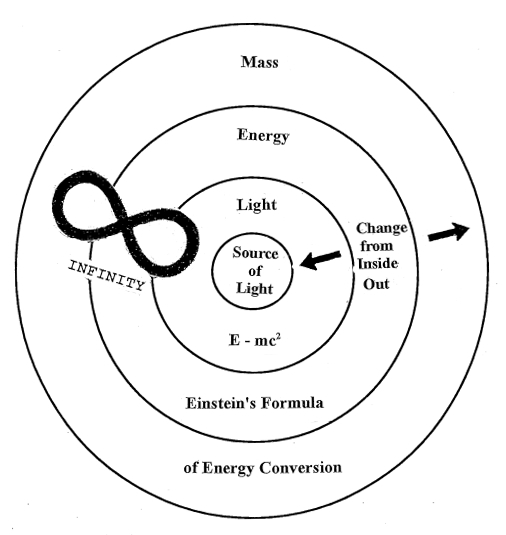
It places the three variables of Einstein’s famous formula, e = mc2 mass, energy and light, on increasingly deeper levels within the Wheel. The result is the Unified Field Theory which Einstein already had — consciousness factor included — though, sadly, lacking yoga background, didn’t recognize. This archetypal wheels-within-wheels model is equally compatible with modern physics, yoga philosophy and the world’s great religions. It is a reality map upon which scientists and sages can agree. It images the in-depth experience of the quantum spacious NOW, abiding beneath the surface waves of rational thinking and everyday sensory experience described by Eckhart Tolle.

  • The intuition Mike describes fits within the WHY level of the Wheel. This innermost level of Light is associated with spiritual guidance and flashes of genius. Unless integrated with the ability to strategize and implement, however, vision and insights fail to manifest as practical results.
  • Emotions (including empathy) and strategy belong to the middle HOW level. The Energy layer is associated with street smarts and Emotional Intelligence. Magnetism and charisma emanate from this level, but unfortunately aren’t always integrated with integrity, intelligence and practical organizational skills.
  • Purpose and outcomes belong to the surface WHAT level associated with tangible, measurable results. The Mass layer is the realm of quantifiable IQ as well as biological family and social/political connections. Persona (mask) and personality are surface appearances. They don’t necessarily reflect actual motives and feelings. (This is why merely imitating the words and actions of great leaders doesn’t have the same affect).

The three outer levels are interrelated and interdependent. Each is necessary but not sufficient. Their existence depends on the unchanging hub of the Life Wheel. The true SELF — also called Conscience, the Tao or God — holds the spokes together as events on the Wheel’s surface rim change continuously. Creation in the form of primal consciousness emanates from and returns to this silent alpha-omega center.

Inspired leaders are Self-aware. Positive leaders link inner vision with compassion to generate practical results. They serve as organizational catalysts, bringing out the best in others by example. Like stringed instruments, we resonate when true leaders strike a universal chord, set in motion by a deeper music.

This quantum paradigm of completion is “positive” because all the levels of experience are included and correctly prioritized. None are excluded. None are out of place. The levels are harmoniously linked in an infinite, two-way continuum of creative balance. (This is the holistic picture of unity or “yoga.”) Mindful of Einstein’s warning that problems cannot be solved at the same level they are created, it pictures the deeper levels where we can first get unstuck, and then travel deeper to where the genuine solutions we dearly need and seek can be found.

Prophetically, Einstein warned about the dangers of inverted priorities: “The intuitive mind is a sacred gift and the rational mind is a faithful servant. We have created a society that honors the servant and has forgotten the gift.” Today, more than ever, the world urgently needs leaders who remember their gifts and use reason correctly.

An important first step in training better leaders is to convince educators/executives/politicians and their students/employees/supporters of the grave dangers inherent in prevailing, incomplete and inaccurate paradigms. Then, it requires rousing sufficient courage to make a paradigm shift.

What could be more powerful motivation than the pending threat to human survival?! For today’s un-in-formed leaders are undeniably steering planet Earth towards a catastrophic disaster that dwarfs the Titanic’s collision. Einstein wasn’t exaggerating when he observed, “We shall require a substantially new manner of thinking if mankind is to survive.”

Decision-makers and leaders in every walk of life can make themselves whole by using the method outlined in The Positive Paradigm Handbook — currently under revision. In addition, it gives a practical standard for assessing leadership potentials, training better leaders, and choosing which ones to follow.

All best!

globe

Don’t Blame the Stars – the Fault is in False Paradigms

globe

Last week, driving down hilly country roads, listening to the radio, I chanced upon an NPR interview with John Green, author of the wildly popular book — now a movie — The Fault in Our Stars. He said he spent years writing, alone in his basement, going, “Marco, Marco, Marco.” And then, finally, a response: “Polo!”

Green has reworked for Millennials the archetypal story of star-crossed lovers that has resonated with theater-goers ever since Shakespeare’s Romeo and Juliet.

In 1970, Love Story, ar tear-jerking tragedy of youthful lovers separated by cancer, was a box office hit.

In 1997, the same archetype catapulted the movie Titanic to world-wide success. Here, lovers rich and poor crossed social boundary lines, only to be separated by calamity and death.

Why is that archetype so powerful? Wherein lies its power to move us? What is the deeper prescient chord it strikes that is common to everyone, everywhere? Because there’s much more to the scenario than just young love and social differences.

It speaks to us at a deeper level. Especially in Titanic, we respond subliminally, not only with a painful awareness of our own mortality, but also an inner foreboding – foreknowledge, if you will — that even as we continue to heedlessly pursue our individual wants, the mother ship of planet Earth is speeding on a collision course towards disaster.

While each individual faces the certainty of physical death, far worse, we’re now faced with the possibility of collective extinction as well.

Importantly, however, Green’s title, The Fault in Our Stars, isn’t taken from Romeo and Juliet. The quote comes from a Shakespearean tragedy about political intrigue, betrayal and assassination: Julius Caesar. The scheming nobleman Cassius tells his co-conspirator: “The fault, dear Brutus, is not in our stars, / But in ourselves, that we are underlings.”

On the surface level, Hazel and Augustus, Green’s cancer-stricken protagonists, may regard their cancers as the separating enemy at fault. But just as there are many kinds of physical cancers, there are deeper ones to blame for the larger tragedies that threaten humanity on a planetary scale.

The same ego-driven madness expressed by Cassius drives leaders today too, escalating the advance of wordwide oppression.

According to The Positive Paradigm Handbook, the megalomaniac urges that motivate many politicians and corporate executives are like cancers:

Dysfunctional paradigms result in fragmented policies and unstable governments. . . This happens when toxic, pride-based competition enters into the mix of human relationships. The illusion that one person or group “needs” to seem bigger, better, stronger, smarter or more powerful than the others poisons the waters of life from which all drink.

This prideful attitude breeds insecurities, triggering an opposite and equal illusion of lack, as if the success of others constitutes an insult or threat that must be counter-attacked.

Like cancers which turn the cellular dynamics of the human body against itself, views that violate holistic wisdom turn the parts of the social organism against each other.

In other words, the underlying fault of the tragic story I’m writing about in my secluded author’s corner is another kind of self-destructive cancer. And though it would take a great deal of courage and considerable, ongoing effort, for some, it’s curable.

What is needed is a positive paradigm shift. In Einstein’s words, “We shall require a substantially new manner of thinking if mankind is to survive.”

True, grieving over a sentimental boy-meets-girl story is less challenging than facing up to our deepest faults and fears first hand. We are ready to weep for fictional characters when what we’re really crying about is our own inevitable demise. The problem with projection, however, is that shedding tears doesn’t change the facts.

It might well be that emotional romance stories are part of the diversionary media noise being generated to distract away from and cover up impending real life dangers. In the meantime, I am still writing away, like Green going “Marco, Marco, Marco.”

“Polo,” anyone?

The Positive Paradigm Handbook Will CHANGE the Way You See Yourself

globeThe Positive Paradigm of Change gives change agents a practical method for achieving the positive, long-lasting change which all of us want, many promise, but few are able to achieve.
The Positive Paradigm Handbook will change the way you see yourself and relate to the world – forever. It gives you:

  • a functional picture of how your life really works, and by extension, what moves the people around you.

  • the map for achieving fulfillment, personal happiness and higher love.

  • an instrument for organizing your personal life, making realistic decisions and acting more effectively to achieve intended results.

  • premier tools for cultivating self-awareness, making the unconscious conscious, and mapping goals for personal change.

  • a comprehensive standard for assessing your leadership skills, maximizing this potential, and choosing which leaders to follow.

  • a powerful diagnostic tool for identifying the roots of disease-causing stress and correcting lifestyle imbalances.

  •  profound insight into the causes of discrimination, sexual abuse and PTSD, as well as  how to heal from their effects.

  • a realistic standard for recognizing true friends from mortal enemies.

Ultimately, it gives those who follow through the edge on long-term success, tipping the scales of history in favor of human survival, one person at a time. If these claims sound intense, they are. But they’re well founded.

To be continued. Follow next week for the Seven Basic Axioms of the Positive Paradigm.

Snippets from The Positive Paradigm Handbook

globe

WHY PARADIGMS MATTER

Ideas drive results. People’s beliefs drive their actions.

Actions that stem from a simple, complete and accurate paradigm result in personal fulfillment, harmonious relationships, and economic prosperity.

Actions based on false, incomplete and inaccurate paradigms, however well intended or passionately defended, are the cause of widespread misery, suffering and deprivation.

As detailed in Rethinking Survival: Getting to the Positive Paradigm of Change, a fatal information deficit explains the worldwide leadership deficit and related budget deficits.

In a dangerous world where psychological and economic warfare compete with religious extremism and terrorism to undo thousands of years of incremental human progress, a healing balance is urgently needed.

Restoring a simple, complete and accurate paradigm of leadership and relationships now could make the difference between human survival on the one hand, and the extinction of the human race (or the end of civilization as we know it), on the other.

cov wheel

The TWIN BASICS of POSITIVE CHANGE

Inside to Out. Individual change begins from the inside and radiates outwards from the central hub of the Positive Paradigm Wheel. Light initiating from the silent innermost center extends outwards. Guidance and inspiration are articulated in language. These ideas, expressed with genius and passionate conviction, drive motivated action that manifests in positive results.

Smallest to Largest. Transformation begins with the smallest unit, the individual. Therefore, the quality of family life depends on the functional integrity of each family member. Large organizations are improved by first improving the quality of family life. Qualitative reform of whole nations is achieved only by restoring the internal integrity of their agencies and supporting business connections.

Einstein’s New Way of Thinking

Human survival, Einstein warned us, cannot be taken for granted. Tipping the scales of history in favor of survival depends on freeing ourselves from the mental prison of limited, delusional thinking:

A human being is part of the whole called “Universe,” a part limited in time and space. We experience ourselves, our thoughts and feelings as something separate from the rest . . . This delusion is a kind of prison for us, restricting us to our personal desires and to affection for a few persons nearest to us. Our task must be to free ourselves from the prison by widening our circle of compassion to embrace all living creatures and the whole of nature in its beauty. . We shall require a substantially new manner of thinking if mankind is to survive.

The Positive Paradigm of Change pictures Einstein’s widened circle of compassion, complete with his magical, magnetic all-encompassing center.

It’s also the answer to comparative religion legend Joseph Campbell’s prescient hint:

We don’t have a mythology for people recognizing the humanity of a person on the other side of the hemisphere. I’ve often wondered if some of the notions coming out of quantum physics, quantum interconnectedness, don’t express that.

In the interests of human survival, the purpose of The Positive Paradigm Handbook: Make Yourself Whole Using the Wheel of Change is to make this new way of thinking as widely known and usefully available as possible.

The Who, When, How, What and Why

Logical questions then follow. Who should use The Positive Paradigm Handbook? When should the Handbook be used and how? What are the benefits? Why is this method of “thinking like a genius” so effective?

Who? The Handbook is intended for self-selected survivors with the heartfelt desire to improve themselves and the courage to rethink their lives. Everyone everywhere with basic English language skills and a commitment to ensuring survival for themselves and those they care for can and should use The Positive Paradigm Handbook.

As the next-generation Book of Change, the Handbook is especially useful to those in responsible leadership positions as well as those who advise them. However, it is equally useful to truth seekers and decisions-makers in every walk of life.

The Handbook should be required reading for young people who need to understand the way the world really works and how they fit in.

When? It’s natural to cling to what’s already known and familiar, especially when it seems as if there’s no better solution to an admittedly bad situation. Many find the possibility of extinction so threatening that they refuse to even think about it.

However, this doesn’t make danger disappear. It just leaves escapists unprepared to face inevitable change. Regardless of what may or may not come, denial, resistance and procrastination are a dangerous waste of precious time.

Once it’s accepted that there is a hopeful and positive approach to facing today’s dangers, the time to work with the Handbook and internalize this worldview is NOW.

What? As the title suggests, the end result of using the Handbook is restored wholeness. The process of comparing one’s immediate personal organization to the Positive Paradigm standard of completeness is a means for recognizing excesses and deficiencies, the better to correct them, thus restoring balance, integration and harmony to the whole. Benefits from using the Handbook are cumulative. Depending on diligence and frequency of use, they increase exponentially.

On the one hand, intentionally aligning and linking the levels of experience will increase self-awareness, improve relationships and lead to effective decision-making. On the other, as beliefs and actions become significantly the less fragmented, the side-effects of stress and related mental/physical disease will decrease accordingly.

Why? In part, working with the Wheel of Change remedies the right- and left-brain imbalances that lead to dysfunctional results. Plugging left-brain language into the right-brain imagery of concentric circles has the balancing effect of stimulating both sides of the brain simultaneously. Further, diminishing the noise of emotional pain and overcoming the dichotomies of either/or thinking opens access to the innermost realms of conscience and the inspirational guidance associated with great leaders and inventive genius.


Rethinking CHANGE

Natural change on the surface and middle levels of the Life Wheel is ongoing and inevitable. In addition, ignorant and/or irresponsible people superimpose additional layers of unnatural change to the mix, products of cultural conditioning and human agendas. So the best hope we have for maintaining inner and outer stability in the midst of chaos and suffering is to focus on the unchanging center. Otherwise, working consistently to achieve worthwhile long-term goals would be impossible. Hence, from the Introduction to the Common Sense Book of Change:

Ancient sages looked to The Book of Change primarily to discover ways to maintain balance and stability in the midst of change.

Advisors to long-lasting dynasties in China observed how to adjust with the winds and waves of time just as a ship pilot shifts the sails or a surfer rides the cresting water to reach a far shore safely.

They knew that temporal wisdom depends on the existence of a timeless essence deeper than change, the same at the heart of the universe, the individual and every atom.

Here, then, is an Essay on natural change from an I Ching perspective:

Phoenix - sized


Essay 11. CHANGE

We have always thought of the Bible as a book. We now know that was only its first incarnation. It is also a computer program. Not merely a book that Rips typed into a computer, but something that its original author actually designed to be interactive and ever-changing.  — Michael Drosnin, The Bible Code


For the last eight years, I have been studying all the various ways that people can heal, and I have integrated all the integrative medicine approaches, and I have learned how to change my lifestyle. . . I can honestly tell you that the one thing I never questioned was the fact that there is divine order, that there is a supreme being behind the universe. I’ve always known that. It’s as if it’s in my DNA. [The “Power to Change” Tour] — Naomi Judd, Larry King Live Interview


The responsibility for [improvement strategies] rests at the top, as in everything that has to do with the spirit of an organization. And so the executives who run innovative organizations must train themselves to look out the window, to look for change. The funny thing is, it’s easier to learn to look out the window than to look inside, and that’s also a smart thing to do systematically. — Peter F. Drucker, Managing the Non-Profit Organization


THE FRONT

Webster’s gives seven definitions of change. Root derivations include exchange, or bent and crooked, suggesting the image of a curved, wavy line. The first definition of the verb is to substitute, replace or transfer one thing for another. The second is to give and receive reciprocally, exchange or switch. The third is to cause to become different, alter, transform, convert, or undergo a variation. The fourth is to give or receive the equivalent of a coin in currency. The fifth is to put on other clothes. The sixth, used as a noun, describes the place where merchants do business. The seventh is the pattern in which bells are rung. By extension, jazz musicians use the term to denote chord progressions.

Translators call the dynamic natural law mapped in the I Ching “change.” However, if we think of the word as its regularly used, we miss what the book’s really about. Change isn’t synonymous with political reform, for example, which results, literally, in different forms. Rarely does it bring about qualitative change. Revolution is closer. Just as the minute hand of a clock revolves once an hour back to its starting point, governments revolve over time from reactionary to revolutionary extremes and back. Rarely, however, is long-term qualitative change is achieved in the process.

Evolution is another word used to mean change. Often it implies improvement. However, life is not like a mechanical clock which always runs forward. Over time, poor choices and destructive behavior change us for the worse. The life clock can be turned counter-clockwise. Humans have equal potential for both evolution and devolution.

No one can take for granted either that change is automatically good, or that no matter what one does or doesn’t do, improvement is inevitable. The I Ching helps careful thinkers to relate wisely to change, to ensure through their choices that they actualize their potentials for positive growth.

As Drucker indicates, leaders too often think of change as external, something imposed from the outside upon others. They too often forget about the personal, internal changes that must precede any qualitative, long-lasting external change. Repent is defined as an awakening of conscience that stimulates regret for past mistakes and determination to improve. The warning “repent before it’s too late” on one level refers to a change of heart. On another, it indicates, as Einstein warned, the urgent need to change the way we think and therefore respond to life’s challenges.

In The Bible Code, a challenge was found in proximity to a pending assassination: “Can you change it?” Drosnin took the question literally and made a futile attempt to warn Prime Minister Rabin, as if to change the course of history.

Perhaps on another level the question implies other challenges. Maybe we are being asked to change our relationship to the timeless teachings we take for granted, to look again with fresh eyes and change not external events, but rather our hearts and minds, to change from the inside out.

THE BACK

The opposite of change is stasis. People who feel threatened by change and think they can benefit from resisting it try to freeze time. This results not in perfection, however, but in stagnation and decay. While natural change is vital and life-enhancing, obstructing it is counter-productive and ultimately self-destructive.

Anarchy is a perversion of natural change. Nature is exquisitely ordered and therefore, to those who observe carefully, predictable. Political radicals impatient with corrupt governments leap to opposite and equal abuses of power. Lacking wisdom, their violence abruptly shatters existing order, but fails to improve the quality of life. On subtle levels, attempts to destroy natural patterns results not in desired freedom, but in annihilation.


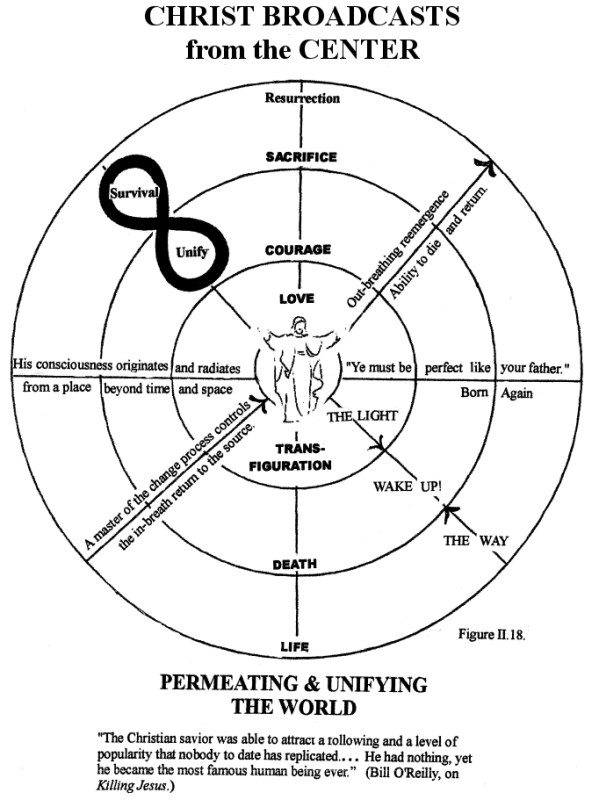
Rethinking CHRIST at EASTER

May this Easter be a time of miracles and new beginnings.

II-18 rev

The Positive Paradigm Handbook is Coming SOON

HERE’s a sample from the Coming Positive Paradigm Handbook!

globe

PREFACE

The Positive Paradigm Handbook will change the way you see yourself

and relate to the world – forever.

  • It gives you a functional picture of how your life really works, and by extension, what moves the people around you.

  • It gives you the map for achieving fulfillment, personal happiness and higher love.

  • It give you an instrument with which to effectively organize your personal life, make realistic decisions, and act more effectively to achieve intended results.

  • It gives you premier tools for cultivating self-awareness, making the unconscious conscious, and mapping goals for personal change.

  • It gives you a comprehensive standard for assessing your leadership skills, maximizing this potential, and choosing which leaders to follow.

  • It gives self-healers and therapists a powerful diagnostic tool for identifying the roots of disease-causing stress and correcting lifestyle imbalances.

  • It gives profound insight into the causes of discrimination, sexual abuse and PTSD, as well as how to heal from their effects.

  • It gives everyone a realistic standard for recognizing true friends from mortal enemies.

  • Ultimately, it gives those who follow through the edge on long-term success, tipping the scales of history in favor of human survival, one person at a time.

If these claims sound intense, they are. But they’re well founded.

As a teenager, I was fascinated by the fact that Einstein’s abstract formula, e = mc2, could produce powerfully tangible results — the atomic bomb!

Later, I was even more intrigued to discover that this same formula, when plugged into the concentric circles of the Positive Paradigm Wheel, not only resulted in the Unified Theory of Einstein’s lifelong quest. It was capable of generating equally powerful and practical personal results.

The Positive Paradigm Handbook reveals this Unified Theory and supplies the tools needed to start thinking like a genius. By internalizing this method, making it your own by repeated use, your life will be changed in ways only dreamed of before. Virtually endless in its practical applications, it can be pointed like a laser beam to illumine every field of endeavor.

The Handbook is the bare bones take-away from Rethinking Survival. The author’s personal background, academic credentials, research and experience are described in Getting to the Positive Paradigm. But here, what matters is simply that it works and that owning it is a matter of personal survival.

Based on the foundation of the earlier books on change, The Positive Paradigm Handbook goes directly to the heart of personal, practical application, here and now. The purpose of working with the Handbook is to ingrain Einstein’s “substantially new way of thinking,” which, he said, is required “if mankind is to survive.”

In a world seemingly intent on fracturing experience into smaller and smaller niches, the Positive Paradigm provides an urgently needed counter-balance, applying an opposite and equal weight in a unifying direction.

Rethinking Suicide at New Year’s

globeTonight I’m remembering the year I worked as a legal secretary for a divorce attorney. His income was seasonal. Before the Christmas, business was slack. He shrugged it of philosophically. He knew he’d make up the difference and then some after New Year’s.

 Then, people who’d gone into the holiday season with unrealistic expectations crashed with opposite and equal disappointment. After all the anticipation, a let down was sure to follow. That’s when they decided to call it quits, in droves.

 Sometimes, calling it quits takes an even more drastic form. This is when Rethinking Survival becomes a must. Here are relevant sections.

 RETHINKING SURVIVAL – Excerpts

 Stability in the Midst of Change

Working with the Quantum Paradigm of Change gives the thoughtful person a realistic perspective on what changes and what doesn’t, of what to depend on and what not. The eternal center, deeper than change, is impervious to time. It’s changeless.

In stark contrast, on the surface, natural elements are continuously combining, separating and recombining. Matter is continuously composing and decomposing. Human organizations are inherently unstable.

Human relationships are continuously evolving. Only the power of higher love and disciplined long-term commitments override the natural process of death and decay.

For those securely established at the hub, the center holds eternal. With a correct and complete model of change, survivors are able to the maintain inner stability necessary to cope with unstable circumstances. But when people forget, they get stuck on the surface and then complain that “the center does not hold.”

Those attuned to the center don’t identify with surface changes. They know better than to take them personally. They don’t kill themselves when the stock market crashes. They adjust. They don’t kill others to revenge themselves on outrageous fortune. For the sake of their own sanity, they simply forgive and remain open to new opportunities.

From a limited human perspective, experience sometimes seems just, the logical consequence of past behavior. Other times, life seems to make no sense whatsoever. Most unjust. But that’s life as we know it on Planet Earth. “Shit happens.”

TO BE OR NOT TO BE: Beliefs and Information Make the Difference

“To be, or not to be: that is the question:
Whether ’tis nobler in the mind to suffer
The slings and arrows of outrageous fortune,
Or to take arms against a sea of troubles,
And by opposing end them?

Shakespeare. Hamlet

The specter of suicidal thoughts haunted my up-bringing. It’s taken me over fifty years to track this demon to its lair and tame it. In retrospect, in simplest terms, I was raised in a family, reinforced by a culture, which disconfirmed my very existence.

A girl who in no way matched demeaning stereotypes — who had no desire to either cynically exploit or fearfully cave into them — was simply a non-being. She could not and should not exist. The tacit message: “Make yourself gone.”

At first I coped with less catastrophic compliance — denial. I reasoned like this: “Women are stupid, fickle and helpless. If I’m not stupid, fickle and helpless, then I’m not a woman.” I disowned the labels associated with gender and escaped into music and books.

Only later, a yogic energy understanding of the difference between feminine essence and cultural molds allowed me to rescue the baby from the bath water, reestablish an identity in harmony with the facts.

Shakespeare studies as well as reading and re-reading Faulkner’s masterpiece, The Sound and the Fury, helped clarify my dilemma.

So did Ph.D. dissertation research that explained the scarcity of women in school administration. It brought to my awareness the programmed stereotypes, antithetical to competent behavior, that I had to root out of my unconscious mind.

In Europe, I clicked with an “A-ha!” moment when a boyfriend put me down with the cliché, “Es gibt nicht so was,” which translates roughly as, “You’re impossible.” Literally, the words mean, “There is no such thing,” or “You don’t exist.” My angry answer was immediate. “Hier bin ich!” I pointed to myself with the literal retort, “Here I am!”

Surely no one intended by such mindless language to harm me, or Marilyn Maraffe either. Yet she is still dead and the lives of those affected by her suicide changed forever. This gifted young cellist, belittled and pushed to the sidelines by condescending males who knew not what they did, dropped out of Oberlin’s Music Conservatory.

She fell into depression, closed herself in her garage and turned on the ignition of her black VW Bug. She left a copy of Shakespeare’s Romeo and Juliet on the passenger seat beside her, opened to the death scene.

She didn’t intend to die. It was cry for help. But crying wolf can backfire.

By an unfortunate quirk of fate, the neighbor who arrived home from work punctually at the same time every night, who should have opened garage doors in time to rescue her, had an errand to run that night. He didn’t find her in time.

. . . In an inhospitable world that continues to disconfirm my true identity, pushes to wipe me off the map, cram me into the narrow molds of other people’s convenience, I practice the positive phoenix response open to everyone, everywhere. When outrageous misfortune impels to suicide, I die to the old, but only to continuously recreate myself new and better.

“Hier bin ich!” I am here still yet!

Einstein’s Energy Variable

 . . . Those denied access to material and social resources are often forced inside. Of necessity, turning inward, they depend for survival on strengths drawn from the middle and center of the wheel. At times, deprivation and hardships yield the opposite and equal blessings of in-sight and emotional fortitude.

At other times, however, excessive investment at the middle level results in delusions, latent with the potential for erupting into violence. In any case, making a virtue of necessity by rejecting the material world prevents completion of the pattern. It can’t correctly be equated with spirituality.

Societies which enforce an exclusively materialistic worldview that denies the experience of everything not tangible and measurable place severe hardship on those whose inner lives are especially active. Denying high energy people’s drive and failing to provide practical methods for articulating and harnessing inner energies creatively can literally drive people crazy, to suicide, or at best, underground.

Many “sensitives” survive by channeling socially banned, unacceptable awareness into the arts: music and literature, including romance, murder mysteries and science fiction.

Humor provides another outlet for releasing the pent-up emotional tensions which cause illness. The Quantum Paradigm gives credence to the Norman Cousin’s belief that “laughter is the best medicine. ”It validates the healing wisdom of Patch Adams, the paradigm-breaking physician whose clowning with patients has earned international fame.

————–

 The Danger: Programmed assumptions too often drive our decisions, actions and ultimately, survival options. Even with the best of intentions, misinformed people operating on conflicting beliefs destroy themselves and others.

Sometimes the process is quick. Murder. Suicide. Usually it’s slower — atrophy and self-sabotage.

This is why it’s imperative to recognize and root out the assumptions based on dysfunctional paradigms that tie us in knots. They tear us apart. They drive us crazy.

To survive intact, we must cleave to the essence of the perennial philosophy. The Quantum Paradigm is a snapshot of the essential truth which the world’s great religions share in common. It offers us a way out of global madness. It gives us a means for restoring sanity to our world outlook.

 ————-

Alien invaders delight in cheating. They stack the deck, gumming up the works with false information driven by dysfunctional paradigms.

If you accept the game and its rules as alien agents define them and proceed to rebel against uncivil authorities, mindlessly hating and resisting, YOU LOSE. (Alien invaders win.)

. . . The only chance of winning — ultimately, surviving — is to demand a new, clean, unmarked deck — one with all the cards. In other words, make a fresh start based on the accurate and complete Quantum Paradigm.

LET THE NEW YEAR BE THE TIME OF YOUR START FRESH.

All best! Pat West

globe