Tag Archives: Einstein

Psychology’s Blind Spot


Jordan B. Peterson’s finest moment (from my point of view) came in his answer to the last question of the lecture’s Q & A session. He came very close to touching on the tradition which explains his mystical experience as well as Jacob’s dream. Almost.

People who are interested in grand narratives have pointed out that there’s a set of common mythological themes across many cultures. They can be the same on one level, different on another. But humanity coalesces on what’s the same over a reasonable period of time.

. . . there’s this constant force [literally, energy structure] that makes our ethical presuppositions converge. And then that’s automatically expressed in those stories.

In one way, he is correct. But in another, significant way, not. Stories take on the images of each specific culture. In that way they are different. What they share in common, however, is not myth or archetype but SCIENCE, meaning “with knowledge.” Jacob’s ladder is certainly a striking example.

Lacking this universal, underlying science, humanity cannot be properly, completely understood. Psychologies remain incomplete and inaccurate. They have grievous blind spots.

Put another way, Huston Smith, premier comparative religion teacher and advocate of what he calls “timeless wisdom,” wrote:

Twenty years ago I wrote a book, The Religions of Man, which presented the world’s enduring traditions in their individuality and variety. It has taken me until now to see how they converge. . . .

What then emerges is a remarkable unity underlying the surface variety. When we look at human bodies, what we normally notice is their surface features, which of course differ markedly. Meanwhile on the insides, the spines that support these motley physiognomies are structurally very much alike.

It is the same with human outlooks. Outwardly they differ, but inwardly it is as if an “invisible geometry” has everywhere been working to shape them to a single truth.

This “invisible geometry” is literally the snake-like intersections of energy pathways crisscrossing and intersecting along the spine. They link the seven centers in a pattern strikingly similar to the DNA double-helix represented in the Caduceus, the healing staff of the winged-messenger god Mercury, familiar now as the symbol of modern medicine.


Ancient Himalayan sages mapped the internal energy transformers knows as chakras (“wheels).” Know how to activate them, they taught. You’ll experience enlightenment.

. . . Though recorded in ancient scripture, sages experienced vibrant spinning wheels of energy in deep meditative states as a fact of inner reality. Their reports are not the same as poetic symbolism, mythology or parable. Chakras exist as literal fact, integral to quantum inner life as an experience which can and has been replicated by countless practitioners over time.

Chakras are key to personal growth and psycho-spiritual evolution.

Genuine transformation can’t be accomplished by mental speculation or acts of sheer will power. It occurs in the deeper layers of the Life Wheel which have, disastrously, been made taboo in Western civilizations.

Einstein called this blind spot “the fateful fear of metaphysics.” The fateful-fear of self-awareness comes in its train, sometimes justified, most often times NOT.

Descriptions of heaven’s gates opening and unfolding lotus flowers which Dr. Peterson experienced in dream state come straight out of the ancient Vedas. The seventh chakra located above the head is described as a Thousand Petaled Lotus. To mystic vision, it looks something like this:

crown chakra x 4

Seven basic chakras are aligned along the human spine and within the skull. In ascending order, each is associated with an increasingly more sophisticated state of consciousness and related emotional/psychological issues. Musicians correlate them with the tones of the scale; artists with geometrical shapes and colors of the spectrum.

The 7th or crown chakra is located at the top of the head and is related to the induction of spiritual energy into the body. Said to control every aspect of the body and mind, it is associated with full enlightenment and union with God. This chakra is normally not fully opened in most humans, although pictures of saints and other spiritual beings with”halos” are depictions of activated crown chakras.

Here’s a picture of all seven, putting the heavenly ruling seventh center in context:

chakras

In the creative process, the non-physical precedes and drives the physical. Western physicians psychologists greatly would benefit from understanding the correlations of each subtle energetic center with equivalent mental and biological conditions.

Put the other way, lacking this foundation, their understanding of human nature is incomplete. Seriously skewed.

The other six are briefly described:

  • The 1st or root chakra, located at the base of the spine, is involved with the physical process of elimination and the organs that work involved in that function. It is the chakra associated with the emotional energy of survival, as well as with grounding to the physical plane.
  • The 2nd or sacral chakra is located about three inches below the navel. This chakra corresponds to sexual energy and the reproductive organs. It is also associated with creativity and intrinsic life force.
  • The 3rd or solar-plexus chakra is located at the navel and several inches above. Its energy is associated to digestion and the digestive organs, personal power, and self mastery.
  • The 4th or heart chakra it located in the center of the chest. On the physical level, it corresponds with the lungs and heart. On the emotional level, it expresses as the energy of compassion.
  • The 5th or throat chakra is located in the throat area, at the base of the neck. It is the center with communication, speech, and hearing. The ears are associated with this chakra, as well as the vocal apparatus.
  • The 6th or brow chakra is located in the center of the forehead, between and slightly above the eyes. Often called “the third eye,” it is associated with imagination and psychic abilities, along with mental activity and brain function.

Each center represents a stage in human evolution. As consciousness grows and ascends to higher levels of awareness, human potentials expand. In an equitable world, people are allowed to live and serve according to their level of consciousness. Qualifications for leadership roles rightfully depend more upon inner awareness than IQ.

A lateral view of chakras aligned along the spinal column reflects the qualitative differences in focus of awareness amongst well-known  psychologists.

invisible geometry sized

From Quantum Paradigm perspective, the chakras align with the levels of the Life Wheel like this:

As written earlier:

. . the Western way of ignoring the reality and influence of chakras makes life’s journey far more difficult than need be. But it doesn’t cause them to cease to exist. Despite scientific prohibitions, most of us still have glimpses of transcendent experience, whether in dream state or through the arts.

For example, music moves us because its resonant sound sets the chakras in sympathetic vibration. Inspired music has a healing, uplifting affect on the nervous system, the emotions, and the soul. It is not coincidence that the seven notes of the Western chromatic scale correspond with the vibratory rates of the seven major chakras. Indian ragas intentionally draw on chakra correlations to soothe emotions or uplift the spirit. In the West, similar effects of inspired music have been described as The Mozart Effect.

In addition, the (albeit too-often unconscious) effect of the chakras on human experience is particularly strong in the symbolic, visual arts –the full spectrum from fashion and home-making to interior design, architecture and fine arts. This in due in large part to the fact that the chakras are associated with geometric shapes, as well as with the rainbow colors of the light spectrum.

closing

Patricia West is author of The Common Sense Book of Change and Two Sides of a Coin: Lao Tze’s Common Sense Way of Change. She’s currently working on The Phoenix Response: Dying To Be Reborn – in the Same Lifetime. 

Life is Eternal

In JBP at his best, I wrote A great deal of suffering comes from ignorant fear of death. Many have been deceived into doubting the existence of the immortal structure that supports the mortal frame.”

Here, due to time constraints, it must suffice to expand on my meaning by drawing from earlier work. In Contemplation of Mortality, I quoted from Essay 2 on DEATH.

Dying patients went through the five stages, but then after “we have done all the work we were sent to Earth to do, we are allowed to shed our body, which imprisons our soul like a cocoon encloses the future butterfly,” and . . . well, then a person had the greatest experience of his life. Elisabeth Kübler-Ross, The Wheel of Life

I continue:

Webster’s definition of death is the act or fact of dying — the permanent ending of all life in a person, animal or plant. Personified, death is pictured as the grim reaper, a hunch-backed, black-robed skeleton wielding a scythe. The term refers to extinction, as in the death of hope.

These definitions, however, represent an extreme cultural bias with important effects on behavior. They reflect the materialistic belief that the physical is all there is. When the body fails, there is nothing else. There is no essence which survives to travel on.

The I Ching embodies a more inclusive, comprehensive view. Like the learned amongst most ancient cultures, Chinese sages regarded birth and death as natural changes, complementary stages of an ongoing cyclical life process.

Sages continue to regard death not as extinction, but the culmination of a winter season most wisely spent preparing for the coming spring. They teach that a soul, having learned the lessons and completed the work of one life cycle, separates from its used up shell. The shell, once the spirit moves on, collapses. The life essence, however, simply migrates, possibly to take on another form.

Further:

Fear is the natural outcome of limited materialistic beliefs equating the end of physical life with total extinction. Those who experience the True Self as immortal and indestructible are not plagued by fear of mortality. No doubt the courage and solace which sustained Socrates as he calmly accepted his death sentence — not as an escape, but an affirmation of principle — came from the depth of his soul awareness.

book header bird

Also to the point are the following sections from Rethinking Survival. The first is “Higher Love, Unity and Inclusiveness.” The other is “The Mystery of Death and Rebirth.”

Higher Love, Unity and Inclusiveness

The Positive Paradigm Wheel is the image of wholeness and completion: Higher Love. It pictures the inclusiveness which Campbell and Einstein believed essential to planetary survival. All parts are present, each in right relationship to the others. No part of life’s experience is lacking. No part is distorted or out of place.

This is the harmonious unity each one of us, by birthright, has the potential to experience. Poets describe the joining of the center with the surface as the Marriage of Heaven and Earth.

Given today’s paradigm malfunctions, the bliss of Higher Love seems like a distant dream. Yet we each have memories, however distant, mirrored in our art and sacred symbols. The mandalas and stained glass church windows are just a few of the countless examples. We each have persistent longings for “home” and romance that remind of us of what’s possible.

These longings are captured in the often quoted “Ode on Intimations of Immortality from Recollections of Early Childhood.” The 19th century English poet William Wordsworth lamented the socialization process that represses early awareness of divine origin:

Wordsworth

Like Wordsworth,  Einstein had glimpses, notably at the beginning and at the very end of his life. As chronicled by Walter Isaacson:

The great awakening that happen in childhood are usually lost to memory. But for Einstein, an experience occurred when he was 4 or 5 that would alter his life and be etched forever in his mind:

The catalyst of this lasting impression was a compass his father gave him. He remembered trembling and growing cold in excitement, awed by the “mysterious powers” of a magnetic needle that behaved as if influenced by a hidden force field. As he recalled later, “Something deeply hidden had to be behind things.”

inner-compass-sized

At about the same time, his mother introduced to him to music. It awakened awe before the magic and mystery of nature. “Mozart’s music is so pure and beautiful that I see it as a reflection of the inner beauty of the universe itself,” Einstein wrote.

For him, “love [of music] is a better teacher than a sense of duty.”

Phoenix - sized

The Mystery of Death and Rebirth

The yin-yang mysteries of life and death apply to experience on every level, from the individual, to families, nations and even planets.

. . . “The strange thing about growing old,” Einstein wrote, “is that the intimate identification with the here and now is slowly lost. One feels transposed into infinity . . . ”

In the year before his death, commenting on the passing of colleague Michele Besso, Einstein wrote, “He has departed from this strange world a little ahead of me. It means nothing.”

Making an observation that could have come directly from the Yoga Sutras, consistent with the Positive Paradigm, he consoled Besso’s family, “For us believing physicists, the distinction between past, present and future is only a stubborn illusion.”

It is said that in the middle ages, Carmelite nuns retired to their cells each night to sleep inside the wooden casket in which, when they died, they would be buried. Taken out of context, this may seem morbid. But in fact, they had it right. They were aligning themselves with the patterns of nature, the better to ultimately survive them. For each in- and out-breath repeats the cycle of release and renewal. Each night that we sleep, we let go of bodily awareness and return refreshed the next day.

On every scale of magnitude, the pattern is the same. Paradoxically,survivors who have released unfounded fears of death are freed to live to the full, here and how.

Lao Tze’s work, which breathes I Ching wisdom, illumines this paradox. He describes the relationship between the Creator and creation in the first passage of the Tao Te Ching. From Two Sides of a Coin: Lao Tze’s Common Sense Way of Change:

Unmanifest and manifest are two sides of a coin, seamlessly joined, though apparently opposite.

Entering this paradox is the beginning of magic.

Figure II.8 shows what this vision looks like when the words are properly placed within the Positive Paradigm Wheel. To the uninitiated who live exclusively on the surface of the Wheel, the eternal may seem illusive. However, the inner vision necessary to accomplish goals is found only by daring to let go of the familiar surface to travel true home to the center from which blessings then flow outward.

In the words of the God of Moses, “Return unto me, and I return unto you.”

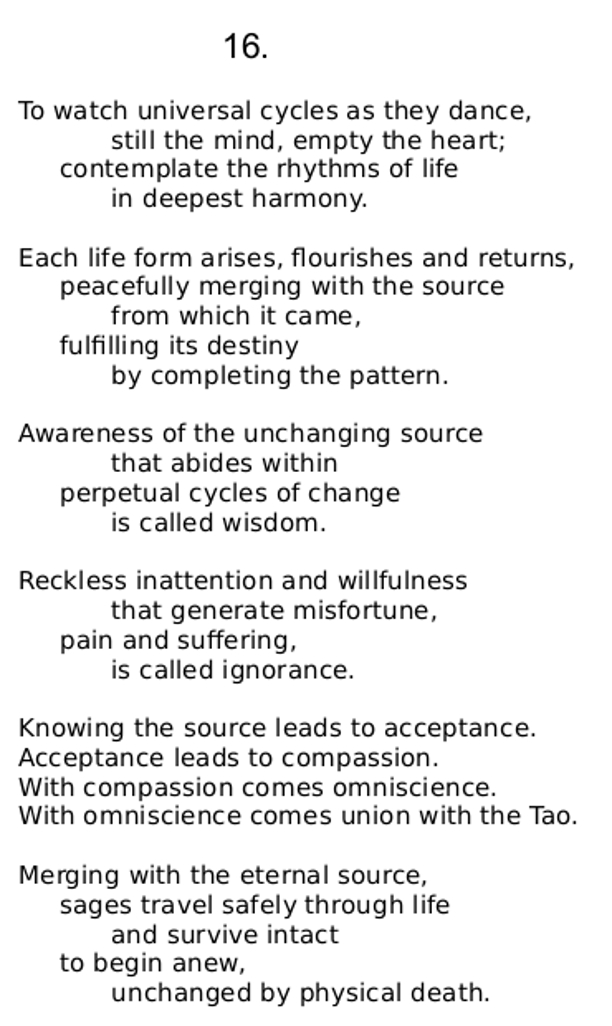
In Passage 16, Lao Tze goes even further:

16

Here, the sage not only repeats the vision of the hero’s journey. He also describes the methods of the journey — the meditative practice of stilling the mind and emptying the heart, followed by contemplation from the detached observer’s perspective. He also describes the consequences of failing to complete the life pattern and the blessings of succeeding.

The ignorant, through inattention and willfulness, generate misfortune, pain and suffering. Those who attain the source, however, (usually with the guidance of an enlightened teacher) achieve the overview which leads to acceptance, compassion and omniscience. Those who survive intact, merge with the eternal source and begin anew, like the New Adam and Christ in The New Testament.

Preparation makes the difference, deciding who is most likely to survive coming transitions, emerging better than before through the experience. Here is the root of Positive Change:

I Ching # 49. CHANGE. Day and night replace each other in endless cycles of CHANGE. The same natural law generates flux in human events. The unprepared see Change as a threat, but the well-prepared face the unknown calmly. They know that after degeneration reaches critical mass, regeneration follows. Welcome the new. Avoid short-sighted fear.

Angel Calling

A Magical Day

magic

Did you ever have a magical day – one that stands out amongst the countless miracles that abound, most often unnoticed and unappreciated, in the midst of daily life?

Today offered one of those rare and precious times for me, bringing up basic life questions important to us all – about the quality of life and very purpose for surviving.

So I’ll share with you what happened and why, in the seemingly endless blur of discouragements and doubts, it shone like a confirming ray of hope, strengthening my resolve to complete the book now listed on CreateSpace as The Phoenix Response.

Today’s story begins, once again, by connecting the dots between two seemingly ordinary events leading to an extraordinary outcome.

The Longevity Book by Cameron Diaz sparked the first. My eyes halted over it while scanning the bestseller bookshelf at Walmart. The hunch flashed that it had an important message for me. I should look into it.

The second was triggered by the first. I thought back to my grandmother, Ellie West, who gave up a promising singing career to marry my grandfather, Hubble.

Late in her life, Ellie told me about the day he proposed. During a walk in the local park, he stopped in front an enormous sun dial set in granite and pointed to the attached plaque. Engraved onto the metal were the words of poet Robert Browning. “Grow old along with me. The best is yet to be.”

It won her heart.

As she described the event, now white-haired and ill, she shook her head. If not cynical, she seemed at best remorseful. For her, life hadn’t turned out the way the poet promised.

Until today, however, I hadn’t thought carefully about her disappointment. Although I remembered the first two lines of the poem, I’d forgotten the name of the poet and never knew the context of those lines, much less the name of the poem from which they came.

Nor had I wondered what she hoped living to old age would be like, or how and why her expectations were left unfulfilled.

Thinking further on these things now brought magical gifts that answered doubts as to my own future directions.

With a little effort, I recovered the poet’s name, the context of the lines and the poem’s name.

The first stanza of Robert Browning’s poem begins:

Grow old along with me!
The best is yet to be,
The last of life, for which the first was made:
Our times are in His hand
Who saith “A whole I planned,
Youth shows but half; trust God: see all, nor be afraid!”

I also searched out a link to the complete poem in which the stanza appears, Rabbi Ben Ezra

This, of course, led to further questions, as well as an Aha! Who was Rabbi Ben Ezra? When did he live? How are his personal story and life work relevant to us now? More specifically, how does his history and Browning’s poem matter to my immediate question – whether or not to complete The Phoenix Response?

Long story short, the good Rabbi born and died in in northern Spain, 1089-1167distinguished himself as a poet, philosopher and astrologer. Between earliest and end years, persecuted for his beliefs, his restless wanderings took him through North Africa, Israel, Italy, England and France.

His ideas outlasted him to influence Browning. Remarkably, the longer poem is interspersed with phrases that could as easily have been drawn from my own writing: I see the whole design, Perfect I call Thy plan.

There is a hint of the phoenix legend: Leave the fire ashes, what survives is gold.

And a foreshadowing of Christ’s enduring presence throughout human history:

Earth changes, but thy soul and God stand sure:
What entered into thee,
That was, is, and shall be:
Time’s wheel runs back or stops: Potter and clay endure.

Not only are there references to a divine Potter and “earth’s wheel” but actually, in conclusion, the WHEEL of LIFE itself. He names the very image (Platonic Idea, meme, archetype – call it what you will) that serves as the substantive foundation of the Positive Action response.

The poem concludes:

My times be in Thy hand!
Perfect the cup as planned!
Let age approve of youth, and death complete the same!

At first reading, I cannot begin to fully understand this poem, much less the philosophical works which inspired it. The writing is complex and terse — more than a little bit difficult. But this much seems clear. There is a succession of ideas being handed down through the generations. Each writer starts up where the last left off, competes the next piece, and hands the work forward for another generation to pick up and continue.

I was comforted to think that my work is interwoven within a larger pattern, connected in the world of ideas with forerunners. Surely I am linked with a larger whole and charged with contributing to the evolution of an ongoing heritage.

On a personal level, Grandma Ellie handed down her unfinished aspiration for me to take the next step. John Philip Sousa auditioned and invited her to travel as a soprano soloist with his band during their European tour. Because she decided to marry instead, she saw in my life the completion of her early aspirations. She was delighted when she heard that I was studying and performing as a violinist in Europe.

And just as Grandma Ellie left me unfinished work to complete, so my writing on holism and the Life Wheel may fulfill fellow violinist Albert Einstein’s heartfelt desire. He intuited the existence of a Unified Theory. Ironically, he’d already received it, but lacked the yogic training to recognize it for what it is:

IF

Returning, however, back to the first strand — the book that sparked this line of thought. Diaz’s best-seller  promises to address a holistic life view. Its description claims: “The Longevity Book offers an all-encompassing, holistic look at how the female body ages —and what we can all do to age better.

There’s so much that could be better accomplished by applying the multi-dimensional Life Wheel model to the claim of being” all-encompassing.” This includes the concept of Einstein’s beloved compass and his call for compassion. For those unfamiliar with the work to which I’m referring or who would like a reminder, here’s a link to bring you up to speed on The Positive Paradigm.

Among reviews, I found a comment supporting my first take that The Longevity Book begs for a sequel – one which I’m eminently qualified to supply. The Phoenix Response fills many gaps crying out for completion. As the reviewer points out, Diaz wrote one book for young women, and now this second for those entering middle age.

The reviewer’s Re line states “Wish she would have taken it to a woman’s age when she’s elderly.” The comment continues “There are so many things mothers did not tell daughters that many of us in our 60’s, 70’s and 80’s have had to find out on our own – sadly.”

My basic message for everyone, up to and including baby-boomers of both genders: it’s never too late. It’s not over til it’s over. Even for those of us who’ve let go of self-care and are now paying the price, there’s always a second chance. There’s always the Phoenix Response of regeneration – going back to the magical creative process of genesis embodied in the Life Wheel.

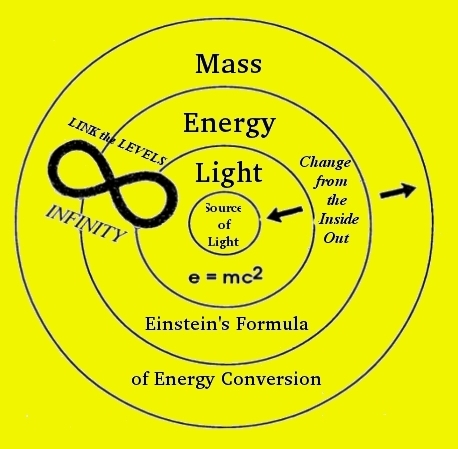
With this knowledge, it’s possible for self-healers to repair not only original the DNA of the physical body, but also the more subtle pattern of the soul, restoring wholeness by healing literally — as the infinity pattern shows — from the inside out.

So yes, without a doubt. Not only is this work dearly needed. The way for it is actually being paved and readiness created.

So – I’m especially grateful for life-confirming days like this one when the ever-present magic speaks with exceptional clarity.

So my best wish for you is the same. May you have a magical day as well!

Two Out of Three Ain’t Enough


Eight months that seem like a life-time ago, I wrote the LinkedIn article I’m sharing below, along with excellent comments made to the post.

At the time, I was rethinking the empathy aspect of writing about the Positive Paradigm. Now, I’m about to launch another approach, one focused on healing on all three levels. Again, unless the three are present in a balanced, integrated way, it’s not sufficient.

As an intriguing book I’m reading explains, wholeness and holiness are necessary compliments. It expands on the Phoenix Response as my comprehensive approach to transcending adversity, when mere physical survival is not enough.

I’ll explain as I go what I mean. But, for today, for starters, here’s a recap of the basic concept, the spring board of what’s to come.

It concludes with questions that invite your feedback, the better to adjust to meet your specific needs in future articles. What do you think? And thanks.


pinnacle-sized

Two Out of Three Isn’t Enough

Some leaders are satisfied to sing along with Meatloaf, “Two Out of Three Ain’t Bad.”

But Authentic Leaders know better. It ain’t enough.

As I’m learning the hard way, when any part goes missing, everything suffers.

Bear with me. I’ll share why three-out-of-three is a must for me – and for effective leaders in every walk of life.

The Life Wheel — the Positive Paradigm based on the Unified Theory Einstein had, though he didn’t know it — is the personal Truth I’d dearly love to share with the world – starting with you.

IF

From Rethinking Survival:

This familiar atomic structure repeats smallest to largest in the patterns of nature, from snow flakes and intricate flowers to spiders’ webs and sea shells. Similar symmetrical patterns repeat worldwide in the art of every culture — including the prayer wheels of Native Americans, the colored sand mandalas of Tibetan Buddhists, the stained glass windows of European cathedrals and the intricate geometrical patterns that cover Muslim Mosques, to name but a few. They offer proof of the universal awareness of a central inner reality, of an inner structure common to all humanity, and to a continuity of experience deeper than individual lives or transitory cultures.

The Life Wheel reflects the perennial philosophy shared in common by the world’s enduring wisdom traditions – free of historical baggage. It is equally compatible with yoga and modern physics. It converts easily into a method for introspection and decision-making. Like a modern day Book of Change, it has the potential to become the best friend of change agents everywhere.

The value unique to the Life Wheel is, because it highlights the innate potentials we share in common, it serves as a foundation of common discourse.

Just as importantly, from personal experience, I’ve found the Life Wheel to be a great tool with virtually universal applications. Point it like a laser beam in any direction. It illumines the field.

In Authentic Leaders Depend on the Center I presented a variation on the Wheel – the MPI (Motive-Purpose-Intent) Standard – used to increase self-awareness.

One LinkedIn connection really got it! After a back-and-forth exchange, he commented:

I can also see how the MPI can work in a variety of contexts, both religious and secular. In fact, I think it could have virtually universal application – – – I hope it catches on!

BUT – it hasn’t. Not yet. For that I take full responsibility.

I have yet to demonstrate how I use the Life Wheel for introspection and goal setting. I have yet to show how it can be adapted as an analytical tool for virtually any purpose.

I haven’t effectively explained that this picture answers the plaintive question, “Why can’t we just get along?” Namely, very few of us work from a unifying concept of our common humanity. We were never taught the basics of natural law, much less how to live in harmony with it and each other. )

I’ve failed to communicate powerfully enough the connection I see between the Life Wheel and its potential to relieve human suffering. Those who’ve been taught to look for fulfillment on the shallow surface have been set up for a world of hurt. Joy returns when we know where to look, when we finally return our focus to the center, where eternal love resides deep within the heart of hearts.

The Wheel explains today’s pervasive sense of loneliness, a result of living exclusively on the noisy, frantically busy surface. It offers a hopeful, alternative life picture. When we reconnect with the center, we know that we are never, ever truly alone. Not possible.

SO – why hasn’t all this vitally important stuff been successfully communicated? In retrospect, I’m recognizing I have yet to live up to my own “three-out-of-three” standard!

For one thing, I’m still building the technical skills needed to do the Life Wheel idea justice.

For example, my first LinkedIn article, Boundary Spanners Connect at the Center, isn’t illustrated. In September of 2014, I didn’t yet know how to create images with photo-shop software. Though I’ve come a far distance in the ten months since then, I am still picking up necessary skills on a daily basis.

Just as importantly, I’m getting important feedback that my communication skills need work. Which is different from language skills. In fact, past academic background sometimes gets in the way. I’ve been faulted for seeming so precise and confident that I’m intimidating. Makes me very very sad. Not at all what I intend.

For this, the recent process of writing a guest post for authorunlimited was good medicine. I submitted a draft on the suggested subject: The important difference between knowledge and knowing. Cathy Presland emailed back an edited version.

Ouch!

Fortunately, I had an inkling as to why she made changes. I already saw her most excellent article Writing with Empathy and taken it to heart. I also followed the link to Seung Chan Lim’s video, How empathy fuels the creative process. Like magic, on that particular day, his message was exactly what I needed to hear.

My sheepish Aha. In my rush to get from “here to there,” from surface results to common understanding, I’ve been leap-frogging over the linking, middle level of empathy.

So I can tell you from sad experience, two out three – ideas and technical skills without empathy –ain’t enough!

Cathy’s quote reminded me:

In the words of George Bernard Shaw, “Do not do unto others as you would have them do unto you—they might have different tastes.”

In other words, I have been writing as if LinkedIn connections all understand and agree that everyone, everywhere shares the same center in common. But “it ain’t necessarily so.”

True, boundary spanners, no matter where they start on the surface of Planet Earth, meet at the universal center. But not everyone sees the value in being a boundary spanner. It’s on me to accept this, adjust and improve accordingly.

So back to the drawing board. As part of the Under Construction operation, I promised to restore empathy to the larger picture, accepting that not everyone is boundary spanner. And remember, respectfully, that many are not only asleep but perhaps a bit afraid of waking up.

Yet my worst worry remains. Unfortunately, it usually takes a horrific wake up call to shake people out of their complacent slumbers. From Rethinking Survival:

While we all have the option to remember who we truly are, most of us are like Lambert, the sheepish lion. It takes a smack with a two-by-four upside the head before we’re finally ready to wake up. Often it takes the form of life-threatening danger to those we care for. A personal health crisis will also do the trick. So will job loss or a run-in with natural disaster.

But, like Dorothy stranded in the Land of Oz, when you want dearly enough to return “home,” you can click your heels whenever you chose — and come to find out, you’re already there.

My preference, which I’d dearly love to share with you is this. Rather than wait for inevitable shocks, when it might be too late to survive, I’d rather you be proactive. Use the tools for anticipating change I have to offer.

As I urged in Being Proactive in the 21st Century, make yourself ready to meet whatever unknowns life has in store, coming around the next bend or two.

Working with Life Wheel maps helps mindful, authentic leaders link the levels, making the three-out-of-three option possible. With it, we can choose to be true to ourselves and realize the vision of a positive future.

Bottom line: Change is inevitable. We can experience it as resisting, passive victims or as proactive agents of positive change. I’ve given you tools to put the choices for change in your hands.

Am I communicating yet? Questions? Comments? Please let me know how I can better meet your needs.

=============================

COMMENTS

Mark Hayward st Head of Sales at TheSmallPicture.biz | NIKKEN Independent Consultant: Helping people to take control of their Wellbeing


No worries Patricia West, you made an instant fan out of me 😉

——————–

Peter Fellingham sVice President of Engineering and Co-Founder at ProtoStar Inc

Hi Patricia, I enjoy your writing style. That said, one must write with a target audience in mind; at least commercially. Otherwise you are just writing for yourself.

Patricia West AUTHOR Blogger; Author of Books on Change, Einstein & Human Survival

When writing for authors as a guest of authorulimited, I welcomed the opportunity to write for a specific audience. Here, am focused on authentic leaders, albeit in every walk of life. If you (or anyone else) has another audience in mind, I’m open to your suggestions. : )

————————-

Bob Hemmerle Senior Zen Practitioner/Baseball Umpire

If you get 1 world leader with nukes to understand this then when he sits down with the others he will have something worthwhile to share, Bravo

————————-

Richard Lipscombe THE MEMES MAN

Patricia: This is a great post. I first read this quickly last night. I had an immediate reaction. You can not, we can not communicate with someone who does not hold to their ‘truth’. I re-read it now and listened to TED talk.I still think the same. Inside all of us is mass, energy, and light as a combination – it is what I call my ‘truth’. I can deny it. I can avoid it. I can run away from it. But I can never hide from it. Most people conceal it.

So most people can never ever admit to hearing your message. It is too painful. In simple terms they can not hear that change is your choice and to choose well for yourself you have to listen to your truth.

Most posts on LinkedIn help people to consider ‘change’ as a surface ripple, a mere happening, an entertainment, a dynamic shift without meaning, and so on. They can do this because this is a place for collectives, cliques, false wisdom, fashions, and fads. They welcome all that because it does not challenge the essence of who they are and thus it can never change them. Change their ‘truth’. Truth can be changed easily if you know what it is and embrace it. Truth is continuity – we cling to it even if we do not acknowledge its existence within us. Change to truth sets up a new continuity for us. Richard.

Patricia West AUTHOR Blogger; Author of Books on Change, Einstein & Human Survival

Thanks for your thoughtful comment, Richard. That courageously mindful folks are in the minority, everywhere . . . not just on LinkedIn. . . is the stuff of tragedy. But deep within we all harbor the latent seeds of heroism. As I said, Sooner or later comes the inevitable wake-up call. Last night, after posting this, I came across an excellent example of how 9/11 changed one leader forever. I highly recommend reading – and heeding – this article: https://www.linkedin.com/pulse/crises-changed-what-i-expect-from-leaders-gerald-hassell

————————————

Cathy Presland Strategist, Trainer, and Editor-in-Chief at Author Unlimited

Patricia this is such a thoughtful piece — I love it! And the concept that we need all three of ideas, technical skills and empathy — I will take that to heart.

———————————–

Catherine Hamrick Communications Manager at the School of Agriculture & Natural Resources at the University of Delaware

On target–as usual. Thanks for shakin’ up my brain.

What IS Your Calling

Angel Calling

A timely message from Charles Caro, a senior LinkedIn expert who was most generous with his knowledge when I was a social media newbee, sparked this post. He wrote:

Patricia, You are on my list of the top people I want to contact related to my new book titled “Job Seeker’s Faithful Guide” . . . The book is targeted to job seekers wanting a resource to sustain themselves mentally and spiritually during their job search journey.

I was hoping you would share information on my new book with your connections either by message or simply sharing my posted Pulse article.

I immediately emailed back congratulating him: You’ve found an important blind spot in the job-seeking canon, and trust you’ve filled it admirably.

And forthwith posted this update:

I highly recommend Charles Caro’s work. I owe him a debt of gratitude which I’m very glad to repay in any small way possible. Please see https://lnkd.in/bX–TjH.

After further thought, I added:

You’ve got me thinking. These are times that test us all, serving to separate the wheat from chaff — those who will hear and survive, from those who have hardened themselves and will thus fall by the wayside. Perhaps I will write a post to rethinkingsurvival.com to this end that mentions your book as its trigger. Your words could well make a positive difference to those who choose to “endure to the end.”

Now where was the perfect timing – the synchronicity – in this exchange? His job-search approach touched on a burning question of my own, a follow-up to my last post confirming the personal decision to endure, Choose LIFE II.

Although the basic decision was made, I was finding it not sufficient. I was filled with grave doubts about the future. As the vitally urgent next step, I had just journaled my burning question as an I Ching query. “Why am I still Here? What is My Calling?”

A review of past LinkedIn correspondence underscored my discouragement. In a professional environment where carving niches is the norm, resonance with my boundary-spanner idea was sparse to nil.

In our earliest exchanges, what I asked Charles was how to connect with like-minded thinkers. By this I meant interdisciplinary innovators who span and link professional disciplines (sciences, religions, and philosophies) by recognizing the universal source that underlies and sustains all life, on every corner of the globe. This was the thought behind illustrating Einstein’s quote in Rethinking Survival.

circle compass of compassion

As good fortune would have it, Charles himself is a boundary-spanner, demonstrated by his ability to recognize the relevance of Chinese wisdom to his Christian worldview. As a practicing Christian, his connections support his approach. For example, he wrote:

Timothy Tobin, who is one of my 1st level connections, lives in Peoria, Illinois where Caterpillar has cut 30,000 employees of the past couple years. Tim has predicted I will sell a million copies in a year. He has let his wife know she can stock the book in their Church bookstore.

In turn, the Life Wheel which is equally compatible with ancient yogic scriptures and modern physics is also compatible with a profound reverence for Christ.

Although coming from very different traditions, what we share in common is a recognition of basic human concerns. For example, my published work focuses on creating awareness of the natural laws of change as well as their relationship to their unchanging source. In describing his new book, Charles choses to call change “transition.”

The “Job Seeker’s Faithful Guide” targets everybody involved in a career transition regardless whether they are unemployed, underemployed, seeking a new opportunity or launching a new business on their own. 

So later I added this observation:

I find repeatedly when researching that two out of three levels of experience are covered — the mental and physical (“think” as in strategize and action/behavior), but the central, driving core — which depends on hearing (“knowing,” trusting, believing in the creative source) is overlooked.

Now, as to the answer to my query, the main text I consulted to examine the implications of my answer was the Jack Balkin version of the I Ching (Book of Change).

Balkin is another, formidable boundary-spanner. As underscored by his title choice, The Laws of Change, Balkin is Knight Professor of Constitutional LAW and the First Amendment at Yale Law School. (As an aside, I urged him to write on a question that fascinates me: the relevance of the Book of Change to Constitutional Law. Sadly, he responded that other work is prohibitive – for the time being.)

Like every other version, being the product of a human mind, this version is limited by the constraints of duality. Yet it is a brilliant contribution to the field and clearly a labor of love. While some might complain that he lacks the traditional linguistic and/or yogic background which Asian translators bring to the subject, in an intuitive way (perhaps exactly for that reason), his understanding rings true.

Be that as it may, to repeat, I asked, “What is My Calling?” In my case, the I Ching Answer was Hexagram 30, Li (double Fire), with no changing lines. Balkin translates Li as RADIANCE, and lists these Key Words:

The Clinging; Interdependence; Synergy; Understanding connections and interdependencies; Fire; Brilliance; Clarity; Shedding Light on Things; Enlightenment

Ah. I instantly recognized the relevance to my boundary-spanner quest.

The text explains:

The two great themes of Li are enlightenment and interdependence. Fire sheds light on everything as its radiance extends outward; but it burns brightly only as long as it has fuel to draw on. As long as the fuel lasts, the fire lasts. Whatever gives light, clarifies, and enlightens depends on something else to which it clings, something whose persistence and perseverance allows the light to shine.

My intuitive response clicked on the image of the burning bush of Exodus, from which the voice of God called out to Moses.

Burning Bush image

Balkin continues, applying these themes to relationships:

So it is with human life. The life of human beings is not free and independent. It is conditioned on circumstances, and, in particular, other human beings. If you wish to gain clarity in your life, you must understand who and what you depend on, and who and what depends on you.

Balkin advises:

Enlightenment means accepting the world for what it is, recognizing one’s connection to others, and taking care of what needs to be taken care of. This is the path to clarity and peace. Acceptance does not mean pessimistic resignation. It means facing up to the facts. Only when we can accept the world can we begin to work with it to improve it and our situation within it.

Relevant to job seekers attached to past successes (or failures), he admonishes:

Do not cling to the past, for it is gone and it will not return. Accept change. Be open-minded and adaptable. Don’t bemoan your fate. Consider how you can change things for the better, given the situation you now face. Nurture others and you will nurture yourself.

His summary states:

Fire is an apt symbol of enlightenment because the power of truth is increased when it spreads to other minds. One candle lights another, and the amount of illumination is doubled without anyone’s light being diminished. For this reason, superior people do not hoard their knowledge or their wisdom, but share it with others who are willing to accept it. In this way enlightenment eventually can reach “to the four corners of the world.”

Food for thought indeed. What do you make of it?

And, as I continue with my own reflections, I encourage you to ask your Self, what is YOUR calling?

As Conflict Escalates, What Can Be Done NOW?

As Conflict Escalates, What Can Be Done NOW? originally appeared in the August edition of Prabuddha Bharata, or Awakened India – an English-language monthly magazine of the Ramakrishna Order. Founded by Swami Vivekenanda — a disciple of Ramakrisha who traveled to the West — it has been in publication since July 1896. With the kind permission of Editor Swami Narasimhananda, I am reposting the full-length article here.

globe bullet size

by Patricia E. West, Ph.D.

The Creator’s most miraculous and precious gift is often the least appreciated. In fact, in the midst of hectic daily life, it sustains everyone – friend and foe, good and evil doers alike – virtually unnoticed by all. Increasing strife and conflict bombards us from every direction. Yet we have very close to our hearts the elusive means of reconciling illusory differences and restoring original unity, first within and then without.

The priceless gift of which I speak is, of course, the breath.

Magically and mystically, every breath each person on the planet takes is infused with prana, that which links the individual being with the Universal Life Source.

Swami Vivekananda defined prana as “a manifestation of the universal power, indefinite and omnipresent.”1 Riding on the vehicle of the physical breath, prana is the most basic, potentially unifying aspect everyone everywhere shares in common.

In Meditation as Medicine, Dharma Singh Khalsa, M.D. writes, “According to the ancient masters, prana is the mystical force found in all living physical entities. It is in the air without being air. It is in water without being water. It is in food without being food.”2

This commonality repeats on every scale of magnitude. Thus Vivekananda quoted, “I am the thread that runs through all these pearls.” According to him, “Each pearl is a religion or even a sect thereof. Such are the different pearls, and God is the thread that runs through all of them.”3

He continues, “most people, however, are entirely unconscious of it.”

So how has it come to pass that most people remain unaware of the energizing life force that breathes through them every minute of every day, and even dare to deny its single origin? How is it that so many pass through their lives ungrateful for the waves of potential abundance they move through like fish in the ocean, seemingly starving for what is so close and so freely given?

As a possible answer, let me tell you a favorite story. It seems that long ago, there was a very old man who took his lunch every day at the same restaurant. He often complained about the service. So, one day when he called the waiter over, the waiter asked impatiently, “What is the matter this time, old man?”

The answer: “Taste the soup and find out for yourself.”

All right,” said the waiter. “Where is the spoon?”

Aha,” exclaimed the old man, delighted. “Now you see!” There was a delicious soup, but no spoon for taking it in.

Which is to say, most people have the nourishment of their heart’s desire everywhere about them, but no means or methods for accessing it. Medical research finds that, for many reasons, very few humans get enough oxygen into the body to fuel the brain or move the muscles properly. Although many are learned and accomplished in intellectual matters, the basics of practical breath control are often ignored. All too few have learned basic paranayama exercises or benefited from the profound insights gained from regular practice.

Workers who slouch long hours at their desks cut off their wind. Tight-fitting clothes force shallow breathing that fills only the top part of the lungs. Habitual tension and chronic anxiety further reduce the limited portion taken in. Attitudes of boredom, apathy and depression produce postures that strangle and suffocate the lungs. Pride stiffens the neck and twists the spine, strangling air circulation. Anger hardens and explodes the heart. Terror causes panic breathing and paralysis in the face of crisis, exactly when full powers are most urgently needed.

In such ways, sadly, many people ultimately cut themselves off from that Universal Source of blessings which everyone everywhere shares in common. So here we have a “chicken and egg” question. Which comes first? Does escalating religious intolerance and extreme violence cause people to increasingly forget their common humanity? Or does lack of fundamental awareness and oxygen deprivation increase the sense of alienation, illusion of lack, and rush for retaliation? Perhaps each feeds the other, causing a downward-spiraling disaster.

The Universal Key

To address the related question of why leaders at every level have failed to correctly identify and heal the root causes of conflict, first within and then without, I will draw contrasting pictures. One is the complete and accurate world view I’ve called the Positive Paradigm. Another shows distortions of the Universal Life Wheel responsible for today’s worldwide deficit of inspired leadership.

Here is the Life Wheel described in Rethinking Survival: Getting to the Positive Paradigm of Change.4 It embodies Einstein’s dearly sought Unified Theory. Ironically, he had already received it, but, for lack of yoga training, didn’t recognize what he’d been given. Being universal, its applications are seemingly infinite.

Utopia.sized

This multi-directional, mandala-like pattern of interdependent wheels-within-wheels is equally compatible with the world’s enduring religions, the teachings of Patanjali’s Yoga Sutras, and modern physics.

It is universal key, the answer to Shaunaka’s question, “What is that, knowing which, all else is known?”

This structure mirrors the pattern of each cell, where electrons and protons spin around a single nucleus.

It likewise pictures our solar system’s organization of planets circling the sun. As written:

This well-familiar atomic structure repeats smallest to largest in the patterns of nature, from snowflakes and intricate flowers to spiders’ webs and sea shells. Similar symmetrical patterns repeat worldwide in the art of every culture — including, to name but a few, the prayer wheels of Native Americans, the colored sand mandalas of Tibetan Buddhists, the stained glass windows of European cathedrals and the intricate geometrical patterns that cover Muslim Mosques. They offer proof of the universal awareness of a central inner reality, of an inner structure common to all humanity, and to a continuity of experience deeper than individual lives or transitory cultures.”5

The “m = mass” level at the surface correlates with daily experience and tangible, physical objects measured by empirical science. The “e = energy” level corresponds with subtle energies which, though invisible, are experienced by their effects. Prana and electrical energy reside here. It is the field of motion and e-motion. The level of “c = light” is associated with intuition and guidance. Deeper still, within the stable hub of the Wheel, beyond the duality of polar opposites, resides the changeless eternal source.

According to medical brain science, the vibrational speed of the levels slows with inward progression. Beta waves correlate with the busy, cluttered surface of the Life Wheel. Alpha waves associated with relaxation and then theta waves produced in revere or meditation rest increasingly deeper within. Delta waves are slowest of all. Measurable brain waves, in turn, match closely with the states of waking, dream and dreamless sleep described in the Mandaka Upanishad.

In clinical psychology, intelligence at the outermost level is measured by IQ tests. At the middle level it is described as EQ (emotional intelligence) and towards the center as SQ (spiritual intelligence). The levels, which flow along a continuum, neither separate nor totally distinct, are linked in an infinite, two-way loop. One who succeeds in joining the levels, living here and yet there, in the world but not of it, enjoys the experience of enlightenment – Christ Consciousness.

Integrating and balancing the levels of the Life Wheel produces health in every aspect of life – personal, social, economic and political. The executive equally capable of both inspired decisions and effective action embodies Plato’s ideal of the Philosopher-King. Such accomplishment is the goal of Raja Yoga and of holistic leadership. Masters of the creative in- and out-breathing process hold the key to Life itself. For teaching purposes, they occasionally demonstrate their ability to perform apparently miraculous feats of magic.

The Life Wheel is especially useful because, in a clear, simple way, it shows the critically important distinction between 1) what is absolute, eternal and real at the center hub and 2) that which is ephemeral, transitory and subject to change on the surface rim. A very early version the Life Wheel shown below pictures where genuine Unity is to be found as well as where it is NOT.

062514 Balanced World View

The “Pleasure and Pain” level includes the pairs of opposite sensations/ emotions, hot and cold, anger and fear.

The “Right and Wrong” level includes not only competing religions, but also the social/political and economic “-isms.”

The surface, material rim of the Life Wheel is the abode of fashions and fads as well as power and ego contests. Generational swings are reflected on the surface. Enduring, timeless values abide at the eternal center.

Distortions of the Universal Pattern

Those who focus exclusively on the material surface of the Life Wheel cause themselves and those obliged to depend upon them untold amounts of unnecessary pain and suffering. Sometimes, calling it “unity” – whether in the name of God, the common good, or world domination – they seek to impose unnatural social regimentation and political conformance upon others. This naturally stirs up violent reactions from those who have different ideas about such things.

Now, why is it that international leaders have brought the world to its current state of violence and fragmentation? Put another way, why — given the demonstrated and documented benefits of something as basic and simple as mindful breath awareness – is this not taught to every school child and to every medical patient suffering from degenerative diseases and mental disorders? Where is the method in such irresponsible madness?

One hint can be gleaned from the description of a basic pranayama exercise, the Complete Breath. Benefits listed include increased calmness, reduction of toxins, increase of pranic intake, enhanced oxygenation of the blood and even synchronization of personal breath rhythm with universal vibration. However, another benefit is “increased consciousness of unconscious acts.” 6

Sadly, for a host of different reasons, most are unwilling to increase conscious awareness of matters “conveniently” tucked out of sight. They lock themselves in uncomfortable, rigid postures that freeze out self-awareness. There is too much they prefer to hide from themselves and others. Further, monied elites and tyrannical governments have no interest in the education of a self-aware, self-responsible public capable of throwing off the chains of functional slavery.

Like the protagonist of Oscar Wilde’s Faustian tale The Picture of Dorian Gray,7 many choose to focus exclusively on the surface of the Life Wheel. They strive to maintain the physical appearance of youth and beauty, while concealing the internal ravages of ill-spent time from public view. They delude themselves into believing that the paltry profits gained by saving face while heartlessly exploiting others are worth the ultimate price.

It appears as if many world leaders today, the ones we should be able to depend upon to help improve our lives, have themselves chosen the fragmented path of self-deception, cutting themselves off from conscience and inner truth. As educators, such leaders cram youthful heads with hypnotic information to make them passive yet useful workers. They deny followers the basic knowledge of who they truly are, thus preventing access to the Universal Source from which infinite intelligence and power flows.

The following illustration shows how levels become fragmented by living inauthentic to Life, cutting oneself off from the Creative Source. This is but one suggestive version of what it looks like to distort the natural, complete pattern of Creation. Those who themselves are cut off in turn enforce this sorry state on others.

world gone mad.sized

In the extreme, individuals dissociated from their inner lives become psychopaths capable of committing horrific crimes with no apparent remorse. Out of touch with their True Selves, they remain insatiably hungry, thirsty, afraid and very, very angry. No addiction can satisfy. No amount of wealth or worldly success can compensate for the loss of inner connection.

Sages Transcend Conflict

Now then, wherein is consolation to be found during the present difficult times? For Hindu sages foresaw them. We are now enduring the decline described as the Kali Yuga. Christ similarly foretold the End of Times.

It lies in this. Time does not exist for sages established in the eternal center of the Life Wheel. To enlightened beings, it is but an illusion. Because they experience themselves as eternal, at one with the Creator, their inner peace cannot be disturbed by outer violence. For them, life will go on whether or not the world as we now know it continues. Even if for this reason alone, seeking enlightenment should be a top priority.

To the point, a modern day Chinese meditator acknowledged the seamless continuity connecting his tradition with Einstein’s vision:8

Truly, Einstein was an exceptional man, not only because he proved the theory of relativity, but because he took the chance of pursuing the goal of his enlightenment. The important point is that although we might not reach enlightenment through meditation, it is a grand enough aspiration for us to make the effort.

In this, the wisdom of Jou, Tsung Hwa reflects the teachings of the much earlier, world-loved Lao Tze, who knew that true survivors ride the crest of repeating historical cycles to carry on.

Passage 42 of the Tao Te Ching describes the experience of sages who have purified, integrated and mastered the elements of their animal nature. Like the numerous watercolors and ink drawings which depict Lao Tze riding his ox, sages of all times harness instinctive impulses to the service of intentional goals to reach their metaphorical mountain top destination.9

PB LT 1

Wisdom is Lao Tze’s antidote to the instinctive dread of death. He assures us that merging with the Source, the unchanging Tao, overcomes the illusion of mortality. Passage 16 illumines the apparent paradox that death cannot change the sage:10

PB LT 2

For those of us who are less attained, the best efforts made to improve and preserve Life at all levels NOW are noble and worthy in themselves, as valuable as for the experience of the journey as for the end result of achieving immortality.

What Can We Do NOW?

Now then, wherein is consolation to be found during the present difficult times? For Hindu sages foresaw them. We are now enduring the decline described as the Kali Yuga. Christ similarly foretold the End of Times.

It lies in this. Time does not exist for sages established in the eternal center of the Life Wheel. To enlightened beings, it is but an illusion. Because they experience themselves as eternal, at one with the Creator, their inner peace cannot be disturbed by outer violence. For them, life will go on whether or not the world as we now know it continues. Even if for this reason alone, seeking enlightenment should be a top priority.

In the past, monasteries arose as islands of hospitality, learning and civility during Europe and Asia’s so-called dark ages. Once again, as another dark age looms on the horizon, intentional communities dedicated to preserving the essential teachings will naturally arise. My best hope is that future leaders will meet the responsibility of shaping hopeful new beginnings; that they will succeed in transmitting the wisdom of the ancients to future generations along side the complimentary technical know-how of today’s sciences.

In the Positive Paradigm reality map, future educators have a versatile self-awareness tool with which to teach the basics of leading an integrated, self-responsible life. Building on the seven basic axioms which flow from it, tomorrow’s leaders have a viable model upon which to structure healthy social organizations.

As described in The Positive Paradigm Handbook,11 these basic axioms are:

1.  A complete and correct paradigm is the key to personal well-being and success.

2.  We are each a world complete, containing the potentials of the universe.

3.  Unity and diversity are necessary compliments.

4.  The consequences of action are inevitable; those who respect the law of karma survive.

5.  History is neither linear or progressive, nor can human survival be taken for granted.

6.  Used as a linguistic tool, the Life Wheel promotes clear, accurate and effective communication.

7.  With a correct paradigm, practical methods and useful tools, you can make yourself whole.

Herein lies another discussion, complete in itself.

Conclusion

Resolving conflict necessarily occurs one person at a time, and from the inside out. For this reason, however complex and overwhelming world problems may seem, we each have the option and responsibility to improve that which is closest to home: ourselves. By reducing internal conflict within, each of us has the potential, if only in modest ways, to reduce the conflict without. By remaining ever mindful of the breath and the Divine Source from which it flows, self-selected survivors will surely find from deep within the answers to every question along with sufficient intelligence, courage and power to overcome and outlast every challenge.

globe bullet size

References

  1. Swami Vivekananda, quoted by Dharma Sing Khalsa, M.D. and Cameron Stauth in Meditation as Medicine: Activate the Power of Your Natural Healing Force. (New York: Pocket Books, 2001), 55

  2. Meditation as Medicine, 55

  3. Swami Vivekananda, quoted at http://izquotes.com/author/swami-vivekananda

  4. Patricia E. West, Rethinking Survival: Getting to the Positive Paradigm of Change. (Wisconsin: +A Positive Action Press, 2014)

  5. Rethinking Survival, 104

  6. Meditation as Medicine, 64

  1. Oscar Wilde, The Picture of Dorian Gray. (originally published in England, Lippincott’s Monthly Magazine, 1891)

  2. Jou,Tsung Hwa, The Tao of Meditation: Way to Enlightenment. (Scottsdale, AZ: Tai Chi Foundation, 1983), 71

  3. Patricia E. West, Two Sides of a Coin: Lao Tze’s Common Sense Way of Change. (Wisconsin: +A Positive Action Press, 2014), 31-32

  4. Two Sides of a Coin, 70

  5. Patricia E. West, The Positive Paradigm Handbook: Make Yourself Whole Using the Wheel of Change. (Wisconsin: +A Positive Action Press, 2014)

Where Is the Unity in COMM-UNITY?

Working with words mindfully is an interesting challenge.

For example, have you ever wondered about the names United States and United Nations? Why did Founders choose to describe their country as United? United on what levels and in what way(s)? By common principles? Common interests, commitments, or vision for the future?

What did charter members of the international organization intend by using the same word, United? Pursuing common goals, pooling resources and/or standing firm against common dangers? Does the word hold the same meaning today as it did earlier? What does it mean now, and to whom? Does United mean the same thing to insider elites as to the rest of us? Why does this matter?

The use of the word United is ironic with overtones of tragedy, given the current fragmented and contentious condition of both entities.

It part, current problems were inherent from inception, a consequence of failing to be philosophically correct in foundations. This single picture shows wherein unity can truly be found, and where not.

0 Def of Paradigm

Looking for unity in the wrong places was fraught with potentially dangerous consequences which are still bearing poisonous fruit today.

It’s especially important to rethink the meaning of Unity in the context of building intentional communities, for the chain of individuals bound together by common purpose is no stronger than its weakest link. The foundation of viable, sustainable communities begins with the integrity of each participating member.

The following Essay from Conscience provides food for thought along these lines. It offers a holistic perspective on unity, both within and without. This comprehensive view offers a useful understanding for building effective communities, as well as diagnosing past failures experienced as a consequence of limited vision and follow-through.

globe bullet size

Essay 60. UNITY

An individual has not started living until he can rise above the narrow confines of his individualistic concerns to the broader concerns of all humanity. — Martin Luther King, Jr., The Words of Martin Luther King, Jr. 

The scientist or the artist takes two facts or experiences which we separate; he finds in them a likeness which had not been seen before: and he creates a unity by showing the likeness. . . . All science is the search for unity in hidden likenesses. — Jacob Bronowski, quoted by Todd Siler in Think Like a Genius

I have always felt that one of the simplest and most apt metaphors for an organization as complex as the United Nations is the Rorschach inkblot test. What one person sees as the hope of a world free of war, famine, poverty, and disease, another interprets as a global boondoggle comprised of uncaring civil servants threatening the cherished concept of state sovereignty. — James Holtje, Divided It Stands: Can the United Nations Work

THE FRONT

The Latin root of “unity” means oneness. Webster’s first definition is the state of being one, or united; oneness, singleness. It means something complete in itself, single, or separate. It can be the quality of being one in spirit, sentiment, purpose; harmony, agreement or concord. In contrast, it can also mean uniformity.

It can refer to an arrangement of parts or material in a work of art or literature that produce a single, harmonious effect. It can refer to constancy, continuity, or fixity of purpose or action.

The difference amongst these definitions reflects a general cultural confusion as to the optimal relationship of the individual to nature, society, and their creative Source. Effective, consistent action depends on an integrated concept of self and a comfortable relationship of each part with the whole. Therefore, thinking carefully about what unity means — as well as what it doesn’t — is a necessary prelude to ultimate success in life.

Accepting the I Ching view that accomplishments begin with the smallest unit, unity is first to be attained within. It’s common to say, “My mind’s not made up” or “Get it together.” The familiar saying, “The right hand doesn’t know what the left is doing,” could also be phrased, “The left brain doesn’t know what the right brain is doing.”

When Westerns say, “I’m of two minds on this,” it reflects confusion, ambivalence or lack of discipline. However, the martial arts advice to have eight brains and eight hearts refers to the height of attainment. It suggests ability to intentionally shift internal gears to meet any situation. From the totality of unified mind, the ideal I Ching master focuses from above while acting through each of the energy centers according the immediate need at the time.

According to the MPI Standard, the Motive, the WHY of psychologies and meditative practices is the same: to unify fragmented, antagonistic functions of mind, personality and behavior.

The Purpose, the HOW they accomplish this is diverse. Some practices start from the outside with behavior and work inwards. Others start with the mind, ideas and attitudes, and work outwards. Still others work on both simultaneously, which is possible in comm-unities where work and self-awareness training go hand-in-glove.

The Intent, the WHAT, ranges from personal self-mastery to inner peace and/or functional relationships.

As pictured above, in a holistic world view, external diversity complements inner unity. The core of life’s concentric circles, like the hub of a wheel, remains still as the outer rim revolves, constantly changing and in motion. Meridians, like spokes of a wheel, link center to surface, connecting and organizing the Wheel of Life in a dynamic unity.

It hardly matters how the goal of inner unity is attained. Once one is focused and all the facets of inner energy are coordinated by a single-minded purpose, the pieces of life’s mosaic fall into place, forming a coherent picture. Then life becomes a work of art, like a poem or a song.

Albert Einstein — equal parts musician, philosopher, physicist and world citizen — searched lifelong for a Unified Theory. The Book of Change embodies the universal code he sought. We’ve failed to recognize the clues hidden for centuries in a venerable text that have the potential to lead us to solutions desperately needed NOW. Restoring this treasure to the general culture would provide a fully functional paradigm from which positive, life-sustaining results can be generated across-the-board.

THE BACK

Regimentation and conformance are perversions of unity. Nature flourishes in diversity. Like snowflakes, each individual is a unique variation of its kind. Yet, in extreme social contexts, variations are suppressed and punished. While this unnatural state might be appropriate to unnatural situations like war, it’s antithetical to personal well-being.

Technically, because all things are connected, it’s possible to dabble in the dark worlds of demons and departed souls. However, though these realms do exist, it is dangerously unwise to explore them without a specific, positive purpose (“know the enemy”) and a white magician’s guidance.

The Evolution of My Aspirations

Leaders can’t be defined by a standardized, one-size-fits-all list of traits. This is the premise of True North: Discover Your Authentic Leadership. Instead, authors Bill George and Peter Sims found that authentic leaders consistently define themselves in terms of their unique personal stories.

Naturally, they got me to asking myself, what’s mine?

There definitely have been defining moments. Looking back, there have also been consistently recurring themes.

But it took a recent direct message from a new twitter follower to put my answer into focus. Chelsea Hanson, a Business Growth Coach from Green Bay Wisconsin tweeted, “Great to connect . . . I love learning about how people got started in their work. . . how did you get into what you are doing?”

I tweeted back, “Likewise! 🙂 Step by little step. Pieces of mosaic fall into place to form the patterned picture recognized only with hindsight.”

It’s been my consistent belief that, of all the things I could do with my life, I should choose that which does the greatest amount of good for the greatest number of people. With that standard in mind, my aspirations have been shaped and transformed, expanded and focused with each new experience.

The autobiographical section of Rethinking Survival describes early influences. It started with Miss Elson, my senior year English teacher.

Though I didn’t take her seriously at the time, Miss Elson told me I should be a writer. My answers to her essay questions showed the marks of an original thinker. In contrast, she let me read a batch of classmates’ papers to demonstrate the mindlessness she labored to shake up.

What is life?” she asked. Like wind-up toys, most regurgitated definitions memorized in biology class. Catholics added their church credo to the mix. From her I learned that there’s more to being human than the ability parrot others’ words. It includes the capacity to reason and articulate clearly.

Later, while I was earning an M.A. in English M.A. at the UW-Madison, my aspiration was to be like Miss Elson. Without the tools of language and logic to analyze experience and express one’s concerns, how could people name, much less solve their problems? At the time, the highest calling I could imagine was to teach students how to think — really think — for themselves.

My aspirations continued to evolve as a music student in Düsseldorf, Germany. For me, the highlight of studies at the Robert Schumann Konservatorium wasn’t the music teachers, but a modest, insightful kinesiology instructor. Frau Lehru wasn’t a musician herself. But vocal and instrumental teachers alike sent students beyond their help to her.

The pianist whose lessons were scheduled the hour before mine told me her story. Herr Dreschel had given up on her as either lazy or untalented. But Frau Lehru diagnosed the real problem — pinched spinal nerves. Recommended visits to a chiropractor worked “miracles.” Elated, she was a “new person.”

I went to her studio and asked Frau Lehru to coach me. Her lessons were wonderful. She saw timidity in my posture and tension in the way I held my violin. She gave me exercises to correct not only my posture, but the underlying attitudes which bent me out of shape.

“Platz machen,” she encouraged me. “Make room! Don’t crowd me!” And, “Auf wiederstand waschen.” Figuratively, Grow upwards. Stand tall under the pressure of resistance and adversity.

In retrospect, it was as if she’d reinvented the yogic disciplines which sitar and tabla students are taught in India, where music technique is balanced with breathing and physical exercises. Her gift inspired a change in my career goals.

Rather than teach technique, I could help many more musicians by becoming an exercise-and-therapy coach in one, like her. She was much too busy to consider writing about her methods and results. I would do this for her with a book called The Body as Instrument: How to Tune It.

Still later, ratcheting up another notch, I aspired to build schools to facilitate an entire generation of coaches like Frau Lehru. A primary purpose for earning the Ph.D. in Educational Administration from the UW-Madison was to hold the credential required to build an accredited alternative school. My envisioned School-Without-Walls was intended to serve the unmet needs of other boundary-spanners also seeking to fill in the gaps of our failing educational system.

Each new experience has continued to lead to the next. Many steps later, I’ve come full circle to fulfill Miss Elson’s early prediction. Today, I’m a writer because I’m certain that I’ve succeeded in putting my finger on the pulse of a critical information deficit. It explains the excruciating painful, potentially fatal world-wide leadership deficit.

Further, I am certain that the Positive Paradigm of Change not only fills a critical information gap in the way we train our leaders, but that, like a laser beam, it illumines every field of endeavor towards which it’s pointed. This includes not only leadership and governance, but also education, the arts and sciences.

Today my aspiration is for this information to reach the greatest number of people possible, in order to do the greatest possible amount of good. The stakes could not be higher, for I take Einstein’s prophetic warning deeply to heart: “We shall require a substantially new manner of thinking if mankind is to survive.”

If you agree, and if you can help, let’s talk!

globe

Hidden Giants

According to the world-loved Tao Te Ching, when the times reach critical mass, leaders arise in response to the deep-felt heart-cries of the suffering masses for deliverance.

This assurance is repeated twice, first in Passage 18. “When countries degenerate into strife, anarchy sets in. / When danger peaks, however, heroes emerge and come forward.”

It appears again in Passage 78. “Like water, the sage takes the world’s suffering to heart, endures its hardships, / and responsive to the times, becomes the catalyst of collective action.

This is the underlying thought in the following rethinking of the David and Goliath scenario. The upcoming anthology, The BEST of WEST will include this excerpt from Rethinking Survival. It’s taken from the section called “We’re Never Alone: Gladwell’s Misfits and Giants in Perspective.”

globe

When Malcolm Gladwell’s David and Goliath came out in October of 2013, I had to read it. The subject promised to be a perfect fit with the vision of Rethinking. After all, King David is my ideal: musician, psalmist, warrior and king in one.

It turns out this book is a perfect example of how sorely the Positive Paradigm of Change is needed. “We need a better guide for facing giants,” Gladwell wrote. I agree. Here it is.

As far as it goes, the book is a good read. What’s lacking is the Positive Paradigm to put David and Goliath in context. From this viewpoint, Goliath was stuck on the surface. Despite his physical size, he was ultimately powerless. David, on the other hand, was connected to center. That gave him the advantage.

Using this Einstein-inspired model of concentric circles linked in an infinite, two-directional loop, we can place the source of David’s strength as well as his strategies and his deadly slingshot.

Resting in the innermost hub of the Life Wheel associated with light was the source of little David’s confidence — the timeless God of Israel.

His strategies, however, belonged to the middle, dynamic level associated with energy.

His prowess as a straight-shooter depended on physical strength, visual acuity and years of experience. Those have their place on the outermost material surface associated with mass.

In other words, the levels of David’s life were coordinated. They were in synch. Unified.

If David had drawn a blank on any one of the three levels, he wouldn’t have succeed then. Nor can anyone succeed today. Vision that’s not backed by a good plan and technical competence is incomplete. Cunning strategies lacking equal competence to execute them are lop-sided. Without a direct connection with the creative center, all the physical resources in the world aren’t enough.

There are several reasons, however, why the story of David and Goliath isn’t the best model for coping with adversity today. For one, we’re at a very different point in history. This is end stage. Civilization was relatively young back then. Different times call for different responses.

Further, confronting a single foe face-to-face was one matter. The tangled mess of corporate-faced, alien-driven evil which little guys are up against now is a much different threat. Different dangers call for different protections.

Another point: Gladwell’s subtitle refers to underdogs and misfits. It’s not a good idea to romanticize misfits. Not all are creative geniuses. Timothy McVey and Charles Manson were also misfits. They too didn’t fit in with mainstream society, but with good cause.

It’s the telescoping mistake. Extremes on both sides of the bell-shaped median are lumped together and written off as “deviant.” But spiritual geniuses and murderous psychopaths don’t belong in the same category.

Further, not all giants are enemies of the people. There are corporate CEOs who treat their workers decently and genuinely serve the public. When I searched my memory banks for a good example, I thought back to Glenn Beck’s billionaire philanthropist friend. What was his name?!

It took me a couple days to find it. Strangely, he doesn’t get much media attention. (Why not is an interesting question!)

But Jon Huntsman, Sr. is living proof. A corporate giant can be as much a part of the solution as the underdogs. Sometimes even more.

A web search comes up with several sides to his story. He gained his wealth by climbing the corporate ladder of success. In 1974, Huntsman Container Corporation created the “clamshell” container for the McDonald’s Big Mac. It developed other popular products, including the first plastic plates and bowls. This led to the 1994 founding of the multi-billion dollar Huntsman Corporation. He continues to expand into new business ventures.

As a philanthropist, Huntsman has given away more than $1.2 billion to both domestic and international charities. His humanitarian aid includes help to the homeless, ill and under-privileged. He holds that the very rich should give not half, as Gates and Buffet say, but a full 80 percent of their wealth to worthy causes. It should be through voluntary choice, however. Not taxation. In this, he agrees with Thomas Paine’s Common Sense.

His goal is to give away everything before he dies. But this isn’t an easy task. He keeps making too much money.

On the personal side, Huntsman not only lost parents to cancer, but is himself a four-time cancer survivor. His response has been to turn adversity into opposite and equal good. The Huntsman Cancer Institute in Salt Lake City accelerates the work of curing cancer through human genetics. It also focuses on providing humane care to cancer patients.

Huntsman has been married to his wife Karen for over fifty years. He’s the father of nine children. The eldest son, Jon Jr. is a public servant. He was the governor of Utah, and later an ambassador to China. (Small world.) The second son is a corporate executive who carries on his father’s business.

Come to find out, Jon Huntsman. Sr. is also an author. One of his books is Winners Never Cheat – Even in Difficult Times. Amazon’s editorial review calls him “one of the finest human beings, industrial leaders and philanthropists on the planet.” His book drills down on “ten timeless, universal values” for business and life. The review concludes that Huntsman’s work edifies, inspires and motivates all of us to model his common sense lessons.

Timeless? Universal? Common sense? I like it!

Moving on, Gladwell also says little guys need to redefine power. I’ve done that too. In Positive Paradigm context, true power comes from within. Goliath, who drew strength primarily from the physical plane, was puny compared to the force behind David’s sling.

Gladwell notes that a single smooth stone to center of Goliath’s head probably destroyed the pituitary gland. He quotes researchers who theorize that the giant had a glandular disorder which explains his huge size. This same pituitary disease would have caused eye problems. That’s probably why a slave had to lead him into battle. Presumably his vision was failing.

But from a holistic perspective, the same story has a deeper meaning. David’s single shot went straight to the third eye, the ajna center located in the center of the forehead. It correlates with the pineal gland, a close neighbor of the pituitary. In yoga anatomy, this center is associated with spiritual vision.

David’s projectile put out the giant’s lights. It was poetic justice for an enemy who was closed to inner truth. That was the giant’s weakness. It remains the weakness of bad guys today as well. A single shot is all it takes, when you know where to aim.

Here’s yet another point. David and Goliath has one take on the giants of the world. But there’s also another way to think about giants. The reverse, shadow side – the opposite side of the coin. Early on, for example, I was inspired by Awaken the Giant Within. I founded the +A Positive Action Press in response to Tony Robbins’ book. From a Positive Paradigm perspective, his words take on new meaning:

If we want to discover the unlimited possibilities within us, we must find a goal big enough and grand enough to challenge us to push beyond our limits and discover our true potential. . . The answer to our current energy challenges will lie in the imagination and resourcefulness of today’s physicists and engineers. And the resolution to our social crises, like the alarming spread of racial hate groups, homelessness, and hunger, can only be addressed with the inventiveness and compassion of dedicated individuals like you and me.

The threat of evil giants in the world serves to awaken the true giant that resides deep within each of us. That’s the blessing hidden in adversity. It’s the opportunity latent in Titanic Times. The Greek Titans, the giants sired by Kronos, survived his murderous envy and returned to claim their heritage.

Similarly, as Lao Tze assures us, there are surely sleeping giants are among us now.

It’s time for them to WAKE UP!

Are you a sleeping giant? Do you work or live with one? What will it take for you (or them) to wake up?

Gatekeepers & the Knowledge Industry

The following open letter to physicist/author/media personality Dr. Michio Kaku virtually wrote itself. I was attempting to work on a very different, scheduled blog, but it nagged at me until it was finally posted on LinkedIn.

It leaves me with questions and second thoughts. Some, for example, have to do with the many levels of gatekeepers who guard the doors of the knowledge industry. Colleges and Universities grant degrees. Federal and state departments of education regulate curriculum and license those deemed qualified to administrate and teach in public schools. Professional associations certify members to practice in specific fields. Until recently, the publishing industry held yet another monopoly on the content and distribution of knowledge.

In all cases, the front side of the gatekeeper coin is “quality control.” The public interest is being protected,” is the rationale. But the opposite, back side of the same coin is the vested interest of insider power-holders in maintaining a status quo that operates to benefit a few at the expense of the many.

An overriding survival question looms large. Who protects the interests of the public from the multitude of self-interested gatekeepers? I speak with the authority of experience. My statistical research dissertation inadvertently proved with .99% significant results that the selection of principals in Wisconsin public schools is a closed shop, decided in an informal pre-selection process by existing administrators.

To discredit the messenger bearing this unwelcome news, professors used punitive grades to guarantee that I’d never teach at the university level. Just an example. It’s water long since passed under the dam. No real loss.

The point here is that the public loses big time when the knowledge industry devolves to the status of a power fiefdom. Nor do I post blogs with the expectation of winning popularity contests now. There’s far more at stake. Human survival hangs in the balance.

globe

An Urgent Open Letter To Michio Kaku

Dear Dr. Kaku:

Recently I received two messages apparently prompted by books on Einstein, Human Survival and the Positive Paradigm of Change. They deserve your attention. One claims to have found the Holy Grail of Physicists for which you’re also searching. The other asserts that I must submit my work, which if correct, would “revolutinate” physics, to the test of mainstream scientists. Both were sent by LinkedIn connections I’ve never met personally.

Someone of your stature and professional qualifications is best qualified to answer them. I can, at best, make a few personal comments from my point of view.

The first message was sent by a researcher educated in Madrid, now residing in Argentina. Jorge Barcellos lists Portuguese and Spanish as languages of proficiency. English isn’t on the list, though he seems to do okay.

In light of earlier blogs on Millennials, his avatar choice is especially interesting. It’s an Einstein photo and quote: “I fear the day that technology will surpass our human interaction. The world will have a generation of idiots.”

I responded to his original invitation with another Einstein quote, the premise of Rethinking Survival. “We shall require a substantially new manner of thinking if mankind is to survive.”

Here’s what he wrote back:

Dear Patricia.

I finished this year’s work of uniting the whole physics.
I managed to complete the dream of Einstein.
The theory of everything is a theory of information.
which clearly demonstrates the existence of a creator.
Continuity of Awareness after death.
Board quantum mechanics and relativity theories about the same algebraic theory and simple.
Resolving the apparent paradox between time-space between the two theories.
And also 100% compatible with the classical mechanics and electromagnetism.
In general the theory unifies all the physics goes beyond allowing join the religious understanding of the existence of the universe!
However it is not very different from the final agreement would be imagined by physicists in the past!
The grand universe is a quantum computer that uses strings on your hardware!
And it creates in its interior a holographic structure that is called reality!
What I am describing here all the math supporting structure is not philosophy!
It is the result of a string theory in 5 dimensions!
Thank you for listening.

Jorge Barcellos.

WOW!

His closing, “Thank you for listening,” is poignantly simple and humble for someone who has accomplished a work with potentially huge historical impact. Why?

After taking a few days to think this over, I sent back a brief message thanking him for contacting me. I asked if he had published his findings, or is planning to. (It would seem that if Jorge has truly accomplished what he claims, his name would be worldwide news, well-familiar to everyone.) So far, no response.

Is he, perhaps, relatively unknown, as am I, because his work has necessitated working alone (as did Einstein’s until his discovery was completed and confirmed), sheltered from the slings and arrows of outrageous academic-publisher politics?

I have no doubt that all that he claims is possible. Even so, giving him this benefit of the doubt, I still have reservations. Most importantly, it’s this: Sages throughout time have discovered the Unified Theory of which I’m speaking, but experientially – not intellectually. This inner knowing transformed their lives, exponentially improving the quality of their personal relationships and physical health, as well as giving them supernatural, seemingly magical power over the forces of nature.

This inner illumination is not unique. It’s the essence of the perennial philosophy that pervades the world’s enduring religions. Everyone, everywhere shares this same innate potential for transformation in common.

So many questions. Why did his choose to share his discovery with me? Was it because his work confirms and reinforces mine?

Does Jorge intend, as do I, to use the Unified Theory which completes Einstein’s work to facilitate the new way of thinking which might – just maybe – ensure human survival? Would it be used to protect us from the consequences of poor decisions made by leaders by whose technology exceeds their humanity?

What does he foresee as the consequences of his work, for himself and for others?

Has he remained in the shadows for fear that his work will fall into the wrong hands? This scenario is far from impossible After all, Einstein’s work was not used (as it might have been and still could be) to unify and lift humanity, but rather to build atomic bombs. Could this knowledge be used against humanity again, for example, to build high-tech, genetically engineered robots like the death-dealing “Sentinels” envisioned in the latest X-Men movie?

On a lesser scale, could Jorge be anticipating the vengefulness of professional rivals? The possibility is not unheard of. For example, it has been suspected that Mozart’s early, unnatural end was orchestrated by the jealousy of a lesser composer, Antonio Salieri,

Does Jorge dread the consequences of truth-seeking like those suffered by the medieval philosopher featured in last week’s post, Abelard? Power holders accused him of heresy. He was obliged to recant. His books were condemned and burned. He died in prison shortly afterward.

Or is it possible that Jorge dreads the competitive politics of mainstream academic scientists, who have a vested interest (on many levels) in preventing his ideas from getting into the hands of those who would use the information to change their lives – even society – for the better?

After all, tyrants hate truth and go to extraordinary lengths to bury it, discredit its messengers, and use the legal system (via exclusive contracts,non-competition agreements, dead-end patent lawsuits, the IRS . . . whatever dirty tricks work) to prevent life-saving ideas from reaching the public.

Can I help ensure that Jorge’s work reaches the new breed of humanistic corporate leaders described by Art Kleiner in The Age of Heretics – those who can and will put his ideas to good use? With the little clout I have, I’ll do my best!

I devoutly hope, Dr. Kushi, as a wielder of far greater clout in the fields of both physics and public opinion, that you too will give him the benefit of the doubt, do whatever it takes to bring these potentially scale-tipping ideas to the public, and protect their creator from the slings and arrows of outrageous academic politics.

globe

The second message I mentioned came Roberto Neves Silva. It’s copied to an intimidating list of scientists (much longer than the message itself). Their names suggest worldwide membership.

Roberto lists Portuguese as his native language and claims proficiency in English. He gives his location as Brazil and occupation as Prefeitura do Municipio de Sao Paulo –1993 – Present (21 years).

He lists the acronym EPCAR to represent his education, which he apparently assumes is meaningful to others. I searched several places, but the only EPCAR that comes up on the web is the East Polk County Association of Realtors. I don’t think that’s what he means.

Here’s what he sent:

I have read your ideas on your website
I see that if you are right it would revolutionate physics.
It must be tested by physics mainstream scientists, how many of them agree on test your theories ?

An extraordinary number of assumptions are packed into this brief communication.

First, it’s doubtful that he did little more than scan. Had he read thoughtfully, he would know for a certainty that he’s addressing someone who doesn’t agree with his faith in empirical science as a method for arriving at Truth.

Second, he assumes that he and/or his mainstream peers have the authority to require that my ideas be submitted to their validity tests. (Does he believe I am held to this standard as an absolute, regardless of whether or not I agree with it?)

Third, he assumes that my ideas aren’t valid until/unless a certain number of scientists test and validate them. From my point of view, Truth is not a matter of consensus. It certainly doesn’t require a stamp of approval from mainstream academic authorities (some of whom may be far afield from Truth themselves). I trust, Dr. Kushi, that you would agree.

The kindest response I can muster is simply to repeat, the Unified Theory of which I speak is first and foremost experiential. Its origins rest deep within each of us, at the center of the Life Wheel – something taboo and outside the narrow, constricting parameters of empirical science. Like Einstein, I’m advocating, as a matter of human survival, a substantial rethinking of this incomplete, dysfunctional paradigm.

Nowhere do I claim that the ideas I’m presenting are revolutionary. Though presented with a model that meets the dual standard of Occam’s Razor – utmost simplicity with maximum inclusiveness – the basic concepts are not news.

Nor is revolution in my worldview a positive value. According to the Chinese Book of Change, revolution simply implies revolving back and forth in cyclical pendulum swings over time, accomplishing little of substantive value.

In contrast, the Positive Paradigm of Change which embodies Einstein’s Unified Theory reflects the unchanging essence of eternal Truth as it has been consistently experienced by the deepest thinkers of every generation.

Truth itself is not revolutionary. Rather, time and time again we fall asleep. When inspired teachers or sudden shocks have the effect of reawakening us to who we truly are, we only imagine that it’s new and for the first time.

My bottom-line response to the verification demand: Truth is not subject to the whims of power-holding gatekeepers or rules of democracy, where the most influence and/or votes win the day. Consistent with Gandhi’s worldview, One with God is a majority.

You Can Have It All

A most excellent article recently brought to my attention on LinkedIn by Frank Feather serves as springboard to this rethinking of pinnacle experience.

For starters, since “you can’t leave a place you’ve never been,” I searched the web for current definitions and uses of “pinnacle.”

In geography, the highest elevation point of a rugged mountain is called its pinnacle. In architecture, the spire or steeple that tapes to a point at the top is called the building’s pinnacle. In athletics, the peak of success (playing in the Olympics, for example), is called the pinnacle of achievement.

Because it’s entertaining, I also searched for clip art images. Icons include a victorious athlete grasping his gold trophy cup, banners proclaiming WINNER, and business-suited people crawling and racing up stairs towards the top. I even found a quote saying that his physics formula “catapulted Einstein to the pinnacle of fame.”

Graphics portray a figure in hiking gear standing on a mountain top, planting a flag signifying his presence. The also picture organizational charts with a larger-than-life CEO dominating diminutive subordinates.

Applied to government and corporate dynamics, these images imply the elevation of a single, unique and exclusively outstanding individual. By current standards, the pinnacle of achievement glorifies personal ego and winning at everyone else’s expense.

But there is an alternative way to look at the pinnacle experience. In Rethinking Survival, the illustration the illustration called PARADOX places the illusion of separateness in Quantum Paradigm context. Here, each of us occupies only a tiny sliver of space in the integrated matrix of the Life Wheel. The broad base of the hierarchy rests on the outermost material level of ephemeral appearances. The apex, the pinnacle of life and leadership, rests deep within the unchanging center.

Here — reminiscent of the first LinkedIn post, “Boundary Spanners Connect at the Center” — illumined minds meet at the universal point which everyone everywhere shares in common looks. It looks like this:

Illusion sized

Unlike conventional wisdom, a holistic pinnacle of experience is neither the most visible nor a winner-takes-all position gotten through ruthless competition. Here, the apex of experience is universal and inclusive.

This is where the article recommended by Frank Feather comes in. Just as a holistic vision of pinnacle experience shapes a new standard for success, so does Shane Snow’s most excellent post,”The Counterintuitive Trait That Will Make You Significantly More Successful.”

Shane finds that crossing a horizontal base line with a complimentary vertical axis yields a useful picture of the relationship between attitudes and outcomes. He starts with a horizontal axis that locates Faith in the center. The extreme of Optimism is placed on the right-hand side, due East. The extreme of Pessimism is on the left-hand, due West.

Next he adds a vertical axis that intersects the horizontal line through the central point of Faith. The extreme of Credulous is placed to the North. The extreme of Skeptical is placed due South.

Positive change, he found, is a paradoxical balance between contradictory attitudes:

The most counter-intuitive quadrant is the one where the most breakthrough success can be found: Optimistic, but Skeptical. This is where the innovators reside, where inventors who dare to doubt the status quo ask the questions that need to be asked in order for the world to change. They need a healthy amount of optimism to believe that the world can change for the better, and that drives them to make transformative things happen.

In this case, to complete the Quantum Paradigm picture, an additional illustration is needed. “Success” has its shadow side, “failure.” Redefining one necessarily redefines the other. In the same vein, “achievement” also has an opposite, necessary compliment.

What’s needed to complete the pattern is the distinction between two words frequently used interchangeably, but which have diametrically opposed meanings: “achievement” versus “attainment.”

Technically, “attainment” is best used in the context of inward growth. An enlightened sage is said to be spiritually attained. In contrast, “accomplishment” is correctly used to describe the tangible results of sustained effort on the surface rim of the Life Wheel.

Anti-social mass murderers are highly accomplished at what they do. So are highly successful financial geniuses who “make a killing” on the stock-market — at horrific cost to others. (Surely a few names come instantly to mind.)

In the following illustration, Attainment is placed on the vertical North-South axis. Achievement is placed on the intersecting horizontal East-West line. Positive, creative and unifying achievement is placed on the right-hand side, East of the eternal center. Negative, fragmenting, destructive achievement is on the Western, left-hand side.

pinn sized

Is “the pinnacle of achievement” an oxymoron, meaning a combo of mutually exclusive terms? Sometimes, but not always. When the levels of the Quantum Life Wheel are linked in an infinite continuum of Do-ing and Be-ing, we experience what Loehr & Schwartz call “The Power of Full Engagement.”

The seated figure with the levels (chakras) activated and unified is the image of a philosopher-king — a leader capable of balancing inspiration with wise decision-making and decisive action. Attainment in-spires and fuels achievement. In turn, professional achievements express and complete the spiritual journey.

Put another way, in a holistic worldview, attainment and achievement aren’t an either/or choice. Seen in this perspective, it is possible to “have it all.”

It would benefit power-seeking over-achievers to keep this picture in mind. For when the levels aren’t balanced, prioritized and integrated — when power isn’t motivated by good will and implemented with self-aware competence — drastically destructive consequences follow. Up to and including atomic bombs. The destruction of nations. The end of the world as we know it.

In a recent post, a Millennial marketer gushed that she “wants it all.” But her extravagant wish list includes only the things she wants to accomplish — things of the economic-political world. No mention of aspiration for wisdom, compassion or enlightenment.

I confess that in the heat of momentary outrage, I commented that Satan offered the whole world to Christ. Perhaps if she approached him, he’d cut her the same special deal offered to the rich and infamous political leaders of every generation.

To the politically correct, this may seem extreme. Probably so. But everyone has their own personal limits. Expressing personal opinions is one thing. Presuming to represent and lead others in a disastrous direction is quite another. Especially when it comes to young people.

As written elsewhere, I have a special place in my heart for Millennials. I regard them as the children and grandchildren I never had. I’m protective as a mama bear towards the generation from whose ranks tomorrow’s best leader-followers will emerge.

In balance, I assure you, the comment wasn’t intended to demean or offend anyone. It was meant as a proactive warning. Ambitious wanna-be leaders who operate on dysfunctional paradigms are, even if unknowingly, a grave danger to themselves as well as the rest of us. History repeatedly confirms the maxim, “Good intentions pave the road to hell.”

On the other hand, human survival will depend upon fully engaged individuals — even if only a handful — who operate on the basis of a complete and accurate reality map, one with an inner compass (or GPS, if you will) at the center.

globe

What the Generations Share in Common

Before writing on ways Millennials might use an Inner GPS App to decide where they want to go and how to get there, I searched the web for similar posts. There are tons of researched opinions on what Millennials want and need.

Marketers survey Millennials asking what they want to buy, from whom, and why. Business experts list the leadership qualities Millennials need.

But this particular approach is more inclusive. It goes a bit deeper.

Even in a world gone mad, as members of the human species, our basic wants and needs remain the same. On the surface of the Life Wheel, we all need food, clean water, shelter and clothing to survive. Some sleep also helps.

In a civilized world, we need the means to purchase these basics: income and/or a job. Respect in the larger community also helps.

At the middle energy/emotion level of the Life Wheel, most of us want to be accepted and supported. We want to feel secure. We want to enjoy the pleasures of life and, whenever possible, to avoid pain. In sum, we want to share our lives with fellow human beings.

At the innermost level, we crave answers about the purpose and meaning of our lives. We seek value. The boldest and bravest even aspire to know Truth. We want to know what Love IS. We crave unity, the stuff of Einstein’s Unified Theory, but continue to look for it in all the wrong places. (That, however, is the subject of another post still on the drawing board.)

The question here, however, is Where in a high-tech, polarized world gone mad, where the levels of the Wheel are fragmented and out of synch, can Millennials go to fulfill these universal requirements?

world gone mad.sized

Behind Millennials’ bravado and superficial social masks, their woes aren’t much different than they’ve ever been. The Buddha put suffering in perspective by promising to bring a dead child back to life if the grieving parents could find any household in the local village that had not been visited by death.

But of course, they could not.

The recent public revelation by movie star, political activist and philanthropist Jane Fonda translates universal suffering into today’s familiar terms. Her mother, Frances Ford Seymour, committed suicide at age 42 when Jane was 12. Only recently did the facts come out which led to closure. At age 76, to write her memoir, Jane looked up her mother’s medical records. There she found the key to understanding her mother’s behavior. From age 8, Frances had been the victim of sexual abuse.

Nor has life exempted me. My father, William Kirby West (named for his ancestor William Kirby Brewster, one of the earliest pilgrims who sailed from England to the New World on the Mayflower), committed suicide when I was 6. Since the subject was taboo in my dysfunctional family (a mirror of the dysfunctional society at large), no one told me the truth. I grew up believing my heart surgeon father died of a sudden heart attack at age 33. Only when I was 50 did my failing mother finally “remember” the facts surrounding his death.

This isn’t my only personal story. For example, (if you’ll pardon a bad pun), Swami Rama was one of the first to introduce yoga to the West. His front was that a celibate monk who’d taken vows of poverty. But appearances were deceiving.

Behind the scenes, he was a bold-faced hypocrite, liar and sexual predator who betrayed the trust of his students. A Yoga Journal author called his abuse of Tantric teachings “spiritual incest.” Translate: rape. In the hands of this opportunist, the teachings (a priceless heritage) were a convenient “product” that thirsty, naïve Americans wanted. He used them to make himself (for a short while) very rich and somewhat famous.

Oh well. “Something’s lost but something’s gained in living every day.”

The point here is that I haven’t allowed the slings and arrows of outrageous misfortune on the Wheel’s surface to define me. Instead, I’ve chosen to live by my mottos. First, “Take the best. Leave the rest.” Second, “Resist not evil. Persist in the good.”

I’ve repeatedly healed – made myself whole again – thanks to my inner apps (in this case, based on the King James version of The Bible and the Chinese Book of Change). I trust that nothing that happens on the surface can touch or change the essence of who I truly AM.

This blessing, the Inner App, is what I would love to share with millennials, as well as the parents and grandparents who dearly wish them well. It necessarily starts with a complete and correct reality map that puts the whole of life into perspective.

Here’s a picture of universal needs, wants and aspirations and the ways many millennials seek to fill them:

MILLENIALS.sized

An aside to millennials. The world of hurt we’re in today was foretold by Christ and foreseen by yogic seers long before that. It has been a long time coming. Today’s mess cannot be taken personally. Nor is it appropriate or helpful to blame your elders. (If you believe in karma, consider that, even if for reasons unknown to you now, you’re the one who picked the time and place of this particular incarnation, maybe to fulfill an important purpose).

Be that as it may, put things in perspective. You think your elders let you down; but they were equally disappointed by theirs. On the opposite side of the coin, each generation of elders continues, for the most part, to sincerely do the best they know how, often in the face of terrible odds.

So let’s cut each other some slack.

Millennials as well as their elders are welcome to come aboard the Inner App project. After all, it’s in everyone’s best survival interests.

For if we taught ourselves to think holistically, in concentric circles, and if we organized / prioritized our lives accordingly, we’d begin thinking like Einstein, like geniuses.

If enough of us tuned in to the universal inner compass and began treating each other with compassionate respect, we’d fulfill Einstein’s dearest wish and start getting along. It might even tip the balance of history in favor of human survival.

Because that truly is what’s at stake.

globe

An Inner Compass App for Millennials

In a LinkedIn post, MC wrote We’re strongest when we stand together.

I agree whole-heartedly. So here’s a high value, practical project which tests our mutual willingness / ability to push past apparent differences and take a common stand. Together, we have a unique and powerful opportunity to bridge the generation divide in a way neither of us, separately, can.

The project idea was confirmed by a response made by Tom Richards [Brand Builder for Bass and Guitar Manufacturers] to my earlier Response to Millennial and Boomer Blogs.

For starters, Tom wrote, My metaphor is the map.

Yes. The map is my metaphor too. From Rethinking Survival:

Chances of success in life are slim to none without an accurate reality map. It’s imperative to have a complete picture of your potentials along with a correct understanding of the world around you, and what’s required to survive in that world.

Basing decisions on a worldview that’s distorted, incomplete or otherwise out of synch with the way things really are seriously diminishes chances of survival. In times as dangerous as these, it’s more important than ever to make sure you’re operating on complete and correct information.

Intellectual smarts and material resources on the surface of the Wheel aren’t enough. Lacking competence at the middle, energy level of the Wheel (street smarts) and a functional connection with the inner core (conscience), you can’t get from here (a world in desperate need of positive change) to there (the better world we passionately long for).

However, without an in-depth, comprehensive awareness of what change (natural vs. man-made) is about, and — most importantly — the unchanging creative source of all creation, it’s nigh unto impossible to achieve the personal and social change everyone wants, many promise, but few succeed in achieving.

Moving along. Tom complained, This generation looks for an app to tell them how to go. They do not even attempt to learn directions, understand where towns are in relation to each other, do not ever attempt to really learn their local surroundings, or how to navigate without the old GPS.

Earlier, I placed the seafaring navigator’s compass at the core of concentric circles to image the inclusive, universal nature of the Positive Paradigm. It correlated this technology with Einstein’s beloved compass and his plea to live by the all-encompassing inner compass of compassion which everyone, everywhere shares in common.

Inner Compass.sized

But, as Tom continued, My step-daughter refused to listen to me when I told her she needed to learn how to read a map and basic orienteering skills to navigate with it. She stated she had a GPS and an app.

I wrote The Positive Paradigm Handbook to supply a user manual for successfully navigating the ultimate reality map. It’s seven basic axioms translate roughly as “The Operating Rules of the Game of Life.” Mercy abides at the center of the wheel. The dog-eat-dog Law of the Jungle often prevail on the surface. But what most of us are missing is the middle link between those extremes: the Law of Karma – translate as the Law of Consequences. Those who live mercifully receive attract mercy to themselves. Those who live like animals die like animals.

Lao Tze, who knew a great deal about Natural Law, put it this way:

There’s always a terminator who destroys.

There’s always a place in nature’s plan for predators

who prey on the weak and defenseless.

However, those who serve this purpose

rarely escape annihilation.

Those who don’t know the Rules of the Game (or are foolish enough to think they can be outsmarted) inevitably find themselves, like Tom’s Millennial step-daughter, lost and in a world of hurt:

When I got a call from her an hour later because she was lost and the location her GPS gave her was wrong (and actually off by about two miles because of a paper road that did not exist in reality but was in the GPS map) there were literal tears.

In the long-term, most of us would benefit greatly from rethinking our reality maps (paradigms). In the short-term, however, as a useful step in that direction, it would help to go with the flow of available technology.

Earlier, in “Where in the Wheel Are We NOW, I wrote, The universal structure of the archetypal Wheel continues to take on new expressions to meet the unique needs of immediate times. Star Wars and the Indiana Jones movies are examples of how a timeless fascination with the war between good and evil is being retold using modern technologies.

The Positive Paradigm of Change could easily be programmed as a computer game with the structure of cause and effect consequences, featuring all the action drama of the war against good and evil, the hunt for lost treasure, and whodunit mystery.

To bridge today’s generational gap, we need to give Millennials an app that includes a method for mapping their lives — one that confirms and restores access to the ultimate guidance system of their inner Global Positioning System. This app could be used on a daily basis to answer the personal questions, “Where in the World Am I NOW?” And, if it’s not where one intends, “What am I willing and able to do about it NOW?”

Here is an updated version of the Wheel. The old-fashioned compass has been replaced by the GPS icon (same concept, next generation technology).

GPS.sized

MC, here’s where you and I, by putting differences aside and working together, could accomplish seeming miracles. What I have to offer is a lifetime of truth seeking, as well as a bit of writing. It is the work of a very private person content to live quietly in rural America. But to take this work the next level, it has to be placed it in the hands of future generations.

If you’ll forgive me, it reminds me of an example of teamwork from my undergraduate years at Oberlin College. Sitting around a bar table on a late Saturday night, drinking beer with a group of close friends, my boyfriend told a joke about a chimney sweep. It ended with his throwing a priceless golden brick up into the air. Fritz laughed hysterically. No one else saw the humor. They shrugged and we moved on.

Then it was my turn. I told a joke about a mountaineer who, at the pinnacle of his climb, reached up for a flying object as it sailed past and caught . . . the golden brick. Groans around the table.

The point here is that as a Millennial with peer credibility and social media savvy, you have the ability to access the game-programmer and investor resources needed to develop this Inner GPS app. You also have the proven marketing skills to make it go viral. This is an opportunity to make all the wonderful, valid hopes for positive change you placed in a political election really happen!

I emailed the app article idea and mentioned my intention to invite you on board to PF – the one who commented on your post, saying You don’t need to belong to a group to achieve something of lasting value or temporary glory (if that’s what you’re after), because you are already significant as an individual.

He replied, I like your GPS reference. If MC is a genuine person she may be eager to get on board.

Is he right? Are you in? What about the rest of you?

Oh. In case you’re curious, I’ll tell you. I’m 69 years-old and counting. I was born in August of 1945 within days of the atomic bomb explosions over Japan that blasted an estimated100,000 shocked souls out of their bodies, scattering them screaming, screeching and howling in pain and rage into the upper atmosphere.

My parents were horrified, as was the world at large. Not to mention Einstein, who as a violinist and humanist like myself, was later my childhood hero. I’ve taken his words to heart and made them my motto: “We shall require a substantially new manner of thinking if mankind is to survive.”

Although I’m an early Boomer, I never identified with my generation. MC grew up listening to the music of Boomer parents – Bonnie Raitt. the Stones, Jefferson Airplane and Carly Simon. But I was sustained by Bach, Mozart, Beethoven and lesser knowns including Tartini, Vivaldi and Vitali.

In fact, I have greatest compassion for millennials. I never bought into the dysfunctional paradigms responsible for the dangers of today’s world (and have paid the price). I’ve always thought that, as the ones with the least vested interest in the status quo, they’re the ones most capable of making the positive paradigm shift which might – just might – ensure human survival.

That’s why this maven has summoned the courage to call upon an accomplished connector with ties to the salesman community. Standing together, let’s Tip the Balance of history in favor of a genuinely positive paradigm shift.

One final note. Folks in my household think blogging is a waste of my time. No one is listening. No one cares. I’ve promised that if there’s no response soon, I’ll desist. But I’m betting that millennials (as well as the parents and grandparents who dearly wish them well) will prove them wrong. Like the Nazi-spawned Hydra (if you’re into Capitan America Marvel movies), today’s world leaders may mistakenly think they stand to profit from nuclear destruction of holocaust proportions. But I must trust that We the People won’t allow it.

globe

Use the Wheel to Make Yourself Whole

AXIOM SEVEN of the Positive Paradigm states, “With a Correct Paradigm and Useful Tools, You Can Make Yourself Whole.”

globe

The Handbook’s preface starts with a caveat. Everyone is already intrinsically whole. Put another way, “God don’t make no junk.” This is the wisdom behind the biblical admonition, “Ye must be perfect like your father.”

However, just as Einstein already had the Unified Field Theory but didn’t know it, each and every one of us on the planet is perfect in potential: made in God’s image. But we’ve forgotten.

Worse, many have been deceived into believing they’re inherently not-okay. The Handbook confirms inherent wholeness. Its structure provides a practical, hands on method for waking up. The goal is to re-member (“get it together”) and actualize in-born potential. It initiates the on-going process of making and keeping ourselves FUNCTIONALLY whole, over and over again.

The subtitle Make Yourself Whole Using the Wheel of Change isn’t intended to suggest that this or any other book can magically or literally make anyone whole, or that once through the book, you’re done. It requires not only initial work, but on-going follow-through. It’s personal intention and consistent effort that produce results. This is just a really useful tool.

But it is tremendously important to start this life journey with a reality map that accords with the way things really are. As written in Rethinking Survival:

Chances of success in life are slim to none without an accurate reality map. It’s imperative to have a complete picture of your potentials along with a correct understanding of the world around you, and what’s required to survive in that world.

Basing decisions on a worldview that’s distorted, incomplete or otherwise out of synch with the way things really are seriously diminishes chances of survival. In times as dangerous as these, it’s more important than ever to make sure you’re operating on complete and correct information.

Unfortunately, many have been led to believe, not only that they’re no-okay, but that they have to look outside themselves for permission to be okay, usually at a stiff price. There’s a method to this madness.

. . . tyrants want you to sleep on. They’ll do anything to prevent you from remembering that you’re inherently okay. Because once you do, as Einstein did, no one can intimidate, control or dominate you. You’re aware that nothing anyone has for sale can make you more perfect. Nor can anything that anyone threatens to take away alter your essential okayness.

It’s your inalienable birthright. A given.

The Positive Paradigm is the viable basis upon which to build valid self-esteem. It’s the key to personal freedom — freedom from ignorance, freedom from fear.

It’s the rock-solid foundation of functional democracy. It’s grounds for rethinking what the word really means and how to implement its promise.

One minor caveat: it all depends. While we all have the option to remember who we truly are, most of us are like Lambert, the sheepish lion. It takes a smack with a two-by-four upside the head before we’re finally ready to wake up.

Often it takes the form of life-threatening danger to those we care for. A personal health crisis will also do the trick. So will job loss or a run-in with natural disaster.

But, like Dorothy stranded in the land of Oz, when you want dearly enough to return “home,” you can click your heels whenever you chose — and come to find out, you’re already there.

Useful tools do make a difference, however. Part Four of The Handbook gives examples of putting the Wheel into motion. Part Five supplies instruction on how to modify the Wheel with virtually limitless applications to suit personal interest and needs. Forms supplied in the Appendices help complete the process.

For example, Rethinking Survival shows my personal, evolving uses of the Wheel:

Over time, I began sectoring the circles into quarters, giving it North-South, East-West compass directions. I cut out a single eye from a graphic tiger and pasted it into the center of my template Wheel to represent an all-seeing eye.

I plugged the aspects of my daily life into the model. I chose major categories: work, personal life, social life and public service. I used it to analyze where sectors had changed to take too much or too little space within the wheels, where the layers had grown too thick or thin, or how sectors or levels were coming into conflict.

I repeatedly worked with this information to bring the various demands on my life back into balance, to continuously reintegrate the aspects of daily life.

Later, I found it necessary to break the quarters down into smaller subcategories. The concentric wheels began to look oddly like the twelve-sectored zodiac used by astrologers to diagram the placements and interactions of planetary energies.

I used the model not only to organize the sectors of my life, but to plan for alternative futures. I used it to picture not only where I was, but where I intended to go and what changes were necessary to get from here to there.

Another time, I used the Wheel to record my life history. I used compass North to mark my beginnings. On the surface I noted the date and place of my birth. On the middle level, I plugged in the names of my parents and grandparents. I created new sectors (pie-slices of experience) for each move, from Peoria to Boston to Tucson to Buffalo and so forth.

Inside, I drew significant events and people associated with each time in my life. I used stick figures striding along the surface to represent me in the role I played at that time. I drew happy or sad faces to indicate my state of mind during that particular period.

Personal work with the Wheel over many years has evolved into the inclusive method presented in the Handbook.

globe

Corollary A: The Positive Paradigm of Change is the ultimate answer to the ultimate question, “What is that, knowing which, all else is known?” It’s proof that humans are made in the image of the Creator — the microcosm mirrors the macro. It’s the universal confirmation that everyone everywhere is inherently okay. The purpose of working with the Wheel of Change is to remember who you truly are, to repair the pattern and make yourself whole.

Corollary B: The Wheel can be used to discriminate between absolutes and ephemerals. The “small stuff” goes on the surface. Unrealized hopes, dreams and plans fit in the middle level. Basic commitments are placed close to the center, next to guidance and connection with Conscience.

The Wheel can be used to separate the signal from the noise. Used as a meditative practice, it is a discipline for quieting the mind, withdrawing from draining distractions, eliminating bad attitudes and healing negative emotions.

The Wheel serves to prioritize the levels. By placing first things first, you can see what’s irrelevant and weed it out of the picture. Once Conscience as your ultimate personal survival guide is placed at the center, then everything that gets between you and your conscience is recognized as antithetical to ultimate survival.

Corollary C: Those who’ve done the hard, honest work of mental house-cleaning not only understand themselves better, but also others as well. You can’t leave a place you’ve never been. But once you’re been there and prevailed, you’re in a much better position to empathize with and serve others humanely. Nor can you be easily fooled. Compassionate, skillful leaders/therapists have earned their in-depth worldview through experience.

Conversely, those who block out memories or reject some sectors and levels of experience find it difficult to relate to the needs and experiences of others which they’ve rendered invisible to themselves.

Corollary D: Especially in dangerous times, changing the world is an overwhelming, seemingly impossible prospect. But that’s not your job, nor do you need to be overwhelmed. It doesn’t matter how much is going wrong “out there.” As your primary responsibility, the one manageable unit is the one closest to home: yourself.

The premier self-management method for linking and balancing the levels of the Wheel is the Motive + Purpose + Intent formula given in Chapter Five. Using the Wheel, you can map out and balance the Why (motives) at the center with the How (strategies/actions) in the middle level and the What (results) on the surface.

With this process, there are always choices. Hence the motto, “Because I can’t change the world, I change myself.” The world is a great motivator. The time to remember and wake up is NOW, while there’s still precious time left!

In the face of daunting odds, there’s comfort in the wisdom of quantum realities. The beating of a single butterfly’s wings can change weather patterns continents away. The same is true of personal change. The long-term effects of personal improvements and good deeds may never be known to the doer. But as a simple law of nature, good karma returns over time, exponentially.

Corollary E: Unity is accomplished through personal effort, one person at a time. Attempts to enforce global unity through world organizations operating at the surface of the Wheel are unnatural, unrealistic and no matter how seductively presented, “scary bad.”

Corollary F: Numerous authors have written about to the necessity of changing from the inside out. They include, but are not limited to, Stephen Covey, Jon Kabat-Zinn, Jim Loehr and Tony Schwartz, Dr. Phil McGraw, and Julie Morgenstern. The Positive Paradigm Handbook is a useful compliment that gives a memorable picture of the dynamic process which they advocate.

globe

Use the Wheel as a Linguistic Tool

According to AXIOM SIX, “Used as a Linguistic Tool, the Positive Paradigm Wheel Promotes Clear, Accurate and Effective Communication.”

Like humanity itself, the English language is an endangered species. Clear and effective communication can no more be taken for granted than any other aspect of the civilization.

In tracking the meanings of words, their devolution is found to be systematic. In some cases, the same word means not only one thing, but its exact opposite as well. The inherent danger is that people often talk at cross-purposes. They think they understand each other when in fact they’re missing each other coming and going, only vaguely aware of the disconnect.

It’s well worth taking the time to pay attention to what’s meant by specific words in common use. Working with the Positive Paradigm Wheel explains the dynamics of shifting definitions. The same word takes on different meanings at different levels of the Wheel.

Here is one example of how the single word “discrimination” changes meanings depending on where in the Wheel it’s used.

Discrimination.sized

Another example is the word “positive.” Webster’s Dictionary lists seventeen (!) different uses. They span the continuum from center to surface, with many gradations along the route. At the core, “positive” refers to that which is absolute, unqualified, and independent of circumstances; that which has real existence in itself.

At the middle, energy level, the term is used describe an electrical valence. As an attitude, positive can mean either confident or dogmatic. At the surface, positive may mean showing forward progress or increase, making a constructive contribution.

As this one example serves to indicate, it’s extraordinarily difficult to communicate so as to be understood as intended. The “Tower of Babel” factor issue is addressed both in Rethinking Survival and Conscience. This excerpt represents ongoing concerns:

The Tower of Babel Factor

The gift of language sets humans apart from animals. It provides the building blocks of communication. It’s the foundation of civilizations and the necessary glue of cultural continuity.

That being said, humans are the only creatures capable of using language to rationalize greed, lie to others about their actions and deceive themselves. . . .

That’s was quite the opposite of the language I’d learned to love and respect in high school. There, we were taught to regard language as the premier tool of logic. When used with Sherlock-like diligence, applied the powers of keen observation and heightened awareness, it could solve mysteries — not only to detect the crimes of evil-doers and the nefarious plots of national enemies, but to reveal the mysteries of life and the universe.

Turned inwards, used with self-honesty, language becomes an essential means of introspection and cultivating self-awareness. For the truth-seeker, language is the necessary vehicle of information both on the inward quest and on return journey to share its benefits.

“Leadership” and the related concept of “power” are two words whose meanings require careful attention. They shift depending on the level that they’re associated with. “Power” is a word often associated with “lust” and “abuse.” But it’s also a key component of “democracy” defined as “power to the people.”

At the center of the Wheel, all-powerful is an attribute assigned to God the Creator. Omnipotent. At the middle level, power is associated with energy. High-energy people are said to be magnetic. Attractive. Sexually potent. Forceful. Vigorous.

Socially, towards the surface, powerful people are influential. Effective. They tend to dominate others and control material resources, whether formally (institutional authority) or informally (behind the scenes).

Lao Tze’s Tao Te Ching, translated as The Way and Its Power, hints at the possibility of linking the levels of power. Failing to do so results in dangerous either-ors. For example, a leader whose power depends on controlling material resources, but who has neither compassion for others nor a viable connection with the center, is likely to rule as a tyrant, bringing poverty and misery to unwilling subjects.

A leader who holds the power of middle level charisma over followers may dazzle. However, cult leaders whose connection to the center is unstable (claims to the contrary notwithstanding), can seduce, but not truly lead from darkness to light.

Those whose connection to the center is secure, but whose grounding in the practical skills of day-to-day governance is tenuous, are also incomplete and undependable as leaders. Regardless of how inspired or well-intentioned, they may be forced to rely on staff who are less than loyal or honest, and find themselves undone because of misplaced trust.

Ideally, the true leader links the levels, balancing enlightened vision with compassion, charisma and practical administrative abilities. Plato recommended the total leadership of a philosopher-king, and training aspirants to be equally competent on all levels of the Wheel, able to integrate and balance them.

It’s especially important to define another pair of complimentary words. “Virtuous” and “moral” are often used interchangeably, with misleading results. Technically, “virtue” is an energy concept best used in the context of the middle level of the Wheel. In Traditional Chinese Medicine (TCM), compassion is a composite of complimentary virtues that includes empathy, courage, kindness, calmness, gentleness, and joy.

Each of the virtues is associated with a specific internal organ. When circulation is unobstructed and the internal energies are full and balanced, the mind is clear and virtues are present. When the circulation is blocked or stagnant, in excess or deficient, negative energy expressions present themselves as toxic emotions: anger, fear, cruelty, hate, anxiety, and grief.

Virtues are natural and inherent. They’re common to everyone, everywhere. The potential for positive expression of the virtues is primarily a function of good health, meaning, in Positive Paradigm context, unified wholeness. Conversely, the opposite, negative expressions (vices) are the result of poor health. Appropriate responses for healing them rest with medical interventions, not judgmental social sanctions.

In contrast, morality is a social construct, a relatively superficial layer of cultural conditioning that may or may not be compatible with the expression of deeper, inherent natural energies. Moral codes vary from place to place, and shift over time. Codes of conduct in subcultures, from medical and religious to military and underground gangs, are uniquely context-specific.

Some would say that moral codes are useful, even necessary for maintaining order within a social unit. However, when they’re enforced with harsh sanctions, including an unwholesome admix of self-interest, self-righteousness, and hypocrisy, they’re at best a mixed blessing.

It’s possible to be moral without being virtuous, and vice versa. It’s instructive to ask, How moral are we, and by what standard(s) of conduct? What about our leaders? If there’s a disconnect between virtue and morality, what are the consequences? What’s to be done about it, by whom?

globe

Corollary A. Using the Positive Paradigm model as a standard, the current worldwide leadership deficit and related budget deficits can be explained and (with good will and training) corrected.

Corollary B: In Positive Paradigm context, “good” and “evil” (as well as “friend” and “mortal enemy”) are defined in terms of those who honor versus those who violate or even intentionally tear the universal pattern of life apart. By this standard, those of good will in every land are friends of truth, while evil doers, whether at home or abroad, are the common enemies of humanity.

Corollary C: Politicians who would set nations against each other and who flirt with nuclear holocaust for the sake of petty ego satisfaction and personal power are evil-doers. Even when they cloak evil actions in moral terms, their rationalizations are a danger to us all. The ultimate good requires unmasking their double speak and rescuing the language in the interests of human survival.

Corollary D: Just as the basic genetic structure of all mankind stems from a few original strands of DNA, universal ideas and archetypes are inborn and inherent to our psyches. They’re not restricted by political or national boundaries.

The basic axioms of the archetypal Positive Paradigm pattern and its use as a clarifying linguistic tool offer a foundation upon which to build upon a common sense discourse, reestablishing the universal basics common to everyone, everywhere.

Corollary E: The Wheel gives us a model for redefining love, authority, science, crime, stress, and a host of other key concepts whose meanings are con-fused (lumped together inappropriately), making it difficult to communicate. The 64 Essays on Change in Conscience are a start in this direction.

Corollary F: The chief strategy of the “alien invaders” described in Rethinking Survival is to paralyze the populace by polluting the language and corrupting the paradigms. They prevent people from recognizing the difference between true friends and enemies, between true dangers and boondoggle distractions.

Restoring the Positive Paradigm to general use now is a powerful way to undo this damage, forge better alliances, and prepare to meet whatever dangers are to come.

globe