Category Archives: Philosophy

What’s Your Definition of GOOD?

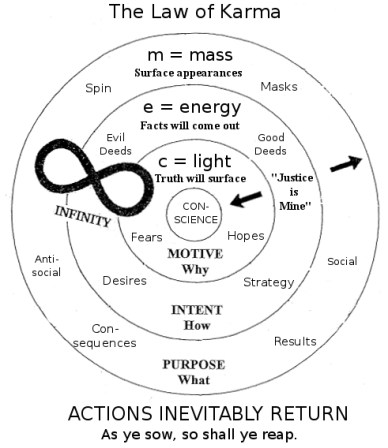
In duality, there are two sides to every coin. It’s a basic law of nature. “Whatever has a front, has back.” Further, “The larger the front, the larger the back.” This explains why surface appearances are often so deceiving.

I mention the Two Sides Law here because I’ve been following a LinkedIn discussion group called The New Philosophy Network. The subject of the particular “thread” is HOW DO YOU DEFINE EVIL?

Not to worry. You haven’t missed much. Philosophy isn’t what it used to be. If there was any “love of wisdom” (the definition of philosophy), it got lost in the one-upsmanship jousting of an extraordinarily uncivil ego contest.

But it got me to thinking about the opposite, shadow side of evil. Did the negative approach influence the quality of conversation? Has anyone asked lately, HOW DO YOU DEFINE GOOD?

Come to think of it, I did awhile ago. So here, for the sake of balance, is the three-part Essay on GOOD from Conscience: Your Ultimate Personal Survival Guide.

globe

Essay 30. GOOD

“The true genius of living is to carry the spirit of the child into old age. And what is the spirit of the child, but that of wide-eyed open wonder, excitement and zest, the optimistic attitude that nothing is too good to be true, that the world is literally a wonderful place?” — Norman Vincent Peale, Enthusiasm Makes the Difference

“We all want the good things in life; we all desire to be surrounded by friends; but we have no right to expect to attract any of these things except when our own lives have earned us the right to be honored, respected, and admired. . . .” — M.P. Hall, Magic: A Treatise on Esoteric Ethics

“It’s the one characteristic that connects all the defendants: a genuine incapacity to feel with their fellow man. Evil, I think, is the absence of empathy.” — Medical Officer, Nuremberg

THE FRONT

The roots of good mean to unite, be associated, or suitable. The term goes through seventeen permutations in Webster’s Dictionary alone.

The first definition is a general term of approval or commendation. Good means suitable to a purpose or effect. It means efficient, producing favorable or beneficial results. It can mean fresh, unspoiled, uncontaminated. It can mean valid, genuine, or real, as in good money or a good excuse.

Good means healthy, strong or vigorous, as in good eyesight. The word is used to mean financially safe or sound. It means honorable, worthy, or respectable. It is used to mean enjoyable, desirable, pleasant or happy, as in the good life. Good can mean dependable, reliable or correct, as in good advice. It can mean thorough or complete, as in a good job of cleaning.

Good can mean excellent of its kind, as in a good novel or considered the best, as in her good china. It can mean morally sound or excellent, virtuous, honest, just, pious, devout, kind, benevolent, generous, sympathetic or well-behaved and dutiful.

It can mean proper, becoming, correct (good manners) and therefore socially acceptable (a good family). It can mean able, skilled, or expert, as in a good swimmer.

It can mean loyal or conforming, as in a good Democrat. In law, it means an effectual or valid title.

The Ten Commandments that Moses gave to the people of Israel, enumerated in the fifth chapter of Deuteronomy in the Old Testament, are a generally accepted code of right conduct. They prescribe what we should and should not do to live a good life. Though the cultural context is different, in principle they are consistent with I Ching philosophy.

Revisiting them from an I Ching point of view enriches their meaning. For example, the seventh commandment has become the focus of special public attention, taking on political overtones. “Neither shalt thou commit adultery.” This one-sentence commandment has depths of meaning which span the energy continuum.

For example, at first chakra level, it includes refraining from contaminating air, water and food with pollutants. At the second, it includes not violating marital or parental responsibilities.

At the third, it includes not tampering with legislation for antisocial purposes. At the fourth, it includes not mixing compassion with sentimentality or greed.

At the fifth, it includes not misconstruing scriptures to suit political agendas. At the sixth, it includes not adulterating conscience with the ego impulses.

In addition, each level’s “shalt not” implies a positive shadow: “thou shalt.” At the first chakra level, this includes taking active responsibility for cleansing air, water and food of pollutants.

At the second chakra level, it includes fulfilling family commitments. At the third, it includes adjusting corporate and government practices to serve the common good.

At the fourth, it includes quietly serving those in need without public fanfare. At the fifth, it includes aligning personal and political goals with natural and scriptural law.

At the sixth, it includes practicing self-awareness methods to purify ego.

THE BACK

In I Ching context, evil violates divine and natural law. It is antithetical to the life process, tearing the pattern apart. Good and evil cannot be equated with yin and yang. Good is inclusive of the harmonious whole, both yin and yang, attainable by males and females of every race without limitation.

In moralist context, violating codes of generally accepted social or sexual conduct is regarded as bad, the opposite of good. Sages, however, define correct or incorrect behavior in terms of context and results. Right or wrong action is defined in terms of the immediate situation and the actor’s deepest, underlying motives.
I Want To Know What Love IS (& Isn’t)

There was a time when, wherever I’d go, the popular Foreigner tune “I Want To Know What Love Is” was playing in the background. I shopped to it at Woodman’s grocery store. At Gold’s gym, I showered and dressed to the sound of the same music. While I waited in line at the local Subway for my six inch sandwich on honey-oat bread with tuna, provolone cheese and veggies . . . again, the same song.

Now this mountain I must climb
Feels like a world upon my shoulders
And through the clouds I see love shine
It keeps me warm as life grows colder.

If it wasn’t that, then it was the Jennings/Winwood song, “Higher Love.”

Think about it: There must be higher love
Down in the heart or hidden in the stars above.
Without it, life is wasted time.
Worlds are turning and we’re just hanging on..

We walk blind, we try to see,
Falling behind in what could be.

I took it as a cosmic hint. Pay attention to this universal need, and the ways we sing about our searchings.

We look everywhere for this illusive, life-sustaining essence (albeit sometimes in the wrong places). Is it above us, hidden in the mountains tops, or still higher, shining from the stars? Does it dwell deep within the human heart?

Or all of the above, like the all-pervading force Yoda honors in Star Wars.

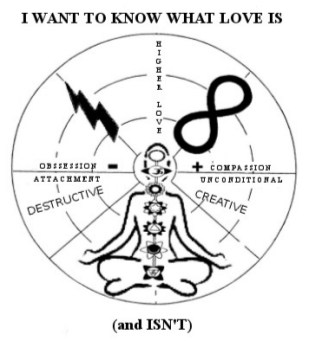
Here’s what I came up with as a result of my personal searchings – a picture of Love’s full-spectrum possibilities:

Want to know

Used as a diagnostic tool, the Life Wheel shows how words shift meanings at each successively inward level. It applies to the full spectrum of value words, from Action to Virtue, including Love.

Positive and negative expressions of love take on different forms at each ascending (or descending) stage of the Life Wheel. We each experience our personal, unique variations on the same basic themes. But the idea isn’t that complicated. It looks like this:

LoveLadder.sized

Scientists limit their search to the outermost tangible, measurable surface of the Life Wheel. Because they look exclusively at physical manifestations, they find different (though complimentary) answers. Take, for example, the Youtube series on “The World’s Most Asked Questions.”

SciShow surveyed Google and Youtube for the most frequently asked questions searched on the web. According to them, the world’s #1 burning question is, “What Is Love?”

The video on the #1 question is hosted by an unidentified, fresh-faced 20-something presenter — gravity-defying hair, sporting a gray hoodie. Reading from a teleprompter, he waves his hands with the confident gestures of an expert. Flashing in the background, bolded scientific terms along with colorful brain-scan images reinforce his message.

“Love,” the unnamed anchor starts out, “is the number one question that keeps poets and philosophers up at night.” But, he claims, it’s no mystery to scientists. “They have good explanations.” Several in fact. The answer changes depending on which kind of scientist you ask.

A biologist would say it’s all about reproduction, evolution and the survival of the species. [Issues associated with the first three centers (“chakras” or “wheels”).]

A psychologist would say it’s all about togetherness and our need for acceptance. [Issues associated with the fourth, heart chakra.]

But, no-name continues, “It’s really about chemistry – brain chemistry to be exact.” Aha! This is where the preamble was leading. “It’s incorrect to associate love with the heart,” he says. “It’s all about the brain. We know this because we can see the brain in action in brain scans.”

What follows is a discourse on brain science. “In fact,” he claims, “the early stages of love look an awful lot like a brain on cocaine.” When a person first “falls” in love, at least a dozen different brain parts light up, releasing powerful chemicals, hormones and neurotransmitters that trigger “feelings of excitement, euphoria, bonding and butterflies.”

Research also shows that the unconditional love between a mother and child activates slightly different regions of the brain, he says. (That’s interesting, but no details are supplied.)

The video ends where it started, “Love may seem like a mystery to poets. But to science, love is within the realms of the comprehensible.”

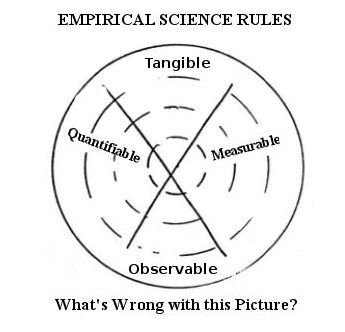
Oh well. If you’ve been following my earlier posts, you’ve seen the hollow-shell diagram of the exclusively materialistic, empirical science worldview. According to the Rules of this Knowledge Game, information received by intuition and con-science at the inward levels of the Life Wheel is excluded as off-limits.

But scientists don’t have all the answers about love. Some perhaps, but not all. Research science (as Einstein knew) is a “necessary but not sufficient” piece of the knowledge puzzle.

From experience, I know there’s much more to higher, unconditional love than meets the measuring eyes. Nor does everything done in the name of love partake of this universal essence. Quite the opposite.

The love we seek and sing about isn’t motivated by chemicals. Hormones aren’t causes, only response mechanisms. Nor can love be contained or explained by analyzing the brain. People come and go. The legacy of love they leave behind endures. The temporary physical receiver can’t be equated with its mysterious, eternal source.

“Re-search” = “Look again.”

The ELEVENTH HOUR

11th hour sized

In drafting “Do You Have the Time?” I brainstormed all the possible ways this seemingly simple question can be taken (and mistaken). Different interpretations yield significantly different answers.

I also browsed for clip art clock faces to illustrate my point. Coincidentally, the one I chose adds yet another perspective, giving the question a deeper, philosophical meaning: “Do you know what time it is in your life?”

What stage of personal evolution / growth are you going through now? From a larger, historical perspective, what point in its life cycle is your business, nation or even the world experiencing today?

The pictured clock face shows the stage many say the world is now in: its eleventh hour.

Even then, there are different views as to the best way to respond to being at the eleventh hour in human history. The cliché is currently used to mean “running out of time, at the very last minute, or almost too late.”

But biblical origins of the cliché offer an alternative viewpoint. In Matthew 20: 2-16, laborers hired at the last, eleventh hour worked for only an hour. But at the end of the day, they received the same reward as those hired early in the morning, who had worked all day.

Christ’s parable of the eleventh hour epitomizes the hope humans have in God’s compassionate mercy. It’s never to late to change. It’s not over til it’s over.

(Of course, there is no such thing as coincidence.)

globe

Do You Have the Time?

Early this morning, I was startled awake by a cell phone alert. The power was out – for a second time. The first outage occurred over night. I was still asleep, so didn’t know the difference.

Roommates who commute long-distance to work got started just before the electric garage door came to a standstill. (They don’t know how to open it manually.)

Emergency protocols immediately kicked into place. I reached out in the dark for my wind-up flashlight. It was where it should be, on top of the disabled alarm clock. It supplied enough light to find a second, larger LED flashlight. It too was where I expected, on my work desk next to the powerless computer. I made my way carefully down the pitch black stairwell.

Next: get the battery-run lanterns out of storage. In one, the D-cells had gone dead. Look for back-ups.

Fortunately, there’s a battery-run wall clock by the main office door that keeps accurate time. Which is the subject of this post. “Do you have the time?”

Have you ever thought about how many different ways there are to answer this seemingly simple question, “Do you have the time?” My smart-mouthed high school friends, for example, would have answered, “If you have the nerve.”

The most straight-forward response is to look at a time-piece and give a literal answer. It’s 6:30 in the morning.

Alternative answers go along the lines of, I don’t have enough time . . . . to get the many tasks that need doing done well . . . to take care of my health . . . to check in on elderly relatives. Etc. etc.

Philosophical answers might include regret for the shortness and uncertainty of life. “Here today. Gone tomorrow.” Or, as the carved and painted wood plaque over my Grandfather’s fireplace mantle put it, “We get too soon old, and too late smart.”

Which brings me back to the point where I left off in the last post, “Rethinking Our Common Humanity:”

While we all have the option to remember who we truly are, most of us are like Lambert, the sheepish lion. It takes a smack with a two-by-four upside the head before we’re finally ready to WAKE UP.

Often it takes the form of life-threatening danger to those we care for. A personal health crisis will also do the trick. So will job loss or a run-in with natural disaster. But, like Dorothy stranded in the Land of Oz, when you want dearly enough to return “home,” you can click your heels whenever you chose — and come to find out, you’re already there.

Most of us live as if today will last forever. We prefer to live in the moment. In part, this is a good thing. The mindful focus of a “Be here and now” attitude allows us to savor our immediate blessings.

However . . . on the other hand, heedless lack of foresight can have extremely dangerous consequences.

Tomorrow and tomorrow and tomorrow add up, inevitably sneaking up from behind like a thief in the night when least expected. (And not just a temporary power outage like this morning. Think Pompeii.)

Impending disasters, even those right before our eyes like handwriting on the wall, can catch the unprepared off guard, robbing them of the precious time which could have been used to wake up from their deep soul sleep and re-member who they truly are.

I understand. Given today’s economy, many have little choice but to live hand-to-mouth. Check-to-pay-(or welfare)-check. Even the well-off who could afford to prepare are besieged with putting out day-to-day fires — or by other glittery distractions.

There’s no time or energy reserved for assessing possible risks. It’s not a priority to think through “If / Then” preparedness scenarios.

I find it most peculiar that even Millennials, who have grown up fluent in computer-driven technology, usually don’t apply if / then computer logic to their personal decision-making and daily behavior. This makes them even more ill-equipped than their elders to cope realistically with sudden change.

For example, in a personal email sent in response to “Give Millennials an App for Their Inner Compass,” Tom Richards detailed his frustration with Millennials:

I live in NJ where Hurricane Sandy hit dead center. Devastation like you would not believe. No power in most of the state for over 8 days. Here are actual examples which I came across immediately following the storm . . .

1. An hour after the storm ended, early in the morning, a car load of kids in their mid-twenties got stuck in a washed out piece of road in front of my house. No power, of course, and trees down everywhere. When the kiddies came to my door to ask to call for a tow truck, I had to laugh. When I asked them why the hell they were out on the roads, in their PJ’s none the less, immediately after the storm of the century, I got this. “We don’t have power and want coffee and breakfast. We are going to WaWa to get some.” Didn’t even dawn on them that if they have no power, and the state has no power, the WaWa doesn’t have power. Nor did it dawn on them that with the storm and devastation, that the people who work at WaWa would not be able to go there and open it for them.

2. Three days later the local farmers market opened, even though they only had power to keep the refrigerated items going. No power within 3 counties at this point. A young couple who lives two doors down needed food. Went to the market and came home empty handed. They had no cash, and the store was obviously only able to take cash. They pay for everything with their debit cards. Never dawned on them to have some cash around for emergencies and things like this. They were mad that the store wouldn’t sell them anything nor that they couldn’t take the debit card. It also is interesting that they never even thought to prepare even though warnings were given over and over.

3. My daughter and her friends were hungry. Her friends hadn’t had a hot meal in days. Plus, it had gotten cold and most had no heat. They came over to our house. Saw we were using my wood stove in the music studio to cook on and stay warm. It never dawned on them (or their parents, which frightened me) to use their BBQ propane grill or make a fire to cook with nor to build a fire in their yards to at least get a bit warm.

4. Just about every traffic light was out, and roads were blocked by either police or downed trees. I cannot tell you how many younger people stopped in front of my house when they saw me there to ask me how to get to a certain place, and also how many could not understand when I gave them road names where those roads were. . . .

What most amazes me is that repeatedly, after each disaster, whether natural or man-made, in media interviews, the “victims” chant the same mantra. “It was a WAKE UP CALL.” But life goes on. After the initial shock wears off, people get mired once again in the routines of daily living. And they forget. They go back to sleep.

We aren’t changing! And time is running out. As the late computer leader-innovator Steve Jobs poignantly observed:

Your time is limited, so don’t waste it living someone else’s life. Don’t be trapped by dogma – which is living with the results of other people’s thinking. Don’t let the noise of other’s opinions drown out your own inner voice. And most important, have the courage to follow your heart and intuition. They somehow already know what you truly want to become. Everything else is secondary.

Time is a blessing and a luxury. None of us knows how much time we have left to WAKE UP, think, prepare, and perhaps survive whatever is to come.

Commenting on “Change the Rules of the Knowledge Game,” Peter Fellingham gave his opinion:

Another reason why people avoid critical thinking is because it usually results in significant introspection. Introspection tends to make clear the responsibility the individual has for the resolution of their own troubles.

I answered back:

Peter, you’ve pinpointed the blind spot in curriculum — the information deficit of which I speak. Clear & critical thinking isn’t often taught in schools, nor are problem-solving tools provided as essential basics. They should be.

Then there’s the question of motivation. Requires a carrot & stick approach. The stick is awareness that laziness comes with horrific consequences. The carrot is assurance of the benefits which accrue to living a self-responsible life.

In part, people often avoid issues they find too fearful to face. If there truly are no better options, and only dangerous consequences, keeping still is an understandable choice. However, if better options ARE available, then making them known and available is an important first step in positive change. That’s what I’m working to accomplish.. . .

So, if you and/or those you lead and care for have been avoiding introspection, if you’ve been ignoring the warning signs and denying fears for the future, waiting for dangers to miraculously disappear and problems to be solved without effort, it’s time to take the striking two-by-four hint from escalating wake-up calls worldwide.

It may be a matter of survival to rethink priorities while there’s still precious time left to do so. Ask, If not now, when?

And consider the likelihood that the life / family / organization you save may be not only yours, but those of generations to come.

To Survive, Change Your Rules

Expanding Rules of the Knowledge Game would give problem-solvers greater leverage over a wide range of social-political malfunctions, from budget deficits to crime (legalized theft included).

A wider field of accepted information options would give a broad new range of diagnostic tools for pinpointing origins of unjust discrimination, inequitable wealth distribution, work-place violence, addictions and mental-emotional depression. It would give a new face to healing PTSD and preventing suicide.

What these personal, social and political ills have in common is a fatal knowledge deficit.

But before defining Rules of the Knowledge Game (epistemology), I’ll share two examples from personal experience. They’re comical, but they demonstrate the basic mistakes people make on limited information.

The first occurred when I was 6 and my brother David was 5. We were living in Tuscon, Arizona at the time. A blond-haired playmate age 3 who lived down the street adored David. Jason pleaded with his mom for a hair cut just like David’s. He expected the change to transform him into the likeness of his idol. But he came home from the barber streaming tears of childish disappointment.

The brush cut didn’t change his hair color from blond to David’s dark brown, nor did it transfer any of the desirable qualities associated with his hero to Jason.

The second happened when I was in my mid-20s. Rooming with a yoga student in Madison, Wisconsin, I was increasingly troubled as more and more of my stuff – kitchen utensils and even clothing – went missing. When I asked Mukit (her initiate name) if she knew anything about this, she explained why she felt free to take whatever she wanted.

“We are all One,” she said. By her logic, it followed that my stuff was hers too.

These are just small examples of the twin mistakes that continue to repeat when our reality maps aren’t complete and accurate. Writ large, they generate crimes and tragedies in every area of life, on every scale of magnitude.

What is lacking is the two-directional, in- and out-breathing reality map which accounts for all dimensions of personal experience and puts them in prioritized perspective.

Today’s prevailing Rules of the Knowledge Game exclude vitally important components of the human condition. Here, “Rules of the Knowledge Game” refers not to philosophical inquires into truth, but rather punitively enforced social-political taboos which prescribe what can be known, by whom, and how.

These rules stipulate what kinds of knowledge are allowed as well as others that are prohibited. Knowledge is sometimes made off-limits to second-class citizens (low income people, for example). Subtle ways of obtaining information (intuition, conscience) are written off as non-existent or invalid.

Here’s the tacit logic behind limiting the field: “Knowledge is power. IF I want to hoard power (and the resources it yields) in order to control others, THEN I must deny others access to knowledge that would empower them.”

To heal the harm incurred by limiting what can be known (ruling out the senses, intuition and conscience as valid information sources), it is imperative to reintegrate these decision-making influences into the rules of what is acceptable.

Currently, rules of empirical science dictate that only knowledge about material, tangible, observable and quantifiable objects is valid. Only university educated, degreed and certified “experts” using standardized research methods are qualified to obtain and disseminate knowledge. Here’s the picture of the hollow shell allowed by these rules.

material rules sized

Please don’t get me wrong. I’m not saying this approach to obtaining information is invalid. In its place, on the surface of material appearances, it is an important piece of the knowledge puzzle. It’s a necessary balance to the opposite and equally exclusionary “religionist” mistake of elevating inward experience to the exclusion of the material world.

BUT, however necessary, it is not sufficient.

Throughout his lifetime, both in personal experience and professionally, the pioneering Swiss analyst Carl Jung dealt with the suffering caused by squeezing the richness of life experience into this hollow mold. As a matter of personal sanity and social health, he advocated “individuation” as a process for reintegrating all the layers and levels of life into conscious awareness.

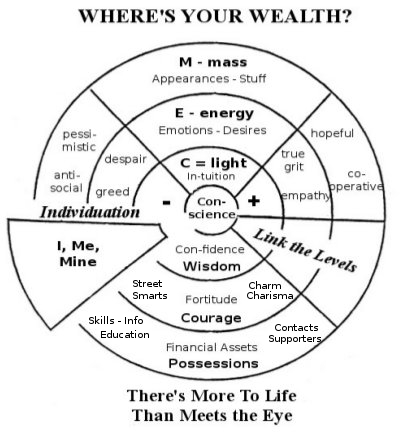
The Life Wheel compliments Jung’s work. It can be used as method to assist in this process of making the unconscious conscious, of restoring access to inner knowing that has been repressed by socialization, including education.

Here is a picture to show you what I’m getting at:

Wealth.sized

On the outward path, the individuation process differentiates the individual from the universal center. It integrates timeless unity with the outward layers of idea, energy, action and results. This was the reality check Mukti needed – a correct picture of where my personal boundaries began and hers ended. We are one at the center, but not on the surface. It was NOT okay for her to take my things.

On the inward, return path, the individuation process reintegrates personal, separate identity with awareness of the timeless, universal source. This is what Jason lacked – a concept of his own inherent value, independent of the people. events and circumstances around him. The qualities he admired in David weren’t defined by physical attributes. Looking on the outside for the inherent self-worth he already had on the inside was a sure recipe for disappointment.

What is needed to change the Rules of the Knowledge Game is access to a useful reality map, one that includes the whole of human experience, one that is easily converted into a practical diagnostic and decision-making tool. That is the purpose of working with the Life Wheel. It can easily be personalized to ask, “Where in the Wheel Am I NOW?” — “Where Do I Intend To Be?” — and then decide – “How Do I Get from Here to There?”

Expanding Rules of the Knowledge Game to match the whole of life can be a matter of life or death. For example, just as 3 year-old Jason tried to acquire my brother’s virtues through imitation, David, in turn, copied his dad. As a Yale grad, David chose to become a physician, following in the footsteps of our Harvard-trained cardiologist father.

David too accepted the scientist’s belief that exclusively empirical science can explain everything. He dismissed other approaches to knowledge as ignorant superstition. He rejected as quackery my quest for deeper knowledge about the origins and purpose of life.

I dearly hope when when faced by extreme adversity, he’ll not, for lack of inner awareness, make the same choice his medical role model did.

When we first found out in the year 2002 – 50 years after the fact – that Kirby hadn’t died of a sudden heart attack (as we grew up believing), that he died from a self-inflicted gunshot wound to the back of the head, my younger sister Annie was instantly reminded of a haunting poem by Edward Arlington Robinson.

Whenever Richard Cory went down town,
We people on the pavement looked at him:
He was a gentleman from sole to crown,
Clean favored, and imperially slim. . . .

. . . he was rich – yes, richer than a king –
And admirably schooled in every grace:
In fine, we thought that he was everything
To make us wish that we were in his place.

So on we worked, and waited for the light,
And went without meat, and cursed the bread.
And Richard Cory, one calm summer night,
Went home and put a bullet through his head.

This poem dramatizes the saying, “Appearances are deceiving.” The key difference it illustrates is this. Those who endured external adversity by patiently waiting for the light survived. Whereas Cory, who seemed to “have it all,” lacked awareness of the inner resources needed to cope with hidden suffering.

Without the confidence that comes from inner wealth, all the riches in the world cannot withstand the despairing, dark of night of the soul.

In sum: the first front against suffering remains knowledge. Knowledge – complete and correct – is the beginning of empowerment. Ultimately, changing the Rules of the Knowledge Game is matter of personal as well as human survival.

globe

Happy One-Year Anniversary

October marks the one-year anniversary of the +A Positive Action Press WordPress website, RethinkingSurvival.com. Looking back, I’m amazed at the way daily, incremental baby-steps have added up.

With the help of (sometimes) forbearing computer savvy friends, I’ve gone from cut-and-paste technology to working with a photo-shop clone to produce illustrations. Starting with no marketing skills and less interest, I’ve swallowed my pride and actually gotten interested in the process. From being overwhelmed by Twitter, I now really enjoy direct messaging with savvy, fun new folks. Certainly limiting myself to messages of 140 characters or less has significantly altered my writing style for the better. : )

So tonight I thought I’d take a break from my current projects to revisit the Essay on Practice from Conscience. Written in the year 2000, it’s not in my current voice. But it speaks to my immediate appreciation for the benefits of daily discipline.

globe

27. PRACTICE

Each T’ai Chi movement is related to a particular hexagram of the I Ching. This relationship holds vital clues to a deeper understanding of Chinese thought which, like all valid world-views, is based on knowledge of the self gleaned from the practical experience of meditation. — Dal Liu, Tai Chi Ch’uan and I Ching: A Choreography of Body and Mind

Practice is essential. Through regular practice, you will become familiar with the feeling of being relaxed. You will find that you can achieve results with shorter and shorter practice sessions. You will become like a pianist who is ready to play a beautiful Mozart sonata as soon as her hands touch the keyboard. — Kenneth S. Cohen, The Way of Qigong

One should never rush in entering Taoism. . . One must proceed step by step, never advancing to the next stage until one is ready. One need not fret. If one discharges one’s tasks and proceeds with training perseveringly, then the transitions are virtually automatic. — Deng Ming-Dao, Chronicles of Tao

THE FRONT

Practice means to do or engage in frequently, make a habit or custom. It means to do repeatedly in order to learn or become proficient; to exercise or drill oneself. Practice is using one’s knowledge, as in a profession. To practice is to adhere to beliefs or ideals. It means to teach or train through exercise. An archaic definition suggests intrigue, trickery, or scheming.

Practice is closely related to the words discipline and preparation. It implies the ability to anticipate the future and make decisions about how best to make ready for it. It was the practice of Chinese emperors to consult ministers and sages for information on how to prepare for the future. They, in turn, consulted the I Ching to decide the best ways to adjust to alternating seasons of hardship and plenty in order to maintain social, political and economic equilibrium.

By biblical account, Joseph was sold into slavery by jealous older brothers and taken to Egypt. Thus, he found himself in the right place at the right time to fulfill his destiny. By correctly interpreting Pharaoh’s dreams, he saved countless lives, including those of the brothers whom he forgave.

He foresaw coming changes in nature and drew conclusions as to how prepare for the future. The practice of disciplined conservation during seven years of plenty allowed Pharaoh to feed his people during the seven years of drought which followed, thus preventing starvation, mass suffering and social upheaval.

Applications to current economic practices should be abundantly clear. Squandering resources during times of abundance is a sure recipe for famine, widespread misery and unrest when the rhythmic pendulum of history swings, replacing times of plenty with times of hardship. Wishing and hoping current “good” times will last forever because we want them to, refusing to heed clear warning signs that they never do, foolishly puts everyone at risk.

Music is a demanding discipline which emphasizes the importance of regular practice, preparing in advance to perform well. Similarly, martial arts instill respect for regular practice, cultivating the ability to adjust quickly and skillfully to sudden danger. In this case, the body itself is the instrument and tuning it a fine art. As Chuck Norris says, “Practice, practice, practice! Practice can save your life.” God forbid you’ll ever be attacked. But be ready.

Through the daily practice of meditation balanced by Tai Chi meditation-in-action, it is possible to make teachings real through experience, fulfilling the maxim “Learn by doing.”

Then, with sustained focus and loving attention, everyday activities and relationships are transformed into spiritual and martial arts training. Practice becomes a way of life, an ongoing proof of commitment in action. It’s not just a few hours set aside from the rest of the day. Nor is it to be flaunted, foolishly attracting envy and vengeance.

In Cleary’s translation of The Taoist I Ching, meditation and action alternating in rhythmic sequence are described as equally important complements. Inner stillness develops the abode of rest. Action completes and tests the abode of rest. Progress achieved by steady, gradual, consistent efforts accomplishes far more than dramatic spurts of activity that can’t be sustained over time.

Understanding the philosophy and science of the I Ching intellectually is relatively easy. Putting it into practice is more of a challenge. It’s not like something memorized for class, and then you’ve got it forever. It requires consistent attention and renewal, applying the readings to myriad kaleidoscope changes during the ongoing process of a lifetime.

THE BACK

The opposite of practice is lack of foresight and disciplined preparation for the future. Aesop’s fable of the race between the tortoise and the hare captures the difference between making steady progress toward a goal and the lazy assumption of inevitable victory, sleeping until it’s too late.

Enforced drilling is an inadequate substitute for intelligent practice. Mechanical repetitions without understanding and involved commitment are pointless. Repeating affirmations instead of taking positive action doesn’t produce quality results.

 globe

What the Generations Share in Common

Before writing on ways Millennials might use an Inner GPS App to decide where they want to go and how to get there, I searched the web for similar posts. There are tons of researched opinions on what Millennials want and need.

Marketers survey Millennials asking what they want to buy, from whom, and why. Business experts list the leadership qualities Millennials need.

But this particular approach is more inclusive. It goes a bit deeper.

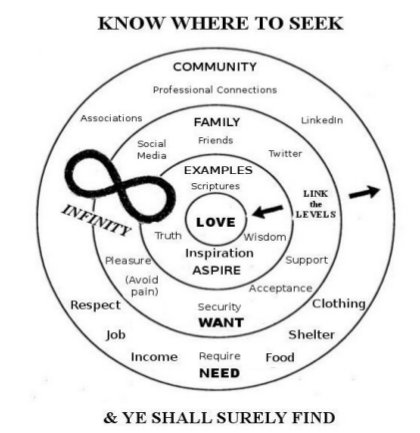
Even in a world gone mad, as members of the human species, our basic wants and needs remain the same. On the surface of the Life Wheel, we all need food, clean water, shelter and clothing to survive. Some sleep also helps.

In a civilized world, we need the means to purchase these basics: income and/or a job. Respect in the larger community also helps.

At the middle energy/emotion level of the Life Wheel, most of us want to be accepted and supported. We want to feel secure. We want to enjoy the pleasures of life and, whenever possible, to avoid pain. In sum, we want to share our lives with fellow human beings.

At the innermost level, we crave answers about the purpose and meaning of our lives. We seek value. The boldest and bravest even aspire to know Truth. We want to know what Love IS. We crave unity, the stuff of Einstein’s Unified Theory, but continue to look for it in all the wrong places. (That, however, is the subject of another post still on the drawing board.)

The question here, however, is Where in a high-tech, polarized world gone mad, where the levels of the Wheel are fragmented and out of synch, can Millennials go to fulfill these universal requirements?

world gone mad.sized

Behind Millennials’ bravado and superficial social masks, their woes aren’t much different than they’ve ever been. The Buddha put suffering in perspective by promising to bring a dead child back to life if the grieving parents could find any household in the local village that had not been visited by death.

But of course, they could not.

The recent public revelation by movie star, political activist and philanthropist Jane Fonda translates universal suffering into today’s familiar terms. Her mother, Frances Ford Seymour, committed suicide at age 42 when Jane was 12. Only recently did the facts come out which led to closure. At age 76, to write her memoir, Jane looked up her mother’s medical records. There she found the key to understanding her mother’s behavior. From age 8, Frances had been the victim of sexual abuse.

Nor has life exempted me. My father, William Kirby West (named for his ancestor William Kirby Brewster, one of the earliest pilgrims who sailed from England to the New World on the Mayflower), committed suicide when I was 6. Since the subject was taboo in my dysfunctional family (a mirror of the dysfunctional society at large), no one told me the truth. I grew up believing my heart surgeon father died of a sudden heart attack at age 33. Only when I was 50 did my failing mother finally “remember” the facts surrounding his death.

This isn’t my only personal story. For example, (if you’ll pardon a bad pun), Swami Rama was one of the first to introduce yoga to the West. His front was that a celibate monk who’d taken vows of poverty. But appearances were deceiving.

Behind the scenes, he was a bold-faced hypocrite, liar and sexual predator who betrayed the trust of his students. A Yoga Journal author called his abuse of Tantric teachings “spiritual incest.” Translate: rape. In the hands of this opportunist, the teachings (a priceless heritage) were a convenient “product” that thirsty, naïve Americans wanted. He used them to make himself (for a short while) very rich and somewhat famous.

Oh well. “Something’s lost but something’s gained in living every day.”

The point here is that I haven’t allowed the slings and arrows of outrageous misfortune on the Wheel’s surface to define me. Instead, I’ve chosen to live by my mottos. First, “Take the best. Leave the rest.” Second, “Resist not evil. Persist in the good.”

I’ve repeatedly healed – made myself whole again – thanks to my inner apps (in this case, based on the King James version of The Bible and the Chinese Book of Change). I trust that nothing that happens on the surface can touch or change the essence of who I truly AM.

This blessing, the Inner App, is what I would love to share with millennials, as well as the parents and grandparents who dearly wish them well. It necessarily starts with a complete and correct reality map that puts the whole of life into perspective.

Here’s a picture of universal needs, wants and aspirations and the ways many millennials seek to fill them:

MILLENIALS.sized

An aside to millennials. The world of hurt we’re in today was foretold by Christ and foreseen by yogic seers long before that. It has been a long time coming. Today’s mess cannot be taken personally. Nor is it appropriate or helpful to blame your elders. (If you believe in karma, consider that, even if for reasons unknown to you now, you’re the one who picked the time and place of this particular incarnation, maybe to fulfill an important purpose).

Be that as it may, put things in perspective. You think your elders let you down; but they were equally disappointed by theirs. On the opposite side of the coin, each generation of elders continues, for the most part, to sincerely do the best they know how, often in the face of terrible odds.

So let’s cut each other some slack.

Millennials as well as their elders are welcome to come aboard the Inner App project. After all, it’s in everyone’s best survival interests.

For if we taught ourselves to think holistically, in concentric circles, and if we organized / prioritized our lives accordingly, we’d begin thinking like Einstein, like geniuses.

If enough of us tuned in to the universal inner compass and began treating each other with compassionate respect, we’d fulfill Einstein’s dearest wish and start getting along. It might even tip the balance of history in favor of human survival.

Because that truly is what’s at stake.

globe

An Inner Compass App for Millennials

In a LinkedIn post, MC wrote We’re strongest when we stand together.

I agree whole-heartedly. So here’s a high value, practical project which tests our mutual willingness / ability to push past apparent differences and take a common stand. Together, we have a unique and powerful opportunity to bridge the generation divide in a way neither of us, separately, can.

The project idea was confirmed by a response made by Tom Richards [Brand Builder for Bass and Guitar Manufacturers] to my earlier Response to Millennial and Boomer Blogs.

For starters, Tom wrote, My metaphor is the map.

Yes. The map is my metaphor too. From Rethinking Survival:

Chances of success in life are slim to none without an accurate reality map. It’s imperative to have a complete picture of your potentials along with a correct understanding of the world around you, and what’s required to survive in that world.

Basing decisions on a worldview that’s distorted, incomplete or otherwise out of synch with the way things really are seriously diminishes chances of survival. In times as dangerous as these, it’s more important than ever to make sure you’re operating on complete and correct information.

Intellectual smarts and material resources on the surface of the Wheel aren’t enough. Lacking competence at the middle, energy level of the Wheel (street smarts) and a functional connection with the inner core (conscience), you can’t get from here (a world in desperate need of positive change) to there (the better world we passionately long for).

However, without an in-depth, comprehensive awareness of what change (natural vs. man-made) is about, and — most importantly — the unchanging creative source of all creation, it’s nigh unto impossible to achieve the personal and social change everyone wants, many promise, but few succeed in achieving.

Moving along. Tom complained, This generation looks for an app to tell them how to go. They do not even attempt to learn directions, understand where towns are in relation to each other, do not ever attempt to really learn their local surroundings, or how to navigate without the old GPS.

Earlier, I placed the seafaring navigator’s compass at the core of concentric circles to image the inclusive, universal nature of the Positive Paradigm. It correlated this technology with Einstein’s beloved compass and his plea to live by the all-encompassing inner compass of compassion which everyone, everywhere shares in common.

Inner Compass.sized

But, as Tom continued, My step-daughter refused to listen to me when I told her she needed to learn how to read a map and basic orienteering skills to navigate with it. She stated she had a GPS and an app.

I wrote The Positive Paradigm Handbook to supply a user manual for successfully navigating the ultimate reality map. It’s seven basic axioms translate roughly as “The Operating Rules of the Game of Life.” Mercy abides at the center of the wheel. The dog-eat-dog Law of the Jungle often prevail on the surface. But what most of us are missing is the middle link between those extremes: the Law of Karma – translate as the Law of Consequences. Those who live mercifully receive attract mercy to themselves. Those who live like animals die like animals.

Lao Tze, who knew a great deal about Natural Law, put it this way:

There’s always a terminator who destroys.

There’s always a place in nature’s plan for predators

who prey on the weak and defenseless.

However, those who serve this purpose

rarely escape annihilation.

Those who don’t know the Rules of the Game (or are foolish enough to think they can be outsmarted) inevitably find themselves, like Tom’s Millennial step-daughter, lost and in a world of hurt:

When I got a call from her an hour later because she was lost and the location her GPS gave her was wrong (and actually off by about two miles because of a paper road that did not exist in reality but was in the GPS map) there were literal tears.

In the long-term, most of us would benefit greatly from rethinking our reality maps (paradigms). In the short-term, however, as a useful step in that direction, it would help to go with the flow of available technology.

Earlier, in “Where in the Wheel Are We NOW, I wrote, The universal structure of the archetypal Wheel continues to take on new expressions to meet the unique needs of immediate times. Star Wars and the Indiana Jones movies are examples of how a timeless fascination with the war between good and evil is being retold using modern technologies.

The Positive Paradigm of Change could easily be programmed as a computer game with the structure of cause and effect consequences, featuring all the action drama of the war against good and evil, the hunt for lost treasure, and whodunit mystery.

To bridge today’s generational gap, we need to give Millennials an app that includes a method for mapping their lives — one that confirms and restores access to the ultimate guidance system of their inner Global Positioning System. This app could be used on a daily basis to answer the personal questions, “Where in the World Am I NOW?” And, if it’s not where one intends, “What am I willing and able to do about it NOW?”

Here is an updated version of the Wheel. The old-fashioned compass has been replaced by the GPS icon (same concept, next generation technology).

GPS.sized

MC, here’s where you and I, by putting differences aside and working together, could accomplish seeming miracles. What I have to offer is a lifetime of truth seeking, as well as a bit of writing. It is the work of a very private person content to live quietly in rural America. But to take this work the next level, it has to be placed it in the hands of future generations.

If you’ll forgive me, it reminds me of an example of teamwork from my undergraduate years at Oberlin College. Sitting around a bar table on a late Saturday night, drinking beer with a group of close friends, my boyfriend told a joke about a chimney sweep. It ended with his throwing a priceless golden brick up into the air. Fritz laughed hysterically. No one else saw the humor. They shrugged and we moved on.

Then it was my turn. I told a joke about a mountaineer who, at the pinnacle of his climb, reached up for a flying object as it sailed past and caught . . . the golden brick. Groans around the table.

The point here is that as a Millennial with peer credibility and social media savvy, you have the ability to access the game-programmer and investor resources needed to develop this Inner GPS app. You also have the proven marketing skills to make it go viral. This is an opportunity to make all the wonderful, valid hopes for positive change you placed in a political election really happen!

I emailed the app article idea and mentioned my intention to invite you on board to PF – the one who commented on your post, saying You don’t need to belong to a group to achieve something of lasting value or temporary glory (if that’s what you’re after), because you are already significant as an individual.

He replied, I like your GPS reference. If MC is a genuine person she may be eager to get on board.

Is he right? Are you in? What about the rest of you?

Oh. In case you’re curious, I’ll tell you. I’m 69 years-old and counting. I was born in August of 1945 within days of the atomic bomb explosions over Japan that blasted an estimated100,000 shocked souls out of their bodies, scattering them screaming, screeching and howling in pain and rage into the upper atmosphere.

My parents were horrified, as was the world at large. Not to mention Einstein, who as a violinist and humanist like myself, was later my childhood hero. I’ve taken his words to heart and made them my motto: “We shall require a substantially new manner of thinking if mankind is to survive.”

Although I’m an early Boomer, I never identified with my generation. MC grew up listening to the music of Boomer parents – Bonnie Raitt. the Stones, Jefferson Airplane and Carly Simon. But I was sustained by Bach, Mozart, Beethoven and lesser knowns including Tartini, Vivaldi and Vitali.

In fact, I have greatest compassion for millennials. I never bought into the dysfunctional paradigms responsible for the dangers of today’s world (and have paid the price). I’ve always thought that, as the ones with the least vested interest in the status quo, they’re the ones most capable of making the positive paradigm shift which might – just might – ensure human survival.

That’s why this maven has summoned the courage to call upon an accomplished connector with ties to the salesman community. Standing together, let’s Tip the Balance of history in favor of a genuinely positive paradigm shift.

One final note. Folks in my household think blogging is a waste of my time. No one is listening. No one cares. I’ve promised that if there’s no response soon, I’ll desist. But I’m betting that millennials (as well as the parents and grandparents who dearly wish them well) will prove them wrong. Like the Nazi-spawned Hydra (if you’re into Capitan America Marvel movies), today’s world leaders may mistakenly think they stand to profit from nuclear destruction of holocaust proportions. But I must trust that We the People won’t allow it.

globe

Contemplation of Mortality

Overnight, I received an email from LinkedIn connection Katherine Morris, who’s currently living in Switzerland.

She wrote, “I just read your last 3 posts on linkedin, and just want to say that I find you to be a very refreshing, very honest writer. I would even say that this is pretty scary to a lot of people. The idea of being able to be honest and not be destroyed, this is quite an accomplishment in modern civilization!”

Katherine added that she’s working on her dissertation right now . . . “very busy writing a review of the scientific and other literature on the topic of contemplation of mortality.”

WOW! Now that’s a subject many find really scary. Reminded me of the Essay on Death included in Conscience: Your Ultimate Personal Survival Guide.

So Katherine, this post is for you. Hope it’s helpful.

globe

2. DEATH

Merging with the eternal source,

sages travel safely through life

and survive intact

to begin anew,

unchanged by physical death.

  Patricia West, Two Sides of a Coin: Lao Tse’s Common Sense Way of Change. #16

—————

Dying patients went through the five stages, but then after “we have done all the work we were sent to Earth to do, we are allowed to shed our body, which imprisons our soul like a cocoon encloses the future butterfly,” and . . . well, then a person had the greatest experience of his life.

— Elisabeth Kübler-Ross, The Wheel of Life

—————

Here is a test to find whether your mission on earth is finished.

If you’re alive, it isn’t.

— Richard Bach, Illusions

—————

Some day, maybe, there will exist a well-informed, well-considered, and yet fervent public conviction that the most deadly of all possible sins is the mutilation of a child’s spirit; for such mutilation undercuts the life principle of trust.

— Erik Erikson, quoted by Jonathan Kozol in Death at an Early Age

THE FRONT

Webster’s definition of death is the act or fact of dying — the permanent ending of all life in a person, animal or plant. Personified, death is pictured as the grim reaper, a hunch-backed, black-robed skeleton wielding a scythe. The term refers to extinction, as in the death of hope.

These definitions, however, represent an extreme cultural bias with important effects on behavior. They reflect the materialistic belief that the physical is all there is. When the body fails, there is nothing else. There is no essence which survives to travel on.

The I Ching embodies a more inclusive, comprehensive view. Like the learned amongst most ancient cultures, Chinese sages regarded birth and death as natural changes, complementary stages of an ongoing cyclical life process.

Sages continue to regard death not as extinction, but the culmination of a winter season most wisely spent preparing for the coming spring. They teach that a soul, having learned the lessons and completed the work of one life cycle, separates from its used up shell. The shell, once the spirit moves on, collapses. The life essence, however, simply migrates, possibly to take on another form.

Meditation practices are instrumental in reconnecting the alienated rational mind with the life principle, restoring trust. They prepare advanced souls to depart the physical form consciously at the auspicious time of their choosing. They also induce the changes of heart and mind that the Bible alludes to as rebirth. To be born again is not necessarily emotional self-deception. Technically, from I Ching perspective, it’s very possible.

As described by healer/teacher/author Barbara Ann Brennan, total transformation and rebirth can also take place within the same body. She describes spending two years in prayer and intense discipline. As a result of her efforts, by the end of that time, every aspect of her life had changed for the better. Going through stages similar to those described by Kübler-Ross, she released her old life, so that new attitudes, better relationships, and a significantly more satisfying lifestyle replaced that which had been outgrown and put away.

Country music star Naomi Judd, another example, refused to accept a death sentence placed on her by the medical establishment. Instead, she took it as a blessing in disguise. Taking responsibility for her health, with a combination of faith and true grit, she educated herself in a broad spectrum of healing arts traditions and succeeded in regenerating herself from the inside out. She not only survived, but became healthy enough to endure the ardors of another music tour, “The Power to Change,” calling on fans to rise to the challenge of change as she had.

butterfly

THE BACK

Fear is the natural outcome of limited materialistic beliefs equating the end of physical life with total extinction. Those who experience the True Self as immortal and indestructible are not plagued by fear of mortality. No doubt the courage and solace which sustained Socrates as he calmly accepted his death sentence — not as an escape, but an affirmation of principle — came from the depth of his soul awareness.

Permanent extinction, however, is possible. Real death is not dissolution of a temporary form, but the annihilation of the soul itself. According to learned traditions, a soul beyond redemption by its own repeated wrong choices can be extinguished forever. Even the thought is cause for horror, powerful incentive to make right choices.

—————–

West, Patricia .E., Two Sides of a Coin: Lao Tse’s Common Sense Way of Change. # 16. (+A Positive Action Press: Madison, WI, 2004).

Elisabeth Kübler-Ross, The Wheel of Life: A Memoir of Living and Dying. (Touchstone: New York, 1997.) p. 189.

Richard Bach, Illusions: The Adventures of a Reluctant Messiah. (Dell: New York, 1977.) p. 159.

Erik Erikson, quoted by Jonathan Kozol in Death at an Early Age: The Destruction of the Hearts and Minds of Negro Children in the Boston Public Schools. (Plume: New York, 1967.) front page.

Use the Wheel to Make Yourself Whole

AXIOM SEVEN of the Positive Paradigm states, “With a Correct Paradigm and Useful Tools, You Can Make Yourself Whole.”

globe

The Handbook’s preface starts with a caveat. Everyone is already intrinsically whole. Put another way, “God don’t make no junk.” This is the wisdom behind the biblical admonition, “Ye must be perfect like your father.”

However, just as Einstein already had the Unified Field Theory but didn’t know it, each and every one of us on the planet is perfect in potential: made in God’s image. But we’ve forgotten.

Worse, many have been deceived into believing they’re inherently not-okay. The Handbook confirms inherent wholeness. Its structure provides a practical, hands on method for waking up. The goal is to re-member (“get it together”) and actualize in-born potential. It initiates the on-going process of making and keeping ourselves FUNCTIONALLY whole, over and over again.

The subtitle Make Yourself Whole Using the Wheel of Change isn’t intended to suggest that this or any other book can magically or literally make anyone whole, or that once through the book, you’re done. It requires not only initial work, but on-going follow-through. It’s personal intention and consistent effort that produce results. This is just a really useful tool.

But it is tremendously important to start this life journey with a reality map that accords with the way things really are. As written in Rethinking Survival:

Chances of success in life are slim to none without an accurate reality map. It’s imperative to have a complete picture of your potentials along with a correct understanding of the world around you, and what’s required to survive in that world.

Basing decisions on a worldview that’s distorted, incomplete or otherwise out of synch with the way things really are seriously diminishes chances of survival. In times as dangerous as these, it’s more important than ever to make sure you’re operating on complete and correct information.

Unfortunately, many have been led to believe, not only that they’re no-okay, but that they have to look outside themselves for permission to be okay, usually at a stiff price. There’s a method to this madness.

. . . tyrants want you to sleep on. They’ll do anything to prevent you from remembering that you’re inherently okay. Because once you do, as Einstein did, no one can intimidate, control or dominate you. You’re aware that nothing anyone has for sale can make you more perfect. Nor can anything that anyone threatens to take away alter your essential okayness.

It’s your inalienable birthright. A given.

The Positive Paradigm is the viable basis upon which to build valid self-esteem. It’s the key to personal freedom — freedom from ignorance, freedom from fear.

It’s the rock-solid foundation of functional democracy. It’s grounds for rethinking what the word really means and how to implement its promise.

One minor caveat: it all depends. While we all have the option to remember who we truly are, most of us are like Lambert, the sheepish lion. It takes a smack with a two-by-four upside the head before we’re finally ready to wake up.

Often it takes the form of life-threatening danger to those we care for. A personal health crisis will also do the trick. So will job loss or a run-in with natural disaster.

But, like Dorothy stranded in the land of Oz, when you want dearly enough to return “home,” you can click your heels whenever you chose — and come to find out, you’re already there.

Useful tools do make a difference, however. Part Four of The Handbook gives examples of putting the Wheel into motion. Part Five supplies instruction on how to modify the Wheel with virtually limitless applications to suit personal interest and needs. Forms supplied in the Appendices help complete the process.

For example, Rethinking Survival shows my personal, evolving uses of the Wheel:

Over time, I began sectoring the circles into quarters, giving it North-South, East-West compass directions. I cut out a single eye from a graphic tiger and pasted it into the center of my template Wheel to represent an all-seeing eye.

I plugged the aspects of my daily life into the model. I chose major categories: work, personal life, social life and public service. I used it to analyze where sectors had changed to take too much or too little space within the wheels, where the layers had grown too thick or thin, or how sectors or levels were coming into conflict.

I repeatedly worked with this information to bring the various demands on my life back into balance, to continuously reintegrate the aspects of daily life.

Later, I found it necessary to break the quarters down into smaller subcategories. The concentric wheels began to look oddly like the twelve-sectored zodiac used by astrologers to diagram the placements and interactions of planetary energies.

I used the model not only to organize the sectors of my life, but to plan for alternative futures. I used it to picture not only where I was, but where I intended to go and what changes were necessary to get from here to there.

Another time, I used the Wheel to record my life history. I used compass North to mark my beginnings. On the surface I noted the date and place of my birth. On the middle level, I plugged in the names of my parents and grandparents. I created new sectors (pie-slices of experience) for each move, from Peoria to Boston to Tucson to Buffalo and so forth.

Inside, I drew significant events and people associated with each time in my life. I used stick figures striding along the surface to represent me in the role I played at that time. I drew happy or sad faces to indicate my state of mind during that particular period.

Personal work with the Wheel over many years has evolved into the inclusive method presented in the Handbook.

globe

Corollary A: The Positive Paradigm of Change is the ultimate answer to the ultimate question, “What is that, knowing which, all else is known?” It’s proof that humans are made in the image of the Creator — the microcosm mirrors the macro. It’s the universal confirmation that everyone everywhere is inherently okay. The purpose of working with the Wheel of Change is to remember who you truly are, to repair the pattern and make yourself whole.

Corollary B: The Wheel can be used to discriminate between absolutes and ephemerals. The “small stuff” goes on the surface. Unrealized hopes, dreams and plans fit in the middle level. Basic commitments are placed close to the center, next to guidance and connection with Conscience.

The Wheel can be used to separate the signal from the noise. Used as a meditative practice, it is a discipline for quieting the mind, withdrawing from draining distractions, eliminating bad attitudes and healing negative emotions.

The Wheel serves to prioritize the levels. By placing first things first, you can see what’s irrelevant and weed it out of the picture. Once Conscience as your ultimate personal survival guide is placed at the center, then everything that gets between you and your conscience is recognized as antithetical to ultimate survival.

Corollary C: Those who’ve done the hard, honest work of mental house-cleaning not only understand themselves better, but also others as well. You can’t leave a place you’ve never been. But once you’re been there and prevailed, you’re in a much better position to empathize with and serve others humanely. Nor can you be easily fooled. Compassionate, skillful leaders/therapists have earned their in-depth worldview through experience.

Conversely, those who block out memories or reject some sectors and levels of experience find it difficult to relate to the needs and experiences of others which they’ve rendered invisible to themselves.

Corollary D: Especially in dangerous times, changing the world is an overwhelming, seemingly impossible prospect. But that’s not your job, nor do you need to be overwhelmed. It doesn’t matter how much is going wrong “out there.” As your primary responsibility, the one manageable unit is the one closest to home: yourself.

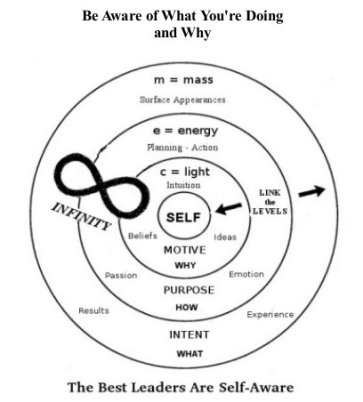
The premier self-management method for linking and balancing the levels of the Wheel is the Motive + Purpose + Intent formula given in Chapter Five. Using the Wheel, you can map out and balance the Why (motives) at the center with the How (strategies/actions) in the middle level and the What (results) on the surface.

With this process, there are always choices. Hence the motto, “Because I can’t change the world, I change myself.” The world is a great motivator. The time to remember and wake up is NOW, while there’s still precious time left!

In the face of daunting odds, there’s comfort in the wisdom of quantum realities. The beating of a single butterfly’s wings can change weather patterns continents away. The same is true of personal change. The long-term effects of personal improvements and good deeds may never be known to the doer. But as a simple law of nature, good karma returns over time, exponentially.

Corollary E: Unity is accomplished through personal effort, one person at a time. Attempts to enforce global unity through world organizations operating at the surface of the Wheel are unnatural, unrealistic and no matter how seductively presented, “scary bad.”

Corollary F: Numerous authors have written about to the necessity of changing from the inside out. They include, but are not limited to, Stephen Covey, Jon Kabat-Zinn, Jim Loehr and Tony Schwartz, Dr. Phil McGraw, and Julie Morgenstern. The Positive Paradigm Handbook is a useful compliment that gives a memorable picture of the dynamic process which they advocate.

globe

Use the Wheel as a Linguistic Tool

According to AXIOM SIX, “Used as a Linguistic Tool, the Positive Paradigm Wheel Promotes Clear, Accurate and Effective Communication.”

Like humanity itself, the English language is an endangered species. Clear and effective communication can no more be taken for granted than any other aspect of the civilization.

In tracking the meanings of words, their devolution is found to be systematic. In some cases, the same word means not only one thing, but its exact opposite as well. The inherent danger is that people often talk at cross-purposes. They think they understand each other when in fact they’re missing each other coming and going, only vaguely aware of the disconnect.

It’s well worth taking the time to pay attention to what’s meant by specific words in common use. Working with the Positive Paradigm Wheel explains the dynamics of shifting definitions. The same word takes on different meanings at different levels of the Wheel.

Here is one example of how the single word “discrimination” changes meanings depending on where in the Wheel it’s used.

Discrimination.sized

Another example is the word “positive.” Webster’s Dictionary lists seventeen (!) different uses. They span the continuum from center to surface, with many gradations along the route. At the core, “positive” refers to that which is absolute, unqualified, and independent of circumstances; that which has real existence in itself.

At the middle, energy level, the term is used describe an electrical valence. As an attitude, positive can mean either confident or dogmatic. At the surface, positive may mean showing forward progress or increase, making a constructive contribution.

As this one example serves to indicate, it’s extraordinarily difficult to communicate so as to be understood as intended. The “Tower of Babel” factor issue is addressed both in Rethinking Survival and Conscience. This excerpt represents ongoing concerns:

The Tower of Babel Factor

The gift of language sets humans apart from animals. It provides the building blocks of communication. It’s the foundation of civilizations and the necessary glue of cultural continuity.

That being said, humans are the only creatures capable of using language to rationalize greed, lie to others about their actions and deceive themselves. . . .

That’s was quite the opposite of the language I’d learned to love and respect in high school. There, we were taught to regard language as the premier tool of logic. When used with Sherlock-like diligence, applied the powers of keen observation and heightened awareness, it could solve mysteries — not only to detect the crimes of evil-doers and the nefarious plots of national enemies, but to reveal the mysteries of life and the universe.

Turned inwards, used with self-honesty, language becomes an essential means of introspection and cultivating self-awareness. For the truth-seeker, language is the necessary vehicle of information both on the inward quest and on return journey to share its benefits.

“Leadership” and the related concept of “power” are two words whose meanings require careful attention. They shift depending on the level that they’re associated with. “Power” is a word often associated with “lust” and “abuse.” But it’s also a key component of “democracy” defined as “power to the people.”

At the center of the Wheel, all-powerful is an attribute assigned to God the Creator. Omnipotent. At the middle level, power is associated with energy. High-energy people are said to be magnetic. Attractive. Sexually potent. Forceful. Vigorous.

Socially, towards the surface, powerful people are influential. Effective. They tend to dominate others and control material resources, whether formally (institutional authority) or informally (behind the scenes).

Lao Tze’s Tao Te Ching, translated as The Way and Its Power, hints at the possibility of linking the levels of power. Failing to do so results in dangerous either-ors. For example, a leader whose power depends on controlling material resources, but who has neither compassion for others nor a viable connection with the center, is likely to rule as a tyrant, bringing poverty and misery to unwilling subjects.

A leader who holds the power of middle level charisma over followers may dazzle. However, cult leaders whose connection to the center is unstable (claims to the contrary notwithstanding), can seduce, but not truly lead from darkness to light.

Those whose connection to the center is secure, but whose grounding in the practical skills of day-to-day governance is tenuous, are also incomplete and undependable as leaders. Regardless of how inspired or well-intentioned, they may be forced to rely on staff who are less than loyal or honest, and find themselves undone because of misplaced trust.

Ideally, the true leader links the levels, balancing enlightened vision with compassion, charisma and practical administrative abilities. Plato recommended the total leadership of a philosopher-king, and training aspirants to be equally competent on all levels of the Wheel, able to integrate and balance them.

It’s especially important to define another pair of complimentary words. “Virtuous” and “moral” are often used interchangeably, with misleading results. Technically, “virtue” is an energy concept best used in the context of the middle level of the Wheel. In Traditional Chinese Medicine (TCM), compassion is a composite of complimentary virtues that includes empathy, courage, kindness, calmness, gentleness, and joy.

Each of the virtues is associated with a specific internal organ. When circulation is unobstructed and the internal energies are full and balanced, the mind is clear and virtues are present. When the circulation is blocked or stagnant, in excess or deficient, negative energy expressions present themselves as toxic emotions: anger, fear, cruelty, hate, anxiety, and grief.

Virtues are natural and inherent. They’re common to everyone, everywhere. The potential for positive expression of the virtues is primarily a function of good health, meaning, in Positive Paradigm context, unified wholeness. Conversely, the opposite, negative expressions (vices) are the result of poor health. Appropriate responses for healing them rest with medical interventions, not judgmental social sanctions.

In contrast, morality is a social construct, a relatively superficial layer of cultural conditioning that may or may not be compatible with the expression of deeper, inherent natural energies. Moral codes vary from place to place, and shift over time. Codes of conduct in subcultures, from medical and religious to military and underground gangs, are uniquely context-specific.

Some would say that moral codes are useful, even necessary for maintaining order within a social unit. However, when they’re enforced with harsh sanctions, including an unwholesome admix of self-interest, self-righteousness, and hypocrisy, they’re at best a mixed blessing.

It’s possible to be moral without being virtuous, and vice versa. It’s instructive to ask, How moral are we, and by what standard(s) of conduct? What about our leaders? If there’s a disconnect between virtue and morality, what are the consequences? What’s to be done about it, by whom?

globe

Corollary A. Using the Positive Paradigm model as a standard, the current worldwide leadership deficit and related budget deficits can be explained and (with good will and training) corrected.

Corollary B: In Positive Paradigm context, “good” and “evil” (as well as “friend” and “mortal enemy”) are defined in terms of those who honor versus those who violate or even intentionally tear the universal pattern of life apart. By this standard, those of good will in every land are friends of truth, while evil doers, whether at home or abroad, are the common enemies of humanity.

Corollary C: Politicians who would set nations against each other and who flirt with nuclear holocaust for the sake of petty ego satisfaction and personal power are evil-doers. Even when they cloak evil actions in moral terms, their rationalizations are a danger to us all. The ultimate good requires unmasking their double speak and rescuing the language in the interests of human survival.

Corollary D: Just as the basic genetic structure of all mankind stems from a few original strands of DNA, universal ideas and archetypes are inborn and inherent to our psyches. They’re not restricted by political or national boundaries.

The basic axioms of the archetypal Positive Paradigm pattern and its use as a clarifying linguistic tool offer a foundation upon which to build upon a common sense discourse, reestablishing the universal basics common to everyone, everywhere.

Corollary E: The Wheel gives us a model for redefining love, authority, science, crime, stress, and a host of other key concepts whose meanings are con-fused (lumped together inappropriately), making it difficult to communicate. The 64 Essays on Change in Conscience are a start in this direction.

Corollary F: The chief strategy of the “alien invaders” described in Rethinking Survival is to paralyze the populace by polluting the language and corrupting the paradigms. They prevent people from recognizing the difference between true friends and enemies, between true dangers and boondoggle distractions.

Restoring the Positive Paradigm to general use now is a powerful way to undo this damage, forge better alliances, and prepare to meet whatever dangers are to come.

globe

Where in the Wheel Are We NOW?

Utopia.sized

Comments on my last post, A Philosopher’s Response to Boomer & Millennial Blogs, are the logical springboard to a series. This the first installment.

Jerry Pociask (Life Coach | Inspirational Mentor | Author | Speaker) remarked, I have seen this diagram many times in the past.

Of course. This archetypal, mandala structure repeats in every civilization throughout history. It’s a map of the basic internal dynamics that make everyone, everywhere tick. It’s present throughout the records of cultural anthropology and embodied in the creation stories of the world’s enduring religions.

What IS news here is that this perennial diagram is also the stuff of modern physics, as well as the foundation of an inclusive Self-Awareness psychology. Rethinking Survival correlates this universal pattern with both the ancient Chinese Book of Change and Einstein’s famous formula of energy conversion.

It describes the universal pattern:

The Positive Paradigm’s Synthesis Wheel mirrors the micro-cosmic structure of atoms as well as the macro-cosmic structure of planetary systems. At the microscopic level, its concentric rings mirror the structure of atoms around a nucleus. It equally mirrors the symmetry of the planets orbiting around an organizing star, the sun. On the largest scale of magnitude, it reflects the in- and out-breaths of perpetually expanding and contracting universes.

This familiar atomic structure repeats smallest to largest in the patterns of nature, from snow flakes and intricate flowers to spiders’ webs and sea shells. Similar symmetrical patterns repeat worldwide in the art of every culture — including the prayer wheels of Native Americans, the colored sand mandalas of Tibetan Buddhists, the stained glass windows of European cathedrals and the intricate geometrical patterns that cover Muslim Mosques, to name but a few.

They offer proof of the universal awareness of a central inner reality, of an inner structure common to all humanity — a continuity of experience deeper than individual lives or transitory cultures.

This structure continues to take on new expressions to meet the unique needs of immediate times. Today is no exception. Star Wars and the Indiana Jones movies are examples of how a timeless fascination with the war between good and evil is being retold using modern technologies. Today, a worldwide audience relates to archetypal adventure stories reenacted by dynamic action heroes.

Similarly, The Positive Paradigm Handbook gives new clothes to the timeless perennial philosophy. It is intentionally designed to meet the needs of decision-makers in every walk of life. Its practical methods and examples show how to personalize the timeless pattern, first bringing one’s individual life into alignment with the universal pattern and then restoring harmony to a chaotic environment.

For example, the universal pattern has been modified to use as a method for restoring mindfulness to the decision-making process. It emphasizes the critically important relationship between self-awareness and effective leadership.

Be Aware.sized

The Life Wheel in pristine form is complete. The levels are all present, correctly prioritized, and in balanced proportion. Were our lives so complete, we would be called “perfect.” Were our society equally whole and balanced, it would be called “Utopia.”

Few of us are there now. Although originally created in the image of the Creator, as a consequence of our own choices and actions over a very long time, our personal Life Wheels have become fragmented and “bent out of shape.” Like Dorothy stranded in the Land of Oz, our dearest, deepest wish is to find our way home again.

Getting there requires a map, methods and proactive discipline. Converting the abstract Wheel into a practical diagnostic tool is a first step. The self-healer can use it to diagram the immediate situation, design a better future, and then decide on the steps necessary to get from here to there. Initially, the levels and sectors of one’s own life are drawn into a Wheel template. Then, taking a sequence of steps one-at-a-time leads towards the experience of an increasingly full and satisfying life.

For example, here is the diagram of an intermediate Life Wheel. It pictures the “state of the art” of an individual whose life is a work in progress. The X at the center represents the conviction that there is no God. The possible existence of a vital center has been ruled out. The innermost level of light (intuition, guidance) is therefore missing.

fagmented

Nevertheless, this improved personal Wheel a represents a major step forward from the starting point. New sectors have been added. Excessive focus on the Professional sector has been reduced and brought into relative balance. The sliver of a missing Family sector has been restored to the picture. An honest NO to the question of whether life is experienced as fulfilling has resulted in the decision to expanding the Entertainment sector to include time for self-improvement.

Redrawing the map can become a daily morning discipline. Ask yourself, “Where in the Wheel am I NOW?” And, if you don’t like it, “What am I willing and able to do about it NOW?”

In addition, however, there’s plenty more work to be done. This is just the tip of the iceberg of what’s possible.

Jerry Pociask’s comment hints at what’s next. He concludes, The diagram can be applied in so many ways . . . unfortunately it probably isn’t available on mobile phones!

That’s where I’ll begin next time.

Human Survival Cannot Be Taken for Granted

Utopia.sized

AXIOM FIVE of the Positive Paradigm states, “History Is Neither Progressive or Linear, Nor can Human Survival Be Taken for Granted.”

This concept runs deeply against the grain of progressive beliefs. It’s so apparently threatening to even consider that many are unwilling and/or unable to wrap their minds around these basic facts. However, denial doesn’t change what IS. It only leaves the fearful unprepared – unable to make the in-formed, correct decisions necessary to meet and survive immanent dangers.

The dangers are no surprise. Einstein warned, “We will require a substantially new manner of thinking if mankind is to survive.” In answer to his call, the methods included in the Handbook embody that substantially new manner.

Survivalists have warned of a Near Extinction Level Crisis (NELC). Some say it’s already under way. We’re already in its midst. Others speak of a catastrophic “deep well die off.”

Be that as it may, in Positive Paradigm context, some things never change. Others do. Knowing the difference between absolutes and ephemerals is a matter of life or death. The center of the Wheel is changeless. Those in the know depend on this. But the Wheel’s rim spins in endless circles of repeating, patterned change. Therefore, survivors anticipate the predictable, cyclical changes of nature.

They know far better than to take immediate appearances at face value. They’re not fooled by wishful thinking into the false belief that what can be seen is permanent.

Lao Tze, author of the world-loved Tao Te Ching (The Way and Its Power), knew this and tried to warn the world. Sun Tzu, Chinese author of The Art of War — a manual used by successful military leaders for hundreds of years — taught savvy strategists how to exploit the knowledge of human dynamics to win their battles.

Today’s international business leaders have adapted this wisdom, as well as spin-offs like the 36 Stratagems, not with an eye to human survival, but only to capture markets, maximize corporate profits and beat out the competition.

These various texts all draw on the wisdom encoded in the Chinese I Ching, the venerable Book of Change to steer the decision-making process. They rely on applications of the laws of subtle change to stay ahead of the curve. Knowing that surface appearances are deceptive can be used either as a protective, self-defense measure or as a means for taking advantage of the less informed.

Those who love life and take human survival to heart have passed on the basics of how the world really works to those with ears to hear. In contrast, others hoard this knowledge as if to prosper themselves at others’ expense. They deny or even ridicule it, keeping perceived enemies “in the dark” to prevent their success.

In the dark ages, Europeans were taught to believe that the world was flat. The fact that the globe of spinning Planet Earth is in fact round was received as life-changing information that dramatically changed the way people thought and lived.

Similarly, today some still continue to think of history as a flat, perpetually forward-moving straight line. But they are as sadly mistaken as were the ancient seafarers who guided their ships on the assumption that the world was flat.

In fact, the dynamics of human history resemble a multi-layered clock whose second, minute and hour hands continuously return to the same starting point at different rates of speed. Rethinking the paradigm of history to align with known facts would give future leaders an edge on survival.

compass clock

Hegel and Marx had a partially correct, but disastrously hollow view of historical change. They pictured it as a rectangular-shaped grandfather clock with a pendulum that swings back and forth, repeatedly moving right and then left of center.

Their concept of a dialectic prescribed an eventual synthesis of both sides in an upwardly moving, progressive direction. The partial truth in this model is obscured by its inaccuracies and politically destructive applications.

It’s important to note that the interrelated, interconnected fabric of life pictured by the Positive Paradigm Wheel isn’t limited to this particular planet or even one solar system. As a universal model, it literally has applications to how the universe, or even multiple universes, work as well. This possibility is not completely foreign to our human history.

For example, the Anastazi, a highly sophisticated culture of eco-savvy cave dwellers located in Mesa Verdi, Colorado, thrived and then mysteriously disappeared. Like the Inca civilization located in Peru, and ancient Egyptians who built the pyramids, their detailed and accurate understanding of astronomy led archaeologists to conclude that they came from, were in correspondence with, and might eventually have returned to destinations far beyond Earth.

Just as humans continue to navigate their ships in the waters of Earth’s oceans, there may have been — and may again be — times when star travelers operate on paradigms that allow them to travel the oceans of distant space. The wheel-shaped Star Gates of the science fiction series by the same name are suggestive of imagined (or carefully kept) secrets.

In sum, there’s far more to human origins and history than people dream of. Science fiction teases us to think outside the limited historical paradigm. There’s truth in supposed “fiction” that would enrich our possible futures if we use it to expand our knowledge paradigm to match the facts of what has been and could yet still be.

globe

Corollary A: The seasonal, cyclical model of history applies equally to personal lives and the dynamics of organizational and even dynasty life-spans. Knowing the current time, as well as the direction in which its going, is important information to be taken into account in any decision-making process.

Corollary B: Just as the hour hand returns to its beginning point and then continues on to start the next hour, our lives do not end with one span, but continue on. This accords with metaphysical and religious views on reincarnation and immortality. These are not mutually exclusive beliefs. Reincarnation occurs on the surface of life’s wheel, while immortality resides at its center.

Corollary C: Facing the prospect of human extinction may be threatening. But refusing to consider and act on the possibility doesn’t make the danger go away. It renders us unprepared to meet and mitigate danger, preventing the possibility of re-charting the course of history for the optimal use of available options.

Keeping the subjects of magic and space exploration secret, relegating them to the genres of so-called fantasy and science fiction is form of denial. It limits our options for meeting whatever is to come fully and optimally prepared.

When life transitions are anticipated and wisely prepared for, they can be faced without fear and navigated successfully. Elizabeth Kübler-Ross’ research on death and dying has equally useful applications to both individual experience and the history of civilizations.

Corollary D: Nothing on Earth lasts forever. Accomplishments in the fields of science, humanism and spiritual enlightenment cannot be taken for granted. In Positive Paradigm context, the creative source resides eternal at the center. While there’s evolution on the outward path, there’s also the opposite and equal potential for devolution on the return path. This includes not only physical dis-integration, but also corruption. This leaves savvy leaders with important choices to make, for themselves as well as the followers who depend on them.

Corollary E: An apparent death sentence makes time remaining all the more precious. In biblical terms, awareness of impending disaster is motive and opportunity to repent (meaning to change one’s heart and ways), and to atone (meaning to realign with the center), using the gift of whatever time is left gratefully, wisely and well.

Some will actually defy medical/historical prognosis and survive to carry on, whether it be here, in other dimensions or even different universes. (Science fiction fans of TV’s two-hearted, regenerating time traveler Dr. Who are well-acquainted with these possibilities.)

globe

The Law of Karma Is a Key to Success

AXIOM FOUR of the Positive Paradigm is the practical foundation of functional ethics. It states, “Consequences of Actions Are Inevitable; Those Who Respect the Law of Karma Succeed.” Were it taught earlier in schools both public and private as the survival basic which it is, today’s world would be very different indeed.

For in an exclusively materialist, linear worldview, it seems possible to “get away with murder.” Unethical leaders mistakenly continue to act on the false premise that they can avoid the consequences of their actions by hiding selfish motives and evil deeds behind a mask of false appearances.

But ultimately, they deceive no one but themselves. (Remember the fate of ponzi racketeer Bernie Madoff and his two tragically unfortunate sons?)

Oscar Wilde’s Picture of Dorian Gray dramatizes the horrific consequences of hiding hideous deeds behind an unnatural mask of eternal youth and physical beauty. Just as Dorian comes to an awful end, in the circular and richly textured fabric of the Positive Paradigm worldview, attempts at evasion and deception are ultimately futile. The concept of a “perfect crime” is an oxymoron.

0 Axiom 4

The Old Testament describes the karmic law of return in agricultural terms. “As ye sow, so shall ye reap” and “For everything there is a season. . . ”

In modern parlance, the saying that underscores the circular dynamic of poetic justice is, “What goes around comes around.”

In the New Testament, Jesus speaks the Law of Karma as practical advice: “Do unto others as ye would have them do unto you.” This rule holds true as axiomatic. It has been observed for a very long time that in fact — even if not immediately, or directly — what is done does, for better or worse, returns in kind.

This code is neither self-righteous nor moralistic. It’s simply a practical fact, an observable law of nature. Because we are all interconnected, good deeds return exponentially, while harm intended becomes harm received.

There’s nothing personal about the Law of Karma. It’s simply how the world works. The dynamics of natural law are similar to computer logic. “If this, then that.” If one respects life and treats others with kindness, then others are likely to respond with gratitude. If one disrespects others, then all but wisest will feel threatened and react with fear, hatred and vengeful retaliation.

This is good news for those content to do the right things for the right reasons. It’s exceedingly bad news for those who choose to intentionally hurt and harm others, whether for immediate financial gain or petty ego-satisfaction.

It’s also incentive to become as knowledgeable as possible about the natural law encoded in the Book of Change. For the more deeply one understands the operations of this law, and the more skillfully they’re applied, the more likely it is that success will follow wherever attention is focused.

The law holds true for relationships on every level and in every avenue of daily life. Family members who honor the law bring blessings upon their loved ones as well as themselves. Those who are ethical in the conduct of their business and political lives succeed accordingly.

This dynamic is central to martial arts and the conduct of war. At the middle level, there are no reservations attached to energy manipulation. In a vacuum, out of context, motives are irrelevant. The playing field is open to all who know the territory.

To the extent that we’re not conscious of the energies that drive us at this middle level, we’re easy prey to behind-the-scenes puppet masters. American journalists see U.S. politicians’ abysmal ineptness at this level (in contrast to their Russian and Chinese counterparts) as putting Americans in grave danger.

Those who go with the grain, being truthful and trustworthy in their words and deeds even (and especially) when the going gets rough, find life ultimately abundant. Those who choose to go against the grain, preferring to get whatever they want however they can get it with as little effort as possible, find the opposite.

The popular riddle asks, “Why do con artists do shabby work, charge unreasonably high prices, and get away with murder.” The cynical answer: “Because they can.” However, this cynical half-truth tells only part of the story.

They can, because there’s free will. They can, because they’re ignorant, or else incredibly stupid. Choices have (all too often unforeseen) consequences. Whether one believes in God or not, whether one respects the natural law or chooses to be blind to it, these consequences are the same. In modern parlance, “Do the Crime. Do the time.” Or, as it’s also said, “Pay back is a bitch.”

Punishment for unrepentant wrong-doing can take many forms. The consequences of breaking human laws include fines. jail-time, and in the extreme, death. Over time, retribution for violating the natural law is visited in many forms, from mental or physical disease, to personal, professional or financial misfortune

Consequences of misdeeds often return on the psychological level. Carl Jung, the Swiss analyst who popularized the concept of archetypes, also wrote the introduction to the Wilhelm/Baynes version of the I Ching. He noted the unintended kickback from rejecting the basic axioms of religion and natural law with mere reason. There are consequences not only for decision-makers, but also those they influence.

In sum, Jung noted that modern thinkers have made a fatal mistake. The facts of inner life can’t be driven out of existence by arbitrarily banishing them from the decision-making equation. Saying God doesn’t exist doesn’t make it so. It just leaves the unbeliever at the disadvantage of being cut off from the center.

According to Jung, denying the facts of inner life has the effect of burying rejected aspects of the whole in the “unconscious,” where they continue to reap havoc on our daily lives. Politicians and journalists under the influence of unacknowledged emotional demons “unwittingly let loose psychic epidemics on the world.”

globe

Corollary A: Free will allows that no one’s fate is irreversibly cast in stone. Destiny is the result of many choices made over a very long time. But even at the eleventh hour, consistently better choices can ameliorate and redirect the outcomes of history, on a personal and on up to national levels. The Law of Nature allows that everyone can change. This is the eternal and best hope of even the seemingly worst among us.

Corollary B: The intricate workings of karma are unfathomable to the human mind. Asking why events happen is productive only insofar as it’s instructive as to how personal beliefs, attitudes and behavior can be improved to generate better results. Then, the most practical question to ask is, “What is the best way to respond to immediate events now?”

Corollary C: It’s best to forswear ignorant meddling. Life is infinitely complex. Humans can’t possibly fathom the far reaching effects of their actions. The best results come from listening to and acting on conscience without imposing selfish ego.

Corollary D: The atheist uses personal suffering as proof that either God does not exist, or that God is so cruel and unjust that this being deserves no trust, respect or allegiance. The answer is, that human suffering is a consequence of consistently poor choices made over a very long time. The opportunity inherent in suffering is to take responsibility for making better choices, beginning with an acceptance of and realignment with the basic axioms of life.

Corollary E: The Law of Karma operates without exceptions. Ignorance is no excuse. Violate it only at your own peril. Nature and Nature’s God cannot be fooled or circumvented. There’s no way to cheat. Nature can’t bet bribed. Conscience can’t be bought off.

Corollary F: A best-selling shaman book advises that it’s okay to go full bore after whatever you want. If others get in the way, it’s their problem. If they hurt you, it’s your fault for letting them. His answer to God, like Cain’s, is, in effect, “Am I my brother’s keeper?” Implying, “No way.” But in Positive Paradigm context, the correct answer is, “We’re more than our brothers’ keepers.” We not only share the same seed origin in common. We’re inextricably connected. The pain and suffering we inflict on others returns, magnified, as our own – as do the kindnesses we compassionately provide along the way.

Corollary G: Justice belongs to the Creator, the all-seeing eye and all-knowing heart that resides at the center of the Wheel. Since everyone’s misdeeds are accounted for, there’s no need for revenge. Why try to even the score? It’s already been taken care of. Besides of which, who are we as short-sighted mortals to presume to judge? It’s far more beneficial to focus on personal karma and dharma.

globe

Unity & Diversity Are Necessary Compliments

AXIOM THREE of the Positive Paradigm of Change is now “Unity and Diversity are Necessary Compliments.” Although the idea isn’t necessarily fun or sexy, understanding this essential relationship will significantly improve the quality of both your personal and professional life.

Taken out of context, the second axiom is subject to distortions and misunderstandings. Resulting confusion can generate conflict in family relationships and on, all the way up the life chain to conflict amongst nations. That’s why Axiom Three is an such important extension of the second.

According to Axiom Two, “We are Each a World Complete, Containing the Potentials of the Universe.” This inherent inner similarity is the realistic foundation of common understanding. However, the fact that we each have the same inner structure does not mean that everyone is identical and that we should act as if we’re all the same.

Like snowflakes, humans are identical in their basic structure. Each, however, is a unique expression of the universal pattern. Personal abilities and needs are the result of an infinitely complex set of variables.

And just as an integrated balance of energy centers is necessary to the overall health of an individual, a balance of complimentary abilities and interests promotes the general health of society at large.

We share the potential for perfection in common. However, in balance, innate potentials are filtered by cultural conditioning. Each of us has an overlay of education and personal experience which tends to distort and even mask that common core.

Each of us has a long history of decisions, not all of them good. We live with the consequences of past actions as well as our hopes for the future.

Further, while our inherent structure is identical, within the evolutionary chakra scale, at any given time and place, most individuals are narrowly focused on only one or a small combination of the seven centers and their specific issues. The roles which meet our immediate learning needs and simultaneously best serve the whole are the outcome of these combined influences.

Bottom line: diversity on the surface is an inevitable, necessary and beneficial compliment to unity at the center. So long as the levels of the perfect pattern are understood and correctly prioritized, there is no conflict between unity and diversity.

0 Axiom 3

When the levels are not prioritized, problems follow. Unity at the surface — meaning regimentation, uniformity and coerced one-size-fits-all thinking — is antithetical to life, just as diversity is at the center is impossible.

So it’s essential to prioritize the levels correctly. Be clear and correct about what is absolute and unchanging. Conversely, worldly success depends on accepting what is ephemeral, non-essential, subject to change and short-lived for what it is . . . and is not. Recognizing the difference is critically important to maintaining both personal and institutional stability.

For example, when alliances are formed on the basis of surface appearances — whether it be immediate self-interest, perceived attractiveness, race, gender, age or other biological markers — the connection is weak and likely to be short-lived.

In contrast, relationships remain stable when they’re based on a personal connection with the unchanging, universal center – that which everyone shares in common and upon which everyone depends. They withstand the tests of time and prove to be mutually beneficial.

For eight-thousand years and counting, Chinese sages operated on an understanding of how the world really works based on The Book of Change. This explains the longevity of dynasties which were steered in alignment with the fundamental axioms of change.

To the extent that ancient societies understood and were governed in accordance with the universal pattern, their leadership choices mirrored this organization. At the family level, the leadership role of the biological father was regarded as a natural reflection of the divine pattern.

In increasingly larger levels of organization, in each case the greatest among the group was designated as its natural leader, seated at its center, and entrusted with the grave responsibility of maintaining stability and balance in the best interests of the whole.

Although rarely honored and only imperfectly implemented, the universal pattern pictured in the Positive Paradigm Wheel remains the organizational model which best accords with reality, and has the most likely chance of generating beneficial results.

Just as we dearly need to depend on the center of our personal lives for inspiration, wisdom and stability, we need to be able to look to the leaders in our lives – families, schools, business, and governments – as stewards of our trust.

When leaders at every level, worldwide cannot be trusted to maintain stability or protect the common good, the times grow exceedingly dangerous. In such times, personal balance and ultimately survival depends ever more greatly upon an unshakable connection with the unchanging center within.

globe

Corollary A: The levels of the Positive Paradigm Wheel are interrelated and interdependent. But they are qualitatively different and should be prioritized accordingly.

The surface is transient. Hurt it, and it can heal. Have a bad day, and there’s always tomorrow. This is “the small stuff.” The center, however is absolute and absolutely necessary. “With God, all is possible.” But without a conscious connection to the center, nothing of enduring value can be accomplished. Violate this connection with impunity long enough, and eventually there will not be another tomorrow.

Corollary B: Looking for completion and stability on the surface, where none exist, is a sure formula for disappointment. Creating false expectations and failing to teach realistic attitudes towards inevitable changes on the surface of the life wheel (as well as where to turn for wisdom and solace in the face of life’s disappointments) is bad for mental health and long-term relationships.

Corollary C: Unrealistic, dysfunctional paradigms are the root cause of addictions. When people are cut off from their center or deny their emotional/physical needs, they feel starved. Not knowing why, they turn to substitutes which don’t truly satisfy. When mental escapes aren’t an option, self-destructive alternatives present themselves.

Corollary D: Bigotry, discrimination and violence of every stripe are a function of ignorance in regard to Axiom Three. We are different on the outside, but eternally the same on the inside. Look past appearances which are often deceptive for the foundation of enduring relationships of value.

Corollary E: Reason is necessary but not sufficient. When used to link the material surface with the middle and inner levels of the Wheel, it is a powerful tool. When turned against the life force, elevating itself as if it were the exclusive way of knowing, it presumes to judge what is beyond it. This is hubris, the catalyst of tragedy. Rationality in the extreme changes into its opposite, producing desperately irrational results.

Corollary F: Forgetting (or denying) the existence of a nucleus at the center of our personal atomic structure along with fighting over the illusion of superiority and possession of ephemeral assets is a sure recipe for personal suffering, relationship problems and professional failure. On an international level, it leads to atrocities and genocidal wars.

globe

We Are Each a World Complete

Sadly, Axiom Two of the Positive Paradigm is a little known but important fact of life we never learned in school – but should have. “We Are Each a World Complete, Containing the Potentials of the Universe.”

In large part, The Positive Paradigm Handbook was written as the book I searched for on library shelves during school years, but couldn’t find. It’s now available for others who also sense that there’s something important missing from what we’re taught which urgently needs to be restored.

Hints of Axiom Two are embedded in ancient healing traditions, both West and East. Medical sciences of Europe as well as India and China map mapped subtle inner energy patterns which traverse the spine. Huston Smith (the famous comparative religion teacher) was correct in recognizing what he called an “invisible geometry” which shapes all humanity to a “single truth.”

Here’s that single truth: We are all made (quite literally) in the image of God. Each and every individual mirrors the structure and godlike potentials of the Creator. As miniatures, we each embody the perfect and complete pattern of the Universe. Starting from the inalienable eternal core, it’s possible to generate (as in “genesis”) entire worlds from that center.

But here’s the catch. We’ve forgotten who we truly are. Most of us are sleeping giants. Only a vestigial memory of this ancient wisdom remains with us. It’s ever present, however, as for example in the familiar shield of modern medicine.

Caduceus

The Caduceus is the symbol of the Greek healer-messenger god, Mercury. The central staff represents the spine. The pair of snakes coiling around it represent alternating positive and negative energy currents that link the levels of the spine into a continuous whole. The pair of wings at the top extend from the third eye, the point of divine connection and intuition. All life emanates from and returns to this creative point of origin.

Similarly, in Traditional Chinese Medicine (TCM), subtle energies radiate throughout the physical body in meridians which link and nourish the internal organs. Chi is stored in energy centers (“dan tiens”) which correspond with the upper, middle and lower parts of the physical body.

0 Invisible Geometry

Yoga anatomy details seven major centers where energy (“prana”) pathways intersect along the human spine. They’re named “chakras” (“wheels”), reflecting their spinning, wheel-like dynamics. As detailed in Conscience: Your Ultimate Personal Guide, each of the chakras is associated a with specific level of psychological/social evolution.

In each of these traditions, “health” means “whole.” The health of subtle energetic and related biological systems depends on the integrated balance of the interrelated parts. Each part depends on and completes the whole. The concept of “holism” expresses this worldview.

Positive Paradigm of Change

The Positive Paradigm Wheel is consistent with these medical traditions. The Handbook extracts from these sciences the universal basics most relevant to today’s immediate, survival needs. Its purpose is to restore applications of this wisdom to their necessary, central place in the decision-making process.

Corollaries (applications) of Axiom Two could fill an entire book. Here, for starters, are a few:

Corollary A: This view of human origin and creative potentials is the universal foundation of respect, both for oneself and for others. That all humans are created equal is an existential truth. [What they’ve chosen to do (or not do) with this gift is different subject.]

Corollary B: “To save one life is to save the world entire.” Every human life is a complete mirror of creation. As an integral and necessary part of the whole, each of individual has intrinsic value and is worth every effort to save.

Corollary C: Because light at the center of the Positive Paradigm Wheel is the source of energy, which in turn generates mass, the biblical instruction is good advice. “Seek ye first the kingdom of God. All else follows.” As Stephen Covey puts it, “First things first.”

The first of the Ten Commandments given to Moses in the Old Testament calls for exclusive commitment to conscience. When faced with a conflict over which commandment to obey, again, the first comes first.

When a noisy world tempts away from inner knowing, survival depends on the ability to listen to the still inner voice at the heart of hearts, and having the courage to honor that calling by following through with positive action.

Corollary D: Looks are deceiving. What is visible on the surface isn’t the whole picture. What’s hidden at the middle energy level and deeper still within the inner core are often very different from surface appearances. [Superficial thinkers produce shallow work and are themselves easily deceived.]

Corollary E: Every excess or deficiency is detrimental to health. In extreme, the opposites of spirituality and materialism are equally dangerous to the whole. If any level is neglected, problems are certain to follow.

Corollary F: When the natural thirst for inner light is not satisfied in healthy, life-confirming ways, life becomes blighted. When high energy people are denied confirmation and remain ignorant as to how best to harness their energies, they become vulnerable to the promises of cults leaders, succumb to mental illness or worse.

globe