Tag Archives: survival

What the Generations Share in Common

Before writing on ways Millennials might use an Inner GPS App to decide where they want to go and how to get there, I searched the web for similar posts. There are tons of researched opinions on what Millennials want and need.

Marketers survey Millennials asking what they want to buy, from whom, and why. Business experts list the leadership qualities Millennials need.

But this particular approach is more inclusive. It goes a bit deeper.

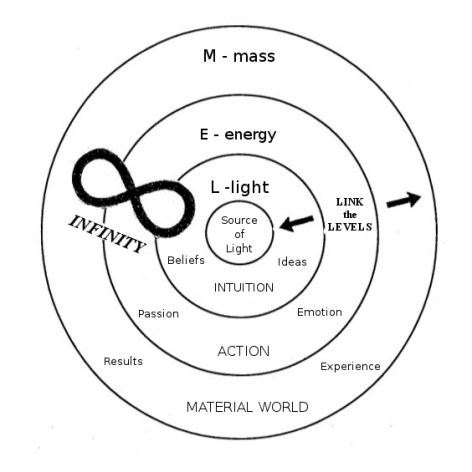
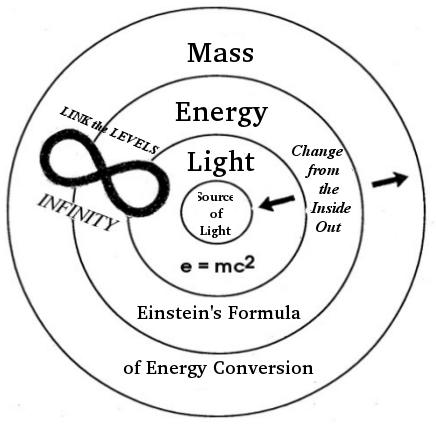
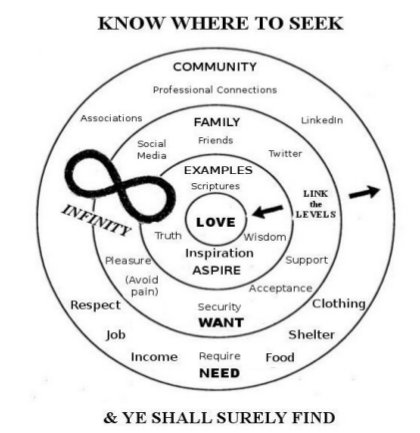
Even in a world gone mad, as members of the human species, our basic wants and needs remain the same. On the surface of the Life Wheel, we all need food, clean water, shelter and clothing to survive. Some sleep also helps.

In a civilized world, we need the means to purchase these basics: income and/or a job. Respect in the larger community also helps.

At the middle energy/emotion level of the Life Wheel, most of us want to be accepted and supported. We want to feel secure. We want to enjoy the pleasures of life and, whenever possible, to avoid pain. In sum, we want to share our lives with fellow human beings.

At the innermost level, we crave answers about the purpose and meaning of our lives. We seek value. The boldest and bravest even aspire to know Truth. We want to know what Love IS. We crave unity, the stuff of Einstein’s Unified Theory, but continue to look for it in all the wrong places. (That, however, is the subject of another post still on the drawing board.)

The question here, however, is Where in a high-tech, polarized world gone mad, where the levels of the Wheel are fragmented and out of synch, can Millennials go to fulfill these universal requirements?

world gone mad.sized

Behind Millennials’ bravado and superficial social masks, their woes aren’t much different than they’ve ever been. The Buddha put suffering in perspective by promising to bring a dead child back to life if the grieving parents could find any household in the local village that had not been visited by death.

But of course, they could not.

The recent public revelation by movie star, political activist and philanthropist Jane Fonda translates universal suffering into today’s familiar terms. Her mother, Frances Ford Seymour, committed suicide at age 42 when Jane was 12. Only recently did the facts come out which led to closure. At age 76, to write her memoir, Jane looked up her mother’s medical records. There she found the key to understanding her mother’s behavior. From age 8, Frances had been the victim of sexual abuse.

Nor has life exempted me. My father, William Kirby West (named for his ancestor William Kirby Brewster, one of the earliest pilgrims who sailed from England to the New World on the Mayflower), committed suicide when I was 6. Since the subject was taboo in my dysfunctional family (a mirror of the dysfunctional society at large), no one told me the truth. I grew up believing my heart surgeon father died of a sudden heart attack at age 33. Only when I was 50 did my failing mother finally “remember” the facts surrounding his death.

This isn’t my only personal story. For example, (if you’ll pardon a bad pun), Swami Rama was one of the first to introduce yoga to the West. His front was that a celibate monk who’d taken vows of poverty. But appearances were deceiving.

Behind the scenes, he was a bold-faced hypocrite, liar and sexual predator who betrayed the trust of his students. A Yoga Journal author called his abuse of Tantric teachings “spiritual incest.” Translate: rape. In the hands of this opportunist, the teachings (a priceless heritage) were a convenient “product” that thirsty, naïve Americans wanted. He used them to make himself (for a short while) very rich and somewhat famous.

Oh well. “Something’s lost but something’s gained in living every day.”

The point here is that I haven’t allowed the slings and arrows of outrageous misfortune on the Wheel’s surface to define me. Instead, I’ve chosen to live by my mottos. First, “Take the best. Leave the rest.” Second, “Resist not evil. Persist in the good.”

I’ve repeatedly healed – made myself whole again – thanks to my inner apps (in this case, based on the King James version of The Bible and the Chinese Book of Change). I trust that nothing that happens on the surface can touch or change the essence of who I truly AM.

This blessing, the Inner App, is what I would love to share with millennials, as well as the parents and grandparents who dearly wish them well. It necessarily starts with a complete and correct reality map that puts the whole of life into perspective.

Here’s a picture of universal needs, wants and aspirations and the ways many millennials seek to fill them:
MILLENIALS.sized

An aside to millennials. The world of hurt we’re in today was foretold by Christ and foreseen by yogic seers long before that. It has been a long time coming. Today’s mess cannot be taken personally. Nor is it appropriate or helpful to blame your elders. (If you believe in karma, consider that, even if for reasons unknown to you now, you’re the one who picked the time and place of this particular incarnation, maybe to fulfill an important purpose).

Be that as it may, put things in perspective. You think your elders let you down; but they were equally disappointed by theirs. On the opposite side of the coin, each generation of elders continues, for the most part, to sincerely do the best they know how, often in the face of terrible odds.

So let’s cut each other some slack.

Millennials as well as their elders are welcome to come aboard the Inner App project. After all, it’s in everyone’s best survival interests.

For if we taught ourselves to think holistically, in concentric circles, and if we organized / prioritized our lives accordingly, we’d begin thinking like Einstein, like geniuses.

If enough of us tuned in to the universal inner compass and began treating each other with compassionate respect, we’d fulfill Einstein’s dearest wish and start getting along. It might even tip the balance of history in favor of human survival.

Because that truly is what’s at stake.

globe

An Inner Compass App for Millennials

In a LinkedIn post, MC wrote We’re strongest when we stand together.

I agree whole-heartedly. So here’s a high value, practical project which tests our mutual willingness / ability to push past apparent differences and take a common stand. Together, we have a unique and powerful opportunity to bridge the generation divide in a way neither of us, separately, can.

The project idea was confirmed by a response made by Tom Richards [Brand Builder for Bass and Guitar Manufacturers] to my earlier Response to Millennial and Boomer Blogs.

For starters, Tom wrote, My metaphor is the map.

Yes. The map is my metaphor too. From Rethinking Survival:

Chances of success in life are slim to none without an accurate reality map. It’s imperative to have a complete picture of your potentials along with a correct understanding of the world around you, and what’s required to survive in that world.

Basing decisions on a worldview that’s distorted, incomplete or otherwise out of synch with the way things really are seriously diminishes chances of survival. In times as dangerous as these, it’s more important than ever to make sure you’re operating on complete and correct information.

Intellectual smarts and material resources on the surface of the Wheel aren’t enough. Lacking competence at the middle, energy level of the Wheel (street smarts) and a functional connection with the inner core (conscience), you can’t get from here (a world in desperate need of positive change) to there (the better world we passionately long for).

However, without an in-depth, comprehensive awareness of what change (natural vs. man-made) is about, and — most importantly — the unchanging creative source of all creation, it’s nigh unto impossible to achieve the personal and social change everyone wants, many promise, but few succeed in achieving.

Moving along. Tom complained, This generation looks for an app to tell them how to go. They do not even attempt to learn directions, understand where towns are in relation to each other, do not ever attempt to really learn their local surroundings, or how to navigate without the old GPS.

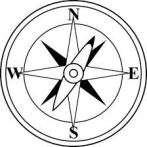
Earlier, I placed the seafaring navigator’s compass at the core of concentric circles to image the inclusive, universal nature of the Positive Paradigm. It correlated this technology with Einstein’s beloved compass and his plea to live by the all-encompassing inner compass of compassion which everyone, everywhere shares in common.

Inner Compass.sized

But, as Tom continued, My step-daughter refused to listen to me when I told her she needed to learn how to read a map and basic orienteering skills to navigate with it. She stated she had a GPS and an app.

I wrote The Positive Paradigm Handbook to supply a user manual for successfully navigating the ultimate reality map. It’s seven basic axioms translate roughly as “The Operating Rules of the Game of Life.” Mercy abides at the center of the wheel. The dog-eat-dog Law of the Jungle often prevail on the surface. But what most of us are missing is the middle link between those extremes: the Law of Karma – translate as the Law of Consequences. Those who live mercifully receive attract mercy to themselves. Those who live like animals die like animals.

Lao Tze, who knew a great deal about Natural Law, put it this way:

There’s always a terminator who destroys.

There’s always a place in nature’s plan for predators

who prey on the weak and defenseless.

However, those who serve this purpose

rarely escape annihilation.

Those who don’t know the Rules of the Game (or are foolish enough to think they can be outsmarted) inevitably find themselves, like Tom’s Millennial step-daughter, lost and in a world of hurt:

When I got a call from her an hour later because she was lost and the location her GPS gave her was wrong (and actually off by about two miles because of a paper road that did not exist in reality but was in the GPS map) there were literal tears.

In the long-term, most of us would benefit greatly from rethinking our reality maps (paradigms). In the short-term, however, as a useful step in that direction, it would help to go with the flow of available technology.

Earlier, in “Where in the Wheel Are We NOW, I wrote, The universal structure of the archetypal Wheel continues to take on new expressions to meet the unique needs of immediate times. Star Wars and the Indiana Jones movies are examples of how a timeless fascination with the war between good and evil is being retold using modern technologies.

The Positive Paradigm of Change could easily be programmed as a computer game with the structure of cause and effect consequences, featuring all the action drama of the war against good and evil, the hunt for lost treasure, and whodunit mystery.

To bridge today’s generational gap, we need to give Millennials an app that includes a method for mapping their lives — one that confirms and restores access to the ultimate guidance system of their inner Global Positioning System. This app could be used on a daily basis to answer the personal questions, “Where in the World Am I NOW?” And, if it’s not where one intends, “What am I willing and able to do about it NOW?”

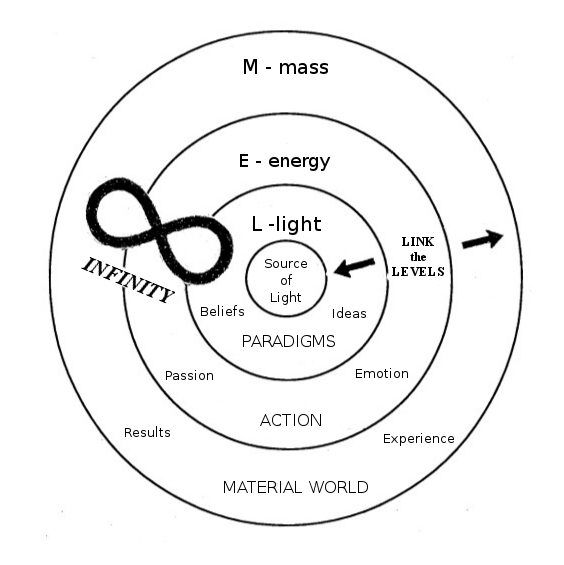
Here is an updated version of the Wheel. The old-fashioned compass has been replaced by the GPS icon (same concept, next generation technology).

GPS.sized

MC, here’s where you and I, by putting differences aside and working together, could accomplish seeming miracles. What I have to offer is a lifetime of truth seeking, as well as a bit of writing. It is the work of a very private person content to live quietly in rural America. But to take this work the next level, it has to be placed it in the hands of future generations.

If you’ll forgive me, it reminds me of an example of teamwork from my undergraduate years at Oberlin College. Sitting around a bar table on a late Saturday night, drinking beer with a group of close friends, my boyfriend told a joke about a chimney sweep. It ended with his throwing a priceless golden brick up into the air. Fritz laughed hysterically. No one else saw the humor. They shrugged and we moved on.

Then it was my turn. I told a joke about a mountaineer who, at the pinnacle of his climb, reached up for a flying object as it sailed past and caught . . . the golden brick. Groans around the table.

The point here is that as a Millennial with peer credibility and social media savvy, you have the ability to access the game-programmer and investor resources needed to develop this Inner GPS app. You also have the proven marketing skills to make it go viral. This is an opportunity to make all the wonderful, valid hopes for positive change you placed in a political election really happen!

I emailed the app article idea and mentioned my intention to invite you on board to PF – the one who commented on your post, saying You don’t need to belong to a group to achieve something of lasting value or temporary glory (if that’s what you’re after), because you are already significant as an individual.

He replied, I like your GPS reference. If MC is a genuine person she may be eager to get on board.

Is he right? Are you in? What about the rest of you?

Oh. In case you’re curious, I’ll tell you. I’m 69 years-old and counting. I was born in August of 1945 within days of the atomic bomb explosions over Japan that blasted an estimated100,000 shocked souls out of their bodies, scattering them screaming, screeching and howling in pain and rage into the upper atmosphere.

My parents were horrified, as was the world at large. Not to mention Einstein, who as a violinist and humanist like myself, was later my childhood hero. I’ve taken his words to heart and made them my motto: “We shall require a substantially new manner of thinking if mankind is to survive.”

Although I’m an early Boomer, I never identified with my generation. MC grew up listening to the music of Boomer parents – Bonnie Raitt. the Stones, Jefferson Airplane and Carly Simon. But I was sustained by Bach, Mozart, Beethoven and lesser knowns including Tartini, Vivaldi and Vitali.

In fact, I have greatest compassion for millennials. I never bought into the dysfunctional paradigms responsible for the dangers of today’s world (and have paid the price). I’ve always thought that, as the ones with the least vested interest in the status quo, they’re the ones most capable of making the positive paradigm shift which might – just might – ensure human survival.

That’s why this maven has summoned the courage to call upon an accomplished connector with ties to the salesman community. Standing together, let’s Tip the Balance of history in favor of a genuinely positive paradigm shift.

One final note. Folks in my household think blogging is a waste of my time. No one is listening. No one cares. I’ve promised that if there’s no response soon, I’ll desist. But I’m betting that millennials (as well as the parents and grandparents who dearly wish them well) will prove them wrong. Like the Nazi-spawned Hydra (if you’re into Capitan America Marvel movies), today’s world leaders may mistakenly think they stand to profit from nuclear destruction of holocaust proportions. But I must trust that We the People won’t allow it.

globe

Use the Wheel to Make Yourself Whole

AXIOM SEVEN of the Positive Paradigm states, “With a Correct Paradigm and Useful Tools, You Can Make Yourself Whole.”

globe

The Handbook’s preface starts with a caveat. Everyone is already intrinsically whole. Put another way, “God don’t make no junk.” This is the wisdom behind the biblical admonition, “Ye must be perfect like your father.”

However, just as Einstein already had the Unified Field Theory but didn’t know it, each and every one of us on the planet is perfect in potential: made in God’s image. But we’ve forgotten.

Worse, many have been deceived into believing they’re inherently not-okay. The Handbook confirms inherent wholeness. Its structure provides a practical, hands on method for waking up. The goal is to re-member (“get it together”) and actualize in-born potential. It initiates the on-going process of making and keeping ourselves FUNCTIONALLY whole, over and over again.

The subtitle Make Yourself Whole Using the Wheel of Change isn’t intended to suggest that this or any other book can magically or literally make anyone whole, or that once through the book, you’re done. It requires not only initial work, but on-going follow-through. It’s personal intention and consistent effort that produce results. This is just a really useful tool.

But it is tremendously important to start this life journey with a reality map that accords with the way things really are. As written in Rethinking Survival:

Chances of success in life are slim to none without an accurate reality map. It’s imperative to have a complete picture of your potentials along with a correct understanding of the world around you, and what’s required to survive in that world.

Basing decisions on a worldview that’s distorted, incomplete or otherwise out of synch with the way things really are seriously diminishes chances of survival. In times as dangerous as these, it’s more important than ever to make sure you’re operating on complete and correct information.

Unfortunately, many have been led to believe, not only that they’re no-okay, but that they have to look outside themselves for permission to be okay, usually at a stiff price. There’s a method to this madness.

. . . tyrants want you to sleep on. They’ll do anything to prevent you from remembering that you’re inherently okay. Because once you do, as Einstein did, no one can intimidate, control or dominate you. You’re aware that nothing anyone has for sale can make you more perfect. Nor can anything that anyone threatens to take away alter your essential okayness.

It’s your inalienable birthright. A given.

The Positive Paradigm is the viable basis upon which to build valid self-esteem. It’s the key to personal freedom — freedom from ignorance, freedom from fear.

It’s the rock-solid foundation of functional democracy. It’s grounds for rethinking what the word really means and how to implement its promise.

One minor caveat: it all depends. While we all have the option to remember who we truly are, most of us are like Lambert, the sheepish lion. It takes a smack with a two-by-four upside the head before we’re finally ready to wake up.

Often it takes the form of life-threatening danger to those we care for. A personal health crisis will also do the trick. So will job loss or a run-in with natural disaster.

But, like Dorothy stranded in the land of Oz, when you want dearly enough to return “home,” you can click your heels whenever you chose — and come to find out, you’re already there.

Useful tools do make a difference, however. Part Four of The Handbook gives examples of putting the Wheel into motion. Part Five supplies instruction on how to modify the Wheel with virtually limitless applications to suit personal interest and needs. Forms supplied in the Appendices help complete the process.

For example, Rethinking Survival shows my personal, evolving uses of the Wheel:

Over time, I began sectoring the circles into quarters, giving it North-South, East-West compass directions. I cut out a single eye from a graphic tiger and pasted it into the center of my template Wheel to represent an all-seeing eye.

I plugged the aspects of my daily life into the model. I chose major categories: work, personal life, social life and public service. I used it to analyze where sectors had changed to take too much or too little space within the wheels, where the layers had grown too thick or thin, or how sectors or levels were coming into conflict.

I repeatedly worked with this information to bring the various demands on my life back into balance, to continuously reintegrate the aspects of daily life.

Later, I found it necessary to break the quarters down into smaller subcategories. The concentric wheels began to look oddly like the twelve-sectored zodiac used by astrologers to diagram the placements and interactions of planetary energies.

I used the model not only to organize the sectors of my life, but to plan for alternative futures. I used it to picture not only where I was, but where I intended to go and what changes were necessary to get from here to there.

Another time, I used the Wheel to record my life history. I used compass North to mark my beginnings. On the surface I noted the date and place of my birth. On the middle level, I plugged in the names of my parents and grandparents. I created new sectors (pie-slices of experience) for each move, from Peoria to Boston to Tucson to Buffalo and so forth.

Inside, I drew significant events and people associated with each time in my life. I used stick figures striding along the surface to represent me in the role I played at that time. I drew happy or sad faces to indicate my state of mind during that particular period.

Personal work with the Wheel over many years has evolved into the inclusive method presented in the Handbook.

globe

Corollary A: The Positive Paradigm of Change is the ultimate answer to the ultimate question, “What is that, knowing which, all else is known?” It’s proof that humans are made in the image of the Creator — the microcosm mirrors the macro. It’s the universal confirmation that everyone everywhere is inherently okay. The purpose of working with the Wheel of Change is to remember who you truly are, to repair the pattern and make yourself whole.

Corollary B: The Wheel can be used to discriminate between absolutes and ephemerals. The “small stuff” goes on the surface. Unrealized hopes, dreams and plans fit in the middle level. Basic commitments are placed close to the center, next to guidance and connection with Conscience.

The Wheel can be used to separate the signal from the noise. Used as a meditative practice, it is a discipline for quieting the mind, withdrawing from draining distractions, eliminating bad attitudes and healing negative emotions.

The Wheel serves to prioritize the levels. By placing first things first, you can see what’s irrelevant and weed it out of the picture. Once Conscience as your ultimate personal survival guide is placed at the center, then everything that gets between you and your conscience is recognized as antithetical to ultimate survival.

Corollary C: Those who’ve done the hard, honest work of mental house-cleaning not only understand themselves better, but also others as well. You can’t leave a place you’ve never been. But once you’re been there and prevailed, you’re in a much better position to empathize with and serve others humanely. Nor can you be easily fooled. Compassionate, skillful leaders/therapists have earned their in-depth worldview through experience.

Conversely, those who block out memories or reject some sectors and levels of experience find it difficult to relate to the needs and experiences of others which they’ve rendered invisible to themselves.

Corollary D: Especially in dangerous times, changing the world is an overwhelming, seemingly impossible prospect. But that’s not your job, nor do you need to be overwhelmed. It doesn’t matter how much is going wrong “out there.” As your primary responsibility, the one manageable unit is the one closest to home: yourself.

The premier self-management method for linking and balancing the levels of the Wheel is the Motive + Purpose + Intent formula given in Chapter Five. Using the Wheel, you can map out and balance the Why (motives) at the center with the How (strategies/actions) in the middle level and the What (results) on the surface.

With this process, there are always choices. Hence the motto, “Because I can’t change the world, I change myself.” The world is a great motivator. The time to remember and wake up is NOW, while there’s still precious time left!

In the face of daunting odds, there’s comfort in the wisdom of quantum realities. The beating of a single butterfly’s wings can change weather patterns continents away. The same is true of personal change. The long-term effects of personal improvements and good deeds may never be known to the doer. But as a simple law of nature, good karma returns over time, exponentially.

Corollary E: Unity is accomplished through personal effort, one person at a time. Attempts to enforce global unity through world organizations operating at the surface of the Wheel are unnatural, unrealistic and no matter how seductively presented, “scary bad.”

Corollary F: Numerous authors have written about to the necessity of changing from the inside out. They include, but are not limited to, Stephen Covey, Jon Kabat-Zinn, Jim Loehr and Tony Schwartz, Dr. Phil McGraw, and Julie Morgenstern. The Positive Paradigm Handbook is a useful compliment that gives a memorable picture of the dynamic process which they advocate.

globe

Unity & Diversity Are Necessary Compliments

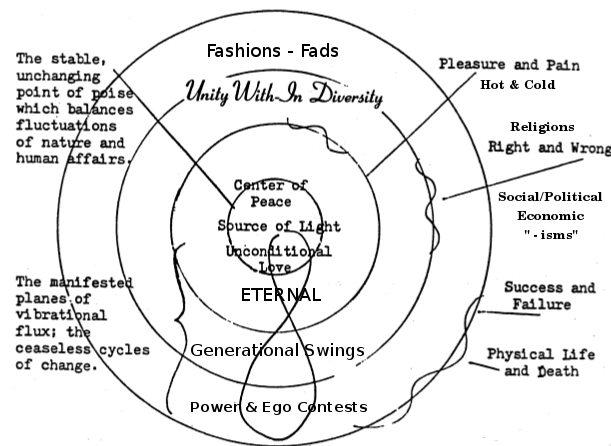
AXIOM THREE of the Positive Paradigm of Change is now “Unity and Diversity are Necessary Compliments.” Although the idea isn’t necessarily fun or sexy, understanding this essential relationship will significantly improve the quality of both your personal and professional life.

Taken out of context, the second axiom is subject to distortions and misunderstandings. Resulting confusion can generate conflict in family relationships and on, all the way up the life chain to conflict amongst nations. That’s why Axiom Three is an such important extension of the second.

According to Axiom Two, “We are Each a World Complete, Containing the Potentials of the Universe.” This inherent inner similarity is the realistic foundation of common understanding. However, the fact that we each have the same inner structure does not mean that everyone is identical and that we should act as if we’re all the same.

Like snowflakes, humans are identical in their basic structure. Each, however, is a unique expression of the universal pattern. Personal abilities and needs are the result of an infinitely complex set of variables.

And just as an integrated balance of energy centers is necessary to the overall health of an individual, a balance of complimentary abilities and interests promotes the general health of society at large.

We share the potential for perfection in common. However, in balance, innate potentials are filtered by cultural conditioning. Each of us has an overlay of education and personal experience which tends to distort and even mask that common core.

Each of us has a long history of decisions, not all of them good. We live with the consequences of past actions as well as our hopes for the future.

Further, while our inherent structure is identical, within the evolutionary chakra scale, at any given time and place, most individuals are narrowly focused on only one or a small combination of the seven centers and their specific issues. The roles which meet our immediate learning needs and simultaneously best serve the whole are the outcome of these combined influences.

Bottom line: diversity on the surface is an inevitable, necessary and beneficial compliment to unity at the center. So long as the levels of the perfect pattern are understood and correctly prioritized, there is no conflict between unity and diversity.

0 Axiom 3

When the levels are not prioritized, problems follow. Unity at the surface — meaning regimentation, uniformity and coerced one-size-fits-all thinking — is antithetical to life, just as diversity is at the center is impossible.

So it’s essential to prioritize the levels correctly. Be clear and correct about what is absolute and unchanging. Conversely, worldly success depends on accepting what is ephemeral, non-essential, subject to change and short-lived for what it is . . . and is not. Recognizing the difference is critically important to maintaining both personal and institutional stability.

For example, when alliances are formed on the basis of surface appearances — whether it be immediate self-interest, perceived attractiveness, race, gender, age or other biological markers — the connection is weak and likely to be short-lived.

In contrast, relationships remain stable when they’re based on a personal connection with the unchanging, universal center – that which everyone shares in common and upon which everyone depends. They withstand the tests of time and prove to be mutually beneficial.

For eight-thousand years and counting, Chinese sages operated on an understanding of how the world really works based on The Book of Change. This explains the longevity of dynasties which were steered in alignment with the fundamental axioms of change.

To the extent that ancient societies understood and were governed in accordance with the universal pattern, their leadership choices mirrored this organization. At the family level, the leadership role of the biological father was regarded as a natural reflection of the divine pattern.

In increasingly larger levels of organization, in each case the greatest among the group was designated as its natural leader, seated at its center, and entrusted with the grave responsibility of maintaining stability and balance in the best interests of the whole.

Although rarely honored and only imperfectly implemented, the universal pattern pictured in the Positive Paradigm Wheel remains the organizational model which best accords with reality, and has the most likely chance of generating beneficial results.

Just as we dearly need to depend on the center of our personal lives for inspiration, wisdom and stability, we need to be able to look to the leaders in our lives – families, schools, business, and governments – as stewards of our trust.

When leaders at every level, worldwide cannot be trusted to maintain stability or protect the common good, the times grow exceedingly dangerous. In such times, personal balance and ultimately survival depends ever more greatly upon an unshakable connection with the unchanging center within.

globe

Corollary A: The levels of the Positive Paradigm Wheel are interrelated and interdependent. But they are qualitatively different and should be prioritized accordingly.

The surface is transient. Hurt it, and it can heal. Have a bad day, and there’s always tomorrow. This is “the small stuff.” The center, however is absolute and absolutely necessary. “With God, all is possible.” But without a conscious connection to the center, nothing of enduring value can be accomplished. Violate this connection with impunity long enough, and eventually there will not be another tomorrow.

Corollary B: Looking for completion and stability on the surface, where none exist, is a sure formula for disappointment. Creating false expectations and failing to teach realistic attitudes towards inevitable changes on the surface of the life wheel (as well as where to turn for wisdom and solace in the face of life’s disappointments) is bad for mental health and long-term relationships.

Corollary C: Unrealistic, dysfunctional paradigms are the root cause of addictions. When people are cut off from their center or deny their emotional/physical needs, they feel starved. Not knowing why, they turn to substitutes which don’t truly satisfy. When mental escapes aren’t an option, self-destructive alternatives present themselves.

Corollary D: Bigotry, discrimination and violence of every stripe are a function of ignorance in regard to Axiom Three. We are different on the outside, but eternally the same on the inside. Look past appearances which are often deceptive for the foundation of enduring relationships of value.

Corollary E: Reason is necessary but not sufficient. When used to link the material surface with the middle and inner levels of the Wheel, it is a powerful tool. When turned against the life force, elevating itself as if it were the exclusive way of knowing, it presumes to judge what is beyond it. This is hubris, the catalyst of tragedy. Rationality in the extreme changes into its opposite, producing desperately irrational results.

Corollary F: Forgetting (or denying) the existence of a nucleus at the center of our personal atomic structure along with fighting over the illusion of superiority and possession of ephemeral assets is a sure recipe for personal suffering, relationship problems and professional failure. On an international level, it leads to atrocities and genocidal wars.

globe

The Key to Personal Well-Being & Success

Each of the seven axioms listed in The Positive Paradigm Handbook has important corollaries — useful facts which follow from and depend upon the correctness of the basic axiom. They describe either positive consequences or down-side, shadow implications. They can be deceptively simple. They’re not always fun or sexy. But survival depends on whether or not they’re understood and put into practice, one person at a time.

AXIOM ONE states “A complete and correct paradigm is the key to personal well-being and success.” Here, as promised earlier, are a few of the most important implications.

globe

To recap — the fundamental premise of the universal, inclusive Positive Paradigm is that the empirical, measurable physical world of tangible objects and daily experience has its origin and end at the creative center of the Wheel. The unseen drives the seen. The invisible precedes the visible. Inspiration precedes actions which in turn produce results.

Positive Paradigm of Change

Therefore, the quality of daily life depends on the quality of belief systems. If the paradigm held is complete and accurate, it leads to consistent action that yields successful, beneficial results. Conversely, when paradigms are incomplete and inaccurate, they generate inconsistent actions that result in failure, pain and suffering.

Further, by definition, a universal paradigm can be applied to every and any aspect of life. It follows that bringing oneself into alignment with the Positive worldview immeasurably improves well-being on all levels. Similarly, rethinking of organizational structures on increasingly larger scales of magnitude has equally beneficial results.

Ultimately, a deep understanding of the Positive Paradigm illumines whatever field of endeavor upon which it is focused like a laser beam. This includes all the arts as well as the physical and social sciences — economics, politics and government. This explains the genius of a “renaissance man” like Leonardo da Vinci.

Corollary A. This powerful paradigm has enormous potential for either creative use or opposite and equal abuse. The end of WW II is a tragic example of abusing Einstein’s elegantly simple and powerful formula to dis-integrative, destructive ends. Atomic bombs detonated over Japan extinguished an estimated 200,000 lives. [Putin either hasn’t learned the lesson, or doesn’t care.]

Sadly, the opposite and equal positive integrative potential of returning to the universal wisdom embodied in the Unified Theory of the Positive Paradigm is yet to be realized.

Corollary B. Universal ideas are qualitatively different from arbitrary intellectual constructs. They originate at a different level of the Wheel. Belief systems, corporate policies and government legislation which don’t aligned with the middle and inner levels of the Wheel have chaotic, even catastrophic results.

Corollary C. A paradigm which recognizes the common origin and full range of human potentials as well as the interconnected, interwoven nature of all experience has the potential to yield inner peace, personal fulfillment and worldly success. Dysfunctional paradigms which deny the common humanity of everyone on the globe and fail to recognize the full range of unlimited human potentials result in inner conflict, personal pain, and ultimately, failure on all levels.

Corollary D. Without the foundation of a simple yet complete and correct paradigm, efforts to initiate positive change are empty and ultimately futile. Despite the best of intentions, no matter how impressive on the surface, they will go terribly wrong. Affirmative Action legislation is one example.

Corollary E. Atheists aren’t playing with a full deck. Arguing from reason alone that God doesn’t exist is like an ant who from its limited viewpoint refuses to accept that elephants exist. They might as well argue that atoms have no nucleus or that the solar system has no sun. Their decisions come from unin-formed ego. Those who have become unconscionably rich at the expense of the rest of us who play by the universal rules are a grave danger to us all.

globe

Does your personal experience support the corollaries? Do you have others share?

How Can I Be More Clear?

Whenever I tweet Einstein’s warning — “We shall require a substantially new manner of thinking if mankind is to survive” — Twitter followers favorite and retweet it. But it seems as if anything longer is too much for the majority with little time (and/or short attention spans).

So here — in pictures and bullet points of 140 characters (or less) — is a summary of my work:

  • Paradigms (ideas, beliefs) rouse emotions, which in turn fuel the actions which generate results.
  • Complete and correct paradigms result in positive emotions and lead to well-being in every area of life.
  • Incomplete, dysfunctional paradigms fragment the mind/body. They result in misery and failure across the board.
  •  Tampering with the consequences of dysfunctional paradigms doesn’t help.
  • Restoring a positive paradigm is the basic first necessary step in generating positive change.

HERE IS THE COMPLETE AND CORRECT POSITIVE PARADIGM OF CHANGE:

PPoC Wheel

  •  This mandala picture repeats in artworks throughout the ages, worldwide. It is the basic archetype of the human psyche.
  •  It embodies the timeless basics, consistent with what Aldus Huxley called the “perennial philosophy.”
  • It is also compatible with the philosophy of the Book of Change, the Chinese I Ching.
  • The PPoC places the three variables of Einstein’s formula of energy conversion into the concentric circles of a wheels-within-wheels model.
  •  The PPoC embodies the Unified Theory which Einstein sought, and ironically already had, but for lack of yoga wisdom, didn’t know it.
  •  The PPoC is a worldview which answers Joseph Campbell’s call for a way to recognize the humanity of a man on the other side of the globe.
  •  This model of change is equally compatible with ancient yoga, the world’s enduring religions, and modern physics.
  • It mirrors the basic structure of natural creation, from the atom’s rings around a nucleus to planets revolving around the sun.
  •  The center of the wheel is the unchanging source of life. We emanate from and return to this eternal source.
  • The PPoC is the picture of human completion. Each individual contains all the potentials of the entire universe.
  • To the extent we have forgotten this, we bring misery and destruction upon ourselves and others.
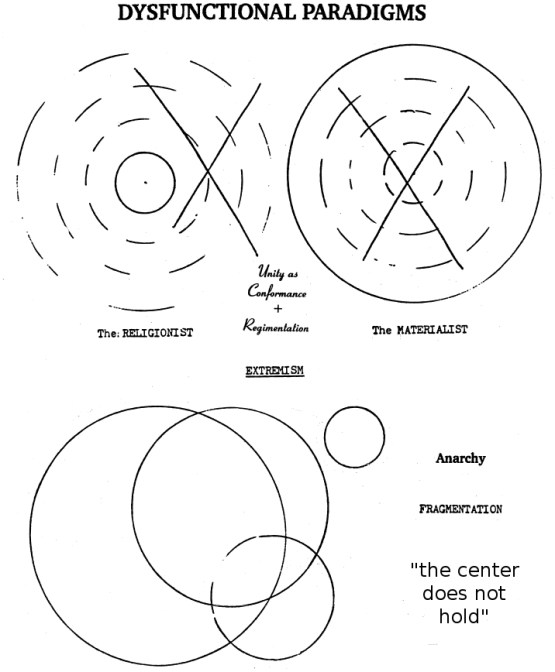
  • We are bent out of shape in countless ways. Levels are dissociated, unbalanced, unprioritized or even cut out entirely.

HERE IS A PICTURE of WAYS in WHICH the PPoC WHEEL of LIFE IS DISTORTED:


0 Bent out of shape

  • To reverse this process, re-member and restore our True Selves, self-actualizing potential, is each person’s primary personal responsibility.
  • Lasting, enduring change begins only from the inside out, and one person at a time.
  • The Positive Paradigm Handbook gives the step-by-step method for initiating this positive change.
  • At this critical point in history, human survival can no longer be taken for granted.
  • As Einstein warned, “We will require a substantially new manner of thinking if mankind is to survive.”
  • The Positive Paradigm Handbook gives the method for cultivating this new manner of “thinking like a genius,” making theory REAL.
  • Millennials, who have little vested interest in prevailing dysfunctional paradigms, are our best hope of the future.

globe

Sometimes I get discouraged. (Today especially.) Current events seem to parallel the story of Noah, who prepared to face immanent danger alone in his calling.

I begin to doubt whether it’s worth the time and personal anguish to keep writing. It seems as if, no matter what I say or do, people will persist in ignoring every wake-up call, heedlessly scurrying about their daily errands as if blocking out anything/everything they’re afraid to face will prevent the unthinkable from happening to them.

But then I remember the words from the end of Schindler’s List that have become my mantra, “To Save One Life Is To Save the World Entire.” In PPoC context, each of us IS a universe complete. This Talmudic saying is literally true. So I continue to write, passionately hoping that the life which could be saved is yours.

Do humanity a favor. Reblog and share this message of hope with those you love and wish well, as I do.

Let Me Be Clear

What does “Positive Paradigm” mean to YOU? I have to wonder, because the word “positive” has 17 (!) discrete definitions which span the Life Wheel’s continuum from center to surface.

The word “paradigm” is becoming equally diluted and compromised. For example, Francisca Moors recently tweeted me from the Netherlands: “What’s todays paradigm about your self?” Her question implies that paradigms are personal filters (not culture-wide agreements) that can be changed like clothes from day-to-day to suit immediate whims.

In response, to clarify, I drew a picture showing the shifting levels to which the same badly abused word “paradigm” is applied.


0 Def of Paradigm

Please. Let me be very clear. When I use the word “positive,” I’m referring primarily to the core: “that which is absolute, unqualified, and independent of circumstances; that which has real existence in itself.” [See wp.me/p46Y5Z-9R.] Whether the effect of religious beliefs, social theories and economic policies is beneficial depends on the extent to which leaders and their followers are functionally connected with the eternal center. To the extent that they’ve lost their mooring, they’ve forfeited inherent power and validity.

Positive thinking becomes delusional when taken to mean “I can have whatever I want.” Positive Paradigm thinking humbly accepts that “With God, all things are possible.” The emphasis is on with. And all includes everything, hard and happy lessons in balance — not just whatever it is one wants.

Let me also be clear about how I use the word “paradigm.” It’s comprehensive and stable, foundational and basic beliefs — not something personal one can change on convenience, shifting with current fashions. What I call the “positive paradigm” is an inclusive, complete and correct worldview. It answers Joseph Campbell’s call for a universal “myth” (creation story), capable of recognizing the humanity of those living on the opposite side of the planet.

The Positive Paradigm of Change embodies what Aldus Huxley called the “perennial philosophy” — the core reality which the world’s great teachings share in common. For just as the sun is the center of our solar system and as there’s a nucleus at the center of each atom, there’s a central timeless experience of life which everyone everywhere shares in common.

Put the other way around, any belief system that’s not founded on eternal wisdom will inevitably, like the sands of time, be blown away. It cannot endure through the variable seasons of change. An incomplete, false paradigm, like the biblical “feet of clay,” will crumble when struck with the iron mallet of destiny.

The poet Yeats wrote “the center does not hold.” But that is the subjective experience of those who deny or forget their center. Nevertheless, acknowledged or not, the center remains, unchanged and eternal. It’s the true “common core” that (misleading label aside) is dangerously overlooked by the current, politically-driven educational fad.

Restoring the Positive Paradigm with its potential to outlast Titanic Times is an urgent matter of human survival. How urgent? Let’s see. The past week’s news alone offers several terrifying examples. Putin is saber-rattling again, doing a repeat of the Khrushchev-Kennedy death dance. “I want to remind you that Russia is one of the leading nuclear powers,” he threatens.

On other fronts, terrorists are planning to build missiles capable of spreading bubonic plague. King Abdullah of Saudi Arabia issued a dire warning: “Jihadists could reach Europe and America in a matter of months.” The chaotic Texas/Mexico border is increasingly feared to be a likely entry point for terrorists. Not to mention the “chatter” of a significant event to “celebrate” the approaching 13th anniversary of 9/11 in honor of the 13th Imam, possibly involving “home grown” American terrorists.

Adding insult to pending injuries, America’s fund-raiser-in-chief announced that America is safer than it was twenty years ago. In response to this statement, two references from earlier blogs come to mind. One is the pictured definition of sheer evil in Positive Paradigm context. [See “How Bad People Become Leaders,” wp.me/p46Y5Z-9B.]

The other is the game show described in “To Tell the Truth.” [See wp.me/p46Y5Z-dA.] In that scenario, the rules of the game are that impostors have no rules. They can lie, deceive and misrepresent their intentions. Alinsky-like, their ends justify any means. An Obama observer on Glenn Beck’s website TheBlaze gave me a new word that describes Obama’s otherwise mystifying behavior exactly: TAQIYYA. It means religiously sanctioned deception. Its purpose is to infiltrate enemy organizations, undermining them from within.

In the face of all this “bad news,” I refer back to Mike Lehr. He’s the one who asked for my explanation as to how bad people become leaders (along with its implicit solution). In addition, he wanted to know whether dangerous circumstances result in the selection of better leaders. My answer: different faces won’t make much difference.

Leader-selectors (both formal and informal) have long since identified, trained and placed look-alikes to follow in their footsteps. Anyone who threatens that status quo has long since been driven off or otherwise destroyed. So insiders from the available candidate pool will continue to operate on the same variety of false paradigms.

There may be a few experienced but disenfranchised survivors left, ones who tenaciously hold to the timeless truth embodied in the Positive Paradigm. But as Old Avatar observed, it’s because they’ve had the good sense to hide out (like Yoda), perhaps to reemerge should another Luke Skywalker come forward. My best hope still remains with the as-yet untested Millennial Generation. From their ranks may emerge a handful of visionary leaders with the combined wisdom, courage and endurance to rise from the ashes of the approaching NELC.

It will be their blessing/responsibility to make the urgently needed Fresh Start clearly foreseen by the biblical dream-reader and prophet Daniel — the one who told the truth, the whole truth, and nothing but.


globe

To Tell the Truth

To tell the truth - image.jpg

Bogus claims about new I Ching sciences remind me of the long-running TV game show, “To Tell the Truth.” In this format, three challengers are introduced to a celebrity panel, each claiming to be the featured guest. Impostors can lie and pretend to be the central character. Only the real one is sworn to tell the truth. Panelists are challenged to ask penetrating questions, see through deceptions, and correctly identify the truth teller.

In this game reality, the best liars are rewarded. But that’s not how it works in the real world. There’s nothing entertaining or ultimately rewarding about deceiving the public. Yet, at this stage of history, it’s nigh unto impossible for all but the most discriminating (in the positive sense) tell the difference between imitators and the “real deal.” Shameless parodies of wisdom traditions abound.

Hucksters out to make a quick fortune while basking in their 15-minutes of fame misrepresent both their intentions and abilities. The sure-fire get-rich formula of “spiritual” entrepreneurs is to tap into people’s deepest desires and fears. Associate your product with an accepted wisdom tradition to piggy-back on its credibility. Offer gullible marks whatever it is they want on the one hand, and guaranteed protection from the consequences of stupidity on the other.

In a crowded market place full of unscrupulous pretenders, how do messengers of substance and integrity stand out from the noisy crowd? Even screaming isn’t heard over the ruckus. Their only option is to play by the rules – quietly, persistently Tell the Truth.

In my last blog, I stood up to a Millennial I Ching pretender. But as soon was that posted, an even more outrageously upside-down New Age pitch came in via the website contact page. This one (again, no names) proposes to change the course of civilization by gathering statistical proof of a timeless, transpersonal “force” (for a donation, of course). Those who hurry can get a free game stone now, before they’re sold for a hefty price. All major credit cards accepted.

Sigh. Statistical methods associated with the prevailing empirical science method may appeal to “rational” intellectuals stuck on the material surface of the wheel. (See illustration below.) But quantifiable evidence is irrelevant to the middle and innermost levels of the Positive Paradigm of Change.

The first false premise is that the rational mind is sufficient to comprehend, analyze and “prove” with its puny methods the existence of the Universal Mind. How comical is that? It’s like a flea presuming to do the metaphorical elephant the favor of confirming its existence to other fleas. (The flea’s arguments make a difference to the elephant because . . . . ?)

Further false logic goes, “Since the source is infinitely powerful, and we as individuals partake of it, therefore we are equally infinitely powerful.” Wrong! (Boooo!) This is like a drop of water claiming equal partnership with the wave within which it rides.

Still more ridiculous is the assumption that we as individual drops of water can make the tidal waves of history change direction – as if puny humans had the superior wisdom and power to influence the forces of nature and Nature’s God.

As a reminder, here’s the Wheel of Change. It reinforces both the appropriate relationships amongst the levels and the value of linking them in a two-way, infinite loop. Each of the outer levels is an extension of and depends upon the deeper ones for its existence. Never the other way around.

082214 to tell the truth

The value of the I Ching, correctly used, is to serve as the energy-level bridge that links reason on the outermost level with innermost ways of knowing – intuition and conscience.

A basic premise of New Age I Ching distortions is that superior humans, if they don’t like the current course of history, can just rewrite history, avoiding the consequences of past action. That is not positive change. The attempt is a delusional waste of precious time.

Today’s place in history is the cumulative consequence of thousands of years of poor choices. To continue an earlier thread, keep in mind the Old Testament prophet Daniel. He foresaw an end time followed by a new beginning. There is no short-cut from here to there that by-passes the tough part of the process he envisioned.

Those who intend to survive to partake of that new beginning would be far better off to heed what is written and align themselves with the tides of Titanic times, rather than resisting or presuming to circumvent them.

Here’s a hint and reminder of what is to come, with its reference to false paradigms (unsustainable foundations of civilization) as “feet of clay” from the King James version of The Book of Daniel:

2:28: But there is a God in heaven that revealeth secrets

and maketh known to the king Nebuchadnezzar what shall be in the latter days.

Preparing now for inevitable changes to come is a personal choice and responsibility, accomplished first on the inside, one person at a time. The basic axioms and methods offered in the I Ching-compatible Positive Paradigm Handbook facilitate that powerful personal change. The purpose is to replace the unsustainable, corrupted foundation of false paradigms (feet of clay) with a complete and correct paradigm. Like childbirth, the process isn’t necessarily fun, but the outcome is worth it.

2:44. And in the days of these kings shall the God of heaven set up a kingdom

which shall never be destroyed . . it shall stand for ever.

Daniel’s vision of this basic truth was written long ago. (Daniel 2:45. . . The dream is certain; and the interpretation thereof sure.) He’s a central character who told the truth, the whole truth, and nothing but.

To Tell the Truth is the longest-running show in history. It’s not a game, however, nor is it for the faint of heart and spirit. But our very survival is at stake.

.

book header bird

Prepare Now for Inevitable Shocks

Why would Millennials (or anyone else, for that matter) want to consult an ancient book that’s outside the familiar boundaries of what’s currently accepted for answers to survival questions? The answer is contained in the question. Expanding beyond limiting boundaries is essential to future survival.

Prevailing paradigms have brought the world to the brink of an NELC (Near Extinction Level Crisis). A better paradigm is urgently necessary. To repeat Einstein’s warning yet again, “It will require a substantially new manner of thinking if mankind is to survive.”

Rethinking Survival: Getting to the Positive Paradigm of Change introduces that qualitatively different manner of thinking. Four contrasting thought paradigms are pictured in an earlier blog. (See wp.me/p46Y5Z-a4.) Another, the Positive Paradigm of Change, translates the old-new I Ching world view into the yoga-compatible Unified Theory. It answers Einstein’s challenge in terms of his own work. It contains within it a seed of hope for generations to come.

Returning to the ongoing discussion, however, How will Millennials benefit from working with the Book of Change (or for that matter, The Positive Paradigm Handbook)? I hinted at the answer in “When the Lights Go Out, Who Will Millennials Call?” There, the question is asked and answered: “On the day when the lights go out, what would happen to wiz kids dependent on their electronic toys? What use would their extreme investment in computer skills be then? The logical answer: None. Zip.” (See wp.me/p46Y5Z-cm.)

Millennials are reputed to depend exclusively on their peers for validation and support. Yet, like any other strength, when taken to extremes, this dependence has the potential to become their greatest weakness. If the noise generated by peer content blocks out inner guidance and prevents individuation, they’ll be in big trouble if/when immanent dangers oblige them to think for and depend upon themselves.

Here’s the larger context, a picture of connections on many levels, joined in an infinite loop. The unique value of the I Ching is that serves to give access to the neglected, innermost sphere which we’ll all eventually need to draw upon for inner strength. Here’s where working with the Book of Change can make all the difference. It gives uninitiated users the direct experience of that neglected, inner connection.

Connections

In answer to my query, the book’s benefit to Millennials is Hexagram 58, INSPIRATION, with changing lines in the third and fifth places. It reads:

When minds are moved by INSPIRATION, nothing is impossible.

Misunderstandings can be cleared up,

problems solved and hardships overcome.

Inspired speakers can move others

to acts of heroism by well-chosen words.

Reminding people of their common goals

and deepest desires

gives them the courage to continue.

Two changing lines modify and transform the initial answer. The third line reads, “Sharpen mental discrimination. Refuse temptations that lead to destructive consequences.” I’m understanding that even inspiration cannot be depended upon exclusively. It requires the balancing faculty of reason to ground intuition and keep priorities in perspective.

The intermediate change that results from the warning is Hexagram 43, DETERMINATION. It advises “If you approach the situation with DETERMINATION, you can now overcome problems that have held you back in the past.” It also stipulates, “Avoid solving problems by force.”

The changing line in the fifth place warns, “Be careful in whom you place your trust. Avoid sorrow.” It changes to Hexagram 54, SUPPORT.

The outcome of the two combined changing lines is Hexagram 51:

SHOCK

Violent movement creates SHOCK.

To prepare yourself to face external disasters calmly,

face your personal fears first. Then nothing can shake you.

Sudden changes will become challenges which test your strength.

Carry on with your daily life but expect major shifts.

Develop the will to endure.

In sum, the sequence leads me to this conclusion. Openness to Inspiration will increase awareness of the need to prepare for shocking, external disasters. Even while carrying on with daily life, it’s important to anticipate major shifts. This resonates with the earlier blog on Change, which also emphasizes prepping. “The unprepared see change as a threat, but the well-prepared face the unknown calmly.”

So, what specifically does the Common Sense Book of Change have to offer the Millennial generation? For starters, the Inspiration to anticipate shocking changes and the determination to meet external disasters calmly.

Naturally, there’s much more. But it will have to wait for next time.

globe

How Will Millennials Benefit?

At the end of “Influencers Cut Through the Noise” I resolved to ask The Common Sense Book of Change how to present the I Ching to the Millennial generation. I did so recognizing that Einstein’s warning doesn’t seem to get through. It’s urgently necessary to find out what will.

Einstein warned, “We shall require a substantially new manner of thinking if mankind is to survive.”

So I queried, “How do savvy influencers translate this imperative into Millennial terms? What relevant key can cut through the layers of noise (assumptions, prejudice, distractions) that cloud perception?”

The hexagram (six-line shorthand graph) answer to my query was COLLECTIVE ACTION with a single changing line in the fourth place. It looks like this:

7 CollectiveAction

Here’s the reading which represents the basic situation:

The foundation of successful COLLECTIVE ACTION is three-fold.

It requires clearly-defined, worthy goals,

effective organization and

willing self-discipline on the part of all involved.

Respectful awareness of others’ needs

will bring grateful cooperation.

Keep the larger purpose for action clearly in mind.

Avoid selfish exploitation of good-will.

Despite similar sounding words, the Collective Action referred to here ultimately has nothing in common with Marxist-derived approximations. Essential components of SUCCESSFUL Collection Action have been glaringly absent: worthy goals, willing self-discipline, and respectful awareness of others. So if Millennials are currently being drawn towards socialist/communist/progressive belief systems, oblivious to inherent dangers, that requires change.

When a reading has changing lines, the original one is taken to represent the immediate situation. The changing line is taken as a warning, which, if heeded, brings about a new situation.

What strikes me immediately is that this recommended approach is antithetical to the hippie, “do your own thing” attitude of the Baby Boomer generation that turned to the Book of Change to reinforce rebellious, antisocial individuality.

Paradoxically, there is no conflict. Thankfully, the I Ching is universal. The Introduction to the CSBOC observes:

Because the I Ching’s diagram of the universe is so complete, it is regarded as a valid tool by people with many different points of view. For example, Lao Tse, a Taoist, used the Book of Change. He viewed the world as an artist and free spirit. Confucius, however, who was mainly concerned with duty towards family and state, also had profound respect for the Book of Change.

The two-directional, infinite loop of the Unified Theory explains how this can be. Introspection on the inward path of individuation and social responsibility on the outward extension are ultimately compatible. Each extreme compliments and completes the other. Conversely, each out of balance and lacking the other, is incomplete.

No Conflict

Moving forward, however, the recommended approach of COLLECTIVE ACTION isn’t static. The fourth place associated with the heart center of yoga anatomy is a changing line. It contains a warning, which, if heeded, has the potential to transform the immediate situation into a new one. “When dangers are too great to handle, retreat. Try later.”

This caution is certainly reason to pause and consider. What dangers? Perhaps there’s an automatic-pilot animosity, a reflexive rejection of an unfamiliar book assumed to be foreign, unscientific, or just plain weird.

Then again, perhaps Millennials harbor an intense, angry mistrust for the I Ching as a book they associate with their irresponsible elders.Then again, perhaps the dangers of Collective Action are inherent in the warning. Remember the outcomes of Russia and China’s unnatural, failed Marxist, Socialist, Communist experiments.

If the warning advice is heeded and thoughtful pause is taken before pushing forward with promoting the Book of Change to Millennials, then what is the likely outcome? The new pattern that results from heeding the warning is Hexagram 40, FORGIVENESS:

Through FORGIVENESS, old debts are canceled and harmony is restored.

Free yourself from outgrown habits. Don’t be afraid to let go of the past.

Releasing tensions will produce health. Mental blocks will be resolved.

New clarity of vision will lead to important decisions.

Peace of mind will follow. Avoid anxiousness.

The consequences of reconciliation that could result from this improved approach to generational strife deserve a major blog in itself. For here it must suffice to say that what both Millennials and their elders have to gain from working intelligently with the I Ching is a healing of destructive misunderstandings. This brings me back to the basic point made in Dangerous Times Call for True Radicals:

My best hope for Millennials is that they’ll benefit from the lessons of history and NOT mindlessly perpetuate the pattern of yo-yo swings between opposite and equally dysfunctional extremes on the surface, disconnected from the timeless center.

There’s a shared benefit for all generations alike in using The Book of Change. Contrary to popular misconceptions, it’s not a manual to use for the purpose of stirring up change for its own sake. The primary purpose for working with the I Ching is to maintain balance. The more confusing and desperate the times, the greater the benefit.

Individuals consult the book to preserve mental-emotional equilibrium throughout life’s ongoing personal challenges. Leaders depend on the wisdom of the I Ching to steer a steady course towards their goals despite all obstacles and upheavals.

More specific benefits for the Millennial generation will have to be continued another time.

globe

It Is Possible to Make A FRESH START

I started “A Fresh Start is Urgently Necessary” by saying two coincidental things happened that day. I described the first, the internet being down. (Turns out a heedless farmer severed a fiber optic cable.) The second had to wait until today. Namely, I connected the dots between an overnight YouTube music search and the challenges inherent in presenting the  timeless I Ching to the Millennial generation in a way they can identify with and own.

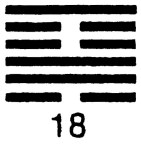
For starters, here’s the Common Sense Book of Change version of Hexagram 18.

hex 18

FRESH START

Even when it seems that all has been spoiled,

it is possibleto make a FRESH START.

Be willing to face your faults.

Find out how to correct them.

The situation will gradually improve

if you are sincere and work hard.

Be sure you know what you want.

Avoid delay.

The unfamiliar graph is called a hexagram. It’s an ancient short-hand method for expressing countless generations of experiential wisdom about the correspondence between chi (energy) flow in the human mind/body (the microcosm) and in the universe (the macrocosm). In yogic philosophy, these six lines correlate with six basic chakras (wheels, or subtle energy centers) located at intersections along the human spine. Each of the centers is associated with specific developmental stages. A primary purpose of yogic practices is to awaken, balance and integrate these levels of experience.

The straight and broken lines of the hexagram are a binary-digital way of expressing alternating, expanding and contracting life rhythms. In the Book of Change, any or all of the six lines can change into its opposite. This results in 64 possible permutations. It’s not coincidence that the ancient I Ching and modern DNA patterns are exact correlates. This is one explanation for the healing effects of medical sciences based on the I Ching hexagrams.

Admittedly, the specifics are beyond my comprehension, for the most part because I trust from experience in the practical results. Just as I use my computer without a deep understanding of how it operates, I have benefited greatly from working with the I Ching and its off-shots. Both sciences, modern and ancient, for many of the same reasons, simply work.

To carry forward the question — When the Lights Go Out, Who Will Millennials Call? (see wp.me/p46Y5Z-cm) — consider this. If/when today’s hospitals are rendered inoperable by grid failures, and/or healthcare as we know it is made unavailable due to social-political malfunctions (like Obama un-care, for example), where can we turn for practical health sciences that maintain health and heal dis-eases? Modern medicine as a profession and a social-political corporate conglomerate has become, for many people, for many reasons, a nightmare. We especially need a Fresh Start in this important area of our lives.

My short answer: long after grid-dependent lights go out, the same basics that work seeming magic with the I Ching will still be available to those familiar with Traditional Chinese Medicine (TCM) methods — including Chi Kung and Tai Chi. The sooner people become fluent in the self-healing arts, the better off — for countless reasons — most of us will be.

I’ve been emphatically told by the one I most trust that “The mind will play any tune you ask it to.” When he speaks, I unpack every word. (He doesn’t waste them.) There is more meaning to this key than simply “Mind over matter” or “Beliefs generate results,” though in terms of self-healing these are included. Training the mind as a musical instrument to skillfully, deliberately apply the I Ching‘s 64-permutations of dynamic “if-then” consequences (analogous to existing computer-driven chess games) would greatly enhance one’s ability to recognize prevailing self-defeating tunes. Further, one could discover better tunes, decide which to play when, and learn how to “ask the mind” to play them.

Advanced meditators describe hearing a celestial “music of the spheres.” Just imagine, if you will, what wondrous music is available to those with “ears to hear.”

Much of I Ching-based philosophy focuses on understanding how fluctuating energy patterns affect human behavior, as well as how they can be used to create harmonious relationships and orchestrate viable institutions of governance. Much has been spoiled by lack of awareness of these patterns (tunes) and ignorance as to how to steer institutions effectively. By reintroducing this vital information, correcting what I have repeatedly described as a “fatal information deficit,” the damage resulting from such ignorance could be repaired and a Fresh Start initiated.

Unfortunately, much of this tradition has a very bad “rep.” It’s been spoiled by a complex mix of misunderstanding, misapplication, and misrepresentation. For example, when I went on YouTube looking for music (the second coincidence I mentioned earlier — see wp.me/p46Y5Z-cJ), what I had in mind was chakra/DNA healing ragas. What I found instead was a commercialized, psychedelic offering of “feel good” audio engineering. Comments likened listening to taking psychotropic drugs that induce the illusion of mind-altering experience. They raved about hallucinations experienced while tripping and listening at the same time.

My Aha: So much of what has been spoiled and cries out for a Fresh Start is the I Ching itself. Today it needs to be approached from the modern science of mind-exploration. It needs to be repackaged as a delightful, game-oriented Lumosity experience, but founded on a profoundly motivating purpose: human survival. Not unlike the Christian tradition, which has suffered greatly in the wrong hands for centuries, the timeless wisdoms must be “reinvented” and approached as if new: First time, every time.

compass clock

It’s the 11th hour, for sure. But, as it has been written, With God all things are possible –including, even, at this late hour, a Fresh Start. But the clock is ticking. God — the Tao — is infinite. Time is not.

A Fresh Start Is Urgently Necessary

I started to pick up here what was started about Millennials and future survival earlier, but recognized I need to back up a few paces. Coincidentally (though there is no such thing, of course) two interesting things happened. First, the internet was down all day. No emails. No tweets. Ahhhh. Quiet. An unexpected relief set in. Would Millennials experience this deprivation (even short-lived) the same way?

Yet, here I sit blogging, trusting things will be back to normal within a few hours. A troubling thought rumbled in the back of my mind. Has something thing terrible happened in Israel? Is this blackout preventing news from getting through? I pushed it aside. Paranoia? It served as a reminder, though, that this relatively comfortable lifestyle might not last forever. It’s a reminder of how precious time is.

The last paragraph of the earlier blog (see wp.me/p46Y5Z-cz) stopped short where I must begin here:

The only chance of winning — ultimately, surviving —

is to demand a new, clean, unmarked deck, one with all the cards.

In other words, make a fresh start based on an accurate, complete paradigm.

Rethinking Survival lists the elements of a Fresh Start in detail. Here are a few snippets.

globe

FRESH START

After facing up to the inescapable proof everywhere around us that our language and idea pools have been corrupted, what do we do about it? Extreme radical measures call for opposite and equal survival responses. Scrap everything. Back to the drawing board. Clear the decks. Empty the overflowing in-baskets and clutter on the mental desktop.

Religious leaders have abused the teachings, so atheists have been conned into rejecting the fundamentals of the timeless, perennial philosophy altogether. Human authorities have violated their responsibilities, so reactionaries have been conned into making the mistake of rejecting all authority on every level.

Let’s face it. Religious and secular institutions inevitably degenerate. They accumulate baggage over time and drift away from founders’ visions.

So from time to time in the repeating cycles of history, it becomes urgently necessary to sort out what’s worth holding on to and what not. Do a thorough cultural house cleaning. Right now, people everywhere are overdue for a major rethinking of their paradigms.

Start with the premise that we’ve been brainwashed. We’re ensnared in contradictory myths and misconceptions. So approach the work with humility and extreme caution. Accept the possibility that everything you thought you knew is wrong.

Initiate OPERATION RESCUE. One individual at a time, take back our most precious asset: our minds. Like tenacious truth-miners, sift through the mud to separate out nuggets of pure gold. Hold fast to truth. Fearlessly put the rest behind.

Go back to the drawing board. Wipe the slate clean. Start over with a fresh, unmarked deck. Rethink organizations by the standard of the Positive Paradigm. Start with the smallest unit of organization — yourself. Work with what’s possible. Be assured that every little bit helps. “One grain of rice can tip the scales.”

If this seems daunting, remember, the stakes. They couldn’t be higher: the survival versus extinction of all you love. Each contribution affects the whole. Everyone matters. As Einstein warned in “Ensuring the Future of Mankind”. . . “Each one of us would be at fault if the goal were not reached in time. There is the danger that everyone waits idly for others to act in his stead.”10

. . . Here are recommended positive attitudes for approaching OPERATION RESCUE:

ONE

Gird personal determination to win the inner war that matters most. Put pride and old attachments aside. Let the consequences of failing to rescue your mind along with the rewards for doing it motivate persistence.

TWO

Take nothing for granted. Appreciate what you have while you still have it. Remember: it took only nine seconds for one lunatic to blow John Fitzgerald Kennedy’s head away. It changed the world as his family and the world knew it. Two bullets was all it took to extinguish our best hope for the future of democracy and world peace.

THREE

Proceed with equal parts humility, courage and trust. Revisit the basic, important life questions carefully. Scrap the old answers. Shed the emotional baggage and prejudices we all carry from personal experience.

Be willing to look at the world and how one fits into it with fresh eyes. Attachments to familiar beliefs as well as obligations to teachers and family are irrelevant to the TRUTH. So are old animosities. Trust that if old answers were correct and personal loyalties valid, they’ll withstand the test of time.

FOUR

Focus on the values everyone everywhere undeniably have in common. Following Einstein’s example, learn how to “think like a genius:”12

The scientist or the artist takes two facts or experiences which we separate;

he finds in them a likeness which had not been seen before:

and he creates a unity by showing the likeness. . . .

All science is the search for unity in hidden likenesses.

FIVE

Focus on TRUTH. Give it the benefit of the doubt. If familiar expressions don’t work for you, dig deeper. Or try a better approach. But cleave to the life-sustaining essence which sincere practitioners of every faith have held in common from time immemorial. Communicate from that center. And build community from there.

Just as each atom has only one nucleus, in Positive Paradigm context there’s only one core at the center of creation. Logically, over time and in every circumstance, inspired teachings partake of it. If you delve deep enough into the teachings with a sincere heart, you’ll find the same universal source.

. . . Future generations depend on each of us to transcend our petty animal nature. They demand that we draw upon this inexhaustible resource of inner strength to keep the wheel of life together for their sake. In times of great calamities and sorrow, the truly great in spirit will rise to meet whatever challenges may come, sustained by the eternal center within.

SIX

Don’t get hung up on language. Don’t be confused by misdirecting spin. Stick to the facts. Don’t let double-speaking truth-twisters insult your intelligence. If you allow them to play on your worst fears, they’ll manipulate you into becoming your own worst enemy. Have a standard for knowing who’s who. If you refuse to be fooled by name-calling, empty labels can’t stick. Know friends from enemies by the fruits of their labors. Not by their whitewash excuses.

SEVEN

The Danger. Don’t let alien agents define who you are. . . . The hub at the center of life’s wheel can’t be equated with a political center. Quite the opposite. Remember the Karate Kid? Pick one side of the road or the other. Good or evil. Truth or spin. As Mr. Miagi warned, middle-of-the-roaders get “squished like grape.”

EIGHT

The Opportunity. Inherent in endings are opportunities for new beginnings. “After degeneration reaches critical mass, regeneration follows.”15

Just as invaders’ agents work to undermine humanity, modern-day sages are tenaciously working to expose and defeat their schemes. That’s why it’s imperative to cut across false boundaries. Connect with like-minded boundary-spanners wherever they are to be found. If they’re true to the common sense voice of conscience, they’re humanity’s best hope. Heed them. . .

But don’t just sit back, waiting for politicians to wake up. Follow Einstein’s advice. Don’t build another human institution, a conglomeration of internally conflicted governments. Instead, build an international community of like minds. The internet gives opportunities for connecting across limiting, artificial boundaries that Einstein would never have dreamed possible.

globe

Wow. That’s a lot. I started by staying two interesting things happened this morning. The first was the internet being down. The second? That’s where I’ll have to pick up next time.

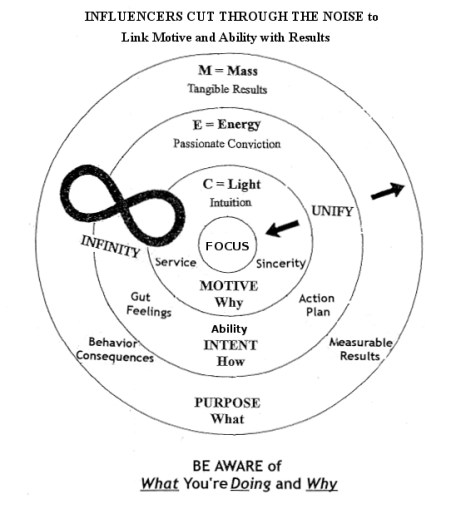
Influencers Cut Through the Noise

To change the world for the good, the multiple authors of Influencer: The New Science of Leading Change recommend a three-stage process. As author of multiple books on change, I was eager read about the new science whereof they speak.

However, their content confirms what a Jungian analyst reminded me of in response to a recent blog on Therapists as Positive Change Agents. Namely, there’s nothing new on leadership under the sun – just infinite variations on a few important themes.

In fact, with the exception of a single random remark debunking the role of intuition in the decision-making process, their worldview is remarkably compatible with the Positive Paradigm of Change. Here’s how it translates into the Bible-, Yoga- and Einstein-compatible Unified Theory Wheel:

————————————————————————————————–

Influencers cut thru the noise

———————————————————————————————-

Authors Joseph Grenny, Kerry Patterson, David Maxfield, Ron McMillan and Al Switzler speak to our common challenge. “How can the leader as alarm sounder cut through the noise to effectively wake the unaware up from their slumbers?”

Their solution, like the Positive Paradigm of Change, recognizes a necessary relationship between motivation and action (ability). However, I see the two as residing on qualitatively different, interior levels of a two-directional life wheel. They posit three paired levels of influence – personal, social and organizational. This yields a total of six areas which can either impede or accelerate positive change. The key is to harness all six and focus them like a laser on a finely tuned purpose.

In Positive Paradigm context, the universal atom-like structure repeats on every scale of magnitude. The individual is a complete unit. By extension, so is the family. The ongoing units of business and government organization are all multi-level organisms, each with its unique motives and action abilities.

But rather than side-track deep into academese, I’ll focus instead on applying the concept of Influence (focused, effective leadership) to my ongoing discussion of survival and Millennials. As the generation apparently disinherited by their elders, Millennials have little ego-investment in the dysfunctional paradigms that have gotten the world into its current political-economic mess. So they’re the most likely to welcome and champion a Positive Paradigm shift.

Here’s the premise: While marketers are correct in selling Millennials as the best hope for the future, as of yet, the hope is only potential. In “When the Lights Go Out, Who Will Millennials Call?” the very real danger – along with its hidden opportunity – is explored. Millennials are fluent to a fault in all things digital. But there’s an inherent risk in lopsided over-investment. What would happen if, overnight, their iPads ceased to work and they were cut off from their social networks? They might suddenly become as helpless as fish out of water.

The hidden upside to their imbalanced addictions to things digital and social remains to be realized. To actualize this potential, the correlations between the ancient science of change and modern binary digital computer language must be drawn. To repeat, when they recognize that they contain in their innermost DNA the very same potentials that drive computers, that their brain functions are limitless beyond even the most powerful digital instruments, then there’s real hope.

In response to the blog When the Lights Go Out, D.R. Baker wrote a complimentary comment, calling it my best, most relevant work yet. He complained about relatives whose addiction to their gadgets seemed mindless and asked for suggestions as to how he could control the situation.

My response was that, in general, it’s better to focus on self-control rather than controlling others. Since D.R. is familiar with the Book of Change, I suggested that he query the book for insight into his specific situation.

His question, however, got me thinking. I should do the same with my compassionate concern for Millennials. It’s not enough to tell them they have marvelous, latent potential but are at risk, or to suggest wherein the positive future lies. I’ve written books on change and survival. I’ve repeatedly tweeted Einstein’s warning, “It will take a substantially new manner of thinking if mankind is to survive.” But that’s apparently not the alarm that suffices to wake sleepers up.

I would have thought Einstein’s wake-up call was powerful and sufficient motivation. But that’s my point of view. What’s theirs? In a future blog I’ll present the results of asking, “What benefit does the Book of Change offer the Millennial generation?” In addition, I’ll ask, “How should this answer be presented? What’s the right, most influential approach for me to take?”

Phoenix - sized

Am I Still Ahead of My Times? Not Really.

A book reviewer (Lisa says she holds my work in highest regard) reluctantly agreed with a former School Board Association mentor. I am ahead of my times. But that was 1977.

In light of current events, is this snippet from Rethinking Survival: Getting to the Positive Paradigm of Change really ahead of the times? Sadly, methinks the times have caught up with me — and then some.

globe

ALIEN INVADERS

In the 1980s, when the Affirmative Action legislation described in Part One was a subject of hot debate, one commentator made an astute observation. If foreign enemies had wanted to undermine the United States, they would have designed exactly this legislation. Valid goals — the window dressing — were buried in burdensome regulations and punitive economic sanctions. Rather than bringing people together, it was alienating, causing an opposite and equal backlash across the board.

Alien invaders infiltrating Planet Earth, weakening humans to eventually take over and enslave them, is a familiar theme in science fiction. For example, in his various incarnations, Dr. Who — television’s beloved two-hearted time traveler — continuously detects nefarious alien plots and rescues heedless humans from annihilation.

Current events indicate there’s considerable truth cloaked in that science “fiction.” Starting with the premise that hidden alien enemies are covertly scheming to undermine humanity, ask, “How would they set about to destroy us?” Logically, they’d create chaos, setting everyone at each others’ throats. They’d trick humans into mutual self-destruction by stirring up dissension and fragmenting their governments.

As discussed in Part Two, the Old Testament and yogic scriptures both maintain that we’re made in the image of God. Each individual mind is a complete miniature of the Universal Mind. When open, receptive, and aligned, everyone everywhere mirrors the wisdom and potential power of the Creator.

Therefore, it’s an absolute priority for evil aliens to attack the mind. Their agents will do whatever it takes to pollute your mind. They confuse it with false paradigms. They clutter and distract it with the noise of an ongoing media circus. Every doubt planted in your mind causing you to forget who you are, to disbelieve in your ultimate origins and creative potentials, is a victory for the dark side.

To totally undermine humanity, atheism is a must. The unifying beliefs which hold families and nations together and fortify them in times of adversity must be destroyed at all costs. Again, how would this be accomplished?

For one thing, language which makes communication and community-building possible would have to be polluted beyond repair. In Part Two, this ongoing process is described as the Tower of Babel factor. In the English language, for example, every value word has devolved to mean both one thing and its opposite. So people often talk at cross purposes, unaware that they’re missing each other coming and going.

. . . Next, by every means available, alien agents would strive to pollute the idea pool. Make access to the law impossible and simple truth seem complicated. Because ideas have consequences, introduce false beliefs with predictably disastrous results.

Then evil aliens would systematically destroy trust, the cement of human relationships, at every level of organization. How? Make deceit the political norm. Convince people that no one’s motives can be trusted. Demonstrate that no one’s words can be believed. Make it “common knowledge” that no one’s actions, however apparently innocent and well intentioned, can be taken at face value.

Diversions would be a must. Rile the public with non-issues to distract them from very real dangers. Using lame-stream media shills, manipulate the masses with the weapons of psychological warfare. Insult them with the lie that they’re not okay. Sell them on the belief that they’re helpless “victims” of oppressors who must depend on tough guys to rescue them (and pay the heavy price of obligation at the voting polls).

. . . in the first chapter [of Rules for Radicals], Alinsky [chief agent of the evil aliens] stated his exact purpose, namely to coach those who “want to change the world” from what it is “to what they believe it should be.” In I Ching context, this assumption-packed premise is an extraordinary feat of tragedy-fraught hubris. Building on this false premise, Alinsky then fueled the undermining alien arsenal with a full battery of destructive tactics. In essence, political radicals should feel “free” to violate the ten commandments. The ends (getting what you want) justify any means.

His version of social change is engineered by stirring up conflict. Use fabricated information to bear false witness against inconvenient neighbors. (Herman Cain’s character assassination is one of countless examples.) Alinsky advocates scapegoating, not unlike the dynamic which propelled Nazis to power. Create the illusion of an outside enemy as the way to unify your base. (How is that for the ultimate double-speak? Conflict is the opposite of unity.)

Divide and conquer. Pit each group against the others. I can almost see alien puppeteers behind the scenes clapping their hands in glee over Alinsky’s contribution to escalating worldwide conflict. It matters not to them which side wins. Let Sharia law advocates, members of Putin’s Eurasian Union and American exceptionalists squander their precious resources duking it out. If they destroy each other and no one’s left, so much the better.

. . . Alien invaders delight in cheating. They stack the deck, gumming up the works with false information driven by dysfunctional paradigms. If you accept the game and its rules as alien agents define them and proceed to rebel against uncivil authorities, mindlessly hating and resisting, YOU LOSE. (Alien invaders win.)

If you give all your attention to what other guys are doing wrong, playing the role of contrarian, YOU LOSE. (Alien invaders win.)

If you quit on humanity and live only for yourself, leading a life of self-centered indulgence, YOU LOSE. (Alien invaders win.)

If you persist in thinking narrowly in terms of political interests and institutions, not human survival, YOU LOSE. (Alien invaders win big time.)

The only chance of winning — ultimately, surviving — is to demand a new, clean, unmarked deck, one with all the cards. In other words, make a fresh start . . .

globe

[to be continued.]

When the Lights Go Out, Who Will Millennials Call?

Whenever I hear how addicted Millennials are to their iPods, social media friends and electronic war games, I cringe. It reminds me of the biblical story about handwriting on the wall. As I recall, in ancient times, a mysterious message magically appeared on a decadent palace wall, writ large by an invisible hand in a script unknown to King Belshazzar or his corrupt cronies. To those able to decipher such warnings, however, it predicted the ruler’s extinction.

Millennials are touted as the golden children of progress. “They’re the last best hope for our future,” I hear you say. That’s the rumor, anyway.

But there’s another rumor. Ever hear the maxim, “Whatever has a front has a back?” It continues, “The larger the front, the larger the back.” It’s another way of saying, “Every coin has two sides.”

In this case, let’s ask, “On the day when the lights go out, what would happen to wiz kids dependent on their electronic toys? What use would their extreme investment in computer skills be then?” The logical answer: None. Zip. They’d be helpless and useless.

Nor is this scenario as unlikely as most would hope. Look at the decrepit condition of overworked national grid systems. Consider the frequently threatened possibility of hostile cyber attacks.

I have a powerful memory of the night the lights went out in New York City. It lasted only a span of a few days. I don’t recall the exact date or duration. Only the horror of that early warning remains clear.

Thousands were trapped in high rise apartment buildings. Their windows didn’t open to fresh air. Phones were down. Radios and TV didn’t work. They couldn’t communicate with loved ones or connect with the outside world for help.

Kitchen and bathroom gadgets were useless. Food and water supplies ran dangerously short. What little food remained in freezers started to spoil. Without central air, slow suffocation was a real possibility. Without lighting, folks could barely fumble their way down long flights of stairs. Those who managed to get outside faced a nightmare war scene of muggings, looting, widespread panic and riots.

After that, if I’d lived in any large city, I’d have relocated as quickly as possible. Some said it was a wake-up call. But, surprisingly, people still continue to go quickly back to sleep, even after a long string of similar wake-up calls. Life appears to get back to “normal” (whatever that may be). Most just shrug and revert back to their old dependencies.

In my last blog, “Early Adapters Are Most Likely To Survive,” I hinted at my best hope for Millennials. [See wp.me/p46Y5Z-c8.] I held that once Millennials start connecting the dots and seeing the larger picture of how the Book of Change resonates with their own computer and game addictions — as well as the enormous implications — there’s a genuine, valid basis for future hope.

This hope is the up-side to the same maxim, “The larger the front, the larger the back.” Name, the same computer technologies turned outward to connect with peers and dazzle (or alienate) their elders have biological and metaphysical equivalents. When turned inward, they have the potential to empower Millennials in a way that changes the dark side of dependency on technology to an opposite and equal survival advantage — even and especially in the face of a (God forbid) technology-poor future.

Here’s the key. There are powerful correspondences between technology and human anatomy. Inventors have always depended on self-awareness to create extensions. For example, the violin’s resonant music depends on the same science of sound vibrations that powers the alternating pulsations of the breath and the lub-dub rhythm of the human heart. It’s no accident that the musical instrument’s parts have human anatomy names — neck, belly and spine. Other examples are legion. Think of the horse-drawn chariot, steam engine, train and automobile, to name a few.

Those who practice the I Ching-related discipline of yoga intentionally tune their bodies as instruments. By regulating the breath and slowing their heart rates, they heighten awareness and increase lifespan.

IF (dare I say when) Millennials connect the dots and recognize the powerful correlations between computer technologies and the human brain — how it’s wired, stores information, etc., —  they can, with appropriate disciplines, change themselves into instruments of higher consciousness. Because, just as violins don’t have souls — it takes musicians to fashion them and then activate their potentials — so also, computers don’t have souls. Their inventors and those who choose to use them wisely do.**

Lumosity computerized games are tapping into the vast potential for good. But so far, based on the limited and limiting research methods of empirical science, they’ve just scratched the surface (quite literally so). To go deeper and actualize the unrecognized potential for expanding human consciousness latent in computer technologies, it’s necessary to look to the tried and tested science developed over eight-thousand years and counting that’s hiding in plain sight. Yes, I’m referring to the Chinese I Ching.

Here’s a picture of how it fits into the larger scheme of things as an essential puzzle piece of the larger, atom-like structure of Einstein’s intuited Unified Theory.

Fits in the Picture

There’s powerful magic latent in the timeless Book of Change, albeit written in a language not all understand. Like the ancients who were able to read, heed and survive the handwriting on the wall, those of every generation who attune themselves to the wisdom of this interactive book will have the edge on future survival. By this I mean not just clinging to the bare minimum of animal existence, but a hopeful new beginning.

And no, this isn’t new age hocus pocus. Although it resonates in musical ways that seem magical to the uninitiated, the modern sciences of atomic physics, computer binary digital code, and DNA structure/function now give intriguing explanations as to how/why it works on a cellular or even atomic level. To repeat, once Millennials start connecting the dots and seeing the larger picture of how the Book of Change resonates with their own computer and game addictions — as well as the enormous implications — there’s a valid basis for genuine future hope.

How can this be? How does this all work? Here’s another pair of maxims, rarely understood, even less often applied: “As within, so without” and “As without, so within.”

In any case, on the day when the physical lights go out, those who depend on inner light for guidance will be the ultimate survivors. In the interim, intelligent use of the interactive Book of Change can serve to reconnect sincere preppers (early adapters) with their deepest core. It gives those with an open mind the wisdom needed to navigate successfully through dangerous times.

Electricity and the many kinds of vehicles it powers are ephemeral mirrors of the inner source upon which they depend, the eternal light which sustains those open to receive it. To repeat what was earlier written for a Millennial who challenged me with a leadership question, “Dangerous Times Call for True Radicals.” [See wp.me/p46Y5Z-aA.]

When preparing for danger — the eventuality, for any host of reasons, that the physical lights go out — the best answer to the movie question “Who you gonna call?” isn’t “Ghost Busters.” But close. Call on the myth busters who dispel dysfunctional paradigms like the limiting exclusively empirical science paradigm which has gotten us into our current mess. Call on the radical truth-and-light-bearers of all times.

——–

** [Atheists may argue the point. There’s no time left for such nonsense. Besides of which, this has already been addressed at length elsewhere.  See Atheism Answered.]

globe