Author Archives: Pat West

Unknown's avatar

About Pat West

Patricia West is author of The Common Sense Book of Change, Two Sides of a Coin: Lao Tze's Common Sense Way of Change, and The Quantum Solution: What the Ancients Knew About Our POTENTIAL Future.

Peace & Good Will

At this time of year, hearing Handel’s perennial Messiah on the radio makes me nostalgic. His oratorio brings written words to life with stirring music. When I think of angelic voices, I imagine choirs singing:

And suddenly there was with the angel a multitude of the heavenly host praising God, and saying, Glory to God in the highest, and on earth peace, good will toward men. (Luke 2:13-14)

heavenly host

This music was the key to my formative years. Two marvelous summers in a row at the National Music Camp – a wooded, lakeside retreat in Interlochen, Michigan – I sang in the Festival Choir.

Outdoor rehearsals blended youthful with adult voices and orchestral instruments with the sounds of wind blowing through the pines. Birds joined in, singing from tree tops. Nature and music wove a fabric of indelible memories.

Over time, I built on that early experience, expanding what I learned as a musician to encompass right relationships and effective governance. Harmony remains the consistent standard.

Today, I wish you angelic peace and good will at this annual solstice nadir, with its implicit hope for regeneration in the coming new year.

To that end, I offer two rethinkings on harmony and health that may prove helpful. The Essay on Harmony was written in the year 2000. My style has changed greatly since then, but the substance remains timely. In contrast, comments on The Way Music Works adds my view point to a recent psychological analysis of music’s effect.


Angel Calling

Essay 8. HARMONY

The art of music has been especially considered divine, because it is the exact miniature of the law working through the whole universe. For instance, if we study ourselves we shall find that the beats of the pulse and the heart, the inhaling and exhaling of the breath, are all the work of rhythm. Life depends upon the rhythmic working of the whole mechanism of the body. Breath manifests as voice, as word, as sound; and the sound is continually audible, the sound without and the sound within ourselves. — Sufi Inayat Khan, Music

Artistic activity does not consist in art itself, as such. It penetrates into a deeper world in which all art forms of things inwardly experienced flow together, and in which the harmony of soul and cosmos in the nothing has its outcome in reality. — Bruce Lee, The Tao of Jeet Kune Do (in The Warrior Within)

When we dance, we are like hobos who jump on the freight train of the beat. Swept along, our bodies automatically adjust to the pace, pulse, and the rhythm of the sound; the music evokes an organized pattern of responses. The emotional pulse of great concert music entrains an entire audience. — Don Campbell, The Mozart Effect

THE FRONT

The Greek root of harmony means fitting. Webster’s first definition is a combination of parts fit into a pleasing or orderly, continuous whole. The second is agreement in feeling, action, ideas or interests, resulting in peaceable or friendly relations. Third is an orderly arrangement according to color, size or shape.

Fourth is an arrangement of parallel passages of different authors, especially of the scriptures, so as to bring out corresponding qualities. Fifth, harmony refers to agreeable sounds, usually the simultaneous sounding of two or more tones structured into chords that are satisfying to the ear.

In Old English, carpenters were called joiners because it was their job to join pieces of wood so they fit together into well-constructed furniture or entire dwellings. There is poetic resonance in Jesus being raised in the home of a simple carpenter. It was his calling to link the levels of experience, earth to heaven, humans to their maker, individuals with their brethren.

In the context of all creative endeavors, the resonance of the joiner concept with the Sanskrit word “yoga,” which means “union,” and in turn, their relevance to the “Unified Field Theory” of Einstein’s heart’s desire deserve understanding and application.

On a small scale, social harmony depends on a sympathetic resonance between inner and outer organizations. An individual can not fit in with family, business or government structures any better than she is organized and harmonized from within. This calls for creating a personal lifestyle which allows sufficient time for introspection and atunement to the silent voice of conscience that calls to self-correction and devotion.

From the unfailing well-spring of inner resources, one draws the strength to succeed in daily action. What some people call multi-tasking is the ability to weave many different responsibilities to self, family, business and larger community into a comfortable fabric, tailoring a lifestyle suited to one’s life immediate needs and long-term goals.

From the other direction, harmonious order within institutions depends on the how well their leaders are able to link organizational goals and practices with the aspirations and abilities of individual members.

This depends on the ability to recognize and adjust to changing social patterns and the ability to steer a steady course through troubled times. This in turn requires keen commitment to hearing and doing the will of the unseen Creator as an accountable steward and worthy protector of the community.

The harmony of the whole depends upon respectful cooperation of each and every part. No one can afford to demean, exploit or sabotage others. Anyone who stands apart as if exclusively important harms everyone, self included. For in fact, each part is indispensable to the health, success and well-being of the whole.

The I Ching hexagram called Nourishment advises us to observe whom leaders choose to nourish and in what way. Most schools are equipped to feed the mind. Most do little to feed the heart or spirit. Few give the practical skills required to live harmoniously with fellow human beings much less the larger natural environment.

Through the growing interest in nutrition research, we’re becoming increasingly sophisticated about feeding the body. Music, however, nourishes in ways physical food can not, especially at levels empirical science doesn’t acknowledge. It is one of the easiest and most enjoyable ways to expand awareness of natural order and atune the mind-spirit to invisible harmony.

THE BACK

Opposites of harmony are unison, and, in the extreme, silence. Both have positive and negative potentials. If people speak in unison because they’ve been brainwashed or intimidated, it is a violation of free will. If they agree from common understanding, it is ideal. If people are mute out fear or indifference, it bodes ill for the future. When they maintain respectful silence in the presence of their maker, all goes well with the world.

In sum, perversions of harmony are called conflict. Dissonant, clashing sounds are displeasing to the mind, hurtful to the ears and harmful to the nervous system. Similarly, differences of ego-driven opinion and self-interest that cannot be respectfully, peaceably resolved disrupt the collective good.

Jupiter

So now, I will take up where I left off in a recent post on Psychology’s Blind Spot. I’m responding to a video called Why MUSIC Has The EFFECTS It Has – Jordan Peterson With Howard Bloom. The descriptor reads, “Jordan Peterson talks about the effects of music, what it represents and what it does to your brand [sic] and soul with Howard Bloom.”

I posted this comment:

Logical, clever, even pompous but gravely limited and misleading. The I Ching is the ancient and ultimate map of universal patterns. The 64 hexagrams (number not coincidental) correspond and resonate with DNA. You intuit this but unfortunately lack practical knowledge. You’re addressing effects, not root causes. This info is way outside the parameters of empirical science. Harmony of the spheres is the stuff of chakras detailed in the Vedas. This is not said lightly, or disrespectfully.

Please forgive me that I haven’t the patience to transcribe word-for-word what I find particularly annoying nonsense. In sum, they’re describing patterns in brain structure as if they account for music’s psychological effects.

Mistake #1. Saying patterned mechanisms in the physical brain account for music’s psychological effects is roughly the equivalent of confusing a physical record player with the sound coming out of it.

Mistake #2. They hold that music is a sociological phenomena specific to particular classes or culture. They also seem to associate it primarily with mating rituals. In fact, music vibrations have psychological effect because they resonate with the internal structure of the subtle chakra system. The second chakra has to do with sex, but there is a full spectrum of other centers with equally essential functions. I’ll continue what I started earlier to show you here a bit of what I mean.

In the Blind Spot post I stated:

Bottom line: mystical experiences and genuine psychological transformation are not accomplished by mental speculation or even acts of sheer will power. They occur in the deeper layers of the Life Wheel which have, disastrously, been made taboo in Western civilizations. Einstein called the blind spot “the fateful fear of metaphysics.”

I described the chakras, the energy fields revealed in the ancient Vedas.

Chakras . . . are “spinning wheels of light.” Seven basic ones are aligned along the human spine. In ascending order, each is associated with an increasingly more sophisticated developmental stage, state of consciousness and related psychological issues.

I continued:

. . . music moves us because its sound sets the chakras in sympathetic vibration. Inspired music has a healing, uplifting affect on the nervous system, the emotions, and the soul. It is not coincidence that the seven notes of the Western chromatic scale correspond with the vibratory rates of the seven major chakras. Indian ragas intentionally draw on chakra correlations to soothe emotions or lift the spirit. In the West, similar effects of inspired music have been described as The Mozart Effect. [Links to music videos give a hint of what’s possible through music.]

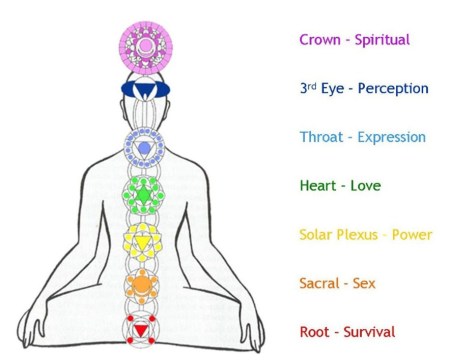
For purposes of this discussion, here’s a summary picture of the issues associated with each center.

ChakraIssues

Even at a glance, this picture suggests on the one hand, the universal nature of music, and on the other, different levels of musical effect. For example, military bands or battle calls rouse the fighting spirit. Other ragas, by time, season, or purpose stimulate the mood of love or spiritual upliftment.

One field study I recall reading many years ago disproved the specificity of cultural background to psychological response. An anthropologist played Mozart for a tribe of cannibal listeners. They were delighted and tapped their feet to the music. He then played Beethoven. They frowned and became agitated.

In many cultures and in different contexts, music has been used medicinally for healing effect. One example is the lyre to which the young shepherd boy David sang, soothing the feverish madness of King Saul.

This second picture is suggestive of ways chakra energies are blocked as well as how restoring vital circulation lifts oppressions:

ChakraDuality

In this necessarily brief “tip of the iceberg,” merely suggestive hint of the oceans of wisdom resting beneath the surface of Western psychologies, I’ll leave you with just one more teaser to ponder.

The chakras are correlated not only with notes of the musical scale, but also with specific archangels and the heavenly host who sang:

Glory to God in the highest,

and on earth peace,

good will toward men.


Psychology’s Blind Spot


Jordan B. Peterson’s finest moment (from my point of view) came in his answer to the last question of the lecture’s Q & A session. He came very close to touching on the tradition which explains his mystical experience as well as Jacob’s dream. Almost.

People who are interested in grand narratives have pointed out that there’s a set of common mythological themes across many cultures. They can be the same on one level, different on another. But humanity coalesces on what’s the same over a reasonable period of time.

. . . there’s this constant force [literally, energy structure] that makes our ethical presuppositions converge. And then that’s automatically expressed in those stories.

In one way, he is correct. But in another, significant way, not. Stories take on the images of each specific culture. In that way they are different. What they share in common, however, is not myth or archetype but SCIENCE, meaning “with knowledge.” Jacob’s ladder is certainly a striking example.

Lacking this universal, underlying science, humanity cannot be properly, completely understood. Psychologies remain incomplete and inaccurate. They have grievous blind spots.

Put another way, Huston Smith, premier comparative religion teacher and advocate of what he calls “timeless wisdom,” wrote:

Twenty years ago I wrote a book, The Religions of Man, which presented the world’s enduring traditions in their individuality and variety. It has taken me until now to see how they converge. . . .

What then emerges is a remarkable unity underlying the surface variety. When we look at human bodies, what we normally notice is their surface features, which of course differ markedly. Meanwhile on the insides, the spines that support these motley physiognomies are structurally very much alike.

It is the same with human outlooks. Outwardly they differ, but inwardly it is as if an “invisible geometry” has everywhere been working to shape them to a single truth.

This “invisible geometry” is literally the snake-like intersections of energy pathways crisscrossing and intersecting along the spine. They link the seven centers in a pattern strikingly similar to the DNA double-helix represented in the Caduceus, the healing staff of the winged-messenger god Mercury, familiar now as the symbol of modern medicine.


Ancient Himalayan sages mapped the internal energy transformers knows as chakras (“wheels).” Know how to activate them, they taught. You’ll experience enlightenment.

. . . Though recorded in ancient scripture, sages experienced vibrant spinning wheels of energy in deep meditative states as a fact of inner reality. Their reports are not the same as poetic symbolism, mythology or parable. Chakras exist as literal fact, integral to quantum inner life as an experience which can and has been replicated by countless practitioners over time.

Chakras are key to personal growth and psycho-spiritual evolution.

Genuine transformation can’t be accomplished by mental speculation or acts of sheer will power. It occurs in the deeper layers of the Life Wheel which have, disastrously, been made taboo in Western civilizations.

Einstein called this blind spot “the fateful fear of metaphysics.” The fateful-fear of self-awareness comes in its train, sometimes justified, most often times NOT.

Descriptions of heaven’s gates opening and unfolding lotus flowers which Dr. Peterson experienced in dream state come straight out of the ancient Vedas. The seventh chakra located above the head is described as a Thousand Petaled Lotus. To mystic vision, it looks something like this:

crown chakra x 4

Seven basic chakras are aligned along the human spine and within the skull. In ascending order, each is associated with an increasingly more sophisticated state of consciousness and related emotional/psychological issues. Musicians correlate them with the tones of the scale; artists with geometrical shapes and colors of the spectrum.

The 7th or crown chakra is located at the top of the head and is related to the induction of spiritual energy into the body. Said to control every aspect of the body and mind, it is associated with full enlightenment and union with God. This chakra is normally not fully opened in most humans, although pictures of saints and other spiritual beings with”halos” are depictions of activated crown chakras.

Here’s a picture of all seven, putting the heavenly ruling seventh center in context:

chakras

In the creative process, the non-physical precedes and drives the physical. Western physicians psychologists greatly would benefit from understanding the correlations of each subtle energetic center with equivalent mental and biological conditions.

Put the other way, lacking this foundation, their understanding of human nature is incomplete. Seriously skewed.

The other six are briefly described:

  • The 1st or root chakra, located at the base of the spine, is involved with the physical process of elimination and the organs that work involved in that function. It is the chakra associated with the emotional energy of survival, as well as with grounding to the physical plane.
  • The 2nd or sacral chakra is located about three inches below the navel. This chakra corresponds to sexual energy and the reproductive organs. It is also associated with creativity and intrinsic life force.
  • The 3rd or solar-plexus chakra is located at the navel and several inches above. Its energy is associated to digestion and the digestive organs, personal power, and self mastery.
  • The 4th or heart chakra it located in the center of the chest. On the physical level, it corresponds with the lungs and heart. On the emotional level, it expresses as the energy of compassion.
  • The 5th or throat chakra is located in the throat area, at the base of the neck. It is the center with communication, speech, and hearing. The ears are associated with this chakra, as well as the vocal apparatus.
  • The 6th or brow chakra is located in the center of the forehead, between and slightly above the eyes. Often called “the third eye,” it is associated with imagination and psychic abilities, along with mental activity and brain function.

Each center represents a stage in human evolution. As consciousness grows and ascends to higher levels of awareness, human potentials expand. In an equitable world, people are allowed to live and serve according to their level of consciousness. Qualifications for leadership roles rightfully depend more upon inner awareness than IQ.

A lateral view of chakras aligned along the spinal column reflects the qualitative differences in focus of awareness amongst well-known  psychologists.

invisible geometry sized

From Quantum Paradigm perspective, the chakras align with the levels of the Life Wheel like this:

As written earlier:

. . the Western way of ignoring the reality and influence of chakras makes life’s journey far more difficult than need be. But it doesn’t cause them to cease to exist. Despite scientific prohibitions, most of us still have glimpses of transcendent experience, whether in dream state or through the arts.

For example, music moves us because its resonant sound sets the chakras in sympathetic vibration. Inspired music has a healing, uplifting affect on the nervous system, the emotions, and the soul. It is not coincidence that the seven notes of the Western chromatic scale correspond with the vibratory rates of the seven major chakras. Indian ragas intentionally draw on chakra correlations to soothe emotions or uplift the spirit. In the West, similar effects of inspired music have been described as The Mozart Effect.

In addition, the (albeit too-often unconscious) effect of the chakras on human experience is particularly strong in the symbolic, visual arts –the full spectrum from fashion and home-making to interior design, architecture and fine arts. This in due in large part to the fact that the chakras are associated with geometric shapes, as well as with the rainbow colors of the light spectrum.

closing

Patricia West is author of The Common Sense Book of Change and Two Sides of a Coin: Lao Tze’s Common Sense Way of Change. She’s currently working on The Phoenix Response: Dying To Be Reborn – in the Same Lifetime. 

JBP at His Best

On September 30th, I found two particularly endearing tweets posted by JB Peterson Quotes. I thought, I owe him a post showing him at his very best.

The first one shows Dr. Peterson outdoors, sun shining on his brow, hugging smiling students from a surrounding crowd. There’s actually a broad grin on his face! It made me want to smile back at him.

The quote assigned to this photo: “Make at least one thing better every single place you go” – JBP

jbp w friends

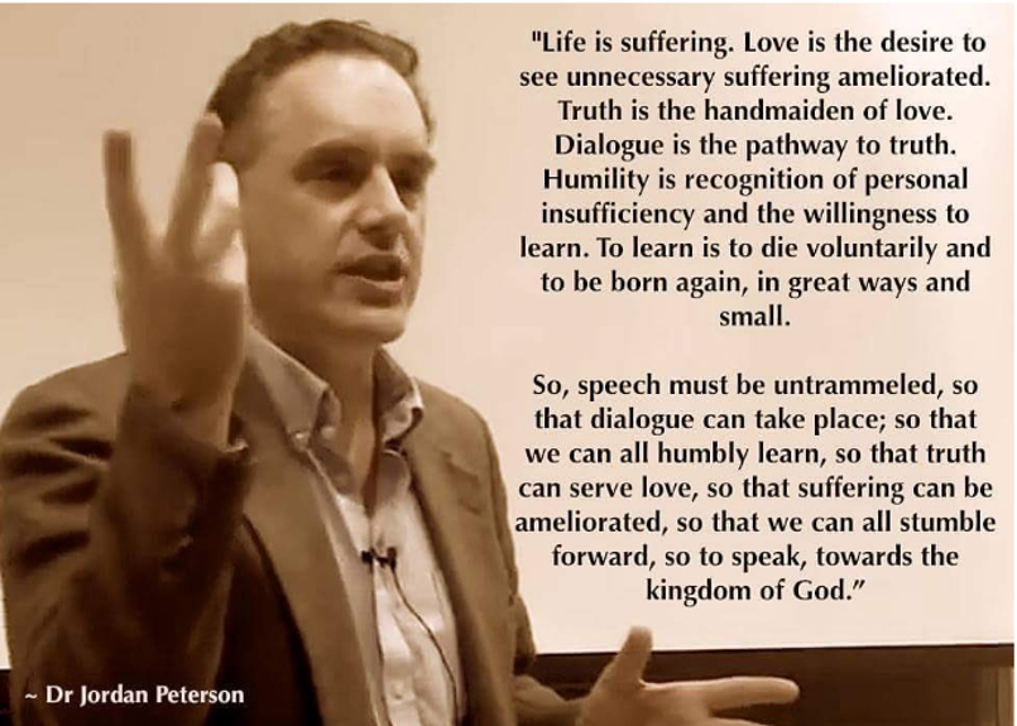
The second shows Dr. Peterson gesturing in the professor mode, pronouncing a noble set of maxims. My first response: “What a great heart this man possesses!” It warmed my heart.

jbp Stumble Forward

But then, my rational mind took over.

After the warm fuzzy feelings he stimulates subside, clarity arises. What’s left is this: At each step, his reasoning is based on false assumptions. More fundamentally, the paradigm he’s operating on is incomplete and incorrect.

Life is suffering” is what Mephistopheles (Satan) argues to Faust. This is pure irony, of course, because Satan’s lies are the primary cause of human suffering.

Christ’s example taught us quite the opposite, that Life is Eternal. Suffering exists on the ephemeral surface of the Life Wheel, in large part due to poor decisions based on false beliefs that lead to catastrophic mistakes. Suffering does not exist at the unchanging Center of the Wheel. I’ve dedicated an entire post, Life is Eternal, to support this alternative premise, from which very different results follow.

Further, however obscured by deception, humans are made in the image of God. They suffer terribly because they have forgotten who they truly are and don’t know how to re-member what they sense they’ve lost and dearly long to recover. Insufficiency is a surface illusion, though a very persistent one. (In the context of mortality, Einstein said the thing about time.)

A great deal of suffering comes from ignorant fear of death. Many have been deceived into doubting the existence of the immortal structure that supports the mortal frame. Sages act on the belief that the consequences of their actions inevitably return. They know of a certainty that upon physical death the immortal part continues on to complete whatever has been left unfinished in future life cycles. So they behave very differently from those who mistakenly believe they can get away with murder or that suicide puts an end to suffering forever.

So what’s the problem? Certainly it’s not lack of intelligence or sincerity. Dr. Peterson is looking for Love and Truth using the limited tool of reason to fathom what exceeds and transcends it.

The rational mind cannot fathom or encompass super-rational realms. Further, he’s looking in the wrong place, on the surface. According to an old saying, “It is futile to hunt for deer in a forest in which none dwell.” Even religions as codified, institutionalized teachings, though speaking to direct experience of the Center, partake of surface limitations.

Nor is truth to be found in the duality of human relationships. That’s an especially hard sell. Not very likely. Actually, it’s the other way around. To the extent individuals align with the Center, the more wisdom, compassion and competence they bring to their relationships. If more of us aligned our personal lives with the Center, increasing numbers would find ways to overcome interpersonal conflicts.

Nor do we need to “stumble” towards the Kingdom of God. As Christ confirmed, the Kingdom of God is already present. It rests within. Getting there, for most of us, however, requires a leap of faith.

He says, “To learn is to die voluntarily and to be born again, in great ways and small.” This is the Phoenix response, of which I’ve written at length.

Nor is any of this a quibble, because a great many people right now are influenced by Dr. Peterson’s logic.

book header bird

I felt compelled to address this quote one word at a time.

SUFFERING. To repeat, stating categorically that life is suffering is misleading. While Buddhists equate human experience with suffering, they also teach that the root of suffering is IGNORANCE. And the primary way to ameliorate suffering is to dispel ignorance. In this case, false, incomplete and incorrect paradigms perpetuate ignorance and generate suffering. As he has also made clear, there’s a direct correlation between beliefs and outcomes.

Whereas Dr. Peterson looks to Goethe’s Faust to explain suffering, I prefer the Old Testament:

And then there’s Job, the model of faith enduring to the end and being restored, even better than before. The phoenix image.

Here’s the secret to be gleaned from this story, illumined by the infinity symbol that links the levels of the Life Wheel. Job says, “The Lord giventh.” This is the outward, materializing movement from center to surface of the Wheel. “And The Lord taketh away.” This is the receding path of return to center. In all, “Blessed be the NAME of the Lord.” The Logos.

LOVE. “Love,” Dr, Peterson says, “is the desire to see unnecessary suffering ameliorated.” To answer that one, I had to write an entire post to reply, Yes. And much more:

[Love] can be an expression of one’s affection. It can mean a feeling of brotherhood and good will towards other people.

It can be strong liking for or interest in something (a love of music). It’s a strong, usually passionate affection, partly based on sexual attraction.

In theology, love refers to God’s tender regard for mankind, or mankind’s desire for God as the supreme good. Love is the ultimate mystery. It sparks and keeps the life process going, more to be accepted and honored than psychoanalyzed.

Further,

Plato described seven stages of love. Each is a rung on an evolutionary ladder which leads from a child’s love for parents, to erotic love, to friendship, and eventually the pinnacle of divine connection. These seven steps correlate exactly with the hierarchal seven energy centers of yoga anatomy.

Plato traces the attraction between males and females to jealous gods who split a complete, content person in half at the navel. Ever since, each part has chased after the other, longing to become whole again – another yogic priority.

Tai Chi Tu

Next, he says,”TRUTH it the handmaiden of love. Dialogue is the Pathway of Truth.”

WOW. What a partial truth. Again, it takes another post to even come close to addressing it.

I say, “Dialogue in good faith may be the instrument of coming to common understanding between individuals and amongst groups. But Truth has many levels.

So, truth meaning what? Facts? Data? Axiomatic laws of nature? Absolutes? All of the above.

What does it mean to tell the truth? About what one is doing? Thinking? Feeling? Believing? Layers and levels of truth. How do they hang together?

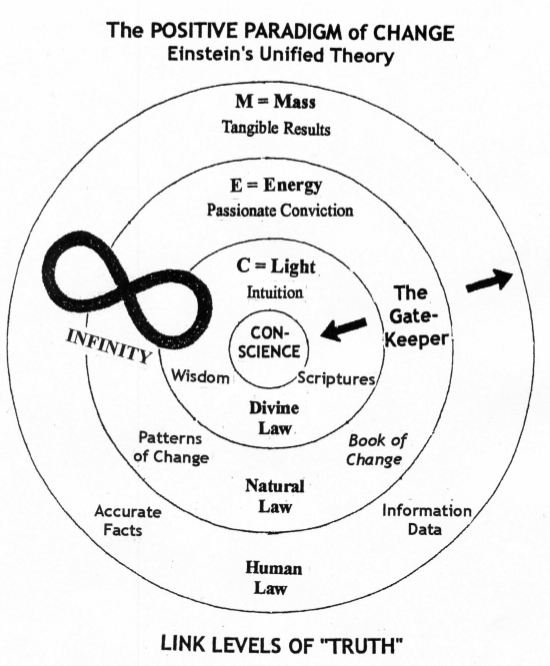
I even supplied a picture, put together early on in my blogging years before I’d acquired photo-shopping skills:

TruthLevels021713

A Rare Opportunity

Immediately after posting Be Harmless, NOT Defenseless, a twitter message from JBP came to my attention. He will be speaking in Madison, Wisconsin on Thursday, November 16th. Small world. This happens to be a day when I’m already scheduled to be in town.

The event will take place on the UW-Madison campus in the building where I worked two years as a Ph.D. candidate in the Department of Educational Administration. My office on the eleventh floor was so high above ground that I could watch incoming weather changes in the sky, far above the railroad tracks and coal yard below.

Since meeting face to face is the only way to answer inevitable questions on both sides, fate seems to be offering us an unlikely and rare opportunity.

Certainly he has many reasons to avoid it. But I have a hunch the best part of him will push past excuses. The opportunity may seem strange, uncomfortable and inconvenient. But on the opposite side of the coin, uncommonly valuable gifts might emerge from a “. . . dialogue . . . so that we can all humbly learn . . .”

Angel Calling

Life is Eternal

In JBP at his best, I wrote A great deal of suffering comes from ignorant fear of death. Many have been deceived into doubting the existence of the immortal structure that supports the mortal frame.”

Here, due to time constraints, it must suffice to expand on my meaning by drawing from earlier work. In Contemplation of Mortality, I quoted from Essay 2 on DEATH.

Dying patients went through the five stages, but then after “we have done all the work we were sent to Earth to do, we are allowed to shed our body, which imprisons our soul like a cocoon encloses the future butterfly,” and . . . well, then a person had the greatest experience of his life. Elisabeth Kübler-Ross, The Wheel of Life

I continue:

Webster’s definition of death is the act or fact of dying — the permanent ending of all life in a person, animal or plant. Personified, death is pictured as the grim reaper, a hunch-backed, black-robed skeleton wielding a scythe. The term refers to extinction, as in the death of hope.

These definitions, however, represent an extreme cultural bias with important effects on behavior. They reflect the materialistic belief that the physical is all there is. When the body fails, there is nothing else. There is no essence which survives to travel on.

The I Ching embodies a more inclusive, comprehensive view. Like the learned amongst most ancient cultures, Chinese sages regarded birth and death as natural changes, complementary stages of an ongoing cyclical life process.

Sages continue to regard death not as extinction, but the culmination of a winter season most wisely spent preparing for the coming spring. They teach that a soul, having learned the lessons and completed the work of one life cycle, separates from its used up shell. The shell, once the spirit moves on, collapses. The life essence, however, simply migrates, possibly to take on another form.

Further:

Fear is the natural outcome of limited materialistic beliefs equating the end of physical life with total extinction. Those who experience the True Self as immortal and indestructible are not plagued by fear of mortality. No doubt the courage and solace which sustained Socrates as he calmly accepted his death sentence — not as an escape, but an affirmation of principle — came from the depth of his soul awareness.

book header bird

Also to the point are the following sections from Rethinking Survival. The first is “Higher Love, Unity and Inclusiveness.” The other is “The Mystery of Death and Rebirth.”

Higher Love, Unity and Inclusiveness

The Positive Paradigm Wheel is the image of wholeness and completion: Higher Love. It pictures the inclusiveness which Campbell and Einstein believed essential to planetary survival. All parts are present, each in right relationship to the others. No part of life’s experience is lacking. No part is distorted or out of place.

This is the harmonious unity each one of us, by birthright, has the potential to experience. Poets describe the joining of the center with the surface as the Marriage of Heaven and Earth.

Given today’s paradigm malfunctions, the bliss of Higher Love seems like a distant dream. Yet we each have memories, however distant, mirrored in our art and sacred symbols. The mandalas and stained glass church windows are just a few of the countless examples. We each have persistent longings for “home” and romance that remind of us of what’s possible.

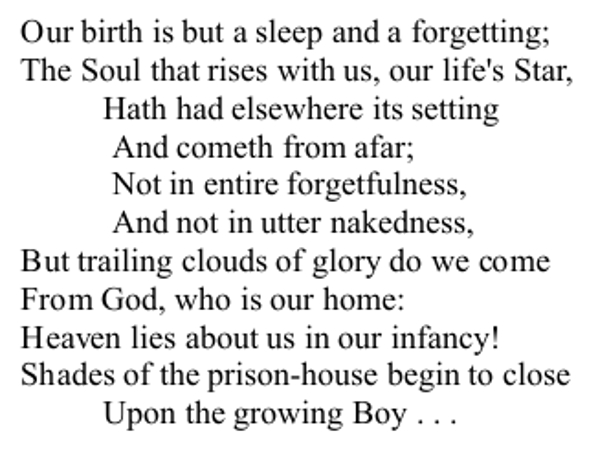
These longings are captured in the often quoted “Ode on Intimations of Immortality from Recollections of Early Childhood.” The 19th century English poet William Wordsworth lamented the socialization process that represses early awareness of divine origin:

Wordsworth

Like Wordsworth,  Einstein had glimpses, notably at the beginning and at the very end of his life. As chronicled by Walter Isaacson:

The great awakening that happen in childhood are usually lost to memory. But for Einstein, an experience occurred when he was 4 or 5 that would alter his life and be etched forever in his mind:

The catalyst of this lasting impression was a compass his father gave him. He remembered trembling and growing cold in excitement, awed by the “mysterious powers” of a magnetic needle that behaved as if influenced by a hidden force field. As he recalled later, “Something deeply hidden had to be behind things.”

inner-compass-sized

At about the same time, his mother introduced to him to music. It awakened awe before the magic and mystery of nature. “Mozart’s music is so pure and beautiful that I see it as a reflection of the inner beauty of the universe itself,” Einstein wrote.

For him, “love [of music] is a better teacher than a sense of duty.”

Phoenix - sized

The Mystery of Death and Rebirth

The yin-yang mysteries of life and death apply to experience on every level, from the individual, to families, nations and even planets.

. . . “The strange thing about growing old,” Einstein wrote, “is that the intimate identification with the here and now is slowly lost. One feels transposed into infinity . . . ”

In the year before his death, commenting on the passing of colleague Michele Besso, Einstein wrote, “He has departed from this strange world a little ahead of me. It means nothing.”

Making an observation that could have come directly from the Yoga Sutras, consistent with the Positive Paradigm, he consoled Besso’s family, “For us believing physicists, the distinction between past, present and future is only a stubborn illusion.”

It is said that in the middle ages, Carmelite nuns retired to their cells each night to sleep inside the wooden casket in which, when they died, they would be buried. Taken out of context, this may seem morbid. But in fact, they had it right. They were aligning themselves with the patterns of nature, the better to ultimately survive them. For each in- and out-breath repeats the cycle of release and renewal. Each night that we sleep, we let go of bodily awareness and return refreshed the next day.

On every scale of magnitude, the pattern is the same. Paradoxically,survivors who have released unfounded fears of death are freed to live to the full, here and how.

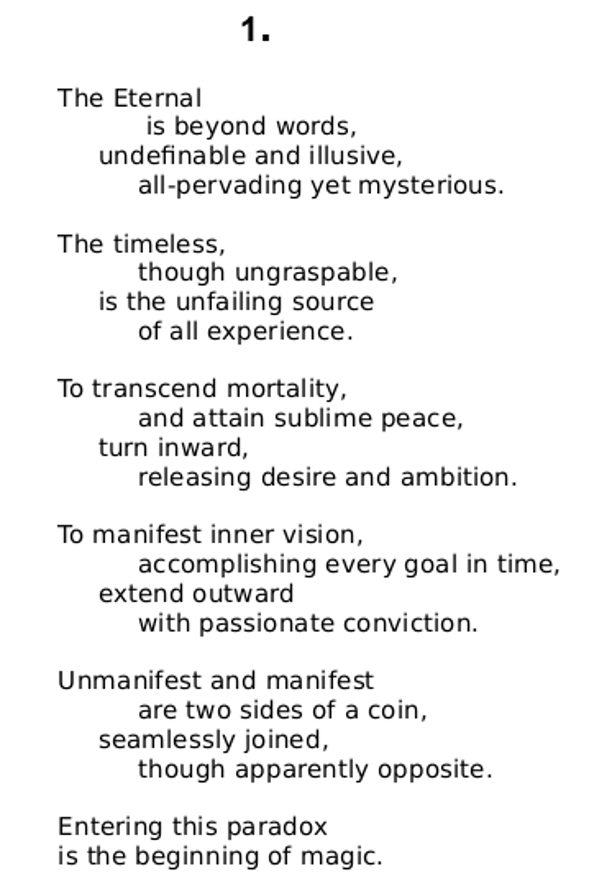
Lao Tze’s work, which breathes I Ching wisdom, illumines this paradox. He describes the relationship between the Creator and creation in the first passage of the Tao Te Ching. From Two Sides of a Coin: Lao Tze’s Common Sense Way of Change:

Unmanifest and manifest are two sides of a coin, seamlessly joined, though apparently opposite.

Entering this paradox is the beginning of magic.

Figure II.8 shows what this vision looks like when the words are properly placed within the Positive Paradigm Wheel. To the uninitiated who live exclusively on the surface of the Wheel, the eternal may seem illusive. However, the inner vision necessary to accomplish goals is found only by daring to let go of the familiar surface to travel true home to the center from which blessings then flow outward.

In the words of the God of Moses, “Return unto me, and I return unto you.”

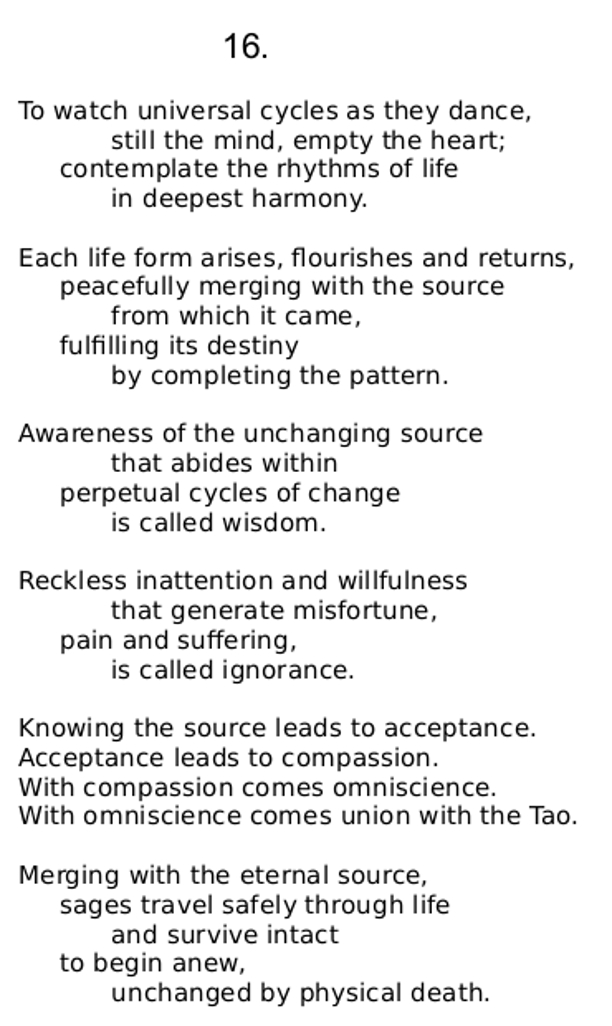
In Passage 16, Lao Tze goes even further:

16

Here, the sage not only repeats the vision of the hero’s journey. He also describes the methods of the journey — the meditative practice of stilling the mind and emptying the heart, followed by contemplation from the detached observer’s perspective. He also describes the consequences of failing to complete the life pattern and the blessings of succeeding.

The ignorant, through inattention and willfulness, generate misfortune, pain and suffering. Those who attain the source, however, (usually with the guidance of an enlightened teacher) achieve the overview which leads to acceptance, compassion and omniscience. Those who survive intact, merge with the eternal source and begin anew, like the New Adam and Christ in The New Testament.

Preparation makes the difference, deciding who is most likely to survive coming transitions, emerging better than before through the experience. Here is the root of Positive Change:

I Ching # 49. CHANGE. Day and night replace each other in endless cycles of CHANGE. The same natural law generates flux in human events. The unprepared see Change as a threat, but the well-prepared face the unknown calmly. They know that after degeneration reaches critical mass, regeneration follows. Welcome the new. Avoid short-sighted fear.

Angel Calling

Truth IS . . .

Dr. Jordan B. Peterson says, “Truth is the handmaiden of love. Dialogue is the pathway to truth.”

I say, “Dialogue may be the instrument of coming to common understanding between individuals and amongst groups. But Truth has many levels.”

TruthLevels021713

At the center of the Life Wheel, Truth partakes of the absolute, unchanging source. But ephemeral manifestations of truth depend upon the focus and direction of travel – the inward or outward pathway – within the Life Wheel.

These distinctions serve to solve much confusion. Understanding them simplifies and clarifies experience.

“Hard evidence” partakes of facts and data verifiable by standard research methods. It lives on the ephemeral surface of the Wheel.

The truth of subjective opinions and feelings/emotions is also subject to continuous change. They reside at the middle level.

Absolute, unchanging Truth rests within the innermost center of the Life Wheel. Several bible study blogs elaborate on Truth at this level:

If we ever hope to determine if there is such a thing as truth apart from cultural and personal preferences, we must acknowledge that we are then aiming to discover something greater than ourselves, something that transcends culture and individual inclinations.  To do this is to look beyond ourselves and outside of ourselves.  In essence, it means we are looking for God.  God would be truth, the absolute and true essence of being and reality who is the author of all truth.  If you are interested in truth beyond yourself, then you must look to God.

References include:

Proverbs says, “one who speaks the truth gives honest evidence. (12:17)

Truth is also a quality used to describe utterances that are from the Lord. The psalmist tells God to “guide me in your truth” (25:5); the psalmist asks God to “send forth your light and your truth.” (43:3)

Ultimately, Jesus said,”I am the way, the truth, and the life…” (John 14:6)

Now, the absolute truth experienced and then described in scripture is unfathomable to most of us. As written elsewhere:

The bad news is, it’s like trying to explain what colors look like to a blind person, or how chocolate tastes to someone who’s never had any.

The good news, however, is that inner truth can be known by direct experience. And there are means and methods for getting from here to there.”

Were you to ask a Zen master how to achieve enlightenment, the simple answer you’d probably get is: “SHUT UP!”

In gentler form, the Yoga Sutras of Patajani offer the same solution.

As I’ve also written elsewhere, the path of a Truth is a two way street.

To know the truth, be quiet. “Shut Up.” “Be still and know that I AM God.” Travel the inward path from surface to center of the Life Wheel to reunite with the Creative Source experienced as Conscience.

If you want know the world, then reverse course. Move in the opposite direction. Extend outwards from stillness towards the manifest world on the hub of the Wheel.

Lao Tze puts it this way:

01

Phoenix - sized

On another tack, in two separate posts, I’ve written about truth as game. Popular shows you’re probably familiar with include TO TELL THE TRUTH and TRUTH OR CONSEQUENCES.

In Yes, AND. . . I wrote:

Bogus claims . . . remind me of the long-running TV game show, “To Tell the Truth.” In this format, three challengers are introduced to a celebrity panel, each claiming to be the featured guest. Impostors can lie and pretend to be the central character. Only the real one is sworn to tell the truth. Panelists are challenged to ask penetrating questions, see through deceptions, and correctly identify the truth teller.

In this game reality, the best liars are rewarded. But that’s not how it works in the real world. There’s nothing entertaining or ultimately rewarding about deceiving the public. Yet, at this stage of history, it’s nigh unto impossible for all but the most discriminating (in the positive sense) to tell the difference between imitators and the “real deal.” Shameless parodies of wisdom traditions abound.

As for Truth or Consequences, it may be well worth your while to check out the entire post. Here’s a snippet:

I remembered this experience while writing about Terry Silver’s three rules for winning an unfair fight. He advised Daniel-san, the Karate Kid:

  • If a man can’t stand, he can’t fight. So break his knees.
  • If a man can’t breathe, he can’t fight. So break his nose.
  • If a man can’t see, he can’t fight. So gouge out his eyes.

Granted, I appreciate what the monkey prohibitions were getting at originally. It has to do with the meditative discipline of Stillness. If the bans are a warning not to get entangled in negative situations that poison mental clarity, not to speak impulsively or slander others, and not to project dark side urges onto others, then fine. Otherwise not.


Angel Calling

Love IS . . .

Dr. Jordan Peterson says, “Love is the desire to see unnecessary suffering ameliorated.”

I say, “Yes . . and much, much more.”

Here’s what I mean:

Essay 38. LOVE

Hear, O Israel: The Lord our God is one Lord; And thou shalt love the Lord thy God, with all thine heart, and with all thy soul, and with all thy might. Moses, Deuteronomy 6:4-5

As the Father hath loved me, so have I loved you. . .This is my commandment. That ye love one another, as I have loved you.  — Jesus Christ in St. John, The New Testament

In Taoism, we say the heart is the seat of love, compassion, joy and happiness. This is what people are looking for. But they are looking outside. We don’t know that joy and happiness is seated INSIDE our heart. We’re running around the whole world. Going to the amusement park, night club, theaters, all kinds of places in search of happiness, peace, joy. But the peace, joy and happiness are within us. – — Mantak Chia, The Inner Smile

THE FRONT

Roots of love mean to be fond, or to desire. Webster’s first definition is a deep and tender feeling of affection for, or attachment to. It can be an expression of one’s affection. It can mean a feeling of brotherhood and good will towards other people.

It can be strong liking for or interest in something (a love of music). It’s a strong, usually passionate affection, partly based on sexual attraction. In theology, love refers to God’s tender regard for mankind, or mankind’s desire for God as the supreme good. Love is the ultimate mystery. It sparks and keeps the life process going, more to be accepted and honored than psychoanalyzed.

Plato described seven stages of love. Each is a rung on an evolutionary ladder which leads from a child’s love for parents, to erotic love, to friendship, and eventually the pinnacle of divine connection. These seven steps correlate exactly with the hierarchal seven energy centers of yoga anatomy.

Plato traces the attraction between males and females to jealous gods who split a complete, content person in half at the navel. Ever since, each part has chased after the other, longing to become whole again – another yogic priority.

Tai Chi Tu - sized

Unfortunately, rather than seeking to integrate male and female energies internally, most Westerners persist in externalizing this desire for re-union. In contrast, I Ching-related healing arts provide methods for restoring inner wholeness, attaining the ultimate level of Platonic love.

The new law Christ taught fulfills the law of Moses. Further, the Old Testament command to unify the three levels of soul, heart and might into a single-minded love of One God resonates with I Ching-related practices which coordinate upper, middle and lower energy centers.

Practical methods give people of every faith practical ways to actualizing their religious ideals. Put another way, only by integrating and harmonizing the levels of mind, body and emotions can love of God be complete or the universal law fulfilled.

Healing gender, race and religious splits calls for fluency in the complete spectrum of love. Even in grimmest times, love is the omnipresent, underlying bedrock. In Rocky IV, for example, Sylvester Stallione scripted an East-West reconciliation of opposite cultures.

A nature-trained David not only defeats a technology-mutant Goliath with love and relentless grit. He wins the hearts of a hostile crowd. His victory message to international TV viewers: “If I can change, and you can change, we all can change.”

Those who turn love into a commodity exploit what people out of touch with their true selves crave most. There’s a push-pull between those greedy to get what they’ve been fooled into thinking they lack and those who profit from this illusion.

False prophets profit from persuading followers that they’re incomplete and not-okay. Further, there’s a life-changing product that can fix them. If they buy it, do whatever they’re told, turn over their power and money, they’ll be transformed and made okay. Sages grounded in reality, however, know better.

The question then arises, what happens when one is focused and centered. Does all interest in the external world and motive to accomplish cease?

Actually, it’s the opposite. As one becomes more secure from within, fear-built barriers come down. New, more authentic motives arise to replace artificial desires. As one pares away the illusion of need, the native impulse to serve with generous compassion arises.

THE BACK

In duality, hate is the opposite of love. While love grows upwards from childish attachment through degrees of maturity to altruism, hate descends to the depths of destruction. It obliterates connections, shatters hope, and in the end destroys those it consumes.

Fear-based insecurities generate a host of love perversions. Possessiveness, envy, jealousy and rivalry are variations on the theme of illusory insufficiency. In all cases, it’s the result of looking on the outside for what can neither be bought nor stolen, for the completion of Higher Love is the timeless, abiding state of one’s innermost life.

Phoenix - sized

In this context, I say to the definition of Love as “the desire to see unnecessary suffering ameliorated” . . YES. With this modifier: Love is an absolute. In duality it manifests in a multitude of ephemeral desires, altruism being one of the highest.

Angel Calling

Be Harmless, NOT Defenseless

Jordan Peterson is drawing predictable backlash upon himself.

Though a clinical psychologist, he seems irrationally intent on attracting danger, while at the same time, logically, persuasively but incorrectly protesting that retreating from conflict when you shouldn’t “will cause self-annihilation.”

The qualifier is “when you shouldn’t.” Sun Tzu, reputed author of The Art of War, is keen on the importance of knowing when to make strategic retreats. There is, after all, a time and place for every purpose under heaven.

Second, what does he mean by “self-annihilation?” As righteous warriors grounded in Old Testament faith know full well, the true Self is indestructible. So also, savvy martial artists who are seeped in I Ching wisdom trust that true identity is neither enhanced nor diminished by the dance of advance and retreat.

So what’s really at stake in pressing forward against the tide, against the grain, against the laws of nature? Why vent rage, disgust and contempt at despicable, treacherous, venomous opponents? If he exposes and humiliates them, however much deserved, they will mirror his negativity back – in spades. It’s called backlash. Every action generates an opposite and equal reaction. It’s a natural law of psychological physics.

There are other, wiser ways to shift gears — address valid grievances on higher ground without attracting inevitable vengeful retaliation.

Persisting in upping the ante, provoking human snakes, smells like pride to me. Hubris, to be precise. The stuff of tragedy in the making.

I am afraid for this highly articulate but unin-formed professor.

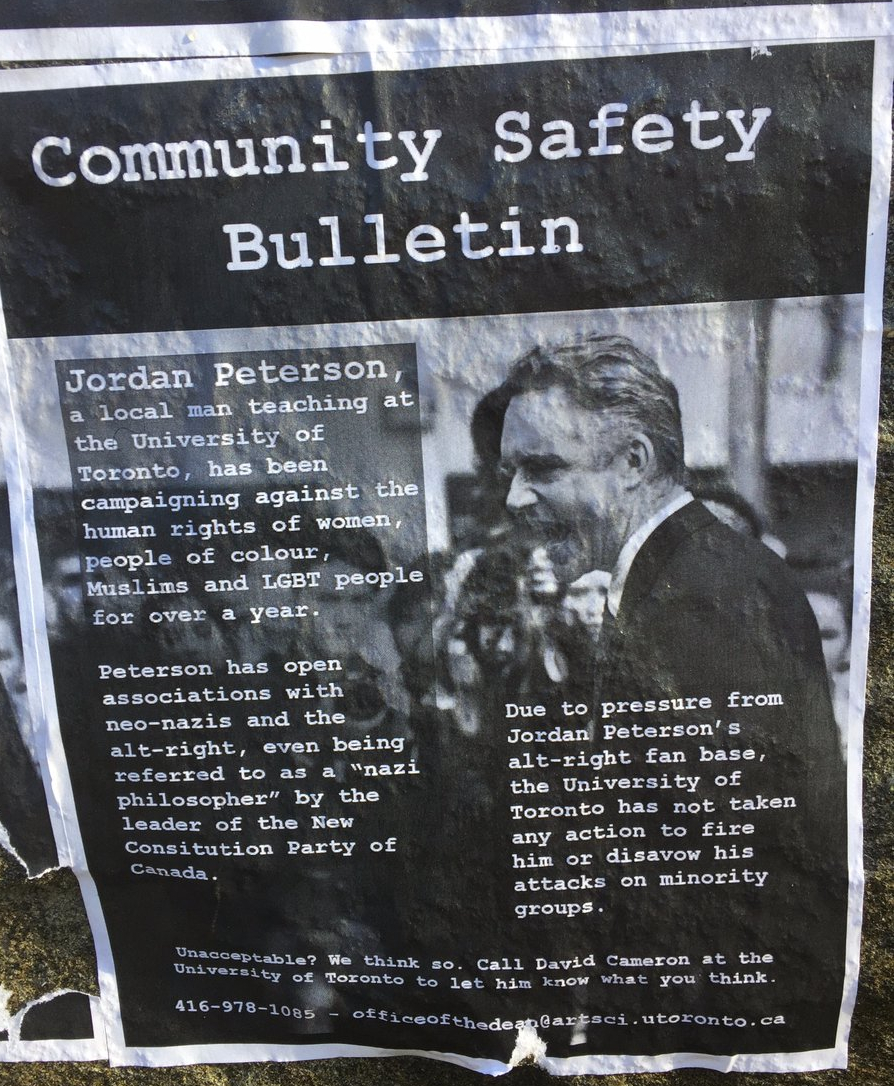
Here’s an example of the inevitable retaliation and escalating conflict he has drawn not only into his own personal life, but also into his neighborhood — not to mention the media.

On October 26th, 2017, he posted on Twitter: Those who consider themselves my enemies have been posting these all around my home neighbourhood.

Here’s the poster:

jbp

I tweeted back, “What else would you expect?” Afterwards, I realized that without this explanation, the remark wouldn’t make sense. Hence, this blog of explanation.

Phoenix - sized

Please understand. I do not write to humiliate or diminish Dr. Peterson. Quite the opposite. He has become to the current generation of young people what John F. Kennedy was to mine. A symbol of nobility. Of hope.

I remember as painfully as if it were yesterday what it felt like to me and my friends when we heard the news that his brains had been splattered by an assassin’s bullet.

I dearly want that NOT to happen again.

I’m writing to warn Dr. Peterson. To suggest ways to protect himself, not only for his own sake and for his family’s, but for those to whom he has become a hero – who would be shattered were he to come to harm.

To plead with him to rethink the limited psychology which allows him to rationalize such intensely emotional, dangerous risk-taking.

I’m writing to urge him to add to his armory of psychologies the survival wisdom of Lao Tze and the foundational attitudes prescribed in Patanjali’s Yoga Sutras. Their teachings have guided the lives of truth seekers of thousands years. There must be something of value to recommend them, having withstood this test of time.

For example, Dr. Peterson knows not whereof he speaks when he says, “Don’t be harmless.

Is he intentionally rejecting ancient wisdom by this word choice, or is he unaware of the significance of this virtue in ancient lore?

Lao Tze, in fact, uses harmlessness as his defense. It’s a time-honored strategy.

Here is a famous drawing of Lao Tze riding his ox. He is credited with writing The Tao Te Ching, which next to the Bible is the world’s most often translated scripture. It shows the enlightened sage as so intricately merged with the beast which carries him that they appear inseparable. This image represents the higher mind which has tamed and harnessed the energy of emotions. He uses them to carry him towards his destination.

Lao Tze on Ox

I will give you a hint of this survival approach to dealing with snakes excerpted from Two Sides of a Coin: Lao Tze’s Common Sense Way of Change.

snake

Passage 50 reads, in part:

Those who live by the law are protected by it.

They travel the world without being injured.

In the midst of hostilities, no one knows where to attack.

Wild beasts sense no openings to penetrate.

Enemies find no weaknesses to exploit.

Armies can’t locate a fortress to assault.

This accords with the following section about harmlessness used as defense strategy.

Non-Violence

Taoists abhor selfish meddling and gratuitous violence as equally destructive to individuals, society and the environment.

In this, their thinking is in accord with the most fundamental tenet of the yoga. Non-violence is the virtue listed first among the commitments which constitute the fundamental basis of yoga disciplines. The attitude of harmlessness, or non-violence, is the prerequisite upon which all more advanced spiritual practices depend.

In Sutra 35 of Book II, Patanjali informs us that:

When non-violence in speech, thought and action is established, one’s aggressive nature is relinquished and others abandon hostility in one’s presence.

Similarly, in Passage 55 Lao Tze describes sages as being accomplished in the ways of the ancient yoga masters:

Sages who master the infant’s harmlessness:

don’t startle wasps or snakes, and therefore don’t get stung;

don’t threaten angry beasts, and therefore are left in peace;

don’t bother birds of prey and therefore aren’t carried off.

Lao Tze describes non-violence as the cornerstone of social stability. In Passage 68 he tells us:

The best leaders act with subtle dignity.

Successful warriors move with alert caution.

Enduring winners shun prideful vengeance.

Good employers quietly support their workers.

The way of non-violence is the supreme treasure of communities

founded in the eternal Tao.

book header bird

Again, let me emphasize that I wish Dr. Peterson all the best. May he live long and prosper. Let him put on the full armor of God for protection. Give him the wisdom to tame his righteous indignation with the discipline of a seasoned sage. Let him survive as a shining inspiration to those who have come to treasure his innate nobility.

As yet, for whatever reasons, he remains unresponsive. The Catch 22 seems to be that since I’m not a well-known public figure, he assumes he has no grounds for communication. In Don’t throw pearls before swine, he says, “You cannot talk to people who will not engage in a discussion.”

So be it. He says he had no desire to engage in the legislative issue that catapulted him to fame, but felt compelled to do so. In exactly the same way, I had no desire whatsoever to write these blogs, but felt deeply compelled to do so. Unfathomable but somehow irresistible.

Whatever the outcome, at least I’ve done my best. And having done so, leave the future in trust to God’s will.

Angel Calling

Be a Warrior, NOT a Monster

Here I must make an exception to my usual rule, “Take the best. Leave the rest.”

As a reminder, here’s the Take the Best standard:

In reading opinion and even “how to” pieces, I recommend the 30/70 principle. With careful attention and a little bit of luck, it’s possible to extract the 30-percent value from the 70-percent rubbish in which its embedded.

At Oberlin, where I had the good fortune to attend college, this process was described in agricultural terms: “sifting and winnowing.” Founders probably had a biblical allusion in mind: the end-time sorting of wheat from chaff.

Were it not so over-used, “discrimination” in its original meaning would be another way to put it.

From Rethinking Survival:

I’ve come to recognize that it’s ideas — usually unconsciously held in the form of automatic-pilot, programmed assumptions — which drive decisions, actions and ultimately, survival options. Even with the best of intentions, people who operate on incomplete, inaccurate and conflicting beliefs undo themselves and harm others .. .

Sadly, I now recognize that Jordan B. Peterson is no exception. On one point in particular, he is dead and dangerously WRONG!

He claims that everyone is a potential monster. Each of us, in certain circumstances, would behave no differently than sadistic Nazi prison guards.

Here, briefly, is how he arrived at that conclusion. He recognized that potential in himself. In reading Jung, he came to mistakenly equate the experience of evil impulses with the “unconscious” shadow side of the human psyche. Ergo, since we all are in part unconscious, we are all in part evil.

Now, his experience of cruel impulses and his buying into Jung’s confusions about the “shadow” are his own personal problems.

I draw the line, however, when he uses his bully pulpit as professor and now media rock star to mislead sincere young people (primarily men). Like the Evil Emperor, he is seducing potential heroes like Luke Skywaker to the dark side of the force.

He asserts as if undeniable fact that we are all intrinsically capable of evil. To deny the dark, shadow, evil side of oneself is self-deception. It is foolish and naive – the mark of victims.

This assumption is so repugnant to me that I asked for OA’s opinion. He shook his head, No. Sadistic Nazi guards, he said, were the ones who as young boys tore the wings off flies and tortured their pet dogs. To the contrary, for example, forensic researchers who studied the remains of America’s Civil War battlefields found that frequently, dead soldiers carried fully loaded weapons on their bodies. Killing a fellow human being was apparently so unacceptable that they preferred to go down without firing a shot. That’s closer to the “norm.”

Yet Dr. Peterson insists on instructing students that they must accept and integrate into their personalities evil (a.k.a. the shadow dark side) as part of their essence. I say, NO! Light is our true and universal essence. To repeat from Be an Instrument of Light:

God is not and could not possibly be dead.

Being made in the image of God,

YOU are the living proof of God’s existence.

The truth cannot be altered. Each of us is the embodied form of a musical instrument. Even if, for any multitude of reasons, your light is switched off right now, you still have the innate potential to conduct electricity (energy, prana, chi) that in turn transforms into light.

The problem lies in the abuse of God-given Free Will. Perversions of our essential nature – including gratuitous cruelty – are the cumulative result of bad decisions made over a very long period of time.

Dr. Peterson’s way to prevent acting out evil is to “tell the truth.” But what does he mean by truth? Does it mean point an accusatory finger outwards towards others to expose their faults? Exposing problems within human institutions?

Or does he point the finger inwards towards his own (and by extension, everyone’s) limitations? Admitting fears, rage, resentments and malevolent intentions driven by envy and greed is NOT divine Truth – certainly not the truth intended when Christ said, I am the Truth and the Way. Far from it.

OA calls identifying with personal limitations “Honest Bullshit.” The Herculean solution is to clean out the Aegean horse stables – releasing negativity to restore underlying, fundamental, universal Truth. Clean out the inner emotional swamp. Just as sculptors chip away at a block of stone to reveal the figure hidden within it, so true teachers show us how to shed human dross and release inborn greatness.

This admittedly “hyper-verbal” professor is fiercely passionate, apparently sincere and highly entertaining in the delivery of false ideas. His personal magnetism – his manly panache – distracts away from critical analysis.

Here’s why I make my exception to the Take the Best rule. While I appreciate the value of Dr. Peterson’s  work, this one point is too dangerous to give a pass. It’s one thing to admit his potential for malevolence. That’s between him and God.

It’s quite another to thing say that, by extension, because he has cruel tendencies, EVERYONE does. That cruelty is innate — part of our essence. DEAD WRONG. Worse, he says we should actually cultivate it in ourselves as if owing it is the only way to recognize it and thereby prevent being victimized. “Be the baddest ass on the block to scare off wanna-be bullies.”

Dr. Peterson holds Disney’s Simba, the Lion King, up as an example to follow. Simba grows into a King, all right. King of the beasts. But there’s much much more to humans than that bestial component! Worse, he repeatedly states that you must develop your inner monster – your inner psychopath – grow TEETH, as if two wrongs make a right. NOOOOO. Two wrongs do not make a right. To the contrary, they magnify and compound the depths of evil.

Quite simply, Jung was probably advising us to make the unconscious conscious. Fine. Granted. But this process has nothing to do with mistakenly integrating hidden demons into our personality. Nor does it sanction acting them out. I doubt this Dr. Peterson’s intention. But it’s too easy, out of context, to misconstrue his meaning.

Giving him the benefit of the doubt, I think what Dr. Peterson intends to recommend is that we become WARRIORS. Fierce. Competent. Able to protect ourselves and others from seductive evil.

That I can identify with and wholeheartedly recommend. In fact, it’s a frequent theme.

OA . . . described the necessary role of a “righteous warrior,” one who has the back of true peace makers. A farmer plows his field, plants and harvests his crops. He teaches his children, loves his family, and mends his fences. Day in and out, he does whatever it takes to support those he loves. And when an enemy approaches his gate, he defends them with his life. It’s all woven into the single fabric of life.

And what protections against monstrousness does a righteous warrior bring to the ongoing battles of daily life? The weapons of light – the equivalent of Luke Skywalker’s light saber, designed to defeat darkness. Members of every American military branch know this. They choose wisely, every day, living by scripture, making incrementally correct choices in every area of their lives.

They live, for example, by Psalm 91, Psalm 144, and Ephesians 6: 10-18.

The opening verse of Psalm 91 offers a radically different understanding of “the shadow.” It is worth your careful thought:

He that dwelleth in the secret place of the most High

shall abide under the shadow of the Almighty.

The opening verse of Psalm 144 is also an eye-opener:

Blessed be the Lord my strength

which teacheth my hands to war,

and my fingers to fight:

Warriors for countless generations have suited up for battle in the full armor of God described in Ephesians.

righteous warrior


11. Put on the whole armour of God, that ye may be able to stand against the wiles of the devil.

12.  For we wrestle not against flesh and blood, but against principalities, against powers, against the rulers of the darkness of this world, against spiritual wickedness in high places.

13.  Wherefore take unto you the whole armour of God, that ye may be able to withstand in the evil day, and having done all, to stand.

14.  Stand therefore, having your loins girt about with truth, and having on the breastplate of righteousness;

15.  And your feet shod with the preparation of the gospel of peace;

16.  Above all, taking the shield of faith, wherewith ye shall be able to quench all the fiery darts of the wicked.

17.  And take the helmet of salvation, and the sword of the Spirit, which is the word of God:

18.  Praying always with all prayer and supplication in the Spirit, and watching thereunto with all perseverance and supplication for all saints . .

This is the tradition which Jesus, as a practicing Jew who kept the sabbath, told us he came to fulfill.

Now, Dr. Peterson is rightly obsessed with how to stop genocides from recurring. Hitler, Stalin and Mao might well be precursors of far worse in the works. He’s got the problem right. But solutions remain where they have been since the times of Moses and later, King David:

Dr. Peterson is looking to Abraham right now, possibly because he was the progenitor of three major religions currently engaged in mutual self-destruction.

But I’m more interested in King David, who, like Christ was born in Bethlehem, and who as young shepherd was anointed by the prophet Samuel as future king. The point in time that’s appropriate to us now, I think, is the confrontation between the boy David and the giant Goliath. Today, this might represent individuals of good will in the face of impending totalitarian global government.

What’s important here is that David exemplifies acting from a complete and accurate paradigm. He acted fearlessly on the belief that “God is with me.” With a single shot to the center of the giant’s forehead (not coincidentally seat of the third eye), he brought the monster down.

David trusted that he was not alone. He “knew” exactly where to aim. His vision was clearly focused on his target (light). He had the vigor (energy) and physical strength (mass) as well as coordination (unity) to overcome the fearsome obstacle that threatened to annihilate him and enslave his people.

It is surely no accident that Patton, the general who stopped Hitler, quoted scriptures like a bishop, knew Shakespeare’s verse by heart.

To repeat,

What’s needed now, OA told me, isn’t pacifists. Trying to reason with an evil enemy is like pissing on a forest fire. What we need now is a generation of warrior monks. Though they serve wisely, with peace in their hearts, at the same time they’re ever alert – competent to protect against intruders, whatever the level.

OA continued, People misconstrue the words, “He who lives by the sword dies by the sword.” No fault or prohibition is implied. A soldier who fights for a living hopes to retire and die in bed. A righteous warrior, however, fights the good fight right up to the last breath. It isn’t a reproach to say he’ll die by the sword. Standing firm in his truth even to the very end earns him an honorable and worthy death.

Phoenix - sized

Here’s a hint. Though not an excuse, Dr. Peterson’s metaphysical /logical insufficiencies are the symptomatic, even  inevitable result of operating from an incomplete, flat and linear false paradigm. It is highly unlikely he would make the same recommendations if he were better in-formed. Were he operating from the complete Life Wheel, he would better understand where Truth resides, what unconscious shadows are about, and how monsters are made.

He owes it to himself, his beloved family, and the countless fans who hang on his every word to get it right.

Angel Calling


Yes, AND . . .

What follows is the irrefutable answer to bogus post-modernist views. Psychologists’ tool boxes are incomplete without it. Political theorists’ speculations are void.

Here’s the plan: I’ll give you the remedy up front, then paint with a broad brush its applications and implications. As a wrap up, I’ll ask why the answer has been overlooked, listing and dismissing arguments (prejudices) that have blinded us to this answer. A P.S. suggests why this post is longer than most.

The key I’m referring to is embedded in Asian teachings that predate Christ’s incarnation by thousands of years. (Mind you, this remedy in no way conflicts with his teachings. Quite the contrary. I’ll get back to this important point in good time.)

Interestingly, Jordan Peterson opened the door to acceptance of this investigation. In describing the classic Tai Chi Tu, the Chinese yin-yang symbol, he refuted the familiar objection that the idea is too abstract. It’s “not real” in the sense that it can’t be quantified or measured. He fired back, it’s hyper-real. It is the substratum which underlies and supports physical reality.
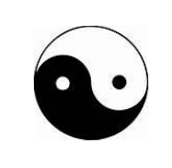
Tai Chi Tu

So too are the chakras. Ancient Hindus mapped the internal energy transformers knows as chakras (“wheels).” Know how to activate them, they taught. You’ll experience enlightenment. (This opens up the subjects of Einstein, the science of human energy transformation, and psychologists as agents of positive change – all of which I’ll also get back to briefly later on.)

Though recorded in ancient scripture, sages experienced vibrant spinning wheels of energy in deep meditative states as a fact of inner reality. Their reports are not the same as poetic symbolism, mythology or parable. Chakras exist as literal fact, integral to inner life as an experience which can and has been replicated by countless practitioners over time.

Here’s the basic picture of seven subtle energy centers aligned along the spine. It sums up the evolutionary stages of human development from base to crown. Increasingly more sophisticated psychological states are assigned to each of the centers, as are specific emotions, endocrine glands, internal organs and life issues.

chakras

Albeit subtle (which is different from “abstract”), this image, like the DNA imprinting of cells, is intrinsic to the very structure of our souls. It includes both the vertical alignment of centers and their interdependence. Its hierarchal nature can no more be debated than can the importance of breathing. Further, the vital structure of inner organization naturally reflects outwardly, mirrored in analogous family and extended social relationships.

So. Arguments that hierarchical relationships are invalid or that value systems have been negated, however apparently seductive to some, are WRONG! FALSE! The image of chakra organization supports the conclusion drawn in Be an Instrument of Light:

God is not

and could not possibly be

dead.

Being made in the image of God,

YOU are the living proof

of God’s existence.

Before you reflexively dismiss this imagery as foreign to Western thinking, let me remind you that, though overlooked, it is intrinsic to Western civilization’s deepest roots. The caduceus is associated with both Greek mythology and the Western medical profession. It serves as a vestigial reminder of the medical sciences which are shared in common by the Western and Asian healing arts, dating even further back to ancient Egypt’s Hermetic tradition.

Caduceus

In Greek mythology, the caduceus is the healing staff of Mercury, messenger of the gods. It links heaven and earth. The axis of the staff represents the human spine. The pair of snakes winding around the axis represent alternating, cyclical patterns of negative and positive (yin and yang) energy currents.

(These twin currents regulate the sympathetic and parasympathetic nervous systems, which explains why focusing the eyes where they intersect at the nostrils evens the breath, calms the mind and heals the body.)

The six chakras are the intersecting points where the curving snake-like energy forces meet and cross at the axis. These are the major centers of transformation and evolution. The wings atop the axis represent its integrating ruler: the crown chakra.

Another view brings it closer to home. Dr. Peterson also opened the door to this picture, which explains the different orientations (he calls them temperaments) amongst the psychologist’s approaches in his “tool box,” each applied at discretion according to individual client needs:

invisible geometry sized

This suggestive picture could be unpacked at length. For those familiar with psychological traditions, however, it speaks volumes unto itself.

The concept of Invisible Geometry, by the way, comes from comparative religion teacher Huston Smith, who wrote:

Twenty years ago I wrote a book, The Religions of Man, which presented the world’s enduring traditions in their individuality and variety. It has taken me until now to see how they converge. . . .

What then emerges is a remarkable unity underlying the surface variety. When we look at human bodies, what we normally notice is their surface features, which of course differ markedly. Meanwhile on the insides, the spines that support these motley physiognomies are structurally very much alike. It is the same with human outlooks. Outwardly they differ, but inwardly it is as if an “invisible geometry” has everywhere been working to shape them to a single truth.

Much is available on the web for those interested in researching the details. What’s relevant to the forward movement of this particular discussion is that this picture shows the innate hierarchal nature of human development and social organization. Not coincidentally, the highest center, associated with Christ consciousness, is called the crown center. It rules over all lesser states of being.

Next in line is the Ajna or Command Center, usually referred to as the “third eye.” It receives messages from above and coordinates functions of the lower centers.

In an article to be published in Prabuddha Bharata, I expanded:

Now, the Western way of ignoring and denying the reality and influence of chakras makes life’s journey far more difficult than need be. But it can’t and doesn’t cause them to cease to exist. Despite scientific prohibitions, most of us still have glimpses of transcendent experience, most often through the arts.

For example, music moves us because its sound sets the chakras in sympathetic vibration. Inspired music has a healing, uplifting affect on the nervous system, the emotions, and the soul. It is not coincidence that the seven notes of the Western chromatic scale correspond with the vibratory rates of the seven major chakras. Indian ragas intentionally draw on chakra correlations to soothe emotions or lift the spirit. In the West, similar effects of inspired music have been described as The Mozart Effect.

In addition, the (albeit too-often unconscious) effect of the chakras on human experience is particularly strong in the visual arts, including the full spectrum from fashion and home-making to interior design, architecture and fine arts. This in due in large part to the fact that the chakras are associated with geometric shapes, as well as with specific colors of rainbow spectrum.

Yes, AND

The Yes, AND was originally a response to a JBP video: Bravo, JBP – But there’s more!”

Yes. This is necessary, but not sufficient. My work compliments and completes yours. Knowledge, as written elsewhere, is a two-way street.

Make no mistake. I’m a great fan.

But there’s more. I MUST hope and trust that, as the declared truth-seeker and teller that he is, he’ll welcome the opportunity to learn and grow.

In one video, JBP says he’s deliberately working to improve himself, taking advice from friends who advise when he comes on too angry, too this or that. But these comments are at the level of presentation. What I’m addressing is deeper and directional. One approach starts from the outside and works inwards. The other starts from the inside and radiates outwards.

As the medieval Great Debate detailed in The Highway to Heaven is a Two-Way Street concluded, there is no contradiction. Truth travels in an infinite loop, joining surface with center, highest to lowest. So, no matter where you start, you’ll eventually cover all the bases and arrive at the same destination.

I’m guessing that limits on his approach might be intentional — strategic and necessary. His options are restricted by the professional hats he wears as clinical psychologist and teaching professor at an established university.

Whatever the case, I am free to take the next steps.

book header bird

Here’s a good example of what I mean. The Youtube video How To Transform is packed with statements that beg to be unpacked – taken the logical next step that leads outside the domains of empirical science.

What got my immediate attention was his mention of the phoenix. That happens to be the subject of a book on my drawing board, The Phoenix Response.

Referring to sorting oneself out, Dr. Peterson says:

. . . you have to allow yourself to shake off those things about you that you might be pathologically attached to – habits and people, for that matter, ways of thinking . . .

Immediately I thought, Aha! Because Rethinking Survival is premised on an Einstein quote: “We shall require a substantially new manner of thinking if mankind is to survive.”

But, continuing:

You have to allow yourself to shake those off. That’s more like a burning. That’s why the phoenix is the symbol. It’s old and it deteriorates, bursts into flame and then it’s reborn.

Well, do you want to be reborn? Do you want to burst into flame?

The answer to that generally is NO. But that’s the wrong answer. The right answer is, You let all that nonsense burn away.

Agreed. This is the hero’s journey, facing the challenges of Chapel Perilous, knowing that “the only way out is through.” Facing fears is part of the hero’s territory.

Here’s my summary or the phoenix book:

The phoenix is a mythical, magical fiery bird that recreates itself, repeatedly rising from its own ashes to begin life anew. An inspiration to self-healers, The Phoenix Response details the ultimate survival option that always remains open, even in a dangerous world which too often compels suicide.

Using time-tested methods, we can continue to repair and rejuvenate, even in the face of overwhelming stress. Yielding before life threats, we can die to the old – to be reborn IN THIS LIFETIME, over and over, each time better than before.

The Phoenix Response draws on universal wisdom written in every human heart, sought after as if lost, and esteemed as a priceless treasure by those who succeed in actualizing the hope of self-renewal.. . . anyone who deeply desires positive personal change can activate the archetypal Life Wheel, going deep within and returning to daily life again, transformed and renewed.

Just one sobering caution, however, before moving on. Ancient practices regarded each day as the microcosm of a life complete. They began and ended the day’s cycle with book-ends of prayer and preparation. Thus made themselves ready to meet the closings of larger-scale cycles whenever they should come, as prelude to the next day’s awakening.

Similarly, we can no more forestall the cyclical downturn we’re now engaged in than we could stop the sun and moon from making their rounds. Though the phoenix can usher in new beginnings, it knows better than to resist the call to transformation.

Politics and Unnatural Change

For a lighter angle, I’ll share the famous Upanishad story about blind men and an elephant as it applies to atheism. I refer to it in part to lay the groundwork for another application. I’m quoting from “The Ant and the Elephant,” a section in the “Atheism Answered” chapter of Rethinking Survival.

An ancient parable from India captures the dilemma of human inadequacy in the face of Truth. Five blind men were introduced to a gigantic elephant. After touching only one part, each reported his experience.

The one who embraced a leg said elephants are round and rough, like the trunk of a tree. The next, who felt a tusk, said elephants are hard and sharp, like a sword. The one who felt an ear described elephants as thin, flat and flexible like a fan. The next, who grabbed hold of the tail, was certain elephants are like ropes, perhaps even whips. The last, who felt its belly concluded that elephants are thick and heavy, like walls.

blindmen & elephant

Now add to the mix a contemporary riddle which captures the humor of human gropings. Question: “What is the height of ambition?” Answer: “An ant climbing up an elephant’s leg with sex on its mind.”

Next question: “What’s the height of fulfillment?” Answer: “The ant climbing back down the elephant’s leg with a smile on its face.”

Just so, we’re like blind beggars, groping towards fulfillment and comprehension of universal Truth. We mistakenly generalize our partial perceptions of a reality which none can see in entirety. We’re like ants who aspire far beyond our limits, sometimes fortunate enough to enjoy a taste of satisfaction.

Heated arguments between religionists and atheists are equally noisy, short-sighted and futile. Each disputant has a partial piece of the larger puzzle. But only that. Their antics — posturings and posings — would be comical, were it not for the extraordinary waste of time and energy lost to creative endeavors.

Atheists who deny the existence of God are equally ignorant and silly. They might as well argue that atoms have no nucleus, or that the solar system has no sun. It’s like ants presuming to deny the existence of elephants.

Their superficial (often angry, self-pitying and self-serving) arguments have no affect whatsoever on the eternal center which always was, IS, and always will be.

Have authority-cloaked religionists, for thousands of years, abused the name of God to excuse abuse of power, claiming divine rights for human rulers — be it European kings, Chinese emperors, Russian tzars, Arabian caliphs, or whomever? Certainly.

Have their enemies repeatedly wrested temporal power away from its holders, only to abuse it in even worse ways themselves? Definitely.

Have humans suffered unspeakable cruelties and injustices at the hands of fellow humans from time immemorial? Sadly so. Continuous upheavals on the surface of the wheel are part of life. It’s nothing new.

But the existence of the unchanging silent center continues into infinity, regardless of what’s happening at the surface. Whether you honor it with awe in simple silence or choose a particular name for it makes no difference. It remains the same.

If you’re totally disillusioned by bad luck or the particular version of religion enforced by your elders, your quarrel is with the ways of the world and its human institutions. Your misfortunes don’t reflect on the Creator’s existence, which is a different subject. God continues to broadcast. Whether you listen remains your choice, the exercise of God-given Free Will.

Here’s a quick summary critique of Saul Alinsky’s concept of “change.” It’s literally antithetical to the Natural Law embodied in the Chinese Book of Change.

It would seem that Edward Bernays — the so-called “father of spin” — was a foremost henchman of the invading aliens. If so, Saul Alinsky was their number one point man. The “coach” was a self-proclaimed radical.

In a twist of our poor abused language, Christ was rightly regarded as “radical” in his day. He would be today as well (in the original meaning) were he to walk among us now, because “radical” originally meant “going to the foundation or source of something; fundamental.”

That’s a far cry from Alinsky’s extremist meaning of “radical.” He was intentionally the antithesis of Christ, going so far as to acknowledge Lucifer in the dedication to Rules for Radicals: ‘the very first radical known to man who rebelled against the establishment and did it so effectively that he at least won his own kingdom – Lucifer.’

His logic is so twisted that a critique would have to move line-by-line to unravel his spiderweb of tangled assumptions. The attempt would be like wading in quicksand. A Jesuit-trained logician would be hard-pressed to come out clean. Yet Rules for Radicals is sometimes made required reading for impressionable teenagers.

In the first chapter, Alinsky stated his exact purpose, namely to coach those who “want to change the world” from what it is “to what they believe it should be.”

In this book we are concerned with how to create mass organizations to seize power and give it to the people. . . We are talking about a mass power organization which will change the world . . [emphasis added.]

Here’s part of my analysis:

Note the use of the “royal we.” This is a megalomaniac talking. He wants to change the entire world. His attitude is towards power holders is openly aggressive. He doesn’t just want to take what they hold. He wants to seize it. To violently “change the world” by means of a “mass power organization” makes no positive sense. History tells us that repeatedly, when power is seized from one set of Haves, it merely passes to another set of worse ones. Never, ever has it been “given” to “the people.” This assumption-packed premise is an extraordinary feat of tragedy-fraught hubris.

First off, what blind, ant-like mortal would dare to think that he can comprehend what, in its entirety, the world — the elephant — really is? What human could possibly be so foolish as to think she is qualified — on the basis of one puny view — to judge what it should be? Alinksy’s rules extended an invitation for blind mortals to jump in feet first where good angels know far better than to tread.

Second, who really understands change? Many bandy the word about. But it’s a profound science of which few have in-depth knowledge. Confucius dedicated a lifetime to understanding the dynamics of Natural Law encoded in the perennial Book of Change.

So, for starters, the “belief” that anyone can change the world from what he assumes it is to what he assumes it should be is unspeakably misguided. Building on this false premise, Alinsky then fueled the undermining alien arsenal with a full battery of destructive tactics. In essence, political radicals should feel “free” to violate the ten commandments. The ends (getting what you want) justify any means.

His version of social change is engineered by stirring up conflict. Use fabricated information to bear false witness against inconvenient neighbors. Alinsky advocates scapegoating, not unlike the dynamic which propelled Nazis to power. Create the illusion of an outside enemy as the way to unify your base. (How is that for the ultimate double-speak? Conflict is the opposite of unity.)

Transformation and Psychologists

Looking back on the story of blind men and the elephant, I now recognize that the seers who told this story were alluding to the chakras, telling us that the world looks very different, depending upon which set of filters you’re seeing through.

That’s why, for example, the world seen through the first chakra makes sense to a behaviorist like Skinner. Whereas, seen through a more evolved lens, human potentials look quite different. Thus, in The Carl Rogers Reader we find this prophetic comparison:

Skinner argued for the intelligent and hopefully humane use of reinforcement theory to direct the course of the individual’s and the society’s development. . . freedom and choice are mere illusions. . . Rogers argued that freedom and choice were not illusory but real phenomena, and that a science that dehumanizes the individual and attempts to control human development paves the way for dictators and despots to move society inexorably toward a totalitarian, Orwellian future.

Now, it’s important that Jordan Peterson holds Rogers in high regard. The video called A Psychotherapist Is An Engineer Of The Soul is well worth quoting:

. . . read the damn therapists, man. Those people were smart. It’s like each of them gives you a different tool box. They’re not scientific theories, exactly.

But as a clinician, you’re not a scientist. You’re an engineer of the soul. That’s a better way of thinking about it. Because it’s applied. It’s like engineering. It’s an applied science. So that makes it not a science exactly. You can use scientific knowledge. But you’re still aiming at the good. Right? That’s what you are doing as a therapist.

You say, Look. You already know that things aren’t as good as they need to be. We’re going to work on that. We’re here to make things better. And I’m going to help you figure out how to make things better. Then I’ll listen to you. And we’ll move towards some place that’s lighter and better.

Then you have tools you can use. Those great psychotherapists, man. Those people had their 10,000 hours. They all come at it from slightly different temperamental perspectives. [chakra filters!] Like Jung’s work is really useful for dealing with people who are high in openness. You have an open client? Jung works. If you have a conservative client, forget it. It’s a whole different thing.

His attitude reaffirms the conclusion drawn in Therapists as Positive Change Agents. Given Alinsky’s nefarious influence on politicians and governments, you don’t dare look to them for positive change. Nor to religionists with their scripture-defying double-talk about “social justice.”

Filling a glaring need, therapists have been obliged to take on that important role:

In the past, those in psychological pain, suffering from self-doubt and looking for a better way to live, would have turned to sages or kings for guidance. At this stage in history, however, therapists as healers (meaning “to make whole”) are often the best secular refuge.

Just imagine, if you will, how even more effective they’d be if they added chakras and the Natural Law of Change to their tool chests.

Why Asian Sciences Are Overlooked and Undervalued

Many in the West devalue Asian teachings, though in some ways, they are more sophisticated than our own. Their sages obtained knowledge from the inside, in prayer and meditation. Unfortunately, this inward focus, taken to yin extremes, explains the material poverty of the masses, which materialist Westerners find abhorrent.

But extreme-yang Westerners swing to the opposite and equal mistake. Making a deity of empirical science, they acknowledge only the “reality” of that which can be quantified and measured. As a result, generally speaking, the vast majority enjoy a relatively high standard of living, but suffer terribly from spiritual poverty.

Here’s a picture of the way each approach fractures the Life Wheel. Extreme yin religionists value the center of the Life Wheel to the exclusion of the material surface. Extreme yang materialists go the other way, valuing material wealth while denying, if not defying, the existence of its Creator.

extremes

Reminiscent of the Hindu parable, extremists are blind to the whole, mistaking a limited experience of a part for all there is. Asians, atheists, theists all have partial understandings of reality.

Now, Christ did not make this mistake, though Western religionists who call themselves Christians often do. Nor could he possibly have sanctioned the out-of-hand rejection of Asian wisdom as if pagan and therefore “unChristian.”

I’ve been told by one who knows, OA, that few people actually understood what Christ was about during his lifetime. Even fewer can claim to completely fathom the vastness of his essence now. But surely, to the extent ancient teachings contain part of universal Truth, they partake of Christ’s essence. For Christ Consciousness pervades the entire field of creation, the full chakra spectrum of potential experience.

Since, as he told us, he existed before and will endure after this Earth, permeating the entire world, how could the truth teachings of distant times and civilizations not be part of Christ? I love this cartoon, in which the Christ corrects the blind men. He gets it! (Now it’s up to the rest of us to take the hint!)
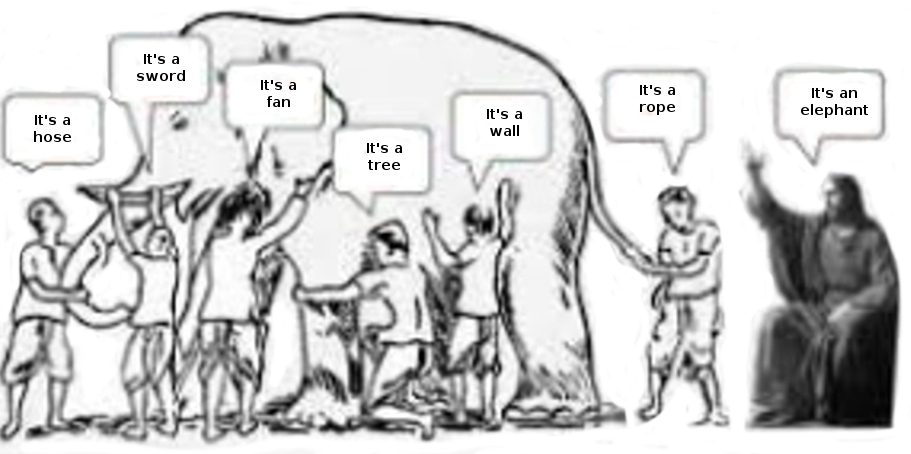
christ & elephant

So let’s drop bogus excuses for overlooking the validity of Asian teaching. They speak to fatal blind spots in Western knowledge banks. They are no more foreign or outdated than are the teachings held up to us as the foundations of Western civilization. To reject them is to forfeit the immeasurable benefits to be gained from restoring that yin part of the metaphorical elephant to our yang arsenal.

It’s the abuse of the teachings, the corruption that has occurred in every time and place, the overlay of dross and foolishness which we must shed. Do this to let pristine Truth rise once more out of the ashes of outworn customs, ignorant prejudices and greedy exploitation.

Wheel2

Wheels within wheels within wheels. Got the picture? : )

Now, here’s what I’ve been trying to get across to JBP in one form or another. Christ, like many before and after him – from ancient Hindus to Mayans – spoke about end times. However detestable, like Judas, today’s postmodernist neo-Marxists have role to play. Crossing swords with them isn’t the Phoenix way of redemption.

The irrefutable answer to bogus postmodernist views is helpful only in so far as it used to prevent deceivers from confusing those who serve truth. It’s not going to “change” the course of history as it has long been foretold.

Resigning oneself to the inevitable crash and burn of civilization is a sad but necessary preliminary step which must be endured as the prelude to its rebirth. Titanic-like victims have chosen to take a joy ride on an ill-equipped, fated ship. Squandering regretful attention on their fate is fruitless. The wiser to choice is to devote limited resources of time and attention to what can be redeemed.

Christ compared today’s end times to the fate of Noah’s civilization. The wise heeded warnings and survived. Fools partied on, oblivious to danger until the flood waters rose up to carry them off. Now as then, those deaf to calling and hardened against Truth will choose to party on, oblivious. It’s their choice. And their consequences.

Let us, instead, choose to follow Noah’s example. Prepare for what coming. Preserve the timeless teachings and protect those willing to listen and follow Truth. The process necessarily begins one person at a the time, living according to a complete and accurate reality paradigm in which yin and yang ways of knowing complete each other, bringing the music of life once again into harmony.

Angel Calling

P.S.

There’s necessity to the length of this post. It’s the last for now, so I’ve reduced the content of what might otherwise have been four separate pieces, to include everything that wanted to be said. As it stands, writing takes too much out of me, for too little in return. I’ll consolidate past work into a book, whose whole may be greater than the sum of its parts. But unless balance is restored in terms of feedback, the rest must remain unsaid.


The Heart Doesn’t Lie

Here’s the dilemma.

The education/information business is an overwhelmingly noisy market place. How can a humble writer with a calling hope to be heard? Is there a way to cut through the cluttered field of competitors out merely to make a big name and bigger buck?

The dark-side method to media madness is that mind-numbing clutter shuts intelligence down. Technology has made it too easy for anyone with a political ax to grind – any agenda however nonsensical or vicious – to build a platform.

The protective, instructive voice of conscience, however, resides in stillness. If people don’t value and have the skills to cultivate peace of mind, they can’t hear conscience. They forfeit the ability to practice conscious discrimination in the original, pristine and positive meaning of the term. They’re rendered helpless, unable to know the difference between true and false messengers.

The logical balance to extreme complexity is to return to utmost simplicity. Scriptures advise, Be still and KNOW, I am God. Listen to the heart of hearts. Not noisy, needy emotions, mind you. But the silent unerring voice of Conscience. It never lies.
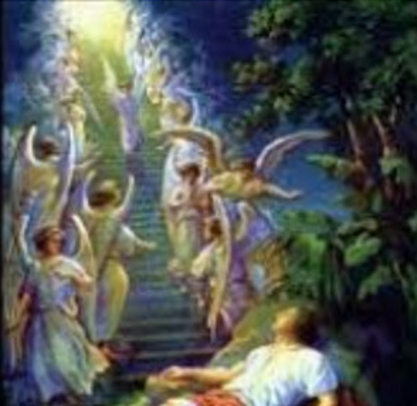

You can run. Hide. Deny it. Deceive yourself. But the heart of hearts . . if you have the courage and self-honesty to listen . . . really listen . . never lies. It can’t. It is at one with the truth. Always was. Always will be.

listen with the heart

So this is a call to conscience. Listen with your heart. It will not fool you as to who is who, or what is what.

My immediate dilemma is this. I need to effectively persuade Jordan B. Peterson that I continue to extend cordial greetings him in good faith. That I am a messenger come to meet him half way in good will, offering hard-earned and extraordinarily useful information that completes (neither challenges, competes with nor diminishes) his admirable accomplishments.

That, from opposite sides a perceptual continuum, each us working to complete the same good work. That I persist in communicating because I am listening, without projecting or anticipating outcomes. Simply because it seems like the thing to do.

Naturally, he must be suspicious. And, being very busy, is a bit too quick to judge, assuming the usual worst. Surely his twitter account is inundated with off-the-wall comments.

After a recent post, Fresh Start, I tweeted to Dr. Peterson,“Young women are just as much at risk as young men!” together with the link.

Apparently he didn’t look at my post, but instead on September 27th posted to his account the link to a video I’d already seen, as if to refute a perceived criticism. The header: “More than half a million people have watched this clip: Every young woman needs to see this!”

The video speaks to the idealized mother-child relationship as foundational to civilization, one that is being undermined by demanding careers.

Had he taken my sentence in the context of the full paragraph, the motherhood vs. career issue wouldn’t have seemed the right response.

Here’s the sentence in context:

Though hardly the masculine role model young men crave, I too grieve for their plight. But young women are just as much at risk! For many of them, a gentler, yin perspective on his intensely yang presentation of universal truths is what’s needed to bring his skewed audience numbers into balance.

So I responded, “Yes, BUT . . .”

Among others, one woman commented: “. . you would have a bigger female following if you made more aimed at women.”

A masculine comment reads: “You’re a warrior Prof. An example for us all, keep fighting the good fight.”

My point: Dr. Peterson has tapped into a crying unanswered need. He speaks to it admirably, but only partially. Nor could more be expected of any one person.

I didn’t say there’s no discussion about women. Rather, that the perspective is intensely yang in presentation. From a young man’s point of view, the professor is “an example for us all” (meaning all young men?) of fighting the good fight. Great. We need that.

The woman’s comment, however, also carries weight. More attention to women’s needs would attract a larger female following. Just not from the same, intensely yang perspective, please. It’s not female bodies that are underrepresented so much as the calm, quiet state of mind which is receptive to inner knowing – an energy valence, if you will, which Asians call “yin.”

When I responded with “Yes, BUT . . ,” what I meant to say is that there’s more to women [and men] than the either/or choice between reproduction/family versus lucrative careers. There’s whole universes of other options to choose from, not just the extremes of virgin mothers versus snake-headed monsters. I can tell you this from personal experience, having traded all other opportunities and resources to put the books on the shelves for others that were missing when I dearly needed them.

As a woman, I’ve experienced first hand the consequences of being given equally false either/or choices. But the fact remains, no matter how punitively society dictates to the contrary, like some men, some women are truth seekers. Philosophers. Fascinated by history and alarmed at the course of current events. Who speaks to them? What are their options?

Sigh. I didn’t even bother to tweet out the last post, Be an Instrument of Light, even though I thought it one of my best.

My ordinary rational mind asks, Why bother? Why not focus on winning a lottery? Carry on with daily routines without the fuss and frustration of writing. The odds of a breakthrough are probably about the same, if not better.

But then that pesky inner voice (Dr. Peterson likens it to Pinocchio’s Cricket) answers me back. “Why bother? Because to survive what’s roaring down the pike at breakneck speed, young people, male and female alike, desperately need the complementary view which balances Dr. Peterson’s example, without which results (like the percentages of his following) would continue to be skewed.” (More on this later, in a separate post, Yes, AND . . )

For now, let me share the ongoing dilemma expressed from anther, earlier angle.

To tell the truth - image

Bogus claims . . . remind me of the long-running TV game show, “To Tell the Truth.” In this format, three challengers are introduced to a celebrity panel, each claiming to be the featured guest. Impostors can lie and pretend to be the central character. Only the real one is sworn to tell the truth. Panelists are challenged to ask penetrating questions, see through deceptions, and correctly identify the truth teller.

In this game reality, the best liars are rewarded. But that’s not how it works in the real world. There’s nothing entertaining or ultimately rewarding about deceiving the public. Yet, at this stage of history, it’s nigh unto impossible for all but the most discriminating (in the positive sense) to tell the difference between imitators and the “real deal.” Shameless parodies of wisdom traditions abound.

Hucksters out to make a quick fortune while basking in their 15-minutes of fame misrepresent both their intentions and abilities. The sure-fire get-rich formula “spiritual” entrepreneurs use is to tap into people’s deepest desires and fears. Associate your product with an accepted wisdom tradition to piggy-back on its credibility. On the one hand, offer gullible marks whatever they want; on the other, guarantee protection from the consequences of stupidity.

In a crowded market place full of unscrupulous pretenders, how do messengers of substance and integrity stand out from the noisy crowd? Even screaming isn’t heard over the ruckus.

The only option is to play by the rules – quietly, persistently Tell the Truth.

To Tell the Truth” is the longest-running show in history. It’s not a game, however, nor is it for the faint of heart and spirit. But human survival is at stake.

11th hour

From another angle, I’m concerned that generosity to a fault puts our good warrior Prof at risk of distraction, if not burnout. I’m mindful of a Sufi saying that I’ve found useful as a standard for allocating positive attention:

Sufi saying sized

Put another way, after a certain point, debating noisy protesters and exposing seemingly endless corruption is a bit like wading in quicksand. It’s not good for peace of mind. There are far more important things to do, more productive uses of precious time and attention.

Ah! Perhaps this is what you mean by refusing to play their game.

Ain’t Playing Their Game

Angel Calling

Be an Instrument of Light

Although the HOW and WHAT vary over time, for me, the WHY of writing is a given. It’s a calling.

Whenever I doubt or become distracted by immediate daily concerns, the inner voice that guides me (call it what you will), sends messages to steer me back on course. Sometimes they’re subtle – even comical. Other times, they hit with the force of incoming bricks. (Maybe you know the feeling.)

Here’s a good example.

I tell it, by the way, because it’s not just about me. More importantly, it’s about you too. So . . . please stay with me.

One day, a couple of years ago by now, I was on the way to the grocery store when the van I was driving took a sharp turn in a different direction. (Sometimes it seems to have a mind of its own : )

It pulled up in front of a Dollar Store. So I decided to take a look around.

As I walked through the aisles, what caught my eye was a small table lamp. It was okay. And I did need a reading light for my bed stand.

But there was no room for extras on my card. I counted out my pocket change to see what I could afford.

I had $6.26. Down to the last penny, that was the exact cost of the lamp. An “all-in” moment. I was being asked, as an act of faith, whether I was willing to give everything I had in exchange for this lamp.

It seemed like the thing to do.

guitar lamp.sized

As you can see, it works fine. The lamp shade is opaque. It appears to be black. But when I turn on the switch, electricity shines through, making it brightly translucent.

I liked the guitar motif, but didn’t get the hidden message for quite a while. Then, Click!

I should have known. Being a string player, the message was tailor-meant for me.

During my musician-yoga years, I’d actually outlined a book, The Body as Instrument: How To Tune It. Did you know that string instruments are modeled on human anatomy? They vibrate the same way we do, which explains our resonance with music.

It’s no accident that violin parts are called the back, belly, neck and head. Strings (which used to be gut) are stretched across the neck. They resonate with an underlying sounding board called the spine.

There’s much more. But here’s the point. Going deep into music, I discovered that there were important similarities between me and my violin. I too am an instrument. One that needs tuning.

In essence, my guitar lamp was an answer to unspoken doubts about writing, confirming the call to “be an instrument of light.” Cool.

But I still continue to unpack the meaning. Is writing the way to serve? I could just as easily be a light in my daily life, in the conduct of my ordinary responsibilities. Becaring the humans and dogs I love. Making meals. Doing laundry. Running errands.

Who’s interested in light, anyway? Most humans are hidden away in Platonic, cave-like normalcy. Historically, they kill light bearers. They certainly shun inspired messages, or else imitate them, adding spin to negate the message.

There are, however, small windows in time when catastrophes make it suddenly “convenient” to hear truth. My thought for a long time has been, prepare. Put the writing in place, so when the opening occurs, what’s needed is ready and available.

book header bird

I’ve waited several years to write about the lamp because its hidden messages are still unpacking. Now, taking it to next level, the connection with you becomes clear.

I’ll give you the Aha conclusion first, then back up to show how I got there.

God is not

and could not possibly be

dead.

Being made in the image of God,

YOU are the living proof

of God’s existence.

(How convoluted and ironic is this? Though made in God’s image, we have the free will to hide from our Creator and deny the very being which our existence mirrors, upon which our lives depend.)

Nevertheless. The truth cannot be altered. Each of us is the embodied form of a musical instrument. Even if, for any multitude of reasons, your light is switched off right now, you still have the innate potential to conduct electricity (energy, prana, chi) that in turn transforms into light.

Ancient Hindus mapped the internal energy transformers knows as chakras [“wheels].” Know how to activate them, they taught. You’ll experience enlightenment.

Throughout time, various systems have reached the same conclusion, though using different avenues to reach the same destination.

If that were not enough, there’s more. Did you know that each and every part of our anatomy is a fractile-like mirror of the whole?

Maps of the front and back of the head catalog pressure points which correlate with every other part of the body. Stimulate one and corresponding internal organs throughout the body resonate with healing effect.

face & head.jpg

Similarly, complete correlations are mapped for the hands, for the feet, for the eyes, ears and tongue.

hands & feet

As such, the human physical body is a magically redundant fail-safe system. If you’re hurt in one place, you have a full-spectrum range of distant locations from which to choose. Use one or any combination of sites to intercept and remedy what ails you.

A few of us are natural healers. We intuitively know how to regenerate from injuries, often with remarkable speed. But most have forgotten. The maps, much less the sciences which explain their effectiveness, are not within the range our limited, fractured belief systems currently allow.

Why? Who does it serve, that we’ve been so alienated and cut off from the magical inner workings of our miraculous, musical bodies?

The Egyptians knew about subtle anatomical correspondences. Sages in China and India based their healing practices on them. Though suppressed by the politics of unnatural Western science, the facts now packaged as “reflexology” are available for you to act on, if you to so choose.

It may well be that, given the inevitable, coming collapse, it will suddenly once again become convenient —  perhaps even urgently necessary — to seek out and restore what we’ve relegated to the outer limits of conscious awareness. We have untold, as yet unknown resources for obtaining information, guidance and healing — if and when we are sufficiently motivated to heed them.

In 2014, I put it this way in Rethinking Survival:

I’m now convinced that the Life Wheel imaged as the Quantum Paradigm of Change is the ultimate answer to the ancient ultimate question. It’s the literal proof that humans are made in the image of the Creator — the microcosm resonates with the macro. I AM that I AM.

Put another way, “God don’t make no junk.” In this context, the exhortation, “Ye must be perfect like your Father in Heaven” makes perfect sense.

Just as Einstein had the Unified Field Theory, but didn’t know it, each and every one of us on the planet is perfect in potential: made in God’s image. But we’ve forgotten.

And tyrants want you to sleep on. They’ll do anything to prevent you from remembering that you’re inherently okay. Because once you do, as Einstein did, no one can intimidate, control or dominate you. You’re aware that nothing anyone has for sale can make you more perfect. Nor can anything that anyone threatens to take away alter your essential okayness.

It’s your inalienable birthright. A given.

The Quantum Paradigm is the viable basis upon which to build valid self-esteem. It’s the key to personal freedom — freedom from ignorance, freedom from fear. It’s the rock-solid foundation of functional relationships/community. It’s grounds for rethinking what the word “freedom” really means and how to implement its promise.

girl w guitar sized

One minor caveat: it all depends. While we all have the option to remember who we truly are, most of us are like Lambert, the Sheepish Lion. It takes a smack with a two-by-four upside the head before we’re finally ready to wake up. Often it takes the form of life-threatening danger to those we care for. A personal health crisis will also do the trick. So will job loss or a run-in with natural disaster.

But, like Dorothy stranded in the Land of Oz, when you want dearly enough to return “home,” you can click your heels whenever you chose — and come to find out, you’re already there.

11th hour

Maybe my calling as an instrument of light is simply to remind you that you are too – if and when you choose to remember who you truly are. And to warn you that crunch time is upon us. The time to wake up to your unlimited potentials is NOW . . or never.

Angel Calling

Freedom Has Many Faces

In working on “Be an Instrument of Light,” I found it necessary to first return to a post on freedom outlined earlier but set aside as a lower priority.

Here’s why.

angry mob

It appears that Jordan B. Peterson has gone all-out in his verbal war against the “bloody post-modernists” – to the point of distraction. He’s taken the high-visibility lead in controversial “transgender wars.” He ardently hammers so-called Social Justice Warriors (SJWs), defending freedom of speech as the Number ONE priority, foundational to preserving Western civilization.

In all this, his powerful arguments are admirably presented. BUT . . . however noble and technically correct, arguing is not enough.

Put another way, the initial goal of letting adversaries expose themselves for who they are has been accomplished. Now, having succeeded in persuading those of us willing and able to follow his logic, it’s time to move on. There are other, more urgent and fundamentally important battles to be fought.

I’ll explain why I say this and show you where it leads.

book header bird

A Youtube video triggered the following, earlier thoughts on freedom:

In Sorting Yourself Out, Stefan Molyneux questioned Jordan Peterson. How can his libertarian followers relate to the Self-Authoring process?

Because Peterson’s answers closely parallel the premise of Rethinking Survival and its companion Handbook, I quote his comments, Molyneux’s reservations and then put the subject in Life Wheel context.

In describing the Self-Authoring process, Dr. Peterson says:

If you’re not united within yourself – united in relationship to a higher purpose – then you’re weak [fragmented]. And the world will take you apart.

He continues:

A more sophisticated approach is, you formulate a question and you wait for an answer. A prayer might be, I would like to do the best thing I could with my life now.

You have to open yourself up to that. That’s to knock so the door will open. I would like to do the best thing with my life . . What might that be?

. . . you could say you’re leaving yourself open for a revelation or an intuition, but you’re communing with whatever it is that enables you to receive wisdom.

. . . you’re really communing with the structure of the cosmos when you’re asking such a question – especially if you do it properly. It’s really necessary because it orients you properly.

So the demise of prayer – to commune with the better part of myself to determine how I should orient myself in the world . . .  It’s a catastrophic loss not to do that.

Suffice it to say here that his comments presuppose the unified components of the Life Wheel whose hub centers around a creative source experienced as conscience. Reintroducing this ancient concept remedies what has truly been experienced as a catastrophic loss for the good guys, a horrific score for the bad guys.

Taking Dr. Peterson up on the question of “higher purpose,” Molyneux observes:

I think this question of a larger purpose to one’s life – I have a very libertarian-ish independence-minded audience. Whenever I talk to them about the need to subjugate mere personal will and desire to a larger mission in life, it strikes them in a very odd way.

I’ve already addressed the libertarian free-will issue in Practical Ethics. In essence, without a multi-dimensional paradigm of reality, you can’t fully and realistically define free-will or ethics:

What is fundamentally (fatally) missing from logician’s concept of ethics is the dynamic action of karma. The Law of Karma is a fact of life which can’t be argued, but rather is known through direct experience by those who pay attention. It’s axiomatic.

Here’s the kicker: Divine Law at the center of the Life Wheel allows for free will, so dear to the hearts of libertarians. We are created innately free to choose. However, this does not exempt anyone from the psychological consequences at the middle, e = energy level of Natural Law, much less karmic pay-back in the material world on the surface of the Wheel.

One of Webster’s definitions of “freedom” is  “being free from the usual rules or patterns.” While it may be possible to cut loose from behavioral customs and rituals associated with the surface level of the Life Wheel, exemption from the operations of Natural Law at the middle, energy level of the Wheel is impossible. Even worse, presuming to placing oneself superior to Divine Law, as if it exists to give you what you want, is a sure recipe for total disaster.

header

Now, here’s where my concern with the current focus on the SJW war is leading. It’s why I chose to return to multi-layered subject of freedom sooner rather than later:

Debating with ignorant, irrational enemies whose “minds” are already made up is as effective as pissing on a forest fire. To my Sun Tze way of thinking, at this late stage, the best response to provocation is to get safely out of their reach and regroup to minimize loses. For the most part, the motives that drive protesting mobs are neither pristine nor positive. Their methods are vulgar at best, if not violently destructive.

Worse, it’s futile waste of precious time better spent on urgently important issues being overlooked.

So here’s my problem. By grabbing center stage attention, immature Luciferian Alinsky minions are serving as unwitting decoys. They’re distracting public attention away from urgent survival issues that REALLY MATTER, running out the clock on precious time left. There’s a high probability that there’s malevolent method to this madness.

The real issues they’re obscuring are ones of basic survival. For if/when our cities are demolished by natural catastrophe, the grid goes down, and the masses are on the brink of starvation, freedom of speech will be the least of their concerns.

As instruments of dark forces pulling the strings from behind the scenes, noisy SJW protesters (an ironic contradiction in terms if ever there was any) are acting as agents of evil, distracting us away from the urgently positive work to be done NOW if mankind is to survive.

As just one example, here’s a summary of James Wesley Rawles best-seller, Patriots: A Novel of Survival in the Coming Collapse:

America faces a full-scale socioeconomic collapse— the stock market plummets, hyperinflation cripples commerce and the mounting crisis passes the tipping point. Practically overnight, the fragile chains of supply and high-technology infrastructure fall, and wholesale rioting and looting grip every major city.

Let’s not forget other threats: solar flares generating CMEs, asteroid strikes, earthquakes, hurricanes, tidal waves, volcanoes, and wars both civil and international. There’s also Einstein’s worst nightmare – nuclear holocaust. One or any combination are eminently possible.

nuclear blast

You wouldn’t know it from mainstream media. Even Glenn Beck’s site featured as the #1 Story That Matters Most, “Woman who said Hobby Lobby cotton decoration is racist speaks out after widespread backlash.” But in fact, hurricane-ravaged islands in the Caribbean are already playing out worst-case disaster scenarios.

Given the seriousness and immediacy of survival issues which trump idealism, I urge JBP as well as his many friends and countless followers to conserve their resources. Focus attention and action where it will do optimal good. Teach those who are open.

There’s some macho satisfaction to be had in crushing ignorant SJWs with powerfully presented pristine logic. But it’s not a fair fight. He has them out-gunned, so to speak, in every respect. Unfortunately, if anything, being so handily humiliated just fans the flames of hatred. It ratchets up the impulse to vengeance.

Like pissing on a forest fire, winning debates is a Pyrrhic victory.

Now, character, as they say, is fate. I haven’t JBP’s strength of will to engage in verbal wars. I personally prefer not go wading in quicksand. The motto of my choice: Resist not evil; persist in the good.

Heeding lessons learned from Sun Tzu’s Art of War, it seems far better to win the battles that really count, on our own turf, in our own terms and at the time of our choosing. Not the other guys’.

dragon

Essay 40 on Freedom has already been posted, so I’m including only the most pertinent parts below. Written in the year 2000, it serves to define the middle and inner levels of freedom, expanding on a libertarian view of personal freedom.

THE FRONT

Freedom is the state or quality of being free, implying exemption or liberation from the control of other people or arbitrary powers.

  • It means liberty and independence.

  • It implies exemption from arbitrary restriction or a specified civil right.

  • It can mean exemption or release from imprisonment, or being able to act, move or use without hindrance or restraint.

  • It means being able of itself to choose or determine action freely, at will, implying ease of movement performance or facility.

  • It means being free from the usual rules or patterns.

  • It can also mean easiness of manner, or sometimes an excessive frankness and familiarity.

Like the words peace, love and unity, freedom is a state attained on the inside first, only then reflected in external circumstances. Freedom is a state of in-dependence, depending on inner resources for guidance, protection and peace. The freedom sages seek is the cessation of negative, involuntary patterns of behavior. Breaking the chains of destructive cause and effect is a function of focus combined with self-correction, forgiveness and positive action.

Those secure in themselves dedicate their lives to extending the freedom they value for themselves to others without prejudice. . .

Legal prohibitions cannot end of slavery. Nor is saying and doing whatever one wants as a puppet of blind impulse true freedom. Seeing through negative filters of fear, pride, or apathy is as limiting as literal blindness. Even in a society that calls itself democratic, to the extent we’re unaware of inner wisdom and the laws of natural change, we’re not really free.

Self-mastery attained by thinking and acting consistently from a paradigm that is simple, complete and correct is the most precious and only inalienable freedom.

THE BACK

The opposite of freedom is imprisonment or slavery. This includes not only external, physical incarceration, but internal, self-imposed limitations. Bad attitudes, negative emotions and self-destructive habits can be as addicting as tobacco, alcohol or drugs, undermining personal freedom.

Recklessness and heedlessness are perversions of freedom. If a mistrusted authority says not to drink, smoke or drive too fast, for example, the first thing a rebellious teen will do to assert “freedom” is disobey, regardless of the consequences. Sadly, this is the hard way to learn the connection between foolishness and disaster.

11th hour

Hey, guys. It’s time to get real!

Restore Conscience to its central place in your decision-making process.

Return the ancient, complete and accurate reality paradigm to generally accepted, conscious awareness as your top priority.

All else follows.


Angel Calling

Fresh Start

 With four equally compelling bogs on the drawing board, it was hard to choose which to complete first. An article Pinned Tweeted to Jordan B. Peterson’s account boiled it down to two.

Tim Lott’s Life Spectator article, Jordan Peterson and the transgender wars, bears the subtitle, “The psychology professor is in trouble with the transgender crowd. He is also one of the foremost thinkers of our age.”

The first choice from this article echoes a book in the works, The Phoenix Response:

He [Peterson – JBP] points out that the INRI inscription on crucifixes has a mystical meaning, apart from ‘King of the Jews’ — ‘Through fire all nature is renewed.’ Which means that in order to renew your soul, you have to die and be reborn repeatedly.

The second choice, however, is closer to practical home. So that’s where I’m starting today. Besides being the eve of a projected doomsday event, Saturday, September 23. 2017 is close to the Fall Equinox, the Jewish New Year — Rosh Hashona — a new moon and to Old Avatar’s birthday. He’s seated at his work desk, mentally traveling through Otherwhere space, to outward appearances reading through a stack of James Wesley Rawles books. “Do not disturb.”

Be that as it may, according to Lott:

More than 90 per cent of his [Peterson’s] audience are men, which seems a pity since there is nothing particularly gender-specific about his teachings. Why the imbalance then?

Because these men’s stress levels are very high,’ he says. ‘I’m telling them something they desperately need to hear — that there are important things that need to be fixed up.

‘I’m saying, “You guys really need to get your act together and you need to bear some responsibility and grow the hell up.”

Lott continues:

At this point, to my astonishment, Peterson begins to weep. He talks through his tears for the next several minutes.

Every time I talk about this, it breaks me up,’ he says. ‘The message I’ve been delivering is, “Find the heaviest weight you can and pick it up. And that will make you strong. You’re not who you could be. And who you could be is worthwhile.”’

They’re so starving for that message. Young men are so desperate for a pathway that they are dying for it. And it’s heart-breaking and terrible that this idea has been kept from them. . . . Some of the young men who come to my lectures are desperately hanging on every word because I am telling them that they are sinful, and insufficient, and deceitful and contemptible in their current form, but that they could be far more than that, and that the world NEEDS THAT. [emphasis added.]

Though hardly the masculine role model young men crave, I too grieve for their plight. But young women are just as much at risk! For many of them, a gentler, yin perspective on his intensely yang presentation of universal truths is what’s needed to bring his skewed audience numbers into balance.

For my story certainly includes gender-confusion issues. Here’s a snippet excerpted from the “Who I Am To Say” section of Rethinking Survival.

The specter of suicidal thoughts haunted my up-bringing. It’s taken me over fifty years to track this demon to its lair and tame it. In retrospect, in simplest terms, I was raised in a family, reinforced by a culture, which disconfirmed my very existence.

A girl who in no way matched demeaning stereotypes — who had no desire to either cynically exploit or fearfully cave into them — was simply a non-being. She could not and should not exist. The tacit message: “Make yourself gone.”

At first I coped with less catastrophic compliance — denial. I reasoned like this: “Women are stupid, fickle and helpless. If I’m not stupid, fickle and helpless, then I’m not a woman.” I disowned the labels associated with gender and escaped into music and books.

Only later, a yogic energy understanding of the difference between feminine essence and cultural molds allowed me to rescue the baby from the bath water, reestablish an identity in harmony with the facts.

Phoenix - sized

In any case, it remains that for those on both sides of the gender see-saw, there’s a hopeful light at the end of the tunnel. Historically, at critical mass, hidden opportunities buried within danger emerge. The dedication to Two Sides reads:

Though it may seem as if [Millennials] have been economically disenfranchised by their elders, material misfortune . . . contains within it the hidden seeds of humanity’s long-term survival.

Ours isn’t the first time in the repeating cycles of history that leaders have squandered national resources. But in the context of Lao Tze’s larger reality, material resources aren’t that significant when compared to the intelligence, inner strength and inexhaustible vitality available to those who choose to access the less tangible but very real levels of inner experience.

Millennials are the ones for whom the results of the current conflict paradigm are so catastrophically dysfunctional that they have no vested interests to protect. They’re the ones prepared to move forward once again into the past, recovering the timeless treasure of . . . the Tao Te Chings wisdom.

They’ve been given the greater opportunity to . . . become the truly radical agents of genuine, positive change. [They have] the means to see through Saul Alinsky’s pseudo-radical pose, answer his twisted rhetoric, and choose the truly radical approach to change.

In work presented elsewhere, I’ve described additional teaching tools which compliment Peterson’s array. BUT . . . I’ve long since come to the conclusion that books and videos aren’t enough. For several reasons.

First, young people need direct interaction with mentors. In addition to psychological advice, they need opportunities to build practical skills. Abstract internet connections are much better than nothing. But they’re not the same as immediate, face-to-face, working relationships.

Second, young people are starved for daily, immediate working environments which support their efforts towards positive change. It’s not enough to walk away from negative pseudo-friends and exploitative employers. There has to be someplace positive, healthy and supportive to go, to live, to sink roots. . . a place where creativity is valued, honesty is rewarded, and personal growth is encouraged.

It’s not only a mental/spiritual pathway young people are starved for. Optimally, they need community: physical locations where they can gather and work together under structured supervision towards a noble goal: human survival, for example.

As it stands now, one of the major reasons many fear change is that personal transformation is the social equivalent of suicide. Too often, there are few rewards and heavy punishments associated with personal growth. In a world where old paradigms are dying, those with vested interests in the status quo are fiercely protective of “normalcy.”

My own university experience is a good example. When I entered the UW-Madison Department of Educational Administration, the doctoral thesis of my choice was “The Origin and Future of Universities.” The plan was to expand on a paper written for an Educational Policy course. It found that universities no longer meet basic student needs and advocated building alternative schools which do.

How naive. Professors married to their comfortable status quo would not allow it.

As a condition of graduation, I was obliged to conduct a statistical research study on women principals in elementary public schools – far afield from my interests in every respect. For a complex set of reasons, including that the Ph.D. credential was essential to accreditation of an alternative school – I completed the study.

Unfortunately, as “fate” would have it, I inadvertently produced statistically significant results that were just as controversial as my original thesis topic. Scratch the surface, it seems. You’ll find problems lurking just beneath.

In this case, analysis of the principal selection process showed that public school administration is a closed-shop monopoly. A pre-selection process grooms candidates who reflect the values and personal attributes of current power-holders. The only teachers who pursue administrator degrees or credentials are those who have already been quietly promised a job. Only pre-approved candidates enter the formal selection process.

Was I rewarded for exposing what insiders already knew? Not in the least!

In retrospect, this career was not meant to be. At least not yet, or as I imagined it then. Within months of my thesis defense in 1978, the rug was pulled out from underneath me. Both of the protectors who guided me safely through the politics of education disappeared. My statistics professor, who was astonished at the quality of my work, died suddenly in his sleep. The job we’d lined up was defunded. My major professor, who never doubted I’d land on my feet, no matter what, retired early and moved out of state (in large part in protest over the way his colleagues had treated me).

I was stranded, left out in the cold – with school loans to pay.

I’m not complaining, mind you. In retrospect, it was the ongoing work of an invisible, friendly hand, closing doors to open windows. But from direct experience, I well appreciate that creative people, no matter how conscientious and agreeable, are likely to find themselves excluded from thoroughly corrupt institutions. It’s simply not a match. Truth seekers and unnatural institutions are – with rare exceptions – a contradiction in terms.

I did, of course, manage to land on my feet. In turn, it has become my calling to facilitate safe landing for as many others as possible.

The alternative school I had in mind earlier was a School-Without-Walls. It would have allowed self-responsible students to define a professional goal and then select all relevant courses combined with internship experiences that furthered that goal. For example, a golfer could study everything from physiology to design and maintenance of greens to teaching golf students to acquiring the business skills necessary to run his business.

JBP speaks of a future Truth University. Yes. That’s foundational. But it’s not enough, especially because the times are growing ever more precarious, on many fronts. There’s no guaranteeing how long the infrastructure that sustains civilization will remain functional. So now I’m thinking more along the lines of monasteries established as islands of survival, community and learning during dark ages, both in Europe and Asia.

The James Wesley Rawles books OA has been browsing are much to the point. Reading these would be an excellent use of time.

Here’s the amazon description of Patriots: A Novel of Survival in the Coming Collapse:

America faces a full-scale socioeconomic collapse— the stock market plummets, hyperinflation cripples commerce and the mounting crisis passes the tipping point. Practically overnight, the fragile chains of supply and high-technology infrastructure fall, and wholesale rioting and looting grip every major city.

As hordes of refugees and looters pour out of the cities, a small group of friends living in the Midwest desperately tries to make their way to a safe-haven ranch in northern Idaho. The journey requires all their skill and training since communication, commerce, transportation and law enforcement have all disappeared. Once at the ranch, the group fends off vicious attacks from outsiders and then looks to join other groups that are trying to restore true Constitutional law to the country.

Patriots is a thrilling narrative depicting fictional characters using authentic survivalist techniques to endure the collapse of the American civilization. Reading this compelling, fast-paced novel could one day mean the difference between life and death.

One review reads:

I read this book after reading “One Second After”. [a nuclear holocaust scenario] They are two different books by two very different authors. I think it’s a very good follow-up book if you have already read that one. This book is written as a story with integrated prepper “how too” instructions.

From more points of view than can be detailed here, it is becoming increasingly evident that the collapse Rawles foresees is only a matter of time. In fact, it often seems to me as if humans and nature are in a race to see which will do us in and under first.

Who is Rawles to say? From his bio:

James Wesley Rawles is a internationally recognized authority on family disaster preparedness and survivalism. He has been described by journalists as the “conscience of survivalism.” Formerly a U.S. Army intelligence officer, Rawles is now a fiction and nonfiction author, as well as a rancher. His books have been translated into seven languages. He is also a lecturer and the founder and Senior Editor of http://www.SurvivalBlog.com, the Internet’s first blog on preparedness that has enjoyed perennial popularity and now receives more than 320,000 unique visits per week.

Interspersing JBP videos with visits to this website might be an effective way to fortify self-improvement goals. Gathering practical survival information, “real,” survival-related news and other interesting tidbits could make a significant contribution towards future positive outcomes. Today’s quote, for example is, Those in possession of absolute power can not only prophesy and make their prophesies come true, but they can also lie and make their lies come true.” Eric Hoffer.

Surely unknown opportunities are embedded within inevitable disasters that loom ahead. However, things are sure to go better for those who proactively prepare to meet them. This includes building viable support systems.

The model of intentional communities I now have in mind is similar to the rural one upon which my alma mater, Oberlin College, was built. Its motto is “Learning and Labor.”

For urban centers are quickly becoming death traps. If and/or when the grid goes down, it may be too late to escape. Better to get out while it is still an option. (Gives new meaning to “safe place.”) Inland locations, not too close to military bases or downwind from nuclear facilities, are preferable. Further, rural settings provide the opportunity to tune in again to nature, restoring harmony with rhythmic cycles which our forefathers took for granted.

Intentional preppers, regardless of their personal beliefs, are dedicated to restoring practical survival skills: learning how to live outdoors and off grid, work with tools to construct basic housing, farm, raise livestock, preserve food, feed and protect their families.

There’s lots of to be relearned by those willing to work in the process of sorting out their personal lives. This is a relatively gentle, voluntary way to make a fresh start, one person at a time.

book header bird

Interestingly, from the Taoist canon which Dr. Peterson greatly respects, Numbers 18 of both Lao Tze’s Tao Te Ching and its ancient great-great-grandfather, the I Ching, both speak the point in repeating cycles of time where – out of the ashes of corruption — new beginnings emerge. For it’s not only humans who crash and burn to be reborn, On larger scales of magnitude, entire communities and civilizations do as well.

Passage 18 from Two Sides of a Coin reads:

18

Hexagram 18 from The Common Sense Book of Change describes a positive approach to encroaching chaos:

18 IC FRESH START.jpg

Our collective future depends upon the quality of individual choices. Is it worth going through the testing fires of positive change to get from here to there? The choice is yours. But be aware. Failing to choose is also a choice, one with dire consequences. In any case, the time is NOW.

Jordan Peterson is doing his heroic best to tip the scales of history in favor of human survival. Clearly, he dearly hopes the young men he grieves for will choose wisely. As do I.

For those with ears, let them hear. And do.

Angel Calling


Coming next:

  • Yes, AND . . . .
  • The Heart Doesn’t Lie
  • Be an Instrument of Light


The Highway to Heaven Is a Two-Way Street

jacob's ladder

Balance yin and yang approaches to solving your problems. It gets better results.

Jordan B. Peterson gives a good example. Early in their marriage, when conflicts arose, he wanted to argue. His wife, however, would turn over and go to sleep. When she awoke, she reported insightful dreams which helped resolve their issues.

Dreams, as you’ll recall, are associated with the middle, Gatekeeper level of the Life Wheel which links the yang surface with inward, yin levels of intuition and conscience.

I’m well familiar with her problem-solving method, as well as how it compliments his.

Here’s an example from my graduate school experience. An Educational Administration professor wanted to know, “Why are there so few women principals in school administration?”

To me, the answer was intuitively obvious. Women teachers get no support. If they received support from family and school administrators, I told him, more would be promoted.

Two years later, after an extensive review of the research literature and a statistical study yielding 99 percent statistically significant results, these yang methods confirmed my yin intuition. My stats prof was amazed at the high probability correlations. Most of his students got garbage results. How did I manage to get significant ones, he wanted to know. And how did I explain the unusually high response rate?

Well. For one thing, because I already “knew” the answer, I knew where to look and what to ask. All I had to do was design a study that allowed the evidence to come forward. In addition, in the statistical portion of the questionnaire, I limited myself to the kinds of questions which statistics can measure. To obtain information about subjective values, I asked open-ended questions requiring written responses.

Finally, the form itself was non-threatening, attractively presented on light blue paper. I used plain language. I intentionally made the content intriguing —  even fun.

Now, for me, empirical methods are an unnecessarily complicated way to arrive at an answer. But we got to the same place, just the same.

The difference between these yin and yang approaches explains the particular value I have to offer in matters philosophical. My yin perspective compliments Dr. Peterson’s yang presentation.

We share in common a desire to understand human nature. In college, my question was, what educational discipline was the best route to answers. Psychology might have been the logical choice. But a discipline that categorizes using statistical methods (often based on rat and monkey research) left me cold.

B.F. Skinner’s presentation as a guest lecturer at Oberlin decided the issue. In his general presentation, he described toilet-training his daughter using music, so her associations would be pleasant. In the question and answer session that followed, a student asked, “What happens the first time she goes to a concert?”

No answer.

Skinner’s work has an important place, no doubt. But as teachings acquired later confirm, it focuses exclusively on behavior – a first chakra center issue. There had to be more! In addition to inhabiting physical bodies constrained within socially conditioned environments, humans have rational minds, hearts capable of empathy, creative aspirations, and, yes – souls.

So for my understanding of humans, I opted to major in comparative history rather than “science,” rounded out in equal parts by philosophy and comparative literature courses.

The places I looked for answers gave me different approaches to the devastating division between faith and empirical science. The Life Wheel described in The Key That Reconciles Science & Religion came both before and after the history course described below.

Critics have complained that its wheels-within-wheels geometry is “too abstract” and unaccessible. In thinking it through, however, I’ve concluded that the problem lies not with the concept. Rather, alienated yang intellects obscure the yin mind which intuitively grasps non-verbal truths.

From personal experience, I know that the Life Wheel is natural and intuitive. Going through puberty, I spontaneously started drawing wheels with multi-colored pencils. Without naming a reason or purpose for doing so, I filled notebooks with mandala-like geometric flowers circling outwards from a center, building layers upon layers.

childish

My step-father thought I was an artist. But it had nothing to do with professional calling. I was going through a natural change. My consciousness was blossoming, expressing itself in the non-verbal language common to native cultures from the beginnings of time. Native Americans draw prayer wheels.

Native American

Buddhists create intricate mandalas with colored sands.

buddhist

Medieval architects built radiantly multi-colored stained glass windows into their cathedrals.

Mandala1

Later, I felt compelled to return to the Life Wheel. As I applied left-brain reasoning to penetrate its meaning, it continued to develop, changing into a diagnostic and decision-making tool, a means of linguistic analysis, a zodiac-like measure of time, and more.

It’s not concentric circles that are too abstract. Quite the contrary, this primal way of understanding has been forgotten by isolated intellectuals out of touch with their universal roots.

In The Key that Reconciles Science & Religion, I showed how the Life Wheel reconciles the conflict which Nietzsche, later Jung and then Dr. Peterson, describe as devastating. I quoted Dr. Peterson, who assures us that “there’s much more to ‘reality’ than current assumptions allow.”

What follows is taken from an earlier post that draws on my history background. Snippet quotes are a spoiler alert intended to intrigue you into reading the rest.

closing

  • Professor McGill beamed his approval of the solution to the either/or conflict between science and religion. Historians, he said, call it “The Great Reconciliation.”

  • According to St. Aquinas, It works both ways. Observing the world leads to faith. Faith leads to effective behavior in the world.

  • As Albert Einstein put it, “Science without religion is lame, religion without science is blind.”

  • At the 11th hour of human history, few people have time to learn much less apply the lessons of history. For the sake of simplicity and immediately useful applications, The Great Debate’s outcome is pictured by the Positive Paradigm of Change in the form of a multi-dimensional Life Wheel.

  • Why have we forgotten this? Why do either/or controversies continue to rage as if the solution had never been articulated? Who perpetuates this unnecessary separation? Why? Who benefits? Who pays the terrible price?

book header bird

The GREAT RECONCILIATION

Like Romeo and Juliet, Abelard and Heloise are remembered in as tragic lovers separated by the slings and arrows of outrageous fortune.

Here are the highlights from medieval history. Abelard, a monk, was rich-girl Heloise’s tutor. He seduced her. Their affair outed when she became pregnant. Her uncle exacted poetic justice: the offending lover was attacked in the night and castrated. Afterwards, the lovers exchanged celebrated letters, but were never reunited.

The low lights are usually overlooked. In fact, Abelard married Heloise. But to protect his reputation as a cleric, kept it secret. He urged her to take monastic vows, which she did, but under protest. She felt no calling. For her, living a cloistered life was most unfair.

Why is this story is relevant to the ongoing discussion about the Rules of the Knowledge Game? Because Abelard later distinguished himself a participant in The Great Debate of the Middle Ages.

During my Freshman year at Oberlin College, Professor Barry McGill presented the debate with style and passion. Tall, pencil-thin, graying and bespectacled, he dramatized the effect of pendulum swings on history.

Ideas, he insisted, have great power. They alter the course of human events. In particular, philosophers’ beliefs profoundly affect the forms governments take and the way leaders treat their people.

Long before Hegel wrote about dialectics, which in turn influenced Marx. a triad of medieval scholars — St. Augustine, our sadly altered Abelard, and St. Aquinas — completed the classic example of contrasting beliefs about What Can Be Known, How, and By Whom (epistemology).

St. Augustine sat on one extreme of the philosophical see-saw. Abelard perched on the other. The intellectual world was at odds until St. Aquinas came up with the balancing fulcrum.

see saw

St. Augustine’s approach was faith-based. He depended exclusively on his belief in God. In his worldview, knowledge is the result of divine grace. His credo: “I believe that I may know.” Faith in God is prior and necessary to human endeavors.

In Life Wheel context, Augustine’s primary reality rested at the center of the Wheel and extended outwards from it to include the surface of the physical, manifested world.

Abelard took the opposite approach. Man, he held, depends on observable things and tangible experience to acquire knowledge. This approach, taken to the extreme, results in the exclusively superficial, materialistic paradigm of research science.

Importantly, however, Abelard never denied the existence of God. He held that experience of the world leads the thoughtful man to deduce the necessary existence of God. In Life Wheel context, he started at the Wheel’s surface and pushed inwards to complete the circuit.

It took St. Aquinas to complete the loop. He concluded there is no conflict between the other two approaches. Knowing is a two-way street. No matter where you start, each position leads to and completes the other, reconnecting heaven and earth, center with surface. Complete knowledge flows continuously along the path of an infinite loop.

According to St. Aquinas, it works both ways. Observing the world leads to faith. Faith leads to effective behavior in the world.

Professor McGill beamed his approval of the solution to the either/or conflict between science and religion. Historians, he said, call it “The Great Reconciliation.”

Why have we forgotten this? Why do either/or controversies continue to rage as if the solution had never been articulated?

Who perpetuates this unnecessary separation? Why? Who benefits? Who pays the terrible price?

CONCLUSION

Allow me to point out a relevant conclusion from the sad story of Abelard and Heloise. Today’s exclusively rational philosophers are as sterile as was he. And Heloise’s feminine counter-parts, isolated and cloistered, are equally unfulfilled. Just as yin and yang yearn for unity and the fulfillment of creative balance, so also faith and reason depend upon one another for completion.

As Albert Einstein put it, “Science without religion is lame, religion without science is blind.”

At the 11th hour of human history, few people have time to learn much less apply the lessons of history. For the sake of simplicity and immediately useful applications, The Great Debate’s outcome has been summed up in the Positive Paradigm of Change and illustrated in the form of its multi-dimensional Life Wheel.

Here’s why it is so critically important to reconnect the surface with the center of the Life Wheel in an infinite two-way loop, joining the material surface with its innermost source. The times in history when the rules of the knowledge game allowed creative thinkers to access both sides of the infinite, two-way street were times of renaissance that saw huge outpourings of invention, commerce, arts and learning.

The renaissance at the end of the middle ages, first in Italy and later in England represented by Elizabeth I’s Shakespeare, were times of paradigm shifts. The origin of universities took place during this time. The rules were in flux. It was fair game to access both sides of the coin, so to speak. There was no perceived conflict between faith and reason. Separation of church and state was a non-existent issue. The result was a time of creative flowering in both the arts and sciences.

Our future may well depend upon

whether or not there’s a similar Positive Paradigm shift now . . .

It will take a reconciliation and reawakening

to the full spectrum of human potentials

to generate a flourishing of creative problem-solving

sufficient to tip the scales of history

in favor of human survival.

Phoenix - sized

N.B. “Re-nasissance” = “rebirth.”

Phoenix rising from its own ashes. Got it? : )

Respect vs OPOs

Namaste1

Without a complete and accurate paradigm, one centered around the universal essence of existence which everyone everywhere shares in common, how can one respect oneself, much less others?

In Life Wheel context, essential respect rests at the center of the Wheel, ever the same, despite the fact that it is ruled out in dangerously incomplete and inaccurate belief systems.

Sadly, we train our young people to base their self-respect on other people’s opinions. Ah. The dreaded OPOs.

Why? Does your survival depend on them? Sometimes, yes. Most times, no. Do you let your self-respect go up and down with them? If so, life’s a rocky ride indeed. For OPOs are as fickle as any Hollywood fad.

Dependence on OPOs leads to this: mobs protesting in the streets, demanding respect while showing none for others. It’s oxy-moronic. A stupid contraction in terms. Look it up. Moron, meaning stupid, is actually part of the word’s Greek root.

Respect on what level, and for what? People unaware of their eternal soul define themselves in terms of their looks, or belongings, or social status. Or their feelings. But these are in continuous flux. They’re as changeable as the daily weather.

As for other people’s opinions. Most often they are a hodge-podge of assumptions, media-influenced “facts,” and mindlessly absorbed cultural conditioning. For the most part, they are myopically self-serving.

But the eternal soul? Ah. That’s something of substance one can depend on, in all weather, that never goes out of fashion.

Here’s a picture worth a thousand words:

Respect in the Center

It suggests that perhaps self-respect might well be based on achievement of consciously chosen goals, ones consistent with the welfare of all. Or living true to conscience, no matter what.

Respect for others on the surface level of results would depend on the same standard held for oneself – ability to choose and work consistently towards the achievement worthy goals.

The Book of Change describes the Self-Possession demonstrated by true leaders.

Great leaders demonstrate the SELF-POSSESSION to remain true to what they know is right despite all hardships. They act gently but fairly with others. Because they are consciously in harmony with the source of creative power, they express ideas brilliantly.

And another picture worth many words:

Namaste2

Essay 53 from Conscience weighs the balance in favor of inward-based and mutual respect:

Essay 53. RESPECT

Through the text runs a moral thread, which foreshadows the most noble ideals of Confucianism: A respect for the Natural Order, an esteem for self-cultivation, and a sense of social justice. — Kerson and Rosemary Huang, The I Ching

As long as companies think of employees as costs rather than assets, they will always be tempted to reduce the costs rather than invest further in the assets by providing safety nets for health care, retirement, and all the things that help people to get through their lives with dignity. — Autry & Mitchell, Real Power: Business Lessons from the Tao Te Ching

Our respect for ourselves determines (a) the amount of respect we crave from others and (b) our need to push for control and dominance. . . when you are in a situation when you feel disrespected, it causes a negative response [as if] the outside world, through your ego, is your only source of psychological support or nourishment. — David J. Lieberman, Make Peace with Anyone

THE FRONT

Roots of “respect” mean to look at, or look back on. Webster’s first definition is to feel or show honor or esteem for, to hold in high regard, or to treat with deference. It also means to show consideration for, to avoid intruding upon or interfering with, as to respect others’ privacy. It can mean a deference or dutiful regard, as in respect for the law. Respect is used to indicate courteous regard, as in respect for others’ feelings.

In the context of Affirmative Action objectives, respect refers to acceptance of diversity in public life, honoring each individual’s dignity and value, regardless of national origin, age, gender or personal beliefs. This implies more than an obligation to pay token lip service to legislation or an attitude of condescending tolerance. It supports the welcoming, embracing view that everyone has something of unique value to offer; that the whole is completed and enriched by contributions from every possible point of view.

In Native American, Buddhist and Hindu traditions alike, children are taught a reverence for all of life, extending not only to humans but nature as well. This includes creatures of the animal and insect kingdoms, as well as rivers and oceans, forests, mountains, deserts, jungles and even the air we breathe. Together they weave the fabric of life on earth, and evoke a commitment to maintaining the delicate balance of life-sustaining elements.

In corporate context, unfortunately, respect takes on the qualities of intimidation, fear of retribution, and enforced loyalty. In the context of inner city gang cultures, respect takes on intense meaning. The slang word “dis” means to disrespect. News stories tell of youth so outraged when strangers show disrespect that they kill for revenge. Their extreme desire for external show of personal respect changes to its extreme opposite, the ultimate show of disrespect for life.

Sages teach enduring respect for the timeless essence of all traditions, but do not hold onto particular forms of its expression after their usefulness has been outgrown. In Chinese history, the life span of successful dynasties was extended not by resisting change, but by embracing it.

When barbarians hordes assailed the empire’s gates, royal advisors, knowing that resistance was futile, recommended that the newcomers’ vitality be respectfully assimilated by mutually beneficial intermarriage of races and ideas.

When paradigms are in flux as new approaches are sought to answer new questions and meet new needs, messengers of change are often shot as if traitors by short-sighted, self-serving gatekeepers of the passing order.

This may impede progress, but cannot turn back the clock.

When the times are dangerous and the need for growth imperative, attempting to inhibit urgently necessary change is as dangerous to the civilization as is attempting to stop a mother’s labor pains once the birthing process has begun.

If, through our examples, we taught our children self-respect, self-awareness and a fearless respect for life, they’d experience no need to demand respect from others. Then disrespectful behavior would trigger not rage, but rather compassion and a commitment to uplift the ignorant and less fortunate.

THE BACK

Disrespect is the opposite of respect. Often it’s a product of sheer laziness and inattention. It can manifest as careless word choice or manner of dress. It’s reflected in failure to maintain one’s health, relationships, tools or property. This attitude is passed down through the generations and perpetuated by imitating bad examples.

The word respect is perverted when used in the context of Mafia-like extortion. It becomes a euphemism for submission due to extreme fear, the illusion of powerlessness and paralysis. Corrupt governments and organized crime rings which depend on passive acquiescence to stay in power are not respecters of life, nor do they receive of authentic respect.