Tag Archives: I Ching

Respect vs OPOs

Namaste1

Without a complete and accurate paradigm, one centered around the universal essence of existence which everyone everywhere shares in common, how can one respect oneself, much less others?

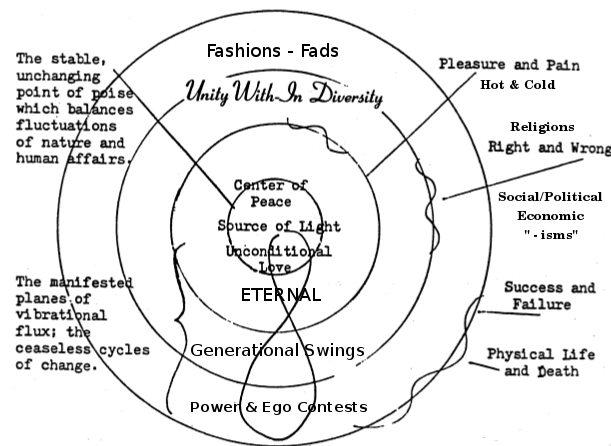
In Life Wheel context, essential respect rests at the center of the Wheel, ever the same, despite the fact that it is ruled out in dangerously incomplete and inaccurate belief systems.

Sadly, we train our young people to base their self-respect on other people’s opinions. Ah. The dreaded OPOs.

Why? Does your survival depend on them? Sometimes, yes. Most times, no. Do you let your self-respect go up and down with them? If so, life’s a rocky ride indeed. For OPOs are as fickle as any Hollywood fad.

Dependence on OPOs leads to this: mobs protesting in the streets, demanding respect while showing none for others. It’s oxy-moronic. A stupid contraction in terms. Look it up. Moron, meaning stupid, is actually part of the word’s Greek root.

Respect on what level, and for what? People unaware of their eternal soul define themselves in terms of their looks, or belongings, or social status. Or their feelings. But these are in continuous flux. They’re as changeable as the daily weather.

As for other people’s opinions. Most often they are a hodge-podge of assumptions, media-influenced “facts,” and mindlessly absorbed cultural conditioning. For the most part, they are myopically self-serving.

But the eternal soul? Ah. That’s something of substance one can depend on, in all weather, that never goes out of fashion.

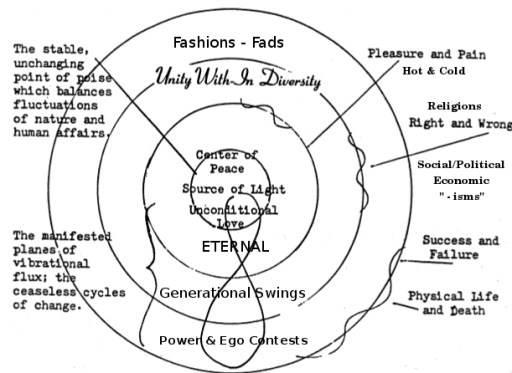
Here’s a picture worth a thousand words:

Respect in the Center

It suggests that perhaps self-respect might well be based on achievement of consciously chosen goals, ones consistent with the welfare of all. Or living true to conscience, no matter what.

Respect for others on the surface level of results would depend on the same standard held for oneself – ability to choose and work consistently towards the achievement worthy goals.

The Book of Change describes the Self-Possession demonstrated by true leaders.

Great leaders demonstrate the SELF-POSSESSION to remain true to what they know is right despite all hardships. They act gently but fairly with others. Because they are consciously in harmony with the source of creative power, they express ideas brilliantly.

And another picture worth many words:

Namaste2

Essay 53 from Conscience weighs the balance in favor of inward-based and mutual respect:

Essay 53. RESPECT

Through the text runs a moral thread, which foreshadows the most noble ideals of Confucianism: A respect for the Natural Order, an esteem for self-cultivation, and a sense of social justice. — Kerson and Rosemary Huang, The I Ching

As long as companies think of employees as costs rather than assets, they will always be tempted to reduce the costs rather than invest further in the assets by providing safety nets for health care, retirement, and all the things that help people to get through their lives with dignity. — Autry & Mitchell, Real Power: Business Lessons from the Tao Te Ching

Our respect for ourselves determines (a) the amount of respect we crave from others and (b) our need to push for control and dominance. . . when you are in a situation when you feel disrespected, it causes a negative response [as if] the outside world, through your ego, is your only source of psychological support or nourishment. — David J. Lieberman, Make Peace with Anyone

THE FRONT

Roots of “respect” mean to look at, or look back on. Webster’s first definition is to feel or show honor or esteem for, to hold in high regard, or to treat with deference. It also means to show consideration for, to avoid intruding upon or interfering with, as to respect others’ privacy. It can mean a deference or dutiful regard, as in respect for the law. Respect is used to indicate courteous regard, as in respect for others’ feelings.

In the context of Affirmative Action objectives, respect refers to acceptance of diversity in public life, honoring each individual’s dignity and value, regardless of national origin, age, gender or personal beliefs. This implies more than an obligation to pay token lip service to legislation or an attitude of condescending tolerance. It supports the welcoming, embracing view that everyone has something of unique value to offer; that the whole is completed and enriched by contributions from every possible point of view.

In Native American, Buddhist and Hindu traditions alike, children are taught a reverence for all of life, extending not only to humans but nature as well. This includes creatures of the animal and insect kingdoms, as well as rivers and oceans, forests, mountains, deserts, jungles and even the air we breathe. Together they weave the fabric of life on earth, and evoke a commitment to maintaining the delicate balance of life-sustaining elements.

In corporate context, unfortunately, respect takes on the qualities of intimidation, fear of retribution, and enforced loyalty. In the context of inner city gang cultures, respect takes on intense meaning. The slang word “dis” means to disrespect. News stories tell of youth so outraged when strangers show disrespect that they kill for revenge. Their extreme desire for external show of personal respect changes to its extreme opposite, the ultimate show of disrespect for life.

Sages teach enduring respect for the timeless essence of all traditions, but do not hold onto particular forms of its expression after their usefulness has been outgrown. In Chinese history, the life span of successful dynasties was extended not by resisting change, but by embracing it.

When barbarians hordes assailed the empire’s gates, royal advisors, knowing that resistance was futile, recommended that the newcomers’ vitality be respectfully assimilated by mutually beneficial intermarriage of races and ideas.

When paradigms are in flux as new approaches are sought to answer new questions and meet new needs, messengers of change are often shot as if traitors by short-sighted, self-serving gatekeepers of the passing order.

This may impede progress, but cannot turn back the clock.

When the times are dangerous and the need for growth imperative, attempting to inhibit urgently necessary change is as dangerous to the civilization as is attempting to stop a mother’s labor pains once the birthing process has begun.

If, through our examples, we taught our children self-respect, self-awareness and a fearless respect for life, they’d experience no need to demand respect from others. Then disrespectful behavior would trigger not rage, but rather compassion and a commitment to uplift the ignorant and less fortunate.

THE BACK

Disrespect is the opposite of respect. Often it’s a product of sheer laziness and inattention. It can manifest as careless word choice or manner of dress. It’s reflected in failure to maintain one’s health, relationships, tools or property. This attitude is passed down through the generations and perpetuated by imitating bad examples.

The word respect is perverted when used in the context of Mafia-like extortion. It becomes a euphemism for submission due to extreme fear, the illusion of powerlessness and paralysis. Corrupt governments and organized crime rings which depend on passive acquiescence to stay in power are not respecters of life, nor do they receive of authentic respect.

Practical Ethics

After outlining an article on ethics, which Stefan Molyneux passionately, intuitively reasons is the necessary foundation of civilization, I did my homework. Come to find out, he went rounds on the subject with an atheist critic.

Unfortunately, for lack of the holistic Life Wheel framework which encompasses the full range of logic complimented by and reinforced with gut feeling and inner knowing, Stefan was hard put to defend his “feelings” from his ruthlessly, exclusively logical (but dead wrong) antagonist.

As shown elsewhere, the “hollow,” exclusively materialist-atheist belief system rules out the levels at which “gut feeling” and intuition reside.

MaterialistAthest

An updated version of the complete Wheel shown earlier puts ideology -isms in their limited place: on the surface, material rim, far removed from the vital energy level of gut feelings, even further detached from the core from which wisdom flows.

expanded wheel

What is fundamentally (fatally) missing from logician’s concept of ethics, however, is the dynamic action of karma. The Law of Karma is a fact of life which can’t be argued, but rather is known through direct  experience by those who pay attention. It’s axiomatic.

Though there’s more to the subject, which I’ll bring up below, for starters, here is an excerpt to the point from The Handbook:

AXIOM FOUR

Consequences of Actions Are Inevitable; Those Who Respect the Law of Karma Succeed.

Axiom Four is the practical foundation of ethics. Were it taught earlier in schools both public and private as the survival basic which it is, today’s world would be very different indeed.

For in an exclusively materialist, linear worldview, it seems possible to “get away with murder.” Unethical leaders mistakenly continue to act on the false premise that they can avoid the consequences of their actions by hiding selfish motives and evil deeds behind a mask of false appearances.

But ultimately, they deceive no one but themselves. (Remember the fate of ponzi racketeer Bernie Madoff and his two tragically unfortunate sons?)

Oscar Wilde’s Picture of Dorian Gray dramatizes the horrific consequences of hiding hideous deeds behind an unnatural mask of eternal youth and physical beauty. Just as Dorian comes to an awful end, in the circular and richly textured fabric of the Positive Paradigm worldview, attempts at evasion and deception are ultimately futile. The concept of a “perfect crime” is an oxymoron. . . .

The Old Testament describes the karmic law of return in agricultural terms. “As ye sow, so shall ye reap” and “For everything there is a season. . . ” In modern parlance, the saying that underscores the circular dynamic of poetic justice is, “What goes around comes around.”

. . . a popular riddle asks, “Why do con artists do shabby work, charge unreasonably high prices, and get away with murder?” The cynical answer: “Because they can.” However, this cynical half-truth tells only part of the story.

They can, because there’s Free Will. They can, because they’re ignorant, or else incredibly stupid. Choices have (all too often unforeseen) consequences.

Whether one believes in God or not, whether one respects Natural Law or chooses to be blind to it, these consequences are the same. In modern parlance, “Do the Crime. Do the time.” Or, as it’s also said, “Pay back is a bitch.”

Punishment for unrepentant wrong-doing can take many forms. The consequences of breaking human laws include fines, jail-time, and in the extreme, death.

But on a deeper level, over time, retribution for violating Natural Law is visited in many forms, from mental or physical disease, to personal, professional or financial misfortune.

Consequences of misdeeds often return on the psychological level. Carl Jung, the Swiss analyst who popularized the concept of archetypes, also wrote the introduction to the Wilhelm/Baynes version of the I Ching. He noted the unintended kickback from rejecting the basic axioms of religion and natural law with mere reason. There are consequences not only for decision-makers, but also those they influence.

In sum, Jung noted that modern thinkers have made a fatal mistake. The facts of inner life can’t be driven out of existence by arbitrarily banishing them from the decision-making equation. Saying God doesn’t exist doesn’t make it so. It just leaves the unbeliever at the disadvantage of being cut off from the center.

According to Jung, denying the facts of inner life has the effect of burying rejected aspects of the whole in the “unconscious,” where they continue to reap havoc on our daily lives. Politicians and journalists under the influence of unacknowledged emotional demons “unwittingly let loose psychic epidemics on the world.”

Phoenix - sized

Here is a picture of the Law of Karma (a practical function of Natural Law). It resides at the middle, energy level of the Life Wheel associated chi, prana and emotions. Beliefs (at best, emanating from conscience – the domain of Divine Law – and experienced as intuition) trigger emotions. In turn, beliefs fueled by passionate feeling drive actions which produce results of the surface level — the domain of Human Law:


Law of Karma

Phoenix - sized

The “more” to the issue of ethics suggested above is this. Because karmic return emanates from the energy level, functional ethics necessarily has a DYNAMIC component. What’s right depends to some extent on the specifics of time, place, person and historical context.

For example, while the motive – compassion – remains constant, the correct actions taken to express this motive change with the situation. Working in a day care environment with an unruly child who doesn’t know better will require different methods of correction than would dealing with a raging psychopath who intends someone you dearly love violent, deadly harm.

For this reason, the best leaders, and the most successful people in every area of life, are the ones who are most self-aware, the ones competent to link the unchanging innermost level of Motive with the fluctuating levels of strategic Purpose and practical Intent. (Hence the admonition,”Get your act  together!”)

Conversely, those who shun self-awareness, ignore the call of Conscience and go after what they want — others be damned — are a danger to themselves and others. In any case, while the Free Will to choose remains constant at the center, the unavoidable consequences implicit in the bargain will return in kind — it’s a package deal.

So here follows an Essay on Consequences:

Phoenix - sized

Essay 43. CONSEQUENCES

Unlike any kind of fortune-telling, prophecy, or magic, the I Ching does not tell the future, it can only analyze the present. Its use does not allow one to make forecasts, only diagnoses. If there were a comparison possible with a Western equivalent, it would not be to the crystal ball but to a chess playing computer program that analyzes the current situation in order to choose one of a number of options. — Cyrille Javary, Understanding the I Ching.

Quantum mechanics is a procedure. It is a specific way of looking at a specific part of reality. The only people who use it are physicists. The advantage of following the procedure of quantum mechanics is that it allows us to predict the probabilities of certain results . . .– Gary Zukav, The Dancing Wu Li Masters: An Overview of the New Physics

One of the principles of modern physics which has contributed heavily to current organizational theory states that matter is nothing but relationships. That’s the glue of an organization — relationships. Without honesty, there is no trust, and consequently, very weak relationships. — Alan Downs, Seven Miracles of Management

THE FRONT

The literal meaning of the root word is “to follow after.” Webster’s first definition of consequence is a result of an action or process, an outcome or effect. Second, it’s a logical result or conclusion, an inference. Third, it’s the relationship of cause and effect. Last, it’s defined as importance or influence, as in a high-ranking person of consequence.

Board games like chess challenge the intellect to think in terms of strategy. High ranking players, white and black, oppose each other. Contestants maneuver their pieces, the object being to take over the field. Pieces of different consequence are ranked by medieval social status as kings, queens, and bishops, down to lowly pawns.

Each has a proportional range of motion, pawns having the least. But, with persistence, pawns can traverse the field and change rank, becoming powerful players in the end.

The United States was founded in reaction to European governments that violated Natural Law, subordinating merit to class interests and siphoning the resources of workers to fill the coffers of a privileged few.

In contrast, the ideal of the original American dream honored the natural law of cause and effect. Every person was free to advance according to merit. Each was entitled to receive just compensation for honest work. All were entitled to protection of individual civil rights under the law.

Throughout history, there’s been a push/pull tension between those who respect the biblical maxim, “As ye sow, so shall ye reap,” and those who would make themselves exempt from the law. In nature, there are times of plenty and times of want, times of success and times of defeat.

Some, however, ignorantly try to short-circuit the process, by-passing the hard times that teach us humility, abusing human law to short-sighted, personal and political ends. They’d rather, by cheating natural laws, be ceaselessly, excessively prosperous, at the expense of others who suffer in perpetual want.

Rather than engage in the give-and-take process on the chess-board of life, where the light and dark, yang and yin, alternate in orderly succession, such people would fold the board, refuse to play, and withdraw from the life process. But even the attempt to evade natural consequences has consequences.

The I Ching, like the game of chess, is a miniature of the human psyche and of community relationships. Like playing three-tiered chess, working with the I Ching not only engages the intellect, but cultivates a keen sense of the hidden forces, deeply irrational and sometimes sublime, which drive and even occasionally inspire the players.

These disciplines teach us to make our choices in terms of cause and effect, mindful of long-term implications. They help us to overcome daily challenges with wisdom and grace, and prepare us to survive and prevail when confronted by opponents who would wipe us off the board.

The title Dancing Wu Li Masters refers to the Chinese word for “physics,” translated as “Patterns of Organic Energy.” Sadly, the logical connection to the I Ching wasn’t made. The Positive Paradigm of Change derived from I Ching — consistent with Einstein’s physics — holds the key to fundamental life questions which continue to elude physicists, social and medical scientists alike. Whether or not we follow through has dire consequences for future survival.

THE BACK

The opposite of consequence would be inconsequential, having no meaning or importance. However, the Chinese saying goes that even one small grain of rice can tip the scales one way or the other. Logically, if there is no action, there would be no consequences. But consequences also follow from failing to take action.

Perversions of consequences include attempts to break the cause-effect connection, either to act without paying the price or to collect unearned rewards. Out of laziness, fear or greed, wrong-doers attempt to cheat life, change the course of events by unnatural means. In the long-term, it never works as intended. Instead, violating Natural Law sets chain reactions in motion that explode when events reach critical mass.

Angel Calling

The Gate Keeper

Responding to a conversation between Jordan Peterson and Stefan Molyneux, Sorting Yourself Out, I wrote:

Practical tools I’ve acquired and developed could well serve to fortify your intellectual arsenals in the ongoing media battle for the hearts and minds of the general public.

. . . my work identifies an overlooked but fatal blind-spot in Western thinking. (I will elaborate on this at length in a post to be called “The Gate Keeper.”) Suffice it to say here that unless/until we restore a complete and correct paradigm to common understanding, the downward spiral of history will continue on its course unchecked.

This, then is The Gate Keeper post.

Phoenix - sized

The middle level of the Life Wheel is the missing piece of the knowledge puzzle, lacking which one cannot get from here (daily experience) to there (inner peace and truth).

Here is the description of the e = energy level of the Life Wheel from The Handbook:

e  =  Energy

Much ignorance, misinformation and confusion surrounds the energy level of the Positive Paradigm. The state of chaos into which the world has degenerated attests to this deficiency, as well as the urgent need to correct it. Only the basics are described here, suggestive of further exploration.

The middle level is the domain of Natural Law, whose dynamics are mapped in the Chinese I Ching, the Book of Change. This body of knowledge has evolved over eight-thousand years as sages continue to observe the operations of energy and document the repetitive patterns of change.

Natural Law maps the energetic underpinnings of the dynamic, physical world. It is experienced as the patterned recurring cycles of seasonal change, and is equally applicable to humans and their cyclical life changes: birth, growth, decay and death.

The middle layer is the realm of less tangible but still measurable states of energy, including electricity. More subtly, it is the chi, ki or prana described by Chinese, Japanese and Indian traditions as the life force which animates all living beings. In Greek and Christian contexts it correlates with the breath, the psyche.

These subtle energies influence internal psychological states and drive external human behavior, which in turn affects social relationships. Knowledge of these dynamics is essential to personal survival.

Effective leadership and the quality of life within organizations hinge on the quality of awareness brought to dynamics at this level. While some leaders understand the dynamics of change at a gut level as a matter of common sense, systematic logic and deliberate understanding would significantly improve the results of the decision-making process.

Those denied access to material and social resources are often forced inside. Of necessity, turning inward, they develop and depend for survival upon strengths drawn from the middle and center of the Life Wheel.

At times, material deprivation and hardships yield the opposite and equal blessings of in-sight and emotional fortitude. At other times, however, excessive investment at the middle level results in delusions, latent with the potential for erupting into violence.

In any case, making a virtue of necessity by rejecting the material world prevents completion of the pattern. It can’t correctly be equated with spirituality.

Cultures which enforce an exclusively materialistic worldview and deny the experience of everything not tangible and measurable place severe hardships on those whose inner lives are especially active. The Handbook gives ample opportunities to diagnose such imbalances, the better to remedy them.

Societies which deny their citizens practical outlets for articulating and harnessing inner energies creatively can literally drive people crazy, to murder and suicide, or at best, underground. Many “sensitives” survive by channeling socially banned, unacceptable awareness and longing for self-fulfilling adventure into the arts: music and literature, including romance, murder mysteries and science fiction. (Substance abuse and food addictions are also turned to for escape, as are violent video games.)

This is a great loss to society. The world would be better off if high-energy, creative individuals were identified as potential leaders, trained and given employment options accordingly.

Phoenix - sized

Awareness of the middle energy level equated with emotions has recently been brought back into fashion in the guise of “emotional intelligence.” But why has the middle, Gate Keeper level for so long been relegated to the realms of the taboo and banned from conscious awareness?

Certainly laziness is one problem. Cleaning out one’s personal emotional swamp can be very hard work.

Furthermore, untamed and unharnessed, it can be very dangerous. When polluted, the middle energy level  houses the inner demons of terrifying, repressed memories. It is the storehouse of our socially unacceptable worst fears and imaginings.

This leads to a fateful fear of self-awareness. For there are times when one shouldn’t believe or follow one’s inner voices. Disciplined, discriminating thinkers (in the pristine meaning of the word) know that not all of them emanate from the Source of truth and light:

. . . the Positive Paradigm also accounts for the actions of destructive and evil people throughout history which give Page pause. Despite claims to the contrary, such actions are not the result listening to the inner voice of conscience. Evil actions are the mark of unbalanced extremists who have been misled into following the seductive voices lodged within the middle, sub-rational level of the Wheel.

Destructive leaders are heeding not the innermost voice of Conscience, but the clamor of the Seven Deadly Sin-Demons — starting with Pride, followed by (and often in combination with) Anger, Avarice, Gluttony, Lust, Envy and Sloth. Modern day demon off-spring include Separatism, Exclusiveness, Arrogance, and Self-Serving Competition.

What’s dangerously missing from the prevailing, exclusively materialistic paradigm of empirical science — a glaring gap which the Positive Paradigm of Change fills — is a universally acceptable reality map which includes the sub-rational middle level with all its dangers, but in its complete and correct context: contained by the super-rational level of intuition on one side and by the rational level of practical experience on the other.

Phoenix - sized

An important reason why the middle level has gotten such a bad rep and is rejected by religionists is that, taken out of context, it becomes the stuff of nature worship, paganism and worse. As guest of an extended family of Frank Lloyd Wright apprentices in Spring Green, I heard their stories of how romanticizing nature while rejecting its Source can end in murder, mayhem and untold miseries.

This is why in The Handbook, Axiom One emphasizes the importance of living according to a complete and accurate paradigm. The shadow side, the caveat, warns of the risks which follow from distorting that paradigm:

AXIOM ONE

A complete and correct paradigm is the key to personal well-being and success.

The empirical, measurable physical world of tangible objects and daily experience has its origin and end at the creative center of the Life Wheel. The unseen drives the seen. The invisible precedes the visible. Inspiration precedes actions which in turn produce results.

Therefore, the quality of daily life depends on the quality of belief systems. If the paradigm held is complete and accurate, it leads to consistent action that yields successful, beneficial results. When paradigms are incomplete and inaccurate, however, they generate inconsistent actions which lead to failure, pain and suffering.

Phoenix - sized

ADDENDUM

The Life Wheel model formulated as the Positive Paradigm of Change is NOT an arbitrary mental confabulation, as are the highly toxic, relatively modern ideological -isms: Marxism, Communism, Socialism and the like. The consequences of fractured, dissociated ideologies begin with personal fragmentation but have the potential to escalate into genocide. The fractured Life Wheel looks something like this:

World gone mad

Significantly, the root of the word “sin” comes from an archery term meaning “to miss the mark.” If the center of the Life Wheel represents the ultimate goal of enlightenment, than any belief system which rules out that center, or attempts to subordinate its power to personal agendas, misses the mark indeed.

The complete and accurate paradigm (belief system) embodied in the target-like concentric circles of the Life Wheel is simply a fact of life, known and taught by the ancients for thousands of years. (Violate it at your own risk.)

It’s no coincidence that yogis describe inner experience in images that evoke the Life Wheel. They speak of increasingly deeper layers as “sheathes” and the process of getting to the core as “peeling away the layers of an onion.” Nor is it coincidental that the word “yoga,” which means union, refers to linking and prioritizing the levels of the Life Wheel so that all are present, balanced and operate harmoniously.

But, of course, arrogant academics will ask, “Where is the proof?”

The yogi’s answer: “In direct experience!”

This is the accomplished meditator’s answer to the skeptical agnostic and antagonistic atheist’s challenge: “The bad news is, it’s like trying to explain what colors look like to a blind person, or how chocolate tastes to someone who’s never had any.

The good news, however, is that inner truth can be known by direct experience. And there are means and methods for getting from here to there.”

Were you to ask a Zen master how to achieve enlightenment, the simple answer you’d probably get is: “SHUT UP!”

In gentler form, the Yoga Sutras of Patajani offers the same solution.

The yogic process involves going step-by-systematic-step deeper into the Life Wheel. The preliminary stage is to heal and strengthen the physical body which correlates with the material surface of the Wheel. This is called Hatha Yoga. Here, the object of physical exercise is not to make oneself attractive to potential mates, but rather to stabilize the physical body so that distractions of pain and disease are eliminated and the body is sufficiently stable to sit somewhat comfortably for prolonged durations of time in meditation.

The next two steps, called the five yamas and five niyamas, (sometimes compared to the Ten Commandments) are disciplines of social behavior. The point is that one’s character must be sufficiently developed in relationship to others to assure that the knowledge and subtle powers which accrue in advanced states of development will be used constructively, in harmony with the greater good.

Significantly, Pranayama, exercises for regulating the breath (prana) are then introduced to link the surface with the middle energy level of the Life Wheel. Breath control practices relax the body, calm the emotions and quiet the mind. [Building on this tradition, mindfulness therapists instruct stressed clients to take a deep breath.]

Only then are the next steps of contemplation and introspection prescribed. (It is at this point of inner development that querying the I Ching for the purpose of increasing self-awareness becomes an especially helpful discipline.) Finally, meditation is prescribed.

It is important to note that the deeper one delves into the Life Wheel experience, the quieter the mind becomes. Thoughts become less fragmented and noisy. Brain waves become harmonized and increasingly slower until the mind achieves the rest of complete stillness. Hence, by the disciplined practice of intentional, systematic methods, one achieves the inward state of grace which scriptures prescribe: “Be still and know that I AM God.”

So western sciences serve to confirm what yogis have taught from direct experience. The following illustration shows how the science of brain waves experienced by meditators (and musicians!!) can be plugged into the Life Wheel. The increasingly deeper states of awareness which sutras describe are the waking and dream states which then slow and relax into the REM state of dreamless sleep. These correlate with bio-feedback measurements of increasingly slower vibrational patterns: the beta, alpha, theta and delta states.
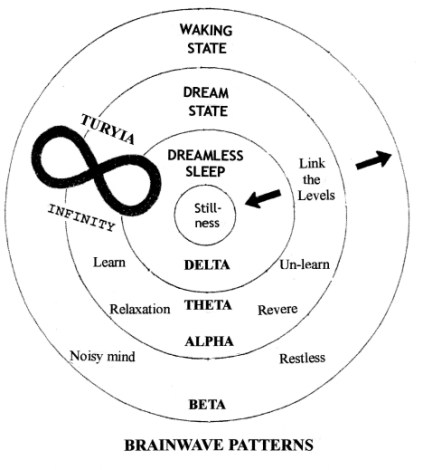
 

brain waves

As an aside – here’s a topic that bears investigation by Western psychologists, particularly those with a Jungian bent. This geometrical construct is consistent with, and may even explain, the fact that careful observers of human experience, especially who aspire to self-knowledge and self-actualization, are persuaded of the significance (sometimes helpfulness) of dreams.

Freud, for example, held that daily events are nested within an encompassing dream state – a field rich in information beyond ordinary access. Small wonder. For, as shown here, the dream state is foundational to the material world. Located within the middle Gate Keeper layer of the Life Wheel, it resides at a deeper level, therefore closer to the experience of light and illumination than the waking state which is invested in primarily tangible, measurable experience.

Be that as it may, the accomplished yogi, one who experiences what is described as “Christ consciousness,” links the levels into a single continuum of awareness called “turyia,” living both here and there. Awareness of the silent core is consciously present while fully awake. One’s daily reality is clear and consistent with one’s dreams as well as with deepest knowing.

Now, although a few come into this world already blessed in a state of Christ consciousness, most of us achieve it through choice and determined, dedicated, disciplined work — the product of consistent positive attitudes, right choices and good deeds. Surely faith and trust enter in. Also in the mix, however, knowledge makes a difference. As stated at the start, it is important to have a clear, correct and complete paradigm – an accurate road map – to steer by. “Every little bit helps.”


Phoenix - sized

On a personal note, as someone who grew up saturated in classical music, I experienced an easier time than most in relating to yoga sciences. String music served as my particular bridge to inner realms of experience.

The following is a description (my emphasis added) of a book that speaks to how this might be so, another example of applying western brain sciences to confirm ancient wisdom: Don Campbell’s The Mozart Effect: Tapping the Power of Music to Heal the Body, Strengthen the Mind, and Unlock the Creative Spirit:

Anyone who has ever seen a two-year-old start bouncing to a beat knows that music speaks to us on a very deep level. But it took celebrated teacher and music visionary Don Campbell to show us just how deep, with his landmark book The Mozart Effect.

. . . The Mozart Effect has a simple but life-changing message: music is medicine for the body, the mind, and the soul. Campbell shows how modern science has begun to confirm this ancient wisdom, finding evidence that listening to certain types of music can improve the quality of life in almost every respect. Here are dramatic accounts of how music is used to deal with everything from anxiety to cancer, high blood pressure, chronic pain, dyslexia, and even mental illness.

. . . Campbell asserts that the kind of noise to which one is exposed can have important effects on mental and bodily health. As a trial, try protecting your hearing for a few days from the continuous barrage of noise in a typical urban environment; it really does seem to improve one’s attitude and fatigue levels.

Where Campbell’s ideas become more provocative is in the realm of music. Supported by much anecdotal evidence, he proposes that Classical music with a big “C” (the music of Mozart’s period) can reach out to those who are mentally isolated from their fellows, like the autistic, and can help infants react and think better. In addition, the music of Mozart contributes to the improved functioning of the higher cerebellar functions, including the ability to deal with logical and mathematical concepts, while contemporary rock actually decreases mental acuity.

Phoenix - sized

The Many Faces of Discrimination

Sorting Yourself Out, a fascinating conversation between Stefan Molyneux and Jordan Peterson, is a  demonstration of critical rational thinking at its best. In response, I’m sharing these earlier thoughts on reason and discrimination.

Up front, I’ll tell you, I’m not persuaded that critical thinking, even at its finest, is enough. I explained why in The Handbook:

Reason is necessary but not sufficient. When used to link the material surface with the middle and inner levels of the Life Wheel, it is a powerful tool. When turned against the life force, elevating itself as if it were the exclusive way of knowing, it presumes to judge what is beyond it. This is hubris, the catalyst of tragedy. [As bureaucratic regulations example] Rationality in the extreme changes into its opposite, producing desperately irrational results.

In Conscience, I elaborated on the uses and political abuses of reason:

Epistemology is the branch of philosophy which defines the rules of knowledge at any given time/place, setting limits by its answers to these questions: What can be known, how, and by whom?

Answers have political overtones, often assigning roles according to class, race, age or gender. Rules governing who may know what drive cultural decisions regarding the distribution of wealth, power, social status and access to legal protections.

Empirical science respects only information known through reason. Universities train students to dissect and analyze with quantitative and verbal skills. At its best, reason is a tool of constructive discernment, capable of articulating both tangible and intangible information.

With proper training, it can be used to harness the sub-rational, serve the super-rational and link the two, balancing their extremes. As such, reason is a harmonizing function.

However, using reason to rule out, avoid or even demean awareness of sub- and super-rational experience is an abuse of the critical faculty.

Though this might sound dry in the abstract, the story excerpted in Rethinking Discrimination of my working as an Affirmative Action Consultant for the Wisconsin Association of School Boards gives it a human face.

Further, in The Tower of Babel Dilemma I wrote:

It seems to me that language has devolved into quite the opposite of the English I’d learned to love and respect in high school. There, we were taught to regard language as the premier tool of logic. When used with Sherlock-like diligence, applied the powers of keen observation and heightened awareness, it could solve mysteries — not only to detect the crimes of evil-doers and the nefarious plots of national enemies, but to unravel the mysteries of life and the universe.

Turned inwards, used with self-honesty, language is essential to cultivating self-awareness. For the truth-seeker, language is a necessary vehicle of information both on the inward quest and on the return journey outwards to share results.

But even people with the best of intentions use the same words to mean very different things. They miss each other coming and going, only vaguely aware of the disconnect.

. . . Instead of being used as a means for unifying human beings, language is often degraded into chaotic paralyzing noise – a weapon for stirring up animosities, division and confusion.

globe bullet size

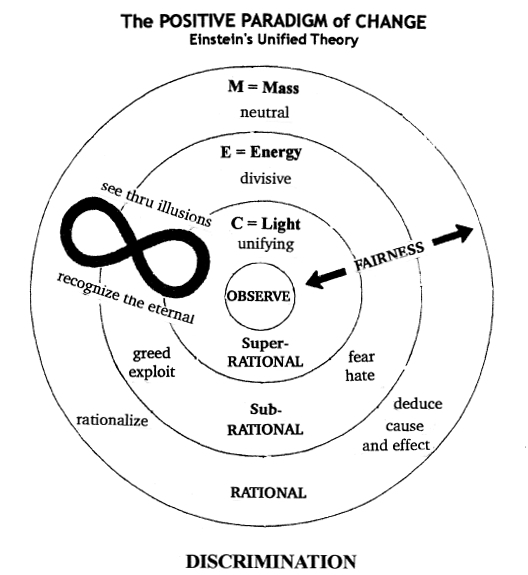
As one example, the following Essay on Discrimination plugs the many definitions of the over-used and abused word “Discrimination” into the levels of the Life Wheel.

ESSAY 19. DISCRIMINATION

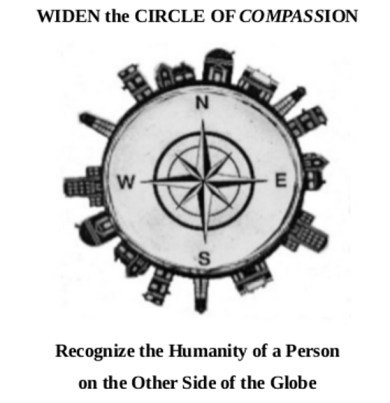
We experience ourselves, our thoughts and feelings as something separate from the rest. . . this delusions is a kind of prison for us . . . Our task must be to free ourselves from the prison by widening our circle of compassion. . We shall require a substantially new manner of thinking if mankind is to survive. — Albert Einstein

Dealing exclusively on a rational level with an issue like discrimination which is deeply emotion-laden (sub-rational) on the one hand, and highly value-laden (super-rational) on the other, fails to acknowledge and draw on the levels where problems begin and where solutions can be found. — Patricia West, Positive Action: The Next Generation

Seeing and hearing are like food and drink; you need them every day, but you also need to digest and eliminate them every day. If they are not digested and eliminated thoroughly, they remain in the gut, eventually producing illness.Taoist Meditation, trans. Thomas Cleary

THE FRONT

Three levels of definition attribute opposite, contradictory meanings to the single word discrimination. In the context of Affirmative Action legislation, failure to recognize and sort out this confusion has resulted in muddled perceptions its purpose, inconsistent implementation and half-hearted compliance.

The Oxford English Dictionary’s rational definition of discrimination posits a neutral function of mind. To discriminate is to distinguish with the mind or intellect; to perceive, observe, or note the difference in or between.

As an analytical tool, discrimination is the neutral function of mind used to dissect a situation’s parts and deduce cause/effect relationships amongst them. As a tool, effects of its use, whether creative or destructive, depend on motives and competence.

The final definition adds a preposition: against. To discriminate against is to make an adverse distinction in regard to, to distinguish unfavorably from others. This negative definition is the sub-rational use.

It describes abuse of the critical faculty of mind to separate, distance and subordinate others, and to rationalize exploitation. Discrimination as a function of biased, negative emotions such as fear, hate, envy, arrogance or greed is the polar opposite of objective analysis.

Still further from the rational meaning of discrimination is its super-rational definition. It is not included in The Oxford English Dictionary. However, in Eastern scriptures, the highest function of mind is called “buddhi” (hence the name Buddha), translated into English as “the power of discrimination.”

This usage alludes to the ability to see through deceptive illusions, to recognize the eternal in the midst of change, to be aware of all-pervading spirit operating within gross material forms.

While rational discrimination is neutral and sub-rational discrimination has separatist results, the super-rational function of discrimination is unifying in effect. Depending on the user’s mind-set, the I Ching can be used to serve rational, sub- or super-rational motives.

Ideally, it’s used to facilitate the process of mental metabolism. When the senses are overloaded with impressions, the Book of Change can be approached as a discipline for settling the mind and organizing one’s thoughts sufficiently to define the immediate situation and ask questions about it.

As negative emotions surface, they’re named and released, not unlike the process of separating toxins from useful nutrients, eliminating them as waste. Rational thoughts are then simplified, prioritizing essentials and aligning them to basic purpose. Then, when emotions and rational mind are harmonized and stilled, the higher mind is invoked. It is in this state of tranquil revere that one pierces the veil of ordinary thought, allowing the transcendent awareness attributed to genius to come forward.

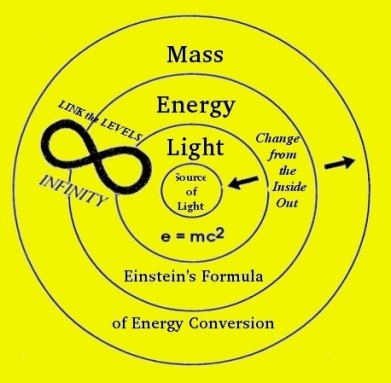
Einstein, for example, acknowledged that his famous e = mc2 formula came in a flash of inspired contemplation. He faulted his peers for what he called the “fateful fear of metaphysics,” a pernicious prejudice that’s easily as dangerous as racism or sexism.

Here are levels of discrimination placed in their Life Wheel context:

Discrim2.jpg

THE BACK

Mercy and compassion ameliorate the effects of negative discrimination. Introspective activities like self-analysis and use of the I Ching promote the positive capacity to discriminate, make correct decisions, and act wisely. In human law, the opposite of discrimination is justice and equity. In an equitable society, wisdom is promoted as the foundation of harmony and order.
In an unjust world, the discipline of positive discrimination is neglected. Ruthless extortionists in positions of political power will kill to prevent discriminating thinkers from recognizing and opposing their abuses. Tyrants promote negative discrimination. They exploit hatred, weakening their people by turning them against each other, conquering by dividing them.

Two Out of Three Ain’t Enough


Eight months that seem like a life-time ago, I wrote the LinkedIn article I’m sharing below, along with excellent comments made to the post.

At the time, I was rethinking the empathy aspect of writing about the Positive Paradigm. Now, I’m about to launch another approach, one focused on healing on all three levels. Again, unless the three are present in a balanced, integrated way, it’s not sufficient.

As an intriguing book I’m reading explains, wholeness and holiness are necessary compliments. It expands on the Phoenix Response as my comprehensive approach to transcending adversity, when mere physical survival is not enough.

I’ll explain as I go what I mean. But, for today, for starters, here’s a recap of the basic concept, the spring board of what’s to come.

It concludes with questions that invite your feedback, the better to adjust to meet your specific needs in future articles. What do you think? And thanks.


pinnacle-sized

Two Out of Three Isn’t Enough

Some leaders are satisfied to sing along with Meatloaf, “Two Out of Three Ain’t Bad.”

But Authentic Leaders know better. It ain’t enough.

As I’m learning the hard way, when any part goes missing, everything suffers.

Bear with me. I’ll share why three-out-of-three is a must for me – and for effective leaders in every walk of life.

The Life Wheel — the Positive Paradigm based on the Unified Theory Einstein had, though he didn’t know it — is the personal Truth I’d dearly love to share with the world – starting with you.

IF

From Rethinking Survival:

This familiar atomic structure repeats smallest to largest in the patterns of nature, from snow flakes and intricate flowers to spiders’ webs and sea shells. Similar symmetrical patterns repeat worldwide in the art of every culture — including the prayer wheels of Native Americans, the colored sand mandalas of Tibetan Buddhists, the stained glass windows of European cathedrals and the intricate geometrical patterns that cover Muslim Mosques, to name but a few. They offer proof of the universal awareness of a central inner reality, of an inner structure common to all humanity, and to a continuity of experience deeper than individual lives or transitory cultures.

The Life Wheel reflects the perennial philosophy shared in common by the world’s enduring wisdom traditions – free of historical baggage. It is equally compatible with yoga and modern physics. It converts easily into a method for introspection and decision-making. Like a modern day Book of Change, it has the potential to become the best friend of change agents everywhere.

The value unique to the Life Wheel is, because it highlights the innate potentials we share in common, it serves as a foundation of common discourse.

Just as importantly, from personal experience, I’ve found the Life Wheel to be a great tool with virtually universal applications. Point it like a laser beam in any direction. It illumines the field.

In Authentic Leaders Depend on the Center I presented a variation on the Wheel – the MPI (Motive-Purpose-Intent) Standard – used to increase self-awareness.

One LinkedIn connection really got it! After a back-and-forth exchange, he commented:

I can also see how the MPI can work in a variety of contexts, both religious and secular. In fact, I think it could have virtually universal application – – – I hope it catches on!

BUT – it hasn’t. Not yet. For that I take full responsibility.

I have yet to demonstrate how I use the Life Wheel for introspection and goal setting. I have yet to show how it can be adapted as an analytical tool for virtually any purpose.

I haven’t effectively explained that this picture answers the plaintive question, “Why can’t we just get along?” Namely, very few of us work from a unifying concept of our common humanity. We were never taught the basics of natural law, much less how to live in harmony with it and each other. )

I’ve failed to communicate powerfully enough the connection I see between the Life Wheel and its potential to relieve human suffering. Those who’ve been taught to look for fulfillment on the shallow surface have been set up for a world of hurt. Joy returns when we know where to look, when we finally return our focus to the center, where eternal love resides deep within the heart of hearts.

The Wheel explains today’s pervasive sense of loneliness, a result of living exclusively on the noisy, frantically busy surface. It offers a hopeful, alternative life picture. When we reconnect with the center, we know that we are never, ever truly alone. Not possible.

SO – why hasn’t all this vitally important stuff been successfully communicated? In retrospect, I’m recognizing I have yet to live up to my own “three-out-of-three” standard!

For one thing, I’m still building the technical skills needed to do the Life Wheel idea justice.

For example, my first LinkedIn article, Boundary Spanners Connect at the Center, isn’t illustrated. In September of 2014, I didn’t yet know how to create images with photo-shop software. Though I’ve come a far distance in the ten months since then, I am still picking up necessary skills on a daily basis.

Just as importantly, I’m getting important feedback that my communication skills need work. Which is different from language skills. In fact, past academic background sometimes gets in the way. I’ve been faulted for seeming so precise and confident that I’m intimidating. Makes me very very sad. Not at all what I intend.
For this, the recent process of writing a guest post for authorunlimited was good medicine. I submitted a draft on the suggested subject: The important difference between knowledge and knowing. Cathy Presland emailed back an edited version.

Ouch!

Fortunately, I had an inkling as to why she made changes. I already saw her most excellent article Writing with Empathy and taken it to heart. I also followed the link to Seung Chan Lim’s video, How empathy fuels the creative process. Like magic, on that particular day, his message was exactly what I needed to hear.

My sheepish Aha. In my rush to get from “here to there,” from surface results to common understanding, I’ve been leap-frogging over the linking, middle level of empathy.

So I can tell you from sad experience, two out three – ideas and technical skills without empathy –ain’t enough!

Cathy’s quote reminded me:

In the words of George Bernard Shaw, “Do not do unto others as you would have them do unto you—they might have different tastes.”

In other words, I have been writing as if LinkedIn connections all understand and agree that everyone, everywhere shares the same center in common. But “it ain’t necessarily so.”

True, boundary spanners, no matter where they start on the surface of Planet Earth, meet at the universal center. But not everyone sees the value in being a boundary spanner. It’s on me to accept this, adjust and improve accordingly.

So back to the drawing board. As part of the Under Construction operation, I promised to restore empathy to the larger picture, accepting that not everyone is boundary spanner. And remember, respectfully, that many are not only asleep but perhaps a bit afraid of waking up.

Yet my worst worry remains. Unfortunately, it usually takes a horrific wake up call to shake people out of their complacent slumbers. From Rethinking Survival:

While we all have the option to remember who we truly are, most of us are like Lambert, the sheepish lion. It takes a smack with a two-by-four upside the head before we’re finally ready to wake up. Often it takes the form of life-threatening danger to those we care for. A personal health crisis will also do the trick. So will job loss or a run-in with natural disaster.

But, like Dorothy stranded in the Land of Oz, when you want dearly enough to return “home,” you can click your heels whenever you chose — and come to find out, you’re already there.

My preference, which I’d dearly love to share with you is this. Rather than wait for inevitable shocks, when it might be too late to survive, I’d rather you be proactive. Use the tools for anticipating change I have to offer.

As I urged in Being Proactive in the 21st Century, make yourself ready to meet whatever unknowns life has in store, coming around the next bend or two.

Working with Life Wheel maps helps mindful, authentic leaders link the levels, making the three-out-of-three option possible. With it, we can choose to be true to ourselves and realize the vision of a positive future.

Bottom line: Change is inevitable. We can experience it as resisting, passive victims or as proactive agents of positive change. I’ve given you tools to put the choices for change in your hands.

Am I communicating yet? Questions? Comments? Please let me know how I can better meet your needs.

=============================

COMMENTS

Mark Hayward st Head of Sales at TheSmallPicture.biz | NIKKEN Independent Consultant: Helping people to take control of their Wellbeing


No worries Patricia West, you made an instant fan out of me 😉

——————–

Peter Fellingham sVice President of Engineering and Co-Founder at ProtoStar Inc

Hi Patricia, I enjoy your writing style. That said, one must write with a target audience in mind; at least commercially. Otherwise you are just writing for yourself.

Patricia West AUTHOR Blogger; Author of Books on Change, Einstein & Human Survival

When writing for authors as a guest of authorulimited, I welcomed the opportunity to write for a specific audience. Here, am focused on authentic leaders, albeit in every walk of life. If you (or anyone else) has another audience in mind, I’m open to your suggestions. : )

————————-

Bob Hemmerle Senior Zen Practitioner/Baseball Umpire

If you get 1 world leader with nukes to understand this then when he sits down with the others he will have something worthwhile to share, Bravo

————————-

Richard Lipscombe THE MEMES MAN

Patricia: This is a great post. I first read this quickly last night. I had an immediate reaction. You can not, we can not communicate with someone who does not hold to their ‘truth’. I re-read it now and listened to TED talk.I still think the same. Inside all of us is mass, energy, and light as a combination – it is what I call my ‘truth’. I can deny it. I can avoid it. I can run away from it. But I can never hide from it. Most people conceal it.

So most people can never ever admit to hearing your message. It is too painful. In simple terms they can not hear that change is your choice and to choose well for yourself you have to listen to your truth.

Most posts on LinkedIn help people to consider ‘change’ as a surface ripple, a mere happening, an entertainment, a dynamic shift without meaning, and so on. They can do this because this is a place for collectives, cliques, false wisdom, fashions, and fads. They welcome all that because it does not challenge the essence of who they are and thus it can never change them. Change their ‘truth’. Truth can be changed easily if you know what it is and embrace it. Truth is continuity – we cling to it even if we do not acknowledge its existence within us. Change to truth sets up a new continuity for us. Richard.

Patricia West AUTHOR Blogger; Author of Books on Change, Einstein & Human Survival

Thanks for your thoughtful comment, Richard. That courageously mindful folks are in the minority, everywhere . . . not just on LinkedIn. . . is the stuff of tragedy. But deep within we all harbor the latent seeds of heroism. As I said, Sooner or later comes the inevitable wake-up call. Last night, after posting this, I came across an excellent example of how 9/11 changed one leader forever. I highly recommend reading – and heeding – this article: https://www.linkedin.com/pulse/crises-changed-what-i-expect-from-leaders-gerald-hassell

————————————

Cathy Presland Strategist, Trainer, and Editor-in-Chief at Author Unlimited

Patricia this is such a thoughtful piece — I love it! And the concept that we need all three of ideas, technical skills and empathy — I will take that to heart.

———————————–

Catherine Hamrick Communications Manager at the School of Agriculture & Natural Resources at the University of Delaware

On target–as usual. Thanks for shakin’ up my brain.

The Phoenix Response

Phoenix - sized

In a recent post, Choose Life II, I wrote:

I was increasingly motivated by dread of facing a future based on past experience. Subconsciously, I had succumbed to a death sentence suggested by people far too “nice” to kill me outright, but all too capable of driving me to slow suicide.

Since then, going a few years back in my notebooks, I found my response to a scary conversation. At least ten years ago, we were in a car, on the way home from running an errand as I recall. The driver was flawlessly made up, as usual. She was wrapped in an ankle-length, black fax-fur coat.

I gently suggested in a general way (nothing personal, of course), that sometimes, surely unintentionally, some people push those they can’t control to self-destruction.

She shook her head, No. It was definitely intentional, she objected.

Horrified, I searched my mind for the right survival response. (My belief in reincarnation rules out suicide. At best, unfinished business would just reappear.)

As the issue continued to come up, here is the solution recorded in notebooks over the years. Whenever circumstances or people push me to suicide, I will die – but only to be reborn in this lifetime, over and over, each time better than before.

I called it The Phoenix Response.

I associated this intentional positive decision with the death and resurrection of Christ, whose archetypal pattern represents a possibility for each of us, at any time, as a matter of personal choice, commitment and dedicated follow-through.

This was, in part, the thinking behind the following essay from Conscience: Your Ultimate Personal Survival Guide. I include it below for the benefit of those who, especially given the pressures of our “interesting” time in history, may be pondering similar choices.

phoenix b&w

ESSAY 2. DEATH

Quotes

merging

Patricia E. West, Two Sides of a Coin:Lao Tze’s Common Sense Way of Change

Tai Chi Tu - sized

Dying patients went through the five stages, but then after “we have done all the work we were sent to Earth to do, we are allowed to shed our body, which imprisons our soul like a cocoon encloses the future butterfly,” and … well, then a person had the greatest experience of his life. — Elisabeth Kübler-Ross, The Wheel of Life

Tai Chi Tu - sized

Here is a test to find whether your mission on earth is finished.

If you’re alive, it isn’t.

— Richard Bach, Illusions

Tai Chi Tu - sized

Some day, maybe, there will exist a well-informed, well-considered, and yet fervent public conviction that the most deadly of all possible sins is the mutilation of a child’s spirit; for such mutilation undercuts the life principle of trust. — Erik Erikson, quoted by Jonathan Kozol in Death at an Early Age

Tai Chi Tu - sized

THE FRONT

Webster’s definition of death is the act or fact of dying — the permanent ending of all life in a person, animal or plant. Personified, death is pictured as the grim reaper, a hunch-backed, black-robed skeleton wielding a scythe. The term refers to extinction, as in the death of hope.

These definitions, however, represent an extreme cultural bias with important effects on behavior. They reflect the materialistic belief that the physical is all there is. When the body fails, there is nothing else. There is no essence which survives to travel on.

The I Ching embodies a more inclusive, comprehensive view. Like the learned amongst most ancient cultures, Chinese sages regarded birth and death as natural changes, complementary stages of an ongoing, cyclical life process.

Sages continue to regard death not as extinction, but the culmination of a winter season most wisely spent preparing for the coming spring. They teach that a soul, having learned the lessons and completed the work of one life cycle, separates from its used up shell. Once the spirit moves on, the shell collapses. The life essence, however, simply migrates, possibly to take on another form.

Meditation practices are instrumental in reconnecting the alienated rational mind with the life principle, restoring trust. They can prepare advanced souls to depart the physical form consciously at the auspicious time of their choosing. They also induce the changes of heart and mind that the Bible alludes to as rebirth. To be born again isn’t necessarily an emotional self-deception. Technically, from I Ching perspective, it’s very possible.

As described by healer/teacher/author Barbara Ann Brennan, total transformation and rebirth can also take place within the same body. She describes spending two years of prayer and intense discipline. By the end of that time, as a result of her efforts, every aspect of her life had changed for the better.

Going through stages similar to those described by Kübler-Ross, she released her old life, so that new attitudes, better relationships, and a significantly more satisfying lifestyle replaced that which had been outgrown and put away.

Country music star Naomi Judd, another example, refused to accept the death sentence placed on her by a short-sighted medical establishment. Instead, she chose to accept her illness as a challenge and blessing in disguise, taking the self-responsibility to restore her health.

With a combination of faith and true grit, Naomi educated herself in a broad spectrum of healing arts traditions and succeeded in regenerating herself from the inside out. She not only survived, but became healthy enough to endure the rigors of another music tour. She called it “The Power to Change,” using it as a platform for urging fans to rise to the challenge of change as she had.

THE BACK

Fear is the natural outcome of limited materialistic beliefs equating the end of physical life with total extinction. Those who experience the True Self as immortal and indestructible are not plagued by fear of mortality. No doubt the courage and solace which sustained Socrates as he calmly accepted his death sentence — not as an escape, but an affirmation of principle — came from the depth of his soul awareness.

Permanent extinction, however, is possible. Real death is not dissolution of a temporary form, but the annihilation of the soul itself. According to learned traditions, a soul beyond redemption by its own repeated wrong choices can be extinguished forever. Even the thought is cause for horror, powerful incentive to make right choices.

globe

What IS Your Calling

Angel Calling

A timely message from Charles Caro, a senior LinkedIn expert who was most generous with his knowledge when I was a social media newbee, sparked this post. He wrote:

Patricia, You are on my list of the top people I want to contact related to my new book titled “Job Seeker’s Faithful Guide” . . . The book is targeted to job seekers wanting a resource to sustain themselves mentally and spiritually during their job search journey.

I was hoping you would share information on my new book with your connections either by message or simply sharing my posted Pulse article.

I immediately emailed back congratulating him: You’ve found an important blind spot in the job-seeking canon, and trust you’ve filled it admirably.

And forthwith posted this update:

I highly recommend Charles Caro’s work. I owe him a debt of gratitude which I’m very glad to repay in any small way possible. Please see https://lnkd.in/bX–TjH.

After further thought, I added:

You’ve got me thinking. These are times that test us all, serving to separate the wheat from chaff — those who will hear and survive, from those who have hardened themselves and will thus fall by the wayside. Perhaps I will write a post to rethinkingsurvival.com to this end that mentions your book as its trigger. Your words could well make a positive difference to those who choose to “endure to the end.”

Now where was the perfect timing – the synchronicity – in this exchange? His job-search approach touched on a burning question of my own, a follow-up to my last post confirming the personal decision to endure, Choose LIFE II.

Although the basic decision was made, I was finding it not sufficient. I was filled with grave doubts about the future. As the vitally urgent next step, I had just journaled my burning question as an I Ching query. “Why am I still Here? What is My Calling?”

A review of past LinkedIn correspondence underscored my discouragement. In a professional environment where carving niches is the norm, resonance with my boundary-spanner idea was sparse to nil.

In our earliest exchanges, what I asked Charles was how to connect with like-minded thinkers. By this I meant interdisciplinary innovators who span and link professional disciplines (sciences, religions, and philosophies) by recognizing the universal source that underlies and sustains all life, on every corner of the globe. This was the thought behind illustrating Einstein’s quote in Rethinking Survival.

circle compass of compassion

As good fortune would have it, Charles himself is a boundary-spanner, demonstrated by his ability to recognize the relevance of Chinese wisdom to his Christian worldview. As a practicing Christian, his connections support his approach. For example, he wrote:

Timothy Tobin, who is one of my 1st level connections, lives in Peoria, Illinois where Caterpillar has cut 30,000 employees of the past couple years. Tim has predicted I will sell a million copies in a year. He has let his wife know she can stock the book in their Church bookstore.

In turn, the Life Wheel which is equally compatible with ancient yogic scriptures and modern physics is also compatible with a profound reverence for Christ.

Although coming from very different traditions, what we share in common is a recognition of basic human concerns. For example, my published work focuses on creating awareness of the natural laws of change as well as their relationship to their unchanging source. In describing his new book, Charles choses to call change “transition.”

The “Job Seeker’s Faithful Guide” targets everybody involved in a career transition regardless whether they are unemployed, underemployed, seeking a new opportunity or launching a new business on their own. 

So later I added this observation:

I find repeatedly when researching that two out of three levels of experience are covered — the mental and physical (“think” as in strategize and action/behavior), but the central, driving core — which depends on hearing (“knowing,” trusting, believing in the creative source) is overlooked.

Now, as to the answer to my query, the main text I consulted to examine the implications of my answer was the Jack Balkin version of the I Ching (Book of Change).

Balkin is another, formidable boundary-spanner. As underscored by his title choice, The Laws of Change, Balkin is Knight Professor of Constitutional LAW and the First Amendment at Yale Law School. (As an aside, I urged him to write on a question that fascinates me: the relevance of the Book of Change to Constitutional Law. Sadly, he responded that other work is prohibitive – for the time being.)

Like every other version, being the product of a human mind, this version is limited by the constraints of duality. Yet it is a brilliant contribution to the field and clearly a labor of love. While some might complain that he lacks the traditional linguistic and/or yogic background which Asian translators bring to the subject, in an intuitive way (perhaps exactly for that reason), his understanding rings true.

Be that as it may, to repeat, I asked, “What is My Calling?” In my case, the I Ching Answer was Hexagram 30, Li (double Fire), with no changing lines. Balkin translates Li as RADIANCE, and lists these Key Words:

The Clinging; Interdependence; Synergy; Understanding connections and interdependencies; Fire; Brilliance; Clarity; Shedding Light on Things; Enlightenment

Ah. I instantly recognized the relevance to my boundary-spanner quest.

The text explains:

The two great themes of Li are enlightenment and interdependence. Fire sheds light on everything as its radiance extends outward; but it burns brightly only as long as it has fuel to draw on. As long as the fuel lasts, the fire lasts. Whatever gives light, clarifies, and enlightens depends on something else to which it clings, something whose persistence and perseverance allows the light to shine.

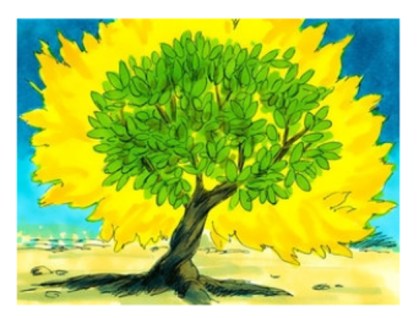
My intuitive response clicked on the image of the burning bush of Exodus, from which the voice of God called out to Moses.

Burning Bush image

Balkin continues, applying these themes to relationships:

So it is with human life. The life of human beings is not free and independent. It is conditioned on circumstances, and, in particular, other human beings. If you wish to gain clarity in your life, you must understand who and what you depend on, and who and what depends on you.

Balkin advises:

Enlightenment means accepting the world for what it is, recognizing one’s connection to others, and taking care of what needs to be taken care of. This is the path to clarity and peace. Acceptance does not mean pessimistic resignation. It means facing up to the facts. Only when we can accept the world can we begin to work with it to improve it and our situation within it.

Relevant to job seekers attached to past successes (or failures), he admonishes:

Do not cling to the past, for it is gone and it will not return. Accept change. Be open-minded and adaptable. Don’t bemoan your fate. Consider how you can change things for the better, given the situation you now face. Nurture others and you will nurture yourself.

His summary states:

Fire is an apt symbol of enlightenment because the power of truth is increased when it spreads to other minds. One candle lights another, and the amount of illumination is doubled without anyone’s light being diminished. For this reason, superior people do not hoard their knowledge or their wisdom, but share it with others who are willing to accept it. In this way enlightenment eventually can reach “to the four corners of the world.”

Food for thought indeed. What do you make of it?

And, as I continue with my own reflections, I encourage you to ask your Self, what is YOUR calling?

Choose LIFE II

body-mind-spirit

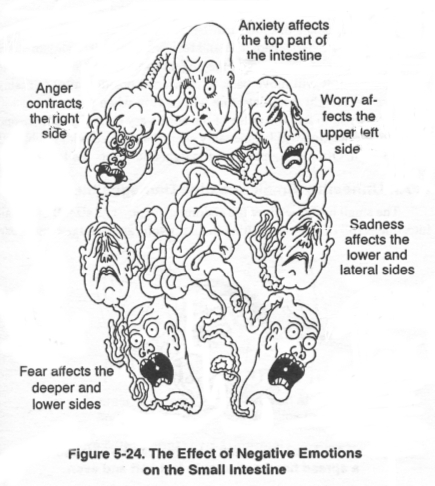
Last fall’s mystery illness became a strict teacher, a blessing in disguise. It dramatically reinforced my awareness of the mutually dependent relationship between brain and gut long recognized by Asian healing traditions.

As modern medical research documents, mental distress manifests as a myriad of gut-spawned diseases – Crone’s disease, fibromyalgia, rheumatoid arthritis, irritable bowel syndrome and eventually cancers, to name but a few.

Conversely, the broad spectrum of diseases arising in the gut spawn a host of mental illnesses – not only depression, memory loss, dementia and schizophrenia, but autism and A.D.H.D, for example.

The hopeful application is this. Correctly steered, interventions on either side of the gut-psychology continuum positively affects the other. The relationship spans an infinite loop. So wherever one starts, given time and effort, it’s possible to complete the cycle, eventually restoring balance and good health.

Follow along if you like and I’ll connect the dots that led to this conclusion.

It started with asking WHY. Medical people failed to correctly diagnosis what went wrong. The ER physician (nice lady) jumped to the convenient assumption that, given my demographics, a lower tract infection was the problem. Antibiotics would make symptoms go away.

When the first round of drugs didn’t help, instead of questioning the assumption, the local nurse practitioner prescribed a battery of (expensive!) different antibiotics over following months – in increasingly stronger doses – each with its “interesting” side effects.

The duration of this “illness” was cause for some serious introspection on my part. Certainly the WHY had a mental origin. Stern teacher that LIFE is, I came to accept that I wasn’t going to be let off the hook until I came clean with myself. Release demanded self-honesty.

What I unburied was a death wish of sorts. It wasn’t that I wanted to be gone, so much as that negative suggestions from false friends absorbed over the years had worn me down to the point of critical mass.

I was increasingly motivated by dread of facing a future based on past experience. Subconsciously, I had succumbed to a death sentence suggested by people far too “nice” to kill me outright, but all too capable of driving me to slow suicide.

LIFE had sounded a warning alarm to bring me back to my Self.

Something had to change. It started with a stark decision. A conscious commitment to LIFE, whatever it takes. I wrote a confirming article, Choose Life.

Once recognition and the decision were made, LIFE responded most generously. The help and information needed to support my choice appeared from several directions.

The next step was for me to ask HOW do I return to health? And how do I change my attitudes and behavior to make my personal future different and better from the past?

Critically important information was found in Susan Forward’s Emotional Blackmail: When the People in Your Life Use Fear, Obligation and Guilt to Manipulate You.

I was instantly inspired to borrow the book from the library after reading a top-ranked review of the book which starts:

This book does a very clear job of defining emotional blackmail so you can begin to easily spot emotional blackmailers in your life. It then concludes with telling you specifically how to deal with emotional blackmail, that is, how to keep your energy, resources, and sometimes your very soul, from being stolen by them.

WOW. I could relate to that!

She writes, At the heart of any kind of blackmail is one basic threat, which can be expressed in many different ways: If you don’t behave the way I want you to, you will suffer.

Forward explains:

Manipulators work hard to deny, obscure, camouflage, prettify, excuse, rationalize, disguise, HIDE what they are doing. They make it hard, if not impossible, to see HOW they’re manipulating us. They lay down a thick FOG that obscures their actions.

FOG is an acronym that stands for the psychological warfare tactics used against targets: Fear, Obligation and Guilt.

This information is reinforced by Harriet Braiker in Who’s Pulling Your Strings? How to Break the Cycle of Manipulation and Regain Control of Your Life:

People who manipulate are often so hard to spot. They become your friend and then find ways to have their way with you. . .

A reviewer summarizes:

You can’t reason with a manipulator because of their insecurities but you can reason with your own insecurities; and best of all are the practical ways you can change your behavior to take back the power.

This book teaches you to get up, learn what you did wrong and what you should have done, and even better how not to repeat the same mistakes.

There’s also a warning given from experience:

I’ve put an end to so much manipulation in my life. It takes the wind right out of the manipulator’s sails. The book is right…the manipulator will blow really hard, so prepare yourself; it’s going to get stormy.

choose life

Another fortunate form of help followed from my decision to seek medical advice elsewhere. An intern at the UW kindly saw me on short notice. Intrigued by my situation, she brought in her mentor. Together, after reviewing the history of lab results, they confirmed that the initial diagnosis wasn’t right. The medications hurt more than helped.

Although I knew enough to eat yogurt to offset the effect of antibiotics, to repair the damage done by antibiotics they recommended taking pharmaceutical probiotics as well. This opened the door to a whole new world of science and healing.

Probiotics for Dummies, for example, includes a useful section on the brain-gut connection.

Medical researchers have long known that stress depresses immune function, but only recently have they linked stress to changes in gut bacteria.

The medical community’s interest in probiotics was initially sparked by the seminal work on GAPS (Gut and Psychology Syndrome) published by researcher Natasha Campbell-McBride.

In Gut and Psychology Syndrome: Natural Treatment for Autism, Dyspraxia, A.D.D., Dyslexia, A.D.H.D., Depression and Schizophrenia, she notes that Western medicine has long acknowledged the brain-gut connection:

The father of modern psychiatry, French psychiatrist Phillipe Pinel (17-45-1828), after working with mental patients for many years, concluded in 1807: “The primary seat of insanity generally is in the region of the stomach and intestines.”

Interestingly, she uses the same word, FOG, when in describing the mental-emotional relief experienced as the intestines heal by using probiotics to restore balance. “It is as if the fog lifts.” Ahh!

But, like cutting through the psychological FOG, cleaning out the gut doesn’t happen over night, or without difficulties. Campbell-McBride warns things often seem to get worse before they get better. Detox is a necessary but challenging middle step along the road that leads from here and there. So, again, “prepare yourself; it’s going to get stormy.”

There are important parallels between the so-called Leaky Gut Syndrome and psychological distress. In the first case, weakened intestines become permeable. Toxins and undigested food leak out and are circulated by the blood stream throughout the entire body, poisoning other internal organs – including the brain.

Similarly, psychological defenses can also be worn down and compromised, sometimes due to “second-hand stress.” In this case, when protective borders between self and others break down, toxic influences from outside undermine mental-emotional balance. Others’ fears, rage and general unhappiness poison the unprotected mind. Toxic people preoccupied with their own wants and personal dramas, even when unintentionally, do great harm.

Interestingly, the GAPS/probiotics approach is highly compatible with the wisdom of Asian healers. Traditional Chinese Medicine, for example, carefully maps the gut-psychology connection. They describe the dynamics of what is called “the abdominal brain.” The following illustration captures thousands of years of wisdom in a single picture.

0 012316

According to Mantak Chia, when the intestine becomes congested, it cannot perform its physiological functions. Though you may eat well, you may be under nourished.

As he explains, each of the organs is correlated with one of the five elements. In turn, each is associated with specific positive or negative emotions:

All negative emotions are expressed in the small intestine by contraction and circumvolutions, Anger contracts the right side of the intestine near the liver. Worry affects the upper left side near the spleen. Impatience and anxiety affect the top. Sadness affects both lower lateral sides. Fear affects the deeper and lower abdominal areas.

As the I Ching instructs, the same dynamics repeat on every scale of magnitude, from cellular to universal. So many hints from sciences both ancient and modern could be taken in many directions. They apply to relationships on a personal level, to community dynamics, and governance. But those will be subject of posts yet to follow.

For starters, I’ll offer just one hint.

Campbell-McBride uses the image of a medieval fortress under attack to describe the breakdown of  defenses that result in auto-immune diseases. It parallels the Interleukin II research described earlier, where the grad students saw their research on pediatric leukemia in terms of a war between good and evil.

When confusions in gut mirror confusions of the mind – when the difference between friend and enemy is fogged — anabolic (building up) and catabolic (breaking down) functions are thrown off balance. The body  is fooled into turning against itself in self-destructive ways.

In conclusion, however, a key component overlooked in the popular gut-psychology formula must be noted. Spirit — that third, underlying, unifying and overriding component of the e = mc2 equation – plays a deciding role in the outcome of the LIFE versus death struggle to survive.

It is said that “The mind will play any tune you tell it to play.”

choose wisely

So – who is it that quietly instructs the mind which tune to choose?

LIFE itself, the soul’s advocate, is the tie-breaker that tips the balance.

Here, I allow Mantak Chia to have the final word. He describes the discipline of cultivating chi – the subtle energy that links mind and body — and the end goal of the path to which all endeavors ultimately lead: 

  • If one wishes to be a healer, success depends upon the ability to channel energy through the hands.
  • If one wishes to be an athlete, success depends upon the ability to convert energy into strength and endurance.
  • If one wishes to be free of negative influences, success depends upon the ability to transform negative energy into positive energy.
  • One who seeks enlightenment is searching for the highest source of all energy.


I write in hopes that you will find this saga helpful. If you relate, I invite you to apply your imagination and follow wherever the subject leads you.

To your health!

Pray for Lee

DNA 1

I get it. It’s early August. Most of us are on summer vacation now. It’s not the time to be bothered by “serious stuff.”

But sometimes, serious stuff won’t wait.

Here, we’re been dealing with escalating medical emergencies. They have dire implications for Lee, for those who care for him, and yes – for the rest of us, too.

Please bear with me. I’ll connect the dots for you.

It started a few months ago with sleepless nights that left him too weary to work during the day. Pain of unknown origin gave Lee no rest.

He lost his appetite. Lost weight.

It seemed like a flare up of rheumatoid arthritis. So the doctors thought. But then came chest pains. Strong enough for an urgent call to 911. Even after an ambulance trip to the hospital in Baraboo and several hours in the emergency room, he continued to experience episodes of severe chest pain no one could explain.

Local doctors consulted together, then contacted Lee’s Madison specialist. It was agreed to transport him via ambulance to the UW-Madison Hospital for a cardiac cath procedure.

To make a long, convoluted story short, two days later, doctors finally agreed on a diagnosis. Lyme’s disease.

I’d heard about it, of course. But didn’t know that much about it. So, while waiting for him to be discharged, I did some research.

I found an excellent article that explains the science and history of Lyme’s. It’s a scary bad plague-like affliction of apparently epidemic proportions, though for some mysterious reason, it’s given little media attention. According to arizonaadvancedmedicine.com:

  • The organism responsible for Lyme disease was identified in 1981 by Dr. Willy Burgdorfer, and named Borrelia burgdorferi (B. burgdorferi), after its discoverer. It is similar in shape to the spirochete Treponema pallidum, which causes syphilis, the scourge.
  • Mankind’s earlier experience with a disease caused by a spirochete was syphilis, the scourge of Europe for hundreds of years. Syphilis was called “the Great Imitator” because its symptoms mimicked so many other diseases. The same is true with Lyme.
  • Lyme disease presents a host of challenges. Once the corkscrew-shaped spirochetes enter the bloodstream, they can cause a wide range of constitutional, musculoskeletal, and neurological symptoms.
  • New York pathologist Dr. Alan MacDonald found B. burgdorferi DNA in 1986 in seven out of ten autopsy samples from the brains of people with Alzheimer’s. MacDonald was also the first to document B. burgdorferi in fetal tissue, meaning the infection passes from mother to child in the womb.
  • The number of Lyme disease cases in the United States has doubled since 1991. The Centers for Disease Control and Prevention (CDC) estimates that there are nearly 325,000 new cases each year – making Lyme disease an epidemic larger than AIDS, West Nile Virus, and Avian Flu combined.

Lyme’s hides itself inside cysts so the immune system can’t find it. It also mutates, making it especially difficult to detect and treat.

In short, it’s one sneaky, sinister bugger.

Reading on Lyme’s resonated with memories of working as an assistant in the UW Hospital’s Department of Pediatric Oncology in the 1990s. Pediatric leukemia was the villain. An international team of research scientists was studying the use of Interleukin II to stimulate the body’s own immune system (T-cells to be exact) to heal this cancer.

Because I asked, one dedicated researcher described what she recognized as the deep, spiritual implications of her work. Her eyes radiated intense conviction as she described the war between good and evil going on at a cellular level. She described the insidious mechanisms of the disease and the doctors’ emotional battle to save afflicted children from pain and sure death.

That experience brought up many of the same questions I have now. Namely, why don’t practitioners of different medical sciences pool their information? Each has a significant piece, but only a partial piece of the larger puzzle. If a boundary spanner could bridge the gaps and put the pieces of the mosaic together, miracles would become possible.

I’m thinking specifically of the benefits attributed to the practice of Tai Chi and Chi Kung (QiGong). Both these approaches to healing-in-motion are based on Traditional Chinese Medicine, which in turn depends on the science encoded in the Book of Change, the I Ching.

Some preliminary work in this direction has already been done. For example, medical research documents that Tai Chi practice stimulates T-cells. In fact, this medical-martial arts discipline achieves what the researchers hoped to achieve with drugs. It stimulates the body’s immune system to protect against and reverse damage done to DNA.

Now here’s a secret hiding in plain sight. I Ching science has been correlated with DNA science. The ancients experienced through meditation what scientists much later discovered through painstaking empirical research. There is no conflict between conclusions, only many roads leading to the same knowledge.

One important difference between the medical and Tai Chi approach to healing, however, is its availability. Tai Chi has long been a family tradition passed on through the generations. It’s slowly becoming available in the West as well. But it requires an attitude of self-responsibility and diligence to practice these methods.

In contrast, drugs can be passively ingested with no intelligent participation on the part of those afflicted. Many drugs, however, have unforeseen and unwelcome side effects. In addition, some are prohibitively expensive, and for many, inaccessible.

I like to call Tai Chi the “poor man’s genome therapy.” The beauty of it is, that it hardly matters how you have become off balance or what symptoms you’re experiencing. Diligent practice restores health. It would seem that especially in a case like Lyme’s, where the symptoms are hard to detect, tend to mutate, and to take multiple forms, this universal solution is uniquely appropriate.

As it happens, I recently found a treasure in books by Jou, Tsung Hwa. The Tao of Tai-Chi Chuan is exactly what I would love to share with Lee. The introduction begins:

I was a math teacher who had published about thirty books on mathematics in Chinese. In 1964 at the age of forty-seven, I became very ill with an enlarged heart and a gastroptosis, because of years of hard work and vigorous schedules. My doctor told me that my condition was incurable using available medication.

At the same time, however, one of his friends told him about Tai Chi Chuan and introduced Dr. Jou to a teacher. He continues:

At first, I had only enough strength to practice a half hour at a time. In only two weeks, my appetite improved and the frequency and severity of my stomach pain lessened. In three years my stomach was completely healed. In five years, my heart returned to normal, and I regained total good health without the use of drugs.

This good experience led to an interest in the Book of Change. In the introduction to his version,  The Tao of I Ching, Dr. Jou writes:

Since the I Ching was first translated into German and other languages, it has awakened great interest and fascinated countless people. Yet, I believe this interest is only a fraction of the attention it deserves when it is used in the way created to be used.

His next words made me jump for joy. I could not agree more:

Remember, this is not a book on Chinese culture or philosophy. This is a book about things no more exclusively Chinese than a lake, a person or the sky.

On a hunch just now, I googled “Tai Chi & Lyme’s Disease” and found this: Nothing is Incurable! In this case, the author is describing his experience with QiGong, the precursor and close relative of Tai Chi.

But why, then, am I conflicted about offering this extraordinarily hopeful approach to healing Lee’s Lyme’s disease?

Because he thinks it’s rubbish. Has an intense aversion against it, probably the result being educated in Catholic schools compounded with an aversion to what he dismisses as “New Age bullshit.”

Well, fortunately for me, I haven’t allowed centuries of historical atrocities committed in the name of the New Testament to alienate me from the teachings of Christ. Now, I can only hope that likewise, he will see fit to give this treasure the benefit of the doubt.

I pray for Lee. I pray that he be restored to health. Not only because as a repository of training, information and experience, he is irreplaceable. (He owes it to the rest of us to get well!!!) But also because this disease can be changed into a teacher and opportunity, if he can accept it as such.

My dearest hope is that, like Dr. Jou, when faced with dire medical circumstances, Lee’s eyes and heart will open to this healing alternative to drugs. May he be like the greatest doubter changed in a flash to become greatest advocate, a Saul become Paul, if you will.

I know he has the integrity, intelligence and will power to take responsibility for his healing and make this science in all its aspects his own. In turn, his example serve to might open Lyme’s researchers minds to alternative ways of erradicating B. burgdorferi DNA. This, in turn, might open doors of help for others suffering from this dreadful plague.

I pray for Lee for many reasons. Please pray for him as well. Your prayers will certainly speed his healing. When healed, he will most definitely become a helper and healer to you and yours in ways too many to count.

Blessings and thanks to all who read this.

I’m Writing To . . .


globe

Like magic, hints about the baby steps to take next have been coming from all directions.

Today, I’m writing in answer to a comment made on Two Out of Three Isn’t Enough:

Hi Patricia, I enjoy your writing style. That said, one must write with a target audience in mind; at least commercially. Otherwise you are just writing for yourself.

For a split second, I went on the defensive.

What??!! Just mental masturbation? Focus on making money?

This particular LinkedIn connection has followed my posts from the beginning. He should know me better by now.

To state once more what I’ve repeatedly said, I write because — like so many men and women – my lonely, early years were haunted by unspeakable specters of suicide and abuses of power. If what helped save me could, paid forward, make a difference in even one life, it would, for me, be enough.

To save one life is to save the world entire.” This is the mantra that keeps me going late nights, after daily tasks are completed, even when my physical body urgently wants rest.

Though surely not intended, what “a target audience” conjures in my mind is the image of armed game hunters dressed in orange and camo garb, scouting for animals to snuff the life out of and eat for dinner.

Not that I haven’t given conventional writers’ wisdom – “know your audience” – some thought, thank you anyway. I have. A lot, in fact.

Here’s part of the problem. The Life Wheel is universal. It offers a scientific underpinning to support humanistic calls to live in peace. As written in Sages and Scientists Can Agree on This, it has the potential to restore awareness of the common humanity everyone everywhere shares in common.

On the opposite, shadow side, today’s lack of a universally accepted, complete and accurate paradigm answers the plaintive question, “Why can’t we all just get along?” Limiting, misleading paradigms are a root cause of widespread conflict and suffering in today’s dangerously volatile world.

Everyone is fascinated by both sides of change. On the one hand, we yearn for positive improvements. On the other, we dread the unknown. That’s because no one taught us the survival basics in school. We never learned how the dynamics of duality drive relationships in the world. We don’t know how to balance yin-yang opposites to maintain stability, first within, then without.

So we remain conflicted – on all levels. Ambivalent. Paralyzed. In fact, lack of survival basics has become our Achilles Heel – our fatal flaw.

Change is a word on the lips of CEOs, politicians, radicals, therapists, pastors everywhere. All use it. But very few have an in-depth understanding of what it’s about, much less have the methods and means to act as effective agents of positive change.

That’s one reason why I have a problem with niche thinking. The current trend of carving humanity into smaller and smaller, mutually exclusive either/or interest groups is a symptom of the fragmented, isolating thinking we desperately need to overcome. . . . which the Life Wheel has the potential to heal.

Fortunately, however, this coin has a flip side too. Being universal, the Life Wheel can be brought to life – animated and applied to illumine each and very tiny corner niche.

So, I’ve done my bestest to go with the flow of common wisdom.

For example, for a time I focused on MILLENNIALS. Being tech savvy, I thought, they are especially well qualified to resonate with the digital technology of the Book of Change — The I Ching. Further, they’re the ones most disillusioned of the “American dream.” Being less invested than their elders in prevailing, dysfunctional paradigms, I thought they would “get it.”

In When the Lights Go Out, Who Will Millennials Call? I wrote what still reads to me like a wake-up tour de force.

I continued with Good News and Bad News for Millenials.

Did any one get it? What more can I say? (Perhaps, I sometimes think, someone else might say it differently and better.)

Nevertheless, I tried again, suggesting what could have been billion dollar game and app ideas in An Inner Compass App for Millennials

Response? Instant contact from a venture capitalist. He wanted to pick my brain; tried to coerce me into signing a non-competition agreement that would, in effect, block further blogging. So sorry. No can do. (Reminded me of Hannibal’s words, “When the lamb cries, the wolf comes. But not to help.”)

Next, in frustration over the foolishness of a self-proclaimed millennial leader who didn’t get it whatsoever, I wrote What the Generations Share in Common.

So, moving on to other audiences.

The I Ching has been the primary decision-making tool used by LEADERS in every walk of life – government, military, monastic, medical, mercantile . . you name it . . . for thousands of years.

So I applied the Life Wheel, as the next generation Book of Change, to address a host of leaderships issues. For example, in response to a direct question, I wrote How Bad People Become Leaders; and then Savvy Leaders Go with the Flow.

In True Leaders Trust Their Inner Compass to Over Come Confusion, I introduced the Life Wheel to Authentic Leaders who already accept the importance of following their North Star.

In The Positive Paradigm Handbook: Make Yourself Whole Using the Wheel of Change, I’ve shown how THERAPISTS and SELF-HEALERS can turn the Life Wheel into a diagnostic and a decision-making tool. I have a special fondness for Jungian analysts, and said so in Therapists as Positive Change Agents.

For those who chose to frame their truth in the language of PHILOSOPHY, I wrote Change the Rules of the Knowledge Game. Here I focused the Life Wheel on the field of epistemology – the (politically charged) study of who can know what, and how.

The list goes on.

But . . . I still ask myself, how does one “target” the diverse and widely scattered audience of readers who hide painful dark secrets under the facade of their ordinary lives as housewives, students, soldiers, athletes, priests, poets, politicians, CEOs, entrepreneurs and on and on. . . ?

How does one “target” the hidden army of loved ones so poorly equipped to win the war to rescue sons, daughters and spouses from quiet desperation?

How does one effectively extend compassionate hope to the multitude of isolated, face-saving power abusers in high office — addicts driven by psychological forces outside their conscious awareness, rendered taboo by current dysfunctional paradigms.

How do I tell all of them, that like me, with the I Ching as a confidential best friend, they would find out that they are never, ever truly alone. And that everyone can choose to change for the better.

With its wisdom and support (explain its magic as you will), I have brought myself back from every temptation – from hated, the impulse to revenge, from self-pity and despair.

With its help, I’ve gleaned the benefit of lessons to be learned from adversity.

It has inspired me, instead reacting against abuse and succumbing to the danger of becoming an abuser myself, to live and to serve as a healing beacon to others.

What follows is a personal example of desperation and life-saving help excerpted from Rethinking Survival:

globe bullet size

The scriptures were inspiring. [the swami] cynically perverted them. A pundit disciple based in Minneapolis initiated gullible students in the rituals of guru worship. This aristocratic charmer held Western seekers in contempt and dummed the teachings down.

The powers of this smooth, flamboyant “holy man” were foreign to Western sensibilities. He flaunted a repertoire of magic tricks. He could change blood flow in his feet. He read minds and hypnotized students.

He reportedly bilked American students out of thousands of dollars for nonexistent hospitals in India.

By his own admission, disciples in India would have burned his ashram to the ground had they known he was habitually performing sexual tantra (rape) on unsuspecting American women. . . .

At his ashram in Rishikesh, India, three women he’d seduced got together and traded information. We realized none of us was a “special exception” to his vow of celibacy.

When we blew the whistle, he flipped out. Tantric teachings, he raged, were sacred teachings. Exposing them would damn us forever. We were terrified and backed down.

To the detriment of other relationships, I obeyed his command, “Keep still!!”

Covering his backside, the swami informed his psychologist henchmen that I was “mentally disturbed.” Protecting vested interests in their careers, they treated me as if I were crazy.

It took years to get over the pain, anger and confusion caused by their betrayals.

But I healed. I used yogic introspection to get over it mentally. To repair emotional damage, I turned to Traditional Chinese Medicine. For solace and hope, I looked to the New Testament.

But my best friend and advisor throughout was The Book of Change. I didn’t dare talk with people who knew the swami. They would have turned against me, not helped.

His powers were outside the experience of university-trained therapists. There were no qualified professionals to turn to.

Confiding in family was out of the question. If I went to them with one problem, I’d end up with two.

But with the I Ching, I could be completely honest. It has no agendas. Opening my heart to ask my questions was like talking with my True Self. Its answers rang true. Instead of tearing myself apart by warring against abuse of power, I used it to turn inward to the higher authority I could trust: my own conscience.

globe bullet size

The I Ching and ME

A guest blog I’ve enjoyed writing focuses on using the Book of Change to experience the difference between KNOWLEDGE (information) and KNOWING (introspection). Maintaining a balance between the two is a survival priority.

The article’s section headers include Lao Tze and the I Ching, Jung and the I Ching, and The I Ching and You.

After submitting it, this thought flashed into mind. A section was missing: The I Ching and ME. So here it is.

For me, the Book of Change is a gateway to magic. On this side, it has been a close companion, good friend and advisor through the years. On the far side, perhaps remembered from lifetimes past, it speaks to me from a place beyond time and space.

With it, I was never alone, even and especially when I was loneliest in crowded rooms. When the world impelled suicide, it brought me back to a deeper, all-pervasive love of life.

So I will share a few sections from Rethinking Survival about how I met the book, and how it has grown on me.

globe

First Introductions

. . . I’d had a hunch about [the I Ching] for a very long time. Ellsworth Carlson, who lived in Shansi, China during WWII, was a classmate of my parents at Oberlin College. When I was nursery school age, he bounced me on his knees at Harvard.

As Freshman student, I took Dr. Carlson’s course in Asian History at Oberlin. What stuck with me how vast an influence the I Ching had on China for 8,000 years and counting.

So, when I left the U.S., all I took with me was my violin and one small suitcase. Of that, half contained clothes. The other half held sheet music and one small book: the Legge translation of the I Ching.

It made no sense to me. I could barely get through a page or two before giving up. But I kept coming back to it. It led to something important I had to know more about.

When I happened upon the Wilhelm/Baynes edition in Düsseldorf’s International Bookshop on Konigs Allee — Finally! — I had a version I could relate to. It literally became my teacher. It gave me a whole new concept of how the world really works.

Not just this family or that institution or the other county. Not arbitrary and capricious, fluctuating fashions, but the constant anchor over time.

From it, I could deduce the fundamental energy dynamics of action and reaction which drive behavior, internally at a psychological level, and externally in relationships and day-to-day events.

It was an extension of the logic my English teacher Miss Elson impressed on my high school brain. But more. It gave me a map of logical consequences, as inevitable as computer language. “If this, then that.”

For example, If you kick people, they kick back (if they can) or otherwise resist. If you are kind, you inspire love and trust in others. If you violate natural law, nature bites back — your mental health suffers; relationships deteriorate; your behavior becomes erratic and social/physical survival is imperiled.

Asian cultures call this “the law of karma.” Its operation is also described in biblical terms: “As ye reap, so shall ye sow,” and “to everything there is a season.”

In sum, its 64 permutations map a progression of the AC-DC energy changes which constitute the natural law of repetitive, cyclical change.

Value

From my point of view, this ancient, timeless science fills a critical blind-spot in Western thinking, lacking which, all efforts are partial and incomplete. Put another way, the glaring absence of this information explains why so much goes so wrong, despite even the best of intentions on the part of politicians, priests, coaches and leaders of every ilk.

The Book of Change combines the best of many worlds. On the one hand, it’s pure logic and math. Its binary-digital code long predates both Leibniz’s calculus and computer science. On the other hand, it leads inwards, serving to link the material world of physical experience (empirical science) with its ultimate source (the realm of con-science).

Working with it, one starts with immediate, practical experience, with the option to travel with it to the opposite end of the reality scale that merges with the apparently mystical. This interactive book, regarded by some as magical, depends on the phenomena of synchronicity to link person, time and events in the decision-making process.

The longevity of ancient Chinese dynasties is attributed to sages who advised their emperors on ways to balance and thus survive historical yin-yang cycles of decay and regeneration. By working in harmony with the laws of nature, rulers succeeded in maintaining social and political stability, riding out the predictable, alternating pendulum swings between extremes.

Even the Communist Chairman Mao, an avowed atheist, owed his success to the I Ching. Its influence permeated both his moving poetry and highly successful, if unorthodox, military strategies.

When I described the many benefits of working with The Book of Change to a business consultant, she summed it up for me. “It sounds to me like the ultimate personal survival guide.” She was exactly right. So I used her description as the title of a book describing its many virtues (as well as answering the unfortunate prejudices/assumptions which have kept the book too much in the shadows).

What You See Is What You Get

The I Ching‘s value, I’ve finally come to understand, is measured by the quality of focused attention, self-honesty and positive intention with which it’s used. Those who dismiss it, who “believe” it is superstitious nonsense, fulfill their expectations. In a way, the book has its own fail-safes. Those who approach it with arrogance or evil motives get little from it.

In my case, it has provided ongoing, life-confirming support, most especially when humans failed me totally. Probably any truth book approached with concentrated attention and an open heart connects the personal mind with the guidance of the Universal Mind. Truth is timeless, so whether the catalyst that triggers inner knowing is ancient or modern doesn’t much matter.

But for me personally, working with The Book of Change is an especially powerful form of introspection. It’s a favorite mindfulness practice, if you will. Best translations link magic with science to satisfy head, heart and soul.

I admit that, as with any good friend, it took a while to break the ice and get to know it. For example, once, when I was relatively new to the book, on an early winter morning in Spring Green, I woke up with a bad feeling and consulted the I Ching for feedback. Its advice, in essence: “Don’t move. Don’t go anywhere. Anything you do now will go wrong.”

Friends were skeptical. I was scheduled for a job interview that couldn’t be missed. Even when the bald tires on my vintage Buick skidded on the ice, spinning me into a snow bank along Willow Gold Farm’s long driveway, they refused to quit. They drove up the tractor and jammed a curved metal hook under the front fender. It punctured the radiator, emptying its yellow-green fluid onto the crystal white snow.

I wasn’t going anywhere that day. Or, after their “help,” even the next.

This was definitely a book to be taken seriously!

globe bullet size

But enough for today. There’s much more, of course. Will have to wait for later.

History Repeats Itself – Renaissance or Another Dark Ages?

A recent post described the unfortunate end of Abelard, the medieval philosopher best known for his tragic love of Heloise.

Out of synch with his times, this celebrated cleric taught that men gain knowledge – including faith – through reason. For this, he was convicted by his monastic superiors of heresy. Abelard’s books were banned and burned. He died shortly afterwards in prison.

St. Augustine’s exclusively faith-based Rules of the Knowledge Game were balanced with Abelard’s opposite approach only after St. Aquinas harmonized the two extremes. According to the new Rules, no matter where you start, each approach leads to and reinforces the other.

This broad-based approach to knowing as a two-way street set the foundation for the flowering of arts, sciences and commerce known as the 12th Century Renaissance.

But, I suspect you’re wondering by now, is medieval history relevant NOW?

It’s highly relevant, particularly when taken in the context of patterned, repeating cycles of human behavior. Learning the basic lessons of history is an important way of leveraging the future.

Back to the 12th Century Renaissance. It was during this time of creative balance that universities evolved to replace monasteries as centers of learning.

I’ve thought about this a lot. The Origin and Future of Universities was the dissertation topic of my choice. In my proposal, I drew a bell-shaped curve that cycled above and below a median-line that represented historical times of creative balance between extremes. It looked like this:

bell curve sized

In the late 1970’s, when I wrote my proposal, universities were at a critical point of intersection. There was still a window of time left during which to mitigate a predictably dangerous direction of change, before a narrow window of opportunity closed.

Humanistic psychology and holistic health movements were leading the way towards another reintegration of faith and logic — a reconciliation of intuitive and rational ways of knowing. On the one hand, I held hopes that another creative renaissance was on the horizon. On the other, I foresaw the possibility that the curve would cross the median balance point and continue its downward slope, plunging the world into another dark ages of fanaticism and intolerance.

Departmental politics prevented me from writing the dissertation of my choice. (That story and its implications, however, are a different subject.) What’s pertinent here is the outcome. The window of opportunity has closed. Proof abounds. For example, during the Arab Spring, disillusioned Muslims who at first had welcomed violence as an opportunity for positive change were horrified at the repressive results. One Egyptian commented to a reporter that his country had entered a new dark age. News here and abroad continues to confirm that downward trend.

What remains are the mitigating possibilities open to I Ching users. The Chinese Book of Change keeps self-honest seekers in synch with the times, giving them survival insights and hints as to where to look for respite from the worst that might yet come. It keeps hope for the positive change we persist in holding dear to our hearts alive.

Here’s the key. Patterns codified in The Book of Change repeat on every scale of magnitude. That is to say, the same seasonal cycles repeat in an individual’s life. They also repeat in families, in the work place, in governments and even in the history of civilizations.

So even when the times are dangerously out of joint, individuals can still change for the better. So can intentional communities. So long as there’s this hope, it’s never to late. In the early dark ages, for example, monasteries were islands of hope, civility and sanity in a violent, barbaric world. Their equivalents might again serve the same purpose.

Further, personal, organizational and historical rhythms aren’t necessarily in synch. This explains why the same view is welcome at one place or time, but not in others. Abelard’s emphasis on reason, for example, would have been in synch in 17th century universities even though they were fatally out of harmony with beliefs held in the monastic circles of his day.

This information holds good or bad news, depending on whether it’s recognized and how it’s used. On one hand, acting as if personally preferred realities are fact, regardless of whether or not they’re in synch with the times, is unrealistic. For example, New-Agers who ardently believe the near future promises a widespread renaissance of human upliftment are quite probably mistaken. Worse, they may be misleading followers who will find themselves unfit and unprepared to survive in an increasingly intolerant, dark ages environment.

But on the other, positive side, it’s still possible, even as a dark age of fanaticism is gaining ground, to maintain personal balance. Personal renaissance – literally re-birth – is possible at any split second in time. Even when social trends are devolving into extremes, individuals aren’t required to forsake the ideal of personal integration just to fit in. In fact, personal and community survival may well depend on the capacity to maintain stable balance even in the most unbalanced of times.

Of a certainty, heightened, intentional balance will be essential to personal survival, even and especially as dark times cloud collective reason and threaten to extinguish faith.

Who Is Qualified to Know What – and How?

Have you ever thought about how the organizations you were born into – family, communities, governments – society in its many interdependent forms and interrelated facets – came into being? Or are you concerned about where they might now be headed?

I certainly do. Often.

Nor are we alone. Over history, serious thinkers have pondered the subject. A LinkedIn connection recently asked for my thoughts on the possible relationship between awareness and responsibility. He framed his question in the context of social contract theory.

Though initially the subject might seem academic, it’s the basic stuff of human survival. The quality of our lives – even, ultimately, our existence – depends on the level and quality of awareness leaders bring to their organizations.

In turn, their success as leaders depends on the trust, integrity and loyalty of their followers. For in fact, rights and responsibilities on both sides – leaders AND followers — are a two-way street. And when the delicate balance of expectations and obligations is violated, social fabric unravels.

contract

Yet the subject doesn’t get the serious attention it urgently deserves. The consequences of taking for granted what we have inherited, with too little awareness of dangers risked by squandering the fragile blessings we enjoy, need comprehensive rethinking NOW – before it’s too late.

I responded to the question with a LinkedIn article, “Natural Leadership or Authority – Where in the Wheel Do YOU Stand?” (See www.linkedin.com/pulse/natural-leadership-authority-where-wheel-do-you-stand-patricia-west.)

A comment on that post by Lloyd Amogan sparked this extension of the subject. With his permission, I’ll quote:

Yes, there is a relationship between social contract and awareness. The awareness has to involve both our physical levels and our Spiritual levels of Awareness/Consciousness, and not many are familiar with the Spiritual Levels, hence very few are qualified to teach.

I responded:

Your premise poses an interesting question, Lloyd. If the relationship “HAS to involve” full-spectrum awareness, yet many are NOT aware, how does lack of awareness impact of the status of the contract? Some theorize that the contract is “understood” or “implied.” Is this sufficient? What consequences follow from a lack of conscious, intentional involvement in the social contract?

An after thought, if Hobbes was unfamiliar, was he unqualified to write on the subject?

Hobbes, by the way, was famous for his view that, without the overseeing rule of a leviathan ruler, human life is necessarily “solitary, poor, nasty, brutish, and short.” Spiritual awareness, in his world view, was NOT a factor on either side of the leader-follower equation.

In contrast, trusted advisors to the rulers of long-lived Chinese dynasties depended on a high-level of awareness to maintain social-political stability. The Book of Change, the leadership manual upon which they depended, instills a comprehensive understanding of the human dynamics which drive social-political organizations.

The applications of the following Essay on Knowledge offer an approach to leadership awareness that might have a positive influence on the future directions of existing organizations:

globe bullet size

Essay 20. KNOWLEDGE

Lao Tzu believed that intuitive knowledge was the purest form of information. For that reason, he expressed his philosophy in the form of thought experiments — mental exercises designed to enhance and evolve the intuitive skills. In the Tao Te Ching, he compels us to use intuition as an equal partner with logic.” — R.L. Wing, The Tao of Power

There is a stream of transcendental, information power flowing into the DNA. . . The I CHING, which, by this hypothesis, is coincident with the DNA system, is perhaps the textbook for this cosmic force, the static tension and dynamic flux flowing into the matrix of the DNA.” — Martin Schönberger, The I Ching & The Genetic Code

Modern science tells us that the human organism is not just a physical structure made of molecules, but that, like everything else, we are also composed of energy fields. . . We, too, ebb and flow like the sea. We, too, are constantly changing. How do we, as human beings, deal with such information?” — Barbara Ann Brennan, Hands of Light

THE FRONT

Roots of knowledge mean both acknowledgment or confession, as well as to play, give, or move about. Webster’s first definition is the act, fact, or state of knowing, specifically direct acquaintance or familiarity with a fact or place.

It can mean awareness or understanding. It can mean acquaintance with the facts, range of information grasped by the mind, or enlightenment. It can mean the body of facts, principles accumulated by mankind. An archaic meaning includes carnal knowledge.

Epistemology is the branch of philosophy which defines the rules of knowledge at any given time/place, setting limits by its answers to these questions: What can be known, how, and by whom? Answers have political overtones, often assigning roles according to class, race, age or gender. They influence cultural decisions about the distribution of wealth, power, social status and access to legal protections.

Empirical science respects only information known through reason. Universities train students to dissect and analyze with quantitative and verbal skills. At its best, reason is a tool of constructive discernment, capable of articulating both tangible and intangible information.

With proper training, it can be used to harness the sub-rational, serve the super-rational and link the two, balancing their extremes. As such, reason is a harmonizing function.

Using reason to rule out, avoid or even demean awareness of sub- and super-rational experience is an abuse of the critical faculty.

One overlooked knowledge matrix is ingrained in our very DNA. Many striking resemblances between the structure of DNA and I Ching hexagrams suggest at least one fascinating explanation for how/why this information source resonates with inner knowing. For example, it can’t be accidental that both are both based upon a binary-quaternary code that generates a system of 64 possibilities.

The chakra system of energy transformers which traverse the spine is another knowledge matrix that affects how we process and transmit information. Each chakra filters perception. Each influences the way we interpret experience. Their existence explains how/why the inspired ideas of every religion or science change over time, being diluted and narrowed to fit the thinking of less evolved followers.

One proof of this process is the wide array of Western psychologies, each relevant to a specific chakra issue. Skinner’s is a first chakra psychology based on behavior. Freud focused on sex, a second chakra issue. Adler thought in terms of power, the third chakra. Fromm wrote about love, the fourth chakra focus. Jung was interested in literary symbols and self-actualization, which are fifth and sixth center interests.

Asian sciences, however, have recognized the interactive relationships amongst these concerns. They provide practical methods for integrating the chakras to pave an optimally functioning two-directional highway of continuous energy and information.

Chakra filters also explain why some users interpret the I Ching through the filters of the sub-rational, using it as an oracle of divination. Farmers rely on it to predict the weather and agricultural yield. Others reject such use, preferring to regard The Book of Change as a rational manual for personal improvement and professional advancement.

Traditional Chinese Medicine (TCM) practitioners refer to it as a psychological and/or medical diagnostic instrument. Still others view it as a super-rational code book, giving it spiritual interpretations. For example Taoist masters interpret it as a yogic manual detailing the alchemical process of inner transformation.

Because it encompass the whole of human experience, the I Ching actually accommodates all of these perspectives – and more.

THE BACK

Ignorance is the opposite of knowledge. It can be the innocence of an inexperienced child, or the result of being kept in the dark, deceived or misled. Some people know, but deny who they are and what they know. The social price of being different seems too high. Others fail to use love and creativity to bridge the gap between inner knowledge and outer experience, and succumb to madness.

Delusion is a perversion of knowledge. It’s a belief that things are as one wants or fears, not as they actually are; or thinking one knows everything there is to know, when one doesn’t. Untrained mediums are sometimes misguided either by their own fantasies or dark angels posing as benefactors.

Now Needed: An Army of Arjunas

Sometimes it seems the magic is gone forever from my life. All that remains is chores, living like an unwelcome fugitive, dodging the condescending cruelties of householders who bring in more money. Pretty grim.

But suddenly that changed. Today the magic is back, full force. Coming out of the blue, encouraging messages from strangers sparked me back into the writing mode.

It started this morning (Saturday, April 18. 2015) with an email notice. A recommendation had been voluntarily added to my [now cancelled] LinkedIn profile. “Insightful, ground breaking, immensely important.”

Shortly afterwards, a delightful, koan-like message (re: Humanity) appeared: “Very acknowledgeable am smiling please carry on.”

That me jolted out of my funk. After thanking these messengers of the Universe (no naming names, so as not to offend anyone), I continued, responding to overlooked messages I earlier hadn’t had the heart to answer. One simply said, “Hey Patricia, Thanks for the new post.”

Another wrote, “Patricia, Good morning, I trust you are doing well. Take good care.”

After that, I checked an abandoned blog site to see how old friends are faring there. I was delighted to find a post from an earlier commenter whom I thought I’d offended beyond repair. Resonance with my work showed he’s following through in his own way. He wrote:

We tend to miss that our immediate environment is part of a much bigger ecosystem whose dynamics and ramifications extend far beyond our limited grasp of space and time.

Though delighted, I kept my response short: Well said. Agreed. : )

But I still had questions about writing. If I should I continue, in what in direction? I’ve been stuck on the topic of intentional communities, which has stalled on the drawing board for months. The content continues to elude me. Outlines only generate more questions.

Further, one LinkedIn connection who’s now occupied elsewhere rejected the topic, assuming communism is what I have in mind. (No way!) Another connection with enormous potential to do great good has taken a different direction, choosing to engage in a family-run start-up.

I considered listing my doubts and inviting comments. But that didn’t click either.

So now, in thinking about the “interesting” timing of encouraging emails, I remembered that today – April 18th – – is a new moon, traditionally associated with new beginnings. Before checking for a description of the day’s potential, I “knew” I should first consult my old, best friend, the Book of Change.

That’s when the magic kicked in big time.

Granted that the I Ching (especially useful as a vehicle for entering the fourth dimension of time-space where synchronicity comes into play) is outside the comfort zone of some professionals. Nevertheless, please stay with me. After all, it has also been the enduring, practical foundation of leadership training in Asian cultures for many thousands of years – with good reason.

Be that as it may, I queried for direction. The resulting hexagram COMMUNITY was directly to the point of my concern. The CSBOC reading for #13 is:

IC 13

A changing line in the second place reinforced the concluding warning against selfishness: Avoid special interest groups. Selfish and corrupt motives bring downfall.

The resultant change, were the warning heeded, is #1 – CREATIVE POWER, which further reinforces the text.

The changing line in the fourth place reads: If you have become isolated, understand why and correct yourself.

This warning line pin-points a major problem. If heeded, the resultant change would result in # 37 – FAMILY, the cornerstone of community. I take the concluding warning very personally: Avoid roles not suited to your nature.

This returns full circle to my immediate dilemma. As a writer, my topic – the uncertainty of human survival – puts me in the role of a Cassandra relative to the larger, defiantly oblivious society. Being the messenger of an unpopular warning, though it seems my calling, can be isolating, not to mention unrewarding. It results in lifestyle issues with no immediate solutions in sight.

Nevertheless, I persist in believing that as increasingly more people find themselves in desperate social and economic straits, readiness will increase and my time eventually will come. The funding needed to support the intentional communities I envision will eventually materialize.

The situation reminds me of the dilemma faced by the warrior-charioteer Arjuna in the Bhadavad Gita. Those who opposed him were corrupt relatives, which posed a great conflict. Was it morally right to take sides against family, even if they were in the wrong? Forced to make an apparently no-win choice was paralyzing. On the battlefield, overwhelmed, he put down his weapons and refused to fight.

But at this crisis and turning point, his chariot driver, Lord Krsna, revealed his true identity. With inspirational encouragement, he encouraged the warrior to take heart, stand firm and win the righteous battle against evil.

GITA sized

Similarly, the communities which timeless scriptures encourage, of which Einstein wrote, and of which I am thinking, are not based on biological or even cultural kindred, but rather on resonance of heart and mind. Communities connecting kindred souls, if you will. And in this, the exceedingly dangerous times in which we live hold magical seeds of opportunity. From Two Sides of a Coin:

Whereas most rulers suffer the unanticipated consequences of ignorance, pride and greed as shock, humiliation and undoing, sages intentionally harness the forces of nature to positive ends. Thus it is, that throughout history, at the right time, in the necessary circumstances, leaders of ordinary and humble beginnings have catapulted to extraordinary levels of accomplishment, effecting broad political and social change.

By voicing the collective yearnings of the suffering masses, perennial sage-leaders shed the light of eternal hope on times of greatest darkness. By inspired words and living example, they recreate ever-new the Gita’s vision of opportunities hidden within the outward experience of hardship.

For as sages know, “when social degeneration reaches critical mass, regeneration follows.” From Passage 78 of the Tao Te Ching:

78a snippet

Returning to this morning’s magical COMMUNITY reading: another next bend in the road occurred. Surprisingly, the changing lines combine to produce a most inauspicious outcome: # 9 – FRUSTRATION, which begins:

External factors you may not even be aware of will cause FRUSTRATION. New projects will not work out now. . . Your choice is either to wait patiently or to leave the situation.

It concludes by advising, Avoid major commitments.

So, turning to what I saved for last, I asked, What is the nature of the frustration in building intentional communities? The answer, when I checked the astrological description of today’s new moon was this. Timing. Major planets of communication and reform are currently going into hibernation, so to speak. Retrograde.

According to the calendar, the correct decision for me personally is to wait until the end September and into October. For the time being, continue to patiently endure unavoidable frustrations.

For others, for many other reasons, there will be other choices. What is consistent across the board is that building effective intentional communities will depend on an army of Arjunas, each of whom listens to the inner voice of conscience represented by Lord Krsna rather than to the dictates of their particular biological families or immediate social, political and religious prejudices.

Sometimes I wish I could win the largest lottery in history, as if that would end current frustrations. Yet I know bringing in money that way cannot solve the deeper problems. It would not influence hearts or minds, persuade the public of the wisdom needed to ensure human survival. For this, patience is required. So it is no accident that first three letters of PATIENCE are also the first letters of my name.

Today’s magic provided the immediate encouragement now needed to keep writing . . . balanced with acceptance of long-term timing. May my telling of it encourage fellow Arjunas-in-waiting, those who also will, when the time is right, God-willing, be ready to build on common ground.

Where Is the Unity in COMM-UNITY?

Working with words mindfully is an interesting challenge.

For example, have you ever wondered about the names United States and United Nations? Why did Founders choose to describe their country as United? United on what levels and in what way(s)? By common principles? Common interests, commitments, or vision for the future?

What did charter members of the international organization intend by using the same word, United? Pursuing common goals, pooling resources and/or standing firm against common dangers? Does the word hold the same meaning today as it did earlier? What does it mean now, and to whom? Does United mean the same thing to insider elites as to the rest of us? Why does this matter?

The use of the word United is ironic with overtones of tragedy, given the current fragmented and contentious condition of both entities.

It part, current problems were inherent from inception, a consequence of failing to be philosophically correct in foundations. This single picture shows wherein unity can truly be found, and where not.

0 Def of Paradigm

Looking for unity in the wrong places was fraught with potentially dangerous consequences which are still bearing poisonous fruit today.

It’s especially important to rethink the meaning of Unity in the context of building intentional communities, for the chain of individuals bound together by common purpose is no stronger than its weakest link. The foundation of viable, sustainable communities begins with the integrity of each participating member.

The following Essay from Conscience provides food for thought along these lines. It offers a holistic perspective on unity, both within and without. This comprehensive view offers a useful understanding for building effective communities, as well as diagnosing past failures experienced as a consequence of limited vision and follow-through.

globe bullet size

Essay 60. UNITY

An individual has not started living until he can rise above the narrow confines of his individualistic concerns to the broader concerns of all humanity. — Martin Luther King, Jr., The Words of Martin Luther King, Jr. 

The scientist or the artist takes two facts or experiences which we separate; he finds in them a likeness which had not been seen before: and he creates a unity by showing the likeness. . . . All science is the search for unity in hidden likenesses. — Jacob Bronowski, quoted by Todd Siler in Think Like a Genius

I have always felt that one of the simplest and most apt metaphors for an organization as complex as the United Nations is the Rorschach inkblot test. What one person sees as the hope of a world free of war, famine, poverty, and disease, another interprets as a global boondoggle comprised of uncaring civil servants threatening the cherished concept of state sovereignty. — James Holtje, Divided It Stands: Can the United Nations Work

THE FRONT

The Latin root of “unity” means oneness. Webster’s first definition is the state of being one, or united; oneness, singleness. It means something complete in itself, single, or separate. It can be the quality of being one in spirit, sentiment, purpose; harmony, agreement or concord. In contrast, it can also mean uniformity.

It can refer to an arrangement of parts or material in a work of art or literature that produce a single, harmonious effect. It can refer to constancy, continuity, or fixity of purpose or action.

The difference amongst these definitions reflects a general cultural confusion as to the optimal relationship of the individual to nature, society, and their creative Source. Effective, consistent action depends on an integrated concept of self and a comfortable relationship of each part with the whole. Therefore, thinking carefully about what unity means — as well as what it doesn’t — is a necessary prelude to ultimate success in life.

Accepting the I Ching view that accomplishments begin with the smallest unit, unity is first to be attained within. It’s common to say, “My mind’s not made up” or “Get it together.” The familiar saying, “The right hand doesn’t know what the left is doing,” could also be phrased, “The left brain doesn’t know what the right brain is doing.”

When Westerns say, “I’m of two minds on this,” it reflects confusion, ambivalence or lack of discipline. However, the martial arts advice to have eight brains and eight hearts refers to the height of attainment. It suggests ability to intentionally shift internal gears to meet any situation. From the totality of unified mind, the ideal I Ching master focuses from above while acting through each of the energy centers according the immediate need at the time.

According to the MPI Standard, the Motive, the WHY of psychologies and meditative practices is the same: to unify fragmented, antagonistic functions of mind, personality and behavior.

The Purpose, the HOW they accomplish this is diverse. Some practices start from the outside with behavior and work inwards. Others start with the mind, ideas and attitudes, and work outwards. Still others work on both simultaneously, which is possible in comm-unities where work and self-awareness training go hand-in-glove.

The Intent, the WHAT, ranges from personal self-mastery to inner peace and/or functional relationships.

As pictured above, in a holistic world view, external diversity complements inner unity. The core of life’s concentric circles, like the hub of a wheel, remains still as the outer rim revolves, constantly changing and in motion. Meridians, like spokes of a wheel, link center to surface, connecting and organizing the Wheel of Life in a dynamic unity.

It hardly matters how the goal of inner unity is attained. Once one is focused and all the facets of inner energy are coordinated by a single-minded purpose, the pieces of life’s mosaic fall into place, forming a coherent picture. Then life becomes a work of art, like a poem or a song.

Albert Einstein — equal parts musician, philosopher, physicist and world citizen — searched lifelong for a Unified Theory. The Book of Change embodies the universal code he sought. We’ve failed to recognize the clues hidden for centuries in a venerable text that have the potential to lead us to solutions desperately needed NOW. Restoring this treasure to the general culture would provide a fully functional paradigm from which positive, life-sustaining results can be generated across-the-board.

THE BACK

Regimentation and conformance are perversions of unity. Nature flourishes in diversity. Like snowflakes, each individual is a unique variation of its kind. Yet, in extreme social contexts, variations are suppressed and punished. While this unnatural state might be appropriate to unnatural situations like war, it’s antithetical to personal well-being.

Technically, because all things are connected, it’s possible to dabble in the dark worlds of demons and departed souls. However, though these realms do exist, it is dangerously unwise to explore them without a specific, positive purpose (“know the enemy”) and a white magician’s guidance.