Author Archives: Pat West

Unknown's avatar

About Pat West

Patricia West is author of The Common Sense Book of Change, Two Sides of a Coin: Lao Tze's Common Sense Way of Change, and The Quantum Solution: What the Ancients Knew About Our POTENTIAL Future.

Saving the Best for Last

Over the past weeks, I’ve been enjoying The Purpose Driven Life: What on Earth Am I Here For? In its 37th of 40 chapters, Rick Warren, founding pastor of Saddleback Church, explicitly states:

Sharing your testimony is an essential part of your mission on earth because it is unique. There’s no other story just like yours, so only you can share it. If you don’t share it, it will be lost forever.

I have always had reservations about writing on Christ. On the one hand, over history, extraordinary damage has been done in his name. How could I hope to make a positive difference in a noisy field so filled with misunderstandings and confusion?

On the other, I am so much in awe of Christ’s sacred sacrifice that it seems presumptuous to dare speak of him.

But, in case it might make a difference, even if to just one soul, in the spirit of the saying, “To save one life is to save the world entire,” excerpted from Rethinking Survival,  is my personal testimony.

CHRIST

SAVING THE BEST FOR LAST: The Wait Was Worth It

I came to the New Testament relatively late in life. This was fortunate in many ways. Whenever I had the opportunity to learn about Jesus, my inner radar said, “No. Wait. Not yet.” This was something very special, something that had to be done at the right time, in the right way.

I did everything else first, as if creating a foundation upon which to build. I did my music years, my yoga years and university years. In each time frame, I closed out everything else to focus entirely on the discipline at hand.

So when it finally came time to focus on The New Testament, I was ready and well prepared to appreciate it. It hadn’t been spoiled by being introduced too early, before I was mature enough to relate to the teachings as an adult.

No one had spoiled the teachings for me with prejudiced opinions or by bad example. There was no social or authoritative pressure put upon me to either believe or not believe. It was my choice.

I came to the teachings, especially St. Matthew, with an open mind and uncluttered brain. I Ching and yogic backgrounds put the life and times of Jesus in perspective. Many of his teachings and so-called miracles were built on tacit understandings generally accepted at a time when people lived far closer to nature than most of us city-folk do today. This bedrock of common understanding has since, for the most part, been lost or forgotten.

His story didn’t seem like hocus pocus to me, as intellectuals often assume. In the context of Chinese sages and Hindu yogis, it was plausible and wonderful.

Here was an extraordinarily great master who choose to arrive on Planet Earth at a tipping point in history. Civilization had reached critical mass.

This rare, great being had the compassion and power to influence the fate (survival versus extinction) of the human race. His demonstrated love, courage and personal sacrifice changed the course of history.

Not coincidentally, it seemed that at the time I was making friends with St. Matthew (the early 1980s), humanity was slowly approaching another tipping point, another time when, again, human survival cannot be taken for granted. There was a message here for those with “ears to hear.”

It later influenced me to write Rethinking Survival for the purpose of giving people worldwide the means to see Christ’s power and purpose with fresh eyes. The Positive Paradigm of Change offers a context within which his life, death and transfiguration are understandable.

It gives us an opportunity to rethink the example of his life, teachings and sacrifice. It’s a means to save the hope of the Christ child from the bathwater of false distortions. It offers a way out of narrow-minded strife in political and religious arenas alike.

Saving the Best

Bottom line: I found that the heart of the Old Testament and the New Testament which completes it both work for me.

What goes on at the surface, cultural level of institutional religions is a different matter. Sadly, too often, it’s apples and oranges. Disconnected universes.

So it bears repeating: distortions at the ephemeral surface cannot negate the power and validity of the scriptures.

Accordingly, whatever unfortunate baggage and associations have accrued to the teachings, release them. However jaded you’ve become, get over it. However tragic the past, forgive it.

Go back and rethink the teachings. See them like a genius, through child-like fresh eyes, as if for the first time, new again. It’s infinitely worth it.

Rethinking HOPE

hope

Paradoxically, the following Essay on Hope compliments the one on Death shared in The Phoenix Response. Tellingly, it reflects beliefs significantly different from those held by my grandparents, Ellie and Hubble West. It might explain, at least in part, their experience of old age.

Nor is the subject merely academic. As I currently face unanticipated health challenges, like many baby-boomers of my generation, I’m being challenged to face and rethink my personal survival expectations.

I’ll explain all this at length later. But for now, here are my earlier thoughts on Hope, for your thoughtful consideration.

Essay 63. HOPE

That the God of our Lord Jesus Christ, the Father of Glory, may give unto you wisdom the spirit of and revelation in the knowledge of him:

The eyes of your understanding being enlightened; that ye may know what is the hope of his calling, and what the riches of the glory of his inheritance in the saints,

And what is the exceeding greatness of his power to usward who believe, according to the working of his mighty power. . .

— St. Paul, Ephesians

Here the people could stand it no longer and complained of the long voyage; but the Admiral cheered them as best he could, holding out the good hope of the advantages they would have. He added that it was useless to complain, he had come [to go] to the Indies, and so had to continue it until he found them, with the help of Our Lord.  — Christopher Columbus, Journal of the First Voyage

We live at a particularly perilous moment, one in which self-deception is a subject of increasing urgency. The planet itself faces a threat unknown in other times: its utter destruction. . . The splitting of the atom, said Einstein, has changed everything, save how we think. And thus, he observed, “we drift toward unparalleled catastrophe.” — Daniel Goleman, Vital Lies, Simple Truths

We are seeing a health care system in pain, people in pain, and a world in pain. I believe that something can be done to make it better. — Patch Adams, Gesundheit!

THE FRONT

Webster’s defines hope as a feeling that what is wanted will happen. It’s a desire accompanied by expectation. It can mean that which one has a hope for. It can mean a reason for hope. A meaning listed as archaic is to trust or rely.

In I Ching context, hope transcends short-sighted wishing and emotional wanting. It is a trust that one has the wherewithal to respond appropriately to every change of fortune. It is not total self-sufficiency, but awareness that one’s efforts are met half way. When one does the best one can, the rest is supplied in the right way, at the right time.

Daniel Goleman emphasizes the direct relationship between honest self-awareness and survival. Like Einstein and like Strauss and Howe (authors of The Fourth Turning), Goleman is a messenger of awareness we’re often trained to block out.

His vision accords with The Book of Change philosophy in this: ignoring dangers, deceiving ourselves that all is well when it isn’t, doesn’t make problems go away. It only renders us powerless to recognize early warning signals in time to prepare and ameliorate the worst that might come.

In The Fourth Turning, Strauss and Howe emphasize that declining resources will necessitate major changes in healthcare delivery. Anticipating that the cost of health-care will continue to rise and become increasingly unaffordable, they recommend that cost-effective, affordable alternatives along the lines of Adams’ work be put in place now.

Forward-looking health practitioners are therefore now turning to inexpensive, preventive self-maintenance practices like Tai Chi, Qigong and yoga.

There are hidden benefits to timely austerities. Though it is unfortunate that people see fit to return back to self-responsible methods only as a last resort, if the prospect of hard times returns people back to their more simple and beneficial roots, it is a (however well disguised) blessing.

In his epistle to the Corinthians, St. Paul wrote of hope in the context of faith and charity. His hope isn’t Webster’s hope of wanting and expecting. Like I Ching hope, it is trust that human events which make no sense in the short-term fit into the larger pattern of life, and that God’s will inevitably in the long-term prevails.

THE BACK

The opposite of hope is despair. Seeing one’s situation as hopeless is a self-fulfilling prophecy. So long as one places hope in externals, one feeds the illusion of powerlessness. Turning the focus of hope inwards makes all the difference.

Self-deception is a perversion of hope. Lacking a concept of cyclical change, linear thinkers hope to control time. They defy the aging process or pretend change can’t or hasn’t happened rather than adjusting and benefiting from new opportunities that arise to replace the ones which pass away.

A Magical Day

magic

Did you ever have a magical day – one that stands out amongst the countless miracles that abound, most often unnoticed and unappreciated, in the midst of daily life?

Today offered one of those rare and precious times for me, bringing up basic life questions important to us all – about the quality of life and very purpose for surviving.

So I’ll share with you what happened and why, in the seemingly endless blur of discouragements and doubts, it shone like a confirming ray of hope, strengthening my resolve to complete the book now listed on CreateSpace as The Phoenix Response.

Today’s story begins, once again, by connecting the dots between two seemingly ordinary events leading to an extraordinary outcome.

The Longevity Book by Cameron Diaz sparked the first. My eyes halted over it while scanning the bestseller bookshelf at Walmart. The hunch flashed that it had an important message for me. I should look into it.

The second was triggered by the first. I thought back to my grandmother, Ellie West, who gave up a promising singing career to marry my grandfather, Hubble.

Late in her life, Ellie told me about the day he proposed. During a walk in the local park, he stopped in front an enormous sun dial set in granite and pointed to the attached plaque. Engraved onto the metal were the words of poet Robert Browning. “Grow old along with me. The best is yet to be.”

It won her heart.

As she described the event, now white-haired and ill, she shook her head. If not cynical, she seemed at best remorseful. For her, life hadn’t turned out the way the poet promised.

Until today, however, I hadn’t thought carefully about her disappointment. Although I remembered the first two lines of the poem, I’d forgotten the name of the poet and never knew the context of those lines, much less the name of the poem from which they came.

Nor had I wondered what she hoped living to old age would be like, or how and why her expectations were left unfulfilled.

Thinking further on these things now brought magical gifts that answered doubts as to my own future directions.

With a little effort, I recovered the poet’s name, the context of the lines and the poem’s name.

The first stanza of Robert Browning’s poem begins:

Grow old along with me!
The best is yet to be,
The last of life, for which the first was made:
Our times are in His hand
Who saith “A whole I planned,
Youth shows but half; trust God: see all, nor be afraid!”

I also searched out a link to the complete poem in which the stanza appears, Rabbi Ben Ezra

This, of course, led to further questions, as well as an Aha! Who was Rabbi Ben Ezra? When did he live? How are his personal story and life work relevant to us now? More specifically, how does his history and Browning’s poem matter to my immediate question – whether or not to complete The Phoenix Response?

Long story short, the good Rabbi born and died in in northern Spain, 1089-1167distinguished himself as a poet, philosopher and astrologer. Between earliest and end years, persecuted for his beliefs, his restless wanderings took him through North Africa, Israel, Italy, England and France.

His ideas outlasted him to influence Browning. Remarkably, the longer poem is interspersed with phrases that could as easily have been drawn from my own writing: I see the whole design, Perfect I call Thy plan.

There is a hint of the phoenix legend: Leave the fire ashes, what survives is gold.

And a foreshadowing of Christ’s enduring presence throughout human history:

Earth changes, but thy soul and God stand sure:
What entered into thee,
That was, is, and shall be:
Time’s wheel runs back or stops: Potter and clay endure.

Not only are there references to a divine Potter and “earth’s wheel” but actually, in conclusion, the WHEEL of LIFE itself. He names the very image (Platonic Idea, meme, archetype – call it what you will) that serves as the substantive foundation of the Positive Action response.

The poem concludes:

My times be in Thy hand!
Perfect the cup as planned!
Let age approve of youth, and death complete the same!

At first reading, I cannot begin to fully understand this poem, much less the philosophical works which inspired it. The writing is complex and terse — more than a little bit difficult. But this much seems clear. There is a succession of ideas being handed down through the generations. Each writer starts up where the last left off, competes the next piece, and hands the work forward for another generation to pick up and continue.

I was comforted to think that my work is interwoven within a larger pattern, connected in the world of ideas with forerunners. Surely I am linked with a larger whole and charged with contributing to the evolution of an ongoing heritage.

On a personal level, Grandma Ellie handed down her unfinished aspiration for me to take the next step. John Philip Sousa auditioned and invited her to travel as a soprano soloist with his band during their European tour. Because she decided to marry instead, she saw in my life the completion of her early aspirations. She was delighted when she heard that I was studying and performing as a violinist in Europe.

And just as Grandma Ellie left me unfinished work to complete, so my writing on holism and the Life Wheel may fulfill fellow violinist Albert Einstein’s heartfelt desire. He intuited the existence of a Unified Theory. Ironically, he’d already received it, but lacked the yogic training to recognize it for what it is:

IF

Returning, however, back to the first strand — the book that sparked this line of thought. Diaz’s best-seller  promises to address a holistic life view. Its description claims: “The Longevity Book offers an all-encompassing, holistic look at how the female body ages —and what we can all do to age better.

There’s so much that could be better accomplished by applying the multi-dimensional Life Wheel model to the claim of being” all-encompassing.” This includes the concept of Einstein’s beloved compass and his call for compassion. For those unfamiliar with the work to which I’m referring or who would like a reminder, here’s a link to bring you up to speed on The Positive Paradigm.

Among reviews, I found a comment supporting my first take that The Longevity Book begs for a sequel – one which I’m eminently qualified to supply. The Phoenix Response fills many gaps crying out for completion. As the reviewer points out, Diaz wrote one book for young women, and now this second for those entering middle age.

The reviewer’s Re line states “Wish she would have taken it to a woman’s age when she’s elderly.” The comment continues “There are so many things mothers did not tell daughters that many of us in our 60’s, 70’s and 80’s have had to find out on our own – sadly.”

My basic message for everyone, up to and including baby-boomers of both genders: it’s never too late. It’s not over til it’s over. Even for those of us who’ve let go of self-care and are now paying the price, there’s always a second chance. There’s always the Phoenix Response of regeneration – going back to the magical creative process of genesis embodied in the Life Wheel.

With this knowledge, it’s possible for self-healers to repair not only original the DNA of the physical body, but also the more subtle pattern of the soul, restoring wholeness by healing literally — as the infinity pattern shows — from the inside out.

So yes, without a doubt. Not only is this work dearly needed. The way for it is actually being paved and readiness created.

So – I’m especially grateful for life-confirming days like this one when the ever-present magic speaks with exceptional clarity.

So my best wish for you is the same. May you have a magical day as well!

Two Out of Three Ain’t Enough


Eight months that seem like a life-time ago, I wrote the LinkedIn article I’m sharing below, along with excellent comments made to the post.

At the time, I was rethinking the empathy aspect of writing about the Positive Paradigm. Now, I’m about to launch another approach, one focused on healing on all three levels. Again, unless the three are present in a balanced, integrated way, it’s not sufficient.

As an intriguing book I’m reading explains, wholeness and holiness are necessary compliments. It expands on the Phoenix Response as my comprehensive approach to transcending adversity, when mere physical survival is not enough.

I’ll explain as I go what I mean. But, for today, for starters, here’s a recap of the basic concept, the spring board of what’s to come.

It concludes with questions that invite your feedback, the better to adjust to meet your specific needs in future articles. What do you think? And thanks.


pinnacle-sized

Two Out of Three Isn’t Enough

Some leaders are satisfied to sing along with Meatloaf, “Two Out of Three Ain’t Bad.”

But Authentic Leaders know better. It ain’t enough.

As I’m learning the hard way, when any part goes missing, everything suffers.

Bear with me. I’ll share why three-out-of-three is a must for me – and for effective leaders in every walk of life.

The Life Wheel — the Positive Paradigm based on the Unified Theory Einstein had, though he didn’t know it — is the personal Truth I’d dearly love to share with the world – starting with you.

IF

From Rethinking Survival:

This familiar atomic structure repeats smallest to largest in the patterns of nature, from snow flakes and intricate flowers to spiders’ webs and sea shells. Similar symmetrical patterns repeat worldwide in the art of every culture — including the prayer wheels of Native Americans, the colored sand mandalas of Tibetan Buddhists, the stained glass windows of European cathedrals and the intricate geometrical patterns that cover Muslim Mosques, to name but a few. They offer proof of the universal awareness of a central inner reality, of an inner structure common to all humanity, and to a continuity of experience deeper than individual lives or transitory cultures.

The Life Wheel reflects the perennial philosophy shared in common by the world’s enduring wisdom traditions – free of historical baggage. It is equally compatible with yoga and modern physics. It converts easily into a method for introspection and decision-making. Like a modern day Book of Change, it has the potential to become the best friend of change agents everywhere.

The value unique to the Life Wheel is, because it highlights the innate potentials we share in common, it serves as a foundation of common discourse.

Just as importantly, from personal experience, I’ve found the Life Wheel to be a great tool with virtually universal applications. Point it like a laser beam in any direction. It illumines the field.

In Authentic Leaders Depend on the Center I presented a variation on the Wheel – the MPI (Motive-Purpose-Intent) Standard – used to increase self-awareness.

One LinkedIn connection really got it! After a back-and-forth exchange, he commented:

I can also see how the MPI can work in a variety of contexts, both religious and secular. In fact, I think it could have virtually universal application – – – I hope it catches on!

BUT – it hasn’t. Not yet. For that I take full responsibility.

I have yet to demonstrate how I use the Life Wheel for introspection and goal setting. I have yet to show how it can be adapted as an analytical tool for virtually any purpose.

I haven’t effectively explained that this picture answers the plaintive question, “Why can’t we just get along?” Namely, very few of us work from a unifying concept of our common humanity. We were never taught the basics of natural law, much less how to live in harmony with it and each other. )

I’ve failed to communicate powerfully enough the connection I see between the Life Wheel and its potential to relieve human suffering. Those who’ve been taught to look for fulfillment on the shallow surface have been set up for a world of hurt. Joy returns when we know where to look, when we finally return our focus to the center, where eternal love resides deep within the heart of hearts.

The Wheel explains today’s pervasive sense of loneliness, a result of living exclusively on the noisy, frantically busy surface. It offers a hopeful, alternative life picture. When we reconnect with the center, we know that we are never, ever truly alone. Not possible.

SO – why hasn’t all this vitally important stuff been successfully communicated? In retrospect, I’m recognizing I have yet to live up to my own “three-out-of-three” standard!

For one thing, I’m still building the technical skills needed to do the Life Wheel idea justice.

For example, my first LinkedIn article, Boundary Spanners Connect at the Center, isn’t illustrated. In September of 2014, I didn’t yet know how to create images with photo-shop software. Though I’ve come a far distance in the ten months since then, I am still picking up necessary skills on a daily basis.

Just as importantly, I’m getting important feedback that my communication skills need work. Which is different from language skills. In fact, past academic background sometimes gets in the way. I’ve been faulted for seeming so precise and confident that I’m intimidating. Makes me very very sad. Not at all what I intend.

For this, the recent process of writing a guest post for authorunlimited was good medicine. I submitted a draft on the suggested subject: The important difference between knowledge and knowing. Cathy Presland emailed back an edited version.

Ouch!

Fortunately, I had an inkling as to why she made changes. I already saw her most excellent article Writing with Empathy and taken it to heart. I also followed the link to Seung Chan Lim’s video, How empathy fuels the creative process. Like magic, on that particular day, his message was exactly what I needed to hear.

My sheepish Aha. In my rush to get from “here to there,” from surface results to common understanding, I’ve been leap-frogging over the linking, middle level of empathy.

So I can tell you from sad experience, two out three – ideas and technical skills without empathy –ain’t enough!

Cathy’s quote reminded me:

In the words of George Bernard Shaw, “Do not do unto others as you would have them do unto you—they might have different tastes.”

In other words, I have been writing as if LinkedIn connections all understand and agree that everyone, everywhere shares the same center in common. But “it ain’t necessarily so.”

True, boundary spanners, no matter where they start on the surface of Planet Earth, meet at the universal center. But not everyone sees the value in being a boundary spanner. It’s on me to accept this, adjust and improve accordingly.

So back to the drawing board. As part of the Under Construction operation, I promised to restore empathy to the larger picture, accepting that not everyone is boundary spanner. And remember, respectfully, that many are not only asleep but perhaps a bit afraid of waking up.

Yet my worst worry remains. Unfortunately, it usually takes a horrific wake up call to shake people out of their complacent slumbers. From Rethinking Survival:

While we all have the option to remember who we truly are, most of us are like Lambert, the sheepish lion. It takes a smack with a two-by-four upside the head before we’re finally ready to wake up. Often it takes the form of life-threatening danger to those we care for. A personal health crisis will also do the trick. So will job loss or a run-in with natural disaster.

But, like Dorothy stranded in the Land of Oz, when you want dearly enough to return “home,” you can click your heels whenever you chose — and come to find out, you’re already there.

My preference, which I’d dearly love to share with you is this. Rather than wait for inevitable shocks, when it might be too late to survive, I’d rather you be proactive. Use the tools for anticipating change I have to offer.

As I urged in Being Proactive in the 21st Century, make yourself ready to meet whatever unknowns life has in store, coming around the next bend or two.

Working with Life Wheel maps helps mindful, authentic leaders link the levels, making the three-out-of-three option possible. With it, we can choose to be true to ourselves and realize the vision of a positive future.

Bottom line: Change is inevitable. We can experience it as resisting, passive victims or as proactive agents of positive change. I’ve given you tools to put the choices for change in your hands.

Am I communicating yet? Questions? Comments? Please let me know how I can better meet your needs.

=============================

COMMENTS

Mark Hayward st Head of Sales at TheSmallPicture.biz | NIKKEN Independent Consultant: Helping people to take control of their Wellbeing


No worries Patricia West, you made an instant fan out of me 😉

——————–

Peter Fellingham sVice President of Engineering and Co-Founder at ProtoStar Inc

Hi Patricia, I enjoy your writing style. That said, one must write with a target audience in mind; at least commercially. Otherwise you are just writing for yourself.

Patricia West AUTHOR Blogger; Author of Books on Change, Einstein & Human Survival

When writing for authors as a guest of authorulimited, I welcomed the opportunity to write for a specific audience. Here, am focused on authentic leaders, albeit in every walk of life. If you (or anyone else) has another audience in mind, I’m open to your suggestions. : )

————————-

Bob Hemmerle Senior Zen Practitioner/Baseball Umpire

If you get 1 world leader with nukes to understand this then when he sits down with the others he will have something worthwhile to share, Bravo

————————-

Richard Lipscombe THE MEMES MAN

Patricia: This is a great post. I first read this quickly last night. I had an immediate reaction. You can not, we can not communicate with someone who does not hold to their ‘truth’. I re-read it now and listened to TED talk.I still think the same. Inside all of us is mass, energy, and light as a combination – it is what I call my ‘truth’. I can deny it. I can avoid it. I can run away from it. But I can never hide from it. Most people conceal it.

So most people can never ever admit to hearing your message. It is too painful. In simple terms they can not hear that change is your choice and to choose well for yourself you have to listen to your truth.

Most posts on LinkedIn help people to consider ‘change’ as a surface ripple, a mere happening, an entertainment, a dynamic shift without meaning, and so on. They can do this because this is a place for collectives, cliques, false wisdom, fashions, and fads. They welcome all that because it does not challenge the essence of who they are and thus it can never change them. Change their ‘truth’. Truth can be changed easily if you know what it is and embrace it. Truth is continuity – we cling to it even if we do not acknowledge its existence within us. Change to truth sets up a new continuity for us. Richard.

Patricia West AUTHOR Blogger; Author of Books on Change, Einstein & Human Survival

Thanks for your thoughtful comment, Richard. That courageously mindful folks are in the minority, everywhere . . . not just on LinkedIn. . . is the stuff of tragedy. But deep within we all harbor the latent seeds of heroism. As I said, Sooner or later comes the inevitable wake-up call. Last night, after posting this, I came across an excellent example of how 9/11 changed one leader forever. I highly recommend reading – and heeding – this article: https://www.linkedin.com/pulse/crises-changed-what-i-expect-from-leaders-gerald-hassell

————————————

Cathy Presland Strategist, Trainer, and Editor-in-Chief at Author Unlimited

Patricia this is such a thoughtful piece — I love it! And the concept that we need all three of ideas, technical skills and empathy — I will take that to heart.

———————————–

Catherine Hamrick Communications Manager at the School of Agriculture & Natural Resources at the University of Delaware

On target–as usual. Thanks for shakin’ up my brain.

THOU SHALT NOT MURDER


10 commandments

A friend recently drew sharp attention to a little known mistranslation with enormous cultural implications.

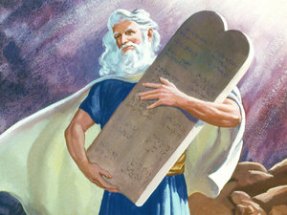
Like most pacifist vegetarians of my generation, I grew up taking a misleading translation of the Old Testament sixth commandment quite literally. “Thou shalt not kill.”

Currently, however, the generally accepted wording is, “Thou Shalt Not Murder.” World of difference.

Murder is a very specific type of killing, defined as unlawful killing committed with malice aforethought, anti-social behavior often associated with other crimes like robbery and political intrigue. Murder is synonymous with assassination and extermination on the one hand, but also with mutilation or mangling.

At the very least, there are two outstanding differences between an across-the-board prohibition on murder versus a blanket prohibition on all killing whatsoever, whensoever, whysoever.

First, according to I Ching wisdom, mirrored by King Solomon’s famous words in Ecclesiastes, there is a time and place for every purpose under Heaven. Within the cyclical laws of nature and nature’s God, purposeful killing is intrinsic to life’s rhythm.

ecclesiastes

Second, if one is prohibited from killing regardless of context, this prohibition, in extreme circumstances, is misconstrued as a guilt-inducing, paralyzing, self-defeating command: “Thou shalt not protect thyself.”

Further, examples of murder are less obvious that one might first think. There are many more forms and levels of crime than those acknowledged by legal systems designed to protect human life and property.

As psychologist Erik Erikson, quoted by Jonathan Kozol in Death at an Early Age, wrote:

Some day, maybe, there will exist a well-informed, well-considered, and yet fervent public conviction that the most deadly of all possible sins is the mutilation of a child’s spirit; for such mutilation undercuts the life principle of trust.

To this point, in Rethinking CRIME I wrote:

Those who dismiss, demean or control children with fear condemn them to empty lives of masked conformity on the material surface of the Life Wheel. Instilling extreme ideas about death, as if it were either a reward or ultimate punishment, one’s only hope or worst enemy, results in living inappropriate to reality.

To take another tack, I’ve more than once observed that the people who on the surface of the Life Wheel give the appearance of being the most conformist, are at deeper levels, the least so. They simply have the most to hide.

Conversely, those who may not be so strict in social correctness have less to hide. Often, they live more faithful to the heart of human kindness. In fact, this is the consistent pattern.

The Laws of Nature explain this consistent inconsistency. Consistent with I Ching wisdom, Michio Kushi lists “Twelve Principles of Order in the Universe.” They include:

1. Everything is a differentiation of ONE Infinity.

2. Everything changes.

3. All antagonisms are complementary.

4. There is nothing identical.

5. What has a front has a back.

6. The bigger the front, the bigger the back.

The dynamics of this natural law explain why what appears so on the surface inevitably has a shadow, complimentary opposite side lurking beneath. Those who know them best find the nicest people can be shockingly cruel.

The most seemingly non-violent – apparently squeamish and helpless when it comes to physical self-defense can be extraordinarily violent in non-physical ways – ruthless when it comes to money matters or partisan politics.

The bravest and most accomplished of performers, if naive about the ways of the financial world, can be undone by a ruthless agent and end up ruined.

Herein lies the stuff of human tragedy. As the Greeks understood, a hero’s greatest strength, untempered, becomes (ironically) the cause of his downfall.

These dynamics repeat on every scale of magnitude. We find them in operation within the family, played out in communities, corporations and nations. In some cases, murder is a question of degree. How different is it from character assassination, for example? Or invalidating others. Or wearing them down, depleting their energies and resources.

People who pride themselves on being powerful in terms of economic and social resources adopt extreme yang lifestyles. This includes using the force of personality and, in extremes, physical violence, to get what they want.

In contrast, those who lack external, material resources take refuge in extreme yin strategies. They too maneuver to get what they want, just in more subtle ways, including psychological warfare. They are just as violent. Just in ways and on levels hidden from most of us.

A current example is a politician who as an outsider, superficially seemed the most liberal and egalitarian. Once inside, however, the opposite side came forward. Outward appearances belied the character of a despot with no qualms about lavishly squandering tax dollars to fund an extravagantly opulent lifestyle.

Hence the virtue of a middle path, free of extremes in any direction. The ideal of health, on every scale of magnitude, is balanced strength on all levels rather than imbalances – excesses on one level masking deficiencies at another.

Understanding the levels and layers of life and the dynamic interplay amongst them is critical to social and economic survival. Adhering to that deepest, infinite core from which integrity, balance and wisdom flow remains the key to ultimate survival.

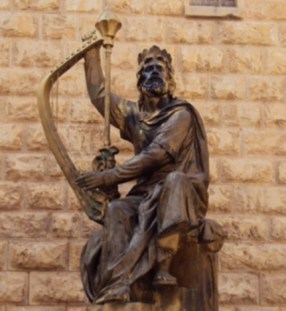
Especially in troubled times such as these, I think back on the Psalms of King David, equal parts musician, warrior and ruler. In all aspects of his reign, he survived by allowing his life to be ruled by that ONE Infinity acknowledged throughout time as the bedrock of life.

Although in family affairs and matters of state, he suffered dearly from the inconsistencies of human behavior, he inevitably found the safe way through trouble.

David-sized

Thus in Psalm 27 he sang:

The Lord is my light and my salvation; whom shall I fear? the Lord is the strength of my life; of whom shall I be afraid?

2  When the wicked, even mine enemies and my foes, came upon me to eat up my flesh, they stumbled and fell.

3  Though an host should encamp against me, my heart shall not fear: though war should rise against me, in this will I be confident.

4  One thing have I desired of the Lord, that will I seek after; that I may dwell in the house of the Lord all the days of my life, to behold the beauty of the Lord, and to enquire in his temple.

5  For in the time of trouble he shall hide me in his pavilion: in the secret of his tabernacle shall he hide me; he shall set me up upon a rock.

In all, the survival path is marked by adherence to the Law. Conversely, it requires avoidance of that which is unlawful. This includes both refraining from acting unlawfully — violating the laws of nature and nature’s God —  and protecting oneself and those one loves from unlawful behavior perpetrated by others.

Therefore, thou shalt not murder. By extension, thou shalt not murder the language, rendering the God-fearing defenseless before enemies and foes.

victory-sized

The Phoenix Response

Phoenix - sized

In a recent post, Choose Life II, I wrote:

I was increasingly motivated by dread of facing a future based on past experience. Subconsciously, I had succumbed to a death sentence suggested by people far too “nice” to kill me outright, but all too capable of driving me to slow suicide.

Since then, going a few years back in my notebooks, I found my response to a scary conversation. At least ten years ago, we were in a car, on the way home from running an errand as I recall. The driver was flawlessly made up, as usual. She was wrapped in an ankle-length, black fax-fur coat.

I gently suggested in a general way (nothing personal, of course), that sometimes, surely unintentionally, some people push those they can’t control to self-destruction.

She shook her head, No. It was definitely intentional, she objected.

Horrified, I searched my mind for the right survival response. (My belief in reincarnation rules out suicide. At best, unfinished business would just reappear.)

As the issue continued to come up, here is the solution recorded in notebooks over the years. Whenever circumstances or people push me to suicide, I will die – but only to be reborn in this lifetime, over and over, each time better than before.

I called it The Phoenix Response.

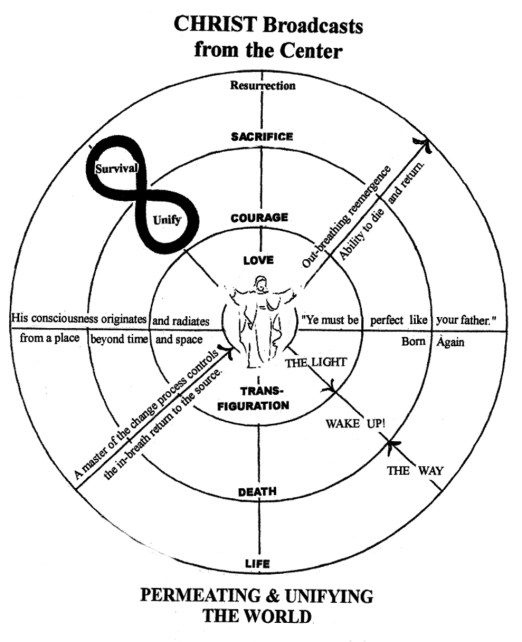
I associated this intentional positive decision with the death and resurrection of Christ, whose archetypal pattern represents a possibility for each of us, at any time, as a matter of personal choice, commitment and dedicated follow-through.

This was, in part, the thinking behind the following essay from Conscience: Your Ultimate Personal Survival Guide. I include it below for the benefit of those who, especially given the pressures of our “interesting” time in history, may be pondering similar choices.

phoenix b&w

ESSAY 2. DEATH

Quotes

merging

Patricia E. West, Two Sides of a Coin:Lao Tze’s Common Sense Way of Change

Tai Chi Tu - sized

Dying patients went through the five stages, but then after “we have done all the work we were sent to Earth to do, we are allowed to shed our body, which imprisons our soul like a cocoon encloses the future butterfly,” and … well, then a person had the greatest experience of his life. — Elisabeth Kübler-Ross, The Wheel of Life

Tai Chi Tu - sized

Here is a test to find whether your mission on earth is finished.

If you’re alive, it isn’t.

— Richard Bach, Illusions

Tai Chi Tu - sized

Some day, maybe, there will exist a well-informed, well-considered, and yet fervent public conviction that the most deadly of all possible sins is the mutilation of a child’s spirit; for such mutilation undercuts the life principle of trust. — Erik Erikson, quoted by Jonathan Kozol in Death at an Early Age

Tai Chi Tu - sized

THE FRONT

Webster’s definition of death is the act or fact of dying — the permanent ending of all life in a person, animal or plant. Personified, death is pictured as the grim reaper, a hunch-backed, black-robed skeleton wielding a scythe. The term refers to extinction, as in the death of hope.

These definitions, however, represent an extreme cultural bias with important effects on behavior. They reflect the materialistic belief that the physical is all there is. When the body fails, there is nothing else. There is no essence which survives to travel on.

The I Ching embodies a more inclusive, comprehensive view. Like the learned amongst most ancient cultures, Chinese sages regarded birth and death as natural changes, complementary stages of an ongoing, cyclical life process.

Sages continue to regard death not as extinction, but the culmination of a winter season most wisely spent preparing for the coming spring. They teach that a soul, having learned the lessons and completed the work of one life cycle, separates from its used up shell. Once the spirit moves on, the shell collapses. The life essence, however, simply migrates, possibly to take on another form.

Meditation practices are instrumental in reconnecting the alienated rational mind with the life principle, restoring trust. They can prepare advanced souls to depart the physical form consciously at the auspicious time of their choosing. They also induce the changes of heart and mind that the Bible alludes to as rebirth. To be born again isn’t necessarily an emotional self-deception. Technically, from I Ching perspective, it’s very possible.

As described by healer/teacher/author Barbara Ann Brennan, total transformation and rebirth can also take place within the same body. She describes spending two years of prayer and intense discipline. By the end of that time, as a result of her efforts, every aspect of her life had changed for the better.

Going through stages similar to those described by Kübler-Ross, she released her old life, so that new attitudes, better relationships, and a significantly more satisfying lifestyle replaced that which had been outgrown and put away.

Country music star Naomi Judd, another example, refused to accept the death sentence placed on her by a short-sighted medical establishment. Instead, she chose to accept her illness as a challenge and blessing in disguise, taking the self-responsibility to restore her health.

With a combination of faith and true grit, Naomi educated herself in a broad spectrum of healing arts traditions and succeeded in regenerating herself from the inside out. She not only survived, but became healthy enough to endure the rigors of another music tour. She called it “The Power to Change,” using it as a platform for urging fans to rise to the challenge of change as she had.

THE BACK

Fear is the natural outcome of limited materialistic beliefs equating the end of physical life with total extinction. Those who experience the True Self as immortal and indestructible are not plagued by fear of mortality. No doubt the courage and solace which sustained Socrates as he calmly accepted his death sentence — not as an escape, but an affirmation of principle — came from the depth of his soul awareness.

Permanent extinction, however, is possible. Real death is not dissolution of a temporary form, but the annihilation of the soul itself. According to learned traditions, a soul beyond redemption by its own repeated wrong choices can be extinguished forever. Even the thought is cause for horror, powerful incentive to make right choices.

globe

What IS Your Calling

Angel Calling

A timely message from Charles Caro, a senior LinkedIn expert who was most generous with his knowledge when I was a social media newbee, sparked this post. He wrote:

Patricia, You are on my list of the top people I want to contact related to my new book titled “Job Seeker’s Faithful Guide” . . . The book is targeted to job seekers wanting a resource to sustain themselves mentally and spiritually during their job search journey.

I was hoping you would share information on my new book with your connections either by message or simply sharing my posted Pulse article.

I immediately emailed back congratulating him: You’ve found an important blind spot in the job-seeking canon, and trust you’ve filled it admirably.

And forthwith posted this update:

I highly recommend Charles Caro’s work. I owe him a debt of gratitude which I’m very glad to repay in any small way possible. Please see https://lnkd.in/bX–TjH.

After further thought, I added:

You’ve got me thinking. These are times that test us all, serving to separate the wheat from chaff — those who will hear and survive, from those who have hardened themselves and will thus fall by the wayside. Perhaps I will write a post to rethinkingsurvival.com to this end that mentions your book as its trigger. Your words could well make a positive difference to those who choose to “endure to the end.”

Now where was the perfect timing – the synchronicity – in this exchange? His job-search approach touched on a burning question of my own, a follow-up to my last post confirming the personal decision to endure, Choose LIFE II.

Although the basic decision was made, I was finding it not sufficient. I was filled with grave doubts about the future. As the vitally urgent next step, I had just journaled my burning question as an I Ching query. “Why am I still Here? What is My Calling?”

A review of past LinkedIn correspondence underscored my discouragement. In a professional environment where carving niches is the norm, resonance with my boundary-spanner idea was sparse to nil.

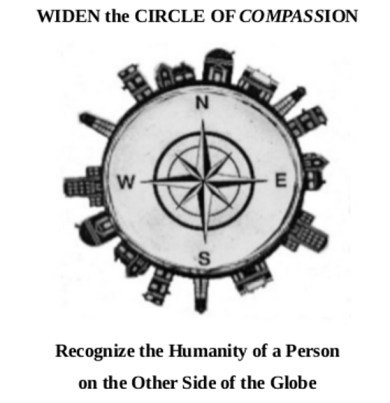
In our earliest exchanges, what I asked Charles was how to connect with like-minded thinkers. By this I meant interdisciplinary innovators who span and link professional disciplines (sciences, religions, and philosophies) by recognizing the universal source that underlies and sustains all life, on every corner of the globe. This was the thought behind illustrating Einstein’s quote in Rethinking Survival.

circle compass of compassion

As good fortune would have it, Charles himself is a boundary-spanner, demonstrated by his ability to recognize the relevance of Chinese wisdom to his Christian worldview. As a practicing Christian, his connections support his approach. For example, he wrote:

Timothy Tobin, who is one of my 1st level connections, lives in Peoria, Illinois where Caterpillar has cut 30,000 employees of the past couple years. Tim has predicted I will sell a million copies in a year. He has let his wife know she can stock the book in their Church bookstore.

In turn, the Life Wheel which is equally compatible with ancient yogic scriptures and modern physics is also compatible with a profound reverence for Christ.

Although coming from very different traditions, what we share in common is a recognition of basic human concerns. For example, my published work focuses on creating awareness of the natural laws of change as well as their relationship to their unchanging source. In describing his new book, Charles choses to call change “transition.”

The “Job Seeker’s Faithful Guide” targets everybody involved in a career transition regardless whether they are unemployed, underemployed, seeking a new opportunity or launching a new business on their own. 

So later I added this observation:

I find repeatedly when researching that two out of three levels of experience are covered — the mental and physical (“think” as in strategize and action/behavior), but the central, driving core — which depends on hearing (“knowing,” trusting, believing in the creative source) is overlooked.

Now, as to the answer to my query, the main text I consulted to examine the implications of my answer was the Jack Balkin version of the I Ching (Book of Change).

Balkin is another, formidable boundary-spanner. As underscored by his title choice, The Laws of Change, Balkin is Knight Professor of Constitutional LAW and the First Amendment at Yale Law School. (As an aside, I urged him to write on a question that fascinates me: the relevance of the Book of Change to Constitutional Law. Sadly, he responded that other work is prohibitive – for the time being.)

Like every other version, being the product of a human mind, this version is limited by the constraints of duality. Yet it is a brilliant contribution to the field and clearly a labor of love. While some might complain that he lacks the traditional linguistic and/or yogic background which Asian translators bring to the subject, in an intuitive way (perhaps exactly for that reason), his understanding rings true.

Be that as it may, to repeat, I asked, “What is My Calling?” In my case, the I Ching Answer was Hexagram 30, Li (double Fire), with no changing lines. Balkin translates Li as RADIANCE, and lists these Key Words:

The Clinging; Interdependence; Synergy; Understanding connections and interdependencies; Fire; Brilliance; Clarity; Shedding Light on Things; Enlightenment

Ah. I instantly recognized the relevance to my boundary-spanner quest.

The text explains:

The two great themes of Li are enlightenment and interdependence. Fire sheds light on everything as its radiance extends outward; but it burns brightly only as long as it has fuel to draw on. As long as the fuel lasts, the fire lasts. Whatever gives light, clarifies, and enlightens depends on something else to which it clings, something whose persistence and perseverance allows the light to shine.

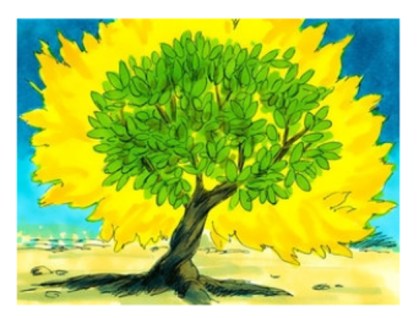
My intuitive response clicked on the image of the burning bush of Exodus, from which the voice of God called out to Moses.

Burning Bush image

Balkin continues, applying these themes to relationships:

So it is with human life. The life of human beings is not free and independent. It is conditioned on circumstances, and, in particular, other human beings. If you wish to gain clarity in your life, you must understand who and what you depend on, and who and what depends on you.

Balkin advises:

Enlightenment means accepting the world for what it is, recognizing one’s connection to others, and taking care of what needs to be taken care of. This is the path to clarity and peace. Acceptance does not mean pessimistic resignation. It means facing up to the facts. Only when we can accept the world can we begin to work with it to improve it and our situation within it.

Relevant to job seekers attached to past successes (or failures), he admonishes:

Do not cling to the past, for it is gone and it will not return. Accept change. Be open-minded and adaptable. Don’t bemoan your fate. Consider how you can change things for the better, given the situation you now face. Nurture others and you will nurture yourself.

His summary states:

Fire is an apt symbol of enlightenment because the power of truth is increased when it spreads to other minds. One candle lights another, and the amount of illumination is doubled without anyone’s light being diminished. For this reason, superior people do not hoard their knowledge or their wisdom, but share it with others who are willing to accept it. In this way enlightenment eventually can reach “to the four corners of the world.”

Food for thought indeed. What do you make of it?

And, as I continue with my own reflections, I encourage you to ask your Self, what is YOUR calling?

Choose LIFE II

body-mind-spirit

Last fall’s mystery illness became a strict teacher, a blessing in disguise. It dramatically reinforced my awareness of the mutually dependent relationship between brain and gut long recognized by Asian healing traditions.

As modern medical research documents, mental distress manifests as a myriad of gut-spawned diseases – Crone’s disease, fibromyalgia, rheumatoid arthritis, irritable bowel syndrome and eventually cancers, to name but a few.

Conversely, the broad spectrum of diseases arising in the gut spawn a host of mental illnesses – not only depression, memory loss, dementia and schizophrenia, but autism and A.D.H.D, for example.

The hopeful application is this. Correctly steered, interventions on either side of the gut-psychology continuum positively affects the other. The relationship spans an infinite loop. So wherever one starts, given time and effort, it’s possible to complete the cycle, eventually restoring balance and good health.

Follow along if you like and I’ll connect the dots that led to this conclusion.

It started with asking WHY. Medical people failed to correctly diagnosis what went wrong. The ER physician (nice lady) jumped to the convenient assumption that, given my demographics, a lower tract infection was the problem. Antibiotics would make symptoms go away.

When the first round of drugs didn’t help, instead of questioning the assumption, the local nurse practitioner prescribed a battery of (expensive!) different antibiotics over following months – in increasingly stronger doses – each with its “interesting” side effects.

The duration of this “illness” was cause for some serious introspection on my part. Certainly the WHY had a mental origin. Stern teacher that LIFE is, I came to accept that I wasn’t going to be let off the hook until I came clean with myself. Release demanded self-honesty.

What I unburied was a death wish of sorts. It wasn’t that I wanted to be gone, so much as that negative suggestions from false friends absorbed over the years had worn me down to the point of critical mass.

I was increasingly motivated by dread of facing a future based on past experience. Subconsciously, I had succumbed to a death sentence suggested by people far too “nice” to kill me outright, but all too capable of driving me to slow suicide.

LIFE had sounded a warning alarm to bring me back to my Self.

Something had to change. It started with a stark decision. A conscious commitment to LIFE, whatever it takes. I wrote a confirming article, Choose Life.

Once recognition and the decision were made, LIFE responded most generously. The help and information needed to support my choice appeared from several directions.

The next step was for me to ask HOW do I return to health? And how do I change my attitudes and behavior to make my personal future different and better from the past?

Critically important information was found in Susan Forward’s Emotional Blackmail: When the People in Your Life Use Fear, Obligation and Guilt to Manipulate You.

I was instantly inspired to borrow the book from the library after reading a top-ranked review of the book which starts:

This book does a very clear job of defining emotional blackmail so you can begin to easily spot emotional blackmailers in your life. It then concludes with telling you specifically how to deal with emotional blackmail, that is, how to keep your energy, resources, and sometimes your very soul, from being stolen by them.

WOW. I could relate to that!

She writes, At the heart of any kind of blackmail is one basic threat, which can be expressed in many different ways: If you don’t behave the way I want you to, you will suffer.

Forward explains:

Manipulators work hard to deny, obscure, camouflage, prettify, excuse, rationalize, disguise, HIDE what they are doing. They make it hard, if not impossible, to see HOW they’re manipulating us. They lay down a thick FOG that obscures their actions.

FOG is an acronym that stands for the psychological warfare tactics used against targets: Fear, Obligation and Guilt.

This information is reinforced by Harriet Braiker in Who’s Pulling Your Strings? How to Break the Cycle of Manipulation and Regain Control of Your Life:

People who manipulate are often so hard to spot. They become your friend and then find ways to have their way with you. . .

A reviewer summarizes:

You can’t reason with a manipulator because of their insecurities but you can reason with your own insecurities; and best of all are the practical ways you can change your behavior to take back the power.

This book teaches you to get up, learn what you did wrong and what you should have done, and even better how not to repeat the same mistakes.

There’s also a warning given from experience:

I’ve put an end to so much manipulation in my life. It takes the wind right out of the manipulator’s sails. The book is right…the manipulator will blow really hard, so prepare yourself; it’s going to get stormy.

choose life

Another fortunate form of help followed from my decision to seek medical advice elsewhere. An intern at the UW kindly saw me on short notice. Intrigued by my situation, she brought in her mentor. Together, after reviewing the history of lab results, they confirmed that the initial diagnosis wasn’t right. The medications hurt more than helped.

Although I knew enough to eat yogurt to offset the effect of antibiotics, to repair the damage done by antibiotics they recommended taking pharmaceutical probiotics as well. This opened the door to a whole new world of science and healing.

Probiotics for Dummies, for example, includes a useful section on the brain-gut connection.

Medical researchers have long known that stress depresses immune function, but only recently have they linked stress to changes in gut bacteria.

The medical community’s interest in probiotics was initially sparked by the seminal work on GAPS (Gut and Psychology Syndrome) published by researcher Natasha Campbell-McBride.

In Gut and Psychology Syndrome: Natural Treatment for Autism, Dyspraxia, A.D.D., Dyslexia, A.D.H.D., Depression and Schizophrenia, she notes that Western medicine has long acknowledged the brain-gut connection:

The father of modern psychiatry, French psychiatrist Phillipe Pinel (17-45-1828), after working with mental patients for many years, concluded in 1807: “The primary seat of insanity generally is in the region of the stomach and intestines.”

Interestingly, she uses the same word, FOG, when in describing the mental-emotional relief experienced as the intestines heal by using probiotics to restore balance. “It is as if the fog lifts.” Ahh!

But, like cutting through the psychological FOG, cleaning out the gut doesn’t happen over night, or without difficulties. Campbell-McBride warns things often seem to get worse before they get better. Detox is a necessary but challenging middle step along the road that leads from here and there. So, again, “prepare yourself; it’s going to get stormy.”

There are important parallels between the so-called Leaky Gut Syndrome and psychological distress. In the first case, weakened intestines become permeable. Toxins and undigested food leak out and are circulated by the blood stream throughout the entire body, poisoning other internal organs – including the brain.

Similarly, psychological defenses can also be worn down and compromised, sometimes due to “second-hand stress.” In this case, when protective borders between self and others break down, toxic influences from outside undermine mental-emotional balance. Others’ fears, rage and general unhappiness poison the unprotected mind. Toxic people preoccupied with their own wants and personal dramas, even when unintentionally, do great harm.

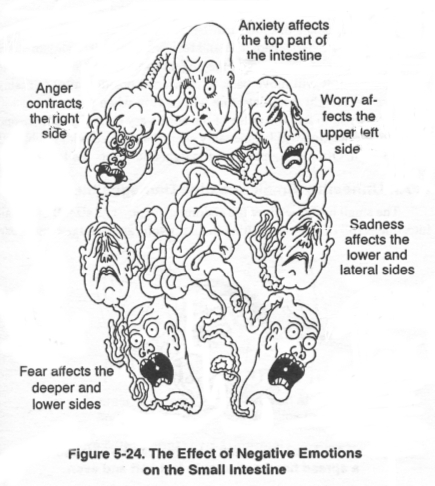
Interestingly, the GAPS/probiotics approach is highly compatible with the wisdom of Asian healers. Traditional Chinese Medicine, for example, carefully maps the gut-psychology connection. They describe the dynamics of what is called “the abdominal brain.” The following illustration captures thousands of years of wisdom in a single picture.

0 012316

According to Mantak Chia, when the intestine becomes congested, it cannot perform its physiological functions. Though you may eat well, you may be under nourished.

As he explains, each of the organs is correlated with one of the five elements. In turn, each is associated with specific positive or negative emotions:

All negative emotions are expressed in the small intestine by contraction and circumvolutions, Anger contracts the right side of the intestine near the liver. Worry affects the upper left side near the spleen. Impatience and anxiety affect the top. Sadness affects both lower lateral sides. Fear affects the deeper and lower abdominal areas.

As the I Ching instructs, the same dynamics repeat on every scale of magnitude, from cellular to universal. So many hints from sciences both ancient and modern could be taken in many directions. They apply to relationships on a personal level, to community dynamics, and governance. But those will be subject of posts yet to follow.

For starters, I’ll offer just one hint.

Campbell-McBride uses the image of a medieval fortress under attack to describe the breakdown of  defenses that result in auto-immune diseases. It parallels the Interleukin II research described earlier, where the grad students saw their research on pediatric leukemia in terms of a war between good and evil.

When confusions in gut mirror confusions of the mind – when the difference between friend and enemy is fogged — anabolic (building up) and catabolic (breaking down) functions are thrown off balance. The body  is fooled into turning against itself in self-destructive ways.

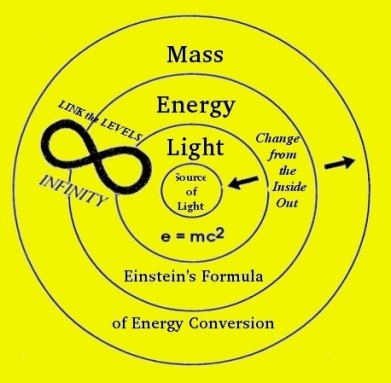
In conclusion, however, a key component overlooked in the popular gut-psychology formula must be noted. Spirit — that third, underlying, unifying and overriding component of the e = mc2 equation – plays a deciding role in the outcome of the LIFE versus death struggle to survive.

It is said that “The mind will play any tune you tell it to play.”

choose wisely

So – who is it that quietly instructs the mind which tune to choose?

LIFE itself, the soul’s advocate, is the tie-breaker that tips the balance.

Here, I allow Mantak Chia to have the final word. He describes the discipline of cultivating chi – the subtle energy that links mind and body — and the end goal of the path to which all endeavors ultimately lead: 

  • If one wishes to be a healer, success depends upon the ability to channel energy through the hands.
  • If one wishes to be an athlete, success depends upon the ability to convert energy into strength and endurance.
  • If one wishes to be free of negative influences, success depends upon the ability to transform negative energy into positive energy.
  • One who seeks enlightenment is searching for the highest source of all energy.


I write in hopes that you will find this saga helpful. If you relate, I invite you to apply your imagination and follow wherever the subject leads you.

To your health!

Keep It Together

star of david

Although it seems there’s no longer much more to be said, yesterday’s Aha moment is an exception.

Here’s the back story.

Over Thanksgiving week-end, for the benefit of those who hadn’t seen The Walking Dead series, we spent several hours here watching back-to-back episodes of the first two seasons.

For me, this second go round had an even greater impact. The content speaks on many levels, in many ways, to our increasingly dangerous times.

Like life itself, the series is a complex counterpoint of relationship drama, political intrigue, philosophical ponderings and soul searchings. It’s intense: not for the weak of stomach or for lovers of sentimental fluff.

Beyond the surface story line, however, it is poignantly symbolic. Perhaps in a very deep way, it’s prophetic. Which explains why a simple pilot unexpectedly took off to become a sensational success. For those with ears to hear, it resonates straight to our very core.

How, you might ask, does a story about a world overrun by hoards of cannibalistic zombies apply to current events and leadership issues?

Well, let’s see.

In The Walking Dead, zombies are mindless corpses that carry on after humans die. All but the primal, limbic functions of the human brain have been disease-destroyed.

When you think about it, it’s not such a far cry from the end result being achieved (perhaps intentionally, perhaps not) by manipulating humans (programming them in the name of education) based on brain science.

Neuro-marketing, for example, stimulates the same vestigial, animal part of the brain that drives zombiesintentionally bypassing rational cognitive functions involved in critical thinking and rational decision-making.

An academic website defines neuro marketing as : the formal study of the brain’s responses to advertising and branding, and the adjustment of those messages based on feedback to elicit even better responses. Researchers use technologies such as functional magnetic resonance imaging (MRI) and electroencephalography (EEG) to measure specific types of brain activity in response to advertising messages. With this information, companies learn why consumers make the decisions they do, and what parts of the brain are motivating them to do so.

It increasingly seems as if walking dead hoards include not only fictional zombies, but average consumers and citizens — even the college professors, marketing professionals and politicians who direct their communications to these same animal brain functions.

Economists and politicians have jumped on the marketing bandwagon, exploiting brain science. Earlier, I expressed strong reservations about the ethics and consequences of applying brain science research to marketing and policy making.

Intentionally targeting instinctual, animal functions of the brain with subliminal messages represents an intentional effort to control and dehumanize the general population. The results could be scary indeed.

In a LinkedIn article that points out serious problems with Thinking, fast and slow, Kahneman’s book on behavioral economics, I concluded:

To continue sleep-walking on the shallow surface of life as most of us do now plays into the hands of madmen and tyrants, some of whom, if it seemed to further their ambitions, would have no compunction whatsoever about plunging the entire world into nuclear war.

But back to The Walking Dead. As a commentary on leadership options in this scary new world, it triggered my Aha on the importance of “keeping it together” as a devolving world militates to tear us apart. The answer I came up with is part mystical, part medical for those with the training and diligence to practice yogic breathing and concentration methods.

The primary questions this series challenges us to think about are, “Who is going to survive in such a chaotic future, How, and Why?”

The protagonist, Rick represents the voice of reason. His words and actions show him to be more evolved than most. He’s a “natural leader,” if you will. This former sheriff’s deputy knows weapons and can handle himself in a fight. But in balance, he is also a “righteous dude.”

Rick earns farm-owner Hershel’s respect by showing him respect.

Hershel – a religious optimist who chooses to deny the existence of danger closing in on all sides – wakes up the hard way, losing all he owns in the process. He’s highly evolved, but out of balance. The practical street smarts were too late coming. At least in the beginning, he was extreme yin, out of balance.

And then there’s the opposite side of the coin. Shane. His exudes extreme yang energy. This treacherous shake in the grass, ruled by animal appetites, rationalizes his lusts and takes whatever he wants however he can.

Shane dogs Rick’s every step, working to undermine him, scheming to take everything – Rick’s wife, son, and leadership role in their small community. Shane operates from the solar center, with little heart awareness and no functional conscience. He has no concept (much less respect) for higher levels of consciousness. Mercy is outside his range of awareness. To Shane, Rick and Hershel seem weak.

Shane seduces whomever he can with the argument that, civilization being destroyed, he is the wave of the future. Only he is qualified to protect the group. But, depending on the rest of us, that vision remains to be seen.

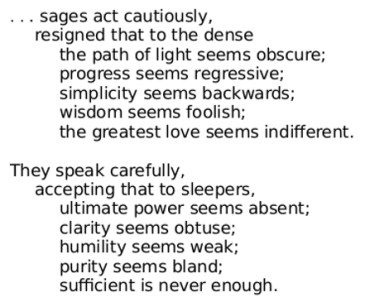
How to deal with the Shanes of the ugly new world? I’m reminded of Lao Tze 41:

120115 2 Sides 41

In thinking about what combination of leadership qualities will succeed in steering small communities through both the internal and external dangers they will face if/when “civilization” breaks down, I was amazed at how skillfully the leaders in The Walking Dead adjust to change. Like the ancients, they keep their balance by adjusting to the fluctuating demands of a dualistic world.

For in duality, as Solomon wrote:

120115 ecclesiastes

In the future, those in small communities who persist in old ways of thinking, clinging to one extreme or the other, either rational or animal, rigidly ignoring the complex demands of an altered, endangered new world, risk forgetting Henry David Thoreau’s warning: “A foolish consistency is the hobgoblin of feeble minds.”

Certainly Christ knew this. He taught, “Love one another as I have loved you.” Yet his was not an example of foolish sentimental permissive “tolerant” love. Certainly he had no use for the money changers and demonstrated fierce anger towards hypocrites.

It was at this point in my thinking that the Aha happened. The Star of David, traditionally worn over the heart, is the perfect symbol of balancing the polar qualities future leaders will need to keep civilization from devolving into the exclusively animal realms of a zombie-like existence.

This Star is housed in the “secret place of the Most High” described in Psalm 91. It is associated with the heart center located in the middle Dan Tien. It is the seat of compassion, the place where the upper Tan Tien’s mental light and lower Tan Tien’s solar fire join, blend and balance.

This joining is mirrored in the meaning of Ha-tha (sun & moon) yoga = union.

This six-pointed Star is formed by the intersection of two equilateral triangles. According to Chinese medical notation, the upward pointing triangle represents the quality of yang energies. The downward pointing triangle represents yin.

It is no accident that equilateral triangles are the strongest, most stable of geometric structures. Those who internalize and actualize these realities have the practical means to keep themselves and their communities together.

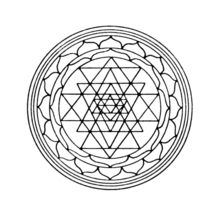
In the Hindu tradition, the Sri Yantra is similarly constructed of nine interlocking triangles that surround and radiate outwards from a central point.

Sri Yantra

These variations are each based on the same subtle geometry. They express the same inner experience of a central, underlying reality.

To repeat, while on one hand, the universal secret of these interlocking triangles is a profound mystery, on the other, for those familiar with yogic breathing and concentration methods, they are the foundation of practical disciplines with physical, mental and spiritual results.

Given time to refine what is written here, the ideas could be better expressed. But the substance remains as a Christmas gift offered to those prepared to receive it as such.

Arguing and nit-picking would miss the point. The better choice is to bring your own understanding to an urgently important subject and make it your own. It is a key to not only personal survival, but the hope for a better future.


ANNOUNCEMENT – Promises Kept


globe bullet size

Those who follow my work will remember Under Construction, where I listed website changes to occur over the summer and into fall.

Well, true to my word, much has changed. Please visit rethinkingsurvival.com and see for yourself.

Earlier I promised, “Nothing of substance – the archetypal ideas presented here – will change, but presentation will improve dramatically.” So the Home Page has a new face – and content is significantly improved.

Now that Labor Day is behind us, it’s time to report on listed changes accomplished to date.

1. Much of the content of + A Positive Action Press books sold through Amazon has already been made available on website pages. When you click on the each of the book pages at the top of the Home Page, drop down menus now appear. So you can pick and choose as you prefer.

I personally recommend the Make Yourself Whole section of the HANDBOOK page as the practical sum of the rest. It might also spark your interest to know how I got to “here”  . . . information supplied in the other sections and earlier books.

Each of the five books on change is described on the Home Page. Content of each found on its own page.  In chronological order, they are:

  • CSBOC = Common Sense Book of Change.
  • 2 SIDES = Two Sides of a Coin: Lao Tze’s Common Sense Way of Change.
  • RS = Rethinking Survival: Getting to the Positive Paradigm of Change.
  • USPG =Conscience: Your Ultimate Personal Survival Guide
  • HANDBOOK = The Positive Paradigm Handbook: Make Yourself Whole Using the Wheel of Change

2. I promised current photos. You’ll find them in the NEW PHOTOS page, along with why I’ve decided to stay with my current gravaar.

3. I spoke of a possible Guest Post page. It was added, but after sorry experience I thought better of the possibility. Among other things, it would have required CrowdFunding to pay for the administrative costs, which is not a realistic option.

https://rethinkingsurvival.com/donate-2/

4. As mentioned, a DONATE page has been added. Here is the language, for your consideration:

You have the option to purchase the books described on the Home Page from amazon.com. Now, however, as an alternative, content is being be made available directly on the website as well.

If you are moved to donate in return for value received from this website — the sum of a lifetime’s search, sacrifice and hard work — that would be great!

If you can’t afford to donate, I understand. I’ve been there. Please do everyone a favor — benefit from the ideas, tools and methods as you dare. I trust you to pay what you gain forward, when and as you can.

If you are able, however, and especially if you are one of my regular visitors, please donate so that I can continue to provide timely, entertaining, and useful food for thought.

Without your help, the time I can afford to put into writing and marketing remains limited. So another way you can help is to let your friends know about rethinkingsurvival. Click on the share buttons below to magnify the benefit of what you have received here.

I leave it to you to act on the honor system, donating as you can, according to both value received and the work’s future potential.

Let the ripple effect of positive change of which I write begin here and now.

Namaste. Thank you. Patricia”

globe bullet size

Under Construction work is still in progress. Labor Day has passed but the fall equinox is still ahead. Your comments and suggestions make a difference.. What do you think?


As Conflict Escalates, What Can Be Done NOW?

As Conflict Escalates, What Can Be Done NOW? originally appeared in the August edition of Prabuddha Bharata, or Awakened India – an English-language monthly magazine of the Ramakrishna Order. Founded by Swami Vivekenanda — a disciple of Ramakrisha who traveled to the West — it has been in publication since July 1896. With the kind permission of Editor Swami Narasimhananda, I am reposting the full-length article here.

globe bullet size

by Patricia E. West, Ph.D.

The Creator’s most miraculous and precious gift is often the least appreciated. In fact, in the midst of hectic daily life, it sustains everyone – friend and foe, good and evil doers alike – virtually unnoticed by all. Increasing strife and conflict bombards us from every direction. Yet we have very close to our hearts the elusive means of reconciling illusory differences and restoring original unity, first within and then without.

The priceless gift of which I speak is, of course, the breath.

Magically and mystically, every breath each person on the planet takes is infused with prana, that which links the individual being with the Universal Life Source.

Swami Vivekananda defined prana as “a manifestation of the universal power, indefinite and omnipresent.”1 Riding on the vehicle of the physical breath, prana is the most basic, potentially unifying aspect everyone everywhere shares in common.

In Meditation as Medicine, Dharma Singh Khalsa, M.D. writes, “According to the ancient masters, prana is the mystical force found in all living physical entities. It is in the air without being air. It is in water without being water. It is in food without being food.”2

This commonality repeats on every scale of magnitude. Thus Vivekananda quoted, “I am the thread that runs through all these pearls.” According to him, “Each pearl is a religion or even a sect thereof. Such are the different pearls, and God is the thread that runs through all of them.”3

He continues, “most people, however, are entirely unconscious of it.”

So how has it come to pass that most people remain unaware of the energizing life force that breathes through them every minute of every day, and even dare to deny its single origin? How is it that so many pass through their lives ungrateful for the waves of potential abundance they move through like fish in the ocean, seemingly starving for what is so close and so freely given?

As a possible answer, let me tell you a favorite story. It seems that long ago, there was a very old man who took his lunch every day at the same restaurant. He often complained about the service. So, one day when he called the waiter over, the waiter asked impatiently, “What is the matter this time, old man?”

The answer: “Taste the soup and find out for yourself.”

All right,” said the waiter. “Where is the spoon?”

Aha,” exclaimed the old man, delighted. “Now you see!” There was a delicious soup, but no spoon for taking it in.

Which is to say, most people have the nourishment of their heart’s desire everywhere about them, but no means or methods for accessing it. Medical research finds that, for many reasons, very few humans get enough oxygen into the body to fuel the brain or move the muscles properly. Although many are learned and accomplished in intellectual matters, the basics of practical breath control are often ignored. All too few have learned basic paranayama exercises or benefited from the profound insights gained from regular practice.

Workers who slouch long hours at their desks cut off their wind. Tight-fitting clothes force shallow breathing that fills only the top part of the lungs. Habitual tension and chronic anxiety further reduce the limited portion taken in. Attitudes of boredom, apathy and depression produce postures that strangle and suffocate the lungs. Pride stiffens the neck and twists the spine, strangling air circulation. Anger hardens and explodes the heart. Terror causes panic breathing and paralysis in the face of crisis, exactly when full powers are most urgently needed.

In such ways, sadly, many people ultimately cut themselves off from that Universal Source of blessings which everyone everywhere shares in common. So here we have a “chicken and egg” question. Which comes first? Does escalating religious intolerance and extreme violence cause people to increasingly forget their common humanity? Or does lack of fundamental awareness and oxygen deprivation increase the sense of alienation, illusion of lack, and rush for retaliation? Perhaps each feeds the other, causing a downward-spiraling disaster.

The Universal Key

To address the related question of why leaders at every level have failed to correctly identify and heal the root causes of conflict, first within and then without, I will draw contrasting pictures. One is the complete and accurate world view I’ve called the Positive Paradigm. Another shows distortions of the Universal Life Wheel responsible for today’s worldwide deficit of inspired leadership.

Here is the Life Wheel described in Rethinking Survival: Getting to the Positive Paradigm of Change.4 It embodies Einstein’s dearly sought Unified Theory. Ironically, he had already received it, but, for lack of yoga training, didn’t recognize what he’d been given. Being universal, its applications are seemingly infinite.

Utopia.sized

This multi-directional, mandala-like pattern of interdependent wheels-within-wheels is equally compatible with the world’s enduring religions, the teachings of Patanjali’s Yoga Sutras, and modern physics.

It is universal key, the answer to Shaunaka’s question, “What is that, knowing which, all else is known?”

This structure mirrors the pattern of each cell, where electrons and protons spin around a single nucleus.

It likewise pictures our solar system’s organization of planets circling the sun. As written:

This well-familiar atomic structure repeats smallest to largest in the patterns of nature, from snowflakes and intricate flowers to spiders’ webs and sea shells. Similar symmetrical patterns repeat worldwide in the art of every culture — including, to name but a few, the prayer wheels of Native Americans, the colored sand mandalas of Tibetan Buddhists, the stained glass windows of European cathedrals and the intricate geometrical patterns that cover Muslim Mosques. They offer proof of the universal awareness of a central inner reality, of an inner structure common to all humanity, and to a continuity of experience deeper than individual lives or transitory cultures.”5

The “m = mass” level at the surface correlates with daily experience and tangible, physical objects measured by empirical science. The “e = energy” level corresponds with subtle energies which, though invisible, are experienced by their effects. Prana and electrical energy reside here. It is the field of motion and e-motion. The level of “c = light” is associated with intuition and guidance. Deeper still, within the stable hub of the Wheel, beyond the duality of polar opposites, resides the changeless eternal source.

According to medical brain science, the vibrational speed of the levels slows with inward progression. Beta waves correlate with the busy, cluttered surface of the Life Wheel. Alpha waves associated with relaxation and then theta waves produced in revere or meditation rest increasingly deeper within. Delta waves are slowest of all. Measurable brain waves, in turn, match closely with the states of waking, dream and dreamless sleep described in the Mandaka Upanishad.

In clinical psychology, intelligence at the outermost level is measured by IQ tests. At the middle level it is described as EQ (emotional intelligence) and towards the center as SQ (spiritual intelligence). The levels, which flow along a continuum, neither separate nor totally distinct, are linked in an infinite, two-way loop. One who succeeds in joining the levels, living here and yet there, in the world but not of it, enjoys the experience of enlightenment – Christ Consciousness.

Integrating and balancing the levels of the Life Wheel produces health in every aspect of life – personal, social, economic and political. The executive equally capable of both inspired decisions and effective action embodies Plato’s ideal of the Philosopher-King. Such accomplishment is the goal of Raja Yoga and of holistic leadership. Masters of the creative in- and out-breathing process hold the key to Life itself. For teaching purposes, they occasionally demonstrate their ability to perform apparently miraculous feats of magic.

The Life Wheel is especially useful because, in a clear, simple way, it shows the critically important distinction between 1) what is absolute, eternal and real at the center hub and 2) that which is ephemeral, transitory and subject to change on the surface rim. A very early version the Life Wheel shown below pictures where genuine Unity is to be found as well as where it is NOT.

062514 Balanced World View

The “Pleasure and Pain” level includes the pairs of opposite sensations/ emotions, hot and cold, anger and fear.

The “Right and Wrong” level includes not only competing religions, but also the social/political and economic “-isms.”

The surface, material rim of the Life Wheel is the abode of fashions and fads as well as power and ego contests. Generational swings are reflected on the surface. Enduring, timeless values abide at the eternal center.

Distortions of the Universal Pattern

Those who focus exclusively on the material surface of the Life Wheel cause themselves and those obliged to depend upon them untold amounts of unnecessary pain and suffering. Sometimes, calling it “unity” – whether in the name of God, the common good, or world domination – they seek to impose unnatural social regimentation and political conformance upon others. This naturally stirs up violent reactions from those who have different ideas about such things.

Now, why is it that international leaders have brought the world to its current state of violence and fragmentation? Put another way, why — given the demonstrated and documented benefits of something as basic and simple as mindful breath awareness – is this not taught to every school child and to every medical patient suffering from degenerative diseases and mental disorders? Where is the method in such irresponsible madness?

One hint can be gleaned from the description of a basic pranayama exercise, the Complete Breath. Benefits listed include increased calmness, reduction of toxins, increase of pranic intake, enhanced oxygenation of the blood and even synchronization of personal breath rhythm with universal vibration. However, another benefit is “increased consciousness of unconscious acts.” 6

Sadly, for a host of different reasons, most are unwilling to increase conscious awareness of matters “conveniently” tucked out of sight. They lock themselves in uncomfortable, rigid postures that freeze out self-awareness. There is too much they prefer to hide from themselves and others. Further, monied elites and tyrannical governments have no interest in the education of a self-aware, self-responsible public capable of throwing off the chains of functional slavery.

Like the protagonist of Oscar Wilde’s Faustian tale The Picture of Dorian Gray,7 many choose to focus exclusively on the surface of the Life Wheel. They strive to maintain the physical appearance of youth and beauty, while concealing the internal ravages of ill-spent time from public view. They delude themselves into believing that the paltry profits gained by saving face while heartlessly exploiting others are worth the ultimate price.

It appears as if many world leaders today, the ones we should be able to depend upon to help improve our lives, have themselves chosen the fragmented path of self-deception, cutting themselves off from conscience and inner truth. As educators, such leaders cram youthful heads with hypnotic information to make them passive yet useful workers. They deny followers the basic knowledge of who they truly are, thus preventing access to the Universal Source from which infinite intelligence and power flows.

The following illustration shows how levels become fragmented by living inauthentic to Life, cutting oneself off from the Creative Source. This is but one suggestive version of what it looks like to distort the natural, complete pattern of Creation. Those who themselves are cut off in turn enforce this sorry state on others.

world gone mad.sized

In the extreme, individuals dissociated from their inner lives become psychopaths capable of committing horrific crimes with no apparent remorse. Out of touch with their True Selves, they remain insatiably hungry, thirsty, afraid and very, very angry. No addiction can satisfy. No amount of wealth or worldly success can compensate for the loss of inner connection.

Sages Transcend Conflict

Now then, wherein is consolation to be found during the present difficult times? For Hindu sages foresaw them. We are now enduring the decline described as the Kali Yuga. Christ similarly foretold the End of Times.

It lies in this. Time does not exist for sages established in the eternal center of the Life Wheel. To enlightened beings, it is but an illusion. Because they experience themselves as eternal, at one with the Creator, their inner peace cannot be disturbed by outer violence. For them, life will go on whether or not the world as we now know it continues. Even if for this reason alone, seeking enlightenment should be a top priority.

To the point, a modern day Chinese meditator acknowledged the seamless continuity connecting his tradition with Einstein’s vision:8

Truly, Einstein was an exceptional man, not only because he proved the theory of relativity, but because he took the chance of pursuing the goal of his enlightenment. The important point is that although we might not reach enlightenment through meditation, it is a grand enough aspiration for us to make the effort.

In this, the wisdom of Jou, Tsung Hwa reflects the teachings of the much earlier, world-loved Lao Tze, who knew that true survivors ride the crest of repeating historical cycles to carry on.

Passage 42 of the Tao Te Ching describes the experience of sages who have purified, integrated and mastered the elements of their animal nature. Like the numerous watercolors and ink drawings which depict Lao Tze riding his ox, sages of all times harness instinctive impulses to the service of intentional goals to reach their metaphorical mountain top destination.9

PB LT 1

Wisdom is Lao Tze’s antidote to the instinctive dread of death. He assures us that merging with the Source, the unchanging Tao, overcomes the illusion of mortality. Passage 16 illumines the apparent paradox that death cannot change the sage:10
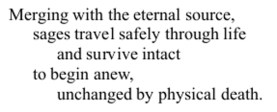
PB LT 2

For those of us who are less attained, the best efforts made to improve and preserve Life at all levels NOW are noble and worthy in themselves, as valuable as for the experience of the journey as for the end result of achieving immortality.

What Can We Do NOW?

Now then, wherein is consolation to be found during the present difficult times? For Hindu sages foresaw them. We are now enduring the decline described as the Kali Yuga. Christ similarly foretold the End of Times.

It lies in this. Time does not exist for sages established in the eternal center of the Life Wheel. To enlightened beings, it is but an illusion. Because they experience themselves as eternal, at one with the Creator, their inner peace cannot be disturbed by outer violence. For them, life will go on whether or not the world as we now know it continues. Even if for this reason alone, seeking enlightenment should be a top priority.

In the past, monasteries arose as islands of hospitality, learning and civility during Europe and Asia’s so-called dark ages. Once again, as another dark age looms on the horizon, intentional communities dedicated to preserving the essential teachings will naturally arise. My best hope is that future leaders will meet the responsibility of shaping hopeful new beginnings; that they will succeed in transmitting the wisdom of the ancients to future generations along side the complimentary technical know-how of today’s sciences.

In the Positive Paradigm reality map, future educators have a versatile self-awareness tool with which to teach the basics of leading an integrated, self-responsible life. Building on the seven basic axioms which flow from it, tomorrow’s leaders have a viable model upon which to structure healthy social organizations.

As described in The Positive Paradigm Handbook,11 these basic axioms are:

1.  A complete and correct paradigm is the key to personal well-being and success.

2.  We are each a world complete, containing the potentials of the universe.

3.  Unity and diversity are necessary compliments.

4.  The consequences of action are inevitable; those who respect the law of karma survive.

5.  History is neither linear or progressive, nor can human survival be taken for granted.

6.  Used as a linguistic tool, the Life Wheel promotes clear, accurate and effective communication.

7.  With a correct paradigm, practical methods and useful tools, you can make yourself whole.

Herein lies another discussion, complete in itself.

Conclusion

Resolving conflict necessarily occurs one person at a time, and from the inside out. For this reason, however complex and overwhelming world problems may seem, we each have the option and responsibility to improve that which is closest to home: ourselves. By reducing internal conflict within, each of us has the potential, if only in modest ways, to reduce the conflict without. By remaining ever mindful of the breath and the Divine Source from which it flows, self-selected survivors will surely find from deep within the answers to every question along with sufficient intelligence, courage and power to overcome and outlast every challenge.

globe bullet size

References

  1. Swami Vivekananda, quoted by Dharma Sing Khalsa, M.D. and Cameron Stauth in Meditation as Medicine: Activate the Power of Your Natural Healing Force. (New York: Pocket Books, 2001), 55

  2. Meditation as Medicine, 55

  3. Swami Vivekananda, quoted at http://izquotes.com/author/swami-vivekananda

  4. Patricia E. West, Rethinking Survival: Getting to the Positive Paradigm of Change. (Wisconsin: +A Positive Action Press, 2014)

  5. Rethinking Survival, 104

  6. Meditation as Medicine, 64

  1. Oscar Wilde, The Picture of Dorian Gray. (originally published in England, Lippincott’s Monthly Magazine, 1891)

  2. Jou,Tsung Hwa, The Tao of Meditation: Way to Enlightenment. (Scottsdale, AZ: Tai Chi Foundation, 1983), 71

  3. Patricia E. West, Two Sides of a Coin: Lao Tze’s Common Sense Way of Change. (Wisconsin: +A Positive Action Press, 2014), 31-32

  4. Two Sides of a Coin, 70

  5. Patricia E. West, The Positive Paradigm Handbook: Make Yourself Whole Using the Wheel of Change. (Wisconsin: +A Positive Action Press, 2014)

Truth or Consequences

truth or consequences

Have you ever wondered what Truth has to do with TV game shows? I have.

Follow along, if you will, and I’ll entertain you with what I’ve learned.

It started with an earlier post using as its title the name of a long-running show: To Tell the Truth. I had to wonder, what did Truth mean in this setting?

There, celebrity panelists were challenged to identify one from among three guests. One was authentic, presenting personal facts correctly. The others were impostors who pretended to be the first. Their goal was to deceive the panelists about the Truth.

So Truth was being defined exclusively at the material surface level of the Life Wheel – accurate representation of the facts. Truth of the middle, energy level of the Life Wheel – honesty about feelings and behavior – wasn’t a factor. At a still deeper level, Truth -– meaning honesty about underlying motives — was irrelevant. For impostor guests, lying to hide one’s true identity was highly valued — an accepted part of the game rules.

If you recall, in To Be or Not To Be PC, I used the story-line of Karate Kid III as an example of why awareness on all three levels – three-out-of-three – is essential to survival. In that movie, until the end, Daniel-san fails to understand who is truly his best friend and who is, in fact, his worst enemy.

Judging only from surface appearances, Daniel is deceived into believing Terry Silver is teaching him how to win. What he doesn’t know is that Silver is acting as the agent of an old enemy. This false friend’s underlying, hidden motive is to destroy Daniel as a way to get revenge on Mr. Miagi.

Mr. Miagi, in contrast, appears to be unhelpful, but only because he has Daniel’s best interests at heart. His deepest motive is to protect Daniel, whom he loves as a son.

Now this is an important point for all of us, because the war between Truth v. Deception is pervasive and ongoing. First, we experience conflicts internally. Then, externalized, they are mirrored in the politics of personal relationships, and continue to expand with an ever-broader ripple effect into the conduct of national and global affairs.

I’m not finger pointing. Just saying: For those concerned with survival on any or all of the Life Wheel’s levels, it’s something to think about very very carefully.

Moving on, the second Truth-named game show I’m remembering was called Truth or Consequences. It started as a radio show in the 1940-50s, followed by several television versions into the late 1980’s.

As ominous as the game name sounds, content was strictly light-hearted entertainment, often with an emotional “feel-good” component. Contestants were asked questions of fact –-  usually ones with no clear answer. If contestants could not correctly tell the “Truth” in short time, there were “Consequences,” usually involving a hilarious or embarrassing stunt.

In many broadcasts, stunts included a heart-warming surprise for the contestant. It could be a reunion with a long-lost relative or with an enlisted son or daughter returning from military duty overseas. When the military person was based in California, spouse or parents were flown in.

So here again, the game concept of Truth was shallow and incomplete. The idea of Consequences was similarly given short shrift. (For those interested, the Essay on Consequences offers a comprehensive view.)

Next, please stay with me and I’ll take the notion of Truth or Consequences to the next level.

For this, I need to tell you a story from childhood. It images much the same lessons Daniel-san learned the hard way.

The year would have been about 1953. It was after my father died, but before Mom remarried. That made me between six and seven years old. For that short time, we lived in a run-down old apartment building on Buffalo’s show-case Delavan Boulevard.

The incident I’m recalling involved a neighbor lady who lived all alone in an attic-like room on the top floor. To me, she looked very old and seemed terribly sad. Being a friendly and curious kid, I tried to get to know her.

Not so easy. I pestered her with childish questions. She wanted no part of it. Instead of speaking, she diverted my attention, pointing to a chipped and faded plaster-of-Paris nicknack on her shabby dresser that said it all.

I picked it up and examined it closely. On the water-colored figurine sat three monkeys. The first covered its ears with its hands. The second held both hands over its mouth. The third held both hands over its eyes. This motto was carved into the base: “Hear no evil. Speak no evil. See no evil.”

Three wise monkeys

This childhood experience made such a powerful impression because it was loaded with contradictions that left me bewildered. I had no idea what evil was. Why did she feel compelled to point out non-verbally that recognizing it was taboo? Most importantly, why was she so . . . now it seems . . . yes, afraid.

I remembered this experience while writing about Terry Silver’s three rules for winning an unfair fight. He advised Daniel:

  • If a man can’t stand, he can’t fight. So break his knees.
  • If a man can’t breathe, he can’t fight. So break his nose.
  • If a man can’t see, he can’t fight. So gouge out his eyes.

Granted, I appreciate what the monkey prohibitions were getting at originally. It has to do with the meditative discipline of Stillness. If the bans are a warning not to get entangled in negative situations that poison mental clarity, not to speak impulsively or slander others, and not to project dark side urges onto others, then fine. Otherwise not.

First off, humans are not monkeys. Unless drugged, lobotomized or otherwise incapacitated, the faculties of reason and intuition compliment and complete the animal part of our being.

Today, repressing the sensory faculties of awareness is proof of an increasing sense of helplessness. Looking back, I understand that my neighbor lady was telling me without words that her life was unspeakably difficult and painful. She survived by not being aware. The battered wife syndrome fits here, as does the slave mentality – passively accepting an unfulfilling life of toil and misery.

Second, genuine evil does exist. To deny that it does makes one powerless to deal with its effects, opening the door to a world of hurt. I’ve defined what I mean when I use the word elsewhere. Here are quotes:

Evil in Positive Paradigm context is defined as “destructive acts or intentions which violate the integrity of the whole, with the aim of destroying the life pattern itself.”

And again:

In Positive Paradigm context, the intentions and actions of any person (or group) that destroys its own and/or threatens to annihilate enemy groups, devoid of respect for the inherent sanctity of life, are defined as evil.

Tai Chi Tu - sized

One final point about Truth or Consequences. This article initially came to mind over concern for LinkedIn readers who gladly gobble up superficial articles written by polished prosperity-consciousness authors to promote purchase of their books. In one place, I was actually moved to comment:

I’ve found the formula for this author’s content. To make yourself popular and rich, tell people whatever it is you think they want to hear. End of story.

Was it unkind of me to say this? In the same way Mr. Miagi seemed unkind, maybe so. But I was motivated by good will. I have readers’ long-term interests at heart. I have, for a long time, had a survival issue with gurus who make themselves rich by selling abundance consciousness masked as spirituality. (Sketches below explain why.)

In essence, going full bore for whatever it is you want lacks realistic balance. In a natural world view, there is a time for every purpose under heaven: a time for gain and a time for loss, a time for prosperity in the cycles of history and times of inevitable adversity as well.

Remaining blind to the cycles of history – pretending everything can be however we want it to be because we really really passionately want what we want, is, well . . . unrealistic. In the real world, pretending everything is rosy even when it’s not is disempowering. Buying into the temptation to seemingly pleasant self-deception doesn’t change the way things are. It only renders those who choose to remain unaware at extreme disadvantage, unable to make situation-appropriate, effective decisions.

Put another way, positivity has become the new opiate of the masses. It prevents starry-eyed dreamers from seeing the world as the gravely dangerous place has become. It prevents them from recognizing and responding wisely to protect themselves and those they care for from genuine evil.

Bottom line: What I’m hoping you’ll gather from all this is: 1) Truth embodied as keen, alert awareness on all levels is life sustaining; and 2) today, in the real world, Truth or Consequences is NOT a game. Ignoring the facts as they are, refusing to hear warnings and failing to take positive action is having disastrous CONSEQUENCES.

If you’ll forgive me for repeating myself once again, human survival hangs in the balance. It is that serious.

Just saying. Food for thought.

globe bullet size

Although it never happened, I originally planned to expand thumbnail sketches into full chapters to include in a book called Essays on Positive Action. They were written in the year 2000, but are as relevant now as they were earlier. The following four address the prosperity-consciousness issue.

WHO TURNED NAPOLEON HILL UPSIDE DOWN & WHY? At Andrew Carnegie’s request, Attorney Napoleon Hill undertook a 20-year research project to discover the common denominators which explain the effectiveness of highly successful businessmen. The upshot, Think and Grow Rich, has had vast international influence and inspired a small army of imitators to build a lucrative “prosperity consciousness” profession. Perhaps coincidentally (perhaps not), his findings are reminiscent of occult teachings. An organization claiming to further Hill’s work continues to publish new titles using his name, including Napoleon Hill’s Positive Action Plan. Something’s been seriously distorted in the translation.

NATURAL LAW VERSUS UNNATURAL GREED. A host of imitators jumping on the lucrative prosperity consciousness bandwagon, each selling seductive feel-good half-truth formulas for material success, are misdirecting pristine natural law into the twilight zone of insatiable greed. The ancient law is that every extreme changes to its opposite. In The 10 Dumbest Mistakes Smart People Make and How To Avoid Them, Dr. Freeman correctly observes that “an overdose of positive thinking can produce negative results.” Economic euphoria driven by a misleading paradigm of science at end-century will inevitably cycle past unnatural expansion to opposite and equal contraction in the next millennium.

THE QUESTION DETERMINES YOUR RESULT. “Ask and it shall be answered. Seek and ye shall find” — but only what you have the heart/vision to ask/seek. Ask along with Dale how to win friends and influence people. Ask with Napoleon how to become a millionaire. Ask Deepak how to use spiritual laws to get worldly success. Ask Anthony how to awaken the giant within. But the will of God? To know it? Serve it? Who asks this? Who asks what is right? What is wise? Could current human condition be result of failure to ask wisely? Shallow questions yield paltry results. So in wishing, remember the law of karma and be very careful what you ask for. Long-term payback for greedy goals is frightful to behold.

NO MATTER WHERE YOU START, THE GOAL IS HERE & NOW. Though cultures East and West begin from opposite ends of the planet, in striving for wisdom they join as one at the center of life’s wheel. The financially rich at apex and poor at nadir of life’s arc are same in inner origin and ultimate destination. So also, those of every persuasion who do their best to live with uncompromising courage, heart, wisdom and strength find common home at day’s end. Like Job who endured unimaginable torment but remained steadfast in faith, like Noah who listened and followed through regardless of heedless/scornful contemporaries, those who hold to fast to center actualize promise of safe passage to new beginnings.

Pray for Lee

DNA 1

I get it. It’s early August. Most of us are on summer vacation now. It’s not the time to be bothered by “serious stuff.”

But sometimes, serious stuff won’t wait.

Here, we’re been dealing with escalating medical emergencies. They have dire implications for Lee, for those who care for him, and yes – for the rest of us, too.

Please bear with me. I’ll connect the dots for you.

It started a few months ago with sleepless nights that left him too weary to work during the day. Pain of unknown origin gave Lee no rest.

He lost his appetite. Lost weight.

It seemed like a flare up of rheumatoid arthritis. So the doctors thought. But then came chest pains. Strong enough for an urgent call to 911. Even after an ambulance trip to the hospital in Baraboo and several hours in the emergency room, he continued to experience episodes of severe chest pain no one could explain.

Local doctors consulted together, then contacted Lee’s Madison specialist. It was agreed to transport him via ambulance to the UW-Madison Hospital for a cardiac cath procedure.

To make a long, convoluted story short, two days later, doctors finally agreed on a diagnosis. Lyme’s disease.

I’d heard about it, of course. But didn’t know that much about it. So, while waiting for him to be discharged, I did some research.

I found an excellent article that explains the science and history of Lyme’s. It’s a scary bad plague-like affliction of apparently epidemic proportions, though for some mysterious reason, it’s given little media attention. According to arizonaadvancedmedicine.com:

  • The organism responsible for Lyme disease was identified in 1981 by Dr. Willy Burgdorfer, and named Borrelia burgdorferi (B. burgdorferi), after its discoverer. It is similar in shape to the spirochete Treponema pallidum, which causes syphilis, the scourge.
  • Mankind’s earlier experience with a disease caused by a spirochete was syphilis, the scourge of Europe for hundreds of years. Syphilis was called “the Great Imitator” because its symptoms mimicked so many other diseases. The same is true with Lyme.
  • Lyme disease presents a host of challenges. Once the corkscrew-shaped spirochetes enter the bloodstream, they can cause a wide range of constitutional, musculoskeletal, and neurological symptoms.
  • New York pathologist Dr. Alan MacDonald found B. burgdorferi DNA in 1986 in seven out of ten autopsy samples from the brains of people with Alzheimer’s. MacDonald was also the first to document B. burgdorferi in fetal tissue, meaning the infection passes from mother to child in the womb.
  • The number of Lyme disease cases in the United States has doubled since 1991. The Centers for Disease Control and Prevention (CDC) estimates that there are nearly 325,000 new cases each year – making Lyme disease an epidemic larger than AIDS, West Nile Virus, and Avian Flu combined.

Lyme’s hides itself inside cysts so the immune system can’t find it. It also mutates, making it especially difficult to detect and treat.

In short, it’s one sneaky, sinister bugger.

Reading on Lyme’s resonated with memories of working as an assistant in the UW Hospital’s Department of Pediatric Oncology in the 1990s. Pediatric leukemia was the villain. An international team of research scientists was studying the use of Interleukin II to stimulate the body’s own immune system (T-cells to be exact) to heal this cancer.

Because I asked, one dedicated researcher described what she recognized as the deep, spiritual implications of her work. Her eyes radiated intense conviction as she described the war between good and evil going on at a cellular level. She described the insidious mechanisms of the disease and the doctors’ emotional battle to save afflicted children from pain and sure death.

That experience brought up many of the same questions I have now. Namely, why don’t practitioners of different medical sciences pool their information? Each has a significant piece, but only a partial piece of the larger puzzle. If a boundary spanner could bridge the gaps and put the pieces of the mosaic together, miracles would become possible.

I’m thinking specifically of the benefits attributed to the practice of Tai Chi and Chi Kung (QiGong). Both these approaches to healing-in-motion are based on Traditional Chinese Medicine, which in turn depends on the science encoded in the Book of Change, the I Ching.

Some preliminary work in this direction has already been done. For example, medical research documents that Tai Chi practice stimulates T-cells. In fact, this medical-martial arts discipline achieves what the researchers hoped to achieve with drugs. It stimulates the body’s immune system to protect against and reverse damage done to DNA.

Now here’s a secret hiding in plain sight. I Ching science has been correlated with DNA science. The ancients experienced through meditation what scientists much later discovered through painstaking empirical research. There is no conflict between conclusions, only many roads leading to the same knowledge.

One important difference between the medical and Tai Chi approach to healing, however, is its availability. Tai Chi has long been a family tradition passed on through the generations. It’s slowly becoming available in the West as well. But it requires an attitude of self-responsibility and diligence to practice these methods.

In contrast, drugs can be passively ingested with no intelligent participation on the part of those afflicted. Many drugs, however, have unforeseen and unwelcome side effects. In addition, some are prohibitively expensive, and for many, inaccessible.

I like to call Tai Chi the “poor man’s genome therapy.” The beauty of it is, that it hardly matters how you have become off balance or what symptoms you’re experiencing. Diligent practice restores health. It would seem that especially in a case like Lyme’s, where the symptoms are hard to detect, tend to mutate, and to take multiple forms, this universal solution is uniquely appropriate.

As it happens, I recently found a treasure in books by Jou, Tsung Hwa. The Tao of Tai-Chi Chuan is exactly what I would love to share with Lee. The introduction begins:

I was a math teacher who had published about thirty books on mathematics in Chinese. In 1964 at the age of forty-seven, I became very ill with an enlarged heart and a gastroptosis, because of years of hard work and vigorous schedules. My doctor told me that my condition was incurable using available medication.

At the same time, however, one of his friends told him about Tai Chi Chuan and introduced Dr. Jou to a teacher. He continues:

At first, I had only enough strength to practice a half hour at a time. In only two weeks, my appetite improved and the frequency and severity of my stomach pain lessened. In three years my stomach was completely healed. In five years, my heart returned to normal, and I regained total good health without the use of drugs.

This good experience led to an interest in the Book of Change. In the introduction to his version,  The Tao of I Ching, Dr. Jou writes:

Since the I Ching was first translated into German and other languages, it has awakened great interest and fascinated countless people. Yet, I believe this interest is only a fraction of the attention it deserves when it is used in the way created to be used.

His next words made me jump for joy. I could not agree more:

Remember, this is not a book on Chinese culture or philosophy. This is a book about things no more exclusively Chinese than a lake, a person or the sky.

On a hunch just now, I googled “Tai Chi & Lyme’s Disease” and found this: Nothing is Incurable! In this case, the author is describing his experience with QiGong, the precursor and close relative of Tai Chi.

But why, then, am I conflicted about offering this extraordinarily hopeful approach to healing Lee’s Lyme’s disease?

Because he thinks it’s rubbish. Has an intense aversion against it, probably the result being educated in Catholic schools compounded with an aversion to what he dismisses as “New Age bullshit.”

Well, fortunately for me, I haven’t allowed centuries of historical atrocities committed in the name of the New Testament to alienate me from the teachings of Christ. Now, I can only hope that likewise, he will see fit to give this treasure the benefit of the doubt.

I pray for Lee. I pray that he be restored to health. Not only because as a repository of training, information and experience, he is irreplaceable. (He owes it to the rest of us to get well!!!) But also because this disease can be changed into a teacher and opportunity, if he can accept it as such.

My dearest hope is that, like Dr. Jou, when faced with dire medical circumstances, Lee’s eyes and heart will open to this healing alternative to drugs. May he be like the greatest doubter changed in a flash to become greatest advocate, a Saul become Paul, if you will.

I know he has the integrity, intelligence and will power to take responsibility for his healing and make this science in all its aspects his own. In turn, his example serve to might open Lyme’s researchers minds to alternative ways of erradicating B. burgdorferi DNA. This, in turn, might open doors of help for others suffering from this dreadful plague.

I pray for Lee for many reasons. Please pray for him as well. Your prayers will certainly speed his healing. When healed, he will most definitely become a helper and healer to you and yours in ways too many to count.

Blessings and thanks to all who read this.

A Birthday Gift to YOU

 Gift

I’ve been busy working to keep promises made to you earlier.

In Under Construction, I outlined changes to rethinkingsurvival to occur over the summer months and into the fall.

Today, August 3, marks my 70th birthday. Yesterday, I was spontaneously offered a photo shoot to mark the occasion. Paying the birthday gift forward, I’ve made the results available to you. Along with comments, they are now posted on a new page called, logically, NEW PHOTOS. So that’s one promise kept. : )

The evening before that offer was made, I worked through the night to make good on my promise to make content of books about positive change available on the website. As a result, for starters, another four value-filled pages have been added for your viewing.

Each includes content from the keystone of the change series: The Positive Paradigm Handbook: Make Yourself Whole Using the Wheel of Change.

  • The second lists the Seven Axioms and Corollaries which follow from this complete and accurate but deceptively simple world view.
  • The third puts the Wheel into motion, showing how to create personalized Life Wheels that take you “from here to there.” It gives the practical tool and a step-by-step method for becoming an intentional agent of positive change, first in your own life and then in the world.
  • The fourth reveals the Mind Map that pictures where the work leads, including building intentional communities and saving as many lives as possible in Titanic Times.

This is just the start. Please stay tuned. There’s more to follow.

globe bullet size

I’m Writing To . . .


globe

Like magic, hints about the baby steps to take next have been coming from all directions.

Today, I’m writing in answer to a comment made on Two Out of Three Isn’t Enough:

Hi Patricia, I enjoy your writing style. That said, one must write with a target audience in mind; at least commercially. Otherwise you are just writing for yourself.

For a split second, I went on the defensive.

What??!! Just mental masturbation? Focus on making money?

This particular LinkedIn connection has followed my posts from the beginning. He should know me better by now.

To state once more what I’ve repeatedly said, I write because — like so many men and women – my lonely, early years were haunted by unspeakable specters of suicide and abuses of power. If what helped save me could, paid forward, make a difference in even one life, it would, for me, be enough.

To save one life is to save the world entire.” This is the mantra that keeps me going late nights, after daily tasks are completed, even when my physical body urgently wants rest.

Though surely not intended, what “a target audience” conjures in my mind is the image of armed game hunters dressed in orange and camo garb, scouting for animals to snuff the life out of and eat for dinner.

Not that I haven’t given conventional writers’ wisdom – “know your audience” – some thought, thank you anyway. I have. A lot, in fact.

Here’s part of the problem. The Life Wheel is universal. It offers a scientific underpinning to support humanistic calls to live in peace. As written in Sages and Scientists Can Agree on This, it has the potential to restore awareness of the common humanity everyone everywhere shares in common.

On the opposite, shadow side, today’s lack of a universally accepted, complete and accurate paradigm answers the plaintive question, “Why can’t we all just get along?” Limiting, misleading paradigms are a root cause of widespread conflict and suffering in today’s dangerously volatile world.

Everyone is fascinated by both sides of change. On the one hand, we yearn for positive improvements. On the other, we dread the unknown. That’s because no one taught us the survival basics in school. We never learned how the dynamics of duality drive relationships in the world. We don’t know how to balance yin-yang opposites to maintain stability, first within, then without.

So we remain conflicted – on all levels. Ambivalent. Paralyzed. In fact, lack of survival basics has become our Achilles Heel – our fatal flaw.

Change is a word on the lips of CEOs, politicians, radicals, therapists, pastors everywhere. All use it. But very few have an in-depth understanding of what it’s about, much less have the methods and means to act as effective agents of positive change.

That’s one reason why I have a problem with niche thinking. The current trend of carving humanity into smaller and smaller, mutually exclusive either/or interest groups is a symptom of the fragmented, isolating thinking we desperately need to overcome. . . . which the Life Wheel has the potential to heal.

Fortunately, however, this coin has a flip side too. Being universal, the Life Wheel can be brought to life – animated and applied to illumine each and very tiny corner niche.

So, I’ve done my bestest to go with the flow of common wisdom.

For example, for a time I focused on MILLENNIALS. Being tech savvy, I thought, they are especially well qualified to resonate with the digital technology of the Book of Change — The I Ching. Further, they’re the ones most disillusioned of the “American dream.” Being less invested than their elders in prevailing, dysfunctional paradigms, I thought they would “get it.”

In When the Lights Go Out, Who Will Millennials Call? I wrote what still reads to me like a wake-up tour de force.

I continued with Good News and Bad News for Millenials.

Did any one get it? What more can I say? (Perhaps, I sometimes think, someone else might say it differently and better.)

Nevertheless, I tried again, suggesting what could have been billion dollar game and app ideas in An Inner Compass App for Millennials

Response? Instant contact from a venture capitalist. He wanted to pick my brain; tried to coerce me into signing a non-competition agreement that would, in effect, block further blogging. So sorry. No can do. (Reminded me of Hannibal’s words, “When the lamb cries, the wolf comes. But not to help.”)

Next, in frustration over the foolishness of a self-proclaimed millennial leader who didn’t get it whatsoever, I wrote What the Generations Share in Common.

So, moving on to other audiences.

The I Ching has been the primary decision-making tool used by LEADERS in every walk of life – government, military, monastic, medical, mercantile . . you name it . . . for thousands of years.

So I applied the Life Wheel, as the next generation Book of Change, to address a host of leaderships issues. For example, in response to a direct question, I wrote How Bad People Become Leaders; and then Savvy Leaders Go with the Flow.

In True Leaders Trust Their Inner Compass to Over Come Confusion, I introduced the Life Wheel to Authentic Leaders who already accept the importance of following their North Star.

In The Positive Paradigm Handbook: Make Yourself Whole Using the Wheel of Change, I’ve shown how THERAPISTS and SELF-HEALERS can turn the Life Wheel into a diagnostic and a decision-making tool. I have a special fondness for Jungian analysts, and said so in Therapists as Positive Change Agents.

For those who chose to frame their truth in the language of PHILOSOPHY, I wrote Change the Rules of the Knowledge Game. Here I focused the Life Wheel on the field of epistemology – the (politically charged) study of who can know what, and how.

The list goes on.

But . . . I still ask myself, how does one “target” the diverse and widely scattered audience of readers who hide painful dark secrets under the facade of their ordinary lives as housewives, students, soldiers, athletes, priests, poets, politicians, CEOs, entrepreneurs and on and on. . . ?

How does one “target” the hidden army of loved ones so poorly equipped to win the war to rescue sons, daughters and spouses from quiet desperation?

How does one effectively extend compassionate hope to the multitude of isolated, face-saving power abusers in high office — addicts driven by psychological forces outside their conscious awareness, rendered taboo by current dysfunctional paradigms.

How do I tell all of them, that like me, with the I Ching as a confidential best friend, they would find out that they are never, ever truly alone. And that everyone can choose to change for the better.

With its wisdom and support (explain its magic as you will), I have brought myself back from every temptation – from hated, the impulse to revenge, from self-pity and despair.

With its help, I’ve gleaned the benefit of lessons to be learned from adversity.

It has inspired me, instead reacting against abuse and succumbing to the danger of becoming an abuser myself, to live and to serve as a healing beacon to others.

What follows is a personal example of desperation and life-saving help excerpted from Rethinking Survival:

globe bullet size

The scriptures were inspiring. [the swami] cynically perverted them. A pundit disciple based in Minneapolis initiated gullible students in the rituals of guru worship. This aristocratic charmer held Western seekers in contempt and dummed the teachings down.

The powers of this smooth, flamboyant “holy man” were foreign to Western sensibilities. He flaunted a repertoire of magic tricks. He could change blood flow in his feet. He read minds and hypnotized students.

He reportedly bilked American students out of thousands of dollars for nonexistent hospitals in India.

By his own admission, disciples in India would have burned his ashram to the ground had they known he was habitually performing sexual tantra (rape) on unsuspecting American women. . . .

At his ashram in Rishikesh, India, three women he’d seduced got together and traded information. We realized none of us was a “special exception” to his vow of celibacy.

When we blew the whistle, he flipped out. Tantric teachings, he raged, were sacred teachings. Exposing them would damn us forever. We were terrified and backed down.

To the detriment of other relationships, I obeyed his command, “Keep still!!”

Covering his backside, the swami informed his psychologist henchmen that I was “mentally disturbed.” Protecting vested interests in their careers, they treated me as if I were crazy.

It took years to get over the pain, anger and confusion caused by their betrayals.

But I healed. I used yogic introspection to get over it mentally. To repair emotional damage, I turned to Traditional Chinese Medicine. For solace and hope, I looked to the New Testament.

But my best friend and advisor throughout was The Book of Change. I didn’t dare talk with people who knew the swami. They would have turned against me, not helped.

His powers were outside the experience of university-trained therapists. There were no qualified professionals to turn to.

Confiding in family was out of the question. If I went to them with one problem, I’d end up with two.

But with the I Ching, I could be completely honest. It has no agendas. Opening my heart to ask my questions was like talking with my True Self. Its answers rang true. Instead of tearing myself apart by warring against abuse of power, I used it to turn inward to the higher authority I could trust: my own conscience.

globe bullet size