Fresh Start

 With four equally compelling bogs on the drawing board, it was hard to choose which to complete first. An article Pinned Tweeted to Jordan B. Peterson’s account boiled it down to two.

Tim Lott’s Life Spectator article, Jordan Peterson and the transgender wars, bears the subtitle, “The psychology professor is in trouble with the transgender crowd. He is also one of the foremost thinkers of our age.”

The first choice from this article echoes a book in the works, The Phoenix Response:

He [Peterson – JBP] points out that the INRI inscription on crucifixes has a mystical meaning, apart from ‘King of the Jews’ — ‘Through fire all nature is renewed.’ Which means that in order to renew your soul, you have to die and be reborn repeatedly.

The second choice, however, is closer to practical home. So that’s where I’m starting today. Besides being the eve of a projected doomsday event, Saturday, September 23. 2017 is close to the Fall Equinox, the Jewish New Year — Rosh Hashona — a new moon and to Old Avatar’s birthday. He’s seated at his work desk, mentally traveling through Otherwhere space, to outward appearances reading through a stack of James Wesley Rawles books. “Do not disturb.”

Be that as it may, according to Lott:

More than 90 per cent of his [Peterson’s] audience are men, which seems a pity since there is nothing particularly gender-specific about his teachings. Why the imbalance then?

Because these men’s stress levels are very high,’ he says. ‘I’m telling them something they desperately need to hear — that there are important things that need to be fixed up.

‘I’m saying, “You guys really need to get your act together and you need to bear some responsibility and grow the hell up.”

Lott continues:

At this point, to my astonishment, Peterson begins to weep. He talks through his tears for the next several minutes.

Every time I talk about this, it breaks me up,’ he says. ‘The message I’ve been delivering is, “Find the heaviest weight you can and pick it up. And that will make you strong. You’re not who you could be. And who you could be is worthwhile.”’

They’re so starving for that message. Young men are so desperate for a pathway that they are dying for it. And it’s heart-breaking and terrible that this idea has been kept from them. . . . Some of the young men who come to my lectures are desperately hanging on every word because I am telling them that they are sinful, and insufficient, and deceitful and contemptible in their current form, but that they could be far more than that, and that the world NEEDS THAT. [emphasis added.]

Though hardly the masculine role model young men crave, I too grieve for their plight. But young women are just as much at risk! For many of them, a gentler, yin perspective on his intensely yang presentation of universal truths is what’s needed to bring his skewed audience numbers into balance.

For my story certainly includes gender-confusion issues. Here’s a snippet excerpted from the “Who I Am To Say” section of Rethinking Survival.

The specter of suicidal thoughts haunted my up-bringing. It’s taken me over fifty years to track this demon to its lair and tame it. In retrospect, in simplest terms, I was raised in a family, reinforced by a culture, which disconfirmed my very existence.

A girl who in no way matched demeaning stereotypes — who had no desire to either cynically exploit or fearfully cave into them — was simply a non-being. She could not and should not exist. The tacit message: “Make yourself gone.”

At first I coped with less catastrophic compliance — denial. I reasoned like this: “Women are stupid, fickle and helpless. If I’m not stupid, fickle and helpless, then I’m not a woman.” I disowned the labels associated with gender and escaped into music and books.

Only later, a yogic energy understanding of the difference between feminine essence and cultural molds allowed me to rescue the baby from the bath water, reestablish an identity in harmony with the facts.

Phoenix - sized

In any case, it remains that for those on both sides of the gender see-saw, there’s a hopeful light at the end of the tunnel. Historically, at critical mass, hidden opportunities buried within danger emerge. The dedication to Two Sides reads:

Though it may seem as if [Millennials] have been economically disenfranchised by their elders, material misfortune . . . contains within it the hidden seeds of humanity’s long-term survival.

Ours isn’t the first time in the repeating cycles of history that leaders have squandered national resources. But in the context of Lao Tze’s larger reality, material resources aren’t that significant when compared to the intelligence, inner strength and inexhaustible vitality available to those who choose to access the less tangible but very real levels of inner experience.

Millennials are the ones for whom the results of the current conflict paradigm are so catastrophically dysfunctional that they have no vested interests to protect. They’re the ones prepared to move forward once again into the past, recovering the timeless treasure of . . . the Tao Te Chings wisdom.

They’ve been given the greater opportunity to . . . become the truly radical agents of genuine, positive change. [They have] the means to see through Saul Alinsky’s pseudo-radical pose, answer his twisted rhetoric, and choose the truly radical approach to change.

In work presented elsewhere, I’ve described additional teaching tools which compliment Peterson’s array. BUT . . . I’ve long since come to the conclusion that books and videos aren’t enough. For several reasons.

First, young people need direct interaction with mentors. In addition to psychological advice, they need opportunities to build practical skills. Abstract internet connections are much better than nothing. But they’re not the same as immediate, face-to-face, working relationships.

Second, young people are starved for daily, immediate working environments which support their efforts towards positive change. It’s not enough to walk away from negative pseudo-friends and exploitative employers. There has to be someplace positive, healthy and supportive to go, to live, to sink roots. . . a place where creativity is valued, honesty is rewarded, and personal growth is encouraged.

It’s not only a mental/spiritual pathway young people are starved for. Optimally, they need community: physical locations where they can gather and work together under structured supervision towards a noble goal: human survival, for example.

As it stands now, one of the major reasons many fear change is that personal transformation is the social equivalent of suicide. Too often, there are few rewards and heavy punishments associated with personal growth. In a world where old paradigms are dying, those with vested interests in the status quo are fiercely protective of “normalcy.”

My own university experience is a good example. When I entered the UW-Madison Department of Educational Administration, the doctoral thesis of my choice was “The Origin and Future of Universities.” The plan was to expand on a paper written for an Educational Policy course. It found that universities no longer meet basic student needs and advocated building alternative schools which do.

How naive. Professors married to their comfortable status quo would not allow it.

As a condition of graduation, I was obliged to conduct a statistical research study on women principals in elementary public schools – far afield from my interests in every respect. For a complex set of reasons, including that the Ph.D. credential was essential to accreditation of an alternative school – I completed the study.

Unfortunately, as “fate” would have it, I inadvertently produced statistically significant results that were just as controversial as my original thesis topic. Scratch the surface, it seems. You’ll find problems lurking just beneath.

In this case, analysis of the principal selection process showed that public school administration is a closed-shop monopoly. A pre-selection process grooms candidates who reflect the values and personal attributes of current power-holders. The only teachers who pursue administrator degrees or credentials are those who have already been quietly promised a job. Only pre-approved candidates enter the formal selection process.

Was I rewarded for exposing what insiders already knew? Not in the least!

In retrospect, this career was not meant to be. At least not yet, or as I imagined it then. Within months of my thesis defense in 1978, the rug was pulled out from underneath me. Both of the protectors who guided me safely through the politics of education disappeared. My statistics professor, who was astonished at the quality of my work, died suddenly in his sleep. The job we’d lined up was defunded. My major professor, who never doubted I’d land on my feet, no matter what, retired early and moved out of state (in large part in protest over the way his colleagues had treated me).

I was stranded, left out in the cold – with school loans to pay.

I’m not complaining, mind you. In retrospect, it was the ongoing work of an invisible, friendly hand, closing doors to open windows. But from direct experience, I well appreciate that creative people, no matter how conscientious and agreeable, are likely to find themselves excluded from thoroughly corrupt institutions. It’s simply not a match. Truth seekers and unnatural institutions are – with rare exceptions – a contradiction in terms.

I did, of course, manage to land on my feet. In turn, it has become my calling to facilitate safe landing for as many others as possible.

The alternative school I had in mind earlier was a School-Without-Walls. It would have allowed self-responsible students to define a professional goal and then select all relevant courses combined with internship experiences that furthered that goal. For example, a golfer could study everything from physiology to design and maintenance of greens to teaching golf students to acquiring the business skills necessary to run his business.

JBP speaks of a future Truth University. Yes. That’s foundational. But it’s not enough, especially because the times are growing ever more precarious, on many fronts. There’s no guaranteeing how long the infrastructure that sustains civilization will remain functional. So now I’m thinking more along the lines of monasteries established as islands of survival, community and learning during dark ages, both in Europe and Asia.

The James Wesley Rawles books OA has been browsing are much to the point. Reading these would be an excellent use of time.

Here’s the amazon description of Patriots: A Novel of Survival in the Coming Collapse:

America faces a full-scale socioeconomic collapse— the stock market plummets, hyperinflation cripples commerce and the mounting crisis passes the tipping point. Practically overnight, the fragile chains of supply and high-technology infrastructure fall, and wholesale rioting and looting grip every major city.

As hordes of refugees and looters pour out of the cities, a small group of friends living in the Midwest desperately tries to make their way to a safe-haven ranch in northern Idaho. The journey requires all their skill and training since communication, commerce, transportation and law enforcement have all disappeared. Once at the ranch, the group fends off vicious attacks from outsiders and then looks to join other groups that are trying to restore true Constitutional law to the country.

Patriots is a thrilling narrative depicting fictional characters using authentic survivalist techniques to endure the collapse of the American civilization. Reading this compelling, fast-paced novel could one day mean the difference between life and death.

One review reads:

I read this book after reading “One Second After”. [a nuclear holocaust scenario] They are two different books by two very different authors. I think it’s a very good follow-up book if you have already read that one. This book is written as a story with integrated prepper “how too” instructions.

From more points of view than can be detailed here, it is becoming increasingly evident that the collapse Rawles foresees is only a matter of time. In fact, it often seems to me as if humans and nature are in a race to see which will do us in and under first.

Who is Rawles to say? From his bio:

James Wesley Rawles is a internationally recognized authority on family disaster preparedness and survivalism. He has been described by journalists as the “conscience of survivalism.” Formerly a U.S. Army intelligence officer, Rawles is now a fiction and nonfiction author, as well as a rancher. His books have been translated into seven languages. He is also a lecturer and the founder and Senior Editor of http://www.SurvivalBlog.com, the Internet’s first blog on preparedness that has enjoyed perennial popularity and now receives more than 320,000 unique visits per week.

Interspersing JBP videos with visits to this website might be an effective way to fortify self-improvement goals. Gathering practical survival information, “real,” survival-related news and other interesting tidbits could make a significant contribution towards future positive outcomes. Today’s quote, for example is, Those in possession of absolute power can not only prophesy and make their prophesies come true, but they can also lie and make their lies come true.” Eric Hoffer.

Surely unknown opportunities are embedded within inevitable disasters that loom ahead. However, things are sure to go better for those who proactively prepare to meet them. This includes building viable support systems.

The model of intentional communities I now have in mind is similar to the rural one upon which my alma mater, Oberlin College, was built. Its motto is “Learning and Labor.”

For urban centers are quickly becoming death traps. If and/or when the grid goes down, it may be too late to escape. Better to get out while it is still an option. (Gives new meaning to “safe place.”) Inland locations, not too close to military bases or downwind from nuclear facilities, are preferable. Further, rural settings provide the opportunity to tune in again to nature, restoring harmony with rhythmic cycles which our forefathers took for granted.

Intentional preppers, regardless of their personal beliefs, are dedicated to restoring practical survival skills: learning how to live outdoors and off grid, work with tools to construct basic housing, farm, raise livestock, preserve food, feed and protect their families.

There’s lots of to be relearned by those willing to work in the process of sorting out their personal lives. This is a relatively gentle, voluntary way to make a fresh start, one person at a time.

book header bird

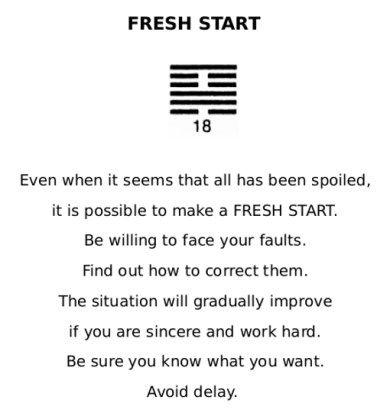
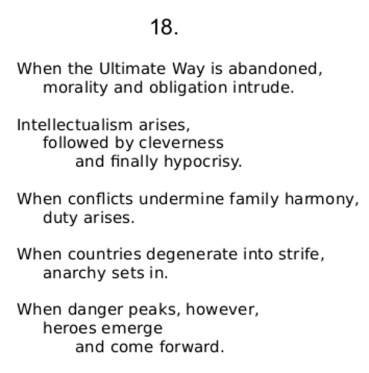
Interestingly, from the Taoist canon which Dr. Peterson greatly respects, Numbers 18 of both Lao Tze’s Tao Te Ching and its ancient great-great-grandfather, the I Ching, both speak the point in repeating cycles of time where – out of the ashes of corruption — new beginnings emerge. For it’s not only humans who crash and burn to be reborn, On larger scales of magnitude, entire communities and civilizations do as well.

Passage 18 from Two Sides of a Coin reads:

18

Hexagram 18 from The Common Sense Book of Change describes a positive approach to encroaching chaos:

18 IC FRESH START.jpg

Our collective future depends upon the quality of individual choices. Is it worth going through the testing fires of positive change to get from here to there? The choice is yours. But be aware. Failing to choose is also a choice, one with dire consequences. In any case, the time is NOW.

Jordan Peterson is doing his heroic best to tip the scales of history in favor of human survival. Clearly, he dearly hopes the young men he grieves for will choose wisely. As do I.

For those with ears, let them hear. And do.

Angel Calling


Coming next:

  • Yes, AND . . . .
  • The Heart Doesn’t Lie
  • Be an Instrument of Light


The Highway to Heaven Is a Two-Way Street

jacob's ladder

Balance yin and yang approaches to solving your problems. It gets better results.

Jordan B. Peterson gives a good example. Early in their marriage, when conflicts arose, he wanted to argue. His wife, however, would turn over and go to sleep. When she awoke, she reported insightful dreams which helped resolve their issues.

Dreams, as you’ll recall, are associated with the middle, Gatekeeper level of the Life Wheel which links the yang surface with inward, yin levels of intuition and conscience.

I’m well familiar with her problem-solving method, as well as how it compliments his.

Here’s an example from my graduate school experience. An Educational Administration professor wanted to know, “Why are there so few women principals in school administration?”

To me, the answer was intuitively obvious. Women teachers get no support. If they received support from family and school administrators, I told him, more would be promoted.

Two years later, after an extensive review of the research literature and a statistical study yielding 99 percent statistically significant results, these yang methods confirmed my yin intuition. My stats prof was amazed at the high probability correlations. Most of his students got garbage results. How did I manage to get significant ones, he wanted to know. And how did I explain the unusually high response rate?

Well. For one thing, because I already “knew” the answer, I knew where to look and what to ask. All I had to do was design a study that allowed the evidence to come forward. In addition, in the statistical portion of the questionnaire, I limited myself to the kinds of questions which statistics can measure. To obtain information about subjective values, I asked open-ended questions requiring written responses.

Finally, the form itself was non-threatening, attractively presented on light blue paper. I used plain language. I intentionally made the content intriguing —  even fun.

Now, for me, empirical methods are an unnecessarily complicated way to arrive at an answer. But we got to the same place, just the same.

The difference between these yin and yang approaches explains the particular value I have to offer in matters philosophical. My yin perspective compliments Dr. Peterson’s yang presentation.

We share in common a desire to understand human nature. In college, my question was, what educational discipline was the best route to answers. Psychology might have been the logical choice. But a discipline that categorizes using statistical methods (often based on rat and monkey research) left me cold.

B.F. Skinner’s presentation as a guest lecturer at Oberlin decided the issue. In his general presentation, he described toilet-training his daughter using music, so her associations would be pleasant. In the question and answer session that followed, a student asked, “What happens the first time she goes to a concert?”

No answer.

Skinner’s work has an important place, no doubt. But as teachings acquired later confirm, it focuses exclusively on behavior – a first chakra center issue. There had to be more! In addition to inhabiting physical bodies constrained within socially conditioned environments, humans have rational minds, hearts capable of empathy, creative aspirations, and, yes – souls.

So for my understanding of humans, I opted to major in comparative history rather than “science,” rounded out in equal parts by philosophy and comparative literature courses.

The places I looked for answers gave me different approaches to the devastating division between faith and empirical science. The Life Wheel described in The Key That Reconciles Science & Religion came both before and after the history course described below.

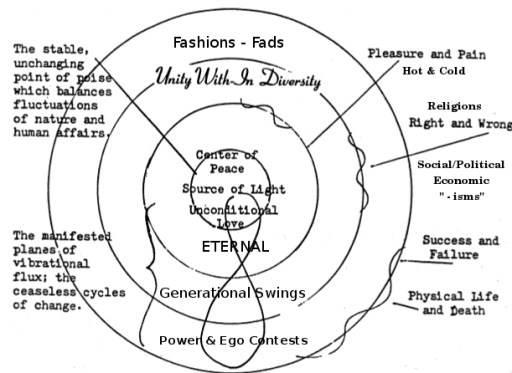
Critics have complained that its wheels-within-wheels geometry is “too abstract” and unaccessible. In thinking it through, however, I’ve concluded that the problem lies not with the concept. Rather, alienated yang intellects obscure the yin mind which intuitively grasps non-verbal truths.

From personal experience, I know that the Life Wheel is natural and intuitive. Going through puberty, I spontaneously started drawing wheels with multi-colored pencils. Without naming a reason or purpose for doing so, I filled notebooks with mandala-like geometric flowers circling outwards from a center, building layers upon layers.

childish

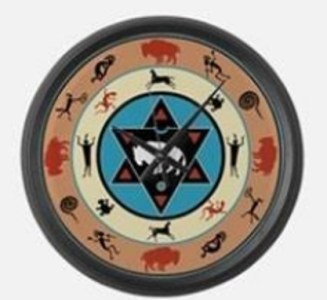
My step-father thought I was an artist. But it had nothing to do with professional calling. I was going through a natural change. My consciousness was blossoming, expressing itself in the non-verbal language common to native cultures from the beginnings of time. Native Americans draw prayer wheels.

Native American

Buddhists create intricate mandalas with colored sands.

buddhist

Medieval architects built radiantly multi-colored stained glass windows into their cathedrals.

Mandala1

Later, I felt compelled to return to the Life Wheel. As I applied left-brain reasoning to penetrate its meaning, it continued to develop, changing into a diagnostic and decision-making tool, a means of linguistic analysis, a zodiac-like measure of time, and more.

It’s not concentric circles that are too abstract. Quite the contrary, this primal way of understanding has been forgotten by isolated intellectuals out of touch with their universal roots.

In The Key that Reconciles Science & Religion, I showed how the Life Wheel reconciles the conflict which Nietzsche, later Jung and then Dr. Peterson, describe as devastating. I quoted Dr. Peterson, who assures us that “there’s much more to ‘reality’ than current assumptions allow.”

What follows is taken from an earlier post that draws on my history background. Snippet quotes are a spoiler alert intended to intrigue you into reading the rest.

closing

  • Professor McGill beamed his approval of the solution to the either/or conflict between science and religion. Historians, he said, call it “The Great Reconciliation.”

  • According to St. Aquinas, It works both ways. Observing the world leads to faith. Faith leads to effective behavior in the world.

  • As Albert Einstein put it, “Science without religion is lame, religion without science is blind.”

  • At the 11th hour of human history, few people have time to learn much less apply the lessons of history. For the sake of simplicity and immediately useful applications, The Great Debate’s outcome is pictured by the Positive Paradigm of Change in the form of a multi-dimensional Life Wheel.

  • Why have we forgotten this? Why do either/or controversies continue to rage as if the solution had never been articulated? Who perpetuates this unnecessary separation? Why? Who benefits? Who pays the terrible price?

book header bird

The GREAT RECONCILIATION

Like Romeo and Juliet, Abelard and Heloise are remembered in as tragic lovers separated by the slings and arrows of outrageous fortune.

Here are the highlights from medieval history. Abelard, a monk, was rich-girl Heloise’s tutor. He seduced her. Their affair outed when she became pregnant. Her uncle exacted poetic justice: the offending lover was attacked in the night and castrated. Afterwards, the lovers exchanged celebrated letters, but were never reunited.

The low lights are usually overlooked. In fact, Abelard married Heloise. But to protect his reputation as a cleric, kept it secret. He urged her to take monastic vows, which she did, but under protest. She felt no calling. For her, living a cloistered life was most unfair.

Why is this story is relevant to the ongoing discussion about the Rules of the Knowledge Game? Because Abelard later distinguished himself a participant in The Great Debate of the Middle Ages.

During my Freshman year at Oberlin College, Professor Barry McGill presented the debate with style and passion. Tall, pencil-thin, graying and bespectacled, he dramatized the effect of pendulum swings on history.

Ideas, he insisted, have great power. They alter the course of human events. In particular, philosophers’ beliefs profoundly affect the forms governments take and the way leaders treat their people.

Long before Hegel wrote about dialectics, which in turn influenced Marx. a triad of medieval scholars — St. Augustine, our sadly altered Abelard, and St. Aquinas — completed the classic example of contrasting beliefs about What Can Be Known, How, and By Whom (epistemology).

St. Augustine sat on one extreme of the philosophical see-saw. Abelard perched on the other. The intellectual world was at odds until St. Aquinas came up with the balancing fulcrum.

see saw

St. Augustine’s approach was faith-based. He depended exclusively on his belief in God. In his worldview, knowledge is the result of divine grace. His credo: “I believe that I may know.” Faith in God is prior and necessary to human endeavors.

In Life Wheel context, Augustine’s primary reality rested at the center of the Wheel and extended outwards from it to include the surface of the physical, manifested world.

Abelard took the opposite approach. Man, he held, depends on observable things and tangible experience to acquire knowledge. This approach, taken to the extreme, results in the exclusively superficial, materialistic paradigm of research science.

Importantly, however, Abelard never denied the existence of God. He held that experience of the world leads the thoughtful man to deduce the necessary existence of God. In Life Wheel context, he started at the Wheel’s surface and pushed inwards to complete the circuit.

It took St. Aquinas to complete the loop. He concluded there is no conflict between the other two approaches. Knowing is a two-way street. No matter where you start, each position leads to and completes the other, reconnecting heaven and earth, center with surface. Complete knowledge flows continuously along the path of an infinite loop.

According to St. Aquinas, it works both ways. Observing the world leads to faith. Faith leads to effective behavior in the world.

Professor McGill beamed his approval of the solution to the either/or conflict between science and religion. Historians, he said, call it “The Great Reconciliation.”

Why have we forgotten this? Why do either/or controversies continue to rage as if the solution had never been articulated?

Who perpetuates this unnecessary separation? Why? Who benefits? Who pays the terrible price?

CONCLUSION

Allow me to point out a relevant conclusion from the sad story of Abelard and Heloise. Today’s exclusively rational philosophers are as sterile as was he. And Heloise’s feminine counter-parts, isolated and cloistered, are equally unfulfilled. Just as yin and yang yearn for unity and the fulfillment of creative balance, so also faith and reason depend upon one another for completion.

As Albert Einstein put it, “Science without religion is lame, religion without science is blind.”

At the 11th hour of human history, few people have time to learn much less apply the lessons of history. For the sake of simplicity and immediately useful applications, The Great Debate’s outcome has been summed up in the Positive Paradigm of Change and illustrated in the form of its multi-dimensional Life Wheel.

Here’s why it is so critically important to reconnect the surface with the center of the Life Wheel in an infinite two-way loop, joining the material surface with its innermost source. The times in history when the rules of the knowledge game allowed creative thinkers to access both sides of the infinite, two-way street were times of renaissance that saw huge outpourings of invention, commerce, arts and learning.

The renaissance at the end of the middle ages, first in Italy and later in England represented by Elizabeth I’s Shakespeare, were times of paradigm shifts. The origin of universities took place during this time. The rules were in flux. It was fair game to access both sides of the coin, so to speak. There was no perceived conflict between faith and reason. Separation of church and state was a non-existent issue. The result was a time of creative flowering in both the arts and sciences.

Our future may well depend upon

whether or not there’s a similar Positive Paradigm shift now . . .

It will take a reconciliation and reawakening

to the full spectrum of human potentials

to generate a flourishing of creative problem-solving

sufficient to tip the scales of history

in favor of human survival.

Phoenix - sized

N.B. “Re-nasissance” = “rebirth.”

Phoenix rising from its own ashes. Got it? : )

Respect vs OPOs

Namaste1

Without a complete and accurate paradigm, one centered around the universal essence of existence which everyone everywhere shares in common, how can one respect oneself, much less others?

In Life Wheel context, essential respect rests at the center of the Wheel, ever the same, despite the fact that it is ruled out in dangerously incomplete and inaccurate belief systems.

Sadly, we train our young people to base their self-respect on other people’s opinions. Ah. The dreaded OPOs.

Why? Does your survival depend on them? Sometimes, yes. Most times, no. Do you let your self-respect go up and down with them? If so, life’s a rocky ride indeed. For OPOs are as fickle as any Hollywood fad.

Dependence on OPOs leads to this: mobs protesting in the streets, demanding respect while showing none for others. It’s oxy-moronic. A stupid contraction in terms. Look it up. Moron, meaning stupid, is actually part of the word’s Greek root.

Respect on what level, and for what? People unaware of their eternal soul define themselves in terms of their looks, or belongings, or social status. Or their feelings. But these are in continuous flux. They’re as changeable as the daily weather.

As for other people’s opinions. Most often they are a hodge-podge of assumptions, media-influenced “facts,” and mindlessly absorbed cultural conditioning. For the most part, they are myopically self-serving.

But the eternal soul? Ah. That’s something of substance one can depend on, in all weather, that never goes out of fashion.

Here’s a picture worth a thousand words:

Respect in the Center

It suggests that perhaps self-respect might well be based on achievement of consciously chosen goals, ones consistent with the welfare of all. Or living true to conscience, no matter what.

Respect for others on the surface level of results would depend on the same standard held for oneself – ability to choose and work consistently towards the achievement worthy goals.

The Book of Change describes the Self-Possession demonstrated by true leaders.

Great leaders demonstrate the SELF-POSSESSION to remain true to what they know is right despite all hardships. They act gently but fairly with others. Because they are consciously in harmony with the source of creative power, they express ideas brilliantly.

And another picture worth many words:

Namaste2

Essay 53 from Conscience weighs the balance in favor of inward-based and mutual respect:

Essay 53. RESPECT

Through the text runs a moral thread, which foreshadows the most noble ideals of Confucianism: A respect for the Natural Order, an esteem for self-cultivation, and a sense of social justice. — Kerson and Rosemary Huang, The I Ching

As long as companies think of employees as costs rather than assets, they will always be tempted to reduce the costs rather than invest further in the assets by providing safety nets for health care, retirement, and all the things that help people to get through their lives with dignity. — Autry & Mitchell, Real Power: Business Lessons from the Tao Te Ching

Our respect for ourselves determines (a) the amount of respect we crave from others and (b) our need to push for control and dominance. . . when you are in a situation when you feel disrespected, it causes a negative response [as if] the outside world, through your ego, is your only source of psychological support or nourishment. — David J. Lieberman, Make Peace with Anyone

THE FRONT

Roots of “respect” mean to look at, or look back on. Webster’s first definition is to feel or show honor or esteem for, to hold in high regard, or to treat with deference. It also means to show consideration for, to avoid intruding upon or interfering with, as to respect others’ privacy. It can mean a deference or dutiful regard, as in respect for the law. Respect is used to indicate courteous regard, as in respect for others’ feelings.

In the context of Affirmative Action objectives, respect refers to acceptance of diversity in public life, honoring each individual’s dignity and value, regardless of national origin, age, gender or personal beliefs. This implies more than an obligation to pay token lip service to legislation or an attitude of condescending tolerance. It supports the welcoming, embracing view that everyone has something of unique value to offer; that the whole is completed and enriched by contributions from every possible point of view.

In Native American, Buddhist and Hindu traditions alike, children are taught a reverence for all of life, extending not only to humans but nature as well. This includes creatures of the animal and insect kingdoms, as well as rivers and oceans, forests, mountains, deserts, jungles and even the air we breathe. Together they weave the fabric of life on earth, and evoke a commitment to maintaining the delicate balance of life-sustaining elements.

In corporate context, unfortunately, respect takes on the qualities of intimidation, fear of retribution, and enforced loyalty. In the context of inner city gang cultures, respect takes on intense meaning. The slang word “dis” means to disrespect. News stories tell of youth so outraged when strangers show disrespect that they kill for revenge. Their extreme desire for external show of personal respect changes to its extreme opposite, the ultimate show of disrespect for life.

Sages teach enduring respect for the timeless essence of all traditions, but do not hold onto particular forms of its expression after their usefulness has been outgrown. In Chinese history, the life span of successful dynasties was extended not by resisting change, but by embracing it.

When barbarians hordes assailed the empire’s gates, royal advisors, knowing that resistance was futile, recommended that the newcomers’ vitality be respectfully assimilated by mutually beneficial intermarriage of races and ideas.

When paradigms are in flux as new approaches are sought to answer new questions and meet new needs, messengers of change are often shot as if traitors by short-sighted, self-serving gatekeepers of the passing order.

This may impede progress, but cannot turn back the clock.

When the times are dangerous and the need for growth imperative, attempting to inhibit urgently necessary change is as dangerous to the civilization as is attempting to stop a mother’s labor pains once the birthing process has begun.

If, through our examples, we taught our children self-respect, self-awareness and a fearless respect for life, they’d experience no need to demand respect from others. Then disrespectful behavior would trigger not rage, but rather compassion and a commitment to uplift the ignorant and less fortunate.

THE BACK

Disrespect is the opposite of respect. Often it’s a product of sheer laziness and inattention. It can manifest as careless word choice or manner of dress. It’s reflected in failure to maintain one’s health, relationships, tools or property. This attitude is passed down through the generations and perpetuated by imitating bad examples.

The word respect is perverted when used in the context of Mafia-like extortion. It becomes a euphemism for submission due to extreme fear, the illusion of powerlessness and paralysis. Corrupt governments and organized crime rings which depend on passive acquiescence to stay in power are not respecters of life, nor do they receive of authentic respect.

The KEY That Reconciles Science & Religion

In Potential, a TEDxUofT presentation, Dr. Jordan B. Peterson pinpoints the historical cause of current mayhem: the rise of empirical science and its “shattering” effect on religious belief systems. As a result, our current definition of “reality” is dangerously skewed. He draws on Western poetry, psychology and the philosophy of religions “developed over thousands and thousands of years” to argue the case that there’s much more to “reality” than current assumptions allow:

If you follow the follow the thing that manifests to you as interesting, it will lead you through adversity, lead you to do things that are difficult [the hero’s journey] . . .

What will happen is that as you hit yourself against the world pursuing what you’re interested in, you’ll tap yourself into alignment. . . Your internal structure will become non-contradictory like the internal structure of a jewel, which is something that reflects light. It makes you hard and durable and able to bear the terrible conditions of existence without becoming corrupt.

He includes all the main elements of the Life Wheel. The “inner structure” consisting of conscience, light, strength, and unity of alignment – are all described in his linear description.

What I contribute to this vision is the picture of ever deepening concentric circles unified by an endlessly infinite loop that traverses and links them, center to surface and back to center.

In Scientists and Sages Can Agree on This, I describe the Wheel. It is not “new” nor is it arbitrary. It embodies the timeless healing solution to the relatively “modern” rift between materialist and philosophical definitions of “reality:”

The archetypal Life Wheel formulated as the Positive Paradigm of Change is a modern day descendant of the time-tested Book of Change which leaders in every field of endeavor have consulted for over eight-thousand years.

While true to the ancient teachings of India and China, it abstracts their essence in a simple and complete manner accessible to us today.

It places the three variables of Einstein’s famous formula, e = mc2 mass, energy and light, on increasingly deeper levels within the Life Wheel. The result is the Unified Theory which Einstein already had, though didn’t know it.

PPoC gold

The three outer levels are interrelated and interdependent. Each is necessary but not sufficient. Their existence depends upon the unchanging hub of the Wheel. The true SELF — also called Conscience, the Tao or God — holds the spokes together as events on the Wheel’s surface rim change continuously. Creation in the form of primal consciousness emanates from and returns to this silent alpha-omega center.

This wheels-within-wheels model

is equally compatible with modern physics, yoga philosophy

and the world’s great religions.

It is a reality map upon which scientists and sages can agree.

Complete and accurate, it meets the Occam’s Razor standard by explaining the totality of human experience with maximum inclusiveness and utmost simplicity.

In Rethinking Survival, I connected with the idea that the Life Wheel is the answer to the ancient Upanishad question: “What is that, knowing which, all else is known?” In essence, genuinely understood and implemented, it holds the KEY to Life.

The Positive Paradigm of Change can be personalized to facilitate positive personal change on all levels. Applied on increasingly larger scales of magnitude (to relationships, families, communities and organizations) it carries social implications in its wake.

According to Dr. Peterson:

Nietzsche said, “The person who has a Why can bear any How.” That’s a really useful thing to know. Because you think, well, we’re very vulnerable creatures. And our life ends catastrophically. Terrible things happen. How can we bear that?

The answer to that is, and always has been, that you have to be in synch with something that’s beyond you. Because that synchrony gives you the strength that you need to bear your terrible limitations.

The Life Wheel pictures the seat of Why and the place of How. It shows the eternal connection between individual, physically fragile life on the surface and the eternal Source within. However, the source of strength is not so much beyond as it is deep within:

The WHY at the center shines through every HOW, conforming WHAT on the surface to its inward vision:

  • Intuition fits within the WHY level of the Wheel. This innermost level of Light is associated with conscience, spiritual guidance and flashes of genius. Unless integrated with the ability to strategize and implement, however, vision and insights fail to manifest as practical results.
  • Emotions (including empathy) and strategy belong to the middle HOW level. The Energy layer is associated with action, street smarts and Emotional Intelligence. Magnetism and charisma emanate from this level, but unfortunately aren’t always integrated with integrity, intelligence or practical organizational skills.
  • Outcomes belong to the surface WHAT level associated with tangible, measurable results. The Mass layer is the realm of quantifiable IQ as well as biological family and social/political connections. Persona (mask) and personality are surface appearances. They don’t necessarily reflect actual motives and feelings. (This is why merely imitating the words and actions of great leaders doesn’t have the same affect).

Phoenix - sized

DYSFUNCTIONAL BELIEF SYSTEMS

Please stay with me. What follows isn’t necessarily sexy or fun. But it IS a matter of life or death. And the life it saves could be your own.

Technically, this subject comes under the philosophic umbrella of “epistemology” – the (highly politicized) rules of the knowledge game that prescribe who may know what, and how. Today, empirical science dictates that experience which is intangible and can’t be measured doesn’t exist – it isn’t real. In effect, conscience, intuition, compassion and gut feelings of the Life Wheel are ruled out. People who depend on those modes of knowing are invalidated and socially excluded.

Of course, saying inward modes of experience don’t (and shouldn’t) exist doesn’t make it true. As Carl Jung pointed out, repressing these intrinsic parts of the human psyche only has the effect of putting them outside of conscious awareness. Relegated to the “unconscious,” fragmented parts continue to operate out of reach, wreaking havoc on mental health, relationships and social systems.

Dr. Peterson is clear that our current course, driven by skewed belief systems, is fraught with dangers up to and including annihilation. In this, he echoes Albert Einstein, who, dreading the possibility of a nuclear holocaust, warned, “We shall require a substantially new manner of thinking if mankind is to survive.” Again, the Unified Theory and substantially improved (holistic) manner of thinking is hardly “new.” But it urgently needs to be restored to wide-spread, generally agreed-upon conscious awareness.

This urgency is underscored by Dr. Peterson’s point that competition between scientific and religious viewpoints resulted in large numbers of confused thinkers turning to substitutes for religion, especially to mass movements that are “erroneous in every way.”

Since the scientific age began, we’ve lived in a universe where the bottom strata of reality is considered to be something that’s dead like dirt. It’s matter. It’s objective. It’s external. There isn’t any element of it that lends reality to phenomena like meaning or purpose. That’s all been relegated to the subjective, and in some ways, to the illusory.

However, grave dangers flow from decisions and actions based on erroneous belief systems:

It really matters what you assume is most real, because you base the decisions you make that. You run the entire course of your life on those assumptions — whether you recognize it or not. And if you get the assumptions [basic axioms] wrong, or even if you leave them incomplete, you’re going to pay a big price for it.

Trade-offs have huge consequences:

The assumptions we use in our culture, although they’ve enabled us to develop a tremendously potent technology, are incomplete in ways that have cost us and that are extremely dangerous. . . A fair number of pathologies stem from assumptions of the systems they use to define reality.

Here is my visual representation of the hollow, incomplete reality brought about by empirical science. It rules out the middle and central inward levels of a complete and accurate belief system.

MaterialistAthest

And here is a representation of resulting pathologies. The levels are out of synch, fragmented and disjointed. In “The Second Coming,” the poet Yeats mourned, “the centre cannot hold.” In fact, it is the other way around. The eternal center is, was and will always remain steadfast. It is we who have distanced ourselves from truth, blinded ourself to awareness of the unchanging. At terrible cost.

Stress

CONCLUSION

In the right hands, championed by well-known truth-speakers like Jordan Peterson and by the legion of folks who have grown to know, respect and love him through his good work, the KEY concept offers the world a way out of madness, an alternative path to the current course that leads to destruction and hell.

The question remains, how many truly want a positive, healing reconciliation of science and religion? How many are closed and committed to the path of ultimate destruction?

The worst case scenario is that members of fragmenting, polarized, warring factions world-wide are content to remain “conveniently” blind and deaf. They salivate at the visceral excitement of conflict, not to mention the greedy side-benefit of violence – looting (think Nazis dispossessing the Jews, Stalin robbing Russia’s Orthodox Churches, and Chinese warlords filling their coffers from the spoils of Tibetan temples). Heedless of the ultimate consequences, all-too-many are committed to killing each other off in uncivil wars, reducing the structures of civilization to oblivion.

My best case scenario and remaining hope is that those with the foresight to prepare will prevail. May they stay safely under the radar as long as possible. May the Angel of Death pass over their dwellings. And may they also be ready to fight and WIN when the time calls for them to take a stand. For God will be with them as they were with the psalmist/healer King David in battle.

Angel Calling

Rethinking SACRIFICE

After listening to Jordan Peterson’s Youtube video, The Great Sacrifice: Abraham and Isaac, I thought to revisit the Essay on Sacrifice written in 2000 and later included in Conscience: Your Ultimate Personal Survival Guide.

My document search stopped at Essay 7 on Authority. Lo. Not coincidentally, I found a quote which puts the Abraham story in larger context. It helps make sense of my approach, which sheds a different but helpful light on biblical traditions:

Christ was one of the greatest mystics of all time. He knew everything that has been ever said in the Eastern traditions.

When Moses asked God, who are you? God said, I AM that I AM.

Christ in the Gospel of John says, “Before Abraham was, I AM.”

The very word Abraham comes from the Eastern word Brahman, which means the primordial being. . . So when you start looking, as paleo-linguistic anthropologists do, at the common roots of the various religions and traditions, you find that it’s all universal. Truth has to be universal. It can’t be your domain or my domain.

In a more popular vein, when I think of sacrifice, trading the lesser for the greater, the Lovin’ Spoonfuls’ tune, Did You Ever Have To Make Up Your Mind, starts humming in my mind:

Did you ever have to make up your mind,
Pick up on one and leave the other behind?
It’s not often easy and not often kind.
Did you ever have to make up your mind?

Did you ever have to finally decide?
Say yes to one and let the other one ride?
There’s so many changes and tears you must hide.
Did you ever have to finally decide?

This is the essence of the life or death choice offered us in Exodus: Choose Life. “Return unto me and I return unto you.” It emphasizes travel on the inward path from surface to center of the Life Wheel, releasing attachments to ephemeral possessions, limited opinions/identities, and outgrown lifestyles.

Looked at this way, sacrifice isn’t necessarily a negative or hurtful experience. It can be positive change: expansive, illuminating, and in the long-term, generative.

book header bird

Essay 33. SACRIFICE

A balanced relationship between the individual and the whole is achieved through service in the spirit of SACRIFICE. Changing selfishness to compassion and acts of kindness builds bridges of mutual trust. Unselfish giving benefits everyone involved, helping the community to overcome obstacles and dangers. Avoid twin dangers: selfishness and self-denial. — Patricia West, The Common Sense Book of Change

A significant part of the existential suffering of life is the suffering involved in constantly discerning — or choosing — what we are responsible for and what we are not responsible for and maintaining a healthy balance. — M. Scott Peck, The Road Less Traveled & Beyond

The pain of verbal abuse goes deep into the self and festers there. . . Verbal violence all too often goes unrecognized, except at a level that you cannot even understand yourself. You know you are suffering, and you vaguely know where the pain is coming from; but because the aggression is so well hidden, you are likely to blame yourself instead of the aggressor. – Suzette Haden Elgin, The Gentle Art of Verbal Self-Defense

THE FRONT

The root of sacrifice means to make sacred. Webster’s first definition is the act of offering the life of a person or animal or some object in propitiation of or homage to a deity. It is the act of giving up, destroying, permitting injury to, or forgoing something valued for the sake of something having a more pressing claim. It can mean selling or giving up of something of less than its supposed value.

The Old Testament story of Abraham and his son Isaac in the mountains of Moriah deserves careful consideration in regard to sacrifice.

  • It’s about willingness to trade attachment and human love for the sake of fidelity to a higher calling.

  • It’s about faith that surpasses understanding.

  • It’s about trading earthly desire to perpetuate one’s life through transmission of genes for the abundant certainty of eternal life.

Abraham was tested to prove his fidelity to the voice of inner conscience, no matter what. The parallel to the life of Jesus is direct. Christ was literally sacrificed, but, paradoxically, like Isaac, lived on, albeit on a higher level.

Pagan sacrifice of children and animals is irrelevant to the meaning of Abraham’s test. At issue is the difference between transcending pain for the sake of higher love versus selfishly destroying life using physical, verbal and/or psychological violence, to get what one wants here on earth.

This distinction is relevant to prosperity courses which flirt with spirituality, but in fact tamper with Natural Law. In the short term, harnessing aversion to pain and desire for pleasure to get what we want may work. But where’s the wisdom?

Pain and pleasure motivate animals. However, the purpose of I Ching disciplines is to overcome such instinctive reactions. Pavlovian dogs can be trained to react automatically to programmed stimulation.

Humans, however, have the unique ability to reason. By choosing to remain steadfast in commitment and true to higher calling, we realize the priceless opportunity to overcome and transcend reactive pendulum swings of nature — pain and pleasure, attraction and aversion – to fulfill our innermost, innate potentials.

In this way, following the example of Christ, who sacrificed mortal existence for eternal life, we too can change, shifting gears, raising our focus from the material surface of the Life Wheel, then from the deeper emotional level of what we want, to the central core of what IS. This, ultimately, is the purpose of mastering natural change, and the gift which a profound understanding of the I Ching has to offer.

Similarly, working with the meta-reality-map — the Life Wheel — helps articulate, focus and accelerate the self-actualization process. It is KEY to fully understanding the multiple dimensions and meanings of scriptural events.

Saving the Best

It’s important to remember, however, that fidelity to calling is the standard. Whether or not one physically lives or dies is irrelevant. Bodhisattvas, for example, are fully-attained beings who have completed their life lessons here, but choose to remain on Earth in order to serve.

We each contain the seed potentials of our most admired leaders.

If we each dig into our own depths and live the promise now by following their examples, then hope could not be extinguished by killing single individuals.

If one person of conscience stands alone, one bullet can demoralize a nation.

If conscience informs the entire community, when one leader is struck down, two, ten or a thousand more come forward to continue on.

This is the fruitfulness promised to descendants of Abraham.

THE BACK

The opposite of sacrifice is attachment. Refusing to let go of outgrown beliefs — resisting change or hanging on to people when it’s time to move on in order to grow — is antithetical to the life process. Making a show of suffering, imposing obligations and guilt on others for what they’ve been given is false martyrdom.

Slaughter of animals or innocents to atone for one’s own sins is a perversion of sacrifice. It violates the sanctity of life and free will of others. Each of us is accountable for our own actions. Therefore, taking life can’t change bad karma. Instead, it compounds trouble.

book header bird

Paradigms Are a Matter of Life or Death

Jordan B. Peterson, psychologist, truth-sayer and rock star of recent months, said that the most important work that can be done is establishing the relationship between belief systems and the outcomes they generate. I agree.

BECAUSE:

It doesn’t help to tell people to follow their dreams, to be the best they can be, or that nothing is impossible with the right attitude. When they live in societies that enforce limiting, false beliefs, they are (so to speak) paddling upstream in a leaky canoe without oars.

If you thinking you can wish on a star and get what you want, whenever you want it, with no concept of history, you’re in for a rude shock or two. Easy times are over.

If you think it’s possible to eliminate irrational hatreds and eradicate self-serving prejudice with logic and love alone, you’ll have as much success as a man pissing on a forest fire.

Here are (just a few) examples of disastrous results that flow from static, incomplete and incorrect paradigms:

People who live in the poverty of a flattened, empirical science belief system are being told, in effect, by their parents, educators and political leaders that they don’t (and shouldn’t) exist. That only their physical appearance, social status and material possessions matter. Wonder why suicide rates are so high? Or that respect for authority is at an all time low? Or that government corruption is rampant? Or that underworld violence is escalating over the top? (Surely you can add to the list.)

Deny inner emotional levels of the Life Wheel. Suffocate innate impulses to play and seek adventure. Ridicule innermost intimations of immorality and highest aspirations. Starve people of meaning and joy in the name of duty and obligations to serve the collective. That’s the sure recipe for destruction of highest magnitude. It begins one destroyed individual at a time. And ends with the collapse of whole civilizations.

The only way out of this madness is to restore a complete and accurate paradigm. Acknowledge the multi-dimensional quality of life – the inherent pattern of perfection – which is everyone’s inalienable birthright.

Further, the Life Wheel doubles as a time clock. You need to know not only who you are, but where you stand. The precise point in the cycles of history you’re in right now tells you the specific dangers and opportunities open to you NOW.

For example, the biblical stories which Dr. Peterson recommends as Maps of Meaning show repeating cycles of events. Which of these stories apply to us NOW? More specifically, which point in time within those stories is relevant?

Dr. Peterson is looking to Abraham right now, possibly because he was the progenitor of three major religions currently engaged in mutual self-destruction.

But I’m more interested in King David, who, like Christ, was born in Bethlehem, and who as a young shepherd was anointed by the prophet Samuel to be future king. The point in time that’s appropriate to us now, I think, is the confrontation between the boy David and the giant Goliath. Today, this might represent individuals of good will in the face of impending totalitarian global government.

What’s important here is that David exemplifies acting from a complete and accurate paradigm. He acted fearlessly on the belief that “God is with me.” With a single shot to the center of the giant’s forehead (not coincidentally seat of the third eye), he brought the monster down.

David trusted that he was not alone. He “knew” exactly where to aim. His vision was clearly focused on his target (light). He had the vigor (energy) and physical strength (mass) as well as coordination (unity) to overcome the fearsome obstacle that threatened to annihilate him and enslave his people.

There are other biblical figures who at critical points in their cyclical (hero’s journey) experience, are being picked up upon as useful role models. One is Noah anticipating the flood. Another is Joseph at the time he foresaw and was allowed to prepare for times of famine.

There’s Moses at the critical time when the Angel of Death upon the Land of Egypt passed over the homes of the faithful.

And then there’s Job, the model of faith enduring to the end and being restored, even better than before. The phoenix image.

Here’s the secret to be gleaned from this story, illumined by the infinity symbol that links the levels of the Life Wheel. Job says, “The Lord giventh.” This is the outward, materializing movement from center to surface of the Wheel. “And The Lord taketh away.” This is the receding path of return to center. In all, “Blessed be the NAME of the Lord.” The Logos. Think Indy Jones in the Grail movie, the Last Crusade. The receding steps leading to treasure are marked with the Hebrew letters that spell out the Name of God. The creative Name. Remember his “Leap of Faith.”

Also remember that he’s not the only one seeking the Grail . . . power-hungry Nazis are close on his heels, seeking immortality not for love of human/divine fathers, but for the fatherland.

Phoenix - sized

The 11th hour we’re now approaching was foreseen in 1998. I continue to write in this mode, most currently in As Conflict Escalates, What Can Be Done Now? Here is summary and conclusion:

In the past, monasteries arose as islands of hospitality, learning and civility during Europe and Asia’s so-called dark ages. Once again, as another dark age looms on the horizon, intentional communities dedicated to preserving the essential teachings will naturally arise. My best hope is that future leaders will meet the responsibility of shaping hopeful new beginnings; that they will succeed in transmitting the wisdom of the ancients to future generations along side the complimentary technical know-how of today’s sciences.

In the Positive Paradigm reality map, future educators have a versatile self-awareness tool with which to teach the basics of leading an integrated, self-responsible life. Building on the seven basic axioms which flow from it, tomorrow’s leaders have a viable model upon which to structure healthy social organizations.

Conclusion

Resolving conflict necessarily occurs one person at a time, and from the inside out. For this reason, however complex and overwhelming world problems may seem, we each have the option and responsibility to improve that which is closest to home: ourselves. By reducing internal conflict within, each of us has the potential, if only in modest ways, to reduce the conflict without. . . .

Angel Calling

Virtue – Rewards and Punishments

On a personal note, I’ll confess that the following was written because of an early morning dream. The previous night, being overwhelmed by the illusion of futility, I’d decided not to write further unless invited, and with a promise of financial reward attached.

But the dreaming mind knows better. I can’t recall how the dream started. What I do remember was sitting in a large convention hall at a dinner hosted by a football coach. He was chastising (in absentia) ticket holders who hadn’t shown up. And he was honoring fans who had. He rewarded the most loyal ones with lifetime game tickets. The middling ones received the current season’s tickets only.

Exactly how this followed, I cannot tell you. But I knew I had to keep writing, and that a blog on Virtue was what needed to be thought through and posted.

Phoenix - sized

In rethinking the recent blog on ethics, I connected several dots for the first time. I’ll also connect what I’ve written on Virtue to Dr. Jordan Peterson’s most excellent videos on the subject. Spoiler alert: we agree in substance entirely. My particular contribution is the multi-dimensional Life Wheel geometry. It adds depth and dimension — a new perspective — to the mix. In addition, I look to the energy concepts embedded in Traditional Chinese Medicine (TCM) for a more comprehensive take on Virtue.

But, Dr. Peterson first.

In Why be Virtuous, he says:

If you’re going to rely on your sense of meaning, make sure that you don’t pollute the mechanism. . . . try not to utter falsehoods, because you warp your neurological structure by doing so. . . it will read out pathologically. . . if you rely on it to guide you, it will run you right off a cliff. So that’s why there’s a moral element to this.

. . . Why be virtuous? That’s the question. It’s so that you can bear the suffering of life without becoming corrupt [forgetting, becoming disconnected, dissociated from the core center of who you truly are] . . . it’s practical. There’s nothing more practical than that. Unless you want misery . . .

Listening really closely to Dr. Jordan Peterson on the Necessity of Virtue helped me recognize that in fact, he is fully aware of and gives us all the elements of the Life Wheel. It’s as if he as a “natural,” intuitively aware of the Wheel’s existence. But he zips right passed it, like Einstein and his famous equation, not knowing what he has been given.

With emphasis to underscore the correlation with the Wheel, he says:

Virtue, ethics, morality isn’t a field of study. It’s a mode of being upon which all fields of study rest. It’s also a mode of being upon which all everything you do in your life rests. . . And more deeply than that, what role it is that you play in your life in the world.

. . . To the degree that they [clinical clients] are embedded in a network of relationships where virtue is fundamentally absent, they’re tortured and tormented and they’re unable to find firm ground.

. . . Modern people are fundamentally materialistic. There’s some utility in that. We’re masters of material transformation. And the fact that we’re materialistic in our scientific philosophies has made us extremely powerful – maybe too powerful for our morality – extremely powerful from a technological perspective. But it has blinded us to certain things.

I think one of the things that it has really blinded us to is the nature of our own being. 2:32 because we make the assumption that the fundamental constituent elements of reality are material. We fail to notice that the fundamental constituent elements of our own reality are NOT material [outer surface rim of the Life Wheel]. They”re emotional [energy level]. They’re motivational [light and conscience levels]. They’re dreams. They’re visions. They’re relationships with other people. They’re dependent on consciousness – and Self-consciousness. And we have no materialist explanation whatsoever either for consciousness or Self-consciousness. And we don’t deal well from a materialistic perspective with the qualities of being.

Phoenix - sized

Now me.

First, as an aside, here is a personal example of how life experience has prepared me step-by-step for the unforeseeable future. I started as a musician, training my hands and building keyboard skills. This translated into typing faster than a speeding bullet, which made it possible to pay the bills as a legal secretary. In that job, I learned transcription, which later served me well as a graduate student taking ethnology courses. During that time, I learned that recording interviews not only freed me from having to take notes, the better to give the subject my full attention. Transcribing afterwards gave me the humble awareness that – of what I thought I had heard — I’d consciously registered at best a small fraction of what had been spoken.

The payoff even further down the pike is that now, when I listen to youtube videos dense in spoken content, I know to transcribe them word-for-word, the better to really “hear” all that has been spoken.

A second important aside – an inversion of the Crime and Punishment theme. While full-spectrum virtue has its intrinsic rewards, in corrupted civilizations, virtue sometimes has short-term punishments. Socrates’ death, described by Plato, is an example. Described in Essay 2 on Death:

Fear is the natural outcome of limited materialistic beliefs equating the end of physical life with total extinction. Those who experience the True Self as immortal and indestructible are not plagued by fear of mortality. No doubt the courage and solace which sustained Socrates as he calmly accepted his death sentence — not as an escape, but an affirmation of principle — came from the depth of his soul awareness.

Now then, to the point: the complete and accurate paradigm embodied in the Life Wheel makes it possible to distinguish the differences between morality, ethics and virtue.

This is one reason why restoring a complete and accurate paradigm to common understanding is a matter of human survival. For without agreement upon a complete and correct paradigm, a community of shared, effective communication is not possible. (Who would actively promote this negative/destructive outcome, and why? Who stands to benefit?)

Conversely, there is no place for genuine Virtue in a hollowed out, atheist world view. Its origins and home have been ruled out.

Phoenix - sized

In the complete and correct paradigm, Christ shines forth from the eternal center of the Life Wheel. His light illumines the middle level, which filters light into the full spectrum of natural virtues. Virtues, including kindness, gentleness and courage, reflect inner light. They are hardwired at the energy center, woven into human DNA.

Dr. Peterson says the significance of Christ’s being a carpenter is that he had to do good work – build houses that stay standing. Agreed. In addition, however, historically a “carpenter” is “joiner,” meaning one who connects all the pieces together – one who has the ability to unify separate parts into a single, coherent whole. The Life Wheel which links center to surface in an infinite loop represents this reality.

In this context, morality is a socially useful code of conduct located on the surface rim of the Wheel. Genuine virtue, like the Law of Karma, is an energy concept located in the fatally forgotten middle level of the Life Wheel. As described earlier, this level serves as the necessary two-way Gate-Keeper between the eternal center and its manifest world.

Morality has a virtue component, but with add-ons. It can reflects Divine Law. An example of this is the Ten Commandments handed down from God on Mount Sinai to Moses. On the other, it sometimes, though not always, is reflected in Human Laws. Warrior codes of conduct are one example. Others include religious sanctions and secular legislation which dictates moral behavior. Outcomes are inconsistent at best.

Whereas ethics are strictly intellectual, moral courage blends mental commitment to a code of conduct with the virtue of fiery conviction.

Phoenix - sized


Here is an essay that expands on what I mean:

Essay 54. VIRTUE

In the West, virtue suggests righteousness, but in fact Te is a term that refers to the potential energy that comes from being in the right place and in the right frame of mind at the right time. — R.L. Wing, The Tao of Power

The last thing to say about strategy is that it exploits opportunity, the right moment. Greek theologians called it Kairos, the point when the new is received. . . Ask: “Is this something that fits our strengths? Can we develop the service that satisfies?” Then comes the third element, the right moment to seize the opportunity by the forelock, to run with success. — Peter F. Drucker, Managing the Non-Profit Organization

The destiny of mankind is not decided by material computation. When great causes are on the move in the world. . . we learn we are spirits, not animals, and that something is going on in space and time, and beyond space and time, which, whether we like it or not, spells duty. — Sir Winston Churchill, Radio broadcast to America

THE FRONT

Definitions of virtue are mixed and confusing. Ancient derivations suggest goodness or power. Latin roots imply manliness or worth. Webster’s definitions refer to moral excellence, right action and thinking. In a woman, virtue is said to imply chastity. In a man, it implies effectiveness or force. It can also mean the power to heal or strengthen.

In ancient Asian traditions, virtue is used as an umbrella term. Healing sciences correlate the healthy functioning of each internal organ with a specific virtue, while weakened energy centers generate negative emotions.

For example, heart energy produces either the experience of love or expressions of cruelty. Kidney energy manifests as either gentleness or fear. Liver energy has the potential for either kindness or anger. Lung energy produces confidence or grief. Spleen energy manifests alternatively as openness or anxiety. Combined positive energies blended together create a transcendent virtue called compassion. In Western traditions, this compassion is called charity.

Though in medical schools it remains a little know fact, oriental and occidental healing traditions have common origins. The caduceus, the familiar symbol of the modern medical profession, has its origins in Greek mythology, which in turn extends back to Himalayan traditions, and still further to ancient Egypt. In Greek mythology, the caduceus is the healing staff of the messenger god, Mercury. In yoga traditions, this symbol represents energy anatomy.

Caduceus.jpg

As a shorthand logo, the staff represents the spine. Twin snakes encircling the axis represent alternating positive and negative energy currents. Intersecting points where cyclic energy forces meet at the axis are the major centers of transformation, chakras. Wings sprouting from the bija point at the top of the axis represent the ajna center, known as the “third eye.”

I Ching traditions describe virtue as the competence acquired by coordinating and balancing the yin-yang functions and concerns associated with each subtle energy center, then harnessing these energies to serve consistent, positive ends. It is not gender-specific.

Confucius compared virtue to an oriel. He observed this bird as being perfectly in harmony with nature: precisely accurate in the timing of its flight, poised upon well-chosen landing, and sweet in its song. Who, he asked, could hope to be more virtuous than this winged messenger?

Such virtue is radically different from arbitrary moral codes specific to a particular time and place. Sometimes an elite class imposes morality upon presumed inferiors in order to exploit them. Often, the unspoken maxim is, “Do what I say, not what I do.”

Rich corporate owners, for example, expect their workers to be hard-working, law-abiding and honest. For the most part, however, they themselves act as if above the law. Compliant workers though moral, aren’t necessarily virtuous.

Soldiers follow orders, mindlessly destroying life and property for the sake of pay. Warriors uphold the codes of their particular tribe or clan. Heroes act from love to protect life. Great leaders like Lincoln, Churchill and most recently Giuliani, however, shed light on the human condition during history’s darkest hours and times of greatest need. They exemplify innate virtue — the courage which leaders of all cultures share in common.

THE BACK

Vice is the opposite of virtue, while sin is the opposite of morality. Villains are those who abuse energy potentials to destructive ends. Chief among the vices is pride, taking natural gifts for granted, forgetting their universal Source. Another is deception, pretending to have virtues one lacks in order to get respect and compliance from others.

Indifference, apathy and paralysis are perversions of virtue. Stagnations in the human body and body politic reduce an organism’s vitality and capacity for positive action. Macho moral codes which assume virtue is exclusively gender-related become self-fulfilling prophecies — IF women and men are fooled into accepting them.

Practical Ethics

After outlining an article on ethics, which Stefan Molyneux passionately, intuitively reasons is the necessary foundation of civilization, I did my homework. Come to find out, he went rounds on the subject with an atheist critic.

Unfortunately, for lack of the holistic Life Wheel framework which encompasses the full range of logic complimented by and reinforced with gut feeling and inner knowing, Stefan was hard put to defend his “feelings” from his ruthlessly, exclusively logical (but dead wrong) antagonist.

As shown elsewhere, the “hollow,” exclusively materialist-atheist belief system rules out the levels at which “gut feeling” and intuition reside.

MaterialistAthest

An updated version of the complete Wheel shown earlier puts ideology -isms in their limited place: on the surface, material rim, far removed from the vital energy level of gut feelings, even further detached from the core from which wisdom flows.

expanded wheel

What is fundamentally (fatally) missing from logician’s concept of ethics, however, is the dynamic action of karma. The Law of Karma is a fact of life which can’t be argued, but rather is known through direct  experience by those who pay attention. It’s axiomatic.

Though there’s more to the subject, which I’ll bring up below, for starters, here is an excerpt to the point from The Handbook:

AXIOM FOUR

Consequences of Actions Are Inevitable; Those Who Respect the Law of Karma Succeed.

Axiom Four is the practical foundation of ethics. Were it taught earlier in schools both public and private as the survival basic which it is, today’s world would be very different indeed.

For in an exclusively materialist, linear worldview, it seems possible to “get away with murder.” Unethical leaders mistakenly continue to act on the false premise that they can avoid the consequences of their actions by hiding selfish motives and evil deeds behind a mask of false appearances.

But ultimately, they deceive no one but themselves. (Remember the fate of ponzi racketeer Bernie Madoff and his two tragically unfortunate sons?)

Oscar Wilde’s Picture of Dorian Gray dramatizes the horrific consequences of hiding hideous deeds behind an unnatural mask of eternal youth and physical beauty. Just as Dorian comes to an awful end, in the circular and richly textured fabric of the Positive Paradigm worldview, attempts at evasion and deception are ultimately futile. The concept of a “perfect crime” is an oxymoron. . . .

The Old Testament describes the karmic law of return in agricultural terms. “As ye sow, so shall ye reap” and “For everything there is a season. . . ” In modern parlance, the saying that underscores the circular dynamic of poetic justice is, “What goes around comes around.”

. . . a popular riddle asks, “Why do con artists do shabby work, charge unreasonably high prices, and get away with murder?” The cynical answer: “Because they can.” However, this cynical half-truth tells only part of the story.

They can, because there’s Free Will. They can, because they’re ignorant, or else incredibly stupid. Choices have (all too often unforeseen) consequences.

Whether one believes in God or not, whether one respects Natural Law or chooses to be blind to it, these consequences are the same. In modern parlance, “Do the Crime. Do the time.” Or, as it’s also said, “Pay back is a bitch.”

Punishment for unrepentant wrong-doing can take many forms. The consequences of breaking human laws include fines, jail-time, and in the extreme, death.

But on a deeper level, over time, retribution for violating Natural Law is visited in many forms, from mental or physical disease, to personal, professional or financial misfortune.

Consequences of misdeeds often return on the psychological level. Carl Jung, the Swiss analyst who popularized the concept of archetypes, also wrote the introduction to the Wilhelm/Baynes version of the I Ching. He noted the unintended kickback from rejecting the basic axioms of religion and natural law with mere reason. There are consequences not only for decision-makers, but also those they influence.

In sum, Jung noted that modern thinkers have made a fatal mistake. The facts of inner life can’t be driven out of existence by arbitrarily banishing them from the decision-making equation. Saying God doesn’t exist doesn’t make it so. It just leaves the unbeliever at the disadvantage of being cut off from the center.

According to Jung, denying the facts of inner life has the effect of burying rejected aspects of the whole in the “unconscious,” where they continue to reap havoc on our daily lives. Politicians and journalists under the influence of unacknowledged emotional demons “unwittingly let loose psychic epidemics on the world.”

Phoenix - sized

Here is a picture of the Law of Karma (a practical function of Natural Law). It resides at the middle, energy level of the Life Wheel associated chi, prana and emotions. Beliefs (at best, emanating from conscience – the domain of Divine Law – and experienced as intuition) trigger emotions. In turn, beliefs fueled by passionate feeling drive actions which produce results of the surface level — the domain of Human Law:


Law of Karma

Phoenix - sized

The “more” to the issue of ethics suggested above is this. Because karmic return emanates from the energy level, functional ethics necessarily has a DYNAMIC component. What’s right depends to some extent on the specifics of time, place, person and historical context.

For example, while the motive – compassion – remains constant, the correct actions taken to express this motive change with the situation. Working in a day care environment with an unruly child who doesn’t know better will require different methods of correction than would dealing with a raging psychopath who intends someone you dearly love violent, deadly harm.

For this reason, the best leaders, and the most successful people in every area of life, are the ones who are most self-aware, the ones competent to link the unchanging innermost level of Motive with the fluctuating levels of strategic Purpose and practical Intent. (Hence the admonition,”Get your act  together!”)

Conversely, those who shun self-awareness, ignore the call of Conscience and go after what they want — others be damned — are a danger to themselves and others. In any case, while the Free Will to choose remains constant at the center, the unavoidable consequences implicit in the bargain will return in kind — it’s a package deal.

So here follows an Essay on Consequences:

Phoenix - sized

Essay 43. CONSEQUENCES

Unlike any kind of fortune-telling, prophecy, or magic, the I Ching does not tell the future, it can only analyze the present. Its use does not allow one to make forecasts, only diagnoses. If there were a comparison possible with a Western equivalent, it would not be to the crystal ball but to a chess playing computer program that analyzes the current situation in order to choose one of a number of options. — Cyrille Javary, Understanding the I Ching.

Quantum mechanics is a procedure. It is a specific way of looking at a specific part of reality. The only people who use it are physicists. The advantage of following the procedure of quantum mechanics is that it allows us to predict the probabilities of certain results . . .– Gary Zukav, The Dancing Wu Li Masters: An Overview of the New Physics

One of the principles of modern physics which has contributed heavily to current organizational theory states that matter is nothing but relationships. That’s the glue of an organization — relationships. Without honesty, there is no trust, and consequently, very weak relationships. — Alan Downs, Seven Miracles of Management

THE FRONT

The literal meaning of the root word is “to follow after.” Webster’s first definition of consequence is a result of an action or process, an outcome or effect. Second, it’s a logical result or conclusion, an inference. Third, it’s the relationship of cause and effect. Last, it’s defined as importance or influence, as in a high-ranking person of consequence.

Board games like chess challenge the intellect to think in terms of strategy. High ranking players, white and black, oppose each other. Contestants maneuver their pieces, the object being to take over the field. Pieces of different consequence are ranked by medieval social status as kings, queens, and bishops, down to lowly pawns.

Each has a proportional range of motion, pawns having the least. But, with persistence, pawns can traverse the field and change rank, becoming powerful players in the end.

The United States was founded in reaction to European governments that violated Natural Law, subordinating merit to class interests and siphoning the resources of workers to fill the coffers of a privileged few.

In contrast, the ideal of the original American dream honored the natural law of cause and effect. Every person was free to advance according to merit. Each was entitled to receive just compensation for honest work. All were entitled to protection of individual civil rights under the law.

Throughout history, there’s been a push/pull tension between those who respect the biblical maxim, “As ye sow, so shall ye reap,” and those who would make themselves exempt from the law. In nature, there are times of plenty and times of want, times of success and times of defeat.

Some, however, ignorantly try to short-circuit the process, by-passing the hard times that teach us humility, abusing human law to short-sighted, personal and political ends. They’d rather, by cheating natural laws, be ceaselessly, excessively prosperous, at the expense of others who suffer in perpetual want.

Rather than engage in the give-and-take process on the chess-board of life, where the light and dark, yang and yin, alternate in orderly succession, such people would fold the board, refuse to play, and withdraw from the life process. But even the attempt to evade natural consequences has consequences.

The I Ching, like the game of chess, is a miniature of the human psyche and of community relationships. Like playing three-tiered chess, working with the I Ching not only engages the intellect, but cultivates a keen sense of the hidden forces, deeply irrational and sometimes sublime, which drive and even occasionally inspire the players.

These disciplines teach us to make our choices in terms of cause and effect, mindful of long-term implications. They help us to overcome daily challenges with wisdom and grace, and prepare us to survive and prevail when confronted by opponents who would wipe us off the board.

The title Dancing Wu Li Masters refers to the Chinese word for “physics,” translated as “Patterns of Organic Energy.” Sadly, the logical connection to the I Ching wasn’t made. The Positive Paradigm of Change derived from I Ching — consistent with Einstein’s physics — holds the key to fundamental life questions which continue to elude physicists, social and medical scientists alike. Whether or not we follow through has dire consequences for future survival.

THE BACK

The opposite of consequence would be inconsequential, having no meaning or importance. However, the Chinese saying goes that even one small grain of rice can tip the scales one way or the other. Logically, if there is no action, there would be no consequences. But consequences also follow from failing to take action.

Perversions of consequences include attempts to break the cause-effect connection, either to act without paying the price or to collect unearned rewards. Out of laziness, fear or greed, wrong-doers attempt to cheat life, change the course of events by unnatural means. In the long-term, it never works as intended. Instead, violating Natural Law sets chain reactions in motion that explode when events reach critical mass.

Angel Calling

The Gate Keeper

Responding to a conversation between Jordan Peterson and Stefan Molyneux, Sorting Yourself Out, I wrote:

Practical tools I’ve acquired and developed could well serve to fortify your intellectual arsenals in the ongoing media battle for the hearts and minds of the general public.

. . . my work identifies an overlooked but fatal blind-spot in Western thinking. (I will elaborate on this at length in a post to be called “The Gate Keeper.”) Suffice it to say here that unless/until we restore a complete and correct paradigm to common understanding, the downward spiral of history will continue on its course unchecked.

This, then is The Gate Keeper post.

Phoenix - sized

The middle level of the Life Wheel is the missing piece of the knowledge puzzle, lacking which one cannot get from here (daily experience) to there (inner peace and truth).

Here is the description of the e = energy level of the Life Wheel from The Handbook:

e  =  Energy

Much ignorance, misinformation and confusion surrounds the energy level of the Positive Paradigm. The state of chaos into which the world has degenerated attests to this deficiency, as well as the urgent need to correct it. Only the basics are described here, suggestive of further exploration.

The middle level is the domain of Natural Law, whose dynamics are mapped in the Chinese I Ching, the Book of Change. This body of knowledge has evolved over eight-thousand years as sages continue to observe the operations of energy and document the repetitive patterns of change.

Natural Law maps the energetic underpinnings of the dynamic, physical world. It is experienced as the patterned recurring cycles of seasonal change, and is equally applicable to humans and their cyclical life changes: birth, growth, decay and death.

The middle layer is the realm of less tangible but still measurable states of energy, including electricity. More subtly, it is the chi, ki or prana described by Chinese, Japanese and Indian traditions as the life force which animates all living beings. In Greek and Christian contexts it correlates with the breath, the psyche.

These subtle energies influence internal psychological states and drive external human behavior, which in turn affects social relationships. Knowledge of these dynamics is essential to personal survival.

Effective leadership and the quality of life within organizations hinge on the quality of awareness brought to dynamics at this level. While some leaders understand the dynamics of change at a gut level as a matter of common sense, systematic logic and deliberate understanding would significantly improve the results of the decision-making process.

Those denied access to material and social resources are often forced inside. Of necessity, turning inward, they develop and depend for survival upon strengths drawn from the middle and center of the Life Wheel.

At times, material deprivation and hardships yield the opposite and equal blessings of in-sight and emotional fortitude. At other times, however, excessive investment at the middle level results in delusions, latent with the potential for erupting into violence.

In any case, making a virtue of necessity by rejecting the material world prevents completion of the pattern. It can’t correctly be equated with spirituality.

Cultures which enforce an exclusively materialistic worldview and deny the experience of everything not tangible and measurable place severe hardships on those whose inner lives are especially active. The Handbook gives ample opportunities to diagnose such imbalances, the better to remedy them.

Societies which deny their citizens practical outlets for articulating and harnessing inner energies creatively can literally drive people crazy, to murder and suicide, or at best, underground. Many “sensitives” survive by channeling socially banned, unacceptable awareness and longing for self-fulfilling adventure into the arts: music and literature, including romance, murder mysteries and science fiction. (Substance abuse and food addictions are also turned to for escape, as are violent video games.)

This is a great loss to society. The world would be better off if high-energy, creative individuals were identified as potential leaders, trained and given employment options accordingly.

Phoenix - sized

Awareness of the middle energy level equated with emotions has recently been brought back into fashion in the guise of “emotional intelligence.” But why has the middle, Gate Keeper level for so long been relegated to the realms of the taboo and banned from conscious awareness?

Certainly laziness is one problem. Cleaning out one’s personal emotional swamp can be very hard work.

Furthermore, untamed and unharnessed, it can be very dangerous. When polluted, the middle energy level  houses the inner demons of terrifying, repressed memories. It is the storehouse of our socially unacceptable worst fears and imaginings.

This leads to a fateful fear of self-awareness. For there are times when one shouldn’t believe or follow one’s inner voices. Disciplined, discriminating thinkers (in the pristine meaning of the word) know that not all of them emanate from the Source of truth and light:

. . . the Positive Paradigm also accounts for the actions of destructive and evil people throughout history which give Page pause. Despite claims to the contrary, such actions are not the result listening to the inner voice of conscience. Evil actions are the mark of unbalanced extremists who have been misled into following the seductive voices lodged within the middle, sub-rational level of the Wheel.

Destructive leaders are heeding not the innermost voice of Conscience, but the clamor of the Seven Deadly Sin-Demons — starting with Pride, followed by (and often in combination with) Anger, Avarice, Gluttony, Lust, Envy and Sloth. Modern day demon off-spring include Separatism, Exclusiveness, Arrogance, and Self-Serving Competition.

What’s dangerously missing from the prevailing, exclusively materialistic paradigm of empirical science — a glaring gap which the Positive Paradigm of Change fills — is a universally acceptable reality map which includes the sub-rational middle level with all its dangers, but in its complete and correct context: contained by the super-rational level of intuition on one side and by the rational level of practical experience on the other.

Phoenix - sized

An important reason why the middle level has gotten such a bad rep and is rejected by religionists is that, taken out of context, it becomes the stuff of nature worship, paganism and worse. As guest of an extended family of Frank Lloyd Wright apprentices in Spring Green, I heard their stories of how romanticizing nature while rejecting its Source can end in murder, mayhem and untold miseries.

This is why in The Handbook, Axiom One emphasizes the importance of living according to a complete and accurate paradigm. The shadow side, the caveat, warns of the risks which follow from distorting that paradigm:

AXIOM ONE

A complete and correct paradigm is the key to personal well-being and success.

The empirical, measurable physical world of tangible objects and daily experience has its origin and end at the creative center of the Life Wheel. The unseen drives the seen. The invisible precedes the visible. Inspiration precedes actions which in turn produce results.

Therefore, the quality of daily life depends on the quality of belief systems. If the paradigm held is complete and accurate, it leads to consistent action that yields successful, beneficial results. When paradigms are incomplete and inaccurate, however, they generate inconsistent actions which lead to failure, pain and suffering.

Phoenix - sized

ADDENDUM

The Life Wheel model formulated as the Positive Paradigm of Change is NOT an arbitrary mental confabulation, as are the highly toxic, relatively modern ideological -isms: Marxism, Communism, Socialism and the like. The consequences of fractured, dissociated ideologies begin with personal fragmentation but have the potential to escalate into genocide. The fractured Life Wheel looks something like this:

World gone mad

Significantly, the root of the word “sin” comes from an archery term meaning “to miss the mark.” If the center of the Life Wheel represents the ultimate goal of enlightenment, than any belief system which rules out that center, or attempts to subordinate its power to personal agendas, misses the mark indeed.

The complete and accurate paradigm (belief system) embodied in the target-like concentric circles of the Life Wheel is simply a fact of life, known and taught by the ancients for thousands of years. (Violate it at your own risk.)

It’s no coincidence that yogis describe inner experience in images that evoke the Life Wheel. They speak of increasingly deeper layers as “sheathes” and the process of getting to the core as “peeling away the layers of an onion.” Nor is it coincidental that the word “yoga,” which means union, refers to linking and prioritizing the levels of the Life Wheel so that all are present, balanced and operate harmoniously.

But, of course, arrogant academics will ask, “Where is the proof?”

The yogi’s answer: “In direct experience!”

This is the accomplished meditator’s answer to the skeptical agnostic and antagonistic atheist’s challenge: “The bad news is, it’s like trying to explain what colors look like to a blind person, or how chocolate tastes to someone who’s never had any.

The good news, however, is that inner truth can be known by direct experience. And there are means and methods for getting from here to there.”

Were you to ask a Zen master how to achieve enlightenment, the simple answer you’d probably get is: “SHUT UP!”

In gentler form, the Yoga Sutras of Patajani offers the same solution.

The yogic process involves going step-by-systematic-step deeper into the Life Wheel. The preliminary stage is to heal and strengthen the physical body which correlates with the material surface of the Wheel. This is called Hatha Yoga. Here, the object of physical exercise is not to make oneself attractive to potential mates, but rather to stabilize the physical body so that distractions of pain and disease are eliminated and the body is sufficiently stable to sit somewhat comfortably for prolonged durations of time in meditation.

The next two steps, called the five yamas and five niyamas, (sometimes compared to the Ten Commandments) are disciplines of social behavior. The point is that one’s character must be sufficiently developed in relationship to others to assure that the knowledge and subtle powers which accrue in advanced states of development will be used constructively, in harmony with the greater good.

Significantly, Pranayama, exercises for regulating the breath (prana) are then introduced to link the surface with the middle energy level of the Life Wheel. Breath control practices relax the body, calm the emotions and quiet the mind. [Building on this tradition, mindfulness therapists instruct stressed clients to take a deep breath.]

Only then are the next steps of contemplation and introspection prescribed. (It is at this point of inner development that querying the I Ching for the purpose of increasing self-awareness becomes an especially helpful discipline.) Finally, meditation is prescribed.

It is important to note that the deeper one delves into the Life Wheel experience, the quieter the mind becomes. Thoughts become less fragmented and noisy. Brain waves become harmonized and increasingly slower until the mind achieves the rest of complete stillness. Hence, by the disciplined practice of intentional, systematic methods, one achieves the inward state of grace which scriptures prescribe: “Be still and know that I AM God.”

So western sciences serve to confirm what yogis have taught from direct experience. The following illustration shows how the science of brain waves experienced by meditators (and musicians!!) can be plugged into the Life Wheel. The increasingly deeper states of awareness which sutras describe are the waking and dream states which then slow and relax into the REM state of dreamless sleep. These correlate with bio-feedback measurements of increasingly slower vibrational patterns: the beta, alpha, theta and delta states.


brain waves

As an aside – here’s a topic that bears investigation by Western psychologists, particularly those with a Jungian bent. This geometrical construct is consistent with, and may even explain, the fact that careful observers of human experience, especially who aspire to self-knowledge and self-actualization, are persuaded of the significance (sometimes helpfulness) of dreams.

Freud, for example, held that daily events are nested within an encompassing dream state – a field rich in information beyond ordinary access. Small wonder. For, as shown here, the dream state is foundational to the material world. Located within the middle Gate Keeper layer of the Life Wheel, it resides at a deeper level, therefore closer to the experience of light and illumination than the waking state which is invested in primarily tangible, measurable experience.

Be that as it may, the accomplished yogi, one who experiences what is described as “Christ consciousness,” links the levels into a single continuum of awareness called “turyia,” living both here and there. Awareness of the silent core is consciously present while fully awake. One’s daily reality is clear and consistent with one’s dreams as well as with deepest knowing.

Now, although a few come into this world already blessed in a state of Christ consciousness, most of us achieve it through choice and determined, dedicated, disciplined work — the product of consistent positive attitudes, right choices and good deeds. Surely faith and trust enter in. Also in the mix, however, knowledge makes a difference. As stated at the start, it is important to have a clear, correct and complete paradigm – an accurate road map – to steer by. “Every little bit helps.”


Phoenix - sized

On a personal note, as someone who grew up saturated in classical music, I experienced an easier time than most in relating to yoga sciences. String music served as my particular bridge to inner realms of experience.

The following is a description (my emphasis added) of a book that speaks to how this might be so, another example of applying western brain sciences to confirm ancient wisdom: Don Campbell’s The Mozart Effect: Tapping the Power of Music to Heal the Body, Strengthen the Mind, and Unlock the Creative Spirit:

Anyone who has ever seen a two-year-old start bouncing to a beat knows that music speaks to us on a very deep level. But it took celebrated teacher and music visionary Don Campbell to show us just how deep, with his landmark book The Mozart Effect.

. . . The Mozart Effect has a simple but life-changing message: music is medicine for the body, the mind, and the soul. Campbell shows how modern science has begun to confirm this ancient wisdom, finding evidence that listening to certain types of music can improve the quality of life in almost every respect. Here are dramatic accounts of how music is used to deal with everything from anxiety to cancer, high blood pressure, chronic pain, dyslexia, and even mental illness.

. . . Campbell asserts that the kind of noise to which one is exposed can have important effects on mental and bodily health. As a trial, try protecting your hearing for a few days from the continuous barrage of noise in a typical urban environment; it really does seem to improve one’s attitude and fatigue levels.

Where Campbell’s ideas become more provocative is in the realm of music. Supported by much anecdotal evidence, he proposes that Classical music with a big “C” (the music of Mozart’s period) can reach out to those who are mentally isolated from their fellows, like the autistic, and can help infants react and think better. In addition, the music of Mozart contributes to the improved functioning of the higher cerebellar functions, including the ability to deal with logical and mathematical concepts, while contemporary rock actually decreases mental acuity.

Phoenix - sized

Cordial Greetings

Hello to Stefan Molyneux and Jordan Peterson.

This post, along with the companion blogs linked below, are my heartfelt response to Stefan’s passionate call for creative positive action, specifically in the most excellent discussion, Sorting Yourself Out.

I certainly agree with you that, world-wide, civilization as we know it is reaching the point of critical mass.

Not coincidentally, I have been working in parallel on the subjects of ethics, epistemology, personal freedom, and introspection – as well as their urgent relevance to human survival – for a very long time.

My particular contribution to your effort is a model that expands on your invaluable research, adding urgently needed depth. Practical tools I’ve acquired and developed could well serve to fortify your intellectual arsenals in the ongoing media battle for the hearts and minds of the general public.

Put another way, my work identifies an overlooked but fatal blind-spot in Western thinking. (I elaborate on this at length in a post called “The Gate Keeper.”) Suffice it to say here that unless/until we restore a complete and correct paradigm to common understanding, the downward spiral of history will continue on its course unchecked.

By way of introduction, I should tell you that though this contact may seem sudden and rather late in the game, in fact, I’ve foreseen the state of critical mass a long time coming, patiently waiting for the right time to come forward.

Proof of the timing is written into the concluding chapter of Rethinking Survival’s memoir section called “Who I Am To Say.”

I chose the introductory quote to underscore the fact that I’m not alone in subscribing to the premise of Rethinking Survival:

Curiosity, awareness, attention — those are the tools we need if we hope to avoid our worst mistakes — and indeed if our children are to have a future on this planet. We have come to a pass in our evolution where we all must, to one degree or another, be scientists at heart or be victims of forces we don’t understand. I am certainly concerned about our survival as individuals. But I am also concerned that if we don’t know the rules of our world — both the human and physical rules — we will be in danger collectively as well. Laurence Gonzales. Everyday Survival: Why Smart People Do Stupid Things

Between 2008 and 2009, I worked over-night third-shift hours at the Wisconsin Relay Center for the Deaf and Hard of Hearing as a Communications Assistant. Quiet times gave me the opportunity to outline a book proposal for Surviving Titanic Times:

It seemed ironic that the general public in some ways is as of hard of hearing as the deaf community. What, I wondered, will it take for the “conveniently” hard of hearing to open their ears, hear warnings of threats to their survival and build lifeboats in time?

I decided that before readiness is there, it’s smartest to keep a low profile. When immediate danger is actually on the front doorstep, it will finally become convenient for people to rethink their assumptions. Only then will the general public have an vested interest in heeding the warnings of boundary-spanners, making it safe for “non-traditional” thinkers to come forward. . . .

This is the upside of dark times. Extreme danger is a 2’x4′ sufficient to get people’s attention, wake them up to their true greatness — “the giant within.”

Most news reporters, along with the politicians and experts they interview, are products of the skewed educational system that has brought us to the brink. However, according to the maxim, “The larger the front, the larger the back,” times of gravest danger are when greatest opportunities for change arise.

Heroes emerge when the time calls. A new readiness to see what before was invisible can open new avenues of Positive Action. As Gonzales details, survivors remember their best qualities and have eye-opening epiphanies.

Quite possibly there’s a whole generation of true leaders, ruined professionally to shut them up, patiently biding their time. They’re hidden in society’s woodwork, waiting quietly with the patience of Chinese sages for the right time and opportunity to come forward, to tell their stories. They’ll educate those with an ear to hear about the fundamental rules of our world, as Gonzales calls them — not just social standards, but more fundamentally, the laws of nature — and help us find the way out of self-destructive madness.

I’ve taken the experience of journalist Dorothy Thompson, “the American Cassandra,” to heart. Reporting from Germany in the 1930’s, she found no one in the U.S. wanted to hear about Hitler’s menace . . . until Americans were galvanized into entering WWII. Then it became convenient to listen to her.

With patient forbearance, I heed the I Ching wisdom of Stillness:

52 Stillness

I remain confident that over time, quietness inevitably changes to its opposite. Stillness is fecund. It bears within it the latent seeds of future action. So it’s important to know when to be quiet, to listen to inner guidance that warns against danger. Then, when the time is right, you’ll know to be in the right place and how to take the right action.

Phoenix - sized

Here I will briefly tell you my basic premise, describe the Life Wheel in abstract, and then show how it can be set into motion and applied to specific situations. Out of infinitely possible examples, I refer to the youtube conversation to demonstrate how the Wheel works.

Here is the basic premise as stated in the Introduction to Rethinking Survival:

The Danger

Programmed assumptions too often drive our decisions, actions and ultimately, survival options. Even with the best of intentions, misinformed people operating on conflicting beliefs destroy themselves and others. Sometimes the process is quick. Suicide. Murder. Usually it’s slower — atrophy and self-sabotage.

The connection between skewed thinking and disastrous results is mirrored in the global disconnect between policy and practice. Knowledge deficits are directly responsible for bankrupt economies, personal and international alike.

In the United States, politicians of both parties use psychological scare tactics to polarize the public. They warn with phony threats, at the same time, putting all of us at risk. Like Nero who fiddled while Rome burned, leaders alienate us with disgraceful partisan bickering. At the same time, they avoid the real dangers which threaten to burst the bubble of illusory progress with excruciating finality.

In sum: Just as the Titanic’s designers failed to recognize the ship’s fatal flaw, today’s religious and political leaders, acting on misinformation, are steering the planet ever closer to the brink of destruction. Presented here for the first time, the Positive Paradigm of Change offers the hopeful opportunity to rethink our collective future, shift away from the current collision course towards disaster and ensure human survival.

Building on this premise in The Positive Paradigm Handbook, I continued:

WHY PARADIGMS MATTER

Ideas drive results. People’s beliefs color their feelings, triggering basic emotions which in turn drive their actions.

Actions that stem from a simple, complete and accurate paradigm result in personal fulfillment, harmonious relationships, and economic prosperity.

Actions based on false, incomplete and inaccurate paradigms, however well intended or passionately defended, are the cause of widespread misery, suffering and deprivation.

As detailed in Rethinking Survival: Getting to the Positive Paradigm of Change, a fatal information deficit explains the worldwide leadership deficit and related budget deficits.

In a dangerous world where psychological and economic warfare compete with religious extremism and terrorism to undo thousands of years of incremental human progress, a healing balance is urgently needed.

Restoring a simple, complete and accurate paradigm of leadership and relationships now could make the difference between human survival on the one hand, and the extinction of the human race (or the end of civilization as we know it), on the other.

Phoenix - sized

Here then is the universal Life Wheel implicit (as detailed at length elsewhere) in the world’s enduring wisdom traditions. It is equally compatible with the discipline of yoga sutras and with modern physics. Formulated as the Positive Paradigm of Change, it meets the Occam’s Razor standard of utmost simplicity with maximum inclusiveness.

PPoC gold

If gives us a complete and accurate model with which to sort out – articulate, organize and improve upon –- the levels and directions of our very complex lives. For, in fact, life – both personal and historical – is neither flat nor linear.

Here is a very early picture of how the interdependent but qualitatively different dimensions of life experience are related, prioritized and linked in the abstract.

II.05 Unity & Diversity


Phoenix - sized

In Sorting Yourself Out, Jordan Peterson compares the biblical example of Abraham’s “call to adventure” (and promise of exponential reward) to his intentional Self-Authoring process. It’s one example of what legendary comparative religion teacher Joseph Campbell called the “Hero’s Journey.” The cyclical, alpha-omega (but also inward) journey is also detailed by Clift and Clift in The Hero Journey in Dreams.

They tell us that journey starts with a call to adventure, followed by departure and initiation. These lead to sacrifice and suffering which in turn yields wisdom, then transformation and finally return to the world. We are told:

Dreams present one with symbols of transformation – the opportunity to expand one’s horizon. Painful experiences can be a great teacher – if one lets them. The hero is someone who has learned something, gained a new perspective.

Here, the stages of the Hero’s Journey are plugged into the Life Wheel, showing this multi-layered, dynamic process in motion. (N.B. This is not simply myth, but rather psychological necessity. We are each at one time or another in our lives – whether we choose to heed the call or not – invited to follow and complete the universal pattern.)

Hero's Journey

In essence, the Life Wheel is a Meta-Map. It forms the geometry of all Maps of Meaning, including the stories of not only the New and Old Testaments, but also Greek mythology and, significantly, the Bhagavad Gita.

A few examples of archetypal heroes from scriptural/literary history include Odysseus, Arjuna, Moses and Christ. Here (expanding on the narrow perspectives of secular atheists and religionists alike), is the dynamic Wheel which explains the ongoing presence/influence of the extraordinary teacher who told us, “Ye must be perfect like your Father.”

Saving the Best

The Positive Paradigm Handbook: Make Yourself Whole Using the Wheel of Change shows the way to use the Wheel as a multi-purpose tool of self-analysis and positive, personal change. We can apply it as a diagnostic and decision-making tool on any scale of magnitude – personal, organizational, or societal — marking investments of attention, time and effort over time (epochs) in various life sectors.


Phoenix - sized

Disastrously, the levels of the Life Wheel are becoming increasingly fragmented and out of synch in myriad ways. Here is just one example. It pictures what Stefan Molyneux repeatedly refers to as the increasing “hollowness” of communications. It equates with the incomplete paradigm of scientific materialism that recognizes only the reality of what is tangible and measurable.

Atheists rule out their awareness (though certainly not the functional existence) of inward levels of energy/emotions and intuition/light.

MaterialistAthest

Phoenix - sized

For the sake of brevity, additional applications must be addressed elsewhere. One post is already complete. Both Stefan and Jordan emphasize the importance of reasoned, critical thinking. This subject includes the highly political field of epistemology.

They also question of how to communicate their ideas to followers with Libertarian leanings. So a post on the interior level where innate Free Will resides as well as interrelated but qualitatively different levels of “freedom” is on the drawing board.

Stefan is a notable champion of ethics as foundational to viable civilizations. I agree heartily, and the post on the little known and gravely underrated Natural Law codified in the Chinese Book of Change (along with the implicit Law of Karma) supplies the insight/ammunition necessary to WIN this argument handily. Essentially, Freedom of Choice does not guarantee a free lunch. Far from it, it bears with it the responsibility to accept the inevitable Consequences of one’s choices. In this context, I’ve briefly introduced the MPI Standard for increasing self-awareness. The basic formula: Increase Awareness of What You are Doing, How and Why. Use the Wheel to articulate, prioritize and align the levels of Motive, Purpose and Intent.

CONCLUSION

I know this is a lot to take in. How can I be of help? Do you have questions or comments for me? If so, I’ll gladly respond to the thoughtful ones.

And, in balance, how might you help me? Let’s see. Value for value is the stated exchange. I used my 72nd birthday to write this post. As of now, writing is a low-priority hobby and working late hours takes a lot out of me. Lifestyle constraints are frustrating indeed. As food for thought along these lines, please take a peek at the mind-map of what could be materialized with this work if resources were made available.

With thanks for your kind attention and response, All best – Patricia West


The Many Faces of Discrimination

Sorting Yourself Out, a fascinating conversation between Stefan Molyneux and Jordan Peterson, is a  demonstration of critical rational thinking at its best. In response, I’m sharing these earlier thoughts on reason and discrimination.

Up front, I’ll tell you, I’m not persuaded that critical thinking, even at its finest, is enough. I explained why in The Handbook:

Reason is necessary but not sufficient. When used to link the material surface with the middle and inner levels of the Life Wheel, it is a powerful tool. When turned against the life force, elevating itself as if it were the exclusive way of knowing, it presumes to judge what is beyond it. This is hubris, the catalyst of tragedy. [As bureaucratic regulations example] Rationality in the extreme changes into its opposite, producing desperately irrational results.

In Conscience, I elaborated on the uses and political abuses of reason:

Epistemology is the branch of philosophy which defines the rules of knowledge at any given time/place, setting limits by its answers to these questions: What can be known, how, and by whom?

Answers have political overtones, often assigning roles according to class, race, age or gender. Rules governing who may know what drive cultural decisions regarding the distribution of wealth, power, social status and access to legal protections.

Empirical science respects only information known through reason. Universities train students to dissect and analyze with quantitative and verbal skills. At its best, reason is a tool of constructive discernment, capable of articulating both tangible and intangible information.

With proper training, it can be used to harness the sub-rational, serve the super-rational and link the two, balancing their extremes. As such, reason is a harmonizing function.

However, using reason to rule out, avoid or even demean awareness of sub- and super-rational experience is an abuse of the critical faculty.

Though this might sound dry in the abstract, the story excerpted in Rethinking Discrimination of my working as an Affirmative Action Consultant for the Wisconsin Association of School Boards gives it a human face.

Further, in The Tower of Babel Dilemma I wrote:

It seems to me that language has devolved into quite the opposite of the English I’d learned to love and respect in high school. There, we were taught to regard language as the premier tool of logic. When used with Sherlock-like diligence, applied the powers of keen observation and heightened awareness, it could solve mysteries — not only to detect the crimes of evil-doers and the nefarious plots of national enemies, but to unravel the mysteries of life and the universe.

Turned inwards, used with self-honesty, language is essential to cultivating self-awareness. For the truth-seeker, language is a necessary vehicle of information both on the inward quest and on the return journey outwards to share results.

But even people with the best of intentions use the same words to mean very different things. They miss each other coming and going, only vaguely aware of the disconnect.

. . . Instead of being used as a means for unifying human beings, language is often degraded into chaotic paralyzing noise – a weapon for stirring up animosities, division and confusion.

globe bullet size

As one example, the following Essay on Discrimination plugs the many definitions of the over-used and abused word “Discrimination” into the levels of the Life Wheel.

ESSAY 19. DISCRIMINATION

We experience ourselves, our thoughts and feelings as something separate from the rest. . . this delusions is a kind of prison for us . . . Our task must be to free ourselves from the prison by widening our circle of compassion. . We shall require a substantially new manner of thinking if mankind is to survive. — Albert Einstein

Dealing exclusively on a rational level with an issue like discrimination which is deeply emotion-laden (sub-rational) on the one hand, and highly value-laden (super-rational) on the other, fails to acknowledge and draw on the levels where problems begin and where solutions can be found. — Patricia West, Positive Action: The Next Generation

Seeing and hearing are like food and drink; you need them every day, but you also need to digest and eliminate them every day. If they are not digested and eliminated thoroughly, they remain in the gut, eventually producing illness.Taoist Meditation, trans. Thomas Cleary

THE FRONT

Three levels of definition attribute opposite, contradictory meanings to the single word discrimination. In the context of Affirmative Action legislation, failure to recognize and sort out this confusion has resulted in muddled perceptions its purpose, inconsistent implementation and half-hearted compliance.

The Oxford English Dictionary’s rational definition of discrimination posits a neutral function of mind. To discriminate is to distinguish with the mind or intellect; to perceive, observe, or note the difference in or between.

As an analytical tool, discrimination is the neutral function of mind used to dissect a situation’s parts and deduce cause/effect relationships amongst them. As a tool, effects of its use, whether creative or destructive, depend on motives and competence.

The final definition adds a preposition: against. To discriminate against is to make an adverse distinction in regard to, to distinguish unfavorably from others. This negative definition is the sub-rational use.

It describes abuse of the critical faculty of mind to separate, distance and subordinate others, and to rationalize exploitation. Discrimination as a function of biased, negative emotions such as fear, hate, envy, arrogance or greed is the polar opposite of objective analysis.

Still further from the rational meaning of discrimination is its super-rational definition. It is not included in The Oxford English Dictionary. However, in Eastern scriptures, the highest function of mind is called “buddhi” (hence the name Buddha), translated into English as “the power of discrimination.”

This usage alludes to the ability to see through deceptive illusions, to recognize the eternal in the midst of change, to be aware of all-pervading spirit operating within gross material forms.

While rational discrimination is neutral and sub-rational discrimination has separatist results, the super-rational function of discrimination is unifying in effect. Depending on the user’s mind-set, the I Ching can be used to serve rational, sub- or super-rational motives.

Ideally, it’s used to facilitate the process of mental metabolism. When the senses are overloaded with impressions, the Book of Change can be approached as a discipline for settling the mind and organizing one’s thoughts sufficiently to define the immediate situation and ask questions about it.

As negative emotions surface, they’re named and released, not unlike the process of separating toxins from useful nutrients, eliminating them as waste. Rational thoughts are then simplified, prioritizing essentials and aligning them to basic purpose. Then, when emotions and rational mind are harmonized and stilled, the higher mind is invoked. It is in this state of tranquil revere that one pierces the veil of ordinary thought, allowing the transcendent awareness attributed to genius to come forward.

Einstein, for example, acknowledged that his famous e = mc2 formula came in a flash of inspired contemplation. He faulted his peers for what he called the “fateful fear of metaphysics,” a pernicious prejudice that’s easily as dangerous as racism or sexism.

Here are levels of discrimination placed in their Life Wheel context:

Discrim2.jpg

THE BACK

Mercy and compassion ameliorate the effects of negative discrimination. Introspective activities like self-analysis and use of the I Ching promote the positive capacity to discriminate, make correct decisions, and act wisely. In human law, the opposite of discrimination is justice and equity. In an equitable society, wisdom is promoted as the foundation of harmony and order.

In an unjust world, the discipline of positive discrimination is neglected. Ruthless extortionists in positions of political power will kill to prevent discriminating thinkers from recognizing and opposing their abuses. Tyrants promote negative discrimination. They exploit hatred, weakening their people by turning them against each other, conquering by dividing them.

It’s Hard

I identify with Jack Kornfield‘s stories about the hard work between leaving everything behind and coming to a bit of self-knowledge and calm. In the 1960s, walking away from an unhappy childhood in a troubled American society, he sought out Asian teachers via the Peace Corps and apprenticed himself to Buddhist masters.

However, a warning maxim sums up what he quickly learned: “Wherever you go, there you are.”

When Kornfield – a senior founder of the mindfulness movement – sat in a far away jungle monastery practicing meditation, he didn’t experience bliss. Instead, what came forward was a powerful mix of painful emotions – buried disappointment, fear, rage, and hatred – triggered by memories of an abusive father which he’d failed to heal earlier.

His experience confirms another cautionary maxim. As I was warned early on, best not expect quick results from introspection. “It’s hard to remember you’re here to clean out the swamp when you’re up to your ass in alligators.”

alligators

I wrote about my own personal challenges in Rethinking Survival:

Rethinking Survival is a hybrid. It’s part memoir. But far deeper, it’s the stuff of a paradigm shift. It voices the aspirations which everyone shares in common. But it also fingers the false assumptions that too often tie us in paralyzing knots. 

Inevitably, shadow issues to face were embedded within the wonderful opportunities I’ve been granted.

Each opportunity that presented itself contained within it an opposite and equal challenge to divest myself of limiting myths and misconceptions. Yogis compare the process to peeling away the layers of an onion. The Taoist I Ching scholar translated by Thomas Cleary described it as stripping away artificial veneers of cultural conditioning to restore the original True Self. Another source likens the process to the Herculean task of cleaning out the Aegean horse stables.

Further:

The same friend who told me about neatsies also reminded me about R.D. Laing’s Knots.2 Undetected assumptions wrapped in twisted logic can tie people in knots. They act like a life-draining cancer. False beliefs can drive people crazy, even to acts of criminal violence. We agreed about the dangers of living a lie, as if there were no options. This is how individuals (then dysfunctional families and nations) self-destruct.

One benefit of respecting the wisdom to be found in ancient cultures is this: Those who lived simply, close to nature, remind us of timeless truths which we as complicated urban dwellers have forgotten. Asians seeped for thousands of years in the I Ching understood much that harried moderns dearly need to recover.

For example, Confucius understood the primary importance of personal responsibility:

Confucius

Though stated in reverse order in the Tao Te Ching, Lao Tze also held that the world is necessarily changed one person at a time, and from the inside out:

18

With this in mind, I had mixed emotions about the recent American election. In Clarion Call I wrote:

Perhaps deeper than the President-Elect consciously knows (or even needs to), his words ring true across the full continuum of the Life Wheel. BUT: here is the danger . . .

Many people, due to a host of unfortunate circumstances, live primarily on the shallow surface of the Life Wheel. They haven’t the depth to recognize or respect what,  for whatever reason, they’ve forgotten. Worse, some, unintentionally or otherwise, live at odds with inner truth. They will continue to spin, distort and attempt to delegitimize DJT’s victory . . .

They will definitely stir up unnecessary conflict to destabilize the world, as if to prevent his best intentions from coming True.

Today, looking back with the advantage of hindsight, I shake my head. What a noble but sadly mistaken approach, to focus on ending corruption on a national scale, while individual hearts, families, communities and states are, for the most part, alligator-infested swamps.

Current events reinforce earlier my conclusion:

Changing the world, especially in dangerous times, is an overwhelming prospect. It’s also unnecessary. No matter how much is going wrong “out there,” the manageable unit that’s one’s first responsibility to change is the one closest to home: oneself.

Our best hope is, still yet, to think small. Begin with one’s self.

Yes, taming one’s inner alligators is hard work. Very hard. But it’s infinitely worth it.

climbing alligator


Take the Best

grain

In reading opinion and even “how to” pieces, I recommend the 30/70 principle. With careful attention and a little bit of luck, it’s possible to extract the thirty-percent value from the 70-percent rubbish in which its embedded.

At Oberlin, where I had the good fortune to attend college, this process was described in agricultural terms: “sifting and winnowing.” Founders probably had a biblical allusion in mind: the end-time sorting of wheat from chaff.

Were it not so over-used, “discrimination” in its original meaning would be another way to put it.

I tell you this because I just now revisited the premise of Rethinking Survival, written in 2014. By mid-2017 it seems like a life-time ago. Then, I wrote:

I’ve come to recognize that it’s ideas — usually unconsciously held in the form of automatic-pilot, programmed assumptions — which drive decisions, actions and ultimately, survival options. Even with the best of intentions, people who operate on incomplete, inaccurate and conflicting beliefs undo themselves and harm others .. .

Like passengers on the ship Titanic, we’re approaching ever closer to disaster, not recognizing that we’re steering in a collision course towards extinction.

Though fundamentally the same person I was then, so much has changed that I find myself applying the 30/70 principle to that distant piece of writing.

Yet, the basic concepts are not only valid. They are urgently timely. We are in a world of hurt for lack of their practical applications. So I humbly ask that you read the following excerpt mindfully, take the best, and forgive me the rest.

Still further, if the value of the concept, however imperfectly expressed, touches your heart-mind, then please – for everyone’s sake – take whatever action you can to share them them those who stand to benefit.

flower

PART ONE

GETTING THERE: WHO I AM TO SAY

PREFACE

“Survival” is a primal word. It means to LIVE, the alternative being extinction. Survival is the bottom line. In a life or death situation, the natural instinct is to survive at the cost of everything else. The basics must be secured first. If you’re dead, thriving isn’t an option.

However, as the title suggests, the focus of Rethinking Survival isn’t on “how to” survive. Here, survival implies that there’s more than martial arts skills, back woods know-how and environmental smarts to staying alive. It requires self-knowledge and a connection to one’s deepest roots of origin, as well as a powerful, clearly defined and positive purpose for living. It also requires an educated sense of timing: an acute awareness of alternating cycles — natural pendulum swings between extremes of expansion and contraction — along with the will and patience to ride them out.

This view of survival is the end result of many rethinkings. When answers at home weren’t enough, I searched abroad. Europe. India. Much had to be unlearned as better information replaced cultural conditioning and the -ism filters that distort common sense experience.

Over my lifetime, in the host of different situations described here, I’ve seen the same, increasingly familiar dynamics play out, predictably, comically, were it not for the tragic consequences for individual lives, businesses and even nations.

I’ve come to recognize that it’s ideas — usually unconsciously held in the form of automatic-pilot, programmed assumptions — which drive decisions, actions and ultimately, survival options. Even with the best of intentions, people who operate on incomplete, inaccurate and conflicting beliefs undo themselves and harm others.

Logically, if corrupted ideas are the root of the problem, then restoring a complete and accurate, consciously-held knowledge base is the necessary starting-point of positive change. Our tragedy is that we continue to look for solutions in the wrong places. We depend on experts who, themselves products of a skewed educational system, are not only unable to help. They’re actually part of the problem. Like passengers on the ship Titanic, we’re approaching ever closer to disaster, not recognizing that we’re steering in a collision course towards extinction.

Rethinking concludes that the way out of this terminal confusion begins with shifting to a complete and correct worldview. We need to start over with fresh deck. All the cards have to be there, and none of them marked.

Answers I found in my personal quest reside in the simple eternal truths which people everywhere share in common. Return to these too often forgotten basics heals confusion and paralysis. They’re the foundation of the Positive Paradigm of Change described in Part Two.

I tell my story with the understanding that all of us face the same basic survival questions. They’re common to all humanity, however different the settings and challenges (opportunities) that drive them home. I was raised with America’s myths and got stuck in their misconceptions. I’ve labored to get free of them. It’s my hope that my story will stimulate others to rethink their options as well.

I tell about my journey to make other people’s lives easier. Ultimately, it’s done to tip the scales in favor of human survival.


What Do YOU Think?

confusion

I have an important question for you. Your thoughtful answer(s) are greatly appreciated!

Here’s the problem, wonderfully put in The Art of Growing Old – Aging with Grace by Marie De Hennezel:

. . . the worst is not inevitable. The keys to a fulfilling old age do exist, and it’s up to our generation to discover them and pass them on. It’s up to us, the baby boomers, to invent a new art of growing old – which is a paradox, as it means accepting the inevitablity of aging without becoming “old.”

She continues:

. . . we can grow old intelligently; we can accept what we cannot change, and look toward all that has yet to be discovered.

I totally agree. But there are issues. First, although she states the challenge (opportunity!) wonderfully and touches on important responses, she doesn’t really have The KEY.

Second, I do. It’s what The Phoenix Response is about.

Why is that an issue? That’s where YOU come in.

In 2014, I wrote about “The Key to Everything” in Rethinking Survival – from my point of view. For me, it explains “The Mystery of Death and Rebirth.” Looking back, I was clarifying my thoughts for me.

Now the burning question remains, How do I bridge the gap between where I stood then and where you are NOW? For me, The Key and it’s implications for ultimate survival are breath-taking. How could I present them better, in a way YOU can usefully relate to and enjoy?

Or is all this something you’d rather not think about? If so, Why not?

Please tell me. And while you’re at it, it would help to know your (relative) age, gender, and location along with any comments on what shapes your current needs.

So, what do YOU think about “The Key to Everything” and “The Mystery of Death and Rebirth?”

The KEY

The Key to Everything

My “take away” from yoga years was the parable of a young boy who asked his teacher, “What is that, knowing which, all else is known.” The implication to this question, put forth in the ancient Sanskrit Mandukya Upanishad,41 is that, with the right key, everything can be known.

It reminded me of the medieval masterpiece in the Prado Museum that grabbed my mind earlier, the one which showed me that it’s possible to see with a larger point of view, beyond time, where all history is like a static painting and everything is actually going on at the same time.

I ardently wanted that key to life and the universe. I asked myself this question over and over and compared everything I read to this standard.

Years ago, I put the question to a wise friend, “What is that, knowing which, all else is known?” His cryptic reply: “Look it up in the encyclopedia.”

“Huh?”

I parsed this one-liner for every hint and clue. What does this riddle in answer to a riddle mean? “Look upwards?” And “en-cyclo-pedia?” That which encircles (cyclo, cycles). Pedia meaning feet. The foundation? The fundamental base which supports the whole body. Perhaps the functional impetus of movement and action.

According to Webster’s dictionary, “encyclopedic” means “comprehensive in scope.” All-encompassing view. Aha! I got it!The Positive Paradigm is the answer to the riddle. Look there.

I’m now convinced that the Positive Paradigm of Change is the ultimate answer to the ancient ultimate question. It’s the literal proof that humans are made in the image of the Creator — the microcosm resonates with the macro. I AM that I AM.

Put another way, “God don’t make no junk.” In this context, the exhortation, “Ye must be perfect like your Father in Heaven” makes perfect sense.

Just as Einstein had the Unified Field Theory, but didn’t know it, each and every one of us on the planet is perfect in potential: made in God’s image. But we’ve forgotten.

And tyrants want you to sleep on. They’ll do anything to prevent you from remembering that you’re inherently okay. Because once you do, as Einstein did, no one can intimidate, control or dominate you. You’re aware that nothing anyone has for sale can make you more perfect. Nor can anything that anyone threatens to take away alter your essential okayness.

It’s your inalienable birthright. A given.

The Positive Paradigm is the viable basis upon which to build valid self-esteem. It’s the key to personal freedom — freedom from ignorance, freedom from fear.

One minor caveat: it all depends. While we all have the option to remember who we truly are, most of us are like Lambert, the sheepish lion. It takes a smack with a two-by-four upside the head before we’re finally ready to wake up. Often it takes the form of life-threatening danger to those we care for.

A personal health crisis will also do the trick. So will job loss or a run-in with natural disaster.

But, like Dorothy stranded in the Land of Oz, when you want dearly enough to return “home,” you can click your heels whenever you chose — and come to find out, you’re already there.

Innocence

The Mystery of Death and Rebirth

The yin-yang mysteries of life and death are embedded within every in- and out-breath of our lives. They alternate, however unappreciated, inside each unit of time: from minute-to-minute, day-to-day and season-to-season. They repeat on every scale of magnitude, from the individual, to families, corporations, nations, whole civilizations and even planets.

Buddhist teachings reflect these mysteries, compatible with the Positive Wheel model and its central hub. For example, in Being with Dying: Cultivating Compassion and Fearlessness in the Presence of Death, Roshi Joan Halifax explores the transformative power of the dying process, advising readers to be still, listen and open to the unknown.

Indian film actor Rajini captures the Rethinking concept succinctly in his review: “This book helped me touch that divine part that we all share; it is the Deathless, eternal part of us that will never die because it was never born.”

“The strange thing about growing old,” Einstein wrote, “is that the intimate identification with the here and now is slowly lost. One feels transposed into infinity . . . ”

In the year before his death, commenting on the passing of colleague Michele Besso, Einstein wrote, “He has departed from this strange world a little ahead of me. It means nothing.”

Making an observation that could have come directly from the Yoga Sutras, consistent with the Positive Paradigm, Einstein consoled Besso’s family, “For us believing physicists, the distinction between past, present and future is only a stubborn illusion.”

It is said that in the middle ages, Carmelite nuns retired to their cells each night to sleep inside the wooden casket in which, when they died, they would be buried. Taken out of context, this may seem morbid. But in fact, they had it right. They were aligning themselves with the patterns of nature, the better to ultimately survive them. For each in- and out-breath repeats the cycle of release and renewal. Each night that we sleep, we let go of bodily awareness and return refreshed the next day.

On every scale of magnitude, the pattern is the same. Paradoxically, survivors who have released unfounded fears of death are freed to live to the full, here and how.

Lao Tze’s work, which breathes I Ching wisdom, illumines this paradox. He describes the relationship between the Creator and creation in the first aphorism of the Tao Te Ching. From Two Sides of a Coin: Lao Tze’s Common Sense Way of Change:

01

Figure II.8 shows what this vision looks like when the words are properly placed within the Positive Paradigm Wheel. To the uninitiated who live exclusively on the surface of the Wheel, the eternal may seem illusive. However, the inner vision is accomplished by daring to let go of the familiar surface to travel true home to the center, from which, completing the cycle, blessings then flow outward.

II-8 rev

(Reminiscent is God’s promise in Genesis, “Return unto me, and I return unto you.”)

In Passage 16, Lao Tze goes even further:

16

Here, Lao Tze’s sage not only repeats the vision of the hero’s journey. The methods of the journey are given — the meditative practice of stilling the mind and emptying the heart, followed by contemplation from the detached observer’s perspective. Lao Tze also details the consequences of failing to complete the life pattern: misfortune, pain and suffering.

Those who attain the source, however, (usually with the guidance of an enlightened teacher) achieve the overview which leads to acceptance, compassion and omniscience. Those who survive intact, merge with the eternal source and begin anew, like the New Adam and Christ in The New Testament. (See Figure II.9.)

II-9 rev

Preparation makes the difference, deciding who is most likely to survive coming transitions, emerging better than before through the experience. Here is the root of Positive Change, described in Hexagram 49 from The Common Sense Book of Change:

49. CHANGE. Day and night replace each other in endless cycles of CHANGE. The same natural law generates flux in human events. The unprepared see Change as a threat, but the well-prepared face the unknown calmly. They know that after degeneration reaches critical mass, regeneration follows. Welcome the new. Avoid short-sighted fear.

Please Help Me.jpg

So, now it’s your Turn. Please tell me what YOU think about all this. And, thank You.

thanks.jpg

The Wright Connection


connection

On two separate occasions, I’ve recently had reason to revisit a blog about Frank Lloyd Wright originally posted elsewhere.

The first was reading about Judith Orloff being jilted because her boyfriend’s rabbi called her a witch. Contact with her deceased grandfather was judged unacceptable. Especially because — though living in Europe with no way to know that he’d died — I had vivid dream warnings from my Grandpa West at the time of his passing. It’s described in Rethinking Survival:

In another memorable dream, I spoke with my father’s father, Hubble West — the one his grandkids nicknamed “Hubba Hubba,” from whom I inherited my Native American looks. Gravely, he warned that I was trapped in a high-rise tower. I was dead and didn’t know it.

I took this troubling message as a warning that important parts of me were atrophied. I was stuck in my head, neglecting my body and failing to listen to my heart. As a result, I was in mortal danger. Later I learned that at the time of the dream, Hub had just passed. This was his parting benediction.

So, to me, the clergyman’s assumption seems most unjust. To the best of my knowledge, Dr. Orloff’s dream guidance had nothing to with witchcraft. The Wright post serves to vindicate her, putting her experience in larger context.

In brief, as I understand it, our experiences of nature or the so-called “supernatural” are pagan only if we  seek them out, especially to the exclusion of or elevating them above their deepest, original Source. Wright overtly courted the pagan god Taliesin, defiantly rejecting Isaiah’s Hebrew God. Dr Orloff’s stated beliefs, however, are completely compatible with the Positive Paradigm shown below.

The second occasion was an email exchange with friend describing a museum visit. She wrote:

Seeing a tapestry/hanging from Frank Lloyd Wright in the crafts section brought you to mind, although I’ve forgotten just how you ended up with your connection to Taliesin. Through music perhaps? The same association came to me as I listened to a talk at the Seattle public library on the history of Seattle architecture just before leaving for Boston.

I reminded her:

The Taliesin connection was music and yoga related. I was at Hill Top for a yoga retreat. It’s just down the road from Taliesin. The owner, Herb Fritz, was one of Wright’s apprentices. Also a cellist, he heard me play violin and invited me back to play chamber music. The rest, as they say, was history.

She isn’t familiar with the context of that connection, however. This Wright post also fills in those blanks for her. For example, as described below, Herb Fritz was sole apprentice to survive the Taliesin mass murder and testify about what happened.

So for those reasons, I’m posting below an edited version of the earlier LinkedIin post.

header

Frank Lloyd Wright Had It Wrong!

Why does it still matter that a century ago, Frank Lloyd Wright’s Taliesin burned, torched by an ax-wielding mass murderer?

It matters a great deal. Not because of the tragedy’s lurid details. But because Taliesin East – located in Spring Green, Wisconsin – is an important example of how NOT to organize an intentional community.

Years ago, from stories told in Spring Green at dinner tables and around fireplaces, I learned how powerful an effect Wright’s personality had on apprentices and their families. They remembered him with equal parts awe and dread. He was, so they believed, an architectural genius. He was not, they all agreed, a good neighbor or compassionate, trustworthy friend.

What I learned from those close to him motivated me to read books written by the Wrights, as well as biographies by others – notably The Fellowship. I came to the conclusion that intentional communities like Taliesin – an inherently worthy endeavor — deserve careful rethinking.

I wrote about Taliesin in a LinkedIn email exchange.

Viewing my profile, a connection (“Senior Zen Practitioner and Baseball Umpire”) noticed mention of the time I spent in Spring Green. He emailed me RE. Taliesin West:

My Mom was the Office Mgr. for 21 years…small world

To which I responded:

This particular West has never been to Taliesin, either East or West. But the tales told by scarred survivors (some of whom are very dear to me) sparked keen interest in building BETTER intentional communities. . . . I’m sure your Mom has her share of stories to tell too.

The conversation continued from there. Quoted with his permission, he replied:

“particular West.”…you are cracking me up! My Mom knew everyone, was dear friends with all of them, one-on-one teaching. survivors…you are very wise. my Mom fell down and they fired her because they were afraid she would sue them and she is hard core Catholic and would never sue anyone. . . they broke her heart. . .

Later he wrote:

i just spoke with Mom, she says everything i already told you is true, which i already knew. She said FLW was a slave driver who made the apprentices build the buildings themselves, i did not know that. She said when they cut her loose the yearly tuition was 30K.

Later I responded:

Have been giving much thought to the best ways to use limited time and energy. (Did you see the blog posted over night on rethinkingsurvival.com?)

I mention this because it applies to the article on Wright. It’s important to keep my focus on how to do things RIGHT. Exposing the dark side of Taliesin isn’t my purpose. For the tabloid dirt on FLW, you can easily read The Fellowship: The Untold Story of Frank Lloyd Wright and the Taliesin Fellowship by Friedland & Zellman. In fact, you can just look up the book description on Amazon along with the comments to find out all you ever wanted to know . . . and more.

Though I will add that (unless I missed it), the authors omitted a significant detail. The third Mrs. Wright was not only a student of [the so-called mystic] Gurdjieff, but bore one of his illegitimate children (Svetlana the first). Gurdjieff wanted live at Taliesin, but Wright would have none of it . . .

So, moving on. My basic purpose is to address a viable approach to doing intentional communities RIGHT. As an intermediate step in this direction – proof of the larger point — it is instructive to consider what Wright did WRONG.

Here’s my underlying premise: Paradigms are of life-or-death importance. Incomplete, inaccurate beliefs result in tragedy. Achieving more positive, sustainable results requires the foundation of a complete and accurate worldview.

Like Wright, many today strive with all their hearts to accomplish great work. Sadly, even geniuses like Wright, despite the best of intentions, undo themselves, precipitating loss and disaster. In the process, they hurt others as well as themselves. Yet they rail against misfortune as if they were randomly selected, unjustly persecuted victims of fate.

From my point of view, positive solutions start with recognizing a major source of life problems: a knowledge deficit. For example, outcomes would significantly improve by expanding one’s reality map to include three kinds of law. Each regulates its own level of the Life Wheel.

levels of law - sized

The levels are interrelated and interdependent. When they are aligned, integrated and balanced, when they operate harmoniously, all goes well. When any of the levels is left out of the equation, nothing works right. When they are out of balance, so is life. When they aren’t correctly prioritized, all hell breaks loose.

The Positive Paradigm represented by the Life Wheel is a universal standard. In this context, Wright acted without respect for the whole of life. As a consequence, he experienced repeated setbacks — as do many of today’s leaders.

Here is Wright’s attitude towards each level of law:

  • Divine Law. He rebelled against it. In his equation, the innermost level of law was ruled out. To the extent God exists, the relationship between God and man is one of mutual enmity.
  • Natural Law. Instead of God, he worshiped a romanticized version of nature.
  • Human Law. In his financial and social behavior, he demonstrated an arrogant disregard for fellow human beings, acting as if he were out exclusively for himself.

Ironically, Wright seemed to think his genius (a gift of God) placed him above the laws which ordinary mortals respect and follow. He didn’t pay bills, didn’t honor family commitments, and later in life, presumed to act as if he were a god, dominating the lives of apprentice architects.

And, as the Greeks knew, the flaw of pride – hubris – precipitates tragedy.

From his books, we know that Wright hated and probably feared the wrathful prophet Isaiah. In reaction to the failings of his preacher father, he swung to an opposite extreme – replacing worship of God with deification of nature.

He may well have had valid grievances against his biological father. He may have been correct about the limitations of conventional morality.

But (if you’ll forgive the pun), “Two wrongs don’t make a right.”

Taliesin (meaning shining brow) is the name of the pagan Celtic god Wright invoked as patron of his unconventional lifestyle. When Taliesin East was built, Wright had just walked away from his first wife and their six children. It was designed as a love nest to share with the married mistress from Chicago whom he felt was his soul mate.

The dynamics of ancient Natural Law (a subject altogether different from Wright’s beliefs) explain the inevitable misfortunes that plagued him throughout life. The Law of Karma (“As ye sow, so shall ye reap”), is quite straight forward. Whatever you do returns in kind.

As a simple, infallible law of nature, if you hurt and harm others, your actions come back to you, in some form or other, at some time or other. (“What goes around comes around,” as they say. Or, “Payback is a bitch.”)

In this case, Wright had remarkable (dare I say, God-given) gifts as an architect. But on a personal level, he was despised by many people, for many reasons. Not all were forgiving. Newton’s law, “For every action there is an opposite and equal reaction,” caused his short-sighted desires to backfire in horrific ways.

For example, to all appearances, the mass murder at Taliesin was an orchestrated hit. The assassin, 30-year-old Julian Carlton, an estate worker originally from Barbados, was recommended to Wright by Chicago associates who just might have held grudges. Carlton himself had no motive for butchering Mamah Borthwick or her two children. He didn’t have the education to plan his carefully calculated attack on the apprentices, standing outside the only door of their burning room, ax in hand, waiting to cut them down one-by-one as they tried to escape certain death by fire.

Killing the apprentices was probably a secondary priority. Had all of them died, there would have been no witnesses to the crime. One, however, though gravely injured, survived long enough to run from the isolated rural setting and sound an alarm. A second (Herb Fritz, my Spring Green host) lived to identify the killer.

How would a simple hired man have known to purchase and pack a vial of cyanide to swallow in case he was caught? It scarred his throat so badly he couldn’t have answered questions in jail even if he wanted to. Nor could he eat. He died within a few days of capture, starved, in agony. So today, no one knows for sure who commissioned his crime.

But then again, back in the day, no one really wanted the world to know the facts. Carlton’s death was a convenience not only for the unknown master-mind, but also for Wright and his followers. Being highly invested in their image, whether for personal or financial reasons, they preferred to deny any connection between Wright’s personal life and its logical consequences. Rather than recognizing the opportunity to learn from hard lessons, Wright wallowed dramatically in his grief. Rather than take personal responsibility, he blamed a vengeful God for this (as well as the following string of repeated tragedies – including a later fire at Taliesin which destroyed newly acquired treasures of Japanese art and then the drowning death of Svetlana I).

The lessons set by his example, however, remain useful for us now. Bottom line: communities based on upside-down worldviews are tragedy magnets. They never have and never will work out well.

What remains to be seen is whether, on the basis of a complete and correct paradigm, with sufficient motivation to do things RIGHT, we can do better now.

book header bird