Tag Archives: survival

Virtue – Rewards and Punishments

On a personal note, I’ll confess that the following was written because of an early morning dream. The previous night, being overwhelmed by the illusion of futility, I’d decided not to write further unless invited, and with a promise of financial reward attached.

But the dreaming mind knows better. I can’t recall how the dream started. What I do remember was sitting in a large convention hall at a dinner hosted by a football coach. He was chastising (in absentia) ticket holders who hadn’t shown up. And he was honoring fans who had. He rewarded the most loyal ones with lifetime game tickets. The middling ones received the current season’s tickets only.

Exactly how this followed, I cannot tell you. But I knew I had to keep writing, and that a blog on Virtue was what needed to be thought through and posted.
Phoenix - sized

In rethinking the recent blog on ethics, I connected several dots for the first time. I’ll also connect what I’ve written on Virtue to Dr. Jordan Peterson’s most excellent videos on the subject. Spoiler alert: we agree in substance entirely. My particular contribution is the multi-dimensional Life Wheel geometry. It adds depth and dimension — a new perspective — to the mix. In addition, I look to the energy concepts embedded in Traditional Chinese Medicine (TCM) for a more comprehensive take on Virtue.

But, Dr. Peterson first.

In Why be Virtuous, he says:

If you’re going to rely on your sense of meaning, make sure that you don’t pollute the mechanism. . . . try not to utter falsehoods, because you warp your neurological structure by doing so. . . it will read out pathologically. . . if you rely on it to guide you, it will run you right off a cliff. So that’s why there’s a moral element to this.

. . . Why be virtuous? That’s the question. It’s so that you can bear the suffering of life without becoming corrupt [forgetting, becoming disconnected, dissociated from the core center of who you truly are] . . . it’s practical. There’s nothing more practical than that. Unless you want misery . . .

Listening really closely to Dr. Jordan Peterson on the Necessity of Virtue helped me recognize that in fact, he is fully aware of and gives us all the elements of the Life Wheel. It’s as if he as a “natural,” intuitively aware of the Wheel’s existence. But he zips right passed it, like Einstein and his famous equation, not knowing what he has been given.

With emphasis to underscore the correlation with the Wheel, he says:

Virtue, ethics, morality isn’t a field of study. It’s a mode of being upon which all fields of study rest. It’s also a mode of being upon which all everything you do in your life rests. . . And more deeply than that, what role it is that you play in your life in the world.

. . . To the degree that they [clinical clients] are embedded in a network of relationships where virtue is fundamentally absent, they’re tortured and tormented and they’re unable to find firm ground.

. . . Modern people are fundamentally materialistic. There’s some utility in that. We’re masters of material transformation. And the fact that we’re materialistic in our scientific philosophies has made us extremely powerful – maybe too powerful for our morality – extremely powerful from a technological perspective. But it has blinded us to certain things.

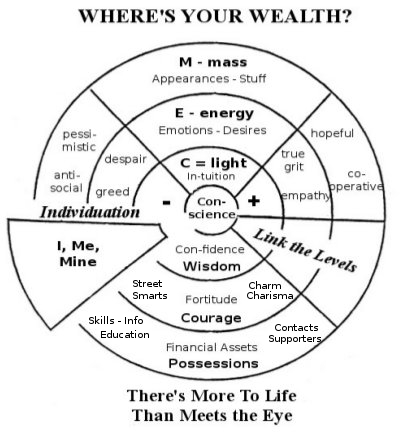
I think one of the things that it has really blinded us to is the nature of our own being. 2:32 because we make the assumption that the fundamental constituent elements of reality are material. We fail to notice that the fundamental constituent elements of our own reality are NOT material [outer surface rim of the Life Wheel]. They”re emotional [energy level]. They’re motivational [light and conscience levels]. They’re dreams. They’re visions. They’re relationships with other people. They’re dependent on consciousness – and Self-consciousness. And we have no materialist explanation whatsoever either for consciousness or Self-consciousness. And we don’t deal well from a materialistic perspective with the qualities of being.
Phoenix - sized

Now me.

First, as an aside, here is a personal example of how life experience has prepared me step-by-step for the unforeseeable future. I started as a musician, training my hands and building keyboard skills. This translated into typing faster than a speeding bullet, which made it possible to pay the bills as a legal secretary. In that job, I learned transcription, which later served me well as a graduate student taking ethnology courses. During that time, I learned that recording interviews not only freed me from having to take notes, the better to give the subject my full attention. Transcribing afterwards gave me the humble awareness that – of what I thought I had heard — I’d consciously registered at best a small fraction of what had been spoken.

The payoff even further down the pike is that now, when I listen to youtube videos dense in spoken content, I know to transcribe them word-for-word, the better to really “hear” all that has been spoken.

A second important aside – an inversion of the Crime and Punishment theme. While full-spectrum virtue has its intrinsic rewards, in corrupted civilizations, virtue sometimes has short-term punishments. Socrates’ death, described by Plato, is an example. Described in Essay 2 on Death:

Fear is the natural outcome of limited materialistic beliefs equating the end of physical life with total extinction. Those who experience the True Self as immortal and indestructible are not plagued by fear of mortality. No doubt the courage and solace which sustained Socrates as he calmly accepted his death sentence — not as an escape, but an affirmation of principle — came from the depth of his soul awareness.

Now then, to the point: the complete and accurate paradigm embodied in the Life Wheel makes it possible to distinguish the differences between morality, ethics and virtue.

This is one reason why restoring a complete and accurate paradigm to common understanding is a matter of human survival. For without agreement upon a complete and correct paradigm, a community of shared, effective communication is not possible. (Who would actively promote this negative/destructive outcome, and why? Who stands to benefit?)

Conversely, there is no place for genuine Virtue in a hollowed out, atheist world view. Its origins and home have been ruled out.

Phoenix - sized

In the complete and correct paradigm, Christ shines forth from the eternal center of the Life Wheel. His light illumines the middle level, which filters light into the full spectrum of natural virtues. Virtues, including kindness, gentleness and courage, reflect inner light. They are hardwired at the energy center, woven into human DNA.

Dr. Peterson says the significance of Christ’s being a carpenter is that he had to do good work – build houses that stay standing. Agreed. In addition, however, historically a “carpenter” is “joiner,” meaning one who connects all the pieces together – one who has the ability to unify separate parts into a single, coherent whole. The Life Wheel which links center to surface in an infinite loop represents this reality.

In this context, morality is a socially useful code of conduct located on the surface rim of the Wheel. Genuine virtue, like the Law of Karma, is an energy concept located in the fatally forgotten middle level of the Life Wheel. As described earlier, this level serves as the necessary two-way Gate-Keeper between the eternal center and its manifest world.

Morality has a virtue component, but with add-ons. It can reflects Divine Law. An example of this is the Ten Commandments handed down from God on Mount Sinai to Moses. On the other, it sometimes, though not always, is reflected in Human Laws. Warrior codes of conduct are one example. Others include religious sanctions and secular legislation which dictates moral behavior. Outcomes are inconsistent at best.

Whereas ethics are strictly intellectual, moral courage blends mental commitment to a code of conduct with the virtue of fiery conviction.

Phoenix - sized


Here is an essay that expands on what I mean:

Essay 54. VIRTUE

In the West, virtue suggests righteousness, but in fact Te is a term that refers to the potential energy that comes from being in the right place and in the right frame of mind at the right time. — R.L. Wing, The Tao of Power

The last thing to say about strategy is that it exploits opportunity, the right moment. Greek theologians called it Kairos, the point when the new is received. . . Ask: “Is this something that fits our strengths? Can we develop the service that satisfies?” Then comes the third element, the right moment to seize the opportunity by the forelock, to run with success. — Peter F. Drucker, Managing the Non-Profit Organization

The destiny of mankind is not decided by material computation. When great causes are on the move in the world. . . we learn we are spirits, not animals, and that something is going on in space and time, and beyond space and time, which, whether we like it or not, spells duty. — Sir Winston Churchill, Radio broadcast to America

THE FRONT

Definitions of virtue are mixed and confusing. Ancient derivations suggest goodness or power. Latin roots imply manliness or worth. Webster’s definitions refer to moral excellence, right action and thinking. In a woman, virtue is said to imply chastity. In a man, it implies effectiveness or force. It can also mean the power to heal or strengthen.

In ancient Asian traditions, virtue is used as an umbrella term. Healing sciences correlate the healthy functioning of each internal organ with a specific virtue, while weakened energy centers generate negative emotions.

For example, heart energy produces either the experience of love or expressions of cruelty. Kidney energy manifests as either gentleness or fear. Liver energy has the potential for either kindness or anger. Lung energy produces confidence or grief. Spleen energy manifests alternatively as openness or anxiety. Combined positive energies blended together create a transcendent virtue called compassion. In Western traditions, this compassion is called charity.

Though in medical schools it remains a little know fact, oriental and occidental healing traditions have common origins. The caduceus, the familiar symbol of the modern medical profession, has its origins in Greek mythology, which in turn extends back to Himalayan traditions, and still further to ancient Egypt. In Greek mythology, the caduceus is the healing staff of the messenger god, Mercury. In yoga traditions, this symbol represents energy anatomy.

Caduceus.jpg

As a shorthand logo, the staff represents the spine. Twin snakes encircling the axis represent alternating positive and negative energy currents. Intersecting points where cyclic energy forces meet at the axis are the major centers of transformation, chakras. Wings sprouting from the bija point at the top of the axis represent the ajna center, known as the “third eye.”

I Ching traditions describe virtue as the competence acquired by coordinating and balancing the yin-yang functions and concerns associated with each subtle energy center, then harnessing these energies to serve consistent, positive ends. It is not gender-specific.

Confucius compared virtue to an oriel. He observed this bird as being perfectly in harmony with nature: precisely accurate in the timing of its flight, poised upon well-chosen landing, and sweet in its song. Who, he asked, could hope to be more virtuous than this winged messenger?

Such virtue is radically different from arbitrary moral codes specific to a particular time and place. Sometimes an elite class imposes morality upon presumed inferiors in order to exploit them. Often, the unspoken maxim is, “Do what I say, not what I do.”

Rich corporate owners, for example, expect their workers to be hard-working, law-abiding and honest. For the most part, however, they themselves act as if above the law. Compliant workers though moral, aren’t necessarily virtuous.

Soldiers follow orders, mindlessly destroying life and property for the sake of pay. Warriors uphold the codes of their particular tribe or clan. Heroes act from love to protect life. Great leaders like Lincoln, Churchill and most recently Giuliani, however, shed light on the human condition during history’s darkest hours and times of greatest need. They exemplify innate virtue — the courage which leaders of all cultures share in common.

THE BACK

Vice is the opposite of virtue, while sin is the opposite of morality. Villains are those who abuse energy potentials to destructive ends. Chief among the vices is pride, taking natural gifts for granted, forgetting their universal Source. Another is deception, pretending to have virtues one lacks in order to get respect and compliance from others.

Indifference, apathy and paralysis are perversions of virtue. Stagnations in the human body and body politic reduce an organism’s vitality and capacity for positive action. Macho moral codes which assume virtue is exclusively gender-related become self-fulfilling prophecies — IF women and men are fooled into accepting them.

What Do YOU Think?

confusion

I have an important question for you. Your thoughtful answer(s) are greatly appreciated!

Here’s the problem, wonderfully put in The Art of Growing Old – Aging with Grace by Marie De Hennezel:

. . . the worst is not inevitable. The keys to a fulfilling old age do exist, and it’s up to our generation to discover them and pass them on. It’s up to us, the baby boomers, to invent a new art of growing old – which is a paradox, as it means accepting the inevitablity of aging without becoming “old.”

She continues:

. . . we can grow old intelligently; we can accept what we cannot change, and look toward all that has yet to be discovered.

I totally agree. But there are issues. First, although she states the challenge (opportunity!) wonderfully and touches on important responses, she doesn’t really have The KEY.

Second, I do. It’s what The Phoenix Response is about.

Why is that an issue? That’s where YOU come in.

In 2014, I wrote about “The Key to Everything” in Rethinking Survival – from my point of view. For me, it explains “The Mystery of Death and Rebirth.” Looking back, I was clarifying my thoughts for me.

Now the burning question remains, How do I bridge the gap between where I stood then and where you are NOW? For me, The Key and it’s implications for ultimate survival are breath-taking. How could I present them better, in a way YOU can usefully relate to and enjoy?

Or is all this something you’d rather not think about? If so, Why not?

Please tell me. And while you’re at it, it would help to know your (relative) age, gender, and location along with any comments on what shapes your current needs.

So, what do YOU think about “The Key to Everything” and “The Mystery of Death and Rebirth?”

The KEY

The Key to Everything

My “take away” from yoga years was the parable of a young boy who asked his teacher, “What is that, knowing which, all else is known.” The implication to this question, put forth in the ancient Sanskrit Mandukya Upanishad,41 is that, with the right key, everything can be known.

It reminded me of the medieval masterpiece in the Prado Museum that grabbed my mind earlier, the one which showed me that it’s possible to see with a larger point of view, beyond time, where all history is like a static painting and everything is actually going on at the same time.

I ardently wanted that key to life and the universe. I asked myself this question over and over and compared everything I read to this standard.

Years ago, I put the question to a wise friend, “What is that, knowing which, all else is known?” His cryptic reply: “Look it up in the encyclopedia.”

“Huh?”

I parsed this one-liner for every hint and clue. What does this riddle in answer to a riddle mean? “Look upwards?” And “en-cyclo-pedia?” That which encircles (cyclo, cycles). Pedia meaning feet. The foundation? The fundamental base which supports the whole body. Perhaps the functional impetus of movement and action.

According to Webster’s dictionary, “encyclopedic” means “comprehensive in scope.” All-encompassing view. Aha! I got it!The Positive Paradigm is the answer to the riddle. Look there.

I’m now convinced that the Positive Paradigm of Change is the ultimate answer to the ancient ultimate question. It’s the literal proof that humans are made in the image of the Creator — the microcosm resonates with the macro. I AM that I AM.

Put another way, “God don’t make no junk.” In this context, the exhortation, “Ye must be perfect like your Father in Heaven” makes perfect sense.

Just as Einstein had the Unified Field Theory, but didn’t know it, each and every one of us on the planet is perfect in potential: made in God’s image. But we’ve forgotten.

And tyrants want you to sleep on. They’ll do anything to prevent you from remembering that you’re inherently okay. Because once you do, as Einstein did, no one can intimidate, control or dominate you. You’re aware that nothing anyone has for sale can make you more perfect. Nor can anything that anyone threatens to take away alter your essential okayness.

It’s your inalienable birthright. A given.

The Positive Paradigm is the viable basis upon which to build valid self-esteem. It’s the key to personal freedom — freedom from ignorance, freedom from fear.

One minor caveat: it all depends. While we all have the option to remember who we truly are, most of us are like Lambert, the sheepish lion. It takes a smack with a two-by-four upside the head before we’re finally ready to wake up. Often it takes the form of life-threatening danger to those we care for.

A personal health crisis will also do the trick. So will job loss or a run-in with natural disaster.

But, like Dorothy stranded in the Land of Oz, when you want dearly enough to return “home,” you can click your heels whenever you chose — and come to find out, you’re already there.

Innocence

The Mystery of Death and Rebirth

The yin-yang mysteries of life and death are embedded within every in- and out-breath of our lives. They alternate, however unappreciated, inside each unit of time: from minute-to-minute, day-to-day and season-to-season. They repeat on every scale of magnitude, from the individual, to families, corporations, nations, whole civilizations and even planets.

Buddhist teachings reflect these mysteries, compatible with the Positive Wheel model and its central hub. For example, in Being with Dying: Cultivating Compassion and Fearlessness in the Presence of Death, Roshi Joan Halifax explores the transformative power of the dying process, advising readers to be still, listen and open to the unknown.

Indian film actor Rajini captures the Rethinking concept succinctly in his review: “This book helped me touch that divine part that we all share; it is the Deathless, eternal part of us that will never die because it was never born.”

“The strange thing about growing old,” Einstein wrote, “is that the intimate identification with the here and now is slowly lost. One feels transposed into infinity . . . ”

In the year before his death, commenting on the passing of colleague Michele Besso, Einstein wrote, “He has departed from this strange world a little ahead of me. It means nothing.”

Making an observation that could have come directly from the Yoga Sutras, consistent with the Positive Paradigm, Einstein consoled Besso’s family, “For us believing physicists, the distinction between past, present and future is only a stubborn illusion.”

It is said that in the middle ages, Carmelite nuns retired to their cells each night to sleep inside the wooden casket in which, when they died, they would be buried. Taken out of context, this may seem morbid. But in fact, they had it right. They were aligning themselves with the patterns of nature, the better to ultimately survive them. For each in- and out-breath repeats the cycle of release and renewal. Each night that we sleep, we let go of bodily awareness and return refreshed the next day.

On every scale of magnitude, the pattern is the same. Paradoxically, survivors who have released unfounded fears of death are freed to live to the full, here and how.

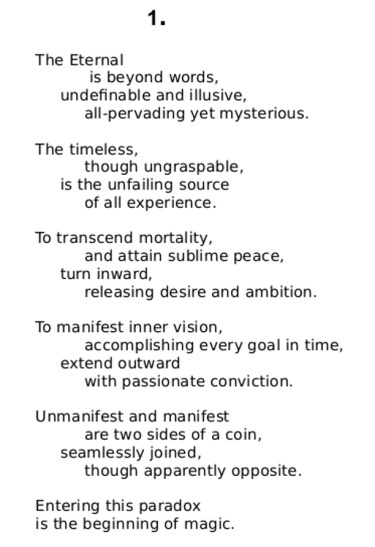
Lao Tze’s work, which breathes I Ching wisdom, illumines this paradox. He describes the relationship between the Creator and creation in the first aphorism of the Tao Te Ching. From Two Sides of a Coin: Lao Tze’s Common Sense Way of Change:

01

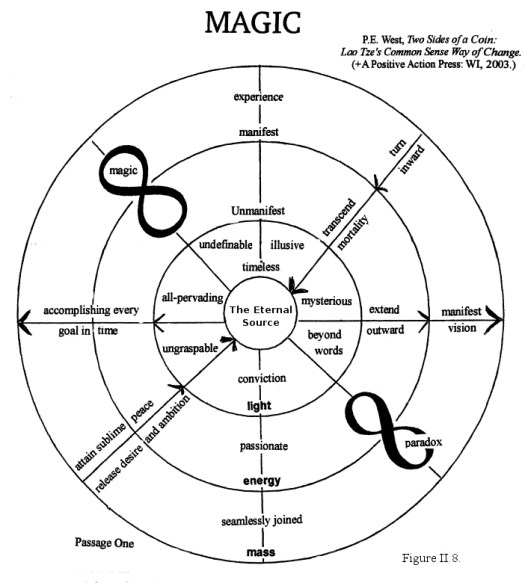
Figure II.8 shows what this vision looks like when the words are properly placed within the Positive Paradigm Wheel. To the uninitiated who live exclusively on the surface of the Wheel, the eternal may seem illusive. However, the inner vision is accomplished by daring to let go of the familiar surface to travel true home to the center, from which, completing the cycle, blessings then flow outward.

II-8 rev

(Reminiscent is God’s promise in Genesis, “Return unto me, and I return unto you.”)

In Passage 16, Lao Tze goes even further:

16

Here, Lao Tze’s sage not only repeats the vision of the hero’s journey. The methods of the journey are given — the meditative practice of stilling the mind and emptying the heart, followed by contemplation from the detached observer’s perspective. Lao Tze also details the consequences of failing to complete the life pattern: misfortune, pain and suffering.

Those who attain the source, however, (usually with the guidance of an enlightened teacher) achieve the overview which leads to acceptance, compassion and omniscience. Those who survive intact, merge with the eternal source and begin anew, like the New Adam and Christ in The New Testament. (See Figure II.9.)

II-9 rev

Preparation makes the difference, deciding who is most likely to survive coming transitions, emerging better than before through the experience. Here is the root of Positive Change, described in Hexagram 49 from The Common Sense Book of Change:

49. CHANGE. Day and night replace each other in endless cycles of CHANGE. The same natural law generates flux in human events. The unprepared see Change as a threat, but the well-prepared face the unknown calmly. They know that after degeneration reaches critical mass, regeneration follows. Welcome the new. Avoid short-sighted fear.

Please Help Me.jpg

So, now it’s your Turn. Please tell me what YOU think about all this. And, thank You.

thanks.jpg

Rethinking HOPE

hope

Paradoxically, the following Essay on Hope compliments the one on Death shared in The Phoenix Response. Tellingly, it reflects beliefs significantly different from those held by my grandparents, Ellie and Hubble West. It might explain, at least in part, their experience of old age.

Nor is the subject merely academic. As I currently face unanticipated health challenges, like many baby-boomers of my generation, I’m being challenged to face and rethink my personal survival expectations.

I’ll explain all this at length later. But for now, here are my earlier thoughts on Hope, for your thoughtful consideration.

Essay 63. HOPE

That the God of our Lord Jesus Christ, the Father of Glory, may give unto you wisdom the spirit of and revelation in the knowledge of him:

The eyes of your understanding being enlightened; that ye may know what is the hope of his calling, and what the riches of the glory of his inheritance in the saints,

And what is the exceeding greatness of his power to usward who believe, according to the working of his mighty power. . .

— St. Paul, Ephesians

Here the people could stand it no longer and complained of the long voyage; but the Admiral cheered them as best he could, holding out the good hope of the advantages they would have. He added that it was useless to complain, he had come [to go] to the Indies, and so had to continue it until he found them, with the help of Our Lord.  — Christopher Columbus, Journal of the First Voyage

We live at a particularly perilous moment, one in which self-deception is a subject of increasing urgency. The planet itself faces a threat unknown in other times: its utter destruction. . . The splitting of the atom, said Einstein, has changed everything, save how we think. And thus, he observed, “we drift toward unparalleled catastrophe.” — Daniel Goleman, Vital Lies, Simple Truths

We are seeing a health care system in pain, people in pain, and a world in pain. I believe that something can be done to make it better. — Patch Adams, Gesundheit!

THE FRONT

Webster’s defines hope as a feeling that what is wanted will happen. It’s a desire accompanied by expectation. It can mean that which one has a hope for. It can mean a reason for hope. A meaning listed as archaic is to trust or rely.

In I Ching context, hope transcends short-sighted wishing and emotional wanting. It is a trust that one has the wherewithal to respond appropriately to every change of fortune. It is not total self-sufficiency, but awareness that one’s efforts are met half way. When one does the best one can, the rest is supplied in the right way, at the right time.

Daniel Goleman emphasizes the direct relationship between honest self-awareness and survival. Like Einstein and like Strauss and Howe (authors of The Fourth Turning), Goleman is a messenger of awareness we’re often trained to block out.

His vision accords with The Book of Change philosophy in this: ignoring dangers, deceiving ourselves that all is well when it isn’t, doesn’t make problems go away. It only renders us powerless to recognize early warning signals in time to prepare and ameliorate the worst that might come.

In The Fourth Turning, Strauss and Howe emphasize that declining resources will necessitate major changes in healthcare delivery. Anticipating that the cost of health-care will continue to rise and become increasingly unaffordable, they recommend that cost-effective, affordable alternatives along the lines of Adams’ work be put in place now.

Forward-looking health practitioners are therefore now turning to inexpensive, preventive self-maintenance practices like Tai Chi, Qigong and yoga.

There are hidden benefits to timely austerities. Though it is unfortunate that people see fit to return back to self-responsible methods only as a last resort, if the prospect of hard times returns people back to their more simple and beneficial roots, it is a (however well disguised) blessing.

In his epistle to the Corinthians, St. Paul wrote of hope in the context of faith and charity. His hope isn’t Webster’s hope of wanting and expecting. Like I Ching hope, it is trust that human events which make no sense in the short-term fit into the larger pattern of life, and that God’s will inevitably in the long-term prevails.

THE BACK

The opposite of hope is despair. Seeing one’s situation as hopeless is a self-fulfilling prophecy. So long as one places hope in externals, one feeds the illusion of powerlessness. Turning the focus of hope inwards makes all the difference.

Self-deception is a perversion of hope. Lacking a concept of cyclical change, linear thinkers hope to control time. They defy the aging process or pretend change can’t or hasn’t happened rather than adjusting and benefiting from new opportunities that arise to replace the ones which pass away.

Choose LIFE II

body-mind-spirit

Last fall’s mystery illness became a strict teacher, a blessing in disguise. It dramatically reinforced my awareness of the mutually dependent relationship between brain and gut long recognized by Asian healing traditions.

As modern medical research documents, mental distress manifests as a myriad of gut-spawned diseases – Crone’s disease, fibromyalgia, rheumatoid arthritis, irritable bowel syndrome and eventually cancers, to name but a few.

Conversely, the broad spectrum of diseases arising in the gut spawn a host of mental illnesses – not only depression, memory loss, dementia and schizophrenia, but autism and A.D.H.D, for example.

The hopeful application is this. Correctly steered, interventions on either side of the gut-psychology continuum positively affects the other. The relationship spans an infinite loop. So wherever one starts, given time and effort, it’s possible to complete the cycle, eventually restoring balance and good health.

Follow along if you like and I’ll connect the dots that led to this conclusion.

It started with asking WHY. Medical people failed to correctly diagnosis what went wrong. The ER physician (nice lady) jumped to the convenient assumption that, given my demographics, a lower tract infection was the problem. Antibiotics would make symptoms go away.

When the first round of drugs didn’t help, instead of questioning the assumption, the local nurse practitioner prescribed a battery of (expensive!) different antibiotics over following months – in increasingly stronger doses – each with its “interesting” side effects.

The duration of this “illness” was cause for some serious introspection on my part. Certainly the WHY had a mental origin. Stern teacher that LIFE is, I came to accept that I wasn’t going to be let off the hook until I came clean with myself. Release demanded self-honesty.

What I unburied was a death wish of sorts. It wasn’t that I wanted to be gone, so much as that negative suggestions from false friends absorbed over the years had worn me down to the point of critical mass.

I was increasingly motivated by dread of facing a future based on past experience. Subconsciously, I had succumbed to a death sentence suggested by people far too “nice” to kill me outright, but all too capable of driving me to slow suicide.

LIFE had sounded a warning alarm to bring me back to my Self.

Something had to change. It started with a stark decision. A conscious commitment to LIFE, whatever it takes. I wrote a confirming article, Choose Life.

Once recognition and the decision were made, LIFE responded most generously. The help and information needed to support my choice appeared from several directions.

The next step was for me to ask HOW do I return to health? And how do I change my attitudes and behavior to make my personal future different and better from the past?

Critically important information was found in Susan Forward’s Emotional Blackmail: When the People in Your Life Use Fear, Obligation and Guilt to Manipulate You.

I was instantly inspired to borrow the book from the library after reading a top-ranked review of the book which starts:

This book does a very clear job of defining emotional blackmail so you can begin to easily spot emotional blackmailers in your life. It then concludes with telling you specifically how to deal with emotional blackmail, that is, how to keep your energy, resources, and sometimes your very soul, from being stolen by them.

WOW. I could relate to that!

She writes, At the heart of any kind of blackmail is one basic threat, which can be expressed in many different ways: If you don’t behave the way I want you to, you will suffer.

Forward explains:

Manipulators work hard to deny, obscure, camouflage, prettify, excuse, rationalize, disguise, HIDE what they are doing. They make it hard, if not impossible, to see HOW they’re manipulating us. They lay down a thick FOG that obscures their actions.

FOG is an acronym that stands for the psychological warfare tactics used against targets: Fear, Obligation and Guilt.

This information is reinforced by Harriet Braiker in Who’s Pulling Your Strings? How to Break the Cycle of Manipulation and Regain Control of Your Life:

People who manipulate are often so hard to spot. They become your friend and then find ways to have their way with you. . .

A reviewer summarizes:

You can’t reason with a manipulator because of their insecurities but you can reason with your own insecurities; and best of all are the practical ways you can change your behavior to take back the power.

This book teaches you to get up, learn what you did wrong and what you should have done, and even better how not to repeat the same mistakes.

There’s also a warning given from experience:

I’ve put an end to so much manipulation in my life. It takes the wind right out of the manipulator’s sails. The book is right…the manipulator will blow really hard, so prepare yourself; it’s going to get stormy.

choose life

Another fortunate form of help followed from my decision to seek medical advice elsewhere. An intern at the UW kindly saw me on short notice. Intrigued by my situation, she brought in her mentor. Together, after reviewing the history of lab results, they confirmed that the initial diagnosis wasn’t right. The medications hurt more than helped.

Although I knew enough to eat yogurt to offset the effect of antibiotics, to repair the damage done by antibiotics they recommended taking pharmaceutical probiotics as well. This opened the door to a whole new world of science and healing.

Probiotics for Dummies, for example, includes a useful section on the brain-gut connection.

Medical researchers have long known that stress depresses immune function, but only recently have they linked stress to changes in gut bacteria.

The medical community’s interest in probiotics was initially sparked by the seminal work on GAPS (Gut and Psychology Syndrome) published by researcher Natasha Campbell-McBride.

In Gut and Psychology Syndrome: Natural Treatment for Autism, Dyspraxia, A.D.D., Dyslexia, A.D.H.D., Depression and Schizophrenia, she notes that Western medicine has long acknowledged the brain-gut connection:

The father of modern psychiatry, French psychiatrist Phillipe Pinel (17-45-1828), after working with mental patients for many years, concluded in 1807: “The primary seat of insanity generally is in the region of the stomach and intestines.”

Interestingly, she uses the same word, FOG, when in describing the mental-emotional relief experienced as the intestines heal by using probiotics to restore balance. “It is as if the fog lifts.” Ahh!

But, like cutting through the psychological FOG, cleaning out the gut doesn’t happen over night, or without difficulties. Campbell-McBride warns things often seem to get worse before they get better. Detox is a necessary but challenging middle step along the road that leads from here and there. So, again, “prepare yourself; it’s going to get stormy.”

There are important parallels between the so-called Leaky Gut Syndrome and psychological distress. In the first case, weakened intestines become permeable. Toxins and undigested food leak out and are circulated by the blood stream throughout the entire body, poisoning other internal organs – including the brain.

Similarly, psychological defenses can also be worn down and compromised, sometimes due to “second-hand stress.” In this case, when protective borders between self and others break down, toxic influences from outside undermine mental-emotional balance. Others’ fears, rage and general unhappiness poison the unprotected mind. Toxic people preoccupied with their own wants and personal dramas, even when unintentionally, do great harm.

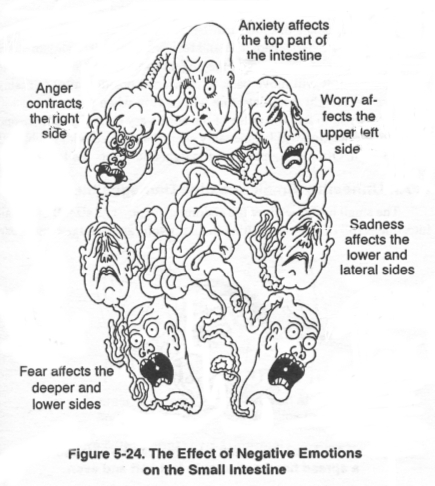
Interestingly, the GAPS/probiotics approach is highly compatible with the wisdom of Asian healers. Traditional Chinese Medicine, for example, carefully maps the gut-psychology connection. They describe the dynamics of what is called “the abdominal brain.” The following illustration captures thousands of years of wisdom in a single picture.

0 012316

According to Mantak Chia, when the intestine becomes congested, it cannot perform its physiological functions. Though you may eat well, you may be under nourished.

As he explains, each of the organs is correlated with one of the five elements. In turn, each is associated with specific positive or negative emotions:

All negative emotions are expressed in the small intestine by contraction and circumvolutions, Anger contracts the right side of the intestine near the liver. Worry affects the upper left side near the spleen. Impatience and anxiety affect the top. Sadness affects both lower lateral sides. Fear affects the deeper and lower abdominal areas.

As the I Ching instructs, the same dynamics repeat on every scale of magnitude, from cellular to universal. So many hints from sciences both ancient and modern could be taken in many directions. They apply to relationships on a personal level, to community dynamics, and governance. But those will be subject of posts yet to follow.

For starters, I’ll offer just one hint.

Campbell-McBride uses the image of a medieval fortress under attack to describe the breakdown of  defenses that result in auto-immune diseases. It parallels the Interleukin II research described earlier, where the grad students saw their research on pediatric leukemia in terms of a war between good and evil.

When confusions in gut mirror confusions of the mind – when the difference between friend and enemy is fogged — anabolic (building up) and catabolic (breaking down) functions are thrown off balance. The body  is fooled into turning against itself in self-destructive ways.

In conclusion, however, a key component overlooked in the popular gut-psychology formula must be noted. Spirit — that third, underlying, unifying and overriding component of the e = mc2 equation – plays a deciding role in the outcome of the LIFE versus death struggle to survive.

It is said that “The mind will play any tune you tell it to play.”

choose wisely

So – who is it that quietly instructs the mind which tune to choose?

LIFE itself, the soul’s advocate, is the tie-breaker that tips the balance.

Here, I allow Mantak Chia to have the final word. He describes the discipline of cultivating chi – the subtle energy that links mind and body — and the end goal of the path to which all endeavors ultimately lead: 

  • If one wishes to be a healer, success depends upon the ability to channel energy through the hands.
  • If one wishes to be an athlete, success depends upon the ability to convert energy into strength and endurance.
  • If one wishes to be free of negative influences, success depends upon the ability to transform negative energy into positive energy.
  • One who seeks enlightenment is searching for the highest source of all energy.


I write in hopes that you will find this saga helpful. If you relate, I invite you to apply your imagination and follow wherever the subject leads you.

To your health!

Keep It Together

star of david

Although it seems there’s no longer much more to be said, yesterday’s Aha moment is an exception.

Here’s the back story.

Over Thanksgiving week-end, for the benefit of those who hadn’t seen The Walking Dead series, we spent several hours here watching back-to-back episodes of the first two seasons.

For me, this second go round had an even greater impact. The content speaks on many levels, in many ways, to our increasingly dangerous times.

Like life itself, the series is a complex counterpoint of relationship drama, political intrigue, philosophical ponderings and soul searchings. It’s intense: not for the weak of stomach or for lovers of sentimental fluff.

Beyond the surface story line, however, it is poignantly symbolic. Perhaps in a very deep way, it’s prophetic. Which explains why a simple pilot unexpectedly took off to become a sensational success. For those with ears to hear, it resonates straight to our very core.

How, you might ask, does a story about a world overrun by hoards of cannibalistic zombies apply to current events and leadership issues?

Well, let’s see.

In The Walking Dead, zombies are mindless corpses that carry on after humans die. All but the primal, limbic functions of the human brain have been disease-destroyed.

When you think about it, it’s not such a far cry from the end result being achieved (perhaps intentionally, perhaps not) by manipulating humans (programming them in the name of education) based on brain science.

Neuro-marketing, for example, stimulates the same vestigial, animal part of the brain that drives zombiesintentionally bypassing rational cognitive functions involved in critical thinking and rational decision-making.

An academic website defines neuro marketing as : the formal study of the brain’s responses to advertising and branding, and the adjustment of those messages based on feedback to elicit even better responses. Researchers use technologies such as functional magnetic resonance imaging (MRI) and electroencephalography (EEG) to measure specific types of brain activity in response to advertising messages. With this information, companies learn why consumers make the decisions they do, and what parts of the brain are motivating them to do so.

It increasingly seems as if walking dead hoards include not only fictional zombies, but average consumers and citizens — even the college professors, marketing professionals and politicians who direct their communications to these same animal brain functions.

Economists and politicians have jumped on the marketing bandwagon, exploiting brain science. Earlier, I expressed strong reservations about the ethics and consequences of applying brain science research to marketing and policy making.

Intentionally targeting instinctual, animal functions of the brain with subliminal messages represents an intentional effort to control and dehumanize the general population. The results could be scary indeed.

In a LinkedIn article that points out serious problems with Thinking, fast and slow, Kahneman’s book on behavioral economics, I concluded:

To continue sleep-walking on the shallow surface of life as most of us do now plays into the hands of madmen and tyrants, some of whom, if it seemed to further their ambitions, would have no compunction whatsoever about plunging the entire world into nuclear war.

But back to The Walking Dead. As a commentary on leadership options in this scary new world, it triggered my Aha on the importance of “keeping it together” as a devolving world militates to tear us apart. The answer I came up with is part mystical, part medical for those with the training and diligence to practice yogic breathing and concentration methods.

The primary questions this series challenges us to think about are, “Who is going to survive in such a chaotic future, How, and Why?”

The protagonist, Rick represents the voice of reason. His words and actions show him to be more evolved than most. He’s a “natural leader,” if you will. This former sheriff’s deputy knows weapons and can handle himself in a fight. But in balance, he is also a “righteous dude.”

Rick earns farm-owner Hershel’s respect by showing him respect.

Hershel – a religious optimist who chooses to deny the existence of danger closing in on all sides – wakes up the hard way, losing all he owns in the process. He’s highly evolved, but out of balance. The practical street smarts were too late coming. At least in the beginning, he was extreme yin, out of balance.

And then there’s the opposite side of the coin. Shane. His exudes extreme yang energy. This treacherous shake in the grass, ruled by animal appetites, rationalizes his lusts and takes whatever he wants however he can.

Shane dogs Rick’s every step, working to undermine him, scheming to take everything – Rick’s wife, son, and leadership role in their small community. Shane operates from the solar center, with little heart awareness and no functional conscience. He has no concept (much less respect) for higher levels of consciousness. Mercy is outside his range of awareness. To Shane, Rick and Hershel seem weak.

Shane seduces whomever he can with the argument that, civilization being destroyed, he is the wave of the future. Only he is qualified to protect the group. But, depending on the rest of us, that vision remains to be seen.

How to deal with the Shanes of the ugly new world? I’m reminded of Lao Tze 41:

120115 2 Sides 41

In thinking about what combination of leadership qualities will succeed in steering small communities through both the internal and external dangers they will face if/when “civilization” breaks down, I was amazed at how skillfully the leaders in The Walking Dead adjust to change. Like the ancients, they keep their balance by adjusting to the fluctuating demands of a dualistic world.

For in duality, as Solomon wrote:

120115 ecclesiastes

In the future, those in small communities who persist in old ways of thinking, clinging to one extreme or the other, either rational or animal, rigidly ignoring the complex demands of an altered, endangered new world, risk forgetting Henry David Thoreau’s warning: “A foolish consistency is the hobgoblin of feeble minds.”

Certainly Christ knew this. He taught, “Love one another as I have loved you.” Yet his was not an example of foolish sentimental permissive “tolerant” love. Certainly he had no use for the money changers and demonstrated fierce anger towards hypocrites.

It was at this point in my thinking that the Aha happened. The Star of David, traditionally worn over the heart, is the perfect symbol of balancing the polar qualities future leaders will need to keep civilization from devolving into the exclusively animal realms of a zombie-like existence.

This Star is housed in the “secret place of the Most High” described in Psalm 91. It is associated with the heart center located in the middle Dan Tien. It is the seat of compassion, the place where the upper Tan Tien’s mental light and lower Tan Tien’s solar fire join, blend and balance.

This joining is mirrored in the meaning of Ha-tha (sun & moon) yoga = union.

This six-pointed Star is formed by the intersection of two equilateral triangles. According to Chinese medical notation, the upward pointing triangle represents the quality of yang energies. The downward pointing triangle represents yin.

It is no accident that equilateral triangles are the strongest, most stable of geometric structures. Those who internalize and actualize these realities have the practical means to keep themselves and their communities together.

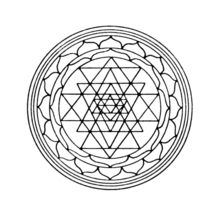
In the Hindu tradition, the Sri Yantra is similarly constructed of nine interlocking triangles that surround and radiate outwards from a central point.

Sri Yantra

These variations are each based on the same subtle geometry. They express the same inner experience of a central, underlying reality.

To repeat, while on one hand, the universal secret of these interlocking triangles is a profound mystery, on the other, for those familiar with yogic breathing and concentration methods, they are the foundation of practical disciplines with physical, mental and spiritual results.

Given time to refine what is written here, the ideas could be better expressed. But the substance remains as a Christmas gift offered to those prepared to receive it as such.

Arguing and nit-picking would miss the point. The better choice is to bring your own understanding to an urgently important subject and make it your own. It is a key to not only personal survival, but the hope for a better future.


History Repeats Itself – Renaissance or Another Dark Ages?

A recent post described the unfortunate end of Abelard, the medieval philosopher best known for his tragic love of Heloise.

Out of synch with his times, this celebrated cleric taught that men gain knowledge – including faith – through reason. For this, he was convicted by his monastic superiors of heresy. Abelard’s books were banned and burned. He died shortly afterwards in prison.

St. Augustine’s exclusively faith-based Rules of the Knowledge Game were balanced with Abelard’s opposite approach only after St. Aquinas harmonized the two extremes. According to the new Rules, no matter where you start, each approach leads to and reinforces the other.

This broad-based approach to knowing as a two-way street set the foundation for the flowering of arts, sciences and commerce known as the 12th Century Renaissance.

But, I suspect you’re wondering by now, is medieval history relevant NOW?

It’s highly relevant, particularly when taken in the context of patterned, repeating cycles of human behavior. Learning the basic lessons of history is an important way of leveraging the future.

Back to the 12th Century Renaissance. It was during this time of creative balance that universities evolved to replace monasteries as centers of learning.

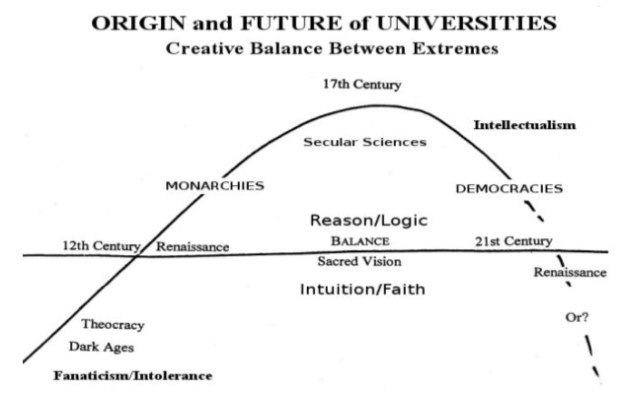
I’ve thought about this a lot. The Origin and Future of Universities was the dissertation topic of my choice. In my proposal, I drew a bell-shaped curve that cycled above and below a median-line that represented historical times of creative balance between extremes. It looked like this:

bell curve sized

In the late 1970’s, when I wrote my proposal, universities were at a critical point of intersection. There was still a window of time left during which to mitigate a predictably dangerous direction of change, before a narrow window of opportunity closed.

Humanistic psychology and holistic health movements were leading the way towards another reintegration of faith and logic — a reconciliation of intuitive and rational ways of knowing. On the one hand, I held hopes that another creative renaissance was on the horizon. On the other, I foresaw the possibility that the curve would cross the median balance point and continue its downward slope, plunging the world into another dark ages of fanaticism and intolerance.

Departmental politics prevented me from writing the dissertation of my choice. (That story and its implications, however, are a different subject.) What’s pertinent here is the outcome. The window of opportunity has closed. Proof abounds. For example, during the Arab Spring, disillusioned Muslims who at first had welcomed violence as an opportunity for positive change were horrified at the repressive results. One Egyptian commented to a reporter that his country had entered a new dark age. News here and abroad continues to confirm that downward trend.

What remains are the mitigating possibilities open to I Ching users. The Chinese Book of Change keeps self-honest seekers in synch with the times, giving them survival insights and hints as to where to look for respite from the worst that might yet come. It keeps hope for the positive change we persist in holding dear to our hearts alive.

Here’s the key. Patterns codified in The Book of Change repeat on every scale of magnitude. That is to say, the same seasonal cycles repeat in an individual’s life. They also repeat in families, in the work place, in governments and even in the history of civilizations.

So even when the times are dangerously out of joint, individuals can still change for the better. So can intentional communities. So long as there’s this hope, it’s never to late. In the early dark ages, for example, monasteries were islands of hope, civility and sanity in a violent, barbaric world. Their equivalents might again serve the same purpose.

Further, personal, organizational and historical rhythms aren’t necessarily in synch. This explains why the same view is welcome at one place or time, but not in others. Abelard’s emphasis on reason, for example, would have been in synch in 17th century universities even though they were fatally out of harmony with beliefs held in the monastic circles of his day.

This information holds good or bad news, depending on whether it’s recognized and how it’s used. On one hand, acting as if personally preferred realities are fact, regardless of whether or not they’re in synch with the times, is unrealistic. For example, New-Agers who ardently believe the near future promises a widespread renaissance of human upliftment are quite probably mistaken. Worse, they may be misleading followers who will find themselves unfit and unprepared to survive in an increasingly intolerant, dark ages environment.

But on the other, positive side, it’s still possible, even as a dark age of fanaticism is gaining ground, to maintain personal balance. Personal renaissance – literally re-birth – is possible at any split second in time. Even when social trends are devolving into extremes, individuals aren’t required to forsake the ideal of personal integration just to fit in. In fact, personal and community survival may well depend on the capacity to maintain stable balance even in the most unbalanced of times.

Of a certainty, heightened, intentional balance will be essential to personal survival, even and especially as dark times cloud collective reason and threaten to extinguish faith.

Rethinking HOPE

New years are traditionally welcomed as a harbinger of fresh hope and the opportunity for new beginnings. In these perilous times, I have searched my heart for the most realistic approach to fulling the eternal hope for love, unity and survival which everyone everywhere shares in common – a way that acknowledges escalating world challenges while balancing them with their inherent potential for renewal.

Because it rings true as the vision of realistic hope, I have chosen to return to this simple essay, written in the year 2000, included in Conscience: Your Ultimate Personal Survival Guide.

May your New Year be filled with the blessings of your dearest heart’s desire.

121714 rose

ESSAY 63. HOPE

Ephesians

Here the people could stand it no longer and complained of the long voyage; but the Admiral cheered them as best he could, holding out the good hope of the advantages they would have. He added that it was useless to complain, he had come [to go] to the Indies, and so had to continue it until he found them, with the help of Our Lord.  — Christopher Columbus, Journal of the First Voyage

We live at a particularly perilous moment, one in which self-deception is a subject of increasing urgency. The planet itself faces a threat unknown in other times: its utter destruction. . . The splitting of the atom, said Einstein, has changed everything, save how we think. And thus, he observed, “we drift toward unparalleled catastrophe.” — Daniel Goleman, Vital Lies, Simple Truths

We are seeing a health care system in pain, people in pain, and a world in pain. I believe that something can be done to make it better. — Patch Adams, Gesundheit!

THE FRONT

Webster’s defines hope as a feeling that what is wanted will happen. It is a desire accompanied by expectation. It can mean that which one has a hope for. It can mean a reason for hope. A meaning listed as archaic is to trust or rely.

In I Ching context, hope transcends short-sighted wishing and emotional wanting. It is a trust that one has the wherewithal to respond appropriately to every change of fortune. It’s not total self-sufficiency, but awareness that one’s efforts are met half way. When one does the best one can, the rest is supplied in the right way, at the right time.

Daniel Goleman emphasizes the direct relationship between honest self-awareness and survival. Like Einstein and like Strauss & Howe (authors of The Fourth Turning), Goleman is a messenger of awareness we’re often trained to block out. His vision is in synch with The Book of Change philosophy in this: ignoring dangers, deceiving ourselves that all is well when it isn’t, doesn’t make problems go away. It only renders us powerless to recognize early warning signals in time to prepare and ameliorate the worst that might come.

In The Fourth Turning, Strauss and Howe emphasize that declining resources will necessitate major changes in healthcare delivery. Anticipating that the cost of health-care will continue to rise and become increasingly unaffordable, they recommend that cost-effective, affordable alternatives be in put in place now. Forward-looking health practitioners are therefore now turning to inexpensive, preventive self-maintenance practices like Tai Chi, Qigong and yoga.

There are hidden benefits to timely austerities. Though it is unfortunate that people see fit to return back to self-responsible methods only as a last resort, if the prospect of hard times returns people back to their more simple and beneficial roots, it serves as a blessing in disguise.

In his epistle to the Corinthians, St. Paul wrote of hope in the context of faith and charity. His hope isn’t Webster’s hope of wanting and expecting. Like I Ching hope, it is trust that human events which make no sense in the short-term fit into the larger pattern of life, and that God’s will does in the long-term prevail.

THE BACK

The opposite of hope is despair. Seeing one’s situation as hopeless is a self-fulfilling prophecy. So long as one places hope in externals, one feeds the illusion of powerlessness. Turning the focus of hope inwards makes all the difference.

Self-deception is a perversion of hope. Lacking a concept of cyclical change, linear thinkers hope to control time. They defy the aging process or pretend change can’t or hasn’t happened rather than adjusting and benefiting from new opportunities that arise to replace the ones which pass away.

globe

The Evolution of My Understanding

A post-Thanksgiving exchange with a LinkedIn connection (I’ll call him Dave, a favorite name) made me realize I owe it to readers to describe from personal experience why I’ve come to place so much importance on Natural Law. It’s critically important to be fluent in its operations. It’s equally essential to understand how it’s related to, though different from, Divine Law. As I’ve learned from personal experience, a little knowledge can get you in a lot of trouble.

dragon

Dave and I have never met. He hasn’t, to the best of my knowledge, read any of my books, so isn’t familiar with the autobiographical account written in Rethinking Survival. So other than candid answers to his frank questions, his impression is based on posts I’ve written.

We originally hit it off in an exchange of comments. In response to “Boundary Spanners Connect at the Center,” posted September 10, 2014, he wrote:

Wow and thanks Patricia! That was Profound and easy to read. Writing such articles take real skill and something of real value to communicate. I especially liked the hors d’oeuvre at the beginning that made me want to read the rest. Half way through I said out loud, “I think I love you”. I certainly enjoyed reading your article very much. I just clicked “follow”, although I hate the concept of “leaders” and “followers” because I am fiercely independent. I think of it instead as “subscribe”; as in “offer me some more of your tasty wares”; rather than tell me what to think…

I can relate to independent. Mom didn’t call the toddler-me an “independent critter” for nothing. So I answered back:

In-dependent = depending on the True Self deep within. Fiercely = connected with the passionate energy of the middle level. Love you too! Thanks for the subscribe, Dave. : )

Dave’s 80-something parents, who live in South Africa, flew to California, where both he and his brother now live. He dedicated the duration of the Thanksgiving holiday season to family. After they left, he wrote:

I told my mother about you and she asked me if you were a Christian. I said that you were aware of God and often reference Christian tenets in your writing, but that your belief system seemed much wider than that. I did not feel the need to try and label you, but said that you are driven by natural law that springs from the Creator; and that is enough for me.

But that got me to thinking. How would I have answered if she had asked me directly? Then one thing led to another. Later I wrote back:

I was thinking of how to answer your mother’s question, and remembered a post from last December, “Rethinking Christ at Christmas.”. . . I’ll include the link so you can forward it to her – in case she would like to see it.

I continued:

In terms of her asking if I am Christian, the correct answer is that I love, respect and do my best to follow Christ. I’m not sure that’s the same thing as being a “Christian.” (I was not born/raised in a Christian family.)

But, having reservations about his description, I continued.

However, I am not driven by natural law. Rather, ignorance regarding the relationship of divine, human and natural law is a fatal blind spot in our education. It prevents us from understanding and connecting with Christ. (The blog will show you, literally, what I mean. If we can’t recognize/navigate that middle, energy level of natural law, we’re left stuck on the material surface.)

My belief system is “much wider” than Christian tenants, but, then again, so is Christ.

My understanding is that the essence of Christ is vastly greater in time/space than institutionalized Christian religions. Again, the illustration in the blog shows how this must be so. Christ told us he was before the world, is with us always, and will continue to exist long after the world does not. So, if his presence permeates all time and space, in effect of his presence permeates all religions.

Dave’s lengthy, astute response is too long to quote in entirety. Two paragraphs relevant to the critically important distinction which is the purpose of my blogging today (12-13-14 is an “interesting” date – perhaps the right time to make a breakthrough, finally get across the all-important sequence I’ve been laboring to define).

Religions have too much dogma. For me, the only absolute truth is that every individual is responsible directly to God for their own decisions and actions. No human intermediaries are required. Any person can communicate directly with God. Not only can they; they should.

I could not say it better!

But here’s where the conversation became murky, and needs clarification:

My remarks about natural law may not fit your definition exactly, but to me, natural law is God’s law. That said, I use the term more often in the context of physics and chemistry, without declaring who the author is.

From my point of view, two critically important distinctions must be emphasized. First, Divine Law is the Creator’s law. It rules that which is timeless, unchanging and eternal. It pertains to the source of (but cannot be equated with) the created world measured and quantified by human sciences. I don’t quibble about names. The Creator is an essence beyond words. Call it the Tao. The Universal Mind. The Divine by any other name is still eternal.

Second. Natural Law is a related but distinctly different subject. The Book of Change, the Chinese I Ching codifies the 64 permutations of alternating, cyclical change. It is the binary-digital code of duality, the blueprint of DNA – that which has a beginning and an end in time. It maps the dynamics by which creation emanates from the hub at the timeless center of the Life Wheel, and then recedes, being absorbed back into the stillness of original silence.

That’s a lot of big words and still bigger, mind-boggling ideas. But, in simple language, I’ll want to tell you why this distinction between Divine and Natural Law is so critically and personally important to me.

In the evolution of my understanding, I began an as agnostic. As described in Rethinking Survival:

The silver lining to being uprooted early and often is that assumptions others take for granted weren’t deeply ingrained. I was raised by adults from different religions who held conflicting political beliefs. Not all of them could be right. It was my responsibility to sort things out, make sense out confusion and choose for myself. “Take the best and leave the rest.”

As to the existence of God, I had no opinion. I didn’t know whether or not God existed. I didn’t really care. It didn’t seem to make a difference in the conduct of my daily life one way or the other. I was quite content to live according to the maxim,“The reward for a good life is a good life,” which appealed to me as sensible and satisfying.

But then things changed. I began to have experiences which were outside the boundaries of anything I’d thought possible, unlike anything I’d learned from anyone anywhere. One day at the downtown YWCA, a yoga teacher intoned, “When the student is ready, the master appears.” And the very next day, as I was hitch-hiking to a concert, violin case in hand, out-of-town yoga disciples stopped their VW bug to pick me up. They were in Madison to attend a seminar. I was invited. Their teacher picked up on me. I ended up in India, and doors to a new life opened.

In retrospect, there was nothing in my training that gave me a frame of reference to help put this swami in context. He was a con artist. He performed cheap magic tricks that impressed gullible physicians and therapists, and seduced vulnerable women.

He had a modest degree of attainment, mistakenly assumed to be “spiritual.” He could read minds and manipulate material objects. He knew just enough about Natural Law to seem powerful to naïve Westerners. He cynically claimed to be a man of God, a celibate monk and penniless renunciate. But he wasn’t.

What was lacking in my education was an understanding that Natural Law exists. With simple mastery, anyone can do magic tricks. (They’re called sidhiis, or powers.) My pesudo-logic went something like this: “The Swami is powerful. Power comes from God. Therefore he is a man of God. God is good. Therefore the Swami can be implicitly trusted as good.”

His hapless students had never been taught to discriminate in the positive meaning of the word. We didn’t recognize the importance difference between holiness and magnetism, between sincerity and smooth-talking charisma.

Here’s the bottom-line, the extremely important point I want to impress, the lesson learned from this sad experience, to be passed along as a cautionary tale. Divine Law and Natural Law are NOT the same. One is an off-shoot of the other. But there is nothing sacred about Natural Law. Depending on the motive, purpose and intent of the user, power can be used to serve and heal. It can also be abused to exploit and even destroy. It can be turned to serve good or evil. It expresses in the extremes of black and white magic, was well as intermediate shades of gray and yellow.

Tony Silver’s rules for an unfair fight (remember the Karate Kid?) sum up the disadvantages of limited and limiting education:

A man who can’t stand, can’t fight. So break his knees.

A man who can’t breathe, can’t fight. So break his nose.

A man who can’t see, can’t fight. So gouge out his eyes.

In effect, education which doesn’t teach us how to take a stand, breathe deep and see life for what it is, complete and whole, cripples and suffocates us. It blinds us to the dangers inherent in our immediate circumstances. It renders us powerless in the face of dark-side puppet masters who practice black magic to dominate and control unsuspecting innocents. It renders us unable to protect ourselves and those we care for. It sets us adrift, unable to recognize the difference between shadow and substance, between lies and truth, and between illusory, false teachers who distract with cheap magic tricks versus true leaders who offer genuine hope.

In the evolution of my understanding, here’s my take-away from the swami experience. Just as the biological process of metabolism is essential to physical health, so also the process of mental metabolism is equally important to psychological well-being. We take in experience raw and whole. But then it’s imperative to digest it. Take responsibility to decide what is beneficial and healthy. Put it to good use. But eliminate the rest before it festers, causing disease and decay. Release release poisons from the system completely.

In the case of the swami experience, the beneficial effect worth keeping was that it shook me out of my culturally-induced coma. It gave me first-hand experience of invisible forces which bad guys manipulate with impunity to get whatever they want, at everyone else’s expense. It also led me to other experiences. There are protections. Working with the Book of Change, for example, was a life saver. It gave me the leverage to recognize danger, put it in perspective and protect myself from it.

My choice was to honor and maintain connection with the life-sustaining eternal center. I released as poisonous the anger/pain which causes many to react to unfortunate experiences with false teachers by rejecting the Creator whom they only pretend to represent. That would be to choose starvation rather than taking responsibility to process life’s challenges intelligently.

As a child, I thought the question of God’s existence didn’t matter. Now I recognize that operating on the basis of a complete and accurate reality map makes all the difference. There’s more to life than our materialist teachers taught us. Seeing life whole and complete is the starting point of clear thinking and effective, positive action. It’s imperative to recognize that there is an eternal center which abides deep within, regardless of whatever abuses of power are perpetrated in the name of God. It continues to exist whether or not we choose to be aware of it.

In the evolution of my understanding, I’ve come aware that bad guys succeed in wielding temporal power by abusing natural law with impunity. They succeed only by keeping the rest of us in ignorance, the mother of slavery and seed of suffering. I’ve become convinced that the way out of mortal danger is for good guys to open their eyes, breathe in their courage and take a stand. Human survival will depend upon the leadership of those who exercise their God-given free will, who choose to wake up to the magnitude of the danger we’re in, and who are capable of wielding their natural powers/potentials in the service of the larger good.

“Promise Them Anything, But . . .”

dragon

The state-of-the-political/marketing-art is to conduct surveys to determine what people really, really want — what they feel they can’t live without – and then promise them exactly that. Frame (disguise) whatever you have for sale in terms of those most basic, deepest needs. After they’re hooked, then switch.

Here’s the upside of this dismally deceptive state-of-the-art: The empty promises are a well-researched, accurate gauge of peoples’ valid needs and deepest desires. A partial check-list includes: Change we can believe in. Hope. Accountable, transparent government. Authentic leadership. A paradigm shift. Compassion. Collaboration. Opportunity. Freedom. Justice.

But the burning question remains. How do We-the-People (whose desires are exploited by false leaders/teachers to make themselves rich and powerful), get from here to there?

How do we get from cynical promises (which self-serving, irresponsible opinion-pollsters have no intention or ability whatsoever to deliver) to the real deal?

This is a pervasive, many-faceted problem. I keep making unpleasant encounters with new variations. Two recent examples include a book on the future recommended by a LinkedIn connection who claimed it resembles mine. The second was a CEO’s LinkedIn post about Ferguson issues (which is also the focus of “Beware of Disinformation” shown below.)

Naming names would miss the point. It’s the dynamic, not particular individuals, I’m targeting. Besides of which, only counter-productive rounds of retaliatory accusations would result from being specific.

In both recent examples, dilution/co-opting of language/ideas is the constant. I’m learning that this dynamic is as pervasive in the knowledge industry — universities and publishing corporations – as it is in politics. The formula seems to be, take all the most sacred words in the language and turn them into buzz. That way, whatever you have for sale takes on the aura of the sacred. Conversely, when those with authentic ideas which could actually deliver on those deepest needs use these sacred works – people who represent a serious threat to status quo power-holders – can’t be recognized. Because the powerful words have been co-opted, it’s next to impossible to distinguish genuine and sincere leaders from the glut of false gurus on the market.

In my two recent examples, a futurist and a CEO have poured as many as buzz words as possible into a single glass. “Positive. Change. Revolution. Collaboration. Paradigm. Unity. Equity.” Then shake, do not stir.

The futurist comes highly recommended from the small community of back-scratching, best-selling new age gurus who promote each others’ books. He spins a vague vision of “quantum interconnectedness” to predict what one reviewer calls a future of the “spiritual-Borg:” collectivists ruled by and dependent on community consensus. He takes an ancient, scriptural reference to akasha and turns even that into a glamorous but meaningless buzz word.

But there is a glimmer of hope. Every once in awhile, an authentic voice arises which stands above the rest. Someone recognizes that personal self-responsibility rather than collective action is the first line of positive action. Someone, who, like me, insists that positive change necessarily takes place one person at a time, and from the inside out.

Let me introduce you to John Williams, who posted a LinkedIn blog called “Principles We Can Take Away From Ferguson.” At last count, there were 53 views and 3 likes (one of them mine). No buzz. No empty promises. But solid, first-rate, practical recommendations.

However, in contrast, sadly but predictably, at last count the self-promoting CEO had 91,528 views and 2,278 likes (as well as very mixed-reviews). His article reads like the carefully manicured product of a focus-group process, full of empty, shop-worn buzzers – “positive” being the worst offender. All the changes he recommends depend on experts and groups conducting empty, tried-and-disproven committee efforts guaranteed to accomplish nothing much.

My take away is that the knowledge industry promotes and protects the Agents of Disinformation. It marginalizes, when it can’t entirely exclude, other voices. It feeds on the demands/expectation that we be told (whether it be true or not) only what we want to hear.

Below, in “Beware of Disinformation,” I acknowledge Edward Bernays as the inventor of public relations, known in Hitler’s time as propaganda, and today as spin. The remedy available to We-the-People is genuinely Positive Action.

To this end, let’s rename the dragon and snake described below.

Because he’s been tied in a knot, turned upside-down and headed due South, I gave the dragon the pet-name DRAG. Let’s uncoil our energies and desires, turn them right-side up and redirect them True North. Let’s put paralyzing fears and confusion behind, take heart/courage to deserve a new name, GET IT ON.

Similarly, uncoil the American Revolution’s mascot, the rattlesnake on the Tea-Party flag that warns, “Don’t Tread on Me.” I nick-named him DON’T because he resists oppression, but hasn’t as yet generated authentically positive alternatives. Let him show us his true value and take a new name: CAN DO.

Let’s breathe life into our representative mascots, allow them the full-spectrum colors of their energetic potentials, rather than letting them see (and be seen) in black and white extremes only.

BEWARE of DISINFORMATION

An entangled dragon completes the earlier picture, “Hidden Danger Eludes Us.”

drag-sized

This suggestive image surely has as many meaning as there are viewers. However, this time, I’ll tell you a few of the things “Drag” (my pet name for him) means to me – in this context.

In Chinese mythology, dragons represent the invisible power associated with spirit – universal intelligence, the psyche or soul. They’re somewhat similar to the coiled snake called Kundalini in the Hindu tradition. In latent form, she rests unconscious at the base of the human spine, but gradually uncoils to rise through the energy centers called chakras as human consciousness evolves.

Another close relative is the coiled red-on-black rattlesnake pictured on the yellow flag flown by colonists during the American Revolution. “Don’t” is my pet name for him, short for “DON’T TREAD ON ME.” In recent times, Don’t has been given second life by Tea Party members, sending the message that like their ancestors, they’re fed up to the boiling point of rebellion with government abuses.

However, in this particular illustration, Drag appears (to me) to be in trouble. He’s uncoiling, but he’s tied in a knot. He’s stuck. Further, he’s not rising. His head points not True North, but due South, which (to me) means BIG TROUBLE.

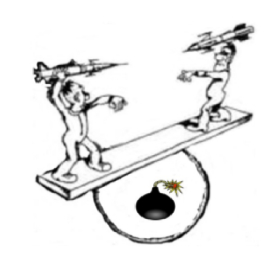
Here’s the segue to the earlier picture of teeter-tottering adversaries engrossed in murderous enmity, oblivious to the live grenade beneath them, threatening both with extinction – the final oblivion.

see saw & bomb sized

There are several different directions this can take. I’ve narrowed the choices to three. Because I’ve already written on this in Rethinking Survival, I’m just summing up major points here. In each case, ongoing Ferguson events and the escalating outpouring of opinions make my point – in spades.

1. Most of us are ignorant of the natural law encoded in the Book of Change. We are (almost as if intentionally) left in ignorance of how we tick at an energetic/emotional level. By extension, we act in ignorance of the human dynamics that drive human relationships, from families to governments and international conglomerates. For this reason, we fail even in sincere efforts to create the positive change everyone wants, many promise, but few deliver.

To me, the invisible ticking time-bomb (threatening both missile-throwing rivals without prejudice) represents volatile unconscious energies. Politicians, marketers and their handlers know how to set them off. They intentionally fuel and harness mindless animosities to enrich military armaments industries and their stockholders, to the danger (and impoverishment) of the rest of us.

2. Especially in the case of Ferguson, the volatile mistrust and empty slogan throwing are grist for escalating police-state dynamics which threaten the freedom of ALL of us. We’re pointed, goose-stepping towards the creation of another fascist state, all in the sentimental double-speak names of freedom, human rights and “justice.” Ironically, the USA is tied in knots. Bottled up long enough, the inarticulate, volatile aspirations and frustrations of the coiled rattlesnake explode, heedless of what targets they destroy –or what the long-term consequences. Oppression of an even more nightmarish form is in the works, being fueled, ironically, in the name of resisting and ending oppression.

3. A critical key is the prevailing dysfunctional empirical science paradigm to which most of pay token lip service. It disallows the existence of not only the subliminal level of emotional content that underlies rational thought and action, but also the deeper core of True North reality called conscience, or the True Self.

Without the Positive Paradigm of Change, we’re stuck, operating blindly without a complete and accurate road map. Even when we have the intuitive experience of the middle and innermost levels of the Life Wheel, we don’t have permission/confidence to know what we know.

We haven’t been educated to recognize the sleeping dragons that move us. We remain ignorant as to how to effectively harness them so they take us in the direction of the positive change we ardently desire.

Further, we don’t recognize when/how others intentionally manipulate our unconscious drives, and NOT in our best interests. We don’t have the means for protecting ourselves from manipulators and their dark intentions.

Nor is this lack of a functional, positive paradigm and its related methods/protections an accident. The information is available. But creative, useful work is systematically banned from public awareness. A positive paradigm is our best interests, but NOT in the interests of those who profit hugely from systematically manipulating the public.

I warned about Bernays and the illusion of democracy in Rethinking Survival. As yet, no one has paid attention. Why not is explained in an eloquent blog (to the same point) by Charles Cawley called “Americans: happy to be manipulated?” posted 11-25-14 on writerbeat.com. It’s but a small leap to connect the dots between dishonesty (disinformation, manipulation, culturally reinforced ignorance) and the outcomes, like Ferguson and its ripple effect in all directions.

Cawley writes, in part:

The principles of Behaviorism developed by BF Skinner and Bernays are key to the foundations of modern advertising, business practice and politics.. . Cosmetic politics have created a generation of reactive politicians who second guess what will appeal to voters and say what is needed to get people to vote for them. This can include significant dishonesty. This process is reactive and marginalizes or even excludes new ideas, policies, and creativity to provide solutions to current economic and political issues. . .

The issue of propaganda is immense and desperately needs urgent attention. However, vested interests have heavily bought into the manipulative dishonest approach to propaganda (a la Bernays and Skinner) and they are a major barrier to engaging with the future. . . . they appear to be destroying democracy. How much more serious can you get than this?

Cawley repeats my frequent warning, WAKE UP!

If we do not wake up and replace manipulation to engineer obedience with stimulation to work well events will crush us all.

It is as serious as that.. . . We have the choice to end this delusional activity ourselves or let events do it for us. The latter will be an immeasurably more costly, painful and bitter experience. This is the dark negative heart of behaviorist manipulation.

I go one step further.

It’s not enough to pinpoint the dynamics of manipulators and their smoke screen of disinformation. A remedy in the form of correct and positive information – a complete and accurate reality map – is also required. False information must be rooted out; it must then be substituted with a practical, useful replacement.

In sum, we’re sitting on a time bomb and fail to recognize it. We’re distracted by dramatic, polarizing events which mask the deeper dynamics and inherent danger to us all. To repeat Einstein’s warning, “We shall require a significantly new manner of thinking if mankind is to survive.” I agree with Cawley. It’s that serious. Human survival is at stake.

dragon-green-sized

Authentic Friends Are Rare & Precious


friend.jpg

When I asked myself what I’m most grateful for this Thanksgiving season, a recent walk through the Hill Top woods in Spring Green, Wisconsin instantly came to mind. Sunny but crisply cool, the fall weather was perfect. Colorful turning leaves were at their brilliant best.

I hadn’t seen long-time friend Janelle Fritz for thirty years and counting. But it could have been yesterday. Authentic friends are like that.

Why did we come together again now? Long story.

On the surface, the catalyst was a note I sent while she and husband Ty were still wintering in Arizona. I had expressed my thanks to his father, Herb Fritz, in the dedication of Rethinking Survival, I told her. Further, in the autobiographical section, I wrote about his being the sole survivor and witness of the 1914 Taliesin massacre, as well as about performing string trios at Hill Top with Herb and his sister, Frances Caraway. I wanted Ty and Janell to know about the dedication first, from me.

On that October day, there was much catching up to do. Words came easily on both sides, punctuated, of course, by spontaneous bear hugs.

I was fascinated to find out that she too is a good friend of the I Ching. Or perhaps, better put, the Book of Change has been a good friend to her. Like me, she has repeatedly turned to the Wilhelm/Baynes edition over the years to survive seriously challenging, tough times. It has served to keep her pointed steadfastly towards her inner True North.

Though I never doubted the outcome, still I rejoiced to see that she’s weathered her personal storms wonderfully and has become even better for them. It’s apparent that this tiny woman (even smaller in size that I am) is the true backbone of her family. And I said so! (Sometimes it helps to hear it from a friend.)

Since our walk, I’ve been reading Bill George’s books, including True North and Authentic Leadership. They describe Janelle to a Tee. She’s centered in her True North. In direct, simple terms, she’s an exemplary authentic leader. Her beliefs, words and actions are consistent across the board. She’s devoted to her family, becaring not only Ty, their sons and now grandchildren (WOW!), but also her sprightly mother-in-law, Eloise Fritz, who’s now 89 years-old.

Janelle was a dancer. In Arizona, she told me, she owned and ran a dance studio. Like Eloise before her, who ran a girls camp at Hill Top, Jan’s purpose was to encourage and bring out the best in young women. Horse riding and dance were incidental to the deeper, soul purpose of their businesses.

We both, Janelle and I, have given up our early avocations. She couldn’t understand, at first, how I could give up music. It was only when I explained it in terms of her releasing the dance studio that she recognized the common thread.

I explained the change in I Ching terms. “The larger the front, the larger the back.” And “Every extreme turns into its opposite.” The benefits – the front side – of the music were enormous. As a child, I lived and breathed in continuous joy. Immersed in music, I was shielded from the dark side of living in a dysfunctional family on a dysfunctional planet.

Music taught me many important life lessons. As Einstein observed, discipline learned through violin practice came much easier than it would have through harsh obligation. Playing in string ensembles and orchestras was a model for cooperation as well as for following the single lead of a conductor.

Music eventually led me, via Menhuin students, to yoga, complimentary medicine, and the scriptures which teach methods for actualizing the Unified Theory reformulated by Einstein. Like every discipline studied with love, focus on music led me deeper, first to the physics and then to the origins and mysteries of sound.

Sufi Inayat Kahn, the great sarod player, explained how this can be. In Music, he wrote:

The art of music has been especially considered divine, because it is the exact miniature of the law working through the whole universe. For instance, if we study ourselves we shall find that the beats of the pulse and the heart, the inhaling and exhaling of the breath, are all the work of rhythm. Life depends upon the rhythmic working of the whole mechanism of the body. Breath manifests as voice, as word, as sound; and the sound is continually audible, the sound without and the sound within ourselves.

Inayat Khan became a role model. As a teacher and author, he himself became the instrument. From his example, I recognized that, like him, I had to give up that which I loved most, my brown-blond,1776 Mathias Thier violin, to go beyond it.

It was necessary because the back of the coin was as great as the front. Over time, the blessing had changed into its opposite. Once the lessons had been learned, holding on to their vehicle would have held me back. I was not only shielded. I had become oblivious to the rest of the world and the responsibility to serve. Music had become an addiction and an obstacle to further, necessary growth.

But, as Janelle was quick to point out, Nothing is ever lost. Only changed. Everything cultivated as a musician is now funneled into the writing. I’ve become the instrument of the ideas that kept me focused True North even during confusing, difficult times. Now I weave in the music of language using the medium of a computer keyboard.

Similarly, Janelle and Ty have dedicated their Hill Top inheritance from Herb and Eloise to building a community center where people gather to honor the passages of their lives. They come to celebrate weddings and return to commemorate their milestones, including anniversaries. Life continues to evolve. We change, yet the True North of constant friendship remains the same.

For that I am abundantly, infinitely grateful.

globe

Survival Basics We Didn’t Learn in School – But Should Have!

Thinking – really thinking – about way the world works and how we fit into it is essential to human survival. This, in large part, depends upon careful, conscious use of the primary tools of logic and language.

Digging deeper than programmed assumptions to understand what we truly mean is one of the basic skills we never learned in school, but should have! Being able to clearly express our concerns and insights is equally important.

This includes knowing the precise definitions of words – how we intend them, as well as the many ways they can be misconstrued by others who use them differently.

Each of the 64 Essays in Conscience: Your Ultimate Personal Survival Guide addresses the Tower of Babel dilemma, where it’s shown that the words we use every day have devolved to mean one thing as well as their opposites. Each Essay highlights the many different meanings assigned to a single, key concept in the English language. Each then focuses on the word’s use in the context of the natural law encoded in the Chinese I Ching.

Westerners, for the most part, remain ignorant of the order implicit in dynamic natural law, as well as the critically important, two-way role it serves as the “middle man” gatekeeper between human and divine law. We suffer the adverse consequences of this blind spot in every aspect of our lives. Unfortunately, even many urban, “modern” Asians seem to have become disconnected from their wisdom roots.

The following is one example: the word ORDER.

As with each of other 64 key terms, its meaning is illuminated by placing gradations within the levels of the Life Wheel. The first principle of Dr. Kushi’s “Principles of Order of the Universe” acknowledges the ONE which resides at the timeless center hub of the Wheel. Infinity is represented by its creative extension process, with its alternating, rhythmic expansions and contractions. The outline below could be expanded and elaborated upon in volumes, and still barely touch the surface of the implications.

Forthcoming blogs will elaborate on the basic principles of universal order which we should have learned as the basics in school and need to know NOW, as an urgent matter of survival.

globe

29. ORDER

Principles of the Order of the Universe:

1. Everything is a differentiation of ONE Infinity.

2. Everything changes.

3. All antagonisms are complementary.

4. There is nothing identical.

5. What has a front has a back.

6. The bigger the front, the bigger the back.

7. What has a beginning has an end.

8. Nothing is solely yin or solely yang.

9. There is nothing neutral.

10. Large yin attracts small yin. Large yang attracts small yang.

11. Extreme yin produces yang, and extreme yang produces yin.

12. All physical manifestations are yang at the center and yin at the surface.

— Michio Kushi, Natural Healing through Macrobiotics

In the secure, high-synergy societies, wealth gets spread around, it gets siphoned off from the high places down to the low places. It tends, one way or another, to go from rich to poor, rather than from poor to rich.  — Abraham H. Maslow, The Farther Reaches of Human Nature

When evil men plot, good men must plan. . . When evil men shout ugly words of hatred, good men must commit themselves to the glories of love. Where evil men would seek to perpetuate an unjust status quo, good men must seek to bring into being a real order of justice. — Martin Luther King, Jr., The Words of Martin Luther King, Jr.

THE FRONT

Roots of order mean straight, row, or regular series. The first of Webster’s seventeen definitions is a social position or rank in the community. Order means a state of peace or serenity, observance of the law, or orderly conduct. It can refer to the sequence or arrangement of things or events, a series, succession. [As in, “Order in the court room!” or “It’s time to put your affairs in order.”]

Order can refer to a fixed or definite place, system or law of arrangement. It can refer to a group or class of persons set off from others by some trait or quality. It can mean a group of persons constituting an association formed for some special purpose, like the Order of Knights Templars, or a community of monks or nuns following a rule.

Order can refer to a group of persons distinguished for having received a certain award or citation. Order can mean a general state, as in “not in working order.” It can mean a command, direction or instruction, usually backed by authority. It can mean an established method or system, as of conduct or action in meetings or worship. It can be a request or commission to make or supply something, such an order for merchandise or services.

In I Ching context, order refers to the sequence in which straight and divided lines are placed in the three-line trigrams which represent the eight building blocks of nature. Alchemical interactions amongst these primal natural forces are mapped by pairing trigrams in every possible combination. The 64 six-line hexagrams which result are placed in ordered matrices, sometimes encompassed by a circle. Different sages place these figures in different order with different effect.

However, any or all of the lines within each six-line configuration can change to its opposite. So the myriad possibilities inherent in any circumstance have the potential to shift in an infinite number of directions.

The implication (and opportunity) is this: Despite appearances, nothing within a given situation is static, nor can the fluid, dynamic permutations of change be controlled or foreseen. Put another way, those who understand how to work with the laws of change can use them to advantage, accepting that no situation, no matter how dire, is either hopeless or without useful possibilities. Order lies in the process, not immediate specifics.

Cutting edge physicists continue to probe the order of the universe. In The Elegant Universe, Brian Greene builds on violinist Einstein’s vision, describing the string theory which “can heal the breach between gravity and quantum, unifying all of nature’s ingredients.” His book is recommended to those who “want to get a real appreciation for the amazing miracle that the universe is.”

The I Ching is recommended for the same reasons. Its advantage over modern physics is first that it is time-tested and proven, second that its careful use over time can bring abstract intellectual theories closer to home, making them applicable to immediate, practical concerns. For it is only with a profound understanding of how the world works, that these dynamics can be applied to establish communities like those envisioned by Maslow and King, where equity and justice prevail.

THE BACK

In biblical context, the shadow side of order is chaos, the primordial state which predates manifest creation. This is different from the chaos physicists study, which refers to turmoil or dynamic instability within which humans have not yet recognized inherent order.

In social context, rigid caste structures based on blood lines or material possessions are perversions of the dynamic natural order. Pigeon-holing or excluding people by race, age, gender or economic status is a competitive strategy; it has nothing to with inherent divine order, human potentials or functional competence.

The Evolution of My Aspirations

Leaders can’t be defined by a standardized, one-size-fits-all list of traits. This is the premise of True North: Discover Your Authentic Leadership. Instead, authors Bill George and Peter Sims found that authentic leaders consistently define themselves in terms of their unique personal stories.

Naturally, they got me to asking myself, what’s mine?

There definitely have been defining moments. Looking back, there have also been consistently recurring themes.

But it took a recent direct message from a new twitter follower to put my answer into focus. Chelsea Hanson, a Business Growth Coach from Green Bay Wisconsin tweeted, “Great to connect . . . I love learning about how people got started in their work. . . how did you get into what you are doing?”

I tweeted back, “Likewise! 🙂 Step by little step. Pieces of mosaic fall into place to form the patterned picture recognized only with hindsight.”

It’s been my consistent belief that, of all the things I could do with my life, I should choose that which does the greatest amount of good for the greatest number of people. With that standard in mind, my aspirations have been shaped and transformed, expanded and focused with each new experience.

The autobiographical section of Rethinking Survival describes early influences. It started with Miss Elson, my senior year English teacher.

Though I didn’t take her seriously at the time, Miss Elson told me I should be a writer. My answers to her essay questions showed the marks of an original thinker. In contrast, she let me read a batch of classmates’ papers to demonstrate the mindlessness she labored to shake up.

What is life?” she asked. Like wind-up toys, most regurgitated definitions memorized in biology class. Catholics added their church credo to the mix. From her I learned that there’s more to being human than the ability parrot others’ words. It includes the capacity to reason and articulate clearly.

Later, while I was earning an M.A. in English M.A. at the UW-Madison, my aspiration was to be like Miss Elson. Without the tools of language and logic to analyze experience and express one’s concerns, how could people name, much less solve their problems? At the time, the highest calling I could imagine was to teach students how to think — really think — for themselves.

My aspirations continued to evolve as a music student in Düsseldorf, Germany. For me, the highlight of studies at the Robert Schumann Konservatorium wasn’t the music teachers, but a modest, insightful kinesiology instructor. Frau Lehru wasn’t a musician herself. But vocal and instrumental teachers alike sent students beyond their help to her.

The pianist whose lessons were scheduled the hour before mine told me her story. Herr Dreschel had given up on her as either lazy or untalented. But Frau Lehru diagnosed the real problem — pinched spinal nerves. Recommended visits to a chiropractor worked “miracles.” Elated, she was a “new person.”

I went to her studio and asked Frau Lehru to coach me. Her lessons were wonderful. She saw timidity in my posture and tension in the way I held my violin. She gave me exercises to correct not only my posture, but the underlying attitudes which bent me out of shape.

“Platz machen,” she encouraged me. “Make room! Don’t crowd me!” And, “Auf wiederstand waschen.” Figuratively, Grow upwards. Stand tall under the pressure of resistance and adversity.

In retrospect, it was as if she’d reinvented the yogic disciplines which sitar and tabla students are taught in India, where music technique is balanced with breathing and physical exercises. Her gift inspired a change in my career goals.

Rather than teach technique, I could help many more musicians by becoming an exercise-and-therapy coach in one, like her. She was much too busy to consider writing about her methods and results. I would do this for her with a book called The Body as Instrument: How to Tune It.

Still later, ratcheting up another notch, I aspired to build schools to facilitate an entire generation of coaches like Frau Lehru. A primary purpose for earning the Ph.D. in Educational Administration from the UW-Madison was to hold the credential required to build an accredited alternative school. My envisioned School-Without-Walls was intended to serve the unmet needs of other boundary-spanners also seeking to fill in the gaps of our failing educational system.

Each new experience has continued to lead to the next. Many steps later, I’ve come full circle to fulfill Miss Elson’s early prediction. Today, I’m a writer because I’m certain that I’ve succeeded in putting my finger on the pulse of a critical information deficit. It explains the excruciating painful, potentially fatal world-wide leadership deficit.

Further, I am certain that the Positive Paradigm of Change not only fills a critical information gap in the way we train our leaders, but that, like a laser beam, it illumines every field of endeavor towards which it’s pointed. This includes not only leadership and governance, but also education, the arts and sciences.

Today my aspiration is for this information to reach the greatest number of people possible, in order to do the greatest possible amount of good. The stakes could not be higher, for I take Einstein’s prophetic warning deeply to heart: “We shall require a substantially new manner of thinking if mankind is to survive.”

If you agree, and if you can help, let’s talk!

globe

The ELEVENTH HOUR

11th hour sized

In drafting “Do You Have the Time?” I brainstormed all the possible ways this seemingly simple question can be taken (and mistaken). Different interpretations yield significantly different answers.

I also browsed for clip art clock faces to illustrate my point. Coincidentally, the one I chose adds yet another perspective, giving the question a deeper, philosophical meaning: “Do you know what time it is in your life?”

What stage of personal evolution / growth are you going through now? From a larger, historical perspective, what point in its life cycle is your business, nation or even the world experiencing today?

The pictured clock face shows the stage many say the world is now in: its eleventh hour.

Even then, there are different views as to the best way to respond to being at the eleventh hour in human history. The cliché is currently used to mean “running out of time, at the very last minute, or almost too late.”

But biblical origins of the cliché offer an alternative viewpoint. In Matthew 20: 2-16, laborers hired at the last, eleventh hour worked for only an hour. But at the end of the day, they received the same reward as those hired early in the morning, who had worked all day.

Christ’s parable of the eleventh hour epitomizes the hope humans have in God’s compassionate mercy. It’s never to late to change. It’s not over til it’s over.

(Of course, there is no such thing as coincidence.)

globe

Do You Have the Time?

Early this morning, I was startled awake by a cell phone alert. The power was out – for a second time. The first outage occurred over night. I was still asleep, so didn’t know the difference.

Roommates who commute long-distance to work got started just before the electric garage door came to a standstill. (They don’t know how to open it manually.)

Emergency protocols immediately kicked into place. I reached out in the dark for my wind-up flashlight. It was where it should be, on top of the disabled alarm clock. It supplied enough light to find a second, larger LED flashlight. It too was where I expected, on my work desk next to the powerless computer. I made my way carefully down the pitch black stairwell.

Next: get the battery-run lanterns out of storage. In one, the D-cells had gone dead. Look for back-ups.

Fortunately, there’s a battery-run wall clock by the main office door that keeps accurate time. Which is the subject of this post. “Do you have the time?”

Have you ever thought about how many different ways there are to answer this seemingly simple question, “Do you have the time?” My smart-mouthed high school friends, for example, would have answered, “If you have the nerve.”

The most straight-forward response is to look at a time-piece and give a literal answer. It’s 6:30 in the morning.

Alternative answers go along the lines of, I don’t have enough time . . . . to get the many tasks that need doing done well . . . to take care of my health . . . to check in on elderly relatives. Etc. etc.

Philosophical answers might include regret for the shortness and uncertainty of life. “Here today. Gone tomorrow.” Or, as the carved and painted wood plaque over my Grandfather’s fireplace mantle put it, “We get too soon old, and too late smart.”

Which brings me back to the point where I left off in the last post, “Rethinking Our Common Humanity:”

While we all have the option to remember who we truly are, most of us are like Lambert, the sheepish lion. It takes a smack with a two-by-four upside the head before we’re finally ready to WAKE UP.

Often it takes the form of life-threatening danger to those we care for. A personal health crisis will also do the trick. So will job loss or a run-in with natural disaster. But, like Dorothy stranded in the Land of Oz, when you want dearly enough to return “home,” you can click your heels whenever you chose — and come to find out, you’re already there.

Most of us live as if today will last forever. We prefer to live in the moment. In part, this is a good thing. The mindful focus of a “Be here and now” attitude allows us to savor our immediate blessings.

However . . . on the other hand, heedless lack of foresight can have extremely dangerous consequences.

Tomorrow and tomorrow and tomorrow add up, inevitably sneaking up from behind like a thief in the night when least expected. (And not just a temporary power outage like this morning. Think Pompeii.)

Impending disasters, even those right before our eyes like handwriting on the wall, can catch the unprepared off guard, robbing them of the precious time which could have been used to wake up from their deep soul sleep and re-member who they truly are.

I understand. Given today’s economy, many have little choice but to live hand-to-mouth. Check-to-pay-(or welfare)-check. Even the well-off who could afford to prepare are besieged with putting out day-to-day fires — or by other glittery distractions.

There’s no time or energy reserved for assessing possible risks. It’s not a priority to think through “If / Then” preparedness scenarios.

I find it most peculiar that even Millennials, who have grown up fluent in computer-driven technology, usually don’t apply if / then computer logic to their personal decision-making and daily behavior. This makes them even more ill-equipped than their elders to cope realistically with sudden change.

For example, in a personal email sent in response to “Give Millennials an App for Their Inner Compass,” Tom Richards detailed his frustration with Millennials:

I live in NJ where Hurricane Sandy hit dead center. Devastation like you would not believe. No power in most of the state for over 8 days. Here are actual examples which I came across immediately following the storm . . .

1. An hour after the storm ended, early in the morning, a car load of kids in their mid-twenties got stuck in a washed out piece of road in front of my house. No power, of course, and trees down everywhere. When the kiddies came to my door to ask to call for a tow truck, I had to laugh. When I asked them why the hell they were out on the roads, in their PJ’s none the less, immediately after the storm of the century, I got this. “We don’t have power and want coffee and breakfast. We are going to WaWa to get some.” Didn’t even dawn on them that if they have no power, and the state has no power, the WaWa doesn’t have power. Nor did it dawn on them that with the storm and devastation, that the people who work at WaWa would not be able to go there and open it for them.

2. Three days later the local farmers market opened, even though they only had power to keep the refrigerated items going. No power within 3 counties at this point. A young couple who lives two doors down needed food. Went to the market and came home empty handed. They had no cash, and the store was obviously only able to take cash. They pay for everything with their debit cards. Never dawned on them to have some cash around for emergencies and things like this. They were mad that the store wouldn’t sell them anything nor that they couldn’t take the debit card. It also is interesting that they never even thought to prepare even though warnings were given over and over.

3. My daughter and her friends were hungry. Her friends hadn’t had a hot meal in days. Plus, it had gotten cold and most had no heat. They came over to our house. Saw we were using my wood stove in the music studio to cook on and stay warm. It never dawned on them (or their parents, which frightened me) to use their BBQ propane grill or make a fire to cook with nor to build a fire in their yards to at least get a bit warm.

4. Just about every traffic light was out, and roads were blocked by either police or downed trees. I cannot tell you how many younger people stopped in front of my house when they saw me there to ask me how to get to a certain place, and also how many could not understand when I gave them road names where those roads were. . . .

What most amazes me is that repeatedly, after each disaster, whether natural or man-made, in media interviews, the “victims” chant the same mantra. “It was a WAKE UP CALL.” But life goes on. After the initial shock wears off, people get mired once again in the routines of daily living. And they forget. They go back to sleep.

We aren’t changing! And time is running out. As the late computer leader-innovator Steve Jobs poignantly observed:

Your time is limited, so don’t waste it living someone else’s life. Don’t be trapped by dogma – which is living with the results of other people’s thinking. Don’t let the noise of other’s opinions drown out your own inner voice. And most important, have the courage to follow your heart and intuition. They somehow already know what you truly want to become. Everything else is secondary.

Time is a blessing and a luxury. None of us knows how much time we have left to WAKE UP, think, prepare, and perhaps survive whatever is to come.

Commenting on “Change the Rules of the Knowledge Game,” Peter Fellingham gave his opinion:

Another reason why people avoid critical thinking is because it usually results in significant introspection. Introspection tends to make clear the responsibility the individual has for the resolution of their own troubles.

I answered back:

Peter, you’ve pinpointed the blind spot in curriculum — the information deficit of which I speak. Clear & critical thinking isn’t often taught in schools, nor are problem-solving tools provided as essential basics. They should be.

Then there’s the question of motivation. Requires a carrot & stick approach. The stick is awareness that laziness comes with horrific consequences. The carrot is assurance of the benefits which accrue to living a self-responsible life.

In part, people often avoid issues they find too fearful to face. If there truly are no better options, and only dangerous consequences, keeping still is an understandable choice. However, if better options ARE available, then making them known and available is an important first step in positive change. That’s what I’m working to accomplish.. . .

So, if you and/or those you lead and care for have been avoiding introspection, if you’ve been ignoring the warning signs and denying fears for the future, waiting for dangers to miraculously disappear and problems to be solved without effort, it’s time to take the striking two-by-four hint from escalating wake-up calls worldwide.

It may be a matter of survival to rethink priorities while there’s still precious time left to do so. Ask, If not now, when?

And consider the likelihood that the life / family / organization you save may be not only yours, but those of generations to come.

To Survive, Change Your Rules

Expanding Rules of the Knowledge Game would give problem-solvers greater leverage over a wide range of social-political malfunctions, from budget deficits to crime (legalized theft included).

A wider field of accepted information options would give a broad new range of diagnostic tools for pinpointing origins of unjust discrimination, inequitable wealth distribution, work-place violence, addictions and mental-emotional depression. It would give a new face to healing PTSD and preventing suicide.

What these personal, social and political ills have in common is a fatal knowledge deficit.

But before defining Rules of the Knowledge Game (epistemology), I’ll share two examples from personal experience. They’re comical, but they demonstrate the basic mistakes people make on limited information.

The first occurred when I was 6 and my brother David was 5. We were living in Tuscon, Arizona at the time. A blond-haired playmate age 3 who lived down the street adored David. Jason pleaded with his mom for a hair cut just like David’s. He expected the change to transform him into the likeness of his idol. But he came home from the barber streaming tears of childish disappointment.

The brush cut didn’t change his hair color from blond to David’s dark brown, nor did it transfer any of the desirable qualities associated with his hero to Jason.

The second happened when I was in my mid-20s. Rooming with a yoga student in Madison, Wisconsin, I was increasingly troubled as more and more of my stuff – kitchen utensils and even clothing – went missing. When I asked Mukit (her initiate name) if she knew anything about this, she explained why she felt free to take whatever she wanted.

“We are all One,” she said. By her logic, it followed that my stuff was hers too.

These are just small examples of the twin mistakes that continue to repeat when our reality maps aren’t complete and accurate. Writ large, they generate crimes and tragedies in every area of life, on every scale of magnitude.

What is lacking is the two-directional, in- and out-breathing reality map which accounts for all dimensions of personal experience and puts them in prioritized perspective.

Today’s prevailing Rules of the Knowledge Game exclude vitally important components of the human condition. Here, “Rules of the Knowledge Game” refers not to philosophical inquires into truth, but rather punitively enforced social-political taboos which prescribe what can be known, by whom, and how.

These rules stipulate what kinds of knowledge are allowed as well as others that are prohibited. Knowledge is sometimes made off-limits to second-class citizens (low income people, for example). Subtle ways of obtaining information (intuition, conscience) are written off as non-existent or invalid.

Here’s the tacit logic behind limiting the field: “Knowledge is power. IF I want to hoard power (and the resources it yields) in order to control others, THEN I must deny others access to knowledge that would empower them.”

To heal the harm incurred by limiting what can be known (ruling out the senses, intuition and conscience as valid information sources), it is imperative to reintegrate these decision-making influences into the rules of what is acceptable.

Currently, rules of empirical science dictate that only knowledge about material, tangible, observable and quantifiable objects is valid. Only university educated, degreed and certified “experts” using standardized research methods are qualified to obtain and disseminate knowledge. Here’s the picture of the hollow shell allowed by these rules.

material rules sized

Please don’t get me wrong. I’m not saying this approach to obtaining information is invalid. In its place, on the surface of material appearances, it is an important piece of the knowledge puzzle. It’s a necessary balance to the opposite and equally exclusionary “religionist” mistake of elevating inward experience to the exclusion of the material world.

BUT, however necessary, it is not sufficient.

Throughout his lifetime, both in personal experience and professionally, the pioneering Swiss analyst Carl Jung dealt with the suffering caused by squeezing the richness of life experience into this hollow mold. As a matter of personal sanity and social health, he advocated “individuation” as a process for reintegrating all the layers and levels of life into conscious awareness.

The Life Wheel compliments Jung’s work. It can be used as method to assist in this process of making the unconscious conscious, of restoring access to inner knowing that has been repressed by socialization, including education.

Here is a picture to show you what I’m getting at:

Wealth.sized

On the outward path, the individuation process differentiates the individual from the universal center. It integrates timeless unity with the outward layers of idea, energy, action and results. This was the reality check Mukti needed – a correct picture of where my personal boundaries began and hers ended. We are one at the center, but not on the surface. It was NOT okay for her to take my things.

On the inward, return path, the individuation process reintegrates personal, separate identity with awareness of the timeless, universal source. This is what Jason lacked – a concept of his own inherent value, independent of the people. events and circumstances around him. The qualities he admired in David weren’t defined by physical attributes. Looking on the outside for the inherent self-worth he already had on the inside was a sure recipe for disappointment.

What is needed to change the Rules of the Knowledge Game is access to a useful reality map, one that includes the whole of human experience, one that is easily converted into a practical diagnostic and decision-making tool. That is the purpose of working with the Life Wheel. It can easily be personalized to ask, “Where in the Wheel Am I NOW?” — “Where Do I Intend To Be?” — and then decide – “How Do I Get from Here to There?”

Expanding Rules of the Knowledge Game to match the whole of life can be a matter of life or death. For example, just as 3 year-old Jason tried to acquire my brother’s virtues through imitation, David, in turn, copied his dad. As a Yale grad, David chose to become a physician, following in the footsteps of our Harvard-trained cardiologist father.

David too accepted the scientist’s belief that exclusively empirical science can explain everything. He dismissed other approaches to knowledge as ignorant superstition. He rejected as quackery my quest for deeper knowledge about the origins and purpose of life.

I dearly hope when when faced by extreme adversity, he’ll not, for lack of inner awareness, make the same choice his medical role model did.

When we first found out in the year 2002 – 50 years after the fact – that Kirby hadn’t died of a sudden heart attack (as we grew up believing), that he died from a self-inflicted gunshot wound to the back of the head, my younger sister Annie was instantly reminded of a haunting poem by Edward Arlington Robinson.

Whenever Richard Cory went down town,
We people on the pavement looked at him:
He was a gentleman from sole to crown,
Clean favored, and imperially slim. . . .

. . . he was rich – yes, richer than a king –
And admirably schooled in every grace:
In fine, we thought that he was everything
To make us wish that we were in his place.

So on we worked, and waited for the light,
And went without meat, and cursed the bread.
And Richard Cory, one calm summer night,
Went home and put a bullet through his head.

This poem dramatizes the saying, “Appearances are deceiving.” The key difference it illustrates is this. Those who endured external adversity by patiently waiting for the light survived. Whereas Cory, who seemed to “have it all,” lacked awareness of the inner resources needed to cope with hidden suffering.

Without the confidence that comes from inner wealth, all the riches in the world cannot withstand the despairing, dark of night of the soul.

In sum: the first front against suffering remains knowledge. Knowledge – complete and correct – is the beginning of empowerment. Ultimately, changing the Rules of the Knowledge Game is matter of personal as well as human survival.

globe

Happy One-Year Anniversary

October marks the one-year anniversary of the +A Positive Action Press WordPress website, RethinkingSurvival.com. Looking back, I’m amazed at the way daily, incremental baby-steps have added up.

With the help of (sometimes) forbearing computer savvy friends, I’ve gone from cut-and-paste technology to working with a photo-shop clone to produce illustrations. Starting with no marketing skills and less interest, I’ve swallowed my pride and actually gotten interested in the process. From being overwhelmed by Twitter, I now really enjoy direct messaging with savvy, fun new folks. Certainly limiting myself to messages of 140 characters or less has significantly altered my writing style for the better. : )

So tonight I thought I’d take a break from my current projects to revisit the Essay on Practice from Conscience. Written in the year 2000, it’s not in my current voice. But it speaks to my immediate appreciation for the benefits of daily discipline.

globe

27. PRACTICE

Each T’ai Chi movement is related to a particular hexagram of the I Ching. This relationship holds vital clues to a deeper understanding of Chinese thought which, like all valid world-views, is based on knowledge of the self gleaned from the practical experience of meditation. — Dal Liu, Tai Chi Ch’uan and I Ching: A Choreography of Body and Mind

Practice is essential. Through regular practice, you will become familiar with the feeling of being relaxed. You will find that you can achieve results with shorter and shorter practice sessions. You will become like a pianist who is ready to play a beautiful Mozart sonata as soon as her hands touch the keyboard. — Kenneth S. Cohen, The Way of Qigong

One should never rush in entering Taoism. . . One must proceed step by step, never advancing to the next stage until one is ready. One need not fret. If one discharges one’s tasks and proceeds with training perseveringly, then the transitions are virtually automatic. — Deng Ming-Dao, Chronicles of Tao

THE FRONT

Practice means to do or engage in frequently, make a habit or custom. It means to do repeatedly in order to learn or become proficient; to exercise or drill oneself. Practice is using one’s knowledge, as in a profession. To practice is to adhere to beliefs or ideals. It means to teach or train through exercise. An archaic definition suggests intrigue, trickery, or scheming.

Practice is closely related to the words discipline and preparation. It implies the ability to anticipate the future and make decisions about how best to make ready for it. It was the practice of Chinese emperors to consult ministers and sages for information on how to prepare for the future. They, in turn, consulted the I Ching to decide the best ways to adjust to alternating seasons of hardship and plenty in order to maintain social, political and economic equilibrium.

By biblical account, Joseph was sold into slavery by jealous older brothers and taken to Egypt. Thus, he found himself in the right place at the right time to fulfill his destiny. By correctly interpreting Pharaoh’s dreams, he saved countless lives, including those of the brothers whom he forgave.

He foresaw coming changes in nature and drew conclusions as to how prepare for the future. The practice of disciplined conservation during seven years of plenty allowed Pharaoh to feed his people during the seven years of drought which followed, thus preventing starvation, mass suffering and social upheaval.

Applications to current economic practices should be abundantly clear. Squandering resources during times of abundance is a sure recipe for famine, widespread misery and unrest when the rhythmic pendulum of history swings, replacing times of plenty with times of hardship. Wishing and hoping current “good” times will last forever because we want them to, refusing to heed clear warning signs that they never do, foolishly puts everyone at risk.

Music is a demanding discipline which emphasizes the importance of regular practice, preparing in advance to perform well. Similarly, martial arts instill respect for regular practice, cultivating the ability to adjust quickly and skillfully to sudden danger. In this case, the body itself is the instrument and tuning it a fine art. As Chuck Norris says, “Practice, practice, practice! Practice can save your life.” God forbid you’ll ever be attacked. But be ready.

Through the daily practice of meditation balanced by Tai Chi meditation-in-action, it is possible to make teachings real through experience, fulfilling the maxim “Learn by doing.”

Then, with sustained focus and loving attention, everyday activities and relationships are transformed into spiritual and martial arts training. Practice becomes a way of life, an ongoing proof of commitment in action. It’s not just a few hours set aside from the rest of the day. Nor is it to be flaunted, foolishly attracting envy and vengeance.

In Cleary’s translation of The Taoist I Ching, meditation and action alternating in rhythmic sequence are described as equally important complements. Inner stillness develops the abode of rest. Action completes and tests the abode of rest. Progress achieved by steady, gradual, consistent efforts accomplishes far more than dramatic spurts of activity that can’t be sustained over time.

Understanding the philosophy and science of the I Ching intellectually is relatively easy. Putting it into practice is more of a challenge. It’s not like something memorized for class, and then you’ve got it forever. It requires consistent attention and renewal, applying the readings to myriad kaleidoscope changes during the ongoing process of a lifetime.

THE BACK

The opposite of practice is lack of foresight and disciplined preparation for the future. Aesop’s fable of the race between the tortoise and the hare captures the difference between making steady progress toward a goal and the lazy assumption of inevitable victory, sleeping until it’s too late.

Enforced drilling is an inadequate substitute for intelligent practice. Mechanical repetitions without understanding and involved commitment are pointless. Repeating affirmations instead of taking positive action doesn’t produce quality results.

 globe