Category Archives: Uncategorized

The KEY That Reconciles Science & Religion

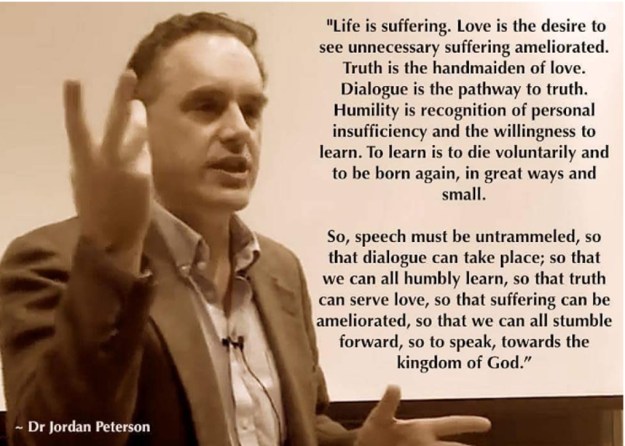
In Potential, a TEDxUofT presentation, Dr. Jordan B. Peterson pinpoints the historical cause of current mayhem: the rise of empirical science and its “shattering” effect on religious belief systems. As a result, our current definition of “reality” is dangerously skewed. He draws on Western poetry, psychology and the philosophy of religions “developed over thousands and thousands of years” to argue the case that there’s much more to “reality” than current assumptions allow:

If you follow the follow the thing that manifests to you as interesting, it will lead you through adversity, lead you to do things that are difficult [the hero’s journey] . . .

What will happen is that as you hit yourself against the world pursuing what you’re interested in, you’ll tap yourself into alignment. . . Your internal structure will become non-contradictory like the internal structure of a jewel, which is something that reflects light. It makes you hard and durable and able to bear the terrible conditions of existence without becoming corrupt.

He includes all the main elements of the Life Wheel. The “inner structure” consisting of conscience, light, strength, and unity of alignment – are all described in his linear description.

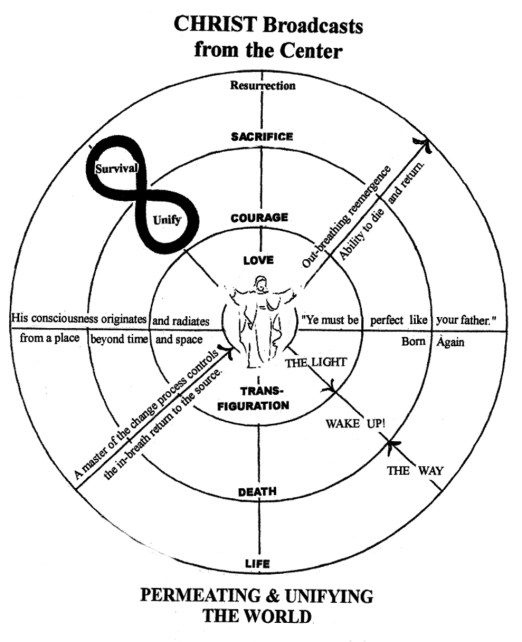
What I contribute to this vision is the picture of ever deepening concentric circles unified by an endlessly infinite loop that traverses and links them, center to surface and back to center.

In Scientists and Sages Can Agree on This, I describe the Wheel. It is not “new” nor is it arbitrary. It embodies the timeless healing solution to the relatively “modern” rift between materialist and philosophical definitions of “reality:”

The archetypal Life Wheel formulated as the Positive Paradigm of Change is a modern day descendant of the time-tested Book of Change which leaders in every field of endeavor have consulted for over eight-thousand years.

While true to the ancient teachings of India and China, it abstracts their essence in a simple and complete manner accessible to us today.

It places the three variables of Einstein’s famous formula, e = mc2 mass, energy and light, on increasingly deeper levels within the Life Wheel. The result is the Unified Theory which Einstein already had, though didn’t know it.

PPoC gold

The three outer levels are interrelated and interdependent. Each is necessary but not sufficient. Their existence depends upon the unchanging hub of the Wheel. The true SELF — also called Conscience, the Tao or God — holds the spokes together as events on the Wheel’s surface rim change continuously. Creation in the form of primal consciousness emanates from and returns to this silent alpha-omega center.

This wheels-within-wheels model

is equally compatible with modern physics, yoga philosophy

and the world’s great religions.

It is a reality map upon which scientists and sages can agree.

Complete and accurate, it meets the Occam’s Razor standard by explaining the totality of human experience with maximum inclusiveness and utmost simplicity.

In Rethinking Survival, I connected with the idea that the Life Wheel is the answer to the ancient Upanishad question: “What is that, knowing which, all else is known?” In essence, genuinely understood and implemented, it holds the KEY to Life.

The Positive Paradigm of Change can be personalized to facilitate positive personal change on all levels. Applied on increasingly larger scales of magnitude (to relationships, families, communities and organizations) it carries social implications in its wake.

According to Dr. Peterson:

Nietzsche said, “The person who has a Why can bear any How.” That’s a really useful thing to know. Because you think, well, we’re very vulnerable creatures. And our life ends catastrophically. Terrible things happen. How can we bear that?

The answer to that is, and always has been, that you have to be in synch with something that’s beyond you. Because that synchrony gives you the strength that you need to bear your terrible limitations.

The Life Wheel pictures the seat of Why and the place of How. It shows the eternal connection between individual, physically fragile life on the surface and the eternal Source within. However, the source of strength is not so much beyond as it is deep within:

The WHY at the center shines through every HOW, conforming WHAT on the surface to its inward vision:

  • Intuition fits within the WHY level of the Wheel. This innermost level of Light is associated with conscience, spiritual guidance and flashes of genius. Unless integrated with the ability to strategize and implement, however, vision and insights fail to manifest as practical results.
  • Emotions (including empathy) and strategy belong to the middle HOW level. The Energy layer is associated with action, street smarts and Emotional Intelligence. Magnetism and charisma emanate from this level, but unfortunately aren’t always integrated with integrity, intelligence or practical organizational skills.
  • Outcomes belong to the surface WHAT level associated with tangible, measurable results. The Mass layer is the realm of quantifiable IQ as well as biological family and social/political connections. Persona (mask) and personality are surface appearances. They don’t necessarily reflect actual motives and feelings. (This is why merely imitating the words and actions of great leaders doesn’t have the same affect).

Phoenix - sized

DYSFUNCTIONAL BELIEF SYSTEMS

Please stay with me. What follows isn’t necessarily sexy or fun. But it IS a matter of life or death. And the life it saves could be your own.

Technically, this subject comes under the philosophic umbrella of “epistemology” – the (highly politicized) rules of the knowledge game that prescribe who may know what, and how. Today, empirical science dictates that experience which is intangible and can’t be measured doesn’t exist – it isn’t real. In effect, conscience, intuition, compassion and gut feelings of the Life Wheel are ruled out. People who depend on those modes of knowing are invalidated and socially excluded.

Of course, saying inward modes of experience don’t (and shouldn’t) exist doesn’t make it true. As Carl Jung pointed out, repressing these intrinsic parts of the human psyche only has the effect of putting them outside of conscious awareness. Relegated to the “unconscious,” fragmented parts continue to operate out of reach, wreaking havoc on mental health, relationships and social systems.

Dr. Peterson is clear that our current course, driven by skewed belief systems, is fraught with dangers up to and including annihilation. In this, he echoes Albert Einstein, who, dreading the possibility of a nuclear holocaust, warned, “We shall require a substantially new manner of thinking if mankind is to survive.” Again, the Unified Theory and substantially improved (holistic) manner of thinking is hardly “new.” But it urgently needs to be restored to wide-spread, generally agreed-upon conscious awareness.

This urgency is underscored by Dr. Peterson’s point that competition between scientific and religious viewpoints resulted in large numbers of confused thinkers turning to substitutes for religion, especially to mass movements that are “erroneous in every way.”

Since the scientific age began, we’ve lived in a universe where the bottom strata of reality is considered to be something that’s dead like dirt. It’s matter. It’s objective. It’s external. There isn’t any element of it that lends reality to phenomena like meaning or purpose. That’s all been relegated to the subjective, and in some ways, to the illusory.

However, grave dangers flow from decisions and actions based on erroneous belief systems:

It really matters what you assume is most real, because you base the decisions you make that. You run the entire course of your life on those assumptions — whether you recognize it or not. And if you get the assumptions [basic axioms] wrong, or even if you leave them incomplete, you’re going to pay a big price for it.

Trade-offs have huge consequences:

The assumptions we use in our culture, although they’ve enabled us to develop a tremendously potent technology, are incomplete in ways that have cost us and that are extremely dangerous. . . A fair number of pathologies stem from assumptions of the systems they use to define reality.

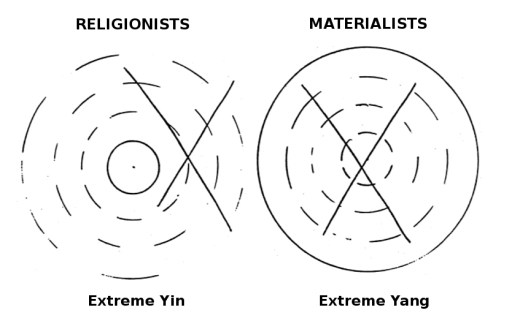
Here is my visual representation of the hollow, incomplete reality brought about by empirical science. It rules out the middle and central inward levels of a complete and accurate belief system.

MaterialistAthest

And here is a representation of resulting pathologies. The levels are out of synch, fragmented and disjointed. In “The Second Coming,” the poet Yeats mourned, “the centre cannot hold.” In fact, it is the other way around. The eternal center is, was and will always remain steadfast. It is we who have distanced ourselves from truth, blinded ourself to awareness of the unchanging. At terrible cost.

Stress

CONCLUSION

In the right hands, championed by well-known truth-speakers like Jordan Peterson and by the legion of folks who have grown to know, respect and love him through his good work, the KEY concept offers the world a way out of madness, an alternative path to the current course that leads to destruction and hell.

The question remains, how many truly want a positive, healing reconciliation of science and religion? How many are closed and committed to the path of ultimate destruction?

The worst case scenario is that members of fragmenting, polarized, warring factions world-wide are content to remain “conveniently” blind and deaf. They salivate at the visceral excitement of conflict, not to mention the greedy side-benefit of violence – looting (think Nazis dispossessing the Jews, Stalin robbing Russia’s Orthodox Churches, and Chinese warlords filling their coffers from the spoils of Tibetan temples). Heedless of the ultimate consequences, all-too-many are committed to killing each other off in uncivil wars, reducing the structures of civilization to oblivion.

My best case scenario and remaining hope is that those with the foresight to prepare will prevail. May they stay safely under the radar as long as possible. May the Angel of Death pass over their dwellings. And may they also be ready to fight and WIN when the time calls for them to take a stand. For God will be with them as they were with the psalmist/healer King David in battle.

Angel Calling

Rethinking SACRIFICE

After listening to Jordan Peterson’s Youtube video, The Great Sacrifice: Abraham and Isaac, I thought to revisit the Essay on Sacrifice written in 2000 and later included in Conscience: Your Ultimate Personal Survival Guide.

My document search stopped at Essay 7 on Authority. Lo. Not coincidentally, I found a quote which puts the Abraham story in larger context. It helps make sense of my approach, which sheds a different but helpful light on biblical traditions:

Christ was one of the greatest mystics of all time. He knew everything that has been ever said in the Eastern traditions.

When Moses asked God, who are you? God said, I AM that I AM.

Christ in the Gospel of John says, “Before Abraham was, I AM.”

The very word Abraham comes from the Eastern word Brahman, which means the primordial being. . . So when you start looking, as paleo-linguistic anthropologists do, at the common roots of the various religions and traditions, you find that it’s all universal. Truth has to be universal. It can’t be your domain or my domain.

In a more popular vein, when I think of sacrifice, trading the lesser for the greater, the Lovin’ Spoonfuls’ tune, Did You Ever Have To Make Up Your Mind, starts humming in my mind:

Did you ever have to make up your mind,
Pick up on one and leave the other behind?
It’s not often easy and not often kind.
Did you ever have to make up your mind?

Did you ever have to finally decide?
Say yes to one and let the other one ride?
There’s so many changes and tears you must hide.
Did you ever have to finally decide?

This is the essence of the life or death choice offered us in Exodus: Choose Life. “Return unto me and I return unto you.” It emphasizes travel on the inward path from surface to center of the Life Wheel, releasing attachments to ephemeral possessions, limited opinions/identities, and outgrown lifestyles.

Looked at this way, sacrifice isn’t necessarily a negative or hurtful experience. It can be positive change: expansive, illuminating, and in the long-term, generative.

book header bird

Essay 33. SACRIFICE

A balanced relationship between the individual and the whole is achieved through service in the spirit of SACRIFICE. Changing selfishness to compassion and acts of kindness builds bridges of mutual trust. Unselfish giving benefits everyone involved, helping the community to overcome obstacles and dangers. Avoid twin dangers: selfishness and self-denial. — Patricia West, The Common Sense Book of Change

A significant part of the existential suffering of life is the suffering involved in constantly discerning — or choosing — what we are responsible for and what we are not responsible for and maintaining a healthy balance. — M. Scott Peck, The Road Less Traveled & Beyond

The pain of verbal abuse goes deep into the self and festers there. . . Verbal violence all too often goes unrecognized, except at a level that you cannot even understand yourself. You know you are suffering, and you vaguely know where the pain is coming from; but because the aggression is so well hidden, you are likely to blame yourself instead of the aggressor. – Suzette Haden Elgin, The Gentle Art of Verbal Self-Defense

THE FRONT

The root of sacrifice means to make sacred. Webster’s first definition is the act of offering the life of a person or animal or some object in propitiation of or homage to a deity. It is the act of giving up, destroying, permitting injury to, or forgoing something valued for the sake of something having a more pressing claim. It can mean selling or giving up of something of less than its supposed value.

The Old Testament story of Abraham and his son Isaac in the mountains of Moriah deserves careful consideration in regard to sacrifice.

  • It’s about willingness to trade attachment and human love for the sake of fidelity to a higher calling.

  • It’s about faith that surpasses understanding.

  • It’s about trading earthly desire to perpetuate one’s life through transmission of genes for the abundant certainty of eternal life.

Abraham was tested to prove his fidelity to the voice of inner conscience, no matter what. The parallel to the life of Jesus is direct. Christ was literally sacrificed, but, paradoxically, like Isaac, lived on, albeit on a higher level.

Pagan sacrifice of children and animals is irrelevant to the meaning of Abraham’s test. At issue is the difference between transcending pain for the sake of higher love versus selfishly destroying life using physical, verbal and/or psychological violence, to get what one wants here on earth.

This distinction is relevant to prosperity courses which flirt with spirituality, but in fact tamper with Natural Law. In the short term, harnessing aversion to pain and desire for pleasure to get what we want may work. But where’s the wisdom?

Pain and pleasure motivate animals. However, the purpose of I Ching disciplines is to overcome such instinctive reactions. Pavlovian dogs can be trained to react automatically to programmed stimulation.

Humans, however, have the unique ability to reason. By choosing to remain steadfast in commitment and true to higher calling, we realize the priceless opportunity to overcome and transcend reactive pendulum swings of nature — pain and pleasure, attraction and aversion – to fulfill our innermost, innate potentials.

In this way, following the example of Christ, who sacrificed mortal existence for eternal life, we too can change, shifting gears, raising our focus from the material surface of the Life Wheel, then from the deeper emotional level of what we want, to the central core of what IS. This, ultimately, is the purpose of mastering natural change, and the gift which a profound understanding of the I Ching has to offer.

Similarly, working with the meta-reality-map — the Life Wheel — helps articulate, focus and accelerate the self-actualization process. It is KEY to fully understanding the multiple dimensions and meanings of scriptural events.

Saving the Best

It’s important to remember, however, that fidelity to calling is the standard. Whether or not one physically lives or dies is irrelevant. Bodhisattvas, for example, are fully-attained beings who have completed their life lessons here, but choose to remain on Earth in order to serve.

We each contain the seed potentials of our most admired leaders.

If we each dig into our own depths and live the promise now by following their examples, then hope could not be extinguished by killing single individuals.

If one person of conscience stands alone, one bullet can demoralize a nation.

If conscience informs the entire community, when one leader is struck down, two, ten or a thousand more come forward to continue on.

This is the fruitfulness promised to descendants of Abraham.

THE BACK

The opposite of sacrifice is attachment. Refusing to let go of outgrown beliefs — resisting change or hanging on to people when it’s time to move on in order to grow — is antithetical to the life process. Making a show of suffering, imposing obligations and guilt on others for what they’ve been given is false martyrdom.

Slaughter of animals or innocents to atone for one’s own sins is a perversion of sacrifice. It violates the sanctity of life and free will of others. Each of us is accountable for our own actions. Therefore, taking life can’t change bad karma. Instead, it compounds trouble.

book header bird

Paradigms Are a Matter of Life or Death

Jordan B. Peterson, psychologist, truth-sayer and rock star of recent months, said that the most important work that can be done is establishing the relationship between belief systems and the outcomes they generate. I agree.

BECAUSE:

It doesn’t help to tell people to follow their dreams, to be the best they can be, or that nothing is impossible with the right attitude. When they live in societies that enforce limiting, false beliefs, they are (so to speak) paddling upstream in a leaky canoe without oars.

If you thinking you can wish on a star and get what you want, whenever you want it, with no concept of history, you’re in for a rude shock or two. Easy times are over.

If you think it’s possible to eliminate irrational hatreds and eradicate self-serving prejudice with logic and love alone, you’ll have as much success as a man pissing on a forest fire.

Here are (just a few) examples of disastrous results that flow from static, incomplete and incorrect paradigms:

People who live in the poverty of a flattened, empirical science belief system are being told, in effect, by their parents, educators and political leaders that they don’t (and shouldn’t) exist. That only their physical appearance, social status and material possessions matter. Wonder why suicide rates are so high? Or that respect for authority is at an all time low? Or that government corruption is rampant? Or that underworld violence is escalating over the top? (Surely you can add to the list.)

Deny inner emotional levels of the Life Wheel. Suffocate innate impulses to play and seek adventure. Ridicule innermost intimations of immorality and highest aspirations. Starve people of meaning and joy in the name of duty and obligations to serve the collective. That’s the sure recipe for destruction of highest magnitude. It begins one destroyed individual at a time. And ends with the collapse of whole civilizations.

The only way out of this madness is to restore a complete and accurate paradigm. Acknowledge the multi-dimensional quality of life – the inherent pattern of perfection – which is everyone’s inalienable birthright.

Further, the Life Wheel doubles as a time clock. You need to know not only who you are, but where you stand. The precise point in the cycles of history you’re in right now tells you the specific dangers and opportunities open to you NOW.

For example, the biblical stories which Dr. Peterson recommends as Maps of Meaning show repeating cycles of events. Which of these stories apply to us NOW? More specifically, which point in time within those stories is relevant?

Dr. Peterson is looking to Abraham right now, possibly because he was the progenitor of three major religions currently engaged in mutual self-destruction.

But I’m more interested in King David, who, like Christ, was born in Bethlehem, and who as a young shepherd was anointed by the prophet Samuel to be future king. The point in time that’s appropriate to us now, I think, is the confrontation between the boy David and the giant Goliath. Today, this might represent individuals of good will in the face of impending totalitarian global government.

What’s important here is that David exemplifies acting from a complete and accurate paradigm. He acted fearlessly on the belief that “God is with me.” With a single shot to the center of the giant’s forehead (not coincidentally seat of the third eye), he brought the monster down.

David trusted that he was not alone. He “knew” exactly where to aim. His vision was clearly focused on his target (light). He had the vigor (energy) and physical strength (mass) as well as coordination (unity) to overcome the fearsome obstacle that threatened to annihilate him and enslave his people.

There are other biblical figures who at critical points in their cyclical (hero’s journey) experience, are being picked up upon as useful role models. One is Noah anticipating the flood. Another is Joseph at the time he foresaw and was allowed to prepare for times of famine.

There’s Moses at the critical time when the Angel of Death upon the Land of Egypt passed over the homes of the faithful.

And then there’s Job, the model of faith enduring to the end and being restored, even better than before. The phoenix image.

Here’s the secret to be gleaned from this story, illumined by the infinity symbol that links the levels of the Life Wheel. Job says, “The Lord giventh.” This is the outward, materializing movement from center to surface of the Wheel. “And The Lord taketh away.” This is the receding path of return to center. In all, “Blessed be the NAME of the Lord.” The Logos. Think Indy Jones in the Grail movie, the Last Crusade. The receding steps leading to treasure are marked with the Hebrew letters that spell out the Name of God. The creative Name. Remember his “Leap of Faith.”

Also remember that he’s not the only one seeking the Grail . . . power-hungry Nazis are close on his heels, seeking immortality not for love of human/divine fathers, but for the fatherland.

Phoenix - sized

The 11th hour we’re now approaching was foreseen in 1998. I continue to write in this mode, most currently in As Conflict Escalates, What Can Be Done Now? Here is summary and conclusion:

In the past, monasteries arose as islands of hospitality, learning and civility during Europe and Asia’s so-called dark ages. Once again, as another dark age looms on the horizon, intentional communities dedicated to preserving the essential teachings will naturally arise. My best hope is that future leaders will meet the responsibility of shaping hopeful new beginnings; that they will succeed in transmitting the wisdom of the ancients to future generations along side the complimentary technical know-how of today’s sciences.

In the Positive Paradigm reality map, future educators have a versatile self-awareness tool with which to teach the basics of leading an integrated, self-responsible life. Building on the seven basic axioms which flow from it, tomorrow’s leaders have a viable model upon which to structure healthy social organizations.

Conclusion

Resolving conflict necessarily occurs one person at a time, and from the inside out. For this reason, however complex and overwhelming world problems may seem, we each have the option and responsibility to improve that which is closest to home: ourselves. By reducing internal conflict within, each of us has the potential, if only in modest ways, to reduce the conflict without. . . .

Angel Calling

It’s Hard

I identify with Jack Kornfield‘s stories about the hard work between leaving everything behind and coming to a bit of self-knowledge and calm. In the 1960s, walking away from an unhappy childhood in a troubled American society, he sought out Asian teachers via the Peace Corps and apprenticed himself to Buddhist masters.

However, a warning maxim sums up what he quickly learned: “Wherever you go, there you are.”

When Kornfield – a senior founder of the mindfulness movement – sat in a far away jungle monastery practicing meditation, he didn’t experience bliss. Instead, what came forward was a powerful mix of painful emotions – buried disappointment, fear, rage, and hatred – triggered by memories of an abusive father which he’d failed to heal earlier.

His experience confirms another cautionary maxim. As I was warned early on, best not expect quick results from introspection. “It’s hard to remember you’re here to clean out the swamp when you’re up to your ass in alligators.”

alligators

I wrote about my own personal challenges in Rethinking Survival:

Rethinking Survival is a hybrid. It’s part memoir. But far deeper, it’s the stuff of a paradigm shift. It voices the aspirations which everyone shares in common. But it also fingers the false assumptions that too often tie us in paralyzing knots. 
Inevitably, shadow issues to face were embedded within the wonderful opportunities I’ve been granted.

Each opportunity that presented itself contained within it an opposite and equal challenge to divest myself of limiting myths and misconceptions. Yogis compare the process to peeling away the layers of an onion. The Taoist I Ching scholar translated by Thomas Cleary described it as stripping away artificial veneers of cultural conditioning to restore the original True Self. Another source likens the process to the Herculean task of cleaning out the Aegean horse stables.

Further:

The same friend who told me about neatsies also reminded me about R.D. Laing’s Knots.2 Undetected assumptions wrapped in twisted logic can tie people in knots. They act like a life-draining cancer. False beliefs can drive people crazy, even to acts of criminal violence. We agreed about the dangers of living a lie, as if there were no options. This is how individuals (then dysfunctional families and nations) self-destruct.

One benefit of respecting the wisdom to be found in ancient cultures is this: Those who lived simply, close to nature, remind us of timeless truths which we as complicated urban dwellers have forgotten. Asians seeped for thousands of years in the I Ching understood much that harried moderns dearly need to recover.

For example, Confucius understood the primary importance of personal responsibility:

Confucius

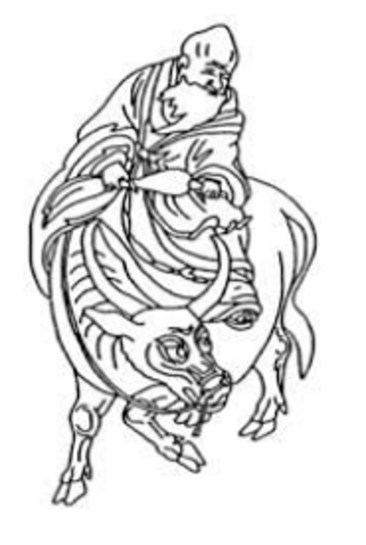
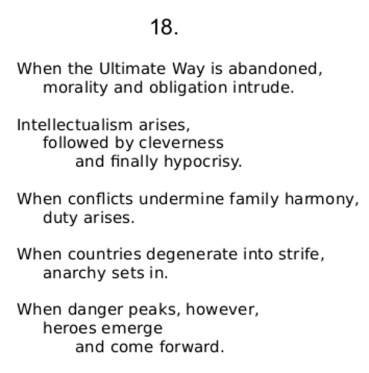
Though stated in reverse order in the Tao Te Ching, Lao Tze also held that the world is necessarily changed one person at a time, and from the inside out:

18

With this in mind, I had mixed emotions about the recent American election. In Clarion Call I wrote:

Perhaps deeper than the President-Elect consciously knows (or even needs to), his words ring true across the full continuum of the Life Wheel. BUT: here is the danger . . .

Many people, due to a host of unfortunate circumstances, live primarily on the shallow surface of the Life Wheel. They haven’t the depth to recognize or respect what,  for whatever reason, they’ve forgotten. Worse, some, unintentionally or otherwise, live at odds with inner truth. They will continue to spin, distort and attempt to delegitimize DJT’s victory . . .

They will definitely stir up unnecessary conflict to destabilize the world, as if to prevent his best intentions from coming True.

Today, looking back with the advantage of hindsight, I shake my head. What a noble but sadly mistaken approach, to focus on ending corruption on a national scale, while individual hearts, families, communities and states are, for the most part, alligator-infested swamps.

Current events reinforce earlier my conclusion:

Changing the world, especially in dangerous times, is an overwhelming prospect. It’s also unnecessary. No matter how much is going wrong “out there,” the manageable unit that’s one’s first responsibility to change is the one closest to home: oneself.

Our best hope is, still yet, to think small. Begin with one’s self.

Yes, taming one’s inner alligators is hard work. Very hard. But it’s infinitely worth it.

climbing alligator


What Do YOU Think?

confusion

I have an important question for you. Your thoughtful answer(s) are greatly appreciated!

Here’s the problem, wonderfully put in The Art of Growing Old – Aging with Grace by Marie De Hennezel:

. . . the worst is not inevitable. The keys to a fulfilling old age do exist, and it’s up to our generation to discover them and pass them on. It’s up to us, the baby boomers, to invent a new art of growing old – which is a paradox, as it means accepting the inevitablity of aging without becoming “old.”

She continues:

. . . we can grow old intelligently; we can accept what we cannot change, and look toward all that has yet to be discovered.

I totally agree. But there are issues. First, although she states the challenge (opportunity!) wonderfully and touches on important responses, she doesn’t really have The KEY.

Second, I do. It’s what The Phoenix Response is about.

Why is that an issue? That’s where YOU come in.

In 2014, I wrote about “The Key to Everything” in Rethinking Survival – from my point of view. For me, it explains “The Mystery of Death and Rebirth.” Looking back, I was clarifying my thoughts for me.

Now the burning question remains, How do I bridge the gap between where I stood then and where you are NOW? For me, The Key and it’s implications for ultimate survival are breath-taking. How could I present them better, in a way YOU can usefully relate to and enjoy?

Or is all this something you’d rather not think about? If so, Why not?

Please tell me. And while you’re at it, it would help to know your (relative) age, gender, and location along with any comments on what shapes your current needs.

So, what do YOU think about “The Key to Everything” and “The Mystery of Death and Rebirth?”

The KEY

The Key to Everything

My “take away” from yoga years was the parable of a young boy who asked his teacher, “What is that, knowing which, all else is known.” The implication to this question, put forth in the ancient Sanskrit Mandukya Upanishad,41 is that, with the right key, everything can be known.

It reminded me of the medieval masterpiece in the Prado Museum that grabbed my mind earlier, the one which showed me that it’s possible to see with a larger point of view, beyond time, where all history is like a static painting and everything is actually going on at the same time.

I ardently wanted that key to life and the universe. I asked myself this question over and over and compared everything I read to this standard.

Years ago, I put the question to a wise friend, “What is that, knowing which, all else is known?” His cryptic reply: “Look it up in the encyclopedia.”

“Huh?”

I parsed this one-liner for every hint and clue. What does this riddle in answer to a riddle mean? “Look upwards?” And “en-cyclo-pedia?” That which encircles (cyclo, cycles). Pedia meaning feet. The foundation? The fundamental base which supports the whole body. Perhaps the functional impetus of movement and action.

According to Webster’s dictionary, “encyclopedic” means “comprehensive in scope.” All-encompassing view. Aha! I got it!The Positive Paradigm is the answer to the riddle. Look there.

I’m now convinced that the Positive Paradigm of Change is the ultimate answer to the ancient ultimate question. It’s the literal proof that humans are made in the image of the Creator — the microcosm resonates with the macro. I AM that I AM.

Put another way, “God don’t make no junk.” In this context, the exhortation, “Ye must be perfect like your Father in Heaven” makes perfect sense.

Just as Einstein had the Unified Field Theory, but didn’t know it, each and every one of us on the planet is perfect in potential: made in God’s image. But we’ve forgotten.

And tyrants want you to sleep on. They’ll do anything to prevent you from remembering that you’re inherently okay. Because once you do, as Einstein did, no one can intimidate, control or dominate you. You’re aware that nothing anyone has for sale can make you more perfect. Nor can anything that anyone threatens to take away alter your essential okayness.

It’s your inalienable birthright. A given.

The Positive Paradigm is the viable basis upon which to build valid self-esteem. It’s the key to personal freedom — freedom from ignorance, freedom from fear.

One minor caveat: it all depends. While we all have the option to remember who we truly are, most of us are like Lambert, the sheepish lion. It takes a smack with a two-by-four upside the head before we’re finally ready to wake up. Often it takes the form of life-threatening danger to those we care for.

A personal health crisis will also do the trick. So will job loss or a run-in with natural disaster.

But, like Dorothy stranded in the Land of Oz, when you want dearly enough to return “home,” you can click your heels whenever you chose — and come to find out, you’re already there.

Innocence

The Mystery of Death and Rebirth

The yin-yang mysteries of life and death are embedded within every in- and out-breath of our lives. They alternate, however unappreciated, inside each unit of time: from minute-to-minute, day-to-day and season-to-season. They repeat on every scale of magnitude, from the individual, to families, corporations, nations, whole civilizations and even planets.

Buddhist teachings reflect these mysteries, compatible with the Positive Wheel model and its central hub. For example, in Being with Dying: Cultivating Compassion and Fearlessness in the Presence of Death, Roshi Joan Halifax explores the transformative power of the dying process, advising readers to be still, listen and open to the unknown.

Indian film actor Rajini captures the Rethinking concept succinctly in his review: “This book helped me touch that divine part that we all share; it is the Deathless, eternal part of us that will never die because it was never born.”

“The strange thing about growing old,” Einstein wrote, “is that the intimate identification with the here and now is slowly lost. One feels transposed into infinity . . . ”

In the year before his death, commenting on the passing of colleague Michele Besso, Einstein wrote, “He has departed from this strange world a little ahead of me. It means nothing.”

Making an observation that could have come directly from the Yoga Sutras, consistent with the Positive Paradigm, Einstein consoled Besso’s family, “For us believing physicists, the distinction between past, present and future is only a stubborn illusion.”

It is said that in the middle ages, Carmelite nuns retired to their cells each night to sleep inside the wooden casket in which, when they died, they would be buried. Taken out of context, this may seem morbid. But in fact, they had it right. They were aligning themselves with the patterns of nature, the better to ultimately survive them. For each in- and out-breath repeats the cycle of release and renewal. Each night that we sleep, we let go of bodily awareness and return refreshed the next day.

On every scale of magnitude, the pattern is the same. Paradoxically, survivors who have released unfounded fears of death are freed to live to the full, here and how.

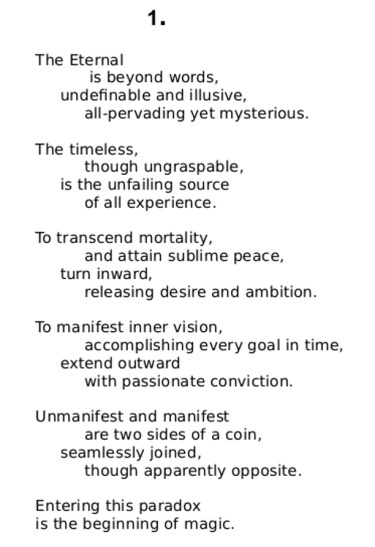
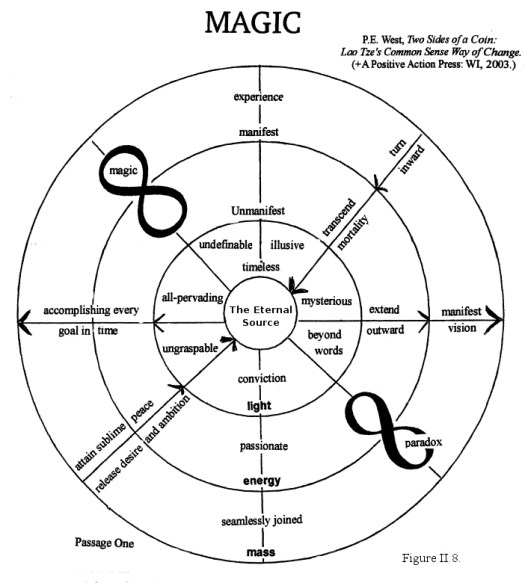
Lao Tze’s work, which breathes I Ching wisdom, illumines this paradox. He describes the relationship between the Creator and creation in the first aphorism of the Tao Te Ching. From Two Sides of a Coin: Lao Tze’s Common Sense Way of Change:

01

Figure II.8 shows what this vision looks like when the words are properly placed within the Positive Paradigm Wheel. To the uninitiated who live exclusively on the surface of the Wheel, the eternal may seem illusive. However, the inner vision is accomplished by daring to let go of the familiar surface to travel true home to the center, from which, completing the cycle, blessings then flow outward.

II-8 rev

(Reminiscent is God’s promise in Genesis, “Return unto me, and I return unto you.”)

In Passage 16, Lao Tze goes even further:

16

Here, Lao Tze’s sage not only repeats the vision of the hero’s journey. The methods of the journey are given — the meditative practice of stilling the mind and emptying the heart, followed by contemplation from the detached observer’s perspective. Lao Tze also details the consequences of failing to complete the life pattern: misfortune, pain and suffering.

Those who attain the source, however, (usually with the guidance of an enlightened teacher) achieve the overview which leads to acceptance, compassion and omniscience. Those who survive intact, merge with the eternal source and begin anew, like the New Adam and Christ in The New Testament. (See Figure II.9.)

II-9 rev

Preparation makes the difference, deciding who is most likely to survive coming transitions, emerging better than before through the experience. Here is the root of Positive Change, described in Hexagram 49 from The Common Sense Book of Change:

49. CHANGE. Day and night replace each other in endless cycles of CHANGE. The same natural law generates flux in human events. The unprepared see Change as a threat, but the well-prepared face the unknown calmly. They know that after degeneration reaches critical mass, regeneration follows. Welcome the new. Avoid short-sighted fear.

Please Help Me.jpg

So, now it’s your Turn. Please tell me what YOU think about all this. And, thank You.

thanks.jpg

The Wright Connection


connection

On two separate occasions, I’ve recently had reason to revisit a blog about Frank Lloyd Wright originally posted elsewhere.

The first was reading about Judith Orloff being jilted because her boyfriend’s rabbi called her a witch. Contact with her deceased grandfather was judged unacceptable. Especially because — though living in Europe with no way to know that he’d died — I had vivid dream warnings from my Grandpa West at the time of his passing. It’s described in Rethinking Survival:

In another memorable dream, I spoke with my father’s father, Hubble West — the one his grandkids nicknamed “Hubba Hubba,” from whom I inherited my Native American looks. Gravely, he warned that I was trapped in a high-rise tower. I was dead and didn’t know it.

I took this troubling message as a warning that important parts of me were atrophied. I was stuck in my head, neglecting my body and failing to listen to my heart. As a result, I was in mortal danger. Later I learned that at the time of the dream, Hub had just passed. This was his parting benediction.

So, to me, the clergyman’s assumption seems most unjust. To the best of my knowledge, Dr. Orloff’s dream guidance had nothing to with witchcraft. The Wright post serves to vindicate her, putting her experience in larger context.

In brief, as I understand it, our experiences of nature or the so-called “supernatural” are pagan only if we  seek them out, especially to the exclusion of or elevating them above their deepest, original Source. Wright overtly courted the pagan god Taliesin, defiantly rejecting Isaiah’s Hebrew God. Dr Orloff’s stated beliefs, however, are completely compatible with the Positive Paradigm shown below.

The second occasion was an email exchange with friend describing a museum visit. She wrote:

Seeing a tapestry/hanging from Frank Lloyd Wright in the crafts section brought you to mind, although I’ve forgotten just how you ended up with your connection to Taliesin. Through music perhaps? The same association came to me as I listened to a talk at the Seattle public library on the history of Seattle architecture just before leaving for Boston.

I reminded her:

The Taliesin connection was music and yoga related. I was at Hill Top for a yoga retreat. It’s just down the road from Taliesin. The owner, Herb Fritz, was one of Wright’s apprentices. Also a cellist, he heard me play violin and invited me back to play chamber music. The rest, as they say, was history.

She isn’t familiar with the context of that connection, however. This Wright post also fills in those blanks for her. For example, as described below, Herb Fritz was sole apprentice to survive the Taliesin mass murder and testify about what happened.

So for those reasons, I’m posting below an edited version of the earlier LinkedIin post.

header

Frank Lloyd Wright Had It Wrong!

Why does it still matter that a century ago, Frank Lloyd Wright’s Taliesin burned, torched by an ax-wielding mass murderer?

It matters a great deal. Not because of the tragedy’s lurid details. But because Taliesin East – located in Spring Green, Wisconsin – is an important example of how NOT to organize an intentional community.

Years ago, from stories told in Spring Green at dinner tables and around fireplaces, I learned how powerful an effect Wright’s personality had on apprentices and their families. They remembered him with equal parts awe and dread. He was, so they believed, an architectural genius. He was not, they all agreed, a good neighbor or compassionate, trustworthy friend.

What I learned from those close to him motivated me to read books written by the Wrights, as well as biographies by others – notably The Fellowship. I came to the conclusion that intentional communities like Taliesin – an inherently worthy endeavor — deserve careful rethinking.

I wrote about Taliesin in a LinkedIn email exchange.

Viewing my profile, a connection (“Senior Zen Practitioner and Baseball Umpire”) noticed mention of the time I spent in Spring Green. He emailed me RE. Taliesin West:

My Mom was the Office Mgr. for 21 years…small world

To which I responded:

This particular West has never been to Taliesin, either East or West. But the tales told by scarred survivors (some of whom are very dear to me) sparked keen interest in building BETTER intentional communities. . . . I’m sure your Mom has her share of stories to tell too.

The conversation continued from there. Quoted with his permission, he replied:

“particular West.”…you are cracking me up! My Mom knew everyone, was dear friends with all of them, one-on-one teaching. survivors…you are very wise. my Mom fell down and they fired her because they were afraid she would sue them and she is hard core Catholic and would never sue anyone. . . they broke her heart. . .

Later he wrote:

i just spoke with Mom, she says everything i already told you is true, which i already knew. She said FLW was a slave driver who made the apprentices build the buildings themselves, i did not know that. She said when they cut her loose the yearly tuition was 30K.

Later I responded:

Have been giving much thought to the best ways to use limited time and energy. (Did you see the blog posted over night on rethinkingsurvival.com?)

I mention this because it applies to the article on Wright. It’s important to keep my focus on how to do things RIGHT. Exposing the dark side of Taliesin isn’t my purpose. For the tabloid dirt on FLW, you can easily read The Fellowship: The Untold Story of Frank Lloyd Wright and the Taliesin Fellowship by Friedland & Zellman. In fact, you can just look up the book description on Amazon along with the comments to find out all you ever wanted to know . . . and more.

Though I will add that (unless I missed it), the authors omitted a significant detail. The third Mrs. Wright was not only a student of [the so-called mystic] Gurdjieff, but bore one of his illegitimate children (Svetlana the first). Gurdjieff wanted live at Taliesin, but Wright would have none of it . . .

So, moving on. My basic purpose is to address a viable approach to doing intentional communities RIGHT. As an intermediate step in this direction – proof of the larger point — it is instructive to consider what Wright did WRONG.

Here’s my underlying premise: Paradigms are of life-or-death importance. Incomplete, inaccurate beliefs result in tragedy. Achieving more positive, sustainable results requires the foundation of a complete and accurate worldview.

Like Wright, many today strive with all their hearts to accomplish great work. Sadly, even geniuses like Wright, despite the best of intentions, undo themselves, precipitating loss and disaster. In the process, they hurt others as well as themselves. Yet they rail against misfortune as if they were randomly selected, unjustly persecuted victims of fate.

From my point of view, positive solutions start with recognizing a major source of life problems: a knowledge deficit. For example, outcomes would significantly improve by expanding one’s reality map to include three kinds of law. Each regulates its own level of the Life Wheel.

levels of law - sized

The levels are interrelated and interdependent. When they are aligned, integrated and balanced, when they operate harmoniously, all goes well. When any of the levels is left out of the equation, nothing works right. When they are out of balance, so is life. When they aren’t correctly prioritized, all hell breaks loose.

The Positive Paradigm represented by the Life Wheel is a universal standard. In this context, Wright acted without respect for the whole of life. As a consequence, he experienced repeated setbacks — as do many of today’s leaders.

Here is Wright’s attitude towards each level of law:

  • Divine Law. He rebelled against it. In his equation, the innermost level of law was ruled out. To the extent God exists, the relationship between God and man is one of mutual enmity.
  • Natural Law. Instead of God, he worshiped a romanticized version of nature.
  • Human Law. In his financial and social behavior, he demonstrated an arrogant disregard for fellow human beings, acting as if he were out exclusively for himself.

Ironically, Wright seemed to think his genius (a gift of God) placed him above the laws which ordinary mortals respect and follow. He didn’t pay bills, didn’t honor family commitments, and later in life, presumed to act as if he were a god, dominating the lives of apprentice architects.

And, as the Greeks knew, the flaw of pride – hubris – precipitates tragedy.

From his books, we know that Wright hated and probably feared the wrathful prophet Isaiah. In reaction to the failings of his preacher father, he swung to an opposite extreme – replacing worship of God with deification of nature.

He may well have had valid grievances against his biological father. He may have been correct about the limitations of conventional morality.

But (if you’ll forgive the pun), “Two wrongs don’t make a right.”

Taliesin (meaning shining brow) is the name of the pagan Celtic god Wright invoked as patron of his unconventional lifestyle. When Taliesin East was built, Wright had just walked away from his first wife and their six children. It was designed as a love nest to share with the married mistress from Chicago whom he felt was his soul mate.

The dynamics of ancient Natural Law (a subject altogether different from Wright’s beliefs) explain the inevitable misfortunes that plagued him throughout life. The Law of Karma (“As ye sow, so shall ye reap”), is quite straight forward. Whatever you do returns in kind.

As a simple, infallible law of nature, if you hurt and harm others, your actions come back to you, in some form or other, at some time or other. (“What goes around comes around,” as they say. Or, “Payback is a bitch.”)

In this case, Wright had remarkable (dare I say, God-given) gifts as an architect. But on a personal level, he was despised by many people, for many reasons. Not all were forgiving. Newton’s law, “For every action there is an opposite and equal reaction,” caused his short-sighted desires to backfire in horrific ways.

For example, to all appearances, the mass murder at Taliesin was an orchestrated hit. The assassin, 30-year-old Julian Carlton, an estate worker originally from Barbados, was recommended to Wright by Chicago associates who just might have held grudges. Carlton himself had no motive for butchering Mamah Borthwick or her two children. He didn’t have the education to plan his carefully calculated attack on the apprentices, standing outside the only door of their burning room, ax in hand, waiting to cut them down one-by-one as they tried to escape certain death by fire.

Killing the apprentices was probably a secondary priority. Had all of them died, there would have been no witnesses to the crime. One, however, though gravely injured, survived long enough to run from the isolated rural setting and sound an alarm. A second (Herb Fritz, my Spring Green host) lived to identify the killer.

How would a simple hired man have known to purchase and pack a vial of cyanide to swallow in case he was caught? It scarred his throat so badly he couldn’t have answered questions in jail even if he wanted to. Nor could he eat. He died within a few days of capture, starved, in agony. So today, no one knows for sure who commissioned his crime.

But then again, back in the day, no one really wanted the world to know the facts. Carlton’s death was a convenience not only for the unknown master-mind, but also for Wright and his followers. Being highly invested in their image, whether for personal or financial reasons, they preferred to deny any connection between Wright’s personal life and its logical consequences. Rather than recognizing the opportunity to learn from hard lessons, Wright wallowed dramatically in his grief. Rather than take personal responsibility, he blamed a vengeful God for this (as well as the following string of repeated tragedies – including a later fire at Taliesin which destroyed newly acquired treasures of Japanese art and then the drowning death of Svetlana I).

The lessons set by his example, however, remain useful for us now. Bottom line: communities based on upside-down worldviews are tragedy magnets. They never have and never will work out well.

What remains to be seen is whether, on the basis of a complete and correct paradigm, with sufficient motivation to do things RIGHT, we can do better now.

book header bird

Friends Coming Full Circle

book header bird

Thursday, April 20th of 2017 wasn’t an ordinary shopping day. Once every two weeks, I routinely make the hour plus drive into Madison to buy groceries. But this day became a one-year book-end to last April’s Magical Day. That day, two parts woven into The Phoenix Response appeared. This day, given hints as subtle as two-by-fours, I clicked on the missing third part.

I look forward to these drives as a time to collect my thoughts and make plans. Truth funnier than fiction, a few days earlier, our teething brindle hound puppy dog trotted off with my reading glasses and thoroughly mangled them. So part of this day’s errands was an optometrist appointment to get new ones. I always take incidents affecting vision as a cue that it’s time to start seeing things differently.

As I drove, enjoying the rural Wisconsin spring greenery, one thing led to another. It started with mentally composing an email about the puppy to Lynn, my college roommate and dear friend.

We go back a long way, Lynn and I. On the surface, we couldn’t be more different. Tall and short, blond and brunette, scientist and musician. Yet, to my mother, we looked alike. The similarity she saw was the same expression on our faces. In some intangible way, we were on the same wavelength.

Back then, our unknown futures lay ahead of us.

Over time, we lost track of each other. But just before Christmas, Lynn found me again through this website. Since then we’ve been writing back and forth, reminiscing and catching up on the last forty years.

Lynn says she’s not a dog fan, so, thinking to entertain her, I was mulling over memories of different dogs I’ve known — the point being that, as with humans, some are definitely more likable than others.

In the process, it dawned on me that our renewed connection was the missing piece that ties The Phoenix Response together.

A year ago, I blogged:

Did you ever have a magical day – one that stands out even amongst the countless miracles that abound, most often unnoticed and unappreciated, in the midst of daily life?

Today offered one of those rare and precious moments to me. It had to do with basic life questions important to us all – about the quality of life and our purpose for surviving.

It was an encouraging day . . .[that] shone as a confirming ray of hope, strengthening my resolve to complete the book listed on CreateSpace as The Phoenix Response.

The initial cue came from finding The Longevity Book on a bestseller store shelf. Carmen Diaz’s first book was written for young women. This, her second, focuses on women entering middle age. But where’s the third?

An amazon reviewer’s Re line states “Wish she would have taken it to a woman’s age when she’s elderly.” The comment continues “There are so many things mothers did not tell daughters that many many of us in our 60’s, 70’s and 80’s have had to find out on our own – sadly.”

I observed: The Longevity Book begs for a sequel – one Im eminently qualified to supply. The Phoenix Response fills many gaps crying out for completion.

That day, however, thoughts about the aging process triggered personal memories. I wrote:

I thought back to my grandmother, Ellie West, who gave up a promising singing career to marry my grandfather, Hubble.

Late in her life, Ellie told me about the day he proposed. During a walk in the local park, he stopped in front an enormous sun dial set in granite and pointed to the attached plaque. Engraved onto the metal were the words of poet Robert Browning. “Grow old along with me. The best is yet to be.”

It won her heart.

As she described the event, now gray and ill, she shook her head. If not cynical, she seemed at best remorseful. For her, life hadn’t turned out the way the poet promised.

Her story left me with questions to ask in The Phoenix Response. Why did the poet associate growing old with the best yet to be? Why wasn’t this Ellie’s experience? What are the implications of her disappointment for Lynn and me as we come full circle, now even older than Grandma Ellie was when she told the youthful me about Hubba Hubba’s proposal?

Over time, the phoenix concept has expanded. In the blog with that title I wrote:

. . . here is the solution recorded in notebooks over the years. Whenever circumstances or people push me to suicide, I will die – but only to be reborn in this lifetime, over and over, each time better than before.

I called it The Phoenix Response.

I associated this intentional positive decision with the death and resurrection of Christ, whose archetypal pattern is an example for each of us to follow, at any time, as a matter of personal choice, commitment and dedicated follow-through.

Later I added:

My message for baby boomers: it’s still not too late. It’s not over til its over. Even for those of us who’ve let go of self-care and made mistakes along the way, there’s always a second chance. There’s always the Phoenix Response of regeneration – returning to the creative process of genesis itself, repairing not only original DNA of the body but of the soul.

Not only is this book dearly needed. The way for it is actually being paved and readiness created.

This April, I was receiving powerful hints from the powers that be that it’s time to start writing again. Further, I should seek out whatever assistance it takes to assure the widest publication possible.

I was pleasantly surprised by the outcome of the eye exam. My long-distance vision has actually changed for the better! And because I was from out of town, it was arranged to have the new reading glasses ready within an hour. I was able to take them home and start working the same day.

There was also a special cup I “knew” was waiting for me to find at the grocery store. A month earlier, I splurged on one with a geometrical blue-gray-violet Native American design. It bears this hopeful omen: “Give thanks for unknown blessings already on their way.”

This day’s companion cup pictured a scene reminiscent of ancient Asian landscape paintings. A bridge connects a valley in the foreground with distant mountains disappearing into a vast sky. The cup’s quote confirmed my experience: “Some days have God’s fingerprints all over them.”

The cup now sits directly above my computer. As I continue to gaze on it, the bridge image grows on me. For we both are inevitably approaching life’s completion in death. Lynn has had bouts with breast cancer. I’ve had my share of physical health scares as well.

But I am of a certainly that death is a bridge to another dimension, whereas fatalistic Lynn probably thinks of it as a dead end, an abrupt full stop, a dark extinction.

This, then, has become the central challenge of The Phoenix Response. How do I lovingly, persuasively communicate to her, to our whole generation, and for that matter, her daughters and their children, about our marvelous but sadly forgotten, neglected and denied potentials.

What practical, proactive methods can we bring to our life and death questions while there’s still precious time left to make positive changes?

How can we make friends with the opportunity inherent in our ultimate transformation, accepting physical death as integral to the larger pattern of repetitive, cyclical change?

How do I bypass tenaciously held prejudice and culturally enforced taboos to help reconnect others once again with the innate birthright we all share in common?

bridge sized

The Tower of Babel Dilemma

tower-of-babel

There was quite a while when I didn’t speak with people, other than to exchange empty greetings and conduct routine business. I was so disillusioned, attempts to communicate about anything of substance seemed futile.

During this time, working with the Book of Change kept me in touch with the deeper, better side of myself and the universe. As this work led me to reestablish meaningful connection with others, my aspirations turned towards seeking ways to share this life-saving gift with others.

If the best I had to offer humanity was the same book which had served to keep me whole, how could I persuade others of its value? Whether intentionally or not, what I have come to call “The Tower of Babel Dilemma” – the degeneration and fragmentation of the English language – is a formidable obstacle to effective communication. Glib labels and false assumptions associated with the book led to out-of-hand rejection. “Foreign.” “Ancient.” “Unscientific.” “Unchristian.” “Pagan.” “Superstitious.” “Difficult.”

It seems to me that language has devolved into quite the opposite of the English I’d learned to love and respect in high school. There, we were taught to regard language as the premier tool of logic. When used with Sherlock-like diligence, applied the powers of keen observation and heightened awareness, it could solve mysteries — not only to detect the crimes of evil-doers and the nefarious plots of national enemies, but to unravel the mysteries of life and the universe.

Turned inwards, used with self-honesty, language is essential to cultivating self-awareness. For the truth-seeker, language is a necessary vehicle of information both on the inward quest and on the return journey outwards to share results.

But even people with the best of intentions use the same words to mean very different things. They miss each other coming and going, only vaguely aware of the disconnect.

Tracking the meanings of words, I was fascinated to find that their devolution is systematic. In some cases, the same word actually means not only one thing, but its exact opposite as well.The “positive” word is an important example. Webster’s dictionary lists seventeen (!) contradictory uses.

Instead of being used as a means for unifying human beings, language is often degraded into chaotic paralyzing noise – a weapon for stirring up animosities, division and confusion.

So I set about to build the all-important groundwork for communicating about The Book of Change. I needed to rescue the language – restore it from its debased status as a smoke screen spun to camouflage self-serving intent. To this end, I outlined chapters for The Yoga Dictionary: Answering the Tower of Babel Dilemma.

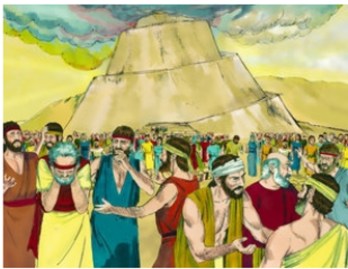
As a reminder, the biblical story describes defiant humanity’s fall from unity into confusion and separation:

In Genesis, a united humanity speaking a single language and migrating eastward, came to the land of Shinar שנער‎‎. There they wanted to build a city and a tower “tall enough to reach heaven;” God, however, disapproved of such behavior as disrespectful, scrambled their speech so they could no longer understand each other and scattered them throughout the world.

The Sixty-Four Essays found in Part Two of Conscience are an off-shoot of this project. They’re meant to be used, as is the Book of Change itself, to cultivate mindfulness. They bring attention to the complexity of basic words we too often take take for granted and the critical importance of establishing a shared common ground of understanding.

Three-Part Format

Like the 64 images of the I Ching, each of the 64 Essays in Conscience: Your Ultimate Personal Survival Guide is self-contained – a miniature world complete. Each invites the reader to slow down and think carefully, taking the time to examine current beliefs and apply timeless wisdom to immediate personal experience.

There’s a method to the order of the Essays. Originally they were placed in a logical progression that seemed to tell a story. However, there’s no need to read them in sequential order. Using the Alphabetical Table of Contents is another option. If a particular subject stands out as immediately relevant or interesting, choose that one.

A three-part format gives each Essay structure-within-structure:

Part One. Though the Book of Change is dismissed as inaccessible and rarely taught in public schools, the number of influential thinkers whose ideas intuitively resonate with its timeless wisdom aren’t limited by either time or place. Quotes from the work of well-known figures serve as a springboard and bridge linking the familiar with the new.

Contrasting voices speaking to the same universal concerns highlight the yin-yang, old-new, East-West dynamic which everyone everywhere, deeper than deep, share in common.

Quotes from Chinese philosophers inspired by working directly with the I Ching include Confucius, Lao Tzu (The Tao Te Ching) and Sun Tzu (The Art of War).

Quotes from the Old and New Testament which resonate with I Ching wisdom include the Psalms of the musician/poet/ healer/warrior King David and the words of his direct descendant, Jesus Christ.

The Muslim tradition is represented, as are modern day medical practitioners, healers and teachers. Countless martial arts disciplines are based on I Ching science and philosophy, as are Tai Chi Chuan and Qigong. Bruce Lee‘s Jeet Kune Do is one well-known example.

Also included are voices of Westerners in synch with I Ching wisdom, from Plato and Christopher Columbus to William Shakespeare and Albert Einstein; from Abraham Lincoln and Sir Winston Churchill to Martin Luther King, Jr. and Nelson Mandela; from Norman Vincent Peale to Peter Drucker, Scott Peck, Steven Covey, Jim Loehr, Norman Cousins, and Tony Robbins.

Voices of creative women in harmony with I Ching wisdom include those of Emily Dickinson and Virginia Woolf, Elisabeth Kübler-Ross, Naomi Judd and Oprah Winfrey.

Part Two. “The Front” examines a specific word’s meaning in depth, giving examples with emphasis on its use in I Ching context, elaborating on implications of the quotes. Quite often changes in meaning correlate with the evolutionary path of the chakra system, reflecting an increasing level of maturity and self-awareness.

Part Three. Just as the coins sometimes used to derive I Ching readings have two sides, every idea has its shadow, opposite side. Accordingly, a brief section called “The Back” balances The Front side of each Essay to round out the picture. It briefly describes each universal idea’s mirror opposite, as well as inversions and perversions.

angel-sized

Revisiting these concepts at this particularly dangerous window of time would be a particularly helpful investment of energy and attention, as the gap between an historical election and projected inauguration stands in the balance.

Let those with an ear to hear and heart to understand take heed.

Saving the Best for Last

Over the past weeks, I’ve been enjoying The Purpose Driven Life: What on Earth Am I Here For? In its 37th of 40 chapters, Rick Warren, founding pastor of Saddleback Church, explicitly states:

Sharing your testimony is an essential part of your mission on earth because it is unique. There’s no other story just like yours, so only you can share it. If you don’t share it, it will be lost forever.

I have always had reservations about writing on Christ. On the one hand, over history, extraordinary damage has been done in his name. How could I hope to make a positive difference in a noisy field so filled with misunderstandings and confusion?

On the other, I am so much in awe of Christ’s sacred sacrifice that it seems presumptuous to dare speak of him.

But, in case it might make a difference, even if to just one soul, in the spirit of the saying, “To save one life is to save the world entire,” excerpted from Rethinking Survival,  is my personal testimony.

CHRIST

SAVING THE BEST FOR LAST: The Wait Was Worth It

I came to the New Testament relatively late in life. This was fortunate in many ways. Whenever I had the opportunity to learn about Jesus, my inner radar said, “No. Wait. Not yet.” This was something very special, something that had to be done at the right time, in the right way.

I did everything else first, as if creating a foundation upon which to build. I did my music years, my yoga years and university years. In each time frame, I closed out everything else to focus entirely on the discipline at hand.

So when it finally came time to focus on The New Testament, I was ready and well prepared to appreciate it. It hadn’t been spoiled by being introduced too early, before I was mature enough to relate to the teachings as an adult.

No one had spoiled the teachings for me with prejudiced opinions or by bad example. There was no social or authoritative pressure put upon me to either believe or not believe. It was my choice.

I came to the teachings, especially St. Matthew, with an open mind and uncluttered brain. I Ching and yogic backgrounds put the life and times of Jesus in perspective. Many of his teachings and so-called miracles were built on tacit understandings generally accepted at a time when people lived far closer to nature than most of us city-folk do today. This bedrock of common understanding has since, for the most part, been lost or forgotten.

His story didn’t seem like hocus pocus to me, as intellectuals often assume. In the context of Chinese sages and Hindu yogis, it was plausible and wonderful.

Here was an extraordinarily great master who choose to arrive on Planet Earth at a tipping point in history. Civilization had reached critical mass.

This rare, great being had the compassion and power to influence the fate (survival versus extinction) of the human race. His demonstrated love, courage and personal sacrifice changed the course of history.

Not coincidentally, it seemed that at the time I was making friends with St. Matthew (the early 1980s), humanity was slowly approaching another tipping point, another time when, again, human survival cannot be taken for granted. There was a message here for those with “ears to hear.”

It later influenced me to write Rethinking Survival for the purpose of giving people worldwide the means to see Christ’s power and purpose with fresh eyes. The Positive Paradigm of Change offers a context within which his life, death and transfiguration are understandable.

It gives us an opportunity to rethink the example of his life, teachings and sacrifice. It’s a means to save the hope of the Christ child from the bathwater of false distortions. It offers a way out of narrow-minded strife in political and religious arenas alike.

Saving the Best

Bottom line: I found that the heart of the Old Testament and the New Testament which completes it both work for me.

What goes on at the surface, cultural level of institutional religions is a different matter. Sadly, too often, it’s apples and oranges. Disconnected universes.

So it bears repeating: distortions at the ephemeral surface cannot negate the power and validity of the scriptures.

Accordingly, whatever unfortunate baggage and associations have accrued to the teachings, release them. However jaded you’ve become, get over it. However tragic the past, forgive it.

Go back and rethink the teachings. See them like a genius, through child-like fresh eyes, as if for the first time, new again. It’s infinitely worth it.

Rethinking HOPE

hope

Paradoxically, the following Essay on Hope compliments the one on Death shared in The Phoenix Response. Tellingly, it reflects beliefs significantly different from those held by my grandparents, Ellie and Hubble West. It might explain, at least in part, their experience of old age.

Nor is the subject merely academic. As I currently face unanticipated health challenges, like many baby-boomers of my generation, I’m being challenged to face and rethink my personal survival expectations.

I’ll explain all this at length later. But for now, here are my earlier thoughts on Hope, for your thoughtful consideration.

Essay 63. HOPE

That the God of our Lord Jesus Christ, the Father of Glory, may give unto you wisdom the spirit of and revelation in the knowledge of him:

The eyes of your understanding being enlightened; that ye may know what is the hope of his calling, and what the riches of the glory of his inheritance in the saints,

And what is the exceeding greatness of his power to usward who believe, according to the working of his mighty power. . .

— St. Paul, Ephesians

Here the people could stand it no longer and complained of the long voyage; but the Admiral cheered them as best he could, holding out the good hope of the advantages they would have. He added that it was useless to complain, he had come [to go] to the Indies, and so had to continue it until he found them, with the help of Our Lord.  — Christopher Columbus, Journal of the First Voyage

We live at a particularly perilous moment, one in which self-deception is a subject of increasing urgency. The planet itself faces a threat unknown in other times: its utter destruction. . . The splitting of the atom, said Einstein, has changed everything, save how we think. And thus, he observed, “we drift toward unparalleled catastrophe.” — Daniel Goleman, Vital Lies, Simple Truths

We are seeing a health care system in pain, people in pain, and a world in pain. I believe that something can be done to make it better. — Patch Adams, Gesundheit!

THE FRONT

Webster’s defines hope as a feeling that what is wanted will happen. It’s a desire accompanied by expectation. It can mean that which one has a hope for. It can mean a reason for hope. A meaning listed as archaic is to trust or rely.

In I Ching context, hope transcends short-sighted wishing and emotional wanting. It is a trust that one has the wherewithal to respond appropriately to every change of fortune. It is not total self-sufficiency, but awareness that one’s efforts are met half way. When one does the best one can, the rest is supplied in the right way, at the right time.

Daniel Goleman emphasizes the direct relationship between honest self-awareness and survival. Like Einstein and like Strauss and Howe (authors of The Fourth Turning), Goleman is a messenger of awareness we’re often trained to block out.

His vision accords with The Book of Change philosophy in this: ignoring dangers, deceiving ourselves that all is well when it isn’t, doesn’t make problems go away. It only renders us powerless to recognize early warning signals in time to prepare and ameliorate the worst that might come.

In The Fourth Turning, Strauss and Howe emphasize that declining resources will necessitate major changes in healthcare delivery. Anticipating that the cost of health-care will continue to rise and become increasingly unaffordable, they recommend that cost-effective, affordable alternatives along the lines of Adams’ work be put in place now.

Forward-looking health practitioners are therefore now turning to inexpensive, preventive self-maintenance practices like Tai Chi, Qigong and yoga.

There are hidden benefits to timely austerities. Though it is unfortunate that people see fit to return back to self-responsible methods only as a last resort, if the prospect of hard times returns people back to their more simple and beneficial roots, it is a (however well disguised) blessing.

In his epistle to the Corinthians, St. Paul wrote of hope in the context of faith and charity. His hope isn’t Webster’s hope of wanting and expecting. Like I Ching hope, it is trust that human events which make no sense in the short-term fit into the larger pattern of life, and that God’s will inevitably in the long-term prevails.

THE BACK

The opposite of hope is despair. Seeing one’s situation as hopeless is a self-fulfilling prophecy. So long as one places hope in externals, one feeds the illusion of powerlessness. Turning the focus of hope inwards makes all the difference.

Self-deception is a perversion of hope. Lacking a concept of cyclical change, linear thinkers hope to control time. They defy the aging process or pretend change can’t or hasn’t happened rather than adjusting and benefiting from new opportunities that arise to replace the ones which pass away.

Two Out of Three Ain’t Enough


Eight months that seem like a life-time ago, I wrote the LinkedIn article I’m sharing below, along with excellent comments made to the post.

At the time, I was rethinking the empathy aspect of writing about the Positive Paradigm. Now, I’m about to launch another approach, one focused on healing on all three levels. Again, unless the three are present in a balanced, integrated way, it’s not sufficient.

As an intriguing book I’m reading explains, wholeness and holiness are necessary compliments. It expands on the Phoenix Response as my comprehensive approach to transcending adversity, when mere physical survival is not enough.

I’ll explain as I go what I mean. But, for today, for starters, here’s a recap of the basic concept, the spring board of what’s to come.

It concludes with questions that invite your feedback, the better to adjust to meet your specific needs in future articles. What do you think? And thanks.


pinnacle-sized

Two Out of Three Isn’t Enough

Some leaders are satisfied to sing along with Meatloaf, “Two Out of Three Ain’t Bad.”

But Authentic Leaders know better. It ain’t enough.

As I’m learning the hard way, when any part goes missing, everything suffers.

Bear with me. I’ll share why three-out-of-three is a must for me – and for effective leaders in every walk of life.

The Life Wheel — the Positive Paradigm based on the Unified Theory Einstein had, though he didn’t know it — is the personal Truth I’d dearly love to share with the world – starting with you.

IF

From Rethinking Survival:

This familiar atomic structure repeats smallest to largest in the patterns of nature, from snow flakes and intricate flowers to spiders’ webs and sea shells. Similar symmetrical patterns repeat worldwide in the art of every culture — including the prayer wheels of Native Americans, the colored sand mandalas of Tibetan Buddhists, the stained glass windows of European cathedrals and the intricate geometrical patterns that cover Muslim Mosques, to name but a few. They offer proof of the universal awareness of a central inner reality, of an inner structure common to all humanity, and to a continuity of experience deeper than individual lives or transitory cultures.

The Life Wheel reflects the perennial philosophy shared in common by the world’s enduring wisdom traditions – free of historical baggage. It is equally compatible with yoga and modern physics. It converts easily into a method for introspection and decision-making. Like a modern day Book of Change, it has the potential to become the best friend of change agents everywhere.

The value unique to the Life Wheel is, because it highlights the innate potentials we share in common, it serves as a foundation of common discourse.

Just as importantly, from personal experience, I’ve found the Life Wheel to be a great tool with virtually universal applications. Point it like a laser beam in any direction. It illumines the field.

In Authentic Leaders Depend on the Center I presented a variation on the Wheel – the MPI (Motive-Purpose-Intent) Standard – used to increase self-awareness.

One LinkedIn connection really got it! After a back-and-forth exchange, he commented:

I can also see how the MPI can work in a variety of contexts, both religious and secular. In fact, I think it could have virtually universal application – – – I hope it catches on!

BUT – it hasn’t. Not yet. For that I take full responsibility.

I have yet to demonstrate how I use the Life Wheel for introspection and goal setting. I have yet to show how it can be adapted as an analytical tool for virtually any purpose.

I haven’t effectively explained that this picture answers the plaintive question, “Why can’t we just get along?” Namely, very few of us work from a unifying concept of our common humanity. We were never taught the basics of natural law, much less how to live in harmony with it and each other. )

I’ve failed to communicate powerfully enough the connection I see between the Life Wheel and its potential to relieve human suffering. Those who’ve been taught to look for fulfillment on the shallow surface have been set up for a world of hurt. Joy returns when we know where to look, when we finally return our focus to the center, where eternal love resides deep within the heart of hearts.

The Wheel explains today’s pervasive sense of loneliness, a result of living exclusively on the noisy, frantically busy surface. It offers a hopeful, alternative life picture. When we reconnect with the center, we know that we are never, ever truly alone. Not possible.

SO – why hasn’t all this vitally important stuff been successfully communicated? In retrospect, I’m recognizing I have yet to live up to my own “three-out-of-three” standard!

For one thing, I’m still building the technical skills needed to do the Life Wheel idea justice.

For example, my first LinkedIn article, Boundary Spanners Connect at the Center, isn’t illustrated. In September of 2014, I didn’t yet know how to create images with photo-shop software. Though I’ve come a far distance in the ten months since then, I am still picking up necessary skills on a daily basis.

Just as importantly, I’m getting important feedback that my communication skills need work. Which is different from language skills. In fact, past academic background sometimes gets in the way. I’ve been faulted for seeming so precise and confident that I’m intimidating. Makes me very very sad. Not at all what I intend.

For this, the recent process of writing a guest post for authorunlimited was good medicine. I submitted a draft on the suggested subject: The important difference between knowledge and knowing. Cathy Presland emailed back an edited version.

Ouch!

Fortunately, I had an inkling as to why she made changes. I already saw her most excellent article Writing with Empathy and taken it to heart. I also followed the link to Seung Chan Lim’s video, How empathy fuels the creative process. Like magic, on that particular day, his message was exactly what I needed to hear.

My sheepish Aha. In my rush to get from “here to there,” from surface results to common understanding, I’ve been leap-frogging over the linking, middle level of empathy.

So I can tell you from sad experience, two out three – ideas and technical skills without empathy –ain’t enough!

Cathy’s quote reminded me:

In the words of George Bernard Shaw, “Do not do unto others as you would have them do unto you—they might have different tastes.”

In other words, I have been writing as if LinkedIn connections all understand and agree that everyone, everywhere shares the same center in common. But “it ain’t necessarily so.”

True, boundary spanners, no matter where they start on the surface of Planet Earth, meet at the universal center. But not everyone sees the value in being a boundary spanner. It’s on me to accept this, adjust and improve accordingly.

So back to the drawing board. As part of the Under Construction operation, I promised to restore empathy to the larger picture, accepting that not everyone is boundary spanner. And remember, respectfully, that many are not only asleep but perhaps a bit afraid of waking up.

Yet my worst worry remains. Unfortunately, it usually takes a horrific wake up call to shake people out of their complacent slumbers. From Rethinking Survival:

While we all have the option to remember who we truly are, most of us are like Lambert, the sheepish lion. It takes a smack with a two-by-four upside the head before we’re finally ready to wake up. Often it takes the form of life-threatening danger to those we care for. A personal health crisis will also do the trick. So will job loss or a run-in with natural disaster.

But, like Dorothy stranded in the Land of Oz, when you want dearly enough to return “home,” you can click your heels whenever you chose — and come to find out, you’re already there.

My preference, which I’d dearly love to share with you is this. Rather than wait for inevitable shocks, when it might be too late to survive, I’d rather you be proactive. Use the tools for anticipating change I have to offer.

As I urged in Being Proactive in the 21st Century, make yourself ready to meet whatever unknowns life has in store, coming around the next bend or two.

Working with Life Wheel maps helps mindful, authentic leaders link the levels, making the three-out-of-three option possible. With it, we can choose to be true to ourselves and realize the vision of a positive future.

Bottom line: Change is inevitable. We can experience it as resisting, passive victims or as proactive agents of positive change. I’ve given you tools to put the choices for change in your hands.

Am I communicating yet? Questions? Comments? Please let me know how I can better meet your needs.

=============================

COMMENTS

Mark Hayward st Head of Sales at TheSmallPicture.biz | NIKKEN Independent Consultant: Helping people to take control of their Wellbeing


No worries Patricia West, you made an instant fan out of me 😉

——————–

Peter Fellingham sVice President of Engineering and Co-Founder at ProtoStar Inc

Hi Patricia, I enjoy your writing style. That said, one must write with a target audience in mind; at least commercially. Otherwise you are just writing for yourself.

Patricia West AUTHOR Blogger; Author of Books on Change, Einstein & Human Survival

When writing for authors as a guest of authorulimited, I welcomed the opportunity to write for a specific audience. Here, am focused on authentic leaders, albeit in every walk of life. If you (or anyone else) has another audience in mind, I’m open to your suggestions. : )

————————-

Bob Hemmerle Senior Zen Practitioner/Baseball Umpire

If you get 1 world leader with nukes to understand this then when he sits down with the others he will have something worthwhile to share, Bravo

————————-

Richard Lipscombe THE MEMES MAN

Patricia: This is a great post. I first read this quickly last night. I had an immediate reaction. You can not, we can not communicate with someone who does not hold to their ‘truth’. I re-read it now and listened to TED talk.I still think the same. Inside all of us is mass, energy, and light as a combination – it is what I call my ‘truth’. I can deny it. I can avoid it. I can run away from it. But I can never hide from it. Most people conceal it.

So most people can never ever admit to hearing your message. It is too painful. In simple terms they can not hear that change is your choice and to choose well for yourself you have to listen to your truth.

Most posts on LinkedIn help people to consider ‘change’ as a surface ripple, a mere happening, an entertainment, a dynamic shift without meaning, and so on. They can do this because this is a place for collectives, cliques, false wisdom, fashions, and fads. They welcome all that because it does not challenge the essence of who they are and thus it can never change them. Change their ‘truth’. Truth can be changed easily if you know what it is and embrace it. Truth is continuity – we cling to it even if we do not acknowledge its existence within us. Change to truth sets up a new continuity for us. Richard.

Patricia West AUTHOR Blogger; Author of Books on Change, Einstein & Human Survival

Thanks for your thoughtful comment, Richard. That courageously mindful folks are in the minority, everywhere . . . not just on LinkedIn. . . is the stuff of tragedy. But deep within we all harbor the latent seeds of heroism. As I said, Sooner or later comes the inevitable wake-up call. Last night, after posting this, I came across an excellent example of how 9/11 changed one leader forever. I highly recommend reading – and heeding – this article: https://www.linkedin.com/pulse/crises-changed-what-i-expect-from-leaders-gerald-hassell

————————————

Cathy Presland Strategist, Trainer, and Editor-in-Chief at Author Unlimited

Patricia this is such a thoughtful piece — I love it! And the concept that we need all three of ideas, technical skills and empathy — I will take that to heart.

———————————–

Catherine Hamrick Communications Manager at the School of Agriculture & Natural Resources at the University of Delaware

On target–as usual. Thanks for shakin’ up my brain.

THOU SHALT NOT MURDER


10 commandments

A friend recently drew sharp attention to a little known mistranslation with enormous cultural implications.

Like most pacifist vegetarians of my generation, I grew up taking a misleading translation of the Old Testament sixth commandment quite literally. “Thou shalt not kill.”

Currently, however, the generally accepted wording is, “Thou Shalt Not Murder.” World of difference.

Murder is a very specific type of killing, defined as unlawful killing committed with malice aforethought, anti-social behavior often associated with other crimes like robbery and political intrigue. Murder is synonymous with assassination and extermination on the one hand, but also with mutilation or mangling.

At the very least, there are two outstanding differences between an across-the-board prohibition on murder versus a blanket prohibition on all killing whatsoever, whensoever, whysoever.

First, according to I Ching wisdom, mirrored by King Solomon’s famous words in Ecclesiastes, there is a time and place for every purpose under Heaven. Within the cyclical laws of nature and nature’s God, purposeful killing is intrinsic to life’s rhythm.

ecclesiastes

Second, if one is prohibited from killing regardless of context, this prohibition, in extreme circumstances, is misconstrued as a guilt-inducing, paralyzing, self-defeating command: “Thou shalt not protect thyself.”

Further, examples of murder are less obvious that one might first think. There are many more forms and levels of crime than those acknowledged by legal systems designed to protect human life and property.

As psychologist Erik Erikson, quoted by Jonathan Kozol in Death at an Early Age, wrote:

Some day, maybe, there will exist a well-informed, well-considered, and yet fervent public conviction that the most deadly of all possible sins is the mutilation of a child’s spirit; for such mutilation undercuts the life principle of trust.

To this point, in Rethinking CRIME I wrote:

Those who dismiss, demean or control children with fear condemn them to empty lives of masked conformity on the material surface of the Life Wheel. Instilling extreme ideas about death, as if it were either a reward or ultimate punishment, one’s only hope or worst enemy, results in living inappropriate to reality.

To take another tack, I’ve more than once observed that the people who on the surface of the Life Wheel give the appearance of being the most conformist, are at deeper levels, the least so. They simply have the most to hide.

Conversely, those who may not be so strict in social correctness have less to hide. Often, they live more faithful to the heart of human kindness. In fact, this is the consistent pattern.

The Laws of Nature explain this consistent inconsistency. Consistent with I Ching wisdom, Michio Kushi lists “Twelve Principles of Order in the Universe.” They include:

1. Everything is a differentiation of ONE Infinity.

2. Everything changes.

3. All antagonisms are complementary.

4. There is nothing identical.

5. What has a front has a back.

6. The bigger the front, the bigger the back.

The dynamics of this natural law explain why what appears so on the surface inevitably has a shadow, complimentary opposite side lurking beneath. Those who know them best find the nicest people can be shockingly cruel.

The most seemingly non-violent – apparently squeamish and helpless when it comes to physical self-defense can be extraordinarily violent in non-physical ways – ruthless when it comes to money matters or partisan politics.

The bravest and most accomplished of performers, if naive about the ways of the financial world, can be undone by a ruthless agent and end up ruined.

Herein lies the stuff of human tragedy. As the Greeks understood, a hero’s greatest strength, untempered, becomes (ironically) the cause of his downfall.

These dynamics repeat on every scale of magnitude. We find them in operation within the family, played out in communities, corporations and nations. In some cases, murder is a question of degree. How different is it from character assassination, for example? Or invalidating others. Or wearing them down, depleting their energies and resources.

People who pride themselves on being powerful in terms of economic and social resources adopt extreme yang lifestyles. This includes using the force of personality and, in extremes, physical violence, to get what they want.

In contrast, those who lack external, material resources take refuge in extreme yin strategies. They too maneuver to get what they want, just in more subtle ways, including psychological warfare. They are just as violent. Just in ways and on levels hidden from most of us.

A current example is a politician who as an outsider, superficially seemed the most liberal and egalitarian. Once inside, however, the opposite side came forward. Outward appearances belied the character of a despot with no qualms about lavishly squandering tax dollars to fund an extravagantly opulent lifestyle.

Hence the virtue of a middle path, free of extremes in any direction. The ideal of health, on every scale of magnitude, is balanced strength on all levels rather than imbalances – excesses on one level masking deficiencies at another.

Understanding the levels and layers of life and the dynamic interplay amongst them is critical to social and economic survival. Adhering to that deepest, infinite core from which integrity, balance and wisdom flow remains the key to ultimate survival.

Especially in troubled times such as these, I think back on the Psalms of King David, equal parts musician, warrior and ruler. In all aspects of his reign, he survived by allowing his life to be ruled by that ONE Infinity acknowledged throughout time as the bedrock of life.

Although in family affairs and matters of state, he suffered dearly from the inconsistencies of human behavior, he inevitably found the safe way through trouble.

David-sized

Thus in Psalm 27 he sang:

The Lord is my light and my salvation; whom shall I fear? the Lord is the strength of my life; of whom shall I be afraid?

2  When the wicked, even mine enemies and my foes, came upon me to eat up my flesh, they stumbled and fell.

3  Though an host should encamp against me, my heart shall not fear: though war should rise against me, in this will I be confident.

4  One thing have I desired of the Lord, that will I seek after; that I may dwell in the house of the Lord all the days of my life, to behold the beauty of the Lord, and to enquire in his temple.

5  For in the time of trouble he shall hide me in his pavilion: in the secret of his tabernacle shall he hide me; he shall set me up upon a rock.

In all, the survival path is marked by adherence to the Law. Conversely, it requires avoidance of that which is unlawful. This includes both refraining from acting unlawfully — violating the laws of nature and nature’s God —  and protecting oneself and those one loves from unlawful behavior perpetrated by others.

Therefore, thou shalt not murder. By extension, thou shalt not murder the language, rendering the God-fearing defenseless before enemies and foes.

victory-sized

The Phoenix Response

Phoenix - sized

In a recent post, Choose Life II, I wrote:

I was increasingly motivated by dread of facing a future based on past experience. Subconsciously, I had succumbed to a death sentence suggested by people far too “nice” to kill me outright, but all too capable of driving me to slow suicide.

Since then, going a few years back in my notebooks, I found my response to a scary conversation. At least ten years ago, we were in a car, on the way home from running an errand as I recall. The driver was flawlessly made up, as usual. She was wrapped in an ankle-length, black fax-fur coat.

I gently suggested in a general way (nothing personal, of course), that sometimes, surely unintentionally, some people push those they can’t control to self-destruction.

She shook her head, No. It was definitely intentional, she objected.

Horrified, I searched my mind for the right survival response. (My belief in reincarnation rules out suicide. At best, unfinished business would just reappear.)

As the issue continued to come up, here is the solution recorded in notebooks over the years. Whenever circumstances or people push me to suicide, I will die – but only to be reborn in this lifetime, over and over, each time better than before.

I called it The Phoenix Response.

I associated this intentional positive decision with the death and resurrection of Christ, whose archetypal pattern represents a possibility for each of us, at any time, as a matter of personal choice, commitment and dedicated follow-through.

This was, in part, the thinking behind the following essay from Conscience: Your Ultimate Personal Survival Guide. I include it below for the benefit of those who, especially given the pressures of our “interesting” time in history, may be pondering similar choices.

phoenix b&w

ESSAY 2. DEATH

Quotes

merging

Patricia E. West, Two Sides of a Coin:Lao Tze’s Common Sense Way of Change

Tai Chi Tu - sized

Dying patients went through the five stages, but then after “we have done all the work we were sent to Earth to do, we are allowed to shed our body, which imprisons our soul like a cocoon encloses the future butterfly,” and … well, then a person had the greatest experience of his life. — Elisabeth Kübler-Ross, The Wheel of Life

Tai Chi Tu - sized

Here is a test to find whether your mission on earth is finished.

If you’re alive, it isn’t.

— Richard Bach, Illusions

Tai Chi Tu - sized

Some day, maybe, there will exist a well-informed, well-considered, and yet fervent public conviction that the most deadly of all possible sins is the mutilation of a child’s spirit; for such mutilation undercuts the life principle of trust. — Erik Erikson, quoted by Jonathan Kozol in Death at an Early Age

Tai Chi Tu - sized

THE FRONT

Webster’s definition of death is the act or fact of dying — the permanent ending of all life in a person, animal or plant. Personified, death is pictured as the grim reaper, a hunch-backed, black-robed skeleton wielding a scythe. The term refers to extinction, as in the death of hope.

These definitions, however, represent an extreme cultural bias with important effects on behavior. They reflect the materialistic belief that the physical is all there is. When the body fails, there is nothing else. There is no essence which survives to travel on.

The I Ching embodies a more inclusive, comprehensive view. Like the learned amongst most ancient cultures, Chinese sages regarded birth and death as natural changes, complementary stages of an ongoing, cyclical life process.

Sages continue to regard death not as extinction, but the culmination of a winter season most wisely spent preparing for the coming spring. They teach that a soul, having learned the lessons and completed the work of one life cycle, separates from its used up shell. Once the spirit moves on, the shell collapses. The life essence, however, simply migrates, possibly to take on another form.

Meditation practices are instrumental in reconnecting the alienated rational mind with the life principle, restoring trust. They can prepare advanced souls to depart the physical form consciously at the auspicious time of their choosing. They also induce the changes of heart and mind that the Bible alludes to as rebirth. To be born again isn’t necessarily an emotional self-deception. Technically, from I Ching perspective, it’s very possible.

As described by healer/teacher/author Barbara Ann Brennan, total transformation and rebirth can also take place within the same body. She describes spending two years of prayer and intense discipline. By the end of that time, as a result of her efforts, every aspect of her life had changed for the better.

Going through stages similar to those described by Kübler-Ross, she released her old life, so that new attitudes, better relationships, and a significantly more satisfying lifestyle replaced that which had been outgrown and put away.

Country music star Naomi Judd, another example, refused to accept the death sentence placed on her by a short-sighted medical establishment. Instead, she chose to accept her illness as a challenge and blessing in disguise, taking the self-responsibility to restore her health.

With a combination of faith and true grit, Naomi educated herself in a broad spectrum of healing arts traditions and succeeded in regenerating herself from the inside out. She not only survived, but became healthy enough to endure the rigors of another music tour. She called it “The Power to Change,” using it as a platform for urging fans to rise to the challenge of change as she had.

THE BACK

Fear is the natural outcome of limited materialistic beliefs equating the end of physical life with total extinction. Those who experience the True Self as immortal and indestructible are not plagued by fear of mortality. No doubt the courage and solace which sustained Socrates as he calmly accepted his death sentence — not as an escape, but an affirmation of principle — came from the depth of his soul awareness.

Permanent extinction, however, is possible. Real death is not dissolution of a temporary form, but the annihilation of the soul itself. According to learned traditions, a soul beyond redemption by its own repeated wrong choices can be extinguished forever. Even the thought is cause for horror, powerful incentive to make right choices.

globe

Choose LIFE II

body-mind-spirit

Last fall’s mystery illness became a strict teacher, a blessing in disguise. It dramatically reinforced my awareness of the mutually dependent relationship between brain and gut long recognized by Asian healing traditions.

As modern medical research documents, mental distress manifests as a myriad of gut-spawned diseases – Crone’s disease, fibromyalgia, rheumatoid arthritis, irritable bowel syndrome and eventually cancers, to name but a few.

Conversely, the broad spectrum of diseases arising in the gut spawn a host of mental illnesses – not only depression, memory loss, dementia and schizophrenia, but autism and A.D.H.D, for example.

The hopeful application is this. Correctly steered, interventions on either side of the gut-psychology continuum positively affects the other. The relationship spans an infinite loop. So wherever one starts, given time and effort, it’s possible to complete the cycle, eventually restoring balance and good health.

Follow along if you like and I’ll connect the dots that led to this conclusion.

It started with asking WHY. Medical people failed to correctly diagnosis what went wrong. The ER physician (nice lady) jumped to the convenient assumption that, given my demographics, a lower tract infection was the problem. Antibiotics would make symptoms go away.

When the first round of drugs didn’t help, instead of questioning the assumption, the local nurse practitioner prescribed a battery of (expensive!) different antibiotics over following months – in increasingly stronger doses – each with its “interesting” side effects.

The duration of this “illness” was cause for some serious introspection on my part. Certainly the WHY had a mental origin. Stern teacher that LIFE is, I came to accept that I wasn’t going to be let off the hook until I came clean with myself. Release demanded self-honesty.

What I unburied was a death wish of sorts. It wasn’t that I wanted to be gone, so much as that negative suggestions from false friends absorbed over the years had worn me down to the point of critical mass.

I was increasingly motivated by dread of facing a future based on past experience. Subconsciously, I had succumbed to a death sentence suggested by people far too “nice” to kill me outright, but all too capable of driving me to slow suicide.

LIFE had sounded a warning alarm to bring me back to my Self.

Something had to change. It started with a stark decision. A conscious commitment to LIFE, whatever it takes. I wrote a confirming article, Choose Life.

Once recognition and the decision were made, LIFE responded most generously. The help and information needed to support my choice appeared from several directions.

The next step was for me to ask HOW do I return to health? And how do I change my attitudes and behavior to make my personal future different and better from the past?

Critically important information was found in Susan Forward’s Emotional Blackmail: When the People in Your Life Use Fear, Obligation and Guilt to Manipulate You.

I was instantly inspired to borrow the book from the library after reading a top-ranked review of the book which starts:

This book does a very clear job of defining emotional blackmail so you can begin to easily spot emotional blackmailers in your life. It then concludes with telling you specifically how to deal with emotional blackmail, that is, how to keep your energy, resources, and sometimes your very soul, from being stolen by them.

WOW. I could relate to that!

She writes, At the heart of any kind of blackmail is one basic threat, which can be expressed in many different ways: If you don’t behave the way I want you to, you will suffer.

Forward explains:

Manipulators work hard to deny, obscure, camouflage, prettify, excuse, rationalize, disguise, HIDE what they are doing. They make it hard, if not impossible, to see HOW they’re manipulating us. They lay down a thick FOG that obscures their actions.

FOG is an acronym that stands for the psychological warfare tactics used against targets: Fear, Obligation and Guilt.

This information is reinforced by Harriet Braiker in Who’s Pulling Your Strings? How to Break the Cycle of Manipulation and Regain Control of Your Life:

People who manipulate are often so hard to spot. They become your friend and then find ways to have their way with you. . .

A reviewer summarizes:

You can’t reason with a manipulator because of their insecurities but you can reason with your own insecurities; and best of all are the practical ways you can change your behavior to take back the power.

This book teaches you to get up, learn what you did wrong and what you should have done, and even better how not to repeat the same mistakes.

There’s also a warning given from experience:

I’ve put an end to so much manipulation in my life. It takes the wind right out of the manipulator’s sails. The book is right…the manipulator will blow really hard, so prepare yourself; it’s going to get stormy.

choose life

Another fortunate form of help followed from my decision to seek medical advice elsewhere. An intern at the UW kindly saw me on short notice. Intrigued by my situation, she brought in her mentor. Together, after reviewing the history of lab results, they confirmed that the initial diagnosis wasn’t right. The medications hurt more than helped.

Although I knew enough to eat yogurt to offset the effect of antibiotics, to repair the damage done by antibiotics they recommended taking pharmaceutical probiotics as well. This opened the door to a whole new world of science and healing.

Probiotics for Dummies, for example, includes a useful section on the brain-gut connection.

Medical researchers have long known that stress depresses immune function, but only recently have they linked stress to changes in gut bacteria.

The medical community’s interest in probiotics was initially sparked by the seminal work on GAPS (Gut and Psychology Syndrome) published by researcher Natasha Campbell-McBride.

In Gut and Psychology Syndrome: Natural Treatment for Autism, Dyspraxia, A.D.D., Dyslexia, A.D.H.D., Depression and Schizophrenia, she notes that Western medicine has long acknowledged the brain-gut connection:

The father of modern psychiatry, French psychiatrist Phillipe Pinel (17-45-1828), after working with mental patients for many years, concluded in 1807: “The primary seat of insanity generally is in the region of the stomach and intestines.”

Interestingly, she uses the same word, FOG, when in describing the mental-emotional relief experienced as the intestines heal by using probiotics to restore balance. “It is as if the fog lifts.” Ahh!

But, like cutting through the psychological FOG, cleaning out the gut doesn’t happen over night, or without difficulties. Campbell-McBride warns things often seem to get worse before they get better. Detox is a necessary but challenging middle step along the road that leads from here and there. So, again, “prepare yourself; it’s going to get stormy.”

There are important parallels between the so-called Leaky Gut Syndrome and psychological distress. In the first case, weakened intestines become permeable. Toxins and undigested food leak out and are circulated by the blood stream throughout the entire body, poisoning other internal organs – including the brain.

Similarly, psychological defenses can also be worn down and compromised, sometimes due to “second-hand stress.” In this case, when protective borders between self and others break down, toxic influences from outside undermine mental-emotional balance. Others’ fears, rage and general unhappiness poison the unprotected mind. Toxic people preoccupied with their own wants and personal dramas, even when unintentionally, do great harm.

Interestingly, the GAPS/probiotics approach is highly compatible with the wisdom of Asian healers. Traditional Chinese Medicine, for example, carefully maps the gut-psychology connection. They describe the dynamics of what is called “the abdominal brain.” The following illustration captures thousands of years of wisdom in a single picture.

0 012316

According to Mantak Chia, when the intestine becomes congested, it cannot perform its physiological functions. Though you may eat well, you may be under nourished.

As he explains, each of the organs is correlated with one of the five elements. In turn, each is associated with specific positive or negative emotions:

All negative emotions are expressed in the small intestine by contraction and circumvolutions, Anger contracts the right side of the intestine near the liver. Worry affects the upper left side near the spleen. Impatience and anxiety affect the top. Sadness affects both lower lateral sides. Fear affects the deeper and lower abdominal areas.

As the I Ching instructs, the same dynamics repeat on every scale of magnitude, from cellular to universal. So many hints from sciences both ancient and modern could be taken in many directions. They apply to relationships on a personal level, to community dynamics, and governance. But those will be subject of posts yet to follow.

For starters, I’ll offer just one hint.

Campbell-McBride uses the image of a medieval fortress under attack to describe the breakdown of  defenses that result in auto-immune diseases. It parallels the Interleukin II research described earlier, where the grad students saw their research on pediatric leukemia in terms of a war between good and evil.

When confusions in gut mirror confusions of the mind – when the difference between friend and enemy is fogged — anabolic (building up) and catabolic (breaking down) functions are thrown off balance. The body  is fooled into turning against itself in self-destructive ways.

In conclusion, however, a key component overlooked in the popular gut-psychology formula must be noted. Spirit — that third, underlying, unifying and overriding component of the e = mc2 equation – plays a deciding role in the outcome of the LIFE versus death struggle to survive.

It is said that “The mind will play any tune you tell it to play.”

choose wisely

So – who is it that quietly instructs the mind which tune to choose?

LIFE itself, the soul’s advocate, is the tie-breaker that tips the balance.

Here, I allow Mantak Chia to have the final word. He describes the discipline of cultivating chi – the subtle energy that links mind and body — and the end goal of the path to which all endeavors ultimately lead: 

  • If one wishes to be a healer, success depends upon the ability to channel energy through the hands.
  • If one wishes to be an athlete, success depends upon the ability to convert energy into strength and endurance.
  • If one wishes to be free of negative influences, success depends upon the ability to transform negative energy into positive energy.
  • One who seeks enlightenment is searching for the highest source of all energy.


I write in hopes that you will find this saga helpful. If you relate, I invite you to apply your imagination and follow wherever the subject leads you.

To your health!

You Can Have It All

A most excellent article recently brought to my attention on LinkedIn by Frank Feather serves as springboard to this rethinking of pinnacle experience.

For starters, since “you can’t leave a place you’ve never been,” I searched the web for current definitions and uses of “pinnacle.”

In geography, the highest elevation point of a rugged mountain is called its pinnacle. In architecture, the spire or steeple that tapes to a point at the top is called the building’s pinnacle. In athletics, the peak of success (playing in the Olympics, for example), is called the pinnacle of achievement.

Because it’s entertaining, I also searched for clip art images. Icons include a victorious athlete grasping his gold trophy cup, banners proclaiming WINNER, and business-suited people crawling and racing up stairs towards the top. I even found a quote saying that his physics formula “catapulted Einstein to the pinnacle of fame.”

Graphics portray a figure in hiking gear standing on a mountain top, planting a flag signifying his presence. The also picture organizational charts with a larger-than-life CEO dominating diminutive subordinates.

Applied to government and corporate dynamics, these images imply the elevation of a single, unique and exclusively outstanding individual. By current standards, the pinnacle of achievement glorifies personal ego and winning at everyone else’s expense.

But there is an alternative way to look at the pinnacle experience. In Rethinking Survival, the illustration the illustration called PARADOX places the illusion of separateness in Quantum Paradigm context. Here, each of us occupies only a tiny sliver of space in the integrated matrix of the Life Wheel. The broad base of the hierarchy rests on the outermost material level of ephemeral appearances. The apex, the pinnacle of life and leadership, rests deep within the unchanging center.

Here — reminiscent of the first LinkedIn post, “Boundary Spanners Connect at the Center” — illumined minds meet at the universal point which everyone everywhere shares in common looks. It looks like this:

Illusion sized

Unlike conventional wisdom, a holistic pinnacle of experience is neither the most visible nor a winner-takes-all position gotten through ruthless competition. Here, the apex of experience is universal and inclusive.

This is where the article recommended by Frank Feather comes in. Just as a holistic vision of pinnacle experience shapes a new standard for success, so does Shane Snow’s most excellent post,”The Counterintuitive Trait That Will Make You Significantly More Successful.”

Shane finds that crossing a horizontal base line with a complimentary vertical axis yields a useful picture of the relationship between attitudes and outcomes. He starts with a horizontal axis that locates Faith in the center. The extreme of Optimism is placed on the right-hand side, due East. The extreme of Pessimism is on the left-hand, due West.

Next he adds a vertical axis that intersects the horizontal line through the central point of Faith. The extreme of Credulous is placed to the North. The extreme of Skeptical is placed due South.

Positive change, he found, is a paradoxical balance between contradictory attitudes:

The most counter-intuitive quadrant is the one where the most breakthrough success can be found: Optimistic, but Skeptical. This is where the innovators reside, where inventors who dare to doubt the status quo ask the questions that need to be asked in order for the world to change. They need a healthy amount of optimism to believe that the world can change for the better, and that drives them to make transformative things happen.

In this case, to complete the Quantum Paradigm picture, an additional illustration is needed. “Success” has its shadow side, “failure.” Redefining one necessarily redefines the other. In the same vein, “achievement” also has an opposite, necessary compliment.

What’s needed to complete the pattern is the distinction between two words frequently used interchangeably, but which have diametrically opposed meanings: “achievement” versus “attainment.”

Technically, “attainment” is best used in the context of inward growth. An enlightened sage is said to be spiritually attained. In contrast, “accomplishment” is correctly used to describe the tangible results of sustained effort on the surface rim of the Life Wheel.

Anti-social mass murderers are highly accomplished at what they do. So are highly successful financial geniuses who “make a killing” on the stock-market — at horrific cost to others. (Surely a few names come instantly to mind.)

In the following illustration, Attainment is placed on the vertical North-South axis. Achievement is placed on the intersecting horizontal East-West line. Positive, creative and unifying achievement is placed on the right-hand side, East of the eternal center. Negative, fragmenting, destructive achievement is on the Western, left-hand side.

pinn sized

Is “the pinnacle of achievement” an oxymoron, meaning a combo of mutually exclusive terms? Sometimes, but not always. When the levels of the Quantum Life Wheel are linked in an infinite continuum of Do-ing and Be-ing, we experience what Loehr & Schwartz call “The Power of Full Engagement.”

The seated figure with the levels (chakras) activated and unified is the image of a philosopher-king — a leader capable of balancing inspiration with wise decision-making and decisive action. Attainment in-spires and fuels achievement. In turn, professional achievements express and complete the spiritual journey.

Put another way, in a holistic worldview, attainment and achievement aren’t an either/or choice. Seen in this perspective, it is possible to “have it all.”

It would benefit power-seeking over-achievers to keep this picture in mind. For when the levels aren’t balanced, prioritized and integrated — when power isn’t motivated by good will and implemented with self-aware competence — drastically destructive consequences follow. Up to and including atomic bombs. The destruction of nations. The end of the world as we know it.

In a recent post, a Millennial marketer gushed that she “wants it all.” But her extravagant wish list includes only the things she wants to accomplish — things of the economic-political world. No mention of aspiration for wisdom, compassion or enlightenment.

I confess that in the heat of momentary outrage, I commented that Satan offered the whole world to Christ. Perhaps if she approached him, he’d cut her the same special deal offered to the rich and infamous political leaders of every generation.

To the politically correct, this may seem extreme. Probably so. But everyone has their own personal limits. Expressing personal opinions is one thing. Presuming to represent and lead others in a disastrous direction is quite another. Especially when it comes to young people.

As written elsewhere, I have a special place in my heart for Millennials. I regard them as the children and grandchildren I never had. I’m protective as a mama bear towards the generation from whose ranks tomorrow’s best leader-followers will emerge.

In balance, I assure you, the comment wasn’t intended to demean or offend anyone. It was meant as a proactive warning. Ambitious wanna-be leaders who operate on dysfunctional paradigms are, even if unknowingly, a grave danger to themselves as well as the rest of us. History repeatedly confirms the maxim, “Good intentions pave the road to hell.”

On the other hand, human survival will depend upon fully engaged individuals — even if only a handful — who operate on the basis of a complete and accurate reality map, one with an inner compass (or GPS, if you will) at the center.

globe