Category Archives: Change

Rethinking SURVIVAL

Today’s post is written with a wink and a nod towards the venerable Bruce Lipton, who confirmed through science what the ancients earlier believed about our eternal spirit.

I’m winking because I totally empathize with the frustration you experienced, being ahead of your times, virtually unheard for decades. The good news is, however long it took, the public is finally getting there.

Being in my 74th year, I too have waited a long time, the patient custodian of work with the potential to alter the outcomes of our extreme times. This work augments yours.

I’m nodding towards you here, thinking perhaps getting your attention could make a difference in whether this vitally important work finally sees the light of day.

The stakes could not be higher, so here’s my best shot. But not to worry. I’ll keep it simple and interesting, so the taste of this sample leaves you wanting more.

My point has three parts:

  • Part One describes your discovery and how it validates ancient wisdomin particular, Lao Tze.
  • Part Two looks forward towards the work I could bring to the table. It complements both empirical science and ancient wisdom – in particular, the Life Wheel which embodies Einstein’s Unified Field Theory. (Yes, though unawares, he had, in fact, received it.)
  • Part Three looks at apparently contradictory definitions of “survival.” I place them in the context of the Life Wheel, the better to confirm that part of us which never dies, and, further, to suggest how best to use that knowledge to regenerate ourselves and in the process, create a better future.

Phoenix - sized

Part One. Here, in your own words, transcribed from a 2015 Youtube video, “A Message of Love,” is the story of your transformational discovery:

The most profound teachers I ever sat before . . . were so magnificent that I can’t fully put [their lessons] into words. Who were those teachers? They were the cells that I was working on in a petri dish. Talking to them. Watching them, day-by-day. Seeing how they lived. And then opening to the message.

That message?

They showed me from my point of view and my reference to life, that there was something called “spirituality” that I didn’t know existed. . . . And the moment I saw the mechanics of how a signal from the universe comes into my body-suit, my virtual reality suit. . . There was this instant of recognition. I said, “Oh my God! I can’t die!”

The result:

It was an OWNING of spirit. . . And the moment I owned it, a weight I never even knew I was carrying around . . . whoosh . . . disappeared. Because I became free for the first time to recognize I’m here for something other than my [mundane] life. I’m going to own who I AM. I’m a spirit that has come to this planet to experience and to create and to manifest heaven on earth.. . It’s an understanding that it’s all driven by love.

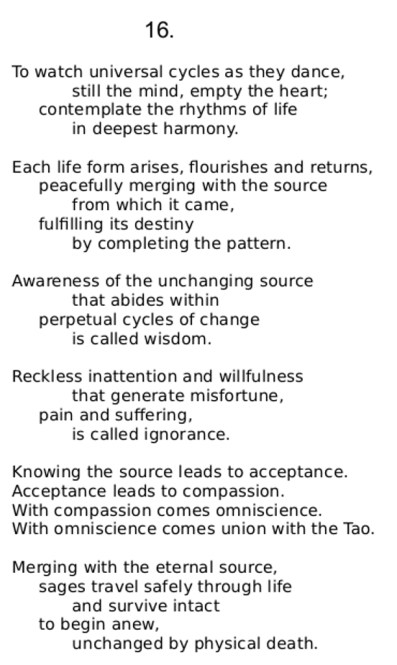
Now, in the Tao Te Ching, Lao Tze repeatedly confirms what you experienced as our inherent immortality. For example, Passage 16 describes the creative process:

16 quote

Conscious life continues on, rooted in a reality larger than a single lifetime. Passage 54 tells us:
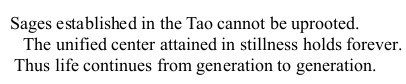
54 quote

Passage 33 urges us to be steadfast in our experience of eternal life:

33 quote

Even further, when meditators intentionally pierce the veil of illusion, traveling back through and beyond time and space, they are, as Dr. Joe Dispenza puts it, “reborn in the same life time.”

Or, in your words:

I now have two lives. I have previous learning life. Struggle, anger, control, trying to fix everything. And I have post experience. A calmness. An understanding that it’s all driven by love. Even if other people can’t see through their filters of criticism, they’re still driven by love. Every one of you is a piece of all that IS. Every one of you!

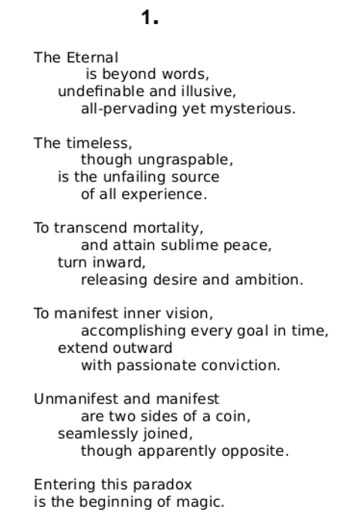
The first Passage from my version, Two Sides of a Coin, gives words to the way ancients experienced travel beyond time:01
Tai Chi Tu

Part Two. Now, how do we identify and connect with that unchanging source, the “unified center achieved in stillness” of which Lao Tze speaks? Where is it located? Within us? Outside and all around us? Both?

To quote myself:

In working with wisdom traditions, I’ve become certain that each is striving to express a particular aspect of a single, unnameable Truth. Further, each is a mosaic piece of a larger picture. When the pieces are put together, the sum is greater than its parts.

The Positive Paradigm of Change adapted from the Life Wheel is that larger picture. It draws from wisdom traditions, both East and West. It is consistent with biblical teachings and the essence of I Ching philosophy. It is yoga-compatible. In addition, it’s equally compatible with modern science.

In Rethinking Survival, the Positive Paradigm of Change is described as:

. . . . a new, inclusive reality map, one people worldwide can easily comprehend and agree upon. It is equally compatible with scriptures and science, bridging the gap between them. It fulfills Einstein’s intuited search for the Unified Field Theory, picturing how all parts of creation are related, interwoven and interdependent.

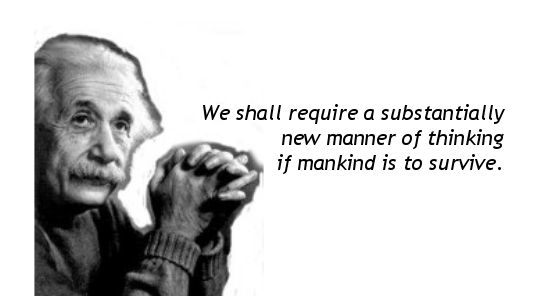
Working with the Positive Paradigm empowers the “substantially new manner of thinking,” which, Einstein said, is necessary “if mankind is to survive.”

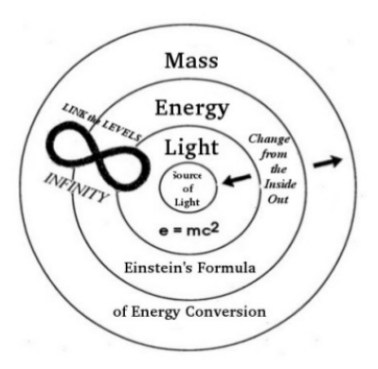
It looks like this:
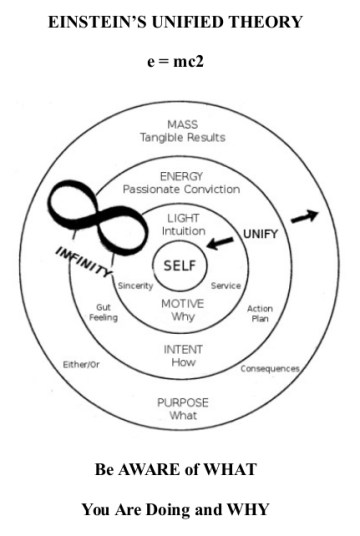
Unified Field Theory

The Positive Paradigm wheels-within-wheels model consists of concentric circles around a common center. It places the three variables of Albert Einstein’s famous formula, e = mc2 (energy, mass and light) in a two-directional, infinite continuum.

This Synthesis Wheel mirrors the microcosmic structure of atoms as well as the macrocosmic structure of planetary systems. On the largest scale of magnitude, it reflects the in- and out-breaths of perpetually expanding and contracting universes.

This familiar structure repeats smallest to largest in the patterns of nature, from snow flakes and intricate flowers to spiders’ webs and sea shells. Similar patterns repeat worldwide in the art of every culture — including the prayer wheels of Native Americans, the colored sand mandalas of Tibetan Buddhists, the stained glass windows of European cathedrals and the intricate geometrical patterns covering Muslim mosques. They offer proof of the universal awareness of a central inner reality, of an inner structure common to all humanity, and to a continuity of experience deeper than individual lives or transitory cultures.

Elsewhere, I’ve described its value thusly:

This Wheel of Change is a paradigm, meaning a worldview. It offers a positive alternative to the prevailing, dysfunctional paradigms which cause so much misery. It is an inclusive reality map that accords with the way life truly is, showing the full spectrum of human potentials. It explains how the world works, how the individual fits into it, and what is required to truly survive.

Unlike exclusively materialistic, atheistic, hedonist or religionist paradigms, all levels of experience are present, and in balanced, aligned relationship with each other. Nothing is missing. Nothing is out of place.

This paradigm pictures an elegantly simple yet complete reality map that meets the standard of Occam’s razor: maximum inclusiveness with greatest simplicity.

I explain the levels, with this caveat:

Yoga scriptures correlate the three levels of the Wheel with three different states of consciousness. Most of us experience the states of waking, sleep and dreamless sleep separately. However, it is possible to experience the entire continuum simultaneously while remaining fully conscious.

In the terms of modern brain science, this is accomplished by not only integrating functions of the right and left hemispheres of the brain, but by simultaneously coordinating the full span of vibrational brain wave frequencies from fastest (beta) to slowest (delta). The fully enlightened sage’s experience of linking the levels is called “turyia.” In that state, a highly accomplished being is said to be “here and there at the same time.”

The concentric circles aren’t literally separate and discrete. Rather, they are a continuum along the infinite spectrum of creation. Within each layer are numerous distinctions verified only by direct experience. For the sake of the following discussion, however, the three levels are described as if discrete, starting from the surface of the Wheel and moving inwards.

And with that said, here are the three states:

m = mass. The outer rim of the circle is the realm of the material, manifested world of creation. This level is the abode of empirical science which measures tangible, measurable things. It is the plane of duality, the fluctuating ebb and flow of mortal life, the ups and downs of daily experience.

It is the realm into which public school education too often squeezes and flattens children. This is the level of which Einstein said, “The only thing that interferes with my learning is my education.”

Those focused excessively here are unduly attached to material possessions as well as to money, social status and institutional power. Here appearances are more important than substance. Saving face replaces authentic virtue.

Paradoxically, out of balance, abundance on the material plane seems to foster an insatiable sense of lack. Limited connection with the center breeds insecurities and greed. The infinite variations on the same eternal forms are misconstrued as grounds for cultural conflict and competition for illusory supremacy.

When people live primarily on the surface, with the middle (primarily “unconscious”) level clogged and in conflict, systems break down. Attempting to fix problems caused by this inner turmoil at the superficial level can not achieve any lasting, qualitative improvement.

e = energy. Much ignorance, misinformation and confusion surrounds the energy level of the Wheel. The state of chaos into which the world has degenerated attests to this deficiency, as well as the urgent need to correct it.

The middle level is the domain of Natural Law mapped in the Chinese I Ching, the Book of Change. These changes are the energetic underpinnings of the dynamic, physical world, experienced as the recurring cycles of seasonal change, as well as humans cycles of birth, growth, decay, death and rebirth.

The middle layer is the realm of less tangible but still measurable states of energy, including electricity. More subtly, it is the chi, ki or prana described in Asian traditions as the life force which animates all living beings. In Greek and Christian contexts it correlates with the breath, the psyche.

These subtle energies influence internal [most often ‘unconscious’] psychological states and drive external human behavior, which in turn affects social relationships. A clear understanding of these dynamics is essential to personal survival.

Now, as you’ll recall, I earlier asked, “How do we identify and connect with that unchanging source, the “unified center achieved in stillness” of which Lao Tze speaks? Where is it located?”

The answer rests deep within the levels of “Light” and “Source of Light” at the central hub of the Wheel:

c = light. The hub of the wheel, the Source of Light, is innermost state of being. It is silent yet fertile, that from which all forms emanate and to which all return. It is the alpha and omega, the ultimate and exclusive source of infinite light and power.

Merging with this all-encompassing source of consciousness is what scriptures refer to, quite literally, as “enlightenment.”

The deepest center is the original seed of life from which creative solutions and new beginnings emerge in answer to the prayers and sincere efforts of those who hear and do. It’s the unfailing source, deeper than ephemeral fears, which gives survivors the inner strength to withstand the sudden shocks and catastrophic changes of Titanic times.

The experience of light is described with worlds like inspiration, intuition or guidance.

Unlike the levels of mass and energy, which can be described at length from experience, the center of light is best honored in silence. Or at least as few words as possible.
0 Hush

Here’s just one example of the myriad ways the Life Wheel is adapted to picture deep understanding. It plugs Passage One into the levels of the Wheel, depicting Lao Tze’s travel away from previous life learning – struggle, anger and control on the outer rim of the Life Wheel – towards the innermost, post-experience of supreme calm.

Inward-pointing arrows trace the path of release; outward-pointing arrows point towards physical manifestation. In the words of the biblical God of Moses, this repetitive, full-circle dynamic is spoken as a command: “Return unto me and I return unto you.”

II-8 rev

Way cool, huh!

Part Three. At the outset, I promised to look at apparently contradictory definitions of “survival” by placing them in Life Wheel context. Briefly, it’s important to rescue the word from the negative context of stress. Survival emotions are counterproductive. However, survival also means to continue to exist through dangerous situations, to live when death seemed imminent. It can be associated with being alive and enduring. Viable ancient customs and beliefs, for example, are said to survive through the ages.

The ongoing concern of this website, RethinkingSurvival.com is based on this premise:

Human survival, Einstein warned us, can no longer be taken for granted. Tipping the scales of history in favor of survival depends on freeing ourselves from the mental prison of limited, delusional thinking.

Again, quoting myself:

Chances of success in life are slim to none without an accurate reality map. It’s imperative to have a complete picture of your potentials along with a correct understanding of the world around you, and what’s required to survive in that world. Basing decisions on a worldview that’s distorted, incomplete or otherwise out of synch with the way things really are seriously diminishes chances of survival. In times as dangerous as these, it’s more important than ever to make sure you’re operating on complete and correct information.

To the point, just briefly, I’ll introduce the Fifth Axiom derived from the Positive Paradigm. “History Is Neither Progressive or Linear, Nor can Human Survival Be Taken for Granted.”

The final Corollary E: An apparent death sentence makes time remaining all the more precious. In biblical terms, awareness of impending disaster is motive and opportunity to repent (meaning to change one’s heart and ways), and to atone (meaning to realign – be ‘at one’ – with the center), using the gift of whatever time is left gratefully, wisely and well.

Some will actually defy medical/historical prognosis and survive to carry on, whether it be here, in other dimensions or even different universes. (Science fiction fans of TV’s two-hearted, regenerating time traveler Dr. Who are well-acquainted with these possibilities.)

CONCLUSION

Bruce, your time has arrived. You get to travel the world, sharing your insights. I’d love to do the same. But mine has yet to come. The I Ching, the super-ancient foundation of Lao Tze’s wisdom, has yet to be reintroduced, refurbished, for survivors who urgently need access to the cosmic clock. Its 64 hexagrams (does that non-coincidental number make you think of DNA?! ), and each of the six-level AC-DC, binary-digital constructs are a short-hand representing the dynamic interactions amongst the six primary energy centers. . . tons of information is stored here like buried treasure to be recovered through diligent re-search. (Understatement.)

But, just maybe, my reaching out to a fellow early-adaptive thinker might change that. After all, within the quantum field of God, all things are possible!

N.B. I’ve already written a post for your compadre, Gregg Braden. On the drawing board is another, on Creativity and Genius, favorite words of another amigo, Joe Dispenza. So is a final one, The Universal Pattern.
Ripples in Time


Stay Alert To Cosmic Patterns

Ripples in Time

Be here and now.” This is the yogi’s mantra.

Be still and know I Am God.” This is the Bible’s instruction.

In the Secret Universal Mind Meditation, Kelley Howell intones, “I am one with God. I am one with God’s plan.”

What do seers attuned to the Universal Mind tell us about that plan for the future?

Dr. Joe Dispenza and Gregg Braden describe this as a time of extremes. Dr. Joe understands that there’s some chaos coming. Gregg goes further. He says, not only do world teachings concur in predicting an end to the world as we know it. But further, the world leaders he speaks with consistently express surprise at how quickly this change is coming upon us.

The spiritual brothers agree that cultivating inner wholeness and resilience is the best possible way to prepare for future challenges.

Both are intentionally building an international community of like-minded souls, people committed to overcoming their personal pasts and the “old” paradigm of separation and competition. In so doing, one person at a time, their students are beginning to manifest at home and at work the “new” paradigm of unity and cooperation.

Now, that’s all well and good. It’s very important. As far as it goes.

But they’re leap-frogging over the chaos part.

Once we achieve that inner wholeness, see beyond the veil, as Dr. Joe puts it, how can each of know where we are in time, what to do NOW, and how to prepare for the “unknown” bearing down upon us?

Those who are called to serve operate on a finely tuned sense of timing, as if they have an inner radar attuned to the future. As earlier written:

Some people experience this inner knowing as a sense of personal destiny or keen sensitivity to the zeitgeist direction of the times.

Faith guides our feet, not only towards good fortune, but away from danger. For example. in the New Testament, Joseph, husband of Mary and protector of Jesus, accepted the mother and her child on faith.

And when King Herod, intent on killing new born males to thwart the prophecy of his downfall, Joseph “knew” it was time to escape from Jerusalem to save the infant’s life. He also knew when danger had passed, and it was time to return the boy to his homeland.

When you want to know what time it is now, and what to do, working with a wisdom tool like the Book of Change is an invaluable help. For, Among other things, the I Ching works like a cosmic clock, telling us the time.

mechanical clock

For ordinary mortals (like me), who aren’t always fully present and clear, the discipline of settling down the physical body and quieting the mind is a great help. Then, the practice of carefully defining the immediate situation leads to the formulation of coherent questions. In this higher, open and receptive state of mind, magic can happen. You bridge the gap between now and the future. It’s experienced as a synchronous connection between yourself and timeless wisdom – call it intuition or angelic guidance, as you will.

The Book of Change puts its users in touch with the patterned, pulsating, alternating rhythms of life. It connects them with inner knowing that anticipates approaching changes, the better to prepare for what is to come.

One reading repeatedly received underscores the importance of cultivating inner wholeness and resilience:

51 Shock
This advice is consistent with examples from scripture. In the Old Testament, Noah was called to build an arc. Joseph in Egypt explained the deeper meaning of Pharoah’s prophetic dreams. He warned that years of plenty should be used to store grain to survive through future years of famine.

In essence, that’s what today’s preppers are doing in advance of foreseen chaos coming down the pike at an alarming rate.

OA had a lot to say about this. Specifically, he advocated building intentional communities of like-minded souls as a bulwark against future chaos. Not just internet networks of like-minded souls, but physical, propertied, nitty gritty communities of committed, organized co-workers like the ones Pastor Joe Fox and James Wesley Rawles support.

For this isn’t the first time in repeating cycles of history we’ve arrived at this point. And in the past, under similar circumstances, survivors were those prepared to prevail during tough times.

For example, in The Age of Heretics, Charles Krone observed that in the dark ages, when chaos enveloped the civilized European world, monasteries appeared as islands of purposeful community — centers of learning, healing, hospitality and mutual protection. Similarly, monasteries of refuge from barbarism (think Shaolin) appeared in Asian lands during harsh historical times.

Now, then. Even more fundamentally, leaders equipped to oversee a safe transition though chaotic times will operate on a complete and correct paradigm. Understanding the multidimensional fabric of reality embodied in the Life Wheel, they will well understand how and why wisdom traditions including the Book of Change are instrumental to making future plans.

As it stands, current world leaders who operate from incomplete, extreme and dysfunctional paradigms continue to make decisions that endanger humanity. And as Einstein warned us, the stakes could not be higher. We’re at a crossroads of civilization. Human survival can no longer be taken for granted. We either change the way we think or go extinct.

Einstein home page

The way out of current madness must begin with restoring a complete and correct paradigm, one that is consistent with both the world’s great religions and with modern physics. That is, in effect, what Joe Dispenza, Gregg Braden, and in my own humble way, I have been deliberately working to do.

But the clock is ticking. Time is precious, and not to be wasted with petty conflicts and misunderstandings. Which side are you on? Which future do you choose?

And, if you agree, please share.

11th hour

Good Intentions Are Not Enough

I’m just now beginning to appreciate the depth and wisdom of OA’s early advice. “When dealing with humans,” he warned, “stay on the surface.”

What did he mean, and why is it the necessary and prudent thing to do? I don’t think he meant for me to be superficial, but rather to be ware of what lies beneath the surface images others project.

Because the unredeemed human condition is fractured. Beneath the superficial mask of good intentions, in most of us there festers an energy body riddled by the full spectrum of unconscious negative emotions: insecurity, hatred, rage, aggression, hostility, hopelessness, powerlessness, depression, guilt and shame. Fractures

Sadly, despite the best of good intentions, uninformed humans seem powerless to bring about the positive changes they want for their lives. Dr. Joe Dispenza tells us why:

Much of the programming in the subconscious mind was impressed on our early childhood minds when we lived in the non-verbal theta brain-wave state. And by the time we are 35 years old:

. . . 95% of who you are is a set of memorized behaviors and emotional reactions, beliefs and perceptions that function just like a subconscious computer program.

So when people initiate change, in effect they’re pitting the puny 5% of the conscious mind against the overwhelming 95% of what has been stored away unawares, embedded in the energy centers and internal organs. With even the slightest lapse of conscious attention, the preponderance of subliminal programming kicks in, hijacking the conscious mind.

Worse, as R.D. Laing described in Knots, the final hypnotic command in our programming is to forget that we’ve been hypnotized. We have been forbidden to be aware that we’ve been violated and abused, of what we’re doing and why, which makes positive change virtually impossible.

Now, the good news is that, thanks to the profound and uplifting work of Dr. Joe Dispenza, there’s a way out of this madness. You have to dearly want out. But when the time is right, when you’re totally ready and willing to do the work to create a better future, all things are possible. The testimonies of students who have experienced miraculous healings and personal transformations give abundant proof.

Here’s how.

Dr. Joe has translated yogic meditative practices which purify and uplift the energy centers into an understandable, practical, science-based method. His books speak to the critical, doubting rational mind. He explains in terms of physics, cutting edge research and medicine, supported by diagrams, photos and case histories. He details all that is possible, how and why.

Then, his meditation CDs make it happen. They talk to the subconscious mind which needs to be activated and reprogrammed to match one’s conscious intentions. The accompanying music in these CDs resonates with and stimulates the energy centers. It is a powerful component in the transformative process. This is because, as you go deeper and slower into the brain-wave states, you’re accessing the theta level of awareness where childhood wounds and confusions are stored, as are later traumas. It looks like this:

Heal fractures

Until very recently, the sciences which train us to access and harness the energies of the middle level of the Life Wheel were the missing link in our knowledge banks. Without this knowledge, even with the best of intentions, we go terribly wrong and are baffled as to why. When we operate from an incomplete paradigm and lack the tools to complete our lives, we’re operating blind. We can’t identify the place where things are messed up. Worse, we don’t know how to return to a positive path.

But now the Unified Field Theory and quantum healing tools are available. Dr. Joe explains:

We know that when people begin to unmemorize those emotional states, they lower the volume on the emotion that’s signaling the gene in the wrong way. And if the emotion is a record of the past, the moment the person overcomes that emotion, they’re free now to create a new future and, according to the religious model, they’re born again in the same life.

So now it’s up to you. What are your priorities? Are you willing to take the time and make the effort to heal your fractured life and create a better future? Can you afford not to?

Angel Calling

How To Create a New Future

A new manner of thinking creates the new way of feeling and acting you need to build a better tomorrow. Einstein gave us the way to begin.

The practical applications of his intuited Unified Field Theory transform it into a powerful self-awareness tool for picturing the present, setting intentional goals and then creating a deeply desired future.

Einstein home page

How’s that for a big idea?

be aware

Please stay with me. I’ll unfold the implications one step at a time.

For starters, we need to decide whether self-awareness a desirable goal. For those programmed into the old paradigm of empirical science – a limited and limiting view of reality – it isn’t.

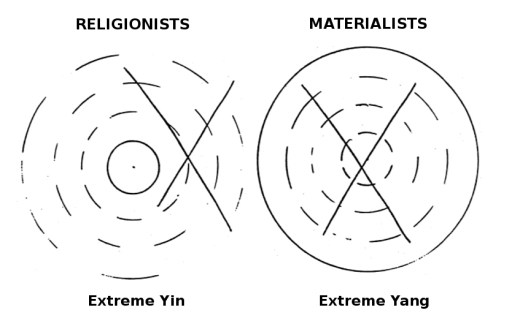
The modified Life Wheel shown below represents the hollow shell of this obsolete world view. Only the outermost level of the Wheel, the things which can be measured and quantified (mass), are accepted. The middle level of emotional intelligence (energy) and inner level of intuitive knowing (light) are both ruled out, functionally relegated to the “unconscious”.

MaterialistAthest

In fact, according to research from the University of Virginia, most people would rather do something external — even hurt themselves — than sit alone with their thoughts. Why?

Because social sanctions impelling self-avoidance are incredibly powerful. If you believe there is nothing more to life than the material surface and to expect that taboos on inner experience will be enforced with ridicule and rejection, then the blessing of quiet time becomes a threat.

This makes life especially painful and difficult for empaths. As Dr. Judith Orloff explains, emotional and intuitive awareness experienced at the inner levels of the Wheel are their functional reality.

For sensitives, restoring a complete and correct paradigm of reality can be a matter of life or death. . . suicide is the logical outcome of a narrow world view which enforces the belief that anyone whose experience draws primarily on the inner levels of the Life Wheel doesn’t – and shouldn’t – exist. (Just ask me. I’ve been there.)

Even for the rest of us, shifting to the more expansive paradigm – one that corresponds with Einstein’s quantum reality – offers multiple benefits across the board. . . improved physical, emotional and mental health, better relationships, and increased abundance, to name a few.

How exactly does all this work?

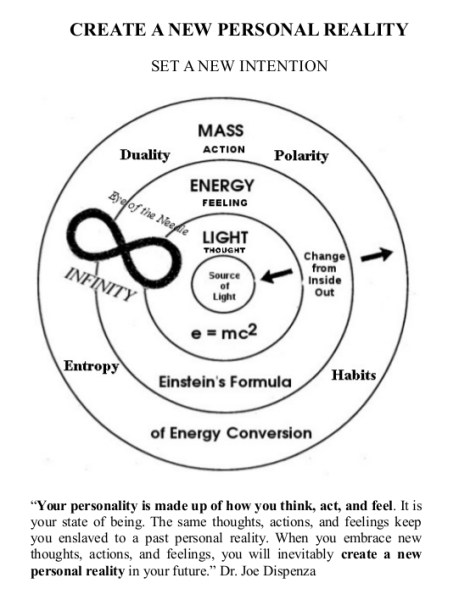
It looks like this:

Create a New Personal Reality

Open your heart to infinite possibility. Replace fear with fearlessness, resentment with gratitude, and self-doubt with infinite Self-trust. Integrate positive feelings with a clear intention for the future firmly in mind. Embed this vision into the “unconscious” mind with consistent repetition until it becomes a memory strong enough to erase and replace the past. To accomplish this, be patient, persistent, determined, and consistent in your practice of meditation.

That’s the short version.

CHAPEL PERILOUS

Chapel Perilous

Now, I’m not saying the shift is easy. If it were, everyone would be doing it.

But the process of increasing self-awareness isn’t for the faint of heart. Social taboos aren’t the only obstacle. For most, the middle level of the Life Wheel is congested – a frightful mine-field of buried traumas, painful associations and toxic emotions. It effectively clouds the inner level of intuition and blocks enlightenment.

So, if increasing self-awareness and reaping the countless blessing which follow is your goal, the work of releasing stuck, negative energy can’t be avoided. The dangers of Chapel Perilous (dark night of the soul) have to be faced and heroically overcome. The only way out is through.

That’s the bad news.

The good news, however, is that the intelligent, full-hearted practice of meditation as Dr. Joe Dispenza has associated it with quantum physics offers a safe way out of this madness. It isn’t necessary (or even advisable) to reopen wounds or relive partially-remembered old injuries to clear out the swamp.

In the same way that it is possible to delete obsolete computer software files without opening them and replace them with new information, meditative practices can reorganize the energy field without having to agonize over the past.

Phoenix - sized

Moving along, now. Activating a personalized Life Wheel is another, complimentary method for setting and actualizing a positive intention, visualizing how to move from a difficult past into a better future. It starts with creating a “Where I Am Now?” Wheel.

Here’s an example:

How My Life Looks Right Now

This personalized Life Wheel represents an introvert’s immediate experience. She has limited material resources. The outer rim of the Wheel reflects this state, being narrow and undefined. In contrast, the e=energy level of her emotional life is wide — full and rich. She has sectioned her Wheel to show how and where she currently invests her time and attention.

There’s a question mark at the center of the Wheel. She’s chosen this symbol rather than an atheist’s emphatic X, because as an agnostic, she’s open to new possibilities, though also has doubts.

When she’s ready, she can take the next step, creating another Personal Wheel to image her thoughts about what a better future looks like along with the action steps she’s willing to take to alter the old snap-shot in time. She can repeat the process as often as necessary, mapping measurable changes as she progresses.

FRAGMENTATION

The levels of our personal Life Wheels expand and contract over a lifetime. Their relationships and interactions are different for each of us. But often the levels aren’t in synch. Here, the Life Wheel is distorted to represent a fractured, incoherent state of being. When we (and our families, business organizations, government institutions and even the world) get bent out of shape, the fractured, fragmented result looks something like this:

Where is LoveThis modification of the Life Wheel shows levels out of alignment. They intersect only in part, manifesting in negative, destructive ways. Love is eternal. But remains a remote possibility, hovering outside of but detached from direct experience.

The first responsibility of the self-aware self-healer is to bring personal levels back into synch, reestablishing balance and harmonious alignment. Restoring Love to the center of one’s life is always a powerfully effective place to start.

Then, without effort, synchronous “opportunities” to extend healing on increasingly larger scales of magnitude are likely appear.

book header bird

A comment posted to an earlier blog on the Life Wheel concluded, The diagram can be applied in so many ways . . . unfortunately it probably isn’t available on mobile phones!

Any takers?

Self-Awareness Tools for Empaths

Dr. Judith Orloff has taken the lead in bringing the needs of empaths to our attention. In The Empath’s Survival Guide, she explains the important difference between having empathy and being an empath.

Having empathy means our heart goes out to another person in joy or pain. . . but for empaths it goes much further. We actually feel others’ emotions, energy, and physical symptoms in our own bodies, without the usual defenses that most people have.

In case you’re wondering why you should care, let me add. You’re probably an empath too, even if a latent or undercover one. To the point, in his praise of The Empath’s Survival Guide, the venerable Dr. Joe Dispenza concludes: “Dr. Orloff does a brilliant job of helping us discover the empath in all of us.”

So, let’s get practical.

The Empath’s Survival Guide offers an array of tools to help sensitive people develop healthy coping mechanisms in a high-stress, high-stimulus world, while at the same time optimizing their unique gifts: intuition, compassion, creativity, and spiritual connection. (In the context of the multi-dimensional Life Wheel, this translates as honing the ability to honor and protect awareness of the middle and innermost levels, while simultaneously strengthening the protective, physical layer.)

Meditation is a strategy Dr. Orloff highly recommends. She calls it “Opening to a Higher Power.” (Dr. Joe’s meditations likewise serve this purpose.)

But there’s one powerful tool they do not mention. It’s related to meditation, but in a unique, extraordinary way — namely, the Chinese I Ching, especially in a version free of unnecessary hocus pocus, sexist assumptions and flowery talk, The Common Sense Book of Change.

The text has a long history. In the last century, psychologist Dr. Carl Jung picked up on it. In his introduction to the first genuinely useful English translation, Jung coined the term “synchronicity” to explain its power – precipitating seemingly magical and awesome non-local connections of understanding, insight, and awareness. This affect may be due to the similarity between the opening and closing lines of the 64 hexagrams and the geometric patterns seen by meditators in deep trance. (Dr. Joe is a fan of synchronisities. He tells students, as they grow in their meditative practice, to look for confirming synchronisities to appear in their lives.)

The Book of Change is a meditative tool especially suited to empaths’ needs. Its introspective method is safely accessed in the privacy of one’s own room. It gives those unable to bear the stress of travel much less mixing in crowds of thousands to participate in Dr. Joe’s popular events, another means of cultivating heightened awareness. Its benefits are cost-effective. And it is consistently available on a daily basis . . .  most especially in emergencies . . . for immediate use.

The Introduction to The Common Sense Book of Change makes its direct connection with Dr. Joe’s work strikingly apparent. In meditation CDs, he intones, “Become AWARE. Become Aware that you’re Aware.”

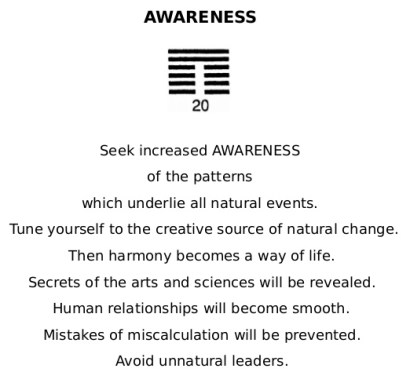
When, following Jung’s example, I asked, “What does the CSBOC have to offer its readers?” its answer was AWARENESS.

Hexagram 20

Personally, I owe a huge debt of gratitude to The Book of Change. In The I Ching and Me, I wrote:

For me, the Book of Change is a gateway to magic. On this side, it has been a close companion, good friend and advisor through the years. On the far side, perhaps remembered from lifetimes past, it speaks to me from a place beyond time and space.

With it, I was never alone, even and especially when I was loneliest in crowded rooms. When the world impelled suicide, it brought me back to a deeper, all-pervasive love of life.

Without it, it’s doubtful I would have survived the challenges and dangers of my “interesting” youth. Which is why, in the spirit of paying it forward, I have gone to considerable lengths to make this book in its essence available, most especially to sensitives.

Because, Yes. I was an empath too. I clearly remember an incident from early teen years. Mom came at me in a rage, fists flying. For many years, her exact words stuck – indelibly imprinted — in my mind. “Stop being so damn hyper-sensitive and act normal like everyone else.” (Our family physician gave her the term. She used it as a complaint, like a club.)

By now, the pain has been released, the memory transformed into wisdom. When I told OA about the incident, he simply remarked, “Good advice.” (Easier said than done, I thought.) What I’ve learned is that the functional word in her demand was ACT. Act as if normal. The challenge is to honor inner awareness while, at the same time acting within the bounds of social norms.)

The reason this was so hard for me to do this was that I picked up on and responded to the non-verbal messages people broadcast, which are often quite at odds with their verbal statements.

Denial

It confused me terribly. Not to mention that my unwelcome awareness frustrated and angered the verbal message senders. Whether they were unaware of the disconnect or were simply invested in saving face, exposure was perceived as a threat. Embarrassing. Enraging. (Along similar lines, in the context of energy vampires, Dr. Christine Northrup describes the effect of mixed messages as “cognitive dissonance.”)

Especially at times when I felt obliged to keep others’ dark secrets and had no one in the world to turn to, I depended on The Book of Change to validate what I “knew” and advise on the wisest way to act on this information, one situation at a time. For example, consistent with Dr. Orloff’s emphasis on the necessity of establishing clear boundaries, I often received this advice:

IC 60 Limits

At other times, when life became exceptionally chaotic and it seemed as if there was no way out of an impossible situation, I would read this and be comforted:

IC 52 Stillness

When I worked as an Administrative Assistant at the now-dissolved UW-Madison Eating Disorders Clinic, it broke my heart to observe how sadly the treatments and advice inflicted on suffering young women (often empaths at a loss to survive in abusive families) missed the mark. I dearly wished someone would offer the same self-counseling remedy that worked for me. They might, for example, have found this, as I did again recently:

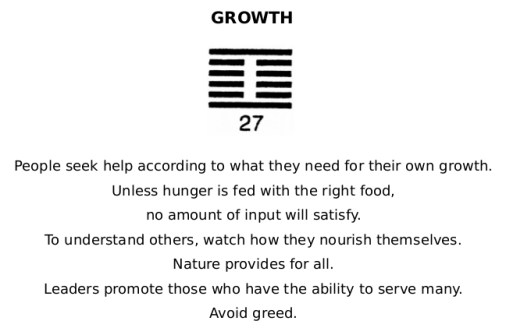
IC 27 Growth

The Book of Change has been instrumental in maintaining my sanity and weaving safely through the uncertainties of an environment dominated by energy vampires – a concept well defined, in case you’re unfamiliar, by Dr. Christian Northrup in Dodging Energy Vampires: An Empath’s Guide to Evading Relationships That Drain You and Restoring Your Health and Power.

Ultimately, the decision may come to this:

IC 21 Breakthrough

Whether this Breakthrough occurs on inward spiritual and mental levels, or on the material plane of physical location, personal relationships and job situation, depends on immediate circumstance. Or, since the levels are interdependent, each influencing the others, the necessary change might eventually span the whole continuum.

book header bird

Since I’ve already given you plenty to absorb already, I’ll save a second, powerful tool for empaths – Personalizing the Life Wheel – for next time.

In the meantime, all best

The Ultimate Gatekeeper

Phoenix - sized

Lately I’ve been fully engaged in absorbing the remarkable work of Dr. Joe Dispenza, including his recent Becoming Supernatural. I have the yoga background to greatly appreciate just how skillfully he has translated and then integrated ancient science (defined as “with knowledge”) with cutting edge modern sciences, including Einstein’s quantum physics.

The Quantum Life Wheel I often refer to meshes perfectly with this work, as does its ancient ancestor, the Book of Change. Both of them compliment and have the potential to further enhance Dispenza’s work. For example, an early post, Sages and Scientists Can Agree on This, pictures the layers and levels of Dr. Joe’s message, in particular his instructions to “become aware of what you are doing and why.”

be aware

Dr. Joe systematically precipitates “miraculous” healings, teaching students how to “change” their lives by raising their energy — focusing awareness on the energy centers . . . blessing them, if you will. In Breaking the Habit of Being Yourself, he reminds readers: Einstein said that no problem could be solved from the same level of consciousness that created it.

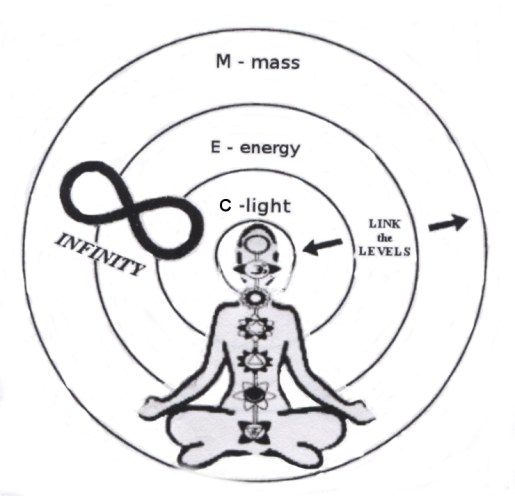
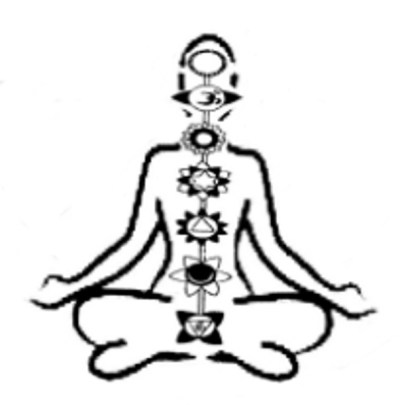
Here is an image of the chakras (energy centers) spanning the levels of the Life Wheel. It pictures the levels of awareness residing at the center of the Wheel where access to higher orders of consciousness generates positive new solutions.

Wheel2

Another point of convergence is the concept that meditation can “upgrade” DNA. The 64 changes of the Book of Change have been correlated with the 64 basic strands of DNA. Nor is it coincidence that Chinese ideogram for I Ching bears a marked resemblance to the double helix of DNA.

side by side

The Preface to The Ultimate Gatekeeper which follows opens still further avenues to links and possibilities.

book header bird

The Ultimate Gatekeeper:

Restoring the Book of Change to the World

PREFACE

In the millennial year, 2000, the title of this book was The Ultimate Personal Survival Guide. It came out of a brainstorming session with a business consultant. We were discussing how to market The Common Sense Book of Change. Suzanne was totally unfamiliar with the I Ching.

We went back and forth with questions and answers about its use and value. Finally, she sat back and blinked. “It sounds like the ultimate personal survival guide,” she concluded.

She’d hit the nail right on the head. She got it!

What I learned as she drew me out with her questions was that I had taken my answers to her valid concerns for granted. Surely many others had similar doubts.

So a further step was necessary. A follow-up book was required, one which would lead people to draw the same conclusion that she had. I had to dispel myths and misconceptions which prevent this gravely misunderstood and underrated treasure from getting the international acceptance it so richly deserves.

For this is a book that truly belongs to the world. It transcends, in its essence, the limitations of time and space. Used correctly, as intended, it leads the ordinary mind towards experiences of self-awareness and transformative transcendence.

Over the years, I had grown absolutely certain that the worldwide leadership deficit (and related budget deficits) are explained by an underlying knowledge deficit. For lack of what The Book of Change has to offer, people everywhere remain perplexed as to how and why so much continues to go so horribly wrong, despite the best of intentions.

It seemed urgent to clear the decks. Making this compendium of Natural Law — the premier leadership training and decision-making manual in China for thousands of years — widely accessible now is necessary in order to fill in this fatal knowledge gap.

Mainstreaming this vitally important information is the first, necessary step towards the positive change which many call for, but remain unable to achieve.

Fourteen years later, after completing a trilogy on change, I found myself in the same predicament. How does one shake up the sleeping public? What will it take to make people worldwide aware of how important this information is, and how gravely we’re at risk due to its absence?

The extraordinary value of the I Ching is that it reveals the secrets of dynamic Natural Law. Working with its changes opens up access to the middle level of the Life Wheel, the “e = energy” layer of Einstein’s Unified Field Theory.

Gatekeeper

This middle level of Natural Law serves as mediating, two-directional gatekeeper between the ever-changing surface rim and the universal, timeless center. You can’t get from here to there and back again, except through the middle “energy” layer which, in Western thinking, is effectively taboo, buried deep within the inaccessible “unconscious.”

To the extent that the Natural Law of energy dynamics remains a blind spot in the prevailing, linear and exclusively empirical paradigm, we are left powerless to move beyond the surface level of experience.

To compound the loss, when stuck on the surface, the realm of light and conscience which rests beyond, on the far side of the dynamic energy level, remains functionally inaccessible.

Only by becoming intelligently competent in managing the subtle energies of the middle level does it become possible to travel further inwards for the direct personal experience of not only Light but even deeper still, its very Source.

Unfortunately, the middle level is too often clogged with painful memories, negative emotions and repressed, socially taboo urges. It becomes a barrier to deeper knowing.

For eight thousand years and counting, the Book of Change has served as an indispensable tool for resolving this dilemma. Used as intended, it can restore the unnecessarily “unconscious” to conscious awareness, reopening the levels of human potential so they can be aligned and unified.

In this context, genuine survivors fit to prevail in today’s increasingly dangerous times aren’t those with the most material wealth, possessions or political power. They’re the ones who’ve successfully navigated the middle realm, reached the far shore of enlightenment and returned to the surface with their new information intact.

Those who succeed in linking the levels of experience are genius-leaders in whatever fields they choose to engage. They’re the fortunate ones who have acquired the inner wealth necessary to both hear the still voice conscience and act effectively on the guidance they receive.

Patricia E. West, Ph.D. 

Wisconsin, U.S.A. 2019

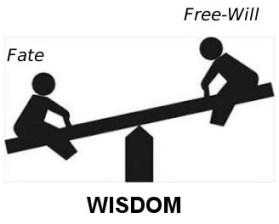
Fate or Free-Will?

Our life is such a curious mix of givens and decisions.

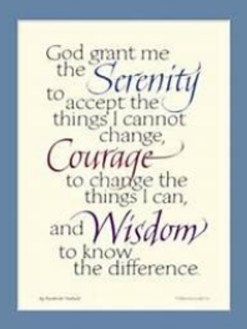
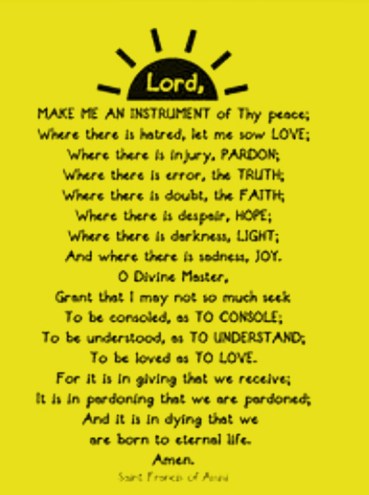
St. Francis of Assisi captured the eternal give-and-take dance between what we can and cannot change:

Now. Let’s take these three God-given variables – SERENITY (peace, calm composure), COURAGE and WISDOM – and put them in I Ching perspective.

For it has been my experience that using The Book of Change as a wisdom-fulcrum tips the balance in favor of what can be changed.

I’ll give you a dynamic example from recent experience.

In an unsettled state of mind, I queried the book asking, as I often do, “What should I be aware of NOW?” The result was Hexagram 47 with a changing line in the 4th place.

The description was right on, matching my mood exactly. It was a chicken-and-egg-like situation. Which came first, the economic or mental stress, I do not know.

But reassurance that “the time will pass” was what I needed right then. It gave distance to seemingly endless difficulties. The advice, “use hardship to develop inner strength” reinforced St.  Francis’ SERENITY option.

The critically important insight, however, was embedded in the dynamic changing line:

Line 4: Placing trust in unreliable people puts your goals in danger.

Aha! I was letting difficult people and their on-going circus dramas distract me from my goals. I let them push and pull me down, forgetting my True Self. A host of spiraling problems all stemmed from that single basic mistake. Correcting that fault had the potential to turn many things on many levels back in a positive direction.

The first step was to take this important hint to heart and have the courage to act on it. The key point of interception was to refocus on my values, on whom I love and whom I serve. Put first things first.

Coincidentally,” identifying the root cause of “danger” indicated in Line 4 resulted in Hexagram 29, DANGER, which offers further advice on the right way to proceed.

I was especially impressed by the resonance between the two readings. Both highlight the importance of holding fast to goals and avoiding negative thoughts/emotions.

 The I Ching WISDOM-fulcrum changed emphasis from SERENITY to the COURAGE option of the St. Francis prayer, tipping the balance away from passive acceptance of what cannot be changed towards that which can.

So it is that magical transformations on many levels begin with changing negatives to positives. Again, almost sage-like, espousing the way of spiritual alchemy, St. Frances gave us a key to positive change:

Please. Do take a minute or so of your precious time to think about this. Let it resonate with you. Ask, Where is your focus? Are you able to tip the balances in your life, giving weight to the positive side of the seesaw?

Maybe, just maybe, if you’re not already friends with the I Ching, it would be well worth your while to try something new. Working with The Common Sense Book of Change might just give you a new way to leverage the balance between fate and free-will in a positive direction.

Magic Is in the Eye of the Beholder

eye of the beholder

What we know as science today would have been considered magical in the days before the operations of electricity were discovered and harnessed. Automobiles, airplanes, and computers we take for granted today would have seemed phenomenal in days passed.

Much of science fiction depends on tricks of changing technologies over time. For example, I remember the story of a hero who saved the day by astonishing the natives with a solar eclipse. When the critical moment arrived, with a flamboyant gesture and incantation – “hocus pocus” – he vanquished enemies by the apparent power to make the sun go dark.

Now, it seems, we have magic in reverse. We have so much come to depend on technology, that the inner workings of our potentially powerful psyches and our connection with the forces of nature seem like “magic.”

We are haunted by distant memories of who we once were and could be againthat deeper, truer intangible part of ourselves. Modern “education” rules out our latent, subtle powers and potentials, as if whatever cannot be measured and quantified cannot and should not be.

Yet we are enchanted by fantasy and science fiction which tease and lead us to remember.

hist of magic

The science (meaning “with knowledge”) which explains the magic of synchronicity demystifies this method for reconnecting with our larger mind and its place in the universe.

When people use a term like magic, they give little thought to the full range of possible meanings it might have. It might be a good idea to rethink what we see as magic – all the uses and abuses which have accrued over time.

To that end, I offer the following Essay on Magic.

image - harry potter

ESSAY 37. MAGIC

Magic is the art of manipulating the unseen forces of nature. A white magician is one who is laboring to gain the confidence of the powers that be. A black magician is one who seeks to gain authority over spiritual powers by means of force rather than by merit. The white magician’s motto is: “right is might.” The black magician’s motto is “might is right.” — M.P. Hall, Magic: A Treatise on Esoteric Ethics

One must distinguish between ordinary magic and consciousness of the harmonic relationships of nature — the philosophy of magic — which is the right gesture at the right place at the right time. Its applications, often excessive, and falsified by popular greed and ignorance, have given birth to superstitious magic and crude sorcery. — Isha Schwaller de Lubicz, Her-Bak: Egyptian Initiate

Taoists say, “Know magic, shun magic.” They mean that through the cultivation of knowledge, you can know precisely how natural calamity and human enmity can be avoided. You can know all the ways in which you might be affected and be able to meet crisis on the challenger’s own terms. The Taoists do not mean that you should learn the ways of others in order to be like them, only that you should learn the ways of others to avoid being manipulated by them. — Deng Ming-Dao, Scholar Warrior: An Introduction to the Tao in Everyday Life

THE FRONT

Webster’s defines magic is the use of charms, spells and rituals in seeking or pretending to cause or control events, or govern certain natural or supernatural forces. It can refer to anything mysterious and seeming inexplicable, or to an extraordinary power or quality (the magic of love). It refers to producing baffling effects or illusions by sleight of hand or use of concealed apparatus. Used as a verb, it means to cause change, or to make disappear.

Of all dictionary definitions, magic is the most incomplete. Little is known of its pristine meaning. The word occult explains why the public knows so little about true magic. This knowledge is intentionally withheld from the unprepared.

“Occult” is defined as hidden, secret, beyond human understanding and therefore mysterious. (Webster’s shows empiricist bias, saying occult designates alleged mystic arts, such as magic, alchemy or astrology.)

In fact, as Hall’s Treatise details, magic is a systematic discipline based on Natural Law. Practitioners are competent to direct natural energies at will. However, few have the courage and compassion to make the personal sacrifices required to pursue this path of knowledge.

Even fewer attain the wisdom to use such power wisely. Prudent masters therefore keep their traditions as carefully guarded secrets, safely away from unqualified seekers who, as Hitler wanna-be’s, would abuse what they could.

For the general public, it suffices to know that such powers do exist, so that when they are used, the possibility of what’s going on is recognized. An appropriate question to consider is, “What color is the magic?” According to Hall, there’s not only positive white and negative black, but yellow and gray as well. It depends on how intentional and extreme the capacity for either good or evil.

Patanjali’s yoga sutras outline the preliminary stages of magician training.As the ancient compendium  of Natural Law, The I Ching (Book of Change) is the necessary complement of all self-awareness disciplines. Exercising conscious awareness of and control over one’s own internal energies is the necessary first step in white magic schools.

With time, mastery over nature comes of its own accord as a by-product of self-knowledge. Because one’s potentials mirror and resonate with those of the entire universe, as one becomes competent to change one’s own internal states at will, one spontaneously begins to influence nature and others.

By his own admission, Aleister Crowley is a black magician. His teachings bear distorted resemblance to occult knowledge. However, his credo, “Do what thou wilt” is the antithesis of the white magician’s prayer, “Thy will be done.”

Witchcraft is incomplete. Practitioners take natural law out of context, seeking occult powers rather than self-mastery, sometimes without social conscience, sometimes in defiance of Divine Law. Seductive claims aside, being incomplete, no witch practices white magic.

Rarely do white magicians announce their presence. They don’t have to. They quietly think, and, as Lao Tze put it, all is accomplished. Christ was an exception to the rule. He was competent to change water to wine. He also performed the ultimate miracle, resurrecting the dead. Such acts, however, were not self-serving. They were done to serve the Father, to teach and to quicken faith.

THE BACK

Miracles are events without natural cause. They are different from magic, which operates within the bounds of natural change. Miracle is defined as an event or action that apparently contradicts known scientific, natural laws, and is therefore attributed to supernatural causes . . .  an act of God.

Special movie effects, card players’ sleights of hand and illusionists’ feats are accomplished by cleverness, manual dexterity, or computer technology. Though they’re irrelevant to bona fide magical powers, they tease the imagination and stir forgotten knowledge of latent potentials and what is truly possible.

The I Ching Works Like a Cosmic Clock

Among other things, the I Ching works like a cosmic clock, telling us the time.

In the Old Testament, King Solomon expressed the natural, rhythmic alternations of time in poetic form:

To everything there is a season, and a time for every purpose under heaven: A time to be born and a time to die; a time to plant and a time to pluck up that which is planted. A time to kill, and a time to heal; a time to break down and a time build up . . . a time to love and a time to hate; a time of war, and a time of peace.

The Book of Change puts its users in touch with these pulsating, alternating rhythms of life. It connects us with inner knowing – call it intuition or conscience – that anticipates approaching changes, the better to prepare for what is to come.

It serves as a reminder that our lives change like the seasons of nature. Fall follows summer. Spring follows winter.

It lends perspective to the current times and what is likely to come next.

In I Ching context, faith is akin to trusting a highly refined sense of timing. It is an atunement with the same inner clock which guides migrating birds and informs heroic displays of virtue.

Some people experience this inner knowing as a sense of personal destiny or keen sensitivity to the zeitgeist direction of the times.

Faith guides our feet, not only towards good fortune, but away from danger. An example from the New Testament is Joseph, husband of Mary, protector of Jesus. He accepted Mary and her child on faith.

When a fearful King Herod was intent on killing new born males to thwart the prophecy of his downfall, Joseph “knew” it was time to escape from Jerusalem, thus saving the infant’s life. He also knew when danger had passed, and it was time to return the boy to his homeland.

Using the interactive Common Sense Book of Change (CSBOC) is a powerful way to get in touch with the native common sense we are all born with, but too often forget under the pressures of hectic daily life.

The text maps the natural patterns of change which trigger predictable passages from one stage to another in our lives.

Those who live close to nature are instinctively closer to their own natural rhythms, something city dwellers too often lose touch with. For those who long to remember who they truly are, but have forgotten, working the I Ching is especially rare and precious blessing.

Use the CSBOC To Increase Self-Awareness

Did you know that Swiss analyst, Carl Jung, who gave us the concept of archetypes and influenced appreciation of dream analysis, also had great respect for the Chinese I Ching? He used it as as a tool for making the unconscious conscious.

In fact, Jung was instrumental in bringing the first usable English translation to the West. He wrote the introduction to the Wilhelm/Baynes version by giving an example of using it. He queried asking for a comment on the translation. The answer received was, in effect, that a vessel of great value which had fallen into disrepair was being restored.

My small yellow book follows Jung’s example. In the Introduction, I ask, “What does the Common Sense Book of Change (CSBOC)  have to offer its readers?”

Its answer: “Awareness.” A changing line yields the likely future outcome of following through. “Gain.” (I’ll show you how this works below.)

But even before starting, the book emphasizes the importance of practicing a thoughtful process of question- asking:

The quality of results depends on the state of mind in which information is received. It is therefore essential to learn how to approach the Book of Change in the best possible frame of mind.

So quiet yourself. Get past the clutter of chaotic thoughts to focus on forming a worthy question.

. . . There are many techniques for calming the mind and focusing attention. One of these is usually practiced before asking the question.

Bottom line: consulting the Book of Change is not only compatible with yogic and mindfulness practices of introspection, contemplation and meditation. They work synergistically. Settling the mind to ask the right question induces a meditative state. The ability to induce a meditative state enhances the quality of questions asked and value of answers received.

To give you the flavor of working with The Common Sense Book of Change, I’m sharing the example given in the book.

If you initially feel uneasy with this approach to increasing self-awareness, you might find the answers to commonly asked questions reassuring.

If this is new to you, try approaching it with the attitude for approaching the unfamiliar recommended by Samuel Coleridge, a “willing suspension of disbelief.” Or, as I do, at the start, prayerfully invoke protection and guidance according to your beliefs.


SAMPLE READING

First I collect my materials. I need three pennies, a pad of paper or notebook, a pen or pencil and the Book of Change.

Then I find a quiet place to sit. I take a few minutes to settle down. I clear my mind of other thoughts and silently watch the breath until it becomes slow and even.

Then I think carefully about what is going on, what is troubling me, and the issues I need to know more about. I list the decisions I have to make and consider what consequences are likely to follow from my future actions.

For the example in this book, I have decided to ask, “What does The Common Sense Book of Change have to offer its readers?”

I enter the date and my question in the Diary Section at the back of the book.

Concentrating on my question, I take my three pennies, shake them a few times in my gently closed fist and roll them onto the flat surface in front of me.

The first throw of my three coins comes up three heads. The value of heads is two, so I multiply three times two to get six.

Since this is an even number, I draw a broken line on my pad of paper. It will be the bottom line. Because all three coins were the same, I place an “X” next to this line to show that it is a changing line.

My bottom line looks like this:

Place Throws Values Sum Line

Bottom H H H 2 2 2 6 ___ ___X

Then I take the three coins and throw them again. This time I get two tails and one head. The value of tails is one, so I add one and one to get two. I add this to the two for the heads coin to get four.

Since four is an even number, I place a broken line in the second place over the bottom line. My pad of paper now looks like this:

Place Throws Values Sum Line

Line 2    T T H 1 1 2 4 ___ ___

Bottom H H H 2 2 2 6 ___ ___ X

̀I follow the same procedure four more times. My final hexagram looks like this:

Place Throws Values Sum Line

Top       T H H 1 2 2 5 _______

Line 5   T H H 1 2 2 5 _______

Line 4    T T H 1 1 2 4 ___ ___

Line 3     T T H 1 1 2 4 ___ ___

Line 2     T T H 1 1 2 4 ___ ___

Bottom  H H H 2 2 2 6 ___ ___ X

The next step is to find the number of my reading. I turn to the chart at the back of the book. The bottom three lines of my hexagram are all broken.

I turn to the chart at the back. In the “lower trigram” column of the chart, the picture which matches this figure is “k’un.”

The top three lines of my hexagram are two solid lines over a broken line. In the “upper trigram” row of the chart, the picture which matches this figure is “sun.”

By going to the box which shows the combination of upper and lower trigrams, I find the number 20. I therefore turn to Hexagram 20 for answers to my question.

Hexagram 20 is AWARENESS. So the answer to my question, “What does the Common Sense Book of Change have to offer its readers?” is AWARENESS. It reads:

Seek increased AWARENESS of the patterns which underlie all natural events. Tune yourself to the creative source of natural change. Then harmony becomes a way of life. Secrets of the arts and sciences will be revealed. Human relationships will become smooth. Mistakes of mis-calculation will be prevented. Avoid unnatural leaders.

Because the bottom line is a changing line, I go to the page directly opposite the hexagram, titled “Direction of Change.” I read the sentences for the bottom line. They advise:

Narrow-minded self-interest is not enlightened. Broaden your views. Include others. (42)

The number in parens after the warning represents the hexagram which results when the bottom line changes to its opposite, a firm line.

The new hexagram, GAIN, indicates the change that would result from the AWARENESS this book has to offer its readers. Turning to Hexagram 42, I read:

GAINS can be made after analyzing the situation correctly. When a person’s life goals are kept firmly in mind, no time is wasted. A way can be found to use whatever resources are at hand to serve one’s purpose. Serving others can be compatible with personal gain. Avoid smug self-satisfaction.

I then turn to the back of the book. In the Diary Section, I write the numbers of the hexagram and any changing lines next to my question. Then I decide what future actions I to take.

Finally, I enter a few sentences to describe my thoughts and decisions into the Diary Section. That way, I know I can return to my question, the reading and my decisions later to think more about them.

I hope this helps. Any questions? Comments? Your feedback is welcome.

Critical Mass

debate sized

Three separate threads weaving in escalating intensity over the past weeks are resolving now, forming a fabric greater than the individual parts.

Here I’ll briefly describe the parts and how each illumines the others.

First, throughout, I was listening along with the one respectfully called Old Avatar to YouTube videos published by KrisAnne Hall and her husband/co-host, Pastor J.C. Hall at Liberty First University. (I would prefer Truth First, but that’s just me.)

In any case, their mission is to educate Americans about the Constitution. In the process, they analyze current events by that standard. How true are the actions of government officials, elected or appointed, to the Constitution they’re sworn to uphold?

Not a pretty picture.

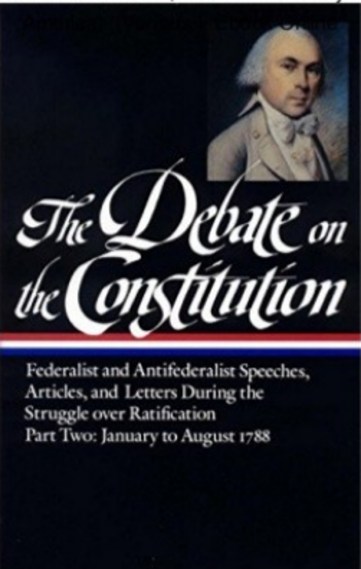
Increasingly curious, OA went to original sources for first hand answers. First he read a through a collection of the Federalist Papers written in support of ratifying the Constitution.

Critical thinker that he is, OA was impressed, but also found flaws in their reasoning. He wanted to know what arguments were made by the Anti-Federalists – those who opposed ratification. So we found two volumes which present both sides of the coin, pro and con, side by side – not exactly easy reading : )

Book on Debate

Some say God smiled on the Founders. Ratification was a miracle,” he winked.

How is that,” I asked. “Were the Founders were so flawed that coming to agreement seemed impossible?”

Something like,” he answered. “You know,” he added. “You’re the one who’s so interested in intentional communities. That’s what creating the Union was about. On a large scale.”

Wow! I never thought of it that way before. But you’re right!”

OA is a man of few words. Usually, he keeps opinions to himself. But recently he took exception to a program where the Halls, outraged, exposed a pattern of abuse by federal officials. Members of both parties systematically steal tax payer monies, living like royalty, impoverishing those they only claim to serve.

This was exactly what the Anti-Federalists foresaw,” he pointed out. According to them, it was only a matter of time until the country would come full circle, back to the critical mass of power abuse which drove colonists to separate from England. Back to another revolt.

Why not contact the Halls,” I asked. “Ask them to comment on the Anti-Federalist papers and their concerns.” He declined, doubting they are ready to admit we’ve arrived at that point.

A second thread, over the past week-end, was the converging holidays of Easter and Passover. Passover marks the exodus of slaves from Egypt. (“Set my people free.”) Easter celebrates the resurrection of Christ, freeing humans from the heavy burden of past sin. Both holidays repeat the pattern of yearning for freedom from oppression — a pattern of sacrifices made to throw off the yoke of enslavement, whether internal or  external.

These same yearnings were reflected in the passionate forces that drove the debate over the Constitution’s ratification.

At one point, looking up from his book, OA commented, “This speech was really dramatic.” He continued, “The founders were totally committed – emotionally, financially. They put everything on the line. They knew how high the stakes were. They were willing to sacrifice everything to prevent falling back into the same mistakes that drove them to leave Europe, to create a form of government that would not drag their heirs down back into the same pit.”

He shook his head. “They were idealists,” he said. “Optimists.”

The ratification went forward only because Anti-Federalist fears were respected by adding the Bill of Rights.”

What happened,” I asked. “What went wrong?”

People got lazy. It is impossible to live continuously on the razor’s edge, perpetually alert and on the lookout for danger. They went back to their ordinary lives. They got immersed in farming, running businesses and raising families.”

They let things slide,” I said. “It’s an I Ching thing. The zenith of achievement doesn’t last forever. Success has to be maintained with constant vigilance and adjustments. Over time things naturally degenerate. No legislation can prevent unraveling. The cause is deeper. Metaphysical.”

The Founders knew that,” he responded.

But people got stupid,” he continued. “This has been a problem from the beginning of time. Even Samuel Adams, who was supposed to be this great defender of liberty. He got stupid. He listened to his wife yapping in his ear. To protect his pride, prevent others from accomplishing what he failed to do, he passed detrimental laws against negotiating with foreign nations that have not to this day been repealed. He lost perspective. He got caught up in the illusion of his own self-importance.”

Yes.”

And then the third strand. We have followed the Parkland shooting and its aftermath, getting increasingly more suspicious. It looks more and more like a set up.

The shooting itself was long foreseen: eminently and egregiously preventable. From start to finish, response by law enforcement was botched beyond belief. The protests which followed have played out like a badly written grade-B movie, tailored to extremists’ ends, designed to escalate public opinion towards critical mass.

David Hogg, a self-proclaimed student representative, is remarkably uneducated either by schooling or experience. He is illiterate, unable to navigate the basics of English grammar. He demonstrates ZERO understanding of the history behind the hard-won Bill of Rights. Nor does he have a clue about the critical difference between a democracy and a republic. (He asserts, “Our parents don’t know how to use a f***ing democracy.”)

Substituting posturing and self-righteous self-pity for genuine passion, DH projects an intensity of rage and hatred that triggers equal animosity in return. Tweets pun on the animal connotations of his last name (“media hog,” “piglet,” etc.).
And then, there’s the irony of his first name, David, a personal hero of mine. Nor was the biblical comparison lost on mainstream media. “David Hogg Took On His Own Media Goliath,” reads one headline.

But the original David fought in the Name of the Lord. This pawn of Soros-driven media is the antithesis of the biblical King David.

For example, DH declared all-out war on Laura Ingraham, vengefully demanding that her advertisers jump ship. (How is this for disrespecting First Amendments rights, much less the Second?) He along with far-left supporters were all too quick in the attempt to ruin someone who simply happened to disagree with him.

Yet in the same breath, he had the gall to turn around and claim the higher ground of civility.

Ben Shapiro rightly nailed this blatant hypocrisy. “You don’t get to play the LOVE THY NEIGHBOR Card.” DH pretending to represent Christ’s new law is obscene.

The timing of the shooting aftermath resonated with holy week themes. Notably, Laura Ingraham picked up on Easter implications. At the start of her week vacation, she tweeted out Psalm 143, a Prayer for Deliverance from Enemies, reminding her followers of the true David, forefather of Christ.

For thy name’s sake, O Lord, preserve my life!
In thy righteousness bring me out of trouble!

Even the KrisAnne Hall and her husband at Liberty University picked up on the irony. They commented that David Hogg, a puppet of anti-constitutional forces, is “driving his generation over a precipice.”

Phoenix - sized

So. Where does all this leave us now? In the cycles of history, are we again reaching the point of critical mass? Historians repeatedly point out similarities between the fall of the Roman Empire and the current state of the U.S. Stefan Molyneux recently described an End of the Empire.

Those on the far-left would have us believe that the U.S. Constitution is an outdated document, along with the faith of the Founders who debated it with such fierce passion.

But I would answer, The American Constitution along with its Bill of Rights represent a passion for Freedom and yes, Truth, far deeper than any historical event or physical political document. Even if  today’s brainwashed, woefully misled youth have forgotten its origins and timeless significance, the ultimate concerns of mankind, remain constant and valid — what psychologists call “archetypal.” It is the underlying belief in the “American dream” of freedom — not just material wealth –which has inspired sincere aspirants from every nation to relinquish their past in the quest for a better life. (Dinesh d’Souza’s story comes to mind.)

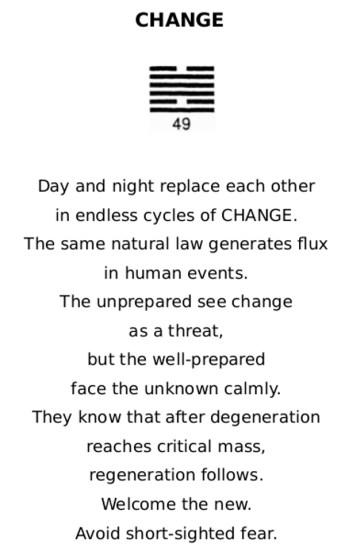
I think about the I Ching view of the hope which remains latent even in degeneration. Just as Christ appeared at the nadir of an earlier cycle, ushering in a ray of hope, the vigilant today will recognize the seeds of possibility present, however dormant, in current ugly times.

IC 49

In this context, foresight and preparing are essential to deciding the direction of long-term outcomes. (Remember Joseph in Egypt storing grain during times of plenty, anticipating future famine.)

Further, recognizing what America’s great constitutional debate has to teach us now about immediate dangers might be helpful in building future alternative communities.

Is it time to think about a Fresh Start,” I asked OA. “After critical mass, will we begin another cycle and rebuild even better?” He answered with a silent shrug, seeming to imply, “Too early to tell. The jury is still out. Depends on . . .”

Technically, I suppose, each and every day offers us the opportunity for a fresh start. . . . one individual at a time. It’s a matter of personal choice.

So here is the immediate question. What is YOUR choice, today?

Angel Calling

Your Choice

Yoda make good choices

Discipline Equals Freedom: Field Manual by Jocko Willink is exactly the right medicine for me right now. It might be for you too.

Here’s the amazon.com summary of his credentials:

Jocko Willink’s methods for success were born in the SEAL Teams, where he spent most of his adult life, enlisting after high school and rising through the ranks to become the commander of the most highly decorated special operations unit of the war in Iraq. In Discipline Equals Freedom, the #1 New York Times bestselling coauthor of Extreme Ownership describes how he lives that mantra: the mental and physical disciplines he imposes on himself in order to achieve freedom in all aspects of life.

JW’s perspective is radically different from that espoused in Jordan B. Peterson’s 12 Rules For Life. As described in If You Love Your Children. . . and . . . Tell Them How the world Works:

Essentially, [12 Rules] advises people to “man up.” All of us have the potential to be much better than we are. Before criticizing the world, our first responsibility is to improve ourselves with discipline, carving out meaning in our lives as a bulwark against the chaos of life’s inevitable hardships.

But the two approaches are, each in its own way, complimentary.

Now – JW’s background is far different from mine.

I’m a woman brought up as a musician. As a college/university-educated scholar majoring in world history-philosophy-literature, much of my later years have been dedicated to unlearning and relearning.

As a violinist and yoga practitioner, my practice disciplines focused on harmony, balance and unity.

In school administration, I looked to the ultimate decision-making manual: the ancient Chinese I Ching — The Book of Change.

JW speaks of fighting. And aggression. I approach self-improvement in terms of transcendence. Our goals and results, however, are much the same. So my approach to discipline is also, in its own way, complimentary.

I find JW’s approach to discipline almost devotional. Similar to Chinese Taoists – including the Shaolin monks who based kung fu martial arts on the I Ching — he refers to The Way of Discipline. He writes:

Discipline: The root of all good qualities. The driver of daily execution. The core principle that overcomes laziness and lethargy and excuses. Discipline defeats the infinite excuses that say: Not today, not now, I need a rest, I will do it tomorrow. . . . .

There is only one way.

THE WAY OF DISCIPLINE.

What inspired me to write this post was his chapter on NATURE VS NURTURE. He asks, What is more important? And he answers, Neither.

In the military, I worked with every type of person:

Ivy League kids with silver spoons, kids from blue-collar families, kids from strong families, and kids with no families, kids who were pampered and kids who were abused. And everything in between. Everything.

And with all those different types of people, there were good and bad. Successful and unsuccessful. And in working with businesses, I see the same thing: People from every walk of life. From the bottom to the top – and I have seen every type of person be successful.

His conclusion:

It is not about nature or nurture.

It is about choice.

He continues:

The people who are successful decide they are going to be successful. They make that choice. And they make other choices. They decide to study hard. They decide to work hard. They decide to be the first person to get to work and the last to go home. They decide they are going to take on the hard jobs. Take on the challenges. They decide they are going to lead when no one else will.

They choose who they are going to hang around and they choose who they will emulate.

Ultimately:

They choose to become who they want to become they aren’t inhibited by nature or nurture. They overcome both.

I totally agree. Choices and consequences hang together. And as pointed out elsewhere in describing the natural Law of Karma, failure to choose is also a choice — one with heavy consequences.


book header bird

There are two directions I could take from here. One is to share with you the post called What’s More Important – Nature, Nurture, OR . . ..

This subject is especially relevant in the context of answering ideologues who use the seeming unfairness of life and suffering as excuses for rebellion and destruction of social order . . . rather than discipline.

The other direction I could take is to share is the Essay on Discipline which give a balancing, complimentary perspective to JW’s military approach.

Here’s my choice. First I’ll offer a few snippets from the blog here. You’re welcome to click on the link if you’d like to see more.

Then I’ll post the Essay on Discipline below.

So. First. From What’s Most Important:

I’ll give one example here using the Positive Paradigm Wheel of Change. This picture talks to the right brain to balance the left-brain discussion which follows.

It places the relationship of nature, nurture and “much more” in prioritized context.

PPoC gold

The surface level that corresponds with MASS includes everything tangible and measurable. It’s the realm of empirical science. That would be “nurture.”

The middle ENERGY level corresponds not only with electricity, but with subtle but measurable energies that yogis call “chi” or “prana.” It’s the level associated with DNA, emotions and “gut” feelings. That’s “nature.”

The innermost level of LIGHT is associated with intangibles, including conscience. That’s the “. . . and More.”

My conclusion:

. . . leaders who intentionally live true their conscience and succeed in linking the levels of life are key to a viable future. The rest of us will depend on them to out-think, out-maneuver and succeed long after pretenders with no substantial connection to the center of life have been blown away like dust in the wind.

Phoenix - sized

And here’s the Essay. Hope you enjoy. Your comments are welcome. If you find this resonant, please share to magnify the effect.

ESSAY 26. DISCIPLINE

Tai ji is a discipline that can help you settle into the experience of your body and your surroundings and re-establish contact with what is happening now. — Chungliang Al Huang, Embrace Tiger, Return to Mountain

Obstacles and problems are a part of life. True happiness comes not when we get rid of all our problems, but when we change our relationship to them, when we see our problems as a potential source of awakening, opportunities to practice patience, and to learn. — Richard Carlson, Don’t Sweat the Small Stuff

When our emotions hijack us into overdrive, we react to others without the benefit of reason. By managing our emotions more effectively, we are able to dissolve distressing emotions, which allows us to think more clearly and use our emotional intelligence to make better decisions. — Lambrou & Pratt, Instant Emotional Healing: Acupressure for the Emotions

THE FRONT

“Discipline” comes from the same root as “disciple,” meaning “learner.” Webster’s first definition is a branch of knowledge or learning.

Second, it’s training that develops either

  • self-control, character, or

  • orderliness and efficiency, or

  • strict control to enforce obedience.

Third, it’s the result of such training or control, specifically either self-control and orderly conduct or acceptance of or submission to authority and control.

Fourth, it’s a system of rules, as for a church or monastic order.

Fifth, it’s treatment that corrects or punishes.

The pristine word means love of learning. In self-actualization traditions, discipline refers to the process by which ignorance is decreased and wisdom is increased.

In balanced measure, incorrect ideas and behavior are recognized, corrected and put away, while correct ones are introduced to replace them. This entails digging deeper than cultural conditioning to reconnect with innate potentials and inner aspirations.

The word “correct” is intrinsic to the concept of discipline. Webster’s defines correct as to change from wrong to right, removing errors. The word is also means to make conform to a standard. Further, it means to scold or punish, or to cure, remove or counteract a disease or fault. Correct also means conforming to fact or logic, to be true, accurate or free from errors.

Whether discipline is a joyful privilege or painful punishment

is decided by the motives of involved participants.

If the learning and correction are imposed externally upon unwilling parties, it’s onerous. The subjects can perhaps be forced to alter behavior. No positive inward change results from coercion, however. If anything, force breeds the opposite of intent: resentment and rebellion.

Societies that fail to inspire and foster internal self-discipline therefore pay a high price in the form of escalating crime rates, overburdened judicial systems and costly prisons.

If, however, through the power of example, a sage attracts students hungry for wisdom and self-improvement, then the condition for positive change exists. When the teacher is motivated by compassion and generosity, and students with respect and love of learning, then innate potential for transformation can be actualized.

Negative emotions can be healed and self-mastery achieved. Mutual consent and willing compliance set the stage for improving oneself and, by extension, society.

As correction agents, coercive prisons impose external discipline on people perceived as threats to society. Those capable of inner discipline, however, remain free to use even external confinement to advantage.

For example, during the time he was imprisoned by a political rival, King Wen turned apparent defeat into the opportunity to order the hexagrams of the I Ching and write commentaries. Upon release, he helped found the next Chinese dynasty. The legacy of his steadfast resolve during dark times and ability to transcend adversity remains with us even today.

Nelson Mandela used thirty years of incarceration to carefully examine and correct his character. When the time was right, the extreme revolutionary became South Africa’s most responsible elected leader. His extreme isolation changed to an opposite and equal status of unparalleled international influence.

THE BACK

Absence of discipline is of the opposite of discipline. Though the immature may regard disorganization and irresponsible disrespect for worthy seniors as a measure of freedom, it isn’t. Without self-discipline and self-correction, there is no self-improvement or sustained achievement.

External regimentation can be a perversion of discipline. In the extreme, it suppresses creativity and initiative. Coercive military conscription, slavery, or other involuntary work are violations of free will that degrade the value of life.


. . . Tell Them How the World Works

teach-sized

In writing this post, I surprised myself and took a different direction. I intended to pick up where the last left off, completing Dr. Phil’s sentence: “If you love your children, tell them how the world works.”

There, I quoted an exchange between Dr. Jordan B. Peterson and a radical student on the subject of identity.

Student: My question isn’t about [the article], but more about identity. . . . Maybe nature lends itself to creation of arbitrary structures within society. But then people self-identify with these categories. . . . How do people reckon with the parts of their identity that may or may not contribute to environments where people feel more estranged, more alone?

JBP: That’s why you educate . . to separate the wheat from the chaff. Because you’re a historical creature. And it’s outside of you and inside of you.

Well. He’s right . . . but only partially so. For we are more than mere “historical creatures.”

What I would add to the mix is a deeper, more comprehensive component of identity. For that, I rely on the gravely misunderstood and underrated I Ching, the Chinese Book of Change, along with its more accessible and familiar spin-offs: Lao Tzu’s Tao Te Ching and Sun Tzu’s classic Art of War. Together, they represent a blind spot in Western thinking, a glaring deficit in our knowledge banks responsible for dangerous deficits in every aspect of today’s civilization.

The I Ching and both spin-offs detail how the world works. They are especially useful when dealing with conflict.This is the gift of love I’ve labored long to restore to common knowledge.

To the extent we applied this knowledge to questions of identity and social structure, we’d have a hope of restoring common sense and sanity to our lives.

Earlier, I spend hours putting together pictures of shallow circumstance and the biblical answer to suffering. However, instead, what I decided to do here is share three related essays. Each applies ancient wisdom to current confusions.

Essay 15 on Roles offers a broader view of gender and social identity. Essay 13 addresses how roles are learned in the Family. This in turn builds into rethinking the structure of Community, Essay 14. This is a lot to take in, I know. But please stay with me. It’s well worth taking the time to give these tried and tested truths your careful consideration.They could well make your New Year go much better.

Also, by the way . . . Dr. Peterson repeatedly states his respect for Taoist philosophy. Everything below is in harmony with and supports his view of how the world works.

Namaste2

Essay 52. ROLES

Traditional business concepts of organizational structure and management technique often condition managers to classify and measure everything and everyone they are responsible for. Organizational charts assign names to little boxes in hierarchal order. . . Not that there is no value in all these charts and systems; on the contrary, they offer a worthwhile way of understanding the fundamental structure. But the structure should serve, as chords do in jazz, as a basis for innovation and improvisation. — Autry & Mitchell, Real Power: Business Lessons from the Tao Te Ching

Leaders must be people who will not fight change but who will anticipate it, and can be challenged enough by it to enjoy it. . . We need a new kind of human being who can divorce himself from his past, who feels strong and courageous and trusting enough to trust himself in the present situation. — Abraham H. Maslow, The Farther Reaches of Human Nature

THE FRONT

“Role” refers to a part or character that an actor plays in a performance. By extension, it refers to a function or office assumed by someone for limited duration to fulfill a particular purpose. We wear roles like clothing put on by day, shed by night.

Success in the world depends on the ability to choose a suitable part and play it with sincerity and skill, aware of how that role fits into the larger pattern of family and business organization. When studied, practiced and performed to perfection, a well-defined role provides a structure from which to relate to others and serve a useful function within the whole.

Knowing one’s particular place in the universe at any given time, in specific contexts, is an important part of self-knowledge. It’s possible to wear an array of “hats,” suitable to many complimentary roles, even during the course of a day.

In Shakespeare’s tragedy, MacBeth laments, “Life’s but a walking shadow, a poor player that struts and frets his hour upon the stage, and then is heard no more.”

When we live unconsciously, we identify not with our essential true selves, but only the roles arbitrarily assigned by accidents of birth and later, by chance.

Though there are exceptions to the rule, and many variations on the theme, gender is a primary dictator of roles. In the West, girl children are traditionally dressed in pink and trained for reproductive and housekeeper roles with no preparation for transition to a productive middle or old age. Boys are dressed in blue and expected to participate in contact sports, fight wars, earn a living and support a family, also with little thought for what else life may have in store.

For the most part, one’s wealth, business and social opportunities are largely determined by whom one’s parents happen to be. Likewise, religious beliefs and nationality traits are mind-sets usually fixed by place and time of birth. In The Taoist I Ching, the sum of these factors is called cultural conditioning.

A life thus lived on automatic pilot, running on programming that has never been examined, is barely human. One cannot say such a life measures up to God’s gift of free will. There’s no conscious choice involved in the way it’s lived.

The goal of I Ching-based, Taoist training is to release us from bondage to arbitrary, unnatural conditioning, so that the mind is freed to return to its universal, pristine nature.

The purpose of overcoming cultural conditioning is not to withdraw from life, but rather to live it consciously and intentionally, to the full. Those who truly know how to act, do so with heart and soul. Rather than merely going through the mechanical gestures of scripted parts spoken without understanding, they play out a changing succession of roles over a lifetime with full awareness and conviction.

Taking on and letting go of roles is either growth-productive or traumatic, depending on one’s philosophy of life. In I Ching context, ephemeral change is natural, not subject to moral judgment as good or bad.

But, to the extent we live unconsciously, we’re but tragic shadows of our true potential. We’re poor players because we know not what we do. The more we become conscious, the more we are able to bring vitality, depth and meaning to the roles we choose, and the more radiant our lives become.

Those in leadership roles with I Ching awareness carefully prepare followers for change, equipping them to meet challenges and survive adversity. People who depend on leaders stuck in the past, unwilling or unable to change, are in deep trouble. Their survival depends on listening to the warnings of conscience in combination with gut instincts, finding positive ways to work around and overcome the dangerous consequences of mismanagement.

THE BACK

The opposite of roles is to be without a part to play. Jobless and/or homeless people are excluded from the give and take of productive daily life, as are incarcerated criminals and those institutionalized with mental or physical health problems. So are slum dwellers whose extreme poverty results in lack of education, skills and access to the work world.

The value of roles is perverted when they’re frozen into masks and performed without authentic involvement. When people identify with roles (or hide behind them) to such an extreme that they forget their true identity, they become disconnected from life. People who think of others only in terms of their roles stereotype them, disrespecting their essential humanity.

11th hour

Essay 13. FAMILY

Confucius

The nature of the chakra cords that you build in your first family will be repeated in all the following relationships that you create later. . . As an adult, you will most likely grow dependent child/mother cords between you and your mate. As you move through life and mature, you gradually transform the child/mother cords into adult/adult ones. Barbara Ann Brennan, Hands of Light

In the family we learn love, patience, respect, nurturing, affirmation, and health. The family also teaches us about competition, domination, selfishness, and deceit. The family is thus a relatively efficient learning system for the development of mind, spirit, and body. It involves the whole self. — Tom Chappell, The Soul of a Business

For whosoever shall do the will of My Father which is in heaven, the same is my brother, and sister, and mother. – Jesus Christ, St. Matthew 12:50

THE FRONT

The Latin root of “family” means household establishment. An obsolete usage refers to all the people living in the same house, including servants and slaves. A later definition refers to all the relatives living in the same house, including extended family. Only recently has it come to mean a nuclear unit, the traditional set of parents (one husband, one wife) and their off-spring.

A family can mean a group of people related by ancestry or marriage, including relatives. It can be all those claiming descent from a common ancestor, tribe, or clan — a lineage. A crime syndicate under a single leader is also called a family.

The extended Kennedy clan is a shining example of family cohesiveness. Yet, in an interview with Larry King, Maria Shriver described lessons her family never taught her. The “real world” lessons in her book, intended to spare others from learning the hard way, are strikingly similar to I Ching basics. For example, she observes, “Behavior has consequences.” This, of course, is the Law of Karma.

Ideally, children should learn the basics within the family. If we trained ourselves and our children in I Ching ways, there would be no need for each generation to reinvent the Wheel over by repeating the same mistakes. Sheltering them from the “real world” isn’t a kindness.

A better way to protect them is to provide the wisdom tools to give them the practical edge, help them meet the challenges of adult life with intelligence and self-confidence.

As Brennan indicates, first family bonds are instinctual. As we extend outwards, we unconsciously tend to replicate parent/child dynamics in later relationships. However, if we succeed in maturing and evolving over time, we can put childish ways behind and succeed in forming adult relationships based on conscious choice and commitment.

As Chappell indicates, within the nuclear family as in the family of man, everything, both positive and negative is possible. As we learn to articulate what we see and respond wisely to experiences in the family environment, we become increasingly able to apply these skills in school, business and extended political situations.

In I Ching context, however, as Confucius indicates, the goal of improving and sustaining family relationships isn’t achieved by extending ever outwards. It requires looking inward.

Efforts to improve personality lead to the necessity to know one’s mind. This in turn leads still deeper into exploring one’s innermost awareness. Then, in due time, inward movement cycles outwards once again, incorporating the benefits of inward journey into one’s personal and practical everyday life.

Within families of every size, whether communities, religions, corporations and governments, some live the law while others do not. As Christ taught, those who love and choose truth form the nucleus of his ultimate extended family.

Those who love life, who seek truth and understanding and do their best to help others as they can wherever they may be, have more in common with each other than with evil-doers within their own groups.

THE BACK

Opposites of family include strangers in our community whom we’ve never gotten to know, foreigners raised abroad who speak languages and practice customs we don’t understand, as well as others we’ve been taught to mistrust and dislike.

The antithesis of family is foe, including competitive opponents and military enemies. Whereas families are ideally founded on common beliefs, goals and mutual support, those who threaten or sabotage others undermine healthy relationships. Gratitude and hope build communities. Mistrust, hostility and abuse break them down.

book header bird

Essay 14. COMMUNITY

We can create communities and relationships that are based on love and intimacy rather than fear and hatred. We can learn from the suffering of others. Awareness is the first stage in healing. . . Likewise, we can create a new model of medicine as we move into the next century that is more competent and cost-effective as well as being more caring and compassionate. — Dean Ornish, Love and Survival

As we accept the smallness of the world, the density of the population, and the myriad influences on individuals and families, someday we may recognize the community and even the whole society as the patient. Imagine, then, what a “doctor of society” might do, what kinds of diseases he or she might treat! — Patch Adams, Gesundheit!

Each celestial body, in fact each and every atom, produces a particular sound on account of its movement, its rhythm or vibration. All these sounds and vibrations form a universal harmony in which each element, while having its own function and character, contributes to the whole. – Pythagoras, quoted in The Healing Power of Sound

THE FRONT

“Community” stems from a root word meaning fellowship. In English, the word refers to all the people living in a particular district or city. It can also mean a group of people living together as a smaller social unity within a larger one, and having interests or work in common, such as a college community.

Alternatively, it can refer to a group of nations loosely or closely associated because of common traditions or for political and economic advantage. It also covers similarity of tastes and preferences. The last definition Webster’s gives is the condition of living with others in friendly association and fellowship. The last definition has come full circle back to original meaning.

Communities are founded on a common cause. It can be as practical as survival or as idealistic as freedom. Often, community cohesion is artificially stimulated by fear and hatred of a common enemy.

Hitler inflamed passions against Jews and foreign bankers to mobilize his war-weary country into a second world war even more devastating than the first. Then Americans rallied behind the common goal of defeating enemies of democracy on two fronts, Asia and Europe.

In Common Sense, Thomas Paine wrote about the relationship of divine, natural and human law in a way that inspired readers at the time of the American Revolution to fight for freedom from tyranny. Winning that war did not, however, automatically secure freedom for all times.

Democracy isn’t a static achievement that can be passed on unchanged from one generation to the next. It must renewed and earned again, one individual at a time, each generation at a time, continuously redefined in the context of immediate circumstances.

Nor can the structures of American-style democracy be imposed by force, whole, from the outside, on peoples whose beliefs are shaped by vastly different cultural influences. It is the common respect of life and liberty, not external forms, which is universally translatable.

The music of life that moves every organization, smallest to largest, is the basis of harmonious fellowship. Approaching Natural Law and social organizations from the deeper understanding of the ancients could inspire a new, more humane and effective approach to international relations now, one based on energy dynamics which the human community share in common.

Sages say that freedom from tyranny begins with dispelling ignorance and overcoming negative emotions.

True freedom and stable communities begin with the self-awareness and self-mastery gained by diligent use of wisdom tools like the I Ching. First remembering the core of compassion and caring within, we can then extend and expand this good-will into healing society as well.

Put another way, it’s useless to fight for a democratic world before first cleaning out the inner swamp of negative emotions. Since inner life conditions attract corresponding external experience, fighting in anger and hatred reaps results in kind.

Working to establish positive community relationships before personal attitudes of good-will and willing self-discipline are established is futile. As Covey reminds us, first things must come first.

Put the other way around, the more individuals free themselves from personal problems, the more they become open to the calling of conscience. They then become increasingly fit to participate as members of a viable community, able to fulfill their part in the harmony of the natural whole.

THE BACK

Street gangs, terrorist groups, religious cults and secret societies are subgroups within the larger community. To the extent that their goals oppose and even endanger the community at large, these organizations are antithetical to the general good.

Pariahs, nomads and outcasts are individuals excluded from society, either voluntarily or by edict. Whether justified or not, their attitudes and behavior are out of harmony with accepted norms.

If enough of them find common cause to band together, they form alternative groups which become the foundation of new communities.

Angel Calling

Life is Eternal

In JBP at his best, I wrote A great deal of suffering comes from ignorant fear of death. Many have been deceived into doubting the existence of the immortal structure that supports the mortal frame.”

Here, due to time constraints, it must suffice to expand on my meaning by drawing from earlier work. In Contemplation of Mortality, I quoted from Essay 2 on DEATH.

Dying patients went through the five stages, but then after “we have done all the work we were sent to Earth to do, we are allowed to shed our body, which imprisons our soul like a cocoon encloses the future butterfly,” and . . . well, then a person had the greatest experience of his life. Elisabeth Kübler-Ross, The Wheel of Life

I continue:

Webster’s definition of death is the act or fact of dying — the permanent ending of all life in a person, animal or plant. Personified, death is pictured as the grim reaper, a hunch-backed, black-robed skeleton wielding a scythe. The term refers to extinction, as in the death of hope.

These definitions, however, represent an extreme cultural bias with important effects on behavior. They reflect the materialistic belief that the physical is all there is. When the body fails, there is nothing else. There is no essence which survives to travel on.

The I Ching embodies a more inclusive, comprehensive view. Like the learned amongst most ancient cultures, Chinese sages regarded birth and death as natural changes, complementary stages of an ongoing cyclical life process.

Sages continue to regard death not as extinction, but the culmination of a winter season most wisely spent preparing for the coming spring. They teach that a soul, having learned the lessons and completed the work of one life cycle, separates from its used up shell. The shell, once the spirit moves on, collapses. The life essence, however, simply migrates, possibly to take on another form.

Further:

Fear is the natural outcome of limited materialistic beliefs equating the end of physical life with total extinction. Those who experience the True Self as immortal and indestructible are not plagued by fear of mortality. No doubt the courage and solace which sustained Socrates as he calmly accepted his death sentence — not as an escape, but an affirmation of principle — came from the depth of his soul awareness.

book header bird

Also to the point are the following sections from Rethinking Survival. The first is “Higher Love, Unity and Inclusiveness.” The other is “The Mystery of Death and Rebirth.”

Higher Love, Unity and Inclusiveness

The Positive Paradigm Wheel is the image of wholeness and completion: Higher Love. It pictures the inclusiveness which Campbell and Einstein believed essential to planetary survival. All parts are present, each in right relationship to the others. No part of life’s experience is lacking. No part is distorted or out of place.

This is the harmonious unity each one of us, by birthright, has the potential to experience. Poets describe the joining of the center with the surface as the Marriage of Heaven and Earth.

Given today’s paradigm malfunctions, the bliss of Higher Love seems like a distant dream. Yet we each have memories, however distant, mirrored in our art and sacred symbols. The mandalas and stained glass church windows are just a few of the countless examples. We each have persistent longings for “home” and romance that remind of us of what’s possible.

These longings are captured in the often quoted “Ode on Intimations of Immortality from Recollections of Early Childhood.” The 19th century English poet William Wordsworth lamented the socialization process that represses early awareness of divine origin:

Wordsworth

Like Wordsworth,  Einstein had glimpses, notably at the beginning and at the very end of his life. As chronicled by Walter Isaacson:

The great awakening that happen in childhood are usually lost to memory. But for Einstein, an experience occurred when he was 4 or 5 that would alter his life and be etched forever in his mind:

The catalyst of this lasting impression was a compass his father gave him. He remembered trembling and growing cold in excitement, awed by the “mysterious powers” of a magnetic needle that behaved as if influenced by a hidden force field. As he recalled later, “Something deeply hidden had to be behind things.”

inner-compass-sized

At about the same time, his mother introduced to him to music. It awakened awe before the magic and mystery of nature. “Mozart’s music is so pure and beautiful that I see it as a reflection of the inner beauty of the universe itself,” Einstein wrote.

For him, “love [of music] is a better teacher than a sense of duty.”

Phoenix - sized

The Mystery of Death and Rebirth

The yin-yang mysteries of life and death apply to experience on every level, from the individual, to families, nations and even planets.

. . . “The strange thing about growing old,” Einstein wrote, “is that the intimate identification with the here and now is slowly lost. One feels transposed into infinity . . . ”

In the year before his death, commenting on the passing of colleague Michele Besso, Einstein wrote, “He has departed from this strange world a little ahead of me. It means nothing.”

Making an observation that could have come directly from the Yoga Sutras, consistent with the Positive Paradigm, he consoled Besso’s family, “For us believing physicists, the distinction between past, present and future is only a stubborn illusion.”

It is said that in the middle ages, Carmelite nuns retired to their cells each night to sleep inside the wooden casket in which, when they died, they would be buried. Taken out of context, this may seem morbid. But in fact, they had it right. They were aligning themselves with the patterns of nature, the better to ultimately survive them. For each in- and out-breath repeats the cycle of release and renewal. Each night that we sleep, we let go of bodily awareness and return refreshed the next day.

On every scale of magnitude, the pattern is the same. Paradoxically,survivors who have released unfounded fears of death are freed to live to the full, here and how.

Lao Tze’s work, which breathes I Ching wisdom, illumines this paradox. He describes the relationship between the Creator and creation in the first passage of the Tao Te Ching. From Two Sides of a Coin: Lao Tze’s Common Sense Way of Change:

Unmanifest and manifest are two sides of a coin, seamlessly joined, though apparently opposite.

Entering this paradox is the beginning of magic.

Figure II.8 shows what this vision looks like when the words are properly placed within the Positive Paradigm Wheel. To the uninitiated who live exclusively on the surface of the Wheel, the eternal may seem illusive. However, the inner vision necessary to accomplish goals is found only by daring to let go of the familiar surface to travel true home to the center from which blessings then flow outward.

In the words of the God of Moses, “Return unto me, and I return unto you.”

In Passage 16, Lao Tze goes even further:

16

Here, the sage not only repeats the vision of the hero’s journey. He also describes the methods of the journey — the meditative practice of stilling the mind and emptying the heart, followed by contemplation from the detached observer’s perspective. He also describes the consequences of failing to complete the life pattern and the blessings of succeeding.

The ignorant, through inattention and willfulness, generate misfortune, pain and suffering. Those who attain the source, however, (usually with the guidance of an enlightened teacher) achieve the overview which leads to acceptance, compassion and omniscience. Those who survive intact, merge with the eternal source and begin anew, like the New Adam and Christ in The New Testament.

Preparation makes the difference, deciding who is most likely to survive coming transitions, emerging better than before through the experience. Here is the root of Positive Change:

I Ching # 49. CHANGE. Day and night replace each other in endless cycles of CHANGE. The same natural law generates flux in human events. The unprepared see Change as a threat, but the well-prepared face the unknown calmly. They know that after degeneration reaches critical mass, regeneration follows. Welcome the new. Avoid short-sighted fear.

Angel Calling

Yes, AND . . .

What follows is the irrefutable answer to bogus post-modernist views. Psychologists’ tool boxes are incomplete without it. Political theorists’ speculations are void.

Here’s the plan: I’ll give you the remedy up front, then paint with a broad brush its applications and implications. As a wrap up, I’ll ask why the answer has been overlooked, listing and dismissing arguments (prejudices) that have blinded us to this answer. A P.S. suggests why this post is longer than most.

The key I’m referring to is embedded in Asian teachings that predate Christ’s incarnation by thousands of years. (Mind you, this remedy in no way conflicts with his teachings. Quite the contrary. I’ll get back to this important point in good time.)

Interestingly, Jordan Peterson opened the door to acceptance of this investigation. In describing the classic Tai Chi Tu, the Chinese yin-yang symbol, he refuted the familiar objection that the idea is too abstract. It’s “not real” in the sense that it can’t be quantified or measured. He fired back, it’s hyper-real. It is the substratum which underlies and supports physical reality.

Tai Chi Tu

So too are the chakras. Ancient Hindus mapped the internal energy transformers knows as chakras (“wheels).” Know how to activate them, they taught. You’ll experience enlightenment. (This opens up the subjects of Einstein, the science of human energy transformation, and psychologists as agents of positive change – all of which I’ll also get back to briefly later on.)

Though recorded in ancient scripture, sages experienced vibrant spinning wheels of energy in deep meditative states as a fact of inner reality. Their reports are not the same as poetic symbolism, mythology or parable. Chakras exist as literal fact, integral to inner life as an experience which can and has been replicated by countless practitioners over time.

Here’s the basic picture of seven subtle energy centers aligned along the spine. It sums up the evolutionary stages of human development from base to crown. Increasingly more sophisticated psychological states are assigned to each of the centers, as are specific emotions, endocrine glands, internal organs and life issues.

chakras

Albeit subtle (which is different from “abstract”), this image, like the DNA imprinting of cells, is intrinsic to the very structure of our souls. It includes both the vertical alignment of centers and their interdependence. Its hierarchal nature can no more be debated than can the importance of breathing. Further, the vital structure of inner organization naturally reflects outwardly, mirrored in analogous family and extended social relationships.

So. Arguments that hierarchical relationships are invalid or that value systems have been negated, however apparently seductive to some, are WRONG! FALSE! The image of chakra organization supports the conclusion drawn in Be an Instrument of Light:

God is not

and could not possibly be

dead.

Being made in the image of God,

YOU are the living proof

of God’s existence.

Before you reflexively dismiss this imagery as foreign to Western thinking, let me remind you that, though overlooked, it is intrinsic to Western civilization’s deepest roots. The caduceus is associated with both Greek mythology and the Western medical profession. It serves as a vestigial reminder of the medical sciences which are shared in common by the Western and Asian healing arts, dating even further back to ancient Egypt’s Hermetic tradition.

Caduceus

In Greek mythology, the caduceus is the healing staff of Mercury, messenger of the gods. It links heaven and earth. The axis of the staff represents the human spine. The pair of snakes winding around the axis represent alternating, cyclical patterns of negative and positive (yin and yang) energy currents.

(These twin currents regulate the sympathetic and parasympathetic nervous systems, which explains why focusing the eyes where they intersect at the nostrils evens the breath, calms the mind and heals the body.)

The six chakras are the intersecting points where the curving snake-like energy forces meet and cross at the axis. These are the major centers of transformation and evolution. The wings atop the axis represent its integrating ruler: the crown chakra.

Another view brings it closer to home. Dr. Peterson also opened the door to this picture, which explains the different orientations (he calls them temperaments) amongst the psychologist’s approaches in his “tool box,” each applied at discretion according to individual client needs:

invisible geometry sized

This suggestive picture could be unpacked at length. For those familiar with psychological traditions, however, it speaks volumes unto itself.

The concept of Invisible Geometry, by the way, comes from comparative religion teacher Huston Smith, who wrote:

Twenty years ago I wrote a book, The Religions of Man, which presented the world’s enduring traditions in their individuality and variety. It has taken me until now to see how they converge. . . .

What then emerges is a remarkable unity underlying the surface variety. When we look at human bodies, what we normally notice is their surface features, which of course differ markedly. Meanwhile on the insides, the spines that support these motley physiognomies are structurally very much alike. It is the same with human outlooks. Outwardly they differ, but inwardly it is as if an “invisible geometry” has everywhere been working to shape them to a single truth.

Much is available on the web for those interested in researching the details. What’s relevant to the forward movement of this particular discussion is that this picture shows the innate hierarchal nature of human development and social organization. Not coincidentally, the highest center, associated with Christ consciousness, is called the crown center. It rules over all lesser states of being.

Next in line is the Ajna or Command Center, usually referred to as the “third eye.” It receives messages from above and coordinates functions of the lower centers.

In an article to be published in Prabuddha Bharata, I expanded:

Now, the Western way of ignoring and denying the reality and influence of chakras makes life’s journey far more difficult than need be. But it can’t and doesn’t cause them to cease to exist. Despite scientific prohibitions, most of us still have glimpses of transcendent experience, most often through the arts.

For example, music moves us because its sound sets the chakras in sympathetic vibration. Inspired music has a healing, uplifting affect on the nervous system, the emotions, and the soul. It is not coincidence that the seven notes of the Western chromatic scale correspond with the vibratory rates of the seven major chakras. Indian ragas intentionally draw on chakra correlations to soothe emotions or lift the spirit. In the West, similar effects of inspired music have been described as The Mozart Effect.

In addition, the (albeit too-often unconscious) effect of the chakras on human experience is particularly strong in the visual arts, including the full spectrum from fashion and home-making to interior design, architecture and fine arts. This in due in large part to the fact that the chakras are associated with geometric shapes, as well as with specific colors of rainbow spectrum.

Yes, AND

The Yes, AND was originally a response to a JBP video: Bravo, JBP – But there’s more!”

Yes. This is necessary, but not sufficient. My work compliments and completes yours. Knowledge, as written elsewhere, is a two-way street.

Make no mistake. I’m a great fan.

But there’s more. I MUST hope and trust that, as the declared truth-seeker and teller that he is, he’ll welcome the opportunity to learn and grow.

In one video, JBP says he’s deliberately working to improve himself, taking advice from friends who advise when he comes on too angry, too this or that. But these comments are at the level of presentation. What I’m addressing is deeper and directional. One approach starts from the outside and works inwards. The other starts from the inside and radiates outwards.

As the medieval Great Debate detailed in The Highway to Heaven is a Two-Way Street concluded, there is no contradiction. Truth travels in an infinite loop, joining surface with center, highest to lowest. So, no matter where you start, you’ll eventually cover all the bases and arrive at the same destination.

I’m guessing that limits on his approach might be intentional — strategic and necessary. His options are restricted by the professional hats he wears as clinical psychologist and teaching professor at an established university.

Whatever the case, I am free to take the next steps.

book header bird

Here’s a good example of what I mean. The Youtube video How To Transform is packed with statements that beg to be unpacked – taken the logical next step that leads outside the domains of empirical science.

What got my immediate attention was his mention of the phoenix. That happens to be the subject of a book on my drawing board, The Phoenix Response.

Referring to sorting oneself out, Dr. Peterson says:

. . . you have to allow yourself to shake off those things about you that you might be pathologically attached to – habits and people, for that matter, ways of thinking . . .

Immediately I thought, Aha! Because Rethinking Survival is premised on an Einstein quote: “We shall require a substantially new manner of thinking if mankind is to survive.”

But, continuing:

You have to allow yourself to shake those off. That’s more like a burning. That’s why the phoenix is the symbol. It’s old and it deteriorates, bursts into flame and then it’s reborn.

Well, do you want to be reborn? Do you want to burst into flame?

The answer to that generally is NO. But that’s the wrong answer. The right answer is, You let all that nonsense burn away.

Agreed. This is the hero’s journey, facing the challenges of Chapel Perilous, knowing that “the only way out is through.” Facing fears is part of the hero’s territory.

Here’s my summary or the phoenix book:

The phoenix is a mythical, magical fiery bird that recreates itself, repeatedly rising from its own ashes to begin life anew. An inspiration to self-healers, The Phoenix Response details the ultimate survival option that always remains open, even in a dangerous world which too often compels suicide.

Using time-tested methods, we can continue to repair and rejuvenate, even in the face of overwhelming stress. Yielding before life threats, we can die to the old – to be reborn IN THIS LIFETIME, over and over, each time better than before.

The Phoenix Response draws on universal wisdom written in every human heart, sought after as if lost, and esteemed as a priceless treasure by those who succeed in actualizing the hope of self-renewal.. . . anyone who deeply desires positive personal change can activate the archetypal Life Wheel, going deep within and returning to daily life again, transformed and renewed.

Just one sobering caution, however, before moving on. Ancient practices regarded each day as the microcosm of a life complete. They began and ended the day’s cycle with book-ends of prayer and preparation. Thus made themselves ready to meet the closings of larger-scale cycles whenever they should come, as prelude to the next day’s awakening.

Similarly, we can no more forestall the cyclical downturn we’re now engaged in than we could stop the sun and moon from making their rounds. Though the phoenix can usher in new beginnings, it knows better than to resist the call to transformation.

Politics and Unnatural Change

For a lighter angle, I’ll share the famous Upanishad story about blind men and an elephant as it applies to atheism. I refer to it in part to lay the groundwork for another application. I’m quoting from “The Ant and the Elephant,” a section in the “Atheism Answered” chapter of Rethinking Survival.

An ancient parable from India captures the dilemma of human inadequacy in the face of Truth. Five blind men were introduced to a gigantic elephant. After touching only one part, each reported his experience.

The one who embraced a leg said elephants are round and rough, like the trunk of a tree. The next, who felt a tusk, said elephants are hard and sharp, like a sword. The one who felt an ear described elephants as thin, flat and flexible like a fan. The next, who grabbed hold of the tail, was certain elephants are like ropes, perhaps even whips. The last, who felt its belly concluded that elephants are thick and heavy, like walls.

blindmen & elephant

Now add to the mix a contemporary riddle which captures the humor of human gropings. Question: “What is the height of ambition?” Answer: “An ant climbing up an elephant’s leg with sex on its mind.”

Next question: “What’s the height of fulfillment?” Answer: “The ant climbing back down the elephant’s leg with a smile on its face.”

Just so, we’re like blind beggars, groping towards fulfillment and comprehension of universal Truth. We mistakenly generalize our partial perceptions of a reality which none can see in entirety. We’re like ants who aspire far beyond our limits, sometimes fortunate enough to enjoy a taste of satisfaction.

Heated arguments between religionists and atheists are equally noisy, short-sighted and futile. Each disputant has a partial piece of the larger puzzle. But only that. Their antics — posturings and posings — would be comical, were it not for the extraordinary waste of time and energy lost to creative endeavors.

Atheists who deny the existence of God are equally ignorant and silly. They might as well argue that atoms have no nucleus, or that the solar system has no sun. It’s like ants presuming to deny the existence of elephants.

Their superficial (often angry, self-pitying and self-serving) arguments have no affect whatsoever on the eternal center which always was, IS, and always will be.

Have authority-cloaked religionists, for thousands of years, abused the name of God to excuse abuse of power, claiming divine rights for human rulers — be it European kings, Chinese emperors, Russian tzars, Arabian caliphs, or whomever? Certainly.

Have their enemies repeatedly wrested temporal power away from its holders, only to abuse it in even worse ways themselves? Definitely.

Have humans suffered unspeakable cruelties and injustices at the hands of fellow humans from time immemorial? Sadly so. Continuous upheavals on the surface of the wheel are part of life. It’s nothing new.

But the existence of the unchanging silent center continues into infinity, regardless of what’s happening at the surface. Whether you honor it with awe in simple silence or choose a particular name for it makes no difference. It remains the same.

If you’re totally disillusioned by bad luck or the particular version of religion enforced by your elders, your quarrel is with the ways of the world and its human institutions. Your misfortunes don’t reflect on the Creator’s existence, which is a different subject. God continues to broadcast. Whether you listen remains your choice, the exercise of God-given Free Will.

Here’s a quick summary critique of Saul Alinsky’s concept of “change.” It’s literally antithetical to the Natural Law embodied in the Chinese Book of Change.

It would seem that Edward Bernays — the so-called “father of spin” — was a foremost henchman of the invading aliens. If so, Saul Alinsky was their number one point man. The “coach” was a self-proclaimed radical.

In a twist of our poor abused language, Christ was rightly regarded as “radical” in his day. He would be today as well (in the original meaning) were he to walk among us now, because “radical” originally meant “going to the foundation or source of something; fundamental.”

That’s a far cry from Alinsky’s extremist meaning of “radical.” He was intentionally the antithesis of Christ, going so far as to acknowledge Lucifer in the dedication to Rules for Radicals: ‘the very first radical known to man who rebelled against the establishment and did it so effectively that he at least won his own kingdom – Lucifer.’

His logic is so twisted that a critique would have to move line-by-line to unravel his spiderweb of tangled assumptions. The attempt would be like wading in quicksand. A Jesuit-trained logician would be hard-pressed to come out clean. Yet Rules for Radicals is sometimes made required reading for impressionable teenagers.

In the first chapter, Alinsky stated his exact purpose, namely to coach those who “want to change the world” from what it is “to what they believe it should be.”

In this book we are concerned with how to create mass organizations to seize power and give it to the people. . . We are talking about a mass power organization which will change the world . . [emphasis added.]

Here’s part of my analysis:

Note the use of the “royal we.” This is a megalomaniac talking. He wants to change the entire world. His attitude is towards power holders is openly aggressive. He doesn’t just want to take what they hold. He wants to seize it. To violently “change the world” by means of a “mass power organization” makes no positive sense. History tells us that repeatedly, when power is seized from one set of Haves, it merely passes to another set of worse ones. Never, ever has it been “given” to “the people.” This assumption-packed premise is an extraordinary feat of tragedy-fraught hubris.

First off, what blind, ant-like mortal would dare to think that he can comprehend what, in its entirety, the world — the elephant — really is? What human could possibly be so foolish as to think she is qualified — on the basis of one puny view — to judge what it should be? Alinksy’s rules extended an invitation for blind mortals to jump in feet first where good angels know far better than to tread.

Second, who really understands change? Many bandy the word about. But it’s a profound science of which few have in-depth knowledge. Confucius dedicated a lifetime to understanding the dynamics of Natural Law encoded in the perennial Book of Change.

So, for starters, the “belief” that anyone can change the world from what he assumes it is to what he assumes it should be is unspeakably misguided. Building on this false premise, Alinsky then fueled the undermining alien arsenal with a full battery of destructive tactics. In essence, political radicals should feel “free” to violate the ten commandments. The ends (getting what you want) justify any means.

His version of social change is engineered by stirring up conflict. Use fabricated information to bear false witness against inconvenient neighbors. Alinsky advocates scapegoating, not unlike the dynamic which propelled Nazis to power. Create the illusion of an outside enemy as the way to unify your base. (How is that for the ultimate double-speak? Conflict is the opposite of unity.)

Transformation and Psychologists

Looking back on the story of blind men and the elephant, I now recognize that the seers who told this story were alluding to the chakras, telling us that the world looks very different, depending upon which set of filters you’re seeing through.

That’s why, for example, the world seen through the first chakra makes sense to a behaviorist like Skinner. Whereas, seen through a more evolved lens, human potentials look quite different. Thus, in The Carl Rogers Reader we find this prophetic comparison:

Skinner argued for the intelligent and hopefully humane use of reinforcement theory to direct the course of the individual’s and the society’s development. . . freedom and choice are mere illusions. . . Rogers argued that freedom and choice were not illusory but real phenomena, and that a science that dehumanizes the individual and attempts to control human development paves the way for dictators and despots to move society inexorably toward a totalitarian, Orwellian future.

Now, it’s important that Jordan Peterson holds Rogers in high regard. The video called A Psychotherapist Is An Engineer Of The Soul is well worth quoting:

. . . read the damn therapists, man. Those people were smart. It’s like each of them gives you a different tool box. They’re not scientific theories, exactly.

But as a clinician, you’re not a scientist. You’re an engineer of the soul. That’s a better way of thinking about it. Because it’s applied. It’s like engineering. It’s an applied science. So that makes it not a science exactly. You can use scientific knowledge. But you’re still aiming at the good. Right? That’s what you are doing as a therapist.

You say, Look. You already know that things aren’t as good as they need to be. We’re going to work on that. We’re here to make things better. And I’m going to help you figure out how to make things better. Then I’ll listen to you. And we’ll move towards some place that’s lighter and better.

Then you have tools you can use. Those great psychotherapists, man. Those people had their 10,000 hours. They all come at it from slightly different temperamental perspectives. [chakra filters!] Like Jung’s work is really useful for dealing with people who are high in openness. You have an open client? Jung works. If you have a conservative client, forget it. It’s a whole different thing.

His attitude reaffirms the conclusion drawn in Therapists as Positive Change Agents. Given Alinsky’s nefarious influence on politicians and governments, you don’t dare look to them for positive change. Nor to religionists with their scripture-defying double-talk about “social justice.”

Filling a glaring need, therapists have been obliged to take on that important role:

In the past, those in psychological pain, suffering from self-doubt and looking for a better way to live, would have turned to sages or kings for guidance. At this stage in history, however, therapists as healers (meaning “to make whole”) are often the best secular refuge.

Just imagine, if you will, how even more effective they’d be if they added chakras and the Natural Law of Change to their tool chests.

Why Asian Sciences Are Overlooked and Undervalued

Many in the West devalue Asian teachings, though in some ways, they are more sophisticated than our own. Their sages obtained knowledge from the inside, in prayer and meditation. Unfortunately, this inward focus, taken to yin extremes, explains the material poverty of the masses, which materialist Westerners find abhorrent.

But extreme-yang Westerners swing to the opposite and equal mistake. Making a deity of empirical science, they acknowledge only the “reality” of that which can be quantified and measured. As a result, generally speaking, the vast majority enjoy a relatively high standard of living, but suffer terribly from spiritual poverty.

Here’s a picture of the way each approach fractures the Life Wheel. Extreme yin religionists value the center of the Life Wheel to the exclusion of the material surface. Extreme yang materialists go the other way, valuing material wealth while denying, if not defying, the existence of its Creator.

extremes

Reminiscent of the Hindu parable, extremists are blind to the whole, mistaking a limited experience of a part for all there is. Asians, atheists, theists all have partial understandings of reality.

Now, Christ did not make this mistake, though Western religionists who call themselves Christians often do. Nor could he possibly have sanctioned the out-of-hand rejection of Asian wisdom as if pagan and therefore “unChristian.”

I’ve been told by one who knows, OA, that few people actually understood what Christ was about during his lifetime. Even fewer can claim to completely fathom the vastness of his essence now. But surely, to the extent ancient teachings contain part of universal Truth, they partake of Christ’s essence. For Christ Consciousness pervades the entire field of creation, the full chakra spectrum of potential experience.

Since, as he told us, he existed before and will endure after this Earth, permeating the entire world, how could the truth teachings of distant times and civilizations not be part of Christ? I love this cartoon, in which the Christ corrects the blind men. He gets it! (Now it’s up to the rest of us to take the hint!)

christ & elephant

So let’s drop bogus excuses for overlooking the validity of Asian teaching. They speak to fatal blind spots in Western knowledge banks. They are no more foreign or outdated than are the teachings held up to us as the foundations of Western civilization. To reject them is to forfeit the immeasurable benefits to be gained from restoring that yin part of the metaphorical elephant to our yang arsenal.

It’s the abuse of the teachings, the corruption that has occurred in every time and place, the overlay of dross and foolishness which we must shed. Do this to let pristine Truth rise once more out of the ashes of outworn customs, ignorant prejudices and greedy exploitation.

Wheel2

Wheels within wheels within wheels. Got the picture? : )

Now, here’s what I’ve been trying to get across to JBP in one form or another. Christ, like many before and after him – from ancient Hindus to Mayans – spoke about end times. However detestable, like Judas, today’s postmodernist neo-Marxists have role to play. Crossing swords with them isn’t the Phoenix way of redemption.

The irrefutable answer to bogus postmodernist views is helpful only in so far as it used to prevent deceivers from confusing those who serve truth. It’s not going to “change” the course of history as it has long been foretold.

Resigning oneself to the inevitable crash and burn of civilization is a sad but necessary preliminary step which must be endured as the prelude to its rebirth. Titanic-like victims have chosen to take a joy ride on an ill-equipped, fated ship. Squandering regretful attention on their fate is fruitless. The wiser to choice is to devote limited resources of time and attention to what can be redeemed.

Christ compared today’s end times to the fate of Noah’s civilization. The wise heeded warnings and survived. Fools partied on, oblivious to danger until the flood waters rose up to carry them off. Now as then, those deaf to calling and hardened against Truth will choose to party on, oblivious. It’s their choice. And their consequences.

Let us, instead, choose to follow Noah’s example. Prepare for what coming. Preserve the timeless teachings and protect those willing to listen and follow Truth. The process necessarily begins one person at a the time, living according to a complete and accurate reality paradigm in which yin and yang ways of knowing complete each other, bringing the music of life once again into harmony.

Angel Calling

P.S.

There’s necessity to the length of this post. It’s the last for now, so I’ve reduced the content of what might otherwise have been four separate pieces, to include everything that wanted to be said. As it stands, writing takes too much out of me, for too little in return. I’ll consolidate past work into a book, whose whole may be greater than the sum of its parts. But unless balance is restored in terms of feedback, the rest must remain unsaid.